Archive
Ephemeris: 04/03/2025 – Blue Ghost’s two week long cold night
This is Ephemeris for Thursday, April 3rd. Today the Sun will be up for 12 hours and 53 minutes, setting at 8:13, and it will rise tomorrow at 7:17. The Moon, 1 day before first quarter, will set at 3:23 tomorrow morning.
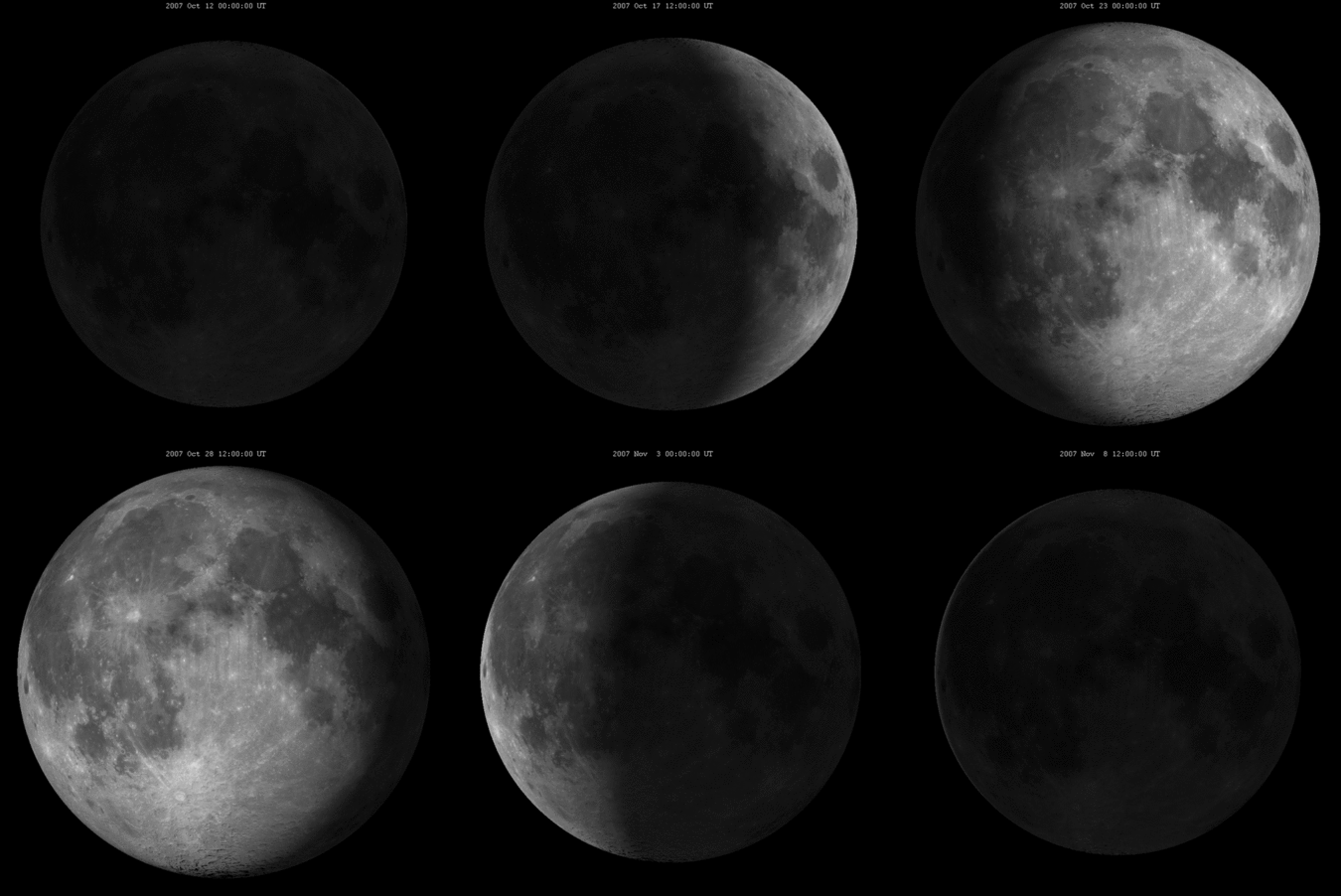
During the last lunar day the Blue Ghost Lander spend its time from little after sunrise until a little after sunset investigating the surface of the Moon at the lunar Sea of Crises or Mare Crisium. It wasn’t expected to survive the two-week-long night. It wasn’t expected to because it had no internal heating and at night the temperatures on the Moon can drop to down to minus 208° F, or a little bit more on the night side. During the day the temperature gets up to 250° which is pretty hot for some of the electronics. But what really kills a Lander is at night where they can’t recharge the batteries and the batteries drop in temperature to 200° below zero for two weeks. They generally do not survive.
The astronomical event times given are for the Traverse City/Interlochen area of Michigan (EDT, UT – 4 hours). Times will be different for other locations.
Addendum
Ephemeris: 03/10/2025 – Aristarchus, the brightest spot on the Moon, but not tonight
This is Ephemeris for Monday, March 10th. Today the Sun will be up for 11 hours and 39 minutes, setting at 7:42, and it will rise tomorrow at 8:01. The Moon, 4 days before full, will set at 7:11 tomorrow morning.
The moon tonight is bright. The sunrise line or terminator on the moon is crossing the large gray plain called Oceanus Procellarum, the largest of the moon’s seas. These seas were figments of the first telescopic observer’s imagination. They are really huge impact basins into which interior lava flowed. On the left edge of the Moon, just below center, this evening, at the terminator is a small shadow filled crater that might be visible in binoculars, but definitely telescopes. It’s called Aristarchus. It is a fairly new crater, probably less than a billion years old. As a rule the brighter the crater the newer it is. Aristarchus is the brightest spot on the Moon, when it is full. Visual astronomers have seen hazes and bright spots on rare occasions in and near Aristarchus.
The astronomical event times given are for the Traverse City/Interlochen area of Michigan (EST, UT – 5 hours). Times will be different for other locations.
Addendum
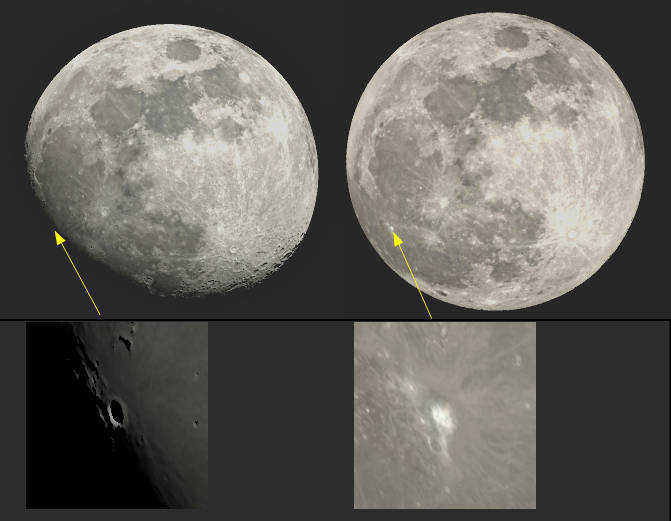
Aristarchus tonight, March 10, 2025, on the terminator (left), and Friday night, the 14th, before the total lunar eclipse starts. The enlargements show the telescopic view. Created using Stellarium, LibreOffice Draw and GIMP. The Moon doesn’t actually appear larger on the 14th. Apparently my field of view changed while getting the 14th’s image.
Ephemeris: 03/06/2025 – The Moon at first quarter
This is Ephemeris for Thursday, March 6th. Today the Sun will be up for 11 hours and 26 minutes, setting at 6:37, and it will rise tomorrow at 7:09. The Moon, at first quarter today, will set at 3:31 tomorrow morning.
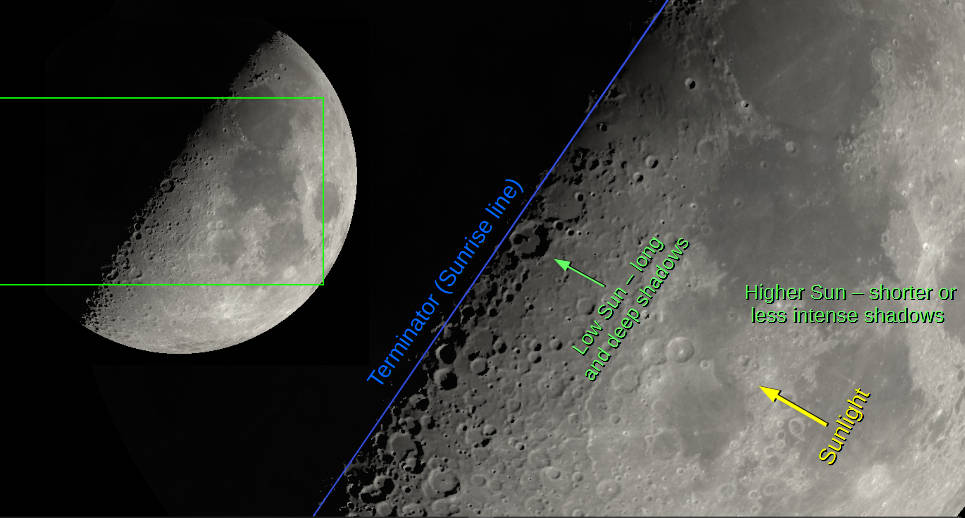
The Moon is indeed at first quarter today with the instant of being 90° from the Sun coming at 11:32 this morning. To me the first quarter moon is the best time to view because there are a lot of craters that are visible in deep shadow. The terminator, the sunrise line, on the Moon cuts the disk in half and a lot of craters can even be seen in binoculars. With a small telescope the jumble of craters provides a wonderful view of the destruction of the early bombardment of the Moon in its early days. The reason the Moon has all these craters and the Earth does not is the fact that the Earth has an active surface with volcanoes, plate tectonics, water and wind to erode and deform the surface. The Moon has really none of that.
The astronomical event times given are for the Traverse City/Interlochen area of Michigan (EST, UT – 5 hours). Times will be different for other locations.
Addendum

Ephemeris: 03/03/2025 – The Moon tonight
This is Bob Moler with Ephemeris for Monday, March 3rd. Today the Sun will be up for 11 hours and 17 minutes, setting at 6:33, and it will rise tomorrow at 7:14. The Moon, 3 days before first quarter, will set at 11:40 this evening.
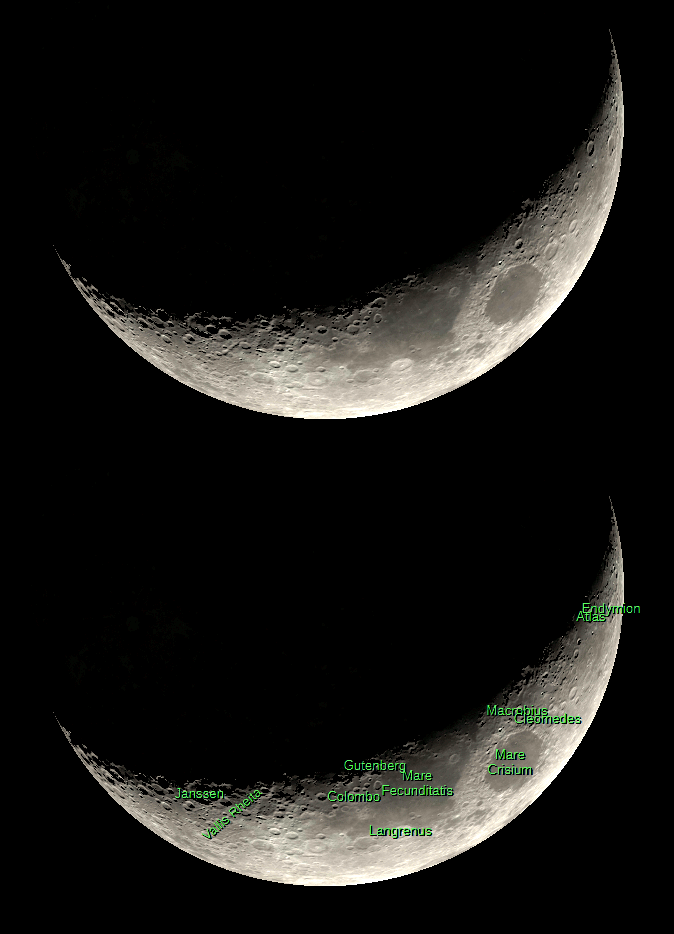
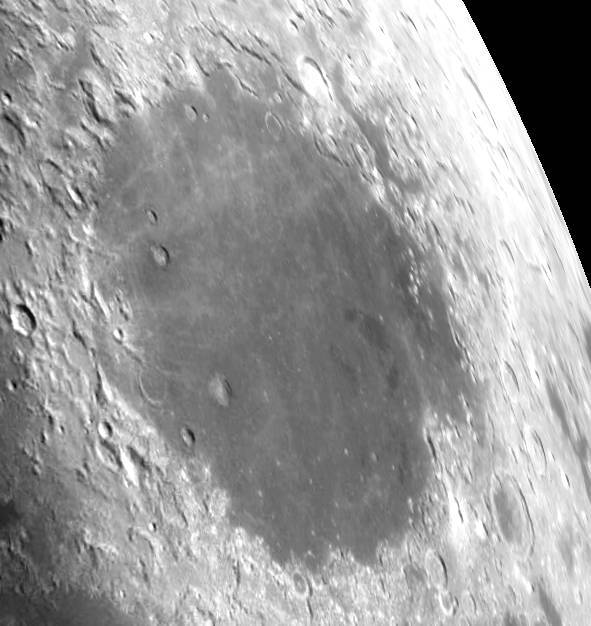
Tonight the moon will be four days old. The age of the moon is the number of days since the new moon which ranges from 1 to 28 or 29 for the lunar month. I usually don’t use that, being more concerned with the phase of the Moon so at the top of the program I give the moon’s relation to its new, quarter, or full phase. Being in its waxing crescent phase right now, the only features to the naked eye on the Moon besides the crescent itself are the dark Sea of Crises, Mare Crisium, target of Firefly Aerospace’s Blue Ghost Lander, and the larger Sea of Fruitfulness, Mare Fecunditatis. The Moon rotates about 1/28th the speed of the Earth, and it’s also smaller, about a quarter of the Earth’s diameter. So one would have to use a supersonic jet to fly around the Earth to keep up with the rotation, but on the Moon one could do that with the Apollo moon rover.
The astronomical event times given are for the Traverse City/Interlochen area of Michigan (EST, UT – 5 hours). Times will be different for other locations.
Addendum
Ephemeris: 02/10/2025 – How old are the features on the Moon?
This is Ephemeris for Monday, February 10th. Today the Sun will be up for 10 hours and 14 minutes, setting at 6:04, and it will rise tomorrow at 7:48. The Moon, 2 days before full, will set at 7:42 tomorrow morning.
In dating Moon rocks scientists get a range of dates from 4.6 to 3.3 billion years. An age of a rock is determined by the decay of a radioactive element one of which is uranium 238 decaying to lead 206. So the ratios of these two elements gives a date when a rock was last solidified. This clock is reset when a rock was last melted either by volcanism or by asteroid impact. It turns out that the rocks of the highlands, the lighter area on the Moon where most of the craters are, date to close to 4.5 billion years, and are probably the original crust of the Moon. The rocks from the lunar maria or seas are younger from about 4.1 billion years down to 3.8 billion years. So they were thought to be caused by asteroid impacts from the Late Heavy Bombardment.
The astronomical event times given are for the Traverse City/Interlochen area of Michigan (EST, UT – 5 hours). Times will be different for other locations.
Addendum
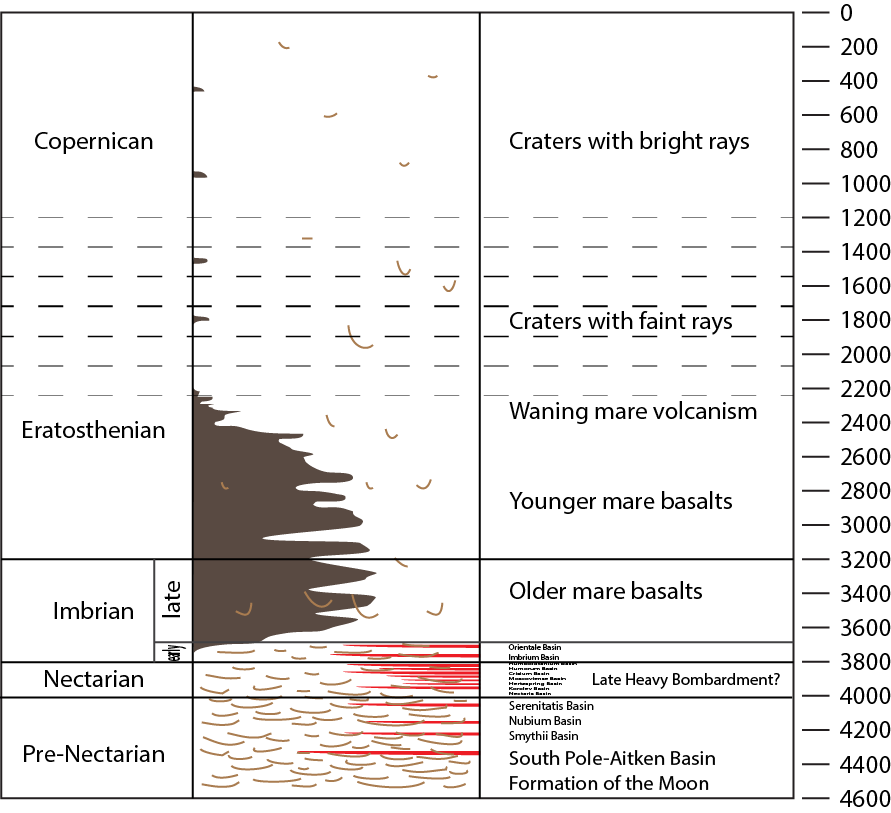
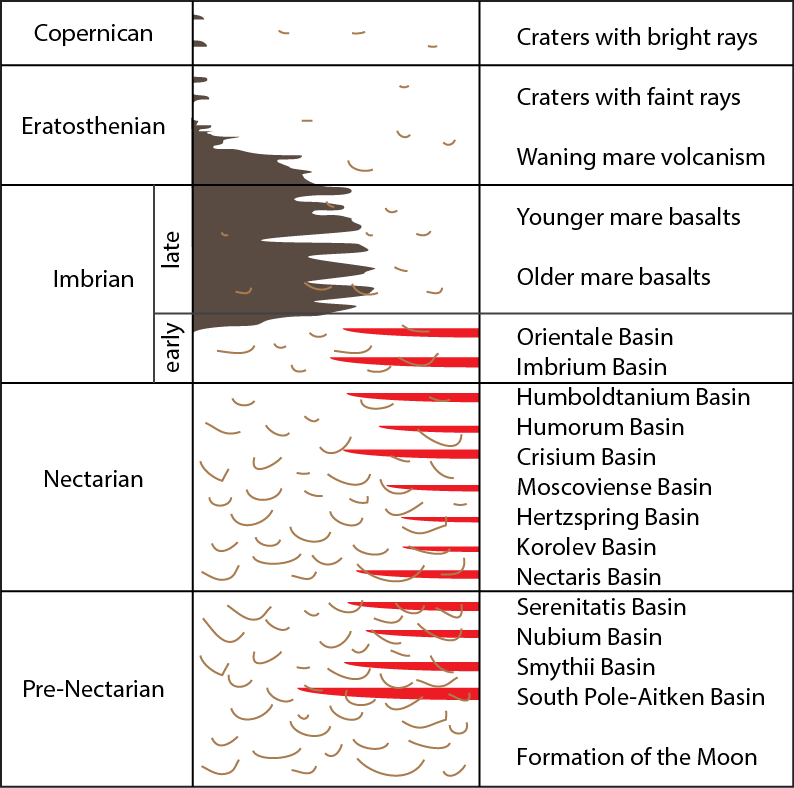
The Late Heavy Bombardment is not accepted by all planetary scientists. The main evidence is the cratering and maria on the Moon.
Ephemeris: 02/06/2025 – The Moon tonight, two days after first quarter
This is Ephemeris for Thursday, February 6th. Today the Sun will be up for 10 hours and 3 minutes, setting at 5:59, and it will rise tomorrow at 7:54. The Moon, 1 day past first quarter, will set at 4:30 tomorrow morning.
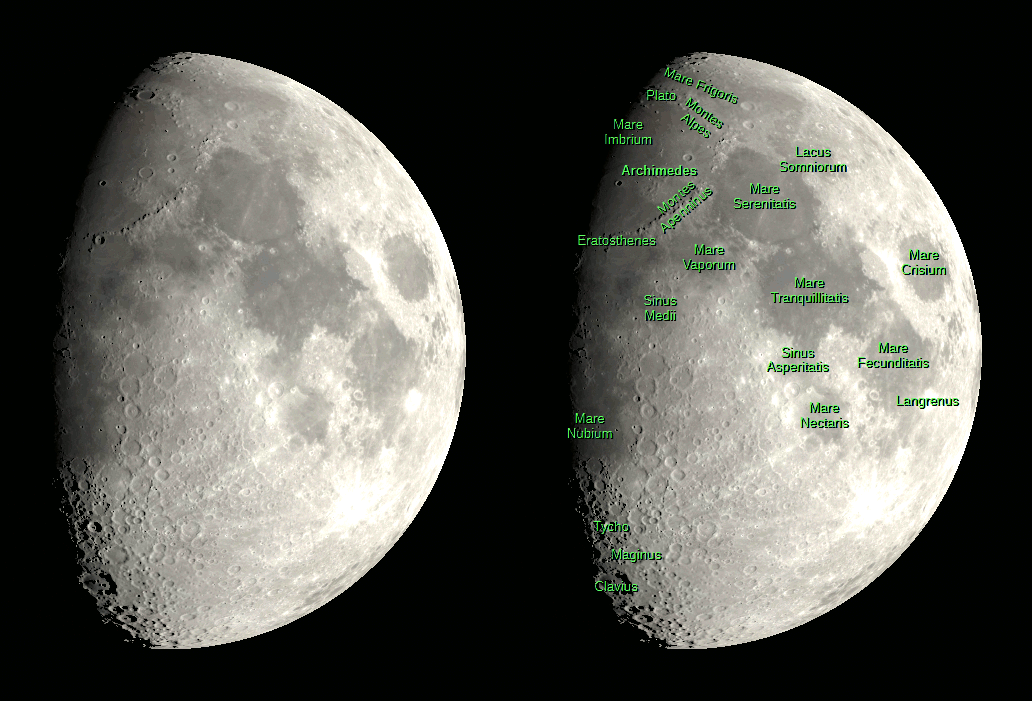
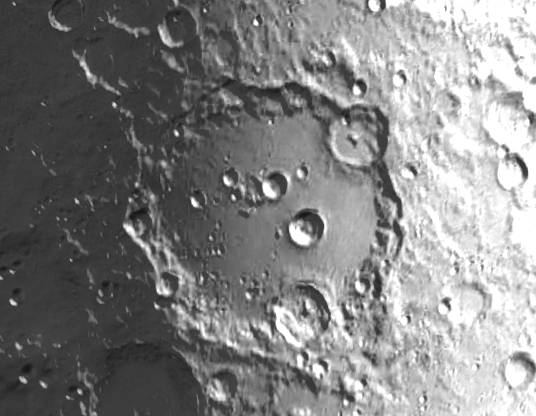
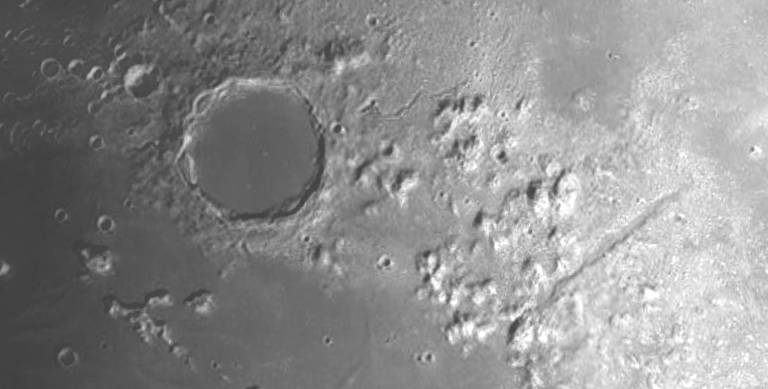
Tonight the moon will be about a day and a half past first quarter it is showing some very nice craters for the binoculars or small telescope. Near the south end of the moon near the terminator, the sunrise line, is the crater called Clavius which has an arc of several craters within it, each of decreasing size. North or above that is the sharp-edged crater called Tycho which, during a full moon, shows several long ejecta rays across the face of the Moon, but are almost invisible now. Near the top edge of the Moon the flat floored crater called Plato is seen by the edge of the large sea Mare Imbrium or Sea of Showers. A mountain range at the opposite side of Imbrium is called the Apennines Mountains.
The astronomical event times given are for the Traverse City/Interlochen area of Michigan (EST, UT – 5 hours). Times will be different for other locations.
Addendum
Ephemeris: 02/04/2025 – Two Moon landers currently en route
This is Bob Moler with Ephemeris for Tuesday, February 4th. Today the Sun will be up for 9 hours and 58 minutes, setting at 5:56, and it will rise tomorrow at 7:56. The Moon, 1 day before first quarter, will set at 1:55 tomorrow morning.
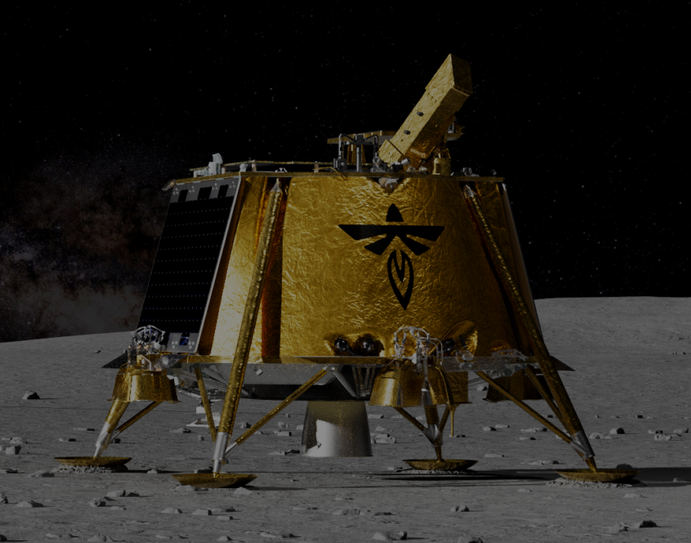
On January 15th a SpaceX Falcon 9 rocket launched 2 missions, at one time, to land on the Moon They will arrive at the Moon months apart. The first to attempt to land is Firefly’s Blue Ghost Lander with a mission called Ghost Riders in the Sky. It is currently spending about a month in Earth orbit before heading out to the Moon, which will take four days and spend another two weeks orbiting the Moon before attempting to land in the small area called Mare Crisium, the Sea of Crises. The second Lander by the Japanese company ispace, called Resilience, will take a more circuitous route to the moon, flying by it later this month and then coming back to the Moon several months later to enter orbit and then finally land on Mare Frigoris, the Cold Sea. So the two missions will not be active on the Moon at the same time.
The astronomical event times given are for the Traverse City/Interlochen area of Michigan (EST, UT – 5 hours). Times will be different for other locations.
Addendum

Ephemeris: 01/06/2025 – Things that go blink in the night
This is Ephemeris for Monday, January 6th. Today the Sun will be up for 8 hours and 58 minutes, setting at 5:18, and it will rise tomorrow at 8:19. The Moon, at first quarter today, will set at 1:26 tomorrow morning.
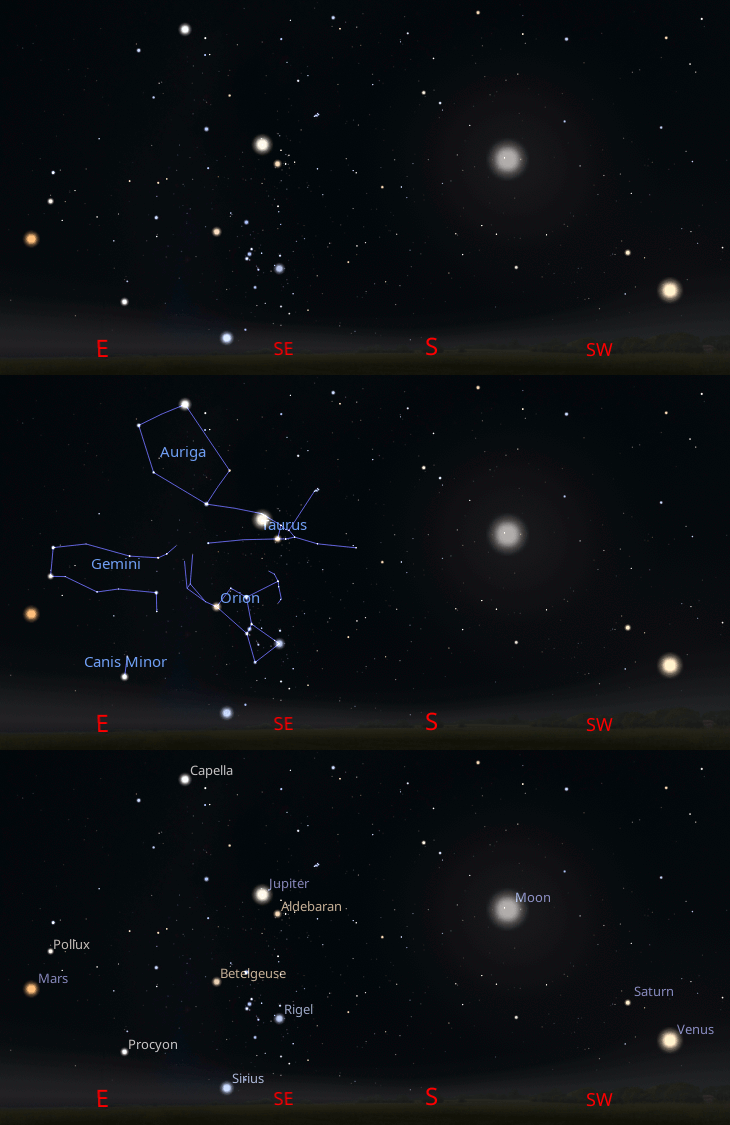
Lately there’s been a lot of reported observations of drones or various things in the sky at night, especially, for some reason, in New Jersey. If it’s something that’s moving in the sky other than satellites, meteors and aurorae, they’re out of my wheelhouse. I generally concern myself with the sidereal universe, the universe beyond the atmosphere. Things that don’t seem to move that rapidly. There are a lot of bright lights in the sky, that are things that I can and do talk about this time of year and this particular year. We have a lot of bright lights in the sky now, foremost Venus in the southwest in the early evening, and Jupiter in the east and the south. Mars is also up, but it’s not in competition with Jupiter this year. These plus the bright winter stars.
The astronomical event times given are for the Traverse City/Interlochen area of Michigan (EST, UT – 5 hours). Times will be different for other locations.
Addendum
Ephemeris: 11/08/2024 – The Jade Rabbit on the Moon
This is Bob Moler with Ephemeris for Friday, November 8th. Today the Sun will be up for 9 hours and 50 minutes, setting at 5:21, and it will rise tomorrow at 7:32. The Moon, 1 day before first quarter, will set at 11:24 this evening.
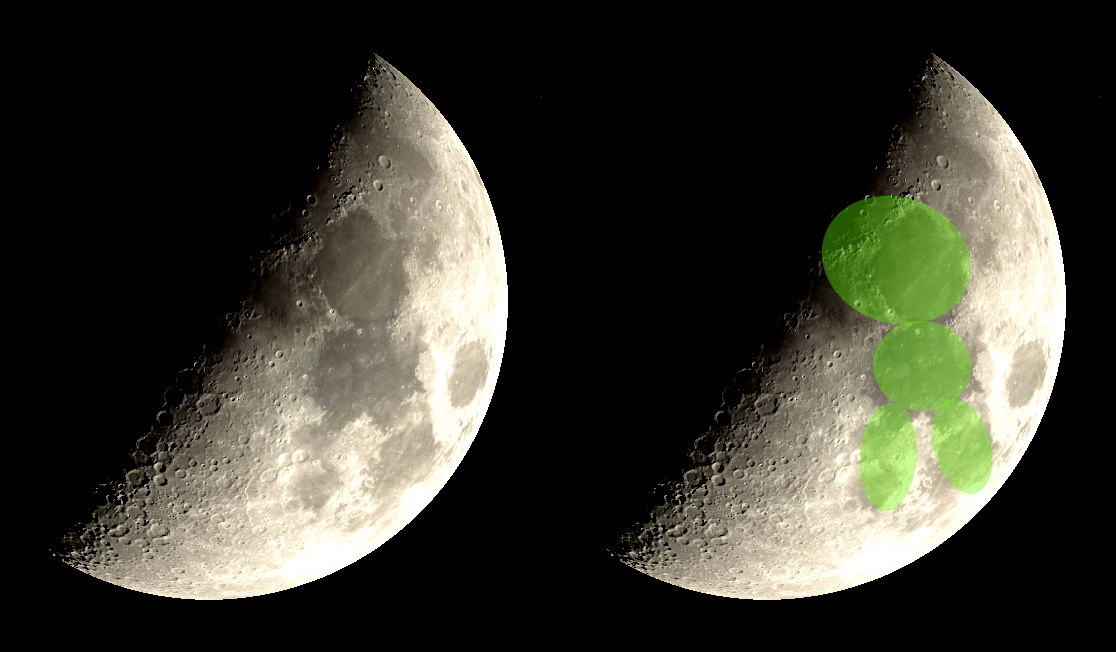
Tonight’s Moon is just a few hours before the instant of first quarter which is officially at 12:56 tomorrow morning. The ancient Chinese saw in the gray areas of the Moon, we call seas, a rabbit, a pet of Chinese moon goddess Chang’e, its name was Yutu. These have become the names of the Chinese lunar landers and rovers. The top half of that rabbit is visible in the gray areas called maria, or seas. Early telescopic astronomers thought they were actually water filled basins. It turned out to be lava plains, actually floors of huge craters, from asteroids that hit the Moon 4 billion years ago during the late heavy bombardment. The top body of the rabbit is at the top part of the moon it descends to the lower right with his head and ears. The rabbit is also known as the Jade Rabbit. The rest of him is visible when the moon is full. Yutu has a real presence on the Moon, as the names of the two Chinese rovers that landed on the Moon.
The astronomical event times given are for the Traverse City/Interlochen area of Michigan (EST, UT – 5 hours). Times will be different for other locations.
Addendum
Ephemeris: 11/07/2024 – The Moon wobbles from Earth’s point of view
This is Ephemeris for Thursday, November 7th. Today the Sun will be up for 9 hours and 53 minutes, setting at 5:22, and it will rise tomorrow at 7:31. The Moon, 2 days before first quarter, will set at 10:08 this evening.
The nearly seven day old Moon appears very low in the southwestern sky tonight. It appears as a fat crescent. The small sea called Mare Crisium or Sea of Crises, near the west edge of the Moon is a good indicator of what we call libration, that is the Moon’s slow wobbling back and forth over the month as it orbits the Earth. One can judge the amount of libration by the distance of that small round sea from the edge of the Moon. This happens because the Moon’s rotation is steady while its orbital velocity around the Earth is not, because its orbit is slightly elliptical. So sometimes the rotation gets ahead of its revolution about the Earth, and sometimes it’s behind. Right now that libration is pushing that small sea towards the edge of the Moon.
The astronomical event times given are for the Traverse City/Interlochen area of Michigan (EST, UT – 5 hours). Times will be different for other locations.
Addendum