Archive
02/17/2014 – Ephemeris – Viewing tonight’s waning gibbous moon
Ephemeris for President’s Day, Monday, February 17th. The sun will rise at 7:39. It’ll be up for 10 hours and 34 minutes, setting at 6:13. The Moon, 3 days past full, will rise at 9:17 this evening.
The bright Moon is now a waning gibbous phase, The right edge of the Moon is now in night as the sunset terminator slowly advances across the moon. Tonight the Sea of Fertility is half in daylight on the right side of the Moon. A telescope looking at it can spot the double crater of Messier and Messier A, a funny impact where the small asteroid skipped producing two craters and a double ray of ejecta. On the other side of the moon the largest sea Oceanus Procellarum, or Ocean of Storms can be seen in its entirety to the left limb of the moon. It happens that the moon is rotated toward us on that side, an effect called libration. The effect is due to the moon’s uneven velocity around the earth.
Times are for the Traverse City/Interlochen area of Michigan. They may be different for your location.
Addendum
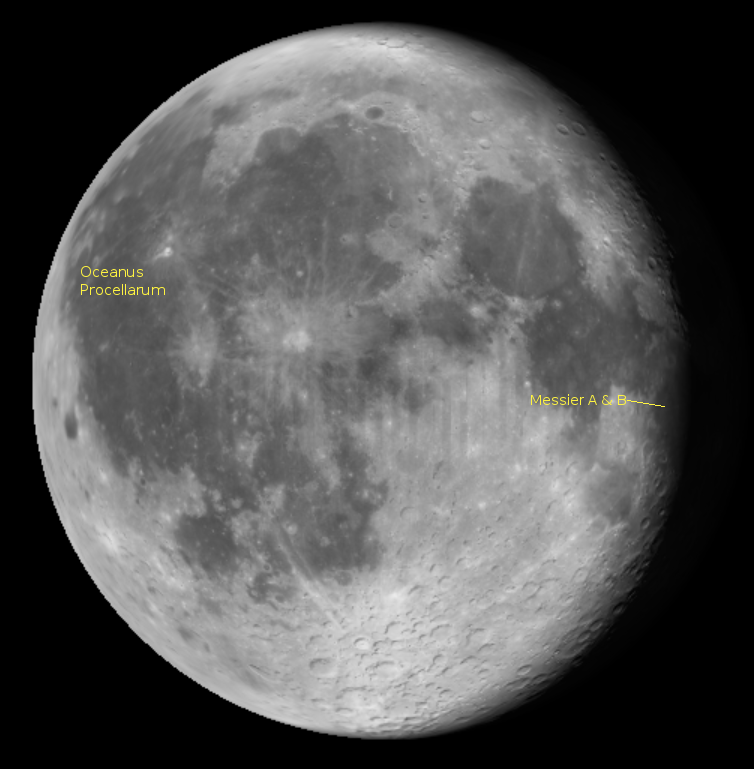
The moon at 9 p.m. on February 17, 2014 showing Oceanus Procellarum and the craters Messier A and B. Created using Virtual Moon Atlas.
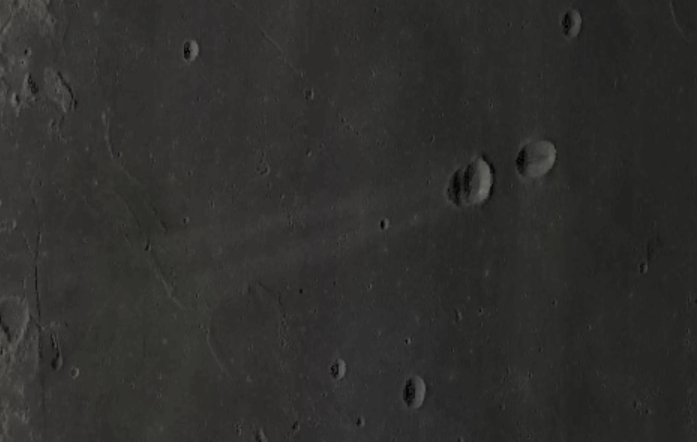
Closeup of the craters Messier A and B showing their twin rays. Created using Virtual Moon Atlas and the Lunar Reconnaissance Orbiter images. Credit: NASA.
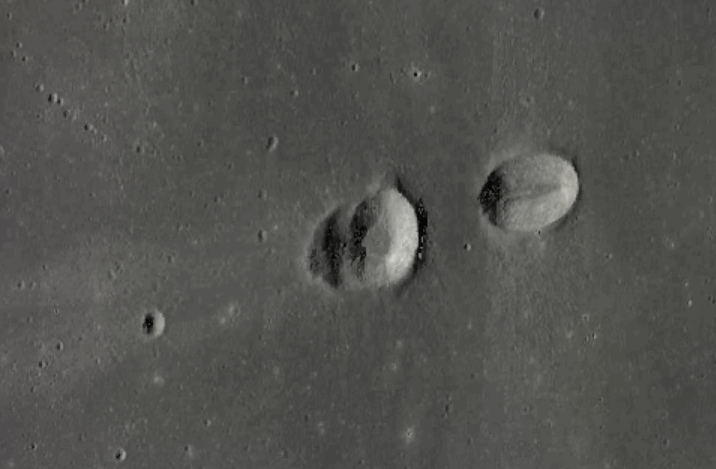
Extreme closeup of the craters Messier A and B showing their twin rays. Created using Virtual Moon Atlas and the Lunar Reconnaissance Orbiter images. Credit: NASA.
02/14/2014 – Ephemeris – This full moon is a bit too cold for lovers.
Ephemeris for St Valentine’s Day, Friday, February 14th. The sun will rise at 7:44. It’ll be up for 10 hours and 25 minutes, setting at 6:09. The Moon, at full today, will rise at 6:15 this evening.
Tonight’s full moon won’t be the type that young lovers would want to look up to because, well it’s February, and it’s cold. Let’s wait until June. But one can bundle up and get the telescope or binoculars out to view the face of our only natural satellite. Even though the actual reflectance is a bit less than 13% of the light that the sun sends its way. If it were snow covered it would really be bright. Looking at it with or without binoculars one can see the man in the moon face. At the bottom of the moon or bottom right as the moon rises is the splashiest crater of all, the crater Tycho. The crater itself seems to have a dark halo around it. Also one can see rays extending great distances across the moon from it.
Times are for the Traverse City/Interlochen area of Michigan. They may be different for your location.
Addendum
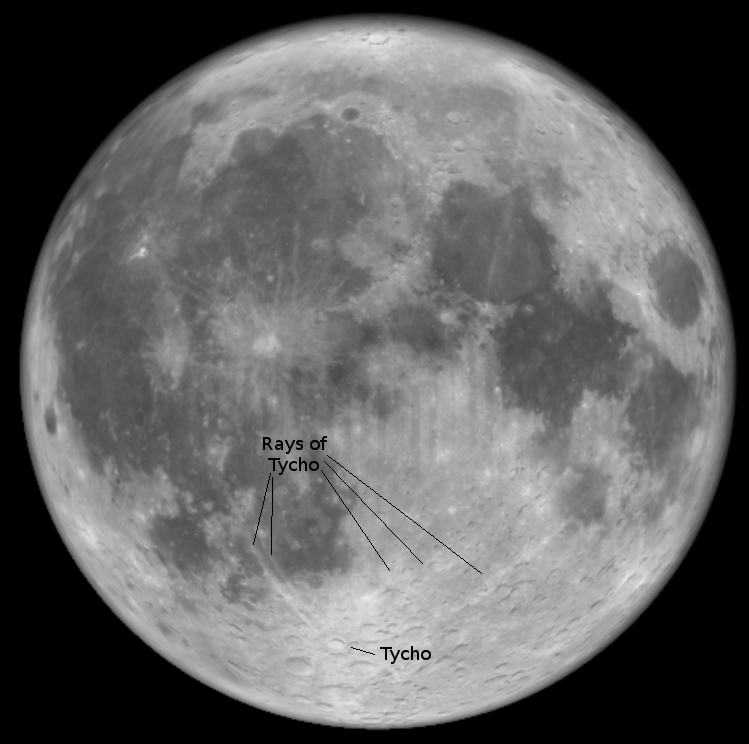
Tycho’s rays at full moon are actually secondary craters thrown by debris from the initial impact. At full moon they are no longer shadow filled so show as being bright. Image created using Virtual Moon Atlas.
02/12/2014 – Ephemeris – Where are the bright planets this week?
Ephemeris for Wednesday, February 12th. The sun will rise at 7:47. It’ll be up for 10 hours and 19 minutes, setting at 6:06. The Moon, 2 days before full, will set at 6:39 tomorrow morning.
Let’s take our weekly look at the planets. Jupiter will be in the southeastern sky as darkness falls tonight. It’s cruising against the stars of Gemini now. It will pass due south at 9:58 p.m., and will set at 5:41 a.m. in the west-northwest. The moon is seen where Cancer is tonight. Mars will rise at 11:17 p.m. in the east-southeast. Reddish Mars is in Virgo now and above and left of the bright star Spica, which it now outshines. Mars will pass due south at 4:49 a.m. Saturn will rise at 1:39 a.m. in the east-southeast. It’s seen against the stars of Libra the scales this year. Venus will rise at 5:21 tomorrow morning, and shines brightly in the southeast before sunrise. It’s in Sagittarius, above the Teapot asterism.
Times are for the Traverse City/Interlochen area of Michigan. They may be different for your location.
Addendum
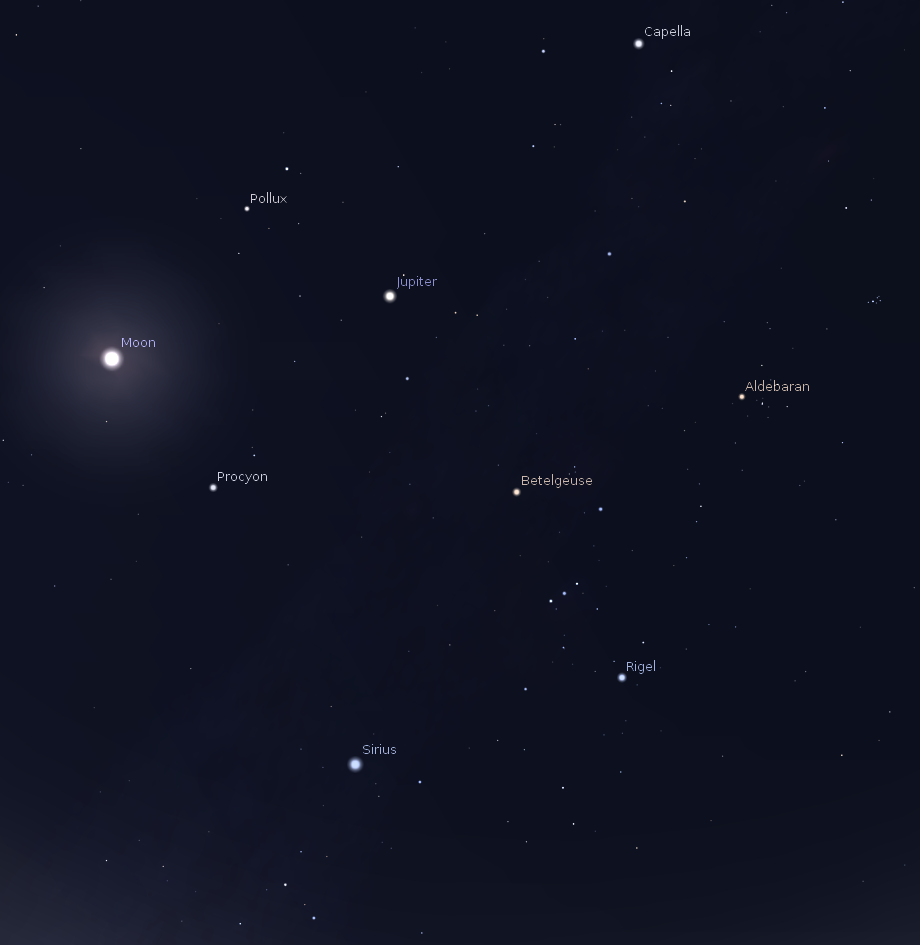
Jupiter, the Moon and the bright stars of winter at 9 p.m. February 12, 2014. Created using Stellarium.
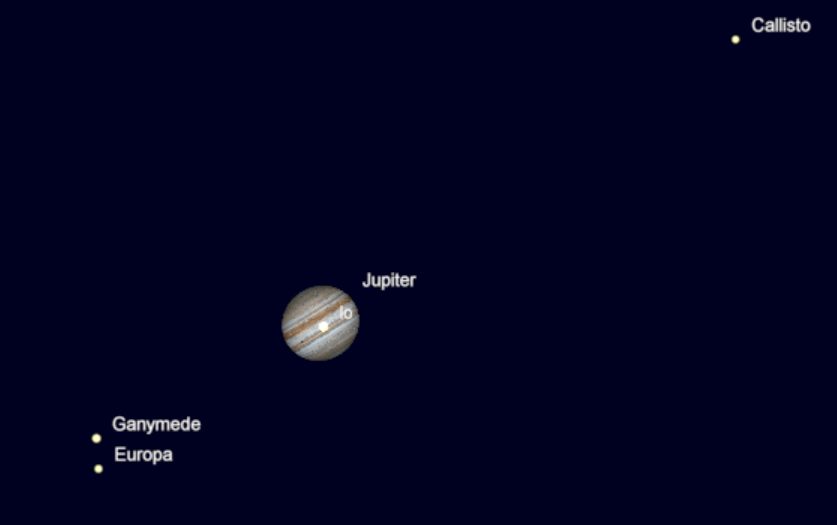
Jupiter at 9 p.m. on February 12, 2014. IO is pretty much invisible in front of the planet. Created using Cartes du Ciel.
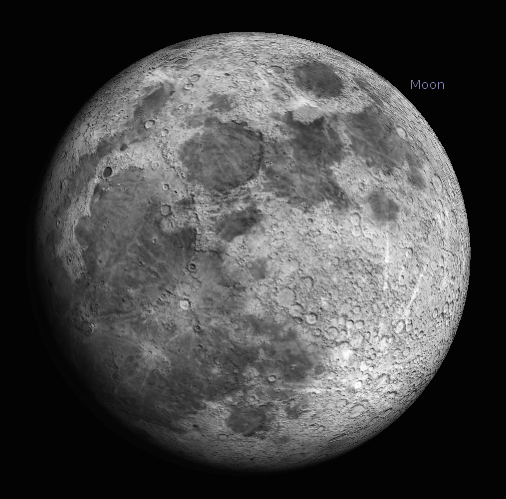
The Moon at 9 p.m. on February 12, 2014. Created using Stellarium.
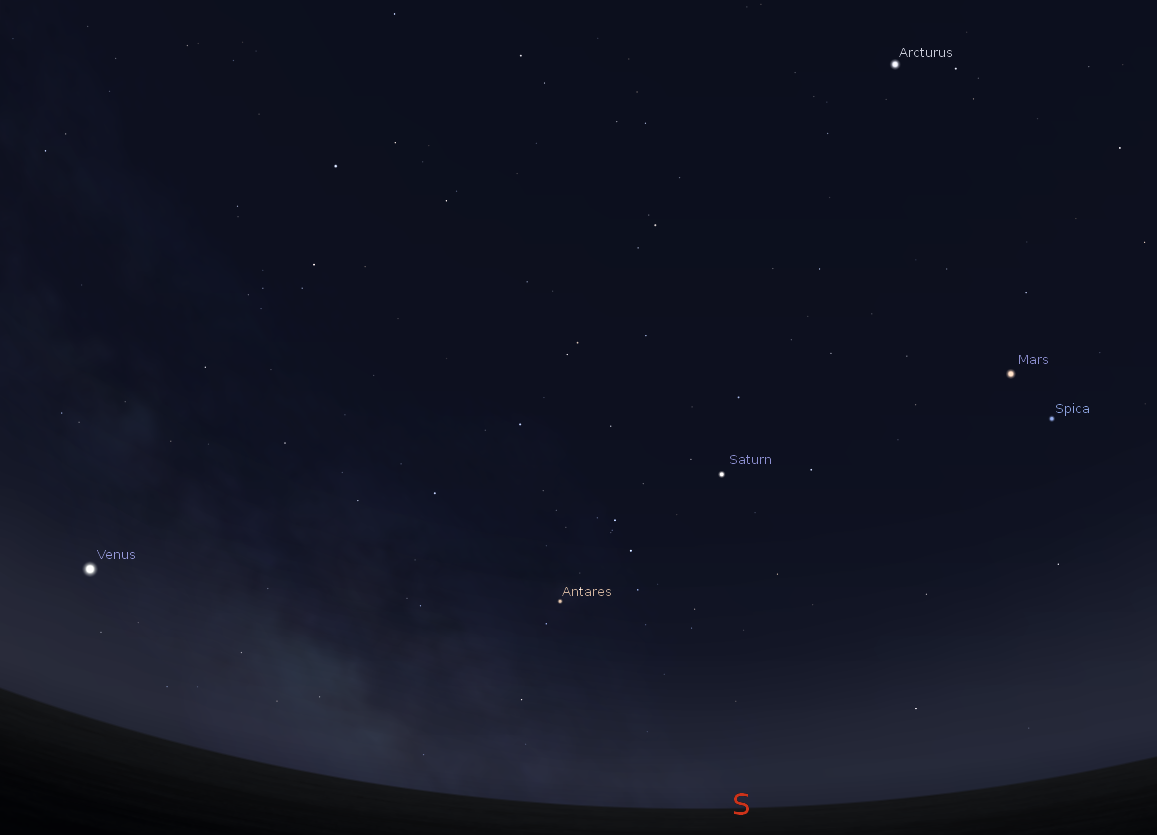
Mars, Saturn, and Venus at 6:30 a.m. February 13, 2014. Created using Stellarium.
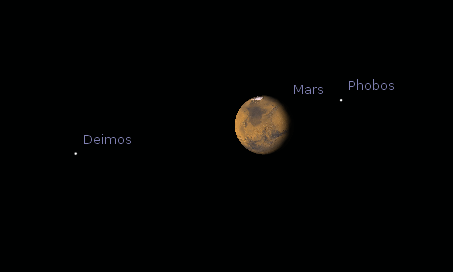
Tiny Mars in a telescope at 6:30 a.m. on February 13, 2014. Don’t expect to see it’s satellites Phobos and Deimos. Created using Stellarium.
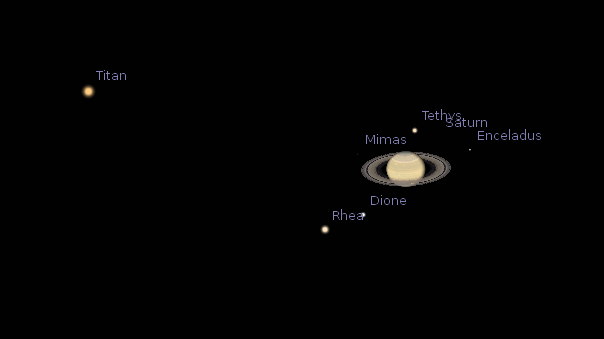
Saturn and its moons at 6:30, February 13, 2014. Of the moons, Titan will be the only one visible in small telescopes. Created using Stellarium.
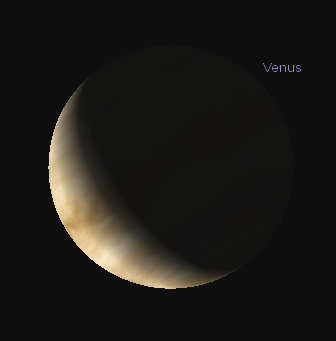
Venus through a telescope. The planet is getting smaller and its crescent is getting fatter as it moves away from the Earth. This image is for 6:30 a.m. February 13, 2014.Created using Stellarium.
02/11/2014 – Ephemeris – The brightest spot on the moon is visible tonight
Ephemeris for Tuesday, February 11th. The sun will rise at 7:48. It’ll be up for 10 hours and 17 minutes, setting at 6:05. The Moon, 3 days before full, will set at 6:06 tomorrow morning.
The moon tonight is very bright. It will be full on Friday. Using binoculars the brightest object on the moon is a spot at the left edge of the moon that rotates to the upper left as the moon rises. It is the young crater Aristarchus. The age is less than 1.1 billion years. How much younger is unknown. It’s in the same age range as Copernicus to the lower right of it with the big round splash marks. In a telescope Aristarchus is a crater 24 miles (40 kilometers) in diameter. Generally, the fresher the crater the brighter it is. The Lunar Reconnaissance Orbiter has been in orbit of the moon for nearly four years. In that time it has discovered small craters that were formed after it arrived in orbit. The initial impacts drill into the moon’s lighter subsurface.
Times are for the Traverse City/Interlochen area of Michigan. They may be different for your location.
Addendum
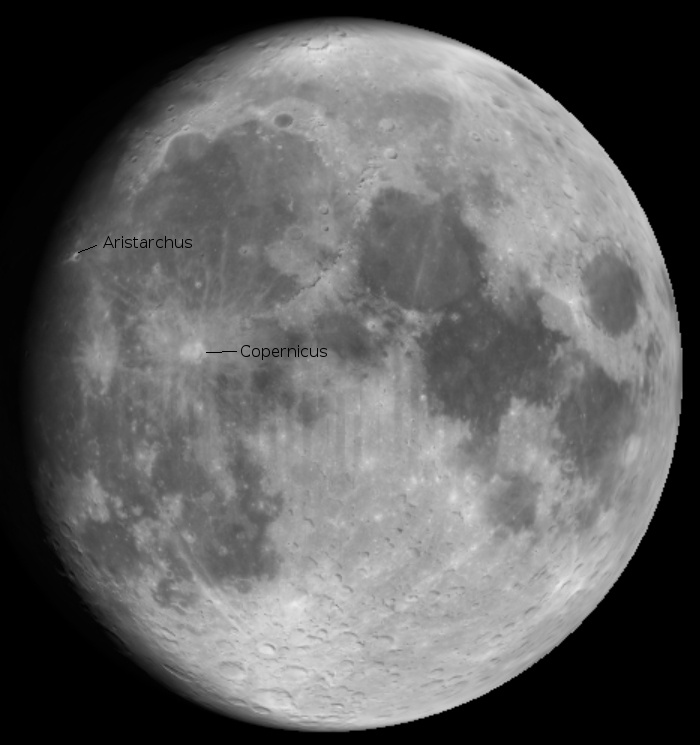
The Moon at 9 p.m. February 11, 2014 showing the craters Aristarchus and Copernicus. Created using Virtual Moon Atlas.
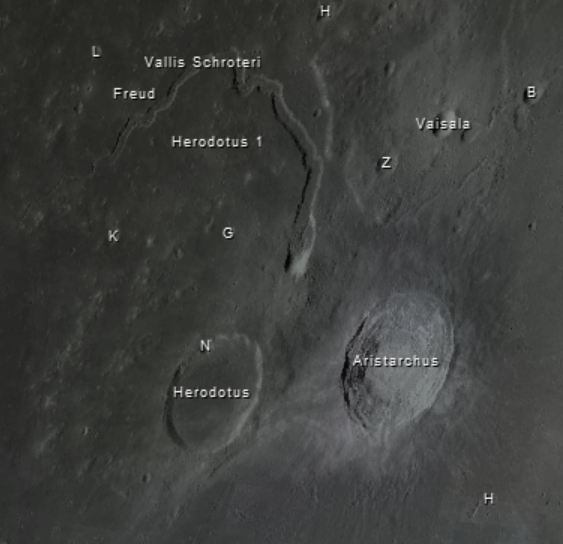
The crater Aristarchus and its environs via the Lunar Reconnaissance Orbiter as a texture in the Virtual Moon Atlas. Credit NASA.
Note the valley that borders Aristarchus, Vallis Schroteri, or Schroter’s Valley. It’s head is called the Cobra’s Head. It is up to a kilometer or 3,000 feet deep.
02/06/2014 – Ephemeris – The moon tonight and libration
Ephemeris for Thursday, February 6th. The sun will rise at 7:55. It’ll be up for 10 hours and 3 minutes, setting at 5:58. The Moon, at first quarter today, will set at 2:11 tomorrow morning.
The Moon, being at first quarter today, has the terminator or sunrise line cut the Moon in half tonight. In binoculars and telescopes the best detail is seen near the terminator where the shadows are longest. The farther one wanders with a telescope the flatter the terrain appears. There’s another effect that can be seen. It’s called libration where the Moon appears to slowly wobble during the month. This is mostly caused by the Moon’s very steady rotation countered by the fact that the Moon’s orbit is elliptical and gets ahead or behind the rotation. At the upper right of the Moon is the small Sea of Crises. That has rotated forward a bit revealing yet another sea at the edge of the Moon, Mare Marginis, the Margin or Border Sea.
Times are for the Traverse City/Interlochen area of Michigan. They may be different for your location.
Addendum
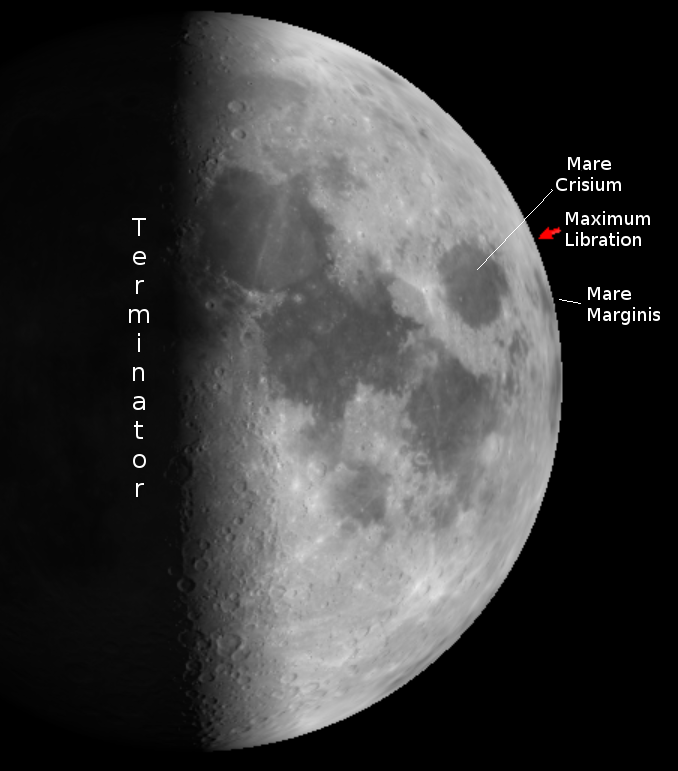
The Moon highlighting the Ephemeris topics at 9 p.m. on February 6, 2014. Created using Virtual Moon Atlas.
The Moon highlighting the Ephemeris topics at 9 p.m. on February 6, 2014. Created using Virtual Moon Atlas.
02/04/2014 – Ephemeris – Viewing the crescent moon tonight
Ephemeris for Tuesday, February 4th. The sun will rise at 7:57. It’ll be up for 9 hours and 57 minutes, setting at 5:55. The moon, 2 days before first quarter, will set at 12:05 tomorrow morning.
The Moon is now beginning to dominate the sky. In small telescopes one of my favorite craters is peeking into sunlight at the sunrise line, astronomers call it the terminator. This one is called Theophilus. Tonight it should be a ring of the circular ramparts lit by the sun as the evening progresses, in the center of which is the central peak just catching sunlight. Theophilus is at the edge of the small Sea of Nectar or Mare Nectaris. For those with small telescopes who want to learn more about how to use them the Grand Traverse Astronomical Society will host a Telescope Clinic at Northwestern Michigan College’s Rogers Observatory on Friday starting at 8 p.m. You can bring your telescope. It’s free, but for the star party the College requests a small donation.
Times are for the Traverse City/Interlochen area of Michigan. They may be different for your location.
Addendum
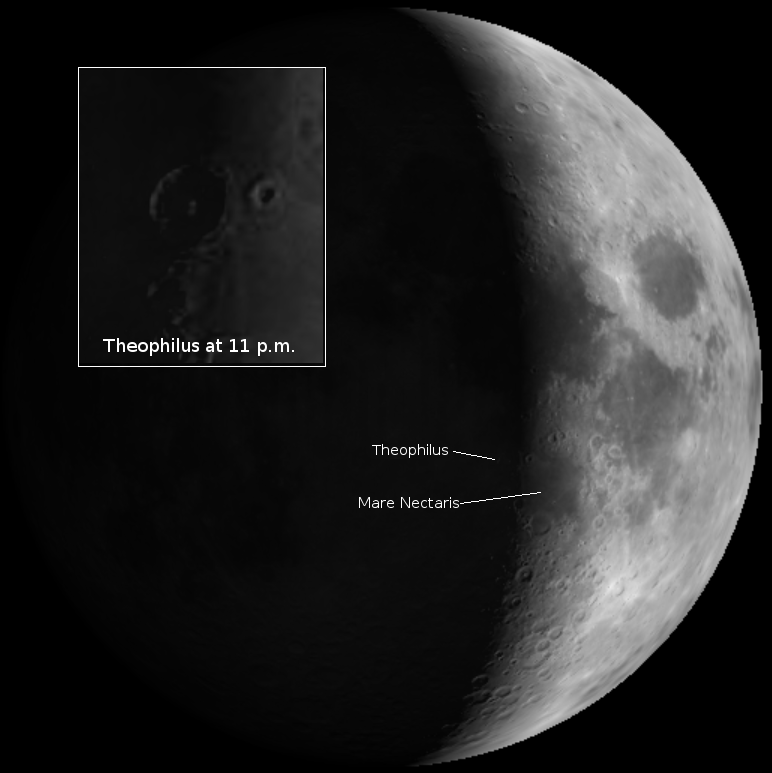
The Moon highlighting the crater Theophilus at 9 and 11 p.m. on February 4, 2014. Created using Virtual Moon Atlas.
01/17/2014 – Ephemeris – The Moon tonight
Ephemeris for Friday, January 17th. The sun will rise at 8:14. It’ll be up for 9 hours and 16 minutes, setting at 5:30. The moon, 2 days past full, will rise at 7:23 this evening. | Let’s take a look at the moon as it’s still dominates the evening sky. The terminator, now that it’s after full moon is the sunset line. It is just starting to encroach on the small distinctive sea at the moon’s upper right edge called the Sea of Crises or Mare Crisium. Where is is situated on the edge of the spherical moon it appears to be elongated north to south. However if you saw it from overhead it would actually be elongated somewhat east to west. On the terminator at the moon’s equator is a large crater called Langrenus with a central peak on the edge of the Sea of Fertility or Mare Fecunditatis, that should be an easy binocular and a great telescopic crater some 80 miles in diameter. The smallest ting you can see on the moon in a small telescope is 2 miles in diameter.
Times are for the Traverse City/Interlochen area of Michigan. They may be different for your location.
Addendum
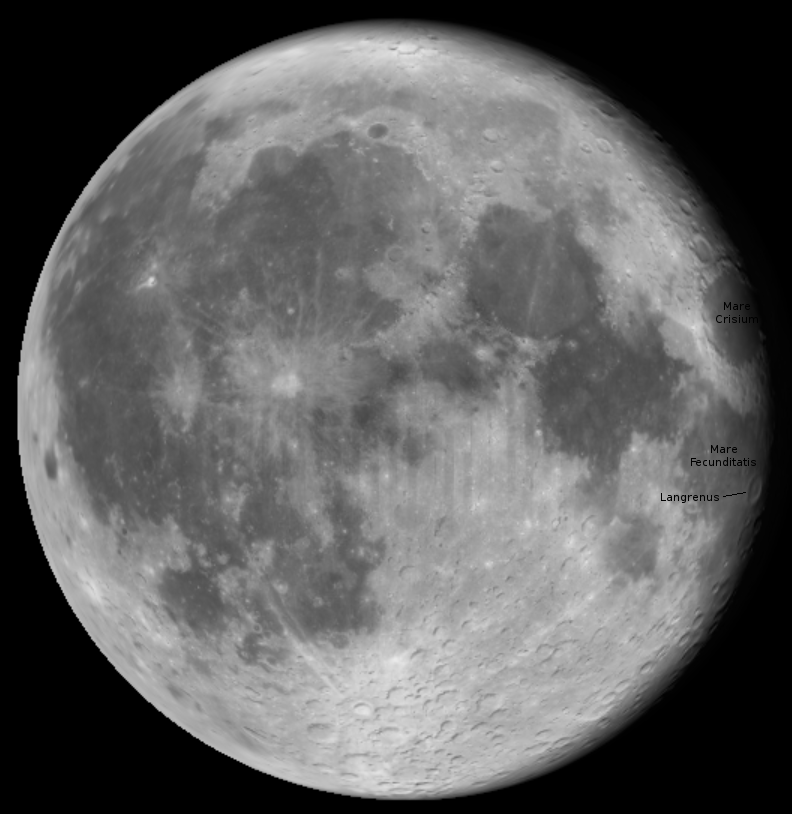
The Moon at 9 p.m., January 17, 2014. Created using Virtual Moon Atlas.
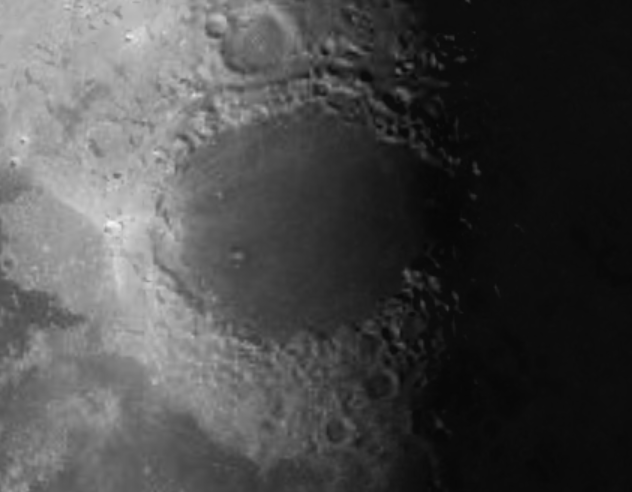
Mare Crisium as seen from overhead at 9 p.m., January 17, 2014. Created using Virtual Moon Atlas.
This last image cannot be seen without a spacecraft. The image was created using data from the Clementine spacecraft.
01/15/14 – Ephemeris – Where are the bright planets this week?
Ephemeris for Wednesday, January 15th. The sun will rise at 8:15. It’ll be up for 9 hours and 12 minutes, setting at 5:28. The moon, at full today, will rise at 5:28 this evening.
Let’s take our weekly look at the planets. The giant planet Jupiter is now alone in the evening sky. It will be in the eastern sky as darkness falls tonight. It’s cruising against the stars of Gemini now. It will pass due south at 12:05 a.m., and will set at 7:42 a.m. in the west northwest. Mars will rise at 12:28 a.m. in the east. Reddish Mars is in Virgo now and to the upper right of the bright star Spica by the three-quarters of the width of your fist held at arm’s length. Saturn will rise at 3:26 a.m. in the east southeast. It’s seen against Libra the scales this year. Venus will rise at 7:18 tomorrow morning, so it may become visible around 7:45 or so very low in the east southeast. It’s sudden appearance has caused come airport tower controllers to give it permission to land.
Times are for the Traverse City/Interlochen area of Michigan. They may be different for your location.
Addendum
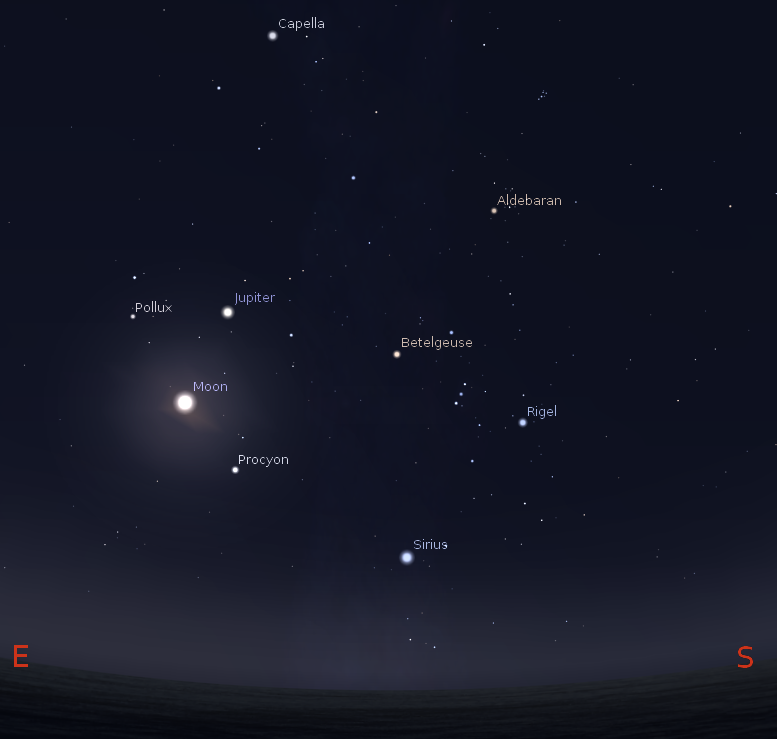
Jupiter, the Moon with the winter stars at 9 p.m. on January 15, 2014. Created using Stellarium.
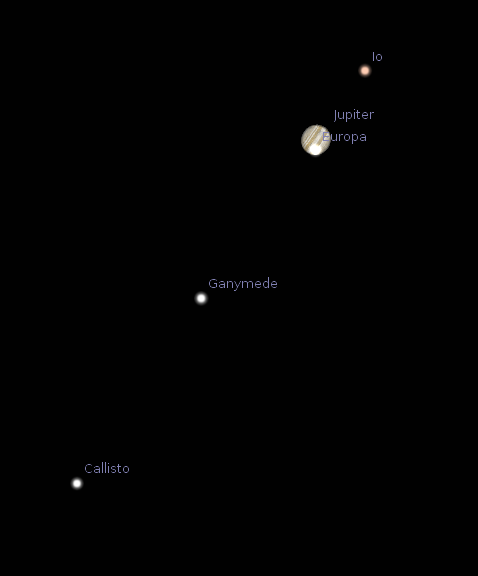
The telescopic Jupiter at 9 p.m. and January 15, 2014. The moon Europa is in front or transiting Jupiter. Created using Stellarium.
Europa, the smallest of the four Galilean satellites of Jupiter will transit the face of Jupiter tonight. It’s shadow will also cross that planet. The transit starts at 9:02 p.m. Stellarium is slightly off in that regard. Cartes du Ceil is better in that regard. Europa’s shadow starts to cross Jupiter at 9:33 p.m. Europa’s transit ends at 11:43 p.m., while it’s shadow leaves the face of Jupiter at 12:16 a.m. The source for these times is Project Pluto’s Jupiter Satellite Events page.
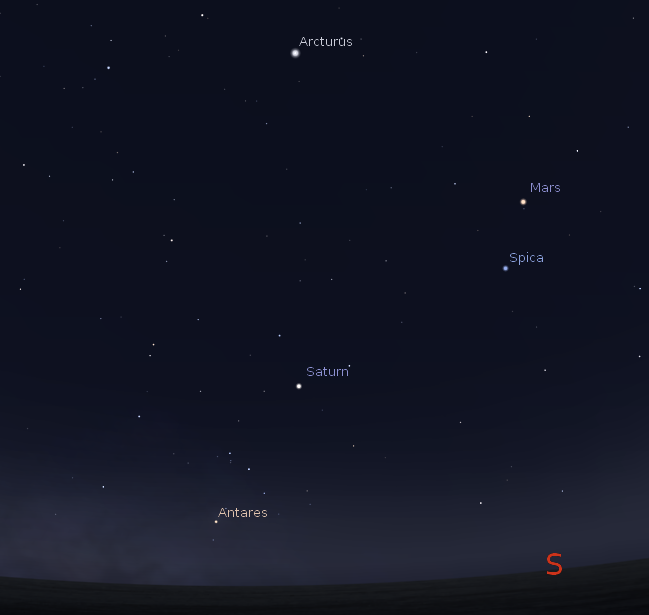
Mars and Saturn with the spring stars at 6:30 a.m. on January 16, 2014. Created using Stellarium.
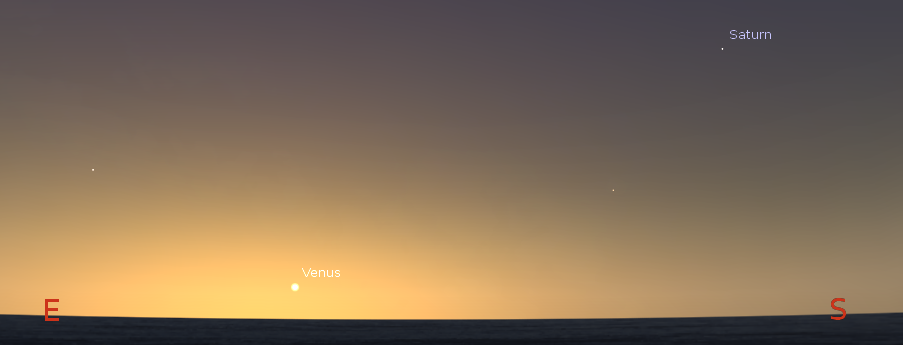
For the adventurous, Venus at 7:45 a.m. tomorrow morning January 16, 2014. Created using Stellarium.
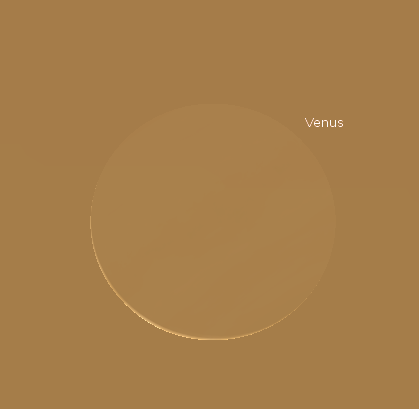
Venus as it might appear in a telescope at 7:45 a.m. tomorrow morning January 16, 2014. You will not see its night side, just the crescent. Created using Stellarium.
Want to see Venus closer to inferior conjunction? Check out Universe Today’s Virtual Star Party for January 12, 2014.
01/14/2014 – Ephemeris – The moon will appear to pass Jupiter tonight
Ephemeris for Tuesday, January 14th. The sun will rise at 8:16. It’ll be up for 9 hours and 10 minutes, setting at 5:27. The moon, 1 day before full, will set at 7:29 tomorrow morning.
The planet Jupiter will appear close to the nearly full moon this evening. The moon will pass about 10 of its diameters south of Jupiter around 1 a.m. tomorrow morning. Until then, Jupiter will appear to the left of the moon. This is a good time to view Jupiter with a small telescope. Even binoculars will detect a tiny disk and several of Jupiter’s satellites. Jupiter is a gas giant planet made primarily of hydrogen. The clouds contain methane and ammonia whipped into parallel bands by Jupiter’s rapid rotation of nearly 10 hours. The planet has a noticeable equatorial bulge, which is accentuated visually by its horizontal cloud bands. Jupiter’s equatorial diameter is 89,000 miles [143,000 km], 11 times that of the earth. [Jupiter’s volume could hold about 1,300 Earths, but its mass is only about 318 Earths. Jupiter is less dense than the Earth by a factor of four.]
Times are for the Traverse City/Interlochen area of Michigan. They may be different for your location.
Addendum
[Content in brackets was not included in the broadcast program due to time constraints.]
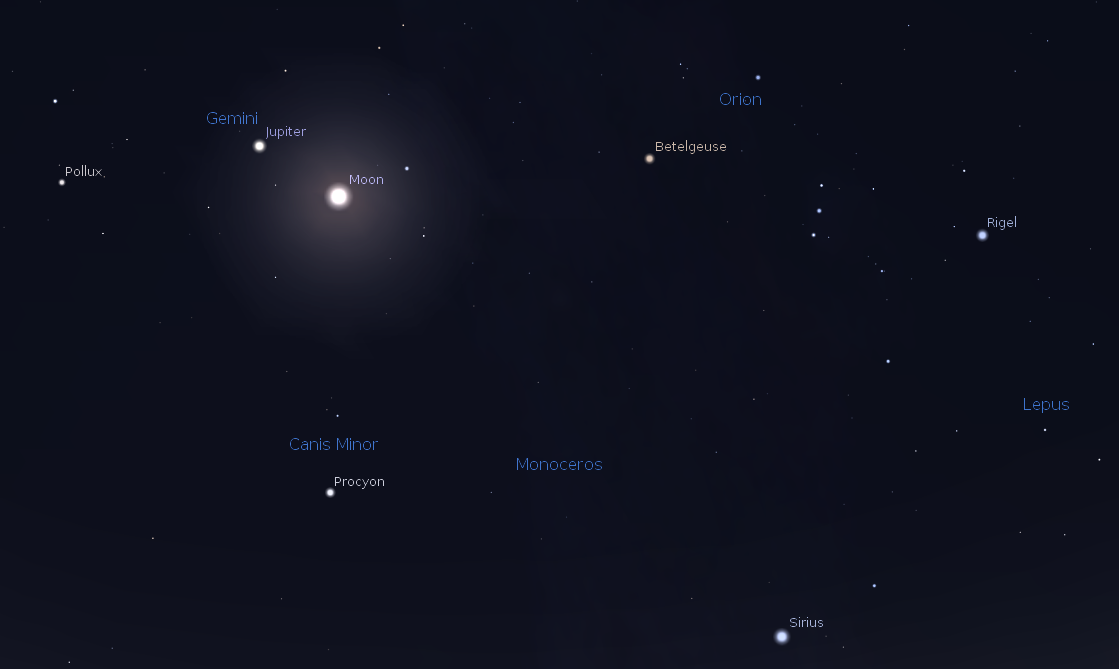
Jupiter, the Moon and the bright stars of winter at 9 p.m. on January 14, 2014. By 1 a.m. the Moon will have slipped to be directly below Jupiter. The Moon moves about its own diameter against the stars each hour. Created using Stellarium.
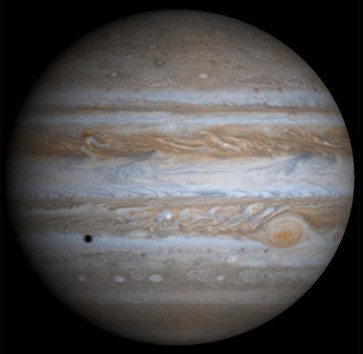
Jupiter as seen by the Cassini spacecraft as it passed by Jupiter gaining velocity on its way to Saturn. The black dot is the shadow of Europa. Credit: NASA/JPL – Caltech.
12/17/2013 – Ephemeris – The Chinese have landed a rover on the Moon
Ephemeris for Tuesday, December 17th. The sun will rise at 8:14. It’ll be up for 8 hours and 49 minutes, setting at 5:03. The moon, at full today, will rise at 5:45 this evening.
Over the weekend the Chinese landed a spacecraft on the moon with a rover. The spacecraft was Chang’E 3 and the third of their successful lunar spacecraft. Name after an ancient moon goddess it deposited a rover named Yutu, or Jade Rabbit named for the goddess’ pet rabbit. The aim point was to be the beautiful Bay of Rainbows or Sinus Iridium, but it landed just outside it in Mare Imbrium, the Sea of Showers. Some astronomers think that the actual landing spot is more interesting mineralogically speaking than the original aim point. Both Chang’E and Yutu are solar powered and it’s difficult to see them surviving the two-week lunar night, Night will fall on the site on December 25th or 26th. Give the Chinese credit though for a flawless landing.
Times are for the Traverse City/Interlochen area of Michigan. They may be different for your location.
Addendum

Chang’E 3 as seen from the Yutu rover. There’s a lot more pictures and information from Emily Lakdawalla’s Planetary Society Blog, where I got this picture link from.
 Bob Moler's Ephemeris Blog