Archive
05/05/2014 – Ephemeris – LADEE is no more but its mission goes on
Ephemeris for Monday, May 5th. The sun rises at 6:27. It’ll be up for 14 hours and 24 minutes, setting at 8:52. The moon, 1 day before first quarter, will set at 2:09 tomorrow morning.
The Lunar Atmosphere and Dust Environment Explorer or LADEE spacecraft that was in a close orbit of the moon to sniff out the Moon’s tenuous exosphere of gases and dust, augured into the moon’s far side April 17th as planned. This was just the end of the data acquisition phase of the mission. The data will be pored over for years to develop a picture of the lunar environment. This will aid lunar explorers to come both robotic and human. Something similar is happening to the Kepler mission to find transiting planets of other stars. The data gathering phase is over but there was an announcement a week or such ago of an earth sized planet in a stars habitable zone. Discoveries will go on for years.
Times are for the Traverse City/Interlochen area of Michigan. They may be different for your location.
Addendum
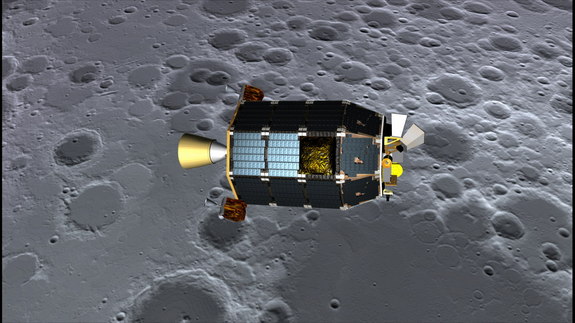
Artist’s depiction of LADEE in orbit of the Moon. Courtesy NASA.
More about the LADEE Mission is here.
04/24/2014 – Ephemeris – Venus and the Moon in the morning
Ephemeris for Thursday, April 24th. The sun rises at 6:43. It’ll be up for 13 hours and 55 minutes, setting at 8:38. The moon, 2 days past last quarter, will rise at 4:39 tomorrow morning.
The planet Venus will be hanging with the moon for the next two mornings. Tomorrow morning the crescent Moon will appear to the right and above Venus. The planet will rise at 5:13, though it should be high enough to spot by 5:30 or 5:45 a.m. in the east. Saturday morning the crescent moon will be to the left of Venus. The moon will be passing Venus about 5 p.m. tomorrow afternoon. Parts of Asia will get a good look at that. We’ll get before and after shots of it. Viewing the moon and planets near the sun is easy or hard depending on the season. For the best views its generally late winter and spring evenings and late summer and autumn mornings. It’s the wrong time of year for easy Venus viewing.
Times are for the Traverse City/Interlochen area of Michigan. They may be different for your location.
Addendum
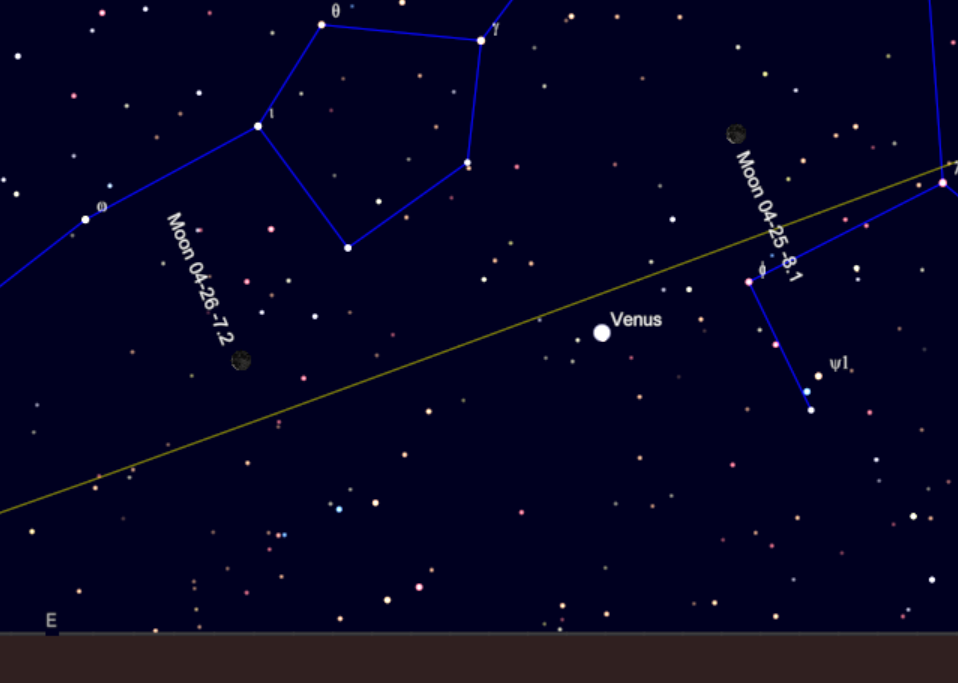
Venus and the Moon on two consecutive mornings 04/25/14 and 04/26/14 at 6 a.m. The yellow line is the ecliptic which is the path of the Sun in the sky. Created using Cartes du Ciel (Sky Charts).
04/07/2014 – Ephemeris – Why does the Moon have all those craters?
Ephemeris for Monday, April 7th. The sun will rise at 7:12. It’ll be up for 13 hours and 4 minutes, setting at 8:17. The Moon, at first quarter today, will set at 3:37 tomorrow morning.
Today the Moon is at first quarter. That moment in time actually occurred a couple of hours ago, so by tonight the Moon’s terminator, the sunrise line on the Moon will be slightly bowed to be a slight gibbous phase. With binoculars or small telescope it’s a fine time to spot craters and mountains near that terminator where the shadows are longest. On the Earth mountains are thrown up by the collision of tectonic plates or volcanoes. There are no tectonic plates as such on the Moon. Mountains that we recognize are the walls of the seas, which are really vast craters caused for the most part by collisions with small asteroids. The reason the Earth doesn’t carry those scars is that the Earth erodes and recycles its surface.
Times are for the Traverse City/Interlochen area of Michigan. They may be different for your location.
Addendum
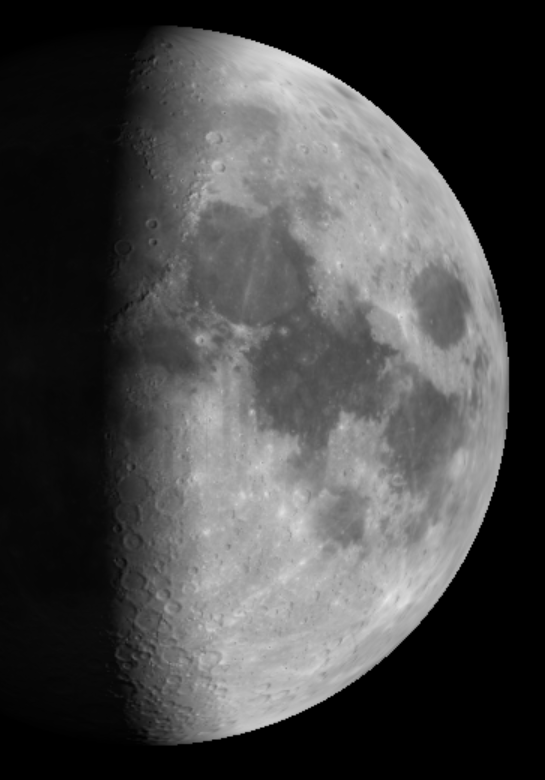
The Moon tonight (10 p.m. April 7, 2014). Created using Virtual Moon Atlas.
04/04/2014 – Ephemeris – Follow the Moon this weekend
Note: Sorry for the late post.
Ephemeris for Friday, April 4th. The sun will rise at 7:17. It’ll be up for 12 hours and 55 minutes, setting at 8:13. The Moon, 3 days before first quarter, will set at 1:32 tomorrow morning.
During this weekend the Moon will be slowly crossing the evening sky, approaching the planet Jupiter. Pay attention if you can to each night’s position and how its phase changes. It is moving farther from the sun in the sky, so we see it more and more illuminated by the sun. Sunday night it will draw even with Jupiter, with the planet some 10 moon widths north or above the Moon. It doesn’t seem at first thought that the Moon rotates, since we see the same face from the Earth all the time,. But the Moon does rotate, once a month. If it didn’t rotate we’d see all of it from our changing view of it over the month. The part of the Moon we can’t see from Earth is not the dark side, it is the far side which is fully illuminated at our new moon.
Times are for the Traverse City/Interlochen area of Michigan. They may be different for your location.
Addendum
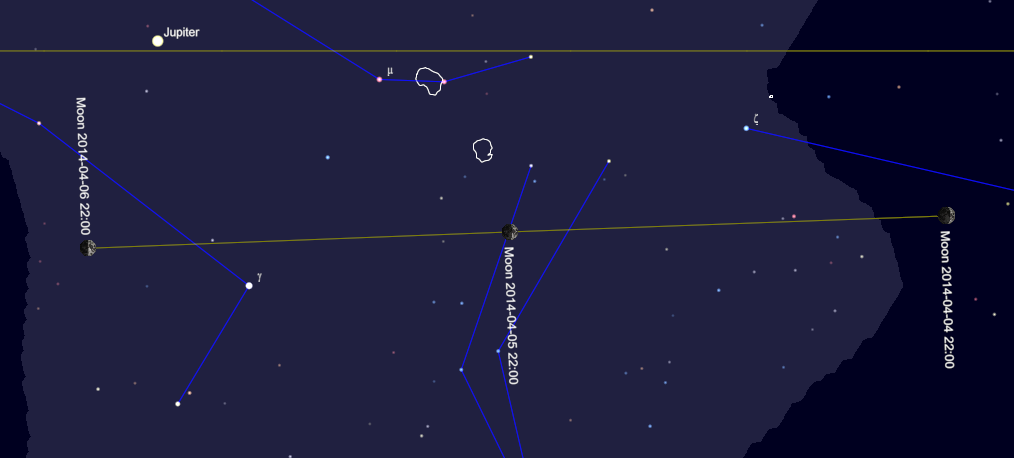
Motion and phase of the Moon for April 4, 5, and 6 2014. Created using Cartes duCiel (SkyCharts).
Click on image to enlarge. Yes, the moon is really that small.
04/02/2014 – Ephemeris – When it’s Wednesday it’s Planet Time!
Ephemeris for Wednesday, April 2nd. The sun will rise at 7:21. It’ll be up for 12 hours and 49 minutes, setting at 8:11. The Moon, 3 days past new, will set at 11:41 this evening.
Wednesday is Bright Planets Day here on Ephemeris. Jupiter will be in the south-southwestern sky as darkness falls tonight. It’s cruising against the stars of Gemini now, and moving slowly eastward after spending a couple of months backtracking to the west. It will set at 3:31 a.m. in the west-northwest. Reddish Mars is in Virgo now above and a bit left of the bright star Spica in the late evening, which it now outshines. Mars will rise at 8:39 p.m. It will pass due south at 2:18 a.m. It’s 58.6 million miles away now. Mars is 6 days from opposition and 12 days from closest approach this go round. Saturn will rise at 11:23 p.m. in the east-southeast and pass due south at 4:20 a.m.. It’s seen against the stars of Libra the scales this year. Venus will rise at 5:37 tomorrow morning and be seen in the southeast.
Times are for the Traverse City/Interlochen area of Michigan. They may be different for your location.
Addendum
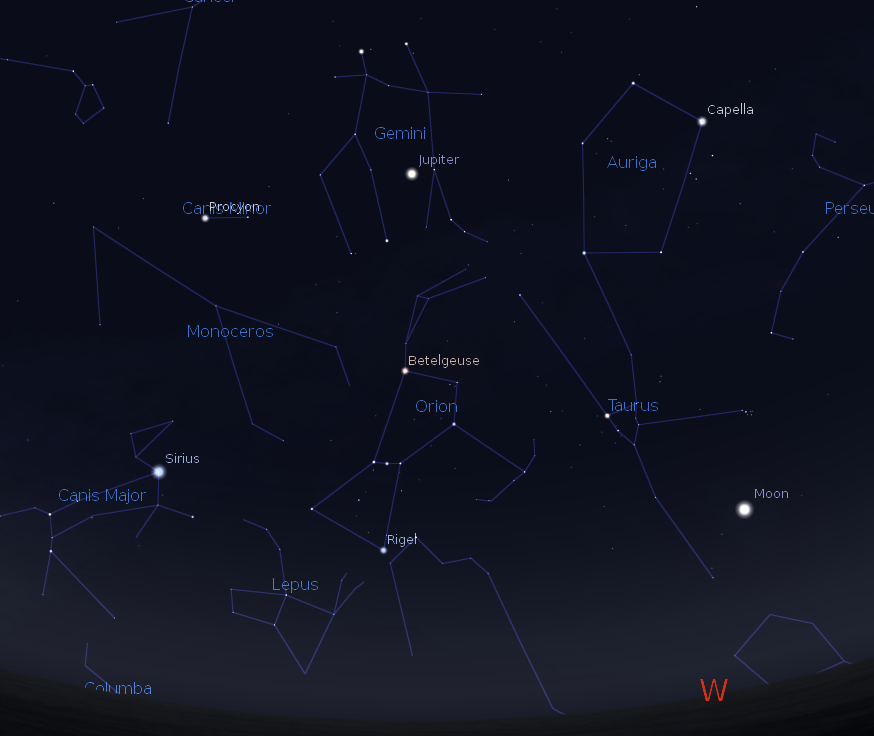
Jupiter, the Moon and the winter constellations at 10 p.m. on April 2, 2014. Created using Stellarium.
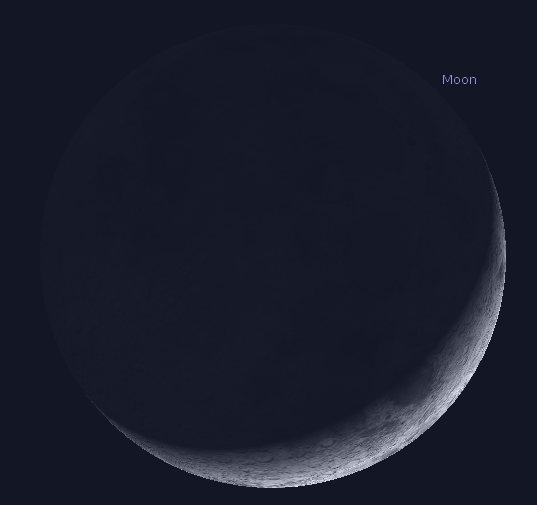
The Moon through a small telescope at 10 p.m. on April 2, 2014. Created using Stellarium.
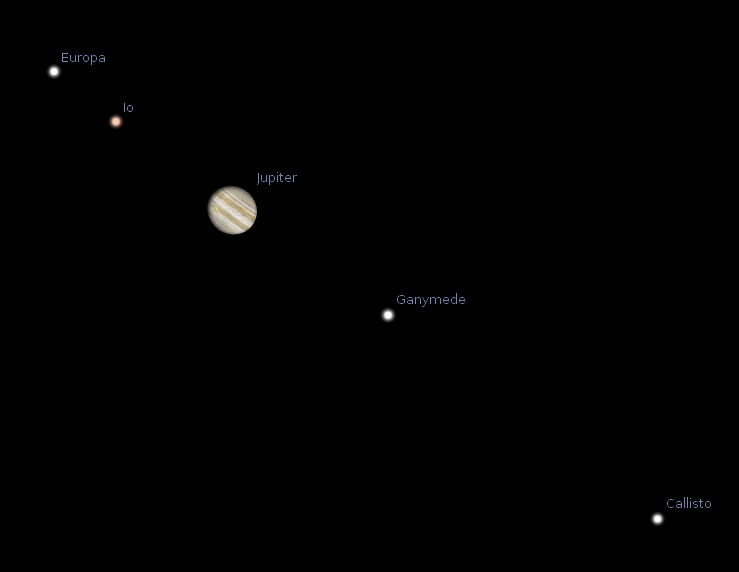
Jupiter and moons through a small telescope at 10 p.m. on April 2, 2014. Created using Stellarium.
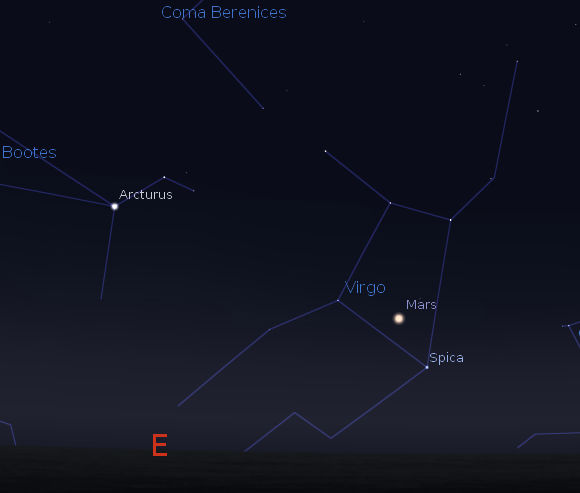
Mars rising at 10 p.m. on April 2, 2014. Created using Stellarium.
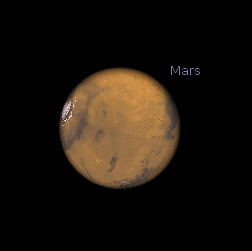
Mars through a telescope at 11 p.m. on April 2, 2014. Created using Stellarium.
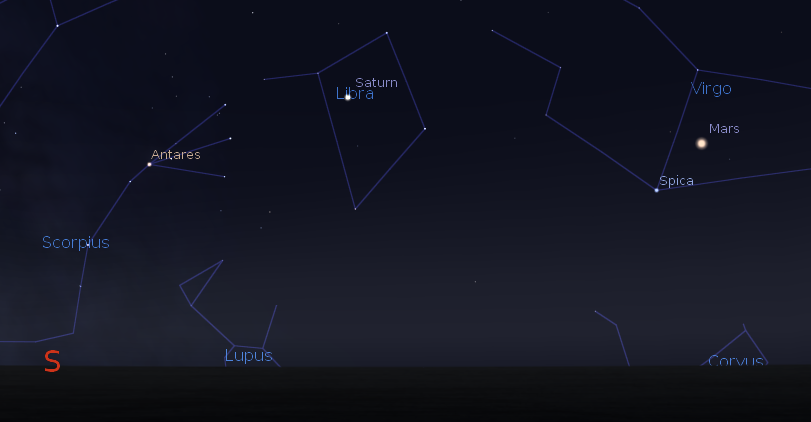
Mars and Saturn with some spring and summer constellations at 6 a.m. on April 3, 2014. Created using Stellarium.
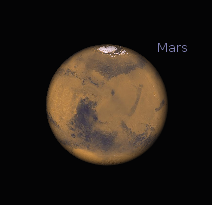
Mars through a telescope at 6 a.m. on April 3, 2014. Created using Stellarium.
In the morning Mars currently turns a more interesting face to us than in the evening. The big dark area on the lower left of Mars is Syrtis Major, which translates to the “Great Swamp”. I prefer the Latin. It is the most recognizable dark features on the planet. Where it appears on the face of Mars depends on the optical arrangement and eyepiece placement in your telescope.
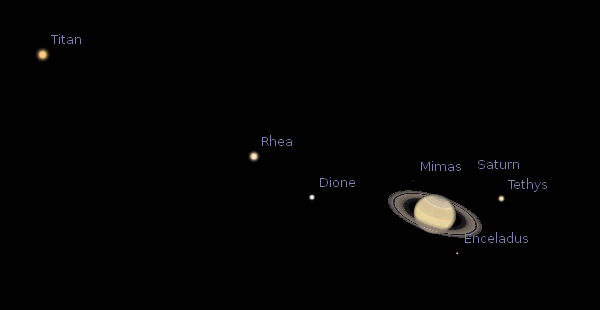
Saturn through a telescope at 6 a.m. on April 3, 2014. Created using Stellarium.
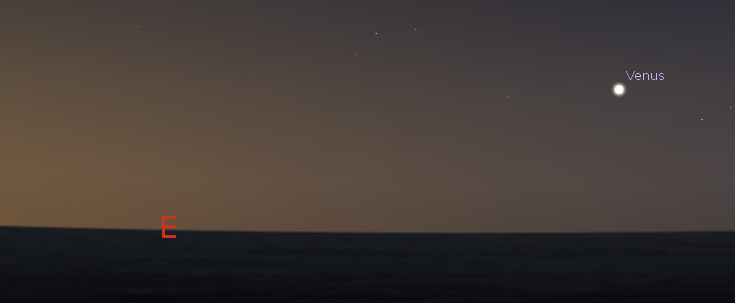
Venus in twilight at 6:30 a.m. on April 3, 2014. Created using Stellarium.
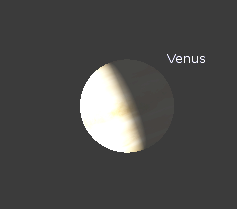
Venus through a telescope at 6:30 a.m. on April 3, 2014. Created using Stellarium.
03/11/2014 – Ephemeris – Observing the moon tonight: Bay of Rainbows and more
Ephemeris for Tuesday, March 11th. The sun will rise at 8:02. It’ll be up for 11 hours and 41 minutes, setting at 7:43. The moon, 4 days past first quarter, will set at 5:39 tomorrow morning.
The moon tonight is a pretty fat gibbous shape, with the sunrise line or terminator revealing the Bay of Rainbows, Sinus Iridium, that large half crater at the moon’s upper left edge, and the edge of the Sea of Showers, Mare Imbrium. In the figure of the man in the moon Imbrium is his big eye, kind of like the cartoon “Bill the Cat”. To the right of it, looking like a hole in a mountain chain, is Plato, whose dark floor is unmistakable even at full moon, when shadows are absent. The crater Copernicus is now beginning to be washed out as the morning shadows shrink. To the left of Copernicus, just catching the sun’s rays on the terminator, is the smaller crater Kepler. When the moon is full Kepler will show a fine ray system.
Times are for the Traverse City/Interlochen area of Michigan. They may be different for your location.
Addendum
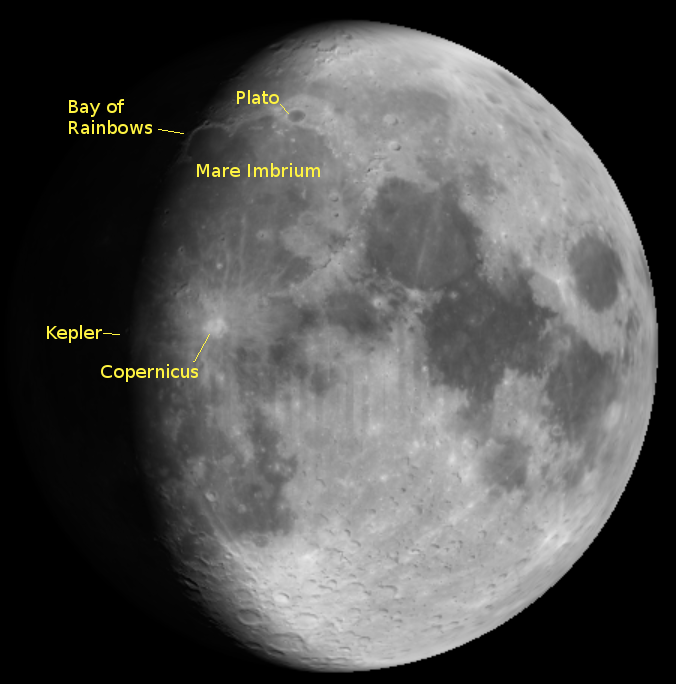
The Moon at 10 p.m. on March 11, 2014. Created using Virtual Moon Atlas.
Note for those not in the Eastern Daylight time zone. 10 p.m. is 2 hours March 12, 2014. If viewing before that time the terminator will be shifted to the right. After the terminator will be shifted to the left.
03/10/2014 – Ephemeris – Observing the Moon tonight and the crater Copernicus
Ephemeris for Monday, March 10th. The sun will rise at 8:03. It’ll be up for 11 hours and 38 minutes, setting at 7:42. The moon, 3 days past first quarter, will set at 5:04 tomorrow morning.
The moon has certainly changed appearance since I last talked about it last Thursday. It’s gone from a fat crescent to its gibbous phase. Gibbous by the way means hump-backed. Near the sunrise terminator can be seen the great crater Copernicus on the left side of the moon. This crater is 56 miles in diameter and the crater floor is two miles below the top of the crater rim. It has a three central peaks and the interior of the crater walls have slumped causing terracing. All these are easily seen with a small telescope. The crater has been dated to less than a billion years old, and it has a spray of ejecta around it that is roughly circular and can best be seen at full moon when the crater is washed out due to lack of shadows.
Times are for the Traverse City/Interlochen area of Michigan. They may be different for your location.
Addendum
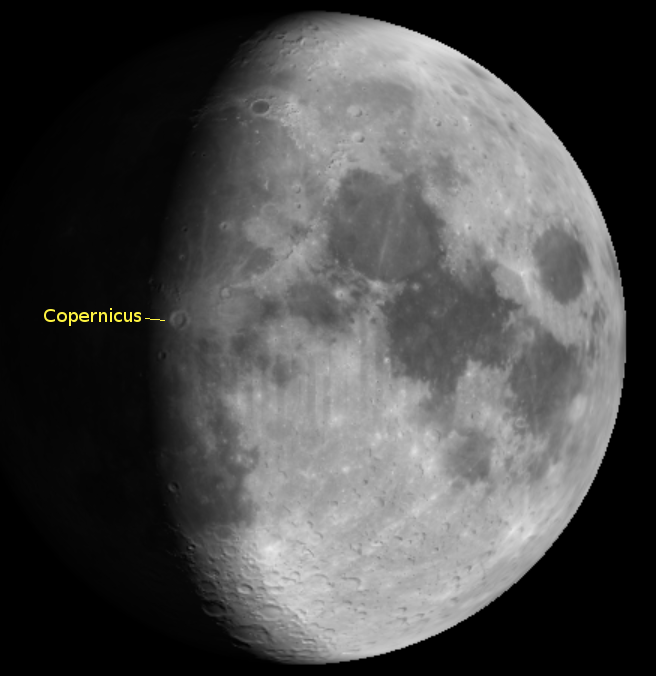
The Moon at 10 p.m. on March 10,2014 pointing out the crater Copernicus. Created using Virtual Moon Atlas.
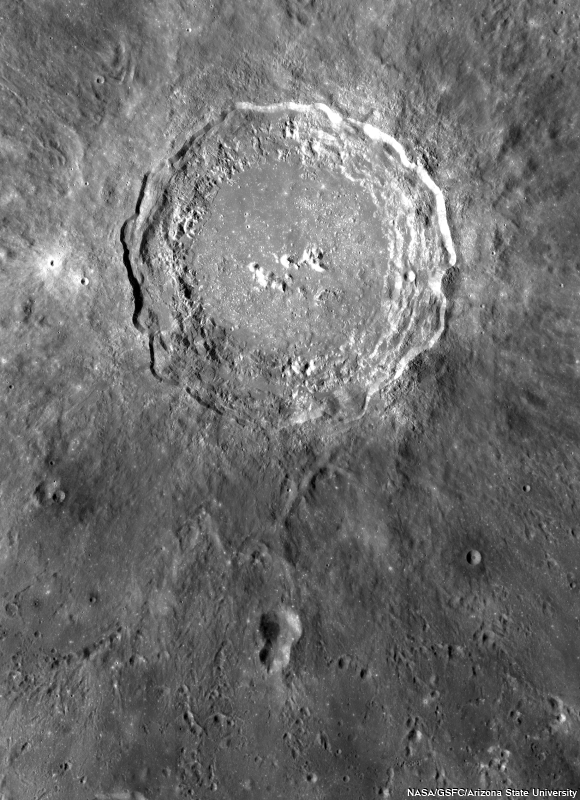
Copernicus from the Lunar Reconnaissance Orbiter. Credit: NASA/GSFC/Arizona State University
03/06/2014 – Ephemeris – Observing the Moon tonight!
Ephemeris for Thursday, March 6th. The sun will rise at 7:11. It’ll be up for 11 hours and 25 minutes, setting at 6:36. The moon, 2 days before first quarter, will set at 12:56 tomorrow morning.
The Moon’s appearance has changed since I last talked about it on Tuesday. The Crescent is wider. The terminator, the sunrise line on the Moon that gives the Moon it’s now crescent phase has uncovered most of the Sea of Tranquility. In fact the sun will have risen at the Apollo 11 landing site by this evening. With a small telescope just beneath the center of the moon and near the terminator is one of my favorite craters Theophilus with its well-defined central peak. It’s kind of middle-aged for craters on the moon from 1 to 3 billion years old. It’s in much better shape than the crater Cyrillus of nearly the same size that it partially overlaps, which is thought to be at least a billion years older and shows it.
Times are for the Traverse City/Interlochen area of Michigan. They may be different for your location.
Addendum
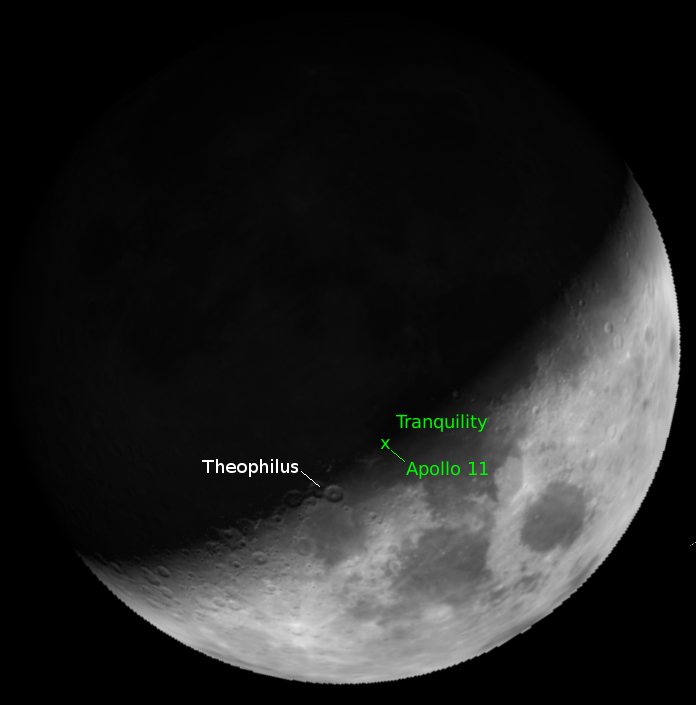
The Moon at 9 p.m. March 6, 2014 highlighting the Sea of Tranquility the Apollo 11 landing site (approximate) and the crater Theophilus. Created using Virtual Moon Atlas.
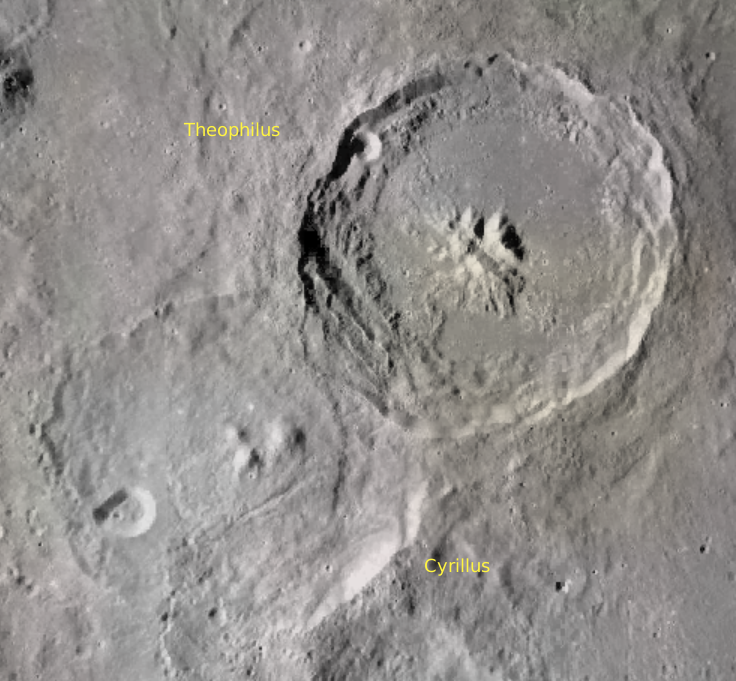
Lunar craters Theophilus and Cyrillus. Credit: NASA/LRO mapped onto Virtual Moon Atlas.
03/04/2014 – Ephemeris – Observing the Moon tonight
Ephemeris for Fat Tuesday, Tuesday, March 4th. The sun will rise at 7:14. It’ll be up for 11 hours and 19 minutes, setting at 6:34. The moon, 3 days past new, will set at 10:52 this evening.
The Moon tonight is visible in the west after sunset. The sunrise terminator is slowly moving across its face. The solar day on the Moon equals its orbit of the Earth with respect to the sun of about 29 and a half days. As the moon is oriented in our sky the dark nearly circular sea. The Sea of Crises is rotated downward so it appear at between 4 and 5 o’clock on the moon’s face. At the bottom is the partially uncovered Sea of Fertility. With binoculars or preferably a small telescope can be seen the large crater Langrenus close to the lunar equator. A picture of that crater was one of the first brought back by the Apollo 8 crew in 1968. I’ve found it for the blog entry for this episode at bobmoler.wordpress.com.
Times are for the Traverse City/Interlochen area of Michigan. They may be different for your location.
Addendum
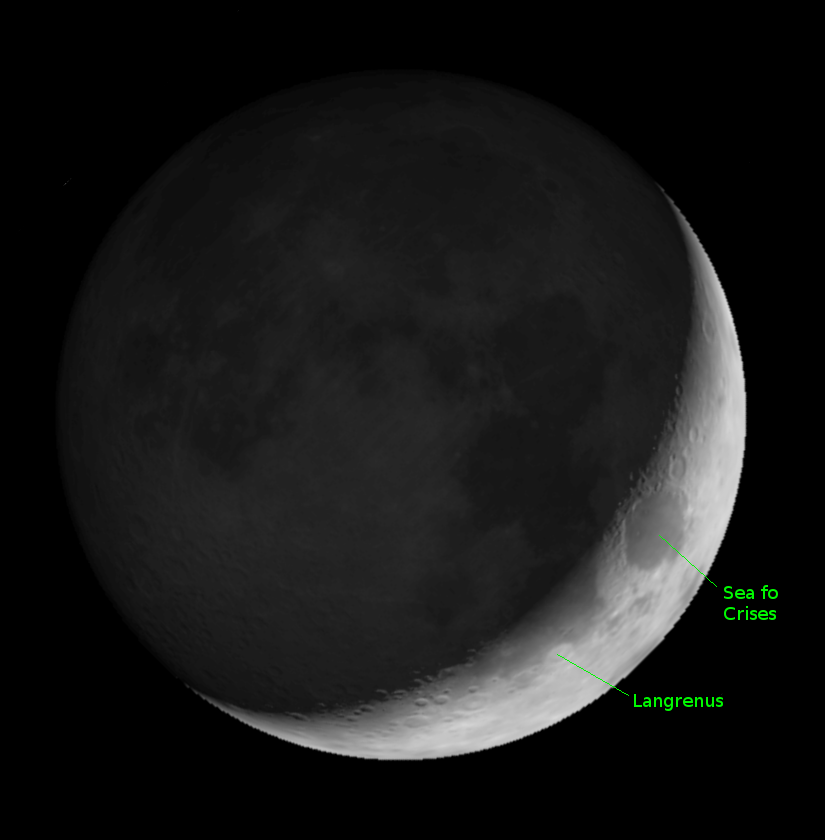
The moon rotated as if it were setting in the west showing the Sea of Crises (Mare Crisium) and the crater Langrenus. The image was enhanced to show Earth shine. Created using Virtual Moon Atlas.
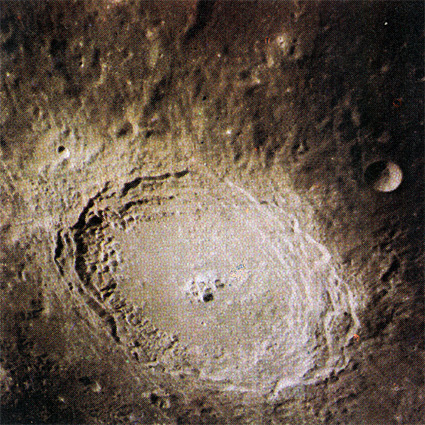
The crater Langrenus as imaged by the Apollo 8 crew on their historic orbiting of the Moon Christmas Eve 1968. Credit: NASA.
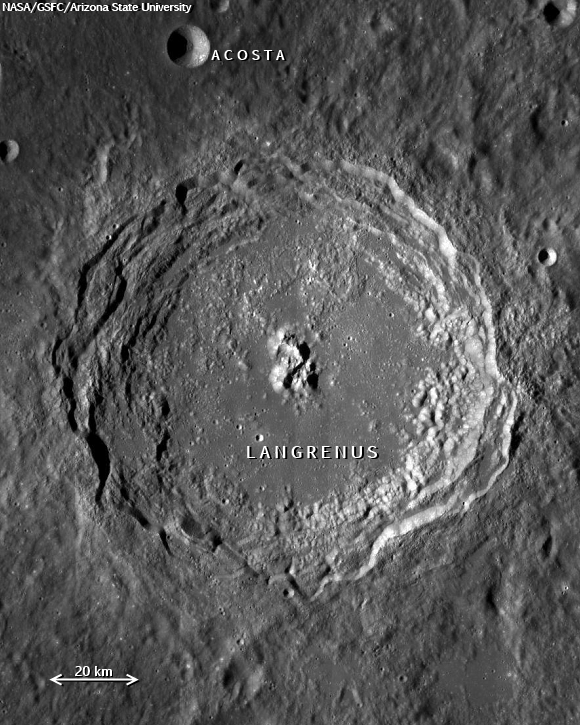
The crater Langrenus as imaged by the Lunar Reconnaissance Orbiter. Credit: NASA\GSFC\Arizona State University.
Note on credits: GSFC is the Goddard Space Flight Center.
02/19/2014 – Ephemeris – Where are the bright planets this week?
Ephemeris for Wednesday, February 19th. The sun will rise at 7:36. It’ll be up for 10 hours and 40 minutes, setting at 6:16. The moon, 3 days before last quarter, will rise at 11:23 this evening.
Let’s take our weekly look at the planets. Jupiter will be in the southeastern sky as darkness falls tonight. It’s cruising against the stars of Gemini now. It will pass due south at 9:29 p.m., and will set at 5:12 a.m. in the west-northwest. Reddish Mars is in Virgo now and above and left of the bright star Spica, which it now outshines. Mars will rise at 10:54 p.m. and will appear above the moon when it rises a half an hour later. It will pass due south at 4:26 a.m. Saturn will rise at 1:13 a.m. in the east-southeast. It’s seen against the stars of Libra the scales this year. Venus will rise at 5:10 tomorrow morning, and shines brightly in the southeast before sunrise. It’s in Sagittarius, left of its Teapot shape of stars.
Times are for the Traverse City/Interlochen area of Michigan. They may be different for your location.
Addendum
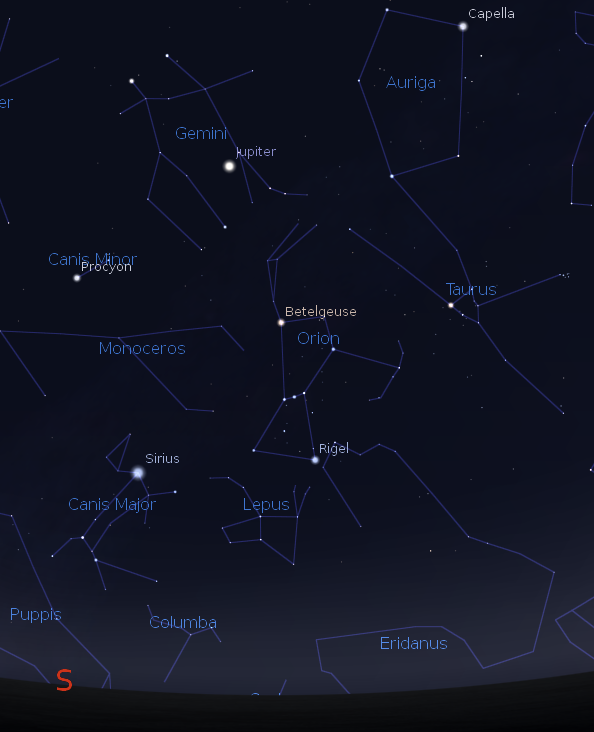
Jupiter and the constellations of winter at 9 p.m. February 18, 2014. Created using Stellarium.
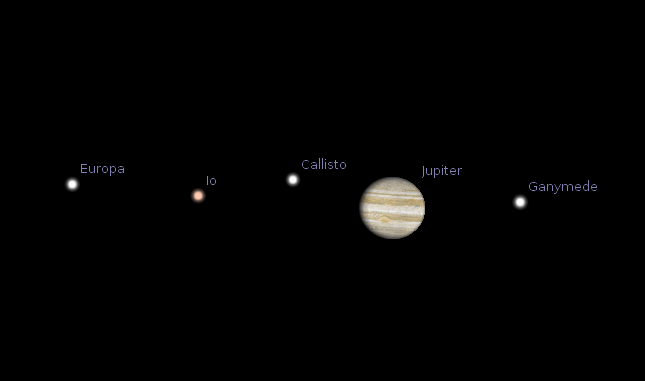
Jupiter at 9 p.m. on February 18, 2014. Created using Cartes du Ciel.
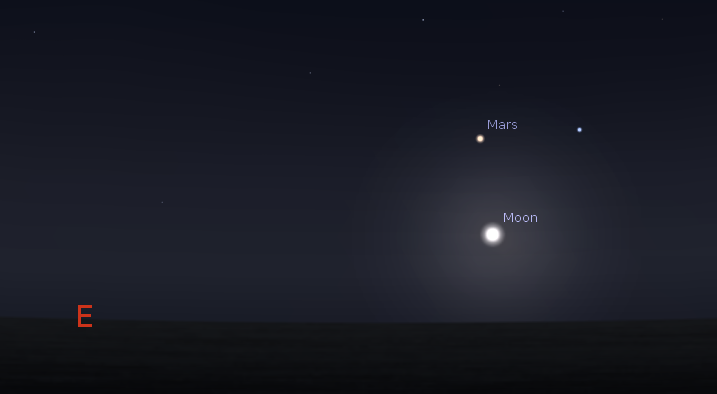
Mars and the Moon at midnight on February 20, 2014. Created using Cartes du Ciel.
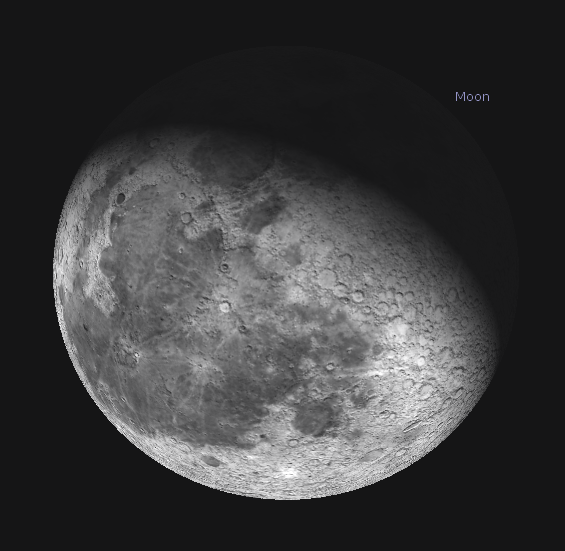
The Moon at midnight on February 20, 2014. Created using Stellarium.
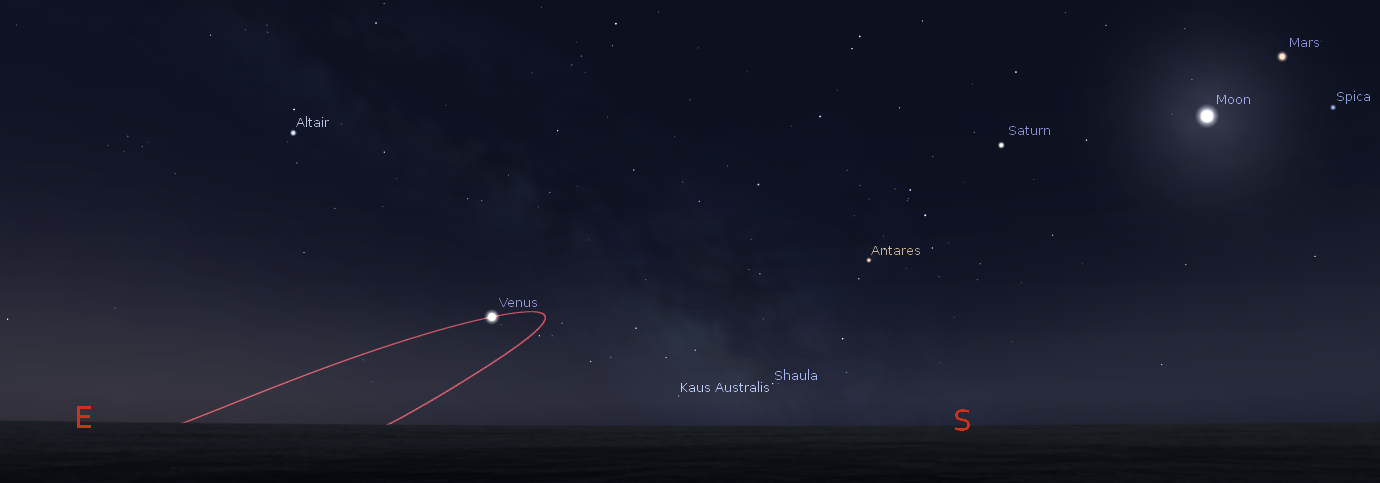
The morning planets at 6:30 a.m. February 20, 2014, including the orbit of Venus. Created using Stellarium.
Venus will reach the end of the red loop, its orbit as seen from Earth, on March 22nd. Of course we and Venus are moving, and so the apparent position of Venus will change also by the Earth’s motion.
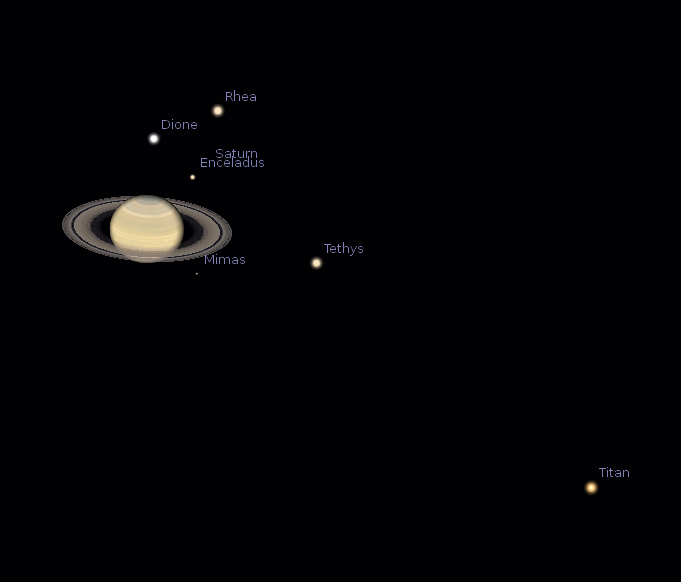
Saturn and its moons at 6:30, February 20, 2014. Of the moons, Titan will be the only one visible in small telescopes. Created using Stellarium.
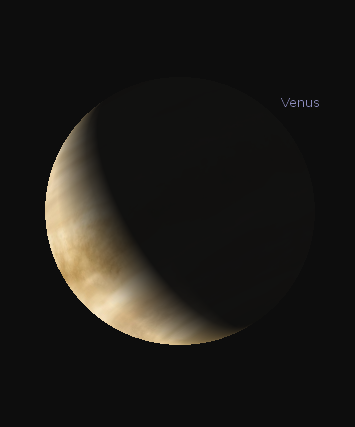
Venus through a telescope. The planet is getting smaller and its crescent is getting fatter as it moves away from the Earth. This image is for 6:30 a.m. February 20, 2014.Created using Stellarium.
 Bob Moler's Ephemeris Blog