Archive
10/11/2013 – Ephemeris – Tomorrow night is International Observe the Moon Night
Ephemeris for Friday, October 11th. The sun will rise at 7:53. It’ll be up for 11 hours and 11 minutes, setting at 7:04. The moon, at first quarter today, will set at 12:41 tomorrow morning.
Tomorrow night the Grand Traverse Astronomical Society (GTAS) and the NMC Astronomy Club will split forces. The NMC Astronomy Club will host the Star party at the Northwestern Michigan College’s Observatory starting at 9 p.m., while the Sidewalk Astronomers contingent of the GTAS will be on the north side 200 block of Front Street in Traverse City, in front of the Orvis Streamside store, for the International Observe the Moon Night weather permitting. Weather permitting means it must not be completely overcast or raining. I like to view the moon at this phase, a day after first quarter for the variety of detail that’s visible on the moon’s surface. This is our usual location for Friday Night Live.
Times are for the Traverse City/Interlochen area of Michigan. They may be different for your location.
Addendum
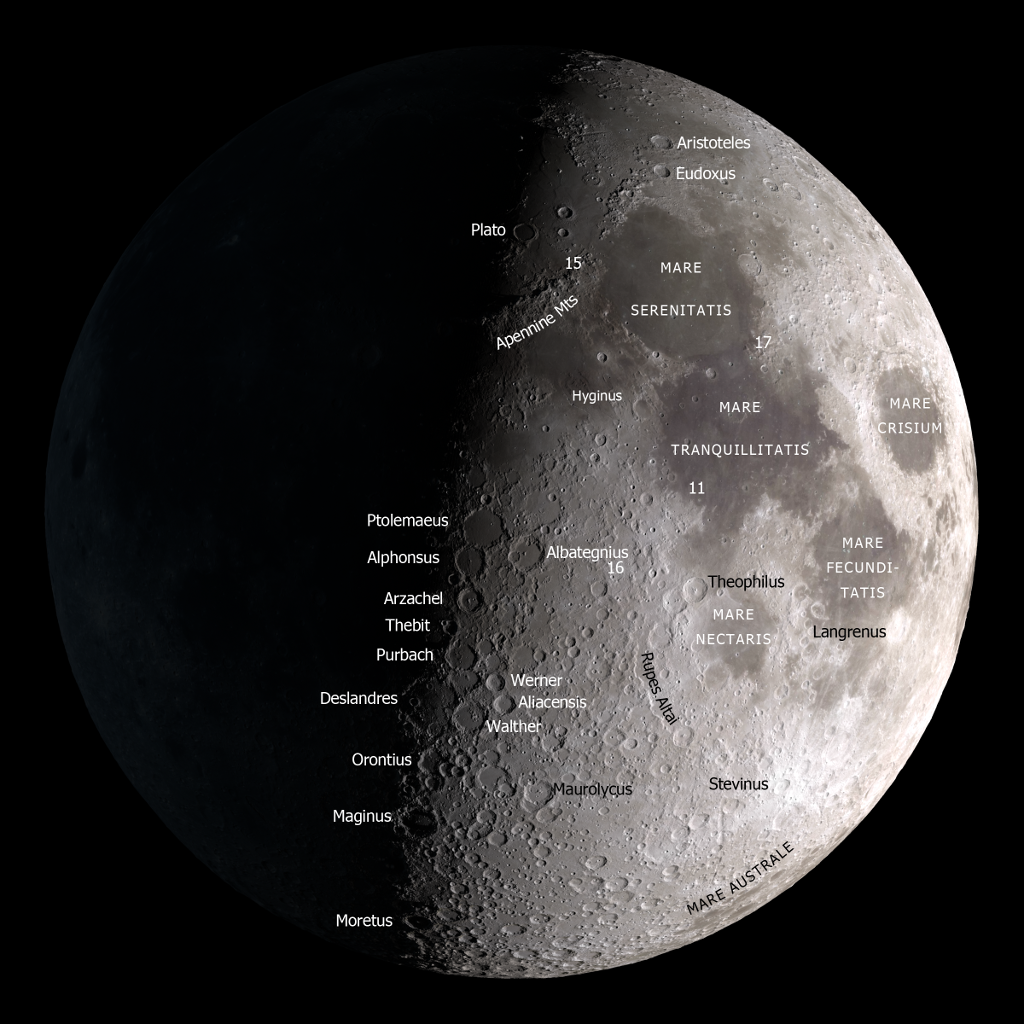
Map supplied by the International Observe the Moon Night. The crater marked Plato should be Archimedes. It’s actually the moon in the afternoon our time.
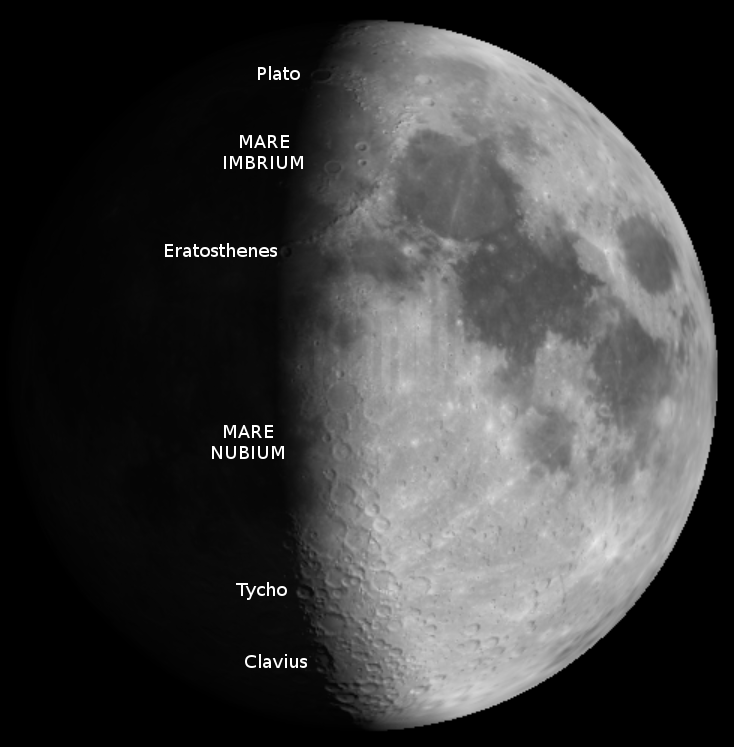
The moon at 9 p.m. October 12, 2013. The terminator progresses a bit more from the above moon chart revealing more details. Created using Virtual Moon Atlas.
10/09/2013 – Ephemeris – The Bright planets and Comet ISON for this week
Ephemeris for Wednesday, October 9th. The sun will rise at 7:50. It’ll be up for 11 hours and 17 minutes, setting at 7:08. The moon, 2 days before first quarter, will set at 10:32 this evening.
Time again to check out the bright planets. Mercury has an unfavorable greatest elongation from the sun today. It’s too close to the horizon for all but the best observers to spot. Almost the same can be said of Saturn, right of and a bit below Venus tonight. Binoculars may be needed to it. Saturn will set at 8:15 while Venus will set at 8:50 p.m.. We are losing Saturn in the sun’s glare for a few months. The rest of the planetary action will be in the morning sky. The giant planet Jupiter will rise at 12:12 a.m. in the east northeast. It’s cruising against the stars of Gemini now. By 6 a.m it will be high in the southeast, the brightest object in that direction. Mars will rise at 3:25 a.m. also in the east northeast. It’s nearing Leo.
Times are for the Traverse City/Interlochen area of Michigan. They may be different for your location.
Addendum
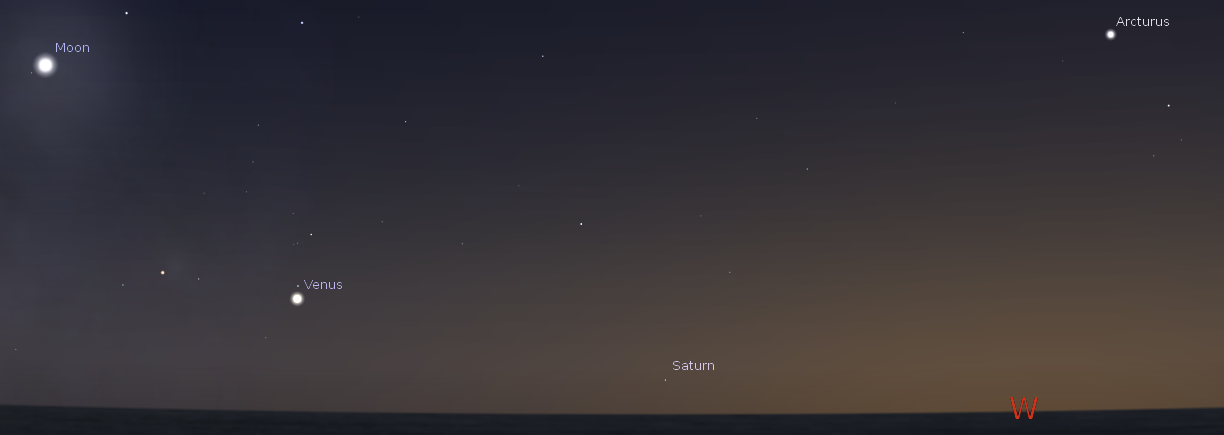
Venus, Saturn and the Moon in the west southwest at 8 p.m. October 9, 2013. Created using Stellarium.
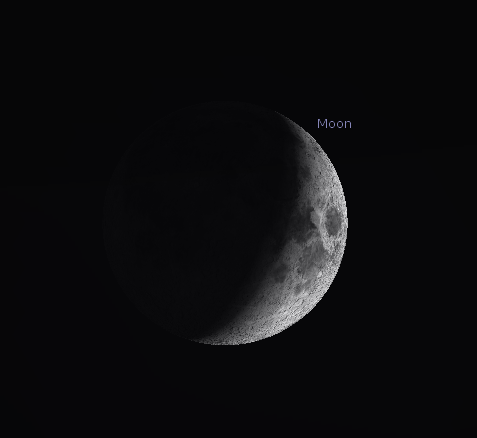
Closeup of the moon. Created using Stellarium.
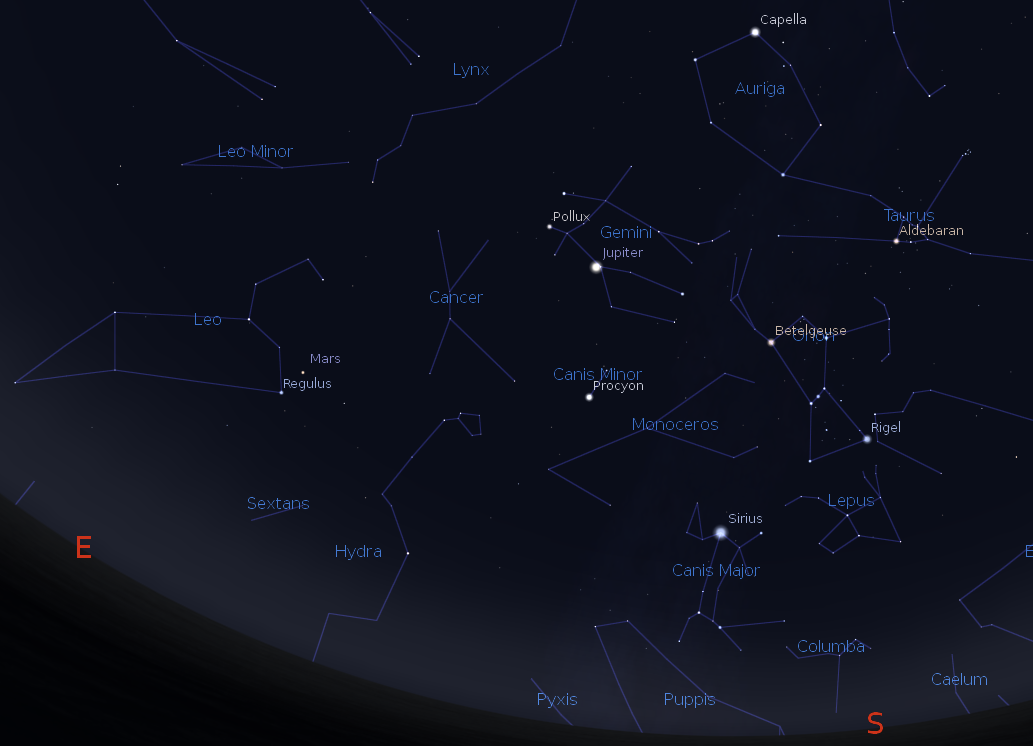
Jupiter and Mars with the winter stars and constellations at 6 a.m., October 10, 2013. Created using Stellarium.
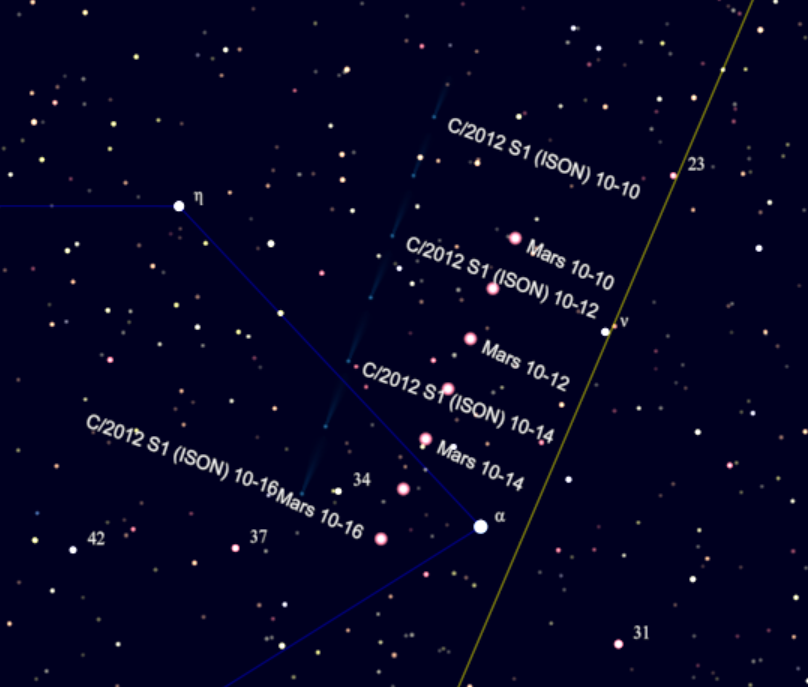
Comet ISON and Mars at 6 a.m. for 7 days starting October 10, 2013. Created using SkyCharts (Cartes du Ciel).
Note that the comet is somewhat dimmer than predicted and barely visible in binoculars. The tail may not be visible except in photographs. I can’t really say since I haven’t seen it yet.
10/07/2013 – Ephemeris – The moon will appear to pass Venus early tomorrow morning
Ephemeris for Monday, October 7th. The sun will rise at 7:48. It’ll be up for 11 hours and 23 minutes, setting at 7:11. The moon, 3 days past new, will set at 8:47 this evening.
The moon will be passing the planet Venus around 7 a.m. tomorrow morning, when they will be below the horizon. So tonight and tomorrow evenings we will have before and after views of the event. Tonight the thin crescent moon will be nearly the width of your fist held at arm’s length to the right of Venus. In binoculars or a telescope only the Sea of Crises is completely uncovered by the moon’s terminator. If you haven’t checked out Venus lately, do so. It is now a bit more than half illuminated by the sun. It’s coming almost directly at the earth now at about 80 million miles away and that distance is decreasing by 650 thousand miles a day. Don’t worry, it will miss us by 25 million miles in January, passing between the Earth and the Sun.
Times are for the Traverse City/Interlochen area of Michigan. They may be different for your location.
Addendum
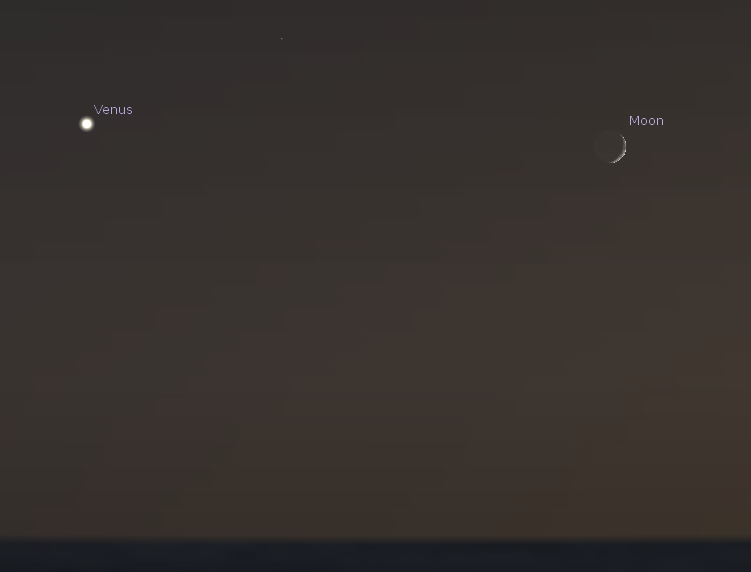
Venus and the Moon on Monday October 7, 2013 at 8 p.m. Created using Stellarium.
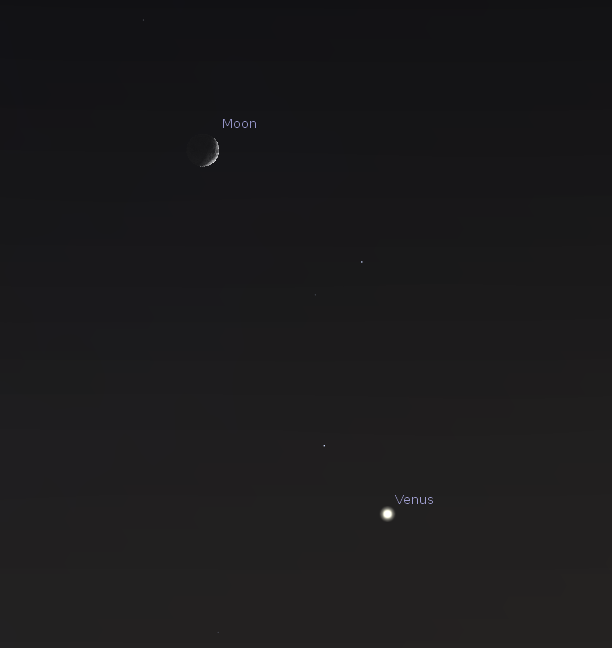
Venus and the Moon on Tuesday October 8, 2013 at 8 p.m. Created using Stellarium.
09/23/2013 – Ephemeris – Motions of the Moon
Ephemeris for Monday, September 23rd. The sun will rise at 7:31. It’ll be up for 12 hours and 6 minutes, setting at 7:37. The moon, 3 days before last quarter, will rise at 9:57 this evening.
The moon has two motions, as I see it in the sky. As the earth rotates, it appears to carry the moon and all the other celestial objects westward each day and night. It so happens that the earth rotates one degree in 4 minutes. The moon and sun happen to be about a half degree in size, so the will appear to move their diameters in 2 minutes. Since around here they rise and set at a 45 degree angle, more or less, the rising and setting of the moon and sun take about 3 minutes. The moon also orbits the earth. It’s orbital velocity is about 2,000 miles an hour. And since the moon is 2,160 miles in diameter, its orbital velocity moves it about its diameter in an hour against the stars. That’s why central solar eclipses last about 2 hours, One hour in and one hour out.
Times are for the Traverse City/Interlochen area of Michigan. They may be different for your location.
Addendum
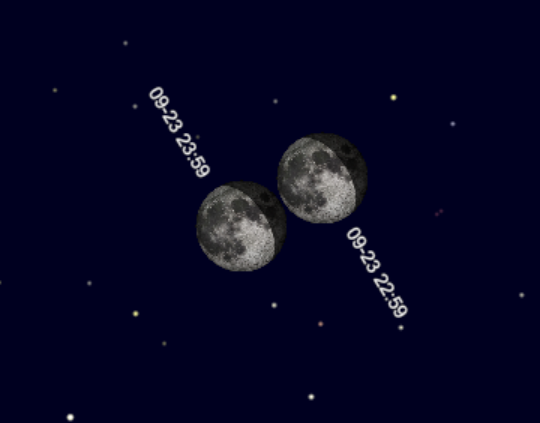
The 1 hour motion of the moon as it orbits the earth. This is for September 23, 2013. Created using Cartes duCiel (Sky Charts).
09/19/2013 – Ephemeris – Talk like a Pirate Day and the Harvest Moon
Aye mateys this is Cap’n. Bob with Ephemeris for Talk like a Pirate Day Thursday, September 19th. Arrr. That’s the extent of it for me. The sun will rise at 7:26. It’ll be up for 12 hours and 18 minutes, setting at 7:45. The moon, at full today, will rise at 7:39 this evening.
This is the Harvest Moon, the closest full moon to the autumnal equinox, which is four days away. It is the most famous and useful of the full moons of the year. In the days before electric lights, the bright moon, rising before and just after sunset extended twilight and allowed farmers extra light to gather in the crops. It is this part of the moon’s cycle that it rises much less than the average 50 minutes later each night. It will rise only 26 minutes later tomorrow night. The moon is in a part of its orbit in which it is most rapidly moving northward and is also staying out longer each night. We will be seeing the bright moon in the early evening for the next few days.
Times are for the Traverse City/Interlochen area of Michigan. They may be different for your location.
Addendum
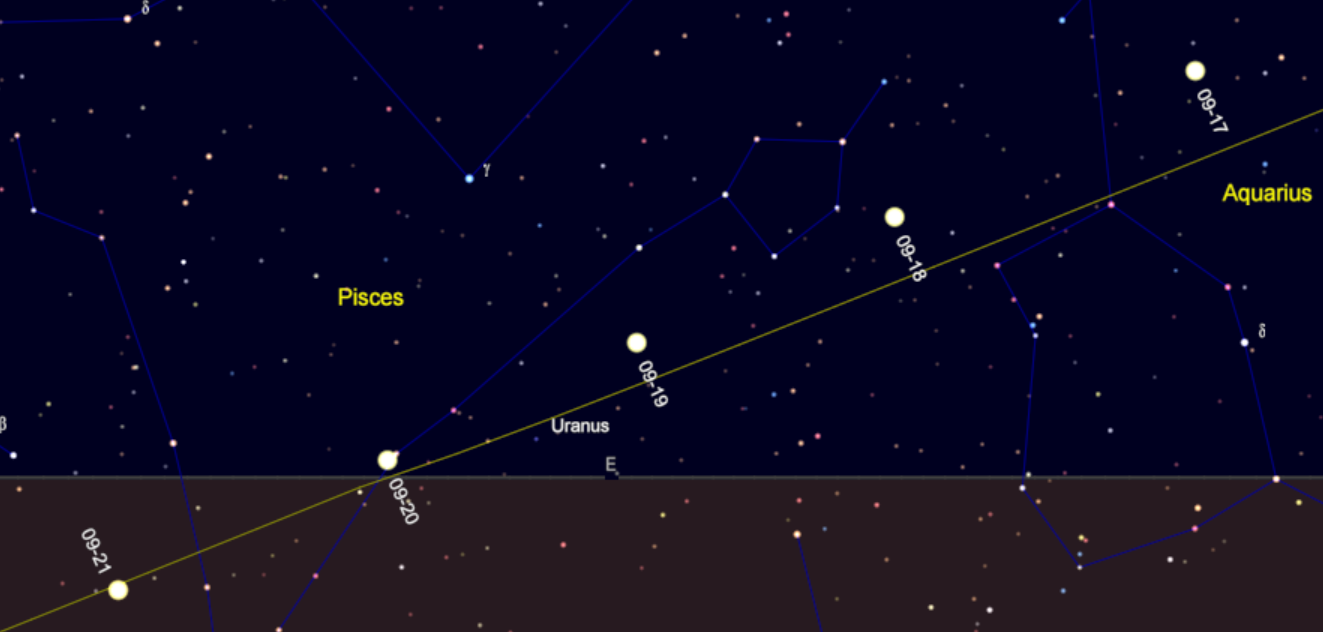
The moon on 5 nights at 8:30 p.m. for September 17 to the 21st, 2013 showing the Moon’s northerly motion. Created using Cartes duCiel.
09/17/2013 – Ephemeris – How did the moon form?
Ephemeris for Tuesday, September 17th. The sun will rise at 7:23. It’ll be up for 12 hours and 24 minutes, setting at 7:48. The moon, 2 days before full, will set at 6:27 tomorrow morning.
The question of how the moon formed has long been a mystery. It was considered impossible that the earth could capture such a large body all by itself. An answer came from the age of the Apollo Moon missions. Though the moon has a 64th the earth’s volume, it has only an eighty-first of the earth’s mass, hence it was made of lighter material overall than the earth. The Moon is made of the same material as the crust of the earth. Even the isotopes of the elements matched, extremely odd if the Moon was the result of a capture or collision with the already formed earth. A new theory posited last year has the earth and moon forming from a collision of two large-sized bodies, whose material was mixed to then form the Earth and Moon.
Times are for the Traverse City/Interlochen area of Michigan. They may be different for your location.
Addendum
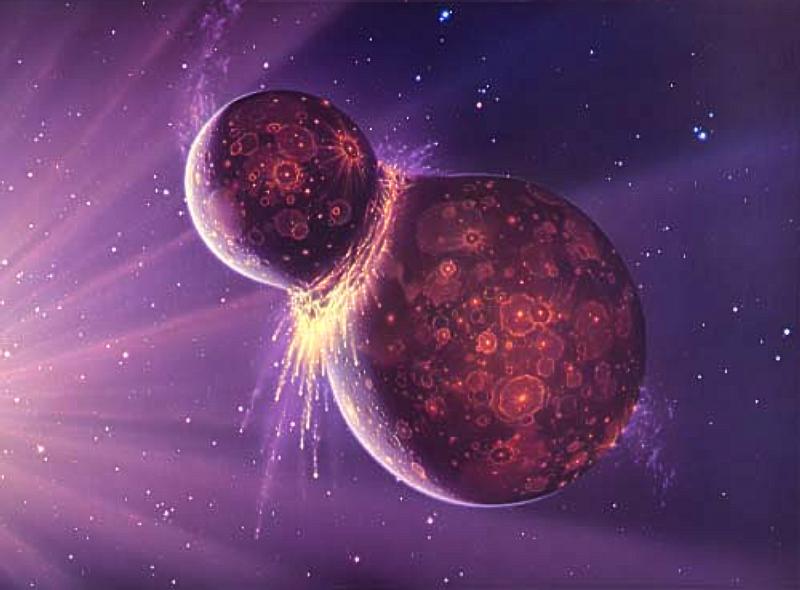
Collision of Mars sized body with the early Earth. A newer theory posited a more equal sized bodies. Credit: NASA
09/16/2013 – Ephemeris – The brightest spot on the moon
Ephemeris for Monday, September 16th. The sun will rise at 7:22. It’ll be up for 12 hours and 27 minutes, setting at 7:50. The moon, 3 days before full, will set at 5:15 tomorrow morning.
The moon is very bright tonight and almost painful to view through a telescope. Remember that’s the full strength of the sun shining on it. Be thankful that it reflects only about 11 percent of the sunlight that hits it. Just thing how much brighter it would be if it was covered by Lake Michigan beach sand. There is a bright spot on the moon now visible. It just became visible today. It’s a crater at the upper left of the moon that’s called Aristarchus after the ancient Greek Philosopher who came up with the sun centered solar system in the 3rd century BC. Unfortunately all his writings have been lost. We only have the comments from others of what he wrote. The crater is the brightest spot on the moon.
Times are for the Traverse City/Interlochen area of Michigan. They may be different for your location.
Addendum
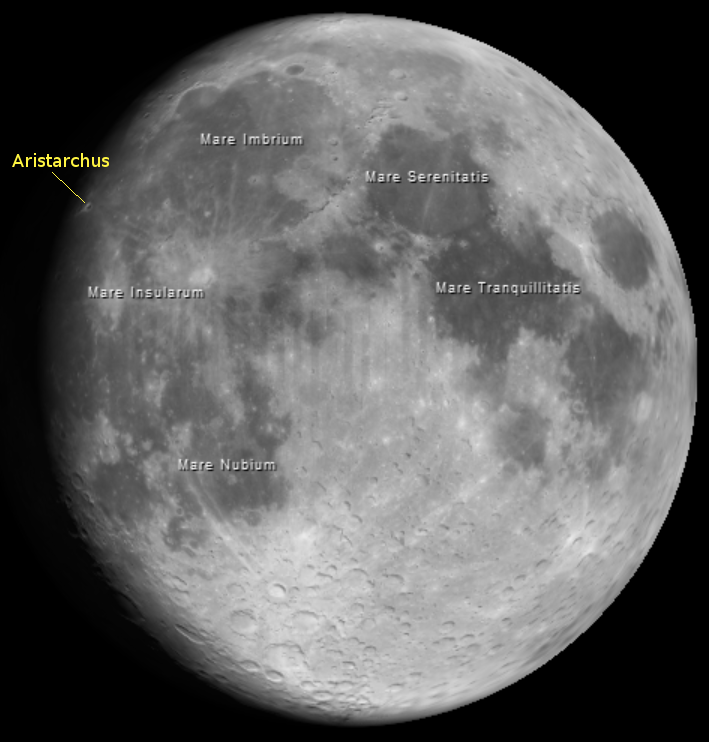
The location of Aristarchus on the moon at 9 p.m. September 16, 2013. Created using Virtual Moon Atlas.
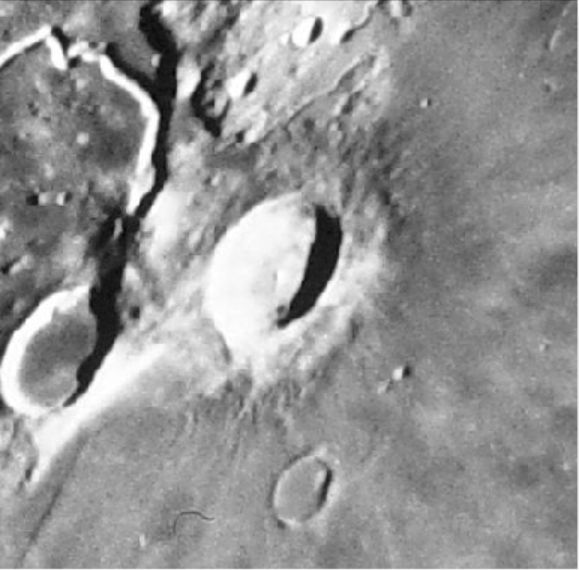
The crater Aristarchus. Credit: Lunar and Planetary Institute.
09/12/2013 – Ephemeris – A look at the first quarter moon
Ephemeris for Thursday, September 12th. The sun will rise at 7:18. It’ll be up for 12 hours and 40 minutes, setting at 7:58. The moon, at first quarter today, will set at 12:36 tomorrow morning.
By this evening the moon will be just past first quarter and the terminator will bulge a bit to the east. Through binoculars or the naked eye the scallop shell shaped sea will be visible at the upper right part of the moon, the man in the moon’s left eye. In telescopes the moon will be inverted and even also reversed, so Serenity could appear in any other quadrant depending on what your telescope does to the image. Toward the terminator from Serenity are two mountain ranges The south part is the Apennines, and the northern part is the Alps. The Alps is cut by a gash called the Alpine Valley. There’s also a triangle of distinctive craters also visible near the terminator.
Times are for the Traverse City/Interlochen area of Michigan. They may be different for your location.
Addendum
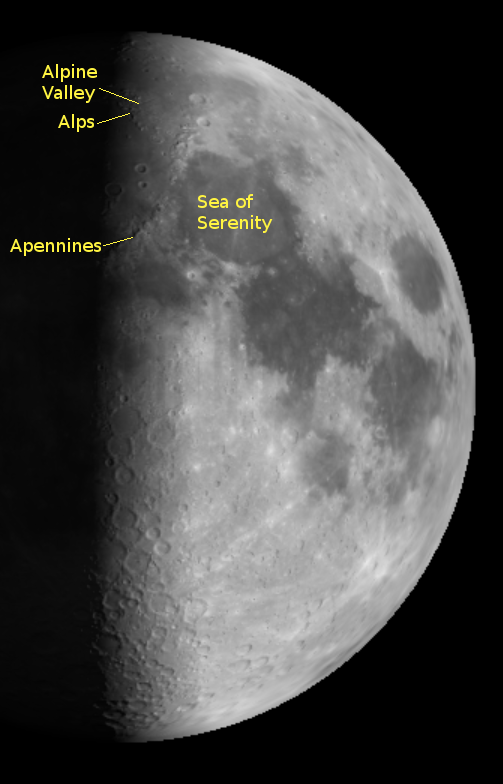
First quarter Moon with some of the features on its northern hemisphere. Created using Virtual Moon Atlas.
09/10/2013 – Ephemeris – The Moon reveals the Apollo 11 landing site
Ephemeris for Tuesday, September 10th. The sun will rise at 7:15. It’ll be up for 12 hours and 46 minutes, setting at 8:02. The moon, 2 days before first quarter, will set at 10:49 this evening.
Tonight the moon will reveal the entire Sea of Tranquility or Mare Tranquilitatis on the moon’s equator near the terminator or sunrise line that makes the moon look like a crescent. The sun is rising right now (morning of the 10th) on the Apollo 11 landing site dubbed Tranquility Base by Neil Armstrong right after landing on July 21st 1969. When showing the moon we are often asked, partly in jest we hope, if they could see the flag left by Armstrong and Aldrin. The answer is no. From the earth, we can barely see anything less than two miles in diameter. It took the Lunar Reconnaissance Orbiter to dip down real low, less than 15 miles altitude, to capture an image of the landing site and what the astronauts left behind. Incidentally the flag was knocked down by the blast of the ascent engine on their lunar module when they took off from the moon.
Times are for the Traverse City/Interlochen area of Michigan. They may be different for your location.
Addendum
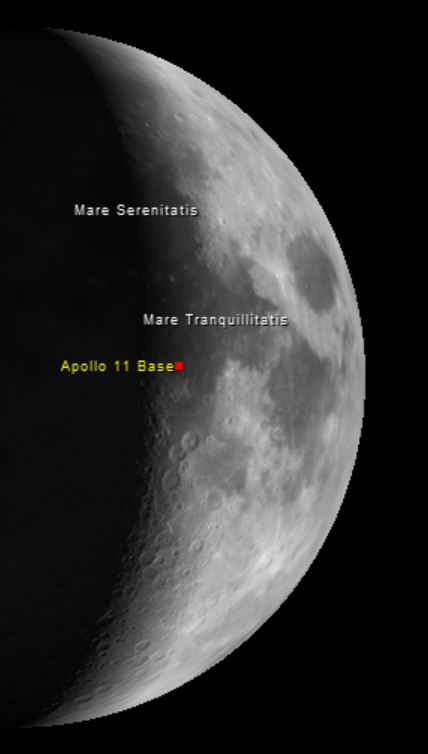
The Moon tonight, 9 p.m. September 10, 2013, with the Apollo 11 landing site marked. Created with Virtual Moon Atlas.
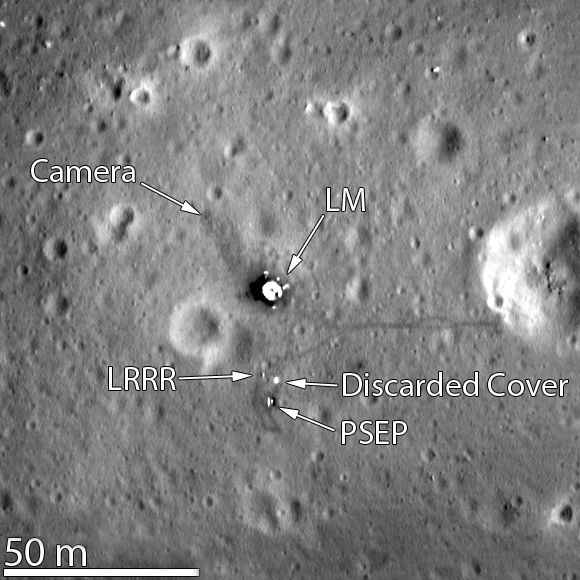
Apollo 11 Base from the Lunar Reconnaissance Orbiter. Credit: NASA.
LM is the descent stage of the Lunar Module that served as a launch platform for the ascent stage.
LRRR is the bank of retro reflectors that are still used to reflect earth based lasers to get an extremely accurate range to the Moon.
PSEP is a solar powered instrument package to monitor moonquakes and other information back to Earth after the astronauts had left the Moon.
The flag is not visible about a third of the way between the LM and the camera.
The dark lines are the tracks of the astronauts as they went about their exploration and equipment set up.
08/22/2013 – Ephemeris – A new mission to the moon starts next month
Thursday, August 22nd. The sun rises at 6:53. It’ll be up for 13 hours and 42 minutes, setting at 8:36. The moon, 2 days past full, will rise at 9:11 this evening.
Though we all know that the moon is airless, surrounded by a better vacuum that we can pump down on the earth. Nonetheless the moon has a tenuous atmosphere of gas and dust. Next month NASA has scheduled the launch of another unmanned spacecraft to the moon. This one is LADEE, an acronym for Lunar Atmosphere and Dust Environment Explorer. It will take 30 days to reach the moon and will measure the dust and tenuous atmosphere of the moon. It will looking for the high altitude glows seen by the Apollo astronauts above the moon. There is also a demonstration laser communication system, at least six times faster than current radio technology.
Times are for the Traverse City/Interlochen area of Michigan. They may be different for your location.
Addendum
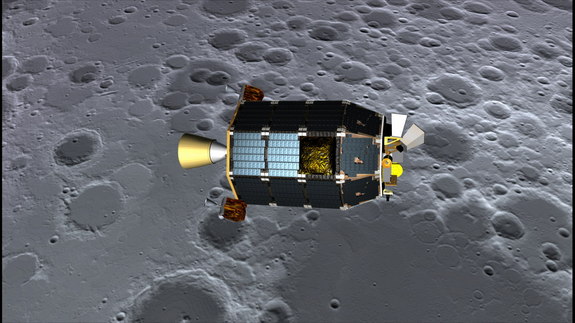
Artist’s depiction of LADEE in orbit of the Moon. Credit: NASA Ames / Dana Berry.
 Bob Moler's Ephemeris Blog