Archive
08/16/2013 – Ephemeris – Another weekend under the stars
Ephemeris for Friday, August 16th. The sun rises at 6:46. It’ll be up for 13 hours and 59 minutes, setting at 8:45. The moon, 2 days past first quarter, will set at 2:44 tomorrow morning.
The Grand Traverse Astronomical Society will have a busy weekend, though not as busy as last weekend where we had four events on four nights. It starts this evening with Friday Night Live, viewing the sun if it’s clear. The society sets up in front of Orvis Streamside, just west of the State Theater. After the event closes we’ll stay after to view the moon and possibly Venus and Saturn. Saturday evening from 9 to 11 p.m. The crew will be out at Northwestern Michigan College’s Rogers Observatory on Birmley Road, south of Traverse City for a Star Party, again with the moon, Venus and Saturn. Some of the brighter objects beyond the solar system, we call them deep sky objects, will be viewed if it’s clear.
Times are for the Traverse City/Interlochen area of Michigan. They may be different for your location.
Addendum
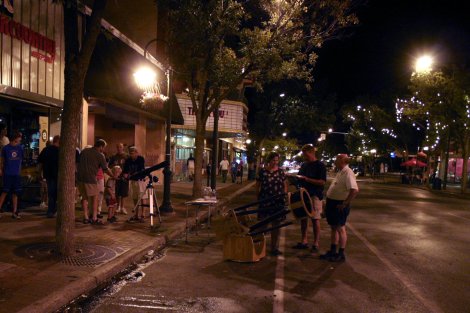
On Front Street after Friday Night Live.
08/15/2013 – Ephemeris – Plato and Copernicus (the craters)
Ephemeris for Thursday, August 15th. The sun rises at 6:45. It’ll be up for 14 hours and 2 minutes, setting at 8:47. The moon, 1 day past first quarter, will set at 1:43 tomorrow morning.
The moon now is slightly gibbous. The term gibbous comes from Latin meaning having a hump or humpbacked. In binoculars or a small telescope look to the upper left where the great Sea of Showers or Mare Imbrium is being revealed by the advance of sunrise. The flat walled plain, actually a crater called Plato is off the top of Imbrium. It is circular and 61 miles in diameter. It looks oval to us because of the curvature of the moon. Below or south at the other edge of Imbrium, just coming into sunlight is the marvelous crater Copernicus with it’s triple central peaks. It’s 56 miles in diameter. In a good enough telescope one can see that the crater walls appear terraced. Copernicus is 2 miles deep.
Times are for the Traverse City/Interlochen area of Michigan. They may be different for your location.
Addendum
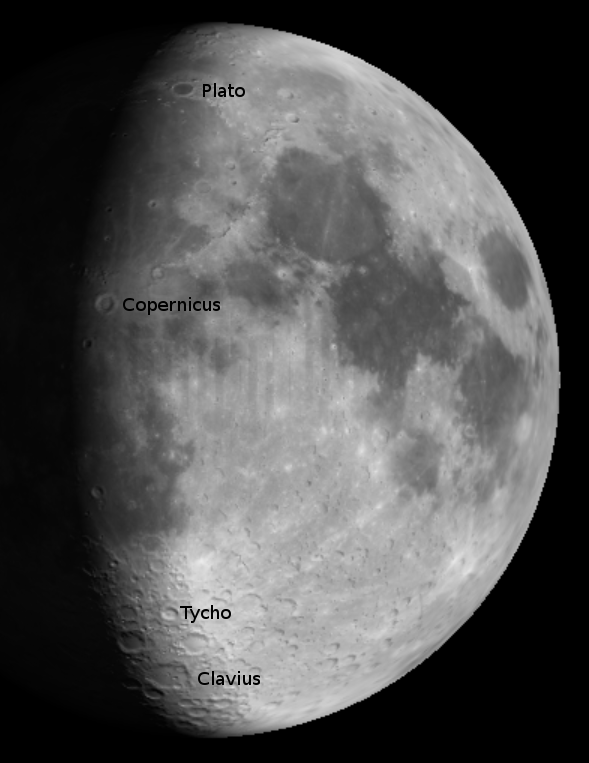
The moon a day after first quarter on August 15, 2013. Created using Virtual Moon Atlas.
The image also includs the craters Tycho and Clavius craters in the southern highlands.
08/13/2013 – Ephemeris – Highs and lows on the moon
Ephemeris for Tuesday, August 13th. The sun rises at 6:43. It’ll be up for 14 hours and 7 minutes, setting at 8:50. The moon, 1 day before first quarter, will set at 12:04 tomorrow morning.
The moon passed Saturn a couple of hours ago while they were below the horizon. By this evening the moon will be to the left of Saturn. In each 24 hour period the moon moves about 24 times its diameter against the stars, or its own width in an hour. Looking at the moon tonight with binoculars or a telescope, the Sea of Serenity or Mare Serenitatis dominates the moon’s upper right quadrant. To me its shaped like a scallop shell. On the bottom part of the moon are the lunar highlands, bright and saturated with craters large and small. The highlands are really high, while the sea’s like Serenity are low. Should the moon have an atmosphere and water, the seas would be real, not just lava filled plains.
Times are for the Traverse City/Interlochen area of Michigan. They may be different for your location.
Addendum
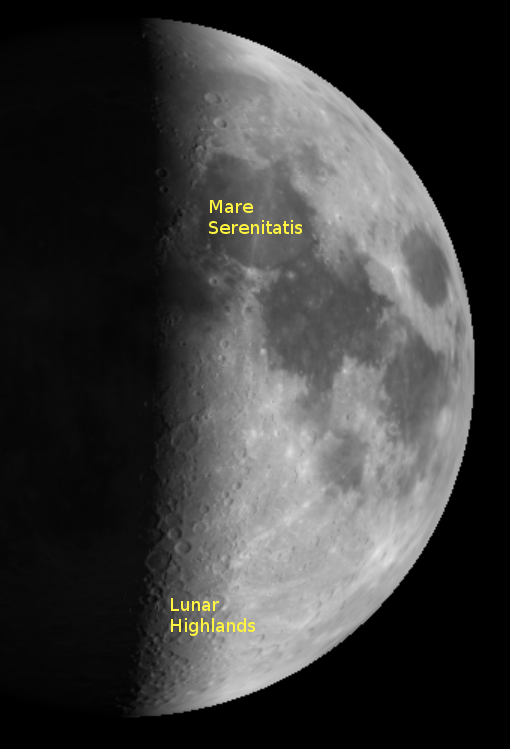
The Moon 1 day before first quarter. Created usinf Virtual Moon Atlas.
07/15/2013 – Ephemeris – The moon will appear near Spica tonight
Ephemeris for Monday, July 15th. Today the sun will be up for 15 hours and 12 minutes, setting at 9:24. The moon, at first quarter today, will set at 12:48 tomorrow morning. Tomorrow the sun will rise at 6:12.
The moon this evening is very close to the bright star Spica. It might take a pair of binoculars to spot it in the glare of the moon. Spica will be just above left of the moon tonight. For other spots on the earth the moon will actually pass in front of the star. The event is called an occultation, from the word occult meaning hidden. Simply put the moon will pass in front of or hide the star for up to an hour. The chief beneficiary of this occultation is the state of Hawai’i. Occultations are one of the best ways to measure the position, diameter and shape of distant asteroids and Kuiper belt objects that are too small to measure otherwise. Satellites of these objects have also been discovered this way.
Times are for the Traverse City/Interlochen area of Michigan. They may be different for your location.
Addendum
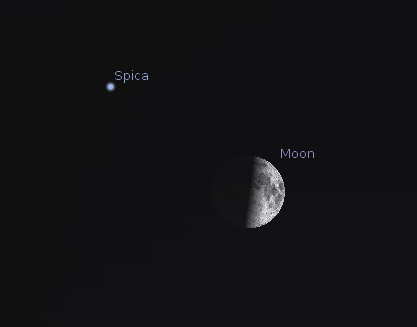
Spica and the Moon at 10 p.m. on July 15, 2013. Created using Stellarium.
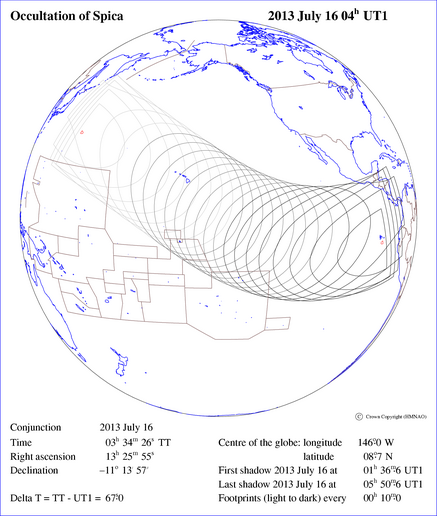
Path on the Earth where the occultation of Spica will be visible. Credit Astronomical Almanac Online.
The Astronomical Almanac Online ( http://asa.usno.navy.mil/) “is a joint publication of the U. S. Nautical Almanac Office, United States Naval Observatory (USNO), in the United States and Her Majesty’s Nautical Almanac Office (HMNAO), United Kingdom Hydrographic Office (UKHO), in the United Kingdom.”
06/19/2013 – Ephemeris – Mercury and Venus one last time
Ephemeris for Wednesday, June 19th. Today the sun will be up for 15 hours and 33 minutes, setting at 9:30. The moon, 3 days past first quarter, will set at 3:28 tomorrow morning. Tomorrow the sun will rise at 5:57.
The early evening will still be taken up with Venus and faint Mercury low in the west northwest at about 10:15 p.m. Mercury is below and left of Venus by 2 degrees, about 4 times the width of the moon. Mercury has dropped greatly in brightness as its phase is now a crescent, moving between the sun and the earth. Mercury will set at 10:56, and Venus will set at 11:03 p.m. Holding forth in the south will be Saturn this evening, the brightest star-like object in the constellation Virgo appearing yellowish to the left of the extremely blue-white star Spica. Saturn is a wonderful sight in a telescope of 20 power or more. Saturn will pass due south at 10:04 p.m., and will set at 3:23 tomorrow morning.
Times are for the Traverse City/Interlochen area of Michigan. They may be different for your location.
Addendum
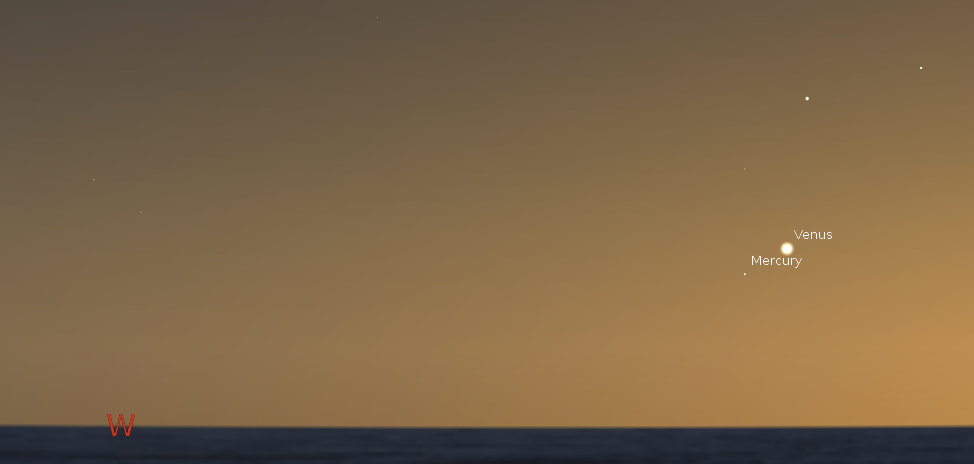
Venus and Mercury conjunction seen at 10:15 p.m. June 19 2013. Created using Stellarium.
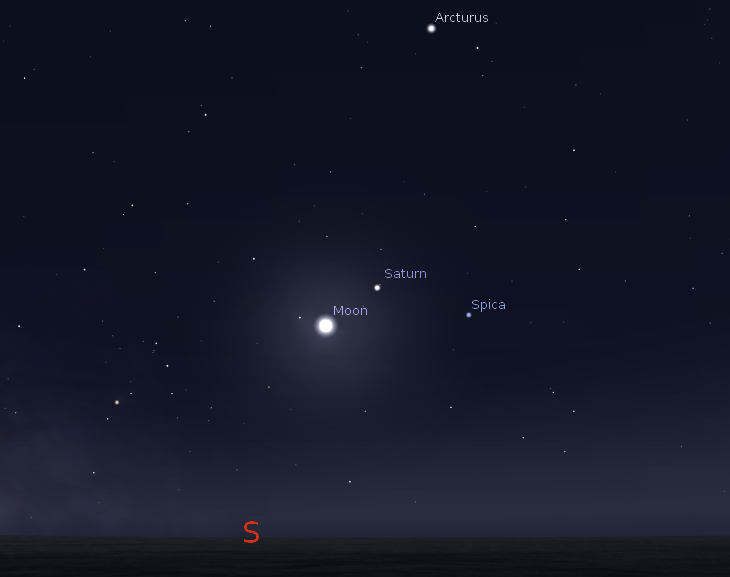
Saturn, the moon and bright stars at 11 p.m. June 19, 2013. Created using Stellarium.
06/18/2013 – Ephemeris – The moon’s most striking feature, the Jura Mountains and the Bay of Rainbows
Ephemeris for Tuesday, June 18th. Today the sun will be up for 15 hours and 33 minutes, setting at 9:30. The moon, 2 days past first quarter, will set at 2:48 tomorrow morning. Tomorrow the sun will rise at 5:56.
On the moon tonight the gibbous phase and the terminator on the left side of the moon is revealing a large semi circular mountain range called the Jura Mountains that encloses a flat lava plain that looks like a bay in the margin of the Sea of Showers or Mare Imbrium. The bay is Sinus Iridium, or Bay of Rainbows. It is easily visible in binoculars this evening when the sunrise line is crossing the bay. The Jura Mountains will appear as a hook at the upper left edge of the moon. That’s about the coolest sight that’s visible on the moon that can be seen with binoculars. It’s especially striking if seen in a small telescope. Though the bay is the same gray as the rest of the moon, at least its name is colorful.
Times are for the Traverse City/Interlochen area of Michigan. They may be different for your location.
Addendum
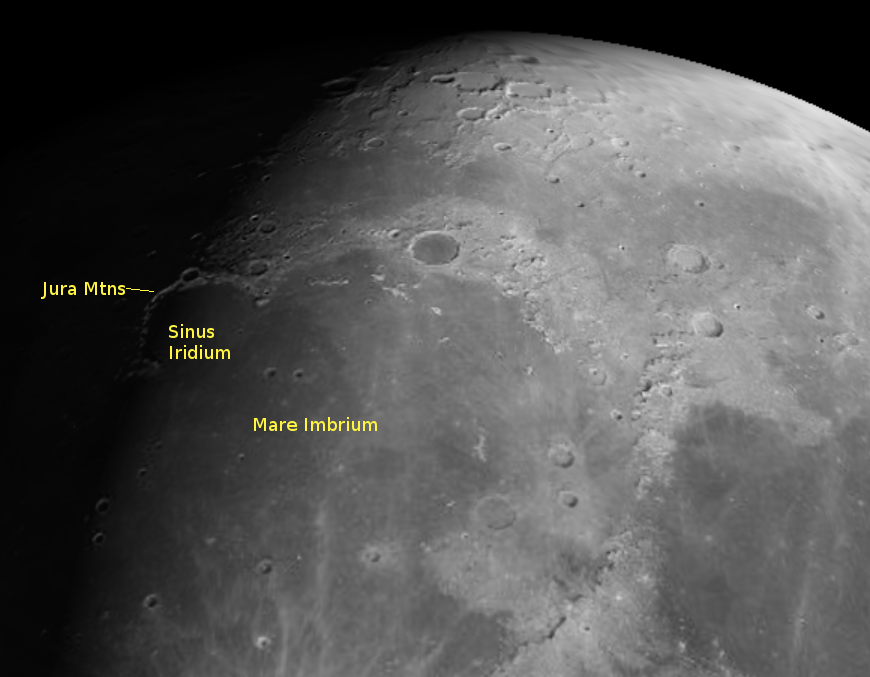
Bay of Rainbows (Sinus Iridium) within the Jura Mountains on the moon. Created using Virtual Moon Atlas.
06/17/2013 – Ephemeris – The crater named Copernicus
Ephemeris for Monday, June 17th. Today the sun will be up for 15 hours and 33 minutes, setting at 9:30. The moon, 1 day past first quarter, will set at 2:15 tomorrow morning. Tomorrow the sun will rise at 5:56.
Let’s take a look at the moon tonight. The sun will have risen on one of the great craters Copernicus. It’s near the terminator, the sunrise line on the moon on the left, close to half way from north to south. Copernicus was named for the Polish astronomer who put forth the heliocentric solar system in the 16th century. The crater is 56 miles in diameter with a vaguely hexagonal form and two miles deep. It has terraced walls and three central peaks. It may look deeper than that due to the low sun angle exaggerating its depth. The asteroid that hit the moon to create the crater hit the moon’s smooth lava plains called seas, probably less that 1.1 billion years ago. Many great photographs of it have been taken.
Times are for the Traverse City/Interlochen area of Michigan. They may be different for your location.
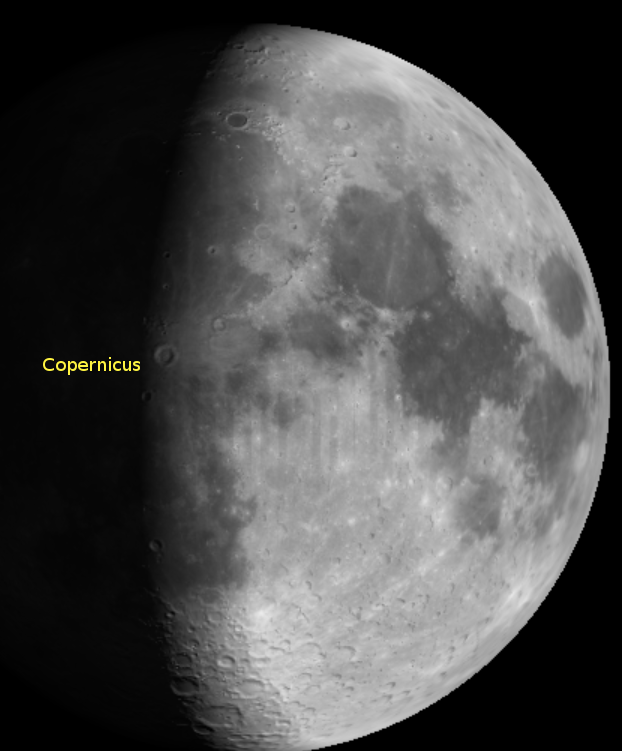
The Crater Copernicus near the moon’s terminator. Created using the Virtual Moon Atlas.
06/13/2013 – Ephemeris – The moon tonight and the crater Theophilus
Ephemeris for Thursday, June 13th. Today the sun will be up for 15 hours and 31 minutes, setting at 9:28. The moon, 3 days before first quarter, will set at 12:23 tomorrow morning. Tomorrow the sun will rise at 5:56.
The 5 day old crescent moon reveals to a small telescope, a trio of large craters on the edge of the moon’s terminator or sunrise line. The best of these is on top Theophilus, a perfectly circular 61 mile diameter crater with a prominent central peak. It’s a little late for it tonight but sometimes when the terminator is crossing the crater, the floor is dark and the central peak catches the morning sunlight. The other two craters won’t be completely in sunlight tonight. Theophilus is a couple of hundred miles south of the Apollo 11 landing site in the Sea of Tranquility, That sea will be completely in sunlight tomorrow night. The moon is a great celestial object to view with any telescope.
Times are for the Traverse City/Interlochen area of Michigan. They may be different for your location.
Addendum
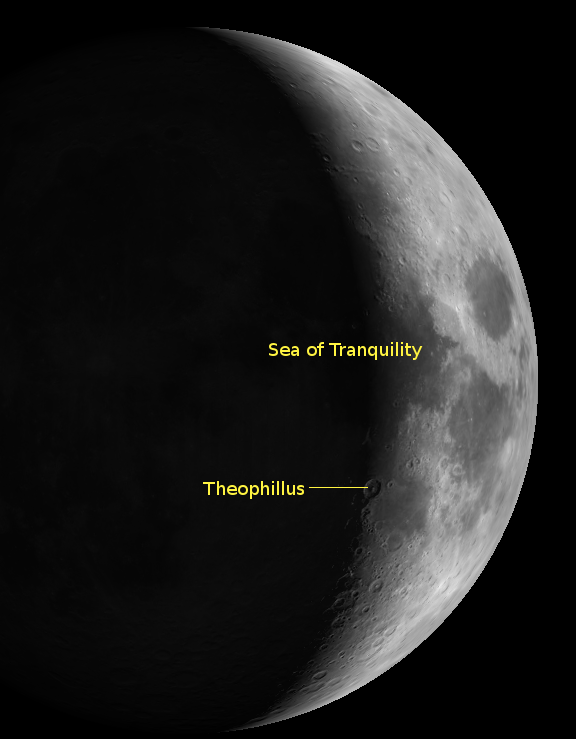
The moon at 10 p.m. on June 13, 2013. In our skies the moon will be rotated some 30-40 degrees clockwise. Created using Virtual Moon Atlas.
Note: Due to some familial concerns yesterday, this post is a bit late.
06/10/2013 – Ephemeris – Mercury and Venus in the west
Ephemeris for Monday, June 10th. Today the sun will be up for 15 hours and 29 minutes, setting at 9:27. The moon, 2 days past new, will set at 10:49 this evening. Tomorrow the sun will rise at 5:56.
Tonight the moon will join Mercury and Venus low in the west northwest at around 10:15. Venus will be the easiest to spot. Mercury will be above Venus and to the left. Binoculars may help you spot it. The crescent moon will be to the left and a bit below Venus. If you’ve been watching these planets for the past two weeks you’ve probably noticed that Mercury is getting fainter. That’s because its phase is becoming less full as moves around the sun toward us. It’s phase is now a bit more than half illuminated. Wednesday it will be half illuminated as it reaches its greatest elongation from the sun, a whopping 24 degree angle from the sun. That’s pretty good for us observing from the northern hemisphere.
Times are for the Traverse City/Interlochen area of Michigan. They may be different for your location.
Addendum
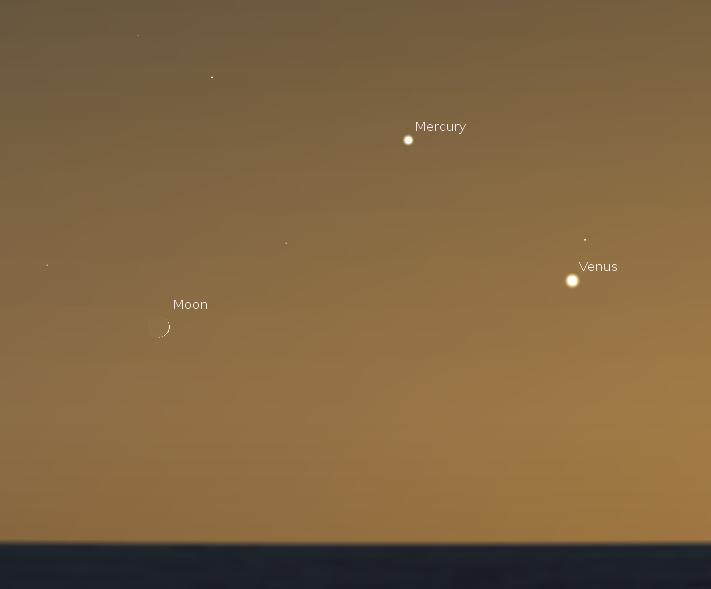
Mercury, Venus and the crescent moon in the west northwest at 10:15 p.m. on June 19, 2013. Created using Stellarium.
05/16/2013 – Ephemeris – The moon’s elliptical orbit
Ephemeris for Thursday, May 16th. Today the sun will be up for 14 hours and 51 minutes, setting at 9:05. The moon, 2 days before first quarter, will set at 1:52 tomorrow morning. Tomorrow the sun will rise at 6:12.
Last week we had an annular eclipse of the sun. The moon didn’t fill up the face of the sun, leaving a ring or annulus. The moon, due to its innately elliptical orbit which is also affected by the sun, and to a much lesser extent the other planets, varies it’s low or perigee distance and its far or apogee distance each month. We saw apogee on Monday at 252,000 miles, perigee will be 223,000 miles on the 25th. That’s a pretty wide range of distances, but since there’s normally nothing to compare the moon’s size this variation in size is not noticeable until there’s a solar eclipse. The large appearance of the moon at its rising and setting is an optical illusion. The moon’s closer when overhead than when rising.
Times are for the Traverse City/Interlochen area of Michigan. They may be different for your location.
 Bob Moler's Ephemeris Blog