Archive
09/26/2018 – Ephemeris – Wednesday os bright planet day on Ephemeris
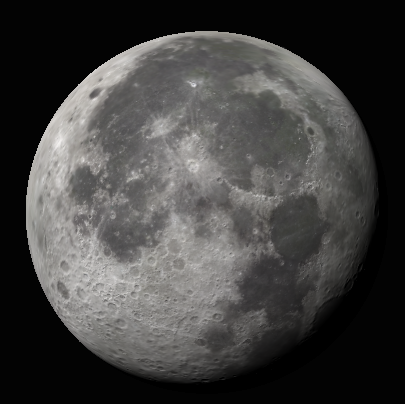
Ephemeris for Wednesday, September 26th. The Sun will rise at 7:34. It’ll be up for 11 hours and 57 minutes, setting at 7:32. The Moon, 2 days past full, will rise at 8:43 this evening.
Let’s look at the bright planets today. Four of them are visible in the evening sky. The brilliant Venus will be visible in the western twilight briefly from about 7:50 p.m. until it sets at 8:14 p.m. Jupiter will be in the southwest as it gets dark. It is only outshone by Venus, and the Moon. The big planet will set at 9:24 p.m. Saturn will start the evening low in the southern sky and will stay relatively low, above the Teapot of Sagittarius. It will be due south at sunset and will set at 11:54 p.m. Mars will be low in the south-southeast as the skies darken tonight. and is now 53.5 million miles (86.2 million km) away. Mars will be due south at 9:48 p.m., and it will set at 2:14 a.m. It’s diameter is 16.4 seconds of arc, quite small in telescopes.
The times given are for the Traverse City/Interlochen area of Michigan. They may be different for your location.
Addendum
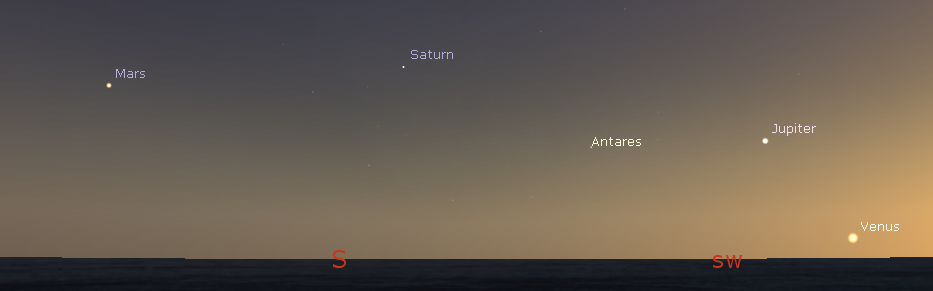
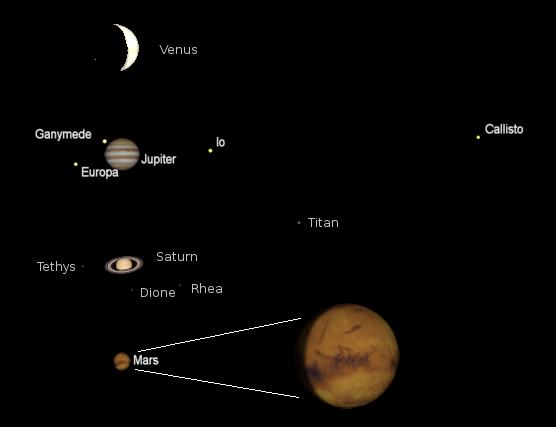
Here are the apparent diameters of the above planets:
Venus 43.7″ (seconds of arc)
Jupiter 32.8″
Saturn 16,6″, rings 38.6″
Mars 16,4″
Jupiter’s moon Ganymede will begin to transit the planet at 8:50 p.m. EDT (00:50 UT September 27).
08/31/2018 – Ephemeris – Previewing September skies
Ephemeris for Friday, August 31st. The Sun will rise at 7:04. It’ll be up for 13 hours and 17 minutes, setting at 8:21. The Moon, 2 days before last quarter, will rise at 11:09 this evening.
Let’s look at the skies for the month of September. The Sun will moving at its greatest speed in its retreat to the south. Daylight hours in the Interlochen/Traverse City area and will drop from 13 hours and 14 minutes tomorrow to 11 hours 45 minutes on the 30th. The altitude of the Sun above the southern horizon at local noon will be 54 degrees tomorrow, and will descend to 42 degrees on the 30th. The season of summer is getting short, so enjoy it while you can. Summer ends and autumn begins at 9:54 p.m. on September 22nd. Venus is retreating toward the Sun now, though still moving eastward against the stars. Jupiter, Saturn and Mars are all moving eastward with respect to the stars, but are moving westward in the sky by our clocks.
The times given are for the Traverse City/Interlochen area of Michigan. They may be different for your location.
Addendum
September Evening Star Chart
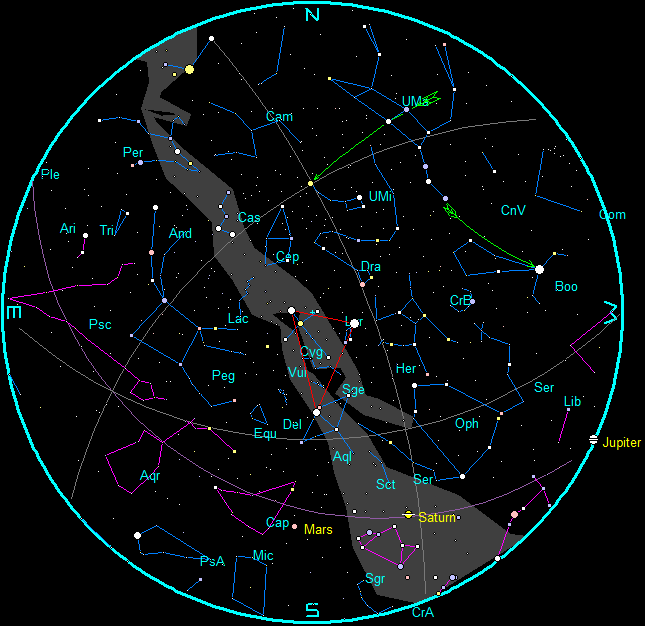
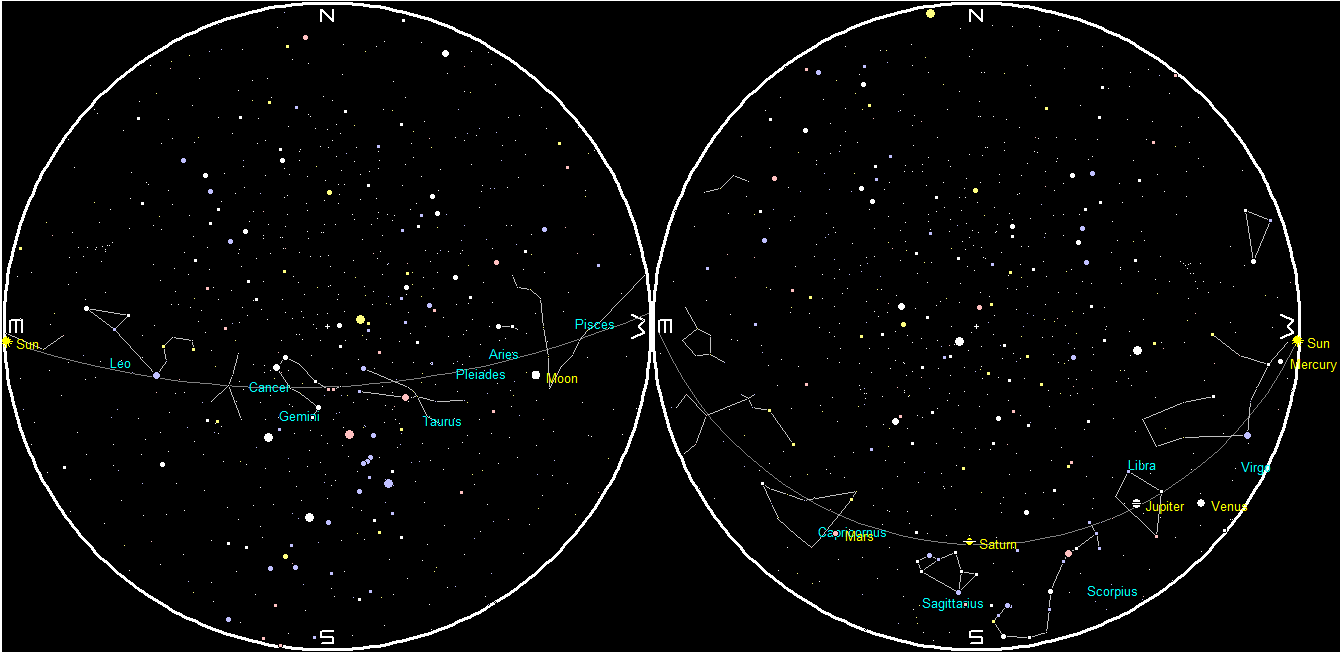
Star Chart for September 2018 (10 p.m. EDT September 15, 2018). Created using my LookingUp program. Click on image to enlarge.
The planets and stars are plotted for the 15th at 10 p.m. EDT in the evening and 6 a.m. for the morning chart. These are the chart times. Note that Traverse City is located approximately 45 minutes behind our time meridian. (An hour 45 minutes behind our daylight saving time meridian during EDT). To duplicate the star positions on a planisphere you may have to set it to 1 hour 45 minutes earlier than the current time.
Note the chart times of 10 p.m. and 4:30 a.m. are for the 15th. For each week before the 15th add ½ hour (28 minutes if you’re picky). For each week after the 15th subtract ½ hour. The planet positions are updated each Wednesday on this blog. For planet positions on dates other than the 15th, check the Wednesday planet posts on this blog.
September Morning Star Chart
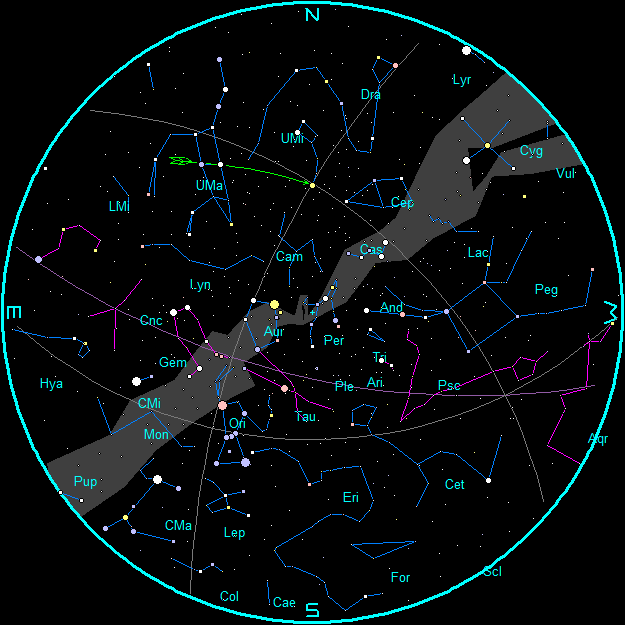
Star Chart for September 2018 mornings based on 6 a.m. September 15th. Created using my LookingUp program. Click on image to enlarge.
For a list of constellation names to go with the abbreviations click here.
- Pointer stars at the front of the bowl of the Big Dipper point to Polaris the North Star.
- Follow the arc of the handle of the Big Dipper to the star Arcturus
- The Summer Triangle is in red.
Twilight
| Morning twilight | Evening twilight | Dark night | Moon | ||||
| Date | Astronomical | Nautical | Nautical | Astronomical | Start | End | Illum. |
| 2018-09-01 | 5h26m | 6h04m | 21h28m | 22h06m | 22h06m | 23h43m | 0.68 |
| 2018-09-02 | 5h27m | 6h05m | 21h26m | 22h04m | 22h04m | – | 0.57 |
| 2018-09-03 | 5h29m | 6h07m | 21h24m | 22h02m | 22h02m | 0h22m | 0.46 |
| 2018-09-04 | 5h30m | 6h08m | 21h22m | 22h00m | 22h00m | 1h08m | 0.34 |
| 2018-09-05 | 5h32m | 6h09m | 21h20m | 21h58m | 21h58m | 2h04m | 0.23 |
| 2018-09-06 | 5h33m | 6h11m | 21h18m | 21h55m | 21h55m | 3h08m | 0.14 |
| 2018-09-07 | 5h35m | 6h12m | 21h16m | 21h53m | 21h53m | 4h19m | 0.06 |
| 2018-09-08 | 5h36m | 6h13m | 21h14m | 21h51m | 21h51m | 5h35m | 0.02 |
| 2018-09-09 | 5h38m | 6h15m | 21h12m | 21h49m | 21h49m | 5h38m | 0 |
| 2018-09-10 | 5h39m | 6h16m | 21h10m | 21h47m | 21h47m | 5h39m | 0.01 |
| 2018-09-11 | 5h41m | 6h17m | 21h08m | 21h44m | 21h44m | 5h41m | 0.06 |
| 2018-09-12 | 5h42m | 6h19m | 21h06m | 21h42m | 21h57m | 5h42m | 0.12 |
| 2018-09-13 | 5h44m | 6h20m | 21h04m | 21h40m | 22h27m | 5h44m | 0.21 |
| 2018-09-14 | 5h45m | 6h21m | 21h02m | 21h38m | 23h01m | 5h45m | 0.3 |
| 2018-09-15 | 5h47m | 6h22m | 21h00m | 21h36m | 23h37m | 5h47m | 0.4 |
| 2018-09-16 | 5h48m | 6h24m | 20h58m | 21h34m | – | 5h48m | 0.5 |
| 2018-09-17 | 5h49m | 6h25m | 20h56m | 21h32m | 0h18m | 5h49m | 0.6 |
| 2018-09-18 | 5h51m | 6h26m | 20h54m | 21h29m | 1h03m | 5h51m | 0.7 |
| 2018-09-19 | 5h52m | 6h28m | 20h52m | 21h27m | 1h53m | 5h52m | 0.78 |
| 2018-09-20 | 5h54m | 6h29m | 20h50m | 21h25m | 2h47m | 5h54m | 0.86 |
| 2018-09-21 | 5h55m | 6h30m | 20h48m | 21h23m | 3h45m | 5h55m | 0.92 |
| 2018-09-22 | 5h56m | 6h31m | 20h46m | 21h21m | 4h44m | 5h56m | 0.92 |
| 2018-09-23 | 5h58m | 6h33m | 20h44m | 21h19m | 5h45m | 5h58m | 0.96 |
| 2018-09-24 | 5h59m | 6h34m | 20h42m | 21h17m | – | – | 0.99 |
| 2018-09-25 | 6h00m | 6h35m | 20h40m | 21h15m | – | – | 1 |
| 2018-09-26 | 6h02m | 6h36m | 20h38m | 21h13m | – | – | 0.99 |
| 2018-09-27 | 6h03m | 6h37m | 20h36m | 21h11m | 21h11m | 21h12m | 0.95 |
| 2018-09-28 | 6h04m | 6h39m | 20h35m | 21h09m | 21h09m | 21h44m | 0.89 |
| 2018-09-29 | 6h06m | 6h40m | 20h33m | 21h07m | 21h07m | 22h21m | 0.81 |
| 2018-09-30 | 6h07m | 6h41m | 20h31m | 21h05m | 21h05m | 23h04m | 0.72 |
Twilight calendar was generated using Cartes du Ciel (Sky Charts).
NASA Calendar of Planetary Events
Date        Time    Event
Sep 01  Sa          Venus: 45° E
    01  Sa 12:45 am Venus-Spica: 1.2° S
    02  Su  9:34 pm Moon-Aldebaran: 1.2° S
    02  Su 10:37 pm Last Quarter
    05  We  2:56 am Moon North Dec.: 20.8° N
    06  Th  6:42 am Moon Ascending Node
    06  Th 10:13 pm Moon-Beehive: 1.4° N
    07  Fr  1:19 pm Neptune Opposition
    07  Fr  9:21 pm Moon Perigee: 361400 km
    09  Su  2:01 pm New Moon
    13  Th 10:21 pm Moon-Jupiter: 4.6° S
    16  Su  7:15 pm First Quarter
    17  Mo 12:46 pm Moon-Saturn: 2.3° S
    18  Tu  5:35 am Moon South Dec.: 20.9° S
    19  We  8:54 pm Moon Apogee: 404900 km
    20  Th  5:30 am Moon Descending Node
    20  Th  9:47 pm Mercury Superior Conj.
    22  Sa  9:54 pm Autumnal Equinox
    24  Mo 10:53 pm Full Moon (Harvest Moon)
    30  Su  3:06 am Moon-Aldebaran: 1.4° S
Oct 01  Mo          Venus: 32.9°
Sky Events Calendar by Fred Espenak and Sumit Dutta (NASA’s GSFC),
http://eclipse.gsfc.nasa.gov/SKYCAL/SKYCAL.html
If you go to the above site you can print out a list like the above for the entire year
or calendar pages for your time zone.
Sun and Moon Rising and Setting Events
     LU                  Ephemeris of Sky Events for Interlochen/TC
     September, 2018    Local time zone: EDT
     +-----------------------------------------------------------------------+
     | DATE |  SUN     SUN  DAYLIGHT|   TWILIGHT*    |MOON  RISE OR    ILLUM |
     |      |  RISE    SET    HOURS |  END    START  |PHASE SET** TIME FRACTN|
     +=======================================================================+
     |Sat  1| 07:05a  08:19p  13:14 | 09:25p  05:58a |      Rise 11:43p   62%|
     +------+-----------------------+----------------+-----------------------+
     |Sun  2| 07:06a  08:17p  13:11 | 09:23p  06:00a |L Qtr Rise 12:22a   51%|
     |Mon  3| 07:07a  08:15p  13:08 | 09:21p  06:01a |      Rise 01:08a   40%|
     |Tue  4| 07:08a  08:13p  13:05 | 09:19p  06:02a |      Rise 02:03a   29%|
     |Wed  5| 07:09a  08:12p  13:02 | 09:17p  06:04a |      Rise 03:08a   19%|
     |Thu  6| 07:11a  08:10p  12:59 | 09:15p  06:05a |      Rise 04:19a   11%|
     |Fri  7| 07:12a  08:08p  12:56 | 09:13p  06:06a |      Rise 05:35a    4%|
     |Sat  8| 07:13a  08:06p  12:53 | 09:11p  06:08a |      Rise 06:51a    1%|
     +------+-----------------------+----------------+-----------------------+
     |Sun  9| 07:14a  08:04p  12:50 | 09:09p  06:09a |New   Set  08:26p    0%|
     |Mon 10| 07:15a  08:02p  12:47 | 09:07p  06:10a |      Set  08:57p    2%|
     |Tue 11| 07:16a  08:00p  12:43 | 09:05p  06:12a |      Set  09:27p    7%|
     |Wed 12| 07:18a  07:59p  12:40 | 09:03p  06:13a |      Set  09:56p   14%|
     |Thu 13| 07:19a  07:57p  12:37 | 09:01p  06:14a |      Set  10:27p   22%|
     |Fri 14| 07:20a  07:55p  12:34 | 08:59p  06:16a |      Set  11:00p   31%|
     |Sat 15| 07:21a  07:53p  12:31 | 08:57p  06:17a |      Set  11:37p   41%|
     +------+-----------------------+----------------+-----------------------+
     |Sun 16| 07:22a  07:51p  12:28 | 08:55p  06:18a |F Qtr Set  12:17a   50%|
     |Mon 17| 07:24a  07:49p  12:25 | 08:53p  06:20a |      Set  01:03a   60%|
     |Tue 18| 07:25a  07:47p  12:22 | 08:51p  06:21a |      Set  01:53a   69%|
     |Wed 19| 07:26a  07:45p  12:19 | 08:49p  06:22a |      Set  02:47a   77%|
     |Thu 20| 07:27a  07:43p  12:16 | 08:47p  06:23a |      Set  03:44a   85%|
     |Fri 21| 07:28a  07:42p  12:13 | 08:45p  06:25a |      Set  04:44a   91%|
     |Sat 22| 07:29a  07:40p  12:10 | 08:43p  06:26a |      Set  05:45a   96%|
     +------+-----------------------+----------------+-----------------------+
     |Sun 23| 07:31a  07:38p  12:07 | 08:41p  06:27a |      Set  06:47a   99%|
     |Mon 24| 07:32a  07:36p  12:04 | 08:39p  06:29a |Full  Rise 07:51p  100%|
     |Tue 25| 07:33a  07:34p  12:00 | 08:37p  06:30a |      Rise 08:17p   99%|
     |Wed 26| 07:34a  07:32p  11:57 | 08:35p  06:31a |      Rise 08:43p   96%|
     |Thu 27| 07:35a  07:30p  11:54 | 08:33p  06:32a |      Rise 09:12p   91%|
     |Fri 28| 07:37a  07:28p  11:51 | 08:31p  06:34a |      Rise 09:44p   84%|
     |Sat 29| 07:38a  07:26p  11:48 | 08:29p  06:35a |      Rise 10:21p   76%|
     +------+-----------------------+----------------+-----------------------+
     |Sun 30| 07:39a  07:25p  11:45 | 08:28p  06:36a |      Rise 11:04p   66%|
     +-----------------------------------------------------------------------+
     * Nautical Twilight
     ** Moonrise or moonset, whichever occurs between sunset and sunrise
08/10/2018 – Ephemeris – A busy weekend here and in the skies
Ephemeris for Friday, August 10th. The Sun rises at 6:39. It’ll be up for 14 hours and 16 minutes, setting at 8:56. The Moon, 1 day before new, will rise at 6:45 tomorrow morning.
It’s a busy weekend for the Grand Traverse Astronomical Society. Members will be on Front Street in Traverse City tonight for Friday Night Live with views of the Sun and later a look at the planet Saturn and its rings, weather permitting. On Saturday, again weather permitting members will be part of Sleeping Bear Dunes Port Oneida Fair with a Sun ‘n Star Party from 4 to 6 p.m. and from 9 to 11 p.m., though members will still be there in between. The location for that event is the Thoreson Farm on South Thoreson Road off M22, near Port Oneida Road. On tap will be Venus, Jupiter, Saturn, Mars and some of the Perseid meteors on the night before its peak night, plus some of the deep sky wonders of the summer Milky Way.
The times given are for the Traverse City/Interlochen area of Michigan. They may be different for your location.
Addendum
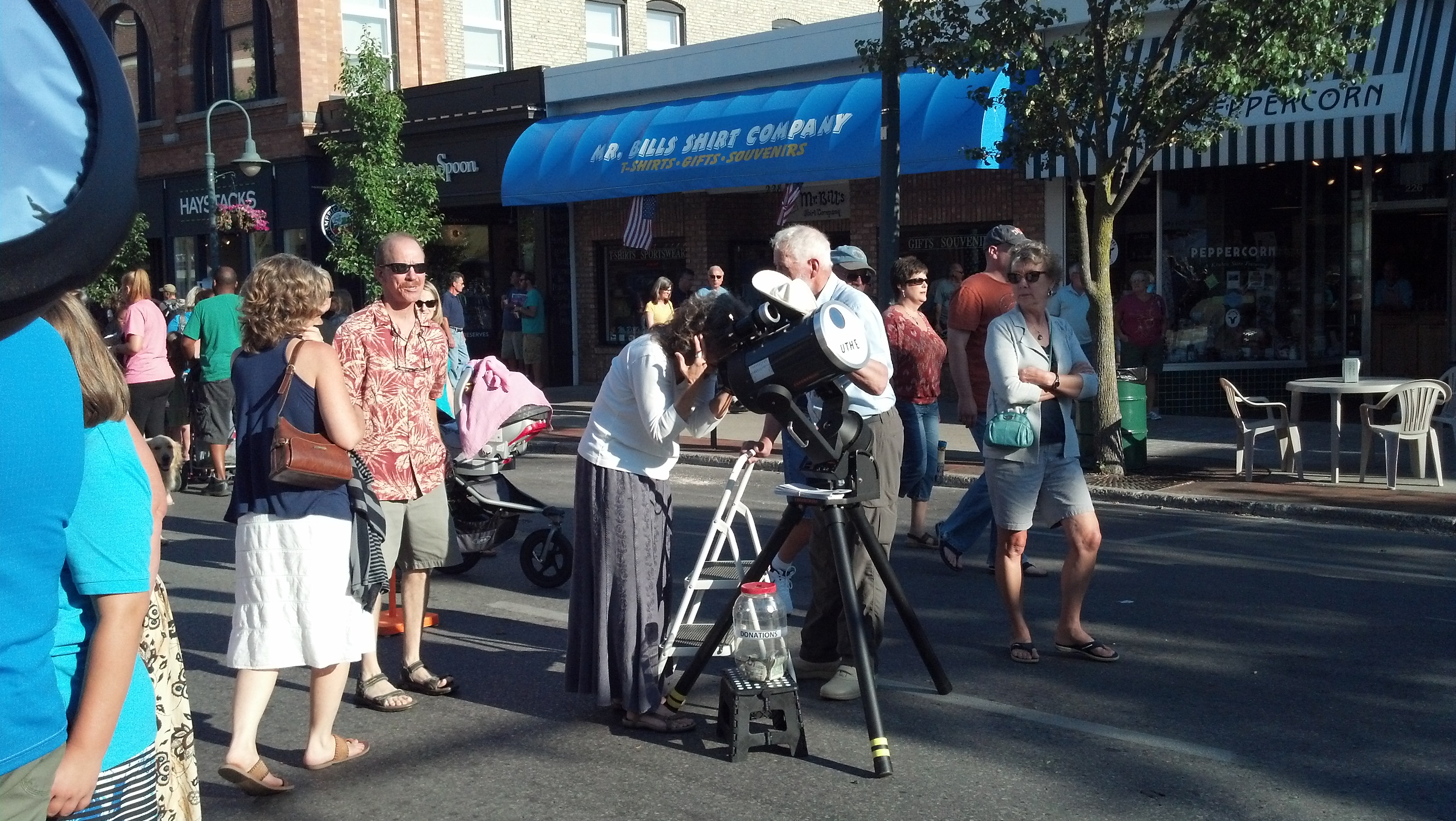
Viewing the Sun with a while light filter at Friday Night Live using Ron Uthe’s telescope at Friday Night Live. Credit Bob Moler
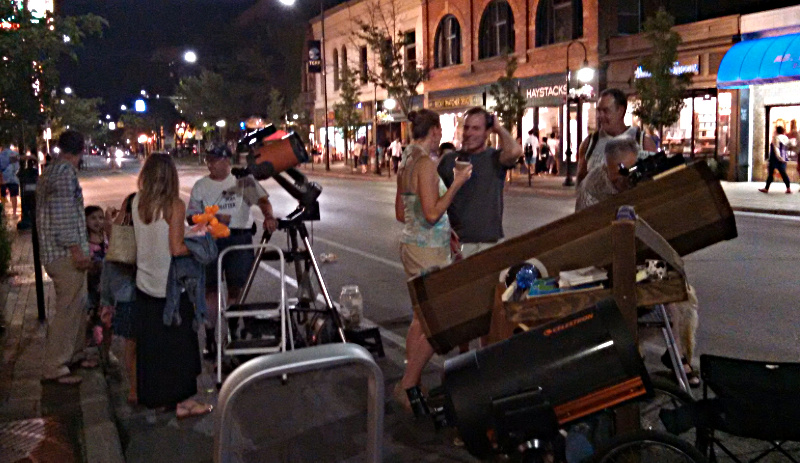
After Friday Night Live was over Saturn was visible until about 11 p.m. Credit: Bob Moler.
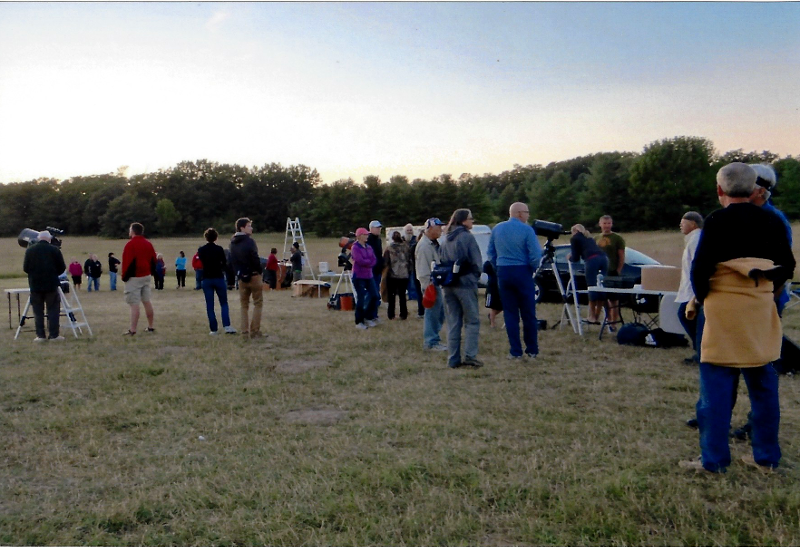
Star Party at the Sleeping Bear Dunes National Lakeshore, Thoreson Farm August 2013. Credit Eileen Carlisle.
07/20/2018 – Ephemeris – Two astronomy events this weekend
Ephemeris for Friday, July 20th. Today the Sun will be up for 15 hours and 5 minutes, setting at 9:21, and it will rise tomorrow at 6:17. The Moon, 1 day past first quarter, will set at 1:57 tomorrow morning.
There are two astronomy events in the Grand Traverse region this weekend, starting tonight with a twilight talk and a star party at the Betsie Valley District Library in Thompsonville. It starts at 8:30 p.m. with a talk about Mars throughout history and how it has fascinated astronomers and the public alike through the ages. After which Jupiter and Saturn will be visible. If cloudy, the talk will go on as scheduled, though the observing part will be rescheduled to a later date. Tomorrow, Saturday there, will be viewing at the Northwestern Michigan College’s Rogers Observatory starting at 9 p.m. Jupiter and Saturn will be featured there too. The Observatory is located south of Traverse City on Birmley road.
The times given are for the Traverse City/Interlochen area of Michigan. They may be different for your location.
Addendum
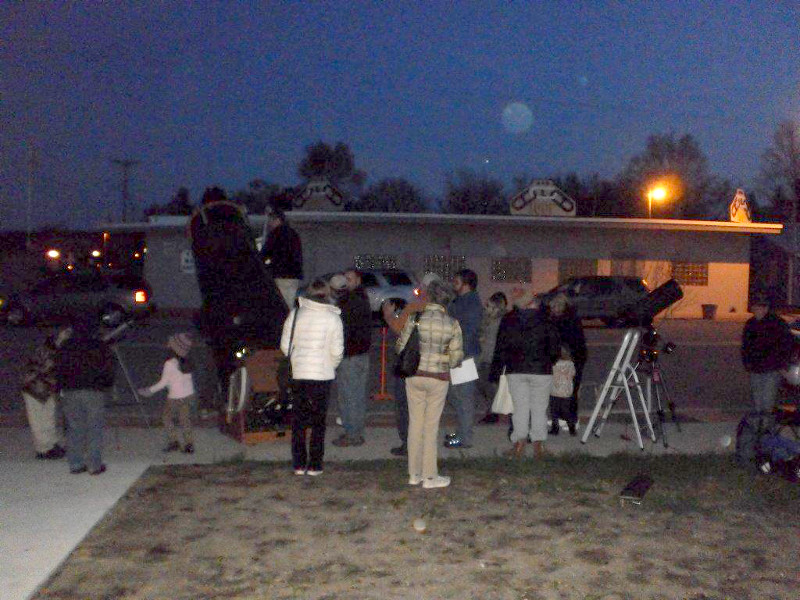
A group of folks out to see the planets with the member’s and society’s telescopes. Credit staff of the Betsie Valley District Library.
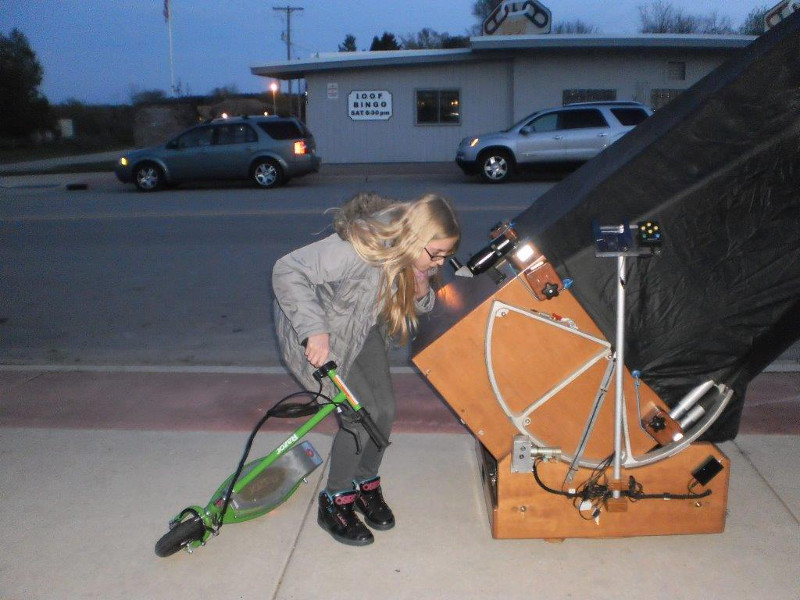
Scooter girl checking out the view through the rear finder of the society’s 25″ “Dobinator”. Credit staff of the Betsie Valley District Library.
05/10/2018 – Ephemeris – Berenice’s Hair
Ephemeris for Thursday, May 10th. The Sun rises at 6:20. It’ll be up for 14 hours and 38 minutes, setting at 8:58. The Moon, 3 days past last quarter, will rise at 4:42 tomorrow morning.
High in the southeast at 10 p.m. is a tiny and faint constellation of Coma Berenices, or Berenice’s hair. In it are lots of faint stars arrayed to look like several strands of hair. The whole group will fit in the field of a pair of binoculars, which will also show many more stars. The hank of hair was supposed to belong to Berenice, Queen of Egypt, of the 3rd century BCE. Coma Berenices is the second closest star cluster to us at only 250 light years away, after the Hyades, the face of Taurus the bull now setting in the west. It’s in an odd spot for a galactic star cluster, that’s supposed to lie in the plane of the Milky Way. It actually lies at the galactic pole. That’s an illusion because it’s so close to us. It’s still really in the plane of the Milky Way.
The times given are for the Traverse City/Interlochen area of Michigan. They may be different for your location.
Addendum
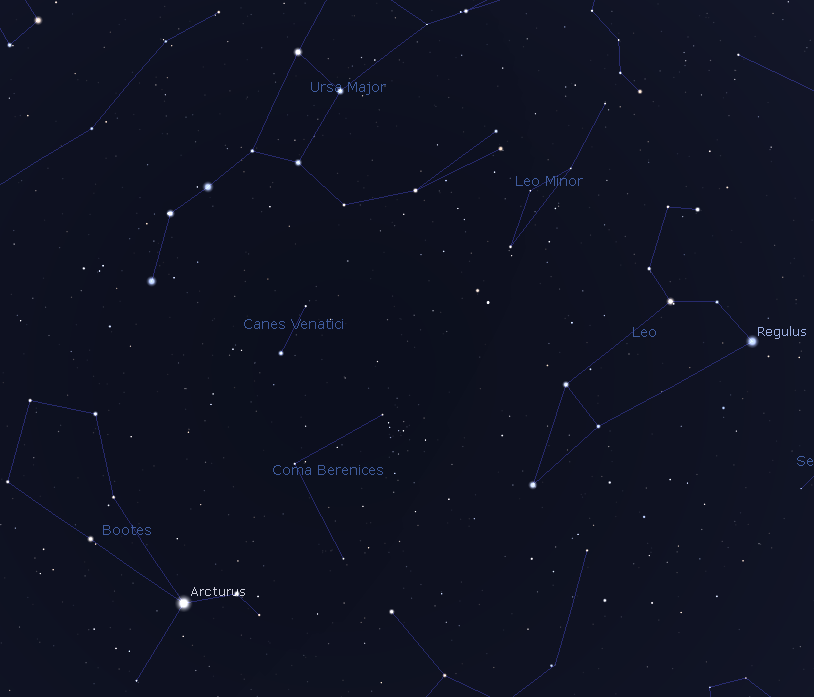
Coma Berenices finder chart for 10 p.m. May 10, 2018. Created using Stellarium.
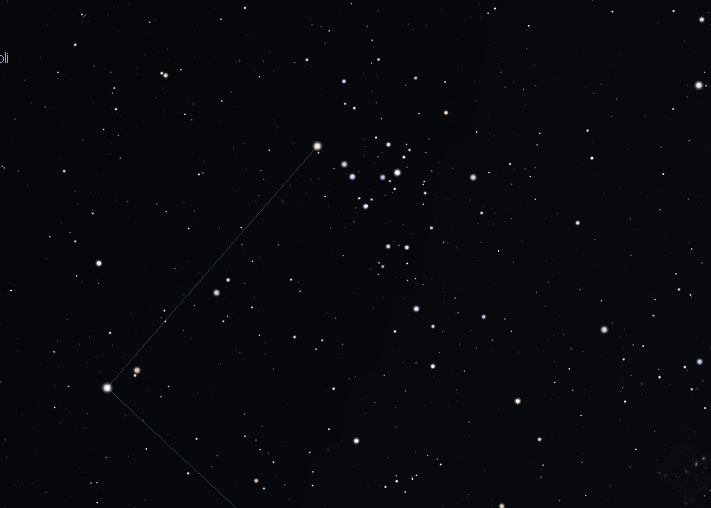
Coma Berenices as it might look in a pair of binoculars. Telescopes are too powerful. Created using Stellarium.
02/09/2018 – Ephemeris – Morning planet high jinx
Ephemeris for Friday, February 9th. The Sun will rise at 7:51. It’ll be up for 10 hours and 11 minutes, setting at 6:02. The Moon, 2 days past last quarter, will rise at 4:05 tomorrow morning.
This past Wednesday morning the Moon passed Jupiter, Earlier this morning the Moon passed north of Mars, and on Sunday morning Saturn will appear south of The Moon. There is a once in about 2 year event, that is red Mars passing Antares, the red giant star in Scorpius, one of the easiest constellations to spot because it actually resembles a scorpion. The name Antares means “Rival of Mars” because they have the same color: Ant meaning anti and Ares is the Greek god of war and counterpart of the Roman god Mars. Mars will pass Antares on average of
every 22 ½ months, its period around the Sun. Since we are viewing it from a moving Earth, it varies. Mars will pass Antares next on January 19th, 2020.
The times given are for the Traverse City/Interlochen area of Michigan. They may be different for your location.
Addendum
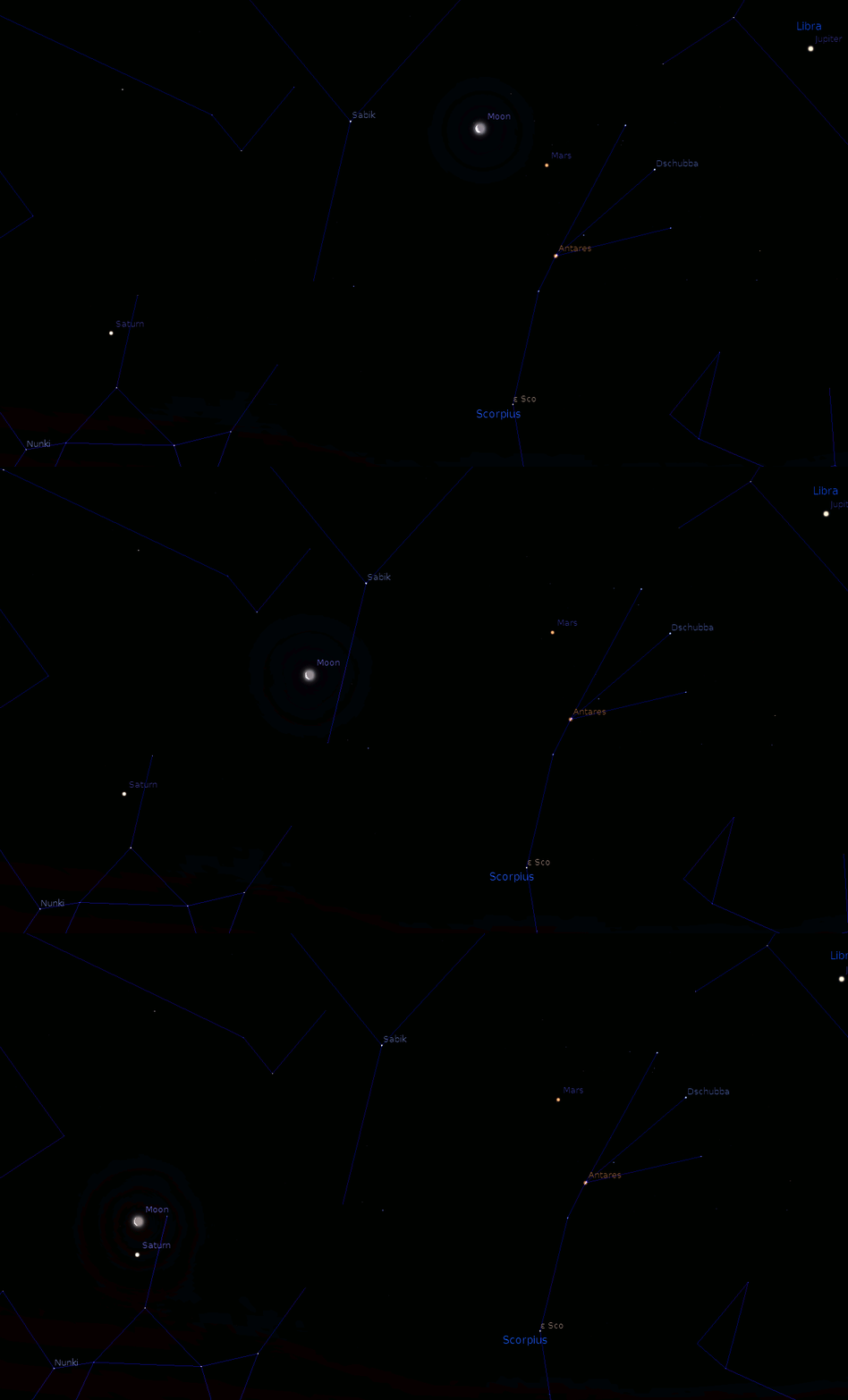
Morning planets and the Moon at 7 a.m. on the mornings of February 9, 10 and 11, 2018. See Mars changing position compared to Antares. Click on image to enlarge. Created using Stellarium and GIMP.
11/22/2017 – Ephemeris – A look at the bright planets for Thanksgiving week
Ephemeris for Wednesday, November 22nd. The Sun will rise at 7:48. It’ll be up for 9 hours and 19 minutes, setting at 5:08. The Moon, half way from new to first quarter, will set at 8:39 this evening.
Let’s take our weekly look at the bright planets. Mercury is briefly visible in binoculars in the southwest in the evening, setting at 6:11 p.m., and will reach it’s greatest elongation from the Sun tomorrow evening. Saturn is sinking low in the southwestern sky. Saturn’s rings are still spectacular in telescopes, but since Saturn is so low in the sky the thick atmosphere makes Saturn fuzzy and seemingly to go in and out of focus. Saturn will set at 6:49 p.m. Tomorrow in the morning sky, Mars, heading away from the Sun will rise in the east at 4:11 a.m., Jupiter, also moving away from the Sun, will rise at in the east-southeast at 5:54 a.m., leaving Venus behind after their conjunction 9 days ago, which will rise at 6:47 a.m..
The times given are for the Traverse City/Interlochen area of Michigan. They may be different for your location.
Addendum
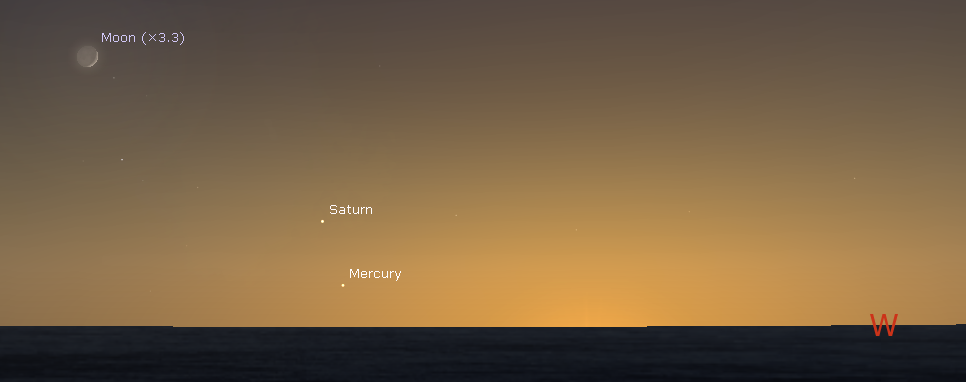
Mercury, Saturn and the Moon at 5:45 p.m., a bit more than a half hour after sunset, November 22, 2017. Click on the image to enlarge. Created using Stellarium.
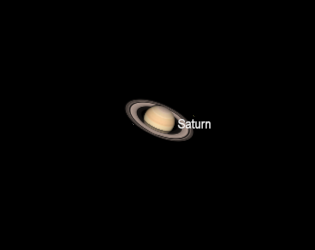
Saturn as it might be seen in a telescope tonight. Created using Cartes du Ciel (Star Charts).
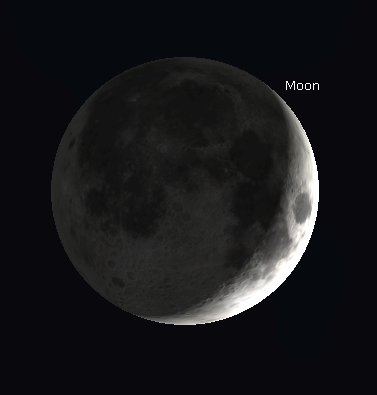
The Moon as it might be seen tonight. Created using Stellarium.
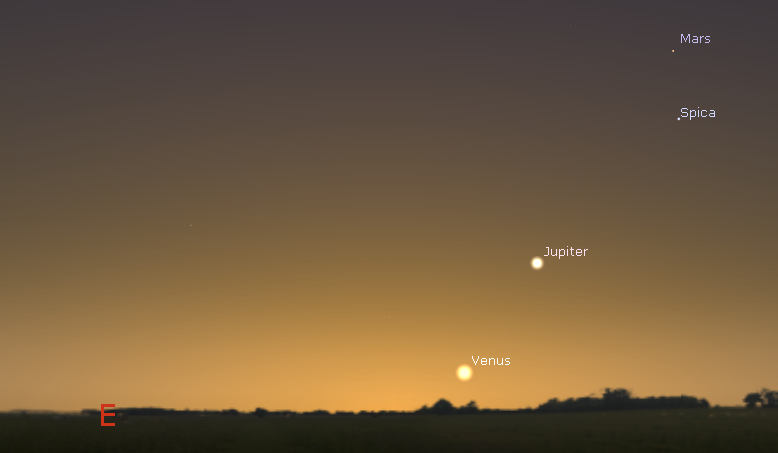
The morning planets Mars, Jupiter and Venus at 7:15 a.m. November 23, 2017, about a half hour before sunrise on a really flat horizon. Created using Stellarium.
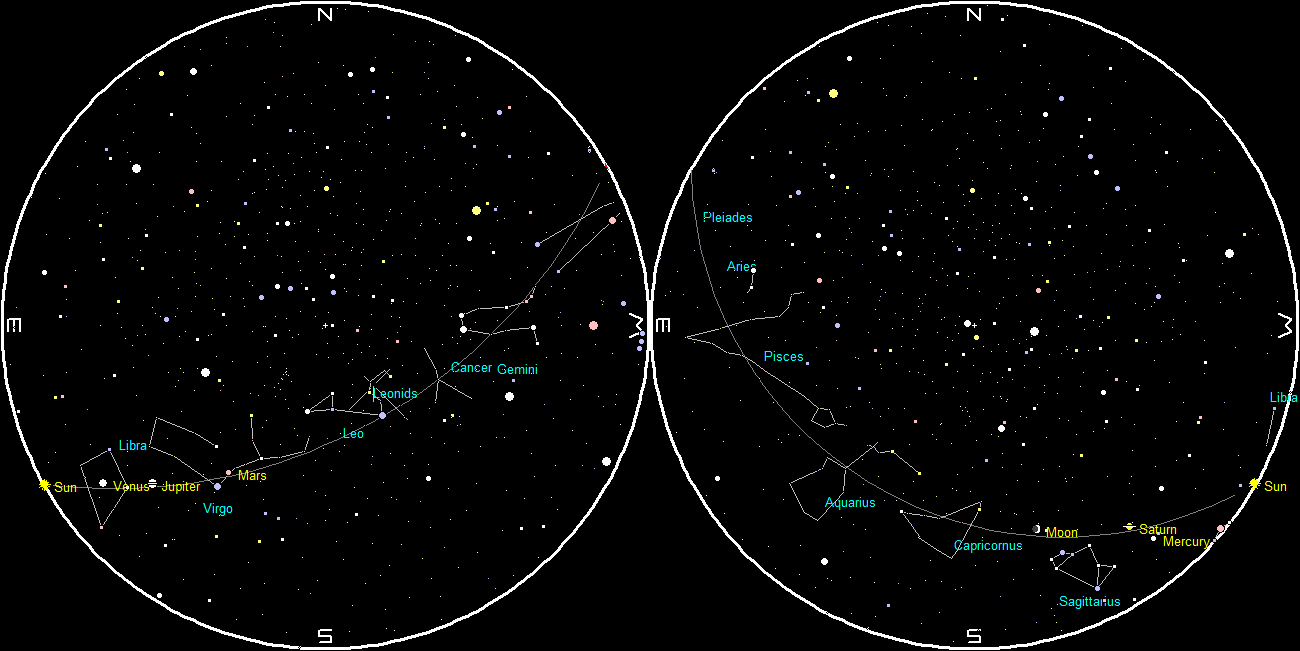
Planets at sunset and sunrise of a single night starting with sunset on the right on November 22, 2017. The night ends on the left with sunrise on the 22nd. Click on the image to enlarge. Created using my LookingUp program.
11/10/2017 – Ephemeris – The North Taurid Meteors are reaching peak this weekend
Ephemeris for Friday, November 10th. The Sun will rise at 7:32. It’ll be up for 9 hours and 46 minutes, setting at 5:19. The Moon, at last quarter today, will rise at 12:07 tomorrow morning.
One of the little known meteor showers for most of us are the North and South Taurid meteor showers. The shower that will reach peak this weekend is the North Taurids. They may show only 5 an hour when their radiants are overhead, but they are reported to be very bright. The radiant, the place where the meteors will appear to come from is just south of the Pleiades, will be up just about all night. Saturday night the Moon will rise at 1:15 a.m. Sunday night it will rise at 2:21 a.m. Both Taurid meteor showers are thought to be related to Encke’s Comet, the periodic comet with a period of only 3.3 years, the shortest known. A posting on Space.com about this years shower talked about the possibility that one of these meteorites might reach the ground.
Space.com has an excellent article about the Taurid meteor showers: https://www.space.com/34587-taurid-meteor-shower-guide.html
The times given are for the Traverse City/Interlochen area of Michigan. They may be different for your location.
Addendum
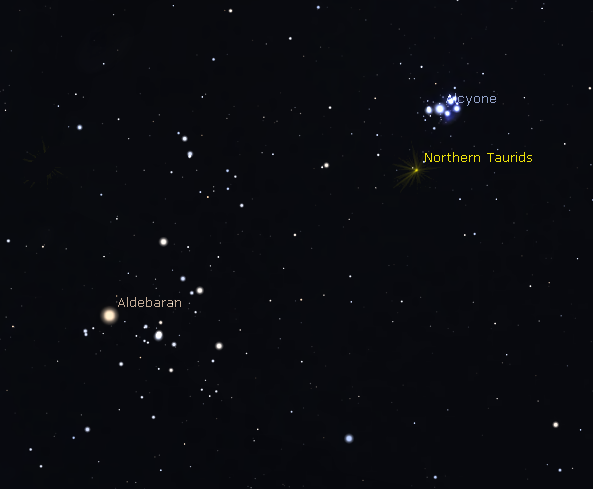
Northern Taurid meteor radiant near the Pleiades in Taurus the bull. Note the face of Taurus, the letter V or stars and Aldebaran. The stars in the face without Aldebaran is a star cluster called the Hyades. Created using Stellarium.
07/28/2017 – Ephemeris – A Sun ‘n Star party tomorrow at the Sleeping Bear Dunes National Lakeshore
Ephemeris for Friday, July 28th. The Sun rises at 6:24. It’ll be up for 14 hours and 47 minutes, setting at 9:12. The Moon, 2 days before first quarter, will set at 12:18 tomorrow morning.
Tomorrow afternoon and evening will be what we call a Sun & Star Party at the Sleeping Bear Dunes National Lakeshore. This event will be at the Dune Climb. From 4 to 6 p.m., the Sun will be featured using two types of telescopes, one showing the sun’s photosphere in what we call white light, and another showing the chromosphere above it in the light of hydrogen giving a completely different view. At 6 p.m. Professor Jerry Dobek of Northwestern Michigan College and the college’s Rogers Observatory will be at the Visitors Center in Empire talking about dark skies and how to promote sensible lighting. Starting at 9 p.m. will be a star party, actually really a planet party, viewing the Jupiter early, plus Saturn, and the Moon.
The times given are for the Traverse City/Interlochen area of Michigan. They may be different for your location.
06/19/2017 – Ephemeris – The hero Hercules in the stars
Ephemeris for Monday, June 19th. Today the Sun will be up for 15 hours and 33 minutes, setting at 9:30, and it will rise tomorrow at 5:57. The Moon, 2 days past last quarter, will rise at 3:33 tomorrow morning.
The greatest Greek hero of all, Hercules, gets a dim group of stars on the border between the spring and summer stars. At 11 p.m. Hercules is high in the eastern sky. It is located above and right of the bright star, Vega, also in the east. Hercules’ central feature is a keystone shaped box of stars, called the Keystone, which represents the old boy’s shorts. From each top corner extend lines of stars that are his legs, from the bottom stars, the rest of his torso and arms extend. So in one final indignity he’s upside down in our sky. Just below and right of the topmost star of the keystone is what looks like a fuzzy star in binoculars or small telescope. It is the Great Hercules Globular Star Cluster, also known as M13, home to a million stars.
The times given are for the Traverse City/Interlochen area of Michigan. They may be different for your location.
Addendum
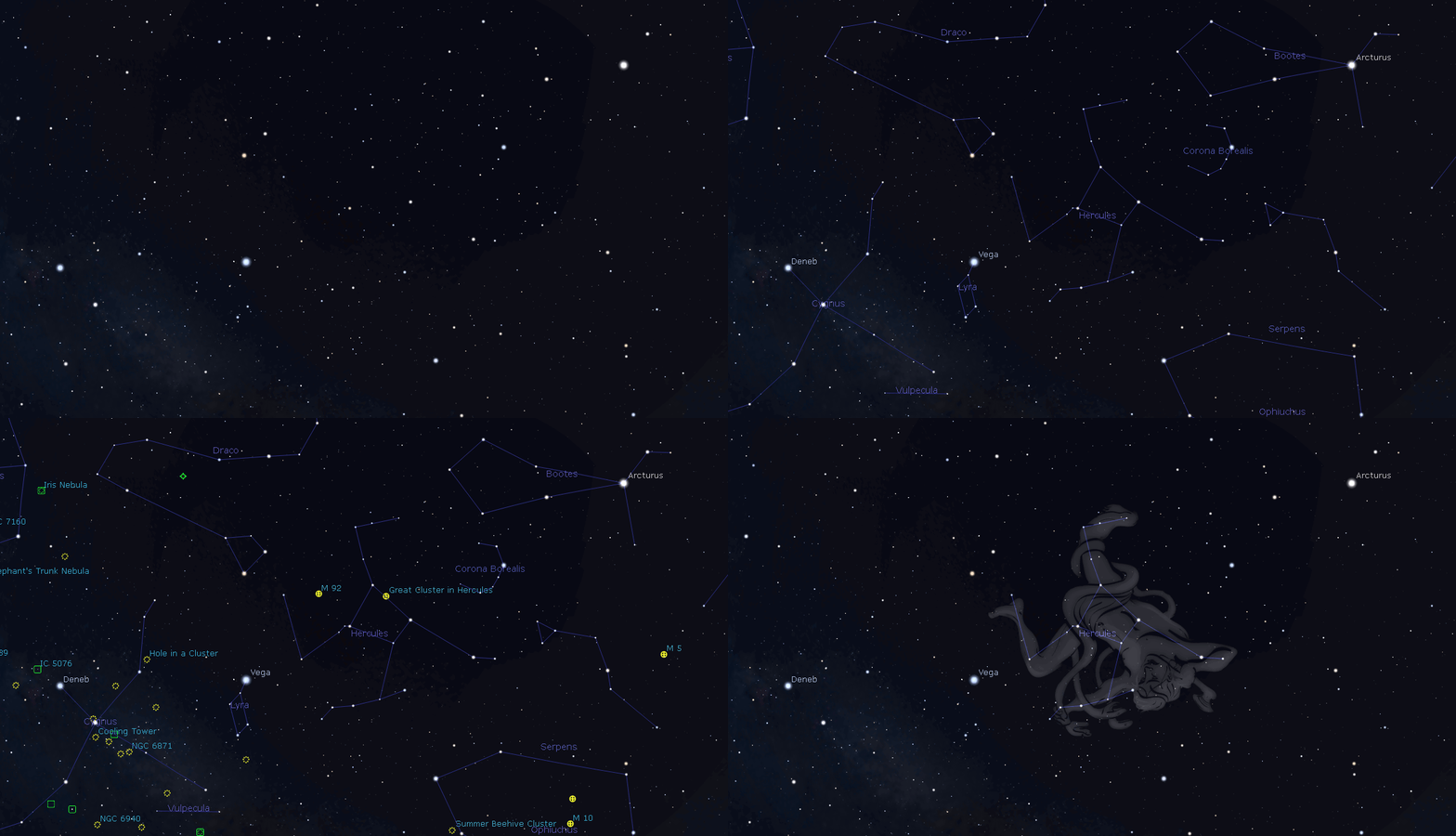
Hercules animation showing neighboring stars, constellation outlines, deep sky objects, and constellation art for Hercules. Created using Stellarium. Click on image to enlarge.
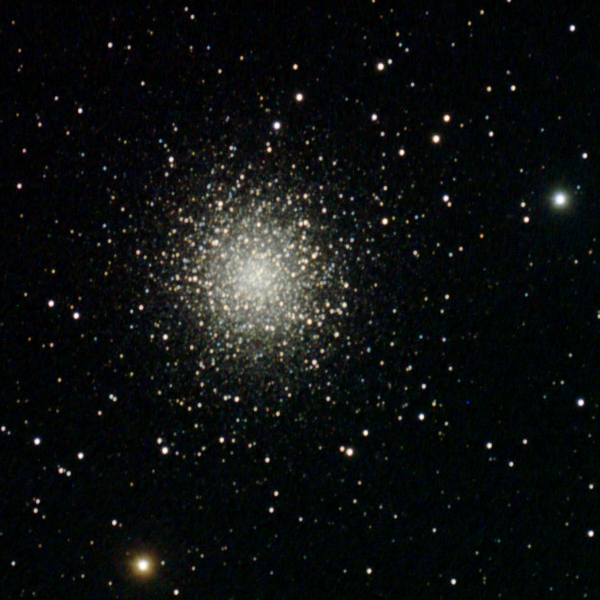
M13, the Great Globular Star Cluster in Hercules. Credit: Scott Anttila
 Bob Moler's Ephemeris Blog