06/06/2022 – Ephemeris – In June we spend our evenings in the twilight zone
This is Ephemeris for Monday, June 6th. Today the Sun will be up for 15 hours and 27 minutes, setting at 9:25, and it will rise tomorrow at 5:57. The Moon, 1 day before first quarter, will set at 2:28 tomorrow morning
We spend our evenings after sunset during the months of June and July, pretty much in the twilight zone. Actually, it’s just twilight. There are three twilight periods: Civil, Nautical and Astronomical. In the evening, civil twilight lasts from sunset to when the Sun drops to 6 degrees below the horizon. The scene around is still quite bright, but car headlights still need to be on. Nautical twilight lasts until the Sun is 12 degrees below the horizon. Bright stars and the horizon are visible for sextant use. After that is astronomical twilight until the Sun is 18 degrees below the horizon, when the stars become more and more numerous. After that it’s officially dark, Moon permitting. This time of year we’re lucky to get three and a half hours of darkness.
The astronomical event times given are for the Traverse City/Interlochen area of Michigan (EDT, UT – 4 hours). They may be different for your location.
Addendum
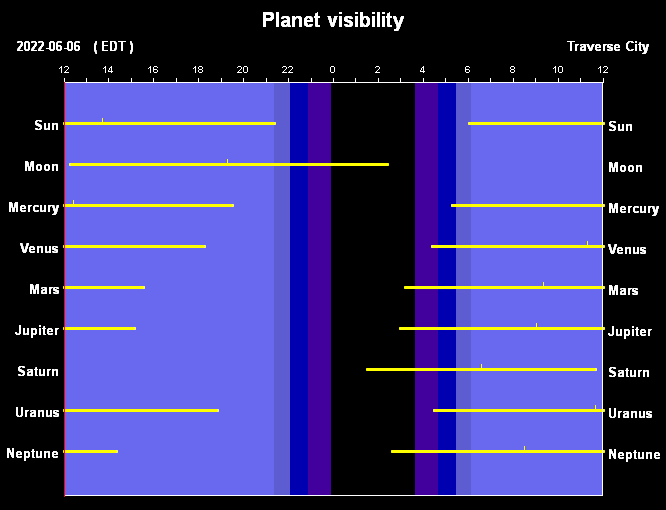
Daylight, twilight, and dark example for June 6, 2022. This graph is centered on midnight. Light blue is daylight, while the three darker shades of blue denote the three twilight periods of civil, nautical and astronomical. The yellow lines show when the Sun, Moon and planets are visible. Dark of night is relegated only to the morning hours, thanks to the season, daylight saving time and our location 43 minutes west of our standard time meridian. The chart is produced by the app Cartes du Ciel (Sky Charts).
06/03/2022 – Ephemeris – GTAS Astronomy meeting tonight explores women of science
This is Bob Moler with Ephemeris for Friday, June 3rd. Today the Sun will be up for 15 hours and 23 minutes, setting at 9:23, and it will rise tomorrow at 5:58. The Moon, halfway from new to first quarter, will set at 1:11 tomorrow morning.
Tonight at 9 pm, the Grand Traverse Astronomical Society will have an in-person meeting at Northwestern Michigan College’s Rogers Observatory. The meeting will also be available via Zoom. The program will be presented by Becky Shaw. Her presentation will be An Encore to the Women of Science. Becky’s programs have always feature historic women of science, from Hypatia of ancient Alexandria to Cecilia Payne’s historic discovery of the elemental makeup of stars 100 years ago. If it’s clear, there will be a star party following the meeting. The observatory is located south of Traverse City off Birmley Road, between Garfield and Keystone roads. A Zoom link will be available at gtastro.org before the meeting.
The astronomical event times given are for the Traverse City/Interlochen area of Michigan (EDT, UT – 4 hours). They may be different for your location.
Addendum
This meeting will mark the 40th anniversary of the Grand Traverse Astronomical Society. I hear someone might be bringing 40 cupcakes to celebrate.
Three of the female astronomers and planetary scientists I follow on Twitter are:
Alessondra Springmann @sondy, Planetary scientist
Dr. Katie Mack, @AstroKatie, Theoretical astrophysicist, Author of The End of Everything (Astrophysically Speaking)
Dr Carolyn Porco, @carolynporco, Planetary scientist
There are lots more in all the science disciplines.
06/02/2022 – Ephemeris – What’s an ephemeris?
This is Ephemeris for Thursday, June 2nd. Today the Sun will be up for 15 hours and 22 minutes, setting at 9:22, and it will rise tomorrow at 5:59. The Moon, 3 days past new, will set at 12:34 tomorrow morning.
Yesterday, I was too busy on this program to mention that that program was the 47th anniversary of the Ephemeris program and was embarking on its 48th orbit of the Sun. At this juncture, you might be wondering: What’s an ephemeris? According to Wikipedia: Quote “In astronomy and celestial navigation, an ephemeris (plural: ephemerides; from Latin ephemeris, meaning ‘diary’, from the Greek, … meaning ‘diary, or journal’) gives the positions of… astronomical objects… at a given time or times. Historically, positions were given as printed tables of values, given at regular intervals of date and time.” enquote. My tables are now databases which I generate for the year during the prior December from published algorithms. I will show all on my blog today: (You are already here). I used to have to interpolate values from printed ephemerides for the first 5 or so years of the program.
The astronomical event times given are for the Traverse City/Interlochen area of Michigan (EDT, UT – 4 hours). They may be different for your location.
Addendum
An Ephemeris Example – Comet 73P-B/Schwassmann-Wachmann 3 nuclear fragment B
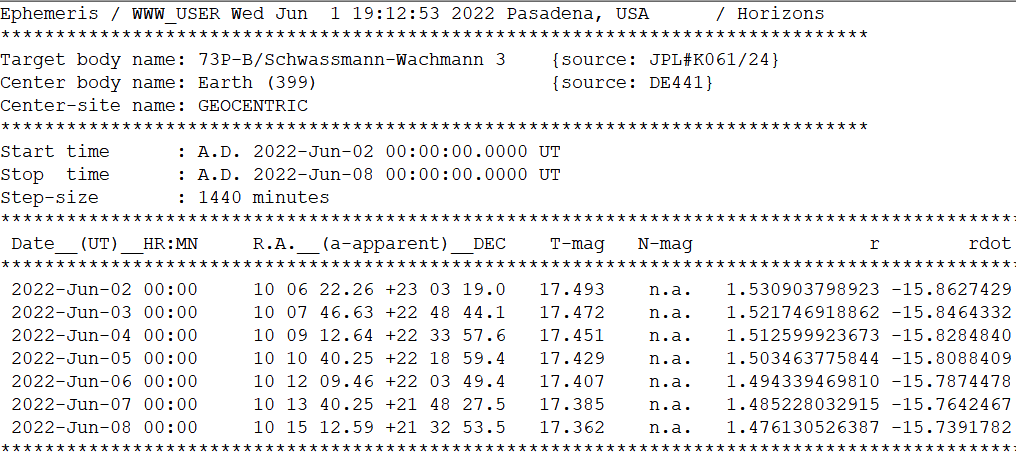
Here’s an ephemeris for Comet Schwassmann-Wachmann 3 nuclear fragment B from the Jet Propulsion Laboratory’s (JPL) Horizons system. The listing has been truncated for width. Click on it to enlarge it.
R.A. is right ascension – East-west position in the sky, like longitude on the Earth, only it’s in hours, minutes and seconds. One hour = 15 degrees.
DEC is declination – North-south position, in the sky, exactly like latitude on the Earth in degrees, minutes and seconds.
(a-apparent) means that the above coordinates are based on where the vernal equinox point in the sky is at that date and time, and for the observer’s location. Since I didn’t specify one, it’s the center of the Earth.
T-mag – Predicted total magnitude of the comet. Magnitudes are like golf scores. The higher magnitude, the dimmer the object. It’s really, really dim.
N-mag – Predicted magnitude of the nucleus. No estimate is made here.
r – Distance from the Sun in terms of Astronomical Units (AU). 1 AU is Earth’s mean distance from the Sun.
rdot – The change in r. It’s in kilometers per second. If negative, it’s moving toward the Sun.
For more information on how I produce ephemerides for this program, go here: https://bobmoler.wordpress.com/2019/01/22/
06/01/2022 – Ephemeris – Let’s search for the naked-eye planets for this week
This is Ephemeris for Wednesday, June 1st. Today the Sun will be up for 15 hours and 21 minutes, setting at 9:21, and it will rise tomorrow at 5:59. The Moon, 2 days past new, will set at 11:49 this evening.
Let’s search for the naked-eye planets for this week. All the naked-eye planets are in the morning sky, although Mercury is too close to the Sun to be seen, and might just be visible low in the east-northeast after 5 am around mid-month. That’s at least for those as far north as we are. At 5 am tomorrow the planets will be spread out from brilliant Venus low in the east to Saturn higher in the south-southeast. To the right of Venus, tomorrow morning, in the east-southeast are Mars and Jupiter. Mars is quite a bit dimmer than Jupiter. All will be in line sloping to the upper right with Saturn all by its lonesome in the south-southeast. Though Mercury will enter the evening sky first, it won’t have great visibility. Saturn will enter the evening sky August 14th.
The astronomical event times given are for the Traverse City/Interlochen area of Michigan (EDT, UT – 4 hours). They may be different for your location.
Addendum
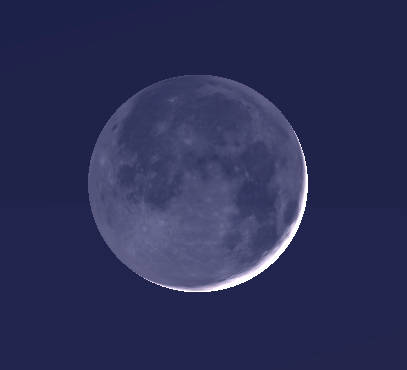
The two-day-old Moon as it might be seen in binoculars tonight, June 1, 2022. Earth shine might illuminate the Moon’s night side. Created using Stellarium and GIMP.
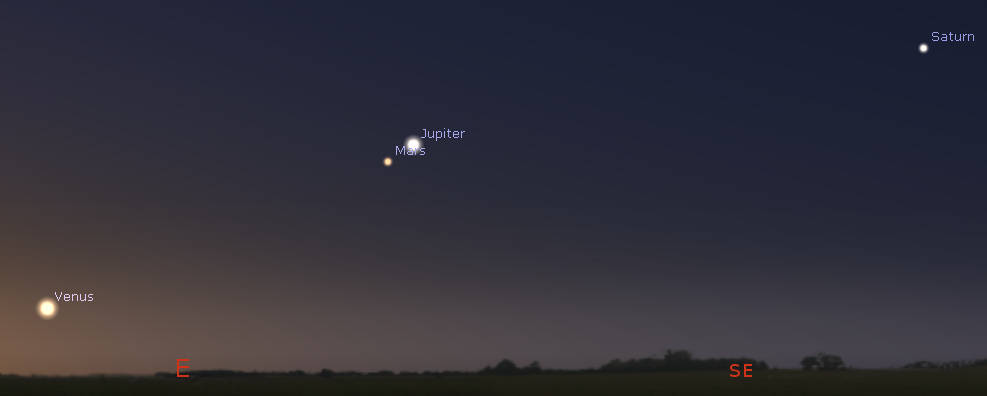
Morning planets at 5 am tomorrow morning, June 2, 2022. Click on the image to enlarge it. The span of the planets from Venus to Saturn is 70 degrees. Click on the image to enlarge it. Created using Stellarium.
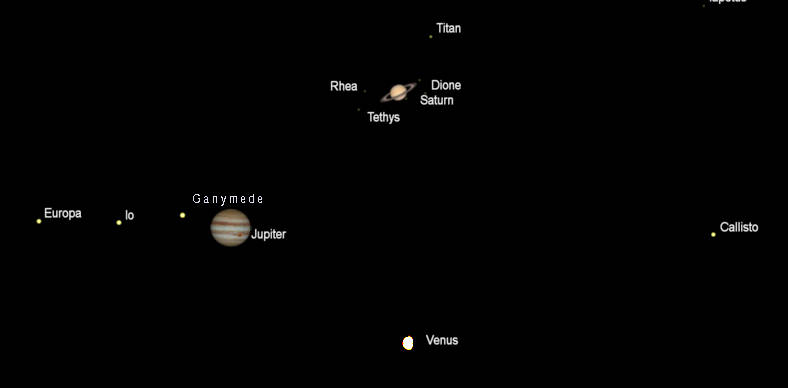
Views of Venus, Jupiter, and Saturn (north up) as they would be seen in a small telescope, with the same magnification, tomorrow morning at 5:00 am, June 2, 2022. I do not show planets less than 10 seconds of arc in diameter. Apparent diameters: Venus 13.58″, 78.3% illuminated; Saturn 17.40″, its rings 40.54″; Jupiter 37.49″. Mars is not shown, its apparent diameter is 6.46″ and is 87.2% illuminated. The ” symbol means seconds of arc (1/3600th of a degree.) Created using Cartes du Ciel (Sky Charts), planet information from Stellarium.
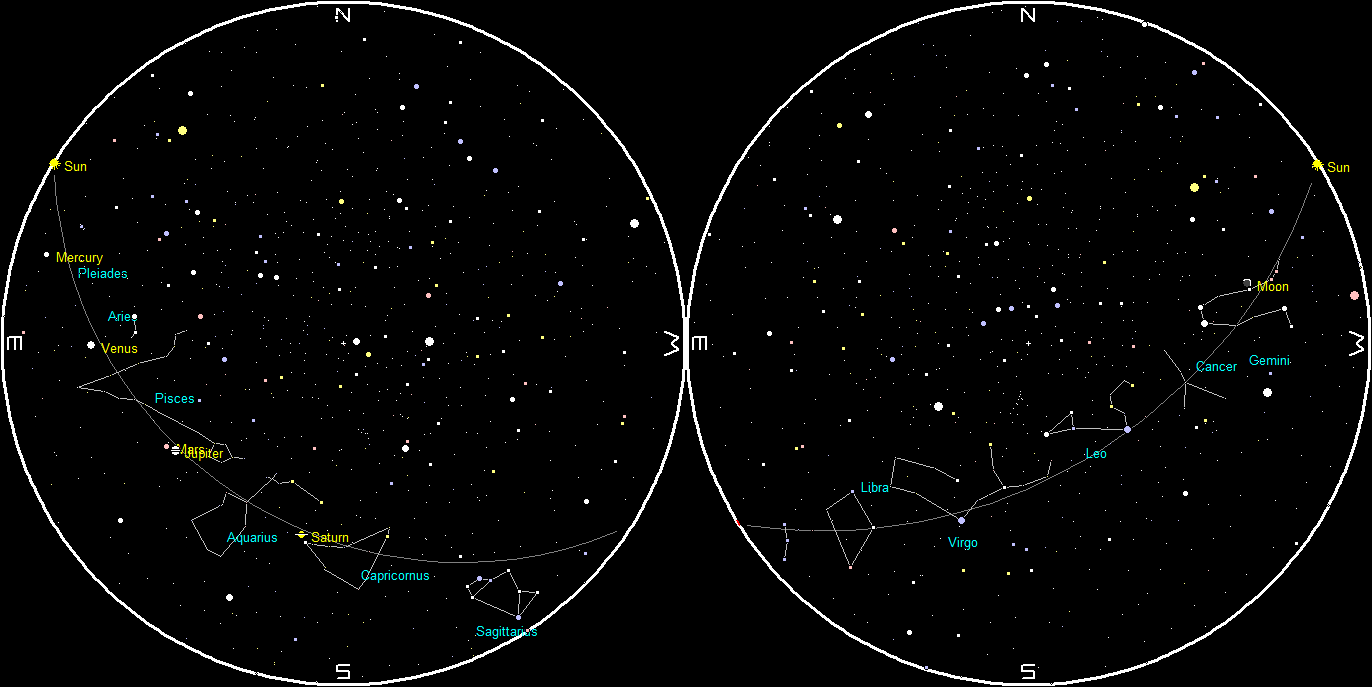
The naked-eye planets and the Moon at sunset and sunrise on a single night, starting with sunset on the right on June 1, 2022. The night ends on the left with sunrise on the 2nd. Notice that all the naked-eye planets are in the morning sky now. Click on the image to enlarge it. Created using my LookingUp program.
Update on the Tau Herculid meteor shower of May 31st.
The meteor shower was rather weak. I saw one during an hour and a half of observing, slowly moving over the Big Dipper. The sky was “clear”, but there was a haze to it. It definitely wasn’t crystal clear. I’ve heard from others who had a bit more success.
05/31/2022 – Ephemeris – Let’s preview the sunny month of June
This is Ephemeris for Tuesday, May 31st. Today the Sun will be up for 15 hours and 19 minutes, setting at 9:20, and it will rise tomorrow at 6:00. The Moon, 1 day past new, will set at 10:56 this evening.
Let’s preview June skies. There will be a lot of sun in June and very little night. The daylight hours will increase a bit from 15 hours and 21 minutes Tomorrow to 15 hours and 34 minutes on the 21st, retreating back to 15 hours 31 minutes at month’s end. The altitude of the Sun above the southern horizon at local noon will hover around 68 to 69 degrees. Local noon, when the Sun is actually due south, will occur at about 1:43 p.m. Summer begins on the 21st at 5:14 am, when the Sun reaches its farthest north. The actual amount of nighttime will be quite short, mostly due to the length of daylight, but also because twilight lasts much longer than average because the Sun sets at a shallow angle. On the 21st, there’s theoretically only 3 ½ hours of total darkness if the Moon wasn’t up.
The astronomical event times given are for the Traverse City/Interlochen area of Michigan (EDT, UT – 4 hours). They may be different for your location.
Addendum
June Evening Star Chart
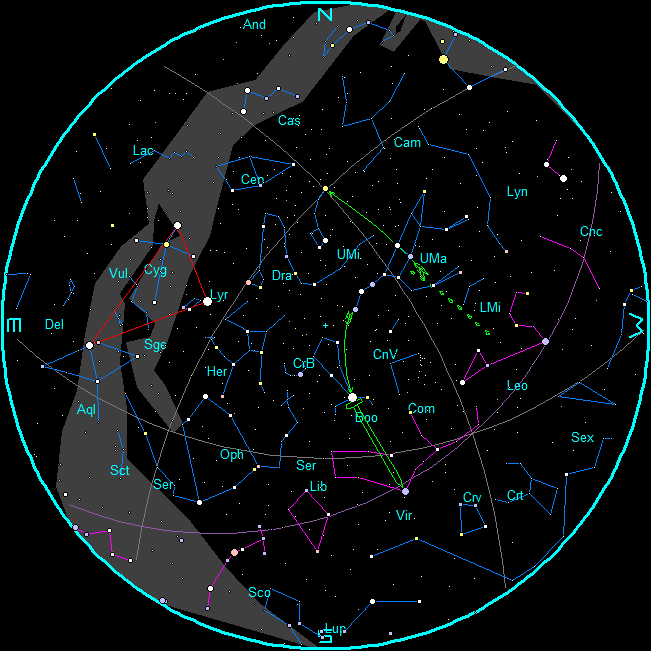
Star Chart for June 2022 (11 p.m. EDT June 15, 2022). Created using my LookingUp program. Click on image to enlarge.
The planets and stars are plotted for the 15th at 11 p.m. EDT in the evening and 4 a.m. for the morning chart. These are the chart times. Note that Interlochen/Traverse City is located approximately 45 minutes behind our time meridian, West 75° longitude. (An hour 45 minutes behind our daylight saving time meridian during EDT). To duplicate the star positions on a planisphere you may have to set it to 1 hour 45 minutes earlier than the current time.
Note the chart times of 11 p.m. and 4 a.m. are for the 15th. For each week before the 15th, add ½ hour (28 minutes if you’re picky). For each week after the 15th, subtract ½ hour, or 28 minutes. The planet positions are updated each Wednesday on this blog. For planet positions on dates other than the 15th, check the Wednesday planet posts on this blog for weekly positions.
June Morning Star Chart
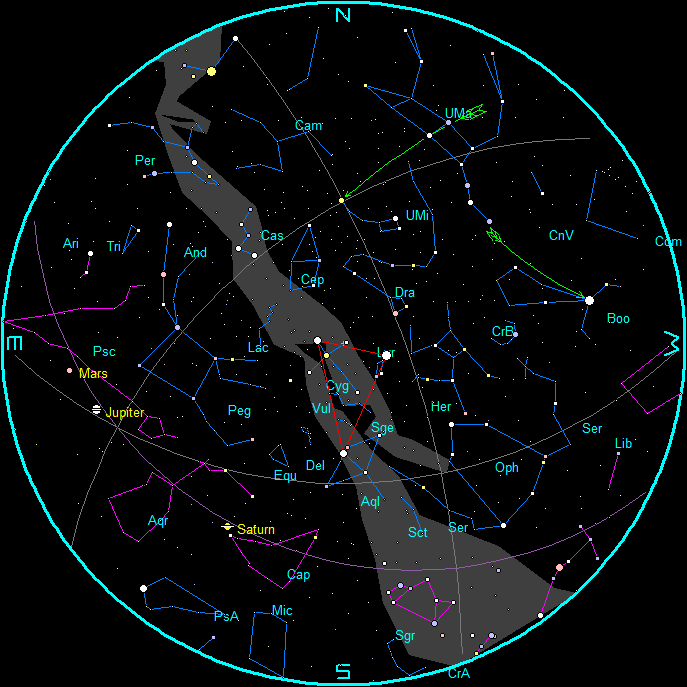
Star Chart for June mornings, 2022 (4 am EDT, June 15, 2022). Created using my LookingUp program. Click on image to enlarge.
For a list of constellation names to go with the abbreviations, click here.
- Pointer stars at the front of the bowl of the Big Dipper point to Polaris, the North Star.
- Leaky dipper drips on Leo
- Follow the arc of the handle of the Big Dipper to the star Arcturus, and
- Extend like a spike to Spica,
Twilight Limits, Nautical and Astronomical
| EDT | |||||||
| Morning | Twilight | Evening | Twilight | Dark | Night | Moon | |
| Date | Astro. | Nautical | Nautical | Astro. | Start | End | Illum. |
| 2022-06-01 | 3h44m | 4h42m | 22h47m | 23h46m | 23h49m | 3h44m | 0.07 |
| 2022-06-02 | 3h42m | 4h42m | 22h48m | 23h47m | – | 3h42m | 0.12 |
| 2022-06-03 | 3h41m | 4h41m | 22h49m | 23h49m | 0h34m | 3h41m | 0.19 |
| 2022-06-04 | 3h40m | 4h40m | 22h50m | 23h50m | 1h11m | 3h40m | 0.27 |
| 2022-06-05 | 3h39m | 4h39m | 22h51m | 23h52m | 1h41m | 3h39m | 0.36 |
| 2022-06-06 | 3h38m | 4h39m | 22h52m | 23h53m | 2h07m | 3h38m | 0.46 |
| 2022-06-07 | 3h37m | 4h38m | 22h53m | 23h54m | 2h29m | 3h37m | 0.56 |
| 2022-06-08 | 3h36m | 4h38m | 22h54m | 23h56m | 2h49m | 3h36m | 0.66 |
| 2022-06-09 | 3h35m | 4h37m | 22h55m | 23h57m | 3h09m | 3h35m | 0.76 |
| 2022-06-10 | 3h34m | 4h37m | 22h55m | 23h58m | 3h29m | 3h34m | 0.85 |
| 2022-06-11 | 3h34m | 4h37m | 22h56m | 23h59m | – | – | 0.92 |
| 2022-06-12 | 3h33m | 4h36m | 22h57m | 0h00m | – | – | 0.98 |
| 2022-06-13 | 3h33m | 4h36m | 22h57m | 0h01m | – | – | 1 |
| 2022-06-14 | 3h32m | 4h36m | 22h58m | 0h02m | – | – | 0.99 |
| 2022-06-15 | 3h32m | 4h36m | 22h59m | 0h02m | – | – | 0.95 |
| 2022-06-16 | 3h32m | 4h36m | 22h59m | 0h03m | – | – | 0.89 |
| 2022-06-17 | 3h32m | 4h36m | 22h59m | 0h04m | 0h04m | 0h18m | 0.81 |
| 2022-06-18 | 3h32m | 4h36m | 23h00m | 0h04m | 0h04m | 0h56m | 0.71 |
| 2022-06-19 | 3h32m | 4h36m | 23h00m | 0h05m | 0h05m | 1h25m | 0.6 |
| 2022-06-20 | 3h32m | 4h36m | 23h00m | 0h05m | 0h05m | 1h49m | 0.49 |
| 2022-06-21 | 3h32m | 4h36m | 23h01m | 0h05m | 0h05m | 2h10m | 0.39 |
| 2022-06-22 | 3h32m | 4h37m | 23h01m | 0h05m | 0h05m | 2h29m | 0.29 |
| 2022-06-23 | 3h33m | 4h37m | 23h01m | 0h05m | 0h05m | 2h48m | 0.21 |
| 2022-06-24 | 3h33m | 4h37m | 23h01m | 0h05m | 0h05m | 3h09m | 0.13 |
| 2022-06-25 | 3h34m | 4h38m | 23h01m | 0h05m | 0h05m | 3h32m | 0.08 |
| 2022-06-26 | 3h34m | 4h38m | 23h01m | 0h05m | 0h05m | 3h34m | 0.03 |
| 2022-06-27 | 3h35m | 4h39m | 23h01m | 0h05m | 0h05m | 3h35m | 0.01 |
| 2022-06-28 | 3h36m | 4h39m | 23h01m | 0h04m | 0h04m | 3h36m | 0 |
| 2022-06-29 | 3h37m | 4h40m | 23h00m | 0h04m | 0h04m | 3h37m | 0.01 |
| 2022-06-30 | 3h38m | 4h41m | 23h00m | 0h03m | 0h03m | 3h38m | 0.04 |
The twilight calendar was generated using Cartes du Ciel (Sky Charts), with some corrections.
See my blog post: Twilight Zone for the definitions of the different periods of twilight here: https://bobmoler.wordpress.com/2018/09/27/.
NASA Calendar of Planetary Events
Jun  1  We            Venus: 36.5° W
     1  We   6:32 pm  Moon North Dec.: 26.9° N
     1  We   9:14 pm  Moon Apogee: 406,200 km
     3  Fr   1:42 am  Moon-Pollux: 2.4° N
     4  Sa   3:17 am  Moon-Beehive: 4° S
     7  Tu  10:48 am  First Quarter
    12  Su   6:02 am  Moon Descending Node
    14  Tu   7:52 am  Full Strawberry Moon (Super Moon)
    14  Tu   7:21 pm  Moon Perigee: 357,400 km
    15  We   6:59 am  Moon South Dec.: 26.9° S
    16  Th  10:59 am  Mercury Elongation: 23.2° W
    18  Sa   8:22 am  Moon-Saturn: 4.3° N
    20  Mo  11:11 pm  Last Quarter
    21  Tu   5:14 am  Summer Solstice
    21  Tu   9:31 am  Moon-Jupiter: 2.9° N
    22  We   2:05 pm  Mercury-Aldebaran: 2.9° N
    22  We   2:16 pm  Moon-Mars: 1° N
    22  We   8:53 pm  Venus-Pleiades: 5.7° S
    25  Sa   3:10 am  Moon Ascending Node
    25  Sa   5:27 pm  Moon-Pleiades: 3.9° N
    26  Su   4:11 am  Moon-Venus: 3° S
    28  Tu  10:52 pm  New Moon
    29  We  12:06 am  Moon North Dec.: 26.9° N
    29  We   2:08 am  Moon Apogee: 406,600 km
    30  Th  10:45 pm  Venus-Aldebaran: 4.1° N
Jul  1  Fr            Venus: 29.6° W
Sky Events Calendar by Fred Espenak and Sumit Dutta (NASA’s GSFC),
http://eclipse.gsfc.nasa.gov/SKYCAL/SKYCAL.html.
Sun and Moon Rising and Setting Events
LU                  Ephemeris of Sky Events for Interlochen/TC
June, 2022    Local time zone: EDT
+-----------------------------------------------------------------------+
| DATE |  SUN     SUN  DAYLIGHT|   TWILIGHT*    |MOON  RISE OR    ILLUM |
|      |  RISE    SET    HOURS |  END    START  |PHASE SET** TIME FRACTN|
+=======================================================================+
|Wed  1| 06:00a  09:21p  15:21 | 10:44p  04:37a |      Set  11:49p    6%|
|Thu  2| 05:59a  09:22p  15:22 | 10:45p  04:36a |      Set  12:34a   11%|
|Fri  3| 05:59a  09:23p  15:23 | 10:46p  04:35a |      Set  01:11a   17%|
|Sat  4| 05:58a  09:23p  15:24 | 10:47p  04:35a |      Set  01:41a   25%|
+------+-----------------------+----------------+-----------------------+
|Sun  5| 05:58a  09:24p  15:26 | 10:48p  04:34a |      Set  02:06a   34%|
|Mon  6| 05:58a  09:25p  15:27 | 10:49p  04:33a |      Set  02:28a   44%|
|Tue  7| 05:57a  09:25p  15:28 | 10:50p  04:33a |F Qtr Set  02:49a   54%|
|Wed  8| 05:57a  09:26p  15:29 | 10:51p  04:32a |      Set  03:08a   64%|
|Thu  9| 05:57a  09:27p  15:29 | 10:52p  04:32a |      Set  03:29a   74%|
|Fri 10| 05:57a  09:27p  15:30 | 10:53p  04:31a |      Set  03:52a   83%|
|Sat 11| 05:56a  09:28p  15:31 | 10:53p  04:31a |      Set  04:19a   91%|
+------+-----------------------+----------------+-----------------------+
|Sun 12| 05:56a  09:28p  15:32 | 10:54p  04:31a |      Set  04:54a   97%|
|Mon 13| 05:56a  09:29p  15:32 | 10:55p  04:30a |      Set  05:41a  100%|
|Tue 14| 05:56a  09:29p  15:33 | 10:55p  04:30a |Full  Rise 10:22p  100%|
|Wed 15| 05:56a  09:30p  15:33 | 10:56p  04:30a |      Rise 11:27p   96%|
|Thu 16| 05:56a  09:30p  15:34 | 10:56p  04:30a |      Rise 12:17a   91%|
|Fri 17| 05:56a  09:30p  15:34 | 10:57p  04:30a |      Rise 12:55a   82%|
|Sat 18| 05:56a  09:31p  15:34 | 10:57p  04:30a |      Rise 01:25a   73%|
+------+-----------------------+----------------+-----------------------+
|Sun 19| 05:56a  09:31p  15:34 | 10:57p  04:30a |      Rise 01:49a   62%|
|Mon 20| 05:57a  09:31p  15:34 | 10:58p  04:30a |L Qtr Rise 02:09a   51%|
|Tue 21| 05:57a  09:32p  15:34 | 10:58p  04:30a |      Rise 02:28a   41%|
|Wed 22| 05:57a  09:32p  15:34 | 10:58p  04:31a |      Rise 02:48a   31%|
|Thu 23| 05:57a  09:32p  15:34 | 10:58p  04:31a |      Rise 03:08a   22%|
|Fri 24| 05:58a  09:32p  15:34 | 10:58p  04:31a |      Rise 03:31a   15%|
|Sat 25| 05:58a  09:32p  15:34 | 10:58p  04:32a |      Rise 03:59a    9%|
+------+-----------------------+----------------+-----------------------+
|Sun 26| 05:58a  09:32p  15:33 | 10:58p  04:32a |      Rise 04:32a    4%|
|Mon 27| 05:59a  09:32p  15:33 | 10:58p  04:33a |      Rise 05:13a    1%|
|Tue 28| 05:59a  09:32p  15:32 | 10:58p  04:33a |New   Set  09:44p    0%|
|Wed 29| 06:00a  09:32p  15:32 | 10:58p  04:34a |      Set  10:32p    1%|
|Thu 30| 06:00a  09:32p  15:31 | 10:57p  04:34a |      Set  11:11p    3%|
+-----------------------------------------------------------------------+
* Nautical Twilight
** Moonrise or moonset, whichever occurs between sunrise and sunset
Generated using my LookingUp for DOS program.
05/30/2022 – Ephemeris – There might be a spectacular meteor shower/storm tonight after midnight!
This is Ephemeris for Memorial Day, Monday, May 30th. Today the Sun will be up for 15 hours and 18 minutes, setting at 9:19, and it will rise tomorrow at 6:00. The Moon is new today, and won’t be visible.
Comet Schwassmann-Wachmann 3, SW3 for short began to breakup in 1995, 27 years ago. Two large chunks of the comet’s nucleus and dozens of smaller pieces have been seen. We expect a vast debris field to be expanding from the remnants of the comet, unseen. Astronomers, calculating what happened to that unseen debris cloud, expect the Earth to run into a part of it around 1 am (EDT, 5 hours UT), give or take, tomorrow morning. Causing, if we’re lucky, a meteor shower or meteor storm. The radiant point from which the meteors seem to come is from between the Big Dipper’s handle and the bright star Arcturus. They will appear all over the sky. I’m crossing my fingers on this one, it could be great, or it could be nothing.
The astronomical event times given are for the Traverse City/Interlochen area of Michigan (EDT, UT – 4 hours). They may be different for your location.
Addendum
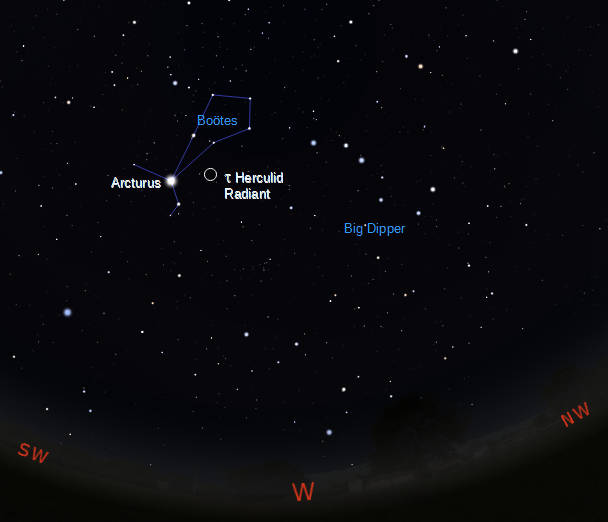
Position of the Tau Herculid radiant at 1 am, May 31, 2022. However, meteors will appear all over the sky, but could be traced back to the radiant. These meteors will appear to travel a lot slower than the Perseid meteors of August. Created using Stellarium for the star field and LibreOffice for annotations.
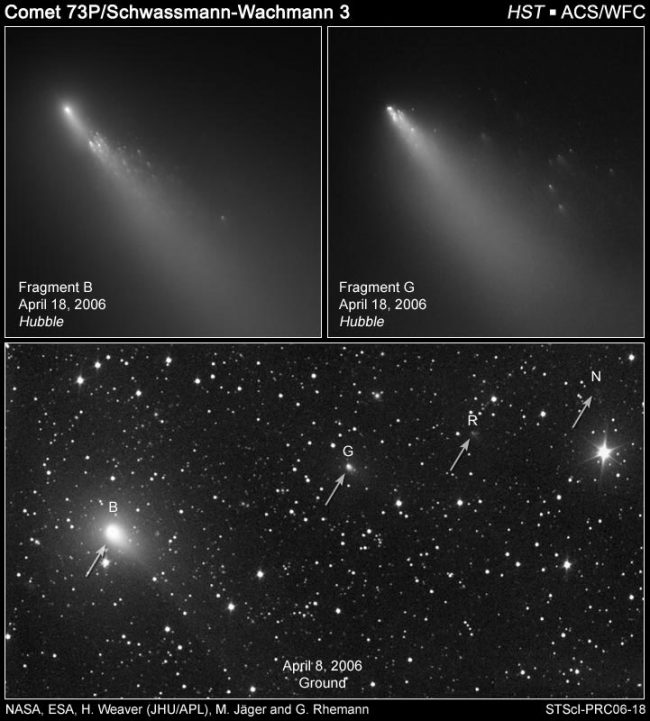
Comet Schwassmann-Wachmann 3 Hubble Space Telescope images from 2006 showing the breakup of the comet. Credit: NASA.
05/27/2022 – Ephemeris – There could be a spectacular meteor display Tuesday early morning, or nothing!
This is Bob Moler with Ephemeris for Friday, May 27th. Today the Sun will be up for 15 hours and 13 minutes, setting at 9:16, and it will rise tomorrow at 6:02. The Moon, 3 days before new, will rise at 5:03 tomorrow morning.
Comet Schwassmann-Wachmann 3, SW3 for short began to breakup in 1995, 27 years ago. Two large chunks of the comet’s nucleus and dozens of smaller pieces have been seen. A vast, unseen debris field is expected to be expanding from the remnants of the comet. Astronomers, calculating what happened to that unseen debris cloud, expect the Earth to run into a part of it around 1 am (EDT, 5 hours UT), give or take, on Tuesday, May 31st (That’s late Memorial Day night). Causing, if we’re lucky, a meteor shower or meteor storm. The radiant point from which the meteors seem to come is from between the Big Dipper’s handle and the bright star Arcturus. They will appear all over the sky. I’m crossing my fingers on this one, it could be great, or it could be nothing.
The astronomical event times given are for the Traverse City/Interlochen area of Michigan (EDT, UT – 4 hours). They may be different for your location.
Addendum
Position of the Tau Herculid radiant at 1 am, May 31, 2022. However, meteors will appear all over the sky, but could be traced back to the radiant. These meteors will appear to travel a lot slower than the Perseid meteors of August. Created using Stellarium for the star field and LibreOffice for annotations.
Comet Schwassmann-Wachmann 3 Hubble Space Telescope images from 2006 showing the breakup of the comet. Credit: NASA.
05/26/2022 – Ephemeris – There may be a spectacular meteor storm Tuesday am or nothing!
This is Ephemeris for Thursday, May 26th. Today the Sun will be up for 15 hours and 11 minutes, setting at 9:16, and it will rise tomorrow at 6:03. The Moon, halfway from last quarter to new, will rise at 4:42 tomorrow morning.
Early risers tomorrow morning should be able to see, if it’s clear, the planet Venus just above and right of the waning crescent Moon. The last of the visible Moon-planet encounters this month. Another event this month may be the Tau Herculid meteor shower. This may be a spectacular meteor shower, or nothing. It would be the result of the breakup of Comet Schwassmann-Wachmann 3 that started back in 1995. SW3, as it’s known for short, has a 5.44 year orbit of the Sun, so we only get a good look at it about every 11 years currently. As the nucleus breaks up, the debris field widens, with time. The comet will pass close to the orbit of the Earth in a few months. The comet’s orbit comes closest to the Earth’s orbit on May 31st. If the debris cloud has widened enough by now, the Earth should intercept it around 1 am our time that morning.
The astronomical event times given are for the Traverse City/Interlochen area of Michigan (EDT, UT – 4 hours). They may be different for your location.
Addendum
Position of the Tau Herculid radiant at 1 am, May 31, 2022. However, meteors will appear all over the sky, but could be traced back to the radiant. These meteors will appear to travel a lot slower than the Perseid meteors of August. The meteor storm, if it occurs, should peak around 1 am. However, there is an uncertainty with the time or if the meteor will show up. Created using Stellarium for the star field and LibreOffice for annotations.
Comet Schwassmann-Wachmann 3 Hubble Space Telescope images from 2006 showing the breakup of the comet. Credit: NASA.
05/25/2022 – Ephemeris – Let’s search for the naked-eye planets for this week
This is Ephemeris for Wednesday, May 25th. Today the Sun will be up for 15 hours and 10 minutes, setting at 9:15, and it will rise tomorrow at 6:04. The Moon, 3 days past last quarter, will rise at 4:22 tomorrow morning. | Let’s search for the naked-eye planets for this week. All the naked-eye planets are back in the morning sky, although the newcomer, Mercury, is too close to the Sun to be seen, and may stay that way for the rest of its morning appearance. That’s at least for those as far north as we are (45° N). At 5 am tomorrow the planets will be spread out from brilliant Venus low in the east to Saturn higher in the southeast. To the right of Venus, tomorrow morning, will be the thin crescent Moon. Farther right is the quite bright Jupiter. Just to the right of Jupiter will be the dimmest of the 4, Mars, which is closing on Jupiter. The two will seem to pass each other on Sunday. All will be in line sloping to the upper right with Saturn all by its lonesome in the southeast.
The astronomical event times given are for the Traverse City/Interlochen area of Michigan (EDT, UT – 4 hours). They may be different for your location.
Addendum
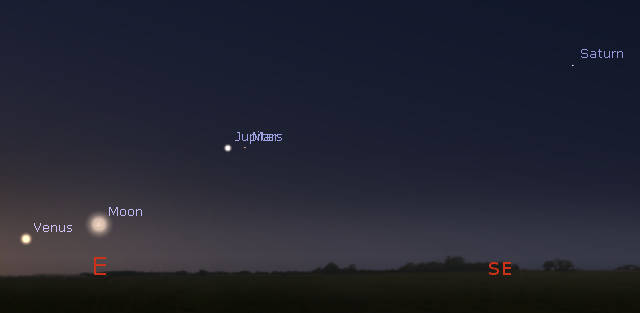
All the morning planets except Mercury, which is too close to the Sun to be seen, will be visible at 5 am tomorrow morning, May 26, 2022. The labels for Mars and Jupiter are on top of each other. Click on the image to enlarge it. Created using Stellarium.
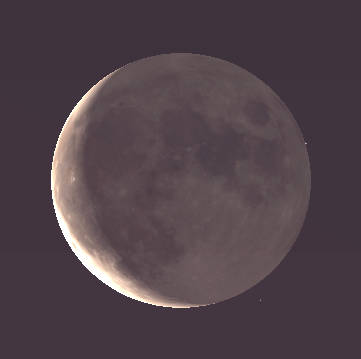
The waning crescent moon as it might appear in binoculars tomorrow morning, May 26, 2022. Earth shine might also illuminate the Moon’s night side. Created using Stellarium.
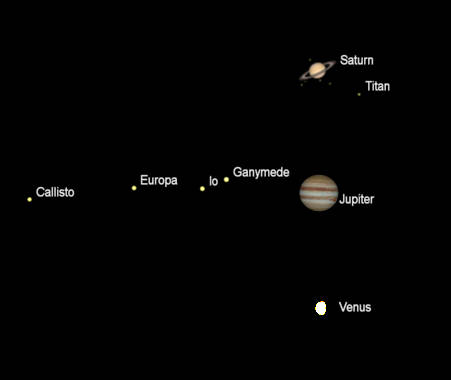
Views of Venus, Jupiter, and Saturn (north up) as they would be seen in a small telescope, with the same magnification, tomorrow morning at 5:00 am, May 26, 2022. I do not show planets less than 10 seconds of arc in diameter. Apparent diameters: Venus 14.13″, 76.1% illuminated; Saturn 17.20″, its rings 40.06″; Jupiter 36.80″. Mars is not shown, its apparent diameter is 6.30″ and is 87.7% illuminated. The ” symbol means seconds of arc (1/3600th of a degree.) Created using Cartes du Ciel (Sky Charts).
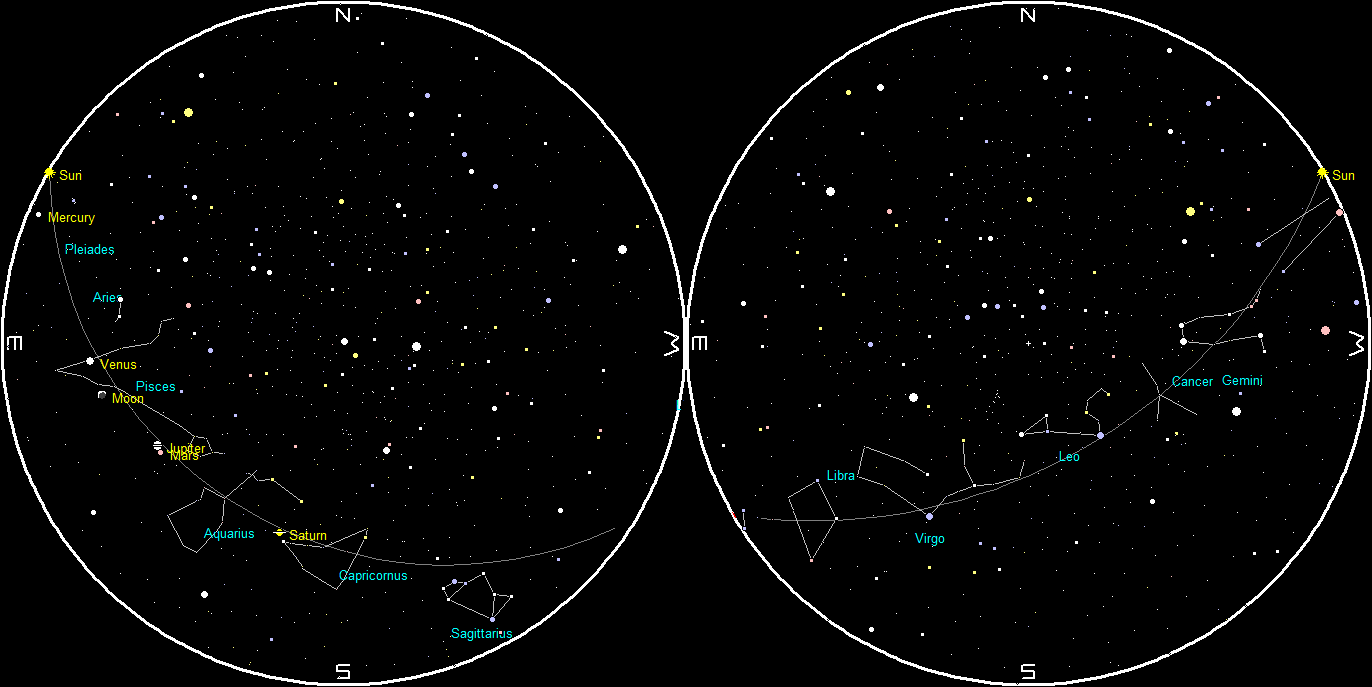
The naked-eye planets and the Moon at sunset and sunrise on a single night, starting with sunset on the right on May 25, 2022. The night ends on the left with sunrise on the 26th. Notice that all the naked-eye planets are in the morning sky now. Click on the image to enlarge it. Created using my LookingUp program.
05/23/2022 – Ephemeris – the Moon and the morning planets plus the Big Dipper’s stars Mizar and Alcor
This is Bob Moler with Ephemeris for Monday, May 23rd. Today the Sun will be up for 15 hours and 6 minutes, setting at 9:13, and it will rise tomorrow at 6:05. The Moon, 1 day past last quarter, will rise at 3:44 tomorrow morning.
This week, the Moon is in the process of passing the morning planets. This morning it passed Saturn. Tomorrow afternoon and evening it will pass Mars, then Jupiter. By Thursday morning, the Moon will be below and left of Jupiter. Thursday evening, it will pass Venus.
Back to tonight’s sky, the Big Dipper is nearly overhead. In its handle is a star or two that are interesting. It’s the star at the bend in the handle. It’s called Mizar. Next to it, for those with good eyesight, is a dimmer star, called Alcor. The name Mizar is from the Arabic, meaning apron or cover, while Alcor means the forgotten one. Before optometrists, the ability to actually see both stars was a test for good eyesight, especially for Arabic warriors. The pair is also known as the “Horse and the Rider”.
The astronomical event times given are for the Traverse City/Interlochen area of Michigan (EDT, UT – 4 hours). They may be different for your location.
Addendum
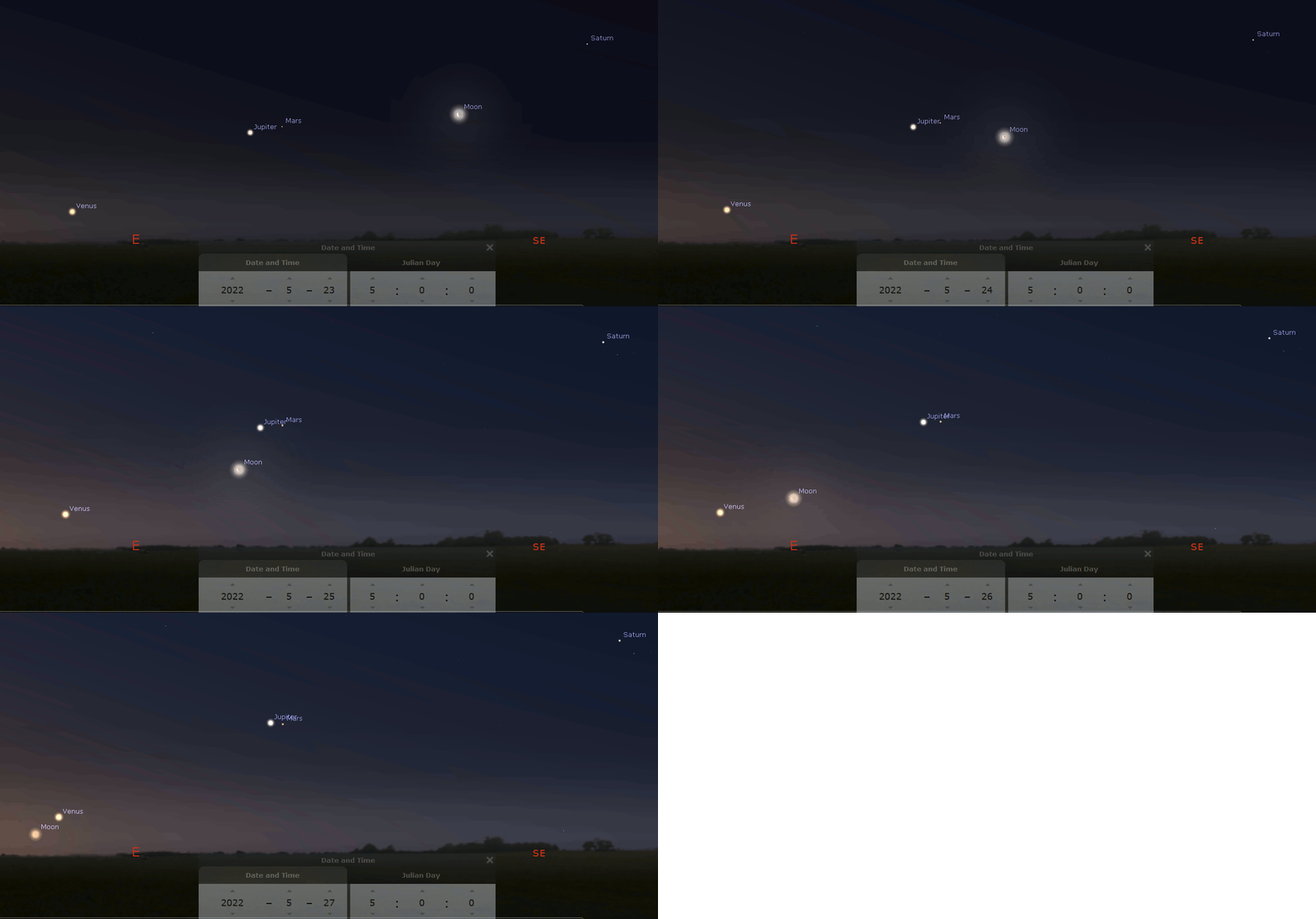
The Moon passing the morning planets at 5 am 5/23/2022 to 5/27/2022. Click on the image to enlarge it. Created using Stellarium and GIMP.
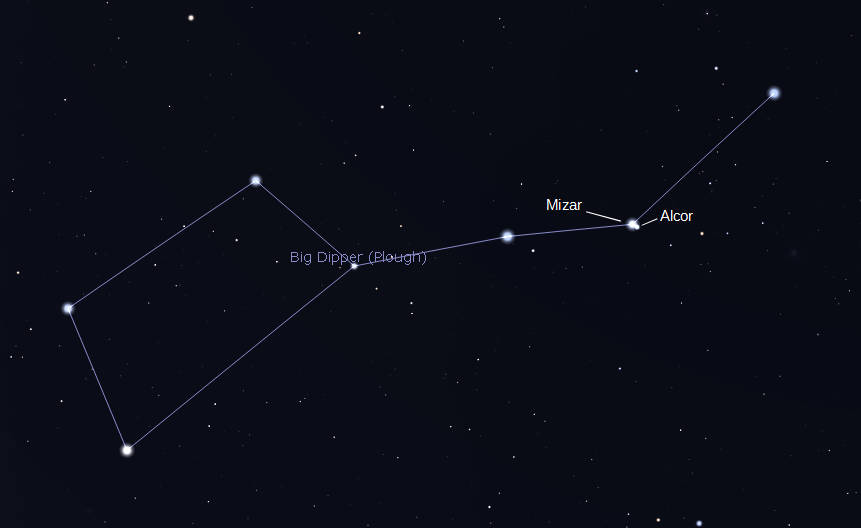
Mizar and Alcor in the Big Dipper as it is nearly overhead towards the north. Click on the image to enlarge it. Created using Stellarium.
Alcor seems to be a true companion to Mizar, since they are at the same distance of 81.7 light years. Alcor also has an unseen companion star. Mizar also has a much closer companion star that can be seen in a telescope. On top of that, each of them has another unseen companion star. Six stars for the price of two. What a deal.
How can you detect a companion star that can’t be seen? When analyzing a star’s spectra, the companion star betrays it presence by its chemical absorption lines shifting with respect to its primary due to the Doppler effect of its motion.
 Bob Moler's Ephemeris Blog