06/20/2022 – Ephemeris – Here we are at the last full day of spring
This is Ephemeris for Juneteenth, Observed, Monday, June 20th. Today the Sun will be up for 15 hours and 34 minutes, setting at 9:31, and it will rise tomorrow at 5:57. The Moon, at last quarter today, will rise at 2:09 tomorrow morning.
Here we are at the last full day of spring. Summer will begin at 5:14 EDT, or 9:14 UT tomorrow morning, when the Sun reaches its highest point on the celestial sphere, and directly over the northern latitude line called the Tropic of Cancer. At that time, folks at or north of the Arctic Circle at about 66 ½ degrees north latitude won’t see the Sun set. As it is, Interlochen is only about 4 degrees latitude south of the land of the all night twilight. It’s neat, around here in the western part of the Lower Michigan, to go out around midnight and see a bit of the last twilight glow near the north. Remember that around here, local or astronomical midnight occurs around 1:45 am. Ah politicians, aren’t they wonderful. And they’ve just made Daylight Saving Time permanent.
The astronomical event times given are for the Traverse City/Interlochen area of Michigan (EDT, UT – 4 hours). They may be different for your location.
Addendum
The event at 5:14 am EDT or 9:14 UT is called the summer solstice, or in deference to our Southern Hemisphere neighbors, the June solstice, because for them winter is starting. Solstice means “Sun stands still”. It doesn’t, of course. The sun is always moving eastward against the stars. However, if one checks the altitude of the Sun in the south at local noon each day, the Sun would move higher each day since the winter solstice until around June 21st, and go no further. It would slowly begin a retreat, day by day. That pause at the highest point is the solstice.
06/17/2022 – Ephemeris – What’s that weird twinkly star low in the south?
This is Ephemeris for Friday, June 17th. Today the Sun will be up for 15 hours and 34 minutes, setting at 9:30, and it will rise tomorrow at 5:56. The Moon, halfway from full to last quarter, will rise at 12:55 tomorrow morning.
At this time of year, there is a star that appears low in the south-southeast that appears red and twinkles mightily. The twinkling caused by the Earth’s atmosphere is enhanced when viewing it in binoculars. In a telescope, it appears as a virtual sparkler. It’s been called in to authorities as a UFO, unidentified flying object, or as the Defense Department now calls them UAPs, or unidentified aerial phenomena. Anyway, this light is identified. It is the red giant star Antares, in the heart of Scorpius the scorpion, one of the constellations of the zodiac. Antares other claim to fame is embodied in its name. Decoded, Antares means Rival of Mars due to its color and the fact that Mars passes by every couple of years. Ant means anti, and Ares is the Greek god of war that the Romans appropriated as Mars.
The astronomical event times given are for the Traverse City/Interlochen area of Michigan (EDT, UT – 4 hours). They may be different for your location.
Addendum
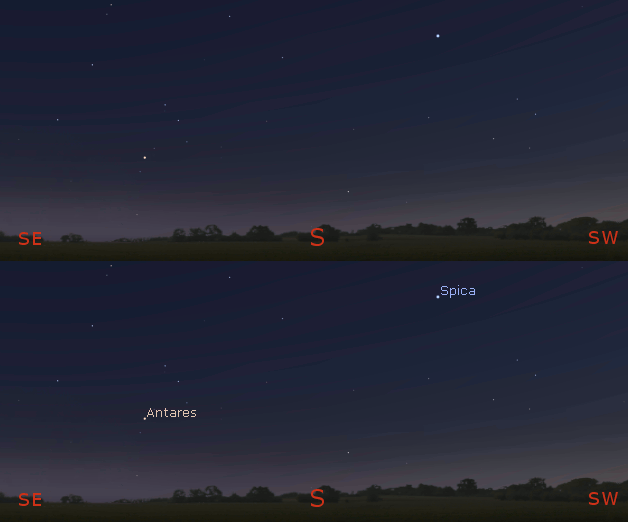
Antares low in the south-southeast at 10:30 pm, June 17, 2022, without Mars for competition. At this time, Antares is only 13 degrees above the horizon. Click on the image to enlarge it. Created Using Stellarium and GIMP.
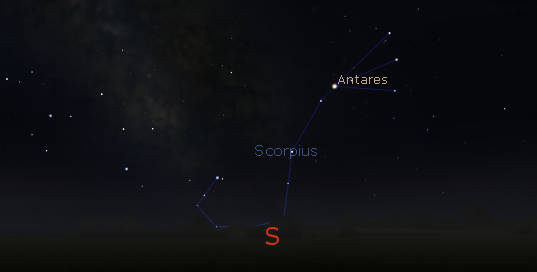
Scorpius at its highest as seen from the Grand Traverse area. Antares at this time is not quite 19 degrees altitude. This is 1 am, June 18th. Perceptive viewers of this image may spot a teapot in the stars to the left of Scorpius. That’s what we modern folk see in the stars of Sagittarius the archer. Created using Stellarium.
06/16/2022 – Ephemeris – Mercury’s poor showing in the morning sky at greatest elongation
This is Ephemeris for Thursday, June 16th. Today the Sun will be up for 15 hours and 34 minutes, setting at 9:30, and it will rise tomorrow at 5:56. The Moon, 2 days past full, will rise at 12:17 tomorrow morning.
The planet Mercury has its greatest elongation to the west of the Sun around 11 this morning. That’s astronomer talk. It will be at its greatest angular separation west of the Sun. That angle will be 23 degrees. Being west of the Sun, it will rise before the Sun, and will be seen in the east. That makes perfect sense, but sounds weird. Not all Mercury greatest elongations are created equal, and being inhabitants of the Northern Hemisphere, we get the short end of the orbit. Mercury has the most elliptical orbit of any planet, since Pluto was kicked out of the planet club. That and Earth’s own axial tilt works against us. This is a poor elongation for us since Mercury is more to the side than above the Sun in the morning.
The astronomical event times given are for the Traverse City/Interlochen area of Michigan (EDT, UT – 4 hours). They may be different for your location.
Addendum
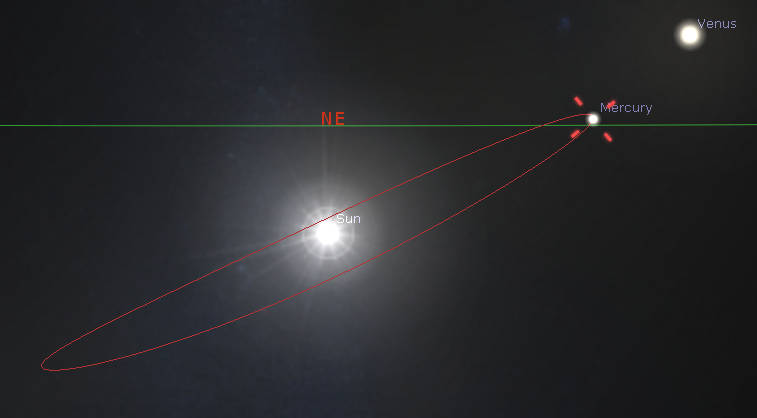
Mercury at greatest western elongation this morning, June 16, 2022. Note that Mercury is more to the right of the Sun, than above it. This is a poor elongation for us. Created using Stellarium.
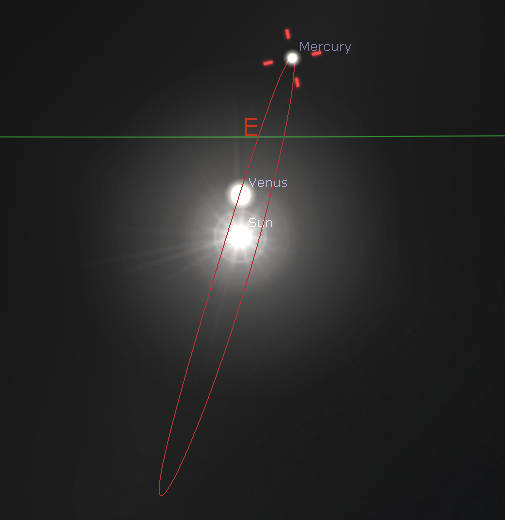
Mercury at greatest western elongation, October 8, 2022. Note that Mercury is more above the Sun, than to the right of it. This will be a good elongation for us. But also note Mercury’s orbit. Mercury is near its perihelion point, its closest to the Sun. Southern Hemisphere observer good elongations feature Mercury near its aphelion, it’s farthest from the Sun. Those southerners get a much better look at Mercury than we do. Created using Stellarium.
06/15/2022 – Ephemeris – Let’s search for the naked-eye planets for this week
This is Ephemeris for Wednesday, June 15th. Today the Sun will be up for 15 hours and 33 minutes, setting at 9:30, and it will rise tomorrow at 5:56. The Moon, 1 day past full, will rise at 11:27 this evening.
Let’s search for the naked-eye planets for this week. All the naked-eye planets are in the morning sky, although Mercury may be too close to the Sun to be seen. It might just be visible low in the east-northeast after 5. That’s at least for those as far north as we are. At 5 am tomorrow the planets will be spread out from Mercury near the horizon, brilliant Venus low in the east to Saturn higher in the south-southeast. To the right of Venus, tomorrow morning, in the east-southeast are Mars and Jupiter. Mars is quite a bit dimmer than Jupiter. All will be in line sloping to the upper right with Saturn all by its lonesome in the south-southeast. The naked-eye planets are arranged in the morning sky, in the same order as their distances from the Sun.
The astronomical event times given are for the Traverse City/Interlochen area of Michigan (EDT, UT – 4 hours). They may be different for your location.
Addendum
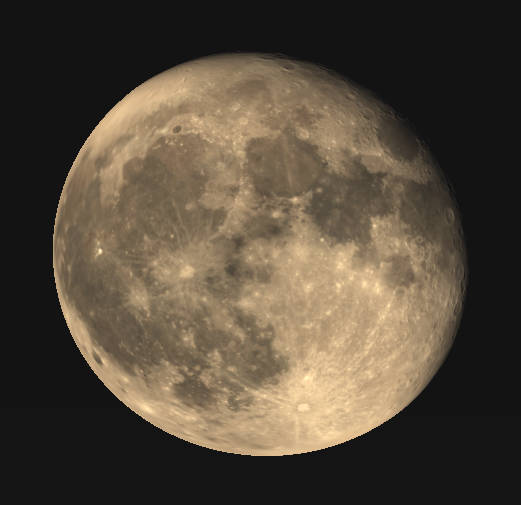
The Moon as it might appear at midnight June 16, 2022, through binoculars or a small telescope. Atmospheric refraction will affect the shape of the Moon when it’s very low in the sky. Created using Stellarium.
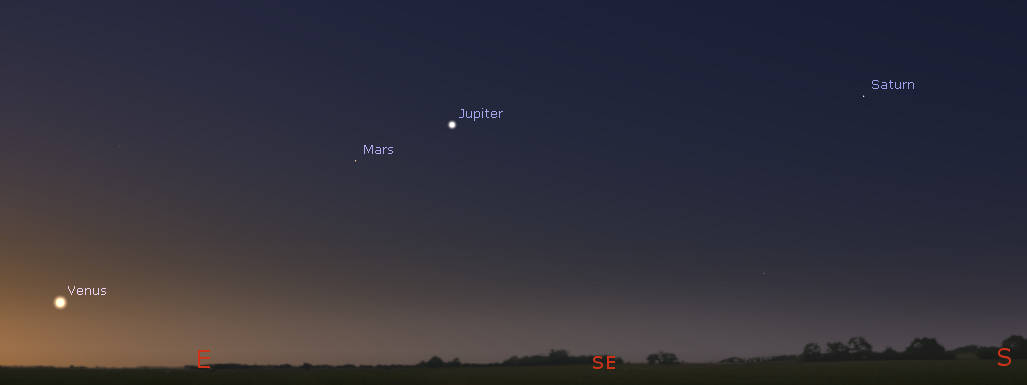
Morning planets at 5 am tomorrow morning, June 16, 2022. Click on the image to enlarge it. The span of the planets from Venus to Saturn is 87 degrees. Click on the image to enlarge it. Created using Stellarium.
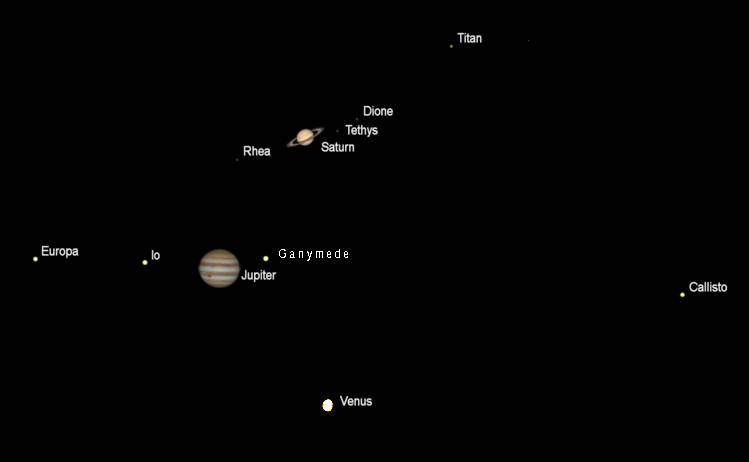
Views of Saturn, Jupiter, and Venus (north up) as they would be seen in a small telescope, with the same magnification, tomorrow morning at 5:00 am, June 16, 2022. I do not show planets less than 10 seconds of arc in diameter. Apparent diameters: Saturn 17.80″, its rings 41.47″; Jupiter 39.02″. Mars is not shown, its apparent diameter is 6.81″ and is 86.4% illuminated; Venus 12.66″, 82.2% illuminated. The ” symbol means seconds of arc (1/3600th of a degree.) Created using Cartes du Ciel (Sky Charts).
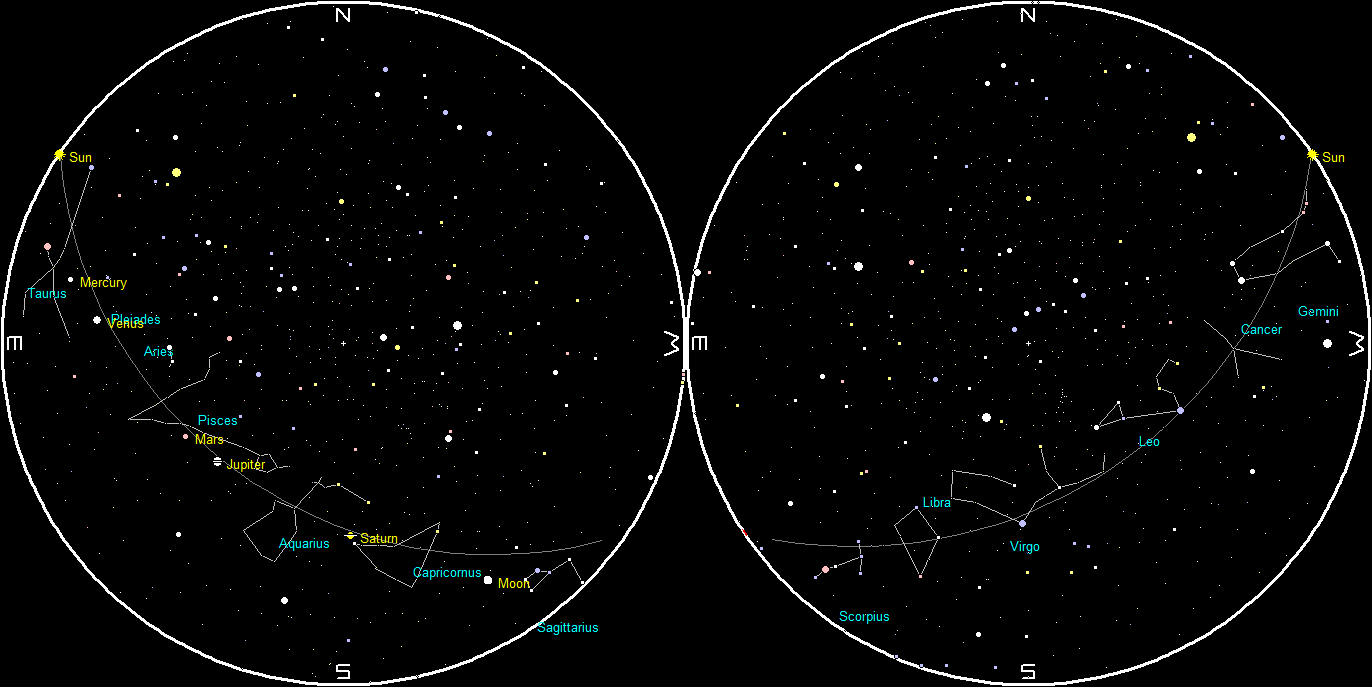
The naked-eye planets and the Moon at sunset and sunrise on a single night, starting with sunset on the right on June 15, 2022. The night ends on the left with sunrise on the 16th. Notice that all the naked-eye planets are in the morning sky now. Click on the image to enlarge it. Created using my LookingUp program.
06/14/2022 – Ephemeris – All about tonight’s full moon
This is Bob Moler with Ephemeris for Flag Day, Tuesday, June 14th. Today the Sun will be up for 15 hours and 33 minutes, setting at 9:29, and it will rise tomorrow at 5:56. The Moon, at full today, will rise at 10:22 this evening.
The actual instant that the Moon was full, that is opposite the Sun in the sky, is 7:52 this morning. That’s why the Moon will rise nearly an hour after the Sun sets tonight. It’s also a supermoon, though I dare anyone to be able to tell it apart from any other rising full Moon, since there is nothing to compare its size too. Both the Sun and Moon appear larger than normal when seen on the horizon. The Moon’s perigee or closest point in its orbit of the Earth occurs at 7:52 this evening. This month’s full Moon is also called the Strawberry Moon by Native Americans, because this is the month that strawberries ripen. Also, the term honeymoon comes from the fact that many weddings are in June, when the full moon is low in the sky in the south and has a yellowish or honey color due to haze and atmospheric preferential scattering of blue light.
The astronomical event times given are for the Traverse City/Interlochen area of Michigan (EDT, UT – 4 hours). They may be different for your location.
Addendum
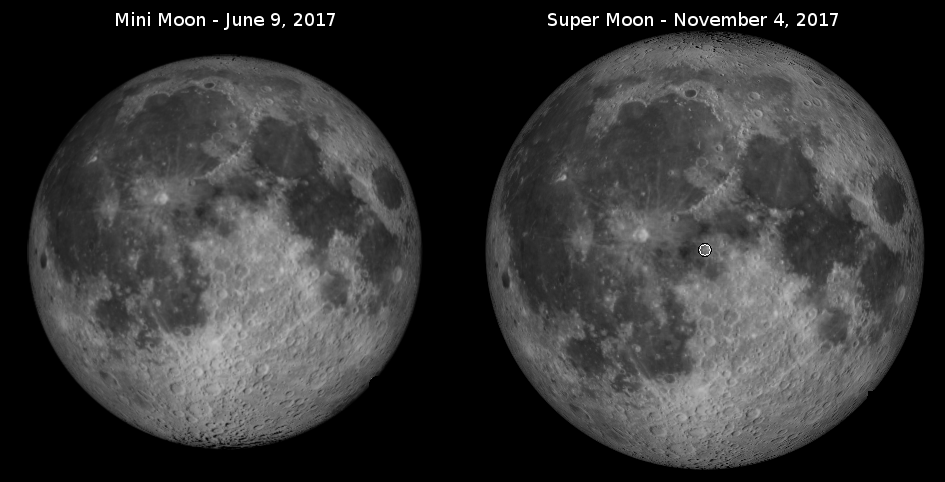
Mini Moon (Moon at apogee) and Super Moon (moon at perigee) for 2017. Created using Cartes du Ciel (Sky Charts).
The distance of the Moon at perigee this month, at 7:21 pm June 14th is 357,400 kilometers, or 222,100 miles. The Moon reaches apogee twice this month: On the 1st at 406,200 kilometers, or 252,400 miles, and again on the 29th at 406,600 kilometers or 252,600 miles. The reason for the differences in aphelion distances, which also occur with perigee distances, is the additional gravitational influences of the Sun, Jupiter and Venus, plus all the other planets to a lesser degree.
06/13/2022 – Ephemeris – What’s a near rectilinear halo orbit?
Since I wrote and recorded this program on June 5th, the launch date has been postponed from June 13th. No new launch date has, been selected, though the launch window extends through the 22nd for this month’s attempt.
This is Ephemeris for Monday, June 13th. Today the Sun will be up for 15 hours and 32 minutes, setting at 9:29, and it will rise tomorrow at 5:56. The Moon, 1 day before full, will set at 5:41 tomorrow morning.
Last Friday I talked about the CAPSTONE mission to a near rectilinear halo orbit of the Moon, which, when I recorded this, could launch as soon as today. Anyway, what is a near rectilinear halo orbit? And why is it so special? It is a long looping orbit that comes quite close to the Moon over its North Pole, and very far away over the South Pole of the Moon. Instead of going behind the Moon from the Earth’s perspective, the orbit will always be face-on to the Earth. It will require occasional tweaks to keep it that way, just like the James Webb Space Telescope needs occasional tweaks to keep it in orbit of the Earth-Sun L2 point. That way a lander, or base at the South Pole of the Moon, can keep in communication with the Lunar Gateway for all but a couple of hours each week. Why the South Pole? That’s where the water ice is!
The astronomical event times given are for the Traverse City/Interlochen area of Michigan (EDT, UT – 4 hours). They may be different for your location.
Addendum
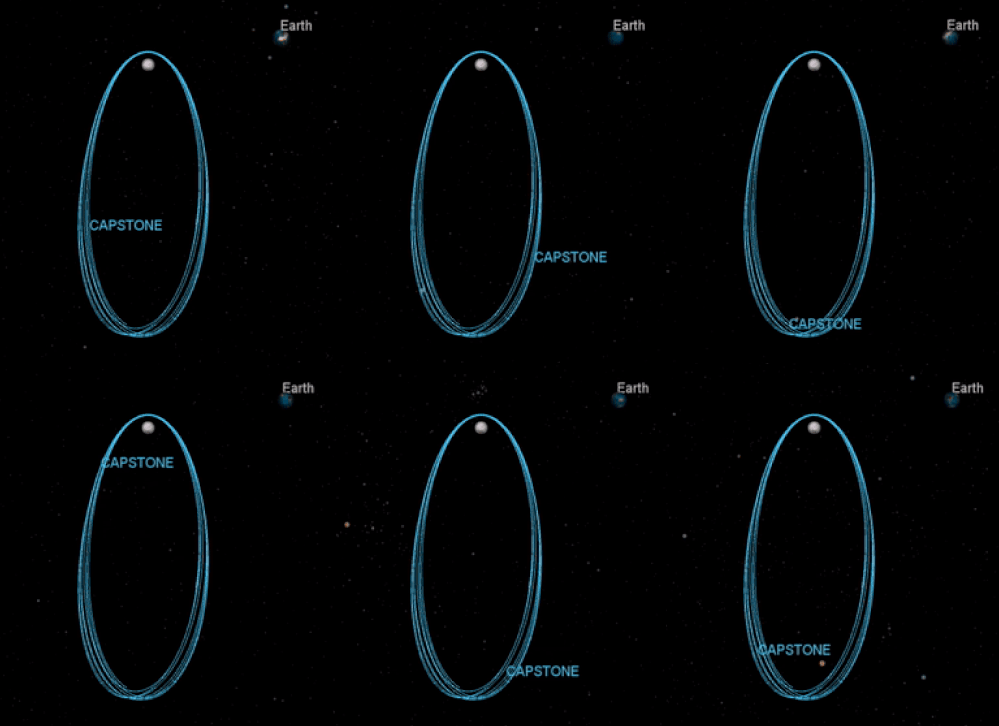
NASA CAPSTONE* pathfinder for gateway orbit is to be launched this year by Rocket Lab to prove out the near rectilinear orbit for the Lunar Gateway.
The orbit will pass 1,900 miles (3,000 km) above the Moon’s North Pole and out to 43,000 miles (70,000 km) above the South Pole. The period of such an orbit is about 6.5 days. Landing attempts at the South Pole of the Moon will begin as the lander departs the Orion spacecraft or the Lunar Gateway space station and begins its descent over the North Pole.
06/10/2022 – Ephemeris – The first Artemis mission: CAPSTONE
This is Bob Moler with Ephemeris for Friday, June 10th. Today the Sun will be up for 15 hours and 30 minutes, setting at 9:27, and it will rise tomorrow at 5:56. The Moon, 3 days past first quarter, will set at 3:52 tomorrow morning.
Launching, perhaps, as soon a Monday is the CAPSTONE Mission, which is part of the Artemis program to send the next man and first woman to the Moon. The Capstone mission is to check out the special near rectilinear halo orbit the Lunar Gateway space station, and the Human Landing Craft will be in when the Orion spacecraft arrives before landing. CAPSTONE is, of course, an acronym that explains its purpose, to achieve and navigate itself into this near rectilinear halo orbit. CAPSTONE is basically a CubeSat made of 12 4 by 4 inch (12 100 mm by 100 mm) cubes. It will be launched by Rocket Lab from New Zealand on their Electron rocket with their Proton upper stage. It will take 3 months to reach the Moon.
The astronomical event times given are for the Traverse City/Interlochen area of Michigan (EDT, UT – 4 hours). They may be different for your location.
Addendum
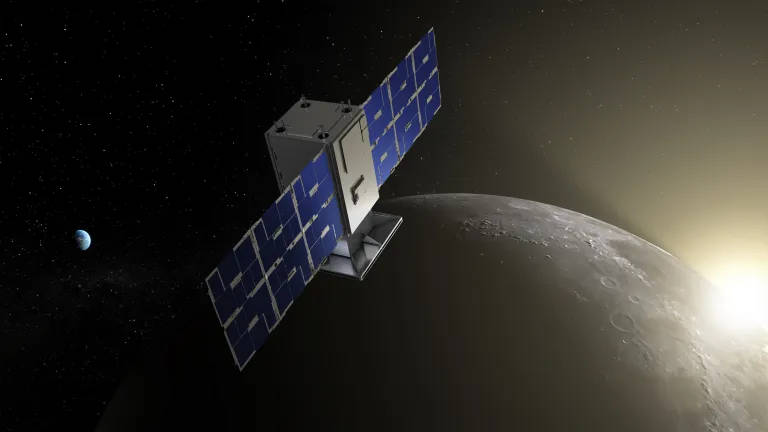
Artist’s impression of the CAPSTONE spacecraft at perilune, the closest point in its orbit, over the north pole of the Moon.
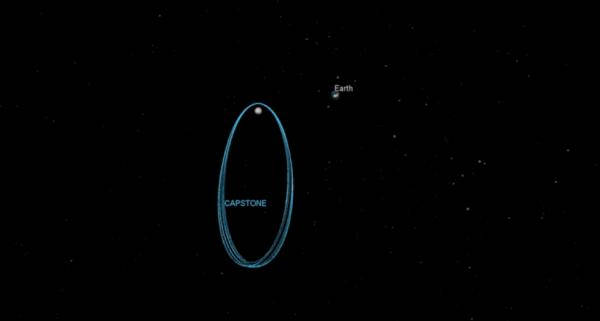
CAPSTONE’s near rectilinear halo orbit of the Moon, which precesses to keep face on to the Earth during the lunar orbit of the Earth.
06/09/2022 – Ephemeris – Looking at the gibbous Moon tonight
This is Bob Moler with Ephemeris for Thursday, June 9th. Today the Sun will be up for 15 hours and 29 minutes, setting at 9:27, and it will rise tomorrow at 5:57. The Moon, 2 days past first quarter, will set at 3:29 tomorrow morning.
By tonight, the gibbous moon will be quite bright. At the moon’s left edge, just coming into sunlight, will be what looks like a large half crater at the edge of the lunar sea called Mare Imbrium, the Sea of Showers. That feature is Sinus Iridium, or Bay of Rainbows. The arc of its mountainous edge is rainbow shaped, but it is as colorless as the rest of the Moon. The crater Copernicus sports few shadows and appears mostly as a bright spot surrounded by its ray system of ejecta craters that appear bright when the sun is high in their sky. At the south end of the Moon are the lunar highlands, bright, rugged and covered by large, mostly very old craters. Largest of these craters is Clavius, named for Christophorus Clavius who, working for Pope Gregory XIII, devised the Gregorian Calendar we use today.
The astronomical event times given are for the Traverse City/Interlochen area of Michigan (EDT, UT – 4 hours). They may be different for your location.
Addendum
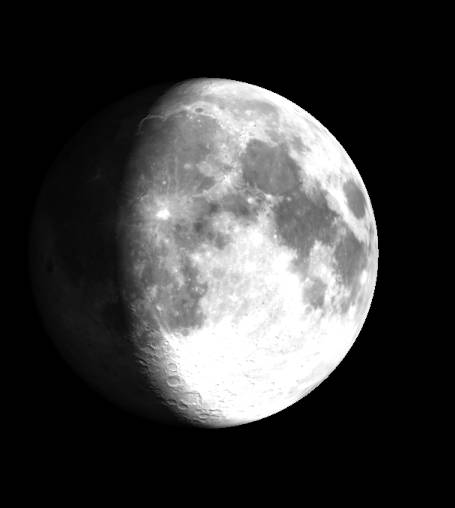
Binocular Moon as it might appear tonight, June 9, 2022. Below, we’ll look closer to the terminator area of the Moon. Created using Virtual Moon Atlas.
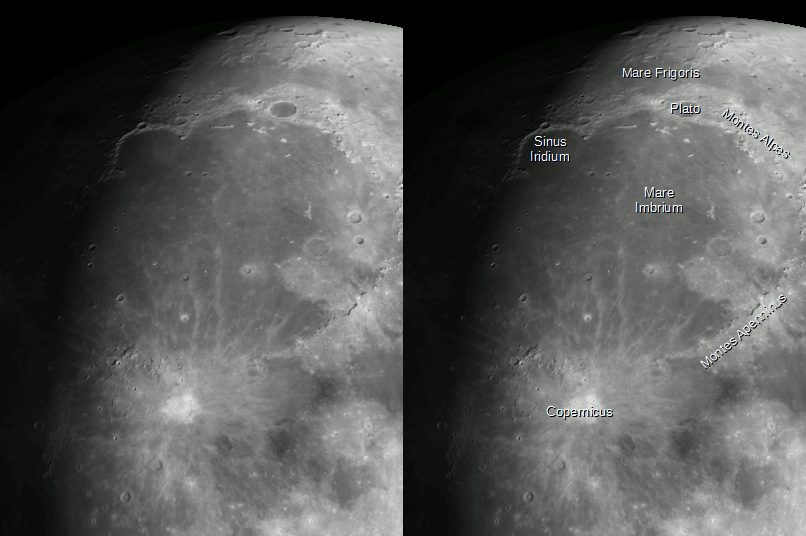
Northern gibbous Moon terminator area with labels for some prominent features. Created using Virtual Moon Atlas, LibreOffice and GIMP.
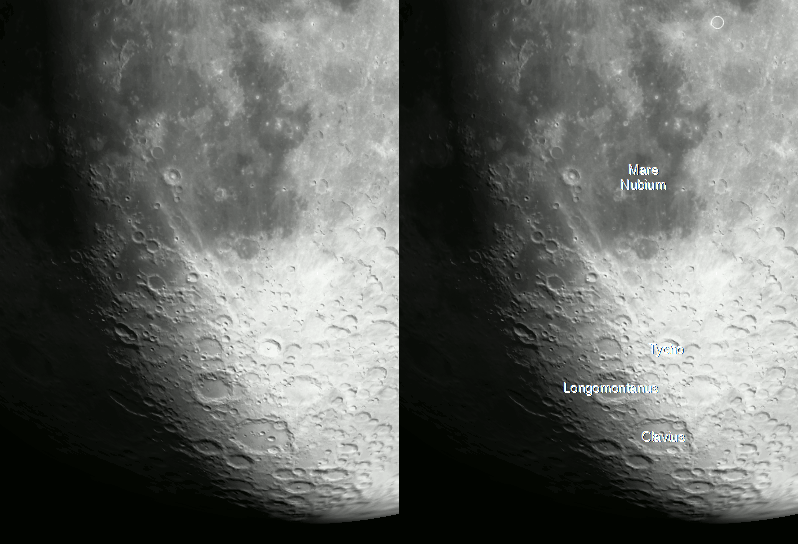
Southern gibbous Moon terminator area with labels for some prominent features. Created using Virtual Moon Atlas, LibreOffice and GIMP.
Translations
Mare Frigoris – Sea of Cold
Mare Imbrium – Sea of Showers
Mare Nubium – Sea of Clouds
Montes Alpes – Alps Mountains
Montes Appinenninus – Apennines Mountains
Sinus Iridium – Bay of Rainbows
06/08/2022 – Ephemeris – Let’s search for the naked-eye planets for this week
This is Ephemeris for Wednesday, June 8th. Today the Sun will be up for 15 hours and 29 minutes, setting at 9:26, and it will rise tomorrow at 5:57. The Moon, 1 day past first quarter, will set at 3:08 tomorrow morning.
Let’s search for the naked-eye planets for this week. All the naked-eye planets are in the morning sky, although Mercury may be too close to the Sun to be seen. It might just be visible low in the east-northeast after 5 am around mid-month. That’s at least for those as far north as we are. At 5 am tomorrow the planets will be spread out from brilliant Venus low in the east to Saturn higher in the south-southeast. To the right of Venus, tomorrow morning, in the east-southeast are Mars and Jupiter. Mars is quite a bit dimmer than Jupiter. All will be in line sloping to the upper right with Saturn all by its lonesome in the south-southeast. The naked-eye planets are arranged in the morning sky, in the same order as their distances from the Sun.
The astronomical event times given are for the Traverse City/Interlochen area of Michigan (EDT, UT – 4 hours). They may be different for your location.
Addendum
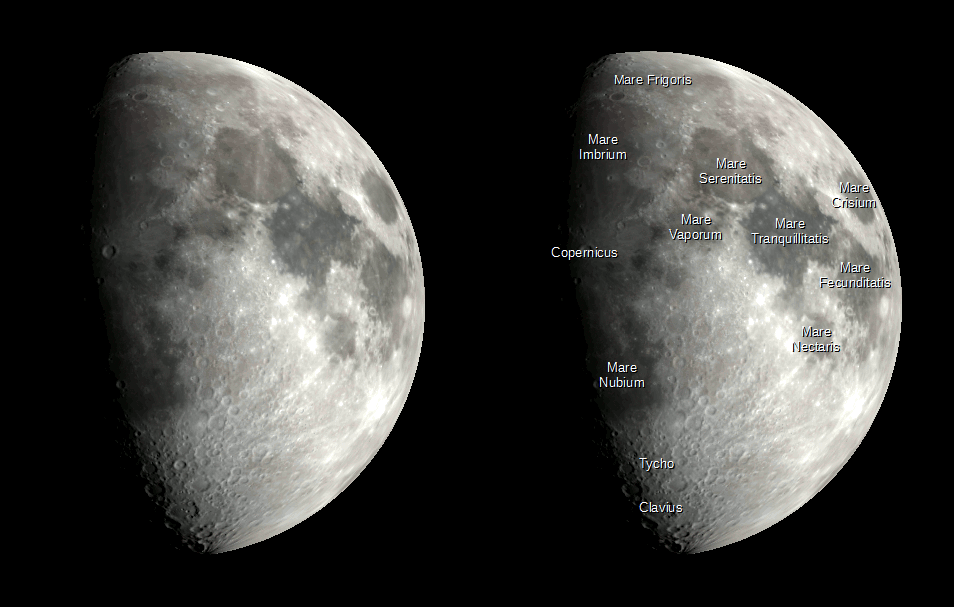
Waning gibbous Moon tonight with prominent features labeled. Created using Stellarium, GIMP and LibreOffice.
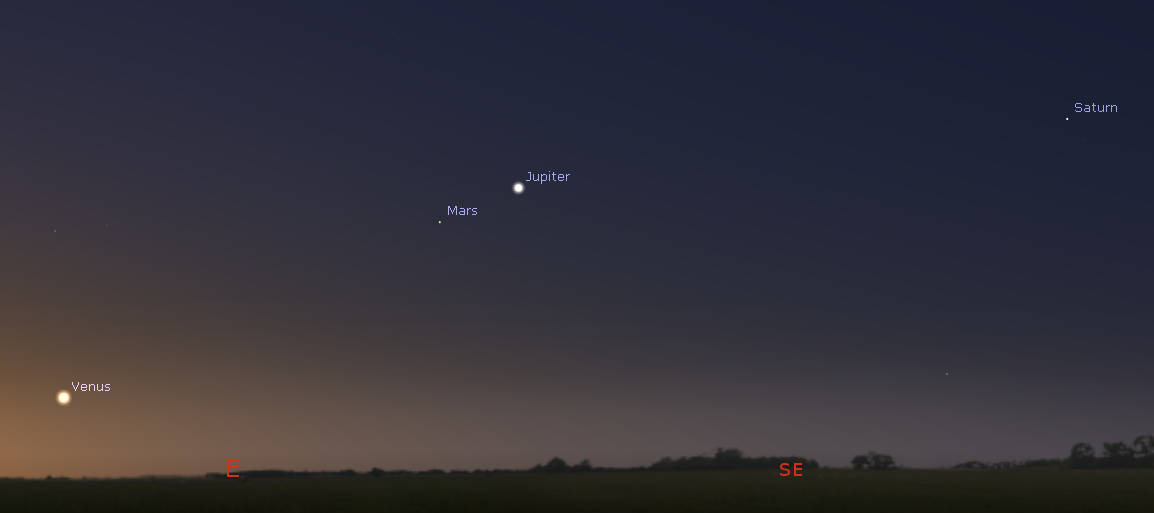
Morning planets at 5 am tomorrow morning, June 9, 2022. Click on the image to enlarge it. The span of the planets from Venus to Saturn is 79 degrees. Created using Stellarium.
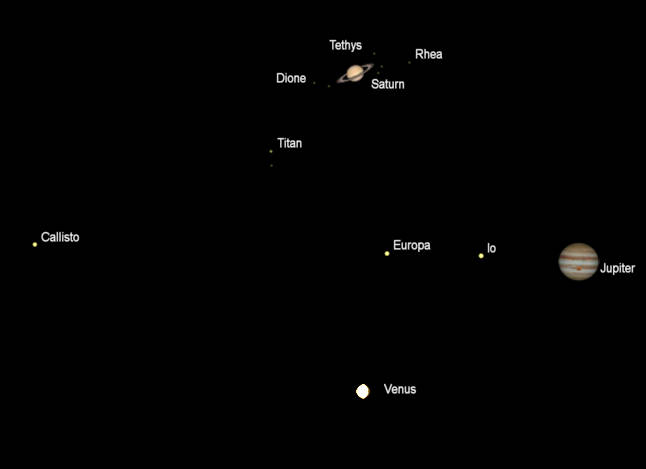
Views of Venus, Jupiter, and Saturn (north up) as they would be seen in a small telescope, with the same magnification, tomorrow morning at 5:00 am, June 9, 2022. I do not show planets less than 10 seconds of arc in diameter. Apparent diameters: Venus 13.10″, 80.3% illuminated; Saturn 17.60″, its rings 41.01″; Jupiter 38.23″. Mars is not shown, its apparent diameter is 6.63″ and is 86.8% illuminated. The ” symbol means seconds of arc (1/3600th of a degree.) Created using Cartes du Ciel (Sky Charts).
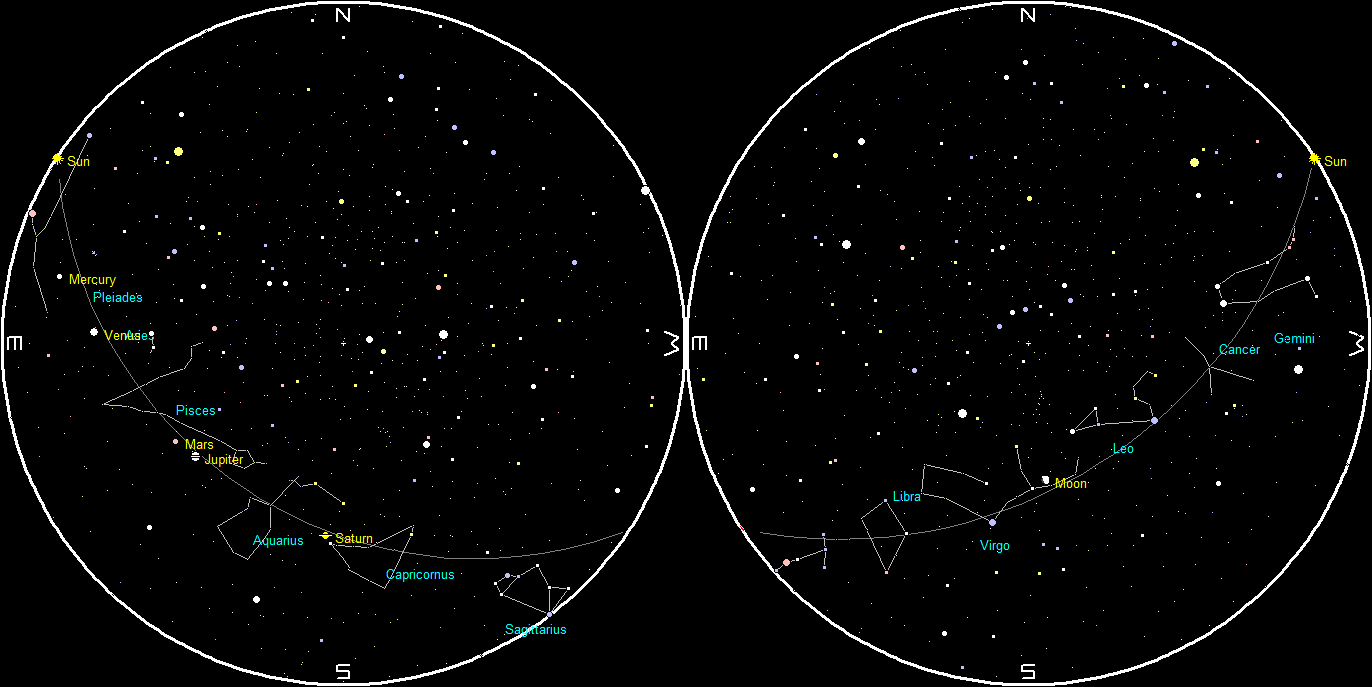
The naked-eye planets and the Moon at sunset and sunrise on a single night, starting with sunset on the right on June 8, 2022. The night ends on the left with sunrise on the 9th. Notice that all the naked-eye planets are in the morning sky now. Click on the image to enlarge it. Created using my LookingUp program.
06/07/2022 – Ephemeris – The Moon’s Straight Wall
This is Ephemeris for Tuesday, June 7th. Today the Sun will be up for 15 hours and 28 minutes, setting at 9:25, and it will rise tomorrow at 5:57. The Moon, at first quarter today, will set at 2:49 tomorrow morning.
Around the first quarter Moon there is, among all the circular formations on the Moon like craters, something that’s straight. Its name is Rupes Recta, better known as the Straight Wall. Tonight it’s a dark line seen near and parallel to the terminator, the sunrise line on the Moon, about a third of the way down from the center of the Moon’s disc to the edge. It looks like a cliff that’s 900 feet (300 meters) high and 67 miles (110 kilometers) long. It’s not. It is apparently a rectilinear fault, and its slope is only 7 degrees. It will disappear as the sun rises higher and illuminates the slope. It can be spotted in a small telescope, though it requires something generally larger and more powerful than a pair of binoculars. Near last quarter, the Straight Wall appears as a bright line.
The astronomical event times given are for the Traverse City/Interlochen area of Michigan (EDT, UT – 4 hours). They may be different for your location.
Addendum
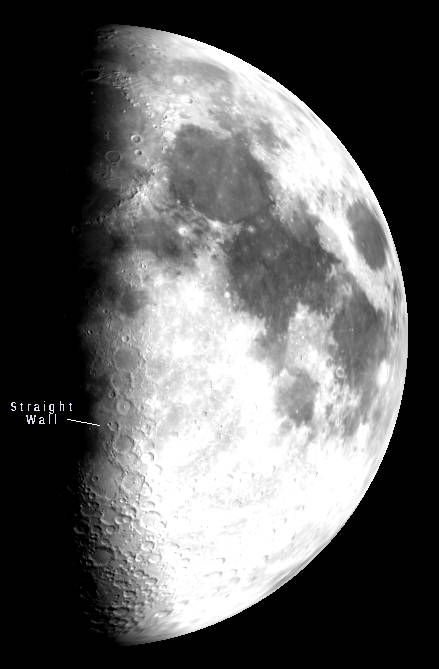
Moon’s Straight Wall locator, though it may not be visible at this magnification. Created using Virtual Moon Atlas.
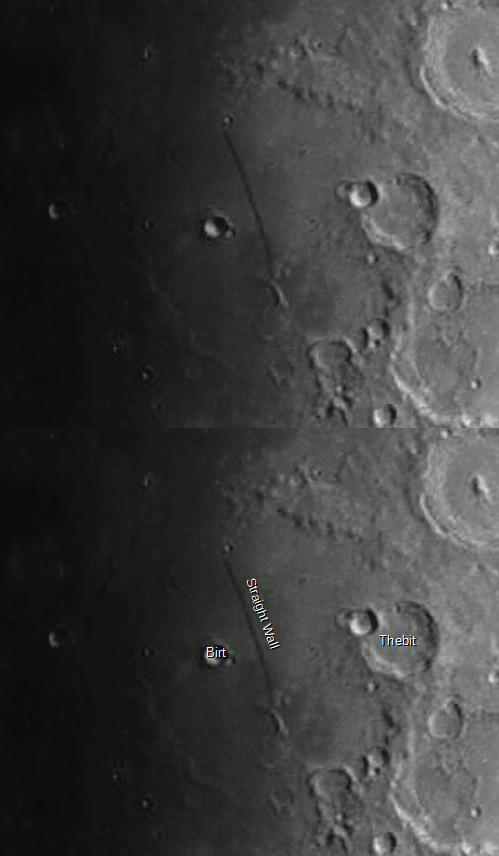
Enlargement of the area of the Straight Wall with labels blinking on and off. Created using Virtual Moon Atlas, Libreoffice, and GIMP.
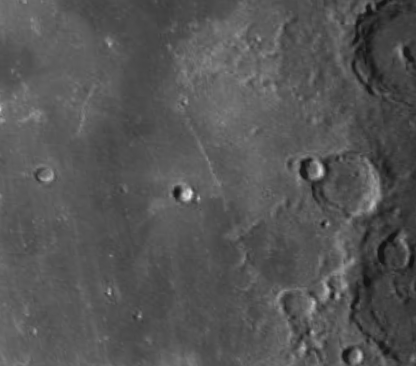
Enlargement of the area of the Straight Wall near last quarter. Created using Virtual Moon Atlas.
 Bob Moler's Ephemeris Blog