11/17/2021 – Ephemeris – Let’s search for the naked-eye planets for this week
This is Ephemeris for Wednesday, November 17th. Today the Sun will be up for 9 hours and 29 minutes, setting at 5:12, and it will rise tomorrow at 7:44. The Moon, 2 days before full, will set at 6:54 tomorrow morning.
Let’s search for the naked-eye planets for this week. Venus will be visible in the southwestern evening twilight by 5:30 tonight. It’s a fat crescent in telescopes. Venus will set at 7:48 pm. By 5:45 pm, both Jupiter and Saturn should be able to be spotted in the southern sky. Saturn will be dimmer, and to its right. It will set first at 10:19 pm, with Jupiter following at 11:42 pm. Saturn’s rings are a beautiful sight in a telescope of even modest power, but the planet will appear tiny. Jupiter, however, is still quite large, and its four biggest moons are spread out and might all be glimpsed in binoculars. In the morning sky, Mars is starting to make its appearance, rising at 6:33. Binoculars might be able to pick it out low in the east-southeast until 7:15 am.
The astronomical event times given are for the Traverse City/Interlochen area of Michigan (EST, UT – 5 hours). They may be different for your location.
Addendum
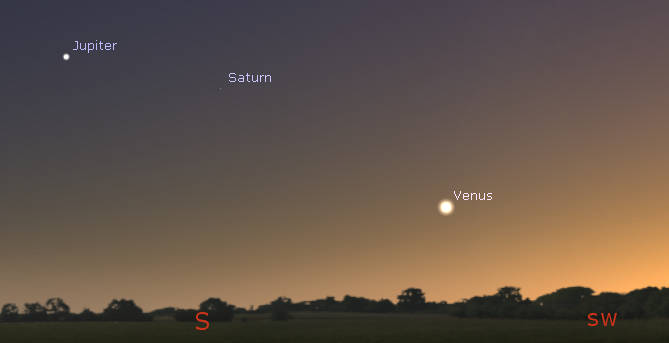
The evening planets Venus, Saturn and Jupiter at 5:45 pm this evening, November 17, 2021. Created using Stellarium.
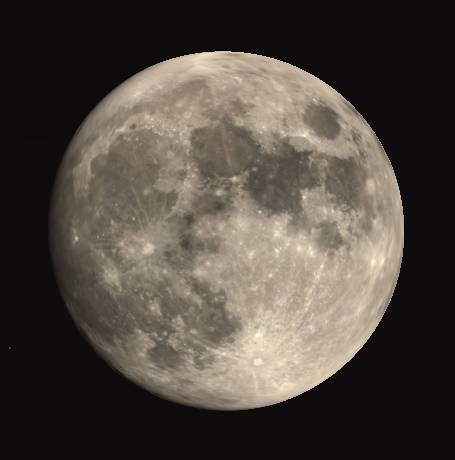
The Moon in binoculars or small telescope as it might appear tonight, November 17, 2021. Created using Stellarium.
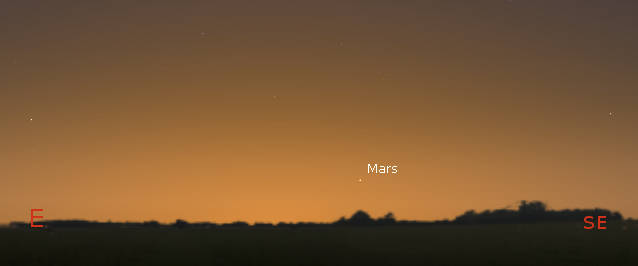
Mars in twilight, tomorrow morning at 7 am, November 18, 2021. Create using Stellarium.
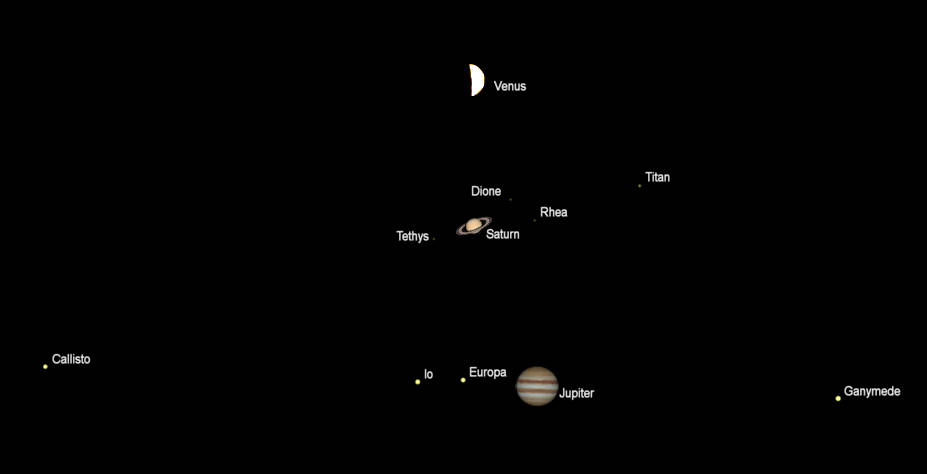
Telescopic views of the bright planets (north up) as they would be seen in a small telescope, with the same magnification, this evening at 7 pm, November 17, 2021. Apparent diameters: Venus, 31.89″, 38.3% illuminated; Saturn 16.32″, its rings 38.01″; Jupiter, 39.95″. Mars in the morning is not shown, but is 3.70″ in diameter. The ” symbol means seconds of arc (1/3600th of a degree.) Click on the image to enlarge it. Created using Cartes du Ciel (Sky Charts).
In the image above, Jupiter’s moon Europa is shown. Actually, before 7:03 pm, it will be hidden in Jupiter’s shadow. Watching it appear is kind of cool. Eclipses of Jupiter’s moons happen all the time. The information for the satellite events is published in Sky and Telescope Magazine. Also tonight, farther to the west, farther out than Ganymede, is the star 45 Capricorni, about the same brightness as the Jovian moons, and nearly in line with them. Don’t mistake it for one of the moons, especially before Europa appears.
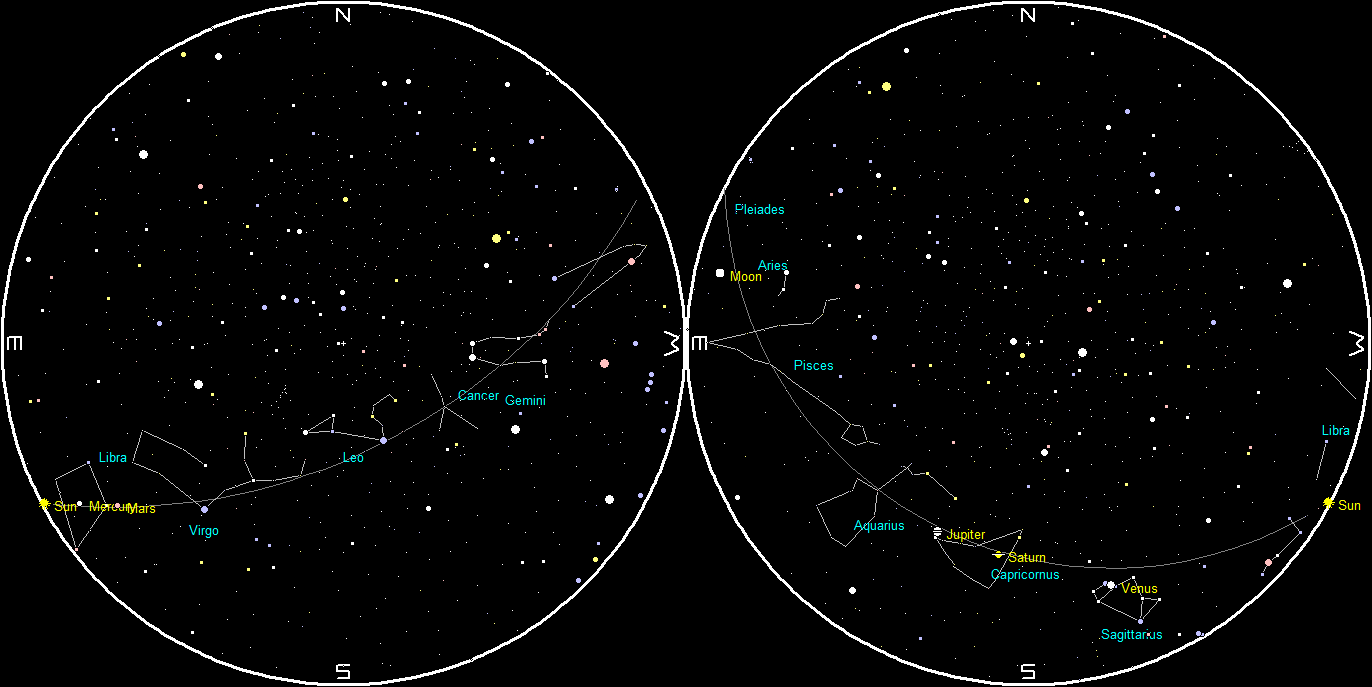
The naked-eye planets and the Moon at sunset and sunrise on a single night, starting with sunset on the right on November 17, 2021. The night ends on the left with sunrise on the 18th. Click on the image to enlarge it. Created using my LookingUp program.
11/16/2021 – Ephemeris – How China retrieved a sample from the Moon, and what Chang’e 5 is up to next
This is Ephemeris for Tuesday, November 16th. Today the Sun will be up for 9 hours and 31 minutes, setting at 5:13, and it will rise tomorrow at 7:42. The Moon, 3 days before full, will set at 5:49 tomorrow morning.
China’s Chang’e sample return mission of late last year was quite a feat. The spacecraft had an orbiter that orbited the Moon, and sent a lander with an ascent rocket. After the lander secured its samples, it put them in the ascent rocket, which launched back up to the orbiter. The samples were placed in a reentry capsule attached to the orbiter, which left the Moon’s orbit and headed back to the Earth. Near Earth, it ejected the reentry capsule and swung past Earth and headed out to the Earth-Sun Lagrangian point 1 between the Earth and Sun. There are already several satellites in halo orbits around L1, because it’s a great spot to be to study the Sun unobstructed by the Earth, and detect Coronal Mass Ejections (CMEs) about an hour before they reach Earth. NASA, NOAA and the European Space Agency all have satellites out there.
The astronomical event times given are for the Traverse City/Interlochen area of Michigan (EST, UT – 5 hours). They may be different for your location.
Addendum

Chang’e 5 Descent Capsule lands. It looks like a miniature Russian Soyuz Descent capsule. Credit Chinese Space Agency via Global Times.
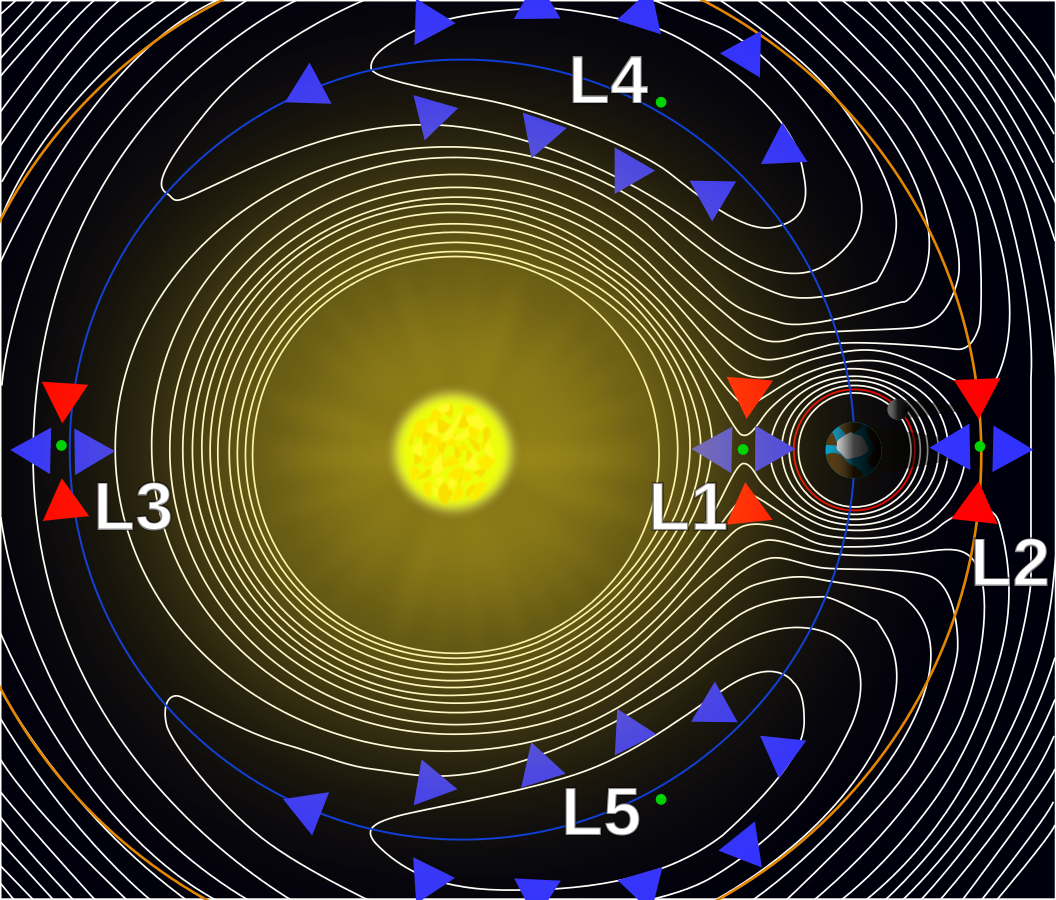
Earth-Sun Lagrangian Points. These are where a small body can stay. L1, 2 and 3 are unstable, so some little effort is needed to keep a spacecraft near there. L4 and L5 are stable. Source: Wikimedia Commons, Xander89. Click to enlarge.
1/15/2021 – Ephemeris – What the Chinese Chang’e 5 lunar mission found
This is Bob Moler with Ephemeris for Monday, November 15th. Today the Sun will be up for 9 hours and 34 minutes, setting at 5:14, and it will rise tomorrow at 7:41. The Moon, halfway from first quarter to full, will set at 4:45 tomorrow morning. | Late last year, the Chinese sent an uncrewed spacecraft to the Moon to collect samples of the surface material. That material is called regolith, and they drilled down at least a meter, which they returned to the Earth. An international team of geologists has been studying the material, and we have the first reports. Apparently the material they picked up was dated at 2 billion years, which is an intermediate age to the material picked up by the Apollo missions that dates either 3 billion years or older or 1 billion years. That helps fill gaps in the Moon’s history. Of course, all the material in the solar system is 4.5 billion years old. But the radioactive dating clock is reset when a rock is melted and solidifies.
The astronomical event times given are for the Traverse City/Interlochen area of Michigan (EST, UT – 5 hours). They may be different for your location.
Addendum
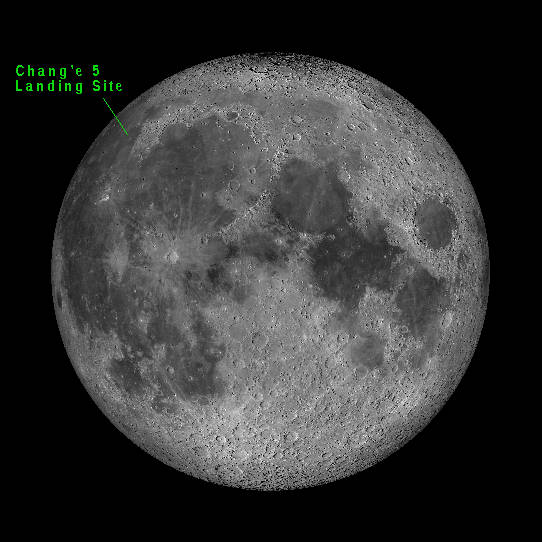
Chang’e 5 Landing-Site on full moon map. Created using Virtual Mon Atlas.
11/12/2021 – Ephemeris – The Moon appears to wobble slowly over the month
This is Ephemeris for Friday, November 12th. Today the Sun will be up for 9 hours and 41 minutes, setting at 5:17, and it will rise tomorrow at 7:37. The Moon, 1 day past first quarter, will set at 1:27 tomorrow morning.
When I look at the Moon, I check the position of one particular feature. A small, nearly circular gray area near the right or western edge of the Moon’s disk. It’s called the Sea of Crises, or in Latin, Mare Crisium. The reason I check it is that over the month its distance from the edge, or what astronomers call the limb, changes. That sea is about as far as it can get from the limb now. The reason for this wobbling back and forth, called libration, is that the Moon rotates at a constant rate due to angular momentum, but its revolution around the earth is an ellipse, so it doesn’t move with a uniform speed in its orbit. It moves faster at its closest to the Earth, called perigee, and is slowest at apogee, its farthest from the Earth.
The astronomical event times given are for the Traverse City/Interlochen area of Michigan (EST, UT – 5 hours). They may be different for your location.
Addendum.
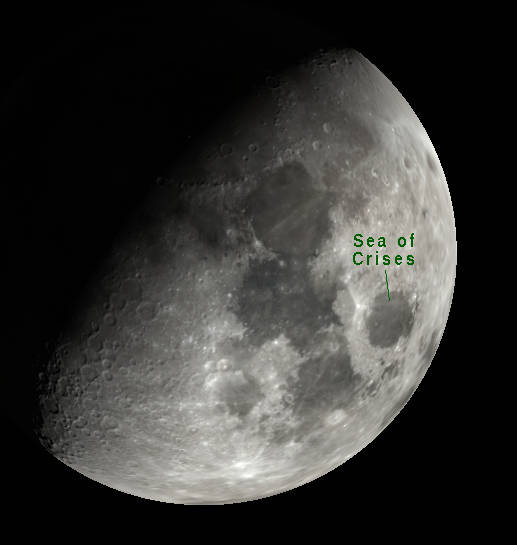
The Moon tonight (November 12, 2021) showing Mare Crisium (Sea of Crises) about as far from the limb (Moon’s edge) as it can get. Created using Stellarium.
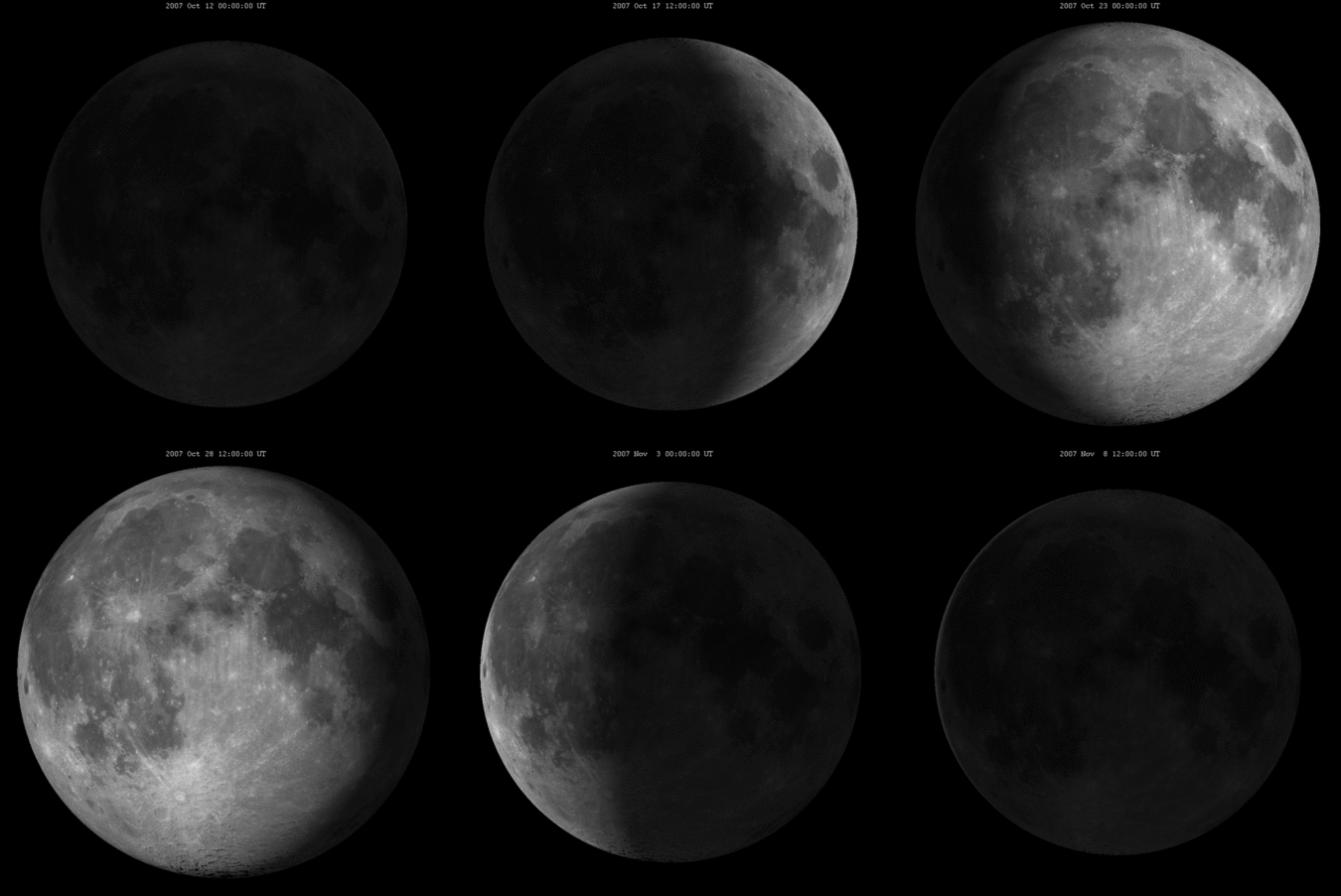
Simulation of the Moon’s phase and libration for October 2007 by Tomruen. Image is in the Public Domain.
11/11/2021 – Ephemeris – The Moon passes Jupiter and a minor meteor shower tonight.
This is Bob Moler with Ephemeris for Veterans Day, Thursday, November 11th. Today the Sun will be up for 9 hours and 43 minutes, setting at 5:18, and it will rise tomorrow at 7:36. The Moon, at first quarter today, will set at 12:16 tomorrow morning.
By tonight, the Moon will have moved over and just passed Jupiter. The bright planet will be to the right and above the first quarter Moon. There is also a meteor shower occurring, well actually two. They are minor, with maybe 5 to 15 meteors per hour at peak. With both showers, the radiants, that is where the meteors seem to come from, is in Taurus the Bull near the Pleiades star cluster. The notes I have for the Northern Taurids is that they are slow and bright, not bothered by a bright Moon. So if a meteor is spotted in the evening coming from the east, it’s probably a North Taurid meteor. As the night progresses the radiant will move westward, higher in the sky and begin to set in the west as morning twilight starts.
The astronomical event times given are for the Traverse City/Interlochen area of Michigan (EST, UT – 5 hours). They may be different for your location.
Addendum
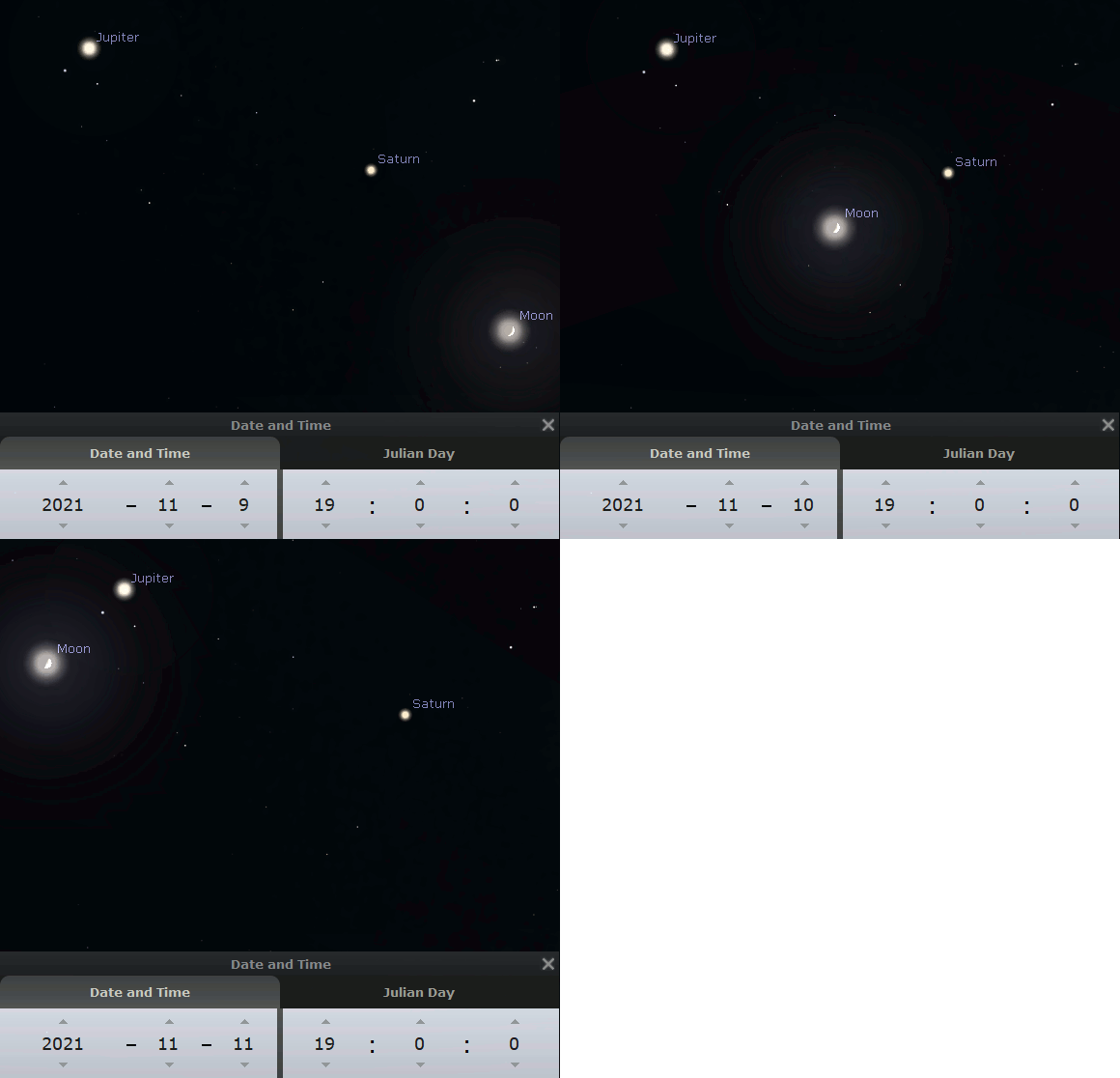
Viewing the Moon’s passage by Saturn and Jupiter for three nights, November 9, 10 and 11 2021. Note that while the Moon is jumping eastward, to the left, the planets and stars are moving the other way, but much more slowly. The Moon moves 360° around the sky in about 29 1/2 days, so it moves about 12° or 24 of its diameters every day. The movement of the stars and planets in the other direction is because we are staying at the same solar time, 7 pm. However, the Earth is orbiting the Sun at a little less than a degree a solar day. To keep the stars stationary, our daily interval should be one sidereal day, the time it takes the earth to rotate with respect to the stars, which is 23 hours 3 minutes and 56 seconds. Should we have stepped at the sidereal rate, the very slight eastward motion of these outer planets may have been noticeable. Created using Stellarium, and GIMP.
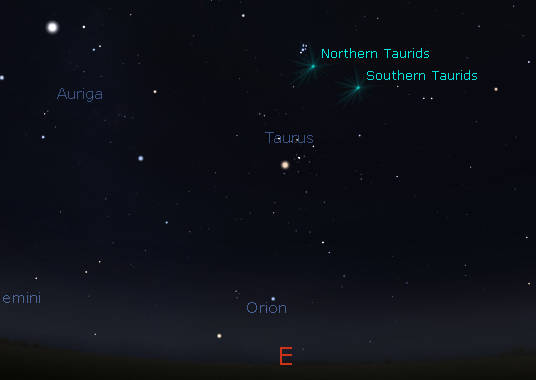
North and South Taurid radiants seen in the east at 9 pm on November 11th. The Northern Taurid radiant is the most active now. Note the Pleiades just to the upper left of the Northern Taurid radiant. The face of Taurus the bull is below as a sideways V where Taurus is displayed. However, since the meteors are seen all over the sky, it might be difficult to trace them back to a specific radiant. Created using Stellarium.
As a side note, about the face of Taurus. The stars, except the brightest one, Aldebaran, belong to a star cluster called the Hyades. They are, mythologically, the half-sisters of the Pleiades. Also, the V can be an upside down A. I am currently working on a program I’m going to present at the December Zoom meeting of the Grand Traverse Astronomical Society about astronomy in ancient times. Back when the alphabet was developed in the Middle East 4000-4500 years ago, Taurus, not Aries was the first sign of the zodiac, so apparently the first letter of the alphabet “Aleph” was modeled after the face of Taurus.
Other tidbits are: the reason there are 24 hours in a day, and 60 minutes in an hour. There are lots of others. We can handle up to 100 people joining the meeting. It’s at 8 pm EST (UT – 5 hours), December 3rd [01:00 UT, December 4th]. To join the meeting, go to www.gtastro.org for instructions and a link.
11/10/2021 – Ephemeris – Let’s search for the naked-eye planets for this week
This is Bob Moler with Ephemeris for Wednesday, November 10th. Today the Sun will be up for 9 hours and 46 minutes, setting at 5:19, and it will rise tomorrow at 7:34. The Moon, 1 day before first quarter, will set at 11:02 this evening.
Let’s search for the naked-eye planets for this week. Venus should be visible in the southwestern evening twilight by 5:40 tonight. It’s a fat crescent in telescopes. Venus will set at 7:46 pm. By 6 pm, Both Jupiter and Saturn should be able to be spotted in the southern sky. Saturn will be dimmer, and to its right. Saturn will be above and right of the Moon tonight. It will set first at 10:45 pm, with Jupiter following at 12:07 am. Saturn’s rings are a beautiful sight in a telescope of even modest power, but the planet will appear tiny. In the morning sky, Mercury now can only be spotted in a telescope, so its appearance in the morning sky is, for all practical purposes, over.
The astronomical event times given are for the Traverse City/Interlochen area of Michigan (EST, UT – 5 hours). They may be different for your location.
Addendum
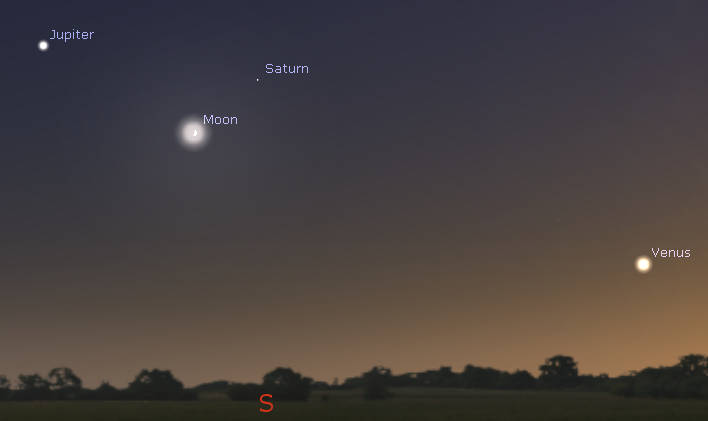
Evening planets and the Moon in twilight at 6 pm tonight, November 10, 2021. Click on the image to enlarge it. Created using Stellarium.
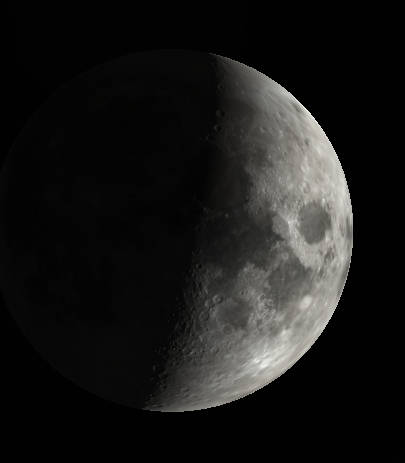
The crescent Moon as it might appear tonight in binoculars or small telescope. It appears here right side up as it would appear in the sky at 6 pm tonight, November 10, 2021. Created using Stellarium.
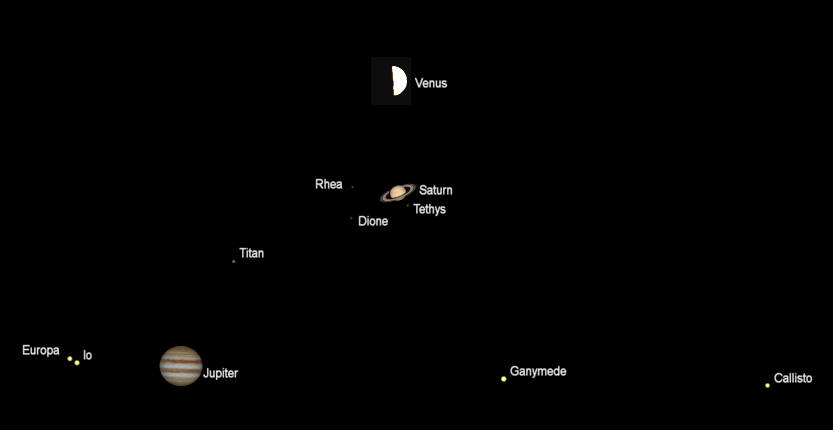
Telescopic views of the bright planets (north up) as they would be seen in a small telescope, with the same magnification, this evening at 7 pm, November 10, 2021. Apparent diameters: Venus, 28.99″, 42.7% illuminated; Saturn 16.50″, its rings 38.44″; Jupiter, 40.94″. The ” symbol means seconds of arc (1/3600th of a degree.) Click on the image to enlarge it. Created using Cartes du Ciel (Sky Charts).
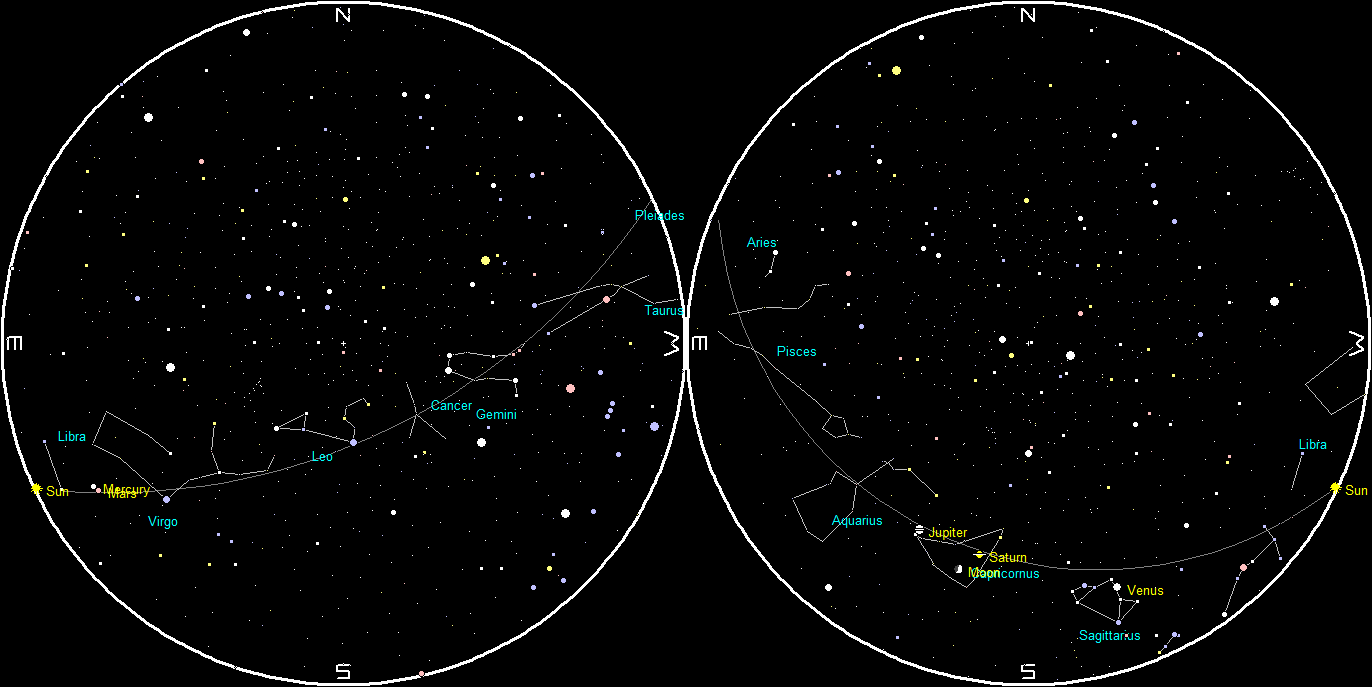
The naked-eye planets and the Moon at sunset and sunrise on a single night, starting with sunset on the right on November 10, 2021. The night ends on the left with sunrise on the 11th. Click on the image to enlarge it. Created using my LookingUp program.
11/09/2021 – Ephemeris – The Moon, Saturn and the return to standard time
This is Bob Moler with Ephemeris for Tuesday, November 9th. Today the Sun will be up for 9 hours and 48 minutes, setting at 5:20, and it will rise tomorrow at 7:33. The Moon, 2 days before first quarter, will set at 9:48 this evening.
Ever since new moon, the Moon has been moving eastward each night. It will be approaching Saturn tonight, and pass south or below Saturn at mid-morning tomorrow. By tomorrow night, the Moon will have moved just past Saturn, on its way toward Jupiter. The return to standard time since Sunday has darkened our evenings and lightened our mornings. We are about 30 days from the earliest sunset on December 9th, just 18 minute earlier than tonight’s sunset. Our sunrise has a longer time to go to reach last week’s late sunrise times, all the way to January second. Thanks to Congress’s messing around with it, we are on daylight saving time for a longer part of the year than standard time. Don’t get me started.
The astronomical event times given are for the Traverse City/Interlochen area of Michigan (EST, UT – 5 hours). They may be different for your location.
Addendum
Viewing the Moon’s passage by Saturn and Jupiter for three nights, November 9, 10 and 11, 2021. Created using Stellarium, and GIMP.
11/08/2021 – Ephemeris – The next two months will be prime time to view Venus in a telescope
This is Bob Moler with Ephemeris for Monday, November 8th. Today the Sun will be up for 9 hours and 51 minutes, setting at 5:21, and it will rise tomorrow at 7:32. The Moon, 3 days before first quarter, will set at 8:37 this evening.
Venus is beginning to look like the crescent Moon in telescopes. Right now it’s a very fat crescent. The reason is that since its greatest separation from the Sun a bit more than a week ago, Venus’ sunlit side is more and more turned away from us as it starts to move between the Earth and Sun. Venus is also rapidly approaching us now and is 54.9 million miles (88.3 million kilometers) away. A month from now it will appear larger than Jupiter, so Venus’ thinning crescent might be glimpsed in binoculars. Venus’ size will grow and crescent will get even thinner until it passes between the Earth and Sun, which will occur January 8th next year. That’s called inferior conjunction with the Sun. From our vantage point, it will pass just north of the Sun, and a week or so later will be seen in the morning sky.
The astronomical event times given are for the Traverse City/Interlochen area of Michigan (EST, UT – 5 hours). They may be different for your location.
Addendum
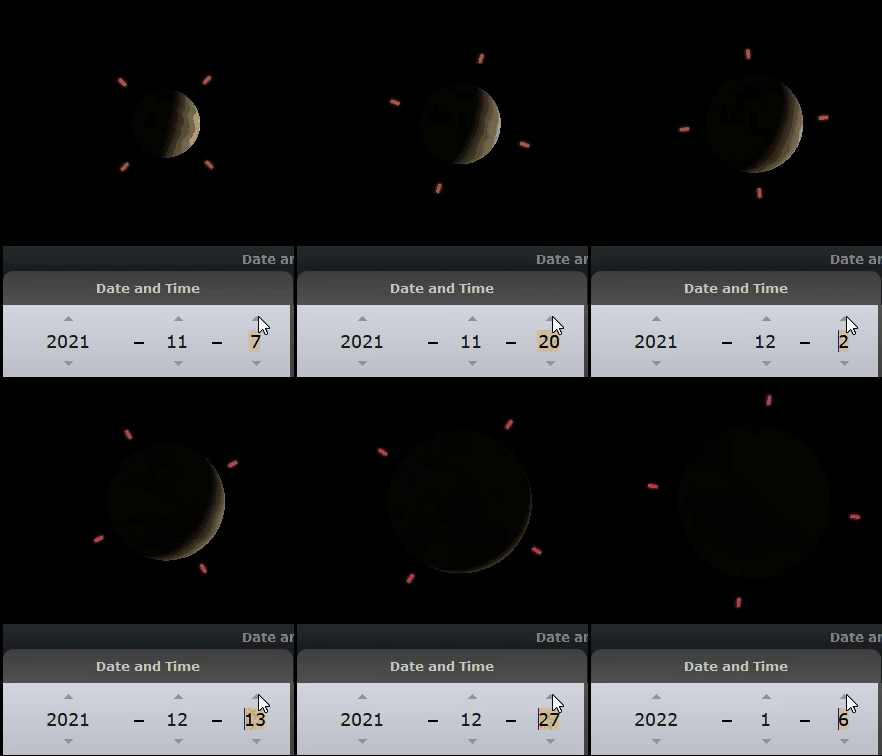
Animated GIF of Venus’ last 2 months in the evening sky, November 8, 2021, to January 8, 2022. After mid-December the crescent is too thin to show in the program, but can actually be seen. I’ve spotted Venus as close as 4 days before inferior conjunction. Created using Stellarium and Filmora.
11/05/2021 – Ephemeris – Astronomy meeting tonight via Zoom
This is Ephemeris for Friday, November 5th. The Sun will rise at 8:26. It’ll be up for 9 hours and 59 minutes, setting at 6:25. The Moon, 1 day past new, will set at 7:04 this evening.
The Grand Traverse Astronomical Society hold a virtual meeting and program at 8 pm tonight via Zoom. For the program, yours truly will present Asteroids in the News. Two new NASA asteroid missions are in the news, the just launched Lucy mission to investigate seven of Jupiter’s Trojan asteroids and later this month the launching a planetary defense mission test called DART to attempt to deflect a small asteroid orbiting another. A virtual star party will start around 9 pm, hosted by Dr. Jerry Dobek, astronomy professor at Northwestern Michigan College, but only if it’s clear in Traverse City. It will feature Jupiter and Saturn, wonders of the autumn sky. Instructions to join the meeting and a link can be found on the society’s website, http://www.gtastro.org.
The astronomical event times given are for the Traverse City/Interlochen area of Michigan (EDT, UT – 4 hours). They may be different for your location.
11/04/2021 – Ephemeris – Myths of the Pleiades from some other cultures
This is Ephemeris for Thursday, November 4th. The Sun will rise at 8:25. It’ll be up for 10 hours and 1 minute, setting at 6:26. The Moon is new today, and won’t be visible.
Let’s look at how some other cultures saw the Pleiades, the star cluster that is seen in the eastern sky these evenings. To the Anishinaabe native peoples around here, the Pleiades is the “Hole in the Sky” or the seven stones that are heated for the sweat lodge ceremony. To the Kiowa, these were sister stars that had been whisked into the sky from the top of Devil’s Tower in Wyoming, where they were threatened by a huge bear. In Norse mythology, these were the goddess Freya’s hens. The name we know them by has rather misty origins. Some think the Greek name is from the mother of the seven sisters, Pleione. The Greek word for sail is similar to Pleiades, and it seems the appearance of the Pleiades in the morning sky saw the best sailing weather in the Mediterranean.
The astronomical event times given are for the Traverse City/Interlochen area of Michigan (EDT, UT – 4 hours). They may be different for your location.
Addendum
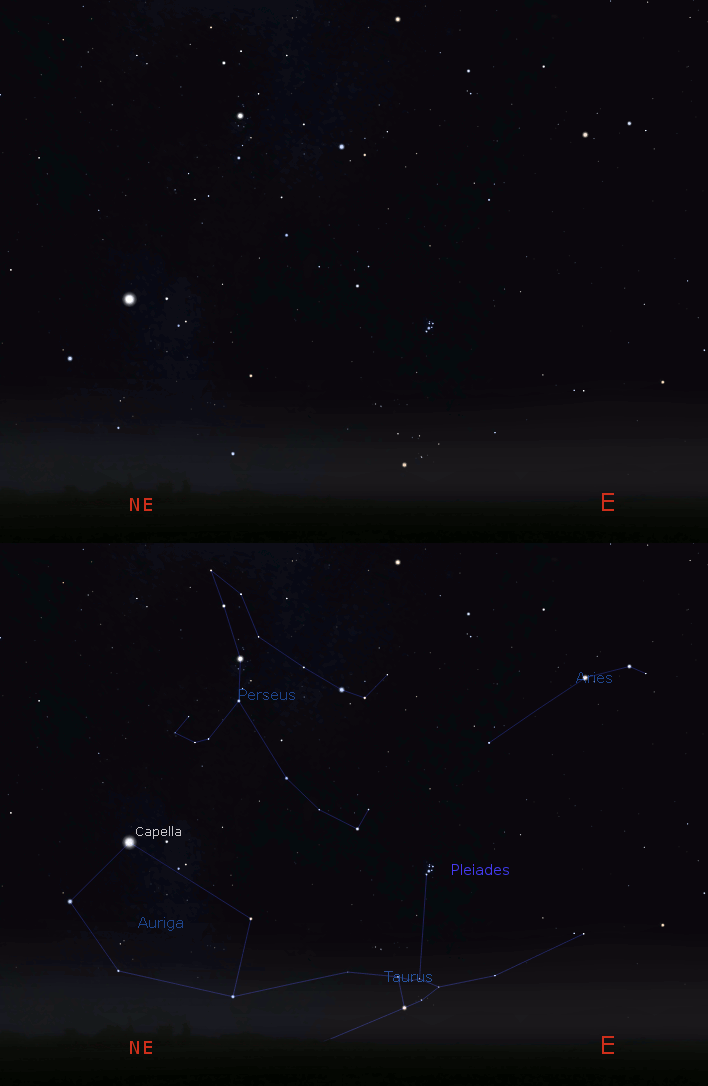
Finding the Pleiades animation for 9 p.m. October 29, 2019. Created using Stellarium and GIMP.

Seven maidens being attacked by a giant bear, having fled to the top of Devil’s Tower in Wyoming. Painting by Herbert Collins, http://www.nps.gov/deto.

They are also the Seven Daughters of the Moon and Sun. They loved to dance and play, and when their father, the Moon was low in the sky, would descend to the Earth in a basket to do their thing. On one of their trips to the earth, one of them was captured by a human, and she ended up falling in love with him, and married him. When father Moon found out he permanently dimmed her star, so now most people now only can spot 6 of the stars. This last bit seems to parallel the Greek story of the lost Pleiad.
 Bob Moler's Ephemeris Blog