11/03/2021 – Ephemeris – Searching for the naked-eye planets for this week
This is Ephemeris for Wednesday, November 3rd. The Sun will rise at 8:23. It’ll be up for 10 hours and 4 minutes, setting at 6:28. The Moon, 1 day before new, will rise at 7:56 tomorrow morning.
Let’s search for the naked-eye planets for this week. Venus should be visible in the southwestern evening twilight by 6:50 tonight. It’s a fat crescent in telescopes. Venus will set at 8:44 pm. By 7 pm, Jupiter should be able to be spotted in the south-southeastern sky. Saturn will be dimmer, and to its right. They will set after midnight in the southwest, with Saturn setting first at 12:11 am, and Jupiter following at 1:32. Saturn’s rings are a beautiful sight in a telescope of even modest power, but the planet will appear tiny. In the morning sky, Mercury will be harder to spot than it was last week. It will be visible and low in the east-southeast from 7:30 to 8 am. All four of Jupiter’s brightest moons will be visible in binoculars early in the evening tonight.
The astronomical event times given are for the Traverse City/Interlochen area of Michigan (EDT, UT – 4 hours). They may be different for your location.
Addendum
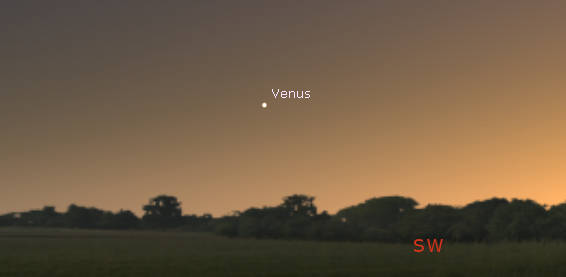
Venus will appear low in the south-southwest by 6:50 pm tonight, November 3, 2021. Created using Stellarium.
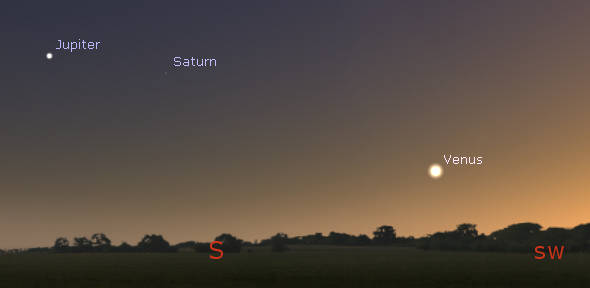
Venus, Jupiter and Saturn at 7 pm in the southern sky. Created using Stellarium.
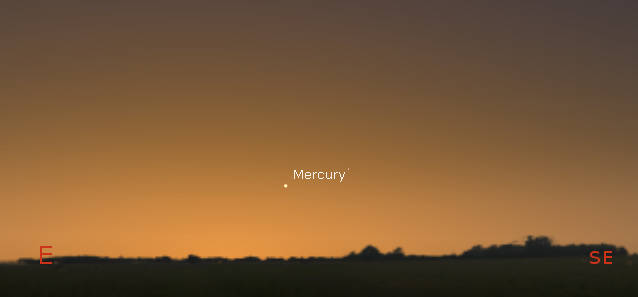
Mercury in morning twilight at 7:45 am, November 4, 2021. Created using Stellarium.
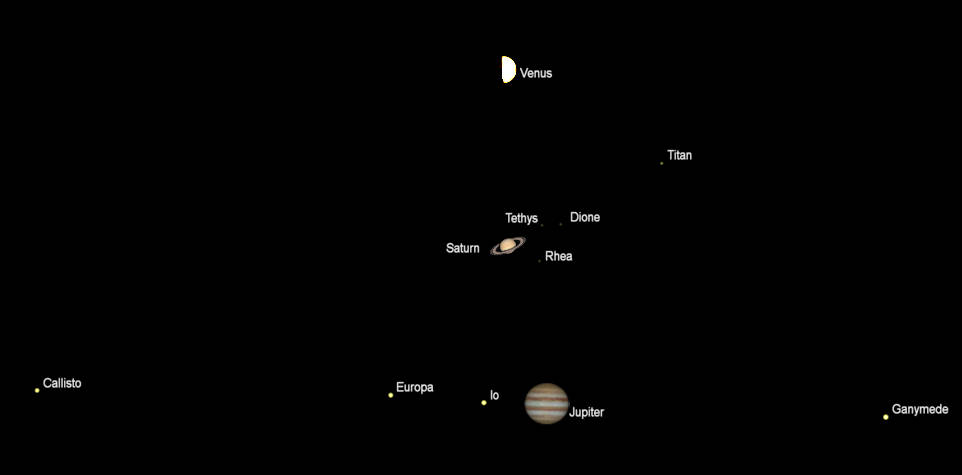
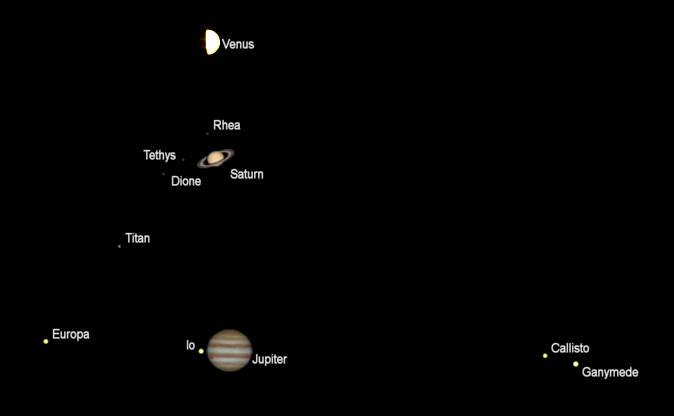
Telescopic views of the bright planets (north up) as they would be seen in a small telescope, with the same magnification, this evening at 9 pm, November 3, 2021. Apparent diameters: Venus at 7 pm, 26.54″, 46.7% illuminated; Saturn 16.69″, its rings 38.88″; Jupiter, 41.77″. Mercury at 7:30 am on the 4th and not plotted, 5.49″, 86.4% illuminated. The Jovian moon Io will begin transiting the face of the planet at 11:14 pm. Its shadow will start to cross at 12:32 am. The ” symbol means seconds of arc (1/3600th of a degree.) Click on the image to enlarge it. Created using Cartes du Ciel (Sky Charts).
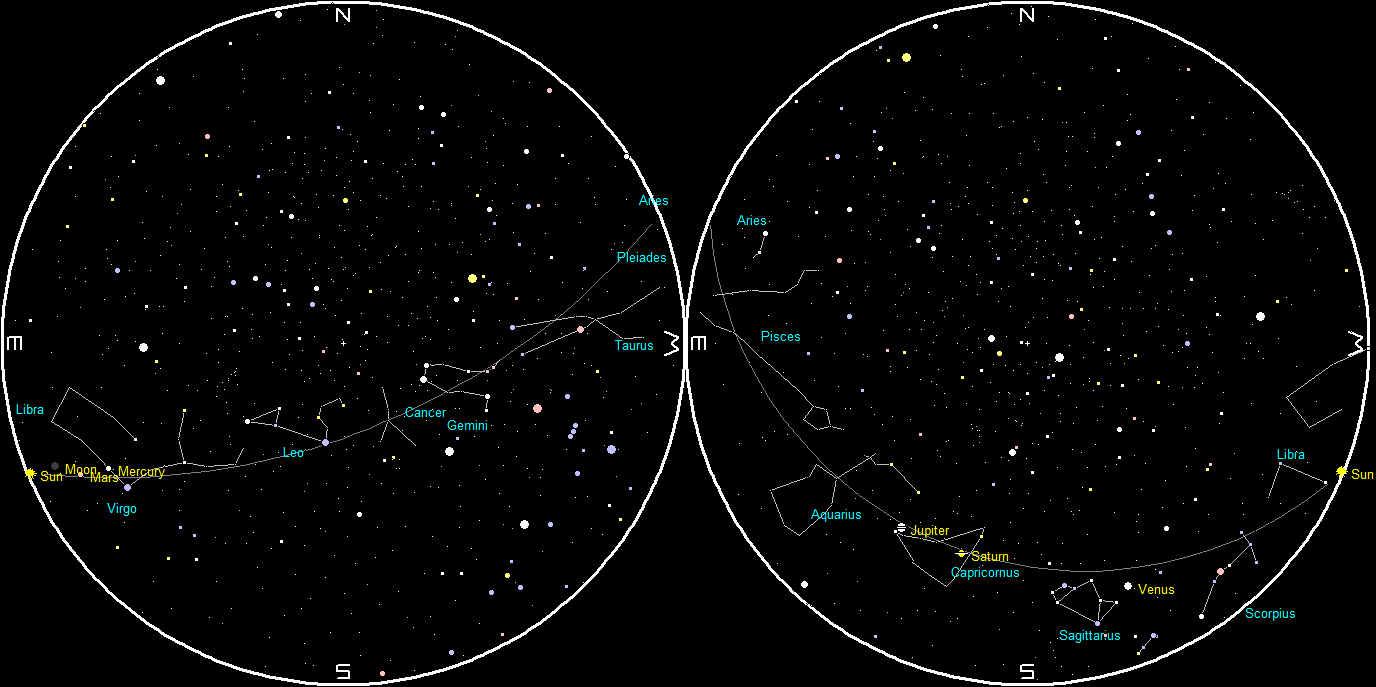
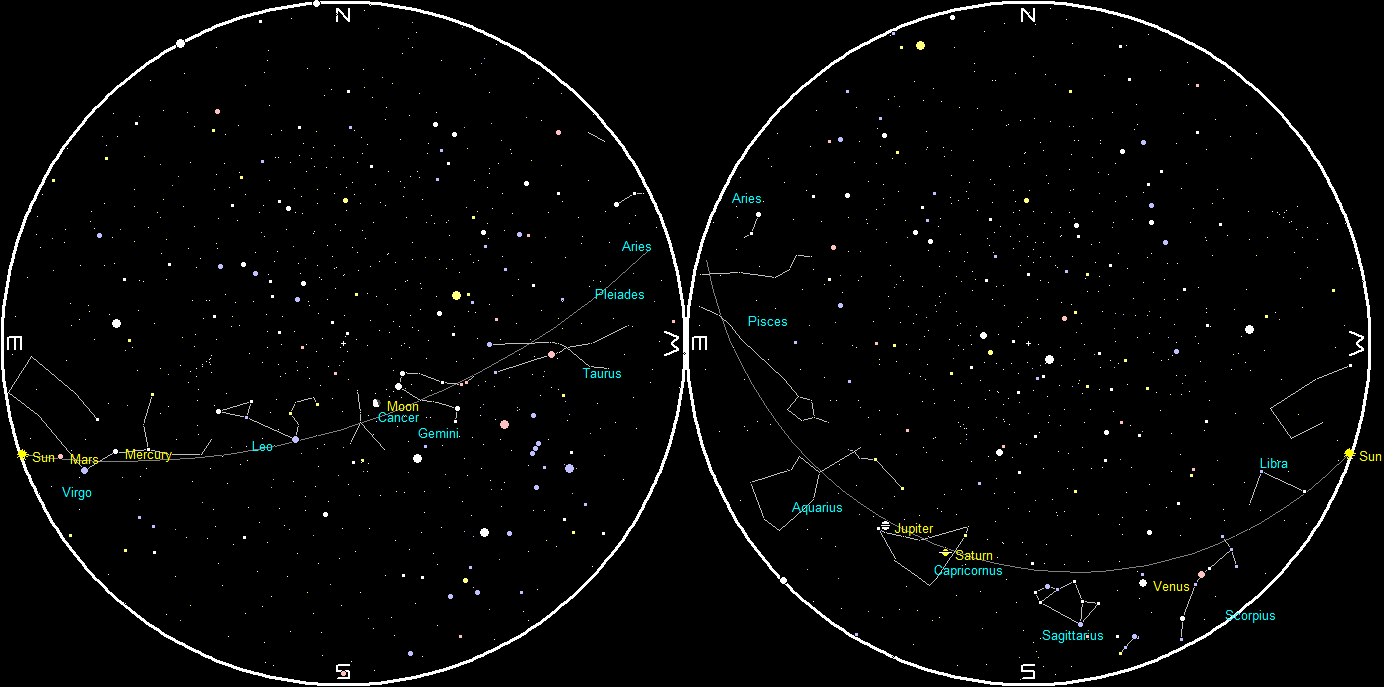
The naked-eye planets and the Moon at sunset and sunrise on a single night, starting with sunset on the right on November 3, 2021. The night ends on the left with sunrise on the 4th. Click on the image to enlarge it. Created using my LookingUp program.
11/02/2021 – Ephemeris – Finding the Pleiades or Seven Sisters
This is Ephemeris for Election Day for some, Tuesday, November 2nd. The Sun will rise at 8:22. It’ll be up for 10 hours and 7 minutes, setting at 6:29. The Moon, 2 days before new, will rise at 6:35 tomorrow morning.
A marvelous sight in the autumn skies can be found low in the east after 8 in the evening. It is the famous star cluster called the Pleiades or the Seven Sisters. I might also add the “Tiny Dipper”. Many people can spot a tiny dipper shape in its six or seven stars, and mistake it for the Little Dipper. However, with binoculars, one can see over a hundred stars appear along with the dipper shape of the brightest. In photographs, the Pleiades actually contain wisps of the dust they are passing through. They are a young star cluster, whose age is estimated to be one hundred million years. In Greek mythology, the sisters were daughters of the god Atlas. I’ll be revisiting the Pleiades several times this autumn, and winter, starting on Thursday.
The astronomical event times given are for the Traverse City/Interlochen area of Michigan (EDT, UT – 4 hours). They may be different for your location.
Addendum
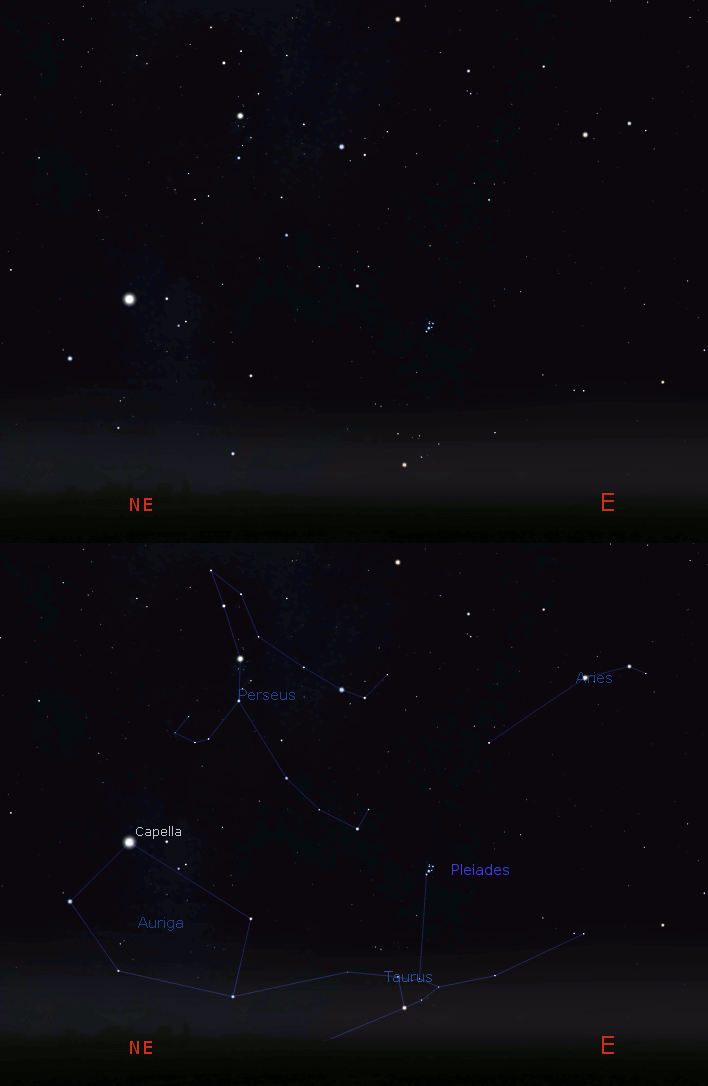
Finding the Pleiades animation for 9 p.m. in late October/early November. Created using Stellarium and GIMP.
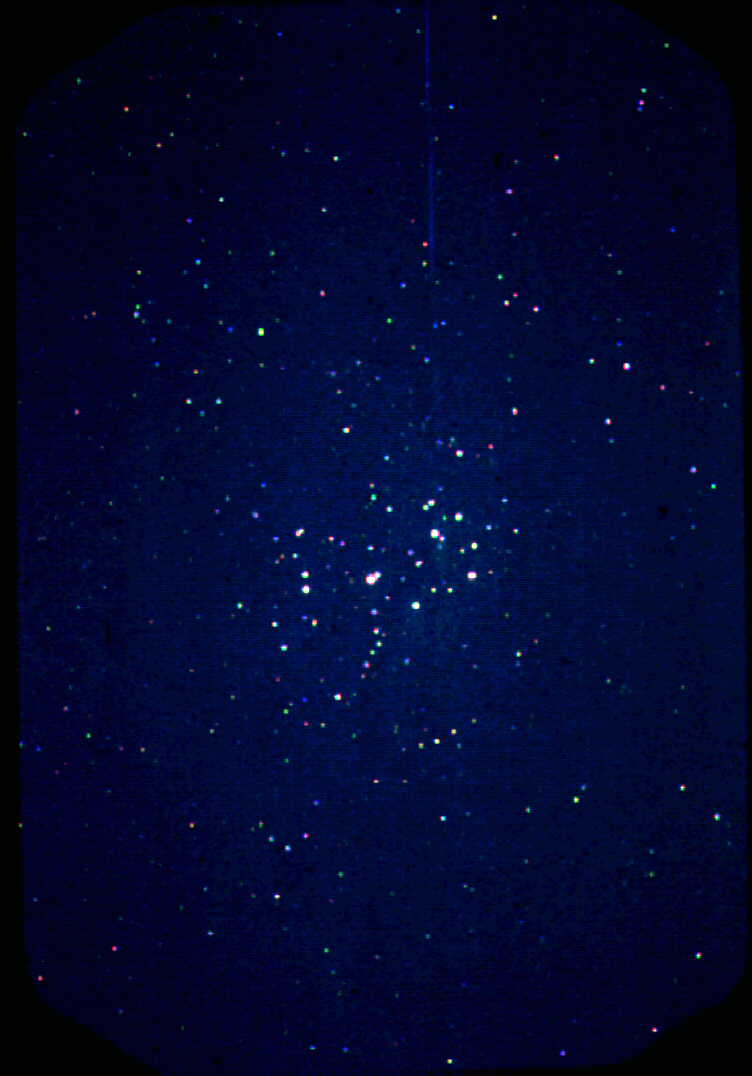
The Pleiades, about what you’d see in binoculars.
11/01/2021 – Ephemeris – Previewing November skies
This is Ephemeris for Monday, November 1st. The Sun will rise at 8:21. It’ll be up for 10 hours and 9 minutes, setting at 6:31. The Moon, 3 days before new, will rise at 5:18 tomorrow morning.
Let’s look ahead at the skies for the month of November. The Sun is still moving south rapidly at the beginning of the month, but will slow down toward the end. Daylight hours in the Interlochen/Traverse City area and will drop from 10 hours and 9 minutes today to 9 hours 4 minutes on the 30th. The altitude, or angle, of the Sun above the southern horizon at local noon will be at 30 degrees tomorrow and will descend to 23 and a half degrees on the 30th. The altitude of the Sun in the Straits area will be a degree lower. Local noon, this month, is about 12:30 p.m. There will be an almost total eclipse of the Moon on the morning of Friday the 19th. The eclipse will start at 2:18 am. Mid-eclipse with a tiny sliver of the Moon in sunlight will be at 4:05 am. It all ends at 5:47 am.
The astronomical event times given are for the Traverse City/Interlochen area of Michigan (EDT, UT – 4 hours). They may be different for your location.
Addendum
November Evening Star Chart
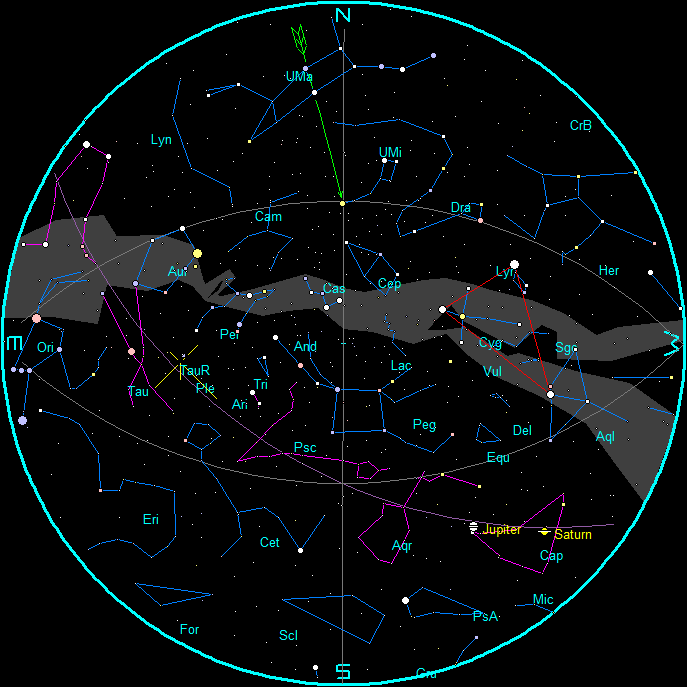
Star Chart for November evenings, 2021 (9 p.m. EST November 15, 2019). Click on image to enlarge. Click on image to enlarge. Created using my LookingUp program.
November Morning Star Chart
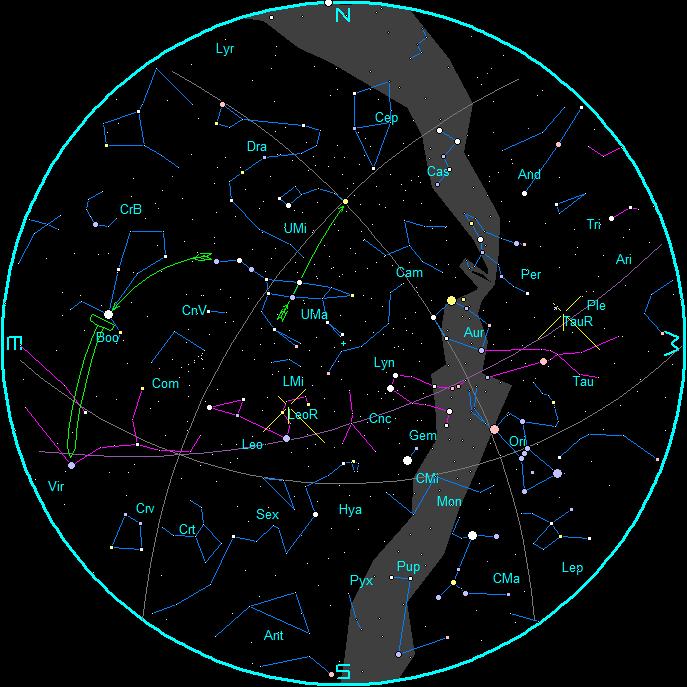
Star Chart for November mornings, 2021 (6 a.m. EST November 15, 2020). Click on image to enlarge. Created using my LookingUp program.
For a list of constellation names to go with the abbreviations, click here.
- Pointer stars at the front of the bowl of the Big Dipper point to Polaris, the North Star.
- Follow the arc of the handle of the Big Dipper to the star Arcturus
- The Summer Triangle is in red.
- TauR on the evening star chart can be used as the radiant for the North and South Taurid meteor showers.
- LeoR on the morning star chart is the radiant of the Leonid meteor shower, which peaks between the 17th.
Twilight Limits, Nautical and Astronomical
| EDT | |||||||
| Morning | Twilight | Evening | Twilight | Dark | Night | Moon | |
| Date | Astro. | Nautical | Nautical | Astro. | Start | End | Illum. |
| 2021-11-01 | 6h47m | 7h21m | 19h39m | 20h13m | 20h13m | 4h03m | 0.1 |
| 2021-11-02 | 6h48m | 7h22m | 19h38m | 20h12m | 20h12m | 5h18m | 0.04 |
| 2021-11-03 | 6h49m | 7h23m | 19h36m | 20h10m | 20h10m | 6h36m | 0.01 |
| 2021-11-04 | 6h51m | 7h25m | 19h35m | 20h09m | 20h09m | 6h51m | 0 |
| 2021-11-05 | 6h52m | 7h26m | 19h34m | 20h08m | 20h08m | 6h52m | 0.03 |
| 2021-11-06 | 6h53m | 7h27m | 19h33m | 20h07m | 20h07m | 6h53m | 0.08 |
| 2021-11-07 | 5h54m | 6h28m | 18h32m | 19h06m | 19h35m | 5h54m | 0.15 |
| 2021-11-08 | 5h55m | 6h30m | 18h31m | 19h05m | 20h37m | 5h55m | 0.25 |
| 2021-11-09 | 5h57m | 6h31m | 18h30m | 19h04m | 21h48m | 5h57m | 0.36 |
| 2021-11-10 | 5h58m | 6h32m | 18h29m | 19h03m | 23h02m | 5h58m | 0.47 |
| 2021-11-11 | 5h59m | 6h33m | 18h28m | 19h02m | – | 5h59m | 0.57 |
| 2021-11-12 | 6h00m | 6h34m | 18h27m | 19h01m | 0h16m | 6h00m | 0.68 |
| 2021-11-13 | 6h01m | 6h36m | 18h26m | 19h00m | 1h27m | 6h01m | 0.77 |
| 2021-11-14 | 6h02m | 6h37m | 18h25m | 18h59m | 2h35m | 6h02m | 0.85 |
| 2021-11-15 | 6h03m | 6h38m | 18h24m | 18h59m | 3h41m | 6h03m | 0.91 |
| 2021-11-16 | 6h05m | 6h39m | 18h23m | 18h58m | 4h45m | 6h05m | 0.96 |
| 2021-11-17 | 6h06m | 6h40m | 18h23m | 18h57m | 5h50m | 6h06m | 0.99 |
| 2021-11-18 | 6h07m | 6h41m | 18h22m | 18h56m | – | – | 1 |
| 2021-11-19 | 6h08m | 6h43m | 18h21m | 18h56m | – | – | 0.99 |
| 2021-11-20 | 6h09m | 6h44m | 18h20m | 18h55m | – | – | 0.97 |
| 2021-11-21 | 6h10m | 6h45m | 18h20m | 18h54m | – | – | 0.93 |
| 2021-11-22 | 6h11m | 6h46m | 18h19m | 18h54m | 18h54m | 19h22m | 0.87 |
| 2021-11-23 | 6h12m | 6h47m | 18h19m | 18h53m | 18h53m | 20h17m | 0.81 |
| 2021-11-24 | 6h13m | 6h48m | 18h18m | 18h53m | 18h53m | 21h19m | 0.72 |
| 2021-11-25 | 6h14m | 6h49m | 18h18m | 18h52m | 18h52m | 22h24m | 0.63 |
| 2021-11-26 | 6h15m | 6h50m | 18h17m | 18h52m | 18h52m | 23h33m | 0.53 |
| 2021-11-27 | 6h16m | 6h51m | 18h17m | 18h52m | 18h52m | – | 0.43 |
| 2021-11-28 | 6h17m | 6h52m | 18h16m | 18h51m | 18h51m | 0h43m | 0.33 |
| 2021-11-29 | 6h18m | 6h54m | 18h16m | 18h51m | 18h51m | 1h54m | 0.23 |
| 2021-11-30 | 6h19m | 6h55m | 18h16m | 18h51m | 18h51m | 3h07m | 0.14 |
Twilight calendar was generated using Cartes du Ciel (Sky Charts).
See my blog post: Twilight Zone for the definitions of the different periods of twilight here: https://bobmoler.wordpress.com/2018/09/27/.
NASA Calendar of Planetary Events
   Date      Time    Event
Nov  1  Mo            Venus: 47° E
     1  Mo   8:17 pm  Mercury-Spica: 4.1° N
     4  Th   4:15 pm  New Moon
     4  Th   7:13 pm  Uranus Opposition
     5  Fr   5:23 pm  Moon Perigee: 358800 km
     5  Fr  10:38 pm  Moon Descending Node
     8  Mo  12:21 am  Moon-Venus: 1.1° S
     8  Mo  11:27 am  Moon South Dec.: 26.3° S
    10  We   9:27 am  Moon-Saturn: 4.2° N
    11  Th   7:46 am  First Quarter
    11  Th  12:12 pm  Moon-Jupiter: 4.5° N
    12  Fr   6:16 am  North Taurid Shower: ZHR = 15
    17  We  12:33 pm  Leonid Shower: ZHR = 15
    19  Fr   3:58 am  Full Moon
    19  Fr   4:04 am  Partial Lunar Eclipse
    19  Fr  12:59 pm  Moon Ascending Node
    20  Sa   9:14 pm  Moon Apogee: 406300 km
    22  Mo   5:43 pm  Moon North Dec.: 26.3° N
    23  Tu  10:22 pm  Moon-Pollux: 2.8° N
    24  We  11:32 pm  Moon-Beehive: 3.6° S
    27  Sa   7:28 am  Last Quarter
    28  Su  11:35 pm  Mercury Superior Solar Conj.
All event times for November 1-6 are given for UTC-4 Eastern Daylight Saving Time. Dates after that times are given for UTC-5 Eastern Standard Time.
Sky Events Calendar by Fred Espenak and Sumit Dutta (NASA’s GSFC),
http://eclipse.gsfc.nasa.gov/SKYCAL/SKYCAL.html.
If you go to the above site you can print out a list like the above for the entire year or calendar pages for your time zone.
Sun and Moon Rising and Setting Events
LU             Ephemeris of Sky Events for Interlochen/TC
November, 2021    Local time zone: EDT
+-----------------------------------------------------------------------+
| DATE |  SUN     SUN  DAYLIGHT|   TWILIGHT*    |MOON  RISE OR    ILLUM |
|      |  RISE    SET    HOURS |  END    START  |PHASE SET** TIME FRACTN|
+=======================================================================+
|Mon  1| 08:21a  06:31p  10:09 | 07:36p  07:16a |      Rise 05:18a   11%|
|Tue  2| 08:22a  06:29p  10:07 | 07:34p  07:17a |      Rise 06:35a    5%|
|Wed  3| 08:23a  06:28p  10:04 | 07:33p  07:18a |      Rise 07:56a    1%|
|Thu  4| 08:25a  06:26p  10:01 | 07:32p  07:19a |New   Set  06:31p    0%|
|Fri  5| 08:26a  06:25p  09:59 | 07:31p  07:21a |      Set  07:04p    2%|
|Sat  6| 08:27a  06:24p  09:56 | 07:30p  07:22a |      Set  07:44p    7%|
+------+-----------------------+----------------+-----------------------+
| EST  |      Time Change      |                |                       |
|Sun  7| 07:29a  05:23p  09:53 | 06:28p  06:23a |      Set  07:35p   14%|
|Mon  8| 07:30a  05:21p  09:51 | 06:27p  06:24a |      Set  08:37p   23%|
|Tue  9| 07:32a  05:20p  09:48 | 06:26p  06:25a |      Set  09:48p   33%|
|Wed 10| 07:33a  05:19p  09:46 | 06:25p  06:27a |      Set  11:02p   44%|
|Thu 11| 07:34a  05:18p  09:43 | 06:24p  06:28a |F Qtr Set  12:16a   55%|
|Fri 12| 07:36a  05:17p  09:41 | 06:24p  06:29a |      Set  01:27a   65%|
|Sat 13| 07:37a  05:16p  09:38 | 06:23p  06:30a |      Set  02:35a   75%|
+------+-----------------------+----------------+-----------------------+
|Sun 14| 07:38a  05:15p  09:36 | 06:22p  06:31a |      Set  03:40a   83%|
|Mon 15| 07:40a  05:14p  09:34 | 06:21p  06:33a |      Set  04:45a   90%|
|Tue 16| 07:41a  05:13p  09:31 | 06:20p  06:34a |      Set  05:49a   95%|
|Wed 17| 07:42a  05:12p  09:29 | 06:19p  06:35a |      Set  06:54a   98%|
|Thu 18| 07:44a  05:11p  09:27 | 06:19p  06:36a |      Set  07:58a  100%|
|Fri 19| 07:45a  05:10p  09:25 | 06:18p  06:37a |Full  Rise 05:23p  100%|
|Sat 20| 07:46a  05:09p  09:23 | 06:17p  06:38a |      Rise 05:56p   98%|
+------+-----------------------+----------------+-----------------------+
|Sun 21| 07:48a  05:09p  09:21 | 06:17p  06:40a |      Rise 06:35p   94%|
|Mon 22| 07:49a  05:08p  09:19 | 06:16p  06:41a |      Rise 07:22p   89%|
|Tue 23| 07:50a  05:07p  09:17 | 06:15p  06:42a |      Rise 08:17p   82%|
|Wed 24| 07:51a  05:07p  09:15 | 06:15p  06:43a |      Rise 09:19p   74%|
|Thu 25| 07:53a  05:06p  09:13 | 06:15p  06:44a |      Rise 10:24p   65%|
|Fri 26| 07:54a  05:05p  09:11 | 06:14p  06:45a |      Rise 11:33p   55%|
|Sat 27| 07:55a  05:05p  09:09 | 06:14p  06:46a |L Qtr Rise 12:42a   45%|
+------+-----------------------+----------------+-----------------------+
|Sun 28| 07:56a  05:04p  09:08 | 06:13p  06:47a |      Rise 01:54a   35%|
|Mon 29| 07:57a  05:04p  09:06 | 06:13p  06:48a |      Rise 03:07a   25%|
|Tue 30| 07:59a  05:03p  09:04 | 06:13p  06:49a |      Rise 04:24a   15%|
+-----------------------------------------------------------------------+
* Nautical Twilight
** Moonrise or moonset, whichever occurs between sunrise and sunset
Generated using my LookingUp for DOS program.
Preview of the November 19, 2021 partial lunar eclipse at maximum at 4:05 am
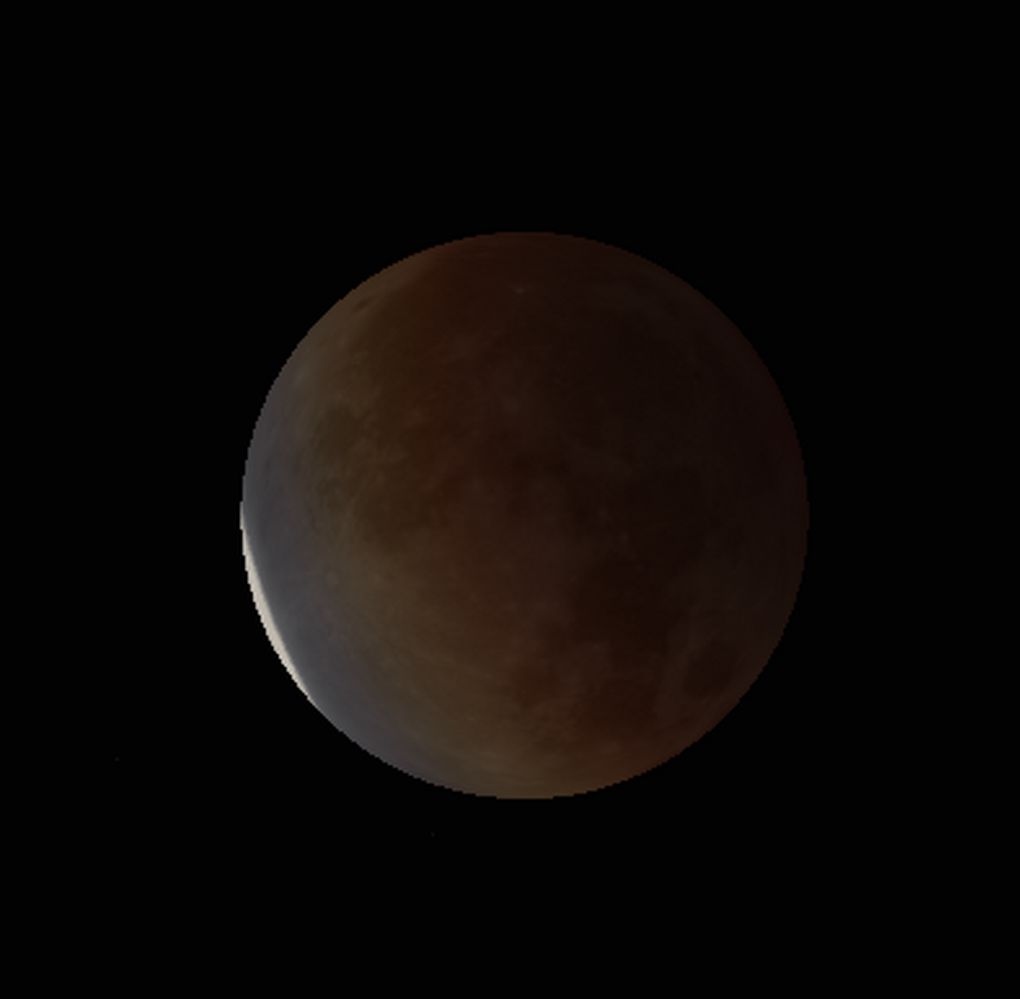
A Stellarium simulation of what the partial lunar eclipse of the 19th might look like at its peak at 4:05 am EST.
10/29/2021 – Ephemeris – Venus is at its greatest separation east from the Sun today
This is Ephemeris for Friday, October 29th. Today the Sun will be up for 10 hours and 18 minutes, setting at 6:35, and it will rise tomorrow at 8:18. The Moon, 1 day past last quarter, will rise at 1:39 tomorrow morning.
Tonight, Venus will be at its greatest separation east of the Sun of 47 angular degrees. Having an orbit inside the Earth’s orbit, Venus never strays more than a 47-degree angle from the Sun. It has been moving away from around behind the Sun to its present position since March 26th. That’s 217 days. And now it will take only 72 days to head back to pass between the Earth and the Sun in inferior conjunction and leave the evening sky on January 9th. For this next 70 or so days, Venus will look great in telescopes. It will get larger as it approaches us and become a dazzling crescent in telescopes. Toward the latter half of December, the tiny crescent can even be made out in binoculars. It is the very best time to view Venus in a telescope.
The astronomical event times given are for the Traverse City/Interlochen area of Michigan (EDT, UT – 4 hours). They may be different for your location.
Addendum
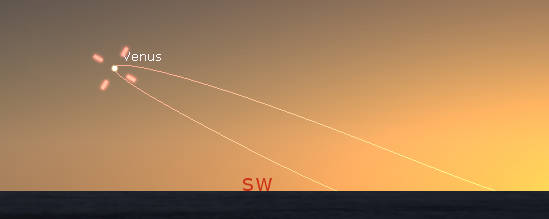
Venus at greatest elongation, seen at 7 pm tonight, October 29, 2021. Note how shallow the orbit is compared with Mercury’s orbit was on Monday’s (10/25/2021) post of Mercury’s greatest western elongation as seen in the morning. Created using Stellarium.
10/28/2021 – Ephemeris – The spookiest star in the sky
This is Ephemeris for Thursday, October 28th. Today the Sun will be up for 10 hours and 21 minutes, setting at 6:36, and it will rise tomorrow at 8:17. The Moon, at last quarter today, will rise at 12:31 tomorrow morning.
We are getting down to the spookiest time of the year, with Halloween on Sunday, so it’s time to talk about the spookiest star in the sky, Algol the Ghoul or Demon Star. It’s in the constellation of Perseus the hero, now rising in the northeastern sky. The constellation itself looks like the Greek letter pi, or like the cartoon Roadrunner with its long legs. Algol is the second brightest star in the constellation, near the Roadrunner’s leading foot. That’s where the eye of the severed head of Medusa, that Perseus is carrying. It’s still winking, once every 2 days and 21 hours*. Tonight it will be in the deepest part of its wink at 8:43 pm. It will take about three hours to recover its usual brightness. I recall that the ancient Chinese weren’t fond of that star either.
The astronomical event times given are for the Traverse City/Interlochen area of Michigan (EDT, UT – 4 hours). They may be different for your location.
* More specifically, 2 days, 20 hours, 49 minutes on average and altered by Earth’s changing distance from the star due to its orbit of the Sun.
Addendum
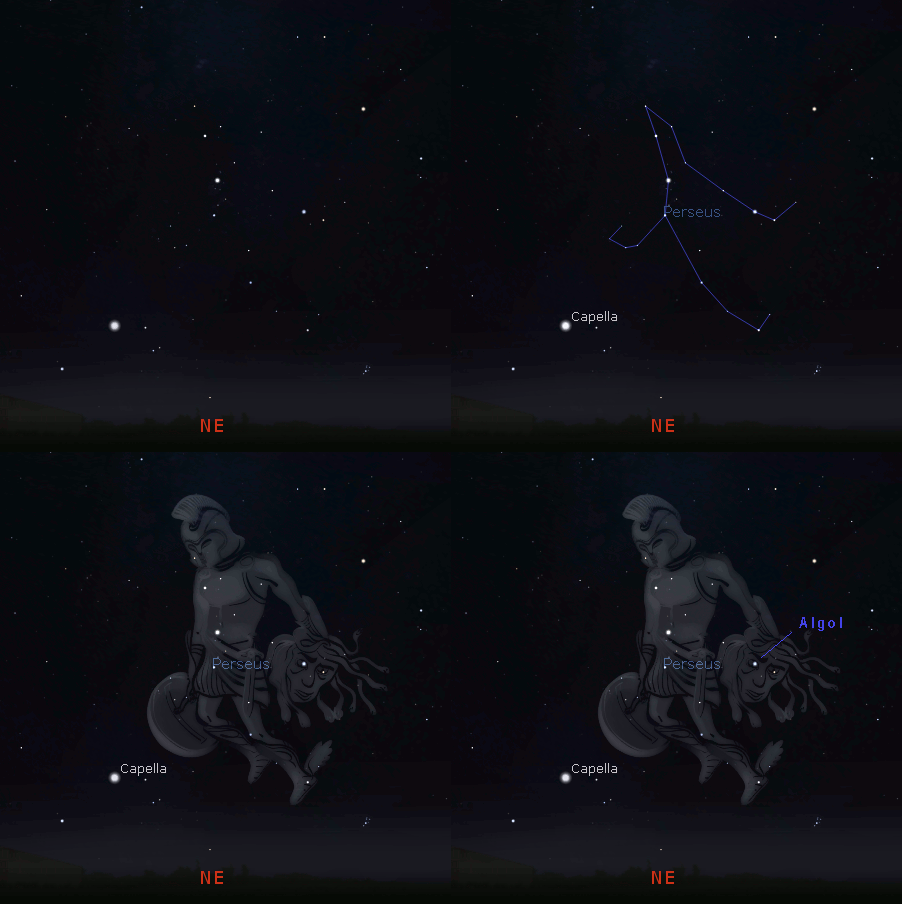
Algol Finder Animation for around 8 pm in the later part of October and early November (7 pm after the EST time change on the first Sunday in November). Created using Stellarium and GIMP.
Algol is an eclipsing binary star, where one star eclipses the other.
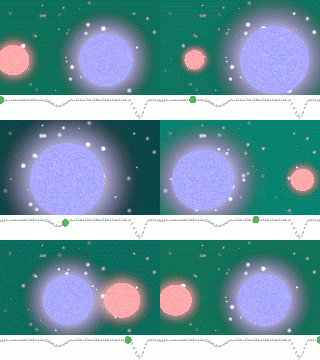
Animation of an eclipsing binary star like Algol. Credit: Wikimedia Commons h/t Earth and Sky
10/27/2021 – Ephemeris – Let’s search for the naked-eye planets for this week
This is Bob Moler with Ephemeris for Wednesday, October 27th. Today the Sun will be up for 10 hours and 23 minutes, setting at 6:38, and it will rise tomorrow at 8:15. The Moon, 1 day before last quarter, will rise at 11:27 this evening.
Let’s search for the naked-eye planets for this week. Venus should be visible in the southwestern evening twilight by 7 tonight. It will set at 8:43 pm. By 7:15 pm, Jupiter will be spotted in the south-southeastern sky. Jupiter should be easy to spot at that hour. Saturn will be dimmer, and to its right. They will be visible for a while after midnight in the southwest, with Saturn setting first at 12:37 am, and Jupiter following at 1:57. Saturn’s rings are a beautiful sight in a telescope of even modest power, but the planet will appear tiny. In the morning sky, Mercury will be visible and low in the east-southeast for most of the 7 am hour. All four of Jupiter’s brightest moons will be visible in binoculars early in the evening tonight.
The astronomical event times given are for the Traverse City/Interlochen area of Michigan (EDT, UT – 4 hours). They may be different for your location.
Addendum
Venus will appear low in the southwest by 7 pm tonight, October 27, 2021. Created using Stellarium.
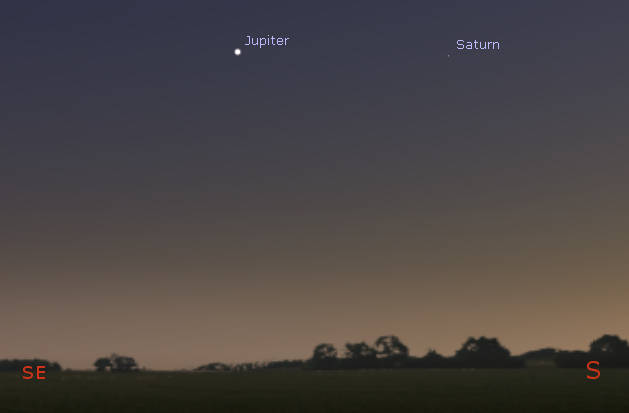
Jupiter and Saturn in evening twilight at 7:15 pm tonight, October 27, 2021. Created using Stellarium.
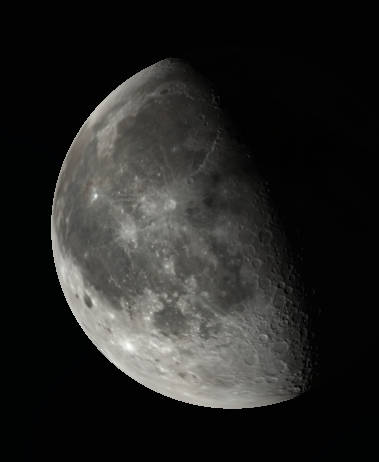
The Moon as it might appear in binoculars or a small telescope tomorrow morning, October 28, 2021. Created using Stellarium.
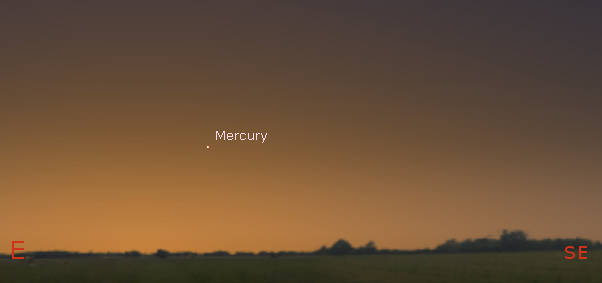
Mercury in morning twilight finder for 7:30 am tomorrow, October 28, 2021. Created using Stellarium.
Telescopic views of the bright planets (north up) as they would be seen in a small telescope, with the same magnification, this evening at 9 pm, October 27, 2021. Apparent diameters: Venus at 7 pm, 24.19″, 50.8% illuminated; Saturn 16.92″, its rings 39.41″; Jupiter, 42.87″. Mercury at 7:30 am on the 28th and not plotted, 6.47″, 64.9% illuminated. The Jovian moon Io will begin transiting the face of the planet at 9:20 pm. Its shadow will start to cross at 10:37 pm. Io’s transit will end at 11:37 pm. The ” symbol means seconds of arc (1/3600th of a degree.) Click on the image to enlarge it. Created using Cartes du Ciel (Sky Charts).
The naked-eye planets and the Moon at sunset and sunrise on a single night, starting with sunset on the right on October 27, 2021. The night ends on the left with sunrise on the 28th. Click on the image to enlarge it. Created using my LookingUp program.
10/26/2021 – Ephemeris – The bright star Capella is slowly ascending in the northeastern sky
This is Ephemeris for Tuesday, October 26th. Today the Sun will be up for 10 hours and 26 minutes, setting at 6:39, and it will rise tomorrow at 8:14. The Moon, 2 days before last quarter, will rise at 10:29 this evening.
The bright star that’s been hanging out fairly low in the northeastern sky in the evening lately is Capella, sometimes called the Goat Star. It’s at the top of a rather oddly shaped pentagon of stars that make up the constellation Auriga, the charioteer. A small, thin triangle of stars to Capella’s right is called the Kids*. Her kids. I’m not sure what a fellow is doing holding 4 goats while driving a chariot. Maybe that’s how he ended up in the sky. Capella itself consists of two yellow giant stars, about the same temperature as the Sun, but much larger. Capella is circumpolar for most of northern Michigan, meaning it never sets. It gets pretty low in the north on summer evenings.
The astronomical event times given are for the Traverse City/Interlochen area of Michigan (EDT, UT – 4 hours). They may be different for your location.
* I’ve always known them as the Kids. Stellarium calls them the Goatlings.
Addendum
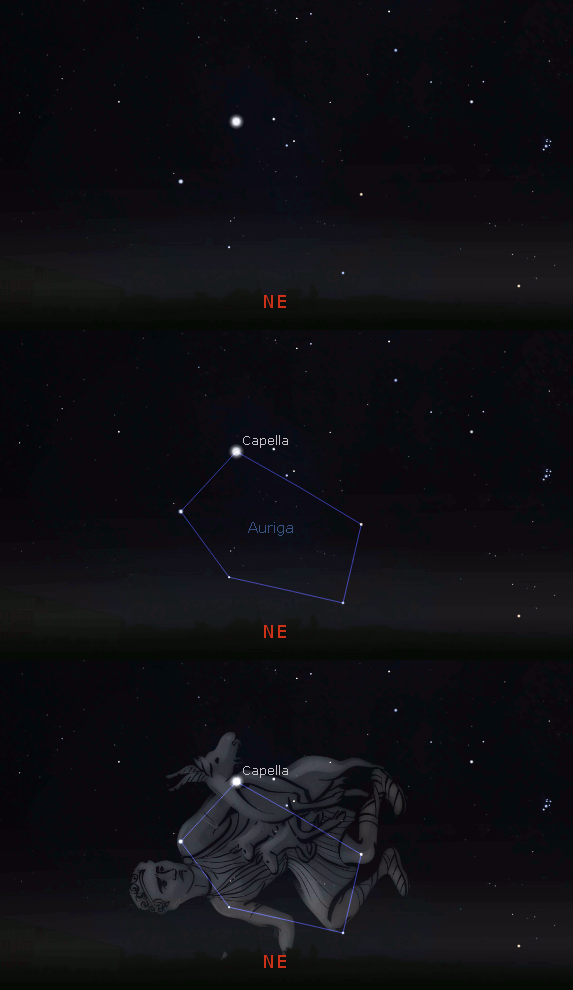
Capella and Auriga, low in the northeastern sky. I left the Kids unannotated, but they are easy to find near Capella. An animation created using Stellarium and GIMP.
10/25/2021 – Ephemeris – Mercury is at its greatest separation west of the Sun of the season
This is Bob Moler with Ephemeris for Monday, October 25th. Today the Sun will be up for 10 hours and 29 minutes, setting at 6:41, and it will rise tomorrow at 8:13. The Moon, 3 days before last quarter, will rise at 9:38 this evening.
This morning at 12:59 am, the planet Mercury reached its greatest western elongation from the Sun. It reached an angle of 18.4 degrees west of the Sun. It will be visible for most of the 7 am hour low in the east southeastern sky. Mercury will be visible to the naked-eye for the next week or 10 days. The planet has quite an elliptical orbit. And it happens that in our favorable appearances of Mercury on fall mornings and spring evenings, we are seeing Mercury in the same part of its orbit. Which is near its perihelion, the closest part of its orbit of the Sun. Observers in the Southern Hemisphere see Mercury’s favorable elongations near aphelion, its farthest from the Sun, of around 28 degrees separation from Earth’s viewpoint.
The astronomical event times given are for the Traverse City/Interlochen area of Michigan (EDT, UT-4 hours). They may be different for your location.
Addendum
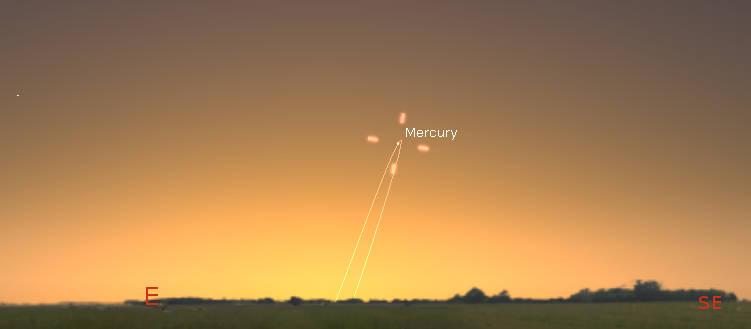
Mercury, a day after greatest western elongation at 7:54 am, or 20 minutes before sunrise tomorrow morning, October 26, 2021. Also shown is its orbit, if we could see it. Mercury is virtually in the same position this morning. Created using Stellarium.
10/22/2021 – Ephemeris 3,001st post – Mercury is now visible in the morning before sunrise
This is Bob Moler with Ephemeris for Friday, October 22nd. Today the Sun will be up for 10 hours and 38 minutes, setting at 6:46, and it will rise tomorrow at 8:09. The Moon, 2 days past full, will rise at 7:53 this evening.
The planet Mercury is now visible on clear mornings, low in the east-southeastern sky after 7 am, and twilight gets too bright around 7:50 am. Tiny Mercury is the smallest planet, only 50% larger than our Moon. It looks a lot like our Moon, close up, all gray and covered in craters. But the resemblance is only skin deep. Before the Arecibo radio telescope could bounce radar pulses from the planet in the 1960s, we thought Mercury held one side pointed at the Sun and the other side eternally away. That wasn’t the case due to its elliptical orbit. It rotates in 59 days, two-thirds of its year of 88 days. This makes its solar day, noon to noon, last two of its years. The European BepiColombo mission to orbit Mercury just made its first pass of the planet.
Addendum
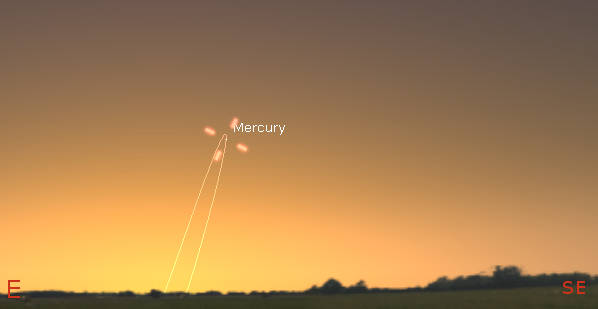
Mercury and its apparent orbit for 7:49 am tomorrow, October 23, 2021, two days before its greatest western elongation (separation from the Sun). Created using Stellarium.
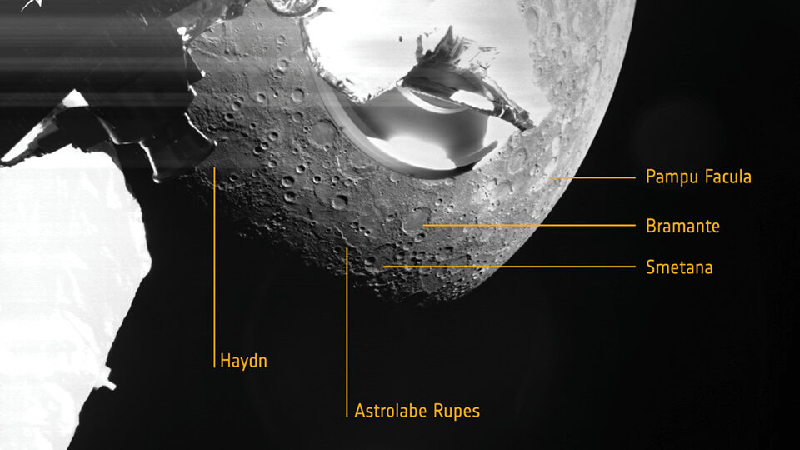
BepiColombo takes a picture of Mercury on its first of 6 flybys, October 1st, before settling into orbit of the planet on December 5, 2025. BepiColombo is actually two spacecraft connected together, and parts of the other spacecraft will get into each other’s images until they separate. Credit: ESA/JAXA.
10/21/2021 – Ephemeris – Defending the planet
This is Ephemeris for Thursday, October 21st. Today the Sun will be up for 10 hours and 41 minutes, setting at 6:47, and it will rise tomorrow at 8:07. The Moon, 1 day past full, will rise at 7:29 this evening.
This is the 4th program in 8 days here on Ephemeris about asteroids. A possible collision of an asteroid or comet has been on our collective minds since the 20-some odd pieces of Comet Shoemaker-Levy 9 hit Jupiter in July 1994. In 2016 NASA established the Planetary Defense Coordination Office to manage its ongoing planetary defense efforts. Its mission is to provide early detection of potentially hazardous objects that can come within 5 million miles of the Earth’s orbit and a size large enough to cause significant damage. Asteroid sizes would be 30 to 50 meters in diameter, that’s 90 to 150 feet in diameter or larger. It will track and issue warnings of these objects when found. It will coordinate responses to any impact threat.
The astronomical event times given are for the Traverse City/Interlochen area of Michigan (EDT, UT-4 hours). They may be different for your location.
Addendum

What the Planetary Defense Coordination Office does. Credit: NASA.
 Bob Moler's Ephemeris Blog