11/06/2020 – Ephemeris – Virtual Star Party or a presentation on the Great Andromeda Galaxy tonight!
This is Ephemeris for Friday, November 6th. Today the Sun will be up for 9 hours and 55 minutes, setting at 5:24, and it will rise tomorrow at 7:29. The Moon, 2 days before last quarter, will rise at 9:54 this evening.
The Grand Traverse Astronomical Society will host a virtual presentation or a virtual star party at 8 pm tonight. It is via the Zoom app for the smart phone, tablet or computer at zoom.us. Instructions and a link can be found on the society’s website gtastro.org. I will be giving the illustrated presentation on the Great Andromeda Galaxy if the night turns out to be cloudy. If clear Dr. Jerry Dobek, astronomy professor at Northwestern Michigan College will be hosting the star party. During a virtual star party the images are produced real time using a telescope mounted CCD camera. The planets Jupiter, Saturn and Mars are in the evening sky along with the Great Andromeda Galaxy and other wonders of the heavens.
11/05/2020 – Ephemeris – Water found on the daylit side of the Moon
This is Ephemeris for Thursday, November 5th. Today the Sun will be up for 9 hours and 58 minutes, setting at 5:25, and it will rise tomorrow at 7:28. The Moon, 3 days before last quarter, will rise at 8:55 this evening.
Last week NASA announced some results from their SOFIA airborne observatory. They had detected the spectral signature of water in a large crater on the Moon named Clavius. This was a high latitude crater, 58.6 degrees south. Supposedly one could process a cubic meter of the regolith to extract a half liter of water. Clavius, which science fiction fans will note was the location of the American base on the Moon in 2001 a Space Odyssey. It is also one of my favorite lunar craters, one of the largest with a distinctive arc of diminishingly sized craters in its floor. As far as resources go, we’ve just literally scratched the surface of the Moon in its equatorial regions with our Apollo and other country’s robotic missions.
The event times given are for the Traverse City/Interlochen area of Michigan. They may be different for your location.
Addendum
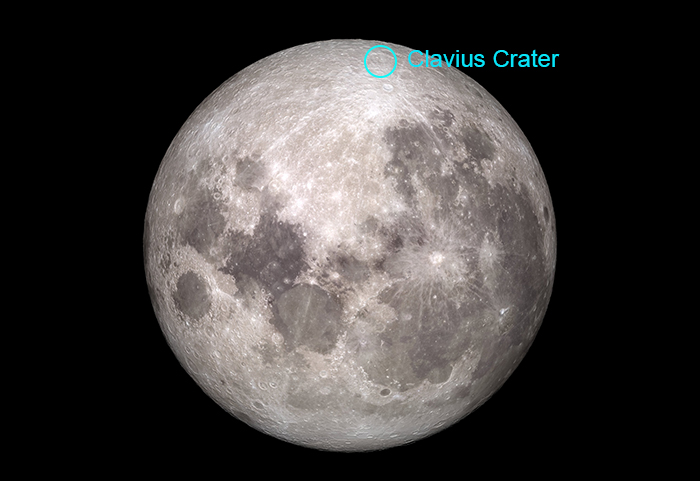
The Moon as seen from Australia (south up) with the crater Clavius circled. This is the same view of the Moon that users of a Newtonian reflector telescope in the northern hemisphere see, and how I first explored the Moon with my reflecting telescope. Source abc.net.au.
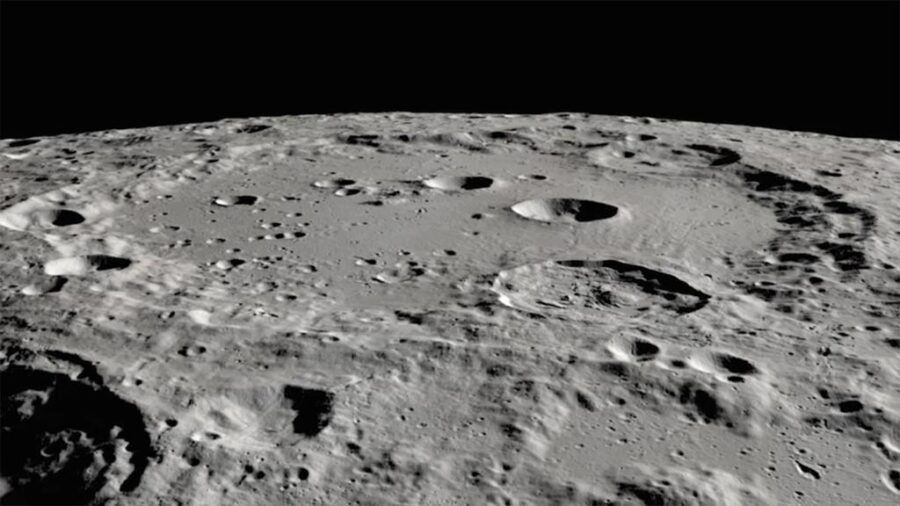
Closeup of Clavius from the Lunar Reconnaissance Orbiter. Credit: NASA/LRO.

The SOFIA Airborne Observatory. A modified Boeing 747 with a 106 inch (2.7 meter) telescope mounted crosswise in its fuselage. It is a joint project between NASA and the German Aerospace Center (DLR) and for some reason always on the verge of being canceled. Credit: NASA.
SOFIA is of course an acronym for Stratospheric Observatory for Infrared Astronomy. For more on SOFIA click here: https://www.nasa.gov/mission_pages/SOFIA/index.html.
11/04/2020 – Ephemeris – Let’s find the naked-eye planets for this week
This is Ephemeris for Wednesday, November 4th. Today the Sun will be up for 10 hours and 1 minute, setting at 5:26, and it will rise tomorrow at 7:26. The Moon, half way from full to last quarter, will rise at 8:04 this evening.
Let’s find the naked-eye planets for this week. Jupiter and Saturn are both low in the southwestern sky at 8 pm. Jupiter is the very bright one. Above and left it will be the somewhat dimmer Saturn. They are closing slowly, so they will cross paths on December 21st and be in the same telescope field that evening. Jupiter will set first tonight at 9:42 with Saturn following at 10:07. Off in the southeast at that hour will be Mars. Since the it was closest 29 days ago its distance has increased to 45.0 million miles (72.4 million kilometers) away. Mars will set at 5:04 tomorrow morning. Brilliant Venus will rise at 4:29 am in the east as it retreats slowly toward the Sun. Beginning to make a morning appearance now will be Mercury rising at 5:52 a.m. in the east.
The event times given are for the Traverse City/Interlochen area of Michigan. They may be different for your location.
Addendum
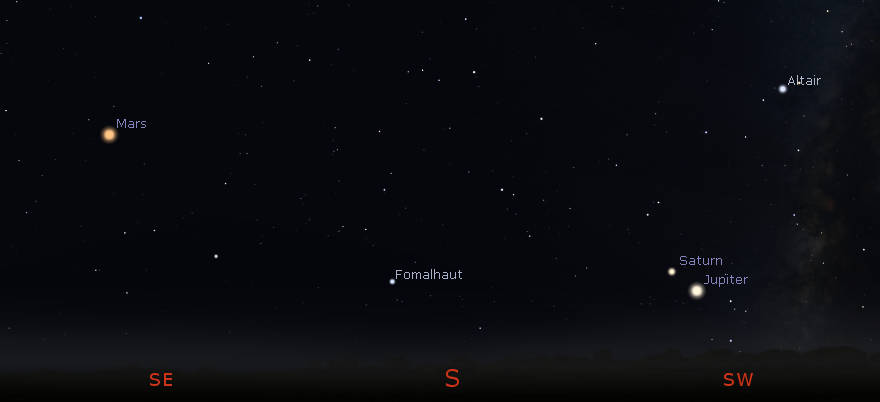
The evening planets and the Moon at 8 pm, just before the Moon will rise, tonight, November 4, 2020. Created using Stellarium.
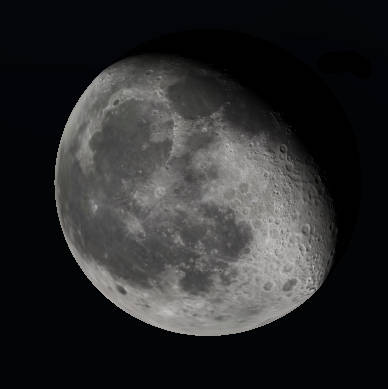
The waning gibbous Moon as it might be seen in binoculars or a small telescope at 9 pm tonight November 4, 2020. Created using Stellarium.
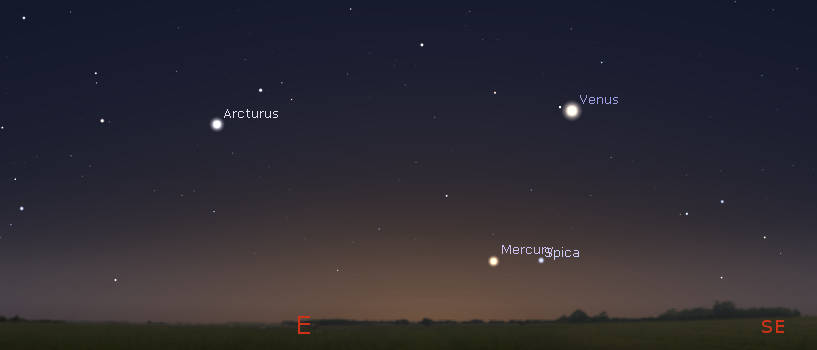
The morning planets Venus and Mercury visible tomorrow at 6:30 am, November 5, 2020 with some of the stars of morning. Click on the image to enlarge. Created using Stellarium.
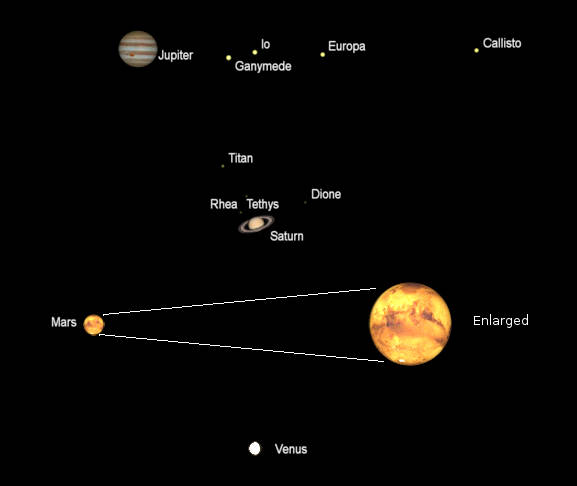
The planets as seen in a telescope (north up) with the same magnification for the night of November 4/5, 2020. Times of the display are: Jupiter and Saturn, 8 pm; Mars, 10 pm; Venus, 6:30 am. Apparent diameters: Jupiter, 36.55″; Saturn, 16.24″, rings, 37.83″. Mars, 19.34″, and Venus 12.87″. Mars also displays an enlargement showing surface detail. Mars was closest to the Earth this go-a-round on October 6. The ” symbol means seconds of arc (1/3600th of a degree.) Created using Cartes du Ciel (Sky Charts).
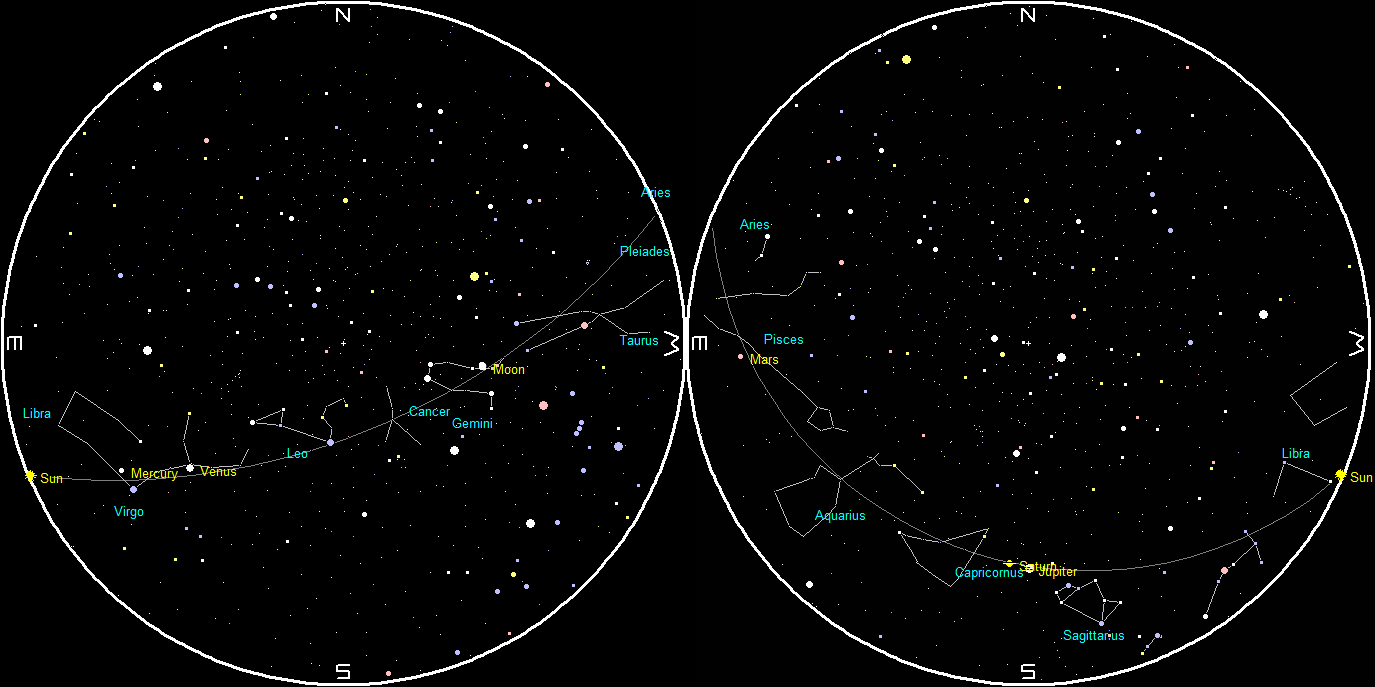
Planets and the Moon at sunset and sunrise of a single night starting with sunset on the right on November 4, 2020. The night ends on the left with sunrise on 5th. Click on the image to enlarge. Created using my LookingUp program.
11/03/2020 – Ephemeris – Two meteor showers emanating from Taurus
This is Ephemeris for Election Day, Tuesday, November 3rd. Today the Sun will be up for 10 hours and 3 minutes, setting at 5:27, and it will rise tomorrow at 7:25. The Moon, 3 days past full, will rise at 7:22 this evening.
November is a month of low grade meteor showers. The first two are related showers from the same comet. They are the South Taurid and North Taurid meteor showers. The South Taurid meteor shower peaks on October 10th, while the North Taurid meteor shower peaks on November 12th. The both have Encke’s Comet as their source. Encke’s official name is 2P/Encke named after Johann Franz Encke who calculated it’s orbit after it had been observed on three earlier appearances including by Charles Messier and Caroline Herschel, sister of William Herschel, astronomer and composer. Encke has the shortest period of any reasonably bright comet of 3.3 years. The other notable meteor shower this month is the Leonids which we’ll visit later.
The event times given are for the Traverse City/Interlochen area of Michigan. They may be different for your location.
Addendum
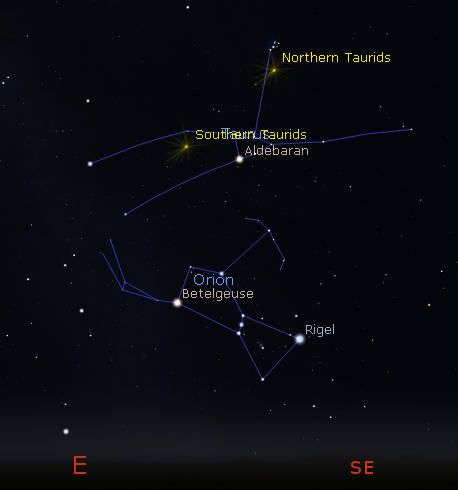
The radiants of the Northern and Southern Taurid meteor showers at 11 pm November 12, 2020. Both these radiants move eastward with time due to the Earth’s orbital motion. The activity dates of the two meteor showers overlap. The Southern Taurids are active between September 10 to November 20, while the Northern Taurids are active between October 20 to December 10. Both have peak rates of 5-10 meteors per hour. Created using Stellarium.
11/02/2020 – Ephemeris – Previewing November Skies
This is Ephemeris for Monday, November 2nd. Today the Sun will be up for 10 hours and 6 minutes, setting at 5:29, and it will rise tomorrow at 7:24. The Moon, 2 days past full, will rise at 6:47 this evening.
The month of November is one early sunsets, especially with the return to standard time yesterday, and shortening of day light hours. Daylight hours will decrease from 10 hours 9 minutes yesterday the 1st to 9 hours 4 minutes at month’s end. The altitude of the Sun above the southern horizon at local noon, which will drop from 31 degrees to 23½ degrees over the month. Apparent local noon this month will be around 12:30 pm. The sunset time on the 30th will be only 2 minutes later than the earliest sunset of the year. The sunrise time on the 30th will have 22 minutes to go to the latest sunrise. The Leonid meteor shower will have a peak on the morning of 17th with the Moon out of the way, but we are about 13 years away from the next Leonid meteor storm.
The event times given are for the Traverse City/Interlochen area of Michigan. They may be different for your location.
Addendum
November Evening Star Chart
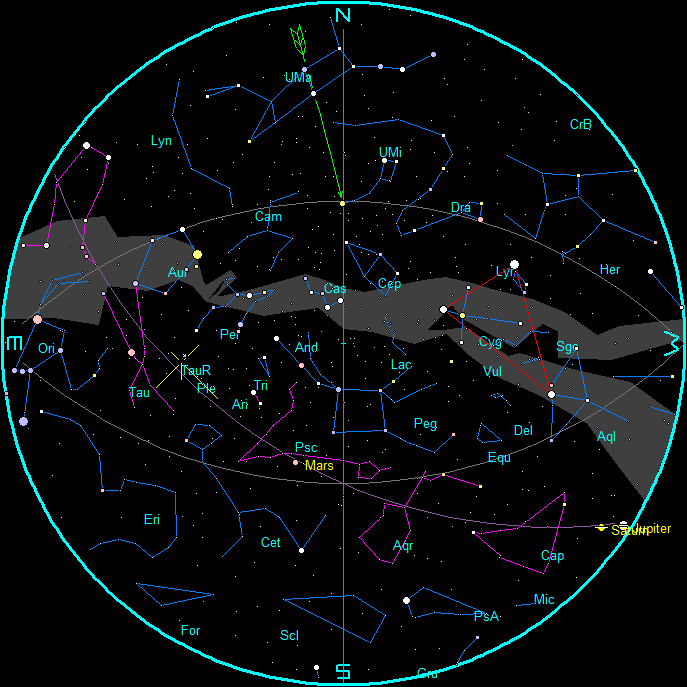
Star Chart for November 2020 (9 p.m. EST November 15, 2019). Click on image to enlarge. Click on image to enlarge. Created using my LookingUp program.
The planets and stars are plotted for the 15th at 9 p.m. EST in the evening and 6 a.m. for the morning chart. These are the chart times. Note that Traverse City is located approximately 45 minutes behind our time meridian, West 75° longitude.
November Morning Star Chart
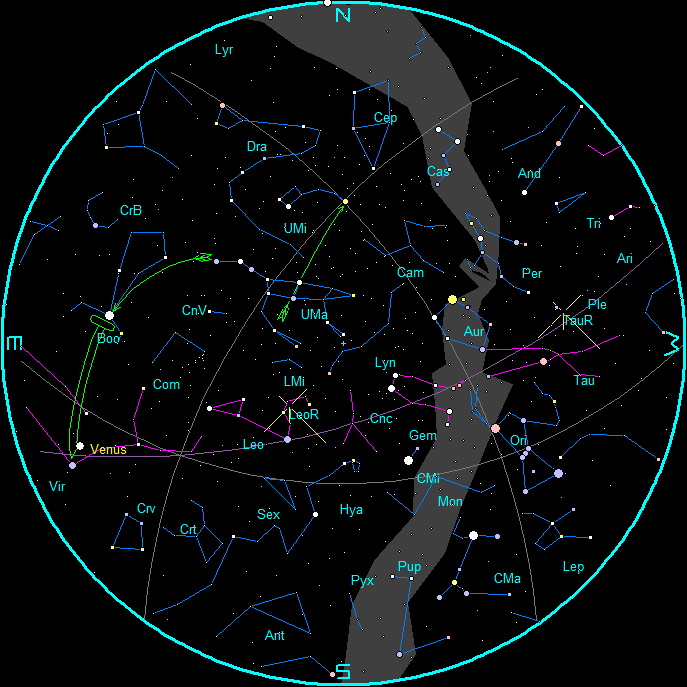
Star Chart for November mornings 2020 (6 a.m. EST November 15, 2020). Click on image to enlarge. Created using my LookingUp program.
For a list of constellation names to go with the abbreviations click here.
- Pointer stars at the front of the bowl of the Big Dipper point to Polaris the North Star.
- Follow the arc of the handle of the Big Dipper to the star Arcturus
- The Summer Triangle is in red.
- TauR on the evening star chart can be used as the radiant for the North and South Taurid meteor showers.
- LeoR on the morning star chart is the radiant of the Leonid meteor shower which peaks between the 16th to 21st.
Twilight Limits, Nautical and Astronomical
| EST | |||||||
| Morning twilight | Evening twilight | Dark night | Moon | ||||
| Date | Astro. | Nautical | Nautical | Astro. | Start | End | Illum. |
| 2020-11-01 | 5h47m | 6h21m | 18h39m | 19h12m | – | – | 1 |
| 2020-11-02 | 5h49m | 6h23m | 18h37m | 19h11m | – | – | 0.98 |
| 2020-11-03 | 5h50m | 6h24m | 18h36m | 19h10m | 19h10m | 19h22m | 0.94 |
| 2020-11-04 | 5h51m | 6h25m | 18h35m | 19h09m | 19h09m | 20h04m | 0.88 |
| 2020-11-05 | 5h52m | 6h26m | 18h34m | 19h08m | 19h08m | 20h55m | 0.81 |
| 2020-11-06 | 5h53m | 6h27m | 18h33m | 19h07m | 19h07m | 21h54m | 0.72 |
| 2020-11-07 | 5h54m | 6h29m | 18h32m | 19h06m | 19h06m | 23h00m | 0.62 |
| 2020-11-08 | 5h56m | 6h30m | 18h30m | 19h05m | 19h05m | – | 0.51 |
| 2020-11-09 | 5h57m | 6h31m | 18h29m | 19h04m | 19h04m | 0h12m | 0.4 |
| 2020-11-10 | 5h58m | 6h32m | 18h28m | 19h03m | 19h03m | 1h26m | 0.29 |
| 2020-11-11 | 5h59m | 6h33m | 18h27m | 19h02m | 19h02m | 2h42m | 0.18 |
| 2020-11-12 | 6h00m | 6h35m | 18h27m | 19h01m | 19h01m | 4h00m | 0.1 |
| 2020-11-13 | 6h01m | 6h36m | 18h26m | 19h00m | 19h00m | 5h19m | 0.04 |
| 2020-11-14 | 6h03m | 6h37m | 18h25m | 18h59m | 18h59m | 6h03m | 0 |
| 2020-11-15 | 6h04m | 6h38m | 18h24m | 18h58m | 18h58m | 6h04m | 0 |
| 2020-11-16 | 6h05m | 6h39m | 18h23m | 18h58m | 18h58m | 6h05m | 0.04 |
| 2020-11-17 | 6h06m | 6h41m | 18h22m | 18h57m | 19h24m | 6h06m | 0.1 |
| 2020-11-18 | 6h07m | 6h42m | 18h22m | 18h56m | 20h24m | 6h07m | 0.18 |
| 2020-11-19 | 6h08m | 6h43m | 18h21m | 18h56m | 21h31m | 6h08m | 0.27 |
| 2020-11-20 | 6h09m | 6h44m | 18h20m | 18h55m | 22h39m | 6h09m | 0.38 |
| 2020-11-21 | 6h10m | 6h45m | 18h20m | 18h54m | 23h46m | 6h10m | 0.48 |
| 2020-11-22 | 6h12m | 6h46m | 18h19m | 18h54m | – | 6h12m | 0.58 |
| 2020-11-23 | 6h13m | 6h47m | 18h19m | 18h53m | 0h52m | 6h13m | 0.68 |
| 2020-11-24 | 6h14m | 6h48m | 18h18m | 18h53m | 1h55m | 6h14m | 0.77 |
| 2020-11-25 | 6h15m | 6h50m | 18h18m | 18h52m | 2h57m | 6h15m | 0.84 |
| 2020-11-26 | 6h16m | 6h51m | 18h17m | 18h52m | 3h58m | 6h16m | 0.91 |
| 2020-11-27 | 6h17m | 6h52m | 18h17m | 18h52m | 5h00m | 6h17m | 0.96 |
| 2020-11-28 | 6h18m | 6h53m | 18h16m | 18h51m | 6h02m | 6h18m | 0.99 |
| 2020-11-29 | 6h19m | 6h54m | 18h16m | 18h51m | – | – | 0.99 |
| 2020-11-30 | 6h20m | 6h55m | 18h16m | 18h51m | – | – | 1 |
Twilight calendar was generated using Cartes du Ciel (Sky Charts).
See my blog post: Twilight Zone for the definitions of the different periods of twilight here: https://bobmoler.wordpress.com/2018/09/27/.
NASA Calendar of Planetary Events
   Date      Time    Event
Nov 1  Su            Venus: 34.2° W
    3  Tu  09:39 pm  Moon Ascending Node
    5  Th  12:50 am  South Taurid Meteor Shower: ZHR = 10
    5  Th  02:30 pm  Moon North Dec.: 24.8° N
    7  Sa  02:34 pm  Moon-Beehive: 2.4° S
    8  Su  08:46 am  Last Quarter
   10  Tu  11:59 am  Mercury Greatest Elongation: 19.1° W
   12  Th  12:06 am  North Taurid Meteor Shower: ZHR = 15
   12  Th  04:31 pm  Moon-Venus: 3° S
   14  Sa  06:48 am  Moon Perigee: 357,800 km
   15  Su  12:07 am  New Moon
   16  Mo  08:24 am  Venus-Spica: 3.8° N
   16  Mo  07:07 pm  Moon Descending Node
   17  Tu  06:24 am  Leonid Meteor Shower: ZHR = 15
   18  We  06:27 am  Moon South Dec.: 24.9° S
   19  Th  03:54 am  Moon-Jupiter: 2.6° N
   19  Th  09:57 am  Moon-Saturn: 3° N
   21  Sa  11:45 pm  First Quarter
   26  Th  07:29 pm  Moon Apogee: 405900 km
   30  Mo  04:30 am  Full Moon
   30  Mo  04:44 am  Penumbral Lunar Eclipse
                          (Asia, Aus., Pacific, Americas)
Dec 1  Tu            Venus: 27.5° W
All event times are given for UTC-5 Eastern Standard Time.
Sky Events Calendar by Fred Espenak and Sumit Dutta (NASA’s GSFC),
http://eclipse.gsfc.nasa.gov/SKYCAL/SKYCAL.html.
If you go to the above site you can print out a list like the above for the entire year or calendar pages for your time zone.
Sun and Moon Rising and Setting Events
     LU                  Ephemeris of Sky Events for Interlochen/TC
November, 2020    Local time zone: EST
+-----------------------------------------------------------------------+
| DATE |  SUN     SUN  DAYLIGHT|   TWILIGHT*    |MOON  RISE OR    ILLUM |
|      |  RISE    SET    HOURS |  END    START  |PHASE SET** TIME FRACTN|
+=======================================================================+
|Sun  1| 07:21a  05:30p  10:09 | 06:35p  06:16a |      Rise 06:18p   98%|
|Mon  2| 07:22a  05:29p  10:06 | 06:34p  06:17a |      Rise 06:47p   95%|
|Tue  3| 07:24a  05:27p  10:03 | 06:33p  06:18a |      Rise 07:22p   90%|
|Wed  4| 07:25a  05:26p  10:01 | 06:32p  06:20a |      Rise 08:04p   83%|
|Thu  5| 07:26a  05:25p  09:58 | 06:30p  06:21a |      Rise 08:55p   75%|
|Fri  6| 07:28a  05:24p  09:55 | 06:29p  06:22a |      Rise 09:54p   66%|
|Sat  7| 07:29a  05:22p  09:53 | 06:28p  06:23a |      Rise 11:00p   56%|
+------+-----------------------+----------------+-----------------------+
|Sun  8| 07:31a  05:21p  09:50 | 06:27p  06:24a |L Qtr Rise 12:12a   45%|
|Mon  9| 07:32a  05:20p  09:48 | 06:26p  06:26a |      Rise 01:26a   35%|
|Tue 10| 07:33a  05:19p  09:45 | 06:25p  06:27a |      Rise 02:42a   24%|
|Wed 11| 07:35a  05:18p  09:43 | 06:24p  06:28a |      Rise 04:00a   15%|
|Thu 12| 07:36a  05:17p  09:40 | 06:23p  06:29a |      Rise 05:19a    7%|
|Fri 13| 07:37a  05:16p  09:38 | 06:22p  06:31a |      Rise 06:41a    2%|
|Sat 14| 07:39a  05:15p  09:35 | 06:22p  06:32a |      Rise 08:04a    0%|
+------+-----------------------+----------------+-----------------------+
|Sun 15| 07:40a  05:14p  09:33 | 06:21p  06:33a |New   Set  05:47p    1%|
|Mon 16| 07:41a  05:13p  09:31 | 06:20p  06:34a |      Set  06:31p    5%|
|Tue 17| 07:43a  05:12p  09:29 | 06:19p  06:35a |      Set  07:23p   11%|
|Wed 18| 07:44a  05:11p  09:26 | 06:18p  06:36a |      Set  08:24p   19%|
|Thu 19| 07:45a  05:10p  09:24 | 06:18p  06:38a |      Set  09:31p   28%|
|Fri 20| 07:47a  05:09p  09:22 | 06:17p  06:39a |      Set  10:39p   38%|
|Sat 21| 07:48a  05:08p  09:20 | 06:16p  06:40a |F Qtr Set  11:46p   48%|
+------+-----------------------+----------------+-----------------------+
|Sun 22| 07:49a  05:08p  09:18 | 06:16p  06:41a |      Set  12:52a   58%|
|Mon 23| 07:50a  05:07p  09:16 | 06:15p  06:42a |      Set  01:55a   67%|
|Tue 24| 07:52a  05:06p  09:14 | 06:15p  06:43a |      Set  02:57a   76%|
|Wed 25| 07:53a  05:06p  09:12 | 06:14p  06:44a |      Set  03:58a   83%|
|Thu 26| 07:54a  05:05p  09:11 | 06:14p  06:45a |      Set  04:59a   90%|
|Fri 27| 07:55a  05:05p  09:09 | 06:14p  06:46a |      Set  06:02a   95%|
|Sat 28| 07:57a  05:04p  09:07 | 06:13p  06:48a |      Set  07:05a   98%|
+------+-----------------------+----------------+-----------------------+
|Sun 29| 07:58a  05:04p  09:06 | 06:13p  06:49a |      Set  08:08a  100%|
|Mon 30| 07:59a  05:03p  09:04 | 06:13p  06:50a |Full  Rise 05:22p  100%|
+-----------------------------------------------------------------------+
* Nautical Twilight
** Moonrise or moonset, whichever occurs between sunrise and sunset
Generated using my LookingUp for DOS program.
10/30/2020 – Ephemeris – The spookiest star in the sky
This is Ephemeris for Friday, October 30th. Today the Sun will be up for 10 hours and 14 minutes, setting at 6:33, and it will rise tomorrow at 8:20. The Moon, 1 day before full, will set at 8:08 tomorrow morning.
With the COVID virus around probably the only spooky thing out tomorrow night will be the star Algol. It’s out every night actually. It’s name, Algol, is from the Arabic for Ghoul Star or Demon Star. The Chinese had a name for it that meant “piled up corpses”. It’s normally the second brightest star in the constellation Perseus the hero, visible in the northeast this evening. The star is located where artists have drawn the severed head of Medusa, whom he had slain. Medusa was so ugly that she turned all who gazed upon her to stone. Algol is her still winking eye. The star got the name before astronomers found out what was wrong with it. They found out that it does a slow wink every two days, 21 hours. That’s because Algol is two stars that eclipse each other. Her next evening wink will be at its dimmest at 12:11 am November 13th. Remember, daylight time ends on Sunday.
The event times given are for the Traverse City/Interlochen area of Michigan. They may be different for your location.
Addendum
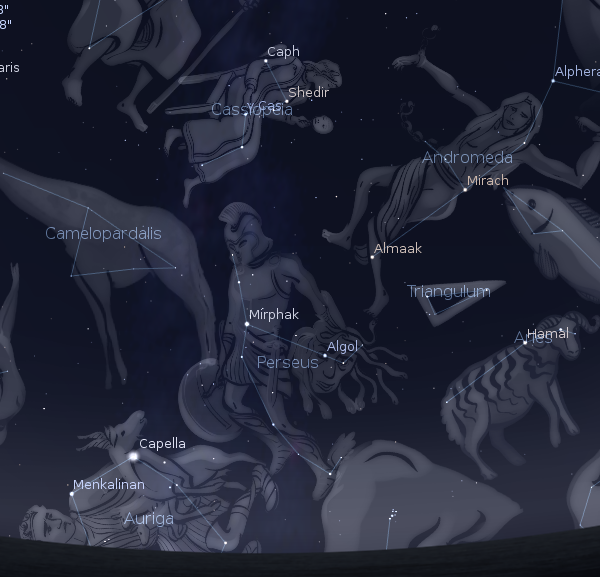
Algol at 7:30 p.m. on Halloween, in a modern portrayal. Created using Stellarium.
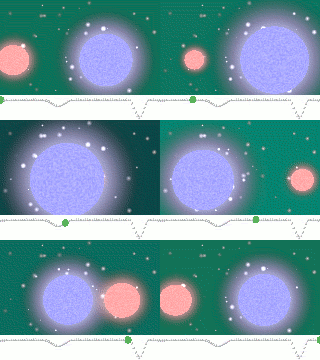
Animation of an eclipsing binary star like Algol. Credit: Wikimedia Commons h/t Earth and Sky
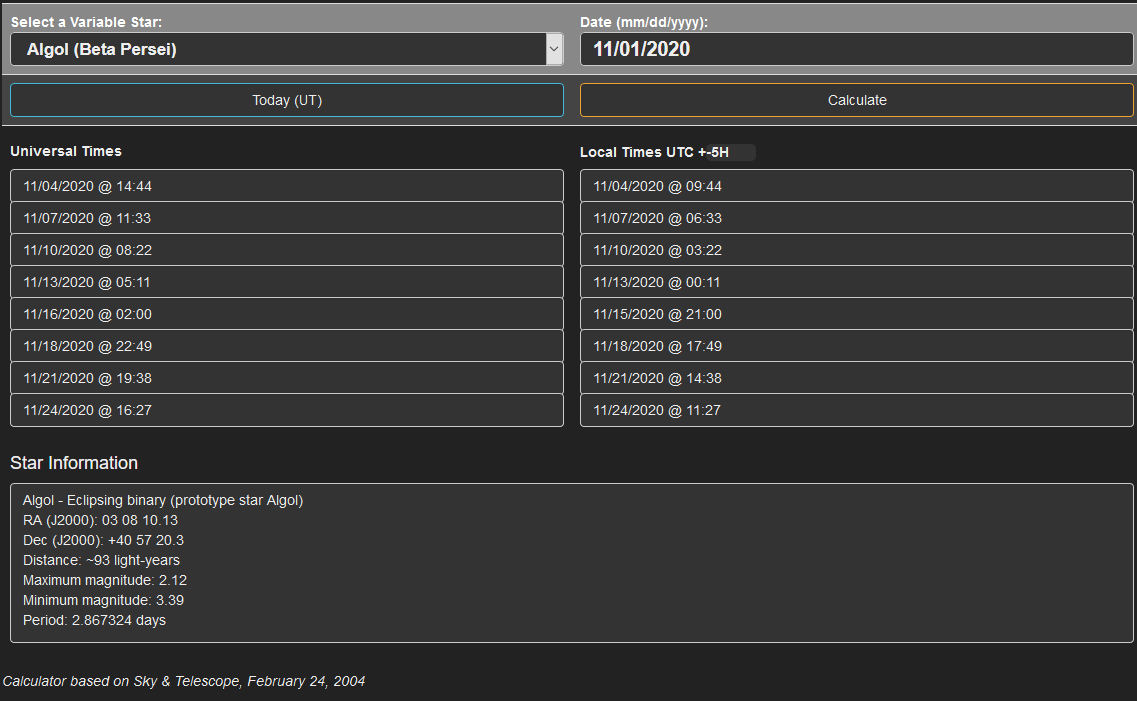
Algol Minima through November 24th 2020. Click on the image to enlarge. Eclipses are about 10 hours long with 5 hours of dimming and another 5 hours to regain brightness. Source: Insula Astra http://www.astropical.space/algol.php.
10/29/2020 – Ephemeris – A look at Bennu the asteroid
This is Ephemeris for Thursday, October 29th. Today the Sun will be up for 10 hours and 17 minutes, setting at 6:34, and it will rise tomorrow at 8:18. The Moon, 2 days before full, will set at 7:06 tomorrow morning.
Tonight we will have Mars appearing above the bright gibbous Moon in the evening sky. Out in space NASA’s OSIRIS-REx spacecraft is still in the vicinity of the tiny asteroid Bennu. The asteroid is about 60 percent the distance between the Earth’s and Mars’ orbits, but on the far side of the Sun from us. This is why it will take 3 years to return the sample to the Earth. Bennu is small, only 743 feet (226.5 meters) in diameter. And is a rubble pile asteroid with lots of empty voids between the rocks. The sampler instead of stopping at the surface, punched into the asteroid surface a bit. Bennu was picked because is a potential hazardous asteroid and is a particularly primitive type of asteroid.
The event times given are for the Traverse City/Interlochen area of Michigan. They may be different for your location.
Addendum
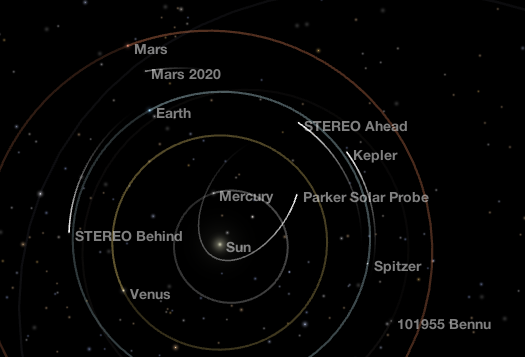
Inner Solar when OSIRIS REx took its sample from Bennu. Bennu’s official designation is 101955 Bennu. The number designation is the consecutive number it is given when placed on the official list of asteroids and dwarf planets when its orbit is determined. Notice that it was on the other side of the Sun. Credit NASA’s Eyes app.
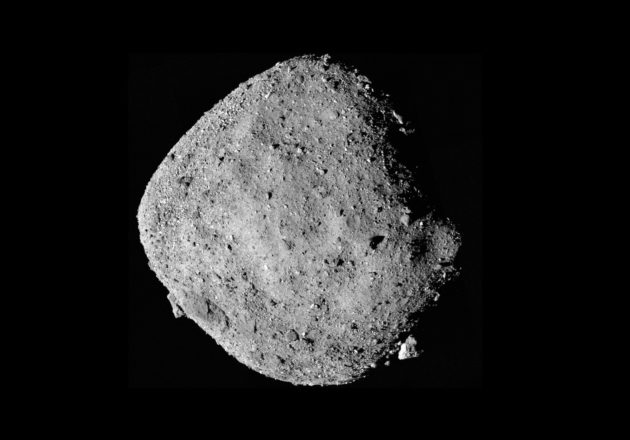
The asteroid Bennu is 743 feet (226.5 meters) in diameter. It is a carbonaceous asteroid. OSIRIS-REX has already discovered water bearing clays on its surface. Credit NASA
10/28/2020 – Ephemeris – Let’s look for the naked-eye planets for this week
This is Ephemeris for Wednesday, October 28th. Today the Sun will be up for 10 hours and 20 minutes, setting at 6:36, and it will rise tomorrow at 8:17. The Moon, 3 days before full, will set at 6:05 tomorrow morning.
Let’s look for the naked-eye planets for this week. Jupiter and Saturn are both low in the south-southwestern sky at 8 pm. Jupiter is the very bright one. Left and a bit above it will be the somewhat dimmer Saturn. They are closing slowly, so they will cross paths on December 21st and be in the same telescope field that evening. Jupiter will set first tonight at 11:08 with Saturn following at 11:37. Off in the east-southeast at that hour will be Mars. Since the it was closest 22 days ago its distance has increased to 42.0 million miles (67.6 million km) away. Brilliant Venus will rise at 5:12 am in the east as it retreats slowly toward the Sun. We’ll have a big jump backwards in rise and set times next week when standard time returns.
The event times given are for the Traverse City/Interlochen area of Michigan. They may be different for your location.
Addendum
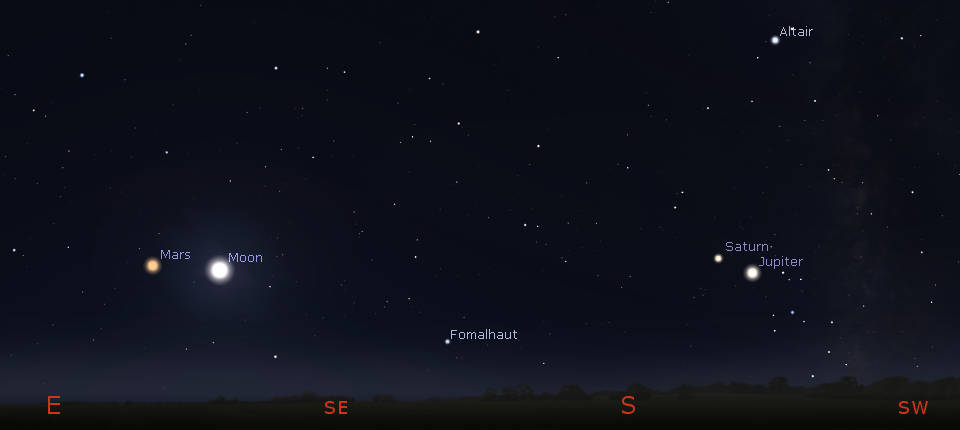
The evening planets and the Moon at 8 pm tonight, October 28, 2020. Click on the image to enlarge. Created using Stellarium.
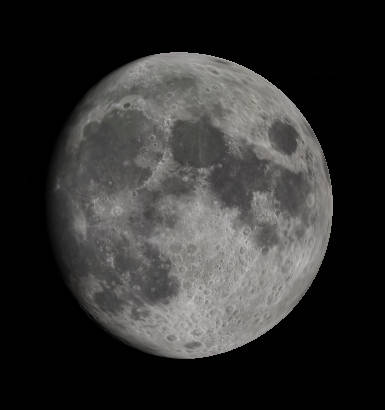
The waxing gibbous Moon tonight October 28, 2020 as it might appear in binoculars or a low power telescope. Created using Stellarium.
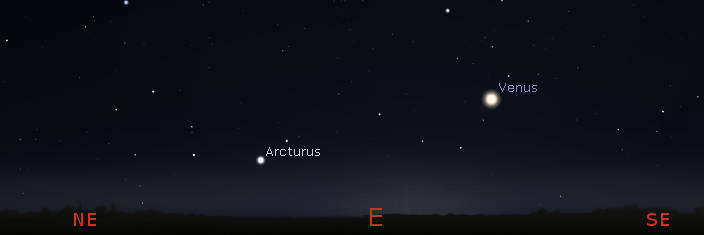
The morning planet Venus visible at 7 am October 29, 2020 with some of the stars of morning. Click on the image to enlarge. Created using Stellarium.
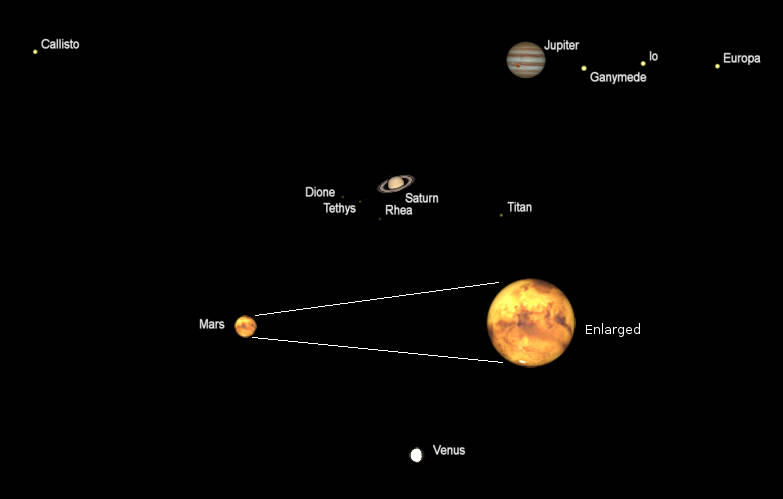
The planets as seen in a telescope (north up) with the same magnification for the night of October 28/29, 2020. Times of the display are: Jupiter and Saturn, 8 pm; Mars, 11 pm; Venus, 7 am. Apparent diameters: Jupiter, 37.26″; Saturn, 16.42″, rings, 38.25″. Mars, 20.27″, and Venus 13.29″. Mars also displays an enlargement showing surface detail. Mars was closest to the Earth this go-a-round on October 6. The ” symbol means seconds of arc (1/3600th of a degree.) Click on the image to enlarge. Created using Cartes du Ciel (Sky Charts).
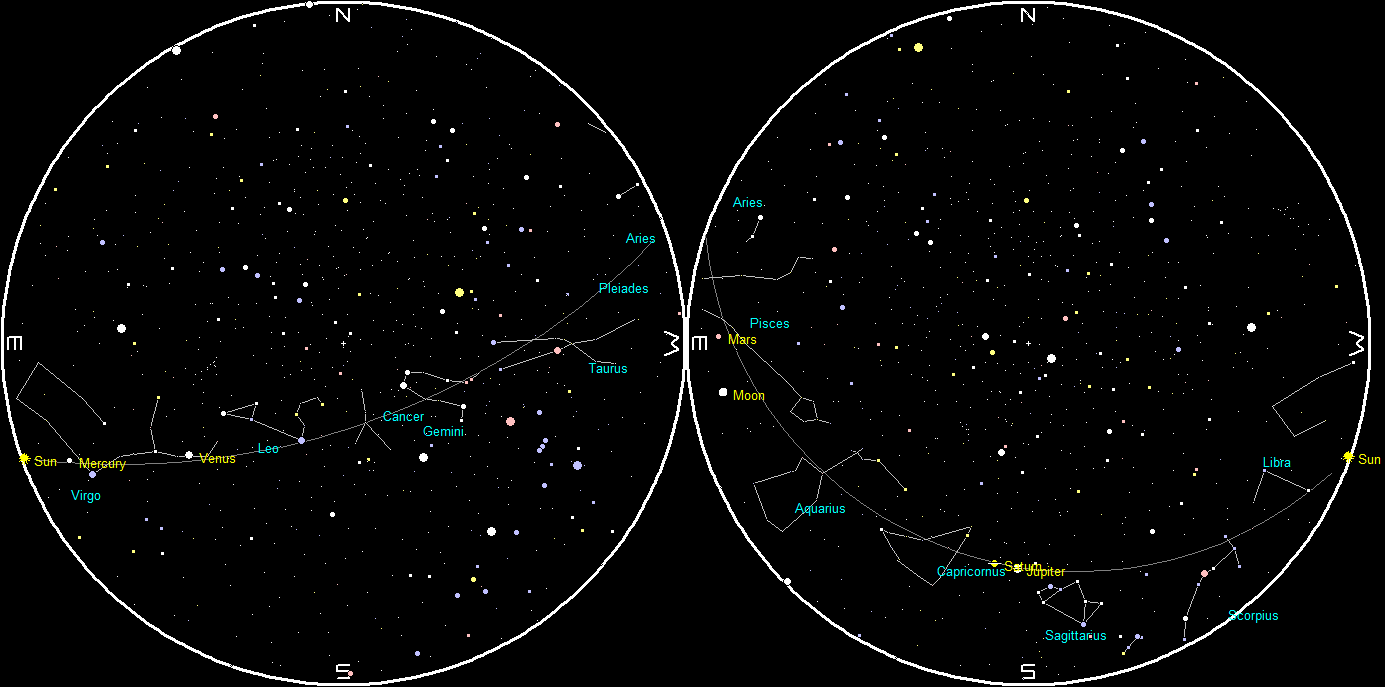
Planets and the Moon at sunset and sunrise of a single night starting with sunset on the right on October 28, 2020. The night ends on the left with sunrise on 29th. Click on the image to enlarge. Created using my LookingUp program.
10/27/2020 – Ephemeris – NASA’s cup runneth over with asteroid bits
This is Ephemeris for Tuesday, October 27th. Today the Sun will be up for 10 hours and 23 minutes, setting at 6:37, and it will rise tomorrow at 8:16. The Moon, half way from first quarter to full, will set at 5:04 tomorrow morning.
One week ago the NASA’s OSIRIS Rex spacecraft unfolded its sampling arm, and folded up it solar panels so as to look like a one legged stork landing and touched a small level patch of small jagged rocks on the tiny asteroid Bennu. A nitrogen bottle was triggered to blow soil and small rocks into a cylindrical container which created quite a blizzard of small rocks. A flap on the collection device was supposed to close, keeping the collected bits in, but was propped open by a large rock, so some of the contents started to leak out. Now flight controllers must gently maneuver the collector into the return canister without losing too much of the contents. The sample canister is expected to return to Earth in 2023.
The event times given are for the Traverse City/Interlochen area of Michigan. They may be different for your location.
Addendum
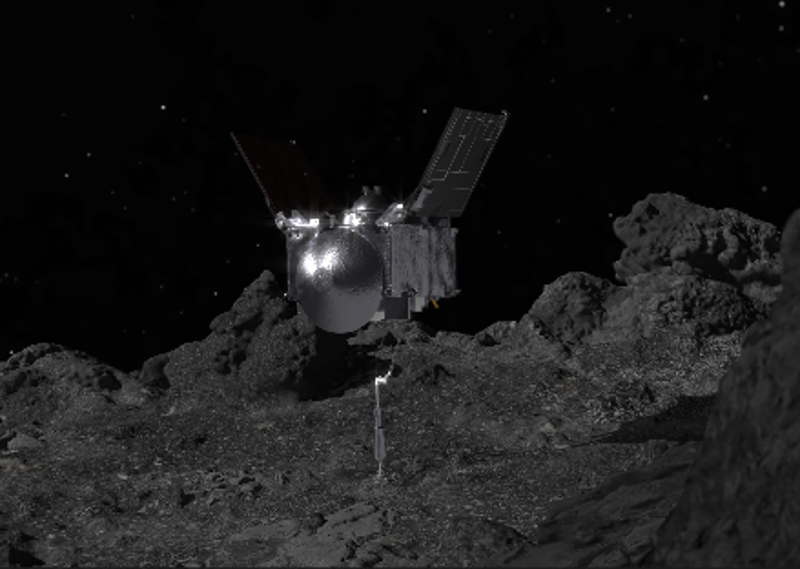
Artist depiction OSIRIS-REx TAG (Touch and Go) from video. Credit NASA.

Animated GIF of the actual sample collection TAG (Touch and Go). Credit NASA.
For more information go to https://www.nasa.gov/osiris-rex
10/26/2020 – Ephemeris – Why does everyone want to go to the Moon’s south pole?
This is Bob Moler with Ephemeris for Monday, October 26th. Today the Sun will be up for 10 hours and 26 minutes, setting at 6:39, and it will rise tomorrow at 8:14. The Moon, 3 days past first quarter, will set at 4:01 tomorrow morning.
Why are the United States and other countries interested in the south pole of the Moon? Two reasons: Water and power. The Moon’s axial tilt to the Earth’s orbit is only a degree and a half. And I’ve seen a mountain peak at the south pole of the Moon sticking out in sunlight in a telescope on a crescent moon, with black all around it. While most of the Moon gets two weeks of daylight and another two of night, that peak is probably always in sunlight. And on the Moon there’s no atmosphere to diminish the strength of the Sun when its low in the sky. And there’s the floors of craters that have never seen the Sun where water ice and other volatile compounds from comets have collected over the eons.
The event times given are for the Traverse City/Interlochen area of Michigan. They may be different for your location.
Addendum
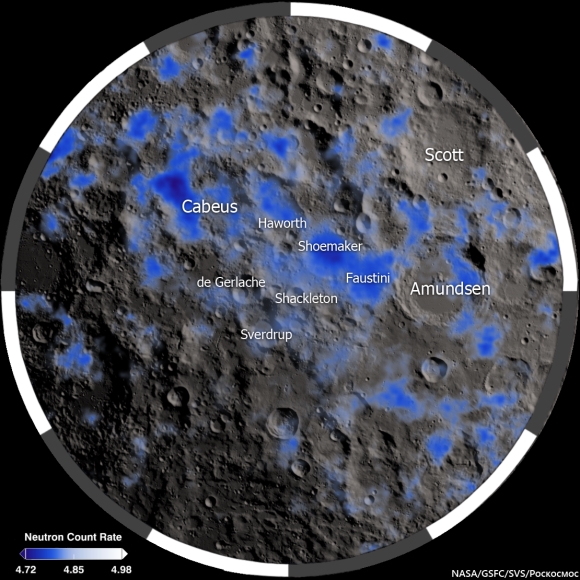
The south pole of the Moon where the presence of water ice is detected by the absorption of neutrons by the hydrogen atoms in the ice. Credit NASA/GSFC/SVS/Roscosmos.
 Bob Moler's Ephemeris Blog