05/08/2020 – Ephemeris – A look at Mars 2020 Endurance Rover’s target crater: Jezero
This is Ephemeris for Friday, May 8th. Today the Sun will be up for 14 hours and 34 minutes, setting at 8:56, and it will rise tomorrow at 6:21. The Moon, 1 day past full, will rise at 10:43 this evening.
The Mars 2020 Rover will be launched on July 17th or thereabouts to land at the crater Jezero* on the Red Planet. What’s the big deal about Jezero? In very early Martian history the crater was filled with water with a river flowing into it. What’s left is a dry river delta. The landing ellipse target for the rover will land it near the leading edge of that delta. Spectral analysis from the Mars Reconnaissance Orbiter has detected clays that can contain, on Earth, fossils of single celled organisms. The rover is not equipped with a powerful enough microscope to detect them so they will be cached to be returned to the Earth sometime in the future as one of its objectives. Scientists believe that Mars was friendly for life for only a billion years or so.
The event times given are for the Traverse City/Interlochen area of Michigan. They may be different for your location.
Addendum
Jezero is pronounced like the biblical character Jezebel.
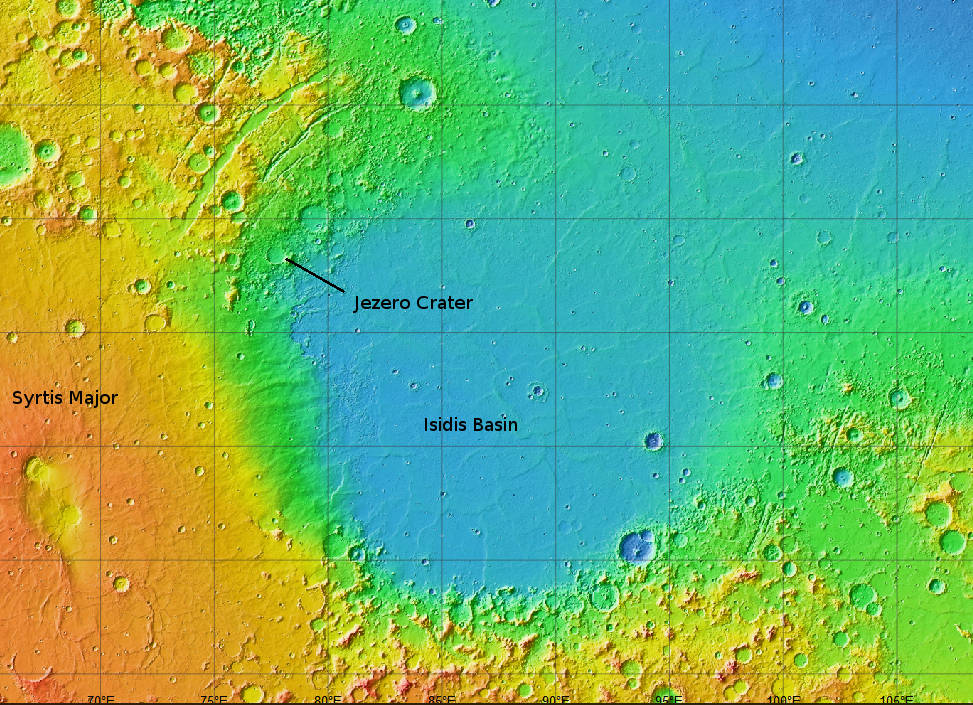
Jezero Crater on a map by the Mars Orbiter Laser Altimeter (MOLA) instrument on the Mars Global Surveyor spacecraft (1996-2006). Colors code by altitude (blue-low to red-high). Click on the image to enlarge. Credit NASA/JPL.
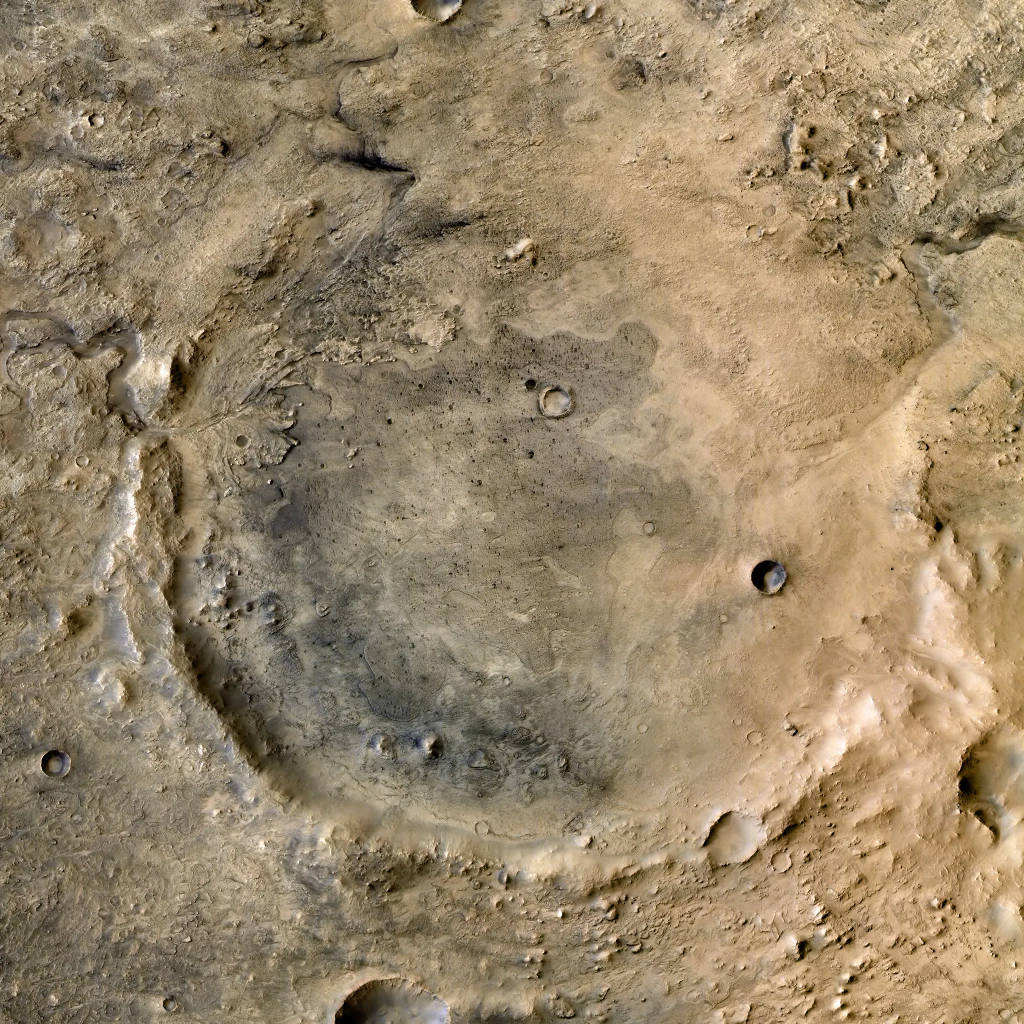
The Jezero crater from the European Space Agency’s Mars Express Orbiter. Jezero is 30.4 miles (49.0 km) in diameter. Note the river delta on the left (west) forming a lake with an outlet on the right. Click on the image to enlarge. Credit: NASA/JPL/MSSS/ESA.
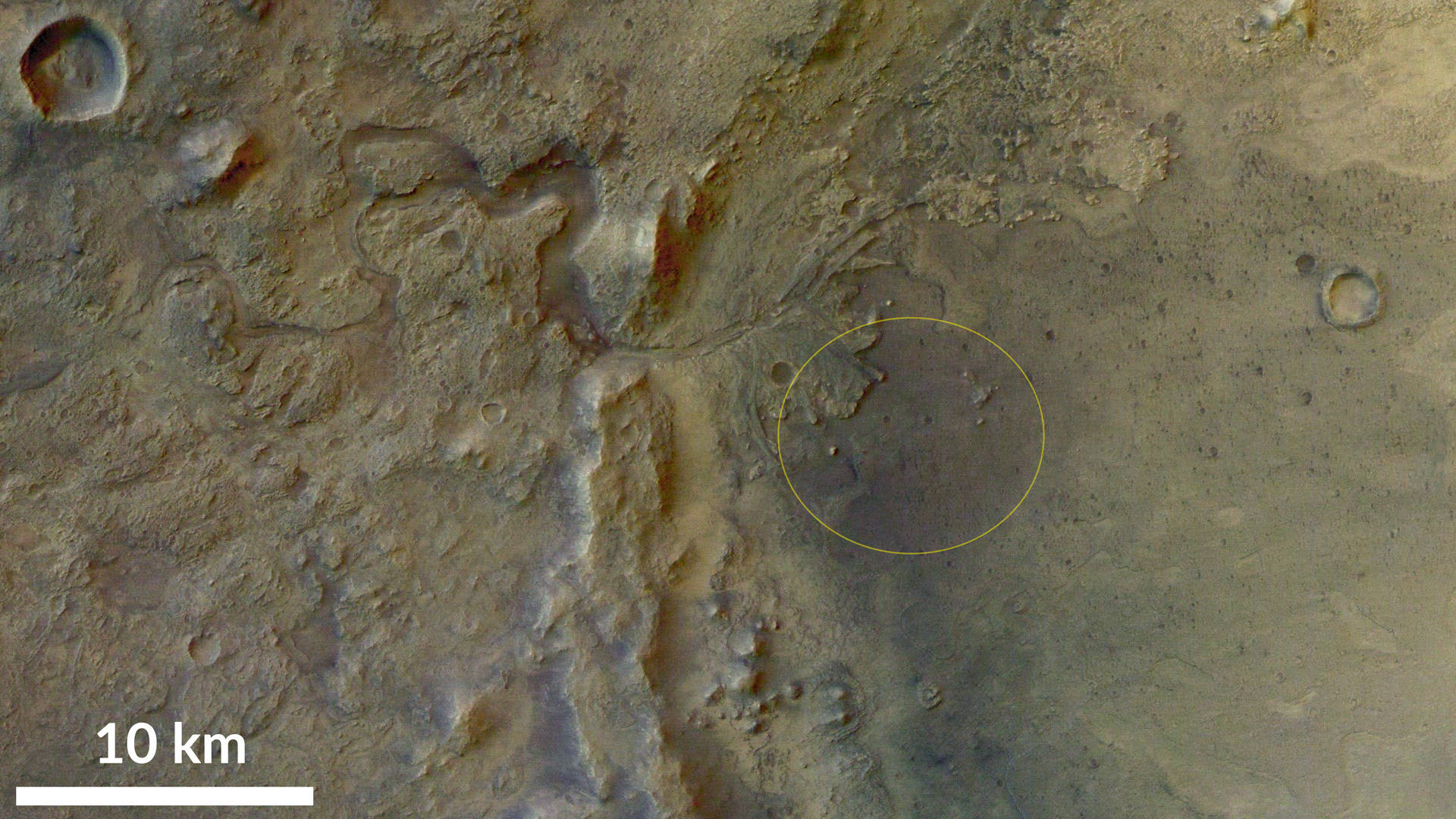
Mars Endurance Rover’s planned landing ellipse partially overlapping the dried up river delta. Click on the image to enlarge. Credit: NASA/JPL.
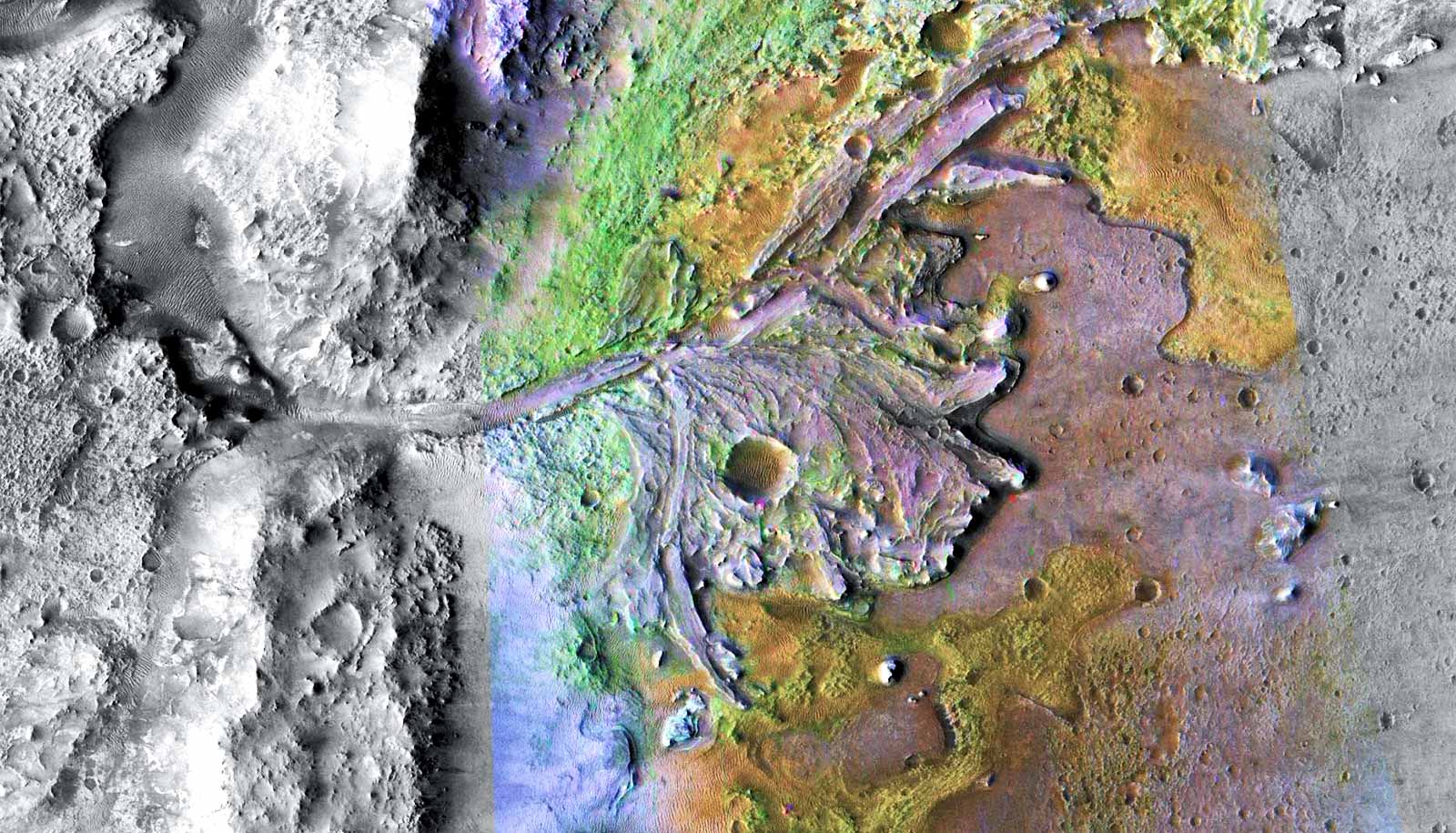
Delta of ancient river that flowed into a lake in the Jezero crater. Color coded based on minerals present. Click on the image to enlarge. Credit NASA.
05/07/2020 – Ephemeris – JPL and NASA preparing a return to Mars via rover and helicopter
This is Ephemeris for Thursday, May 7th. Today the Sun will be up for 14 hours and 32 minutes, setting at 8:55, and it will rise tomorrow at 6:22. The Moon, at full today, will rise at 9:26 this evening.
The Endurance Mars Rover will be launched on or after July 17th. To land on Mars February 18th next year. It has until August 5th to launch. That’s a 20 day launch window. Miss that and it’s a wait of approximately 26 months for the next launch window when the Earth and Mars get into the proper relative positions again. The target of the rover is Jezero crater at the edge of a large Martian feature that can be seen in small telescopes called Syrtis Major. Syrtis Major is cooler sounding than what it means in Latin… The Great Swamp*. Anyway, Jezero crater itself is named after a Bosnian town in 2007 by the International Astronomical Union which named interesting features on Mars after earthly towns. What’s so interesting about Jezero? The answer tomorrow.
* There’s no water there. It’s actually a volcanic plain, maybe a low shield volcano.
The event times given are for the Traverse City/Interlochen area of Michigan. They may be different for your location.
Addendum
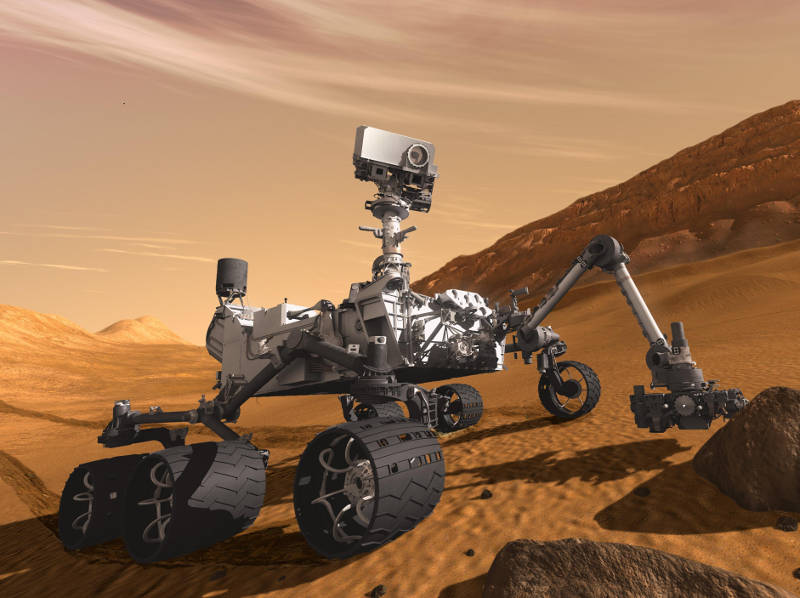
Artist rendition of the Mars 2020 “Endurance” Rover. Credit NASA.

Artist’s concept of the Mars Helicopter “Ingenuity”. Credit: NASA/JPL-Caltech.
Jezero Crater on a map by the Mars Orbiter Laser Altimeter (MOLA) instrument on the Mars Global Surveyor spacecraft (1996-2006). Colors code by altitude (blue-low to red-high). Click on the image to enlarge. I’ll have a closer look tomorrow. Credit NASA/JPL with my labels.
05/06/2020 – Ephemeris – Let’s look at the naked-eye planets for this week
This is Ephemeris for Wednesday, May 6th. Today the Sun will be up for 14 hours and 29 minutes, setting at 8:54, and it will rise tomorrow at 6:23. The Moon, 1 day before full, will set at 6:46 tomorrow morning.
Let’s look at the naked-eye planets for this week. Venus is our evening star shining brightly in the west. It will set at 12:10 a.m. It’s closing in on the Sun in our sky, by approaching the Earth at only 37 million miles (59 million km) away. In the morning sky there are three planets fairly close together in the south-southeast. Bright Jupiter will rise first at 2:02 a.m. Followed by Saturn at 2:17 a.m. Mars, stretching its lead left of Saturn, will rise at 3:31 a.m. Mars is now down to 110 million miles (177 million km) away, as the Earth slowly overtakes it at the rate of about 4 million miles (7 million km) a week. Mars will be closest to us in October at 38 and a half million miles away. That’s only 3 million miles (5 million km) further than it was 2 years ago.
The event times given are for the Traverse City/Interlochen area of Michigan. They may be different for your location.
Addendum
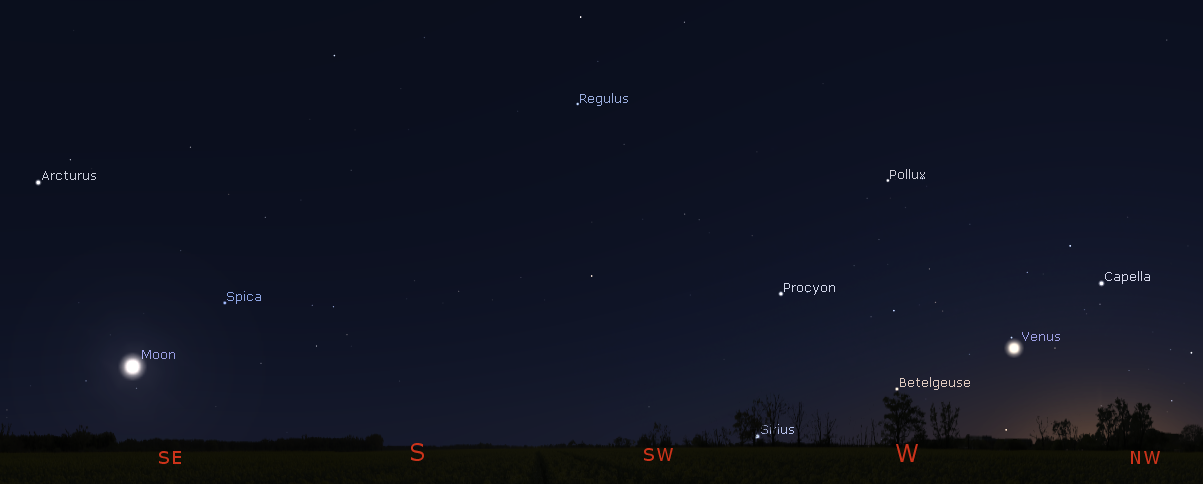
Venus, the Moon and bright evening stars tonight at 10 p.m. May 6, 2020. Click on the image to enlarge. Created using Stellarium.
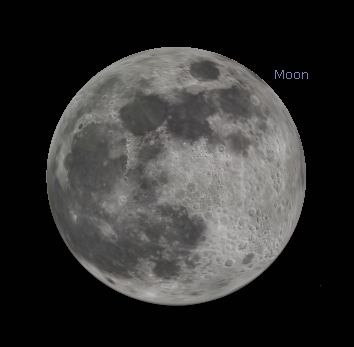
The nearly full Moon as it might be seen in binoculars at 10 p.m. tonight May 6, 2020. Created using Stellarium.
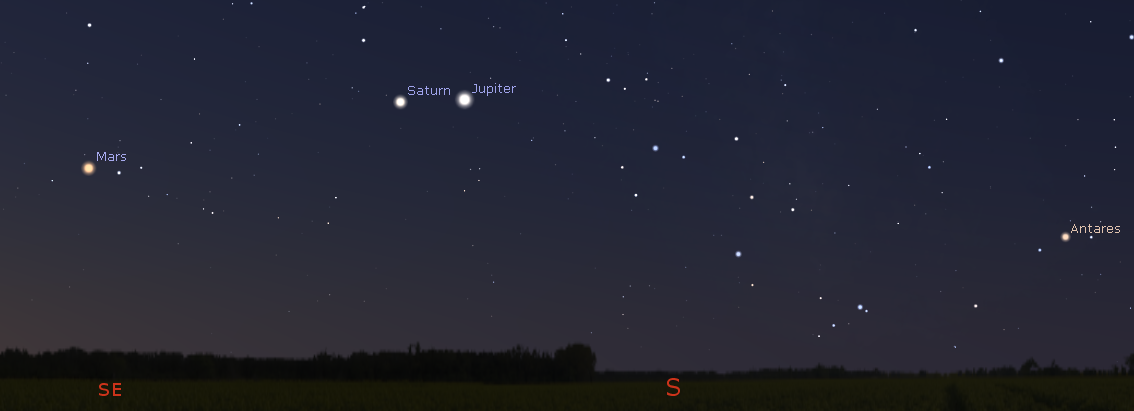
Morning planets in twilight at 5:30 a.m. tomorrow morning, May 7, 2020. Click on the image to enlarge. Created using Stellarium.
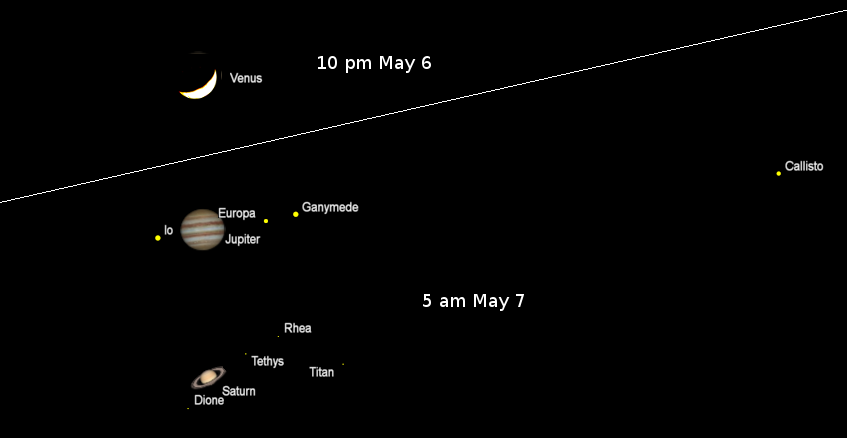
The planets as seen in a telescope with the same magnification. Venus in the evening and Jupiter and Saturn in the morning on the night of May 6/7, 2020. Apparent diameters: Venus, 42.88″. larger than Jupiter, at 41.54″; Saturn, 17.12″, rings, 39.89″. Mars at 7.92″ won’t be added until it reaches 10″. The ” symbol means seconds of arc (1/3600th of a degree.) Created using Cartes du Ciel (Sky Charts).
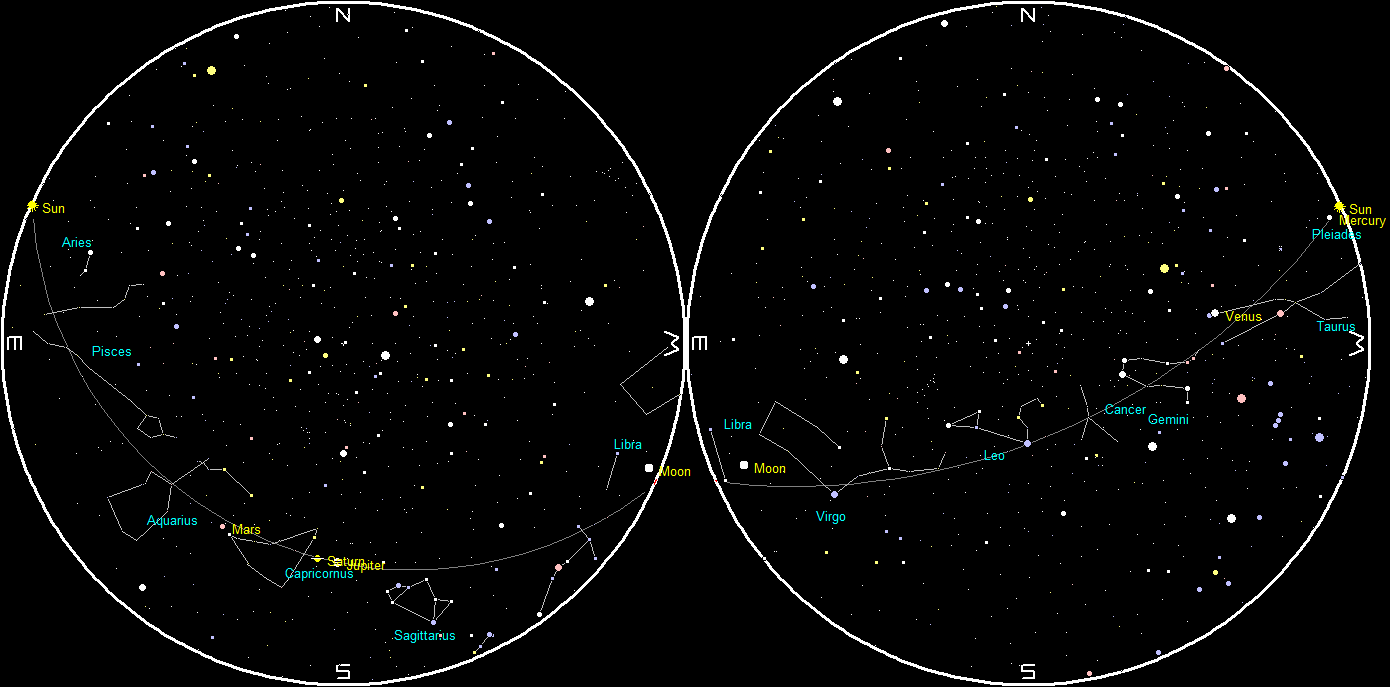
Planets and the Moon at sunset and sunrise of a single night starting with sunset on the right on May 6, 2020. The night ends on the left with sunrise on the 7th. The closeness of Jupiter and Saturn in the morning sky unfortunately overlays planets and labels. Click on the image to enlarge. Created using my LookingUp program.
05/05/2020 – Ephemeris – SpaceX’s Commercial Crew Demo 2 mission extends to multi-months
This is Ephemeris for Tuesday, May 5th. Today the Sun will be up for 14 hours and 26 minutes, setting at 8:53, and it will rise tomorrow at 6:25. The Moon, 2 days before full, will set at 6:15 tomorrow morning.
On May 27th* or shortly thereafter the first crewed spacecraft will leave American soil since the last Space Shuttle launch in 2011. This is called the SpaceX Demo 2. Notice they’re not called manned spacecraft any more. Especially since the American with the most time in space, man or woman is Peggy Whitson with nearly 666 days in space over three flights to the International Space Station. NASA astronauts Bob Behnken and Doug Hurley will launch from historic Pad 39a at the Kennedy Space Center on a Falcon 9 rocket in a Crew Dragon spacecraft to the International Space Station. What was to be a two week stay will turn out to be a several month tour on the station.
The event times given are for the Traverse City/Interlochen area of Michigan. They may be different for your location.
* The date I gave in the program was the 25th.
Addendum
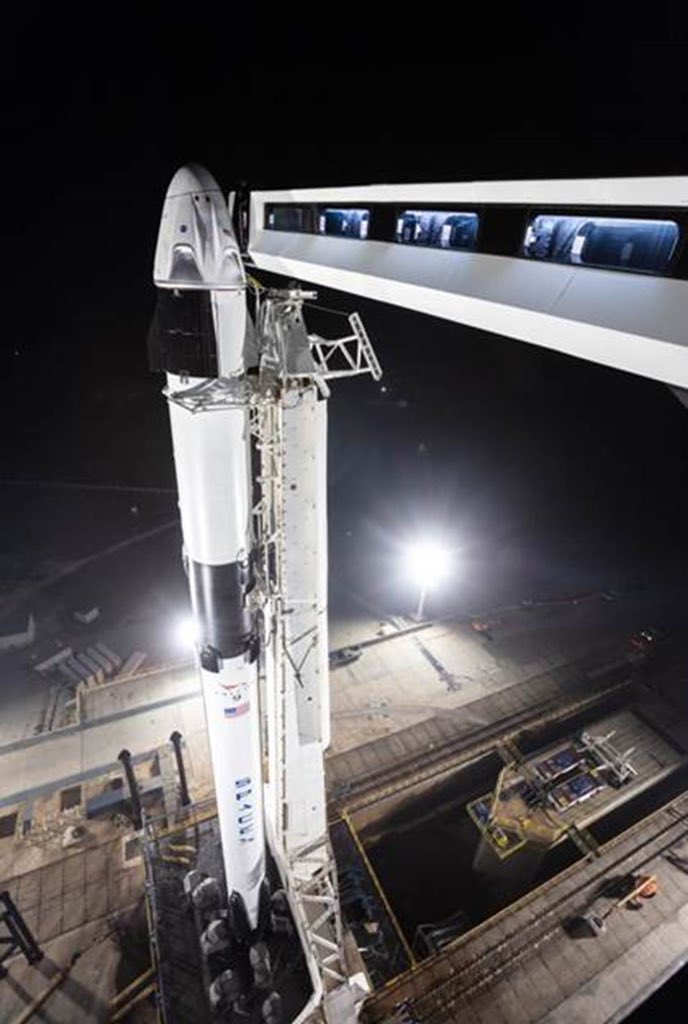
Crew Dragon atop the Falcon 9 and Crew access arm. Credit SpaceX.

Astronaut humor.

Bob Behnken and Doug Hurley, NASA Astronauts for Demo-2 of SpaceX Crew Dragon. Credit: NASA. Each has had two flights on the Space Shuttle. Hurley was Shuttle Pilot twice. Credit NASA.
05/04/2020 – Ephemeris – NASA mission preparations this month
This is Bob Moler with Ephemeris for Monday, May 4th. Today the Sun will be up for 14 hours and 24 minutes, setting at 8:52, and it will rise tomorrow at 6:26. The Moon, 3 days before full, will set at 5:47 tomorrow morning.
May is a month of preparation for the space community. The Mars 2020 Rover, now named Endurance is getting packed up and balanced in preparation to be loaded into the sky crane and aeroshell, part of the cruise stage for its trip to Mars. It will employ the same landing technique as its predecessor, Curiosity which landed 9 years before in 2012. The launch is scheduled for July 17th to land on February 18th next year. It will deploy a small helicopter as a demonstration. It has many of the tools as Curiosity plus new ones and will cache rocks for future return to the Earth for further analysis. Hopefully by month’s end two NASA astronauts will launch on a Falcon 9 from US soil to the International Space Station.
The event times given are for the Traverse City/Interlochen area of Michigan. They may be different for your location.
Addendum
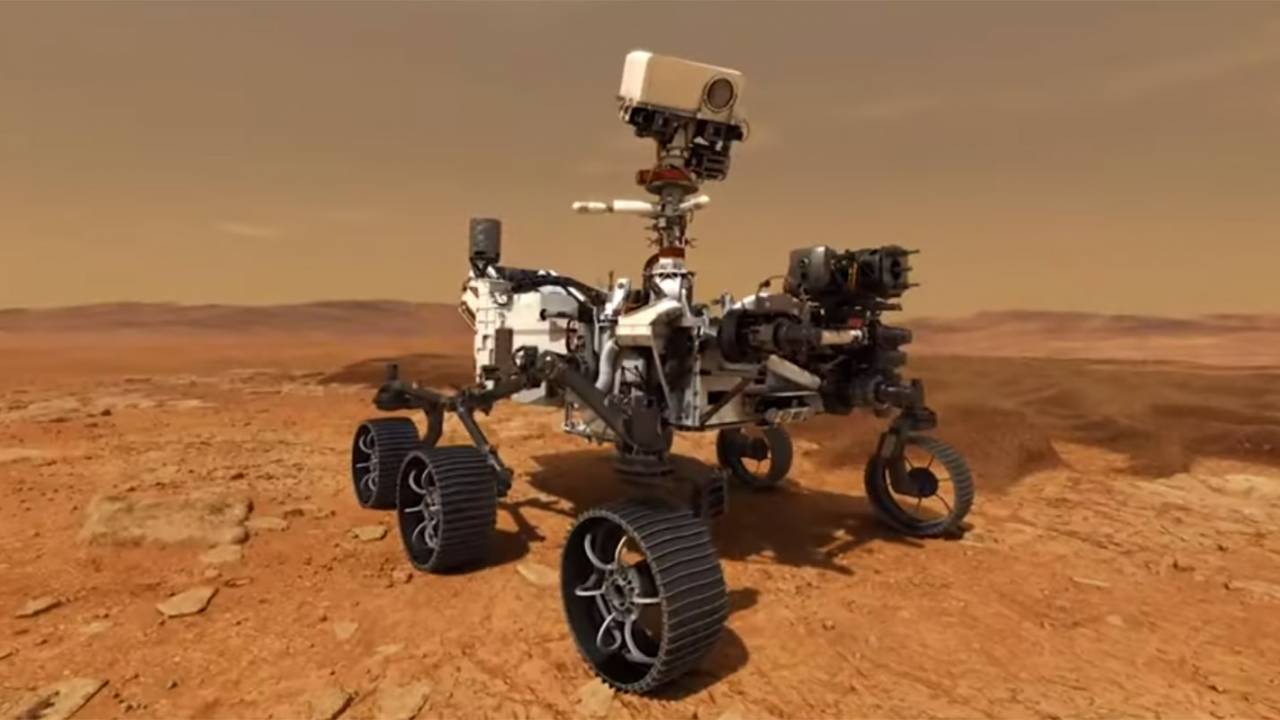
Mars 2020 Rover “Endurance” destined for the martian crater Jezero. Credit NASA.
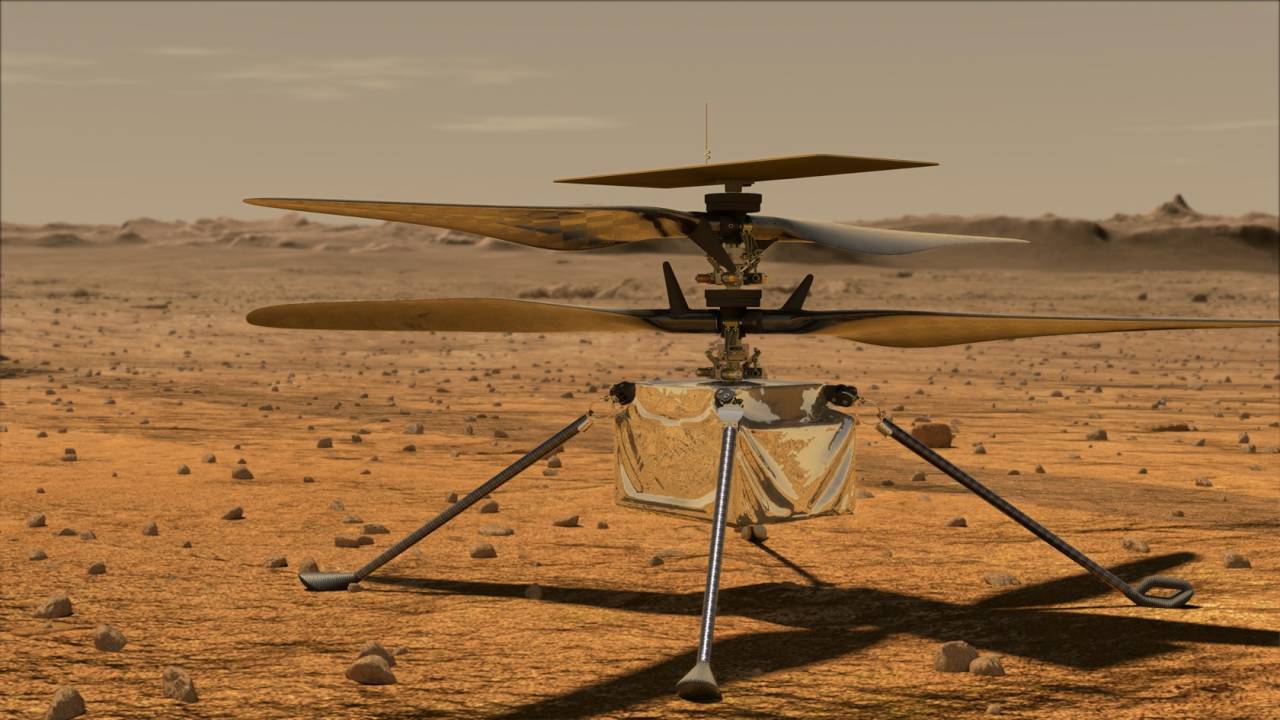
Mars Helicopter “Ingenuity” after deployment. Delta of ancient river that flowed into a lake in the Jezero crater. Credit NASA.
Delta of ancient river that flowed into a lake in the Jezero crater. Credit NASA.

Crew Dragon docking to the International Space Station during the Demo 1 flight. Credit NASA.
05/01/2020 – Ephemeris – Previewing May Skies
This is Bob Moler with Ephemeris for Friday, May 1st. Today the Sun will be up for 14 hours and 16 minutes, setting at 8:48, and it will rise tomorrow at 6:30. The Moon, 1 day past first quarter, will set at 4:22 tomorrow morning.
May is the month when the promise of spring is finally fulfilled. Daylight hours in the Interlochen/Traverse City area will increase from 14 hours and 16 minutes today to 15 hours 20 minutes on the 31st. The altitude, or angle, of the Sun above the southern horizon at local noon will ascend from 60 degrees today to 67 degrees at month’s end. The altitude of the sun in the Straits area will be a degree lower than that but your daylight hours will be a few minutes longer. Venus will end up too close to the Sun to be seen at month’s end, but before then its thin crescent can even be seen in binoculars. Mercury will make an appearance in the evening sky and will appear near Venus on the 22nd. They will be low in the west-northwest in evening twilight.
The event times given are for the Traverse City/Interlochen area of Michigan. They may be different for your location.
Addendum
May Evening Star Chart
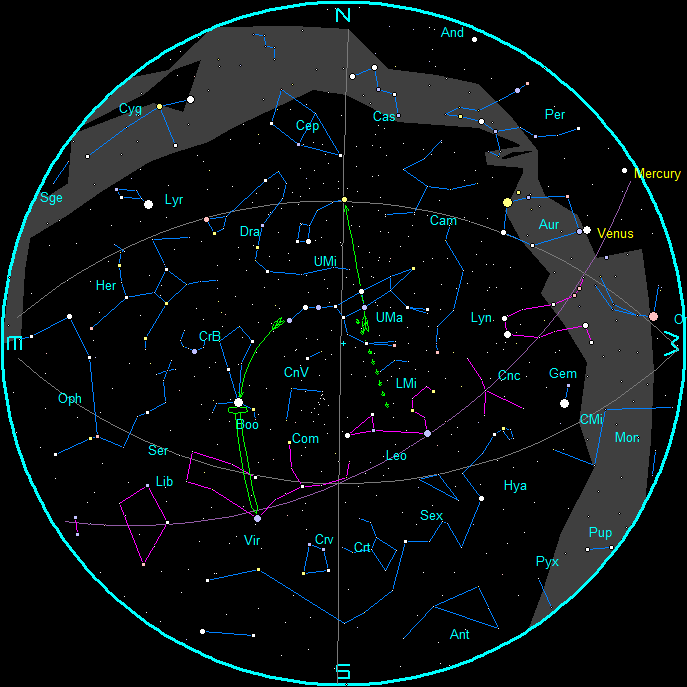
Star Chart for May 2020 (11 p.m. EDT May 15, 2020). Created using my LookingUp program. Click on image to enlarge.
The planets and stars are plotted for the 15th at 11 p.m. EDT in the evening and 5 a.m. for the morning chart. These are the chart times. Note that Traverse City is located approximately 45 minutes behind our time meridian, West 75° longitude. (An hour 45 minutes behind our daylight saving time meridian during EDT). To duplicate the star positions on a planisphere you may have to set it to 1 hour 45 minutes earlier than the current time.
Note the chart times of 11 p.m. and 5 a.m. are for the 15th. For each week before the 15th add ½ hour (28 minutes if you’re picky). For each week after the 15th subtract ½ hour, or 28 minutes. The planet positions are updated each Wednesday on this blog. For planet positions on dates other than the 15th, check the Wednesday planet posts on this blog for weekly positions.
May Morning Star Chart
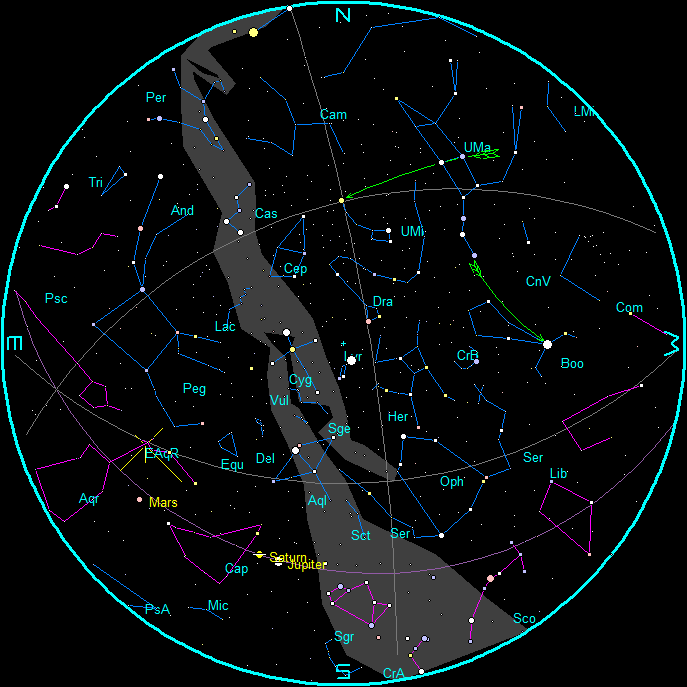
Star Chart for May mornings 2020 (5 a.m. EDT May 15, 2020). Created using my LookingUp program. Click on image to enlarge.
For a list of constellation names to go with the abbreviations click here.
- Pointer stars at the front of the bowl of the Big Dipper point to Polaris the North Star.
- Leaky dipper drips on Leo
- Follow the arc of the handle of the Big Dipper to the star Arcturus, and
- Extend like a spike to Spica,
- EaqR is the radiant of the Aquariid meteor shower that peaks on the 5th. Best viewing is before the peak this year due to the bright Moon.
Twilight Limits, Nautical and Astronomical
| EDT | |||||||
| Morning twilight | Evening twilight | Dark night | Moon | ||||
| Date | Astro. | Nautical | Nautical | Astro. | Start | End | Illum. |
| 2020-05-01 | 4h39m | 5h24m | 22h03m | 22h47m | 3h48m | 4h39m | 0.63 |
| 2020-05-02 | 4h37m | 5h22m | 22h04m | 22h49m | 4h22m | 4h37m | 0.74 |
| 2020-05-03 | 4h35m | 5h20m | 22h06m | 22h51m | – | – | 0.84 |
| 2020-05-04 | 4h33m | 5h19m | 22h07m | 22h53m | – | – | 0.92 |
| 2020-05-05 | 4h31m | 5h17m | 22h09m | 22h55m | – | – | 0.92 |
| 2020-05-06 | 4h29m | 5h15m | 22h11m | 22h57m | – | – | 0.98 |
| 2020-05-07 | 4h27m | 5h14m | 22h12m | 22h59m | – | – | 1 |
| 2020-05-08 | 4h24m | 5h12m | 22h14m | 23h01m | – | – | 0.99 |
| 2020-05-09 | 4h22m | 5h10m | 22h15m | 23h03m | 23h03m | 23h56m | 0.95 |
| 2020-05-10 | 4h20m | 5h09m | 22h17m | 23h05m | 23h05m | – | 0.89 |
| 2020-05-11 | 4h18m | 5h07m | 22h18m | 23h07m | 23h07m | 0h58m | 0.81 |
| 2020-05-12 | 4h16m | 5h06m | 22h20m | 23h09m | 23h09m | 1h51m | 0.71 |
| 2020-05-13 | 4h14m | 5h04m | 22h21m | 23h11m | 23h11m | 2h34m | 0.61 |
| 2020-05-14 | 4h12m | 5h02m | 22h23m | 23h13m | 23h13m | 3h08m | 0.51 |
| 2020-05-15 | 4h10m | 5h01m | 22h24m | 23h15m | 23h15m | 3h36m | 0.41 |
| 2020-05-16 | 4h08m | 5h00m | 22h26m | 23h17m | 23h17m | 4h01m | 0.31 |
| 2020-05-17 | 4h06m | 4h58m | 22h27m | 23h19m | 23h19m | 4h06m | 0.23 |
| 2020-05-18 | 4h05m | 4h57m | 22h29m | 23h21m | 23h21m | 4h05m | 0.15 |
| 2020-05-19 | 4h03m | 4h55m | 22h30m | 23h23m | 23h23m | 4h03m | 0.09 |
| 2020-05-20 | 4h01m | 4h54m | 22h32m | 23h25m | 23h25m | 4h01m | 0.04 |
| 2020-05-21 | 3h59m | 4h53m | 22h33m | 23h27m | 23h27m | 3h59m | 0.01 |
| 2020-05-22 | 3h57m | 4h52m | 22h35m | 23h29m | 23h29m | 3h57m | 0 |
| 2020-05-23 | 3h56m | 4h50m | 22h36m | 23h31m | 23h31m | 3h56m | 0.01 |
| 2020-05-24 | 3h54m | 4h49m | 22h37m | 23h33m | 23h33m | 3h54m | 0.04 |
| 2020-05-25 | 3h52m | 4h48m | 22h39m | 23h34m | – | 3h52m | 0.1 |
| 2020-05-26 | 3h51m | 4h47m | 22h40m | 23h36m | 0h18m | 3h51m | 0.17 |
| 2020-05-27 | 3h49m | 4h46m | 22h41m | 23h38m | 1h08m | 3h49m | 0.26 |
| 2020-05-28 | 3h48m | 4h45m | 22h42m | 23h40m | 1h50m | 3h48m | 0.37 |
| 2020-05-29 | 3h46m | 4h44m | 22h44m | 23h42m | 2h25m | 3h46m | 0.48 |
| 2020-05-30 | 3h45m | 4h43m | 22h45m | 23h43m | 2h56m | 3h45m | 0.6 |
| 2020-05-31 | 3h43m | 4h42m | 22h46m | 23h45m | 3h23m | 3h43m | 0.72 |
The twilight calendar was generated using Cartes du Ciel (Sky Charts), with some corrections.
See my blog post: Twilight Zone for the definitions of the different periods of twilight here: https://bobmoler.wordpress.com/2018/09/27/.
NASA Calendar of Planetary Events
May 1  Fr            Venus: 38° E
    5  Mo  03:00 am  Eta Aquariid Meteor Shower: ZHR = 60
    4  Mo  05:22 pm  Mercury Superior Solar Conjunction
    5  Tu  11:03 pm  Moon Perigee: 359700 km
    7  Th  06:45 am  Full Moon
   10  Su  05:01 am  Moon Descending Node
   11  Mo  02:13 am  Moon South Dec.: 24° S
   12  Tu  05:40 am  Moon-Jupiter: 2.4° N
   12  Tu  02:18 pm  Moon-Saturn: 2.8° N
   14  Th  10:03 am  Last Quarter
   14  Th  10:01 pm  Moon-Mars: 3° N
   18  Mo  03:45 am  Moon Apogee: 405600 km
   22  Fr  05:37 am  Mercury-Venus: 0.9° N
   22  Fr  01:39 pm  New Moon
   23  Sa  10:40 pm  Moon-Venus: 4° N
   24  Su  06:53 am  Moon-Mercury: 3° N
   24  Su  05:34 pm  Moon Ascending Node
   25  Mo  05:16 pm  Moon North Dec.: 24.1° N
   27  We  02:44 pm  Moon-Beehive: 1.8° S
   29  Fr  11:30 pm  First Quarter
Jun 1  Mo            Venus: 3.7° E
All event times are given for UTC-4 hr: Daylight Saving Time.
Sky Events Calendar by Fred Espenak and Sumit Dutta (NASA’s GSFC),
http://eclipse.gsfc.nasa.gov/SKYCAL/SKYCAL.html.
If you go to the above site you can print out a list like the above for the entire year or calendar pages for your time zone.
Sun and Moon Rising and Setting Events
LU Ephemeris of Sky Events for Interlochen/TC
May, 2020    Local time zone: EDT
+-----------------------------------------------------------------------+
| DATE |  SUN     SUN  DAYLIGHT|   TWILIGHT*    |MOON  RISE OR    ILLUM |
|      |  RISE    SET    HOURS |  END    START  |PHASE SET** TIME FRACTN|
+=======================================================================+
|Fri  1| 06:32a  08:48p  14:16 | 10:00p  05:19a |      Set  04:22a   63%|
|Sat  2| 06:30a  08:49p  14:19 | 10:02p  05:18a |      Set  04:52a   73%|
+------+-----------------------+----------------+-----------------------+
|Sun  3| 06:29a  08:50p  14:21 | 10:04p  05:16a |      Set  05:20a   83%|
|Mon  4| 06:27a  08:52p  14:24 | 10:05p  05:14a |      Set  05:47a   91%|
|Tue  5| 06:26a  08:53p  14:26 | 10:07p  05:12a |      Set  06:15a   97%|
|Wed  6| 06:25a  08:54p  14:29 | 10:08p  05:11a |      Set  06:46a  100%|
|Thu  7| 06:23a  08:55p  14:32 | 10:10p  05:09a |Full  Rise 09:26p   99%|
|Fri  8| 06:22a  08:56p  14:34 | 10:11p  05:07a |      Rise 10:43p   97%|
|Sat  9| 06:21a  08:58p  14:36 | 10:13p  05:06a |      Rise 11:55p   91%|
+------+-----------------------+----------------+-----------------------+
|Sun 10| 06:19a  08:59p  14:39 | 10:14p  05:04a |      Rise 12:58a   84%|
|Mon 11| 06:18a  09:00p  14:41 | 10:16p  05:02a |      Rise 01:51a   75%|
|Tue 12| 06:17a  09:01p  14:44 | 10:18p  05:01a |      Rise 02:33a   66%|
|Wed 13| 06:16a  09:02p  14:46 | 10:19p  04:59a |      Rise 03:08a   56%|
|Thu 14| 06:15a  09:03p  14:48 | 10:21p  04:58a |L Qtr Rise 03:36a   46%|
|Fri 15| 06:14a  09:04p  14:50 | 10:22p  04:56a |      Rise 04:01a   36%|
|Sat 16| 06:12a  09:06p  14:53 | 10:24p  04:55a |      Rise 04:23a   28%|
+------+-----------------------+----------------+-----------------------+
|Sun 17| 06:11a  09:07p  14:55 | 10:25p  04:53a |      Rise 04:43a   20%|
|Mon 18| 06:10a  09:08p  14:57 | 10:27p  04:52a |      Rise 05:04a   13%|
|Tue 19| 06:09a  09:09p  14:59 | 10:28p  04:51a |      Rise 05:25a    7%|
|Wed 20| 06:08a  09:10p  15:01 | 10:29p  04:49a |      Rise 05:49a    3%|
|Thu 21| 06:08a  09:11p  15:03 | 10:31p  04:48a |      Rise 06:16a    1%|
|Fri 22| 06:07a  09:12p  15:05 | 10:32p  04:47a |New   Set  09:16p    0%|
|Sat 23| 06:06a  09:13p  15:07 | 10:34p  04:46a |      Set  10:20p    2%|
+------+-----------------------+----------------+-----------------------+
|Sun 24| 06:05a  09:14p  15:09 | 10:35p  04:44a |      Set  11:22p    5%|
|Mon 25| 06:04a  09:15p  15:10 | 10:36p  04:43a |      Set  12:18a   11%|
|Tue 26| 06:03a  09:16p  15:12 | 10:38p  04:42a |      Set  01:07a   18%|
|Wed 27| 06:03a  09:17p  15:14 | 10:39p  04:41a |      Set  01:49a   27%|
|Thu 28| 06:02a  09:18p  15:15 | 10:40p  04:40a |      Set  02:25a   37%|
|Fri 29| 06:01a  09:19p  15:17 | 10:41p  04:39a |F Qtr Set  02:55a   48%|
|Sat 30| 06:01a  09:20p  15:18 | 10:43p  04:38a |      Set  03:23a   60%|
+------+-----------------------+----------------+-----------------------+
|Sun 31| 06:00a  09:20p  15:20 | 10:44p  04:37a |      Set  03:49a   71%|
+-----------------------------------------------------------------------+
* Nautical Twilight
** Moonrise or moonset, whichever occurs between sunrise and sunset
04/30/2020 – Ephemeris – See bits of Halley’s Comet in the morning crashing into the Earth’s atmosphere
This is Bob Moler with Ephemeris for Thursday, April 30th. Today the Sun will be up for 14 hours and 13 minutes, setting at 8:47, and it will rise tomorrow at 6:32. The Moon, at first quarter today, will set at 3:47 tomorrow morning.
Do you remember seeing Halley’s Comet back in 1986? The actual pronunciation is “Hawley’s”, according to Sir Edmund’s contemporary Samuel Pepys. The reason I asked is whether you saw it in 1986 or are young enough to live long enough to see it in 41 years, we all have a twice yearly chance to see bits of Halley’s Comet, shed in previous returns through the inner solar system and strewn along its orbit, burn up in Earth’s atmosphere as the Eta Aquariid meteor shower going on now, or the Orionids in late October. The time to see the meteor shower is in the early morning after the Moon sets. That’s after 3:47 a.m. tomorrow morning and 4:22 Saturday morning. Astronomical twilight starts about 4:40 a.m. It will probably be 5 a.m. before it really interferes. With the meteors all over the sky, coming from the southeast.
The event times given are for the Traverse City/Interlochen area of Michigan. They may be different for your location.
Addendum
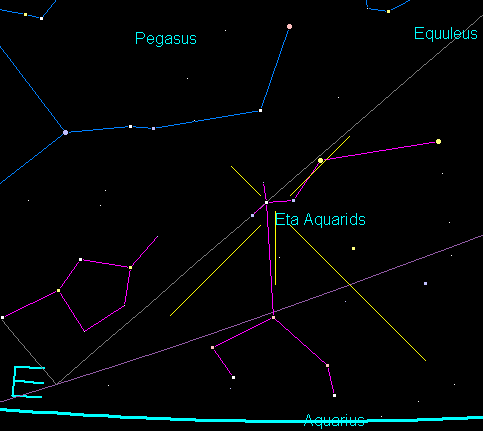
The Eta Aquariid radiant at the peak of the shower. The radiant moves slowly to the east with time. Credit: my LookingUp program.
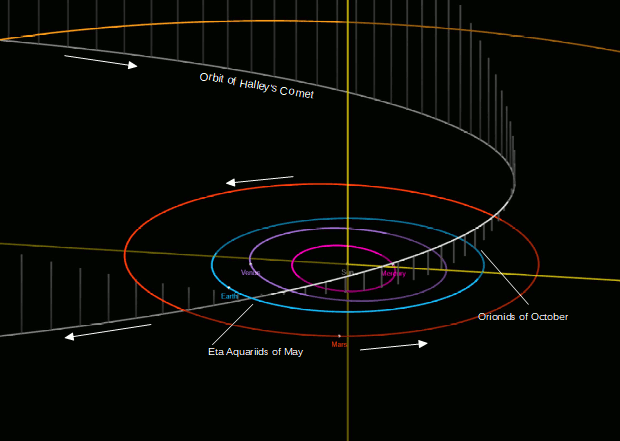
Halley’s Comet orbit with the orbits of the inner planets showing the points at which the debris from the comet intersect with the Earth’s orbit causing meteor showers. Diagram credit JPL Small-Body Database Browser with my annotations.
04/29/2020 – Ephemeris – Let’s look at the naked-eye planets for this week
This is Ephemeris for Wednesday, April 29th. Today the Sun will be up for 14 hours and 11 minutes, setting at 8:45, and it will rise tomorrow at 6:33. The Moon, 1 day before first quarter, will set at 3:07 tomorrow morning.
Let’s look at the naked-eye planets for this week. Venus is our evening star shining brightly in the west. It will set at 12:29 a.m. It’s a couple of days past its greatest brilliancy, and only 41 million miles away. In the morning sky there are three planets fairly close together in the south-southeast. Bright Jupiter will rise first at 2:29 a.m. Followed by Saturn at 2:44 a.m. Mars, stretching its lead left of Saturn, will rise an hour after Saturn. It’s now down to 114 million miles (184 million km) away, as the Earth slowly overtakes it at the rate of about 5 million miles (8 million km) a week. Mars will be closest to us in October. It’s not as close as it was 2 years ago, but closer than it will get for the next 15 years.
The event times given are for the Traverse City/Interlochen area of Michigan. They may be different for your location.
Addendum
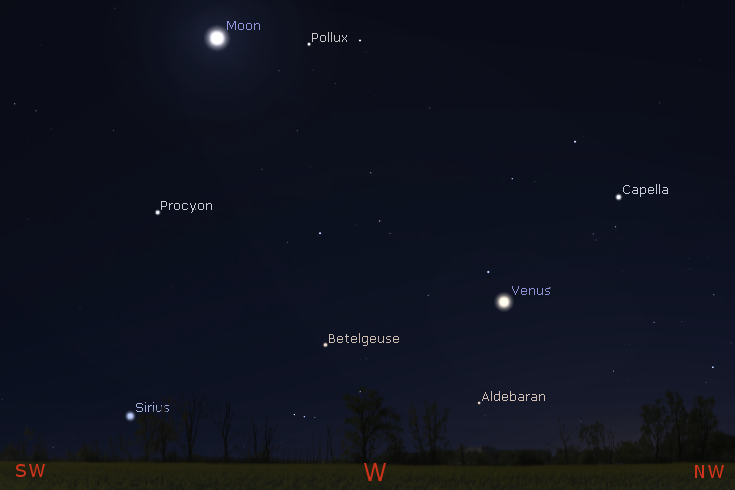
Venus and the fat crescent Moon tonight at 10 p.m. April 29, 2020. Click on the image to enlarge. Created using Stellarium.
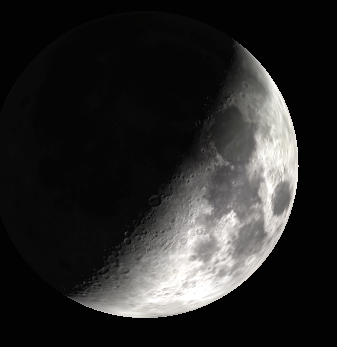
The Moon as it might appear in binoculars tonight April 29, 2020. Created using Stellarium,
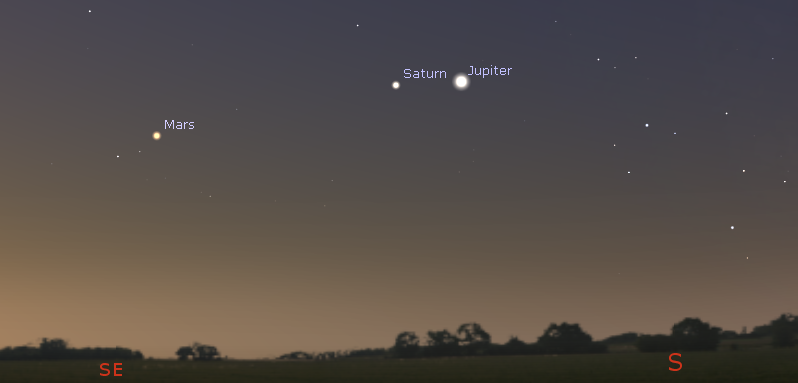
Morning planets in twilight at 6 a.m. tomorrow morning, April 30, 2020. Click on the image to enlarge. Created using Stellarium.
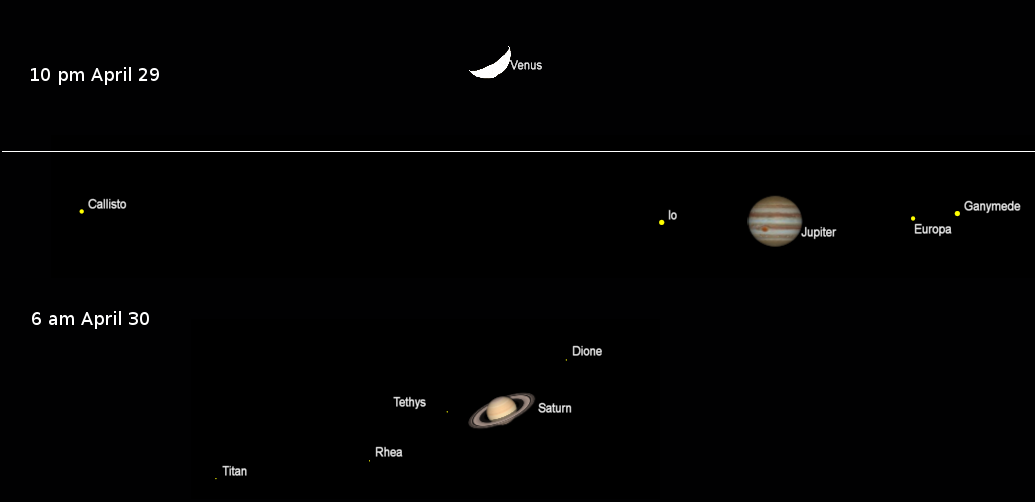
The planets as seen in a telescope with the same magnification. Venus in the evening and Jupiter and Saturn in the morning on the night of April 29/30, 2020. Apparent diameters: Venus, 40.58″; Jupiter, 40.62″; Saturn, 16.92″, rings, 39.42″. Mars at 7.59″ won’t be added until it reaches 10″. The ” symbol means seconds of arc (1/3600th of a degree.) Created using Cartes du Ciel (Sky Charts).
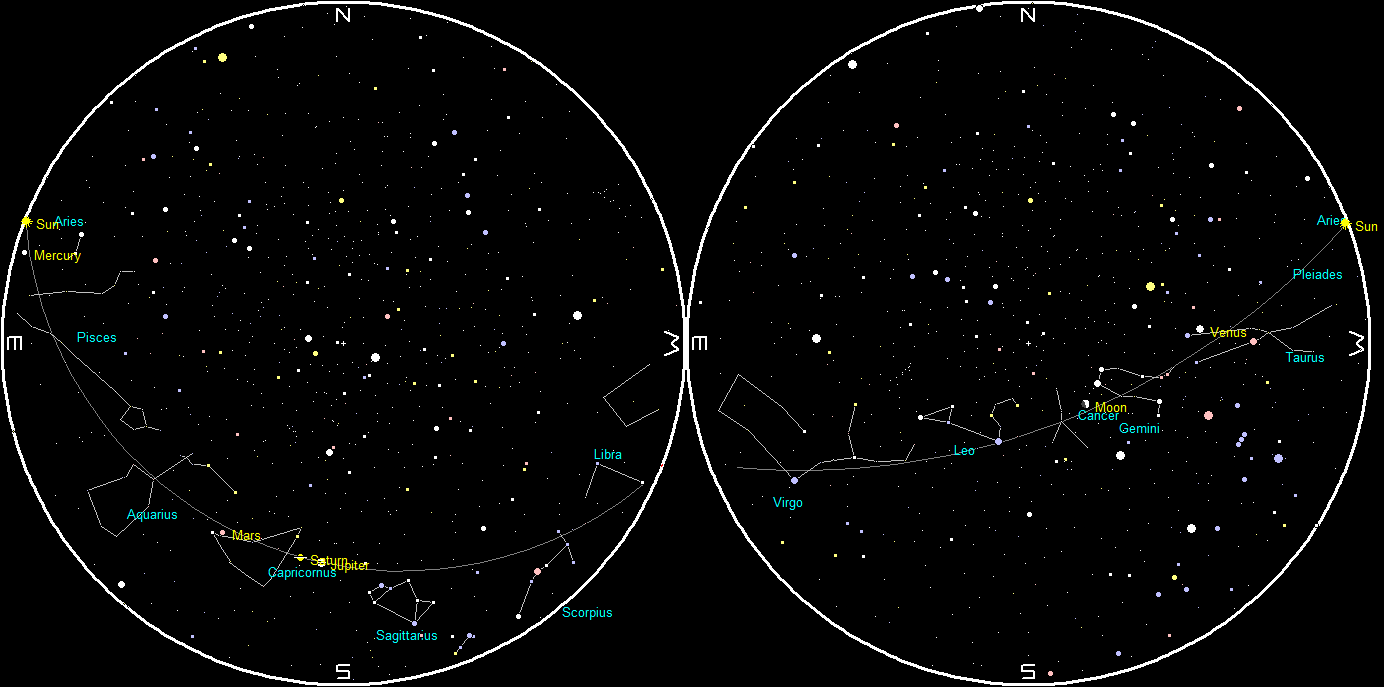
Planets and the Moon at sunset and sunrise of a single night starting with sunset on the right on April 29, 2020. The night ends on the left with sunrise on the 30th. The closeness of Jupiter and Saturn in the morning sky unfortunately overlays planets and labels. Click on the image to enlarge. Created using my LookingUp program.
04/28/2020 – Ephemeris – My life with the pandemic so far (A rare personal program)
This is Bob Moler with Ephemeris for Tuesday, April 28th. Today the Sun will be up for 14 hours and 8 minutes, setting at 8:44, and it will rise tomorrow at 6:34. The Moon, 2 days before first quarter, will set at 2:20 tomorrow morning.
The stay at home order from the Governor issued last week to stay home until at least May 15th was not a surprise to me. I’m at the vulnerable age group… old. Most of what I do is done at home anyway, though will I miss being an instructor for the Inland Seas Educational Association. I am usually on the schooner Manitou in the spring. My stroke in January would have precluded me sailing this spring anyway even if there was no virus to shut things down. Maybe this fall? I’m getting my garden ready. What’s an astronomer doing with all this earth bound stuff? Well it just happens that the Earth’s a planet too. I tend to think of it as spaceship Earth, hurtling around the Sun at 67,000 miles per hour (107,000 kph).
The event times given are for the Traverse City/Interlochen area of Michigan. They may be different for your location.
04/27/2020 – Ephemeris – Sunrise at Theophilus
This is Ephemeris for Monday, April 27th. Today the Sun will be up for 14 hours and 5 minutes, setting at 8:43, and it will rise tomorrow at 6:36. The Moon, 3 days before first quarter, will set at 1:26 tomorrow morning.
If my Moon charting software is correct this is the one evening out of the month when the central peak of the crater Theophilus catches the first rays of the rising Sun, while the crater floor is in shadow. It kind of looks like a bulls eye. It can be spotted with binoculars on the inside of the crescent, on the terminator, the sunrise line about half way between the ends of the crescent. Theophilus is 61 miles (101 km) in diameter. A telescope of any size with 30 to 50 power magnification will really bring out the detail. More magnification may be warranted, but if the bigger image becomes fuzzy, back off the power. It may be the diameter of your telescope due to the wave nature of light or the atmosphere you’re looking through that’s causing the problem.
The event times given are for the Traverse City/Interlochen area of Michigan. They may be different for your location.
Addendum
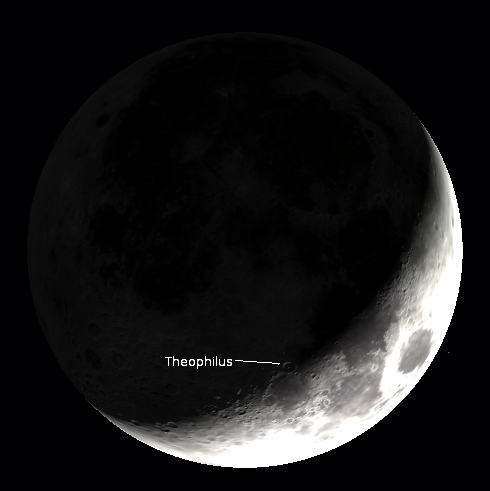
The Moon as it should appear at 10 p.m. tonight April 27, 2020 EDT (2:00 UT the 28th UT) with Theophilus on the terminator. Created with Stellarium.
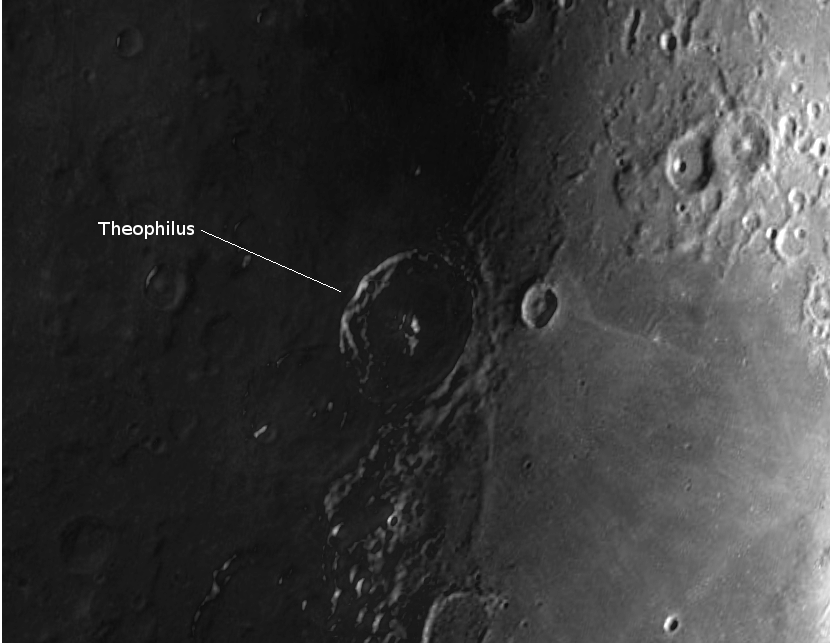
Theophilus at sunrise with the Sun illuminating the central peak and the far crater wall. Theophilus’ diameter is 61 miles or 101 kilometers in diameter. The crater walls rise 13 ,3000 feet or 4,400 meters above the crater floor, and the central mountain with four peaks rises 4,600 feet or 1,400 meters above the crater floor. Image and information from Virtual Moon Atlas. This image needs to be rotated clockwise about 45 degrees to match the image above.
 Bob Moler's Ephemeris Blog