05/22/2020 – Ephemeris – Venus hangs out with Mercury and the Moon this weekend
This is Ephemeris for Friday, May 22nd. Today the Sun will be up for 15 hours and 5 minutes, setting at 9:12, and it will rise tomorrow at 6:06. The Moon is new today, and won’t be visible
Low in the northwest shortly after sunset our brilliant evening star Venus may be seen. It’s getting closer to the Sun every evening. This is an illusion because Venus is in the process of passing between the Earth and the Sun, so it’s not getting closer to the Sun, but it is getting closer to us at 29 million miles (46.8 million km) today. Mercury has passed Venus and is now to the left and a bit above Venus as seen at 10 p.m. Both are pretty close to the horizon, so you may have to move to a spot with a low northwestern horizon. Tomorrow night the day old sliver of the Moon will be spotted just below both of them. It should be quite a sight with these two planets and the Moon in the twilight, just after sunset.
The event times given are for the Traverse City/Interlochen area of Michigan. They may be different for your location.
Addendum
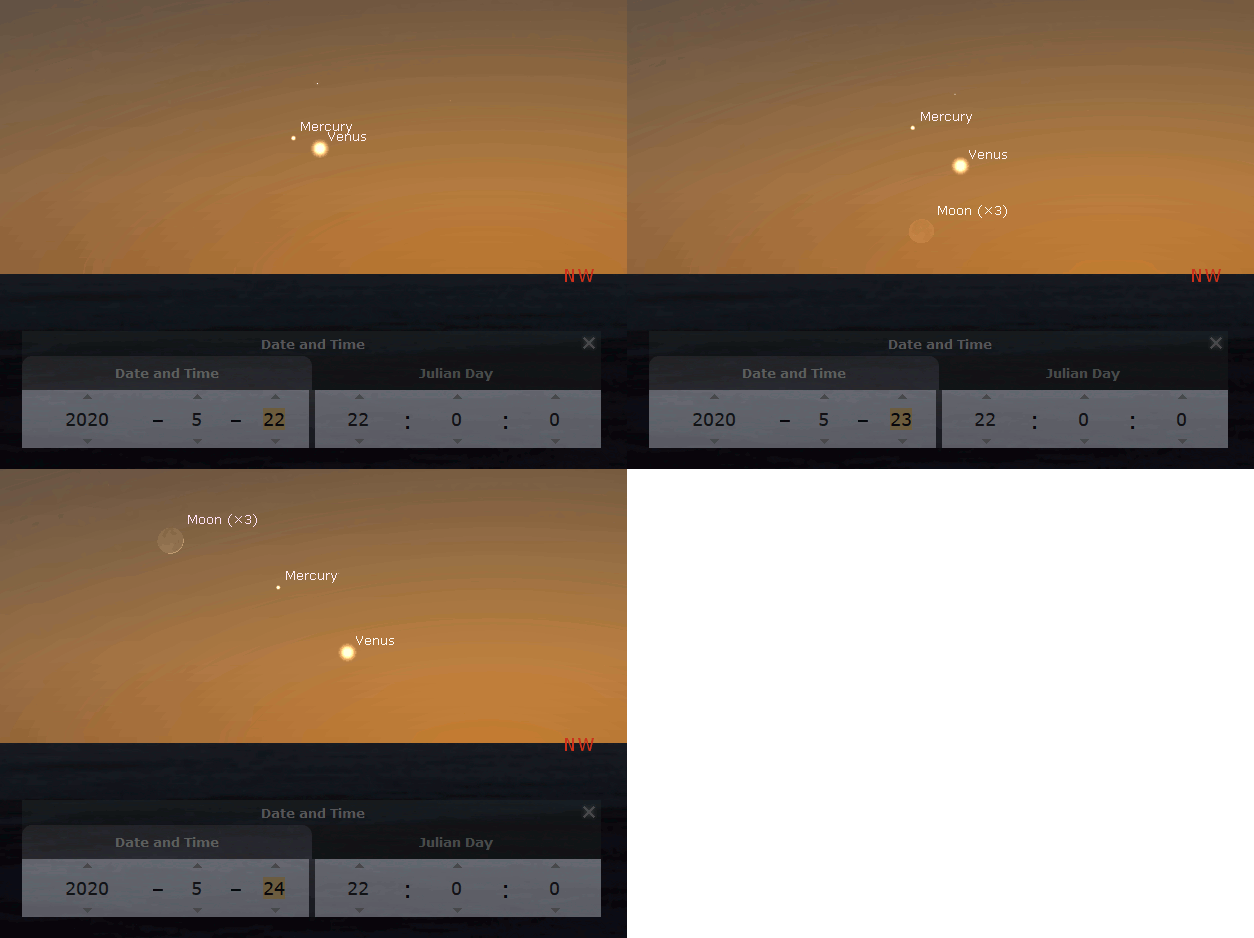
Venus, Mercury, Moon animation for 10 pm May 22nd, 23rd and 24th, 2020. The Moon is shown 3 times actual size in an attempt to show its phase. Created using Stellarium and GIMP.
05/21/2020 – Ephemeris – A star cluster in a most unusual spot
This is Ephemeris for Thursday, May 21st. Today the Sun will be up for 15 hours and 3 minutes, setting at 9:11, and it will rise tomorrow at 6:07. The Moon, 1 day before new, will rise at 6:16 tomorrow morning.
High in the south at 10:30 p.m. or so is a tiny and faint constellation of Coma Berenices, or Berenice’s hair. In it are lots of faint stars arrayed to look like several strands of hair. The whole group will fit in the field of a pair of binoculars, which will also show many more stars. The hank of hair supposed belonged to Berenice II, Queen of Egypt, in the 3rd century BCE. Coma Berenices is the second closest star cluster to us at only 250 light years away, after the Hyades, the face of Taurus the bull a winter constellation. It’s in an odd spot for a galactic star cluster, which are supposed to lie in the plane of the Milky Way. It’s actually seen at the galactic pole, as far as possible away from the milky band. It’s a matter of perspective because it’s so close to us. It’s still really in the plane of the Milky Way.
The event times given are for the Traverse City/Interlochen area of Michigan. They may be different for your location.
Addendum
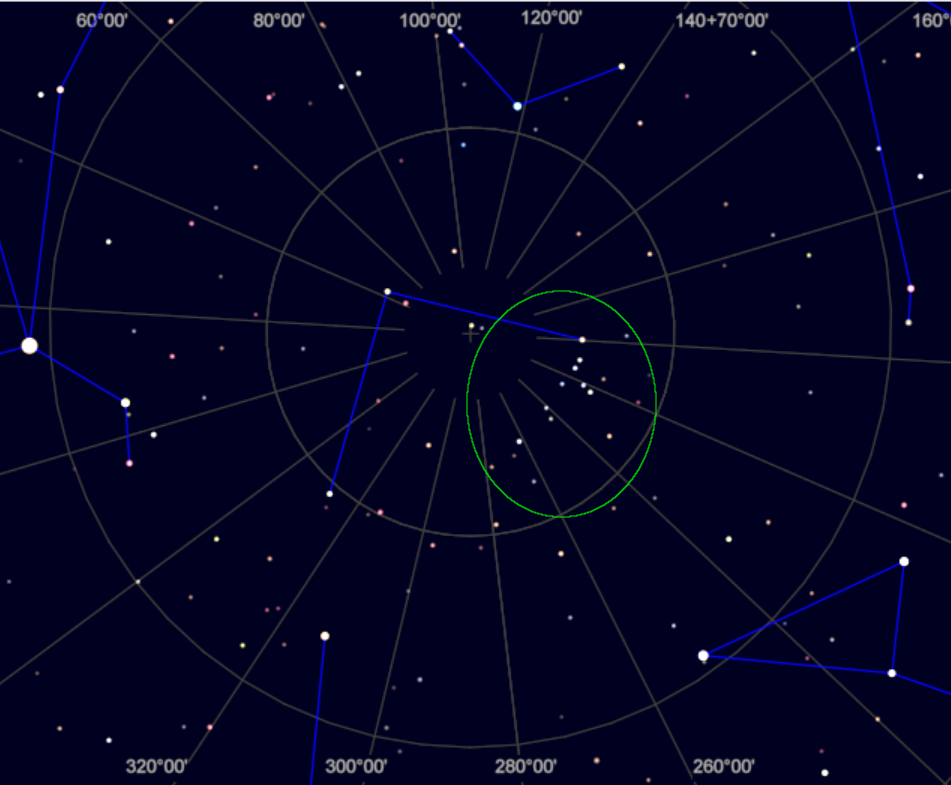
Coma Berenices and galactic coordinated showing how close to the galactic pole it is. The bright star Arcturus at the left edge. Leo’s hind end is at the lower right. Created using Cartes du Ciel (Sky Charts).
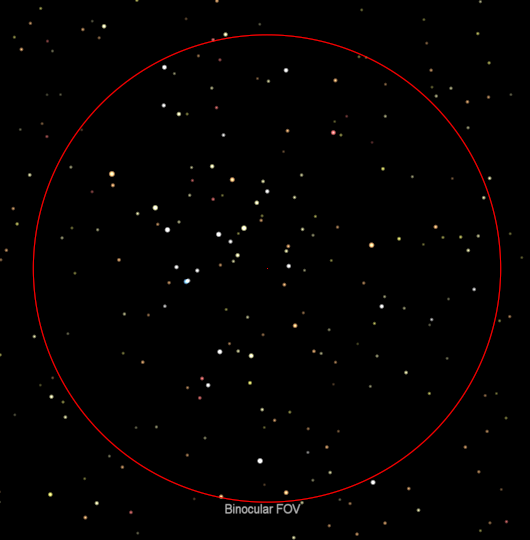
Approximate 7 power binocular field of view of the Coma Berenices Star Cluster. Created using Cartes du Ciel (Sky Charts).
Note: There is another cluster in the constellation. It’s called the Coma Cluster. It’s a cluster of over a thousand galaxies a bit over 300 million light years away.
05/20/2020 – Ephemeris – Let’s look at the naked-eye planets for this week
This is Ephemeris for Wednesday, May 20th. Today the Sun will be up for 15 hours and 1 minute, setting at 9:10, and it will rise tomorrow at 6:08. The Moon, 2 days before new, will rise at 5:49 tomorrow morning.
Let’s look at the naked-eye planets for this week. Venus is our evening star shining brightly in the west northwest. It will be our evening star for only the next 2 weeks. A tiny crescent can now be seen in binoculars. It will cross between the Earth and the Sun on June 3rd. It will set at 11:05 p.m. It’s only 30 million miles (48 million km) away. Mercury is making an appearance just below Venus now. In the morning sky there are three planets close together in the south and southeast. Bright Jupiter will rise first at 1:07 a.m. Followed by Saturn at 1:22 a.m. Mars, is stretching its lead left of Saturn and will rise at 3:00 a.m. Mars continues to get closer. Its now down to 101million miles (163 million km) away, as the Earth slowly overtakes it at the rate of about 5 million miles (7 million km) a week.
The event times given are for the Traverse City/Interlochen area of Michigan. They may be different for your location.
Addendum
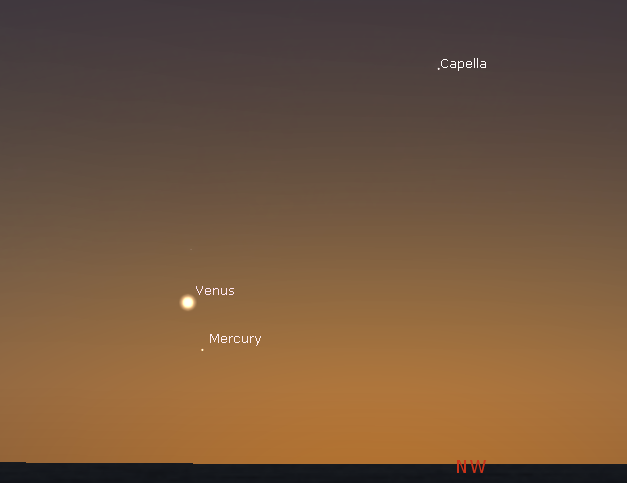
Venus and Mercury as it should appear at 10 pm low in the northwest over the Lake Michigan horizon. May 20, 2020. Created using Stellarium.
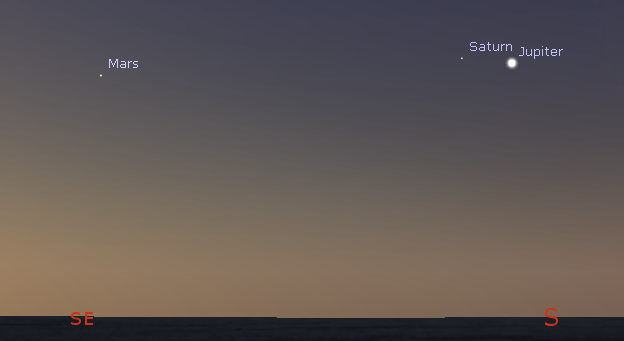
Jupiter, Saturn and Mars seen in the southern sky at 5:30 am tomorrow morning May 21, 2020. Created using Stellarium.
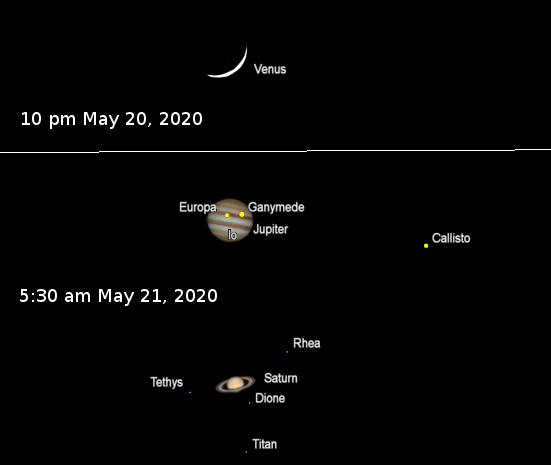
The planets as seen in a telescope with the same magnification. Venus, Jupiter and Saturn on the night of May 13/14, 2020. Apparent diameters: Venus, 52.76″, larger than Jupiter, at 43.37″; Saturn, 17.51″, rings 40.80″. Mars at 8.66″ won’t be added until it reaches 10″. Mercury is gibbous at 6.04″. The ” symbol means seconds of arc (1/3600th of a degree.) Note that Jupiter has two moons in transit, with another behind the planet. The transiting moons are nearly invisible, so only one moon, Callisto is visible. Created using Cartes du Ciel (Sky Charts).
Jovian satellite events (Subtract 4 hours from UT to get EDT)
Moon      Event          Date         UT
Europa:   Shadow start:  21 May 2020  2:36
Ganymede: Shadow end:    21 May 2020  5:50
Europa :  Shadow start:  21 May 2020  6:13
Ganymede: Transit start: 21 May 2020  7:02
Europa:   Transit start: 21 May 2020  8:22
Europa:   Shadow end:    21 May 2020  8:58
Ganymede: Transit end:   21 May 2020 10:24
Source: The Pluto Project https://www.projectpluto.com/jevent.htm
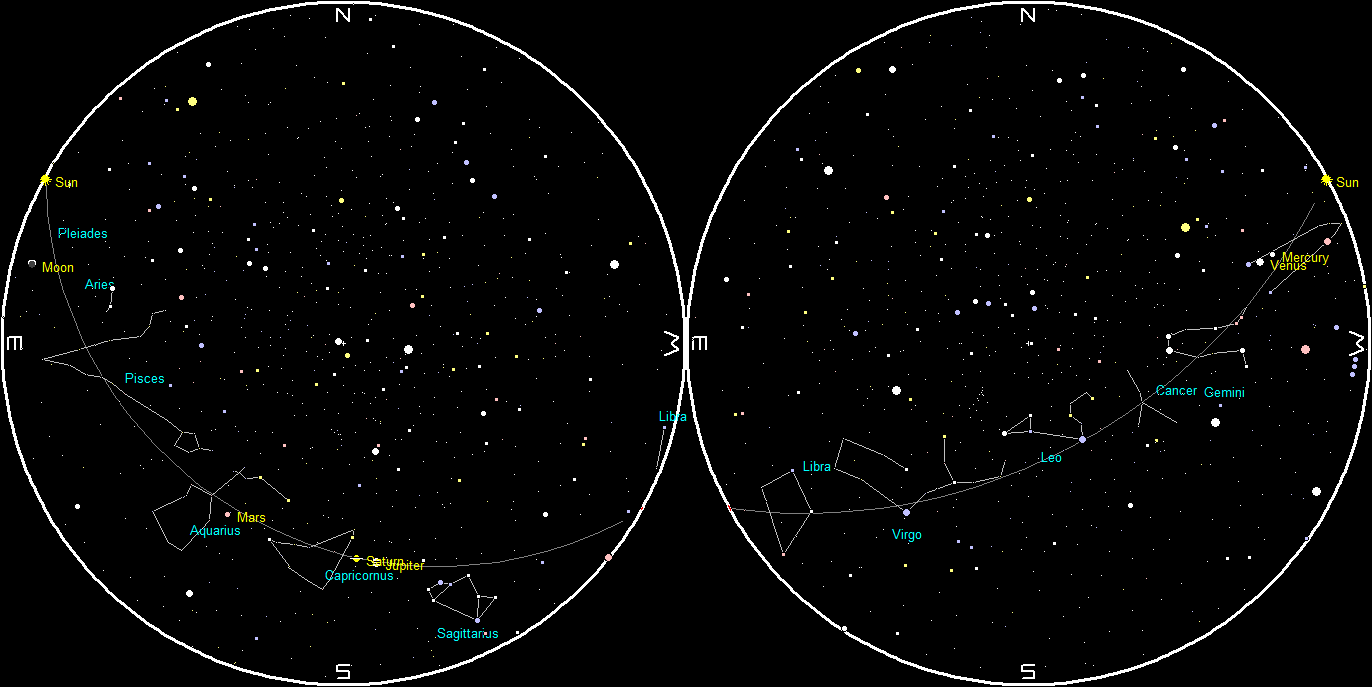
Planets and the Moon at sunset and sunrise of a single night starting with sunset on the right on May 20, 2020. The night ends on the left with sunrise on the 21st. The closeness of Jupiter and Saturn in the morning sky unfortunately overlays planets and labels. Click on the image to enlarge. Created using my LookingUp program.
05/19/2020 – Ephemeris – Venus will leave the evening sky in 15 days
This is Ephemeris for Tuesday, May 19th. Today the Sun will be up for 14 hours and 59 minutes, setting at 9:09, and it will rise tomorrow at 6:08. The Moon, 3 days before new, will rise at 5:25 tomorrow morning.
In 15 days Venus will leave the evening sky by passing between the Earth and the Sun in what astronomers call an inferior conjunction. Eight years ago, June 6th 2012, Venus went through another inferior conjunction. That time it passed directly between the Earth and the Sun so we could see the black spot that was Venus cross the face of the Sun as a rare Transit of Venus. Eight years before that, on June 8th 2004, we had another transit. However we will not see another in our lifetimes. The next one will occur in 2117. With the June 3rd conjunction Venus will pass north of the Sun from our vantage point, since Venus’ orbit is tilted a bit more than 3 degrees to the Earth’s orbit. So enjoy Venus while you can, unless you want to get up really early next month.
The event times given are for the Traverse City/Interlochen area of Michigan. They may be different for your location.
Addendum
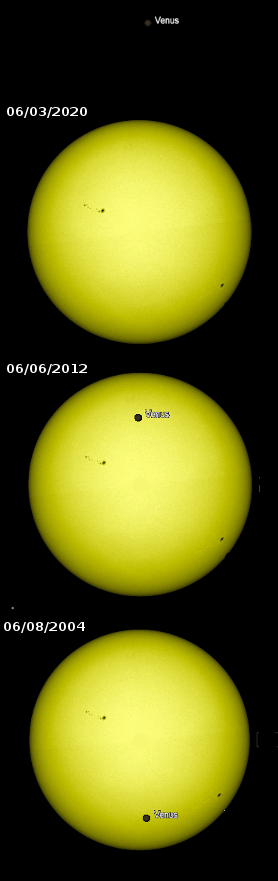
Transits of Venus-Two hits and a miss. Image created using Cartes du Ciel (Sky Charts).
Earth and Venus have a 13:8 orbital resonance. That is Venus orbits the Sun 13 times in the same time that the Earth orbits the Sun 8 times. So Venus has the same position in our skies it had 8 years ago. Actually the resonance is not perfect The resonance comes out 2.4 days short. So events like inferior conjunctions like the ones in the example above back track two and a fraction days from the 8 year interval.
Venus goes through a 584 day cycle from one inferior conjunction to the next. Five of those cycles equals 7.994 years. The Maya were well aware of this and one of their calendars was based on the Venus-Earth relationship.
05/18/2020 – Ephemeris – Comets are fragile, especially this month’s crop
This is Ephemeris for Monday, May 18th. Today the Sun will be up for 14 hours and 57 minutes, setting at 9:08, and it will rise tomorrow at 6:09. The Moon, half way from last quarter to new, will rise at 5:04 tomorrow morning.
Last month most of us astronomers were looking forward to seeing at least two naked-eye comets this month, with another just below naked-eye visibility. Our hopes have been dashed with the first two, Comet ATLAS is disintegrating and Comet SWAN has stopped brightening, and at its brightest, which would be barely visible in a dark sky, would be invisible in bright twilight, where it will be located. Comets are unpredictable. Each is their own beast. They are small bodies of ices dust and bits of rock. When they come inside the orbit of Jupiter the Sun’s heat sublimates their frozen gasses which shoot out along with dust and build a huge tenuous head called a coma that can be larger than Jupiter and a tail that extends millions of miles (kilometers).
The event times given are for the Traverse City/Interlochen area of Michigan. They may be different for your location.
Addendum

Comet ATLAS disintegrates as witnessed by the Hubble Space Telescope. Currently there are 5 nuclear fragments being separately tracked. The color here is most not likely the true visual color. Click on the image to enlarge. Credit: NASA/ESA Hubble Space Telescope.
05/15/2020 – Ephemeris – Virgo and its cluster of galaxies
This is Ephemeris for Friday, May 15th. Today the Sun will be up for 14 hours and 50 minutes, setting at 9:04, and it will rise tomorrow at 6:12. The Moon, 1 day past last quarter, will rise at 4:01 tomorrow morning.
One of the large constellations we see in the south at 11 p.m. can be found using the Big Dipper overhead, follow the arc of the handle to the bright star Arcturus, the straighten the arc to a spike to reach Spica, a bright blue-white star in the south. Spica is the brightest star in the constellation Virgo the virgin. She represents the goddess of the harvest, Virgo is holding a sheaf of wheat in depictions of her, and Spica is placed at the head of the sheaf. In the space between Spica and Leo the lion to her upper right is, a great cluster of thousands of galaxies just below naked eye visibility. The Virgo Cluster. Inside that cluster is galaxy M87 in whose center lies a black hole with the mass of 6.5 billion suns that was imaged last year. The center of the cluster is at about 54 million light years away.
The event times given are for the Traverse City/Interlochen area of Michigan. They may be different for your location.
Addendum
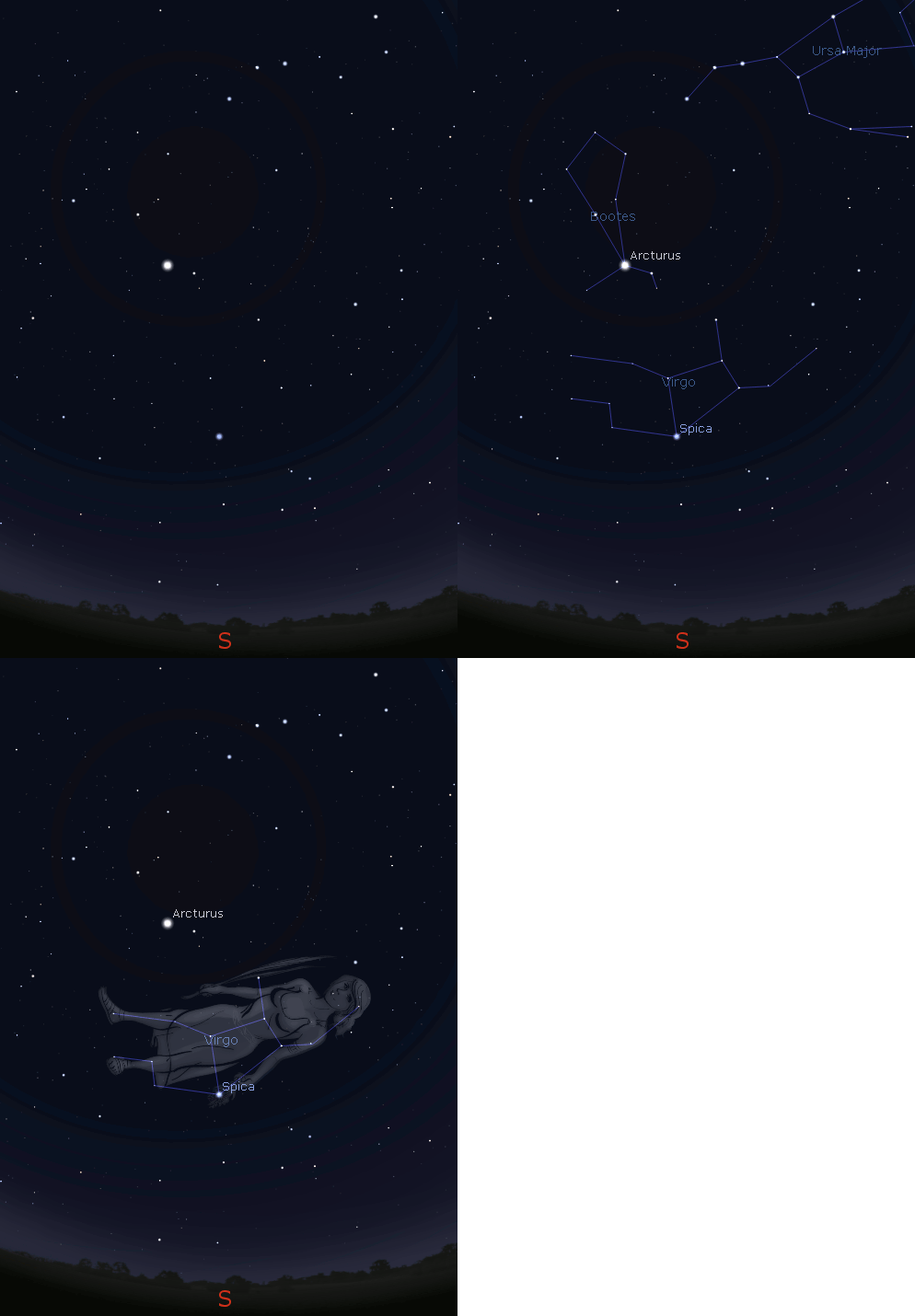
Spica finder animation . Click on the image to enlarge. Created using Stellarium and GIMP.
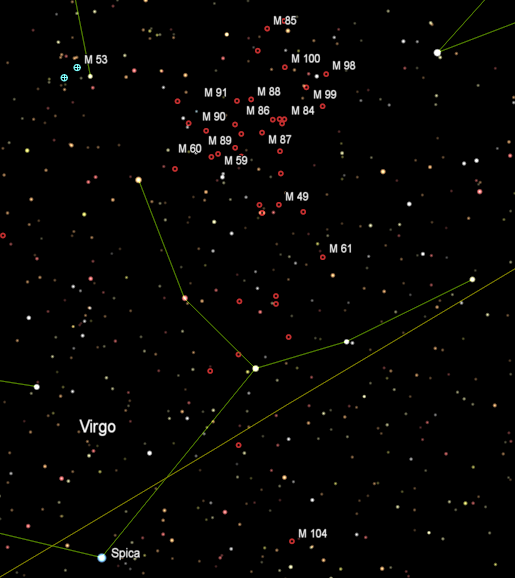
Some of the brighter members of the Virgo Cluster (of galaxies) as red ovals. The galaxies marked with an ‘M’ number are part of Charles Messier’s catalog. It took a telescope of 8 inch diameter for me to spot them. Someone with better vision, like Messier himself can spot them with a smaller telescope. M53 and the object next to it are globular star clusters in the outer reaches of our galaxy. Created using Cartes du Ciel (Sky Charts).
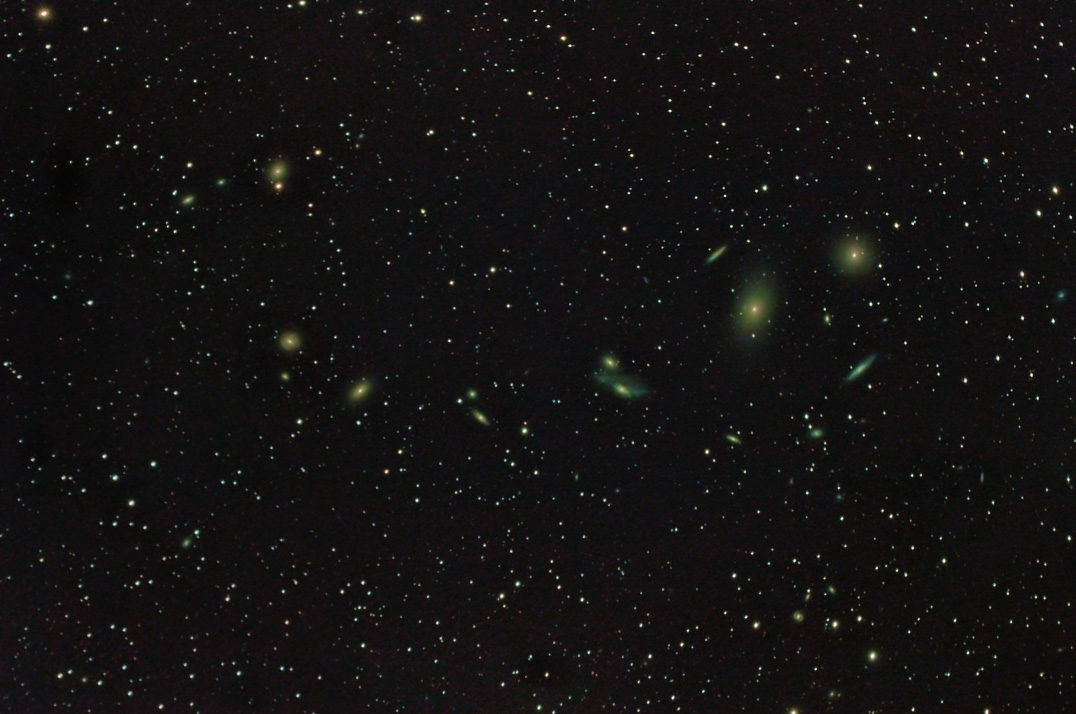
Markarian Chain of galaxies within the Virgo Cluster by Scott Anttila.
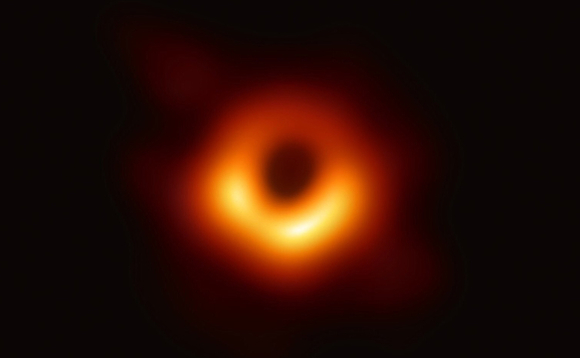
The first image of the black hole in M87. Credit Event Horizon Telescope.
05/14/2020 – Ephemeris – Finding the zodiacal constellation of Virgo
This is Ephemeris for Thursday, May 14th. Today the Sun will be up for 14 hours and 48 minutes, setting at 9:03, and it will rise tomorrow at 6:14. The Moon, at last quarter today, will rise at 3:36 tomorrow morning.
Tonight at 11 p.m. in the south is the constellation and member of the of the zodiac: Virgo the virgin. Virgo is a large constellation of a reclining woman holding a stalk of wheat. Spica, is the head of that spike of wheat; and as such it ruled over the harvest in two of Virgo’s guises as the goddesses Persephone and Ceres. Virgo is also identified as Astraea the goddess of justice. The constellation of Libra, the scales, which she is associated with, is found just east of her low in the southeast. Early Christians who sought to de-paganize the heavens saw Virgo as the Virgin Mary. Virgo is the host to a great cluster of galaxies seen far beyond its stars. Tomorrow morning Mars will appear just above the Moon for very early risers.
The event times given are for the Traverse City/Interlochen area of Michigan. They may be different for your location.
Addendum
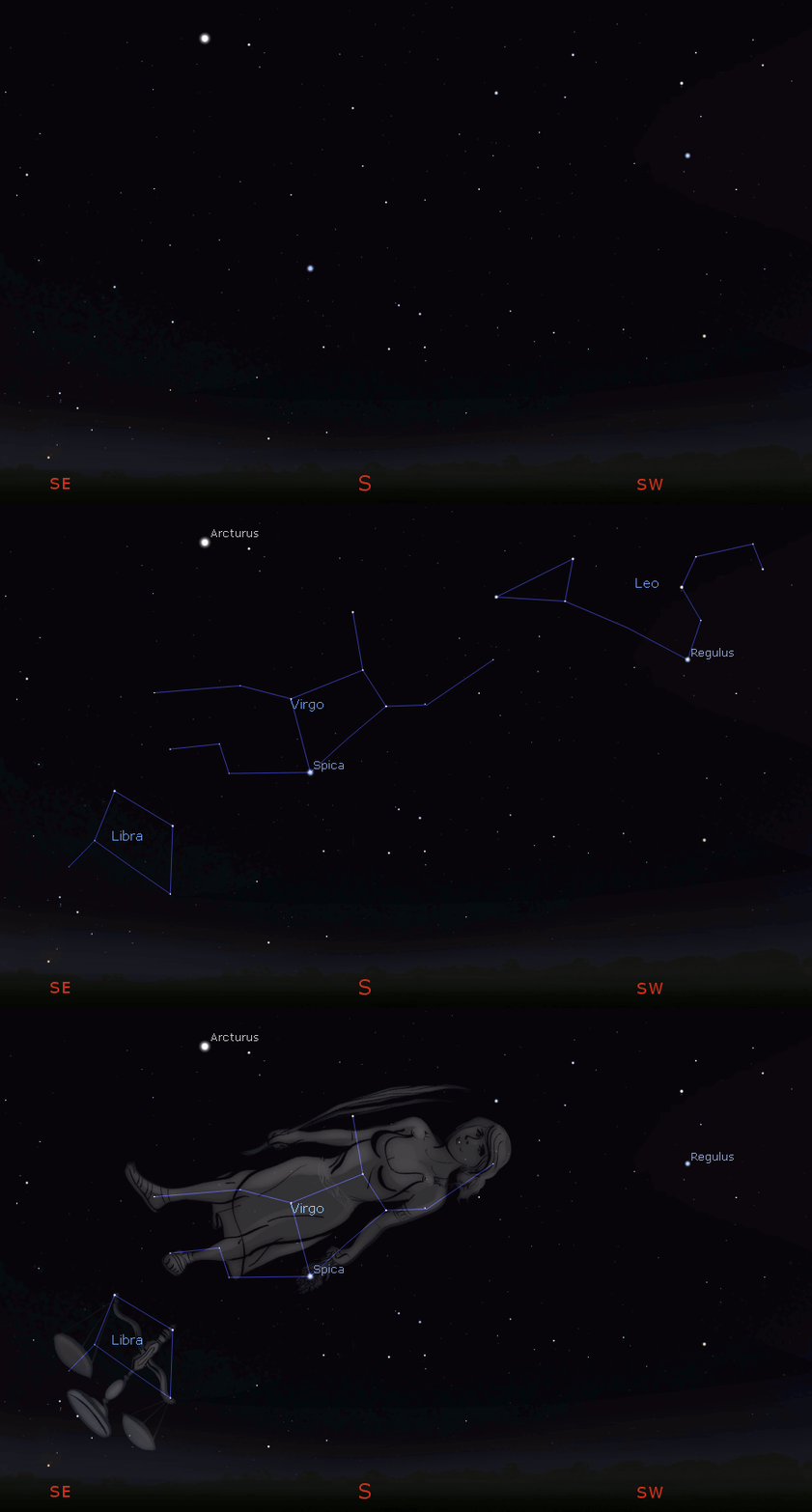
Virgo finder animation with Leo added as an aid for 11 p.m. tonight May 14th. Click on image to enlarge. Created using Stellarium and GIMP.
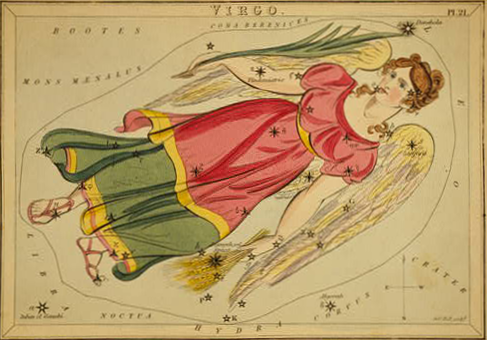
Virgo as depicted in Urania’s Mirror, a set of constellation cards published in London c.1825. From the Library of Congress. Hat tip Wikipedia.
05/13/2020 – Ephemeris – Let’s look at the naked-eye planets for this week
This is Ephemeris for Wednesday, May 13th. Today the Sun will be up for 14 hours and 46 minutes, setting at 9:02, and it will rise tomorrow at 6:15. The Moon, 1 day before last quarter, will rise at 3:08 tomorrow morning.
Let’s look at the naked-eye planets for this week. Venus is our evening star shining brightly in the west. It will be our evening star for only the next 3 weeks. A tiny crescent can now be seen in binoculars. It will cross between the Earth and the Sun on June 3rd. It will set at 11:43 p.m. It’s only 33 million miles (53 million km) away. In the morning sky there are three planets fairly close together in the south-southeast with the Moon among them tomorrow morning. Bright Jupiter will rise first at 1:35 a.m. Followed by Saturn at 1:50 a.m. Mars, is stretching its lead left of Saturn and will rise at 3:14 a.m. Mars is getting closer to us all the time now, until it closest to us in October of this year.
The event times given are for the Traverse City/Interlochen area of Michigan. They may be different for your location.
Addendum
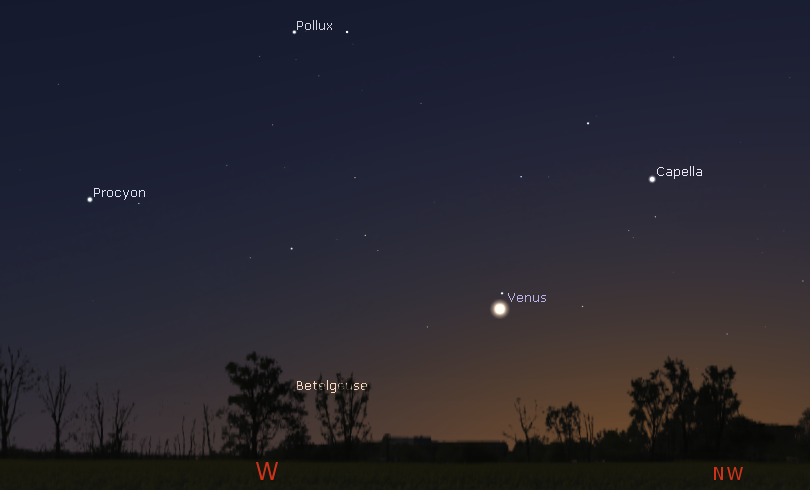
Venus in evening twilight and bright evening stars tonight at 10 p.m. May 13, 2020. Click on the image to enlarge. Created using Stellarium.
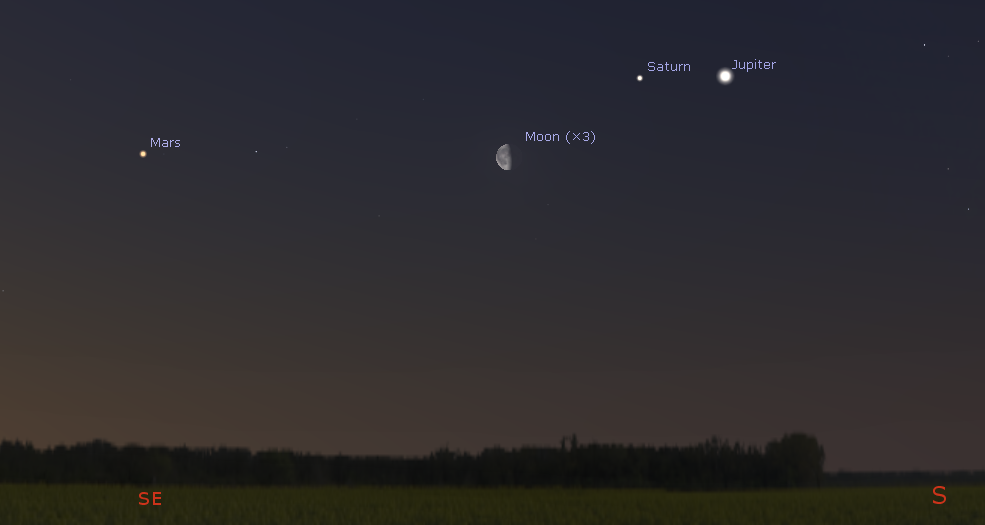
Morning planets and the Moon in twilight at 5:30 a.m. tomorrow morning, May 14, 2020. The Moon is shown at three times its actual size. Click on the image to enlarge. Created using Stellarium.
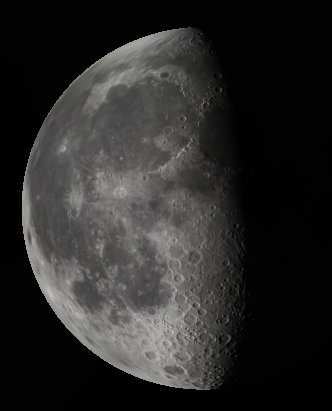
The Moon as it might be seen in binoculars at 5:30 a.m. tomorrow May 14, 2020. Created using Stellarium.
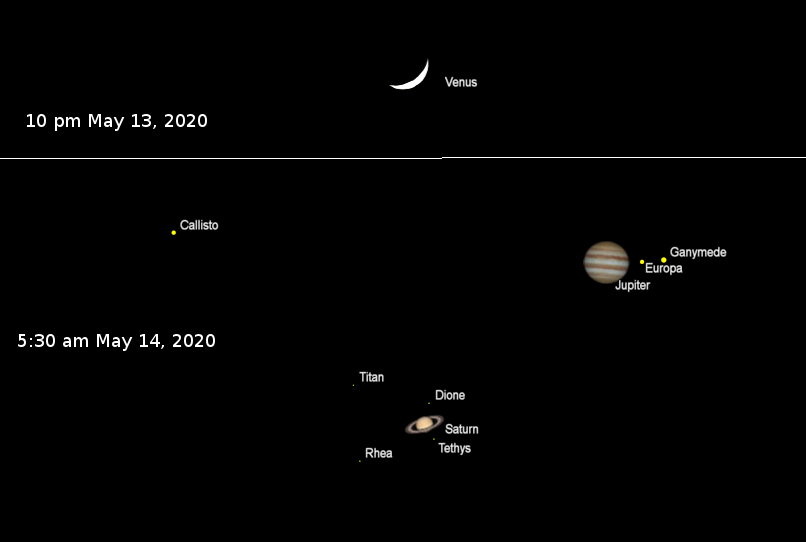
The planets as seen in a telescope with the same magnification. Venus, Jupiter and Saturn on the night of May 13/14, 2020. Apparent diameters: Venus, 47.88″. larger than Jupiter, at 42.46″; Saturn, 17.32″, rings, 40.35″. Mars at 8.28″ won’t be added until it reaches 10″. The ” symbol means seconds of arc (1/3600th of a degree.) Created using Cartes du Ciel (Sky Charts).
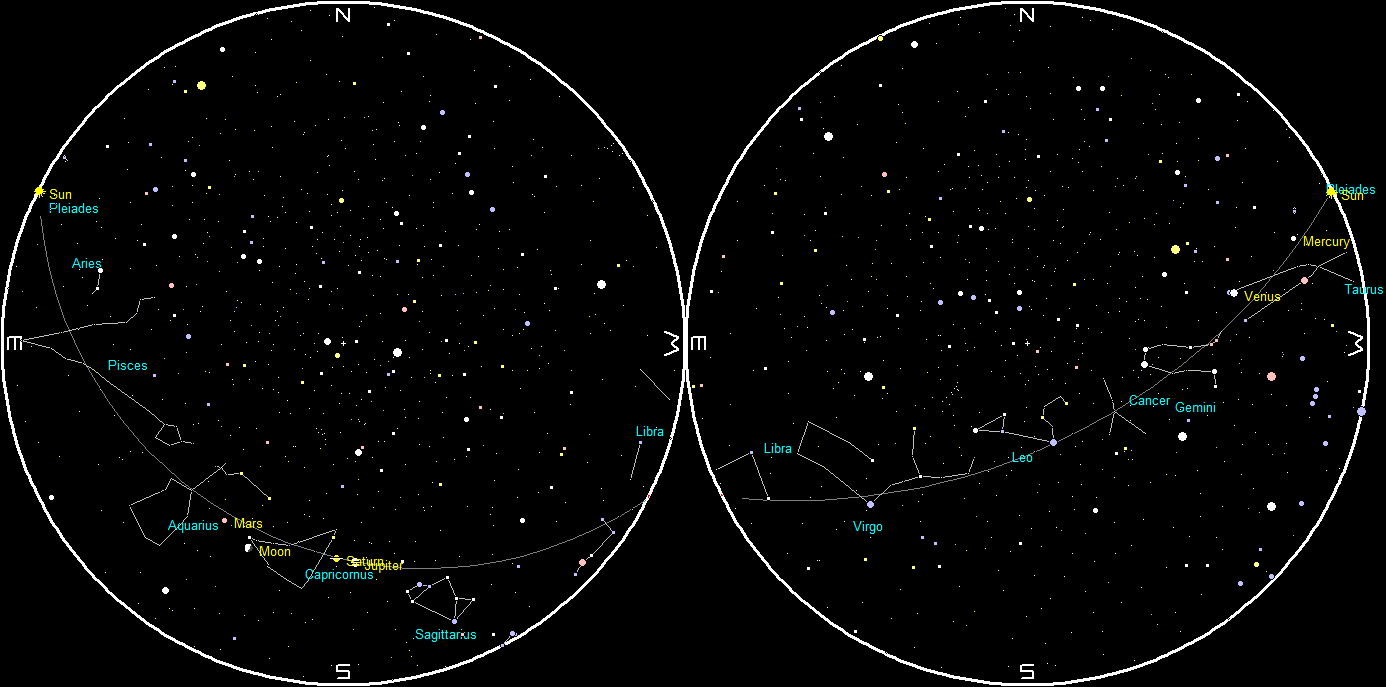
Planets and the Moon at sunset and sunrise of a single night starting with sunset on the right on May 13, 2020. The night ends on the left with sunrise on the 14th. The closeness of Jupiter and Saturn in the morning sky unfortunately overlays planets and labels. Click on the image to enlarge. Created using my LookingUp program.
05/12/2020 – Ephemeris – Hydra the water snake slithers along the southern horizon
This is Ephemeris for Tuesday, May 12th. Today the Sun will be up for 14 hours and 44 minutes, setting at 9:01, and it will rise tomorrow at 6:16. The Moon, 2 days before last quarter, will rise at 2:33 tomorrow morning.
Low in the south and southwestern sky at 10 p.m. and later can be found the constellation of Hydra the water snake. Unlike the monster of the same name this Hydra has but one head, which is its most distinctive part. At 11 p.m. the head of Hydra is located between the bright stars Procyon in the west southwest and Regulus in Leo the lion in the southwest. Hydra’s head is a small but distinctive group of 6 stars that make a drooping loop to the right. The rest of Hydra wends its way diagonally to near the southern horizon below the bright blue star Spica in Virgo. Some delineations of Hydra have the tail tickling the constellation Libra which has just risen in the southeast.
The event times given are for the Traverse City/Interlochen area of Michigan. They may be different for your location.
Addendum
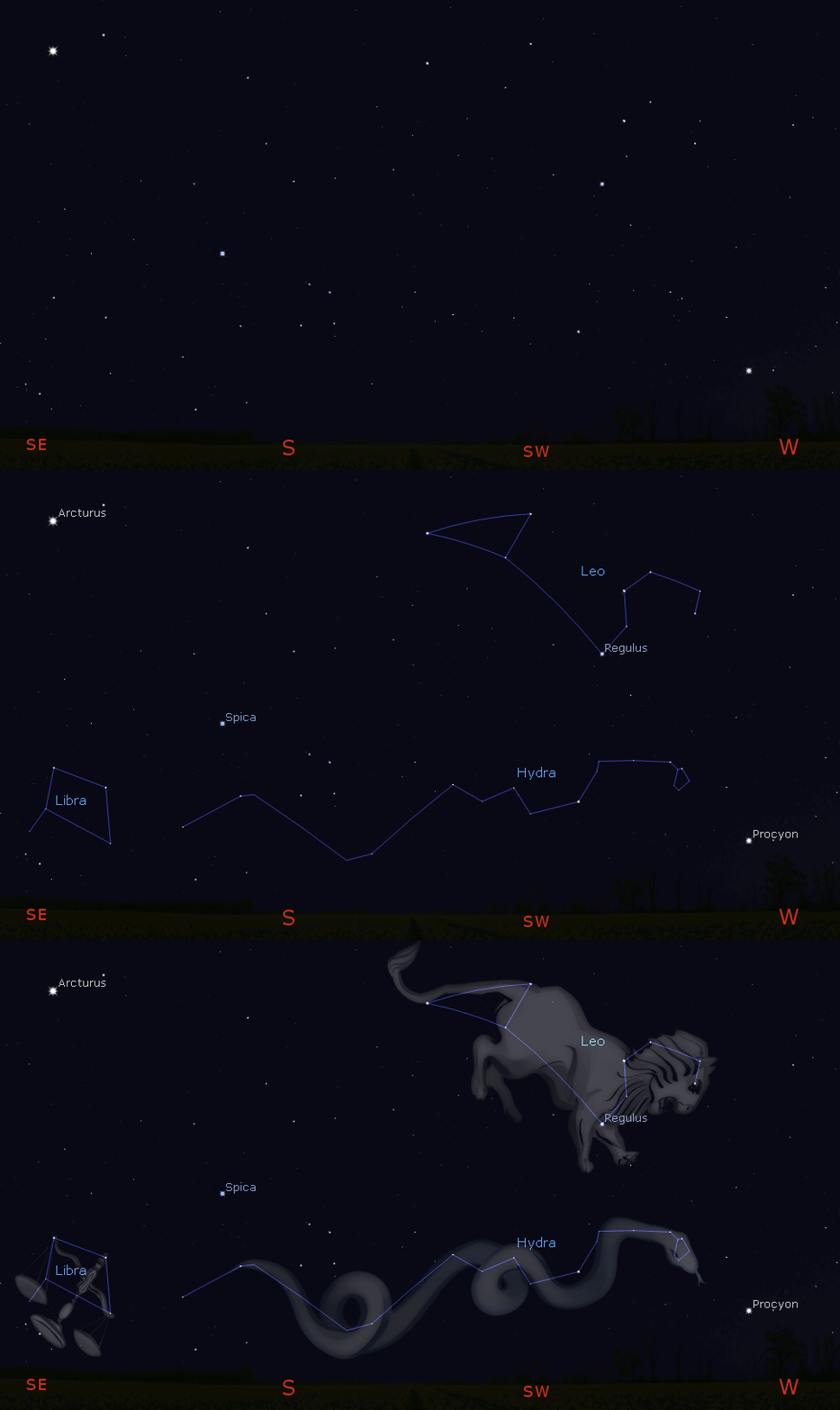
Hydra finder animation for tonight, May 12, 2020. Hydra is the longest constellation. Click on the image to enlarge. Created using Stellarium.
05/11/2020 – Ephemeris – Looking out of the Milky Way in May
This is Ephemeris for Monday, May 11th. Today the Sun will be up for 14 hours and 41 minutes, setting at 9:00, and it will rise tomorrow at 6:17. The Moon, 3 days before last quarter, will rise at 1:51 tomorrow morning.
When it’s finally dark enough to see the stars in a dark sky at the end of astronomical twilight at 11 p.m. the question might be: “Where did the Milky Way go?” The band of the Milky Way is actually nearly ringing the horizon. Part of it runs through the W shaped constellation of Cassiopeia, just above the northern horizon. But the great amount of the Earth’s atmosphere we have to look through that low in the sky dims it to invisibility. The Milky Way is what we see of our galaxy, or more accurately our part of our galaxy whose shape has the rough proportions of a pancake. Remember, we’re in it. In spring we’re mostly looking through the thin side past relatively nearby stars to the intergalactic space beyond.
The event times given are for the Traverse City/Interlochen area of Michigan. They may be different for your location.
Addendum
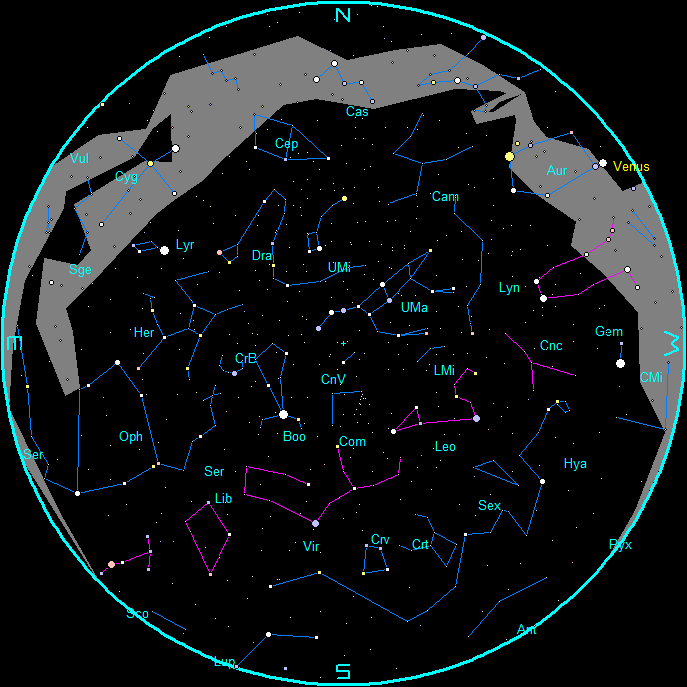
The Dome of the sky on May 15, 2020 at 11 pm with the Milky Way at its lowest in the sky. Credit my LookingUp program.
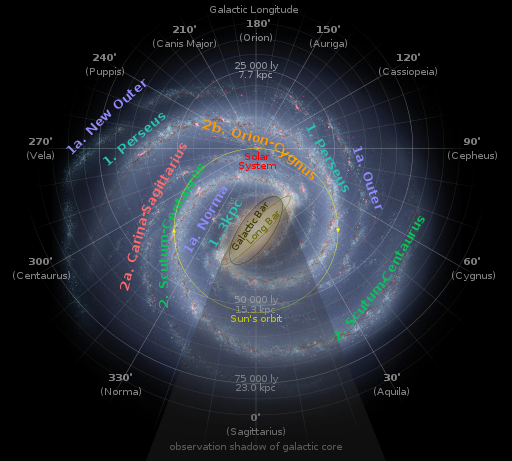
Our place in the Milky Way. Note that we appear to be in a barred spiral galaxy. The arms are numbered and named. 3kpc is the 3 kiloparsec arm. 3kpc = 9,780 light years. The Sun is about 27,000 light years from the center. Credit NASA and Wikimedia Commons, via EarthSky.org.
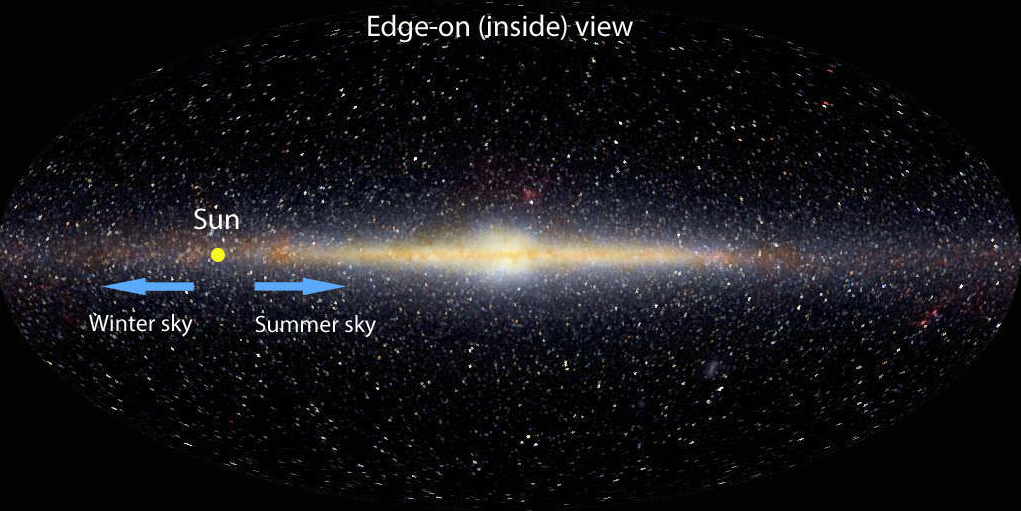
The summer and winter Milky Way viewing directions. During Spring and Autumn, we look out the sides to the universe beyond. Credit Credit: NASA with annotations by Bob King at Universe Today.
 Bob Moler's Ephemeris Blog