11/14/2019 – Ephemeris – Saturn is not only Lord of the Rings, but also King of the Moons
Ephemeris for Thursday, November 14th. Today the Sun will be up for 9 hours and 37 minutes, setting at 5:15, and it will rise tomorrow at 7:39. The Moon, 2 days past full, will rise at 6:57 this evening.
This news item is a month old, but it’d kind of cool. Jupiter may be the king of the planets, but it is not the king of the Moons. In a recent announcement from the International Astronomical Union. Saturn has edged out Jupiter in the number of moons that orbit it. Twenty new moons or satellites have been recently been discovered around the ringed planet bringing its total number up to 82. Jupiter’s total number of moons stands at 79. The discovery of the 20 latest moons was done with the Subaru 8.2 meter telescope on Mauna Kea on the island of Hawai’i by a group headed by Scott Sheppard of the Carnegie Institution for Science. 17 of these new satellites orbit Saturn in similar orbits backward from most of the rest of the moons.
The times given are for the Traverse City/Interlochen area of Michigan. They may be different for your location.
Addendum
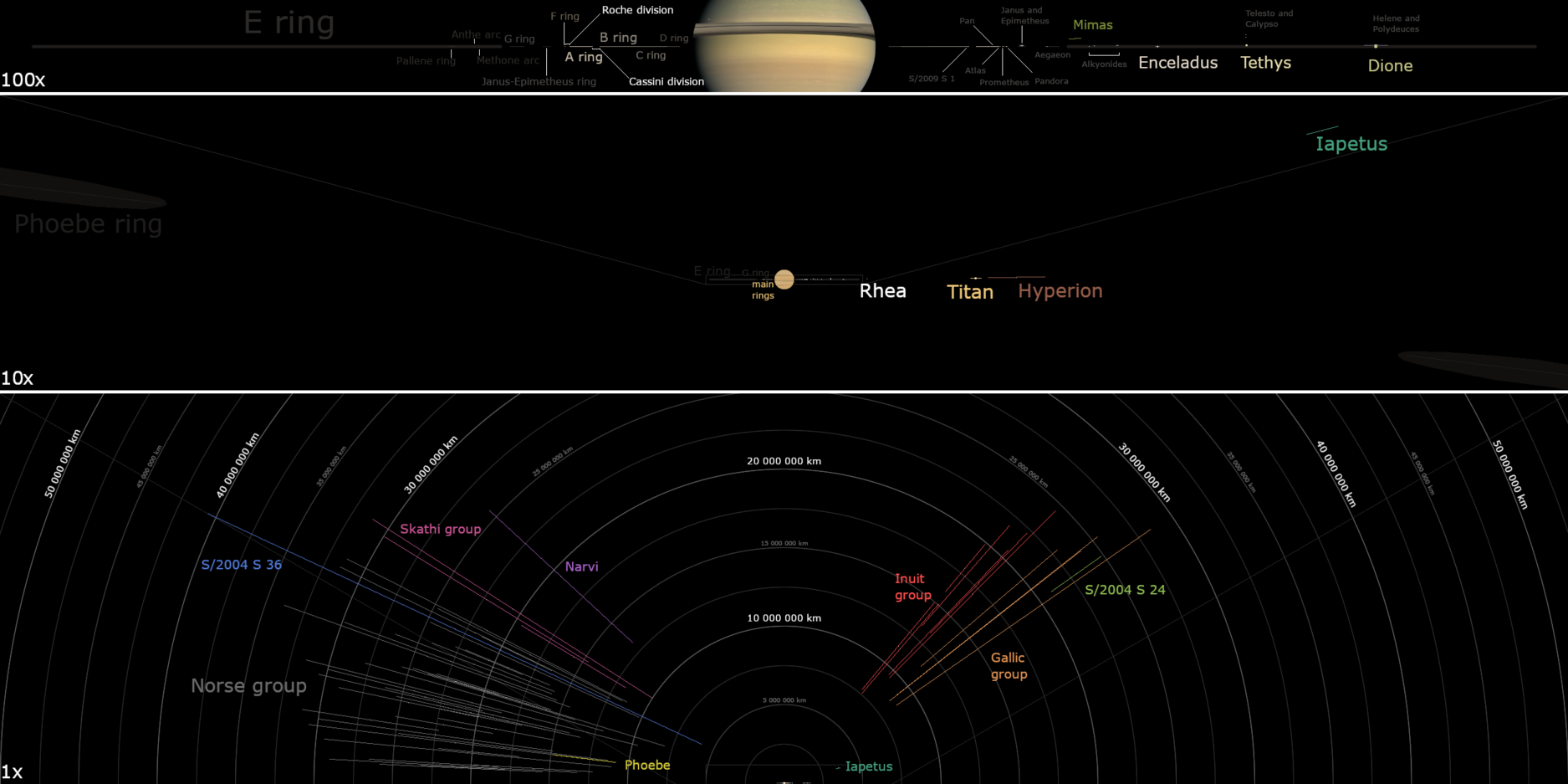
Bottom panel: The outer irregular moons of Saturn, with a scale of 1 pixel = 40,000 km. Moon groups, as well as ungrouped moons, are individually listed. They are graphed by their inclination, as well as the closest/furthest points in their orbit from Saturn (perichron and apochron) Middle panel: The middle moons of Saturn, with a scale of 1 pixel = 4,000 km. Although Saturn’s middle moons can be resolved, the inner moons and its rings are still difficult to resolve
Top panel: The inner moons of Saturn, with a scale of 1 pixel = 400 km. On the left, the rings of Saturn are labeled, and on the right, the inner moons are labeled. Click on the image to enlarge. Credit: Exoplanetaryscience.
Check it out in Bad Astronomy: https://www.syfy.com/syfywire/another-score-for-saturn-20-newly-discovered-moons-for-the-ringed-planet. The satellite diagram it contains shows Saturn not to scale with the satellite orbits. At that scale Saturn would be a small dot. These satellites are far out, really!
For more on all of Saturn’s moons: https://en.wikipedia.org/wiki/Moons_of_Saturn.
11/13/2019 – Ephemeris – Venus is starting to make an appearance in the evening sky
Ephemeris for Wednesday, November 13th. Today the Sun will be up for 9 hours and 40 minutes, setting at 5:16, and it will rise tomorrow at 7:38. The Moon, 1 day past full, will rise at 6:18 this evening.
Let’s look at the bright planets for this week. Venus is starting to make an evening appearance. It will be briefly visible low in the west-southwest before it sets at 6:28 p.m. Jupiter will be very low in the southwestern sky as it gets dark. It will set at 7:17 p.m. Jupiter is moving at nearly its fastest to the east now and next year will be where Saturn is currently. Saturn, the ringed planet, will be in the south-southwestern sky in the evening, and will set at 9:15 p.m. Next year it will be a bit farther east. Jupiter is approaching Saturn in our sky. Mars is in the morning sky and will rise in the east-southeast at 5:25 a.m. It’s not very bright because it’s 230 million (370 million km) miles away, but it’s getting slowly closer to the Earth.
The times given are for the Traverse City/Interlochen area of Michigan. They may be different for your location.
Addendum
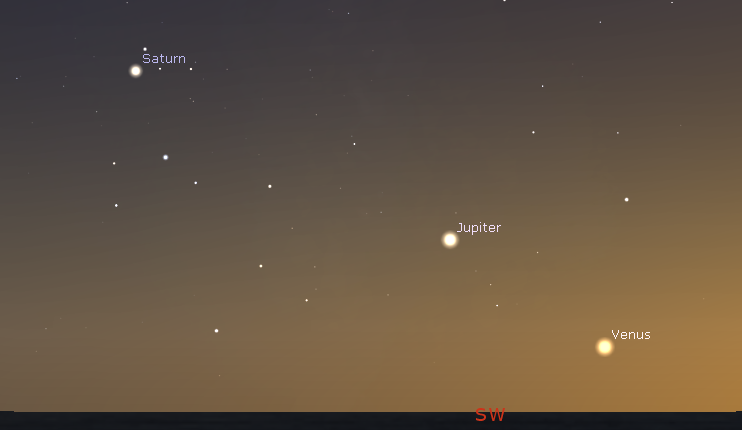
Venus, Jupiter, and Saturn tonight, November 13 at 6 p.m. Created using Stellarium.
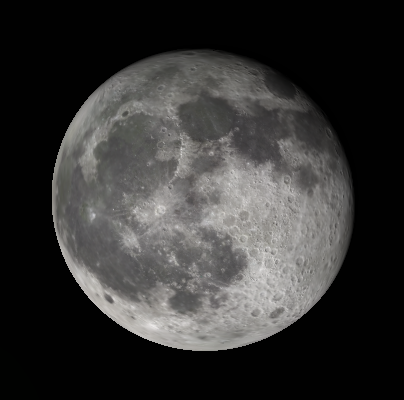
The waning gibbous Moon at 8 p.m. tonight November 13, 2019. Created using Stellarium.
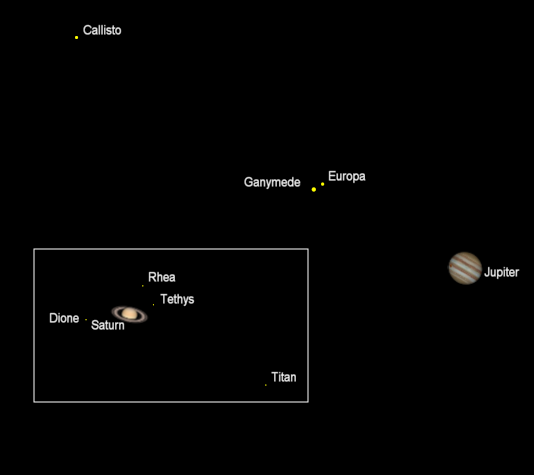
Telescopic views of Jupiter and Saturn with the same magnification at 6 p.m. tonight November 13, 2019. Venus is too close to the horizon to easily see its tiny gibbous shape. In the mrning, Mars is to tiny. Created using Cartes du Ciel (Sky Charts).
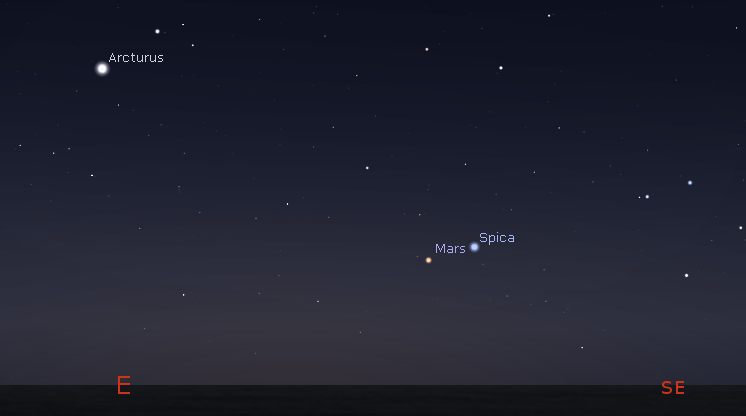
Mars in the morning at 6:30 a.m. November 14, 2019. Created using Stellarium.
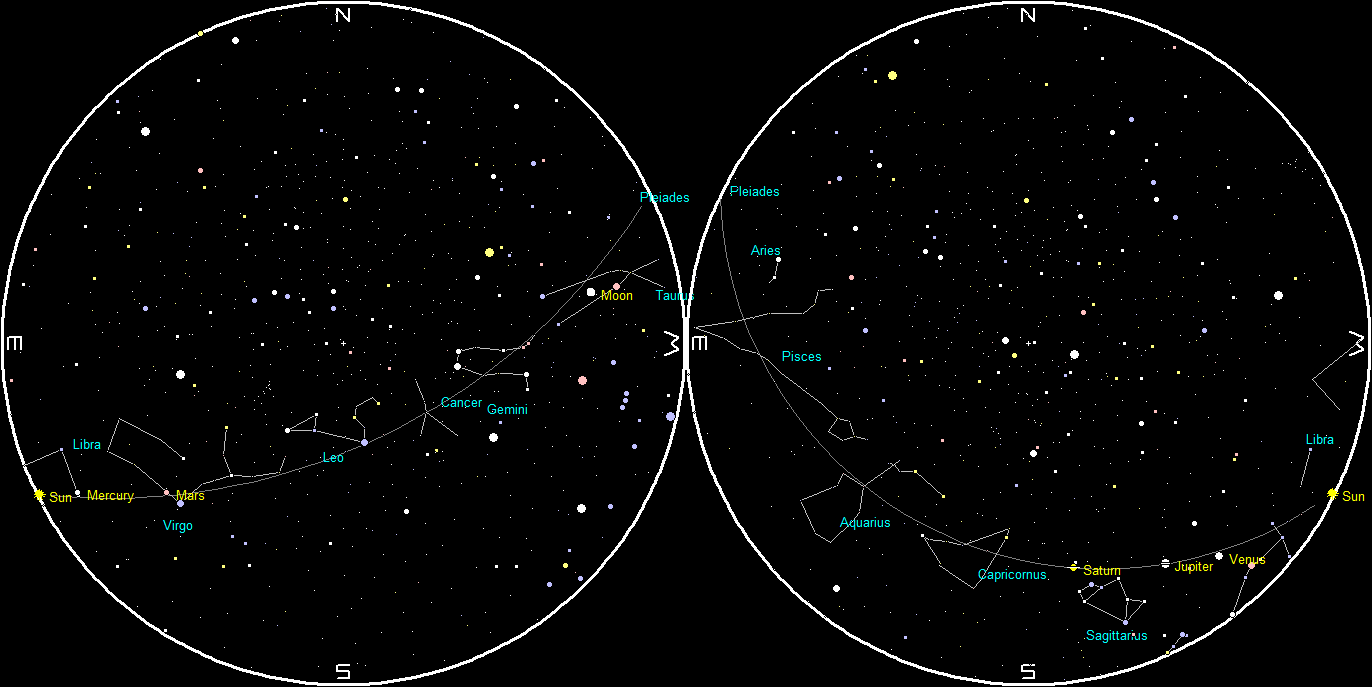
Planets and the Moon at sunset and sunrise of a single night starting with sunset on the right on November 13, 2019. The night ends on the left with sunrise on the 14th. Click on the image to enlarge. Created using my LookingUp program.
11/12/2019 – Ephemeris – November meteor showers
Ephemeris for Tuesday, November 12th. Today the Sun will be up for 9 hours and 42 minutes, setting at 5:17, and it will rise tomorrow at 7:36. The Moon, at full today, will rise at 5:45 this evening.
November is a month with three meteor showers and all this year are affected by the bright moon, at least on the dates of their peak activity. They are the South Taurids which peaked last month but are seen through the 20th of this month; the North Taurids, which are at peak now, and whose members can be seen through December 10th; and the Leonids, which peak next Monday whose members can be seen until the end of the month. At peak on a dark night neither of these showers will produce more than 20 per hour. Both the Taurid meteor showers, which seem to emanate from the constellation of Taurus the Bull are related to Encke’s Comet the shortest periodic comet which orbits the Sun in only 3.3 years.
The times given are for the Traverse City/Interlochen area of Michigan. They may be different for your location.
11/11/2019 – Ephemeris – Mercury is passing across the face of the Sun today
Ephemeris for Veteran’s Day, Monday, November 11th. Today the Sun will be up for 9 hours and 45 minutes, setting at 5:19, and it will rise tomorrow at 7:35. The Moon, 1 day before full, will set at 7:24 tomorrow morning.
Today we are bring treated by a rare event. The planet Mercury is crossing the face of the Sun. It’s called the transit of Mercury. The last one visible from around here was 3 ½ years ago, and the next one will be visible here in 2049. The transit starts at sunrise when Mercury starts to cross the Sun from the lower left from sunrise and will cross the Sun until 1:04 p.m. where it will leave the Sun at the upper right. The best way to see it will be to project the Sun’s image on a white card using binoculars or a telescope. Do not look through them at the Sun. Solar eclipse glasses will not work because Mercury is too small. Do not use eclipse glasses with binoculars. The Sun’s heat will melt the filters and cause blindness.
The times given are for the Traverse City/Interlochen area of Michigan. They may be different for your location.
Addendum
One or more members of the Grand Traverse Astronomical Society mayl be out in the parking lot of Mari Vineyards 8175 Center Road on Old Mission Peninsula, but only if it’s clear. Be advised that there is a winter storm warning for the Grand Traverse Area from 1 a.m. to 6 p.m. today. That means that chances are slim that we’ll have a big enough clear spot to observe through. But I’ll be on the look out., and am a half an hour away.
I found a source for streaming video fo the transit from Griffith Observatory in Los Angeles: https://www.youtube.com/watch?v=rYZKNhTJmOI.
Being on the west coast they will miss part of the transit. They’ll go live at 9:15 a.m. our time. Sunrise over there is at 9:22 our time. There’s more information on: http://www.griffithobservatory.org/events/Transit_of_Mercury_2019.html.
More information about viewing the transit is on: https://spaceweather.com/
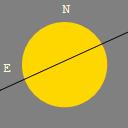
Path of Mercury across the Sun. The planet will move from lower left to upper right. The passage will be from lower left to upper right. Credit: Occult 4.
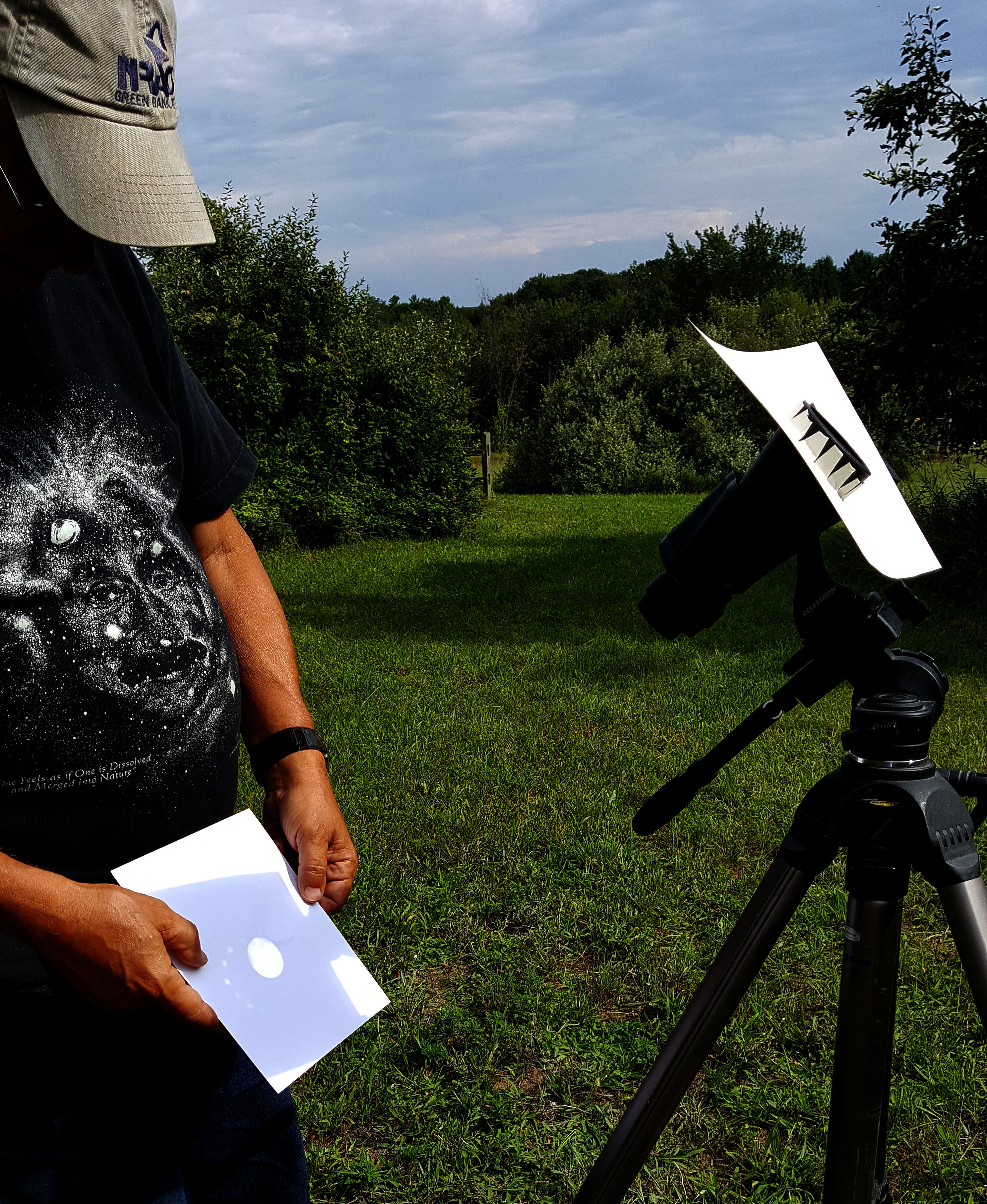
I’m demonstrating using binoculars to project the Sun. Photo by Bea Farrell (granddaughter).
Mercury Inferior Conj.  (Transit)
Transit of Mercury on 2019 Nov 11 (TT)
     Geocentric Event      UTC          EST          P.A.
                           h  m  s                      o
[1]  Exterior Ingress      12 35 27    7:35.27 a.m.  110.0
[2]  Minimum Separation    15 19 48   10:19:48 a.m.
[3]  Exterior Egress       18  4 14    1:04:14 a.m.  298.6

Minimum sepn 75.9";  Radii - Sun 969.3", Mercury 5.0"
delta T =  70.2 secs,  Ephemeris = DE0
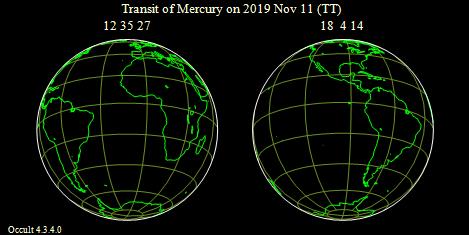
The Sun facing side of the Earth at the start and end of the transit. If you can see your location on either of these maps the transit or part of it will be visible from your location. Credit Occult 4.
11/08/2019 – Ephemeris – On Monday tiny Mercury will cross the face of the Sun
Ephemeris for Friday, November 8th. Today the Sun will be up for 9 hours and 52 minutes, setting at 5:22, and it will rise tomorrow at 7:31. The Moon, half way from first quarter to full, will set at 4:14 tomorrow morning.
Monday we will be treated by a rare event. The planet Mercury will cross the face of the Sun. It’s called the transit of Mercury. The last one visible from around here was 3 ½ years ago, and the next one will be in 2049. Mercury will start across the Sun from the lower left from sunrise at 7:35 and will cross the Sun until 1:04 p.m. where it will leave the Sun at the upper right. The best way to see it will be to project the Sun’s image on a white card using binoculars or a telescope. Do not look through them at the Sun. Solar eclipse glasses will not work because Mercury is too small. Do not use eclipse glasses with binoculars. The heat will melt the glasses and cause blindness. I’ll have more information Monday.
The times given are for the Traverse City/Interlochen area of Michigan. They may be different for your location.
Addendum
Path of Mercury across the Sun. The planet will move from lower left to upper right. The passage will be from lower left to upper right. Credit: Occult 4.
I’m demonstrating using binoculars to project the Sun. Photo by Bea Farrell (granddaughter).
Mercury Inferior Conj.  (Transit)
Transit of Mercury on 2019 Nov 11 (TT)
     Geocentric Event      UTC          EST          P.A.
                           h  m  s                      o
[1]  Exterior Ingress      12 35 27    7:35.27 a.m.  110.0
[2]  Minimum Separation    15 19 48   10:19:48 a.m.
[3]  Exterior Egress       18  4 14    1:04:14 a.m.  298.6

Minimum sepn 75.9";  Radii - Sun 969.3", Mercury 5.0"
delta T =  70.2 secs,  Ephemeris = DE0
11/07/2019 – Ephemeris – The gibbous Moon tonight
Ephemeris for Thursday, November 7th. Today the Sun will be up for 9 hours and 55 minutes, setting at 5:23, and it will rise tomorrow at 7:30. The Moon, 3 days past first quarter, will set at 3:13 tomorrow morning.
Every night when we look at the Moon the sunrise terminator has moved farther west on the Moon which is to our east uncovering more landscape. The Moon rotates once in about 29 ½ days in relation with the Sun. This is the same time it orbits the Earth from new Moon to the next. We call that a lunation or lunar month. Near the upper left corner of the Moon is what looks like a half crater. It’s called Sinus Iridium, the Bay of Rainbows. It’s at the edge of Mare Imbrium or Sea of Showers. To the south cut by the terminator is Oceanus Procellarum, the flat Ocean of Storms. South of that is the small Mare Humorum, the Sea of Vapors. South of all that is the odd shaped crater Schiller.
10-11-2016 has images
The times given are for the Traverse City/Interlochen area of Michigan. They may be different for your location.
Addendum
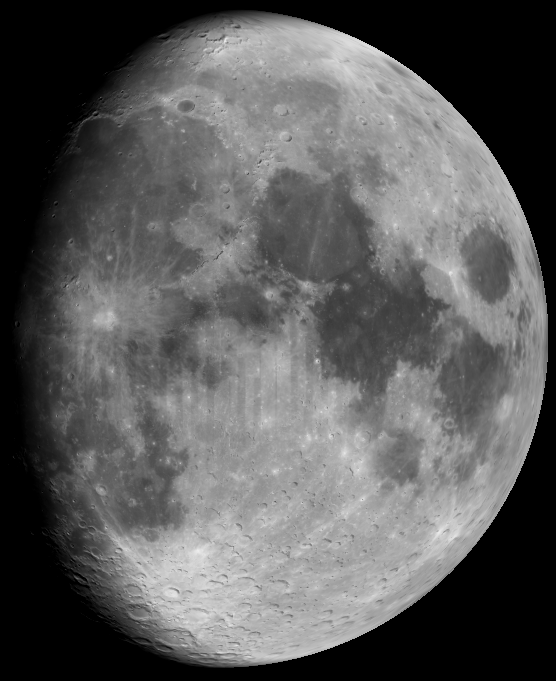
The gibbous Moon tonight at 8 p.m., November 7, 2019. Click on the image to enlarge. Created using Virtual Moon Atlas.
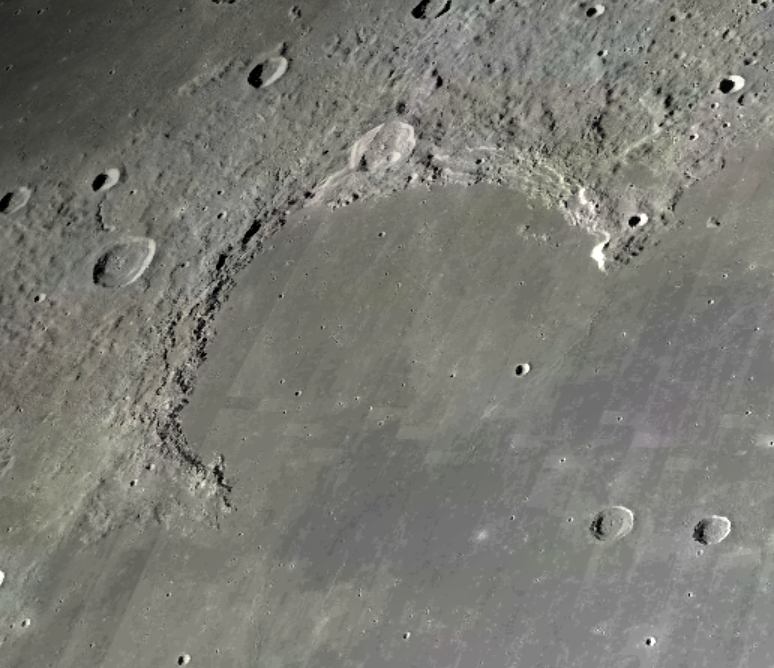
Sinus Iridium photographed by the Lunar Reconnaissance Orbiter as texture mapped on the globe of the Virtual Moon Atlas.
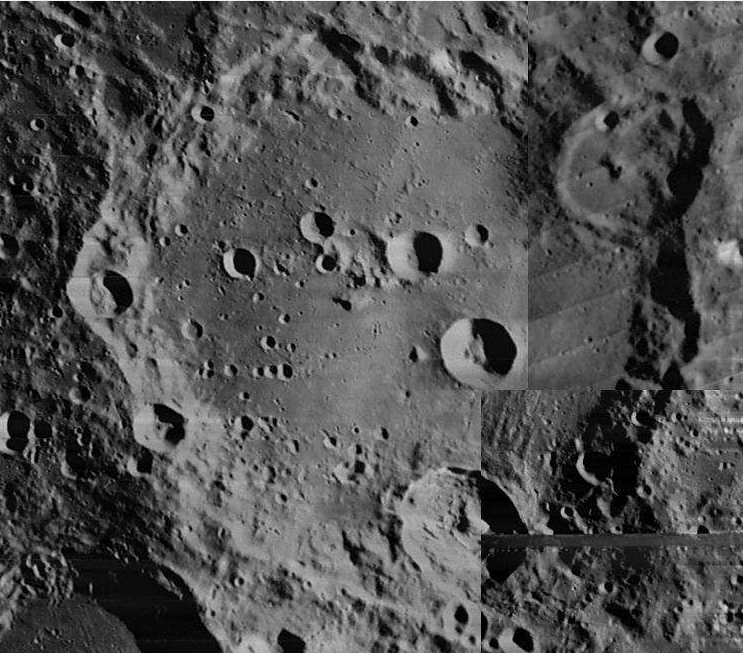
Clavius as photographed by one of the Lunar Orbiter spacecraft in the 1960s From Digital Lunar Orbital Photographic Atlas. This is photographed from overhead. On tonight’s moon it’s near the bottom or south end and is foreshortened.Credit Jeff Gillis, Lunar and Planetary Institute.
11/06/2019 – Ephemeris – Looking for the bright planets
Ephemeris for Wednesday, November 6th. Today the Sun will be up for 9 hours and 57 minutes, setting at 5:25, and it will rise tomorrow at 7:28. The Moon, 2 days past first quarter, will set at 2:13 tomorrow morning.
Let’s look at the bright planets for this week. Venus and Mercury are too close to the Sun to be seen. They are on the evening or east side of the Sun. Jupiter will be very low in the southwestern sky as it gets dark. It will set at 7:38 p.m. Jupiter is moving at nearly its fastest to the east now and next year will be where Saturn is currently. Saturn, the ringed planet, will be in the south-southwestern sky in the evening, and will set at 9:15 p.m. Next year it will be a bit farther east. Jupiter is approaching Saturn in our sky. Mars is in the morning sky and will rise in the east at 5:29 a.m. It’s not very bright because it’s 232 million (375 million km) miles away.
The times given are for the Traverse City/Interlochen area of Michigan. They may be different for your location.
Addendum
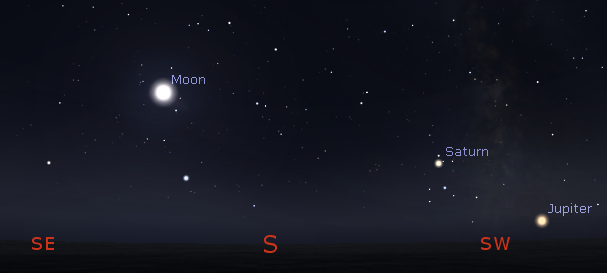
Jupiter, Saturn and the gibbous Moon tonight, November 6 at 7:15 p.m. Created using Stellarium.
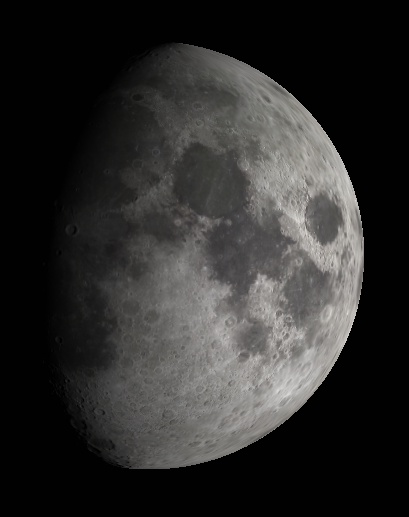
The gibbous Moon as it might appear in binoculars at 7:15 p.m. November 6, 2019. Created using Stellarium.
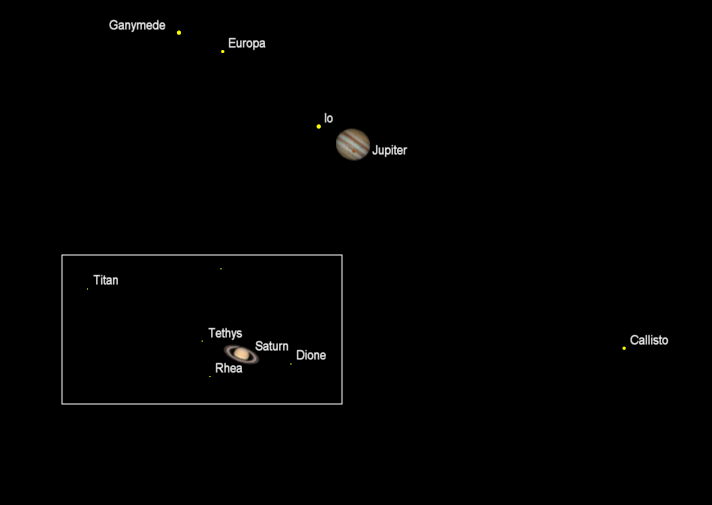
Telescopic views of Jupiter and Saturn with the same magnification at 7:15 p.m. tonight November 6, 2019. Created using Cartes du Ciel (Sky Charts).
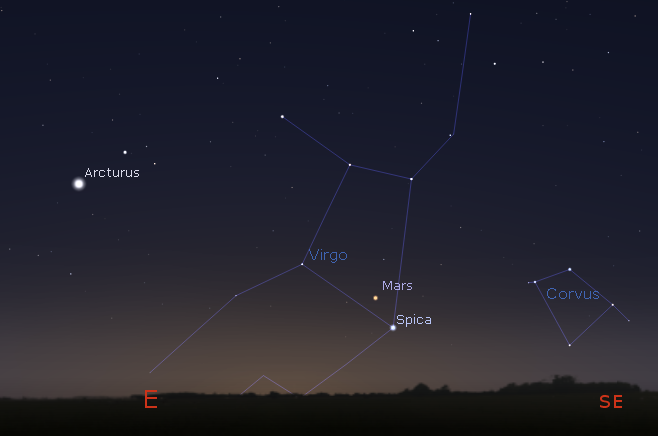
Mars in the morning at 6:30 a.m. November 07, 2019. Created using Stellarium.
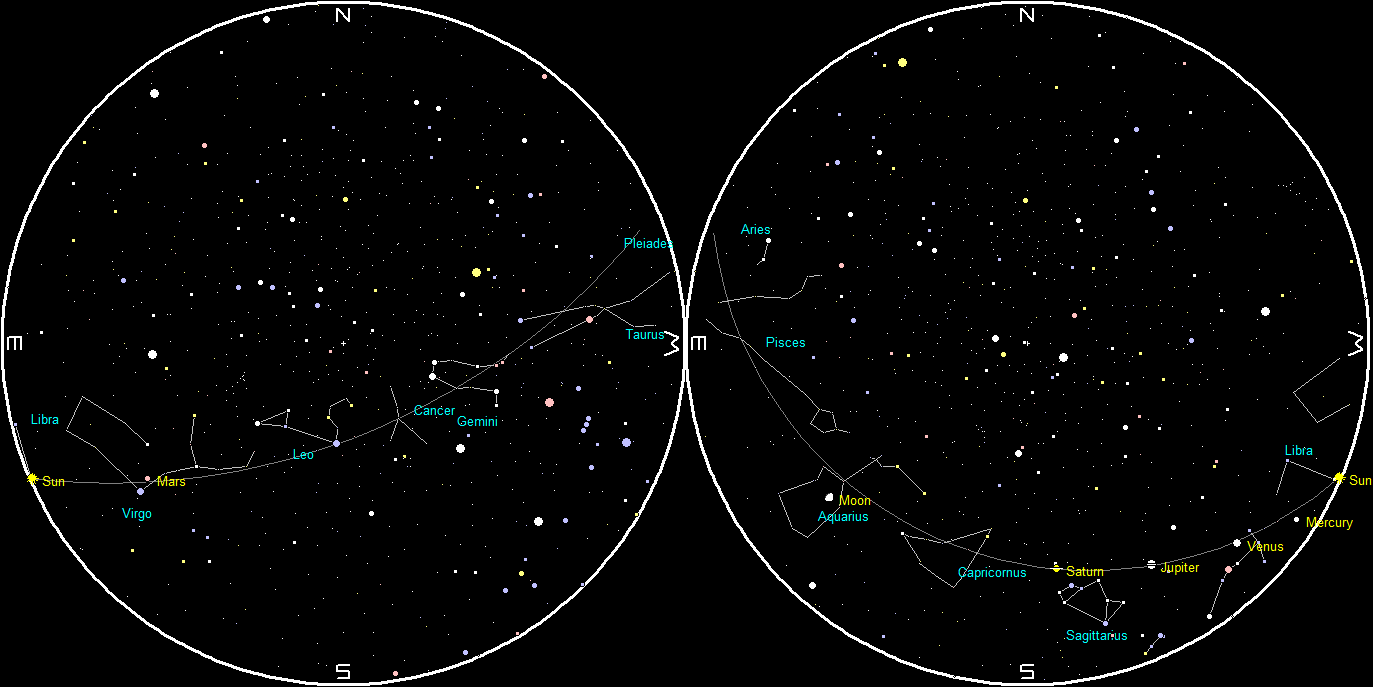
Planets and the Moon at sunset and sunrise of a single night starting with sunset on the right on November 6, 2019. The night ends on the left with sunrise on the 7th. Click on the image to enlarge. Created using my LookingUp program.
11/05/2019 – Ephemeris – Is the asteroid Hygiea the smallest dwarf planet?
Ephemeris for Election Day in some places, Tuesday, November 5th. Today the Sun will be up for 10 hours even, setting at 5:26, and it will rise tomorrow at 7:27. The Moon, 1 day past first quarter, will set at 1:12 tomorrow morning.
The asteroid Hygiea is the 4th largest asteroid in the asteroid belt between Mars and Jupiter. After much study with the European Southern Observatory’s Very Large Telescope (VLT) it appears that Hygiea is very nearly spherical. Only the largest asteroid and dwarf planet Ceres is more spherical, and it’s over twice as large. Ceres is 587 miles (945 km) in diameter. Hygiea is 267 miles (430 km) in diameter. By current definition that a body not fitting the definition of planet because it hadn’t cleared it’d orbit of other objects could have the classification of dwarf planet of it was round, or in astronomer-speak has achieved hydrostatic equilibrium. If the International Astronomical Union agrees it would be the smallest dwarf planet.
The times given are for the Traverse City/Interlochen area of Michigan. They may be different for your location.
Addendum
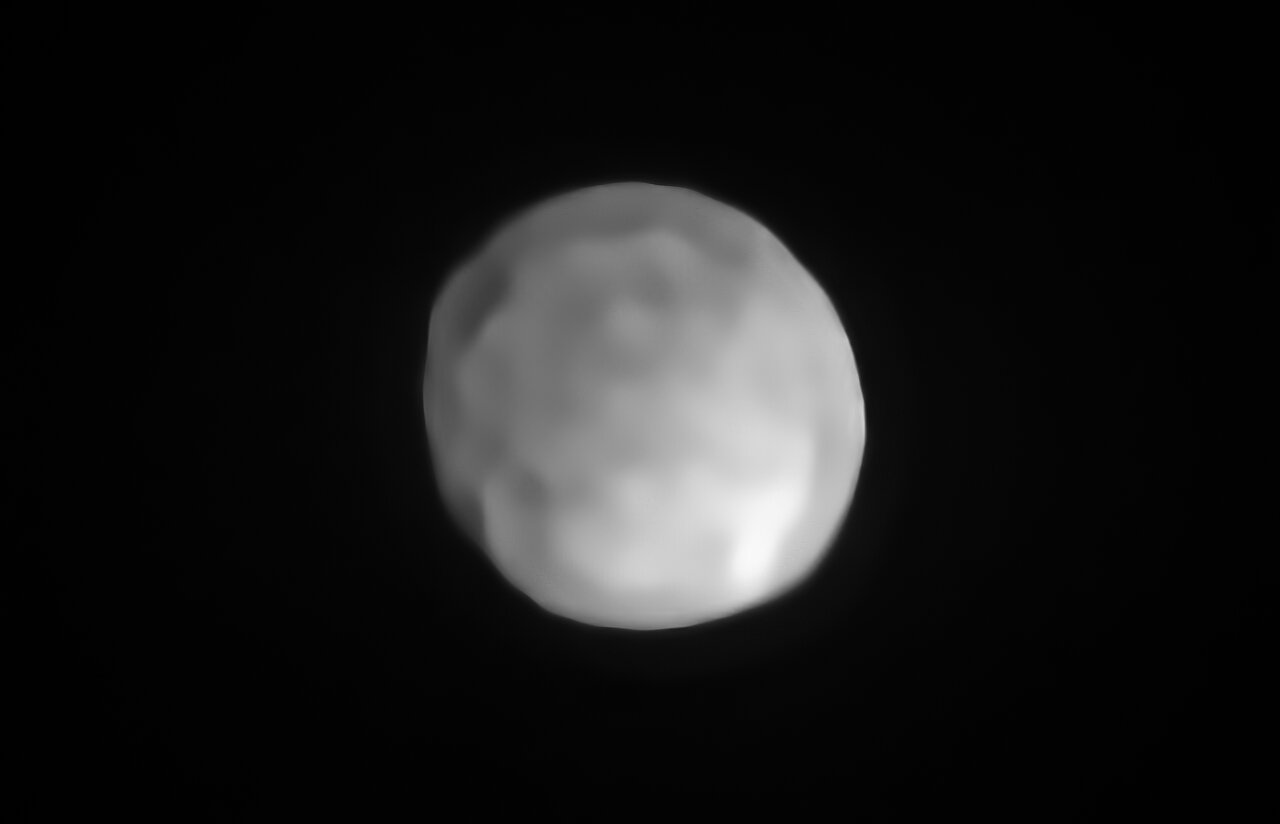
A new SPHERE/VLT image of Hygiea, which could be the Solar System’s smallest dwarf planet yet. As an object in the main asteroid belt, Hygiea satisfies right away three of the four requirements to be classified as a dwarf planet: it orbits around the Sun, it is not a moon and, unlike a planet, it has not cleared the neighbourhood around its orbit. The final requirement is that it have enough mass that its own gravity pulls it into a roughly spherical shape. This is what VLT observations have now revealed about Hygiea.
For more from Universe Today: https://www.universetoday.com/143897/asteroid-hygiea-is-round-enough-that-it-could-qualify-as-a-dwarf-planet-the-smallest-in-the-solar-system/.
11/04/2019 – Ephemeris – It’s a quarter Moon today. On the oceans the smallest difference between high and low tides.
Ephemeris for Monday, November 4th. Today the Sun will be up for 10 hours and 3 minutes, setting at 5:27, and it will rise tomorrow at 7:25. The Moon, at first quarter today, will set at 12:10 tomorrow morning.
Today’s first quarter moon means that this tides caused by the Moon and Sun are pulling on the Earth at right angles which keeps the tides low. These are called neap tides. The Moon also raises higher tides than the Sun, even though the Sun is much more massive. But it’s much farther away. And that’s the reason. Tides are caused by the difference in gravitational pull from one side to the other of the Earth. The Moon, being much closer has a greater difference in gravitational force. Only when the Moon Sun and Earth are lined up do we have the highest tides which are called spring tides. Galaxies, held together by gravity, are easily distorted by the tidal force of other galaxies and pull off what are called tidal tails.
The times given are for the Traverse City/Interlochen area of Michigan. They may be different for your location.
Addendum
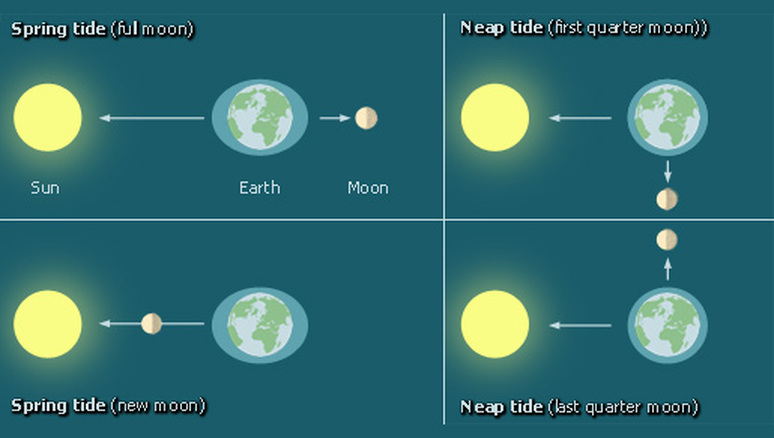
Spring and Neap Tides explained. Credit http://www.millerslocal.co.za/the-inside-skinny-on-tides.html (South Africa).
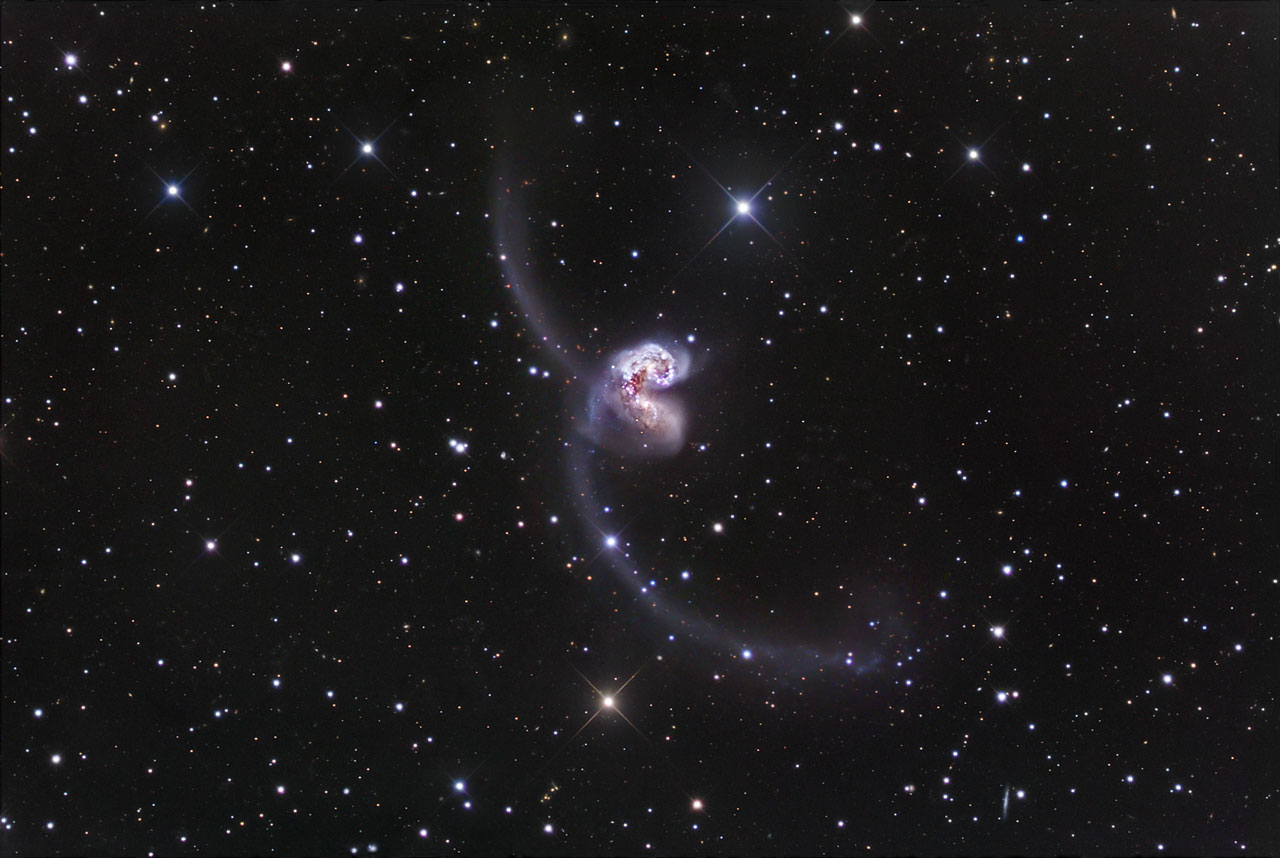
This ground-based image was taken by Robert Gendler and shows the two merging Antennae Galaxies (NGC 4038 and NGC 4039) and their impressive long tidal tails. Click on the image to enlarge. Credit ESA.
11/01/2019 – Ephemeris – Previewing November Skies and a GTAS meeting
Ephemeris for Friday, November 1st. The Sun will rise at 8:20. It’ll be up for 10 hours and 11 minutes, setting at 6:31. The Moon, 3 days before first quarter, will set at 10:13 this evening.
Let’s take a look at November skies. The time change back to standard time will set us back an hour on sunrise and sunset times, so it’ll be brighter in the morning and darker in the evening this Sunday. Out east in New York, the Sun is already setting before 5 p.m. It will never set that early here. The Sun is up for 10 hours 11 minutes today and that will dwindle down to 9 hours and 5 minutes at month’s end. The Sun reaches 30 and a half angular degrees above the southern horizon at local apparent solar noon, which is 12:25 p.m. this month.
The big event this month will be the transit of the planet Mercury across the face of the Sun on the morning of November 11th. Mercury is too small to be seen with eclipse glasses from left over from the eclipse of two years ago. Project the Sun’s image using a telescope or binoculars on a white card. Don’t look through the instruments or finders. The event starts at sunrise at 7:35 and runs to 1:04 p.m. I’ll have more on it next week.
Tonight there will be the monthly meeting of the Grand Traverse Astronomical Society at 8 p.m. followed by a star party at 9 p.m, if it’s clear at Northwestern Michigan College’s Rogers Observatory on Birmley Road.
The times given are for the Traverse City/Interlochen area of Michigan. They may be different for your location.
Addendum
November Evening Star Chart
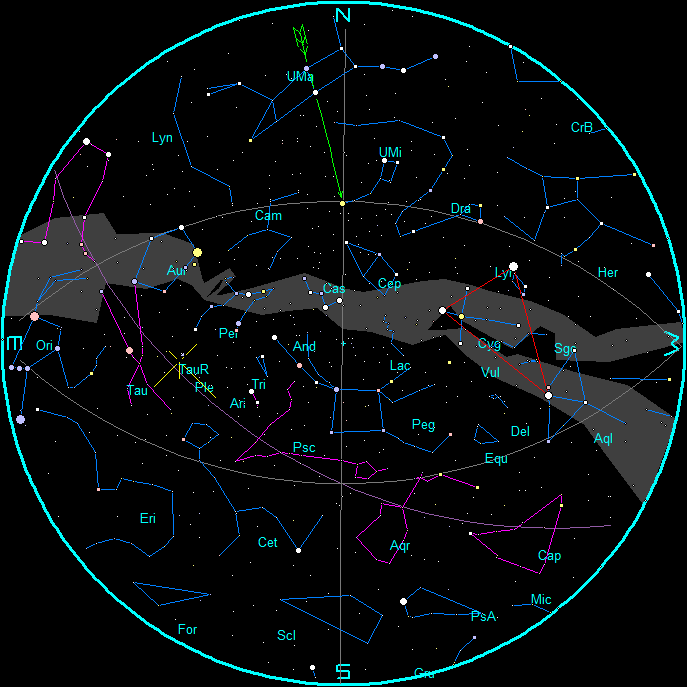
Star Chart for November 2019 (9 p.m. EST November 15, 2019). Click on image to enlarge.Created using my LookingUp program. Click on image to enlarge.
The planets and stars are plotted for the 15th at 9 p.m. EST in the evening and 6 a.m. for the morning chart. These are the chart times. Note that Traverse City is located approximately 45 minutes behind our time meridian, West 75° longitude. (An hour 45 minutes behind our daylight saving time meridian during EDT).
November Morning Star Chart
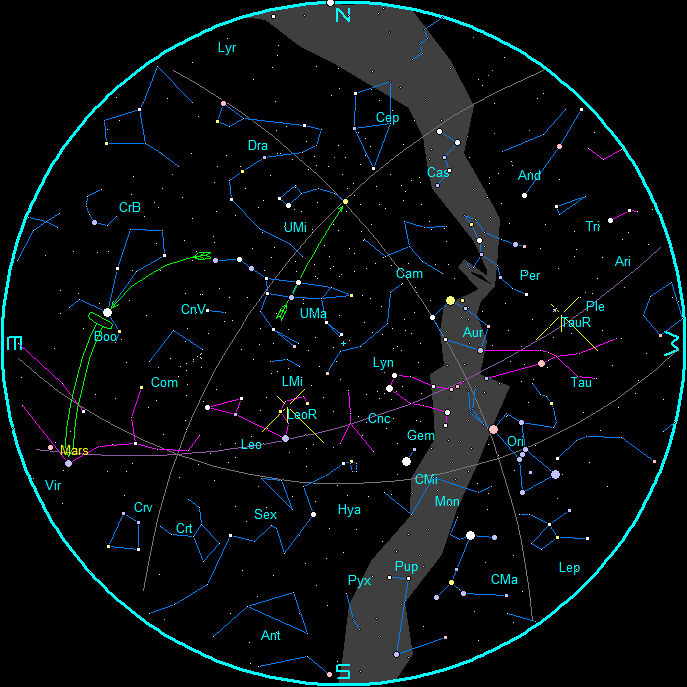
Star Chart for November mornings 2019 (6 a.m. EST November 15, 2019). Click on image to enlarge. Created using my LookingUp program.
For a list of constellation names to go with the abbreviations click here.
- Pointer stars at the front of the bowl of the Big Dipper point to Polaris the North Star.
- Follow the arc of the handle of the Big Dipper to the star Arcturus
- The Summer Triangle is in red.
- TauR on the evening star chart can be used as the radiant for the North and South Taurid meteor showers.
- LeoR on the morning star chart is the radiant of the Leonid meteor shower which peaks between the 16th to 21st.
Twilight Limits, Nautical and Astronomical
| EDT | |||||||
| Traverse City | Morning twilight | Evening twilight | Dark night | Moon | |||
| Date | Astro. | Nautical | Nautical | Astro. | Start | End | Illum. |
| 2019-11-01 | 6h46m | 7h20m | 19h40m | 20h13m | 22h13m | 6h46m | 0.26 |
| 2019-11-02 | 6h48m | 7h22m | 19h38m | 20h12m | 23h10m | 6h48m | 0.36 |
| EST | |||||||
| 2019-11-03 | 5h49m | 6h23m | 18h37m | 19h11m | 23h09m | 5h49m | 0.46 |
| 2019-11-04 | 5h50m | 6h24m | 18h36m | 19h10m | – | 5h50m | 0.56 |
| 2019-11-05 | 5h51m | 6h25m | 18h35m | 19h09m | 0h10m | 5h51m | 0.65 |
| 2019-11-06 | 5h52m | 6h26m | 18h33m | 19h08m | 1h12m | 5h52m | 0.74 |
| 2019-11-07 | 5h54m | 6h28m | 18h32m | 19h06m | 2h13m | 5h54m | 0.82 |
| 2019-11-08 | 5h55m | 6h29m | 18h31m | 19h05m | 3h14m | 5h55m | 0.89 |
| 2019-11-09 | 5h56m | 6h30m | 18h30m | 19h04m | 4h15m | 5h56m | 0.94 |
| 2019-11-10 | 5h57m | 6h31m | 18h29m | 19h03m | 5h16m | 5h57m | 0.98 |
| 2019-11-11 | 5h58m | 6h33m | 18h28m | 19h02m | – | – | 0.98 |
| 2019-11-12 | 5h59m | 6h34m | 18h27m | 19h02m | – | – | 1 |
| 2019-11-13 | 6h01m | 6h35m | 18h26m | 19h01m | – | – | 1 |
| 2019-11-14 | 6h02m | 6h36m | 18h25m | 19h00m | – | – | 0.97 |
| 2019-11-15 | 6h03m | 6h37m | 18h25m | 18h59m | 18h59m | 19h45m | 0.92 |
| 2019-11-16 | 6h04m | 6h38m | 18h24m | 18h58m | 18h58m | 20h41m | 0.85 |
| 2019-11-17 | 6h05m | 6h40m | 18h23m | 18h57m | 18h57m | 21h46m | 0.76 |
| 2019-11-18 | 6h06m | 6h41m | 18h22m | 18h57m | 18h57m | 22h56m | 0.66 |
| 2019-11-19 | 6h07m | 6h42m | 18h21m | 18h56m | 18h56m | – | 0.55 |
| 2019-11-20 | 6h08m | 6h43m | 18h21m | 18h55m | 18h55m | 0h09m | 0.43 |
| 2019-11-21 | 6h10m | 6h44m | 18h20m | 18h55m | 18h55m | 1h24m | 0.31 |
| 2019-11-22 | 6h11m | 6h45m | 18h19m | 18h54m | 18h54m | 2h39m | 0.21 |
| 2019-11-23 | 6h12m | 6h47m | 18h19m | 18h54m | 18h54m | 3h55m | 0.12 |
| 2019-11-24 | 6h13m | 6h48m | 18h18m | 18h53m | 18h53m | 5h11m | 0.05 |
| 2019-11-25 | 6h14m | 6h49m | 18h18m | 18h53m | 18h53m | 6h14m | 0.01 |
| 2019-11-26 | 6h15m | 6h50m | 18h17m | 18h52m | 18h52m | 6h15m | 0 |
| 2019-11-27 | 6h16m | 6h51m | 18h17m | 18h52m | 18h52m | 6h16m | 0.02 |
| 2019-11-28 | 6h17m | 6h52m | 18h17m | 18h52m | 18h59m | 6h17m | 0.06 |
| 2019-11-29 | 6h18m | 6h53m | 18h16m | 18h51m | 19h54m | 6h18m | 0.12 |
| 2019-11-30 | 6h19m | 6h54m | 18h16m | 18h51m | 20h54m | 6h19m | 0.19 |
Twilight calendar was generated using Cartes du Ciel (Sky Charts).
See my blog post: Twilight Zone for the definitions of the different periods of twilight here: https://bobmoler.wordpress.com/2018/09/27/.
NASA Calendar of Planetary Events
     Date   Time   Event
Nov  1 Fr          Venus: 20.8° E
     1 Fr  4:40 pm Moon Descending Node
     1 Fr  7:33 pm Moon South Dec.: 23° S
     2 Sa  2:31 am Moon-Saturn: 0.6° N
     4 Mo  5:23 am First Quarter
     5 Tu  6:41 pm South Taurid Meteor Shower: ZHR = 10
     7 Th  3:37 am Moon Apogee: 405100 km
     9 Sa  2:18 pm Venus-Antares: 3.9° N
     9 Sa  6:05 pm Mars-Spica: 2.8° N
    11 Mo 10:17 am Mercury Inferior Conjunction (Transit)
    12 Tu  8:34 am Full Moon
    12 Tu  5:57 pm North Taurid Meteor Shower: ZHR = 15
    16 Sa  3:48 am Moon Ascending Node
    16 Sa  8:52 am Moon North Dec.: 23.2° N
    18 Mo 12:15 am Leonid Meteor Shower: ZHR = 15
    18 Mo  5:11 am Moon-Beehive: 0.9° S
    19 Tu  4:11 pm Last Quarter
    23 Sa  2:54 am Moon Perigee: 366700 km
    24 Su  4:02 am Moon-Mars: 4.4° S
    24 Su  7:17 am Venus-Jupiter: 1.4° N
    26 Tu 10:06 am New Moon
    28 Th  4:59 am Mercury Greatest Elongation: 20.1° W
    28 Th  5:49 am Moon-Jupiter: 0.8° S
    28 Th  1:50 pm Moon-Venus: 2° S
    28 Th 11:13 pm Moon Descending Node
    29 Fr  5:36 am Moon South Dec.: 23.2° S
    29 Fr  4:12 pm Moon-Saturn: 1° N
Dec  1 Su          Venus: 27.9° E
All event times are given for UTC-4 hr: Eastern Daylight Saving Time or UTC-5 Eastern Standard Time starting the 3rd.
Sky Events Calendar by Fred Espenak and Sumit Dutta (NASA’s GSFC),
http://eclipse.gsfc.nasa.gov/SKYCAL/SKYCAL.html.
If you go to the above site you can print out a list like the above for the entire year or calendar pages for your time zone.
Sun and Moon Rising and Setting Events
     LU                  Ephemeris of Sky Events for Interlochen/TC
     November, 2019    Local time zone: EDT
     +-----------------------------------------------------------------------+
     | DATE |  SUN     SUN  DAYLIGHT|   TWILIGHT*    |MOON  RISE OR    ILLUM |
     |      |  RISE    SET    HOURS |  END    START  |PHASE SET** TIME FRACTN|
     +=======================================================================+
     |Fri  1| 08:20a  06:31p  10:11 | 07:36p  07:15a |      Set  10:13p   27%|
     |Sat  2| 08:21a  06:30p  10:08 | 07:35p  07:16a |      Set  11:09p   36%|
     +------+-----------------------+----------------+-----------------------+
     | EST  |      Time Change      |                |                       |
     |Sun  3| 07:23a  05:29p  10:05 | 06:34p  06:17a |      Set  11:09p   46%|
     |Mon  4| 07:24a  05:27p  10:03 | 06:32p  06:19a |F Qtr Set  12:10a   55%|
     |Tue  5| 07:25a  05:26p  10:00 | 06:31p  06:20a |      Set  01:12a   65%|
     |Wed  6| 07:27a  05:25p  09:57 | 06:30p  06:21a |      Set  02:13a   73%|
     |Thu  7| 07:28a  05:23p  09:55 | 06:29p  06:22a |      Set  03:13a   81%|
     |Fri  8| 07:30a  05:22p  09:52 | 06:28p  06:24a |      Set  04:14a   88%|
     |Sat  9| 07:31a  05:21p  09:50 | 06:27p  06:25a |      Set  05:16a   93%|
     +------+-----------------------+----------------+-----------------------+
     |Sun 10| 07:32a  05:20p  09:47 | 06:26p  06:26a |      Set  06:19a   97%|
     |Mon 11| 07:34a  05:19p  09:45 | 06:25p  06:27a |      Set  07:24a  100%|
     |Tue 12| 07:35a  05:17p  09:42 | 06:24p  06:28a |Full  Rise 05:45p  100%|
     |Wed 13| 07:36a  05:16p  09:40 | 06:23p  06:30a |      Rise 06:18p   98%|
     |Thu 14| 07:38a  05:15p  09:37 | 06:22p  06:31a |      Rise 06:57p   94%|
     |Fri 15| 07:39a  05:14p  09:35 | 06:21p  06:32a |      Rise 07:45p   88%|
     |Sat 16| 07:40a  05:13p  09:33 | 06:21p  06:33a |      Rise 08:41p   80%|
     +------+-----------------------+----------------+-----------------------+
     |Sun 17| 07:42a  05:12p  09:30 | 06:20p  06:34a |      Rise 09:46p   70%|
     |Mon 18| 07:43a  05:12p  09:28 | 06:19p  06:36a |      Rise 10:56p   60%|
     |Tue 19| 07:44a  05:11p  09:26 | 06:18p  06:37a |L Qtr Rise 12:09a   49%|
     |Wed 20| 07:46a  05:10p  09:24 | 06:18p  06:38a |      Rise 01:24a   37%|
     |Thu 21| 07:47a  05:09p  09:22 | 06:17p  06:39a |      Rise 02:39a   27%|
     |Fri 22| 07:48a  05:08p  09:20 | 06:16p  06:40a |      Rise 03:55a   17%|
     |Sat 23| 07:49a  05:08p  09:18 | 06:16p  06:41a |      Rise 05:10a    9%|
     +------+-----------------------+----------------+-----------------------+
     |Sun 24| 07:51a  05:07p  09:16 | 06:15p  06:42a |      Rise 06:26a    4%|
     |Mon 25| 07:52a  05:06p  09:14 | 06:15p  06:43a |      Rise 07:41a    1%|
     |Tue 26| 07:53a  05:06p  09:12 | 06:14p  06:45a |New   Set  05:27p    0%|
     |Wed 27| 07:54a  05:05p  09:10 | 06:14p  06:46a |      Set  06:10p    2%|
     |Thu 28| 07:56a  05:05p  09:08 | 06:13p  06:47a |      Set  06:59p    7%|
     |Fri 29| 07:57a  05:04p  09:07 | 06:13p  06:48a |      Set  07:54p   13%|
     |Sat 30| 07:58a  05:04p  09:05 | 06:13p  06:49a |      Set  08:54p   20%|
     +-----------------------------------------------------------------------+
     * Nautical Twilight
     ** Moonrise or moonset, whichever occurs between sunrise and sunset
Generated using my LookingUp for DOS program.
 Bob Moler's Ephemeris Blog