12/25/2019 – Ephemeris – A look at the naked-eye planets for Christmas
Merry Christmas. This is Ephemeris for Christmas Day, Wednesday, December 25th. Today the Sun will be up for 8 hours and 48 minutes, setting at 5:07, and it will rise tomorrow at 8:18. The Moon, 1 day before new, will rise at 8:42 tomorrow morning.
Let’s look at the naked-eye planets for this week. Venus is our Christmas Star low in the southwest in the early evening. It will set at 7:43 p.m. Saturn, the ringed planet, will be in the southwestern sky in the evening, and will set at 6:26 p.m. Tonight Saturn will be about 16 ½ degrees or more than the width of a fist held at arms length right and below the much brighter Venus. Jupiter is lost in twilight. It will pass behind the Sun on the Friday, entering the morning sky.
Mars is in the morning sky and will rise in the east-southeast at 5:07 a.m. It’s not very bright because it’s 206 million (332 million km) miles away, but it’s getting slowly closer to the Earth. Mercury is now too close to the Sun to be seen in the morning.
The times given are for the Traverse City/Interlochen area of Michigan. They may be different for your location.
Addendum
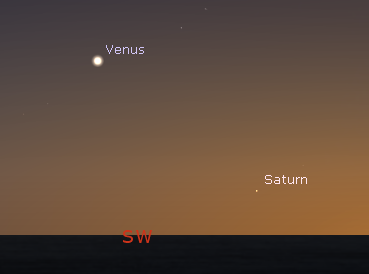
Venus and Saturn low on the southwest tonight at 6 p.m. December25, 2019. Saturn is only 3 1/2 degrees above the Lake Michigan horizon. Created using Stellarium.
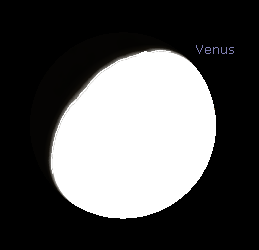
Venus, much larger than it would appear in any telescope to show its gibbous phase, tonight December 25, 2019. Created using Stellarium.
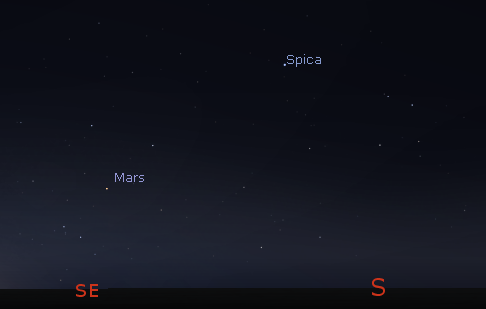
Mars in the morning with the bright stars at 7 a.m. December 26, 2019. Created using Stellarium.
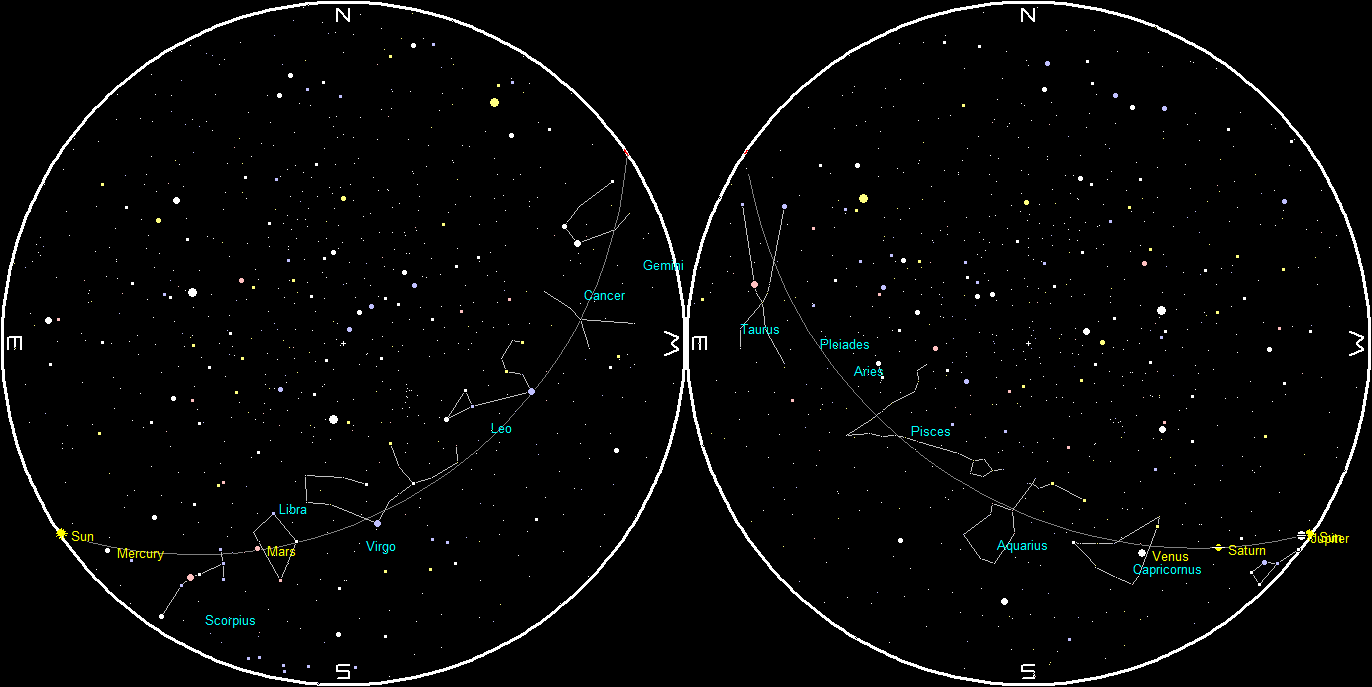
Planets and the Moon at sunset and sunrise of a single night starting with sunset on the right on December 25, 2019. The night ends on the left with sunrise on the 26th. The Moon at the morning hour is south of the Sun having just completing a solar eclipse for Asia. Click on the image to enlarge. Created using my LookingUp program.
12/24/2019 – Ephemeris – Was this the star of Bethlehem?
Ephemeris for Christmas Eve, Tuesday, December 24th. Today the Sun will be up for 8 hours and 48 minutes, setting at 5:06, and it will rise tomorrow at 8:18. The Moon, 2 days before new, will rise at 7:41 tomorrow morning.
Many writers of the 2nd and 3rd centuries AD place Jesus’ birth around 2 BC, which had to be before Herod the Great’s death, which I suggest was in 1 BC marked by to a total lunar eclipse. So the Star of Bethlehem could appear several years later than the triple conjunction of Jupiter and Saturn in 7 BC that’s been popular. In 3 and again in 2 BC there were star-like conjunctions or apparent joinings of the planets Jupiter and Venus against the backdrop of constellation of Leo the Lion. A lion is related to Judah, son of Jacob by a blessing the latter gave his 12 sons in Genesis. The first conjunction occurred in August of 3 BC in the morning sky. In June the next year the two planets got together again, this time in the evening sky, a month or more after Jesus would have been born in the lambing season of spring.
The times given are for the Traverse City/Interlochen area of Michigan. They may be different for your location.
Addendum
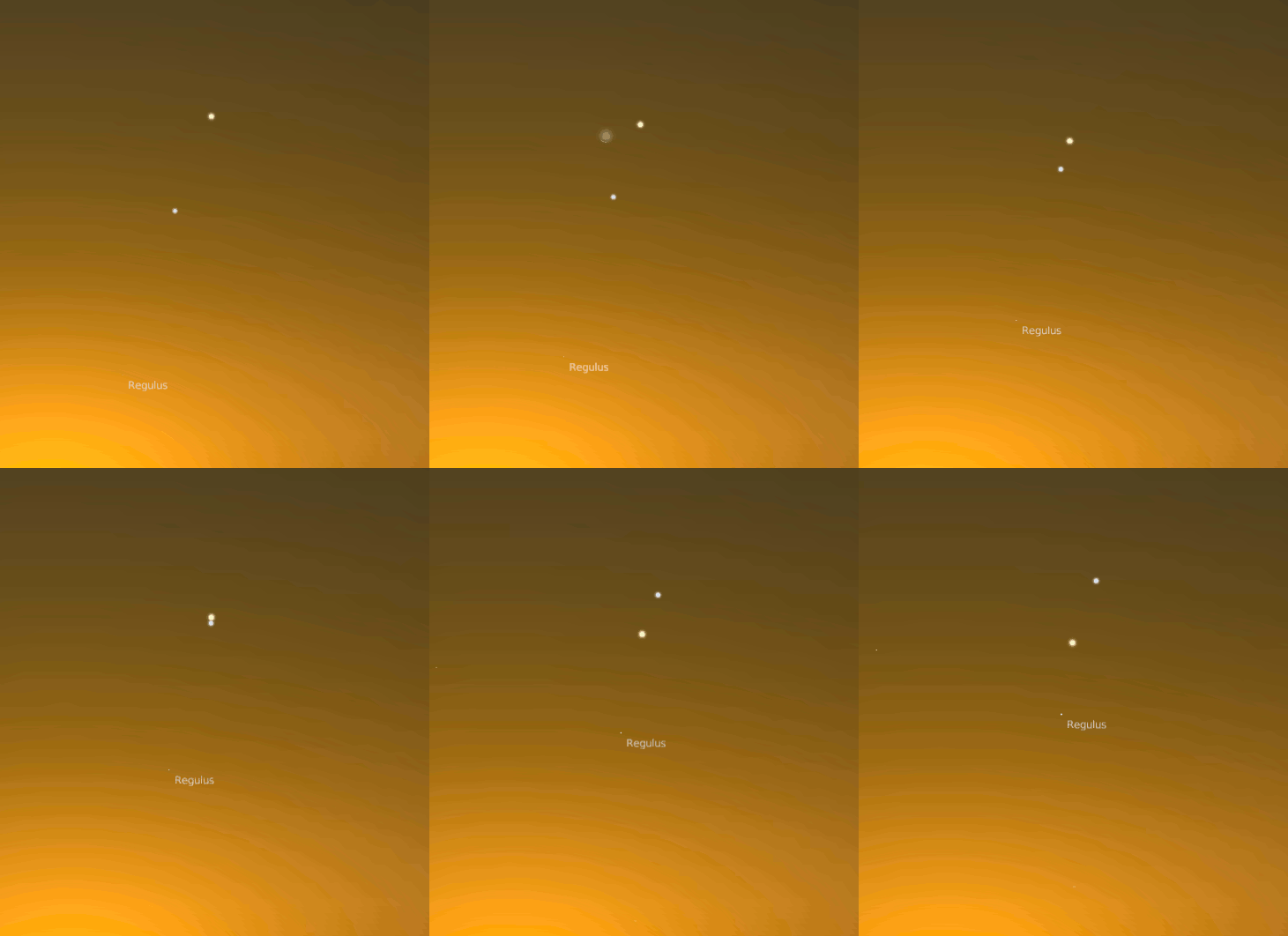
Here is an animation created using Stellarium of Jupiter and Venus, the brighter of the two seeming to coalesce on August 12, 3 BC in the early morning twilight. Created using Stellarium and GIMP.
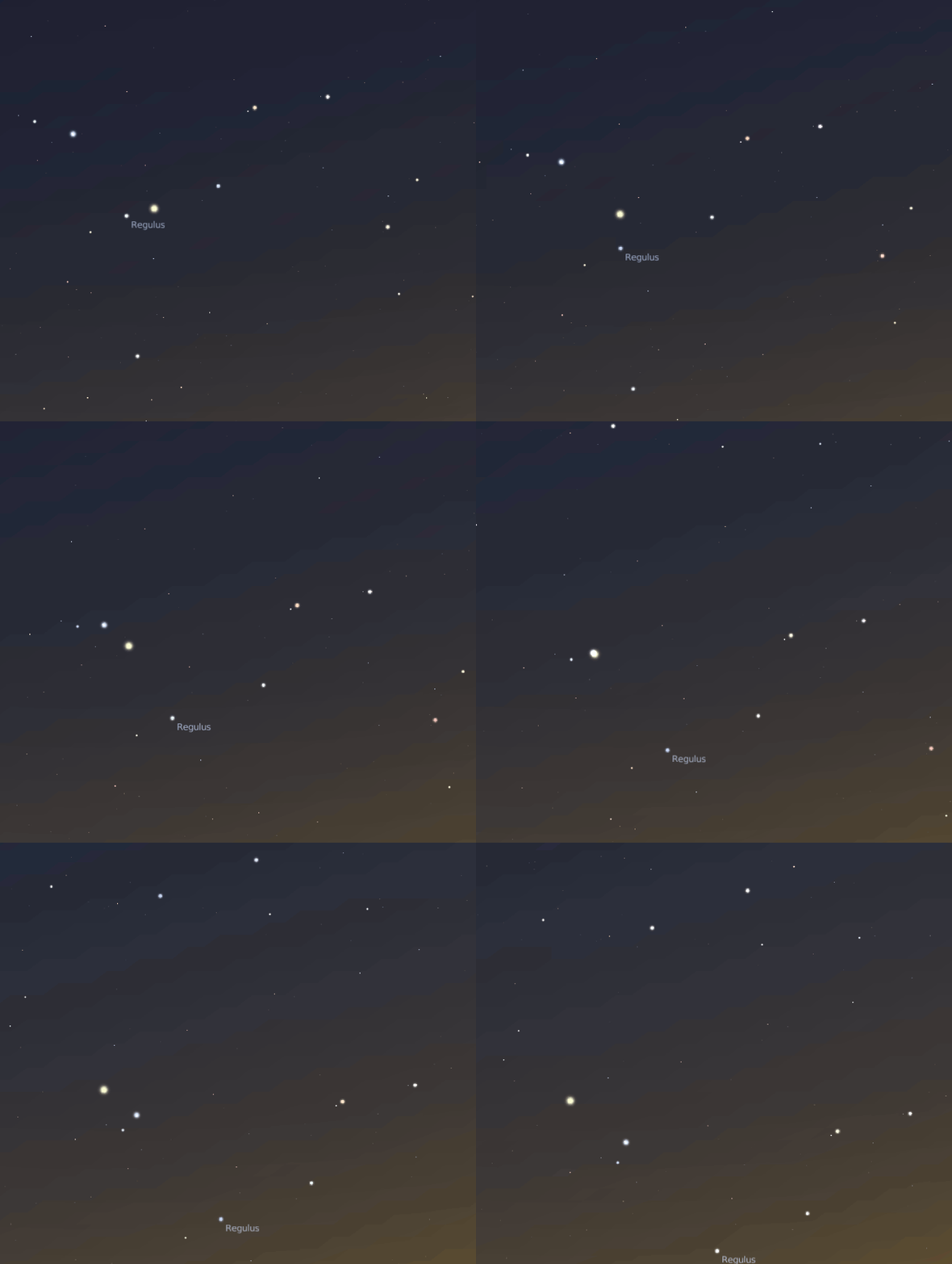
On June 16th 2 BC, this time in the evening, Venus and Jupiter seem to coalesce as one, at least to the naked eye. The first few frames contain the Sickle asterism of Leo the lion’s head and mane. Created using Stellarium and GIMP.
I have much more information on this topic in my December 2, 2016 posting: https://bobmoler.wordpress.com/2016/12/02/12022016-ephemeris-my-talk-about-the-star-of-bethlehem-is-tonight/
12/23/2019 – Ephemeris – Orion, rising even higher now
Ephemeris for Monday, December 23rd. Today the Sun will be up for 8 hours and 48 minutes, setting at 5:05, and it will rise tomorrow at 8:18. The Moon, 3 days before new, will rise at 6:34 tomorrow morning.
The large and bright constellation of Orion the hunter is in the southeast at 9 p.m., with the bright star Sirius below it near the horizon. The equally spaced line of three stars of Orion’s belt are nearly vertical and point down to Sirius, also known as the Dog Star in Canis Major, Orion’s greater dog. Those three belt stars are in the center of an elongated rectangle of stars that tilt to the left. At the top left of Orion’s shoulder stars is the red giant star Betelgeuse. The right shoulder star is Bellatrix. Both Bellatrix and Sirius along with the names of other stars and constellations should be familiar to fans of the Harry Potter novels and movies, as members of the house of Black. The knee stars at the bottom of the rectangle are, from left to right Saiph and the brilliant blue giant star Rigel. Between his belt and knees are stars of his sword.
The times given are for the Traverse City/Interlochen area of Michigan. They may be different for your location.
Addendum
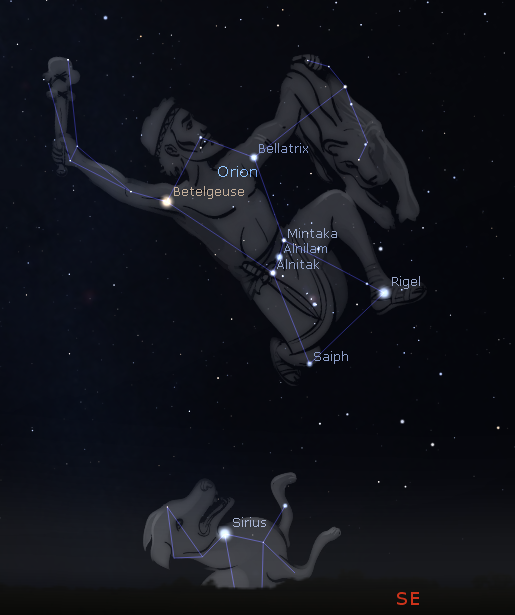
The named bright stars of Orion and Canis Major, the dog rising below Orion with Sirius. Beside the stars mentioned in the program are the stars of Orion’s belt that have their own program later on in winter. Created using Stellarium.
In this season of Biblical stories it’s nice to note that Orion is mentioned four times in the Old Testament. In Isaiah, Amos and twice in Job. In Hebrew his name is “Kesîl”, meaning Fool.
12/20/2019 – Ephemeris – Winter arrives late tomorrow night
Ephemeris for Friday, December 20th. Today the Sun will be up for 8 hours and 48 minutes, setting at 5:04, and it will rise tomorrow at 8:16. The Moon, 1 day past last quarter, will rise at 2:55 tomorrow morning.
Tomorrow will be the first day of winter, barely, since the moment of solstice will arrive at 11:19 p.m. If you’re south of the equator this is the first day of summer. The Earth reaches a point in its orbit where its north pole is tipped its furthest away from the Sun, and is in shadow in the middle of it’s six month night. The Sun for us is up only 8 hours, 48 minutes, and to boot the Sun only rises 22 degrees above the horizon giving us the least amount of energy of any day of the year. Why did the ancients celebrate this time of year? That’s because the Sun had slowed and stopped its drift southward and was beginning to come back higher in the sky. Spring and summer would eventually return!
The times given are for the Traverse City/Interlochen area of Michigan. They may be different for your location.
Addendum
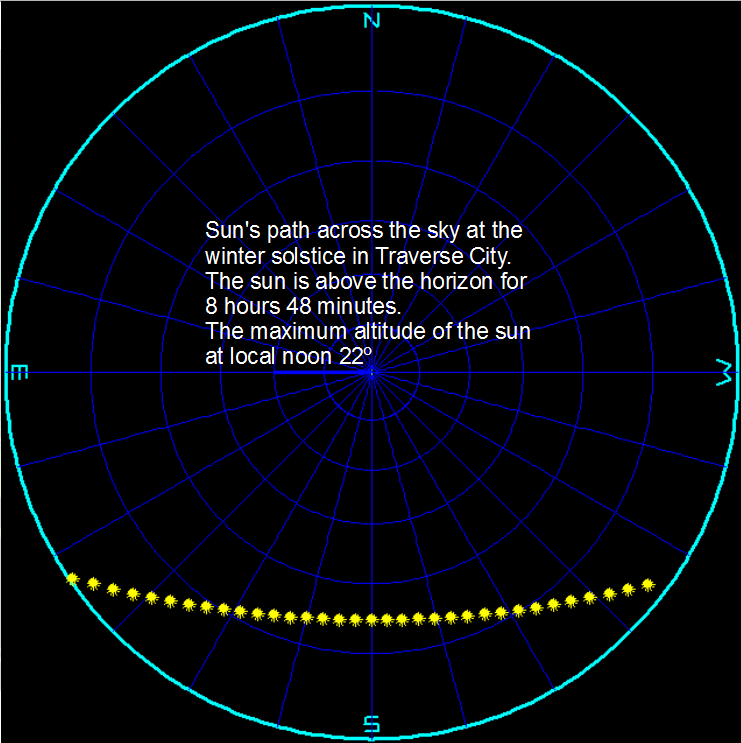
The sun’s daily path through the sky from horizon to horizon on the first day of winter, the winter solstice. Credit My LookingUp program.
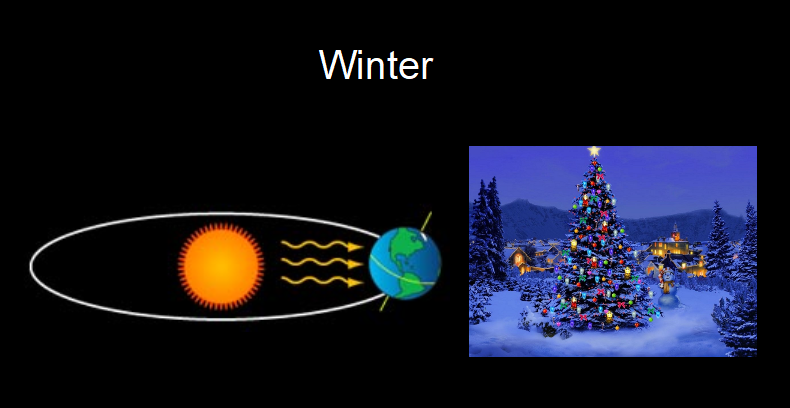
The Earth and its axis on the first day of winter, the winter solstice. From my Sun and the Earth talk slides.
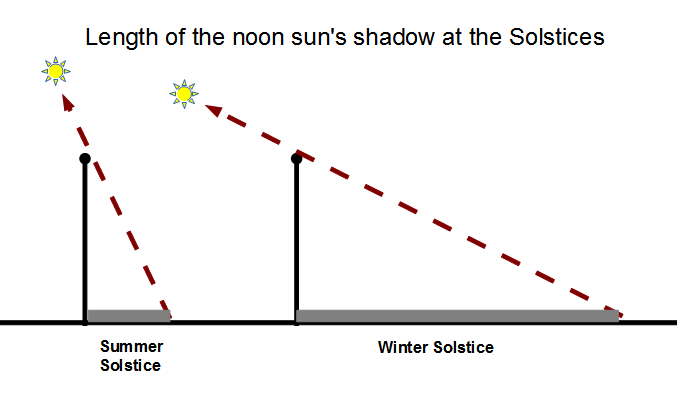
Comparison of shadows between winter and summer solstices. Note the angles are approximate.
12/19/2019 – Ephemeris – What does the bright star Procyon’s name mean?
Ephemeris for Thursday, December 19th. Today the Sun will be up for 8 hours and 48 minutes, setting at 5:04, and it will rise tomorrow at 8:16. The Moon, at last quarter today, will rise at 1:42 tomorrow morning.
Visible low in the east at 8:30 p.m. will appear the star Procyon, sometimes called the little Dog Star. It’s in the constellation of Canis Minor, the little dog. It will rise at 8:05 p.m. for the Traverse City Interlochen area. Yet to rise at that time is the Dog Star itself, Sirius, the brightest night-time star. It won’t rise until 8:40 p.m., 35 minutes later even though Sirius is west of Procyon. I bring this up because the name Procyon means Before the Dog. At our latitude Procyon rises before any part of Canis Major, the big dog, Canis Major, that Sirius is in the heart of. This is sensitive to one’s latitude. At the equator, say in Ecuador. Sirius would rise first due to its westerly position by 54 minutes. You see Procyon is also north of Sirius and that makes all the difference.
The times given are for the Traverse City/Interlochen area of Michigan. They may be different for your location.
Addendum
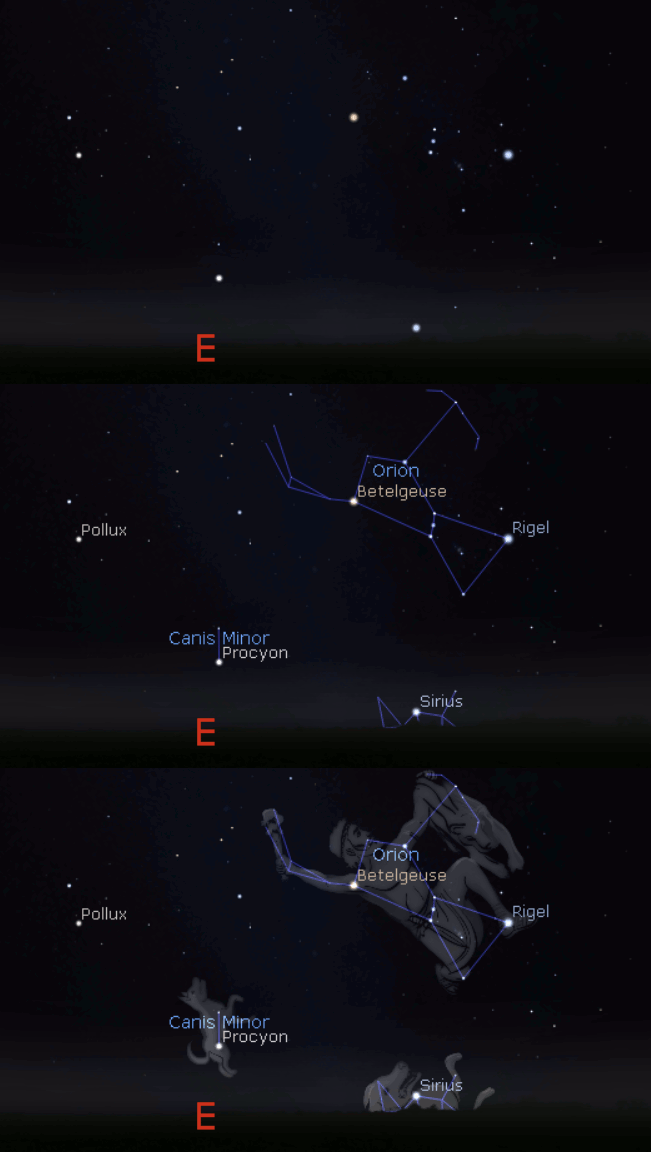
Stars and constellations in the east at 9 p.m., about 4 hours after sunset, on December 19th. This only works for locations above 30 degrees north latitude. Created using Stellarium.
Procyon and Sirius will for observers located at 30º 30′ north latitude. South of that latitude Sirius will rise first.
12/18/2019 – Ephemeris – Where are the naked-eye planets for this week?
Ephemeris for Wednesday, December 18th. Today the Sun will be up for 8 hours and 48 minutes, setting at 5:03, and it will rise tomorrow at 8:15. The Moon, 1 day before last quarter, will rise at 12:28 tomorrow morning.
Let’s look at the naked-eye planets for this week. Venus will be briefly visible low in the southwest before it sets at 7:25 p.m. Jupiter is lost in twilight. It will pass behind the Sun on the 27th and will enter the morning sky. Saturn, the ringed planet, will be in the southwestern sky in the evening, and will set at 6:46 p.m. Tonight Saturn will be about 8 ½ degrees or Nearly the width of a fist held at arms length right and below the much brighter Venus. Mars is in the morning sky and will rise in the east-southeast at 5:10 a.m. It’s not very bright because it’s 211 million (339million km) miles away, but it’s getting slowly closer to the Earth. Mercury is now too close to the Sun to be seen in the morning.
The times given are for the Traverse City/Interlochen area of Michigan. They may be different for your location.
Addendum
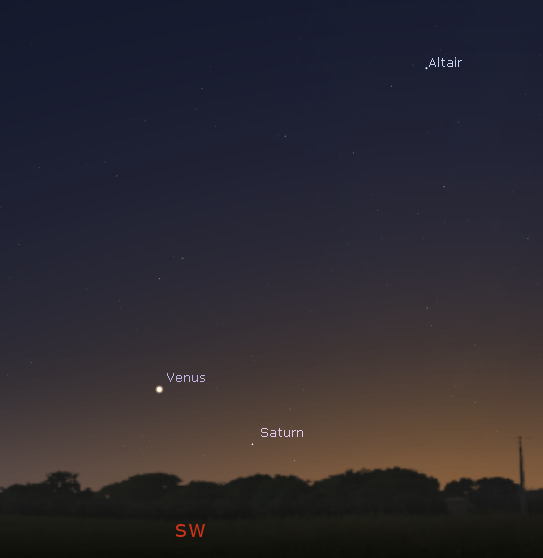
Venus and Saturn low ion the southwest tonight at 6 p.m. December18, 2019. Created using Stellarium.
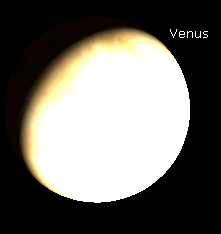
Venus, much larger than it would appear in any telescope to show its gibbous phase, tonight December 18, 2019. Created using Stellarium.
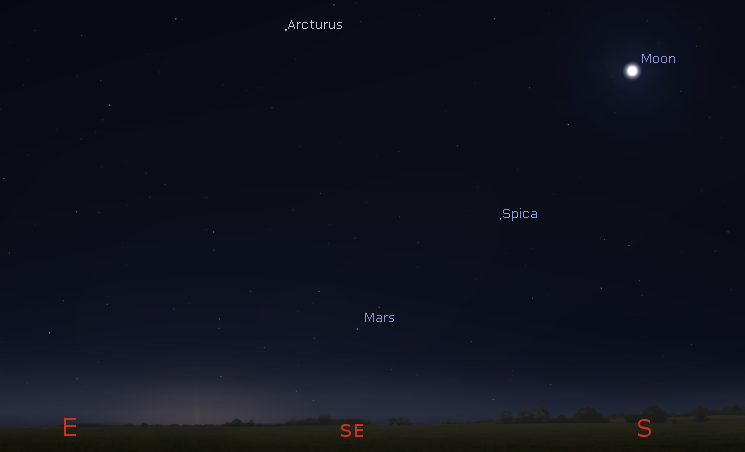
Mars and the Moon in the morning with the bright stars at 7 a.m. December 19, 2019. Created using Stellarium.
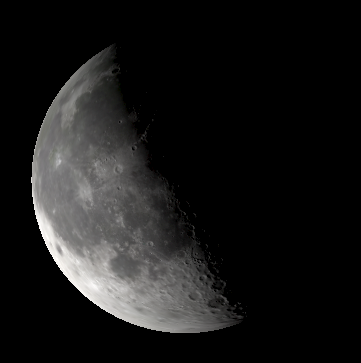
The Moon as it might be seen in binoculars at 7 a.m. tomorrow December 19, 2019. Created using Stellarium.
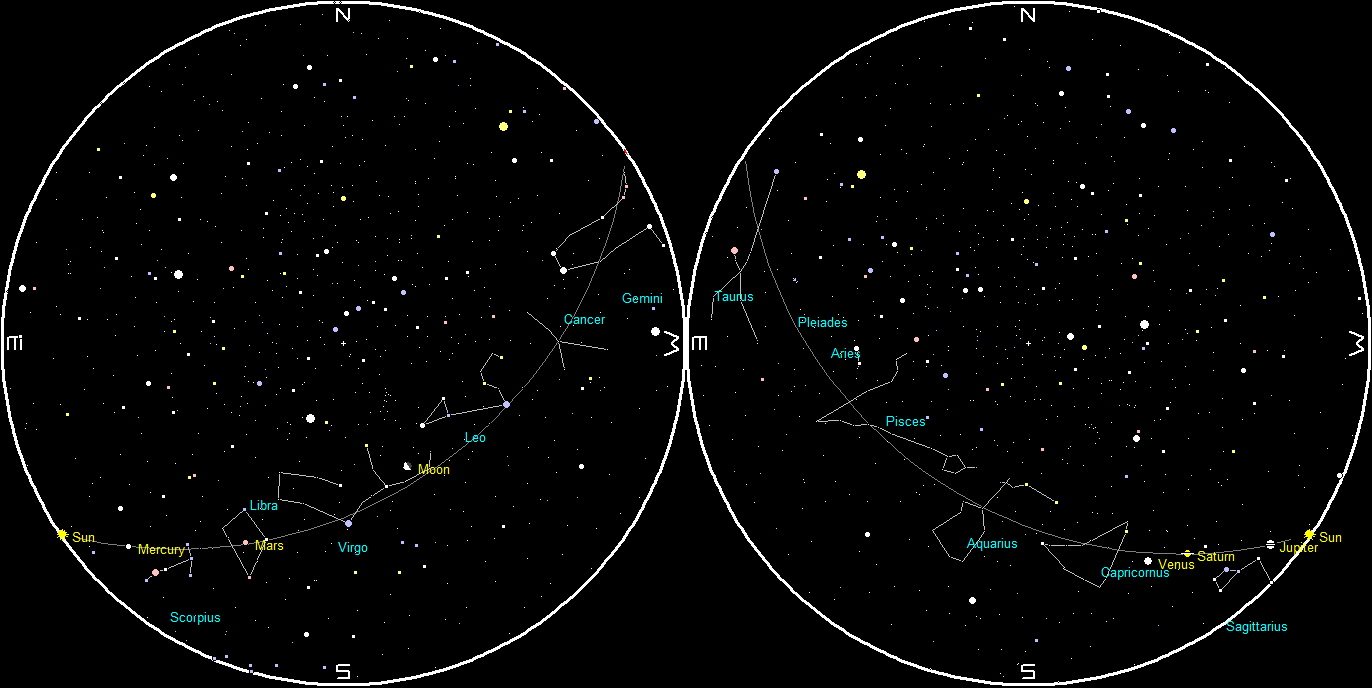
Planets and the Moon at sunset and sunrise of a single night starting with sunset on the right on December 18, 2019. The night ends on the left with sunrise on the 19th. Click on the image to enlarge. Created using my LookingUp program.
12/17/2019 – Ephemeris – Hyades, the face of Taurus the Bull
Ephemeris for Tuesday, December 17th. Today the Sun will be up for 8 hours and 48 minutes, setting at 5:03, and it will rise tomorrow at 8:15. The Moon, 2 days before last quarter, will rise at 11:14 this evening.
The face of the constellation Taurus the bull looks like the letter V sideways above the rising Orion the Hunter in the east at 9 p.m. The bright star at the tip of a letter V of stars is Aldebaran. Look with binoculars at the letter V shape and you will see the stars of the Hyades star cluster The Hyades is the closest star cluster to us, at about 153 light years. And is important for that reason. Before satellites like Hipparcos and Gaia. The Hyades was the only star cluster to be directly measured by a technique called parallax, using the radius of the Earth’s orbit as one side of a surveyors enormous triangle. Its many stars at the same distance were used to determine distances of star clusters even farther away. Additional techniques based on the distance of the Hyades allowed us to measure distances to the galaxies.
The times given are for the Traverse City/Interlochen area of Michigan. They may be different for your location.
Addendum
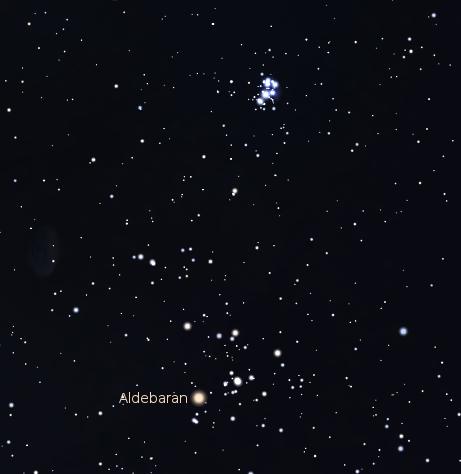
Aldebaran in the ‘V’ shape of the Hyades (The face of Taurus the bull) with the Pleiades above. Created using Stellarium.
12/16/2019 – Ephemeris – Taurus Treasures
Ephemeris for Monday, December 16th. Today the Sun will be up for 8 hours and 49 minutes, setting at 5:03, and it will rise tomorrow at 8:14. The Moon, 3 days before last quarter, will rise at 9:59 this evening.
Rising in the east-southeast now is the bright star Aldebaran an orange star that’s at one end of the sideways letter V of stars that is the head of Taurus the bull. Above it is the jewel-like Pleiades or Seven Sisters star cluster. There’s more to Taurus, like it’s freakishly long horns and front part of its body. But you can say you’ve seem Taurus, if you can spot his face. That V of stars is actually a star cluster called the Hyades, the closest to the Earth, and in Greek Myth were the half-sisters of the Pleiades, also fathered by the god Atlas. Both the Hyades and Pleiades are being pursued by Orion, which is below it. He isn’t the only one following the Pleiades, the name Aldebaran means “The Follower”.
The times given are for the Traverse City/Interlochen area of Michigan. They may be different for your location.
Addendum
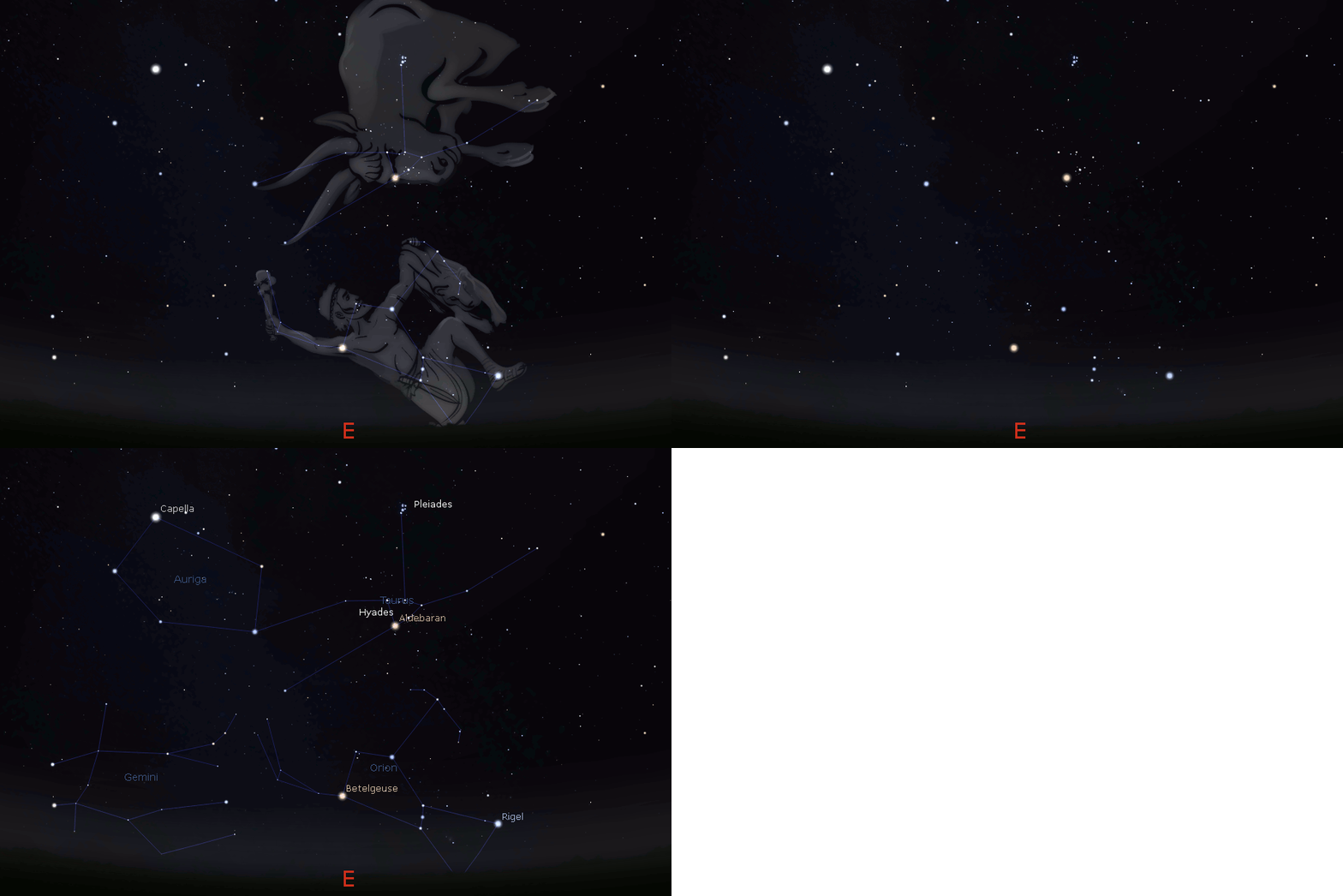
An animation showing the Hyades, Taurus, Orion and the Pleiades. Click on the image to enlarge. Created using Stellarium and GIMP.
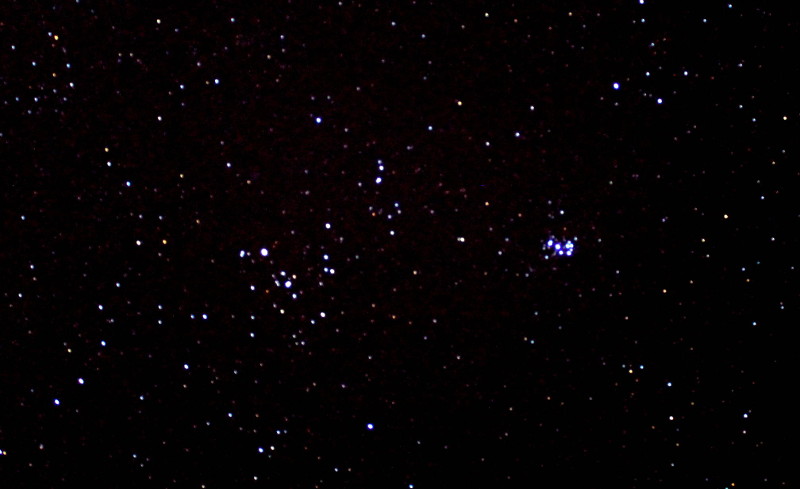
The Pleiades (right) and the Hyades (left) in this photograph I took January 4, 2016.
12/13/2019 – Ephemeris – Tonight is the first night that straddles the peak of the Geminid meteor shower
Ephemeris for Friday, December 13th. Today the Sun will be up for 8 hours and 50 minutes, setting at 5:02, and it will rise tomorrow at 8:12. The Moon, 1 day past full, will rise at 6:33 this evening.
Tonight and tomorrow nights will straddle the peak of the Geminid meteor shower. It is the best meteor shower of the year and it is getting more active over the years. The Moon will interfere with all but the brightest meteors. The radiant is the point in space where the meteors seem to come from, which is near the star Castor in the constellation Gemini from which the shower gets its name. The meteors will be seen all over the sky, but they all can be traced back to the radiant. The body responsible for this meteor shower is an asteroid rather than a comet with the name 3200 Phaethon. It comes very close to the sun, So it may shed bits of itself due to heat stress. I suppose I can’t resist this: That’s how the asteroid crumbles.
The times given are for the Traverse City/Interlochen area of Michigan. They may be different for your location.
Addendum
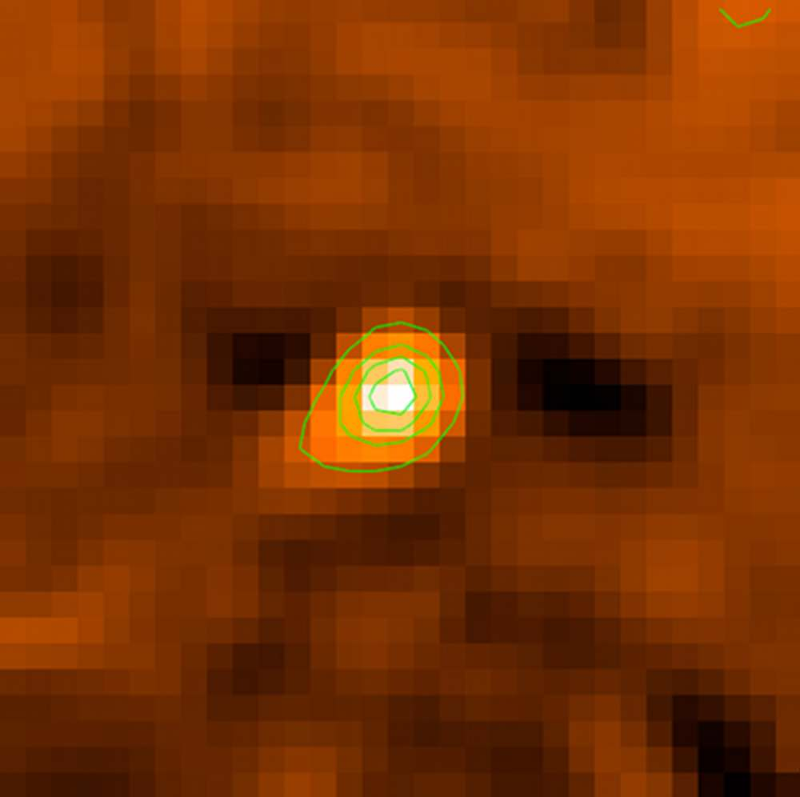
3200 Phaethon a rock comet showing a tail as it nears the Sun. Credit NASA/STEREO
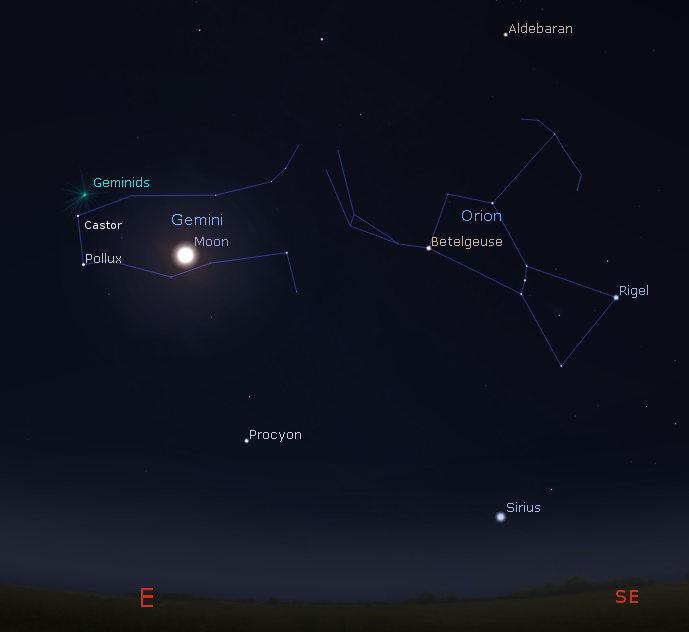
Eastern sky for Geminids at 10 p.m. December 13, 2019. On the 14th the Moon will be the same distance from Pollux but below it. Remember that the Geminid meteors will be seen all over the sky. It might help to hide the moon behind a building so as to better see the brighter meteors. Created using Stellarium.
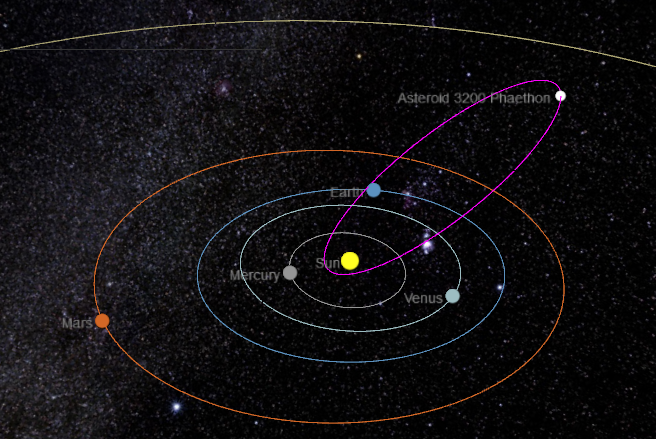
Orbit of 3200 Phaethon with the Earth and Phaethon at 10:02 p.m. December 12, 2019. (03:02 UT Dec 13) Credit TheSkyLive.com.
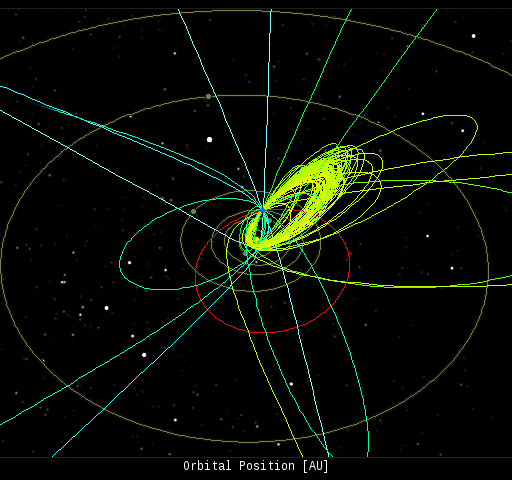
Orbits of Fireballs on the night of December 13-14 as recorded by NASA’s All Sky Cameras six years ago. The preponderance of fireballs (bright meteors) are Geminids. These are published daily on Spaceweather.com. Credit: NASA and Spaceweather.com.
Eastern sky for Geminids at 10 p.m. December 13, 2019. On the 14th the Moon will be the same distance from Pollux but below it. Remember that the Geminid meteors will be seen all over the sky. It might help to hide the moon behind a building so as to better see the brighter meteors. Created using Stellarium.
From the International Meteor Organization: Observing proposal: Geminids and Full Moon
12/12/2019 – Ephemeris – Previewing the Geminids this weekend
Ephemeris for Thursday, December 12th. Today the Sun will be up for 8 hours and 51 minutes, setting at 5:02, and it will rise tomorrow at 8:11. The Moon, at full today, will rise at 5:38 this evening.
This upcoming weekend is the weekend of the greatest annual meteor shower of the year. They’re the Geminids. I confess to never having seen a Geminid. The reason is that it’s generally too cloudy, and for me too cold and this year is another problem, a bright Moon. In dark skies they have a 120 per hour peak, when the radiant point in Gemini is overhead. The body that was discovered to produce these meteors doesn’t appear to be a comet. It is designated as an asteroid 3200 Phaethon. Phaethon gets extremely close to the sun at 13 million miles (21 million km) and one of the STEREO Sun monitoring satellites caught it developing a tail when close to the Sun. Phaethon may then be the first known rock comet. I’ll have more on it tomorrow. (12/08/2014)
The times given are for the Traverse City/Interlochen area of Michigan. They may be different for your location.
Addendum
Eastern sky for Geminids at 10 p.m. December 13, 2019. On the 14th the Moon will be the same distance from Pollux but below it. Remember that the Geminid meteors will be seen all over the sky. It might help to hide the moon behind a building so as to better see the brighter meteors. Created using Stellarium.
Orbits of Fireballs on the night of December 13-14 as recorded by NASA’s All Sky Cameras six years ago. The preponderance of fireballs in yellow (bright meteors) are Geminids. These are published daily on Spaceweather.com. Credit: NASA and Spaceweather.com

