05/07/2019 – Ephemeris – We’re starting to look at the race to the Moon that culminated 50 years ago
Ephemeris for Tuesday, May 7th. Today the Sun will be up for 14 hours and 30 minutes, setting at 8:54, and it will rise tomorrow at 6:23. The Moon, 3 days past new, will set at 11:58 this evening.
As we look at the Moon near the planet Mars tonight, we recall that fifty years ago today the United States was one week from launching Apollo 10, the penultimate lunar mission to test out the Lunar Module shortened to LM pronounced “Lem” in the vicinity of the Moon. President Kennedy announced the goal in 1961 to send a man to the Moon and return him safely by the end of the decade. This required a lot of learning steps and in the end a huge rocket, the Saturn V. That rocket’s chief designer was Wernher von Braun an ex-Nazi officer who designed the German V-2 during World War II. His counterpart on the Soviet side was Sergei Korolev, though we didn’t know his name until after he died in 1966. His death hampered the development of the Soviet’s N-1 moon rocket.
The times given are for the Traverse City/Interlochen area of Michigan. They may be different for your location.
Addendum

Wernher von Braun around 1960. Image is in the public domain.

Sergei Korolev, undated image published after his death. Image is in the public domain.
A fascinating look of the Soviet side of the moon race can be found here: https://www.nasa.gov/connect/ebooks/rockets_people_vol4_detail.html. The ebook Rockets and People Volume IV, The Moon Race by Korolev’s deputy Boris Chertok. It’s available in epub, mobi and pdf formats. Volume 3 covers from 1961 to 1967. There are links to all the other volumes from that page.
05/06/2019 – Ephemeris – The Eta Aquariid meteor shower
Ephemeris for Monday, May 6th. Today the Sun will be up for 14 hours and 27 minutes, setting at 8:53, and it will rise tomorrow at 6:24. The Moon, 2 days past new, will set at 10:52 this evening.
The Earth is now passing through a stream of bits of rock that were shed from Halley’s Comet on its many previous passes of the inner solar system. The Earth gets to pass through this stream twice, Once in late October as the stream passes the Earth’s orbit heading in, and in early May as the stream is departing. The peak of this meteor shower, the Eta Aquariids, lasts several days. But since the meteoroids are coming from nearer the direction of the Sun, there is only a short period when these meteors are visible. Actually only an hour between 3:30 a.m. and 4:30 a.m. or a little bit later in the Grand Traverse region as twilight begins to interfere with the display. The radiant, from where the meteors will seem to come will stay low in the east-southeast, but they will be seen all over the sky. The farther south one is on the earth the longer each morning the meteors will be visible. We’re at a disadvantage being 45º north latitude.
The times given are for the Traverse City/Interlochen area of Michigan. They may be different for your location.
Addendum
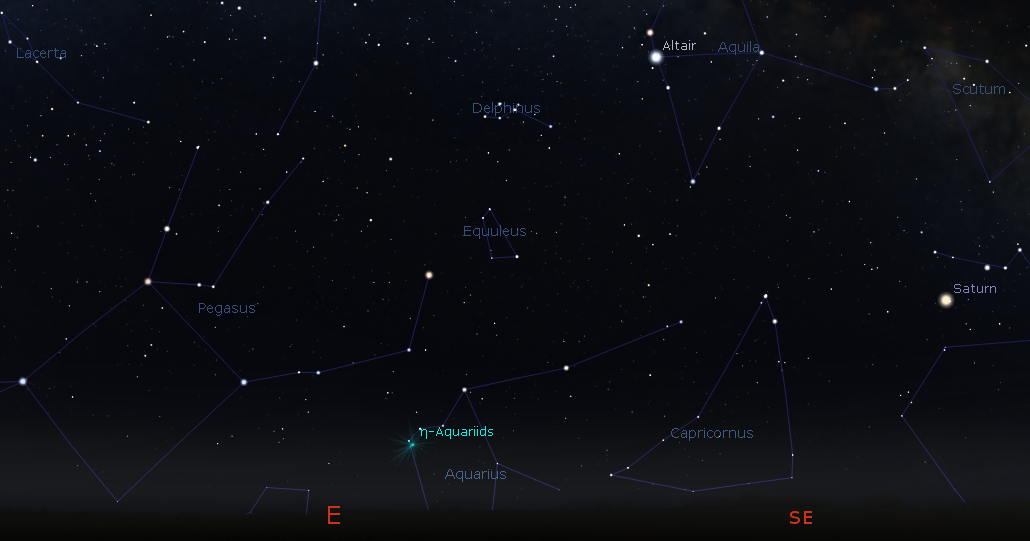
The sky at 4 a.m. tomorrow looking eastward at the Eta Aquariid radiant. Click on the image to enlarge. Created using Stellarium.
05/06/2019 – Ephemeris Extra – The Eta Aquariids – Halley’s Comet never really left
In 1986 Halley’s Comet swam through our skies for the 28th time since the Chinese first recorded it in 240 BCE. It was not especially impressive, considering the week when my family met a group of Leelanau School students in the Florida Keys the week in April 1986 to view and photograph the comet at it’s closest to the Earth of 44 million miles. It turned out that that week the comet lost its tail, probably due to a coronal mass ejection from the Sun. Halley’s Comet was much more impressive a month later. I’ve seen more impressive comets before and since.
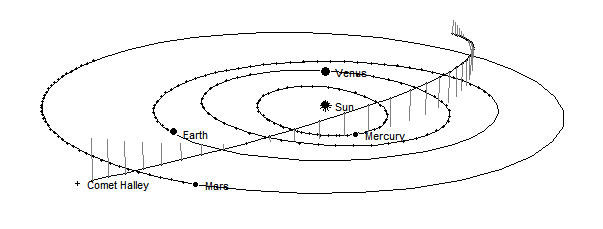
Comet Halley’s path through the inner solar system in 1985-86. Created using my LookingUp program.
Halley’s Comet has been swinging around the Sun countless times before the Chinese first recorded it. The illustration above shows the last time the comet entered the inner solar system in 1986. The comet’s path is from upper right to lower left. When the comet passes within about 3 astronomical units of the Sun, that is 3 times the Earth’s distance from the Sun, the ices in the comet begin to sublimate, escaping from the comet’s nucleus which liberates dust and larger solid material. The gasses and dust form the comet’s ion and dust tails. The larger material, gravel sized bits, end up in and around the comet’s orbit, and over time are spread out around and near the comet’s orbit. Halley’s orbit crosses the Earth’s orbit twice, inbound and outbound. In both cases these crossings are close enough to the plane of the Earth’s orbit to produce meteor showers.
On the inboard leg of the orbit it produces the Orionid meteor shower that peaks on October 22nd. A meteor shower is generally named for the point in the sky they seem to come from, be it a constellation or star. The point, called the radiant, moves during the days or weeks the shower is visible. The Orionids are named for the constellation Orion. The radiant is near his upraised arm.
The center of the outbound meteoroid stream crosses the Earth’s orbit where the Earth is on May 6th. Though they have a broad peak of about 5 days. This meteor shower is visible from April 19th to May28th. During that period the radiant points drifts quite a bit to the east. There are several meteor shower radiants in Aquarius, so they are named for the nearest star at peak.
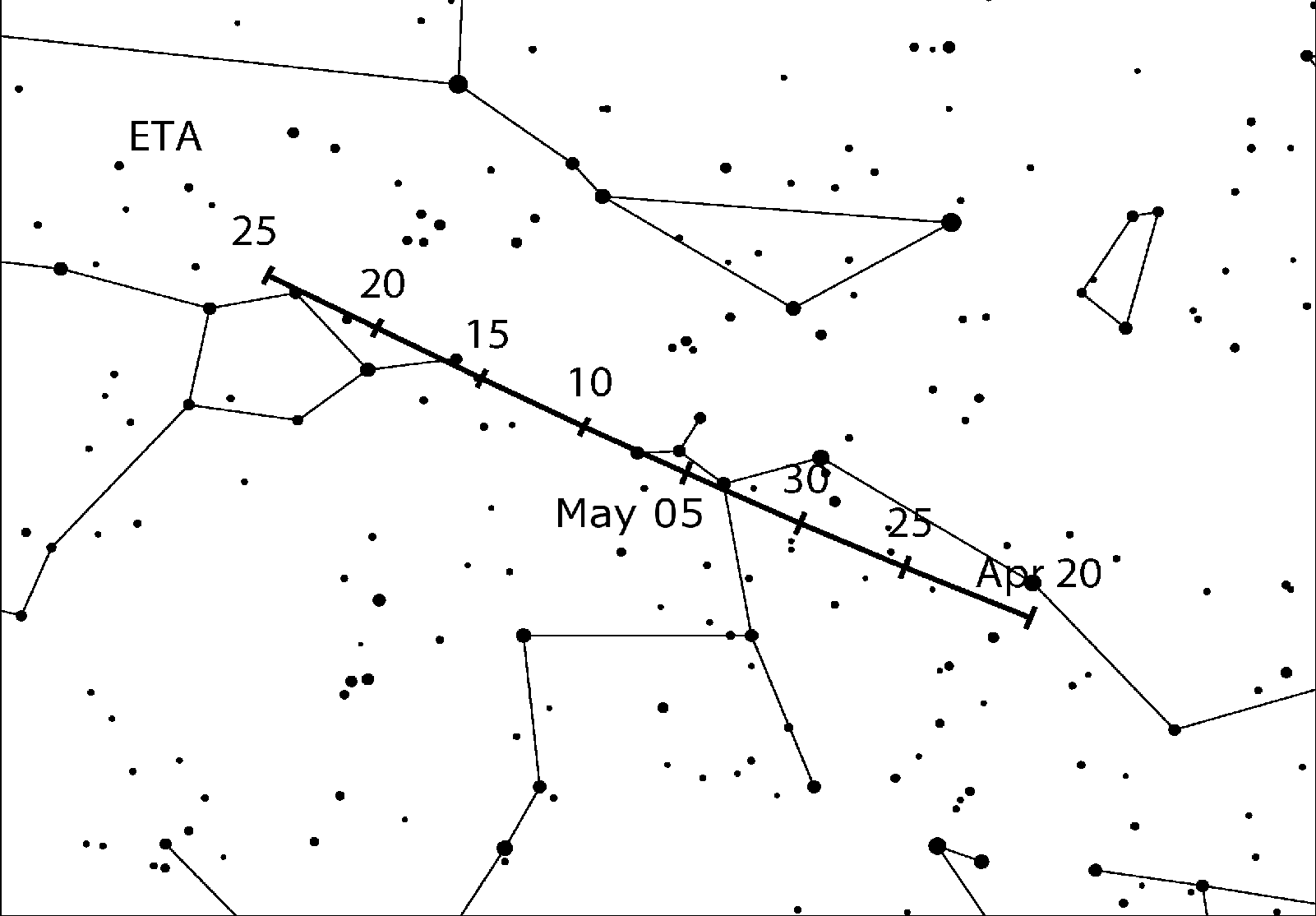
Motion of the Eta Aquariid radiant from April 20 to May 25. The triangle with the star near the center near May 05 is the asterism the Water Jar, a part of Aquarius. Eta Aquarii is the triangle star to the left. Source: PDF version of the International Meteor Organization 2019 Meteor Shower Calendar: https://www.imo.net/resources/calendar/
Though the Moon is new for this shower, the meteoroids are coming from near the direction of the Sun, so there is only an hour where the Eta Aquariids are best seen. For Northern Michigan the radiant rises at 3:30 a.m. on May 6th. Astronomical twilight begins at 4:30 a.m. when the sky begins to brighten. This meteor shower is best seen from the southern hemisphere.
05/03/2019 – Ephemeris – How do you take a picture of a black hole? Find out tonight.
Ephemeris for Friday, May 3rd. Today the Sun will be up for 14 hours and 19 minutes, setting at 8:49, and it will rise tomorrow at 6:28. The Moon, 1 day before new, will rise at 6:44 tomorrow morning.
Nearly a month ago the world was presented with the news and the image that the Earth spanning Event Horizon Telescope captured a picture of a black hole 55 million light years away. Tonight NMC Professor Jerry Dobek will explain how it was done at tonight’s meeting of the Grand Traverse Astronomical Society at Northwestern Michigan College’s Rogers Observatory starting at 8 p.m. He will explain how simultaneous observations of the black hole by 8 separate sub-millimeter radio telescopes that were separately recorded on disk. The disks were brought and processed together to produce the image. Starting at 9 p.m. if it’s clear there will be a star party featuring the brighter wonders of the darkening sky.
The times given are for the Traverse City/Interlochen area of Michigan. They may be different for your location.
Addendum
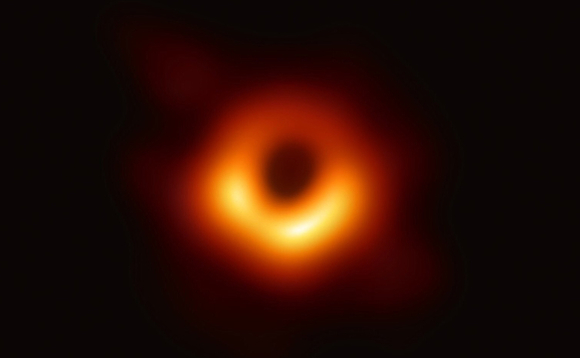
The first image of the black hole in M87. Credit Event Horizon Telescope.
05/02/2019 – Ephemeris – Apollo and the constellations of Corvus, Crater and Hydra
Ephemeris for Thursday, May 2nd. Today the Sun will be up for 14 hours and 17 minutes, setting at 8:48, and it will rise tomorrow at 6:30. The Moon, 2 days before new, will rise at 6:18 tomorrow morning.
The small constellation of Corvus the crow is located low in the south at 10:30 this evening. It’s made of 5 dim stars, but the pattern is a distinctive distorted box with two stars at the upper left marking that corner. To the right is a fainter constellation of a thick stemmed goblet called Crater. Both appear above the long constellation of Hydra the water snake who is slithering just above the southern horizon. In Greek mythology Corvus, then white, was the god Apollo’s pet. He once bid Corvus to take a cup and fetch him some water. Corvus however dallied and waited for a green fig to ripen. Corvus grabbed a snake and returned with a story on how the snake had delayed him. The angry Apollo turned the crow and all crows to this day black.
The times given are for the Traverse City/Interlochen area of Michigan. They may be different for your location.
Addendum
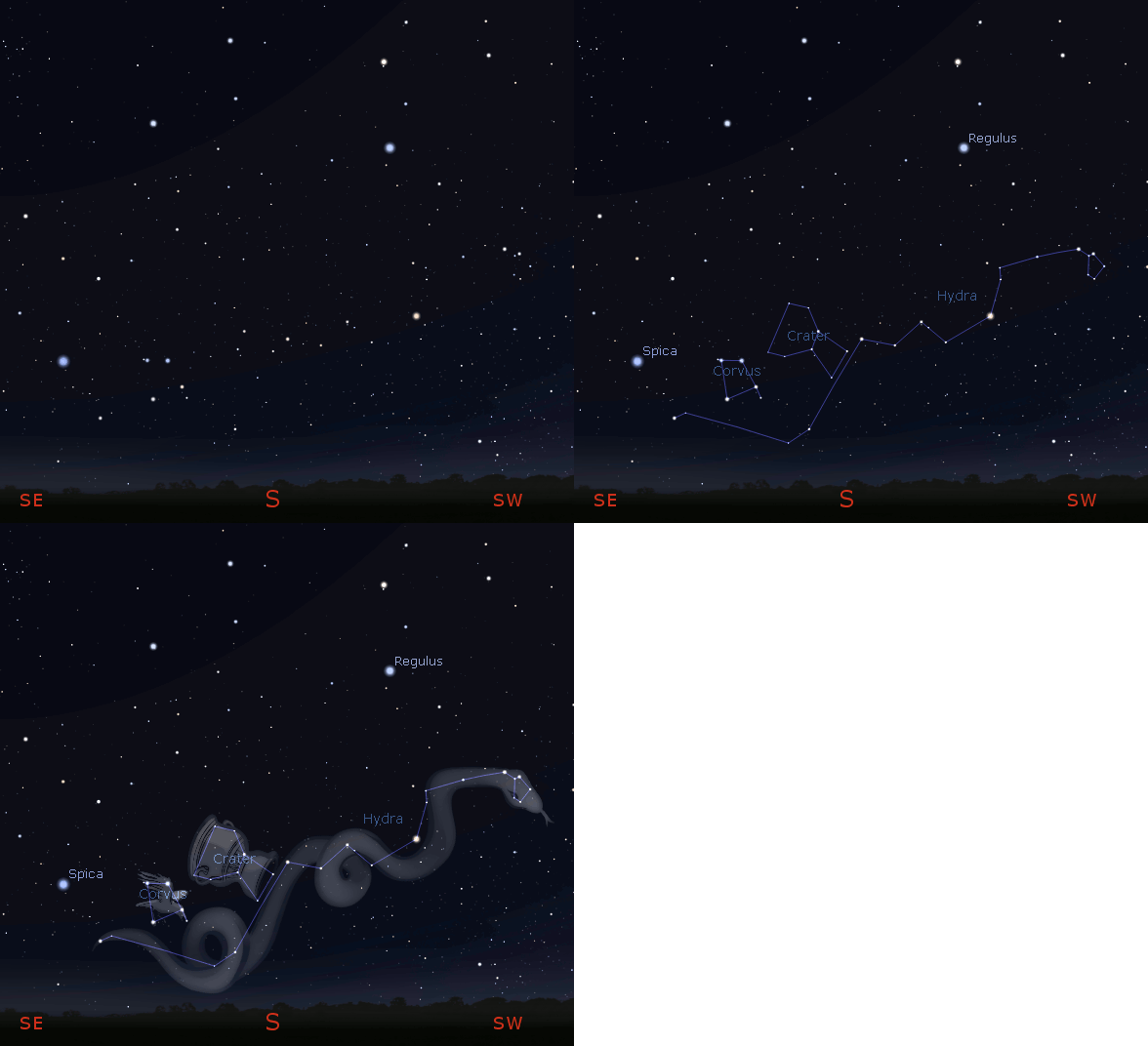
Corvus, Crater and Hydra finder chart for 10 p.m. May 2, 2019. Created using Stellarium and GIMP.
05/01/2019 – Ephemeris – Checking out the bright planets for May Day
Ephemeris for Wednesday, May 1st. Today the Sun will be up for 14 hours and 14 minutes, setting at 8:47, and it will rise tomorrow at 6:31. The Moon, 3 days before new, will rise at 5:54 tomorrow morning.
Let’s look at the planets for this first day of May. Mars will be in the western sky this evening, in the horns above the V-shaped stars of the face of Taurus the bull. It will set at 12:13 a.m. In the morning sky we have Jupiter, in Ophiuchus, which will rise tomorrow at 12:09 a.m. in the east-southeast. Saturn will be next to rise at 2 a.m., also in the east-southeast. It is in Sagittarius. Venus will rise 57 minutes before the Sun in the east. It will remain in our morning sky, though too close to the rising Sun to be easily glimpsed. In August it will pass behind the Sun to enter the evening sky. It will be in position later this year to be our bright evening Christmas Star. Mercury will rise only 32 minutes before the Sun.
The times given are for the Traverse City/Interlochen area of Michigan. They may be different for your location.
Addendum
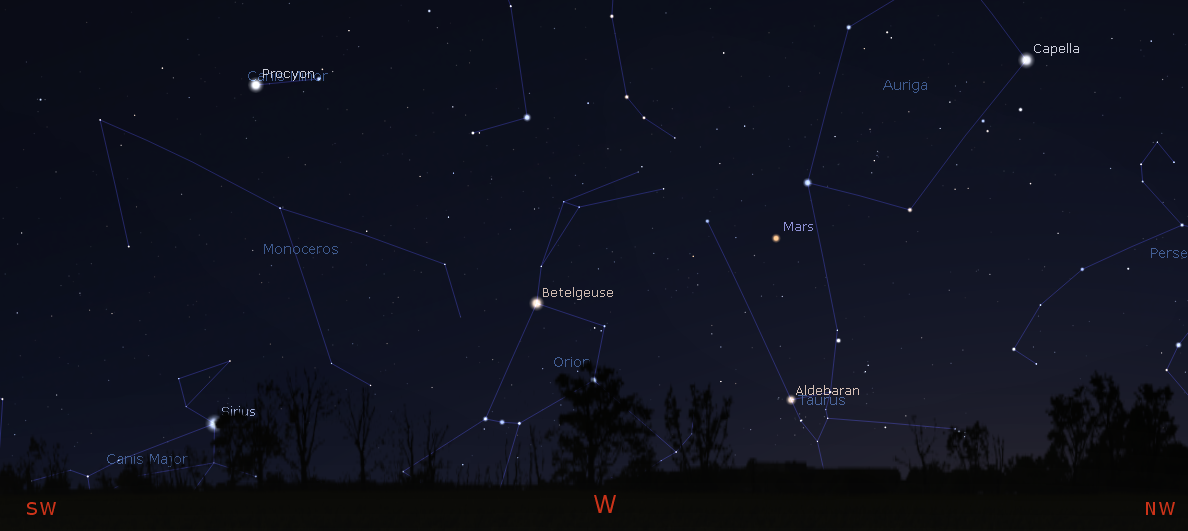
Mars and the setting winter stars tonight at 10 p.m. May 1, 2019. Click on the image to enlarge. Created using Stellarium.
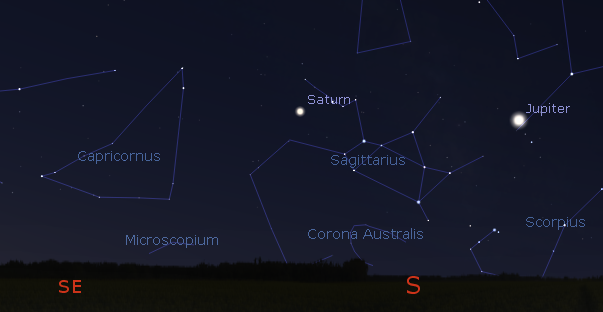
Morning planets and Moon at 5:30 a.m. May 1, 2019. Click on the image to enlarge. Note that at this time for the Grand Traverse area the International Space Station will be visible, crossing from the southwest starting at 5:25 and ending in the east-northeast at 5:31 a.m. Created using Stellarium.
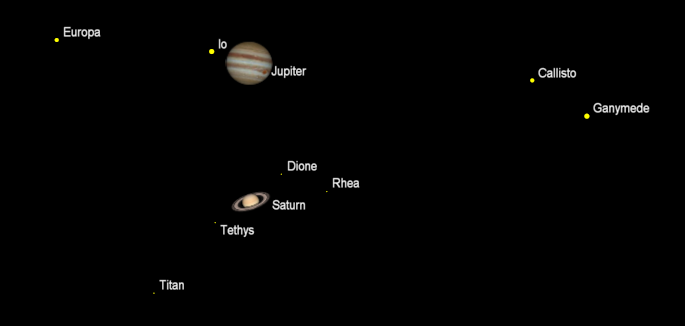
Jupiter and Saturn with the same magnification at 5:30 a.m. tomorrow morning May 2, 2019. Created using Cartes du Ciel (Sky Charts).
Io’s shadow will start to cross Jupiter’s disk at 9:27 UT or 5:27 a.m. EDT.
Io’s will start to transit the planet at 10:19 UT or 6:19 a.m. EDT.
Io events for observers west of here can be accessed from Project Pluto: https://www.projectpluto.com/jevent.htm#may.
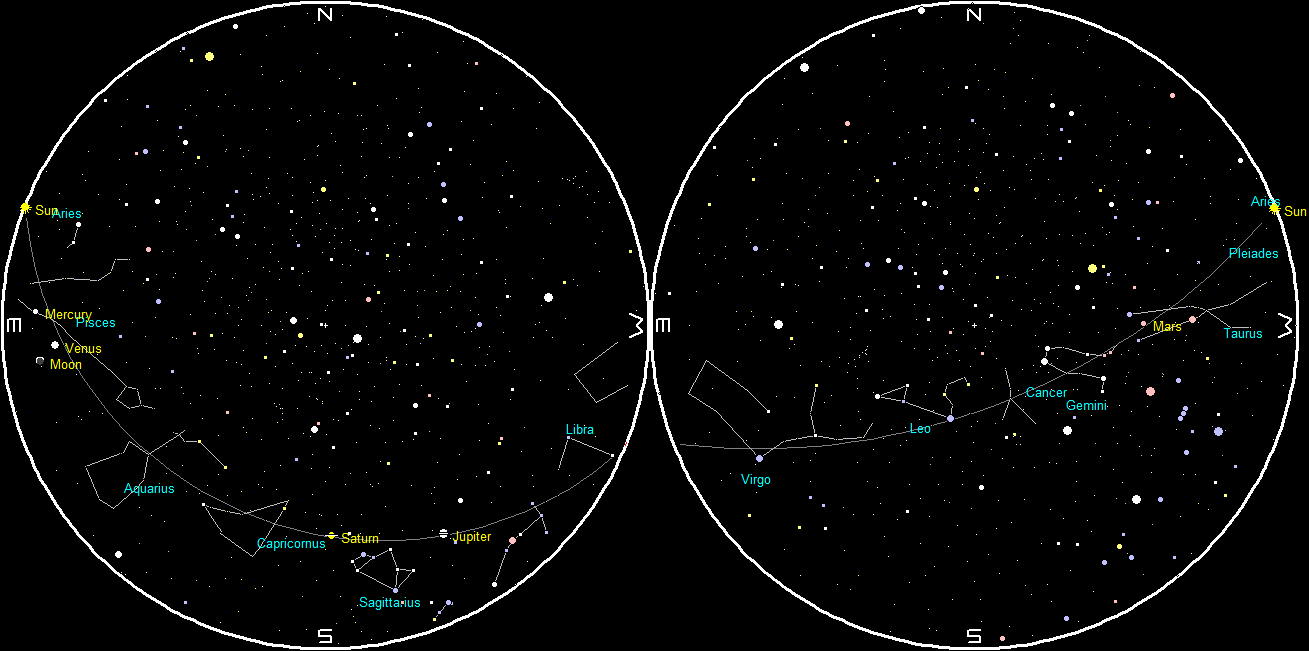
Planets and the Moon at sunset and sunrise of a single night starting with sunset on the right on May 1, 2019. The night ends on the left with sunrise on the 2nd. Click on the image to enlarge. Created using my LookingUp program.
04/30/2019 – Ephemeris – Previewing May skies
Ephemeris for Tuesday, April 30th. Today the Sun will be up for 14 hours and 11 minutes, setting at 8:46, and it will rise tomorrow at 6:33. The Moon, half way from last quarter to new, will rise at 5:30 tomorrow morning.
Let’s look ahead at the month of May, the month when the promise of spring is finally fulfilled. Daylight hours in the Interlochen/Traverse City area will increase from 14 hours and 14 minutes Tomorrow to 15 hours 19 minutes on the 31st. The altitude, or angle, of the sun above the southern horizon at local noon will ascend from 60 degrees tomorrow to 67 degrees at month’s end. The altitude of the sun in the Straits area will be a degree lower than that. Local apparent noon this month, when the sun passes due south, will be about 1:38 p.m. Early this month we’ll have The Eta Aquariid meteor shower early in the morning. Mars is our only evening planet, falling way behind the Earth 217 million miles (349 million km) away at mid-month.
The times given are for the Traverse City/Interlochen area of Michigan. They may be different for your location.
Addendum
May Evening Star Chart
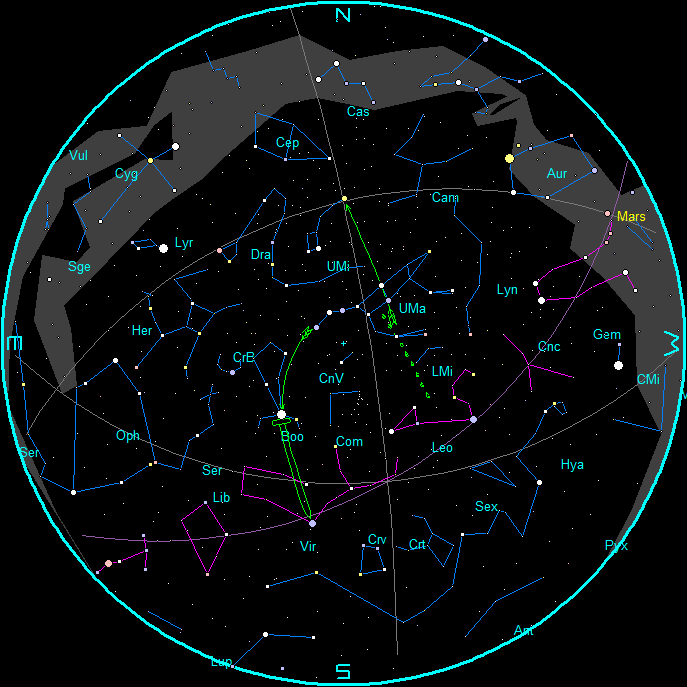
Star Chart for May 2019 (11 p.m. EDT May 15, 2019). Created using my LookingUp program. Click on image to enlarge.
The planets and stars are plotted for the 15th at 11 p.m. EDT in the evening and 5 a.m. for the morning chart. These are the chart times. Note that Traverse City is located approximately 45 minutes behind our time meridian, West 75° longitude. (An hour 45 minutes behind our daylight saving time meridian during EDT). To duplicate the star positions on a planisphere you may have to set it to 1 hour 45 minutes earlier than the current time.
Note the chart times of 10 p.m. and 5 a.m. are for the 15th. For each week before the 15th add ½ hour (28 minutes if you’re picky). For each week after the 15th subtract ½ hour. The planet positions are updated each Wednesday on this blog. For planet positions on dates other than the 15th, check the Wednesday planet posts on this blog.
May Morning Star Chart
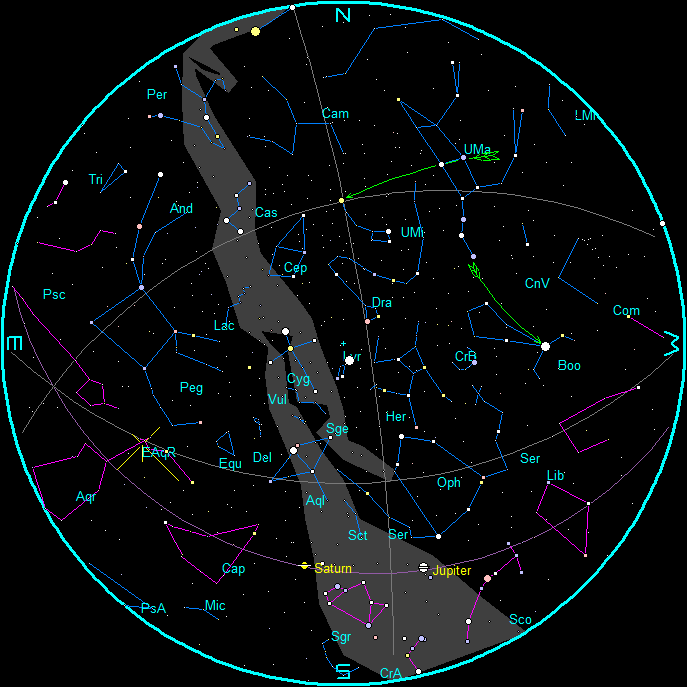
Star Chart for May mornings 2019 (5 a.m. EDT May 15, 2019). Created using my LookingUp program. Click on image to enlarge.
For a list of constellation names to go with the abbreviations click here.
- Pointer stars at the front of the bowl of the Big Dipper point to Polaris the North Star.
- Leaky dipper drips on Leo
- Follow the arc of the handle of the Big Dipper to the star Arcturus, and
- Extend like a spike to Spica,
- The Summer Triangle is in red.
- EaqR is the radiant of the Aquariid meteor shower that peaks on the 5th-6th. See Ephemeris Extra Saturday the 4th.
Twilight Limits, Nautical and Astronomical
| EDT | |||||||
| Traverse City |
Morning twilight | Evening twilight | Dark night | Moon | |||
| Date | Astro. | Nautical | Nautical | Astro. | Start | End | Illum. |
| 2019-05-01 | 4h41m | 5h25m | 22h02m | 22h46m | 22h46m | 4h41m | 0.11 |
| 2019-05-02 | 4h39m | 5h24m | 22h03m | 22h48m | 22h48m | 4h39m | 0.05 |
| 2019-05-03 | 4h37m | 5h22m | 22h05m | 22h50m | 22h50m | 4h37m | 0.02 |
| 2019-05-04 | 4h34m | 5h20m | 22h06m | 22h52m | 22h52m | 4h34m | 0 |
| 2019-05-05 | 4h32m | 5h18m | 22h08m | 22h54m | 22h54m | 4h32m | 0.01 |
| 2019-05-06 | 4h30m | 5h17m | 22h09m | 22h56m | 22h56m | 4h30m | 0.04 |
| 2019-05-07 | 4h28m | 5h15m | 22h11m | 22h58m | 23h58m | 4h28m | 0.09 |
| 2019-05-08 | 4h26m | 5h13m | 22h13m | 23h00m | – | 4h26m | 0.17 |
| 2019-05-09 | 4h24m | 5h12m | 22h14m | 23h02m | 1h00m | 4h24m | 0.27 |
| 2019-05-10 | 4h22m | 5h10m | 22h16m | 23h04m | 1h54m | 4h22m | 0.38 |
| 2019-05-11 | 4h20m | 5h08m | 22h17m | 23h06m | 2h41m | 4h20m | 0.5 |
| 2019-05-12 | 4h18m | 5h07m | 22h19m | 23h08m | 3h21m | 4h18m | 0.61 |
| 2019-05-13 | 4h16m | 5h05m | 22h20m | 23h10m | 3h55m | 4h16m | 0.73 |
| 2019-05-14 | 4h14m | 5h04m | 22h22m | 23h12m | – | – | 0.83 |
| 2019-05-15 | 4h12m | 5h02m | 22h23m | 23h14m | – | – | 0.91 |
| 2019-05-16 | 4h10m | 5h01m | 22h25m | 23h16m | – | – | 0.91 |
| 2019-05-17 | 4h08m | 4h59m | 22h26m | 23h18m | – | – | 0.96 |
| 2019-05-18 | 4h06m | 4h58m | 22h28m | 23h20m | – | – | 0.99 |
| 2019-05-19 | 4h04m | 4h56m | 22h29m | 23h22m | – | – | 1 |
| 2019-05-20 | 4h02m | 4h55m | 22h31m | 23h23m | – | – | 0.98 |
| 2019-05-21 | 4h00m | 4h54m | 22h32m | 23h25m | 23h25m | – | 0.93 |
| 2019-05-22 | 3h59m | 4h53m | 22h33m | 23h27m | 23h27m | 0h07m | 0.87 |
| 2019-05-23 | 3h57m | 4h51m | 22h35m | 23h29m | 23h29m | 0h56m | 0.8 |
| 2019-05-24 | 3h55m | 4h50m | 22h36m | 23h31m | 23h31m | 1h38m | 0.71 |
| 2019-05-25 | 3h54m | 4h49m | 22h38m | 23h33m | 23h33m | 2h13m | 0.62 |
| 2019-05-26 | 3h52m | 4h48m | 22h39m | 23h35m | 23h35m | 2h43m | 0.52 |
| 2019-05-27 | 3h50m | 4h47m | 22h40m | 23h37m | 23h37m | 3h10m | 0.42 |
| 2019-05-28 | 3h49m | 4h46m | 22h42m | 23h38m | 23h38m | 3h34m | 0.33 |
| 2019-05-29 | 3h47m | 4h45m | 22h43m | 23h40m | 23h40m | 3h47m | 0.24 |
| 2019-05-30 | 3h46m | 4h44m | 22h44m | 23h42m | 23h42m | 3h46m | 0.16 |
| 2019-05-31 | 3h44m | 4h43m | 22h45m | 23h44m | 23h44m | 3h44m | 0.09 |
Twilight calendar was generated using Cartes du Ciel (Sky Charts).
See my blog post: Twilight Zone for the definitions of the different periods of twilight here: https://bobmoler.wordpress.com/2018/09/27/.
NASA Calendar of Planetary Events
May  1 We          Venus: 27.8° W
     2 Th  7:39 am Moon-Venus: 3.9° N
     4 Sa  6:45 pm New Moon
     5 Su  9:12 am Eta Aquariid Meteor Shower: ZHR = 60
     6 Mo  5:52 pm Moon-Aldebaran: 2.4° S
     7 Tu  7:36 pm Moon-Mars: 3.3° N
     9 Th  1:46 am Moon North Dec.: 22.2° N
     9 Th  2:50 pm Moon Ascending Node
    10 Fr  9:35 pm Moon-Beehive: 0°
    11 Sa  9:12 pm First Quarter
    13 Mo  5:53 pm Moon Perigee: 369000 km
    18 Sa  5:11 pm Full Moon
    20 Mo 12:54 pm Moon-Jupiter: 1.8° S
    21 Tu  8:59 am Mercury Superior Conj.
    22 We  2:41 am Moon South Dec.: 22.3° S
    22 We  3:12 pm Moon Descending Node
    22 We  6:25 pm Moon-Saturn: 0.6° N
    26 Su  9:27 am Moon Apogee: 404100 km
    26 Su 12:33 pm Last Quarter
Jun  1 Sa          Venus: 20° W
All event times are given for UTC-5 hr: Eastern Standard or UTC-4 hr: Daylight Saving Time starting May 10th.
Sky Events Calendar by Fred Espenak and Sumit Dutta (NASA’s GSFC),
http://eclipse.gsfc.nasa.gov/SKYCAL/SKYCAL.html.
If you go to the above site you can print out a list like the above for the entire year or calendar pages for your time zone.
Sun and Moon Rising and Setting Events
     LU                  Ephemeris of Sky Events for Interlochen/TC
     May, 2019    Local time zone: EDT
     +-----------------------------------------------------------------------+
     | DATE |  SUN     SUN  DAYLIGHT|   TWILIGHT*    |MOON  RISE OR    ILLUM |
     |      |  RISE    SET    HOURS |  END    START  |PHASE SET** TIME FRACTN|
     +=======================================================================+
     |Wed  1| 06:33a  08:47p  14:14 | 09:59p  05:21a |      Rise 05:54a    9%|
     |Thu  2| 06:31a  08:48p  14:17 | 10:01p  05:19a |      Rise 06:18a    4%|
     |Fri  3| 06:30a  08:49p  14:19 | 10:02p  05:17a |      Rise 06:44a    1%|
     |Sat  4| 06:28a  08:51p  14:22 | 10:04p  05:15a |New   Set  08:36p    0%|
     +------+-----------------------+----------------+-----------------------+
     |Sun  5| 06:27a  08:52p  14:24 | 10:06p  05:14a |      Set  09:44p    1%|
     |Mon  6| 06:26a  08:53p  14:27 | 10:07p  05:12a |      Set  10:52p    5%|
     |Tue  7| 06:24a  08:54p  14:30 | 10:09p  05:10a |      Set  11:58p   10%|
     |Wed  8| 06:23a  08:55p  14:32 | 10:10p  05:09a |      Set  12:59a   18%|
     |Thu  9| 06:22a  08:57p  14:35 | 10:12p  05:07a |      Set  01:54a   28%|
     |Fri 10| 06:20a  08:58p  14:37 | 10:13p  05:05a |      Set  02:41a   38%|
     |Sat 11| 06:19a  08:59p  14:39 | 10:15p  05:04a |F Qtr Set  03:21a   49%|
     +------+-----------------------+----------------+-----------------------+
     |Sun 12| 06:18a  09:00p  14:42 | 10:16p  05:02a |      Set  03:55a   61%|
     |Mon 13| 06:17a  09:01p  14:44 | 10:18p  05:00a |      Set  04:26a   72%|
     |Tue 14| 06:15a  09:03p  14:47 | 10:19p  04:59a |      Set  04:54a   81%|
     |Wed 15| 06:14a  09:04p  14:49 | 10:21p  04:57a |      Set  05:22a   89%|
     |Thu 16| 06:13a  09:05p  14:51 | 10:22p  04:56a |      Set  05:51a   95%|
     |Fri 17| 06:12a  09:06p  14:53 | 10:24p  04:55a |      Set  06:22a   99%|
     |Sat 18| 06:11a  09:07p  14:55 | 10:25p  04:53a |Full  Rise 08:59p  100%|
     +------+-----------------------+----------------+-----------------------+
     |Sun 19| 06:10a  09:08p  14:57 | 10:27p  04:52a |      Rise 10:07p   98%|
     |Mon 20| 06:09a  09:09p  15:00 | 10:28p  04:50a |      Rise 11:10p   95%|
     |Tue 21| 06:08a  09:10p  15:02 | 10:30p  04:49a |      Rise 12:07a   89%|
     |Wed 22| 06:07a  09:11p  15:03 | 10:31p  04:48a |      Rise 12:56a   83%|
     |Thu 23| 06:06a  09:12p  15:05 | 10:33p  04:47a |      Rise 01:37a   75%|
     |Fri 24| 06:06a  09:13p  15:07 | 10:34p  04:45a |      Rise 02:13a   66%|
     |Sat 25| 06:05a  09:14p  15:09 | 10:35p  04:44a |      Rise 02:43a   57%|
     +------+-----------------------+----------------+-----------------------+
     |Sun 26| 06:04a  09:15p  15:11 | 10:37p  04:43a |L Qtr Rise 03:09a   47%|
     |Mon 27| 06:03a  09:16p  15:13 | 10:38p  04:42a |      Rise 03:34a   38%|
     |Tue 28| 06:03a  09:17p  15:14 | 10:39p  04:41a |      Rise 03:57a   29%|
     |Wed 29| 06:02a  09:18p  15:16 | 10:40p  04:40a |      Rise 04:21a   20%|
     |Thu 30| 06:01a  09:19p  15:17 | 10:42p  04:39a |      Rise 04:46a   13%|
     |Fri 31| 06:01a  09:20p  15:19 | 10:43p  04:38a |      Rise 05:13a    7%|
     +-----------------------------------------------------------------------+
     * Nautical Twilight
     ** Moonrise or moonset, whichever occurs between sunrise and sunset
04/29/2019 – Ephemeris – Follow the arc to Arcturus
Ephemeris for Monday, April 29th. Today the Sun will be up for 14 hours and 8 minutes, setting at 8:45, and it will rise tomorrow at 6:34. The Moon, 3 days past last quarter, will rise at 5:06 tomorrow morning.
The Big Dipper, now nearing the zenith at 10 p.m. points to several stars and constellations. It’s handle points to two bright stars. First we follow the arc of the handle to the bright orange star Arcturus, the 4th brightest night-time star. The reason I say night-time is that the sun is a star also but by definition is not out at night. The arc to Arcturus is a how to find Arcturus and a clue to its name. Arcturus, midway up the sky in the east, lies at the base point of the kite shaped constellation of Boötes the herdsman. From Arcturus, straighten out the arc to a spike and one soon arrives at Spica a blue-white star in Virgo the virgin, now low in the southeast. Spica is also sometimes pronounced ‘Speeka’.
The times given are for the Traverse City/Interlochen area of Michigan. They may be different for your location.
Addendum
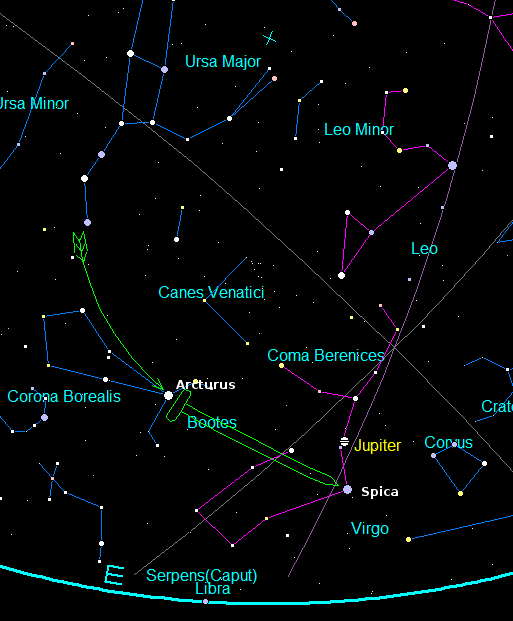
How to find the stars Arcturus and Spica from the Big Dipper in late April. Created using my LookingUp program.
04/26/2019 – Ephemeris – The story of Ursa Major and Boötes
Ephemeris for Arbor Day, Friday, April 26th. Today the Sun will be up for 14 hours even, setting at 8:41, and it will rise tomorrow at 6:39. The Moon, at last quarter today, will rise at 3:39 tomorrow morning.
Seen in the east at 10 p.m. tonight is the kite shaped constellation of Boötes the herdsman. The bright star Arcturus is at the bottom of the kite to the right. It is pointed to by the arc of the handle of the Big Dipper, higher in the east. Boötes represents a young hunter named Arcas, son of Callisto, a beautiful young lady who had the misfortune of being loved by Zeus the chief of the Greek gods. Zeus’ wife Hera, found out about it, and since she couldn’t punish Zeus, turned the poor woman into a bear. Arcas, many years later, unaware of the events surrounding his mother’s disappearance was about to kill the bear when Zeus intervened and placed them both in the sky to save her, as Arcas still pursues her across the sky nightly.
The times given are for the Traverse City/Interlochen area of Michigan. They may be different for your location.
Addendum
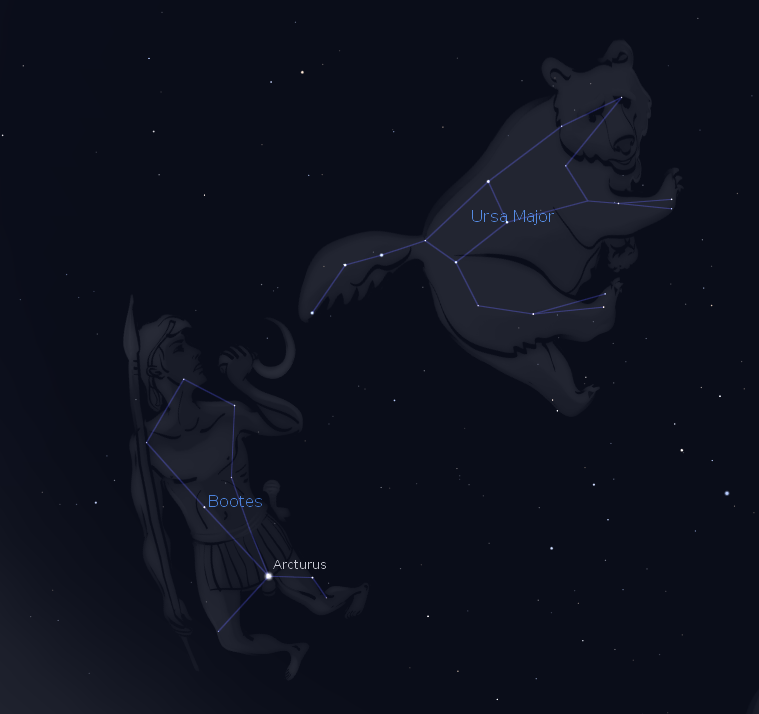
Bootes and Ursa Major aka Arcas chasing Callisto around the pole of the sky. Created using Stellarium.
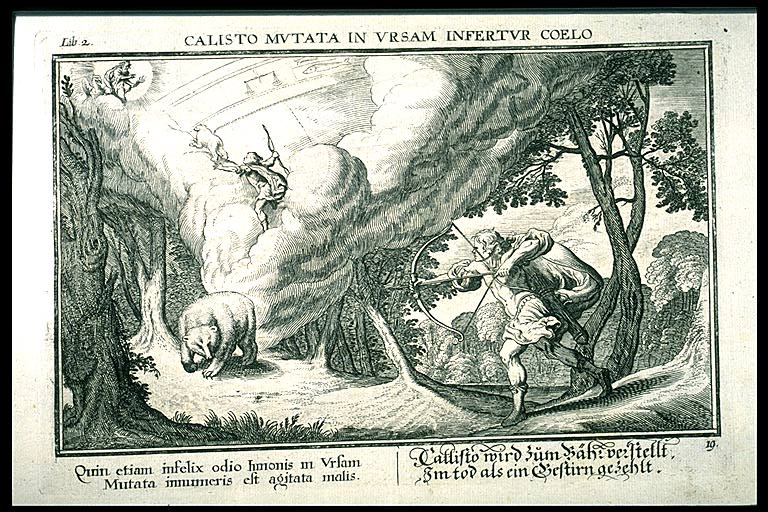
Arcas about to slay the bear by the 17th century artist Baur. Source: University of Virginia Electronic Text Center
04/25/2019 – Ephemeris – About Ursa Major
Ephemeris for Thursday, April 25th. Today the Sun will be up for 13 hours and 57 minutes, setting at 8:40, and it will rise tomorrow at 6:40. The Moon, 1 day before last quarter, will rise at 3:01 tomorrow morning.
The Big Dipper has many names to many peoples and countries around the world. Officially to the International Astronomical Union, it’s part of Ursa Major, the Great Bear, also recognized by many Native Americans, and Europeans. It’s even in the Bible. In the Book of Job the star Arcturus is a miss-translation. Arcturus means Guardian of the Bear. It should be the Bear itself, and most modern translations catch that mistake. Anyway, the Anishinaabe people around the Great Lakes say the stars of the bear are that of another creature, that of the Fisher, Ojiig, a mammal of the weasel family that brought summer to the Earth, and now heralds the seasons by his position in the sky.
The times given are for the Traverse City/Interlochen area of Michigan. They may be different for your location.
Addendum

An animation to visualize the Great Bear, Ursa Major and the Fisher, Ojiig, from the stars of and around the Big Dipper. Created using Stellarium.

