02/17/2017 – Ephemeris – The stars of the Belt of Orion
Ephemeris for Friday, February 17th. The Sun will rise at 7:39. It’ll be up for 10 hours and 35 minutes, setting at 6:14. The Moon, 1 day before last quarter, will rise at 1:15 tomorrow morning.
Let’s take a closer look at the central constellation of the winter sky, the giant hunter Orion. His most remarkable feature in his Belt of three stars in a straight line. It’s the brightest, straightest and most equidistant line of stars I know of. It points down and left to the brightest star Sirius the dog star and up to the right of Aldebaran the angry bloodshot eye in Taurus the bull. The star names as taught to me by Grand Rapids Public Museum curator Evelyn Grebel in my youth in the 1950s was from left to right Alnitak, Alnilam and Mintaka. All the names reference a belt or girdle. Alnitak lights up a faint cloud that can sometimes be glimpsed with binoculars called the Flame Nebula, Just below it and invisible except in photographs is the Horsehead Nebula.
Times are for the Traverse City/Interlochen area of Michigan. They may be different for your location.
Addendum
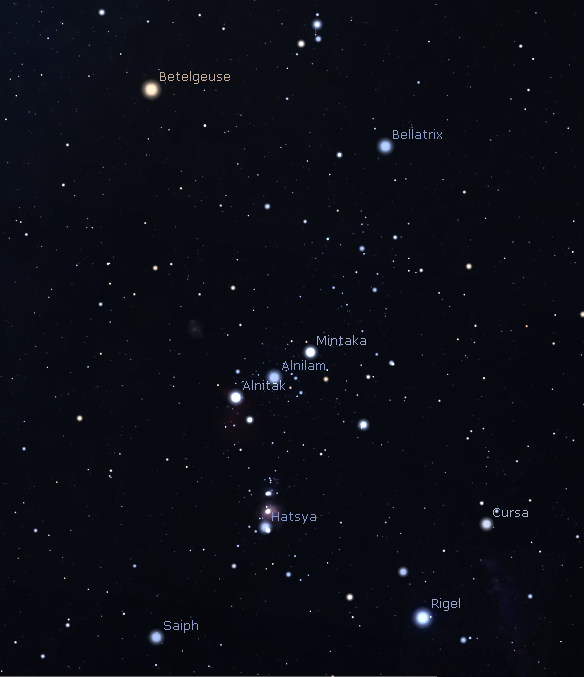
Orion’s named stars including the belt stars. Created using Stellarium.
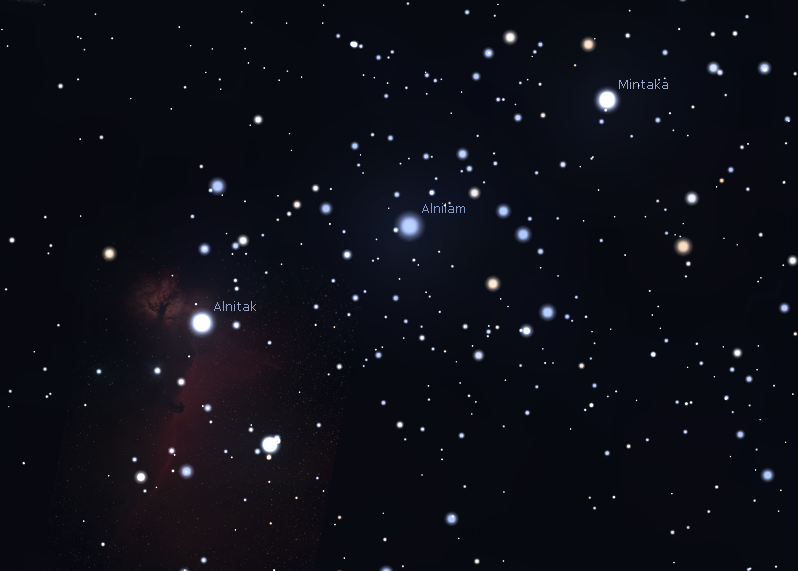
Orion’s belt stars showing the nebulae illuminated by Alnitak. The Flame Nebula above left of it and the Horsehead Nebula below. At this scale the horse’s head figure appears as a dark bump into the left edge of the red glow.
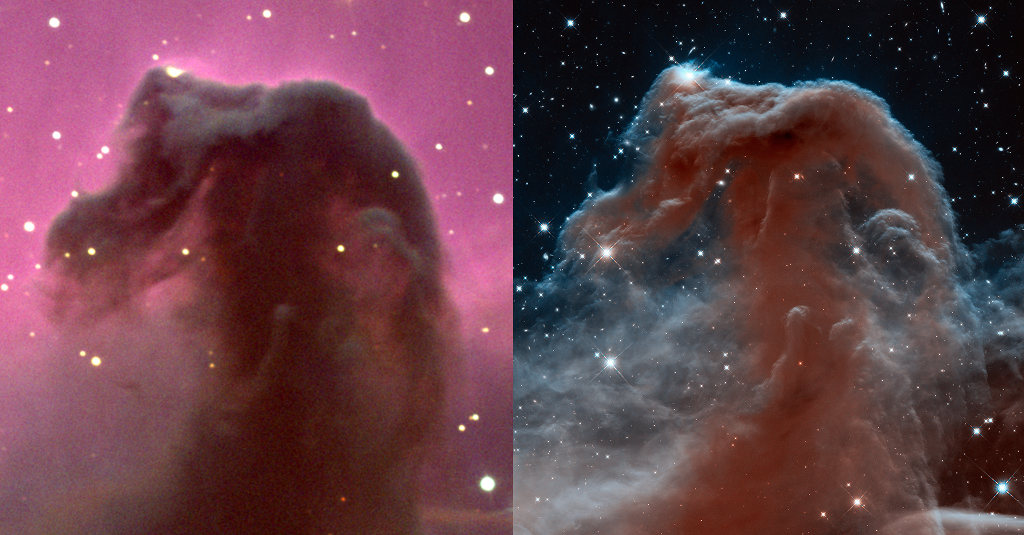
The Horsehead Nebula: On the left in visible light from the National Optical Astronomy Observatory, while the image on the right is from the Hubble Space Telescope’s near infrared camera. Infrared light penetrated dust and gas better than visible light. This image is rotated about 90 degrees counterclockwise from the above image.
02/16/2017 – Ephemeris – The Winter Circle
Ephemeris for Thursday, February 16th. The Sun will rise at 7:40. It’ll be up for 10 hours and 32 minutes, setting at 6:12. The Moon, 2 days before last quarter, will rise at 12:17 tomorrow morning.
The winter skies are blessed with more first magnitude stars than any other season. These are the twenty-one brightest stars in the sky. Six of these stars lie in a large circle centered on the seventh. This circle is up all evening now that we are in the heart of winter. Starting high overhead is Capella in Auriga the charioteer. Moving clockwise, we come to Aldebaran in the face of Taurus the Bull. Then down to Orion’s knee we find Rigel. Down and left is the brightest star of all Sirius the Dog Star in Canis Major Orion’s large hunting dog, lowest of these stars in the south. Moving up and left there is Procyon in Canis Minor, Then above it is Pollux in Gemini the twins. All are centered on Betelgeuse in Orion.
Times are for the Traverse City/Interlochen area of Michigan. They may be different for your location.
Addendum
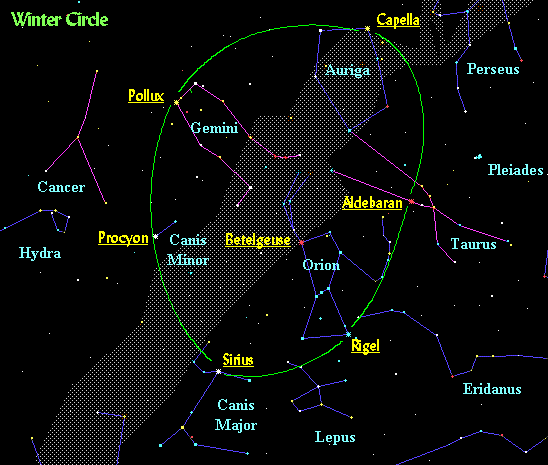
The Winter Circle of 1st magnitude stars. Created using my LookingUp program.
02/15/2017 – Ephemeris – Your weekly look at the bright planets
Ephemeris for Wednesday, February 15th. The Sun will rise at 7:42. It’ll be up for 10 hours and 29 minutes, setting at 6:11. The Moon, 3 days before last quarter, will rise at 11:18 this evening.
Let’s check out the bright planets for this week. Saturn can be glimpsed this morning in the southeast at 7 a.m. It will rise tomorrow at 4:10 a.m. in the east-southeast. Jupiter can be seen in the south-southwest this morning above the star Spica in Virgo and below left of the Moon. Jupiter will rise tonight in the east at 10:47 p.m. Venus and Mars are in the evening sky. At 7 p.m. these planets will be seen in the west-southwestern sky. Venus is unmistakable as the brilliant evening star, Mars will be left and above it and much dimmer. Venus will set at 9:52 p.m. while Mars will set at 10:14. Venus exhibits a dazzling crescent in small telescopes now, but a month from now as it gets closer to Earth the thinning crescent will be big enough to be seen in binoculars.
Times are for the Traverse City/Interlochen area of Michigan. They may be different for your location.
Addendum
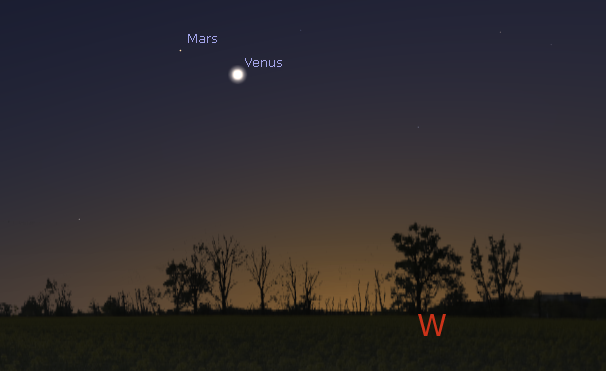
Venus and Mars in the evening twilight of about an hour after sunset. 7 p.m. February 15, 2017. Venus is now drawing away from Mars as it heads toward the Sun faster than Mars. Their apparent paths won’t cross again until October in the morning sky. Created using Stellarium.
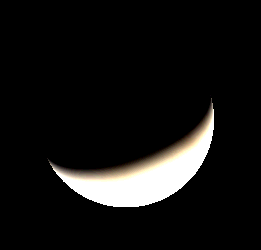
Venus as it might appear in a telescope tonight February 15, 2017. I processed the image to overexpose it as it would appear in a telescope. Venus is getting closer to the Earth at 40.5 million miles, 65.2 million km. It is 38.3″ (arc seconds) in diameter, slightly smaller that Jupiter’s apparent diameter. Created using Stellarium.
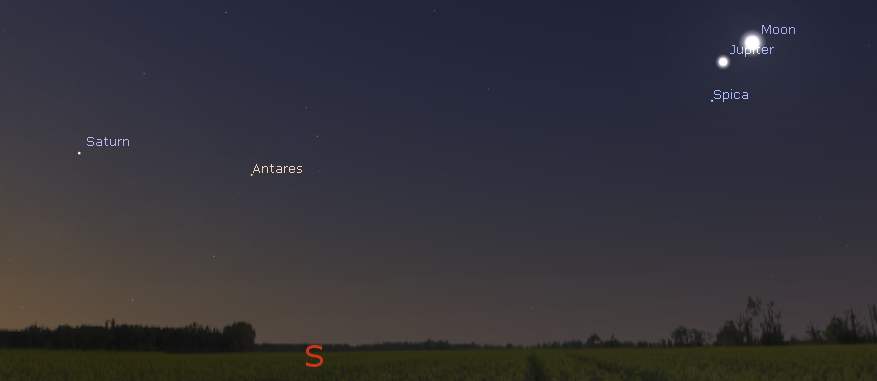
Jupiter in the south above the star Spica and the waning gibbous Moon to the right with Saturn in the southeast at 7 a.m. this morning, February 15, 2017. Created using Stellarium.
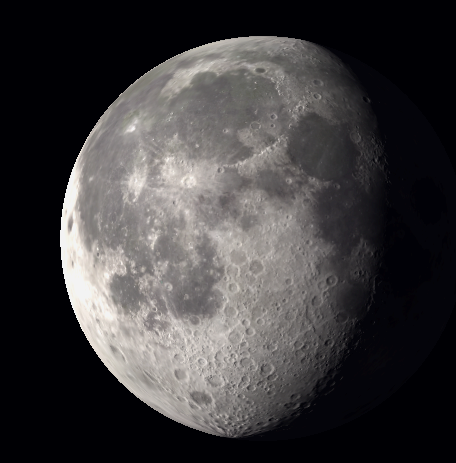
What the waning gibbous Moon might look like in binoculars this morning at 7 a.m. February 15, 2017. Created using Stellarium.
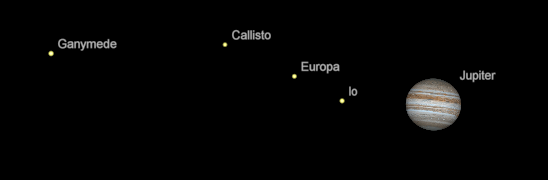
Jupiter and its moons hanging on the east side of the planet as they might appear in telescopes this morning at 7 a.m. February 15, 2017. Created using Cartes du Ciel (Sky Charts).
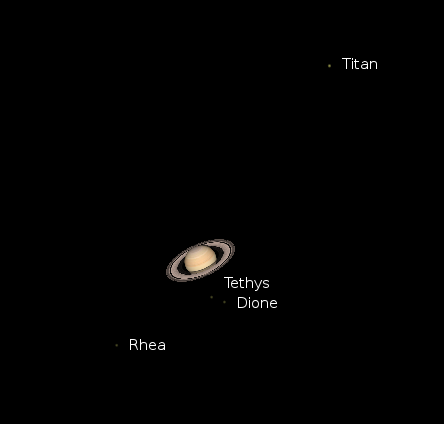
Saturn and its brightest moons as they might appear in telescopes this morning at 7 a.m. February 15, 2017. Created using Cartes du Ciel (Sky Charts).
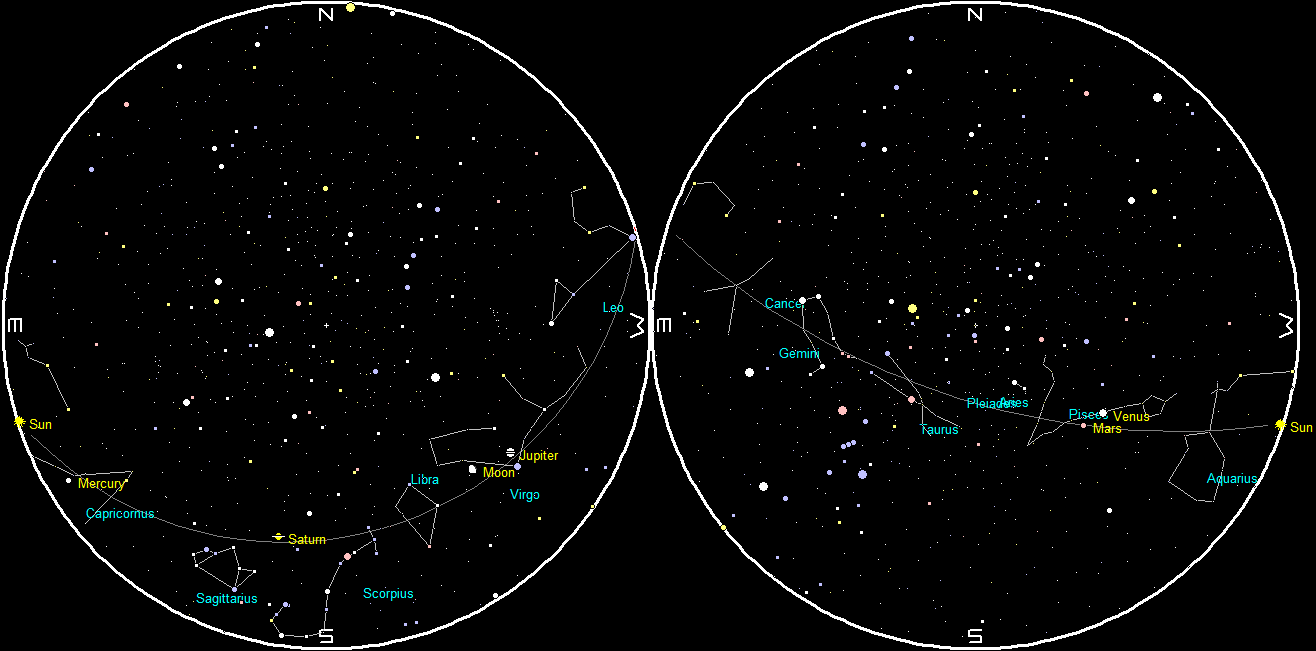
Planets and Moon at sunset and sunrise of a single night starting with sunset on the right on February 15, 2017. The night ends on the left with sunrise on February 16. Click on image to enlarge. Created using my LookingUp program.
02/14/2017 – Ephemeris – Is the Moon waxing or waning?
Ephemeris for St Valentine’s Day, Tuesday, February 14th. The Sun will rise at 7:43. It’ll be up for 10 hours and 26 minutes, setting at 6:10. The Moon, half way from full to last quarter, will rise at 10:18 this evening.
This morning the waning gibbous moon will be a way to the right of the bright planet Jupiter which is in the southwest at 7 a.m. Tomorrow morning the Moon will appear above and right of Jupiter. My granddaughter is taking earth science in school now and is confused about when the Moon is waxing or waning. If it’s waxing it is getting fuller each night. If waning the Moon’s phase is getting thinner each night. But I told her that if you can see the Moon in the evening it’s waxing, and if you can see the Moon in the morning it’s waning. It works except around full Moon where you’d need a calendar for the full moon date or if it rises before or after sunset.
Times are for the Traverse City/Interlochen area of Michigan. They may be different for your location.
Addendum
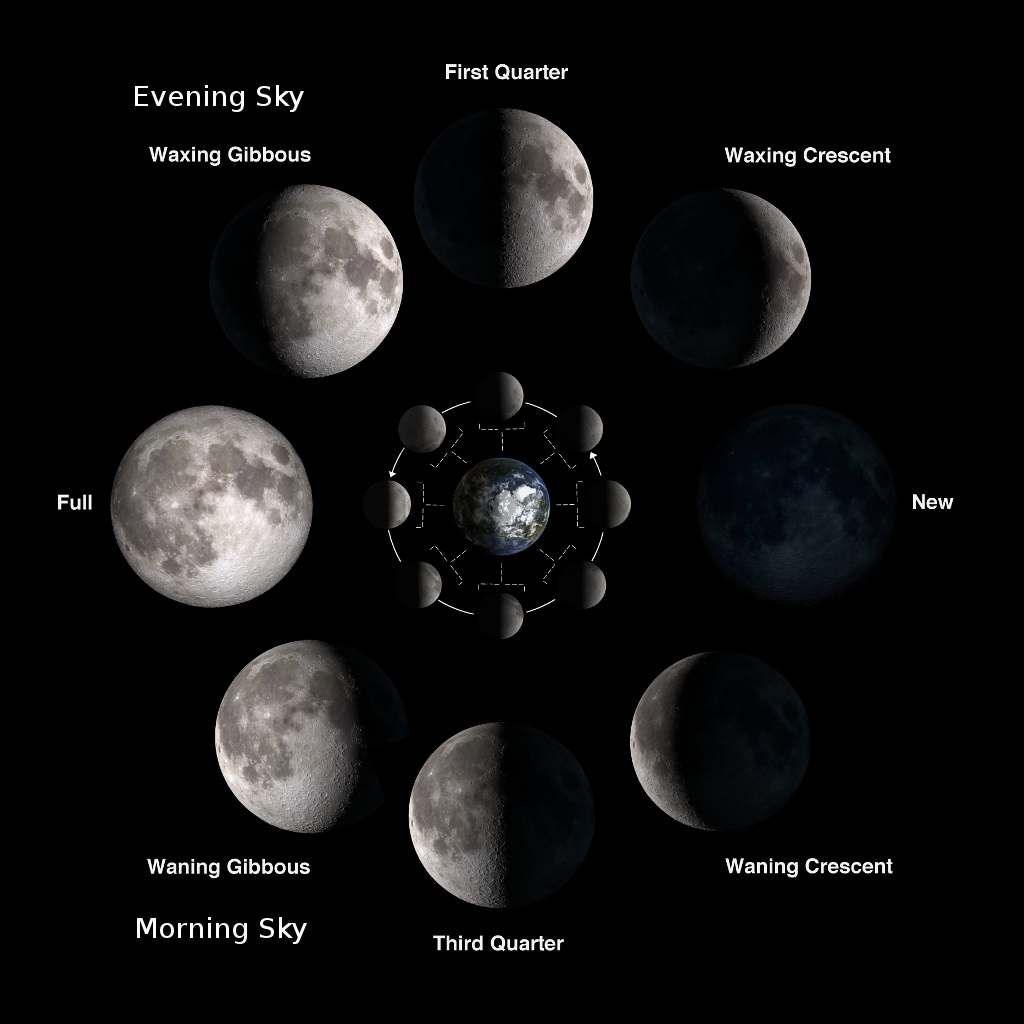
A graphic explaining the Moon’s position with respect to the Earth and Sun (which is off the diagram to the right). The Moon orbits the Earth in a counterclockwise direction. Credit NASA/Bill Dunford.
02/13/2017 – Ephemeris – The brightest night-time star has a tiny stellar companion
Ephemeris for Monday, February 13th. The Sun will rise at 7:45. It’ll be up for 10 hours and 23 minutes, setting at 6:08. The Moon, 3 days past full, will rise at 9:16 this evening.
Sirius is the brightest night-time star and is located in the south at 9 p.m. below and a bit left of Orion the Hunter. We’ve visited Sirius last week. But there is another star in the Sirius system that is practically invisible due to Sirius’ dazzling glare. It’s Sirius B, nicknamed the Pup, alluding to Sirius’ Dog Star title. The tiny star was suspected as far back as 1834 due to Sirius’ wavy path in the sky against the more distant stars. Sirius is only 8 light years away. Sirius A and the Pup have 50 year orbits of each other. The star was first seen by Alvan Clark in 1862 while testing a new telescope. The Pup was the first of a new class of stars to be discovered, white dwarfs. The Pup is about the size of the Earth, with the mass of our Sun; its out of fuel and slowly collapsing.
Times are for the Traverse City/Interlochen area of Michigan. They may be different for your location.
Addendum
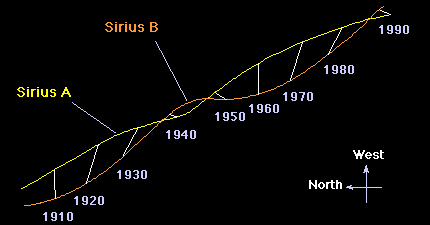
Sirius A & B’s path in the sky showing the wobble that betrayed the Pup’s presence. Credit Mike Guidry, University of Tennessee.
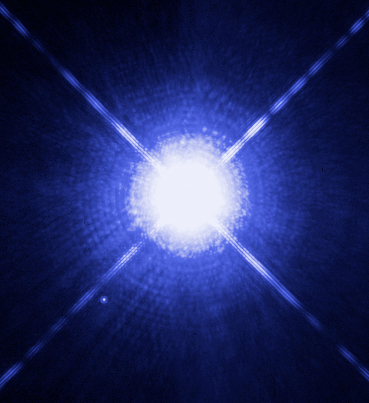
Sirius A and B (near the diffraction spike to the lower left), A Hubble Space Telescope photograph. Credit NASA, ESA.
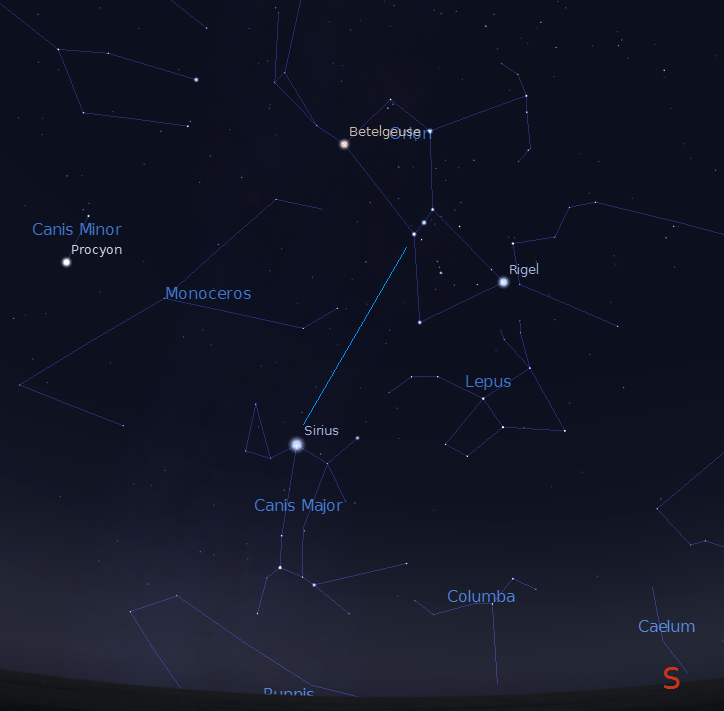
Orion’s Belt points to Sirius. Created using Stellarium.
07/10/2017 – Ephemeris – There’s a penumbral eclipse of the Moon tonight
Ephemeris for Friday, February 10th. The Sun will rise at 7:49. It’ll be up for 10 hours and 15 minutes, setting at 6:04. The Moon, at full today, will rise at 5:58 this evening.
This evening there will be a penumbral eclipse of the moon, which will reach its peak at 7:45 p.m. The moon, on its left side will be slightly darkened as the Moon passes through the Earth’s partial outer shadow where the Sun is only partially blocked by the Earth. Only the left side of he Moon will show the effect, which is best seen wearing sunglasses to reduce the Moon’s glare. The Northwestern Michigan College’s Rogers Observatory will be open to view the event from 6:45 to 8:45 p.m. but only if it’s clear. This event does not require a telescope to appreciate, but it might be nice to view it with others. The observatory is located south of Traverse City on Birmley Road between Keystone and Garfield roads.
Times are for the Traverse City/Interlochen area of Michigan. They may be different for your location.
Addendum
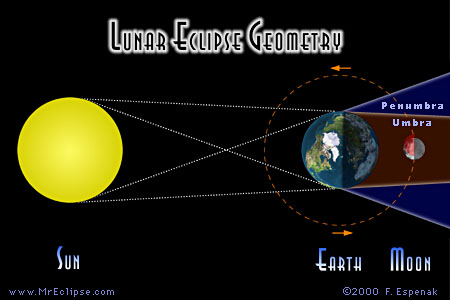
How lunar eclipses occur. For this eclipse the Moon will miss the umbra but will penetrate the deep into the penumbra. Credit NASA/Fred Espenak.
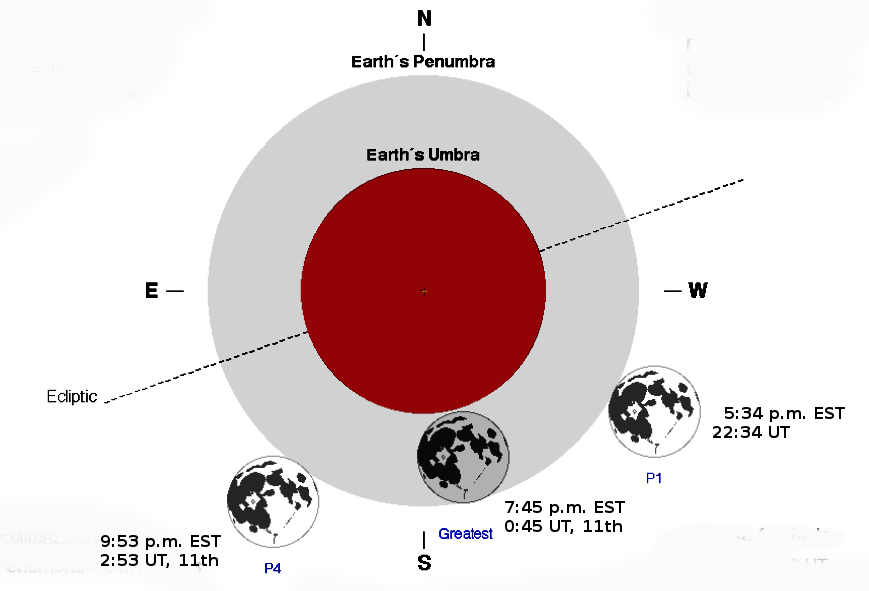
Diagram of the penumbral lunar eclipse on the evening of February 10, 2016 for the Eastern time zone. Diagram adapted from Fred Espenak, NASA GSFC.
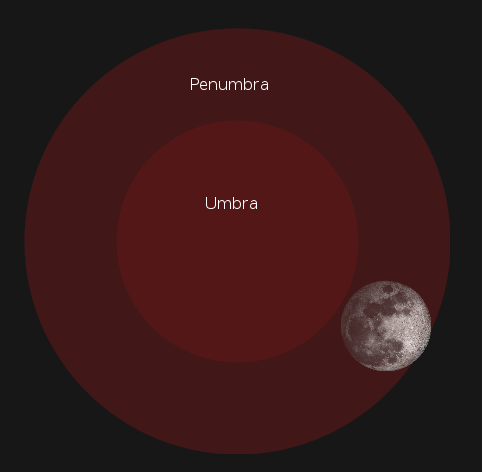
This is the maximum of the February 10th penumbral lunar eclipse. The Moon will appear to move diagonally down to the left. It is shown at maximum eclipse at 7:45 p.m. (0:45 UT February 11). The diagram is oriented for viewing from northern Michigan. Created using Cartes du Ciel.
NASA’s pdf page on this eclipse: https://eclipse.gsfc.nasa.gov/LEplot/LEplot2001/LE2017Feb11N.pdf
02/09/2017 – Ephemeris – Tomorrow’s penumbral eclipse of the Moon
Ephemeris for Thursday, February 9th. The Sun will rise at 7:50. It’ll be up for 10 hours and 12 minutes, setting at 6:03. The Moon, 1 day before full, will set at 7:28 tomorrow morning.
Tomorrow evening, clouds willing, we see an odd partial eclipse of the Moon called a penumbral lunar eclipse. What is a penumbra? It’s the fuzzy outer part of a shadow that’s cast when the light source isn’t a pin point. Look at your shadow in the sunlight, especially that of your head. The outline isn’t sharp. That outer fuzziness of the shadow is your penumbra where the Sun isn’t completely blocked., while the dark inner shadow is the umbra, where the Sun is completely blocked by your head. Tomorrow evening the eclipse will actually start before the Moon rises. The Moon should appear pretty much normal until it passes deep into the penumbra of the Earth’s shadow. Deepest penetration will occur at 7:45 pm. Where the upper left part of the Moon will appear dimmer than the rest of it.
Times are for the Traverse City/Interlochen area of Michigan. They may be different for your location.
Addendum
Diagram of the penumbral lunar eclipse on the evening of February 10, 2016 for the Eastern time zone. Diagram adapted from Fred Espenak, NASA GSFC.
P1 is the first contact with the shadow and P4 the last. Nothing will be noticed at these times. Only when closest to the greatest eclipse will the part of the moon nearest the inner shadow will show darkening.
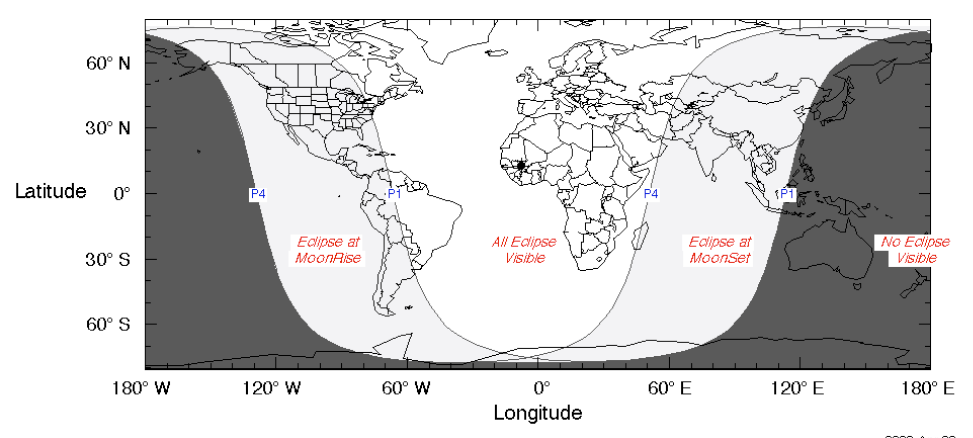
Only from the lighter parts of the map will the eclipse be visible. Diagram from Fred Espenak, NASA GSFC.
02/08/2017 – Ephemeris – Four bright planets are visible, two each in the evening and morning
Ephemeris for Wednesday, February 8th. The Sun will rise at 7:52. It’ll be up for 10 hours and 9 minutes, setting at 6:01. The Moon, 2 days before full, will set at 6:44 tomorrow morning.
Let’s check out the bright planets for this week. Saturn can be glimpsed this morning in the southeast at 7 a.m. It will rise tomorrow at 4:35 a.m. in the east-southeast. Jupiter can be seen in the south-southwest this morning above the star Spica in Virgo. Jupiter will rise tonight at 11:19 p.m. Venus and Mars are in the evening sky. At 7 p.m. these planets will be seen in the west-southwestern sky. Venus is unmistakable as the brilliant evening star, Mars will be left and above it and much dimmer. Mars will set at 10:14. Venus itself will set at 9:52 p.m. Venus exhibits a dazzling fat crescent in small telescopes now, but a month from now as it gets closer to Earth the thinning crescent will be big enough to be seen in binoculars.
Times are for the Traverse City/Interlochen area of Michigan. They may be different for your location.
Addendum
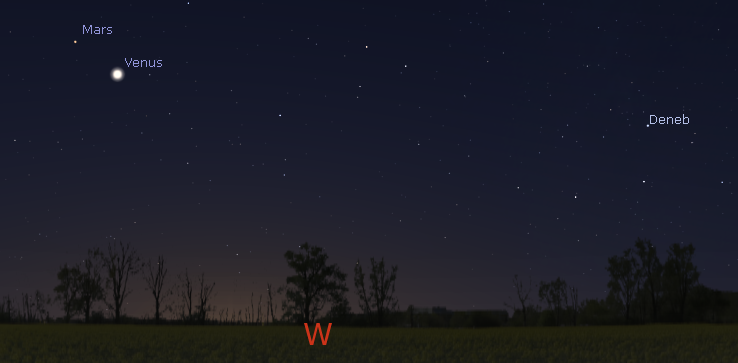
Venus and Mars in the evening twilight of about an hour after sunset. 7 p.m. February 8, 2017. Venus is now drawing away from Mars as it heads toward the Sun faster than Mars. Their apparent paths won’t cross again until October in the October sky. Created using Stellarium.
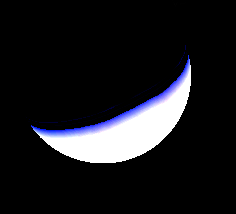
Venus as it might appear in a telescope tonight February 8, 2017. I processed the image to overexpose it as it would appear in a telescope. Created using Stellarium.
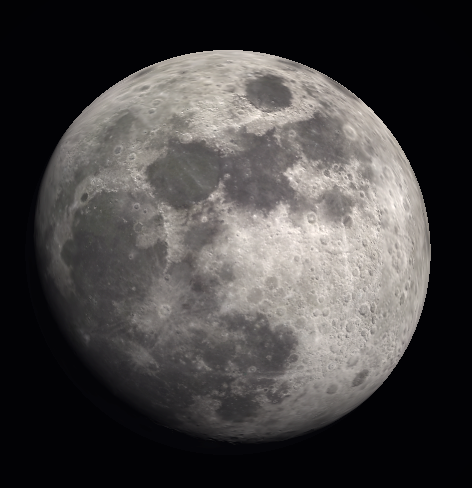
What the Moon might look like in binoculars tonight at 7 p.m. February 8, 2017. Created using Stellarium.
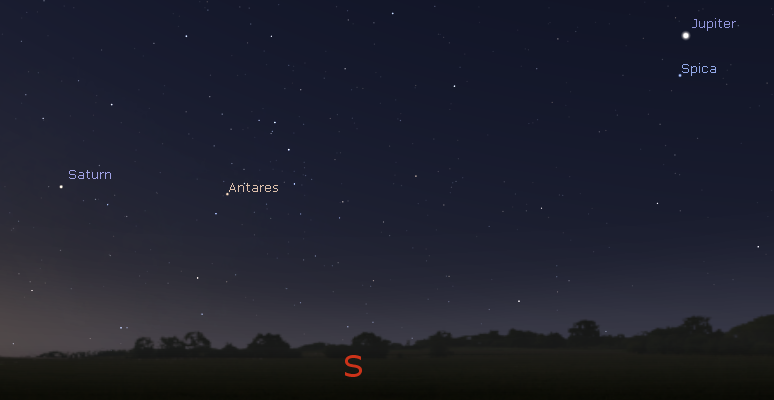
Jupiter in the south above the star Spica with Saturn the southeast at 7 a.m. this morning, February 9, 2017. Created using Stellarium.
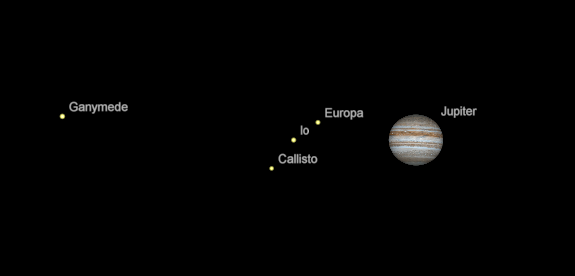
Jupiter and its moon in a compact arrangement as they might appear in telescopes this morning at 7 a.m. February 8, 2017. Created using Stellarium.
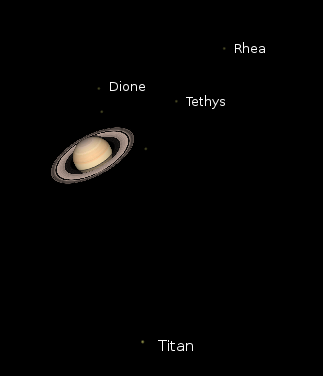
Saturn and its brightest moons as they might appear in telescopes this morning at 7 a.m. February 8, 2017. Created using Cartes du Ciel (Sky Charts).
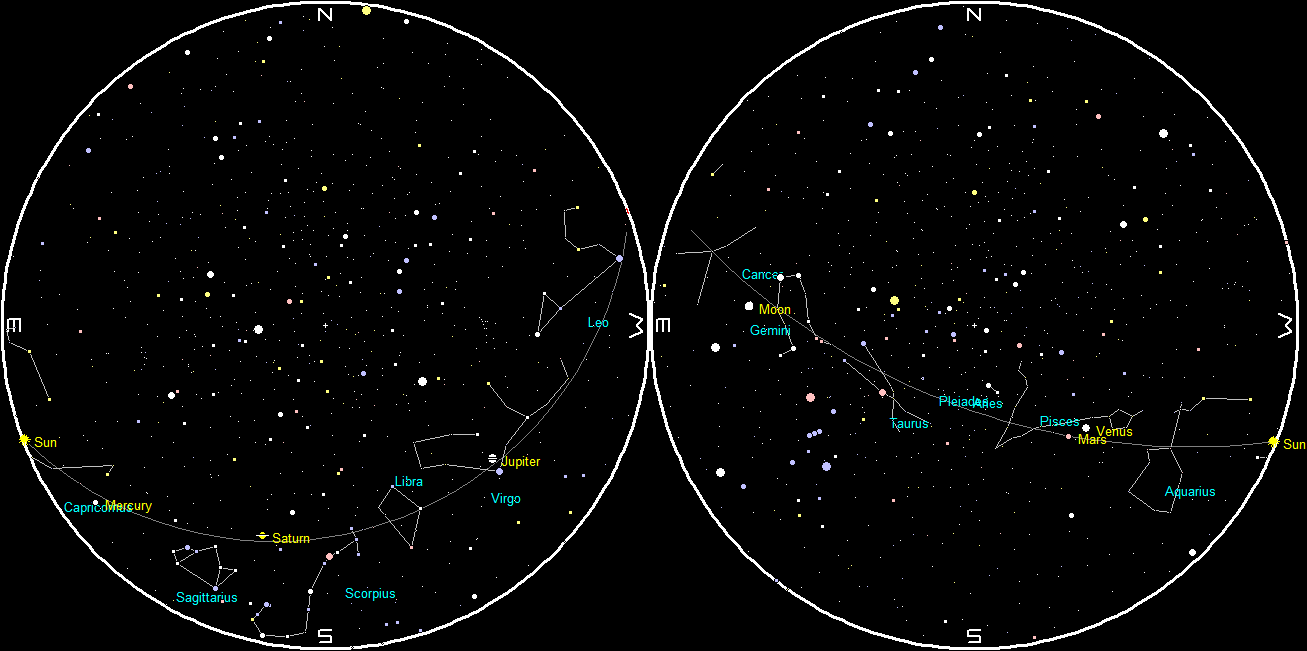
The planets and Moon at sunset and sunrise of a single night starting with sunset on the right on February 8, 2017. The night ends on the left with sunrise on February 9. Click on image to enlarge. Created using my LookingUp program.
02/07/2017 – Ephemeris – Sirius: an important star in history
Ephemeris for Tuesday, February 7th. The Sun will rise at 7:53. It’ll be up for 10 hours and 6 minutes, setting at 6:00. The Moon, 3 days before full, will set at 5:53 tomorrow morning.
The brightest star-like object in the evening sky is Sirius, also known as the Dog Star. It also is the brightest night-time star in our skies period. Tonight at 9 p.m. it’s located in the southeastern sky. The Dog Star name comes from its position at the heart of the constellation Canis Major, the great dog of Orion the hunter. The three stars of Orion’s belt tilt to the southeast and point to Sirius. The name Sirius means ‘Dazzling One’, a reference to its great brilliance and twinkling. Its Egyptian name was Sothis, and its appearance in the dawn skies in late June signaled the flooding of the Nile, and the beginning of the Egyptian agricultural year. Sirius owes much of its brightness to the fact that it lies quite close to us, only about 8 light years away.
Times are for the Traverse City/Interlochen area of Michigan. They may be different for your location.
Addendum
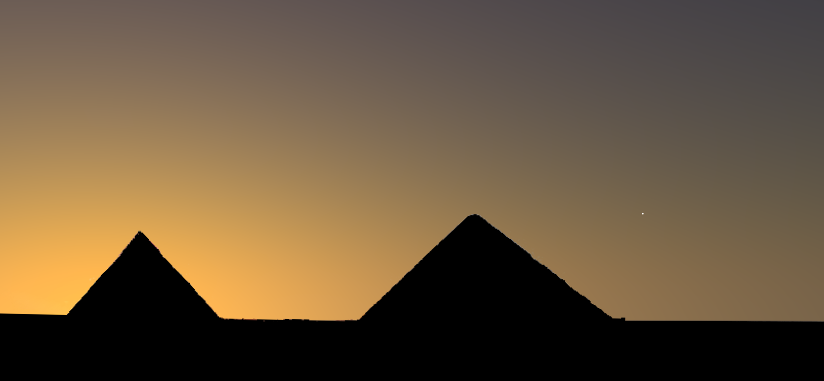
A simulation of the heliacal rising of Sothis (Sirius) with the Egyptian Pyramids circa 2000 BC. Note that Sirius is just visible to the right of the nearest Pyramid. Created using Stellarium and GIMP.
A heliacal rising is the first appearance of a star or planet in the morning after disappearing weeks or months before in the evening twilight.
02/06/2017 – Ephemeris – The Moon is at perigee today
Ephemeris for Monday, February 6th. The Sun will rise at 7:54. It’ll be up for 10 hours and 4 minutes, setting at 5:58. The Moon, 3 days past first quarter, will set at 4:56 tomorrow morning.
At 9 this morning the Moon will be at perigee, the closest it gets to the Earth in its current orbit of the Earth. Had the Moon been full it would be called a super-moon. The Moon isn’t just orbiting the Earth, but it is also pushed around by the Sun, which has a greater hold on he Moon than the Earth, but also by Jupiter and Venus, plus all the other objects in the solar system to a far lesser degree. You are not going to see it rise this afternoon at 1:48, so the big Moon on the horizon optical illusion doesn’t come into play. It will appear its highest at 9:21 this evening, some 63 degrees above the horizon. By then it will be some 3500 miles or so closer than when it’s on the horizon, because we’re on the Moon facing side of the Earth. Look up, there the Moon doesn’t really look very big at all, does it?
Times are for the Traverse City/Interlochen area of Michigan. They may be different for your location.
Addendum
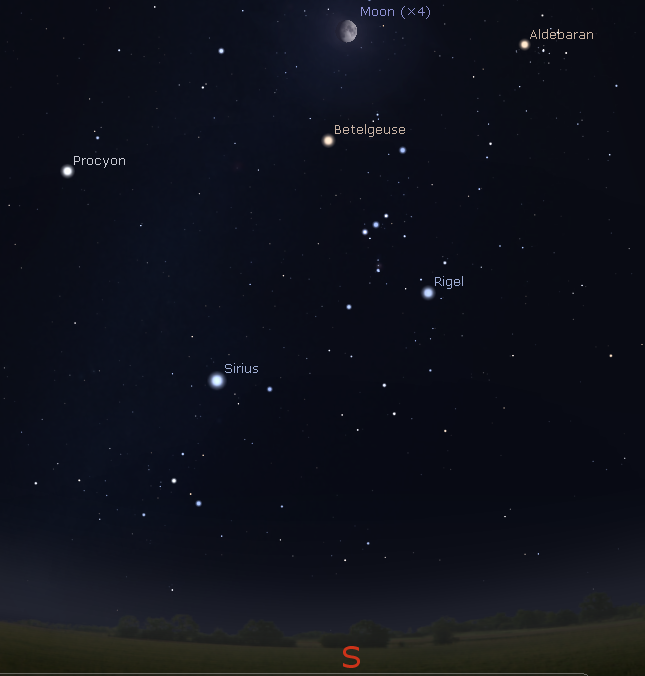
The Moon and the stars tonight at 9:21 p.m. Don’t be fooled by the size of the Moon. Here it appears 4 times its actual diameter, and 16 times its area in this image. It actually appears really small. But it will appear a lot bigger when it sets due to the horizon illusion. Created using Stellarium.

