11/24/2015 – Ephemeris – The bright planets are all in the morning sky
Ephemeris for Tuesday, November 24th. The Sun will rise at 7:51. It’ll be up for 9 hours and 16 minutes, setting at 5:07. The Moon, 1 day before full, will set at 7:10 tomorrow morning.
Let’s check out the whereabouts of the bright naked eye planets a day early this week because of Thursday’s occultation of Aldebaran by the Moon that I want to talk about tomorrow. Saturn and Mercury are too close to the direction of the Sun to be seen now. In the morning sky there are three bright planets. Jupiter will be the first to rise, at 1:30 a.m. in the east-northeast. Mars will rise next at 2:59 a.m. in the east, followed by Venus at 3:56 a.m. also in the east. Mars lies in line between Venus below and Jupiter above, a bit more than a third the way from Venus to Jupiter. Jupiter and Mars will continue to pull away from Venus. Jupiter will meet up with Venus again next year in a very close conjunction in late August. Venus is also approaching the bright star Spica in Virgo the virgin which is now below it.
Times are for the Traverse City/Interlochen area of Michigan. They may be different for your location.
Addendum
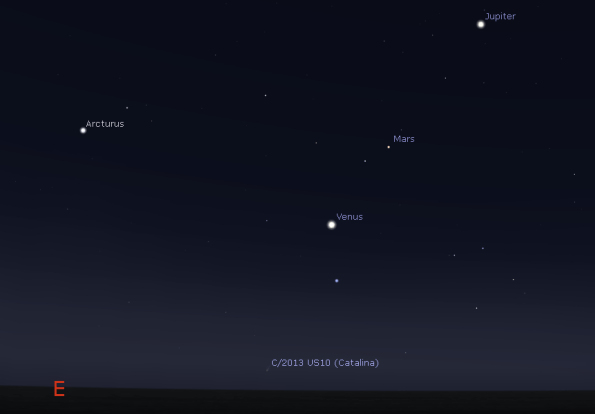
Jupiter, Mars and Venus appear in the southeast at 6 a.m., November 25, 2015.
Note Comet Catalina near the Horizon. I’ll have more on it Thursday and Friday. Created using Stellarium.
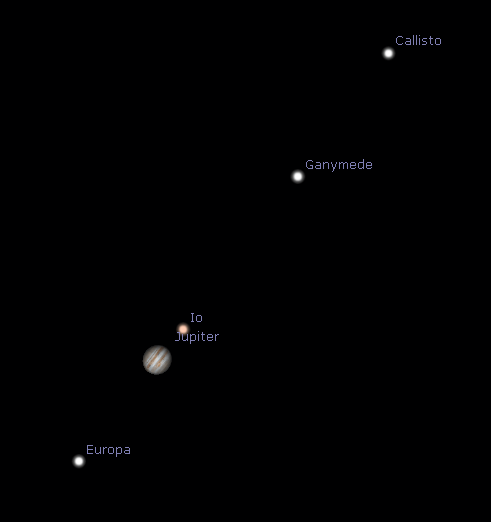
Jupiter and moons in a telescope at 6 a.m. November 25, 2015. Created using Stellarium.
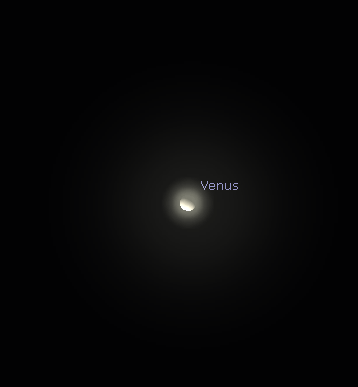
Venus as seen in a telescope as seen at the same magnification as Jupiter above, at 6 a,m. November 25, 2015. Created using Stellarium.
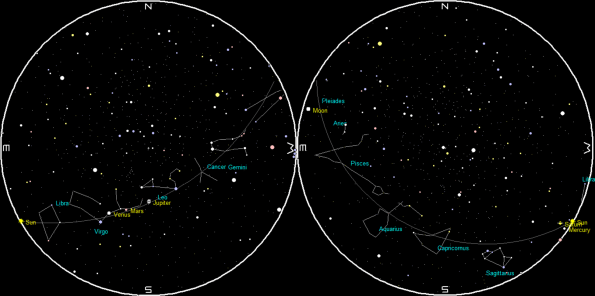
This is a chart showing the sunrise and sunset skies for November 24, 2015 showing the location of the planets and the Moon at that time. Created using my LookingUp program. Click on the image to enlarge.
11/23/2015 – Ephemeris – An occultation of Aldebaran by the Moon will be visible to much of the northern US Thursday morning
Ephemeris for Monday, November 23rd. The Sun will rise at 7:49. It’ll be up for 9 hours and 18 minutes, setting at 5:08. The Moon, 2 days before full, will set at 5:58 tomorrow morning.
Thursday morning, Thanksgiving Day here in the US, the Moon will occult or pass in front of the bright star Aldebaran for the northern half of the United States, and Canada. I have a special post on my blog dated yesterday, November 22nd. It’s titled Aldebaran Occultation November 26, 2015 from Northern Michigan (click here) with all the details. My blog is bobmoler.wordpress.com, or do an Internet search for Bob Moler, That’s Moler spelled M-O-L-E-R, no extra letters. Aldebaran is the bright orange star in the face of the constellation Taurus the bull. You will need at least a pair of binoculars to pick out Aldebaran next to the Moon. Aldebaran will disappear at about 5:38 a.m. and reappear about 6:29 a.m. for Interlochen and Traverse City.
Times are for the Traverse City/Interlochen area of Michigan. They may be different for your location. The November 22 post has instructions on how to calculate the occultation times for your location, and has a map to see if you can view the occultation at all.
Addendum
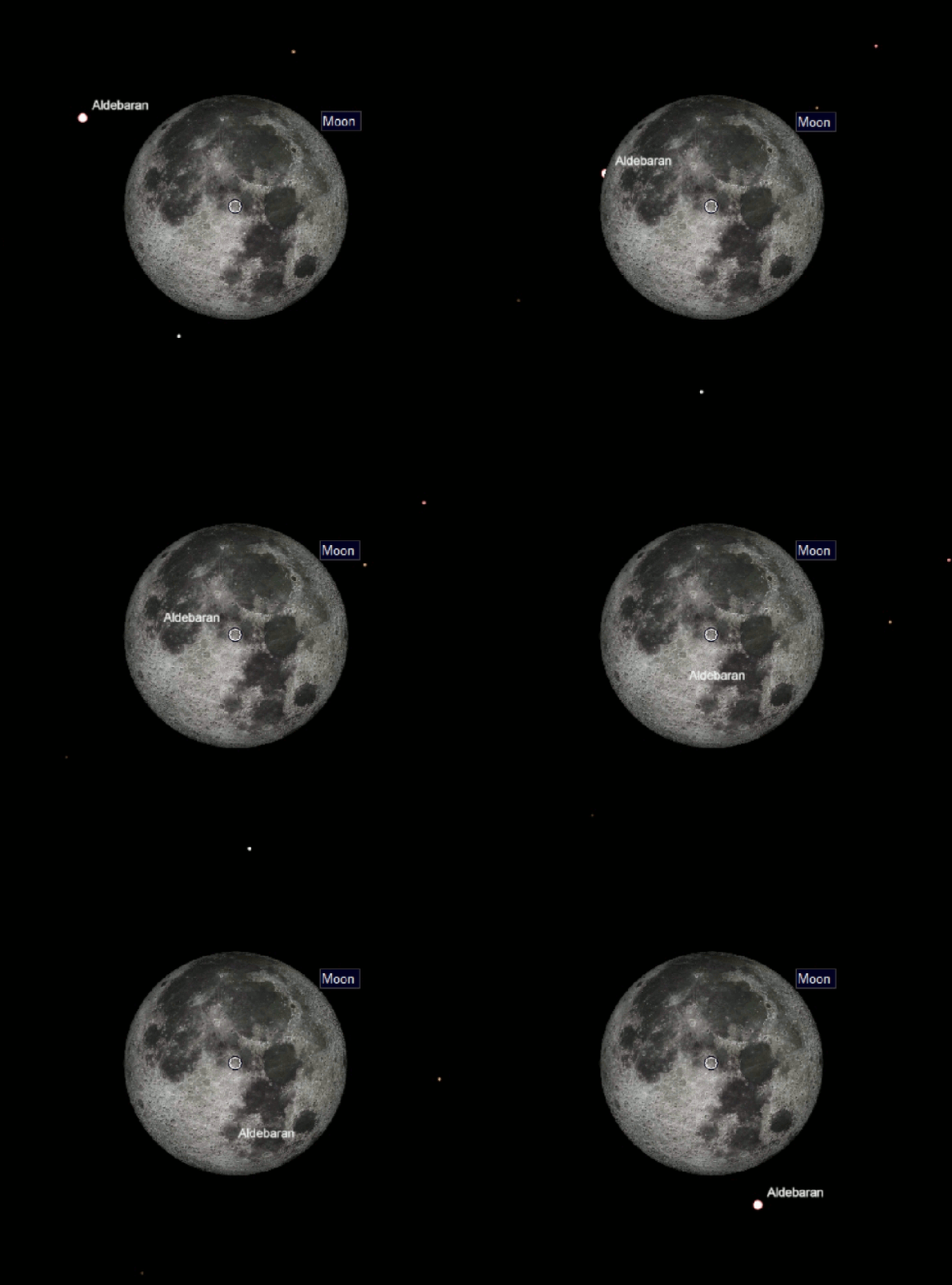
An occultation animation starting at 5:19 a.m. EST showing 10 minute intervals. Not that the computer generated graphics cannot produce a point star. Aldebaran will wink out and back in an instant. Created using Cartes du Ciel (Sky Charts) and GIMP.
Aldebaran Occultation November 26, 2015 from Northern Michigan
On the early morning of November 26th, that’s Thanksgiving morning here in the US, The Moon will pass in front of, or occult, the bright star Aldebaran in Taurus the bull. The event is called an occultation.
Three first magnitude stars can be occulted by the Moon, Aldebaran, Regulus in Leo the lion, Antares in Scorpius the Scorpion, and Spica in Virgo the virgin, since these stars lie within 5 1/2 degrees of the ecliptic, the plane of the Earth’s orbit. The Moon’s orbit is inclined to it by 5º 14′. Also because the Moon’s orbit precesses over a period 18.6 years they occur over the Earth in monthly series every 18.6 years. There are 43 monthly occultations that will occur in this series, which actually started in January. This is the best of them so far. We’ll have another on the evening of January 19th next year. Below is a chart of the event from the Astronomical Almanac Online which can be accessed here: http://asa.usno.navy.mil/.
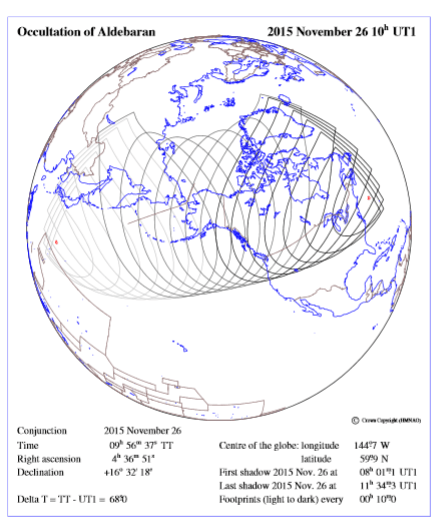
Map of the area where the occultation of Aldebaran is visible. Credit: Astronomical Almanac Online – U.S. Nautical Almanac Office, United States Naval Observatory (USNO), in the United States and Her Majesty’s Nautical Almanac Office (HMNAO), United Kingdom Hydrographic Office (UKHO), in the United Kingdom.
The occultation will be visible for locations within the nested grid of curved lines.
The two important events of the occultation is the star’s disappearance and reappearance. The times of these two events depend on your location, and are scientifically useful in determining the precise position of the Moon.
I’ve worked out the timings for my location about half way between Traverse City and Interlochen, so they should be within a couple of minutes of your observed time if you’re within 30 or so miles. Go out early, the earlier the better. The Moon will be especially bright, being only 12 hours after the instant the Moon will be full. Binoculars or a small telescope will be necessary to spot Aldebaran. The farther away Aldebaran is away from the Moon the easier it can be picked up. Note as a rule of thumb, the Moon moves its own diameter against the stars in about an hour.
For the Traverse City/Interlochen area I calculate the disappearance of Aldebaran at 5:38 a.m.
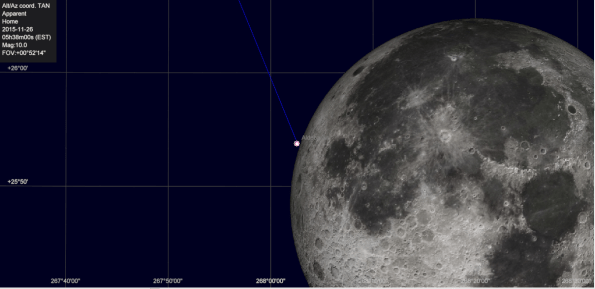
Aldebaran just prior to it’s disappearance behind the Moon from Interlochen/Traverse City. Created using Cartes du Ciel (Sky Charts).
For the Traverse City/Interlochen area I calculate the reappearance of Aldebaran at 6:29 a.m.
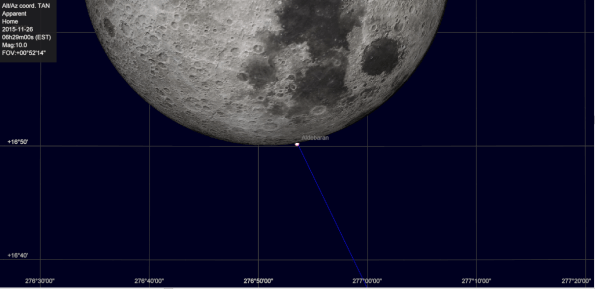
Aldebaran just after it’s reappearance from behind the Moon from Interlochen/Traverse City. Created using Cartes du Ciel (Sky Charts).
The Moon will be low in the western sky.
Timings for 3 locations in Michigan
This can be used to approximate the occultation time for other locations in Michigan.
City(s)                    Disappears  Reappears Location
Ironwood          5:33 a.m.   6:25 a.m. Northwestern corner of the
                                        Upper Peninsula (UP) of
                                        Michigan
Interlochen/      5:38 a.m.   6:29 a.m. Northwestern lower Michigan
   Traverse City
Monroe            5:45 a.m.   6:29 a.m. Southeastern corner of Michigan
Estimating timings for your location
I used Cartes du Ciel the free software that I have a link to on the right. Make sure that the program is set for topocentric positions under Setup/Solar System. And you have entered your position under Setup/Observatory. You can find your location in Google Earth.
You can also use Stellarium. Just make sure the Moon is normal sized.
In both programs you can lock the Moon or Aldebaran in the center of the screen Pick a time in advance of the occultation and using the set time window walk the star towards the Moon, mark the time. Then walk the star out from the Moon and record the reappearance time. That’s it.
This should work with other planetarium programs too.
11/20/2015 – Ephemeris – Finding the bright stars of November
Ephemeris for Friday, November 20th. The Sun will rise at 7:46. It’ll be up for 9 hours and 24 minutes, setting at 5:10. The Moon, 1 day past first quarter, will set at 2:17 tomorrow morning.
The Moon is beginning to brighten up the sky making constellation spotting somewhat difficult, so I thought we’d look for the brightest stars. High in the west are the three stars of the Summer Triangle. At the bottom in the southwest is Altair, the first of these to set. A bit north of west the brightest, Vega. Highest in the west is Deneb, which won’t officially set for those Interlochen northward. Low in the south is the loneliest star Fomalhaut. In the northeast is the winter star Capella, which also doesn’t set for the IPR listener area, but spends summer nights hiding behind hills and trees in the north. Low in the east is the last of our bright stars, Aldebaran in Taurus the bull, which will be playing hide and seek with the Moon next week.
Times are for the Traverse City/Interlochen area of Michigan. They may be different for your location.
Addendum
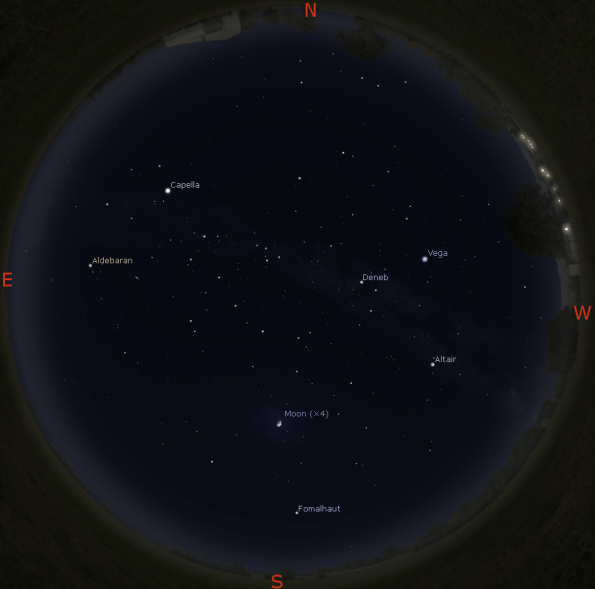
The bright first magnitude stars of autumn shown for 8 p.m. November 20, 2015. If you are closer to your time meridian, we’re 43 minutes behind ours, you will see two more bright stars in the east: Red Betelgeuse and blue-white Rigel. Created using Stellarium.
11/19/2015 – Ephemeris – The no longer quite first quarter Moon tonight
Ephemeris for Thursday, November 19th. The Sun will rise at 7:44. It’ll be up for 9 hours and 26 minutes, setting at 5:11. The Moon, at first quarter today, will set at 1:06 tomorrow morning.
The Moon actually was at first quarter at 1:27 (6:47 UT) this morning. By this evening, when it’s out the terminator, the sunrise line, on the Moon will be curved giving the it a definite gibbous appearance. The upside down rabbit image in the Moon’s dark seas on the illuminated right half can be seen. In a telescope or even powerful binoculars at 9 p.m. the Terminator cuts the southern crater Tycho in half. The large crater Clavius south of it is just catching the morning Sun. To the north the sunrise line cuts the large Mare Imbrium or Sea of Showers in half. In the mountains on the north shore of Imbrium the large walled plain, really a crater, Plato can be seen. Pan near the terminator in the south and the Straight Wall might be spotted as a long shadow.
Times are for the Traverse City/Interlochen area of Michigan. They may be different for your location.
Addendum
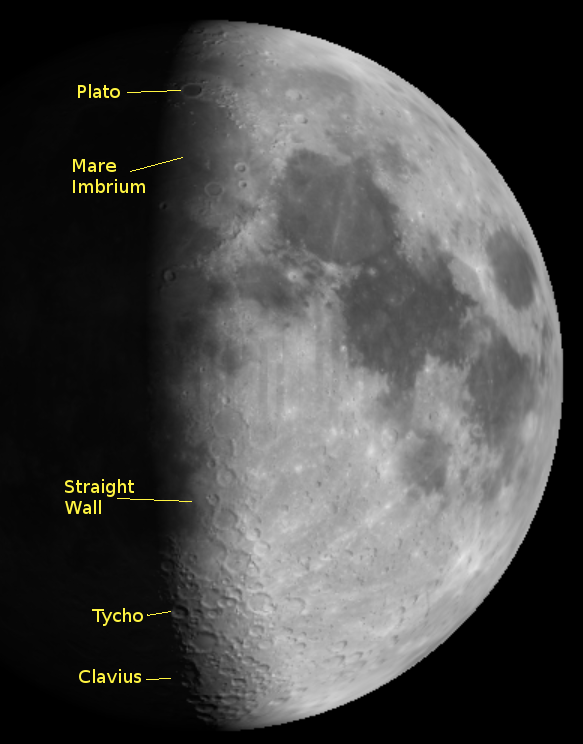
The Moon at 9 p.m. EST November 19, 2015. (2 hr UT November 20) Created using Virtual Moon Atlas.
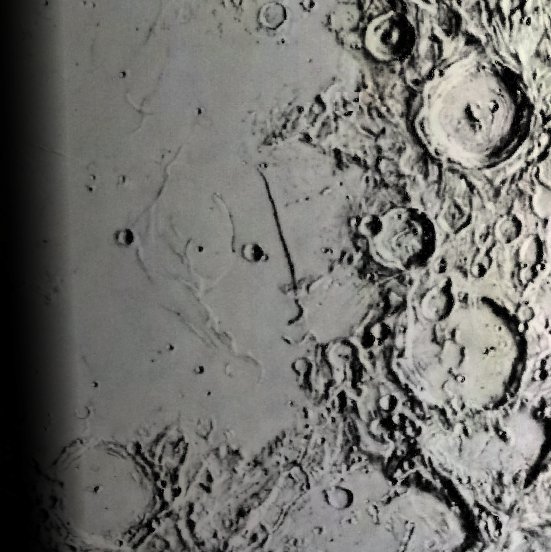
Closeup chart of the Straight Wall.
11/18/2015 – Ephemeris – The planet action is in the morning
Ephemeris for Wednesday, November 18th. The Sun will rise at 7:43. It’ll be up for 9 hours and 28 minutes, setting at 5:12. The Moon, 1 day before first quarter, will set at 11:57 this evening.
Let’s check out the whereabouts of the bright naked eye planets. Saturn is about to depart the evening sky. It’s too close to the direction of the Sun to spot. Mercury passed behind the Sun yesterday and is entering the evening sky. In the morning sky there are three bright planets. Jupiter will be the first to rise, at 1:50 a.m. in the east-northeast. Mars will rise next at 3:04 a.m. in the east, followed by Venus at 3:45 a.m. also in the east. Mars lies in line between Venus below and Jupiter above, a bit more than a third the way from Venus to Jupiter. These three planets will continue to pull apart. Nearly in line with the planets are the bright stars Regulus to the upper right and Spica to the lower left.
Times are for the Traverse City/Interlochen area of Michigan. They may be different for your location.
Addendum
Mercury passed behind the Sun in a superior conjunction yesterday the 17th. The Sun actually occulted Mercury, though that couldn’t be seen. Below is a SOHO LASCO C2 coronagraph GIF animation from the 14th to the 17th showing Mercury entering on the right and disappearing behind the disk that hides the Sun’s photosphere. The white circle in the center shows the position and size of the Sun. The plane of Mercury’s orbit crosses the plane of the Earth’s orbit where the Earth is in early November and again 6 months later in early May. It happens that next May 9th Mercury will pass in front of the Sun, an event called a transit, that will be visible here. It will start at 7:13 a.m. (11:13 UT) and end at 2:44 p.m. (18:44 UT). Transits of Mercury are not as spectacular or as rare as those of Venus. I’ll have more on the transit when the date draws close.
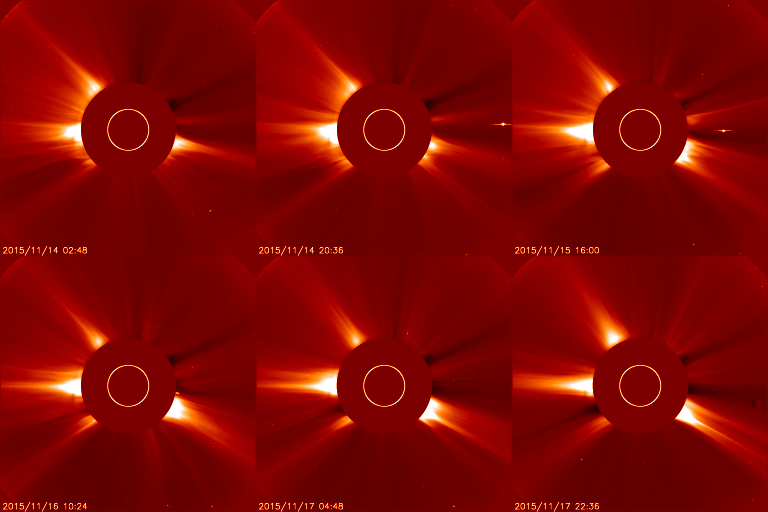
A GIF animation from the Solar and Heliospheric Observatory LASCO C2 coronagraph for November 14th to the 17th. Mercury will enter from the right. Credit ESA/NASA – LASCO/NRL SOHO team.
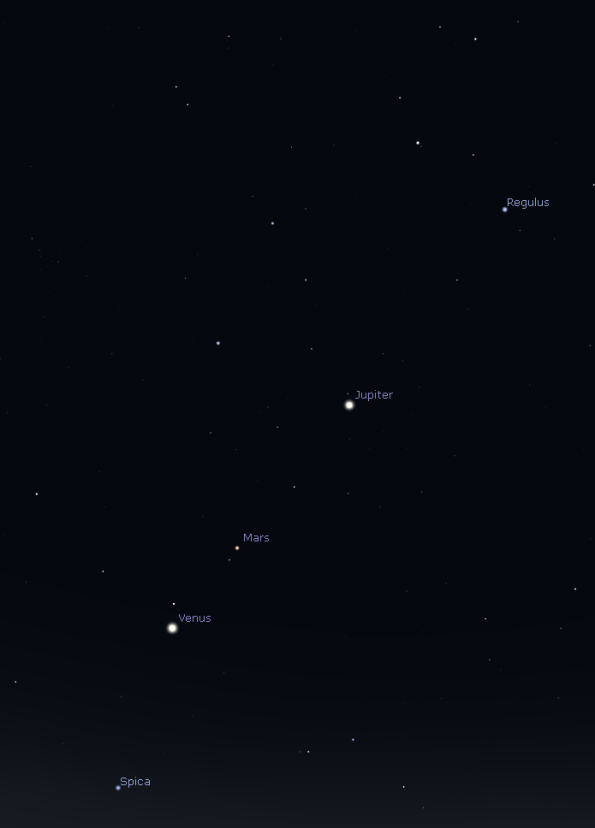
Jupiter, Mars and Venus appear in the southeast at 6 a.m., November 19, 2015. Created using Stellarium.
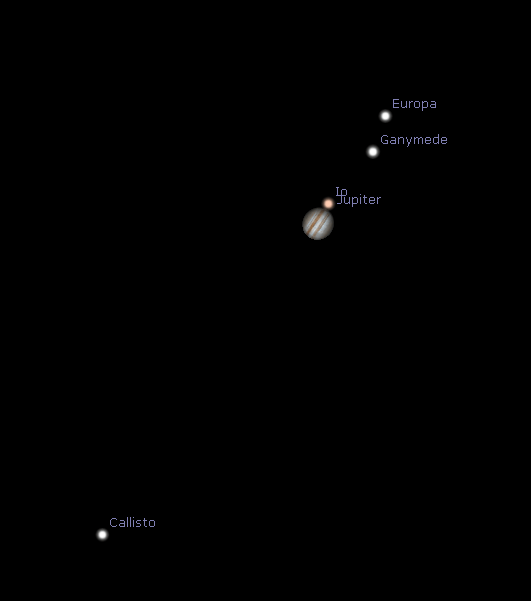
Jupiter and its moons in a telescope at 6 a.m., November 19, 2015. Created using Stellarium.
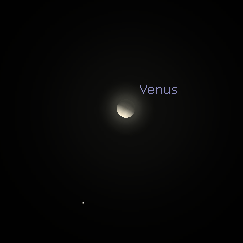
Venus as seen in a telescope at 6 a.m. November 19, 2015. This is at the same scale as the Jupiter image above. Created using Stellarium.
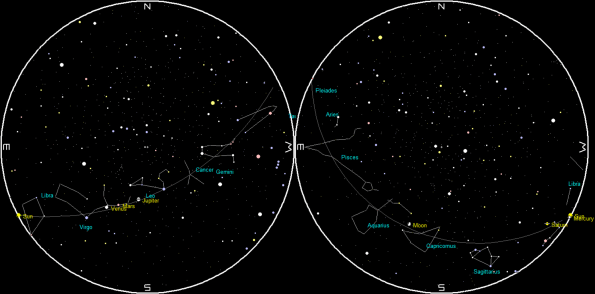
This is a chart showing the sunrise and sunset skies for November 18, 2015 showing the location of the planets and the Moon at that time. Created using my LookingUp program. Click on the image to enlarge.
11/17/2015 – Ephemeris – The Leonid peak is expected to be today and tonight
Ephemeris for Tuesday, November 17th. The Sun will rise at 7:42. It’ll be up for 9 hours and 30 minutes, setting at 5:12. The Moon, 2 days before first quarter, will set at 10:49 this evening.
The Leonid meteor shower is predicted to reach its peak or rather peaks today. One this afternoon is a newly computed peak, which we obviously cannot see, and another around 11 p.m. which occurs just before the radiant rises. The radiant is the point in the sky from which the meteors seem to come from, so to see any meteors that source point must be above the horizon. The Leonid meteors are the debris of Comet 55P/Tempel-Tuttle, which was discovered independently by Ernst Tempel in 1865 and Horace Tuttle 18 days later. The 55P in the name means that it was the 55th recognized periodic comet. It has a period of 33.24 years giving rise to meteor storms every 33 years or so. This isn’t one of those years.
Times are for the Traverse City/Interlochen area of Michigan. They may be different for your location.
Addendum
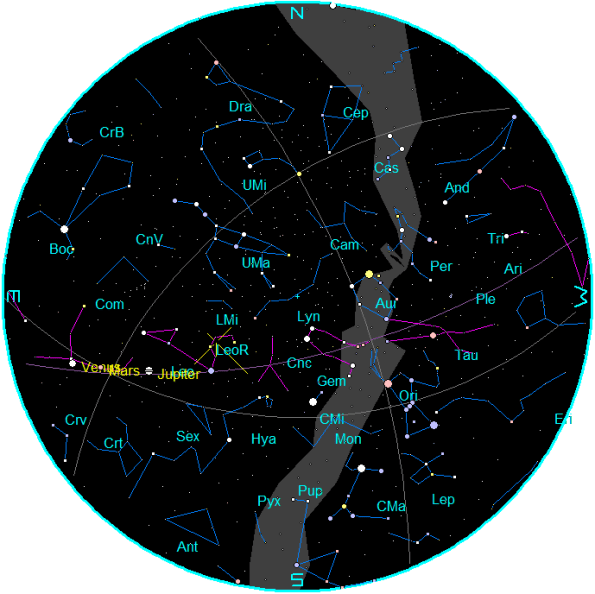
An all sky chart for 5 a.m for the Leonid meteor shower for 2015. Created by my LookingUp program. The yellow pattern marked LeoR is the Leonid radiant.
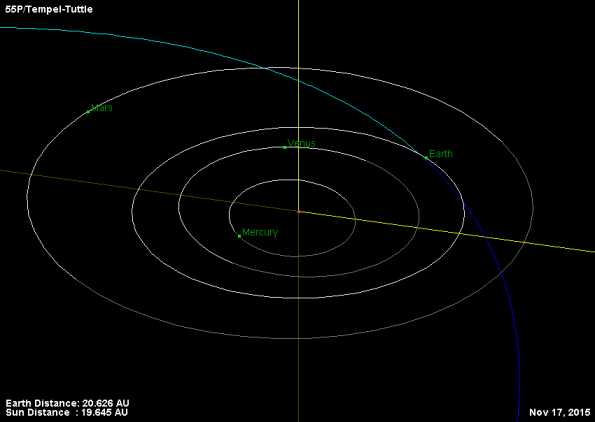
The orbit of 55P/Tempel-Tuttle near the Earth. The color or the orbit is lighter north of the Earth’s orbital plane. Note that the orbit of the comet crosses the Earth’s orbital plane as it passes just inside the Earth’s orbit. Created with JPL Small-Body Database Browser.
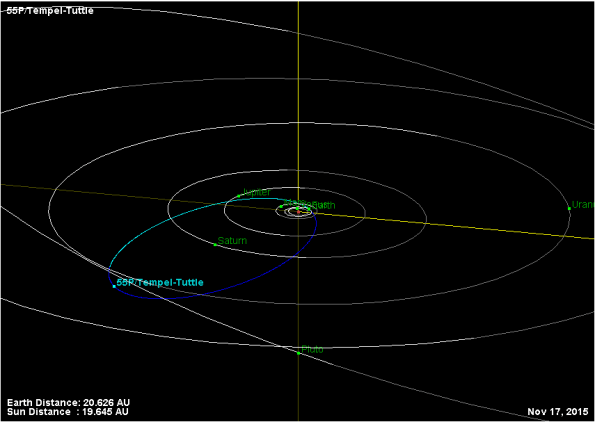
The entire orbit of 55P/Tempel-Tuttle. The color or the orbit is lighter north of the Earth’s orbital plane. Created with JPL Small-Body Database Browser.
11/16/2015 – Ephemeris – The Leonid meteors are expected to reach their peak tomorrow
Ephemeris for Monday, November 16th. The Sun will rise at 7:40. It’ll be up for 9 hours and 33 minutes, setting at 5:13. The Moon, 3 days before first quarter, will set at 9:45 this evening.
Tomorrow night is the expected peak of the Leonid meteor shower. The expected peak will be at 11 p.m. (4 hr UT November 18). Problem is that the radiant won’t rise until just after midnight for northern Michigan. For the best visible numbers the peak of the meteor shower should coincide with the time the radiant is highest in the sky. For the Leonids, that’s when morning twilight starts. There’s another possible peak for those in Asia at 21 hr UT November 17. It’s afternoon for us. The Leonids generally produce their meteor storms of thousands of meteors an hour about every 33 years, when the comet is back near the Earth and the Sun. That next time would be around the year 2031 give or take a year. I personally missed the meteor storm of 1966 by a couple of hours. I missed the one in the late 90s by more than that. The next around 2031 may be a bridge too far for me.
Times are for the Traverse City/Interlochen area of Michigan. They may be different for your location.
Addendum
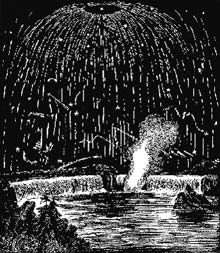
The 1933 Leonid meteor storm depicted over Niagara Falls in this woodcut. Public Domain. by A Pickering.

The 1997 Leonid meteor shower as seen from orbit. Credit NASA.
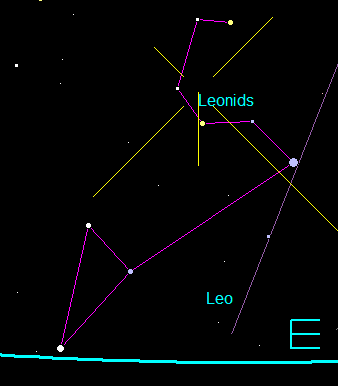
Leonid meteor radiant
11/13/2015 – Ephemeris – The Leonid meteor shower will reach peak next week
Ephemeris for Friday, November 13th. The Sun will rise at 7:36. It’ll be up for 9 hours and 40 minutes, setting at 5:16. The Moon, 2 days past new, will set at 7:02 this evening.
I’m talking about meteors a lot this week. Well this is about next week’s peak of the Leonid meteor shower. The Leonid meteor shower has spectacular peaks about every 33 years when the responsible litter bug, er… comet is near us and the Sun. The last time the comet names 55P/Tempel-Tuttle passed perihelion, its closest to the Sun was 1998. We are about half way between that and the next perihelion in 2031, so we’d expect it to be a dull year with 15 meteors an hour expected tops, but either the Leonids are getting more unpredictable, or astronomers, both professional and amateur are paying better attention. The main peak is expected Tuesday night around 11 p.m. (4 hr UT Wednesday, November 18), with another peak prior to that in the afternoon (21 hr UT Tuesday, November 17). The radiant, however, will rise just before midnight in northern Michigan. The timing will be better for Europe
Times are for the Traverse City/Interlochen area of Michigan. They may be different for your location.
Addendum
Leonid meteor radiant
11/12/2015 – Ephemeris – The North Taurid meteor shower
Ephemeris for Thursday, November 12th. The Sun will rise at 7:35. It’ll be up for 9 hours and 42 minutes, setting at 5:18. The Moon, 1 day past new, will set at 6:19 this evening.
Today is the expected peak of the Northern Taurid meteor shower. While poor in numbers, the two Taurid showers produce many fireballs, that are really, really bright. So bright they are not hindered by a bright moon. They will be visible all night because the radiant, near the head of Taurus the bull will rise in the east by the end of twilight. The radiant is below the Pleiades star cluster and just above the letter V group of stars that is the head of the bull. The path of Encke’s comet, which is responsible, crosses near the Earth’s orbit twice a year. Now and where the Earth is on June 30th. Those meteors then would seem to come from out of the Sun, leaving some to speculate that the Tunguska event in 1908 was caused by a piece of Encke’s Comet.
Times are for the Traverse City/Interlochen area of Michigan. They may be different for your location.
Addendum
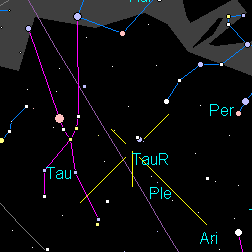
The Taurid Radiant
It turns out that Earth isn’t the only planet to have a meteor shower from Encke’s Comet. It happens to be Mercury. Dave Dickinson has a post on Universe Today pointing to an announcement of data returned from the MESSENGER spacecraft that orbited Mercury at the Division of Planetary Sciences of the American Astronomical Society (#DPS15) meeting this week.

