09/03/2015 – Ephemeris – Jewels in the shield
Ephemeris for Thursday, September 3rd. The Sun will rise at 7:07. It’ll be up for 13 hours and 9 minutes, setting at 8:16. The Moon, 2 days before last quarter, will rise at 11:26 this evening.
The teapot pattern of stars that is the constellation of Sagittarius lies at the southern end of the Milky Way this evening. It appears that the Milky Way is steam rising from the spout. The area above Sagittarius in the brightest part of the Milky Way is the dim constellation of Scutum the shield. Don’t bother looking for the stars that make up the constellation; what’s important is the star clouds of the Milky Way. Scan this area with binoculars or small telescope for star clusters and nebulae or clouds of gas. In binoculars both clusters and nebulae will appear fuzzy, but a small telescope will tell most of them apart. Even if you’ve never been able to find anything in your telescope, you’ll find something here.
Times are for the Traverse City/Interlochen area of Michigan. They may be different for your location.
Addendum
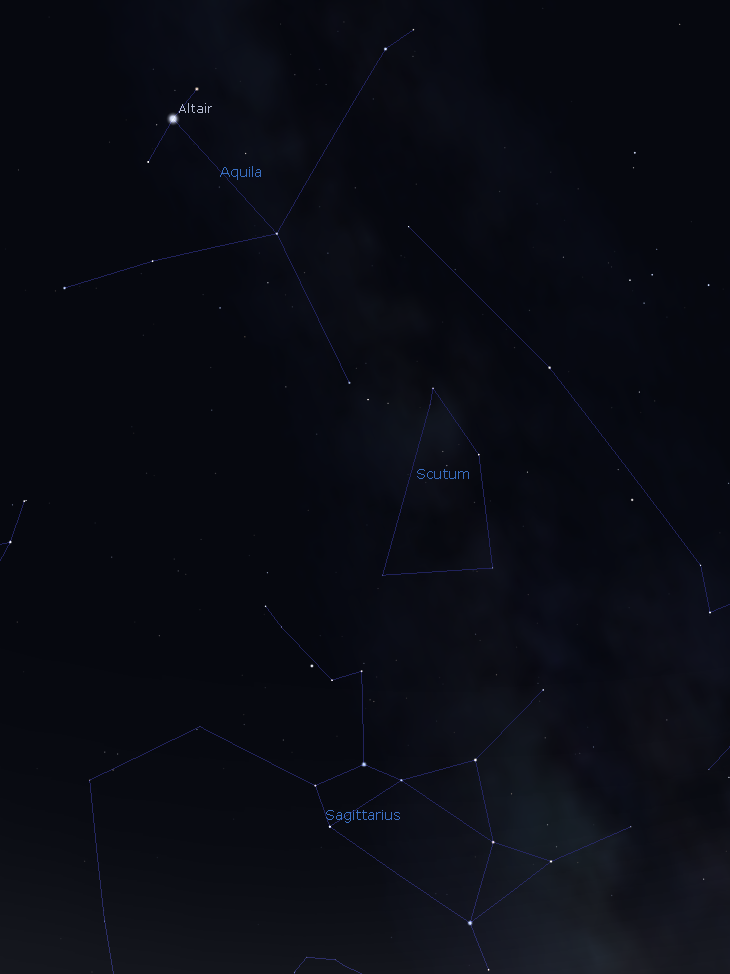
Scutum between Sagittarius below and Aquila above at 10 p.m. September 3, 2015. Created using Stellarium.
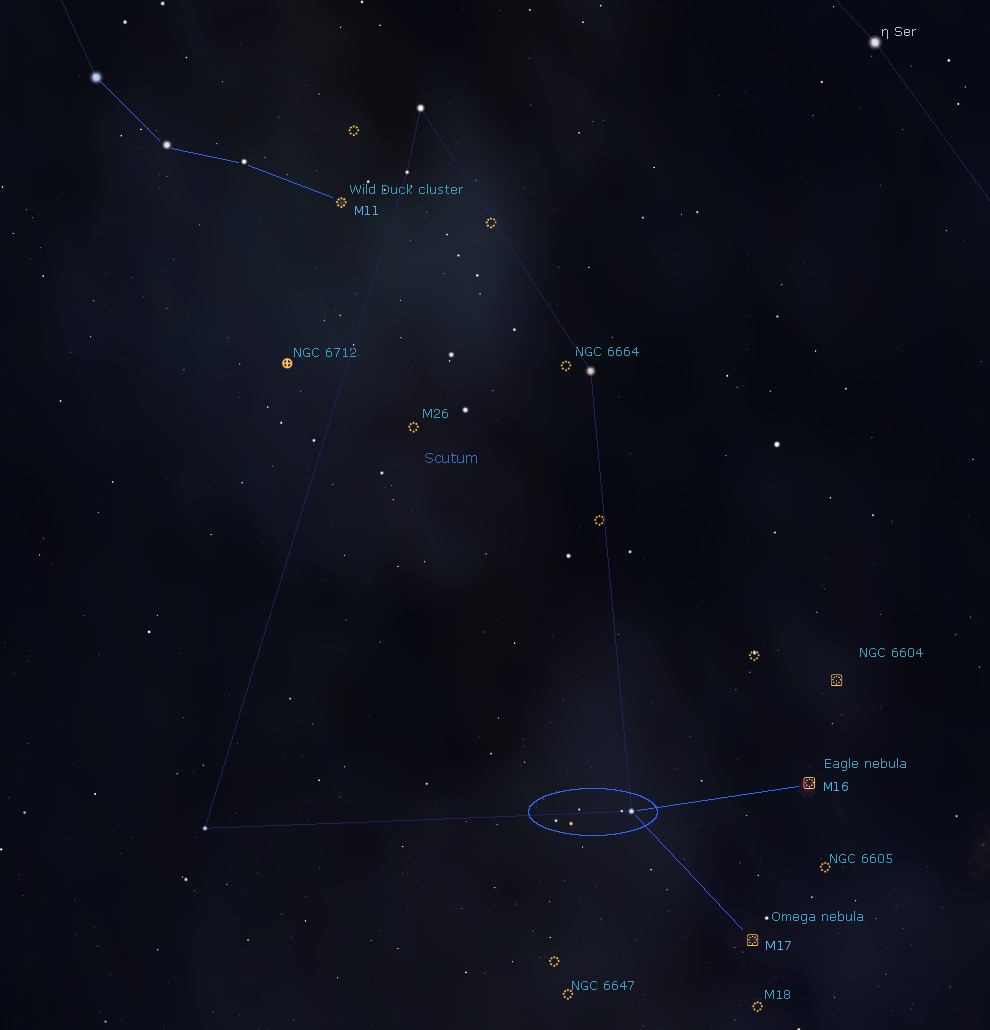
How to find the three brightest deep sky wonders around Scutum by star hopping. Created using Stellarium, annotated by myself.
Star hopping is a method to find objects from familiar star patterns. At the top my method to find M11, the wild duck cluster is to locate the three stars at the tail of Aquila the Eagle and follow them to M11. M11 takes a little bigger telescope to resolve. I remember having trouble resolving it is a 5″ telescope. It looks like a triangular cluster with all the stars of the same dimness except one brighter one.
At the bottom of Scutum, I locate that distinctive 5 star group circled. Directly west is M16, the Eagle Nebula and star cluster. The star cluster is easy to spot, the nebula is hard. The Hubble space telescope made the nebula famous in the 1990’s as the Pillars of Creation.
Below and west is M17, the Omega Nebula, or the Swan Nebula. To me it looks like a swan swimming or a check mark of nebulosity. The associated star cluster is much less noticeable.
Happy star hopping.
09/02/2015 – Ephemeris – Planets at either end of the night
Ephemeris for Wednesday, September 2nd. The Sun will rise at 7:06. It’ll be up for 13 hours and 12 minutes, setting at 8:18. The Moon, 3 days before last quarter, will rise at 10:45 this evening.
Lets look for the bright planets for this week. Saturn is alone in the evening sky spotted low in the southwestern sky near the bright star Antares to its lower left. It will set at 11:32 p.m. The rest of the planet action has moved to the morning sky. Mars is now climbing away from the Sun. It’s pretty dim, rising before the start of morning twilight at 4:56 a.m. in the east-northeast. Venus is making a grand appearance, rising at 5:12 a.m. a bit north of east. Much dimmer Mars is to the left and a bit above Venus. Mercury, though in the evening sky is poorly placed for viewing. That won’t be true next month when it enters the morning sky. Jupiter now is too close to the direction of the Sun to be seen.
Times are for the Traverse City/Interlochen area of Michigan. They may be different for your location.
Addendum
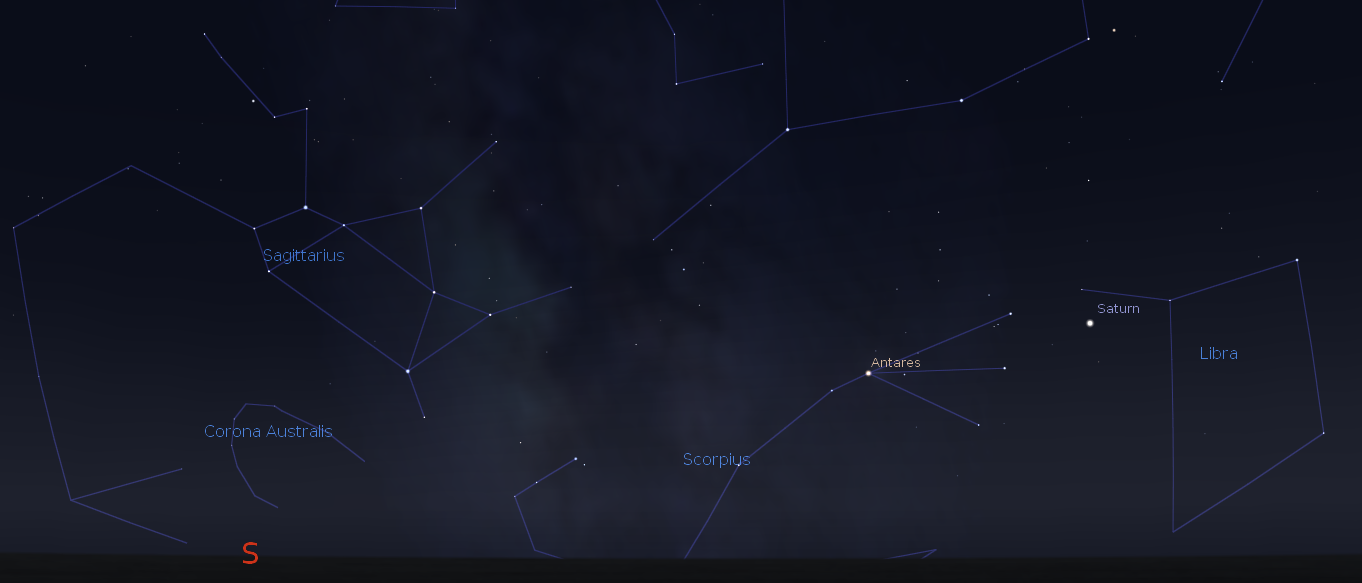
Saturn with the Zodiacal constellations of Libra, Scorpius and Sagittarius as the Teapot. Created using Stellarium.
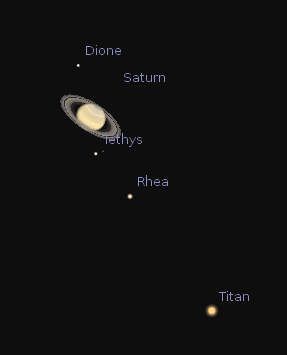
What Saturn and its moons might appear like in a telescope at 10 p.m., September 2, 2015. Small telescopes will show only the moon Titan. Created using Stellarium.
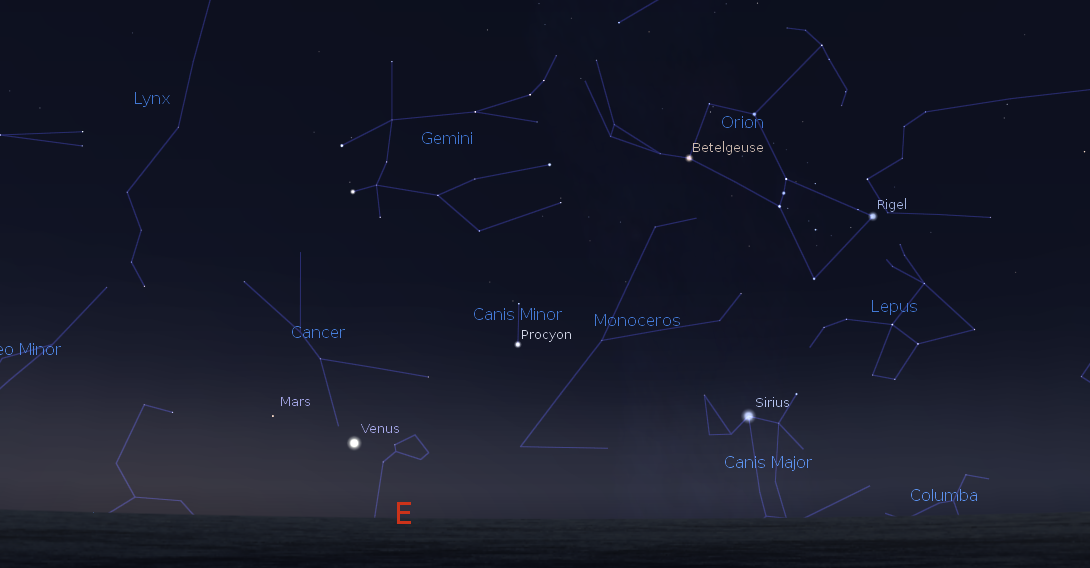
Is it a UFO? Is it an airplane’s landing lights? Nope, it’s Venus. Also visible is Mars nearby with the stars and constellations of Winter at 6 a.m. September 3, 2015. Created using Stellarium.
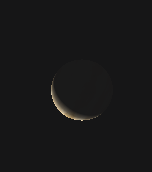
Venus through a telescope – September 3, 2015. Created using Stellarium.
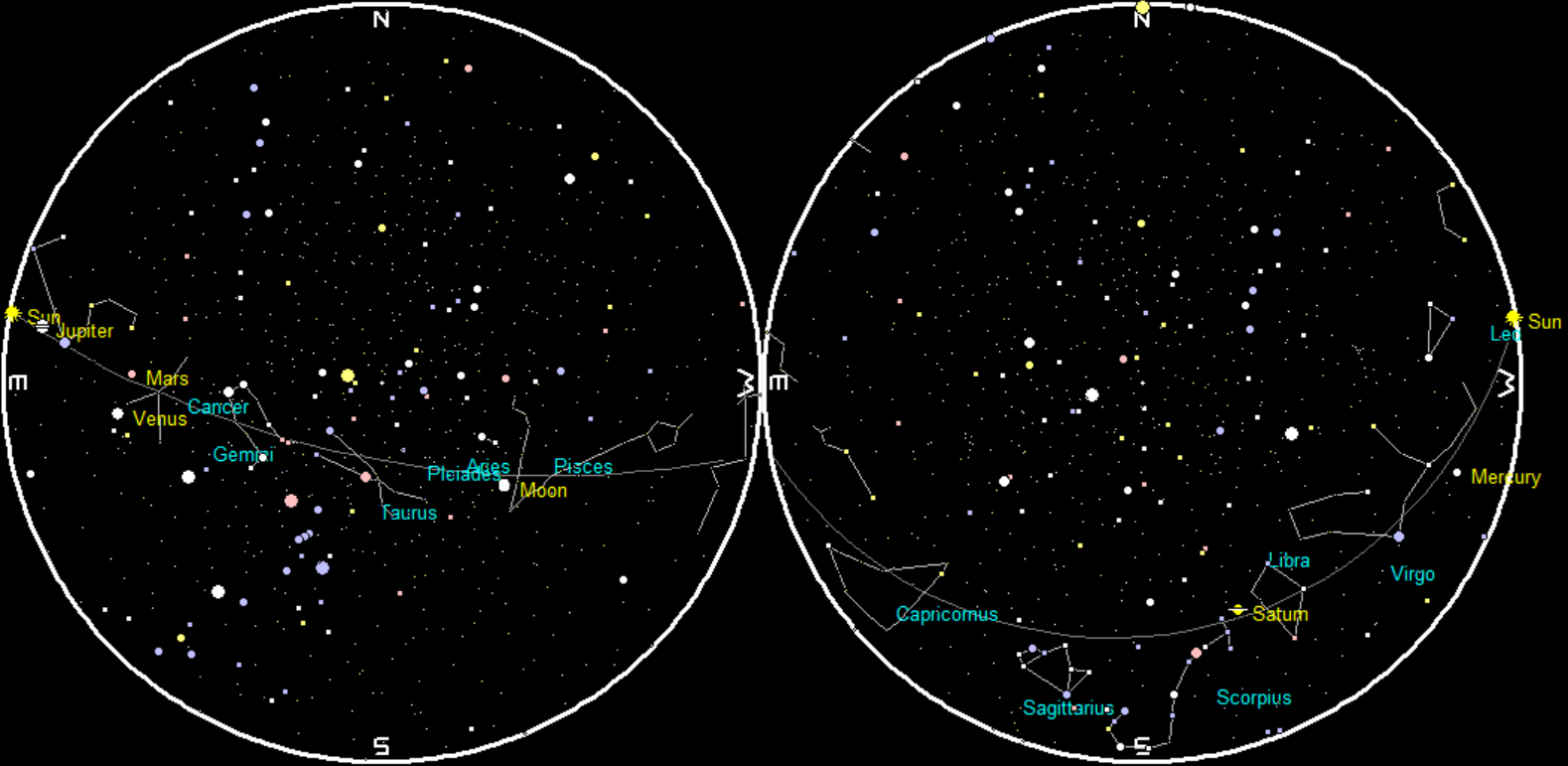
This is a chart showing the sunrise and sunset skies for September 2, 2015 showing the location of the planets and the Moon at that time. Created using my LookingUp program. Click on the image to enlarge.
Note the angle of the ecliptic to the Sun at the morning and evening horizon. It is at a very low angle in the evening. That’s why Mercury, though at a fairly large distance from the Sun (27º) is not really visible in the evening. In the morning the ecliptic rises at a much steeper angle so Venus at 25.5º separation from the Sun is easily visible. The situation will be reversed in 6 months, or right now if you travel south of the equator.
09/01/2015 – Ephemeris – Previewing September – Part 2: Total Lunar Eclipse
Ephemeris for Tuesday, September 1st. The Sun will rise at 7:04. It’ll be up for 13 hours and 15 minutes, setting at 8:19. The Moon, 3 days past full, will rise at 10:07 this evening.
Today in part 2 of the September preview we look ahead at this month’s total lunar eclipse on Sunday evening the 27th. This is the last of four total lunar eclipses in a row that started last year April, continuing last October and this April. Only this past April’s eclipse was visible in clear skies here, but all we could see was the beginning partial phase from here. We will get to see, clouds willing, the whole eclipse between 9 p.m. and 12:30 a.m. Lunar eclipses only can occur at full moon, when the Sun, Earth and Moon are lined up so that the Earth’s shadow falls on the Moon. The Moon will be completely immersed in the Earth’s shadow for over an hour then. You can mark it on your calendars, but I will be reminding you about it all the week before.
Times are for the Traverse City/Interlochen area of Michigan. They may be different for your location.
Addendum
The following is my article from September’s newsletter of the Grand Traverse Astronomical Society the Stellar Sentinel. Note as with the above tines, the times here are Eastern Daylight Time.
The Last of a Quartet of Lunar Eclipses
The last of a quartet or tetrad of consecutive total lunar eclipses will occur Sunday night September 27th. The others were either clouded out or started too late for totality to be visible from here. We are hoping for good weather for this one.
Lunar eclipses or eclipses of the Moon, as these events are also called, only occur at full moon when the Earth’s shadow is cast upon the Moon. Unlike a solar eclipse, of which the partial phases are dangerous to gaze upon without special protection, a lunar eclipse is perfectly safe to view throughout.
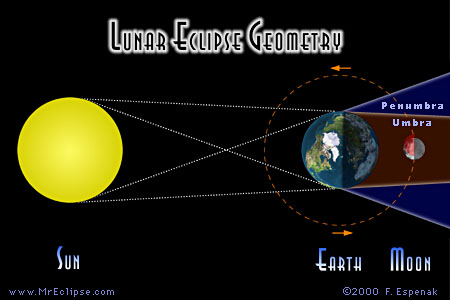
How lunar eclipses occur. Credit NASA/Fred Espenak.
There are three kinds of lunar eclipses or phases of lunar eclipses: penumbral, partial, and total. A total eclipse passes through all three phases. In the penumbra the Sun’s light is increasingly cut off from the outside to the inside of the shadow called the umbra, where all direct sunlight is cut off. Depending on the path of the Moon, it can cut through only the penumbra, in which the eclipse is barely noticeable, a penumbral eclipse; pass only partially through the umbra, a partial eclipse; or immerse completely in the umbra to produce a total eclipse.
Lunar eclipses are easiest to see, because one only has to be on the night side of the Earth to see it. In a solar eclipse, the Moon’s shadow is too small to cover the earth, since it’s only a quarter the size of the Earth, so one has to be in a band a few thousand miles wide to spot the partial phase and has to be in a very narrow couple hundred mile wide path to see the brief totality. We’ll revisit this in 2016 in preparation for the country spanning total solar eclipse of August 21, 2016.
Eclipses, both lunar and solar occur in seasons nearly 6 months apart, which usually have one of each two weeks apart. Occasionally with a central eclipse of one to have two of the other two weeks before and two weeks after.
The reason for this is because the Earth and Moon’s orbits are tilted at about a 5° angle, and the point where they cross, 180° apart is slowly rotating clockwise. This gives us two eclipse seasons a year that slowly move earlier in the calendar. It is only when the Sun is near where the orbital planes cross that we have a chance for an eclipse, otherwise the Moon is too far north or south.
After this eclipse, the next total lunar eclipse will be January 21, 2019. However the Moon will set while in totality for us on that one.
If you’d like to explore eclipses further, check out this NASA website: http://eclipse.gsfc.nasa.gov/eclipse.html.
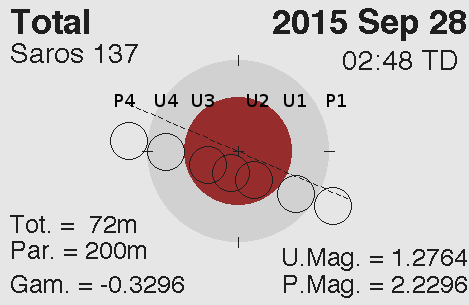
The eclipse occurs on the 28th for Universal Time. It’s the evening of the 27th for us. The Moon travels through the Earth’s shadow from right to left. What are seen are points of contact with the shadow and mid-eclipse. From Five Millennium Canon of Lunar Eclipses (Espenak & Meeus) NASA.
Contact times are labeled P1, U1, U2, U3, U4, and P4. P2 and P3 are omitted because they are synonymous with U1 and U4 respectively:
- P1 – 8:11:47 p.m. Enter the penumbra (unseen). By about 8:30 the duskiness on the left edge of the moon will start to be noticeable.
- U1 – 9:07:11 p.m. Enter the umbra (partial eclipse begins).
- U2 – 10:11:10 p.m. Totality begins.
- Mid eclipse 10:48:17 p.m.
- U3 – 11:23:05 p.m. Totality ends, egress partial phase begins.
- U4 – 12:27:03 a.m. Partial phase ends. The Moon’s upper right edge should appear dusky for the next half hour or so.
- P4 – 1:22:27 a.m. Penumbral phase ends (unseen).
Note: The duskiness of the penumbral phase of the eclipse can be enhanced by viewing through sunglasses.
During the total phase, light leaks in around the Earth due to the bending of light in the Earth’s atmosphere, so the Moon is illuminated by the collective sunrises and sunsets around the globe. This usually gives the Moon a coppery hue, that some are now calling a blood moon. Occasionally, due to volcanic eruptions the Moon can become very dark.
This full moon is also the Harvest Moon and for those who care, a supermoon, it having reached perigee earlier that day.
Weather permitting there will be two GTAS venues in northern lower Michigan to view this eclipse. The first will be the Northwestern Michigan College Rogers Observatory, south of Traverse City, MI. The second will be at the Sleeping Bear Dunes National Lakeshore at Platte River Point at the end of Lake Michigan Road off M22. These sites will be open for the visible parts of the eclipse from 9 to midnight.
Of course the eclipse can be seen from your yard with no optical aide whatsoever.
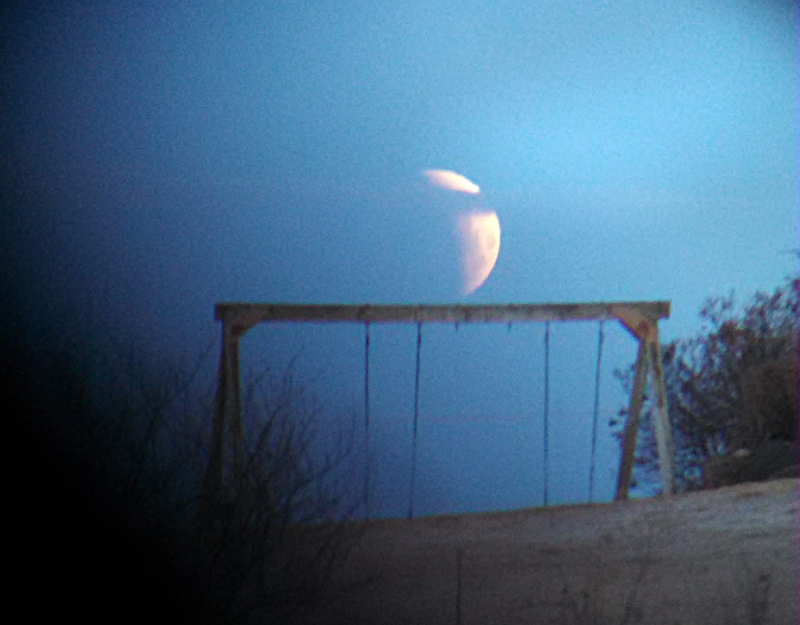
The partially eclipsed Moon setting through a thin clouds and the neighbor’s swing set at 7:09 EDT April 4, 2015. Taken with a Motorola Droid Razr phone through 10X50 binoculars. Credit: Bob Moler.
08/31/2015 – Ephemeris – Previewing the skies of September – Part 1
Ephemeris for Monday, August 31st. The Sun will rise at 7:03. It’ll be up for 13 hours and 18 minutes, setting at 8:21. The Moon, 2 days past full, will rise at 9:31 this evening.
Let’s look forward to the skies of September. The sun will moving at its greatest speed in its retreat to the south. Daylight hours in the Interlochen/Traverse City area and will drop from 13 hours and 15 minutes tomorrow the 1st. to 11 hours 46 minutes on the 30th. The altitude of the sun above the southern horizon at local noon will be 54 degrees tomorrow, and will descend to 42 degrees on the 30th. The Straits area will see the sun a degree lower. The season of summer is getting short, so enjoy it while you can. Summer ends and autumn begins at 4:20 a.m. on September 23rd. Saturn is setting before midnight now, but Venus and Mars are appearing in the morning sky soon. Tomorrow we’ll look at September’s lunar eclipse.
Times are for the Traverse City/Interlochen area of Michigan. They may be different for your location
Addendum
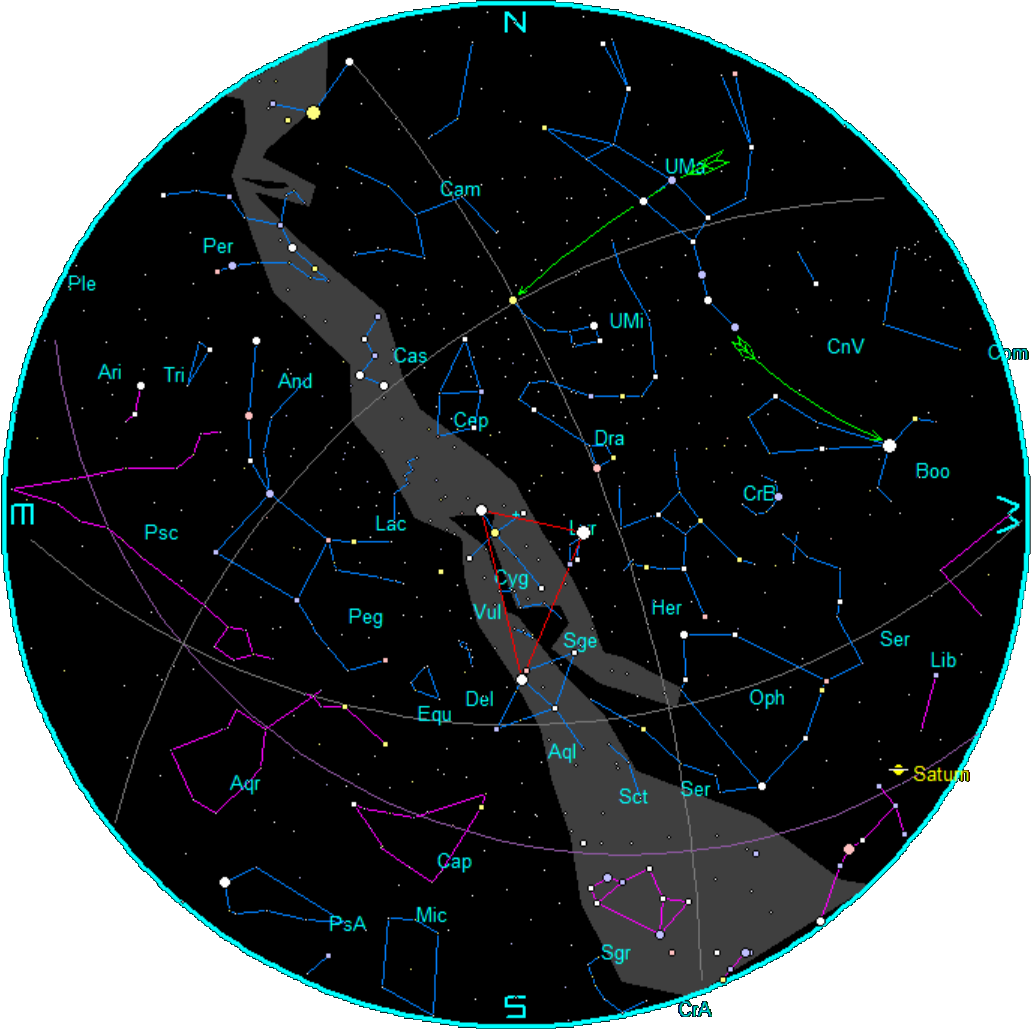
Star Chart for September 2015. Created using my LookingUp program.
The planets and stars are plotted for the 15th at 10 p.m. EDT. That is chart time. Note, Traverse City is located 1 hour 45 minutes behind our time meridian. To duplicate the star positions on a planisphere you may have to set it to 1 hour 45 minutes earlier than the current time.
Evening astronomical twilight ends at 10:04 p.m. EDT on August 1st, decreasing to 9:02 p.m. EDT on the 30th..
Morning astronomical twilight starts at 5:19 a.m. EDT on August 1st, and increasing to 6:01 a.m. EDT on the 30th.
Add a half hour to the chart time every week before the 15th and subtract and hour for every week after the 15th.
For a list of constellation names to go with the abbreviations click here.
The green pointer from the Big Dipper is:
- Pointer stars at the front of the bowl of the Big Dipper point to Polaris the North Star.
- Follow the arc of the Big Dipper’s handle to Arcturus.
- The Summer Triangle is shown in red.
Calendar of Planetary Events
Credit: Sky Events Calendar by Fred Espenak and Sumit Dutta (NASA’s GSFC)
To generate your own calendar go to http://eclipse.gsfc.nasa.gov/SKYCAL/SKYCAL.html
Times are Eastern Daylight Time on a 24 hour clock. Some additions made to aid clarity.
Conjunctions like the Mars-Regulus: 0.8° N means Regulus will appear 0.8° north of Mars.
| Sep | 01 | Tu | Venus: 25° W | |
| 04 | Fr | 05:59 | Mercury Elongation: 27.1° E | |
| 05 | Sa | 01:09 | Moon-Aldebaran: 0.6° S Occultation?* | |
| 05 | Sa | 05:54 | Last Quarter | |
| 06 | Su | 13:06 | Moon North Dec.: 18.2° N | |
| 10 | Th | 01:53 | Moon-Venus: 2.9° S | |
| 13 | Su | 02:41 | New Moon | |
| 13 | Su | 02:55 | Partial Solar Eclipse (Southern tip of Africa to Antarctica) | |
| 14 | Mo | 00:38 | Moon Ascending Node | |
| 14 | Mo | 07:28 | Moon Apogee: 406500 km | |
| 18 | Fr | 22:54 | Moon-Saturn: 3.1° S | |
| 21 | Mo | 04:59 | First Quarter | |
| 21 | Mo | 08:02 | Moon South Dec.: 18.1° S | |
| 23 | We | 04:20 | Autumnal Equinox | |
| 24 | Th | 15:38 | Mars-Regulus: 0.8° N | |
| 27 | Su | 17:04 | Moon Descending Node | |
| 27 | Su | 21:46 | Moon Perigee: 356900 km – Super moon | |
| 27 | Su | 22:48 | Total Lunar Eclipse | |
| 27 | Su | 22:50 | Full Moon – Harvest Moon | |
| 30 | We | 10:36 | Mercury Inferior Conjunction with the Sun | |
| Oct | 01 | Th | Venus: 43.6° W |
* For the Grand Traverse Region the Moon will rise at 12:10 a.m. occulting Aldebaran. Aldebaran will appear at the Moon’s unilluminated top right edge at approximately 12:40 a.m.
Note: All lunar conjunctions in the table above are geocentric. Double check with a program like Stellarium to check on the position of the body with respect to the moon for your location.
08/28/2015 – Ephemeris – The last Friday Night Live of the summer
Ephemeris for Friday, August 28th. The Sun will rise at 7:00. It’ll be up for 13 hours and 26 minutes, setting at 8:27. The Moon, 1 day before full, will set at 6:47 tomorrow morning.
The Grand Traverse Astronomical Society will be at the last Friday Night Live of the year this evening to view the Sun and will stay after if its clear to view the Moon and Saturn in the telescopes. For the Sun members have equipped their telescopes with solar filters to greatly diminish the sun’s light to make it safe to view the bright photosphere of the Sun with it’s sunspots. The society itself has a solar telescope, that not only filters the Sun’s light, but filters the light to isolate the red light of the element hydrogen. The special filter, called an etalon has to be tuned to the exact frequency or wavelength of the hydrogen atoms on the sun which will reveal the layer of gas above the photosphere and the clouds of hydrogen above.
Times are for the Traverse City/Interlochen area of Michigan. They may be different for your location.
Addendum
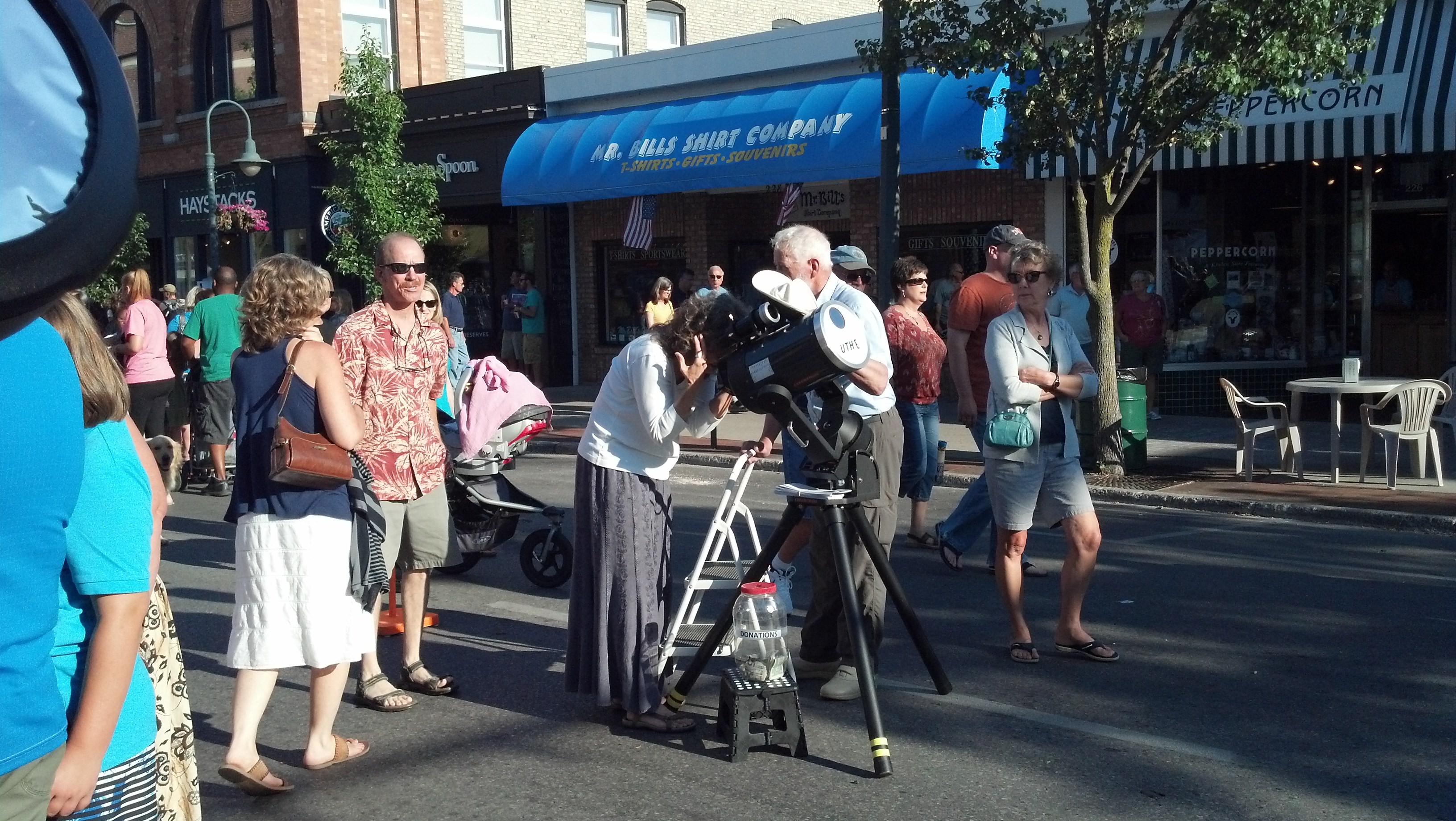
Viewing the Sun with a while light filter at Friday Night Live using Ron Uthe’s telescope at Friday Night Live. Credit Bob Moler.
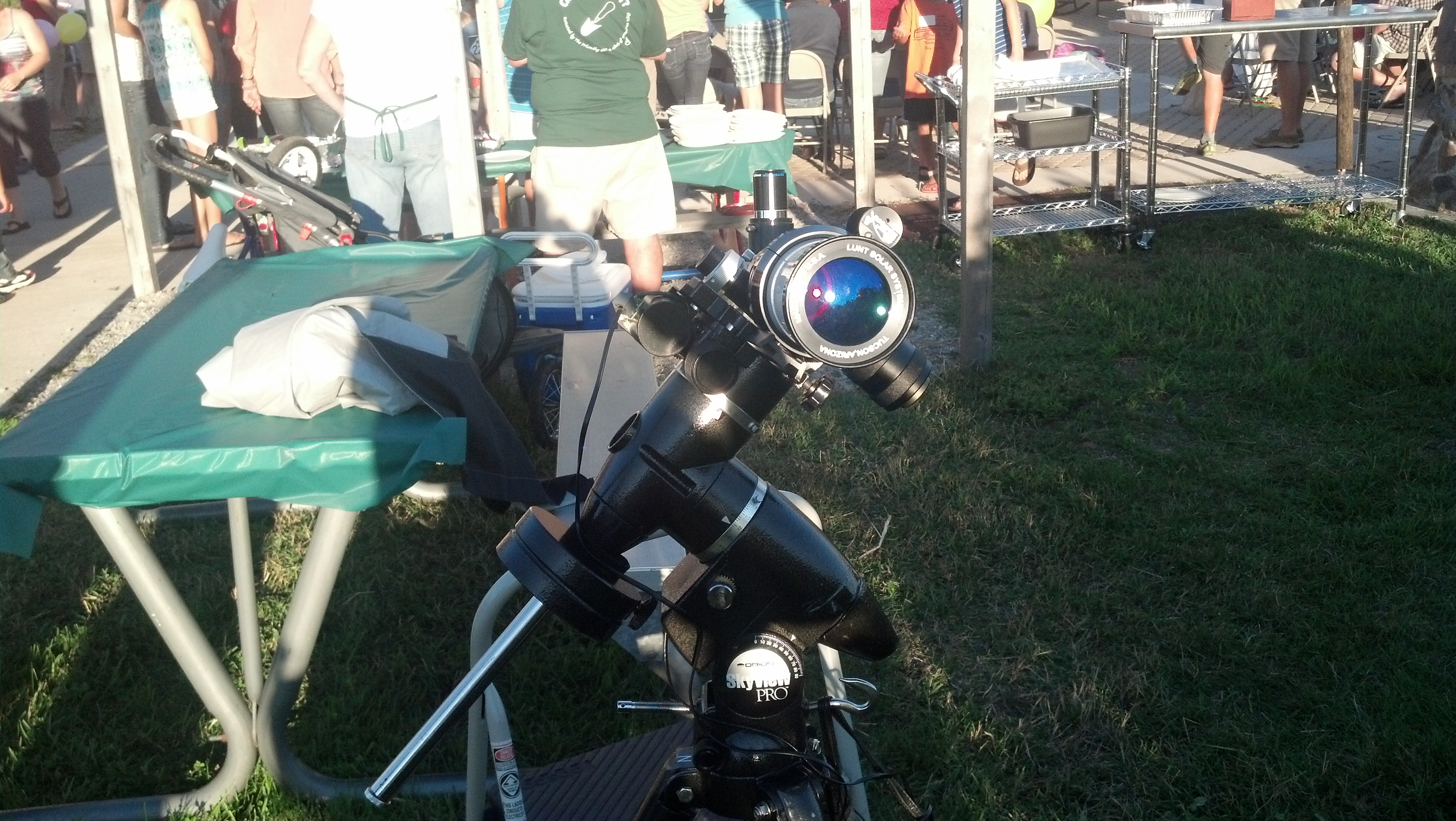
The Lunt solar telescope at another event. Credit Bob Moler.
08/27/2015 – Ephemeris – Thunderstorms can produce sprites pointing upward
Ephemeris for Thursday, August 27th. The Sun will rise at 6:59. It’ll be up for 13 hours and 29 minutes, setting at 8:28. The Moon, 2 days before full, will set at 5:32 tomorrow morning.
Thunderstorms are dangerous, as we experienced with the destruction our area experienced with the August 2nd storm. But beside the lightning, wind, rain, hail and tornadoes thunderstorms also can produce sprites which appear to be electrical discharges extending above the tops of the clouds up to 56 miles. While reported as far back as 1886, they were finally photographed in 1989. They have been photographed many times since from the ground, aircraft and the International Space Station. The images of them that I’ve seen appear to be red in color. However there’s also Blue Jets, Blue Starters, Gigantic Jets and ELVES. Wikipedia describes their appearance, but there appears to be little understanding of them.
Times are for the Traverse City/Interlochen area of Michigan. They may be different for your location.
Addendum

Photograph of Sprites over a Thunderstorm from the International Space Station. NASA/ISS edited by Bob Moler.
08/26/2015 – Ephemeris – Saturn in the evening and an event at the Traverse Area District Library tonight
Wednesday, August 26th. The Sun rises at 6:57. It’ll be up for 13 hours and 32 minutes, setting at 8:30. The Moon, 3 days before full, will set at 4:21 tomorrow morning.
Lets take a look for the bright planets for this week. Saturn is alone in the evening sky spotted low in the southwestern sky near the bright star Antares to its lower left. It will set at 11:59 p.m. Venus crossed over to the morning sky 10 days ago, and Jupiter is passing conjunction with the Sun today. Mars is now in the morning sky climbing away from the Sun. It’s probably too far away from the Earth and faint to spot in the morning twilight. It will rise at 5 a.m. tomorrow. Venus will rise at 5:50 a.m. Tonight the Grand Traverse Astronomical Society will have a summer star party at the Woodmere branch of the Traverse Area District Library starting at 8 p.m. It starts with exploring the summer night skies with a digital sky, before viewing the real one.
Times are for the Traverse City/Interlochen area of Michigan. They may be different for your location.
Addendum
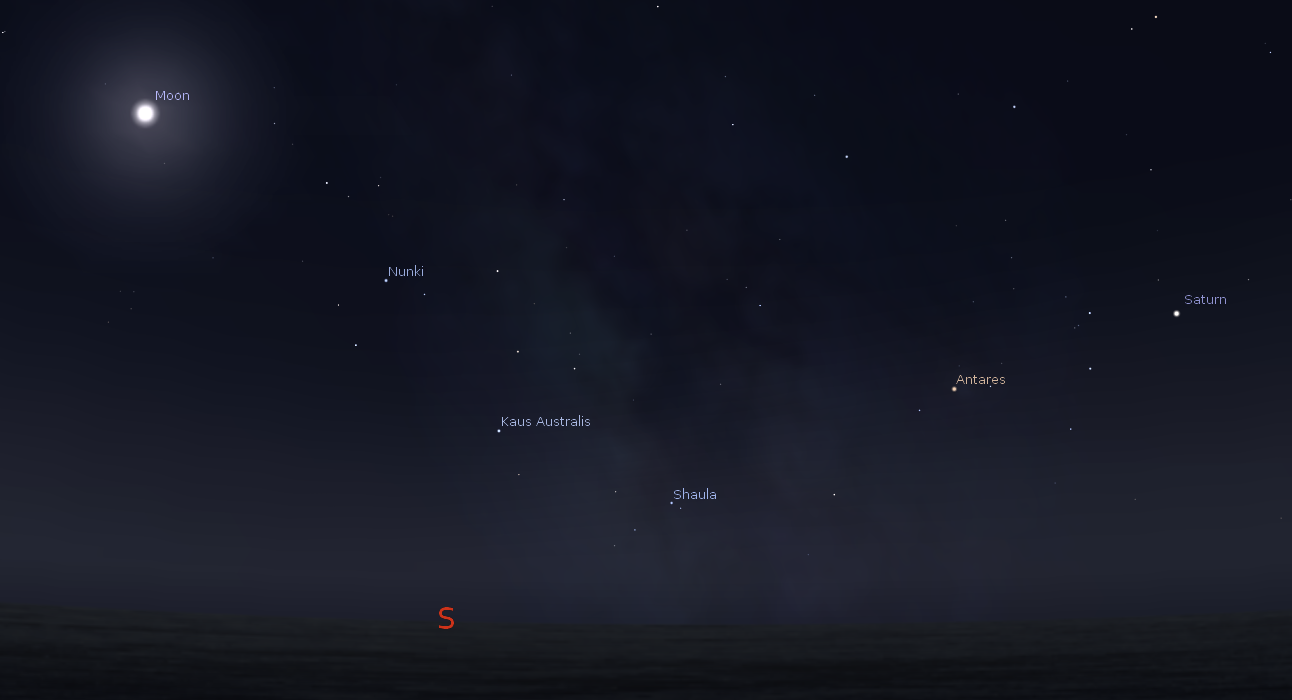
Saturn and the Moon at 10 p.m. August 26, 2015. Created using Stellarium.
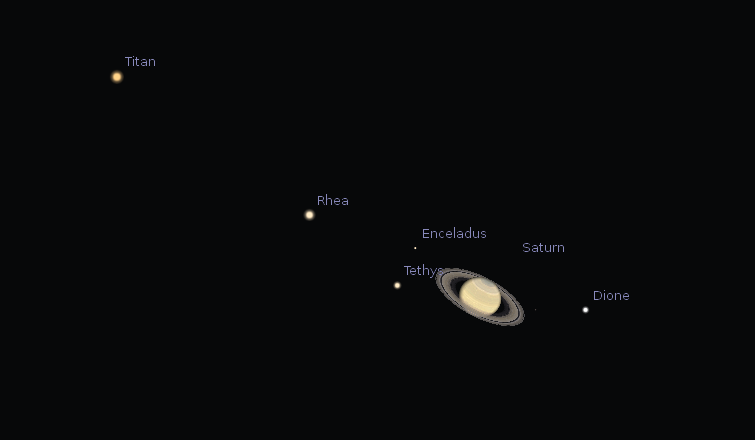
Saturn as seen in a telescope on August 26, 2015. In small telescopes only Titan of all the moons will be visible. Created using Stellarium.
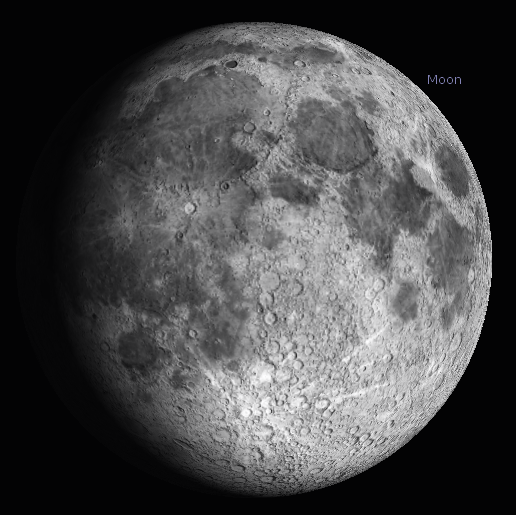
The moon as it would be seen in binoculars at 10 p.m. on August 26, 2015. Created using Stellarium.
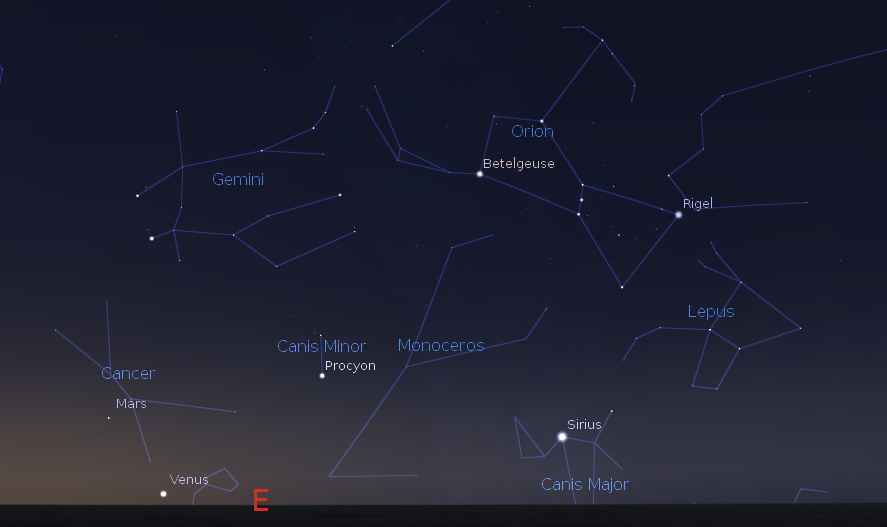
Good morning Venus, with Mars nearby. Venus is very low in the twilight with the stars and constellations of Winter at 6 a.m. August 27, 2015. Created using Stellarium.
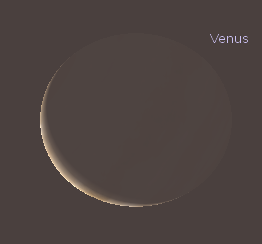
Venus through a telescope – August 27, 2015. Created using Stellarium.
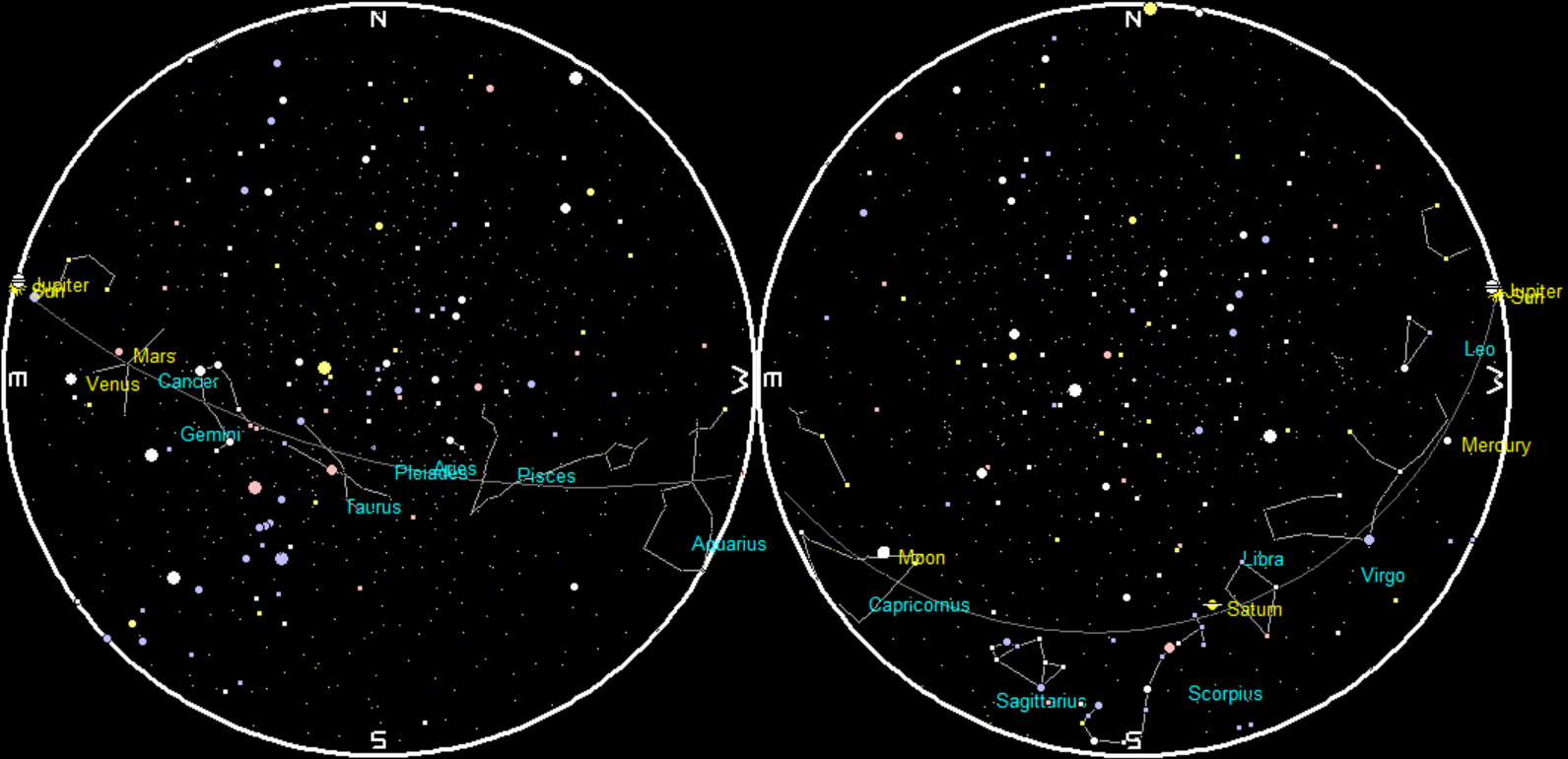
This is a chart showing the sunrise and sunset skies for August 26, 2015 showing the location of the planets and the Moon at that time. Created using my LookingUp program. Click on the image to enlarge.
08/25/2015 – Ephemeris – Waiting for more images from New Horizons
Ephemeris for Tuesday, August 25th. The Sun rises at 6:56. It’ll be up for 13 hours and 35 minutes, setting at 8:32. The Moon, 3 days past first quarter, will set at 3:16 tomorrow morning.
The New Horizons team is downloading data now from all the instruments gathered from the encounter with Pluto, but in mid-September the pictures again will be flowing down to Earth. What was downloaded in the day and a half after close encounter with Pluto were highly compressed images of an area of Pluto and Charon’s surface showing a wider view than we will see later on and in full resolution. The team is already beginning to name the features that can be seen in sufficient detail. The International Astronomical Union has decided the types of names for Pluto, Charon and the rest of the Satellites. Pluto is set aside for explorers, both human and robotic. Charon, for mythical and fictional space and adventure heroes, vessels and authors.
Times are for the Traverse City/Interlochen area of Michigan. They may be different for your location.
Addendum
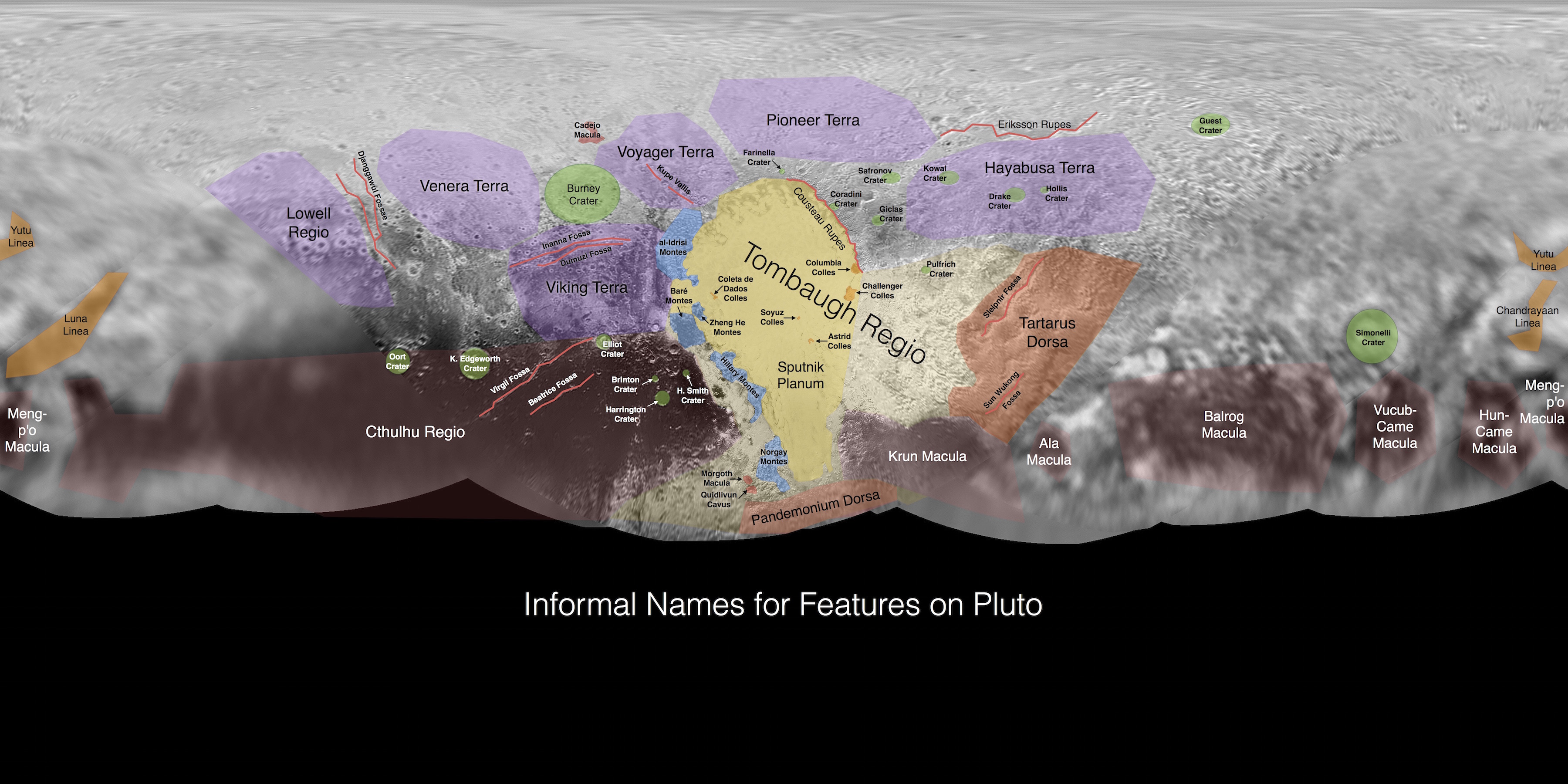
Map of Pluto with unofficial place names so far. Credit NASA/JPL. Click to enlarge.
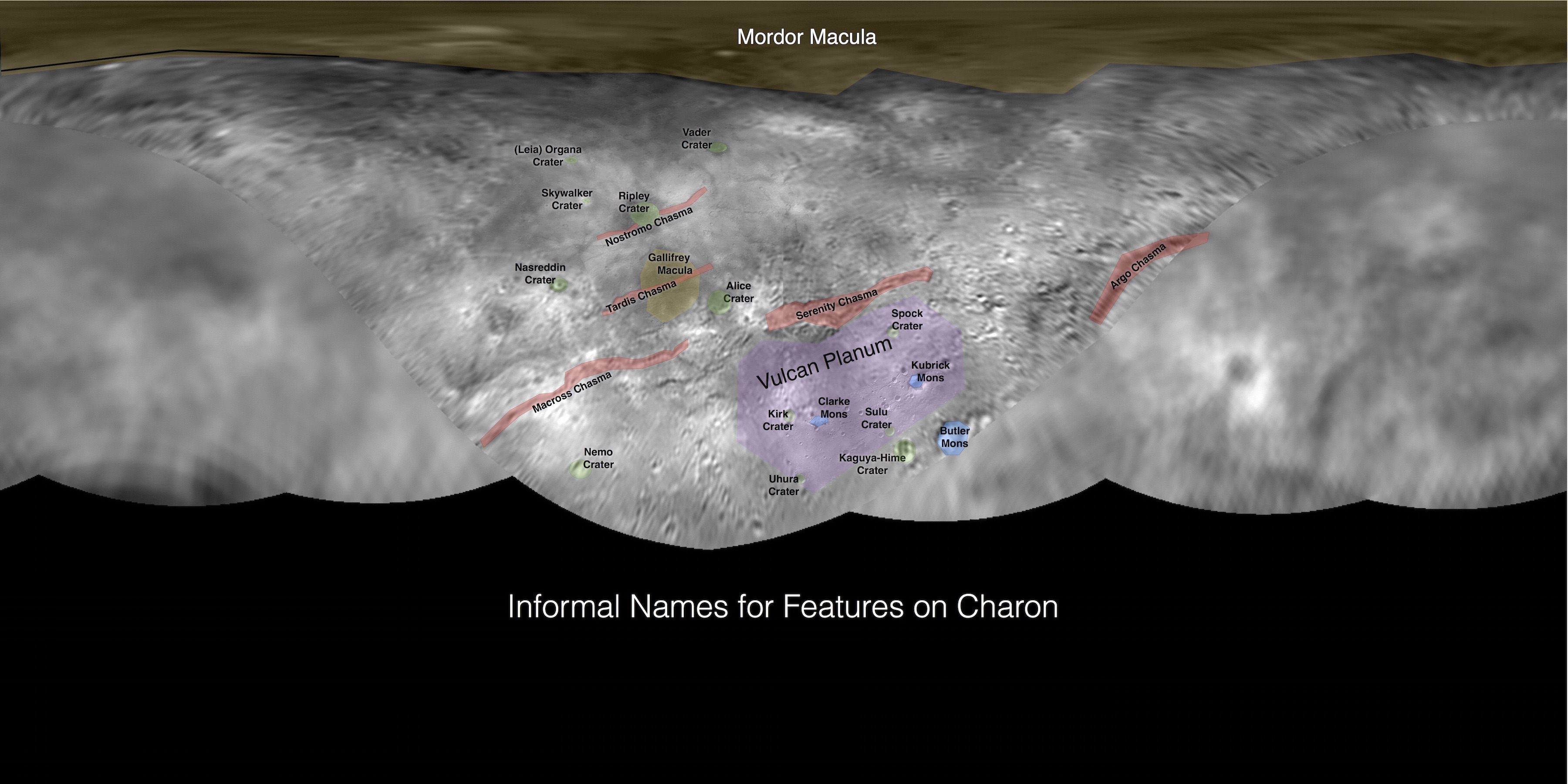
Map of Charon with unofficial place names so far. Credit NASA/JPL. Click to enlarge.
The International Astronomical Union approves all names of objects off the Earth. Go to either http://www.iau.org or more specifically http://planetarynames.wr.usgs.gov.
08/24/2015 – Ephemeris – The Bay of Rainbows
Ephemeris for Monday, August 24th. The Sun rises at 6:55. It’ll be up for 13 hours and 38 minutes, setting at 8:34. The Moon, 2 days past first quarter, will set at 2:17 tomorrow morning.
One of my favorite lunar formations is creeping into sunlight on the Moon this evening. Look to the upper left edge of the moon tonight. The large sea or dark area of the Moon, the Man in the Moon’s right eye as he’s looking at us is Mare Imbrium, the Sea of Showers. At the top left edge of that sea is a large notch. And keeping with of seas these of the first telescopic astronomers its name is Sinus Iridium, or Bay of Rainbows, a colorful name for something as colorless as the rest of the Moon. The terminator which is the sunrise line will be cutting across that bay, illuminating the semicircular mountain ring that surrounds it before all of the floor is illuminated. It can be seen in binoculars or a small telescope.
Times are for the Traverse City/Interlochen area of Michigan. They may be different for your location.
Addendum
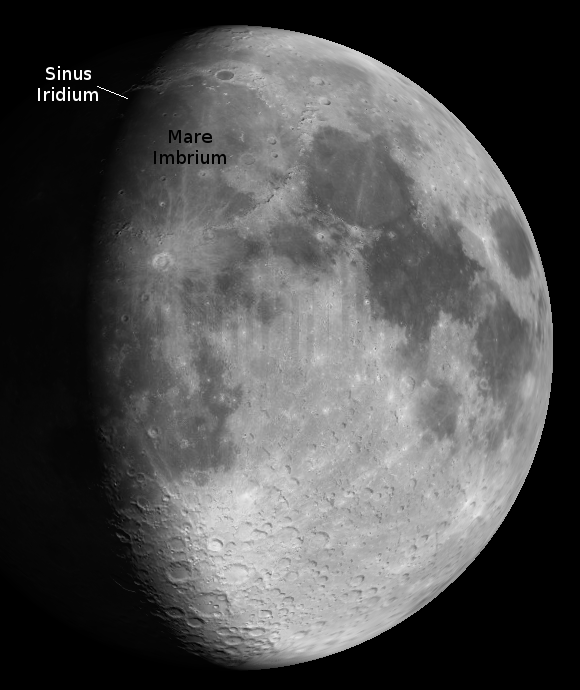
The Moon at 10 p.m. August 24, 2015 showing the location of Sinus Iridium. Created using Virtual Moon Atlas.
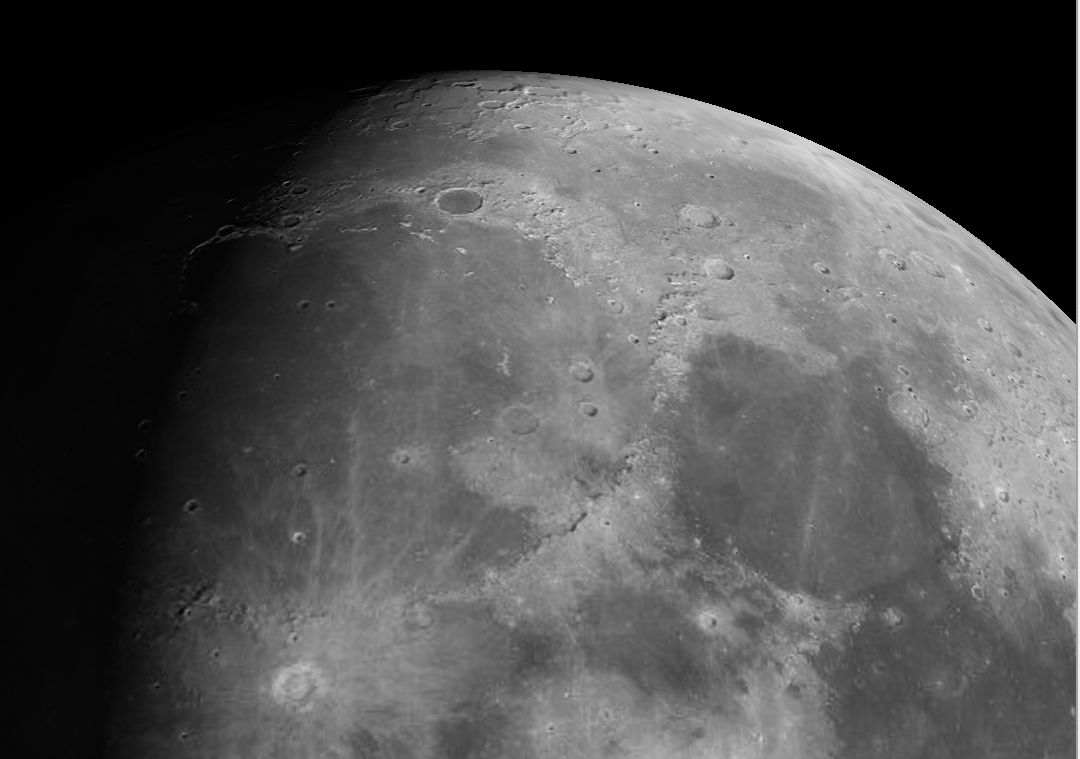
The moon at 10 p.m. August 24, 2015 with Sinus Iridium extending into the lunar night. Created using Virtual Moon Atlas.
This is for 2 hr UT August 25, 2015.

