08/07/2015 – Ephemeris – An opportunity to view the heavens tonight
Ephemeris for Friday, August 7th. The Sun rises at 6:35. It’ll be up for 14 hours and 25 minutes, setting at 9:00. The Moon, 1 day past last quarter, will rise at 1:27 tomorrow morning.
Tonight the Grand Traverse Astronomical Society will host a star party at Northwestern Michigan College’s Rogers Observatory. Featured if weather permits will be the planet Saturn and some of the wonders of the summer Milky Way. In any case we’ll be previewing the skies of August and September, what I consider the richest part of the heavens. It has more beautiful sights than the skies of winter, that everyone raves about. The observatory is located south of Traverse City on Birmley Road opening at 9 p.m. The star party at the Sleeping Bear Dunes originally slated for tomorrow has been canceled due to the damage from last Sunday’s storm. The next star party at the Dunes will be September 12th at the Dune Climb.
Times are for the Traverse City/Interlochen area of Michigan. They may be different for your location.
08/06/2015 – Ephemeris – There’s an eagle in the stars
Ephemeris for Thursday, August 6th. The Sun rises at 6:34. It’ll be up for 14 hours and 27 minutes, setting at 9:02. The Moon, at last quarter today, will rise at 12:46 tomorrow morning.
The southernmost star in the Summer Triangle of three bright stars is Altair, high in the south-southeast in the evening. It’s in the head of the constellation Aquila the Eagle. Altair is flanked by two stars, the eagle’s shoulders, and farther out are the wing tips. Other stars to the lower right are in its body and a last three in its tail. Near the tail binoculars will show a fuzzy spot that telescopes show as a compact star cluster, sometimes called the Wild Duck Cluster for its nearly triangular shape. Aquila is flying northeastward through the Milky Way, where it is split in two by a cloud of gas and dust. According to mythology the Trojan boy Ganymede was taken to heaven at the behest of the god Zeus by this eagle.
Times are for the Traverse City/Interlochen area of Michigan. They may be different for your location.
Addendum
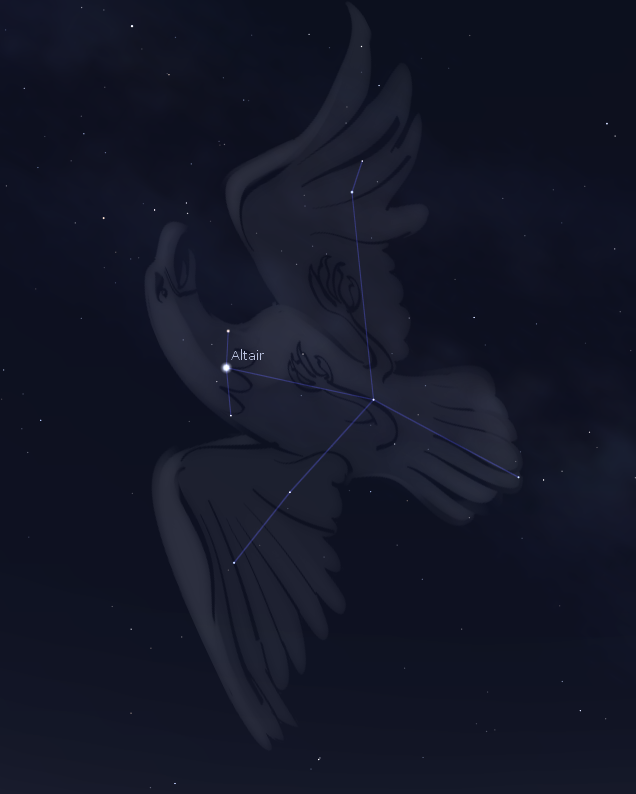
Aquila the Eagle in the southeastern sky. Created using Stellarium.
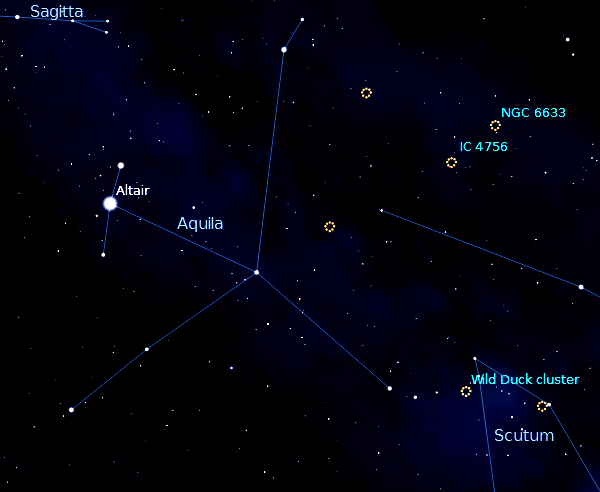
Finder chart for M11, the Wild Duck Cluster, Created using Stellarium.
08/05/2015 – Ephemeris – Down to one easily visible evening planet
Ephemeris for Wednesday, August 5th. The Sun rises at 6:33. It’ll be up for 14 hours and 30 minutes, setting at 9:03. The Moon, 1 day before last quarter, will rise at 12:08 tomorrow morning.
Lets take a look at the bright planets for this week. Our evening stars Venus and Jupiter leaving the evening sky in the west. Venus will set 2 minutes after the Sun, so the only hope to spot it is before sunset, a dangerous prospect with the Sun so close. Jupiter is just too faint in the twilight to pick up. Venus is 10 days from inferior conjunction with the Sun. Saturn is in the south in the evening twilight. Saturn can be spotted just to the right of the constellation of Scorpius the scorpion and its bright red star Antares below and right of it. Even small telescopes can see Saturn’s rings. A spotting scope of 20 power magnification can show that Saturn has a ring. Antares though is star-like, scintillating like a sparkler.
Times are for the Traverse City/Interlochen area of Michigan. They may be different for your location.
Addendum
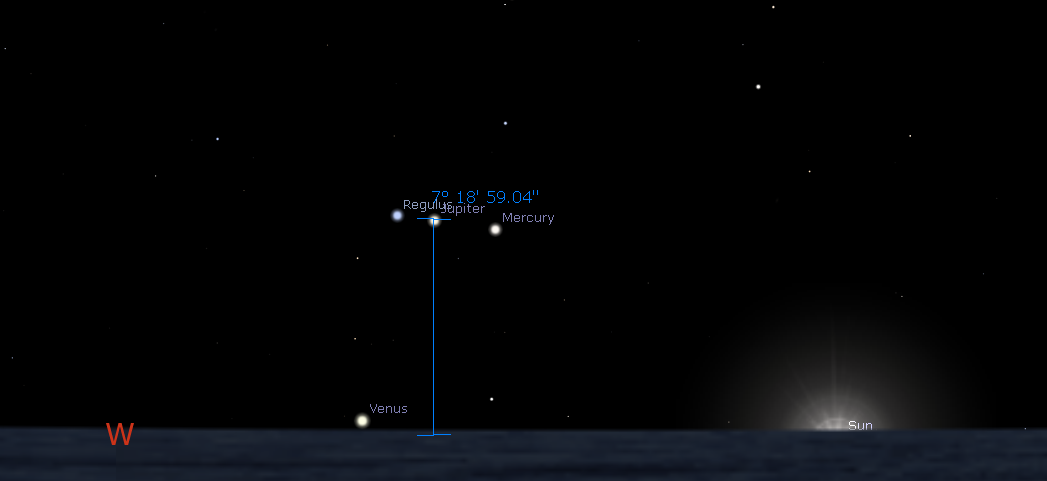
Venus, Jupiter, and Mercury plus the star Regulus together at 9 p.m. August 5, 2015 with the bright Earth’s atmosphere removed. Created using Stellarium.
The reason I don’t discuss Mercury is that This will not be a good apparition of that planet. Apparitions (appearances) of Mercury are best seen in the evening in late winter and spring. Morning apparitions are best seen in late summer and autumn.
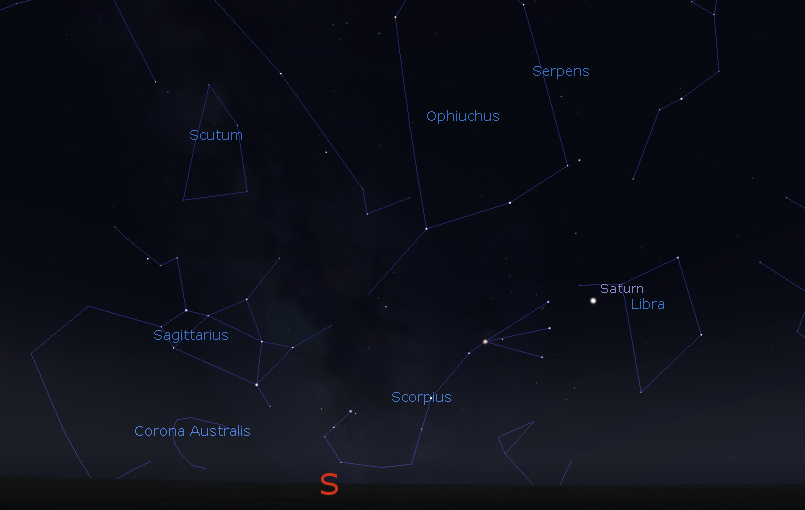
Saturn and the southern Milky Way and stars of summer at 10:30 p.m. August 5, 2015. Created using Stellarium.
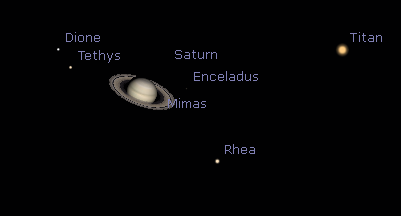
What Saturn and its moons might appear like in a telescope at 10:30 p.m., August 5, 2015. Small telescopes will show only the moon Titan. Created using Stellarium.
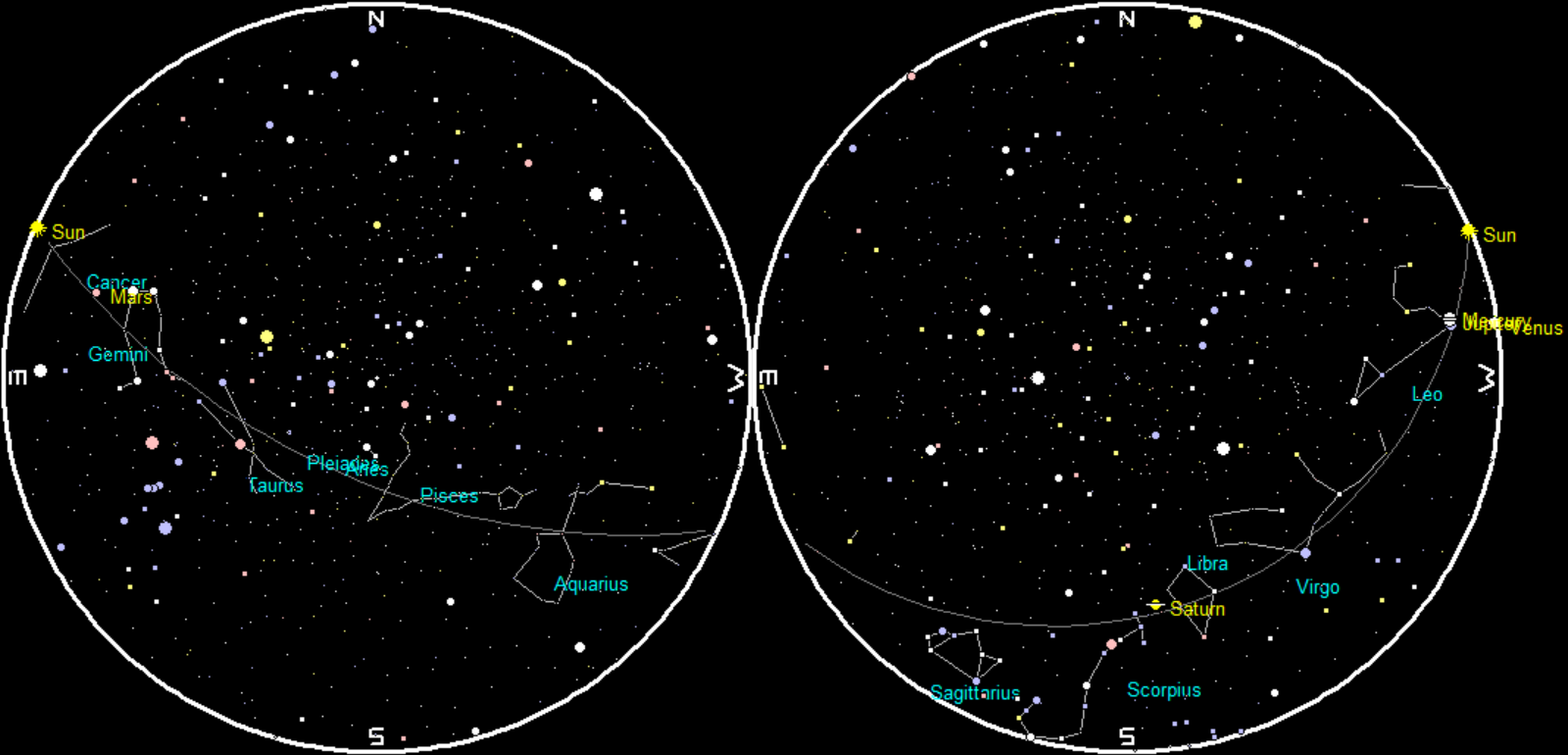
This is a chart showing the sunrise and sunset skies for August 5, 2015 showing the location of the planets at that time. The traffic jam of planets near the western horizon at sunset is best seen in the first image above. Created using my LookingUp program. Click on the image to enlarge.
08/04/2015 – Ephemeris – Is it a swan or a cross?
Ephemeris for Tuesday, August 4th. The Sun rises at 6:32. It’ll be up for 14 hours and 32 minutes, setting at 9:04. The Moon, 2 days before last quarter, will rise at 11:33 this evening.
High in the east northeast as it gets dark flies the constellation of Cygnus the swan. This constellation is also known as the Northern Cross. The cross is seen lying on its side with the bright star Deneb at the head of the cross to the left. The rest of the cross is delineated in the stars to the right. As a swan, Deneb is the tail, the stars of the crosspiece of the cross are part of the leading edges of the wings as Cygnus flies south through the Milky Way. There are faint stars that also define the tips and trailing edges of its wings. It is a very good portrayal of a flying swan, like the mute swans we see on the wing in our area. This is the form the Greek god Zeus took to seduce the maiden Leda in the Leda and the swan affair, out of whose union Pollux was born, who was the twin of Castor, both of whom are also in the stars as the constellation Gemini. In Cygnus we are looking toward the direction that the Sun and the Earth are traveling as we orbit the center of the Milky Way.
Times are for the Traverse City/Interlochen area of Michigan. They may be different for your location.
Addendum
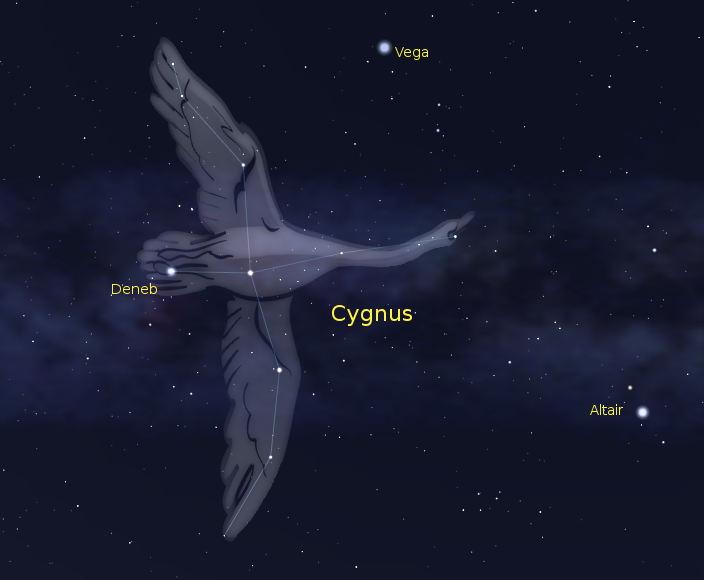
Cygnus The Swan Created using Stellarium.
Note for telescope owners: The star that appears in the eye of the swan image above is Alberio (β Cygni), which splits into a beautiful binary star, whose component stars are blue and gold. It takes a bit more magnification than a pair of binoculars provides.
Note also the mythological citation in the program was omitted from the broadcast version due to time constraints.
08/03/2015 – Ephemeris – The Perseids are coming!
Ephemeris for Monday, August 3rd. The Sun rises at 6:30. It’ll be up for 14 hours and 35 minutes, setting at 9:06. The Moon, half way from full to last quarter, will rise at 10:58 this evening.
After the Moon sets in the evening and morning hours for the next week and a half the numbers of meteors visible will increase each night. These are members of the Perseid meteor shower of August. The peak this year is expected to be during the 2 o’clock hour on the morning of the 13th. These meteors are the result of debris left in the orbit of Comet Swift-Tuttle shed by innumerable visits to the inner solar system. Every year at this time the Earth passes through this trail of debris which intersects its orbit giving rise to the meteor shower. We call them the Perseids, because the appear to come from the direction of the constellation Perseus the hero, which is first seen in the early evening low in the northeast.
Times are for the Traverse City/Interlochen area of Michigan. They may be different for your location.
Addendum
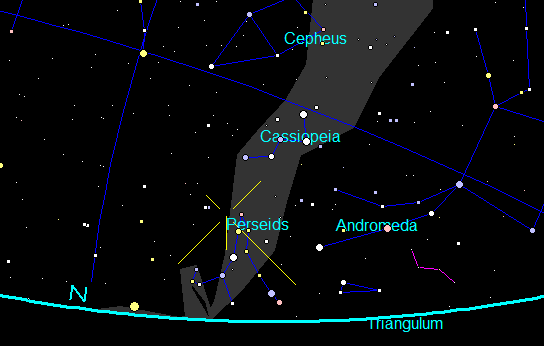
Perseid radiant at 10:30 p.m.
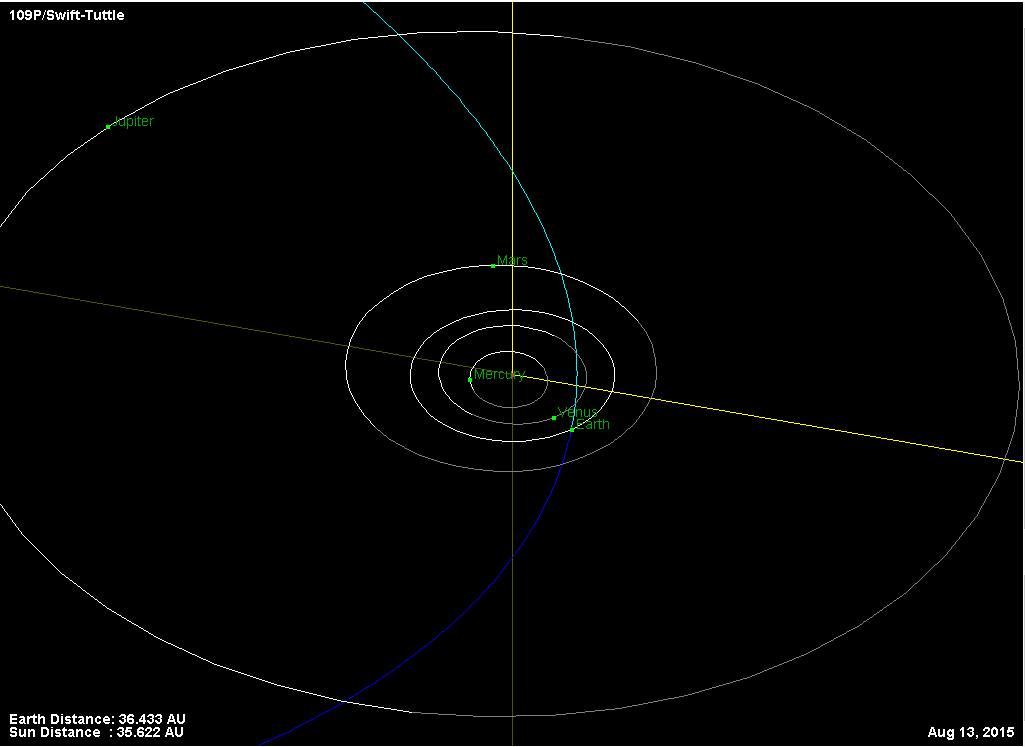
Orbit of Comet 109P/Swift-Tuttle. Blue line is the comet’s orbit, coming from above (North). Credit NASA / JPL / Applet by Osamu Ajiki (AstroArts), and further modified by Ron Baalke (JPL)
The distances in the lower left corner are the comet’s current distances from the Earth and Sun. AU is astronomical units the mean distance between the Earth and Sun. The comet’s last pass through the inner solar system was in 1992. Swift-Tuttle is now out just past the current position of the dwarf planet Pluto. Link to the animation from which the above image was taken and other information on Comet Swift-Tuttle go to http://ssd.jpl.nasa.gov/sbdb.cgi?sstr=109P;cad=1
07/31/2015 – Ephemeris – Looking ahead at August in the skies
Ephemeris for Friday, July 31st. The Sun rises at 6:27. It’ll be up for 14 hours and 42 minutes, setting at 9:10. The Moon, at full today, will rise at 9:08 this evening.
Let’s look ahead at the month of August which starts tomorrow. Daylight hours will decrease from 14 hours and 40 minutes tomorrow to 13 hours 18 minutes on the 31st. The altitude of the sun at local noon, that is degrees of angle above the horizon will decrease from 63 degrees tomorrow to just over 53 degrees on the 31st. Straits area listeners can subtract one more degree from those angles. Local noon, when the sun is due south, is about 1:43 p.m. The Perseid meteor shower will reach its peak at about 2 a.m. on the morning of the 13th, and should be spectacular with a nearly new Moon. On the nights between now and then when the moon has set these meteor numbers will be building to the peak. Saturn will be our only easily visible evening planet.
Times are for the Traverse City/Interlochen area of Michigan. They may be different for your location.
Addendum
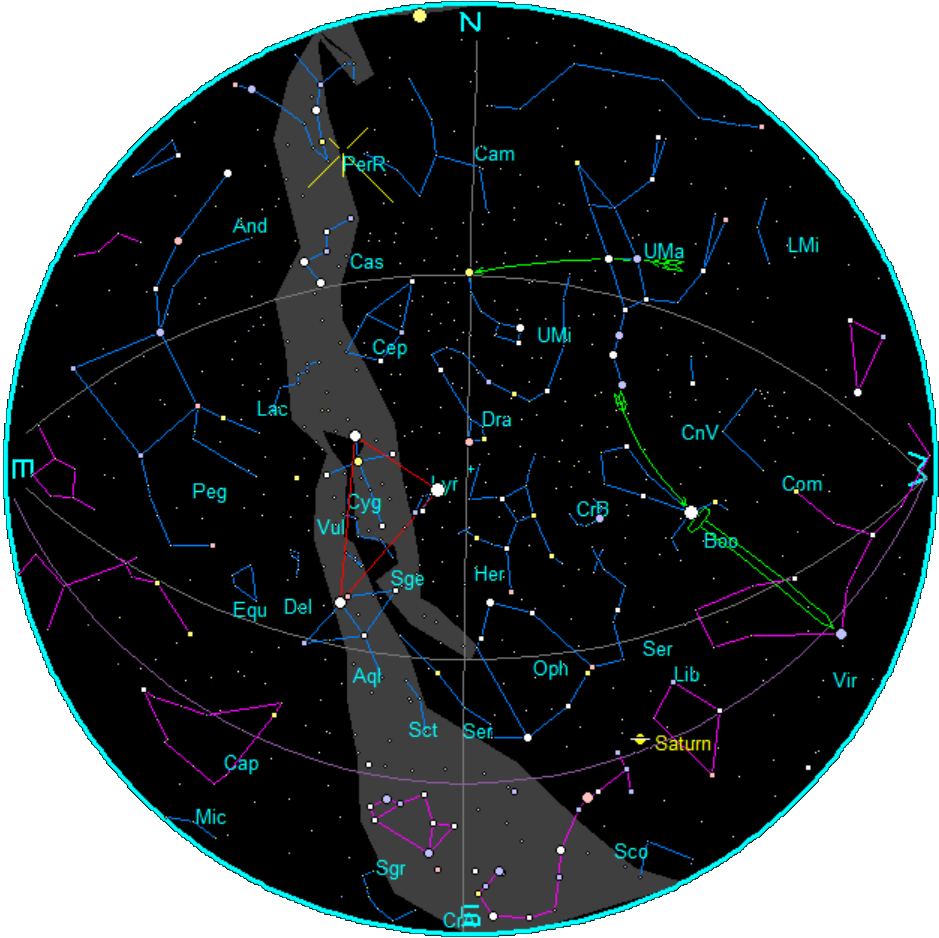
Star Chart for August 2015. Created using my LookingUp program. Click on image to enlarge.The Moon is not plotted.
The planets and stars are plotted for the 15th at 10 p.m. EDT. That is chart time. Note, Traverse City is located 1 hour 45 minutes behind our time meridian. To duplicate the star positions on a planisphere you may have to set it to 1 hour 45 minutes earlier than the current time.
Evening Astronomical twilight ends at 11:12 p.m. EDT on August 1st, decreasing to 10:06 p.m. EDT on the 31st.
Morning astronomical twilight starts at 4:24 a.m. EDT on August 1st, and increasing to 5:18 a.m. EDT on the 31st.
Add a half hour to the chart time every week before the 15th and subtract and hour for every week after the 15th.
For a list of constellation names to go with the abbreviations click here.
The green pointer from the Big Dipper is:
- Pointer stars at the front of the bowl of the Big Dipper point to Polaris the North Star.
- Drill a hole in the bowl of the Big Dipper and the water will drip on the back of Leo the Lion.
- Follow the arc of the Big Dipper’s handle to Arcturus
- Continue with a spike to Spica
- The Summer Triangle is shown in red
- PerR in yellow is the Perseid radiant
Calendar of Planetary Events
Credit: Sky Events Calendar by Fred Espenak and Sumit Dutta (NASA’s GSFC)
To generate your own calendar go to http://eclipse.gsfc.nasa.gov/SKYCAL/SKYCAL.html
Times are Eastern Daylight Time on a 24 hour clock. Some additions made to aid clarity.
Conjunctions like the Mercury-Regulus: 0.9° N means Regulus will appear 0.9° north of Mercury.
| Aug | 01 | Sa | Venus: 21.5° East of the Sun | |
| 02 | Su | 06:11 | Moon Perigee: 362,100 km | |
| 03 | Mo | 22:53 | Moon Descending Node | |
| 06 | Th | 22:03 | Last Quarter | |
| 07 | Fr | 13:25 | Mercury-Regulus: 0.9° N | |
| 08 | Sa | 19:22 | Moon-Aldebaran: 0.7° S | |
| 10 | Mo | 07:11 | Moon North Dec.: 18.3° N | |
| 13 | Th | 02:17 | Perseid Shower: ZHR* = 90 | |
| 14 | Fr | 10:54 | New Moon | |
| 15 | Sa | 15:19 | Venus Inferior Conjunction with the Sun | |
| 16 | Su | 10:34 | Moon-Mercury: 2.2° N | |
| 17 | Mo | 19:05 | Moon Ascending Node | |
| 17 | Mo | 22:33 | Moon Apogee: 405,900 km | |
| 19 | We | 23:35 | Mars-Beehive: 0.5° S | |
| 22 | Sa | 13:21 | Moon-Saturn: 2.8° S | |
| 22 | Sa | 15:31 | First Quarter | |
| 24 | Mo | 23:44 | Moon South Dec.: 18.2° S | |
| 26 | We | 17:04 | Jupiter Conjunction with the Sun | |
| 29 | Sa | 14:35 | Full Moon | |
| 30 | Su | 11:24 | Moon Perigee: 358,300 km | |
| 31 | Mo | 06:16 | Moon Descending Node | |
| 31 | Mo | 22:12 | Neptune Opposition from the Sun | |
| Sep | 01 | Tu | Venus: 25° West of the Sun |
*ZHR – Zenithal Hourly Rate: Approximate number of meteors per hour when the shower radiant is at the zenith. For more information on this and other meteor showers in 2015 see the International Meteor Organization website calendar section: http://www.imo.net/calendar.
07/30/2015 – Ephemeris – Pluto’s enigmatic atmosphere
Ephemeris for Thursday, July 30th. The Sun rises at 6:26. It’ll be up for 14 hours and 44 minutes, setting at 9:11. The Moon, 1 day before full, will set at 6:45 tomorrow morning.
The last image released last week from the New Horizons spacecraft was a stunning one. It was Pluto backlit, showing a glow completely around the planet, the atmosphere, showing layers. Also when New Horizons went behind the planet and again went behind Charon from the Earth’s point of view. Beams of radio waves from seven of the antennas of NASA’s Deep Space Network were sent toward Pluto and New Horizons four and a half hours earlier. The spacecraft turned its antenna toward Earth and listened. As the radio waves passed through the atmosphere of Pluto they were refracted and distorted giving clues to the state of the atmosphere. First takeaway is that Pluto’s atmosphere appears to be collapsing with its increasing distance from the Sun.
Times are for the Traverse City/Interlochen area of Michigan. They may be different for your location.
Addendum
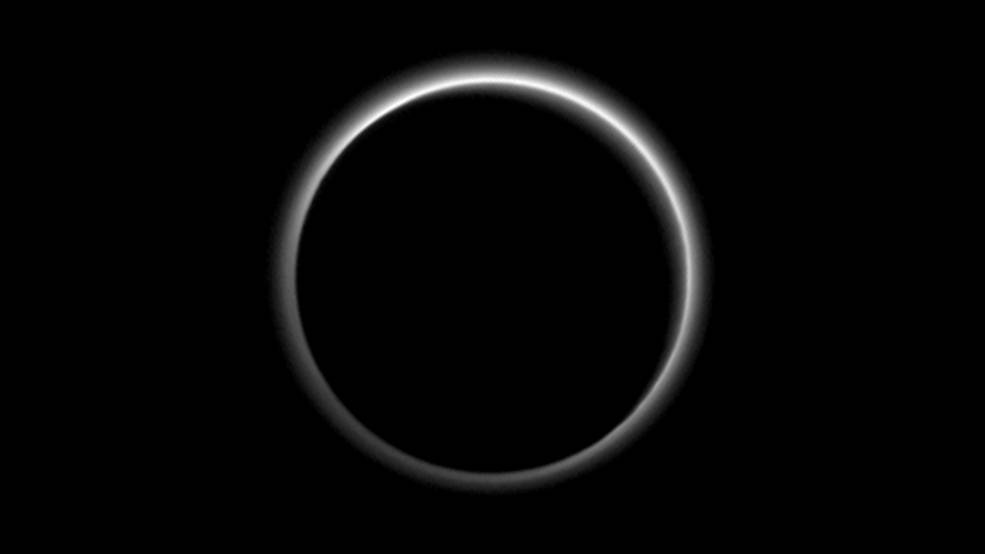
Looking back at Pluto backlit by the Sun from 1.25 million miles. Credits: NASA/JHUAPL/SwRI.
Click here for more information on the above image.
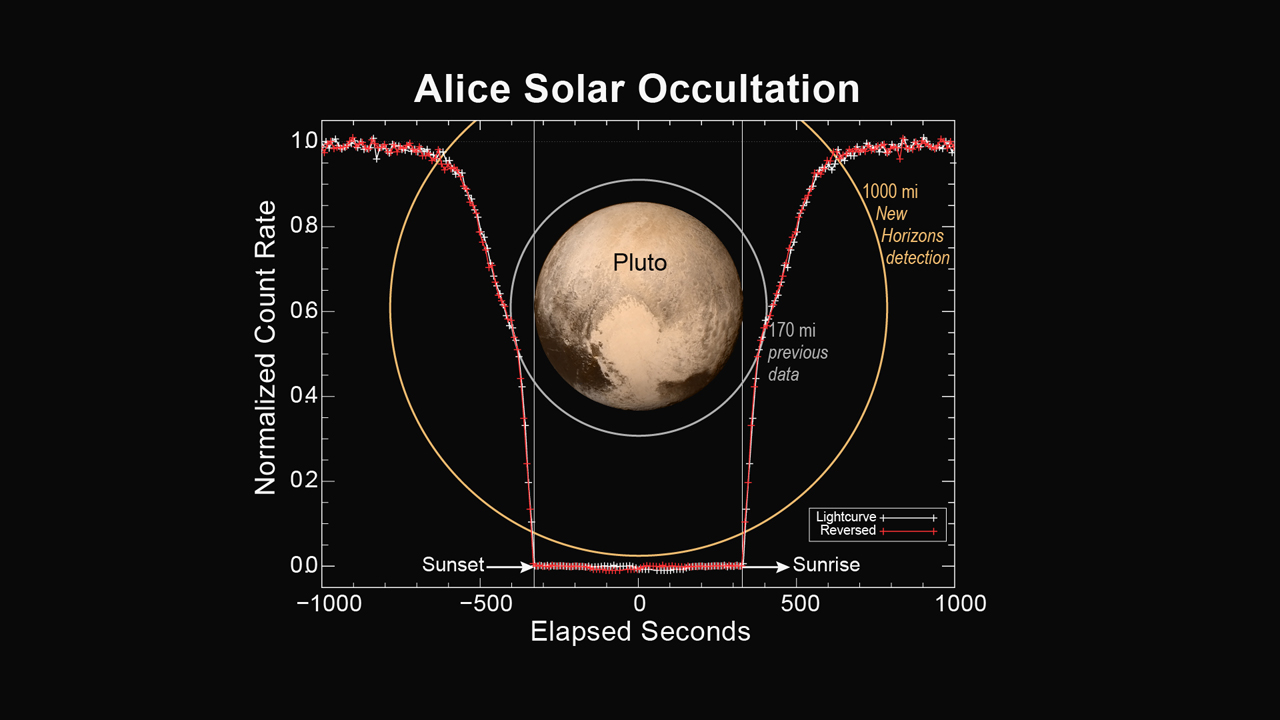
Data from the Alice ultraviolet instrument when Pluto occulted the Sun. Credits: NASA/JHUAPL/SwRI.
Click here for more information on this Alice observation.
07/29/2015 – Ephemeris – Where are the bright planets tonight
Ephemeris for Wednesday, July 29th. The Sun rises at 6:25. It’ll be up for 14 hours and 47 minutes, setting at 9:12. The Moon, 2 days before full, will set at 5:36 tomorrow morning.
Lets take a look at the bright planets for this week. Our evening stars Venus and Jupiter are together in the west by 9:30 p.m. with Jupiter above and right of Venus. Venus will set at 9:46 with Jupiter 23 minutes later. Venus will slide down to the Sun faster and faster in the coming weeks leaving Jupiter behind for a while. Venus will take 17 days to slide past the Sun. Jupiter though will take 28 days, so Venus will pass it again around August 4th when both are too close to the horizon and Sun to spot. There’s a third conjunction of these two in October in the morning sky with Mars nearby. Saturn is in the south in the evening twilight. It will set at 1:48 a.m. Even small telescopes can see Saturn’s rings.
Times are for the Traverse City/Interlochen area of Michigan. They may be different for your location.
Addendum
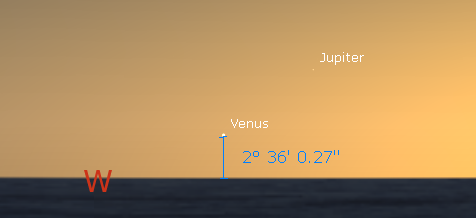
Venus and Jupiter low on the western horizon at 9:30 p.m. on July 29, 2015. This will be their last appearance on this blog in the west this year. We’ll wait until they appear in the east in the morning. For Venus it’ll be sooner than you think. Created using Stellarium.
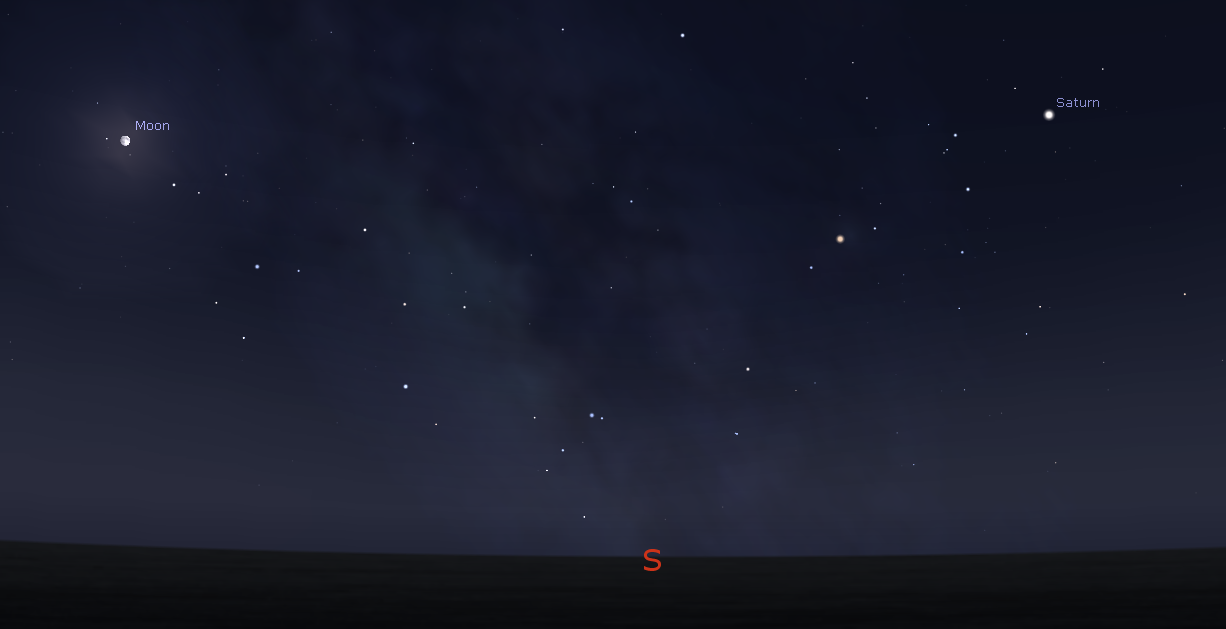
Saturn with the bright Moon and some stars of summer in the constellations Scorpius and Sagittarius at 10:30 p.m. July 29, 2015. Created using Stellarium.
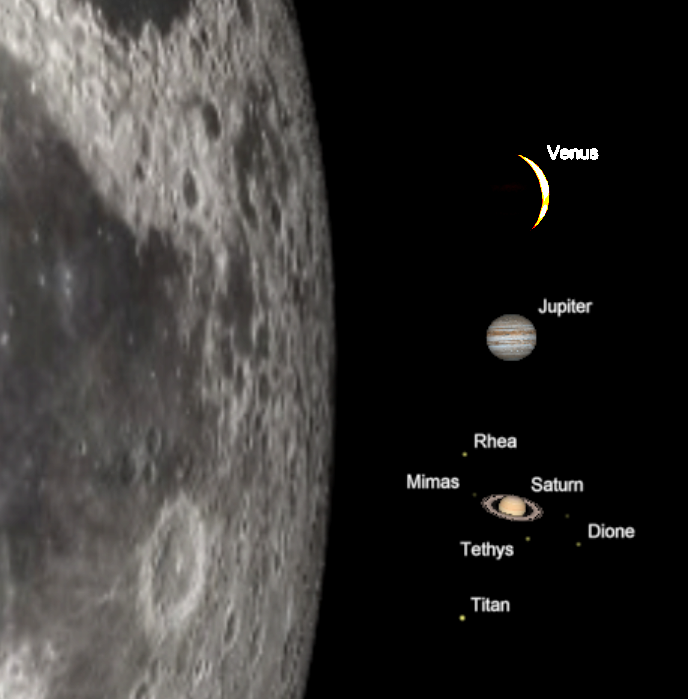
Comparative apparent sizes of the evening planets as seen through a telescope of the same magnification on July 29, 2015. Created using Cartes du Ciel (Sky Charts). Note that I didn’t show the moons of Jupiter which are not visible in the bright twilight. Also the program didn’t extend the cusps of Venus’ crescent properly.
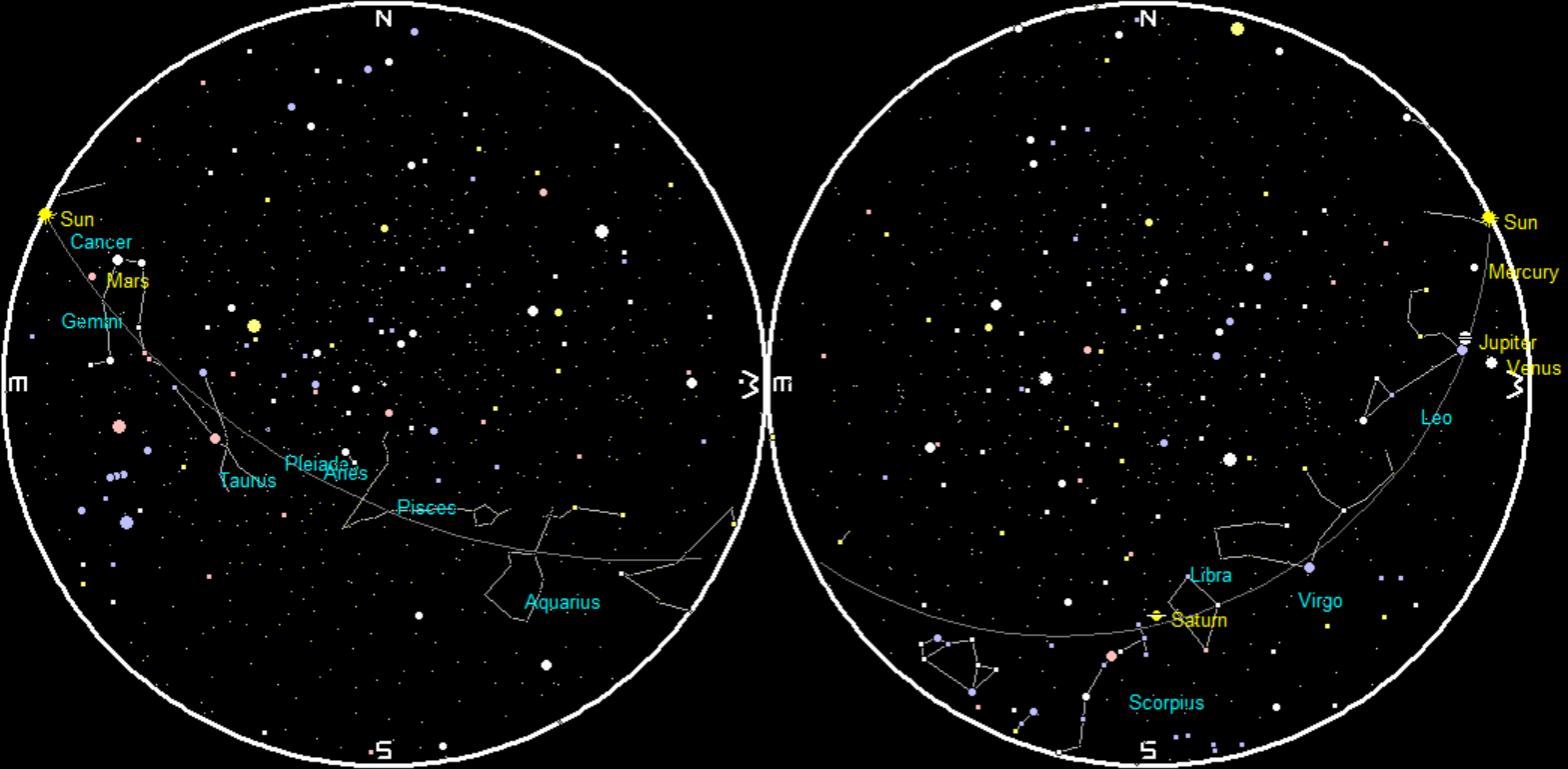
This is a chart showing the sunrise and sunset skies for July 29, 2015 showing the location of the planets at that time. Created using my LookingUp program.
07/28/2015 – Ephemeris – The first close up images of Pluto
Ephemeris for Tuesday, July 28th. The Sun rises at 6:24. It’ll be up for 14 hours and 49 minutes, setting at 9:13. The Moon, 3 days before full, will set at 4:32 tomorrow morning.
Two weeks ago the New Horizons spacecraft zipped through the Pluto system gathering a wealth of information including a whole host of images. Due to their large size the images will take some time to be sent back, however some highly compressed images have been returned and yield a tantalizing look at the dwarf planet Pluto and its large moon Charon. Rather than an apparently dead heavily cratered body, the first images presented a young surface with plains and mountains with nary a crater to be found. Young is relative, perhaps 100 million years old or so and implied heating where there appears no source to be found… yet. The first of many mysteries. And we have 16 months more of data and images to be returned.
Times are for the Traverse City/Interlochen area of Michigan. They may be different for your location.
Addendum
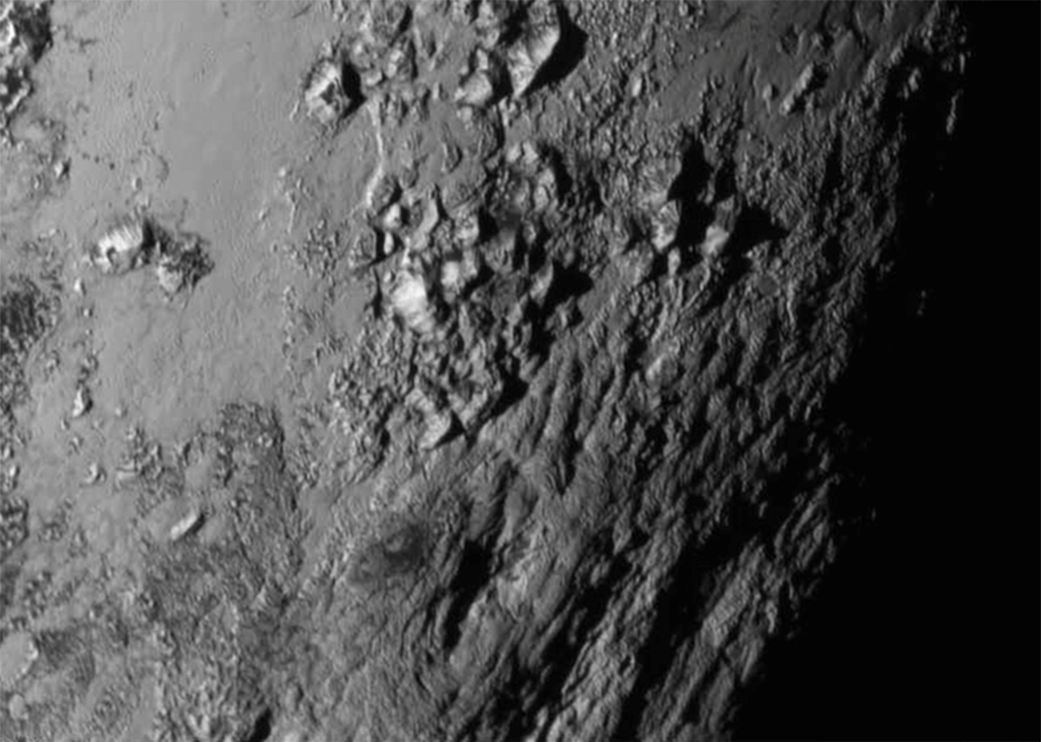
First closeup picture the New Horizon Team showed. Two mile high ice mountains, plains, and interesting terrain, but no craters. A young surface. Credit: NASA/Johns Hopkins University Applied Physics Laboratory/Southwest Research Institute. Click on image to enlarge.
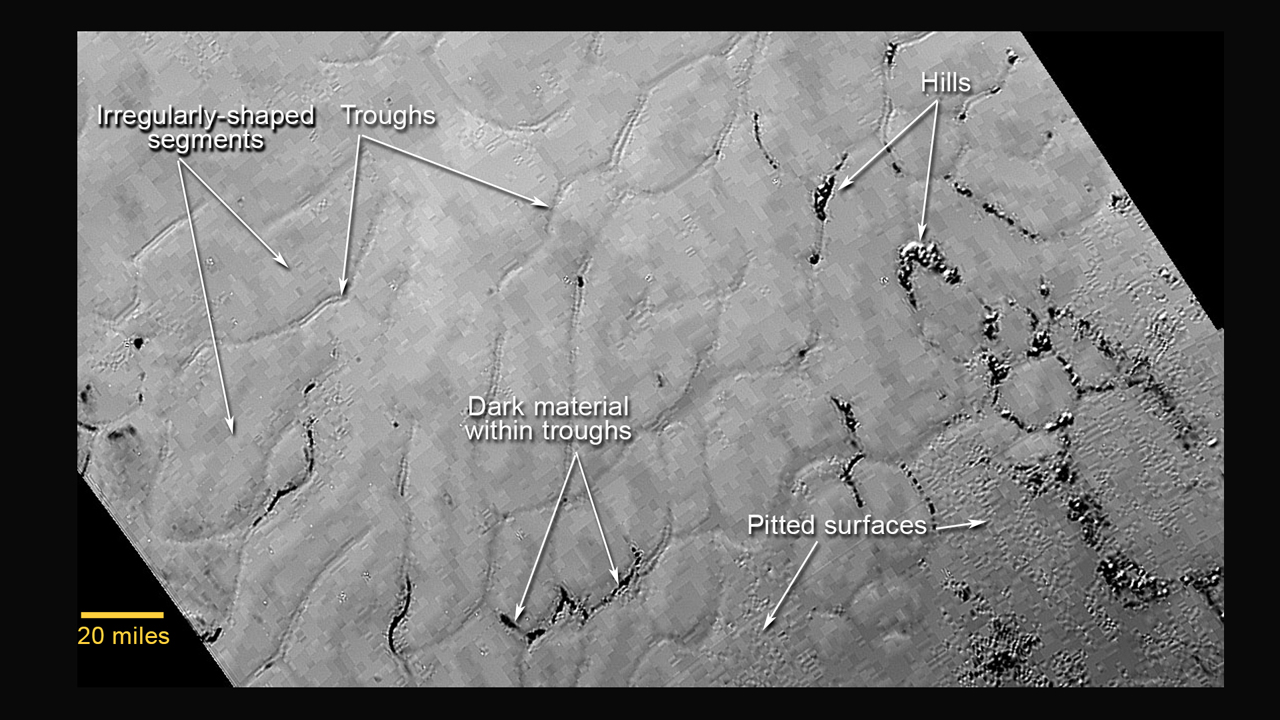
Sputnik Planum (Plain) next to the ice mountains showing polygons and troughs, some with hills. This is part of Pluto’s “Heath”. Note the rectangular lossy compression artifacts in the image. An uncompressed version will be downlinked later. Credit: NASA/Johns Hopkins University Applied Physics Laboratory/Southwest Research Institute. Click on image to enlarge.
07/27/2015 – Ephemeris – Deneb, the dimmest of the Summer Triangle stars. But is it really?
Ephemeris for Monday, July 27th. The Sun rises at 6:23. It’ll be up for 14 hours and 51 minutes, setting at 9:14. The Moon, 3 days past first quarter, will set at 3:36 tomorrow morning.
This evening when it gets dark the bright star Deneb in Cygnus the swan will be high in the east northeast. Deneb is the dimmest star of the summer triangle. Of the other stars of the triangle, Vega is very high in the east, while Altair is lower in the southeast. While Deneb’s apparent magnitude, or brightness as seen from earth, makes it the dimmest of the three bright stars, Deneb’s vast distance of possibly 2,600 light years makes it over 100 times the distance of Vega. If brought as close as Vega, Deneb would be almost as bright as the full moon. It is as bright as two hundred thousand suns. It apparently has run out of hydrogen in its core. Once a blue super giant star, it’s currently evolving through the white supergiant stage.
Times are for the Traverse City/Interlochen area of Michigan. They may be different for your location.
Addendum
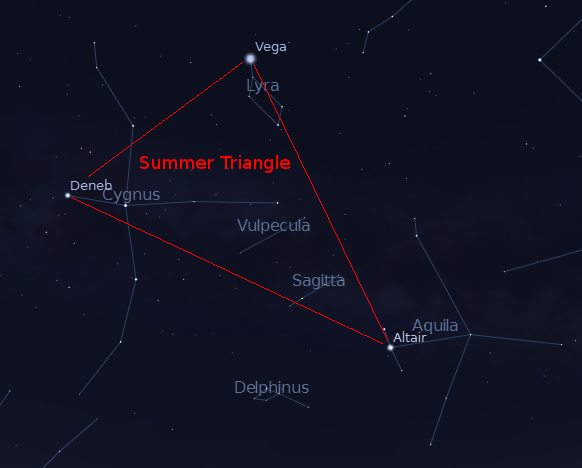
The Summer Triangle. Created using Stellarium and The Gimp.
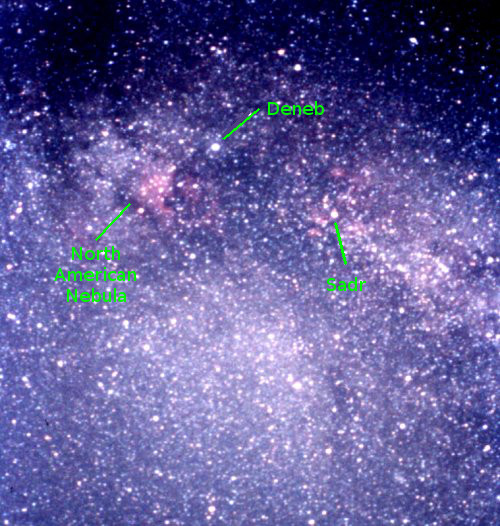
One of my old photographs of Deneb and the North American Nebula digitized from a slide.
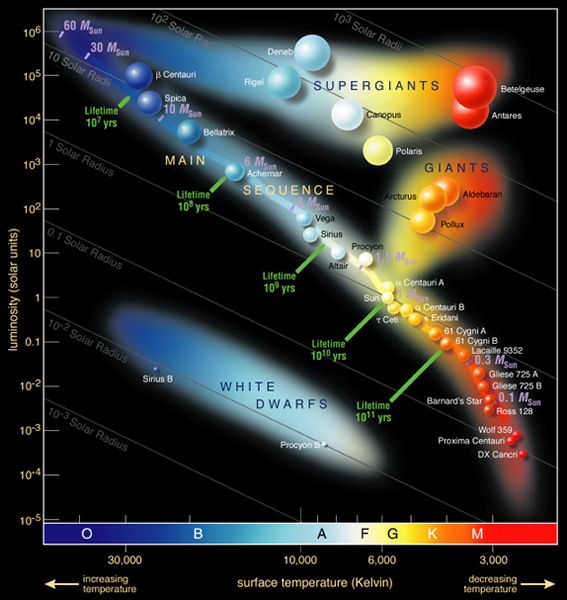
The Hertzsprung-Russell diagram of star luminosity vs. surface temperature. Note that Deneb is at the top center, while the Sun is lower on the main sequence. Credit: European Southern Observatory (ESO).

