05/07/2014 – Ephemeris – Wednesday is bright planet day here on Ephemeris
Ephemeris for Wednesday, May 7th. The sun rises at 6:24. It’ll be up for 14 hours and 30 minutes, setting at 8:54. The moon, 1 day past first quarter, will set at 3:09 tomorrow morning.
It’s Wednesday and once again time to locate the bright planets for this week. Brilliant Jupiter will be in the western sky as darkness falls tonight. It will set at 1:30 a.m. Reddish Mars is in Virgo and outshines the bright bluish star Spica below left of it as darkness falls. Mars is in the south-east as it gets dark. It will pass due south at 11:18 p.m. It’s 61.8 million miles away now, and moving away, and will set at 5:09 a.m. Saturn will rise at 8:50 p.m. It’s in the faint constellation of Libra the scales this year. It will pass due south at 1:53 a.m. Saturn will be opposite the sun in the sky this Saturday. Brilliant Venus will rise in the east at 4:56 a.m. in twilight.
Times are for the Traverse City/Interlochen area of Michigan. They may be different for your location.
Addendum
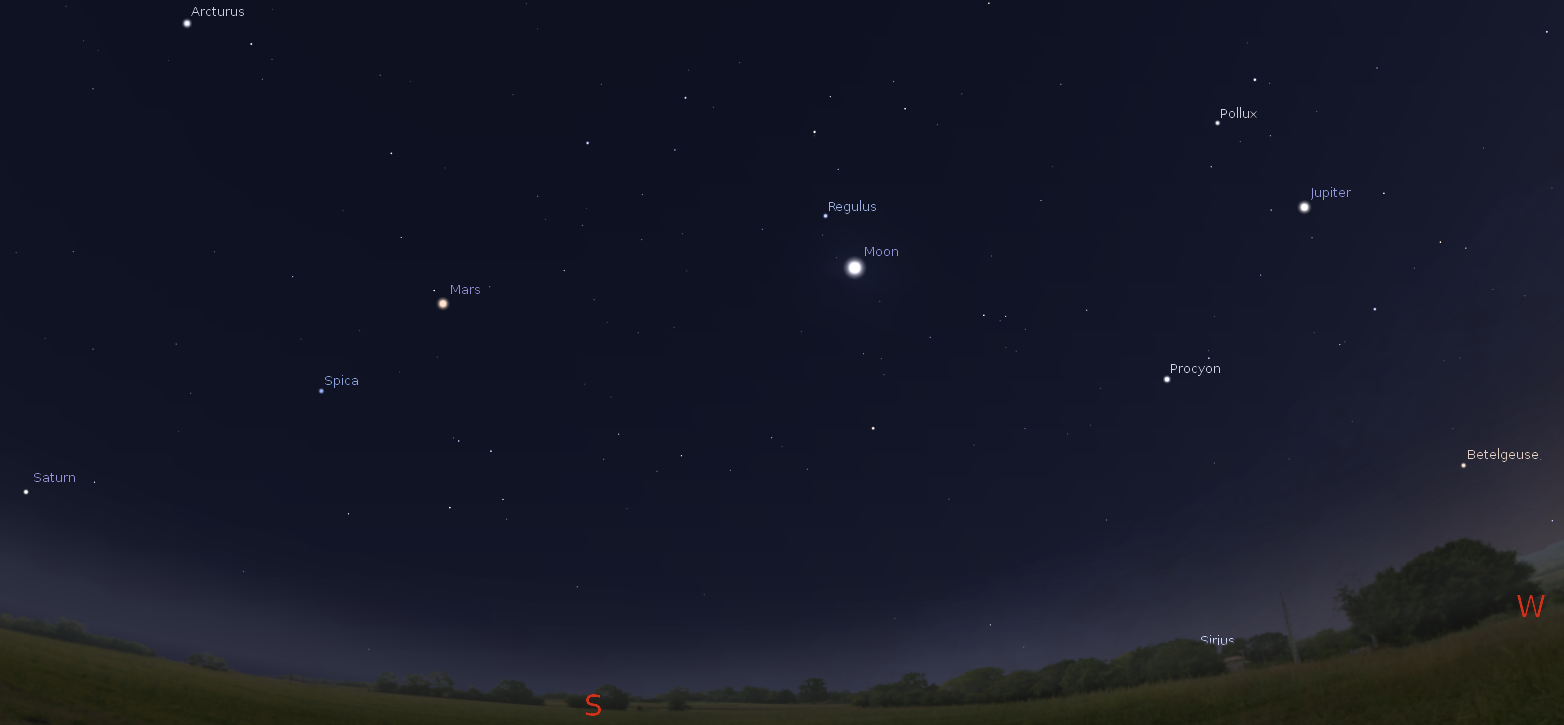
The evening planets: Jupiter, Mars and Saturn with the Moon at 10 p.m. on April 30, 2014. Created using Stellarium. Click to enlarge.
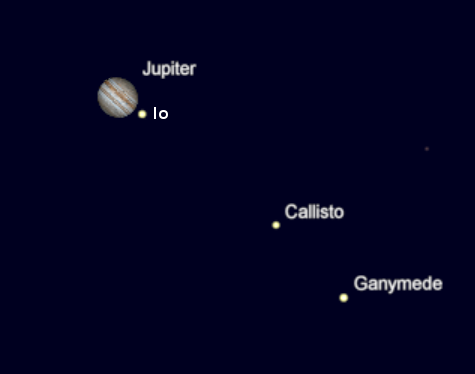
Jupiter with three of its bright satellites at 10 p.m. May 7, 2014. Io will go behind the planet at 10:28. Europa is in Jupiter’s shadow and will reappear at 12:04 a.m. Created using Cartes du Ciel.
Note: Cartes du Ciel (Sky Charts) was used because it takes into consideration the light-time delay. Stellarium does not and showed the occultation of Io already in progress.
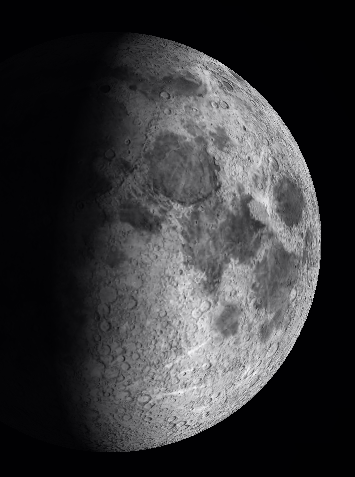
The Moon at 10 p.m. May 7, 2014. Created using Stellarium.
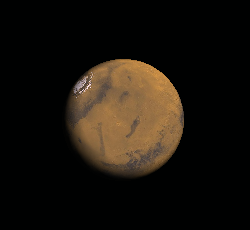
Mars in a telescope at 10 p.m. May 7, 2014. Created using Stellarium.
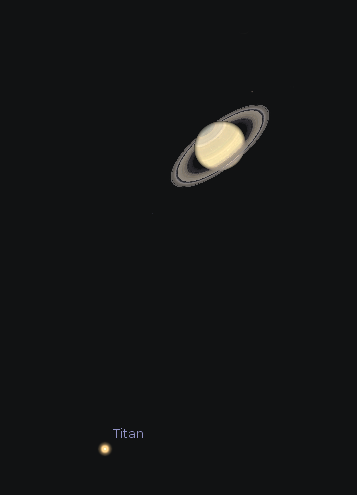
Saturn with its largest moon Titan in a telescope at 10 p.m. May 7, 2014. Created using Stellarium.
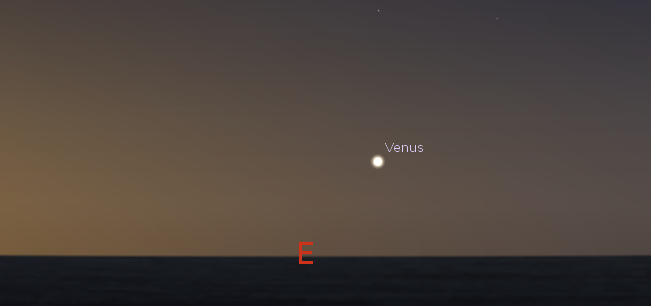
Venus low in the east at 5:30 a.m. May 8, 2014. Created using Stellarium.
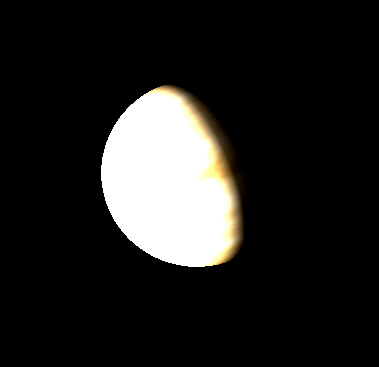
Venus in a telescope at 5:30 a.m. May 8, 2014. Created using Stellarium.
05/06/2014 – Ephemeris – A square crater on the moon
Ephemeris for Tuesday, May 6th. The sun rises at 6:25. It’ll be up for 14 hours and 27 minutes, setting at 8:53. The moon, at first quarter today, will set at 2:40 tomorrow morning.
Tonight’s moon reveals some great features. Back in my early astronomy days, one of the odd thing I saw on the moon with my telescope at about this phase, was what appeared as a square crater on the moon. Craters are supposed to be round. This one was near the north pole of the moon. It can be seen with a small telescope. It was given the name Barrow. I’ve since confirmed that it is indeed quite square, with a small crater, Barrow A sitting on one corner. The Lunar Reconnaissance Orbiter shows this in great detail. Also on the north end of the moon tonight is the Alpine Valley, which looks like a gash crossing the Lunar Alps. Lunar mountain ranges tend to be named for earthly mountains, but are really crater walls.
Times are for the Traverse City/Interlochen area of Michigan. They may be different for your location.
Addendum
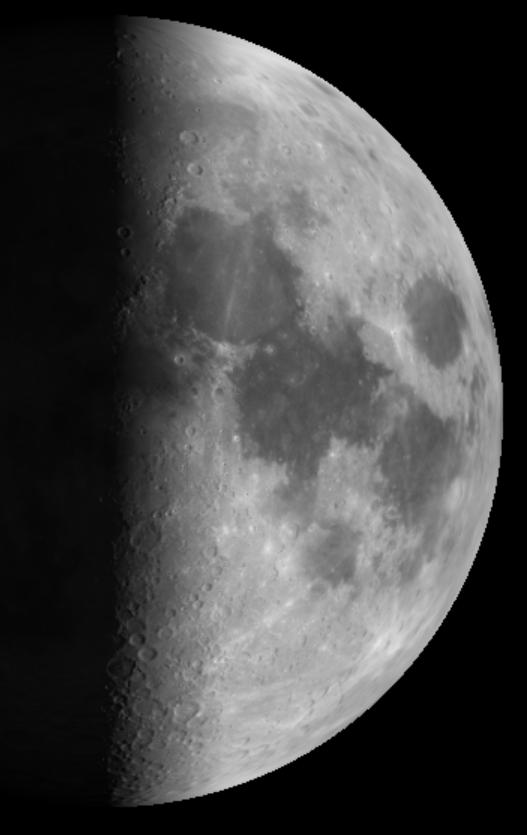
First quarter Moon at 10 p.m. May 6, 2014. Created using Virtual Moon Atlas.
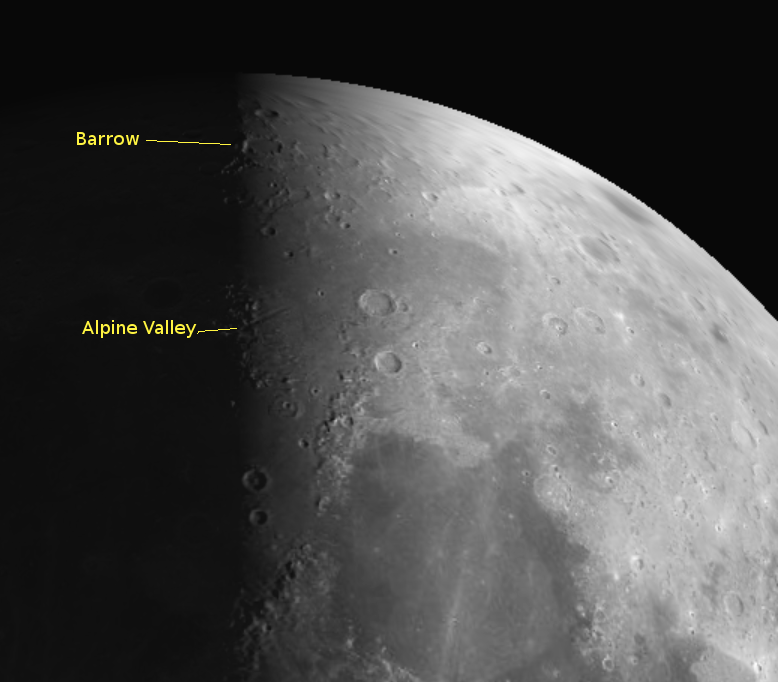
The square crater Barrow and the Alpine Valley as it would be seen in a telescope on May 6, 2014 at 10 p.m. Created using Virtual Moon Atlas.
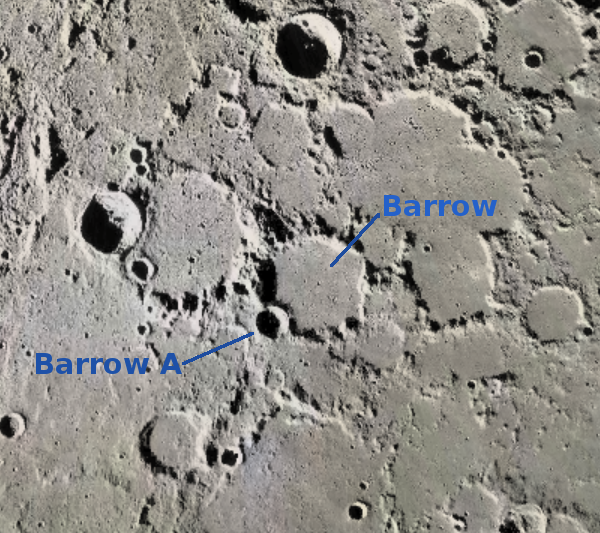
The Barrow crater as imaged by the Lunar Reconnaissance Orbiter. Credit NASA/GSFC/Arizona State University, Virtual Moon Atlas.
Actually Barrow almost looks pentagonal in the above image.
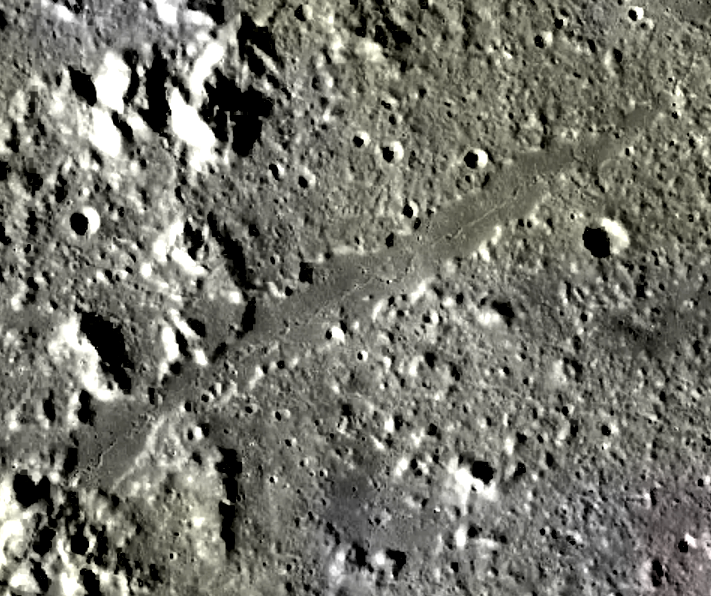
The Alpine Valley as imaged by the Lunar Reconnaissance Orbiter. Credit NASA/GSFC/Arizona State University, Virtual Moon Atlas.
05/05/2014 – Ephemeris – LADEE is no more but its mission goes on
Ephemeris for Monday, May 5th. The sun rises at 6:27. It’ll be up for 14 hours and 24 minutes, setting at 8:52. The moon, 1 day before first quarter, will set at 2:09 tomorrow morning.
The Lunar Atmosphere and Dust Environment Explorer or LADEE spacecraft that was in a close orbit of the moon to sniff out the Moon’s tenuous exosphere of gases and dust, augured into the moon’s far side April 17th as planned. This was just the end of the data acquisition phase of the mission. The data will be pored over for years to develop a picture of the lunar environment. This will aid lunar explorers to come both robotic and human. Something similar is happening to the Kepler mission to find transiting planets of other stars. The data gathering phase is over but there was an announcement a week or such ago of an earth sized planet in a stars habitable zone. Discoveries will go on for years.
Times are for the Traverse City/Interlochen area of Michigan. They may be different for your location.
Addendum
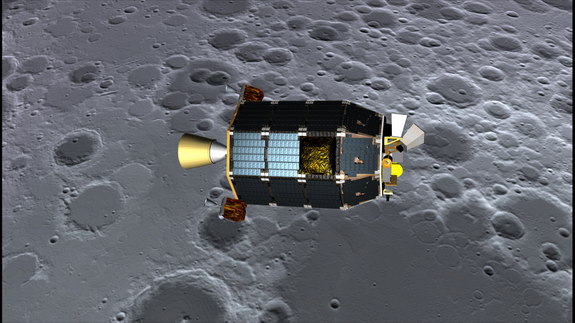
Artist’s depiction of LADEE in orbit of the Moon. Courtesy NASA.
More about the LADEE Mission is here.
05/01/2014 – Ephemeris – Previewing May skies
Ephemeris for Thursday, May 1st. The sun rises at 6:32. It’ll be up for 14 hours and 14 minutes, setting at 8:47. The moon, 2 days past new, will set at 11:21 this evening.
Today we will start the month when the promise of spring is finally fulfilled, we hope. Daylight hours in the Interlochen/Traverse City area will increase from 14 hours and 14 minutes today to 15 hours 18 minutes on May 31st. The altitude, or angle, of the sun above the southern horizon at local noon will ascend from 60 degrees today to 67 degrees at month’s end. The altitude of the sun in the Straits area will be a degree lower than that but your length of daylight will be a few minutes longer. Local apparent noon this month, when the sun passes due south, will be about 1:38 p.m. The Eta Aquarid meteor shower will reach its peak about 2 a.m. this Sunday morning the 4th. I’ll have more on my blog bobmoler.wordpress.com today.
Times are for the Traverse City/Interlochen area of Michigan. They may be different for your location.
Addenda
The Eta Aquarid Meteor Shower
This shower is associated with Halley’s Comet. We see two meteor showers from Halley’s comet. One in October where the comet debris is crossing the earth’s orbit heading toward the sun, and again as its leaving. This shower is caused by the debris leaving the vicinity of the sun.
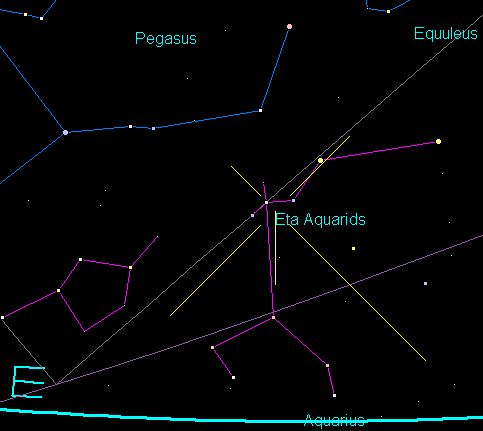
The Eta Aquarid radiant at the peak of the shower. The radiant moves slowly to the east with time. Credit: Bob Moler’s LookingUp program.
The peak of the shower will be at 7 h UT on May 6th. That’s 3 a.m. EDT, about 20 minutes before the radiant will rise. This will give about one hour before astronomical twilight starts to view the meteor shower in completely dark skies.
Possible Meteor Storm – May 24
There will be the possibility of a meteor storm on the morning of May 24th. A meteor storm differs from a meteor shower in the numbers of meteors seen and duration. There is a possibility of up to 400 meteors per hour for the hours of 7h to 8h UT (3 to 4 a.m. EDT).
The body responsible is Comet 209P/LINEAR. It was the 209th periodic comet discovered on February 3, 2004 by Lincoln Near-Earth Asteroid Research (LINEAR). Despite the recent discovery 209P has been orbiting the sun for hundreds of years, maybe longer. This year the comet will come close to the Earth and will allow the Earth to pass through debris that it shed hundreds of years ago.
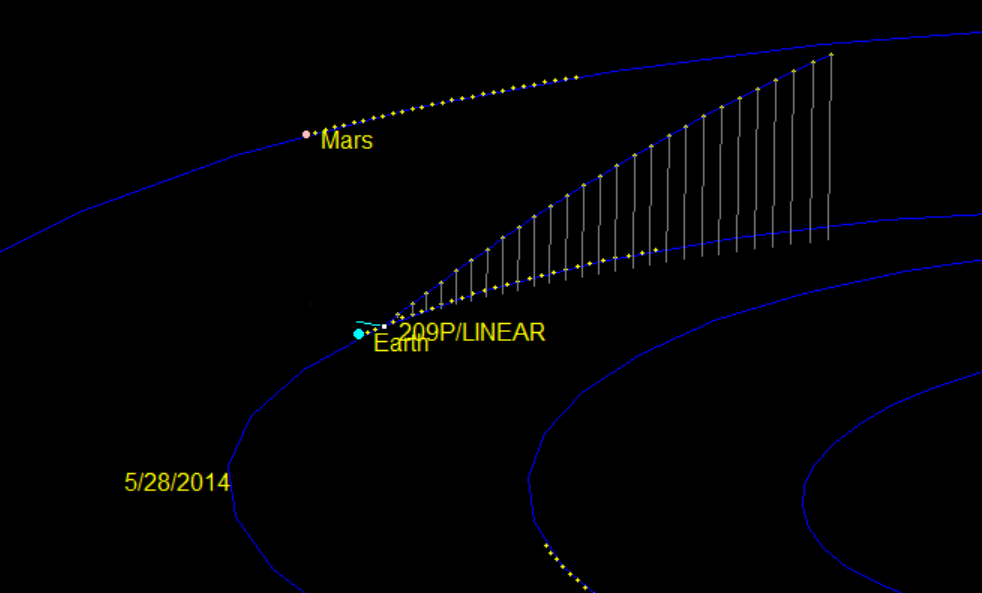
Comet 209P/LINEAR crosses the Earth’s orbit around May 28, 2014. The “stilts” on the comet’s orbit show that it is coming from north of the Earth’s orbital plane. Credit: Bob Moler’s LookingUp program.
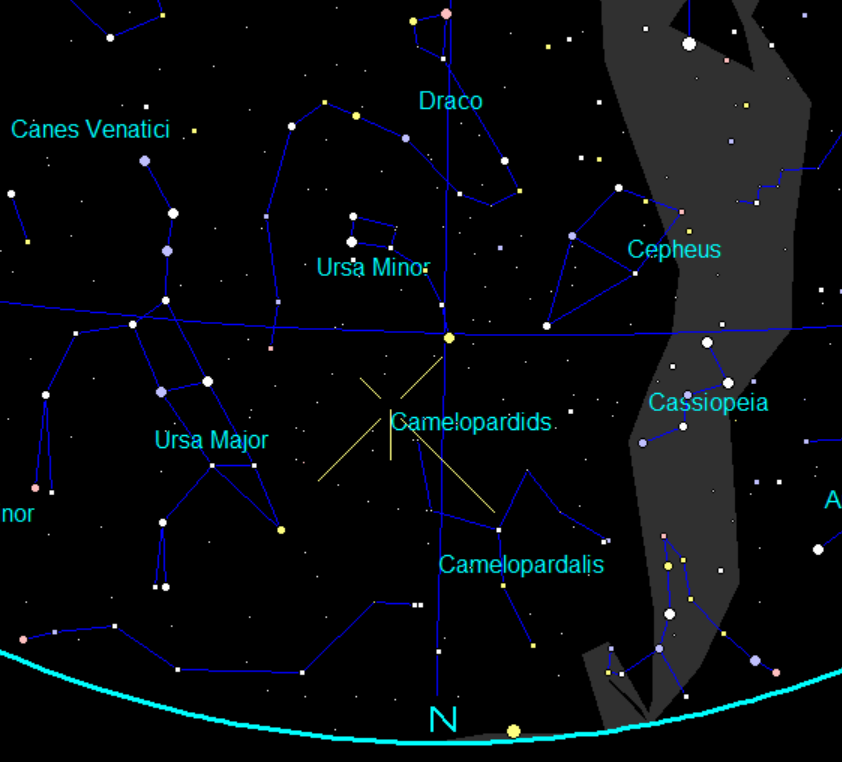
The radiant for the Comet 209P/LINEAR debris. For this purpose I’ve designated it Camelopardids (not official and probably not correct). Credit: Bob Moler’s LookingUp program. Note that the constellation of Camelopardalis is a giraffe.
Astronomical Twilight starts at 3:51 a.m., but the skies should remain dark enough. The 24% illuminated moon will rise about 2:45 or so and may not be much of an impediment in seeing the meteor storm.
May Star Chart
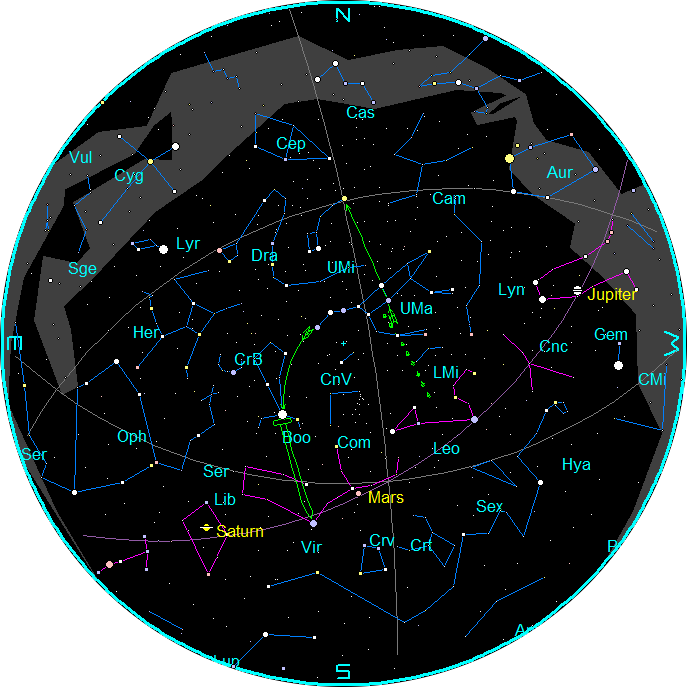
Star Chart for mid-month for May 2014 at 11 p.m. Credit: Bob Moler’s LookingUp program.
Add a half hour to every week before the 15th and subtract and hour for every week after the 15th.
For a list of constellation names to go with the abbreviations click here.
04/30/2014 – Ephemeris – It’s Wednesday, do you know where your planets are?
Ephemeris for Wednesday, April 30th. The sun rises at 6:34. It’ll be up for 14 hours and 11 minutes, setting at 8:45. The moon, 1 day past new, will set at 10:25 this evening.
It’s Wednesday and once again time to locate the bright planets for this week. Brilliant Jupiter will be in the western sky as darkness falls tonight. It will set at 1:54 a.m. Reddish Mars is in Virgo and outshines the bright bluish star Spica below left of it as darkness falls. Mars is in the south-east as it gets dark. It will pass due south at 11:51 p.m. It’s 59.5 million miles away now, and moving away, and will set at 5:41 a.m. Saturn will rise at 9:24 p.m. It’s in the faint constellation of Libra the scales this year. It will pass due south at 2:23 a.m. The telescope will bring out Saturn’s beautiful rings, whose short dimensions now are as wide as the planet. Brilliant Venus will rise in the east at 5:05 a.m. and will stay pretty low to the horizon.
Times are for the Traverse City/Interlochen area of Michigan. They may be different for your location.
Addendum
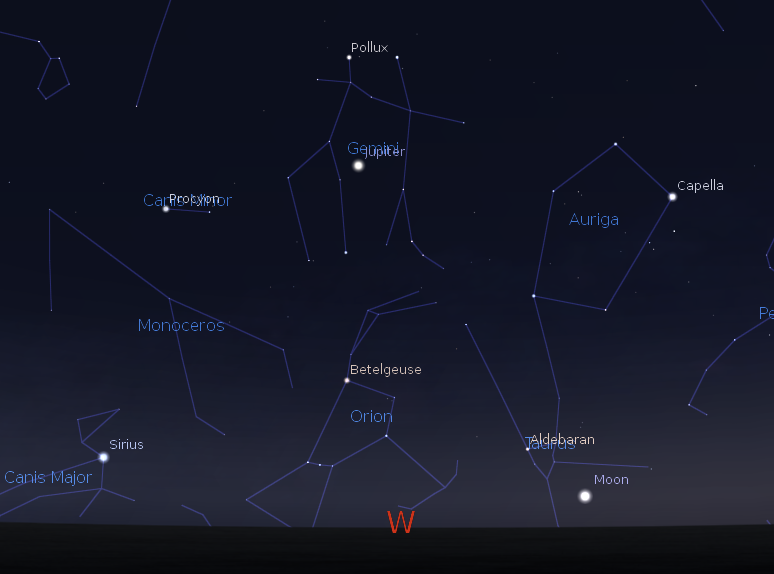
Jupiter, the Moon and the setting winter constellations in the west at 10 p.m. on April 30, 2014. Created using Stellarium.
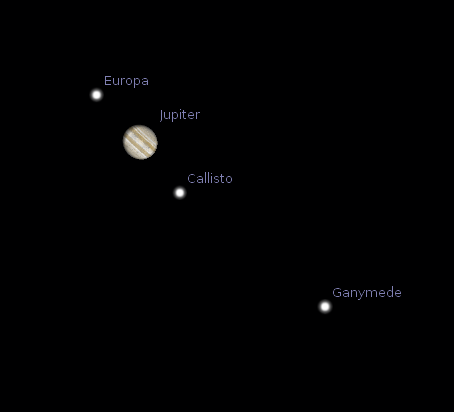
Jupiter and satellites through a telescope at 10 p.m. on April 30, 2014. The satellite Io is being occulted by Jupiter and will reappear at 11:56 p.m. (3:56 UT May 1, 2014). Created using Stellarium.
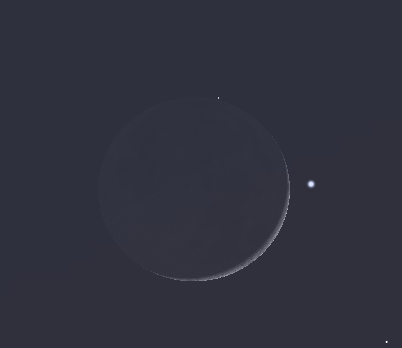
The crescent Moon at 10 p.m. on April 30, 2014. Created using Stellarium.
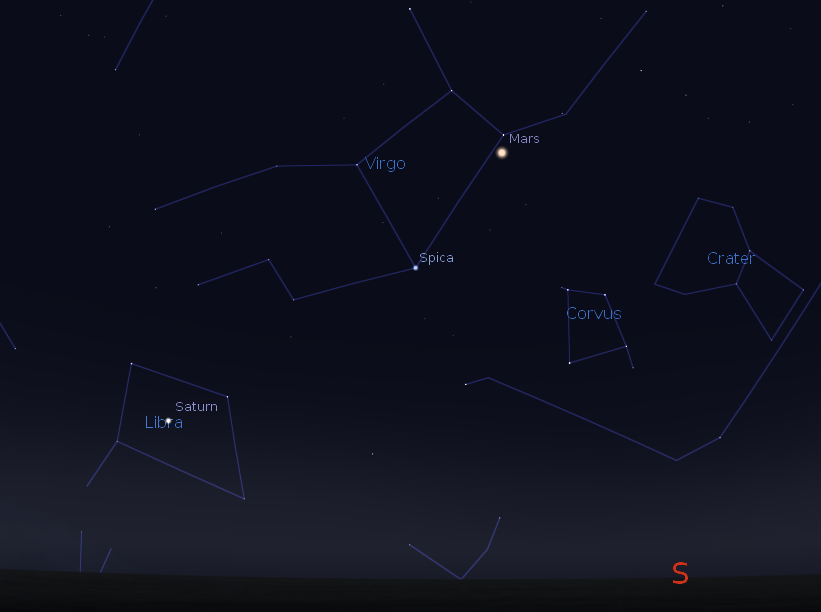
Mars, Saturn and some spring constellation at 11 p.m. April 30, 2014. Created using Stellarium.
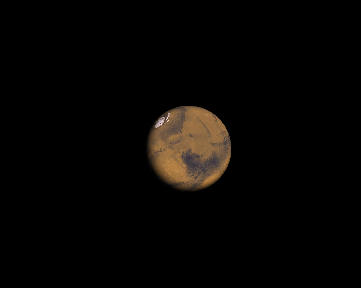
Telescopic view of Mars, 11 p.m. April 30, 2014. Created using Stellarium.
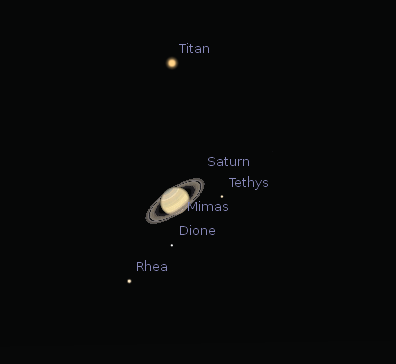
Telescopic view of Saturn and some of its moons at 11 p.m. April 30, 2014. Created using Stellarium.
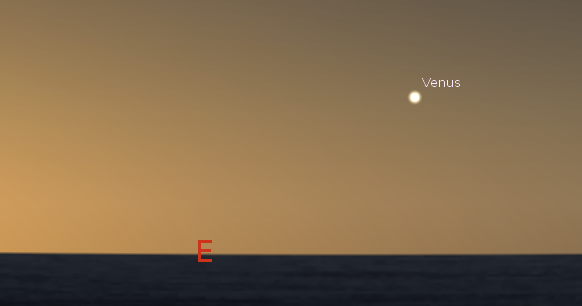
Venus in the twilight at 6 a.m. May 1, 2014. Created using Stellarium.
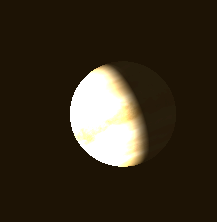
Telescopic view of Venus on May 1, 2014. Created using Stellarium.
04/29/2014 – Ephemeris – Today’s weird annular eclipse
Ephemeris for Tuesday, April 29th. The sun rises at 6:35. It’ll be up for 14 hours and 9 minutes, setting at 8:44. The moon is new today, and won’t be visible.
This event has already happened, and there was now way to be able to get to a spot too see its maximum effect. What I’m talking about was this morning’s weird annular eclipse of the sun. Australia saw the partial phase. An annular eclipse is one in which the moon is too far away to completely fill the face of the sun at maximum eclipse, leaving a bright ring of the uneclipsed sun around the moon. The path of annularity will just graze the earth over a spot in Antarctica. The center of this annular shadow called an antumbra, a new word I learned from descriptions of this eclipse, will just miss the earth. As far as I know no one had gone to the spot where the annular effect can be seen, so remote is its location. It kind of reminds one that the earth is a ball in space.
Times are for the Traverse City/Interlochen area of Michigan. They may be different for your location.
Addendum
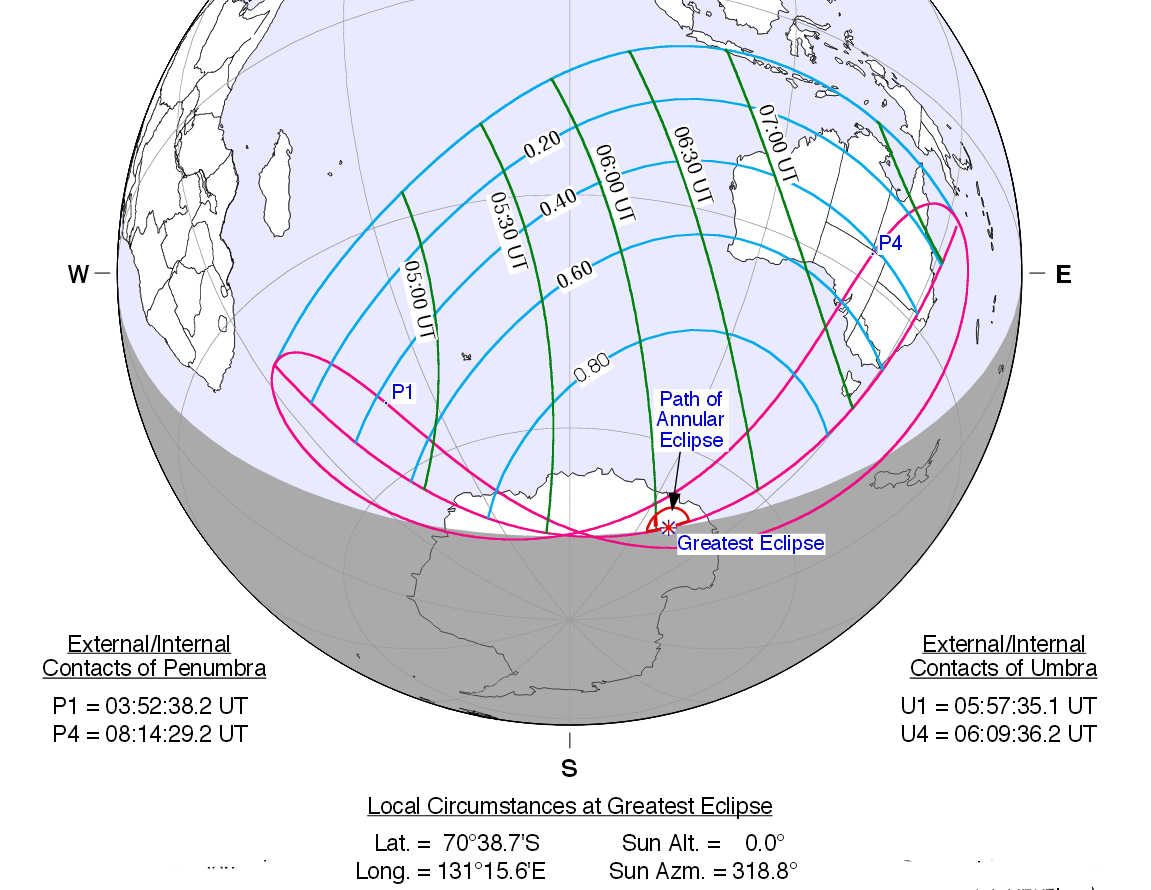
Area on the Earth where the eclipse can be seen. Credit: “Eclipses During 2014”, F. Espenak, Observer’s Handbook – 2014, Royal Astronomical Society of Canada, NASA eclipse website
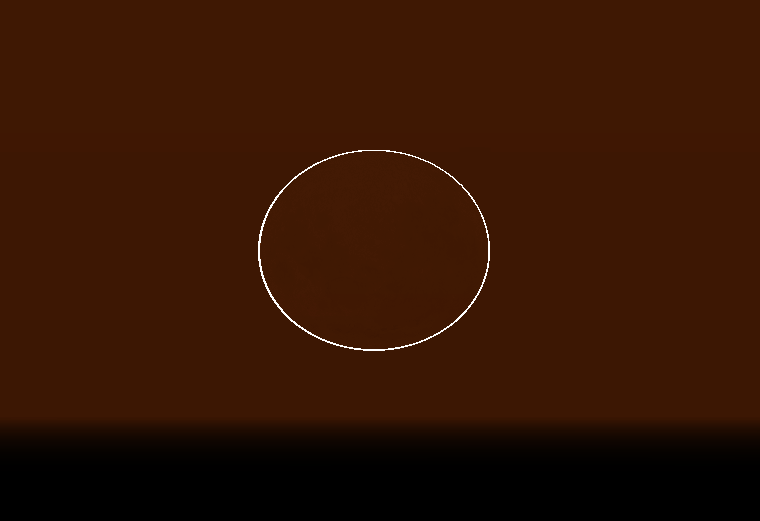
Annularity as simulated in Stellarium.
For more information on this eclipse check here: http://eclipse.gsfc.nasa.gov/OH/OH2014.html#SE2014Apr29A
04/28/2014 – Ephemeris – The legend of the constellation of Corvus the crow
Ephemeris for Monday, April 28th. The sun rises at 6:37. It’ll be up for 14 hours and 6 minutes, setting at 8:43. The moon, 1 day before new, will rise at 6:53 tomorrow morning.
The small constellation of Corvus the crow is located low in the south at 10:30 this evening. It’s made of 5 dim stars, but the pattern is a distinctive distorted box with two stars at the upper left marking that corner. To the right is a fainter constellation of a thick stemmed goblet called Crater. Both appear above the long constellation of Hydra the water snake who is slithering just above the southern horizon. In Greek mythology Corvus, then white, was the god Apollo’s pet. He once bid Corvus to take a cup and fetch him some water. Corvus however dallied and waited for a green fig to ripen. Corvus grabbed a snake and returned with a story on how the snake had delayed him. The angry Apollo turned the crow and all crows to this day black.
Times are for the Traverse City/Interlochen area of Michigan. They may be different for your location.
Addendum
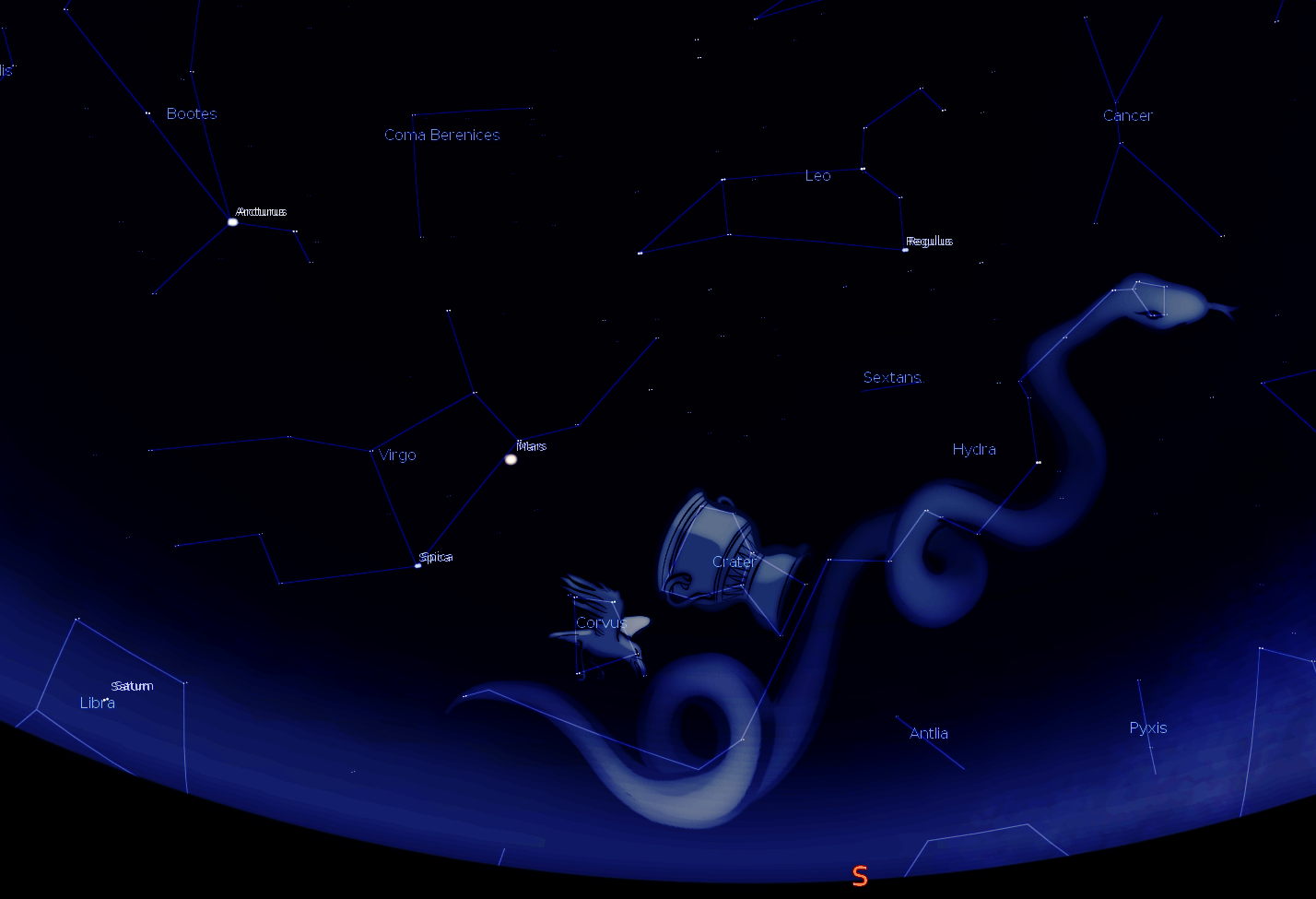
Corvus the crow, Crater the cup and Hydra the water snake along with the other spring constellations ay 10 p.m. April 28, 2014. Created using Stellarium.
04/25/2014 – Ephemeris – Star parties this weekend in the Grand Traverse area
Ephemeris for Arbor Day, Friday, April 25th. The sun rises at 6:41. It’ll be up for 13 hours and 57 minutes, setting at 8:39. The moon, 3 days past last quarter, will rise at 5:11 tomorrow morning.
The Grand Traverse Astronomical Society will be holding two events this weekend, starting tonight. Tonight’s Star Party will be held at the Sleeping Bear Dunes National Lakeshore’s Dune Climb parking lot. The event runs from 9 to 11 p.m. The event will be cancelled due to clouds. Check by calling the park if in doubt this afternoon. The second event will be a star party at Northwestern Michigan College’s Rogers observatory tomorrow night. That one runs also from 9 to 11 p.m. For that one rain or shine we will have scheduled a presentation on famous women astronomers presented by Becky Shaw. The observatory is located south of Traverse City, on Birmley road about a mile south of Hammond Road.
Times are for the Traverse City/Interlochen area of Michigan. They may be different for your location.
04/24/2014 – Ephemeris – Venus and the Moon in the morning
Ephemeris for Thursday, April 24th. The sun rises at 6:43. It’ll be up for 13 hours and 55 minutes, setting at 8:38. The moon, 2 days past last quarter, will rise at 4:39 tomorrow morning.
The planet Venus will be hanging with the moon for the next two mornings. Tomorrow morning the crescent Moon will appear to the right and above Venus. The planet will rise at 5:13, though it should be high enough to spot by 5:30 or 5:45 a.m. in the east. Saturday morning the crescent moon will be to the left of Venus. The moon will be passing Venus about 5 p.m. tomorrow afternoon. Parts of Asia will get a good look at that. We’ll get before and after shots of it. Viewing the moon and planets near the sun is easy or hard depending on the season. For the best views its generally late winter and spring evenings and late summer and autumn mornings. It’s the wrong time of year for easy Venus viewing.
Times are for the Traverse City/Interlochen area of Michigan. They may be different for your location.
Addendum
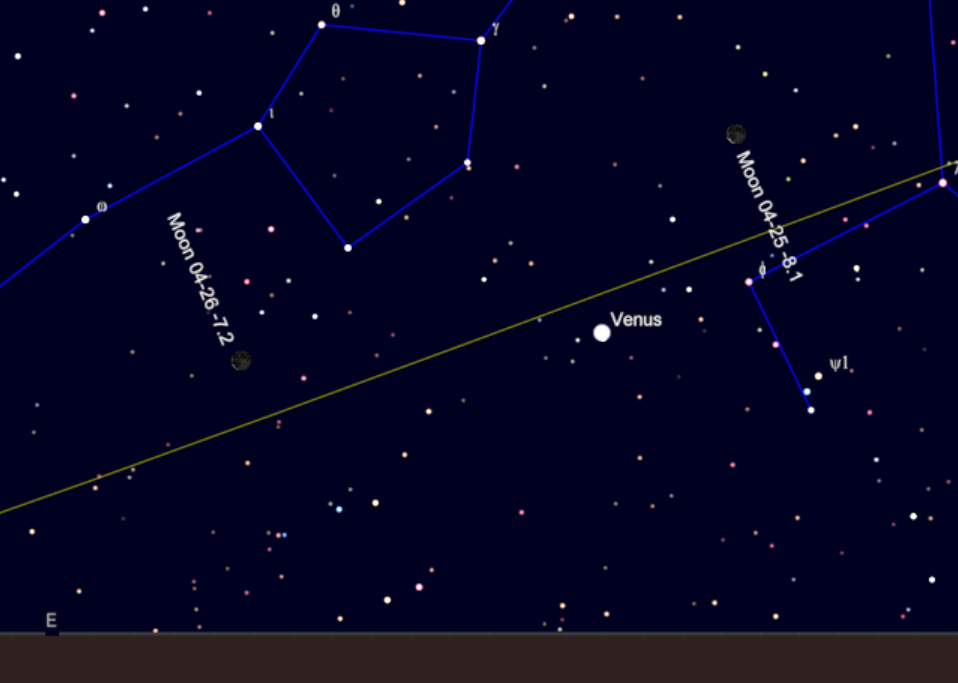
Venus and the Moon on two consecutive mornings 04/25/14 and 04/26/14 at 6 a.m. The yellow line is the ecliptic which is the path of the Sun in the sky. Created using Cartes du Ciel (Sky Charts).
04/23/2014 – Ephemeris – Where are those bright planets this week?
Ephemeris for Wednesday, April 23rd. The sun rises at 6:45. It’ll be up for 13 hours and 52 minutes, setting at 8:37. The moon, 1 day past last quarter, will rise at 4:06 tomorrow morning.
Wednesday is Bright Planets Day, or should I say classical planets day here on Ephemeris. Bright Jupiter will be in the western sky as darkness falls tonight. It will set at 2:17 a.m. Reddish Mars is in Virgo and outshines the bright bluish star Spica below it as darkness falls. Mars is up at sunset in the east. It will pass due south at 12:26 a.m. It’s 58.1 million miles (95.5 million kilometers) away now, and moving away. It will set at 6:14 a.m. Saturn will rise at 9:54 p.m. It’s in the faint constellation of Libra the scales this year. It will pass due south at 2:52 a.m. The telescope will bring out Saturn’s beautiful rings, whose short dimension now is as wide as the planet. Brilliant Venus will rise in the east at 5:14 a.m. and will stay pretty low to the horizon.
Times are for the Traverse City/Interlochen area of Michigan. They may be different for your location.
Addendum
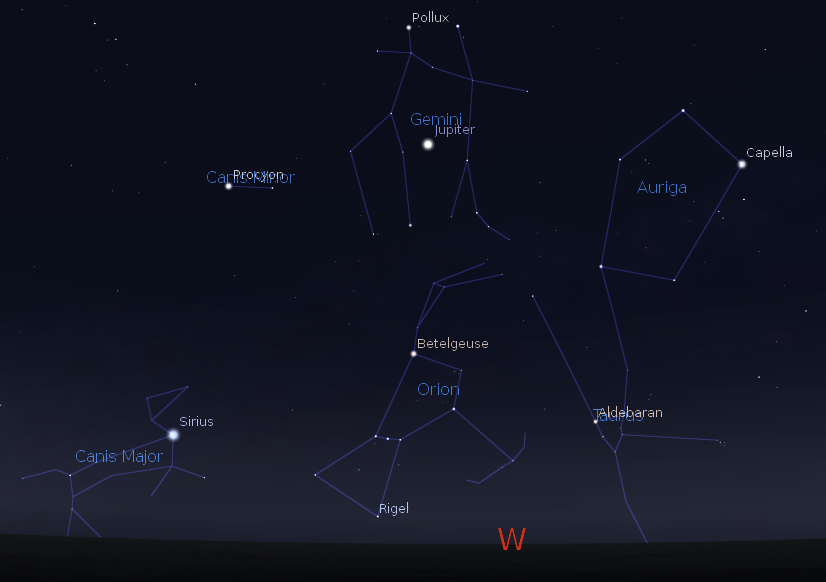
Jupiter and the setting winter constellations in the west at 10 p.m. on April 23, 2014. Created using Stellarium.
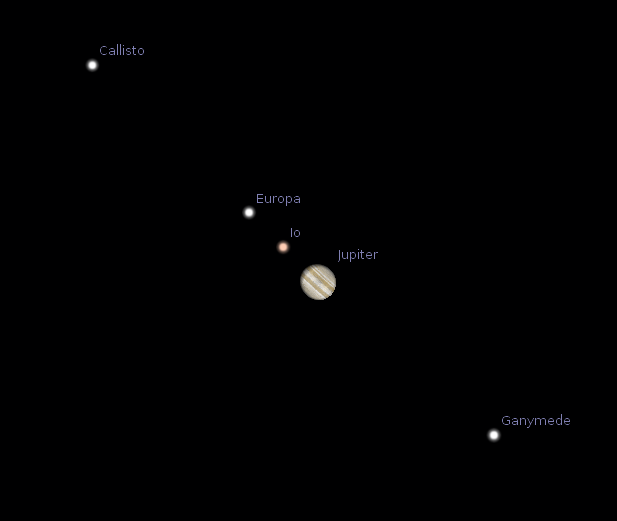
Jupiter and satellites through a telescope at 10 p.m. on April 23, 2014. Created using Stellarium.
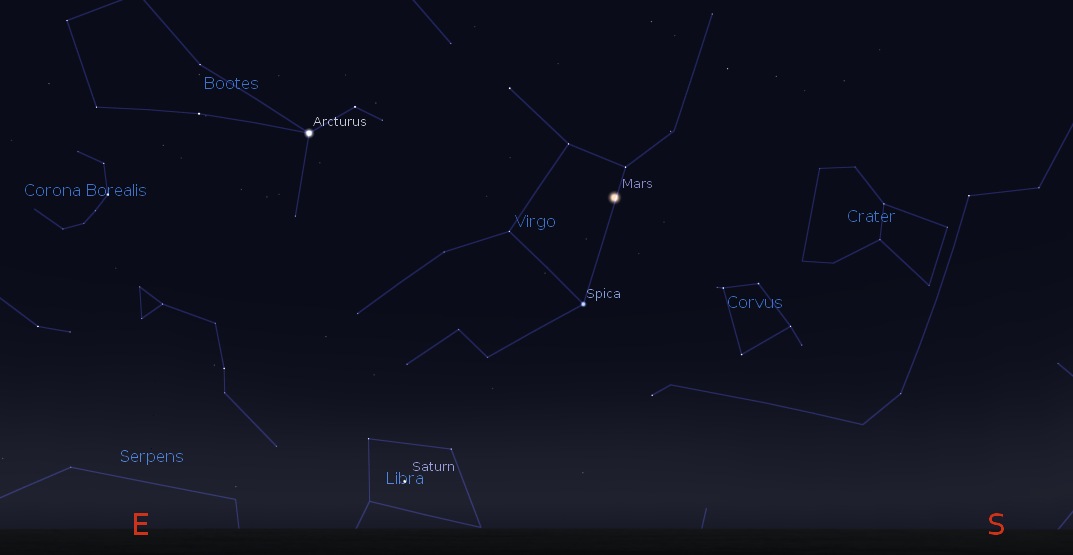
Mars, Saturn and some spring constellation at 10:30 p.m. April 23, 2014. Created using Stellarium.
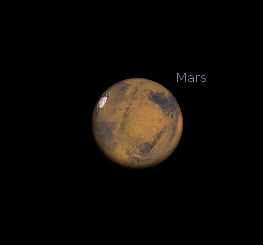
Telescopic Mars. Actually Mars is much smaller in appearance than Jupiter. Interesting albedo features can be seen. For 10:30 pm. April 23, 2014. Created using Stellarium.
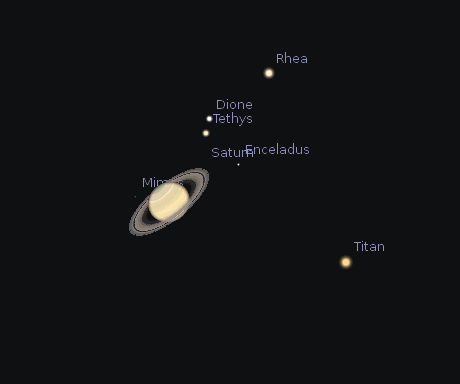
Telescopic Saturn at 11 p.m. April 23, 2014. You may want to wait a bit for it to rise some more for clearer views. Created using Stellarium.
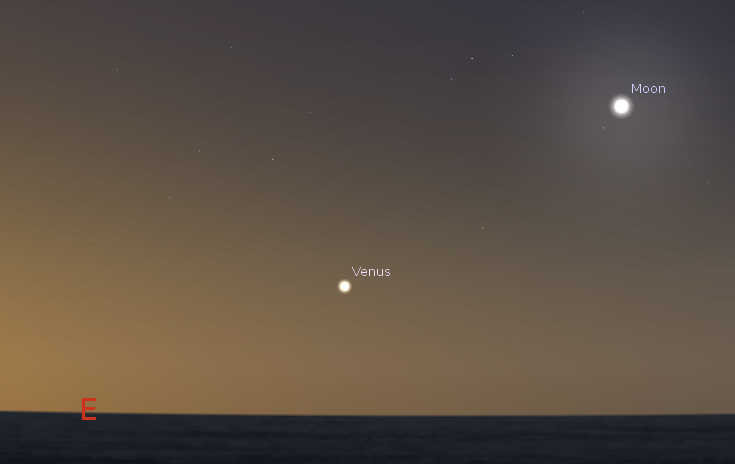
Venus and the Moon looking eastward at 6 a.m. on April 24, 2014. Created using Stellarium.
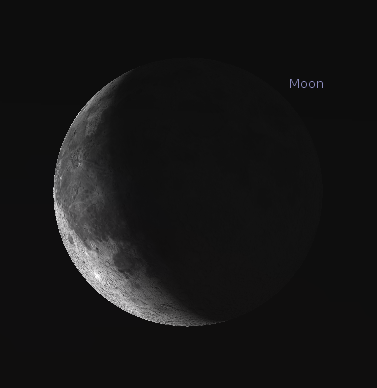
The moon as seen in binoculars at 6 a.m. on April 24, 2014. Created using Stellarium.
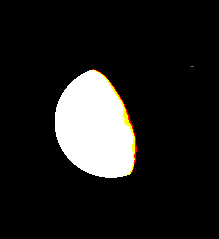
Venus through a telescope at 6 a.m. April 24, 2014. Note that none of these planetary images are to the same scale. Created using Stellarium.

