Sleeping Bear Dunes Star Party tonight
7:00 p.m.
It’s cleared up. Don’t know how long that will last. But its a GO for tonight. The official time for the star party is 9 to 11 p.m. Set up starts at 8 p.m. See you out there!
5:00 p.m.
I talked to ranger Marie Scott just a few minutes ago and consulted the clear sky chart for observatories in the area, and I’d guess prospects are 50% at best. I’ll check in with her again at near 7 p.m. for a final update.
1:30 p.m.
The Star Party at the Sleeping Bear Dunes National Lakeshore will take place if weather permits. It starts at 9 p.m. at the Dune Climb parking lot. As of 1:30 p.m. it is gloomy out with rain in the area. The rain is supposed to end by 3 p.m. according to my weather.com app on my phone. Plus satellite images show that it is clearing over Lake Michigan. We may get a break tonight.
Check back here for updates. I should be contacting the park rangers by around 5 or 6 tonight, but keep an eye on the weather.
Bob
09/06/2013 – Ephemeris – Local astronomical opportunities this weekend
Ephemeris for Friday, September 6th. The sun will rise at 7:11. It’ll be up for 12 hours and 58 minutes, setting at 8:09. The moon, 1 day past new, will set at 8:27 this evening.
This evening at the regular monthly meeting of the Grand Traverse Astronomical Society Dr. David Penney will give a talk about our stellar neighborhood, the most populous stars in which are red dwarf stars. No red dwarf star has died of old age since the big bang. Their life span is calculated to be in trillions of years. The meeting is at 8 p.m. at Northwestern Michigan College’s Rogers Observatory. Starting at 9 p.m. there will be a star party at the observatory. Tomorrow night society will host a star party at the Sleeping Bear Dunes National Lakeshore if its clear. Viewing starts at 9 p.m. at the parking lot of the Dunes Climb. This will be a good time to discover the star clusters and nebulae of the summer Milky Way.
Times are for the Traverse City/Interlochen area of Michigan. They may be different for your location.
Addendum
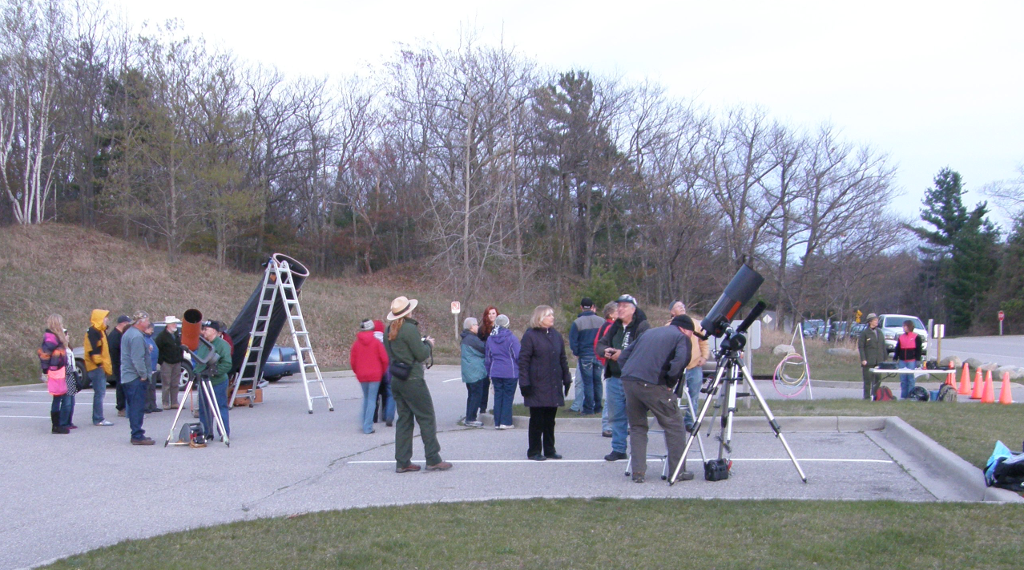
The GTAS at the Sleeping Bear Dunes National Lakeshore’s Platte River Point, April, 2012. Credit Eileen Carlisle.
09/05/2013 – Ephemeris – The constellation of Andromeda, the chained maiden
Ephemeris for Thursday, September 5th. The sun will rise at 7:09. It’ll be up for 13 hours and 1 minute, setting at 8:11. The moon is new today, and won’t be visible.
In the east at 10 this evening can be found a large square of stars, the Great Square of Pegasus the flying horse. The square is standing on one corner. What look like its hind legs stretching to the left from the left corner star is another constellation, Andromeda the chained maiden. She is seen in the sky as two diverging curved strings of stars that curve upward. She was rescued by the hero Perseus, a nearby constellation, riding his steed Pegasus. Andromeda’s claim to astronomical fame is the large galaxy seen with the unaided eye just above the upper line of stars, the Great Andromeda Galaxy, two and a half million light years away. To the unaided eye the galaxy appears as a small smudge of light. In binoculars the galaxy is a delicate spindle of light.
Times are for the Traverse City/Interlochen area of Michigan. They may be different for your location.
Addendum
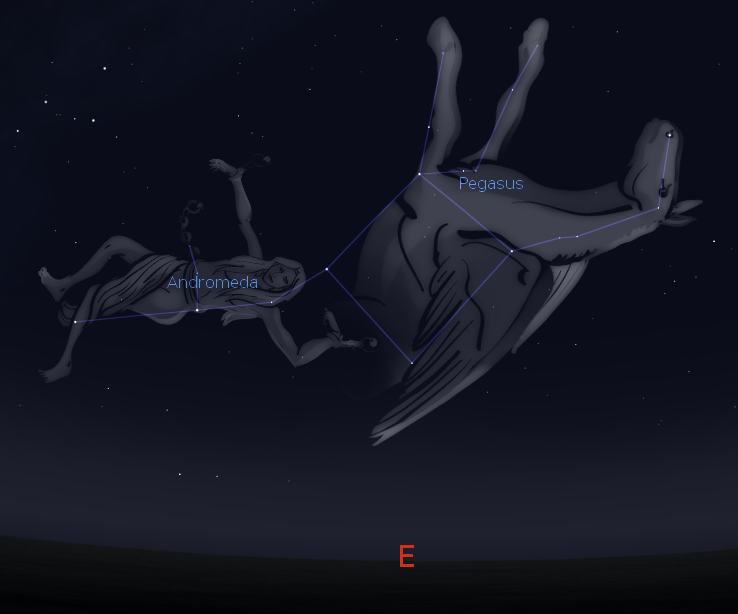
Andromeda and Pegasus images in the stars at 10 p.m. September 5, 2013. Created using Stellarium. Drawing by Johan Meuris.
The constellation lines in Stellarium omit the top strong of stars I see in Andromeda. I’m working on changing that.
09/04/2013 – Ephemeris – Where are the bright planets this week?
Ephemeris for Wednesday, September 4th. The sun will rise at 7:08. It’ll be up for 13 hours and 4 minutes, setting at 8:13. The moon, 1 day before new, will rise at 7:23 tomorrow morning.
Lets check out the planets visible now. Venus is now brilliant low in the western sky in evening twilight. Tonight the bright blue star Spica will appear below and left of Venus, It may take binoculars to spot the much dimmer star in twilight. Venus will set at 9:35 p.m. Holding forth in the west southwest will be Saturn this evening. It has a date with Venus on the 18th. Saturn will set at 10:24 p.m. In the morning sky Jupiter will rise at 2:07 in the east northeast. Starting mid October it will rise before midnight. The red planet Mars will rise at 3:48 a.m. At about 6 a.m. Jupiter will be the brightest star-like object in the east, with Mars visible below and left by two widths of your fist held at arm’s length.
Times are for the Traverse City/Interlochen area of Michigan. They may be different for your location.
Addendum
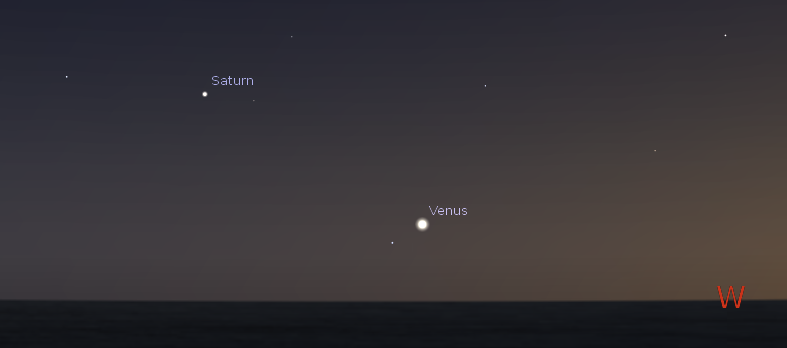
Venus and Saturn low in the west southwest at 9 p.m. on September 4, 2013. Created using Stellarium.
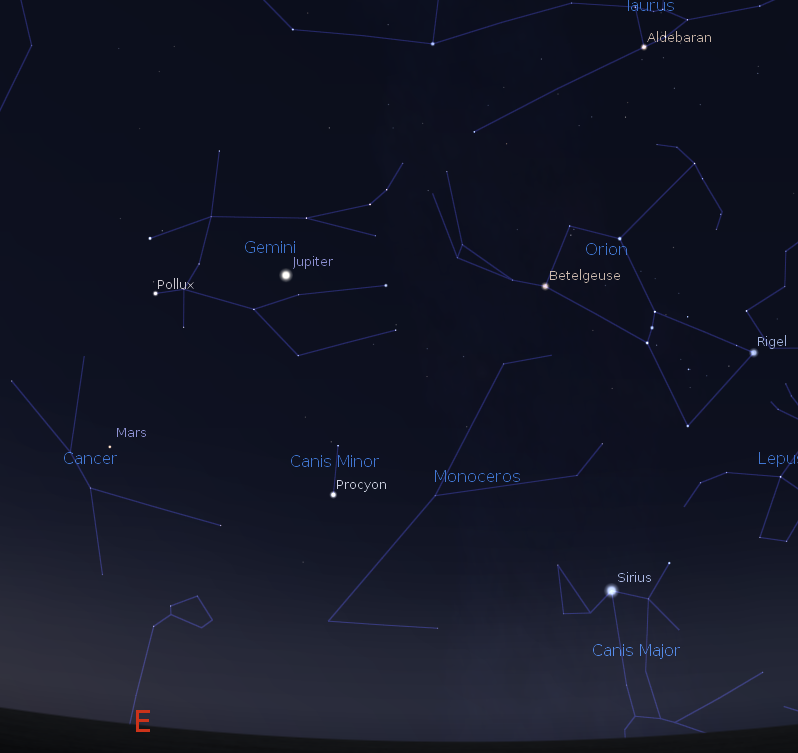
Jupiter, Mars and a preview of the winter constellations at 6n a.m. on September 5, 2013.
09/03/2013 – Ephemeris – The constellation of Pegasus the flying horse
Ephemeris for Tuesday, September 3rd. The sun will rise at 7:07. It’ll be up for 13 hours and 7 minutes, setting at 8:14. The moon, 2 days before new, will rise at 6:20 tomorrow morning.
A reminder that the end of summer is approaching is located in the east around 10 p.m. It’s one of the great autumn constellations: Pegasus the flying horse of Greek myth. Its most visible feature is a large square of four stars, now standing on one corner. This feature, called the Great Square of Pegasus, represents the front part of the horse’s body. The horse is quite aerobatic, because it is seen flying upside down. Remembering that fact, the neck and head is a bent line of stars emanating from the right corner star of the square. Its front legs can be seen in a gallop extending to the upper right from the top star of the square. In Mythology Pegasus was born of the blood of Medusa, decapitated by the hero Perseus, seen as a constellation rising in the northeast.
Times are for the Traverse City/Interlochen area of Michigan. They may be different for your location.
Addendum
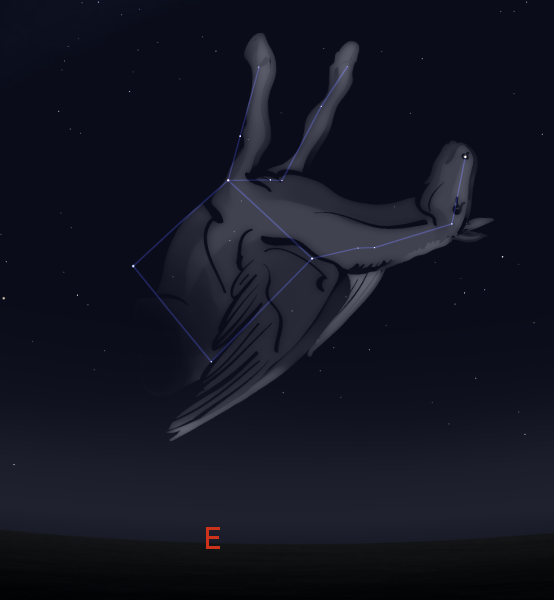
Pegasus image in the stars at 10 p.m. September 3, 2013. Created using Stellarium. Drawing by Johan Meuris.
09/02/2013 – Ephemeris – The Milky Way’s Great Rift
Ephemeris for Labor Day, Monday, September 2nd. The sun will rise at 7:06. It’ll be up for 13 hours and 10 minutes, setting at 8:16. The moon, 3 days before new, will rise at 5:19 tomorrow morning.
High overhead the Milky Way is seen passing through the Summer Triangle of three bright stars. Here we find the Milky Way split into two sections. The split starts in the constellation of Cygnus the Swan or Northern Cross very high in the east. The western branch of the Milky Way ends in the south. The dark dividing feature is called the Great Rift. Despite the lack of stars seen there, it doesn’t mean that there are fewer stars there than in the brighter patches of the Milky Way. The rift is a number of overlapping clouds of dust and gas about 300 light years away that obscure the light of the stars behind them. Sometimes binoculars can be used to find the edges of the clouds of the rift, as stars numbers drop off suddenly. This is especially easily seen in the constellation of Aquila.
Times are for the Traverse City/Interlochen area of Michigan. They may be different for your location.
Addendum
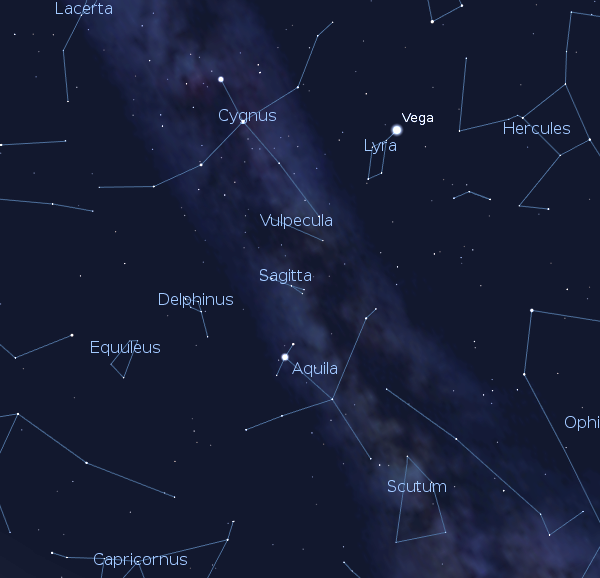
The Great Rift in the Milky Way. Created using Stellarium.
08/29/2013 – Ephemeris – Previewing September Skies
Ephemeris for Friday, August 30th. The sun will rise at 7:02. It’ll be up for 13 hours and 19 minutes, setting at 8:22. The moon, 2 days past last quarter, will rise at 2:25 tomorrow morning.
Let’s look at the skies for the month of September. The sun will moving at its greatest speed in its retreat to the south. Daylight hours in the Interlochen/Traverse City area and will drop from 13 hours and 13 minutes Sunday to 11 hours 44 minutes on the 30th. The altitude of the sun above the southern horizon at local noon will be 54 degrees Sunday, and will descend to 42 degrees on the 30th. The season of summer is getting short, so enjoy it while you can. Summer ends and autumn begins at 4:44 p.m. on September 22nd. On the 18th Saturn will be overtaken by Venus as Venus increases its separation from the Sun and Saturn moves around toward the sun. We’ll soon lose Saturn in its glare.
Times are for the Traverse City/Interlochen area of Michigan. They may be different for your location.
Addendum
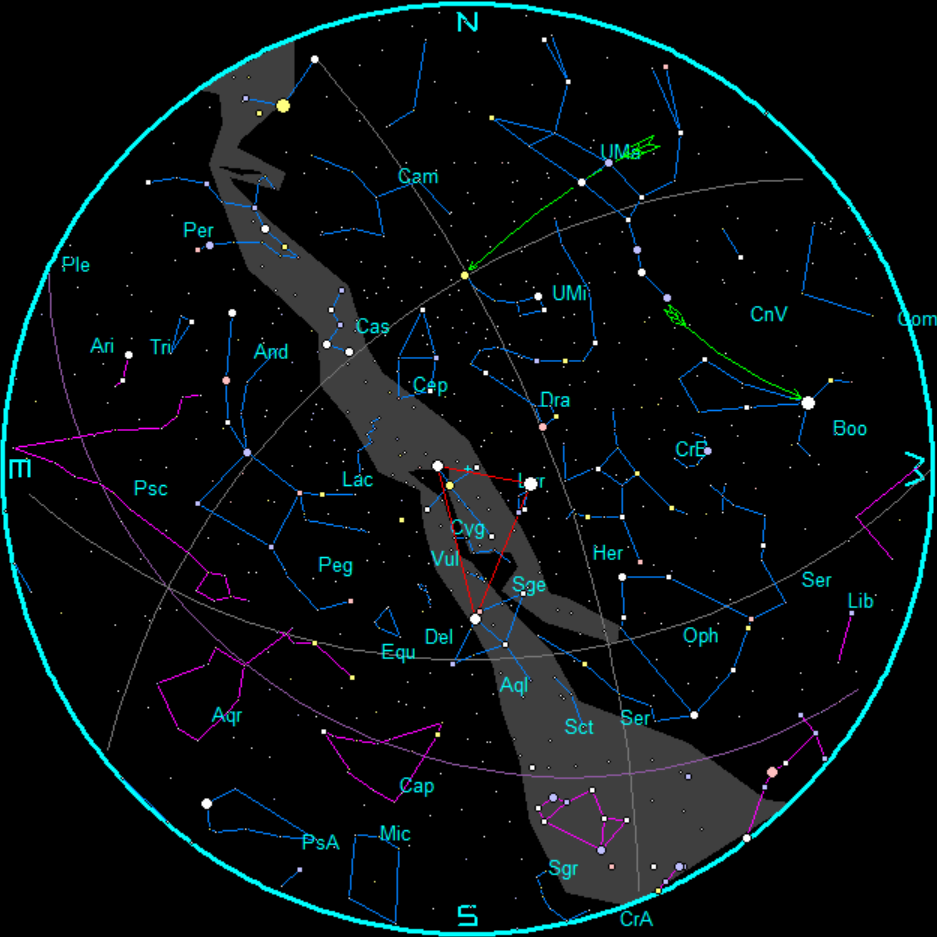
Star chart for September 15, 2013 at 10 p.m. Created using my program LookingUp.
The constellation abbreviations, names and bright star names are found here.
- The arrow from the pointer stars of the Big Dipper to Polaris the North Star, near the north celestial pole.
- Follow the arc of the handle of the Big Dipper to Arcturus.
- A Leaky Dipper drips on Leo
- The Summer Triangle (in red)
08/29/2013 – Ephemeris – Midwest Space Fest coming in October
Ephemeris for Thursday, August 29th. The sun will rise at 7:01. It’ll be up for 13 hours and 22 minutes, setting at 8:23. The moon, 1 day past last quarter, will rise at 1:33 tomorrow morning.
The first weekend of October Traverse City will play host to the Midwest Space Fest, a celebration of astronomy and space. Venues include the State Theater, The ECCO Event Space and the Open Space. The keynote speaker is the world-renowned astronomer Alex Fillipenko, seen on many science TV programs like the Universe. He’ll talk about a hot topic: Dark Energy and the Runaway Universe. Events kick off Friday evening at the State Theater for a film and star talks explaining the starry ceiling of the theater. This will be followed by a launch party or a star party at the Rogers Observatory. Saturday is Dr. Fillipenko’s talk and observing the sun and stars at the open space. There’s more information at www.magnorth.org.
Times are for the Traverse City/Interlochen area of Michigan. They may be different for your location.
Addendum

Midwest Space Fest card
08/28/2013 – Ephemeris – Where are the bright planets this week?
Ephemeris for Wednesday, August 28th. The sun will rise at 7:00. It’ll be up for 13 hours and 25 minutes, setting at 8:25. The moon, at last quarter today, will rise at 12:45 tomorrow morning.
Lets check out the planets visible now. Venus is now brilliant low in the western sky in evening twilight, It will set at 9:47 p.m. Holding forth in the west southwest will be Saturn this evening, the brightest star-like object in the constellation Virgo appearing yellowish. Venus is gaining on it and will cross paths on September 18th. Saturn will set at 10:50 p.m. In the morning sky before twilight starts Jupiter will rise at 2:29 in the east northeast, with Mars rising later at 3:52. At about 5 a.m. Jupiter will be the brightest star-like object in the east northeast, with Mars barely visible below and left by a bit less than two widths of your fist held at arm’s length. Castor and Pollux of Gemini point down to it.
Times are for the Traverse City/Interlochen area of Michigan. They may be different for your location.
Addendum
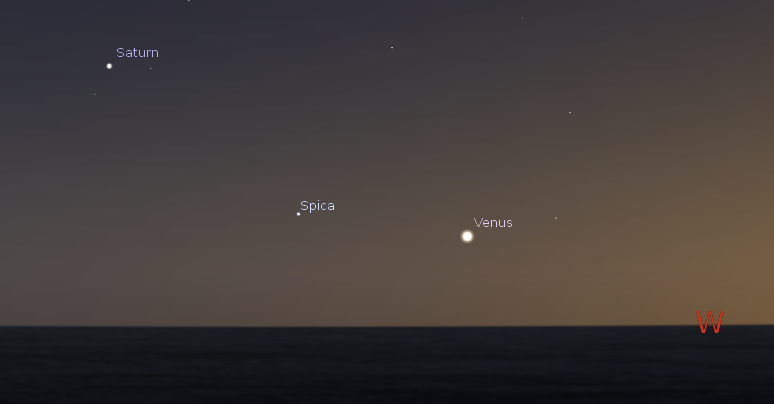
Venus and Saturn at 9:15 p.m. August 28, 2013. Created using Stellarium.
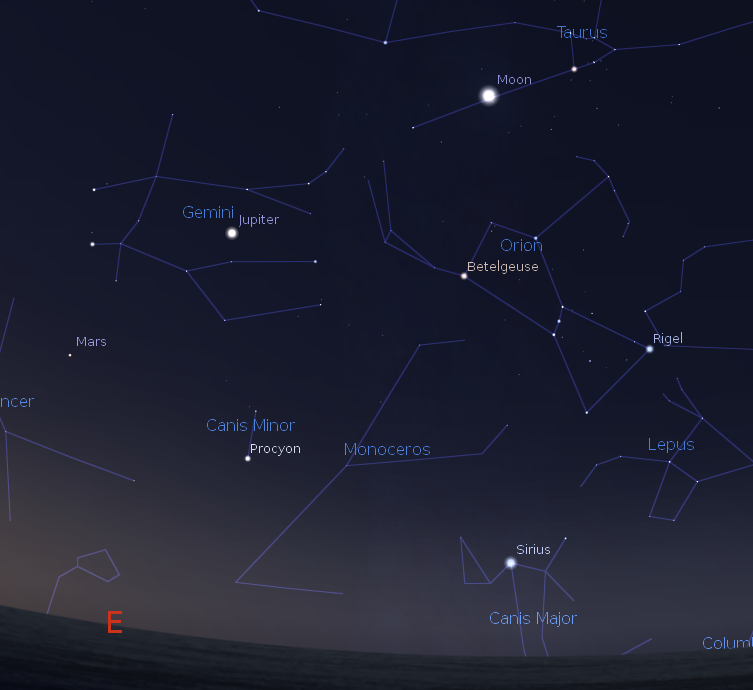
Jupiter, Mars and the Moon at 6 a.m. on August 29, 2013. Created using Stellarium.
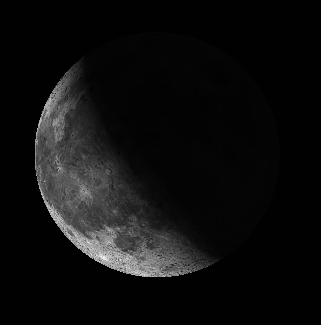
The actual phase of the Moon at 6 a.m. on August 29, 2013. Created using Stellarium.
08/27/2013 -Ephemeris – It’s August 27th. Do you know where Mars is?
Ephemeris for Tuesday, August 27th. The sun will rise at 6:59. It’ll be up for 13 hours and 28 minutes, setting at 8:27. The moon, 1 day before last quarter, will rise at 12:01 tomorrow morning.
It’s August 27th. Do you know where Mars is? The Mars hoax is back. It’s been 10 years since it was first sent out on the Internet as an email. You know the one that says Mars will appear as big as the Moon? In order to appear as big as the Moon Mars would have to be only a half million miles away. Mars in its orbit can never come closer than 34.6 million miles from earth. It came that close to the earth on August 27th, 2003. Even then it was a tiny orb in telescopes. That’s why we have to send spacecraft, taking many months to reach it to get a close look at it. Right now Mars is 214.9 million miles away, over twice the distance of the sun. It is seen in the east in the early morning below the much brighter Jupiter.
Times are for the Traverse City/Interlochen area of Michigan. They may be different for your location.
Addendum

Mars and Earth relative positions for August 27, 2013. Orbits are to scale, however object sizes are greatly exaggerated. Created using my LookingUp program.

