Archive
04/21/2015 – Ephemeris – The Moon will pass the Hyades star cluster today to pass near Venus tonight
Apr 21. This is Bob Moler with Ephemeris for Tuesday, April 21st. Today the Sun will be up for 13 hours and 46 minutes, setting at 8:35. The Moon, 3 days past new, will set at midnight. Tomorrow the Sun will rise at 6:47.
The moon, which was new last Saturday passed the face of the constellation Taurus the bull earlier today. The face of Taurus is a letter V shape of stars which is the star cluster called the Hyades. There’s a bright orange star that appears at the left tip of the V called Aldebaran, which actually doesn’t belong to the cluster. At 9:30 the crescent Moon will have also just passed the brilliant planet Venus. By then they will be nearly 8 degrees apart, which is a bit less than the width of a fist held at arm’s length. The Moon, Venus and all the planets move very close along the path of the Sun in the sky, called the ecliptic. Even so the Moon is now about 5 degrees south of the ecliptic and Venus about 2 degrees north of it.
Times are for the Traverse City/Interlochen area of Michigan. They may be different for your location.
Addendum
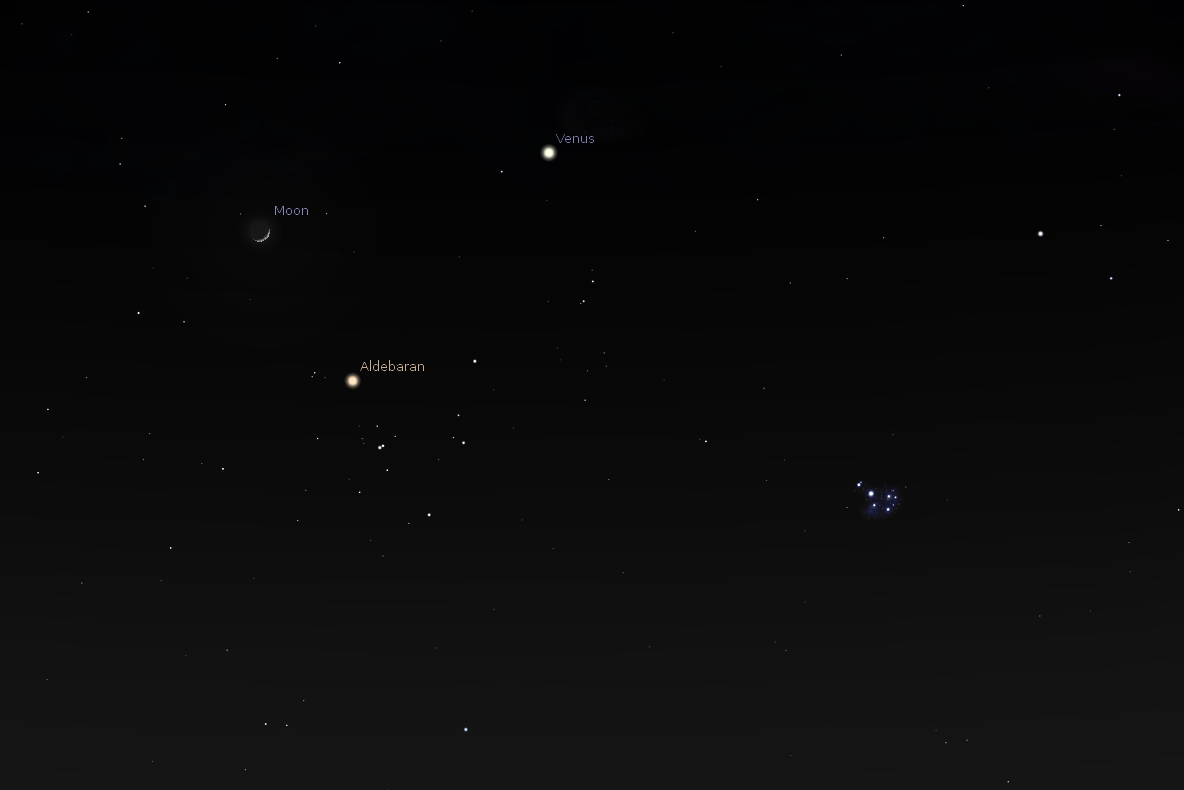
The Moon with Venus and the Hyades at 9:30 p.m. April 21, 2015. Note the Pleiades on the right. Created using Stellarium.
02/16/2015 – Ephemeris – The Winter Circle
Feb 16. This is Bob Moler with Ephemeris for President’s Day, Monday, February 16th. The sun will rise at 7:42. It’ll be up for 10 hours and 30 minutes, setting at 6:12. The moon, 2 days before new, will rise at 6:25 tomorrow morning.
The winter skies are blessed with more first magnitude stars than any other season. That’s a full one-third of the total are seen is a relatively small area. Six of these stars lie in a large circle centered on the seventh. This circle is up at 9 p.m. Starting high overhead is Capella in Auriga the charioteer. Moving down clockwise is Aldebaran in the face of Taurus the Bull. Then down to Orion’s knee we find Rigel. Down and left is the brightest star of all Sirius the Dog Star in Canis Major, lowest of these stars in the south-southeast. Moving up and left is Procyon in Canis Minor, Above Procyon is Pollux in Gemini the twins. All these are centered on Betelgeuse the bright red star in Orion’s shoulder.
Times are for the Traverse City/Interlochen area of Michigan. They may be different for your location.
Addendum
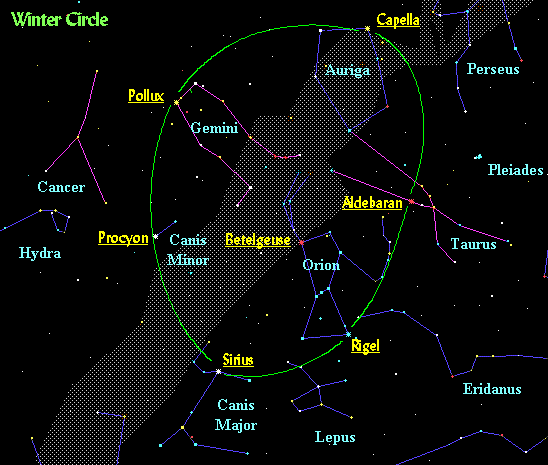
The Winter Circle of 1st magnitude stars
11/21/2014 – Ephemeris – The Hyades a very important star cluster
Ephemeris for Friday, November 21st. The sun will rise at 7:47. It’ll be up for 9 hours and 22 minutes, setting at 5:09. The moon, 1 day before new, will rise at 7:42 tomorrow morning.
The face of the constellation Taurus the bull looks like the letter V sideways above the rising Orion the Hunter in the east at 9 p.m. The bright star at the tip of a letter V of stars is Aldebaran. Look with binoculars at the letter V shape and you will see the stars of the Hyades star cluster The Hyades is the closest star cluster to us, at about 151 light years. And is important for that reason. Before satellites like Hipparcos. The Hyades were the only star cluster to be directly measured by a technique called parallax, using the radius of the earth’s orbit as one side of a surveyors enormous triangle. Its many stars at the same distance were used to determine distances of star clusters even farther away. Additional techniques based on the distance of the Hyades allow us to measure distances to the galaxies.
Times are for the Traverse City/Interlochen area of Michigan. They may be different for your location.
Addendum
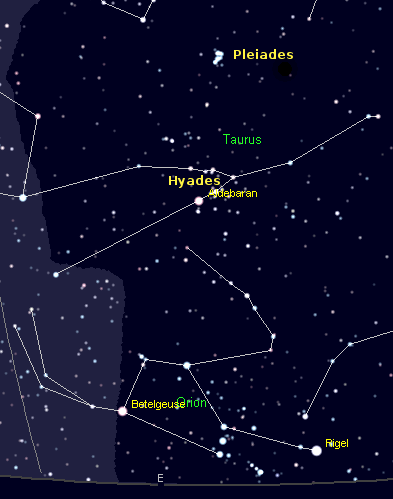
Orion and the Hyades.
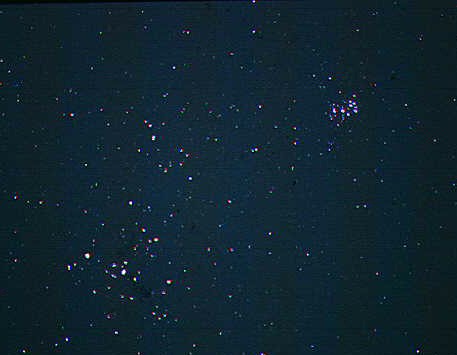
The Hyades (lower left) and the Pleiades (upper right). My photograph from many years ago.
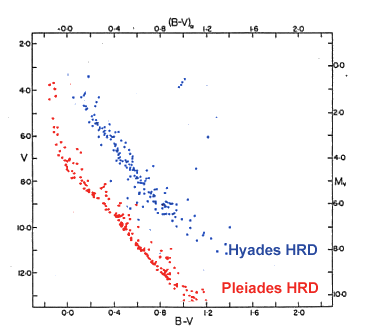
H-R diagram showing the Hyades and Pleiades. Credit: European Southern Observatory.
The Hertzsprung-Russell diagram or H-R diagram plots stars by brightness on the vertical axis versus surface temperature on the horizontal axis, hot to the left to cool on the right. The plot of stars for open or galactic star clusters, where the stars are burning hydrogen in their cores lie on a diagonal line called the main sequence. When matching the plots of two star clusters based on apparent magnitude the main sequence plot for the more distant star cluster will be dimmer by a certain magnitude difference. Since the brightness of and light source diminishes by the inverse square of the distance. The difference in brightness equates to a difference in distance.
For more information on the H-R diagram check out the Wikipedia article. It’s more than about distance.
02/20/2014 – Ephemeris – Winter Circle plus 1
Ephemeris for Thursday, February 20th. The sun will rise at 7:34. It’ll be up for 10 hours and 43 minutes, setting at 6:18. The moon, 2 days before last quarter, will rise at 12:27 tomorrow morning.
The winter skies are blessed with more first magnitude stars than any other season. Six of these stars lie in a large circle centered on the seventh. This circle is up at 9 p.m. Starting high overhead is Capella in Auriga the charioteer. Moving down clockwise is Aldebaran in the face of Taurus the Bull. Then down to Orion’s knee we find Rigel. Down and left is the brightest star of all Sirius the Dog Star in Canis Major, lowest of these stars in the south-southeast. Moving up and left is Procyon in Canis Minor, Above Procyon is Pollux in Gemini the twins. All these are centered on Betelgeuse the bright red star in Orion’s shoulder. The interloper this year is Jupiter which is situated in Gemini and outshines them all.
Times are for the Traverse City/Interlochen area of Michigan. They may be different for your location.
Addendum
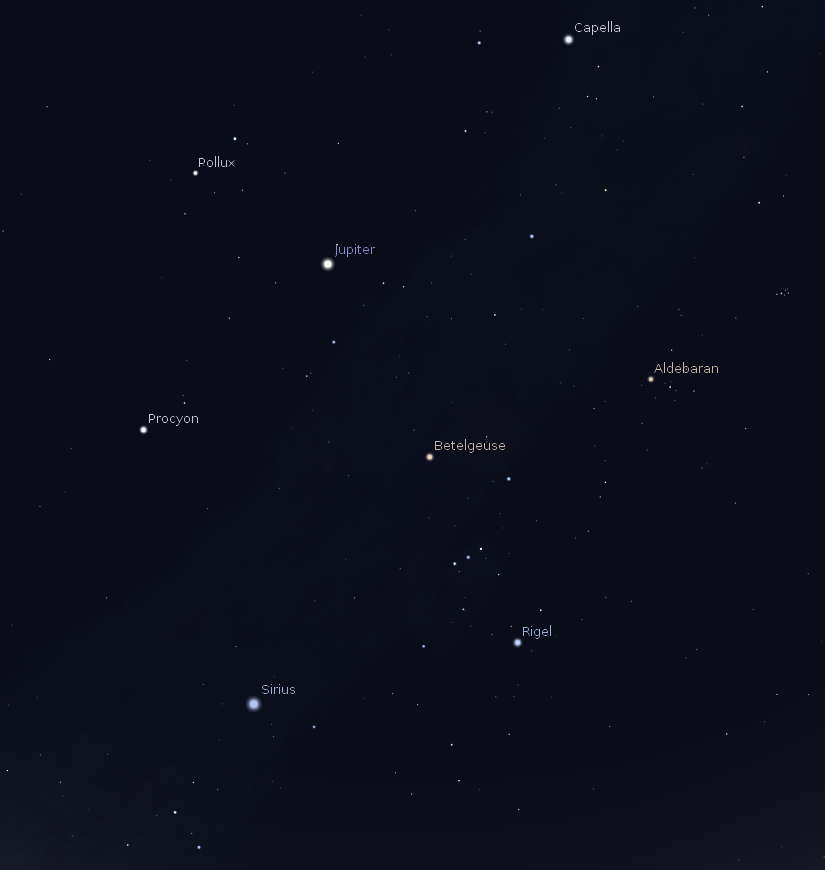
The Winter Circle plus Jupiter at 9 p.m. on February 20, 2014. Created using Stellarium.
12/10/2013 – Ephemeris – The bright star Aldebaran, the Follower
Ephemeris for Tuesday, December 10th. The sun will rise at 8:08. It’ll be up for 8 hours and 53 minutes, setting at 5:02. The moon, 1 day past first quarter, will set at 2:18 tomorrow morning.
The central constellation of winter, Orion, is in the east southeast at 9 p.m. Above it is Taurus the bull. The bright orange star in Taurus is Aldebaran. Aldebaran appears at the lower left tip of a letter V group of stars lying on its side that is the face of the bull. Aldebaran isn’t actually part of the group, called the Hyades star cluster. The cluster is about 153 light years away, while Aldebaran is 65. The star has an orange hue because its surface is cooler than the sun’s. However Aldebaran is 44 times larger in diameter, and shines 465 times brighter than the sun. The name Aldebaran means “Follower” because it follows the Pleiades star cluster through the skies. The Pleiades is above right of Aldebaran.
Times are for the Traverse City/Interlochen area of Michigan. They may be different for your location.
Addendum
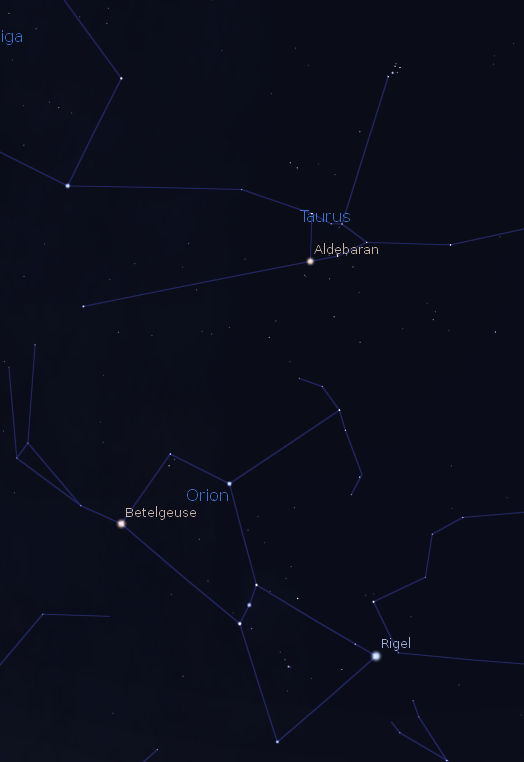
Aldebaran, the Hyades, of Taurus, Orion and the Pleiades at 10 p.m. December 10, 2013. Created using Stellarium.
12/05/2013 – Ephemeris – The constellation Taurus the bull
Ephemeris for Thursday, December 5th. The sun will rise at 8:03. It’ll be up for 8 hours and 58 minutes, setting at 5:02. The moon, 3 days past new, will set at 8:27 this evening.
Early in the evening the moon will appear above the bright planet Venus in the southwest. Low in the east at 9 p.m. is the constellation of Orion the giant hunter. Above him is Taurus the bull. His face is a letter V shape of stars lying on its side with the bright orange-red star Aldebaran at the bottom tip of the V as its angry blood-shot eye. Orion is depicted in the sky facing with club in one hand and a shield in the other the approaching and in some depictions charging Taurus. The V of stars is a star cluster called the Hyades. The Pleiades are in his shoulder above. Taurus in Greek mythology was the guise the god Zeus when he carried off the maiden Europa. Europa’s still with him, sort of, as the intriguing satellite orbiting Zeus’ Roman equivalent Jupiter.
Times are for the Traverse City/Interlochen area of Michigan. They may be different for your location.
Addendum
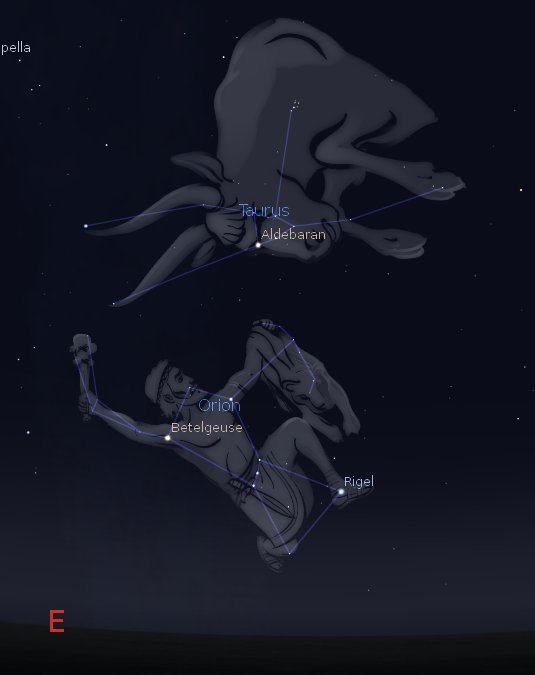
Taurus and Orion in the east at 9 p.m, December 5, 2013. Created using Stellarium.
03/04/2013 – Ephemeris – The Winter Circle
Ephemeris for Monday, March 4th. The sun will rise at 7:14. It’ll be up for 11 hours and 20 minutes, setting at 6:34. The moon, at last quarter today, will rise at 2:34 tomorrow morning.
The winter skies are blessed with more first magnitude stars than any other season. Six of these stars lie in a large circle centered on the seventh. This circle is up all evening now that we are in the heart of winter. Starting high overhead is Capella in Auriga the charioteer. Moving clockwise and downward, we come to Aldebaran in the face of Taurus the Bull and brighter nearby Jupiter. Then down to Orion’s knee we find Rigel. Down and left is the brightest star of all Sirius the Dog Star in Canis Major Orion’s large hunting dog, lowest of these stars in the south. Moving up and left there is Procyon in Canis Minor Orion’s other hunting dog, Then above is Pollux in Gemini the twins. All are centered on Betelgeuse in Orion.
Times are for the Traverse City/Interlochen area of Michigan. They may be different for your location.
Addendum
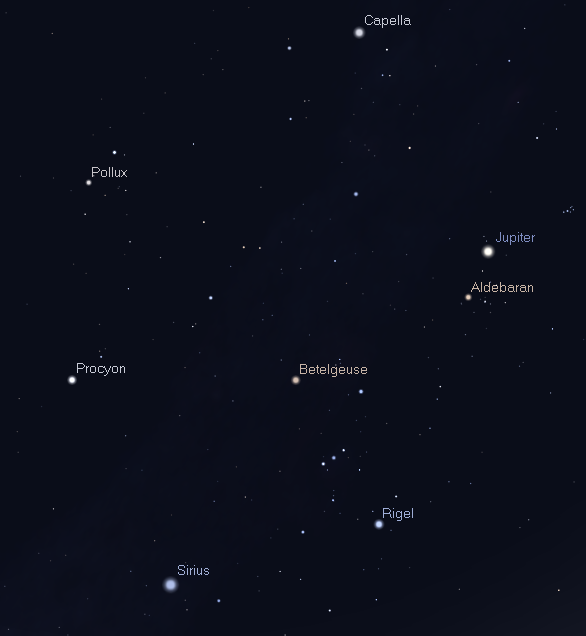
The Winter Circle and Jupiter for March. Created using Stellarium.
01/18/2013 – Ephemeris – Aldebaran, Taurus’ angry read eye
Ephemeris for Friday, January 18th. The sun will rise at 8:13. It’ll be up for 9 hours and 18 minutes, setting at 5:32. The moon, at first quarter today, will set at 1:42 tomorrow morning.
The bright orange star Aldebaran is the most westerly bright star of winter Aldebaran appears at the upper left tip of a letter V group of stars that is the face of the bull, his angry red eye. Aldebaran isn’t actually part of the group, called the Hyades star cluster. Aldebaran is 65 light years away, less than half the distance of the Hyades. The name Aldebaran means “The Follower” because it follows the Pleiades across the skies. The Pleiades is the brightest star cluster in Taurus, also known as the Seven Sisters. Aldebaran has an orange hue because its surface is cooler than the sun’s. However Aldebaran is 44 times larger in diameter, and shines 500 times brighter than the sun. It’s the type of star that’s in the red giant phase of life.
Times are for the Traverse City/Interlochen area of Michigan. They may be different for your location.
Addendum
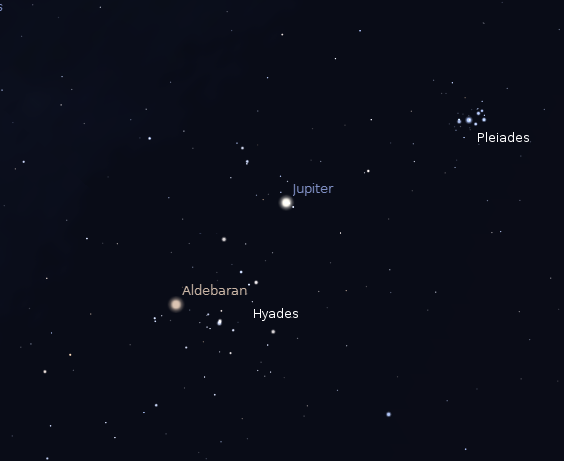
Aldebaran,Jupiter, the Hyades, and the Pleiades on January 18 2913. Created using Stellarium.
08/29/2012 – Ephemeris – Where are the bright planets this week?
Ephemeris for Wednesday, August 29th. The sun will rise at 7:02. It’ll be up for 13 hours and 21 minutes, setting at 8:23. The moon, 2 days before full, will set at 6:04 tomorrow morning.
Let’s see what’s happening with the bright planets for this week. Mars Saturn and the star Spica make a bright but elongating triangle in the west southwest after sunset. Mars is on the upper left with Saturn on the upper right and Spica below. They are located in the constellation Virgo the virgin. Saturn will be setting in the west at 10:20 p.m, and Mars will set 3 minutes later. The morning sky features the two brightest planets: Jupiter, which will rise at 12:23 a.m. in the east northeast and Venus, which will rise at 3:16 also in the east northeast. Jupiter is near the head of Taurus the bull, while Venus is moving between Gemini and Cancer. Early morning is a good time to get a preview of winter stars.
Times are for the Traverse City/Interlochen area of Michigan. They may be different for your location.
Addendum
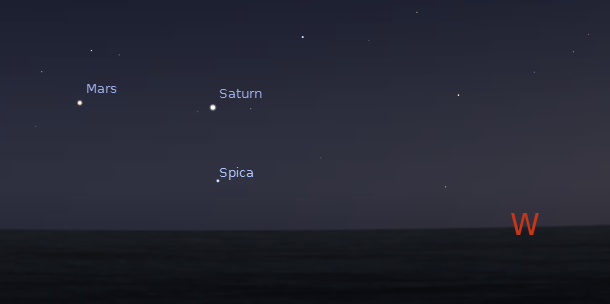
Mars, Saturn and Spica at 9:30 p.m. on August 29, 2012. Created using Stellarium.
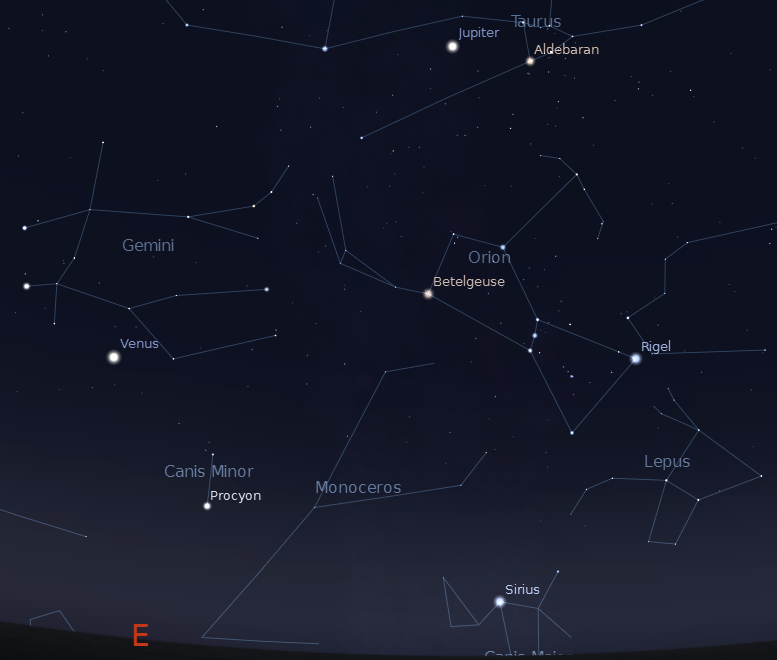
Jupiter, Venus and the stars of winter rising at 5:30 a.m. on August 30, 2012. Created using Stellarium.
 Bob Moler's Ephemeris Blog