Archive
Ephemeris: 08/04/2025 – Mars’ twin
This is Bob Moler with Ephemeris for Monday, August 4th. Today the Sun will be up for 14 hours and 31 minutes, setting at 9:04, and it will rise tomorrow at 6:33. The Moon, 3 days past first quarter, will set at 2:10 tomorrow morning.
Low in the south as it gets dark is the red giant star Antares. It lies at the heart of Scorpius the scorpion. Its name means Rival of Mars, because it has the same hue as the red planet. In Mars case the color comes from iron oxide, rust. In Antares case it has a cool surface temperature, relatively speaking, of 7,000 degrees Fahrenheit (3,660 K). As a red giant star Antares is near the end of its life, though compared to the Sun it is young – possibly 12 million years old. At that age the Sun was just getting started. Antares, with around 13 to 16 times the Sun’s mass, has already run out of fusible hydrogen in its core and has bloated out to double Mars’ orbit in size. Antares is 550 light years away and has a companion star in its system that looks greenish in contrast to Antares red. But, when Antares A, the red giant’s light is blocked, the companion looks bluish.
The astronomical event times given in this blog are for the Traverse City/Interlochen area of Michigan (Lat 44.7° N, Long 85.7° W; EDT, UT – 4 hours) unless stated otherwise. Times will be different for other locations.
Addendum

Ephemeris: 06/19/2025 – Finding the Serpent Bearer in the heavens
This is Ephemeris for Juneteenth, Thursday, June 19th. Today the Sun will be up for 15 hours and 34 minutes, setting at 9:31, and it will rise tomorrow at 5:57. The Moon, 1 day past last quarter, will rise at 2:15 tomorrow morning.
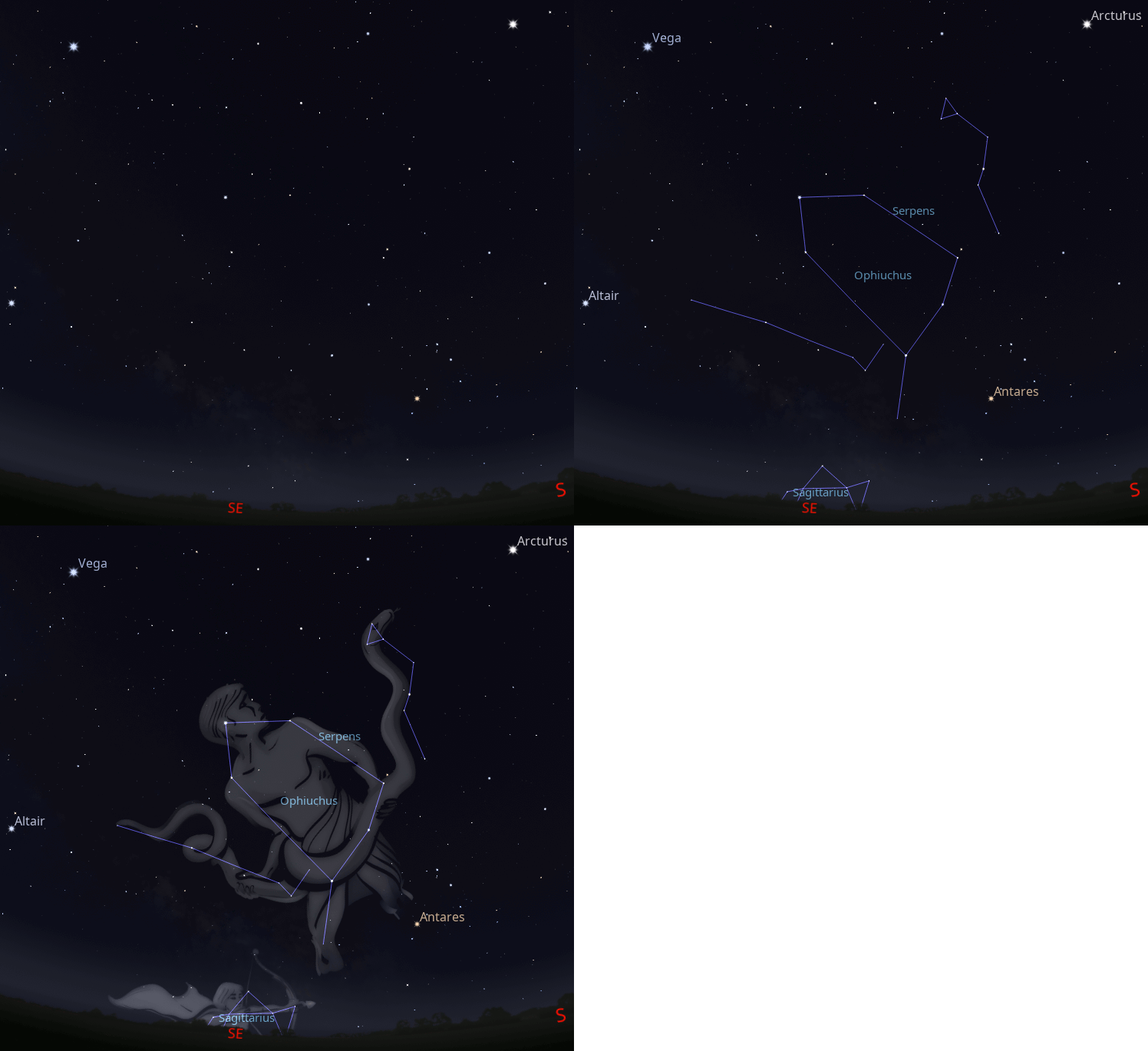
The red star Antares shines low in the south-southeast at 11 PM in the constellation of Scorpius. In the area of sky above and to the left lies a large constellation of faint stars called Ophiuchus, the serpent bearer. The constellation shape is like a large bell, which reminds me of the head, shoulders and arms of a fellow that’s holding the snake stretched out across his body. The serpent he’s holding is Serpens, the only two-part constellation in the heavens. The head rises to Ophiuchus’ right, and the tail extends up to the left. In Greek myth, Ophiuchus represents the great physician Aesculapius, educated by the god Apollo, and the centaur Chiron, who is found in the stars as Sagittarius, just rising below him.
The astronomical event times given in this blog are for the Traverse City/Interlochen area of Michigan (Lat 44.7° N, Long 85.7° W; EDT, UT – 4 hours) unless stated otherwise. Times will be different for other locations.
Addendum
Ephemeris: 08/13/2024 – Antares and the Moon
This is Ephemeris for Tuesday, August 13th. Today the Sun will be up for 14 hours and 7 minutes, setting at 8:50, and it will rise tomorrow at 6:44. The Moon, 1 day past first quarter, will set at 12:41 tomorrow morning.
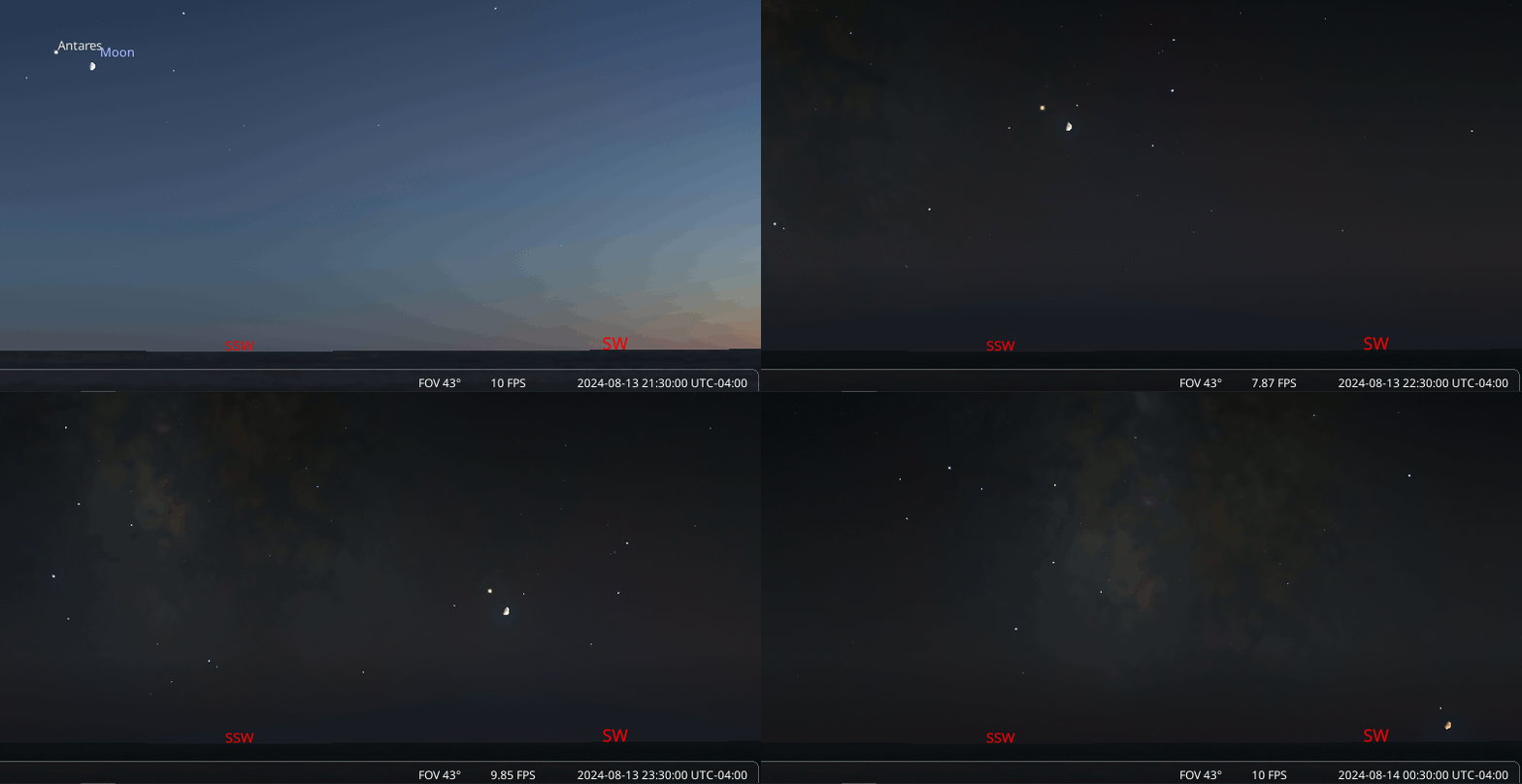
The Moon tonight will have a companion. Just to the left of it will be a star. That star may not look very bright because it is overpowered by moonlight, but it is one of the brightest stars of the sky. It is Antares in Scorpius the scorpion, a red giant star. Every month for the last several years and for the next several years the moon will pass in front of that star. Unfortunately due to the timing and to the path of the Moon it doesn’t happen for any particular spot on the Earth very often. Tonight, as the Moon sets it will be approaching Antares but will appear about to pass below it at the time it sets. We will not be able to see the Moon actually cover or occult Antares from Northern Michigan until May 2028, nearly four years from now.
The astronomical event times given are for the Traverse City/Interlochen area of Michigan (EDT, UT–4 hours). Times will be different for other locations.
Addendum
Ephemeris: 7/02/2024 – Antares and the scorpion
This is Bob Moler with Ephemeris for Tuesday, July 2nd. Today the Sun will be up for 15 hours and 29 minutes, setting at 9:31, and it will rise tomorrow at 6:02. The Moon, 3 days before new, will rise at 3:26 tomorrow morning.
The constellation of Scorpius the scorpion is low in the south at 11 PM these nights. It’s bright star Antares will pass due south at 11:30 this evening. Antares is an interesting star in that it is a red giant star, and its name Antares* means “Rival of Mars” alluding to the fact that it and Mars appears to be the same color. And about every two years Mars passes near Antares, so unless you know your stars and planets you could mistake them for each other. Antares lies at the heart of the scorpion. To its upper right is the front part of its body and claws, and the trail of stars running down the other way, nearly to the horizon, in the south and back up in the south-southeast to the two stars of its stinger make its characteristic tail.
The astronomical event times given are for the Traverse City/Interlochen area of Michigan (EDT, UT–4 hours). They may be different for your location.
*Breaking down Antares: Ant (Anti, against) – Ares (The Greek god of war the Romans called Mars).
Addendum
Note for trivia fans: Zubeneschamali is the longest star name at 14 letters.
Ephemeris: 08/24/2023 – The Moon will pass in front of the star Antares tonight
This is Ephemeris for Thursday, August 24th. Today the Sun will be up for 13 hours and 38 minutes, setting at 8:33, and it will rise tomorrow at 6:56. The Moon, at first quarter today, will set at 12:11 tomorrow morning. | Tonight the Moon is going to pass in front of the bright reddish star in Antares in Scorpius scorpion. The event is called an occultation, and it is the only one of the monthly occultations which we’re going to be able to see in this series that began last month and will extend to August 2028. Antares will disappear at the lower left edge of the dark or night part of the Moon at approximately 10:28 pm* this evening, and it’ll stay hidden until 11:32 pm* when it will pop out on the lower right edge of the bright part of the Moon. Start looking for Antares early, probably with binoculars, because the Moon will be quite bright and might overpower Antares when viewed by the naked eye. Hoping for clear skies tonight.
*The astronomical event times given are for the Traverse City/Interlochen area of Michigan (EDT, UT –4 hours). They may be different for your location. For other locations a planetarium computer app like Stellarium can be used to graphically predict occultation timings within a few minutes. Check your planetarium app, and set it to use Topocentric coordinates. In Stellarium, the selection is in the Configuration window, Tools tab. Check everything under Topocentric coordinates. That way the position of the Moon in the sky will be based on the chosen location, rather than the center of the Earth.
Addendum
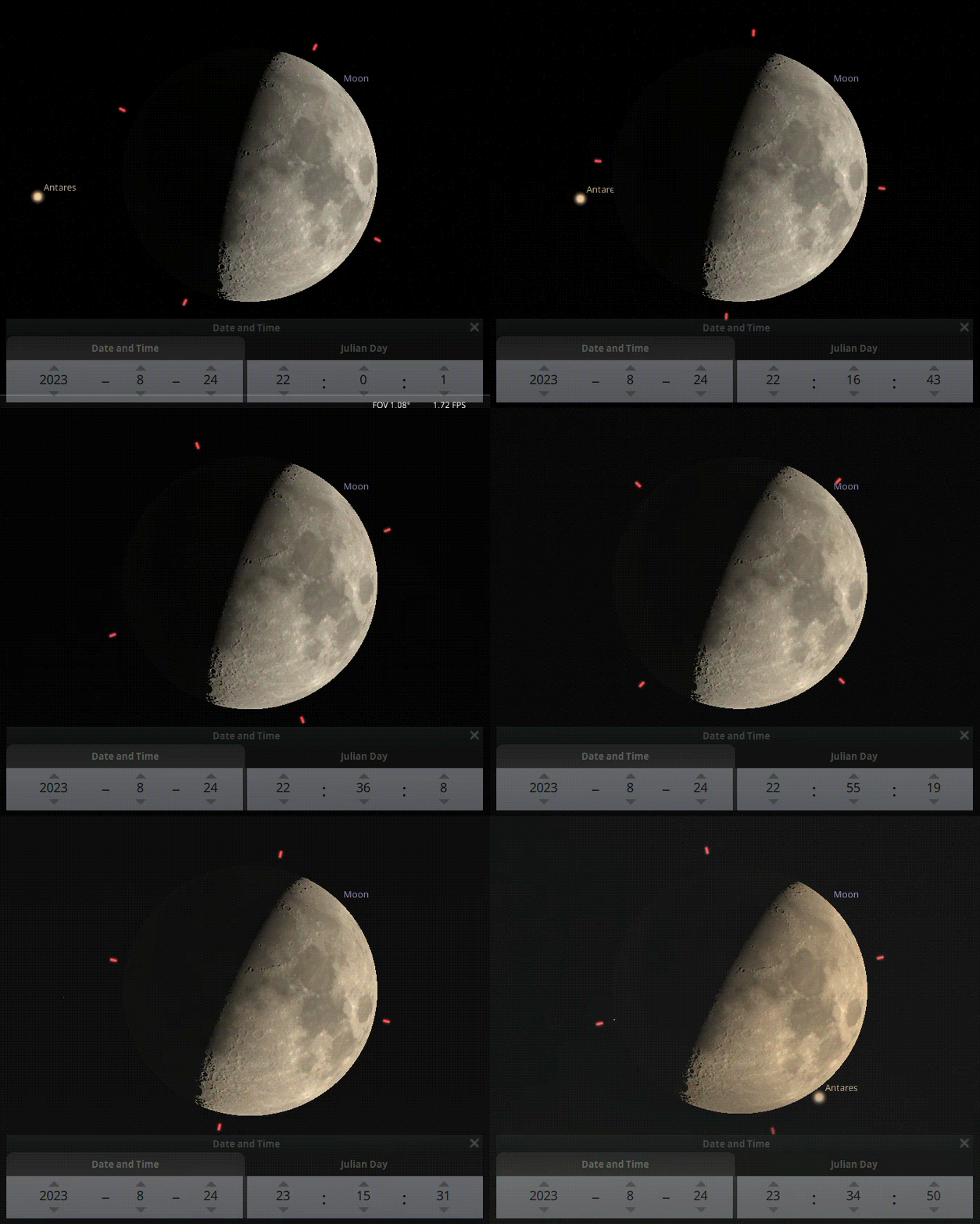
A time-lapse prediction of the occultation of Antares by the Moon based on Stellarium imagery. In the actual occultation Antares will wink out and on suddenly. Antares is a double star, with a 5th magnitude companion. It should wink out and in 9 seconds before the main first magnitude star.

World map showing the area where the occultation of Antares can be visible. It is the area bounded by the white line, the red dotted line and the floppy figure 8 is the area where the occultation is visible. The red line shows that the area near that part of the line is where the occultation occurs during daylight the solid white line on the bottom encloses there is where the occultation will be seen at night. Michigan is close to that cyan line and so the occultation will occur near moonset. Credit: Occult 4 app.
Ephemeris: 07/21/2023 – Antares just looks weird
This is Ephemeris for Friday, July 21st. Today the Sun will be up for 15 hours and 3 minutes, setting at 9:20, and it will rise tomorrow at 6:18. The Moon, halfway from new to first quarter, will set at 11:34 this evening.
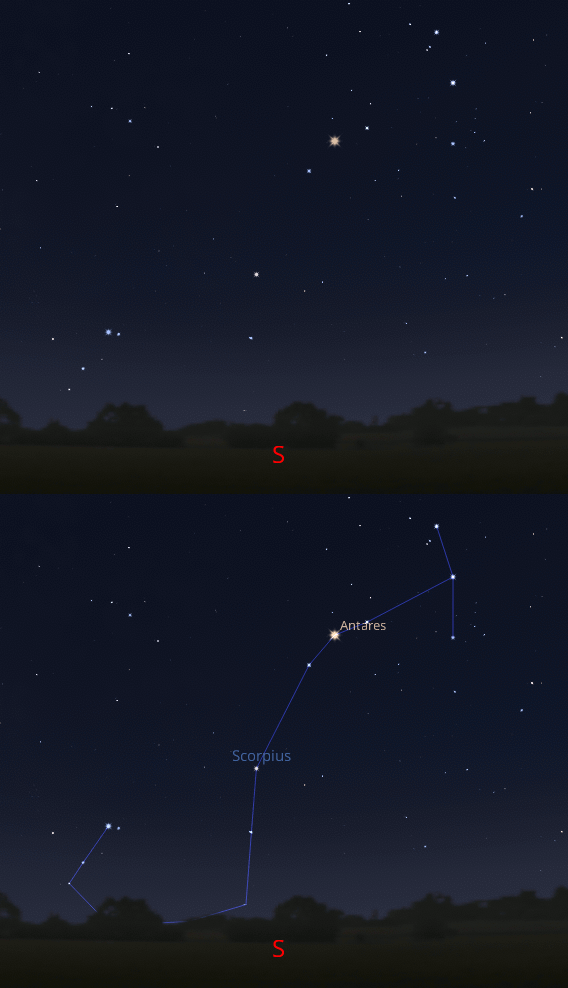
We’ve had our Fourth of July fireworks over two weeks ago, but there’s one star still celebrating as a sparkler. That’s Antares in Scorpius the scorpion low in the south tonight. We in Michigan always see Antares low in the south. It’s a bright red giant star which twinkles mightily, and since it’s low in the sky, it spits and sputters all kinds of colors due to our atmosphere’s turbulence, and the fact that we’re looking through so much of it at Antares. At it’s highest, due south, we are seeing it though 3 times more atmosphere than we would be if it was overhead. The more magnification one uses with binoculars or a telescope, the greater the sparkler effect. It is even called in sometimes as a UFO.
The astronomical event times given are for the Traverse City/Interlochen area of Michigan (EDT, UT –4 hours). They may be different for your location.
Addendum
The name of the star Antares means “Rival of Mars”. “Ant” meaning anti, “Ares”, the Greek equivalent to the Roman god Mars. The reason is their similar reddish color. Antares is red because it is a cool star, a red giant. Mars is red due to its red dust, colored by iron rust. The planet passes Antares about every 23 1/2 months. Mars will next pass Antares on December 8th, 2023. However, the event will not be visible, because both the star and the planet will be too close to the Sun in the morning sky then. Their next meeting, or conjunction, after that, on November 17th, 2025 will be in the evening sky, but still too close to the Sun to be spotted. The conjunction after that will be in the evening sky, again rather close to the Sun, on October 28, 2027. For these three encounters, Mars will be north or above Antares, and dimmer than the star.
07/13/2023 – Ephemeris – How to find Ophiuchus the serpent bearer
This is Ephemeris for Thursday, July 13th. Today the Sun will be up for 15 hours and 17 minutes, setting at 9:27, and it will rise tomorrow at 6:10. The Moon, halfway from last quarter to new, will rise at 3:04 tomorrow morning.
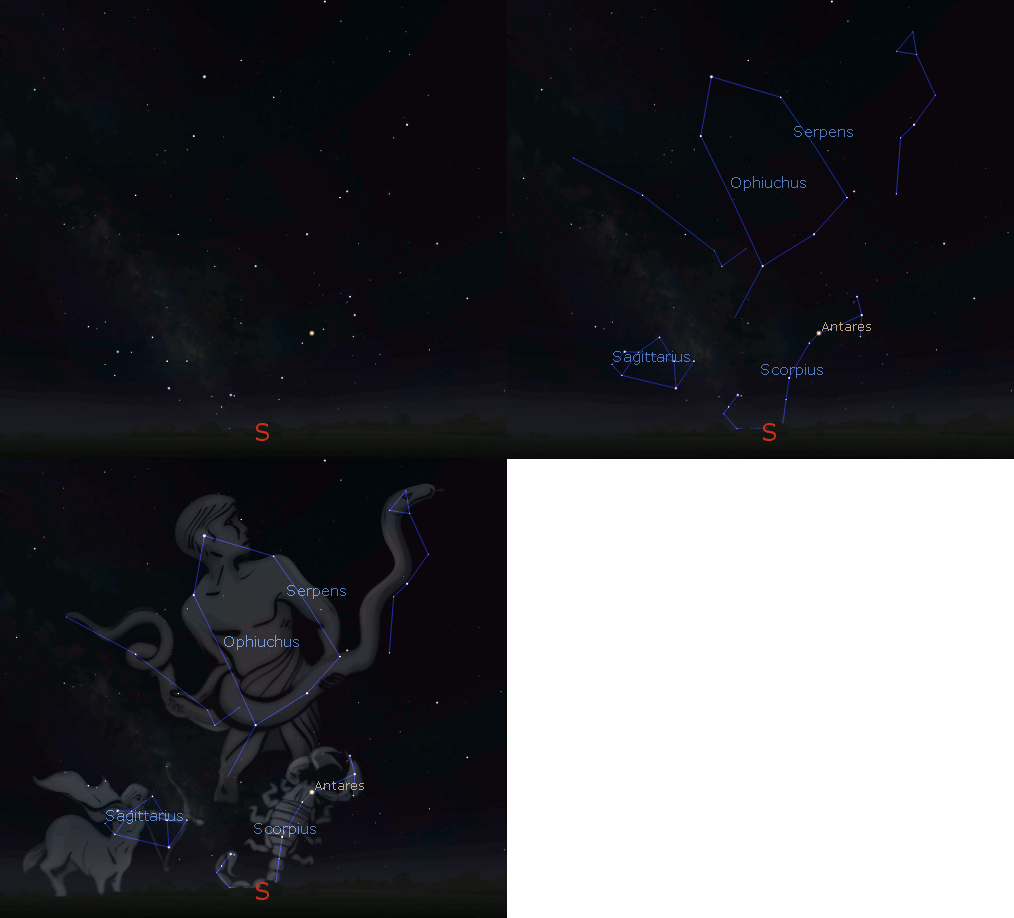
The red star Antares shines in the south at 11 p.m. In the constellation of Scorpius. In the area of sky above and a little to the left lies a large constellation of faint stars called Ophiuchus, the serpent bearer. The constellation shape is like a large bell, which reminds me of the head, shoulders and arms of a fellow that’s holding the snake-like a weight lifter pulling up a heavy barbell. The serpent he’s holding is Serpens, the only two-part constellation in the heavens. The head rises to Ophiuchus’ right, and the tail extends up to the left. In Greek myth, Ophiuchus represents the great physician Aesculapius, educated by the god Apollo, and the centaur Chiron, who is found in the stars as Sagittarius, now rising below and left of him.
The astronomical event times given are for the Traverse City/Interlochen area of Michigan (EDT, UT –4 hours). They may be different for your location.
Addendum
07/19/2022 – Ephemeris – How to find the constellations of the man with the snake
This is Ephemeris for Tuesday, July 19th. Today the Sun will be up for 15 hours and 7 minutes, setting at 9:22, and it will rise tomorrow at 6:16. The Moon, 1 day before last quarter, will rise at 12:52 tomorrow morning.
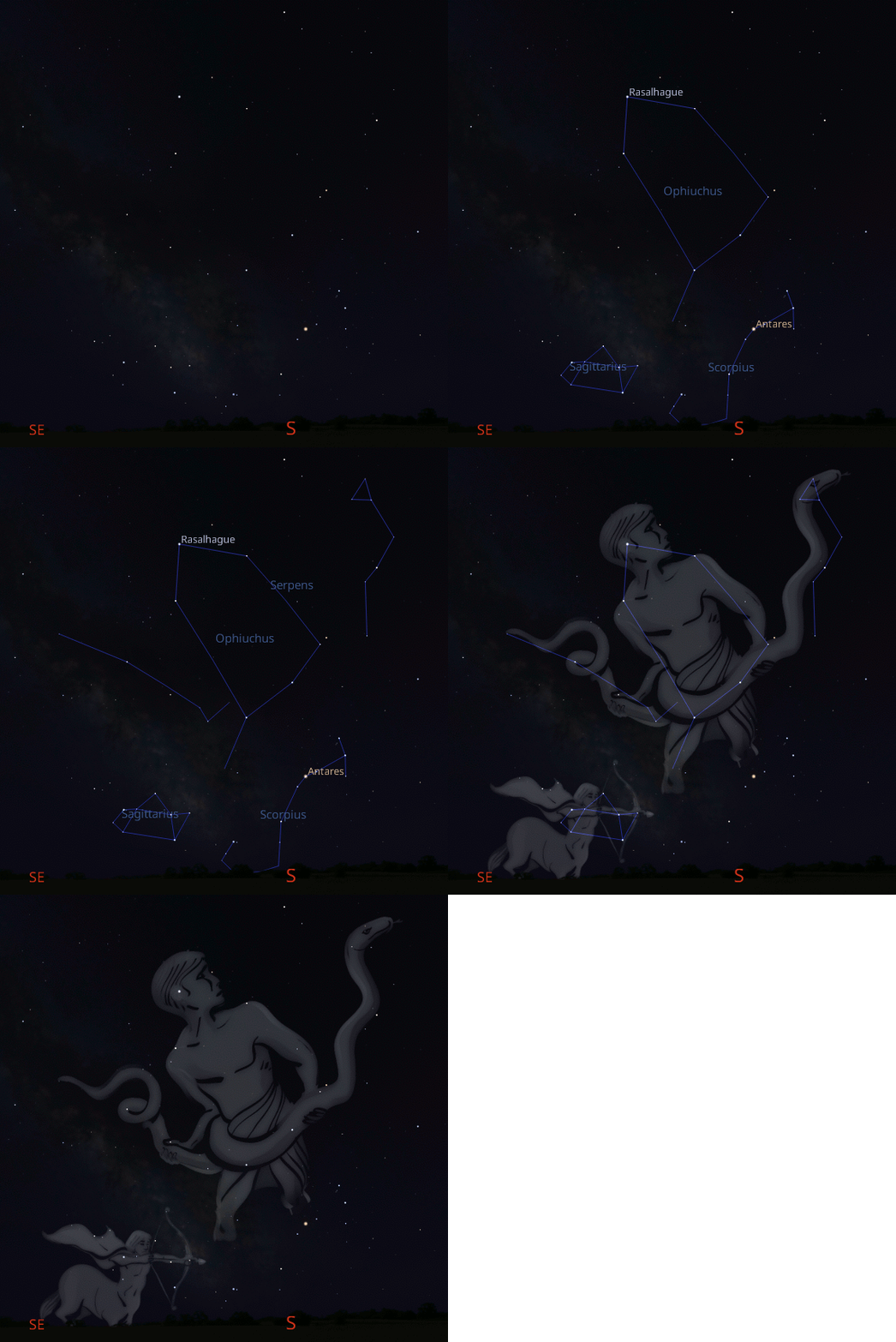
The red star Antares shines in the south at 11 pm, in the constellation of Scorpius. In the area of sky above lies a large constellation of faint stars called Ophiuchus, the serpent bearer. The constellation shape is like a large tilted bell, which reminds me of the head, shoulders and arms of a fellow that’s holding the snake, like a weight lifter pulling up a heavy barbell. The serpent he’s holding is Serpens, the only two-part constellation in the heavens. The head rises to Ophiuchus’ right, and the tail extends up to the left. In Greek legend Ophiuchus represents a great physician, educated by the god Apollo, and the centaur Chiron, who is also found in the stars as Sagittarius, now rising in the south-southeast below and left of him.
The astronomical event times given are for the Traverse City/Interlochen area of Michigan (EDT, UT – 4 hours). They may be different for your location.
Addendum
Ophiuchus finder animation for mid-July at 11 pm. Created using Stellarium and GIMP.
06/17/2022 – Ephemeris – What’s that weird twinkly star low in the south?
This is Ephemeris for Friday, June 17th. Today the Sun will be up for 15 hours and 34 minutes, setting at 9:30, and it will rise tomorrow at 5:56. The Moon, halfway from full to last quarter, will rise at 12:55 tomorrow morning.
At this time of year, there is a star that appears low in the south-southeast that appears red and twinkles mightily. The twinkling caused by the Earth’s atmosphere is enhanced when viewing it in binoculars. In a telescope, it appears as a virtual sparkler. It’s been called in to authorities as a UFO, unidentified flying object, or as the Defense Department now calls them UAPs, or unidentified aerial phenomena. Anyway, this light is identified. It is the red giant star Antares, in the heart of Scorpius the scorpion, one of the constellations of the zodiac. Antares other claim to fame is embodied in its name. Decoded, Antares means Rival of Mars due to its color and the fact that Mars passes by every couple of years. Ant means anti, and Ares is the Greek god of war that the Romans appropriated as Mars.
The astronomical event times given are for the Traverse City/Interlochen area of Michigan (EDT, UT – 4 hours). They may be different for your location.
Addendum
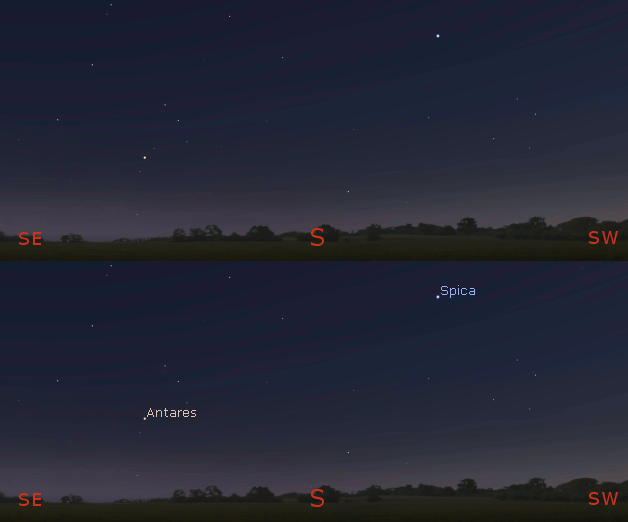
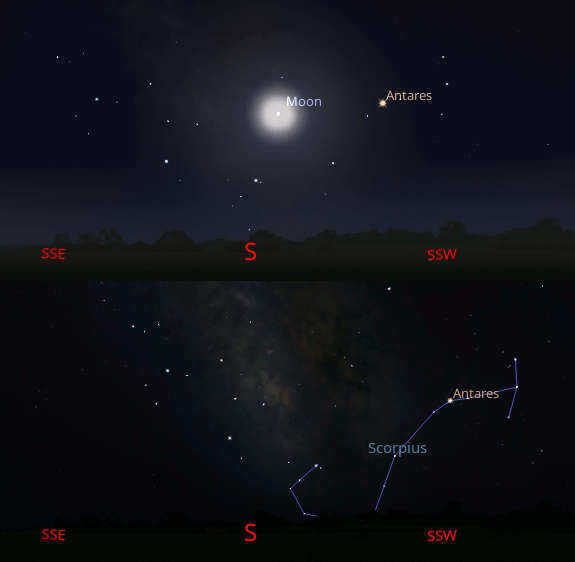
Antares low in the south-southeast at 10:30 pm, June 17, 2022, without Mars for competition. At this time, Antares is only 13 degrees above the horizon. Click on the image to enlarge it. Created Using Stellarium and GIMP.
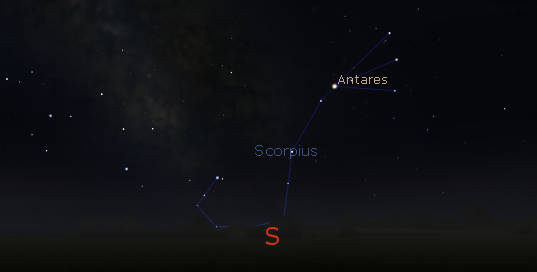
Scorpius at its highest as seen from the Grand Traverse area. Antares at this time is not quite 19 degrees altitude. This is 1 am, June 18th. Perceptive viewers of this image may spot a teapot in the stars to the left of Scorpius. That’s what we modern folk see in the stars of Sagittarius the archer. Created using Stellarium.
07/29/2021 – Ephemeris – Anishinaabe constellation of their hero
This is Bob Moler with Ephemeris for Thursday, July 29th. Today the Sun will be up for 14 hours and 45 minutes, setting at 9:11, and it will rise tomorrow at 6:27. The Moon, 2 days before last quarter, will rise at 12:17 tomorrow morning. | Tuesday I talked about the constellation Scorpius the scorpion now seen low in the southern sky in the evening. To me, the stars here make a very good scorpion. Scorpius was invented by people of the Middle East, where scorpions are plentiful. The Anishinaabe native peoples of our area, however, saw one of their legendary hero figures, Nenabozho*. In the sky, the arc of three stars at the front of the scorpion and to the right of the bright star Antares is his bow. He is shooting an arrow toward the receding Great Panther or Curly Tail a constellation of spring whose curl of a tail is the head of the constellation Leo, now lost in the evening twilight in the west. Nenabozho was a hero in their creation stories, a trickster who was often seen as a rabbit.
The astronomical event times given are for the Traverse City/Interlochen area of Michigan (EDT, UT – 4 hr). They may be different for your location.
Addenda
* Nenabozho is pronounced like Nana-bouz-hou, though different tribes pronounced it differently. I could not find Nenabozho and its various other transliterations, one of which was Nanaboozhoo in the Ojibwe People’s Dictionary (https://ojibwe.lib.umn.edu/). However, since he occasionally shape-shifted into being a rabbit his name includes a part of the name for rabbit, waabooz. That entry had several audio examples. That’s how I got the pronunciation for the radio program.
Finder chart
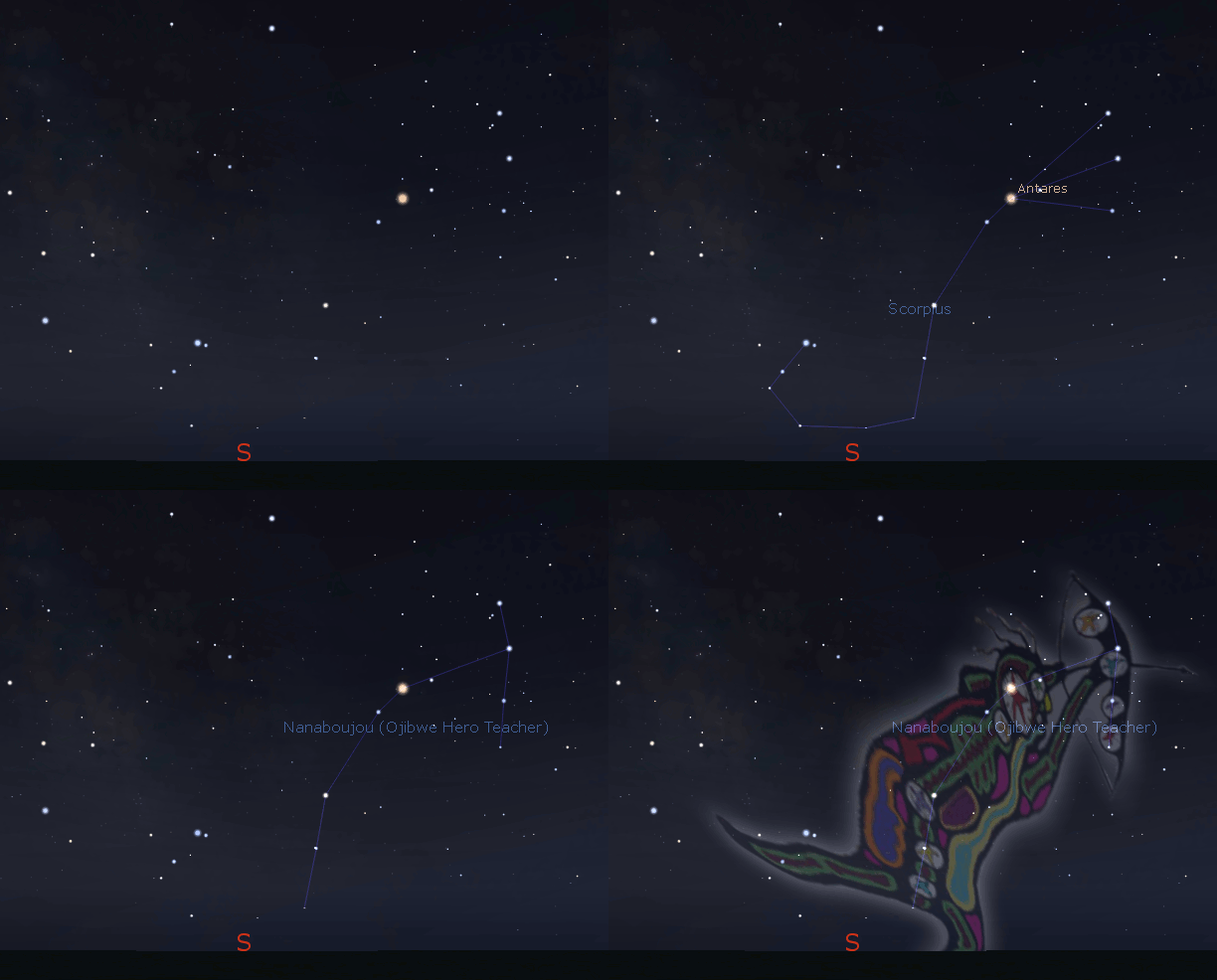
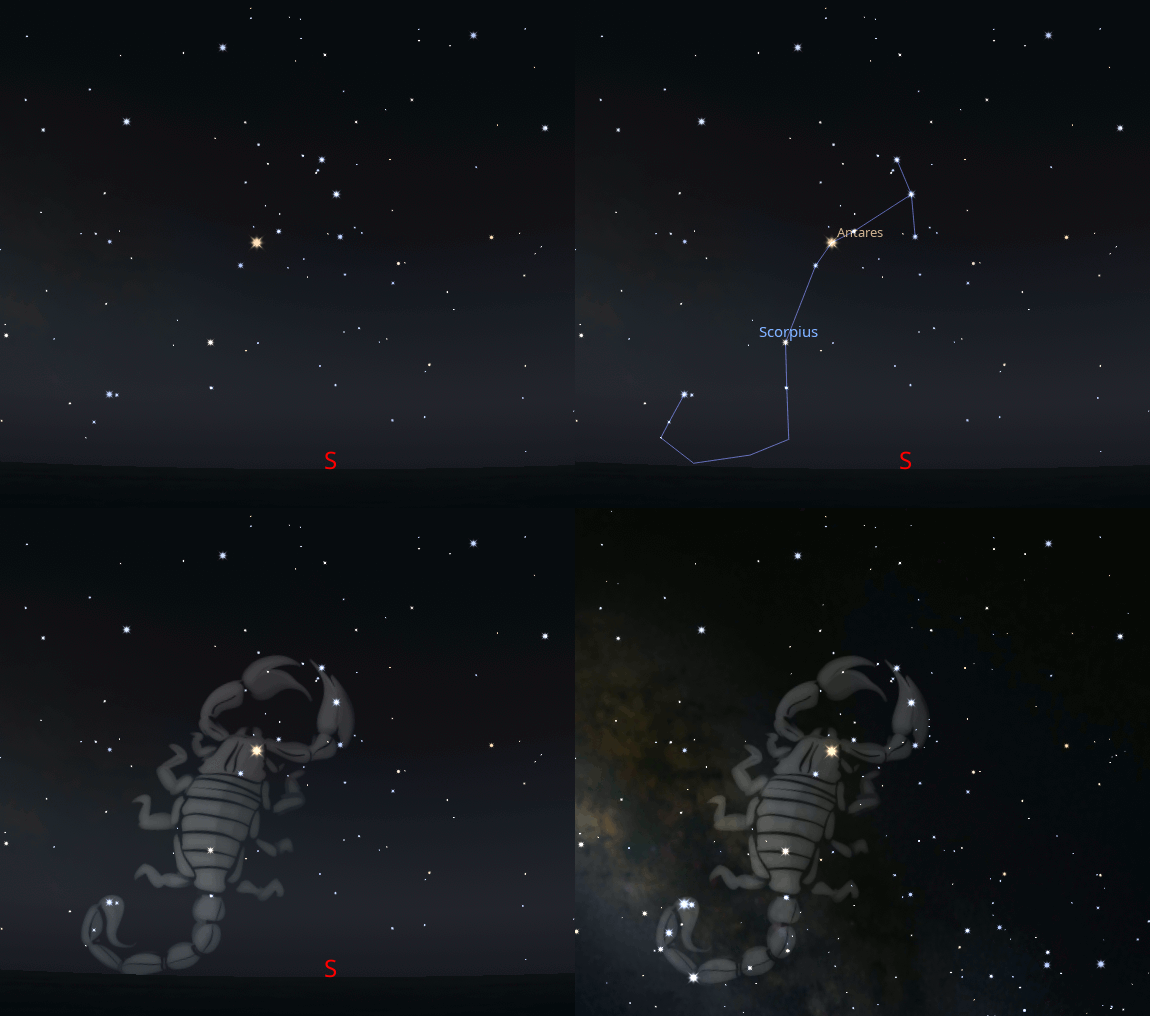
Animated finder for the Anishinaabe constellation of Nenabozho showing the unannotated star field, the Western constellation of Scorpius and Nenabozho. Created using Stellarium (both star lore images are embedded in Stellarium). The Anishinaabe image is embedded in Stellarium and is from Ojibwe Giizhig Anung Masinaaigan – Ojibiwe Sky Star Map created by A. Lee, W. Wilson, and C. Gawboy.
 Bob Moler's Ephemeris Blog