Archive
07/25/2016 – Ephemeris – Hermes’ Harp
Ephemeris for Monday, July 25th. The Sun rises at 6:21. It’ll be up for 14 hours and 54 minutes, setting at 9:16. The Moon, 1 day before last quarter, will rise at 12:34 tomorrow morning.
High up in the eastern sky at 11 p.m. can be found a bright star just north of a small, narrow, but very distinctive parallelogram of stars. They are the stars of the constellation Lyra the harp. The bright star is Vega, one of the twenty-one brightest stars, first magnitude stars. Vega is actually the 5th brightest night-time star. The harp, according to Greek mythology, was invented by the Greek god Hermes. The form of the harp in the sky, is as he had invented it: by stretching strings across a tortoise shell. Hermes gave it to his half-brother Apollo, who in turn gave it to the great musician Orpheus. In binoculars, near Vega, two stars appear together. They barely appear to the unaided eye as one star, called Epsilon Lyrae.
Times are for the Traverse City/Interlochen area of Michigan. They may be different for your location.
Addendum
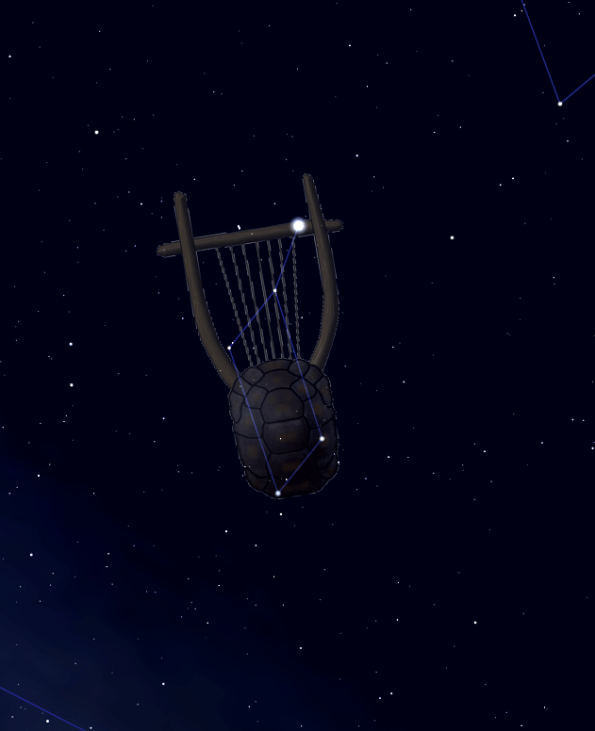
Lyra as a tortoise shell harp. Created using Stellarium and free clip art.
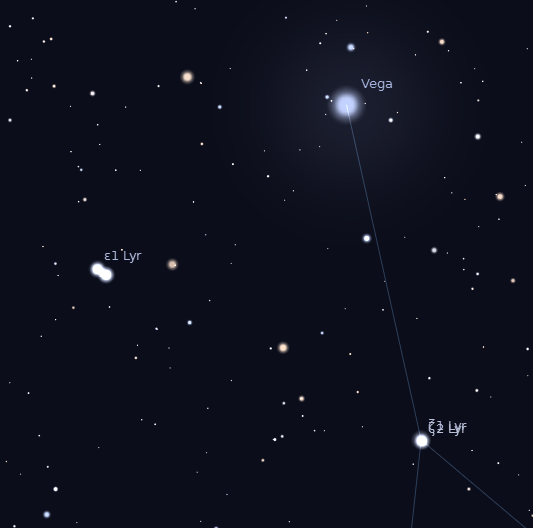
Closeup on Vega and Epsilon Lyrae. Created using Stellarium.
04/28/2016 – Ephemeris – The adventures of Corvus, Apollo’s pet crow
Ephemeris for Thursday, April 28th. The Sun rises at 6:36. It’ll be up for 14 hours and 8 minutes, setting at 8:44. The Moon, 1 day before last quarter, will rise at 2:20 tomorrow morning.
The small constellation of Corvus the crow is located low in the south at 11 this evening. It’s made of 5 dim stars, but the pattern is a distinctive distorted box with two stars at the upper left marking that corner. To the right is a fainter constellation of a thick stemmed goblet called Crater. Both appear above the long constellation of Hydra the water snake who is slithering just above the southern horizon.. In Greek mythology Corvus, then white, was the god Apollo’s pet. Apollo once bid Corvus to take a cup and fetch him some water. Corvus however dallied and waited for a green fig to ripen. Corvus grabbed a snake and returned with a story as to how the snake had delayed him. The angry Apollo turned the crow and all crows to this day black.
Times are for the Traverse City/Interlochen area of Michigan. They may be different for your location.
Addendum
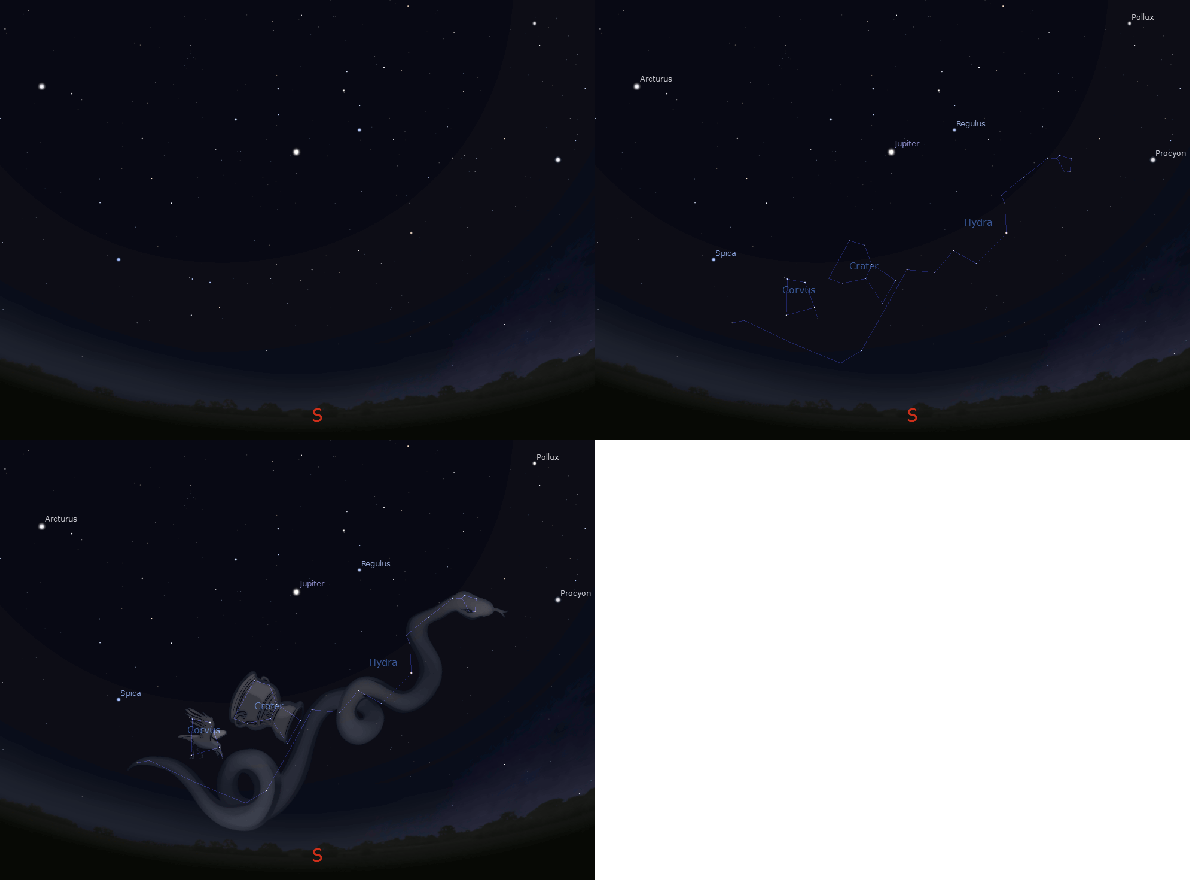
Corvus the crow, Crater the cup and Hydra the water snake along with Jupiter and the other spring stars at 10 p.m. April 28, 2016. Created using Stellarium.
07/15/2014 – Ephemeris – The constellation of Lyra the harp
Ephemeris for Tuesday, July 15th. Today the sun will be up for 15 hours and 13 minutes, setting at 9:24. The moon, half way from full to last quarter, will rise at 11:19 this evening. Tomorrow the sun will rise at 6:12.
Very high up in the eastern sky at 11 p.m. can be found a bright star just north of a small, narrow, but very distinctive parallelogram of stars. They are the stars of the constellation Lyra the harp. The bright star is Vega, one of the twenty one brightest first magnitude stars. Vega is actually the 5th brightest night-time star. The harp, according to Greek mythology, was invented by the Greek god Hermes. The form of the harp in the sky, is as he had invented it: by stretching strings across a tortoise shell. Hermes gave it to his half-brother Apollo, who in turn gave it to the great musician Orpheus. The sun has a motion with respect to most stars around it. Its direction is towards the vicinity of Lyra.
Times are for the Traverse City/Interlochen area of Michigan. They may be different for your location.
Addendum
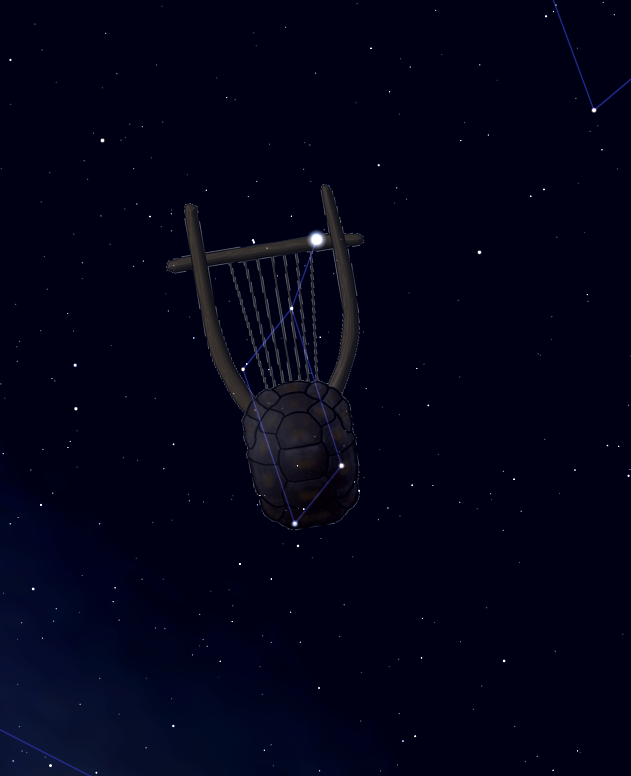
Lyra as a tortoise shell harp. Created using Stellarium and free clip art.
06/30/2014 – Ephemeris – The celestial snake handler
Ephemeris for Monday, June 30th. Today the sun will be up for 15 hours and 30 minutes, setting at 9:31. The moon, 3 days past new, will set at 11:14 this evening. Tomorrow the sun will rise at 6:01. | The red star Antares shines in the south at 11 p.m. In the constellation of Scorpius. In the area of sky above and a little to the left lies a large constellation of faint stars called Ophiuchus, the serpent bearer. The constellation shape is like a large bell, which reminds me of the head, shoulders and arms of a fellow that’s holding the snake-like a weight lifter pulling up a heavy bar bell. The serpent he’s holding is Serpens, the only two-part constellation in the heavens. The head rises to Ophiuchus’ right and the tail extends up to the left. In legend Ophiuchus was a great physician, educated by the god Apollo, and the centaur Chiron, also found in the stars as Sagittarius, now rising below and left of him.
Times are for the Traverse City/Interlochen area of Michigan. They may be different for your location.
Addendum
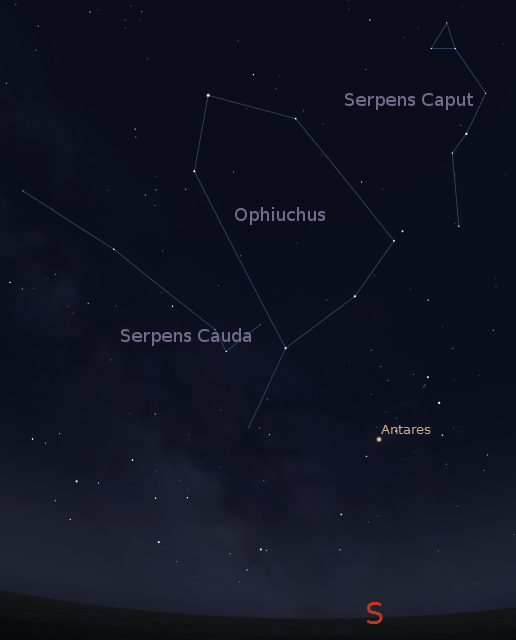
Ophiuchus and Serpens at 11 p.m.. Created using Stellarium.
04/28/2014 – Ephemeris – The legend of the constellation of Corvus the crow
Ephemeris for Monday, April 28th. The sun rises at 6:37. It’ll be up for 14 hours and 6 minutes, setting at 8:43. The moon, 1 day before new, will rise at 6:53 tomorrow morning.
The small constellation of Corvus the crow is located low in the south at 10:30 this evening. It’s made of 5 dim stars, but the pattern is a distinctive distorted box with two stars at the upper left marking that corner. To the right is a fainter constellation of a thick stemmed goblet called Crater. Both appear above the long constellation of Hydra the water snake who is slithering just above the southern horizon. In Greek mythology Corvus, then white, was the god Apollo’s pet. He once bid Corvus to take a cup and fetch him some water. Corvus however dallied and waited for a green fig to ripen. Corvus grabbed a snake and returned with a story on how the snake had delayed him. The angry Apollo turned the crow and all crows to this day black.
Times are for the Traverse City/Interlochen area of Michigan. They may be different for your location.
Addendum
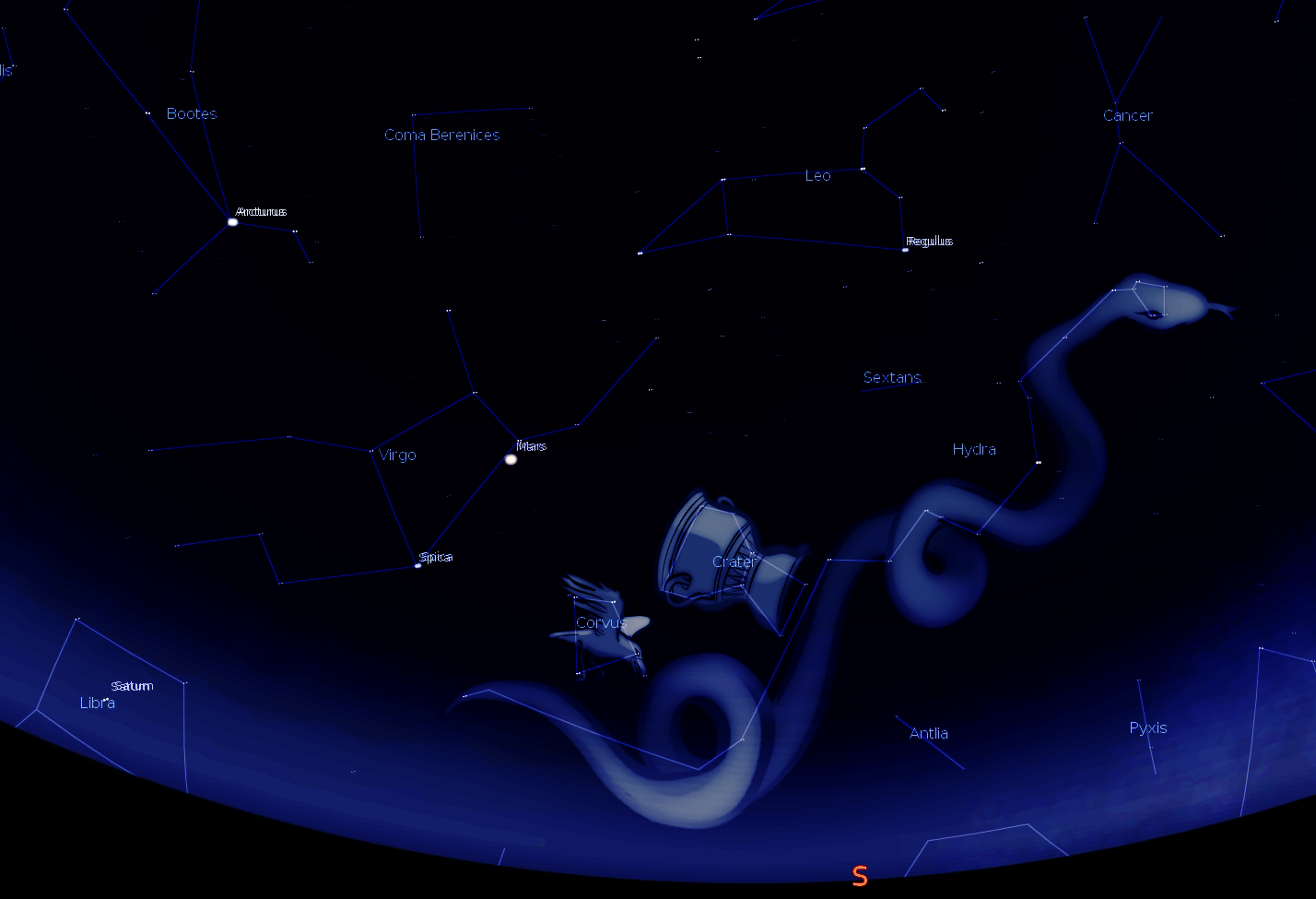
Corvus the crow, Crater the cup and Hydra the water snake along with the other spring constellations ay 10 p.m. April 28, 2014. Created using Stellarium.
12/23/2013 – Ephemeris – The constellation Orion: The hard luck hero
Ephemeris for Monday, December 23rd. The sun will rise at 8:17. It’ll be up for 8 hours and 49 minutes, setting at 5:06. The moon, 2 days before last quarter, will rise at 11:29 this evening.
The large and bright constellation of Orion is now in the southeast at 9 p.m. It is seen as an upright rectangle of bright stars tilting to the left, his shoulders and knees, with a belt of three stars in the center. Orion is a minor character in Greek mythology, much less celebrated than Hercules, which has a dim constellation named for him. Orion was a hunter. He had an ill-fated romance with Merope, whose father King Oenopion, had him blinded. After having his sight restored, Orion became a companion of Diana goddess of the hunt and they wanted to marry. Apollo, Diana’s brother disapproved of Orion also and was able to trick Diana into accidentally killing Orion with her bow. Another story had Orion dying of a scorpion sting.
Times are for the Traverse City/Interlochen area of Michigan. They may be different for your location.
Addendum
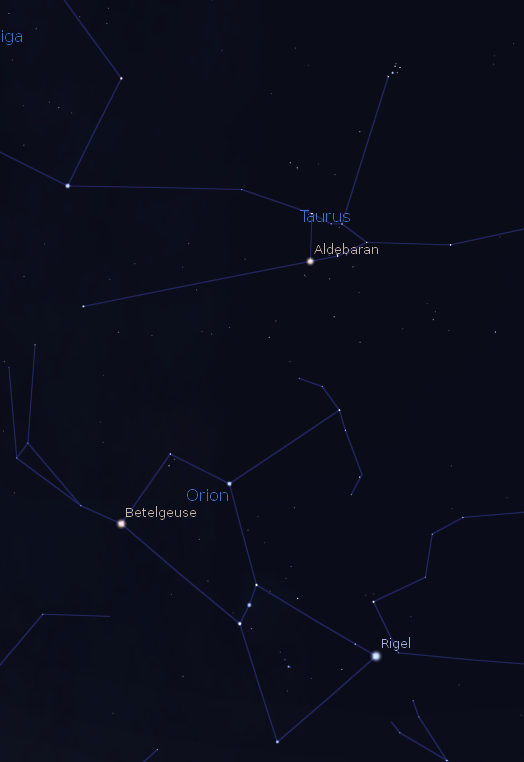
Taurus and Orion with Orion’s brightest stars named. Created using Stellarium.
07/12/2012 – Ephemeris – The constellation Lyra the harp
Thursday, July 12th. Today the sun will be up for 15 hours and 17 minutes, setting at 9:26. The moon, 2 days past last quarter, will rise at 1:50 tomorrow morning. Tomorrow the sun will rise at 6:10.
High in the east at 11 p.m. can be found a bright star called Vega just above a small, narrow, but very distinctive parallelogram of stars. They are the stars of the constellation Lyra the harp. Vega, the 5th brightest night time star, is one of the twenty one brightest stars, called first magnitude stars. The harp, according to Greek mythology, was invented by the god Hermes. The form of the harp in the sky, is as he had invented it: by stretching strings across a tortoise shell. Hermes gave it to his half-brother Apollo, who in turn gave it to the great musician Orpheus. In binoculars, near Vega, two stars appear together. They barely appear to the unaided eye as a single star, designated Epsilon Lyrae.
Times are for the Traverse City/Interlochen area of Michigan. They may be different for your location.
Addendum
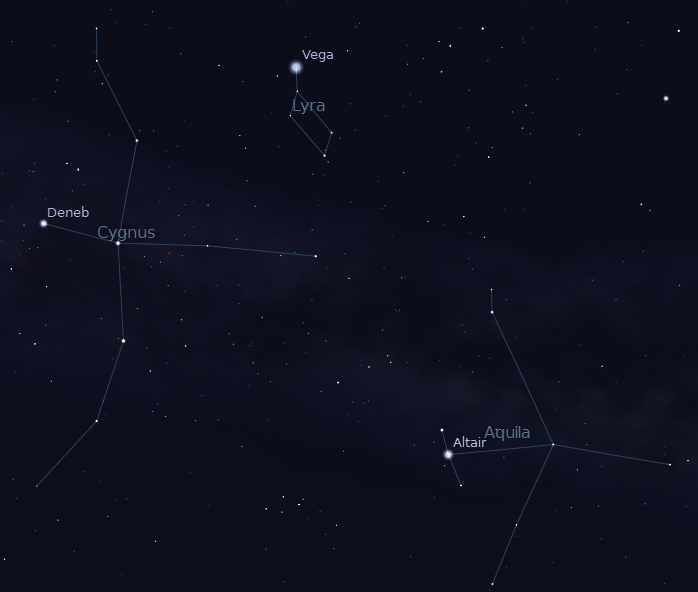
Summer Triangle and the constellation Lyra at 07-12-12 at 11 p.m. Created using Stellarium.
Closeup on Vega and Epsilon Lyrae. Created using Stellarium.
ε1 Lyrae is one of the stars of Epsilon Lyrae. The pair can be split better than this image with binoculars. Looking at the two with a good telescope and over 100 power can split each component into two more stars. We amateur astronomers call it the “Double-Double Star” Note too that Zeta (ζ) Lyrae is also a double star that can be split with a low power telescope.
04/10/2012 – Ephemeris – The story of Corvus the crow
Ephemeris for Tuesday, April 10th. The sun will rise at 7:06. It’ll be up for 13 hours and 15 minutes, setting at 8:21. The moon, 3 days before last quarter, will rise at 1:27 tomorrow morning.
The small constellation of Corvus the crow is located low in the southeast at 10 this evening. It’s made of 5 dim stars, but the pattern is a distinctive distorted box with two stars at the upper left marking that corner. To the right is a fainter constellation of a thick stemmed goblet called Crater. Both appear above the long constellation of Hydra the water snake who is slithering just above the southern horizon.. In Greek mythology Corvus, then white, was the god Apollo’s pet. Apollo once bid Corvus to take a cup and fetch him some water. Corvus however dallied and waited for an unripe fig to ripen. Corvus grabbed a snake and returned with a story as to how the snake had delayed him. The angry Apollo turned the crow and all crows to this day black.
* Times are for the Traverse City/Interlochen area of Michigan. They may be different for your location.
Addendum
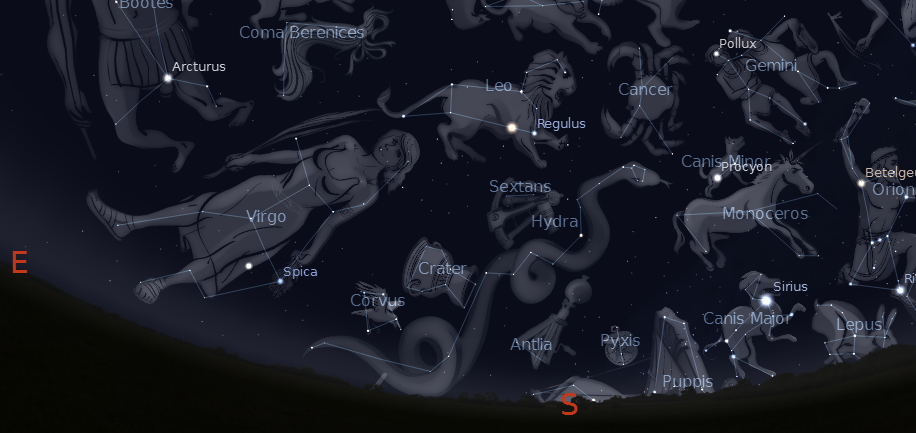
Hydra the Water Snake at 10 p.m. on April 9th, 2012. Created using Stellarium.
Yesterday’s chart, but little change. OK, it for 9:56 p.m. Check out Corvus the crow and Crater the cup. Sextens the sextant came later. The Greeks didn’t have them.
06/14/11 – Ephemeris – Fate of the Apollo lunar flags
Flag Day, Tuesday, June 14th. Today the sun will be up for 15 hours and 32 minutes, setting at 9:28. The moon, 1 day before full, will set at 5:35 tomorrow morning. Tomorrow the sun will rise at 5:56
Whatever happened to the flags left on the moon by the Apollo astronauts? Forty or so years after the landings the sun’s harsh unfiltered light, especially in the ultraviolet has bleached and degraded the nylon fabric of the flags. Also the lunar soil, called regolith contains small jagged particles that are very compact and hard to pound a flag pole in. Apparently the flags of all but Apollo 11 and 15 are still standing, while the rocket blast of the lunar module ascent stage blew down the other two. The flag of the United States is carried on two spacecraft that are about to leave the magnetic bubble around the sun that is the heliosphere. The farthest, Voyager 1 is 117 times the earth’s distance from the sun, nearly 11 billion miles away.
* Times are for the Traverse City/Interlochen area of Michigan. They may be different for your location.
 Bob Moler's Ephemeris Blog