Archive
06/22/2017 – Ephemeris – Now that it’s summer, lets check out the Summer Triangle
Ephemeris for Thursday, June 22nd. Today the Sun will be up for 15 hours and 33 minutes, setting at 9:31, and it will rise tomorrow at 5:57. The Moon, 1 day before new, will rise at 5:45 tomorrow morning.
We’re a day into summer, and the asterism or informal constellation called the Summer Triangle can be seen rising in the east as it gets dark. Highest of the three bright stars is Vega in the constellation Lyra the harp, whose body is seen in a narrow parallelogram nearby. The second star of the triangle is Deneb lower and left of Vega, It appears dimmer than Vega because it is by far the most distant of the three. The third star of the Summer Triangle is seen farther below and a right of Vega. It is Altair in Aquila the eagle, and the closest. Altair is 16.5 light years away, Vega is 27 light years while Deneb may be a whopping 2600 light years away. One light year is 6 trillion miles (9 trillion km).
The times given are for the Traverse City/Interlochen area of Michigan. They may be different for your location.
Addendum
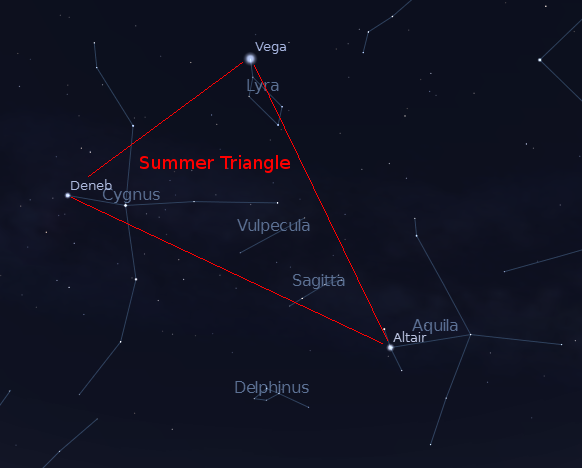
The Summer Triangle. Created using Stellarium and The Gimp.
07/29/2016 – Ephemeris – Aquila the Eagle, third constellation of the Summer Triangle
Ephemeris for Friday, July 29th. The Sun rises at 6:26. It’ll be up for 14 hours and 45 minutes, setting at 9:11. The Moon, 3 days past last quarter, will rise at 3:20 tomorrow morning.
Aquila the eagle is a constellation that lies in the Milky Way. It’s in the southeastern sky as it gets dark. Its brightest star, Altair is one of the stars of the Summer Triangle, a group of three bright stars seen now in the eastern sky in the evening. Altair, in the head of the eagle, is flanked by two slightly dimmer stars, the shoulders of the eagle. The eagle is flying northeastward through the Milky Way. Its wings are seen in the wing tip stars. A curved group of stars to the lower right of Altair is its tail. Within Aquila the Milky Way shows many dark clouds as part of the Great Rift that splits it here. The other summer bird is Cygnus the swan, which I talked about Tuesday, above and left of Aquila, flying in the opposite direction.
Times are for the Traverse City/Interlochen area of Michigan. They may be different for your location.
Addendum
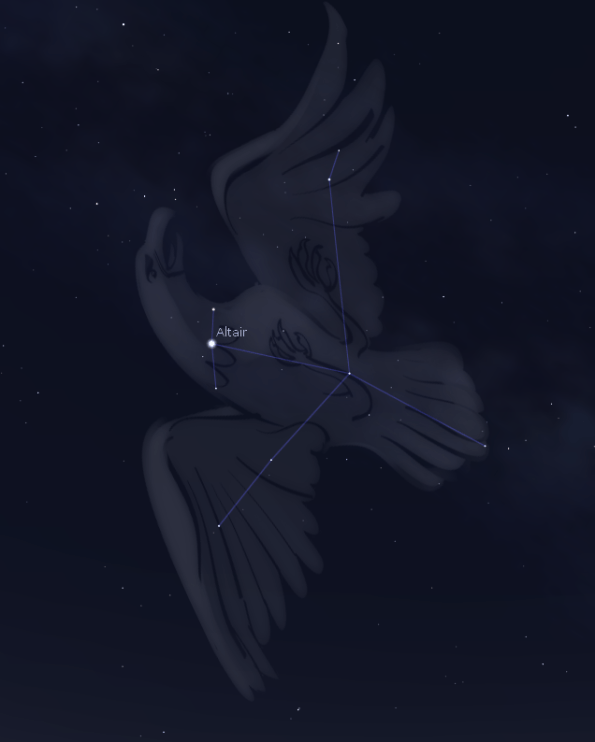
Aquila the Eagle in the southeastern sky. Created using Stellarium.
06/23/2016 – Ephemeris – Tis the season to view the Summer Triangle
Ephemeris for Thursday, June 23rd. Today the Sun will be up for 15 hours and 34 minutes, setting at 9:32, and it will rise tomorrow at 5:58. The Moon, 3 days past full, will rise at 11:43 this evening.
Now that summer is here, the asterism or informal constellation called the Summer Triangle can be seen in the east as it gets dark. Highest of the three bright stars is Vega in the constellation Lyra the harp, whose body is seen in a narrow parallelogram nearby. The second star of the triangle is Deneb lower and left of Vega, It appears dimmer than Vega because its is by far the most distant of the three. The third star of the Summer Triangle is seen farther below and right of Vega. It is Altair in Aquila the eagle, and the closest. Altair is 16.7 light years away, Vega is 25 light years while Deneb may be a whopping 2600 light years away. With a light year at 6 trillion miles. That’s mind boggling to think in miles at least.
Times are for the Traverse City/Interlochen area of Michigan. They may be different for your location.
Addendum
The Summer Triangle. Created using Stellarium and The Gimp.
08/06/2015 – Ephemeris – There’s an eagle in the stars
Ephemeris for Thursday, August 6th. The Sun rises at 6:34. It’ll be up for 14 hours and 27 minutes, setting at 9:02. The Moon, at last quarter today, will rise at 12:46 tomorrow morning.
The southernmost star in the Summer Triangle of three bright stars is Altair, high in the south-southeast in the evening. It’s in the head of the constellation Aquila the Eagle. Altair is flanked by two stars, the eagle’s shoulders, and farther out are the wing tips. Other stars to the lower right are in its body and a last three in its tail. Near the tail binoculars will show a fuzzy spot that telescopes show as a compact star cluster, sometimes called the Wild Duck Cluster for its nearly triangular shape. Aquila is flying northeastward through the Milky Way, where it is split in two by a cloud of gas and dust. According to mythology the Trojan boy Ganymede was taken to heaven at the behest of the god Zeus by this eagle.
Times are for the Traverse City/Interlochen area of Michigan. They may be different for your location.
Addendum
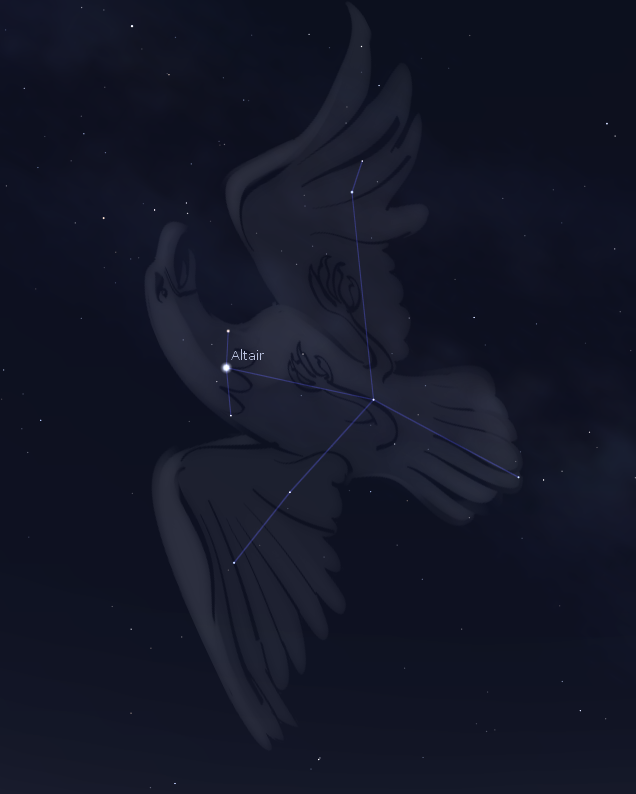
Aquila the Eagle in the southeastern sky. Created using Stellarium.
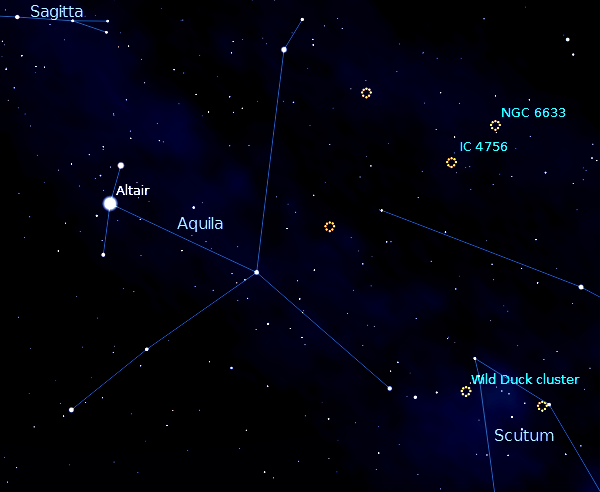
Finder chart for M11, the Wild Duck Cluster, Created using Stellarium.
07/16/2015 – Ephemeris – The Summer Triangle is the sign of the season
Ephemeris for Thursday, July 16th. Today the Sun will be up for 15 hours and 12 minutes, setting at 9:25. The Moon, 1 day past new, will set at 9:32 this evening, and tomorrow the Sun will rise at 6:13.
We’re almost a month into summer, and the asterism or informal constellation called the Summer Triangle can be seen midway up the sky in the east as it gets dark. Highest of the three bright stars is Vega in the constellation Lyra the harp, whose body is seen in a narrow parallelogram nearby. The second star of the triangle is Deneb lower and left of Vega, It appears dimmer than Vega because it is by far the most distant of the three. The third star of the Summer Triangle is seen farther below and a right of Vega. It is Altair in Aquila the eagle, and the closest. Altair is 16.5 light years away, Vega is 27 light years while Deneb is so far away that it’s distance is in some doubt and may be 2,600 light years away.
Times are for the Traverse City/Interlochen area of Michigan. They may be different for your location.
Addendum
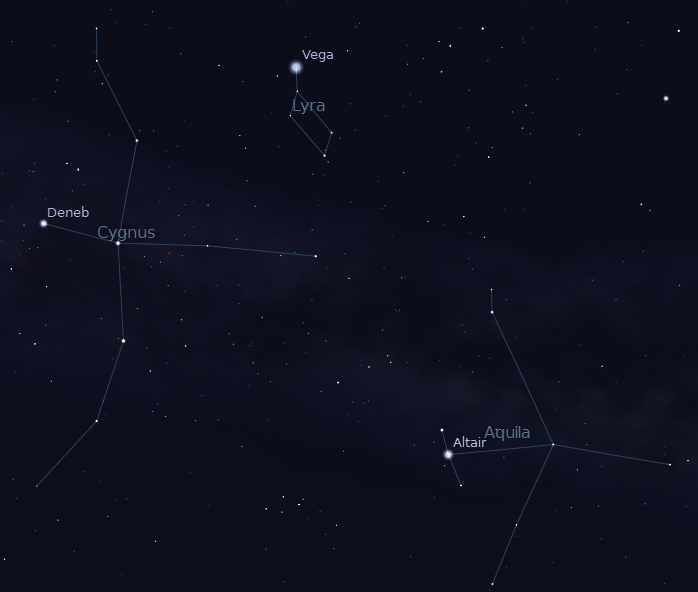
Summer Triangle. Created using Stellarium.
08/26/2014 – Ephemeris – The Great Rift
Ephemeris for Tuesday, August 26th. The sun rises at 6:57. It’ll be up for 13 hours and 31 minutes, setting at 8:29. The moon, 1 day past new, will set at 8:45 this evening.
High overhead the Milky Way is seen passing through the Summer Triangle of three bright stars. Here we find the Milky Way split into two sections. The split starts in the constellation of Cygnus the Swan or Northern Cross very high in the east. The western part of the Milky Way ends southwest of the Aquila the eagle. This dark dividing feature is called the Great Rift. Despite the lack of stars seen there, it doesn’t mean that there are fewer stars there than in the brighter patches of the Milky Way. The rift is a great dark cloud that obscures the light of the stars behind it. Sometimes binoculars can be used to find the edges of the clouds of the rift, as stars numbers drop off suddenly. This is especially easy to see in Aquila.
Times are for the Traverse City/Interlochen area of Michigan. They may be different for your location.
Addendum
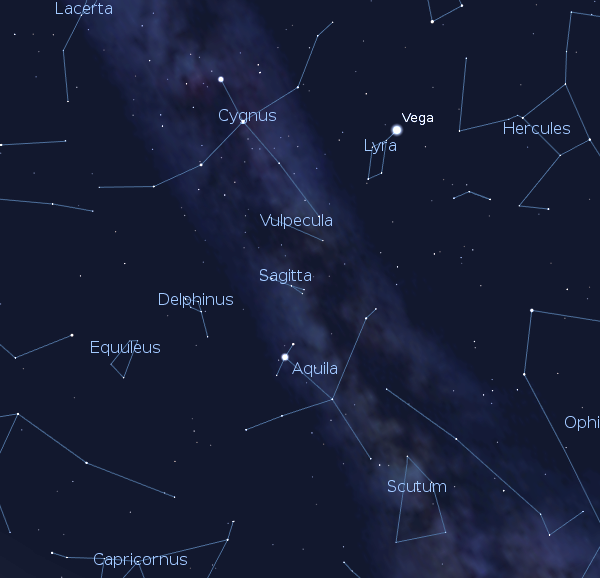
The Great Rift in the Milky Way. Created using Stellarium.
07/24/2014 – Ephemeris – A look at Altair the third star of the Summer Triangle
Ephemeris for Thursday, July 24th. The sun rises at 6:20. It’ll be up for 14 hours and 56 minutes, setting at 9:17. The moon, 2 days before new, will rise at 5:21 tomorrow morning.
The Summer Triangle Is high in the east to southeast sky in the evening. The southernmost star of the Summer Triangle is Altair, in the southeast. Altair is the closest of the three stars at a distance of 16.7 light years away. One light year is nearly 6 trillion miles, that’s 6 followed by 12 zeros. Altair is nearly 11 times the brightness of the sun. If seen at Altair’s distance, the sun would only be as bright as one of the two stars that flank it in our sky. What is rather different about Altair is its rapid rotation. While it’s almost twice the sun’s diameter, it rotates once in only 9 hours, and would show a decidedly squashed appearance if seen close up. Our sun’s a slow poke, taking nearly a month to rotate just once.
Times are for the Traverse City/Interlochen area of Michigan. They may be different for your location.
Addendum
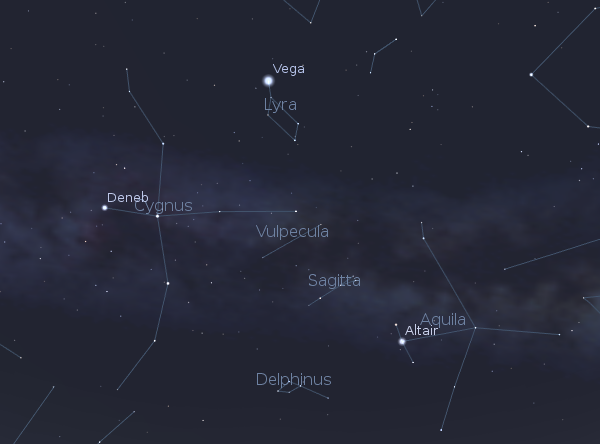
Deneb with the other stars and constellations in the Summer Triangle. Created using Stellarium.

False-color image of the rapidly rotating star Altair, made with the MIRC imager on the CHARA array on Mt. Wilson. Credit: Ming Zhao, University of Michigan
07/21/2014 – Ephemeris – The celestial eagle: Aquila
Ephemeris for Monday, July 21st. Today the sun will be up for 15 hours and 2 minutes, setting at 9:19. The moon, 3 days past last quarter, will rise at 2:52 tomorrow morning. Tomorrow the sun will rise at 6:18.
Aquila the eagle is a constellation that lies in the Milky Way. It’s in the southeastern sky as it gets dark. Its brightest star, Altair is one of the stars of the Summer Triangle, a group of three bright stars dominating the eastern sky in the evening now. Altair, in the head of the eagle, is flanked by two slightly dimmer stars, the shoulders of the eagle. The eagle is flying northeastward through the Milky Way. Its wings are seen in the wing tip stars. A curved group of stars to the lower right of Altair is its tail. Within Aquila the Milky Way shows many dark clouds as part of the Great Rift that splits it here. The other summer bird is Cygnus the swan above and left of Aquila, flying in the opposite direction.
Times are for the Traverse City/Interlochen area of Michigan. They may be different for your location.
Addendum
Deneb with the other stars and constellations in the Summer Triangle. Created using Stellarium.
09/02/2013 – Ephemeris – The Milky Way’s Great Rift
Ephemeris for Labor Day, Monday, September 2nd. The sun will rise at 7:06. It’ll be up for 13 hours and 10 minutes, setting at 8:16. The moon, 3 days before new, will rise at 5:19 tomorrow morning.
High overhead the Milky Way is seen passing through the Summer Triangle of three bright stars. Here we find the Milky Way split into two sections. The split starts in the constellation of Cygnus the Swan or Northern Cross very high in the east. The western branch of the Milky Way ends in the south. The dark dividing feature is called the Great Rift. Despite the lack of stars seen there, it doesn’t mean that there are fewer stars there than in the brighter patches of the Milky Way. The rift is a number of overlapping clouds of dust and gas about 300 light years away that obscure the light of the stars behind them. Sometimes binoculars can be used to find the edges of the clouds of the rift, as stars numbers drop off suddenly. This is especially easily seen in the constellation of Aquila.
Times are for the Traverse City/Interlochen area of Michigan. They may be different for your location.
Addendum
The Great Rift in the Milky Way. Created using Stellarium.
07/29/2013 – Ephemeris – The constellation Aquila the eagle
Ephemeris for Monday, July 29th. The sun rises at 6:25. It’ll be up for 14 hours and 45 minutes, setting at 9:11. The moon, at last quarter today, will rise at 12:46 tomorrow morning.
Aquila the eagle is a constellation that lies in the Milky Way. It’s in the southeastern sky as it gets dark. Its brightest star, Altair is one of the stars of the Summer Triangle, a group of three bright stars seen now in the eastern sky in the evening. Altair, in the head of the eagle, is flanked by two slightly dimmer stars, the shoulders of the eagle. The eagle is flying northeastward through the Milky Way. Its wings are seen in the wing tip stars. A curved group of stars to the lower right of Altair is its tail. Within Aquila the Milky Way shows many dark clouds as part of the Great Rift that splits it here. The other summer bird is Cygnus the swan, above and left of Aquila, flying in the opposite direction, southward.
Times are for the Traverse City/Interlochen area of Michigan. They may be different for your location.
Addendum
Aquila with the other constellations in the Summer Triangle. Created using Stellarium.
 Bob Moler's Ephemeris Blog