Archive
07/18/2014 – Ephemeris – Deneb is the brightest star of the Summer Triangle… Really
Ephemeris for Friday, July 18th. Today the sun will be up for 15 hours and 8 minutes, setting at 9:22. The moon, at last quarter today, will rise at 12:58 tomorrow morning. Tomorrow the sun will rise at 6:15.
At 11 this evening the bright star Deneb in Cygnus the swan will be moderately high in the east northeast. Deneb is the dimmest star of the summer triangle. Of the other stars of the triangle, Vega is nearly overhead, and Altair to the southeast. While Deneb’s apparent magnitude, or brightness as seen from Earth, makes it the dimmest of the three bright stars, Deneb has a vast distance of possibly 1,550 light years. If brought as close as Vega, Deneb would be several times brighter than Venus. For all this it is only 13-20 times the mass of the sun. It will have an extremely short life and will explode, go supernova, in perhaps a few million years. Closer to home, check out the Sun at Kingsley Heritage Days This Saturday and Sunday.
Times are for the Traverse City/Interlochen area of Michigan. They may be different for your location.
Addendum
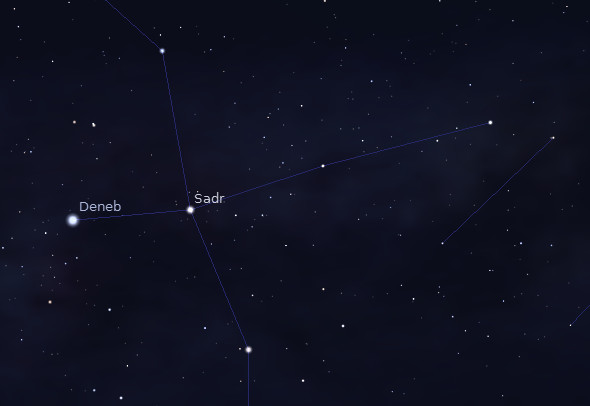
Deneb and the Northern Cross section of Cygnus the swan. Created using Stellarium.
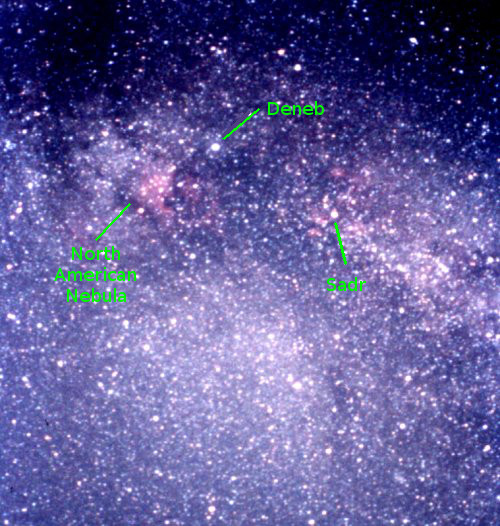
One of my old photographs of Deneb and the North American Nebula digitized from a slide.
The North American Nebula, visible as a faint smudge in binoculars or the naked eye may be ionized and illuminated by Deneb. It’s distance appears to be comparable to that of Deneb.
You may note that previous postings about Deneb over the years have given different distances of Deneb. That just denotes how difficult it is to pin down its distance.
07/17/2014 – Ephemeris – The constellation Cygnus the swan
Ephemeris for Thursday, July 17th. Today the sun will be up for 15 hours and 10 minutes, setting at 9:23. The moon, 1 day before last quarter, will rise at 12:25 tomorrow morning. Tomorrow the sun will rise at 6:14. | Fairly high in the east at 11 p.m. Is the constellation of Cygnus the swan, flying south through the Milky Way. It is also called the Northern Cross. At the left, the tail of the swan or the head of the cross is the bright star Deneb, one of the stars of the Summer Triangle. The next star right is Sadr the intersection of the body and the wings of the swan seen in flight, or the intersection of the two pieces of the cross. There are two or three stars farther to the right that delineate the swan’s long neck or upright of the cross, that ends with the star Alberio in the beak of the swan or foot of the cross. The crosspiece of the cross extends to the stars on either side of the intersection star Sadr, while the swan’s wings extend to a couple more stars each.
Times are for the Traverse City/Interlochen area of Michigan. They may be different for your location.
Addendum
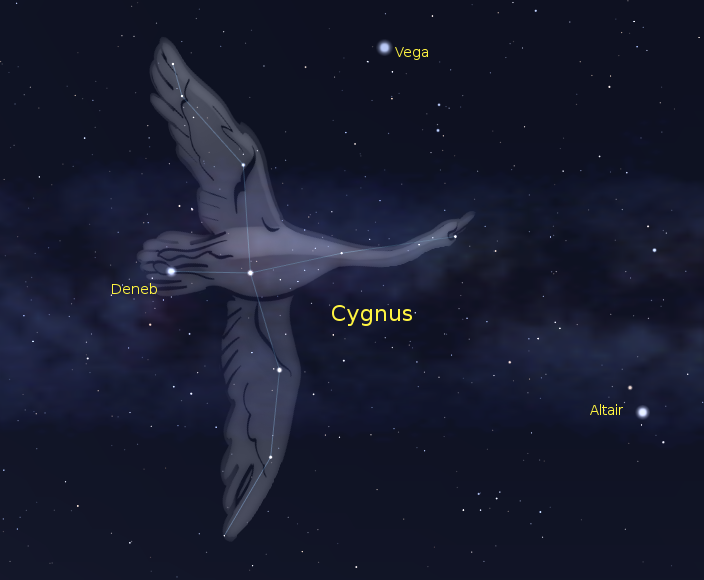
CygnusTheSwan Created using Stellarium.
09/26/2013 – Ephemeris – The Milky Way is crossing overhead
Ephemeris for Thursday, September 26th. The sun will rise at 7:34. It’ll be up for 11 hours and 57 minutes, setting at 7:31. The moon, at last quarter today, will rise at 12:17 tomorrow morning. | At 10 this evening the Milky Way will pass directly overhead. The bright star Deneb of the Summer Triangle and at the head of the Northern Cross is directly overhead at that time. Deneb is incidentally the tail of Cygnus the swan. The Milky Way stretches from the northeast to the southwest where the Teapot of Sagittarius is tipping, pouring out its tea on the horizon. The Milky Way can be enjoyed with the naked eye, binoculars or telescope. With the naked eye, we see it as the pre-scientific cultures did. The Milky way was a pathway of milk, the path that the American Indian warriors journeyed to the hereafter, the stars their camp fires shining in the night. In reality it is what we can see of our galaxy.
Times are for the Traverse City/Interlochen area of Michigan. They may be different for your location.
Addendum
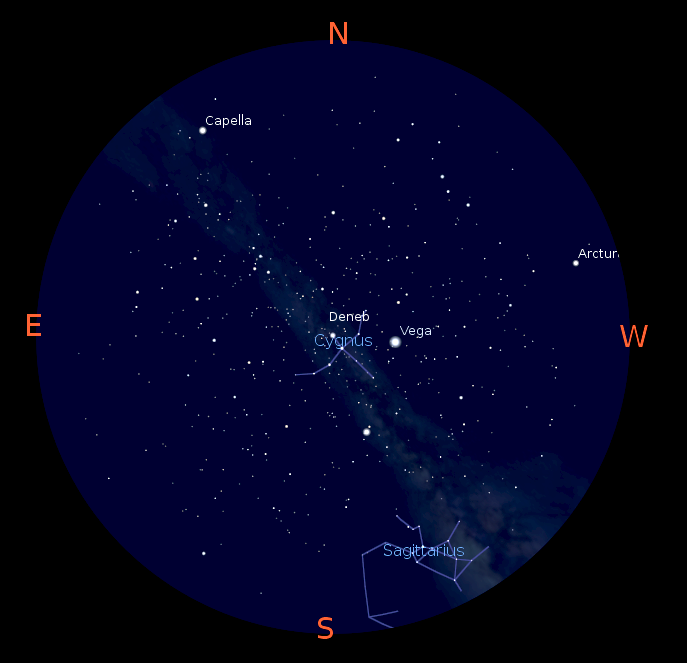
The Milky Way crosses the sky overhead at 10 p.m., September 26, 2013. Horizon to horizon view. Created using Stellarium.
09/02/2013 – Ephemeris – The Milky Way’s Great Rift
Ephemeris for Labor Day, Monday, September 2nd. The sun will rise at 7:06. It’ll be up for 13 hours and 10 minutes, setting at 8:16. The moon, 3 days before new, will rise at 5:19 tomorrow morning.
High overhead the Milky Way is seen passing through the Summer Triangle of three bright stars. Here we find the Milky Way split into two sections. The split starts in the constellation of Cygnus the Swan or Northern Cross very high in the east. The western branch of the Milky Way ends in the south. The dark dividing feature is called the Great Rift. Despite the lack of stars seen there, it doesn’t mean that there are fewer stars there than in the brighter patches of the Milky Way. The rift is a number of overlapping clouds of dust and gas about 300 light years away that obscure the light of the stars behind them. Sometimes binoculars can be used to find the edges of the clouds of the rift, as stars numbers drop off suddenly. This is especially easily seen in the constellation of Aquila.
Times are for the Traverse City/Interlochen area of Michigan. They may be different for your location.
Addendum
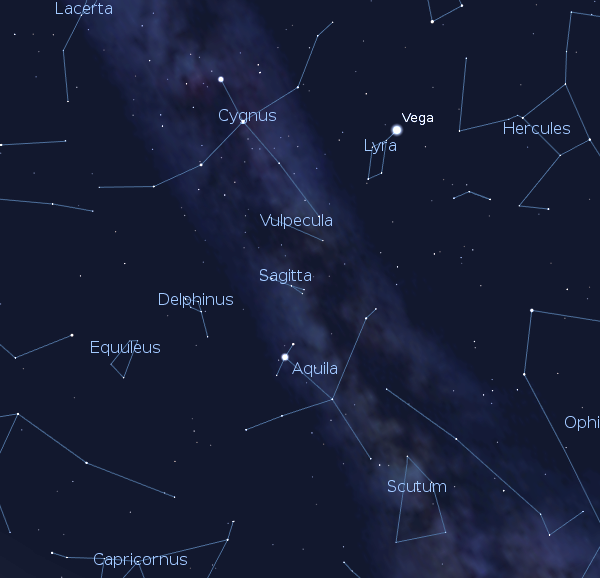
The Great Rift in the Milky Way. Created using Stellarium.
08/05/2013 – Ephemeris – The celestial swan
Ephemeris for Monday, August 5th. The sun rises at 6:33. It’ll be up for 14 hours and 28 minutes, setting at 9:02. The moon, 1 day before new, will rise at 6:28 tomorrow morning.
High in the east as it gets dark flies the constellation of Cygnus the swan. This constellation is also known as the Northern Cross. The cross is seen lying on its side with the bright star Deneb, member of the Summer Triangle, at the head of the cross to the left. The rest of the cross is delineated in the stars to the right. As a swan, Deneb is the tail, the stars of the crosspiece of the cross are the leading edges of wings as Cygnus flies south through the Milky Way. There are faint stars that also define the trailing wing edges. It is a very good portrayal of a flying swan, like the mute swans we see on the wing around here. In Cygnus we are looking in the direction that the sun is traveling as it orbits the center of the Milky Way galaxy.
Times are for the Traverse City/Interlochen area of Michigan. They may be different for your location.
Addendum
Cygnus The Swan Created using Stellarium.
07/29/2013 – Ephemeris – The constellation Aquila the eagle
Ephemeris for Monday, July 29th. The sun rises at 6:25. It’ll be up for 14 hours and 45 minutes, setting at 9:11. The moon, at last quarter today, will rise at 12:46 tomorrow morning.
Aquila the eagle is a constellation that lies in the Milky Way. It’s in the southeastern sky as it gets dark. Its brightest star, Altair is one of the stars of the Summer Triangle, a group of three bright stars seen now in the eastern sky in the evening. Altair, in the head of the eagle, is flanked by two slightly dimmer stars, the shoulders of the eagle. The eagle is flying northeastward through the Milky Way. Its wings are seen in the wing tip stars. A curved group of stars to the lower right of Altair is its tail. Within Aquila the Milky Way shows many dark clouds as part of the Great Rift that splits it here. The other summer bird is Cygnus the swan, above and left of Aquila, flying in the opposite direction, southward.
Times are for the Traverse City/Interlochen area of Michigan. They may be different for your location.
Addendum
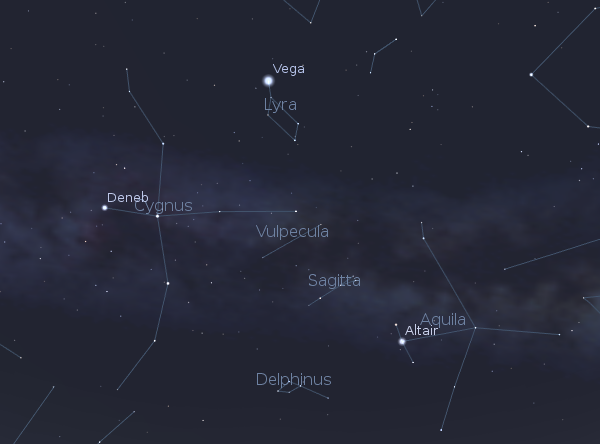
Aquila with the other constellations in the Summer Triangle. Created using Stellarium.
07/22/2013 – Ephemeris – The star Deneb, brighter than it looks
Ephemeris for Monday, July 22nd. Today the sun will be up for 15 hours, setting at 9:18. The moon, at full today, will rise at 9:00 this evening. Tomorrow the sun will rise at 6:19.
At 11 this evening the bright star Deneb in Cygnus the swan will be moderately high in the east northeast. Deneb is the dimmest star of the summer triangle. Of the other stars of the triangle, Vega is nearly overhead, and Altair to the south. While Deneb’s apparent magnitude, or brightness as seen from earth, makes it the dimmest of the three bright stars, Deneb’s vast distance of possibly 2,600 light years makes it 100 times the distance of Vega. If brought as close as Vega, Deneb would be several time brighter than Venus. For all this it is only 13-20 times the mass of the sun. It will have an extremely short life and it will explode, go supernova, in perhaps a few million years.
Times are for the Traverse City/Interlochen area of Michigan. They may be different for your location.
Addendum
Deneb with the other stars and constellations in the Summer Triangle. Created using Stellarium.
10/11/2012 – Ephemeris – North American Nebula
Ephemeris for Thursday, October 11th. The sun will rise at 7:53. It’ll be up for 11 hours and 10 minutes, setting at 7:04. The moon, 3 days past last quarter, will rise at 4:30 tomorrow morning.
Most of what we see in the Milky Way are just masses of stars, but there are bright clouds of gas , or to name them properly: emission nebulae. These bright clouds are areas of star formation. It is the ultraviolet light from young massive stars that light up the clouds they were formed from. A bright one, easily visible in binoculars is just about overhead at 9 p.m. Called the North American Nebula, a glow shaped much like our continent just east of the star Deneb, the northernmost star of the Summer Triangle, and brightest star in Cygnus the swan or Northern Cross. There are many other nebulae in the Milky Way, visible in binoculars and small telescopes. Many enjoyable hours can be spent sweeping the Milky Way for nebulae and star clusters.
Times are for the Traverse City/Interlochen area of Michigan. They may be different for your location.
Addendum
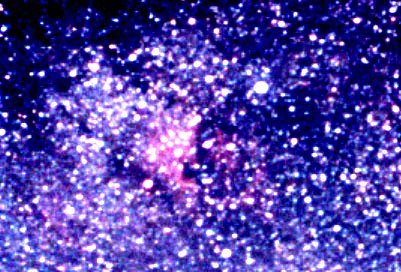
North American Nebula in Red. My old image.
The red object is the North American Nebula. Our eyes cannot perceive the color, due to hydrogen. This was a time exposure on film without telephoto. The bright star to the upper right is Deneb. The orientation is approximately correct if facing south. The photo also shows the stars that make up the glow of the Milky Way to the unaided eye.
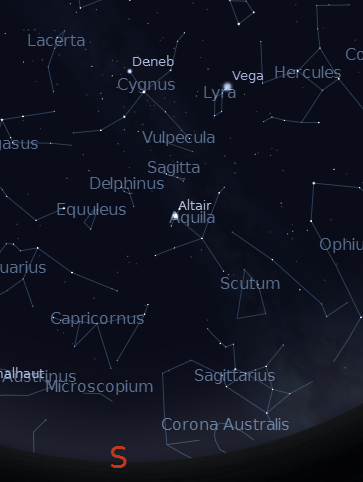
Deneb Overhead at 9 p.m. on October 11. Created using Stellarium.
The North American Nebula is about the size and position of the C in Cygnus.
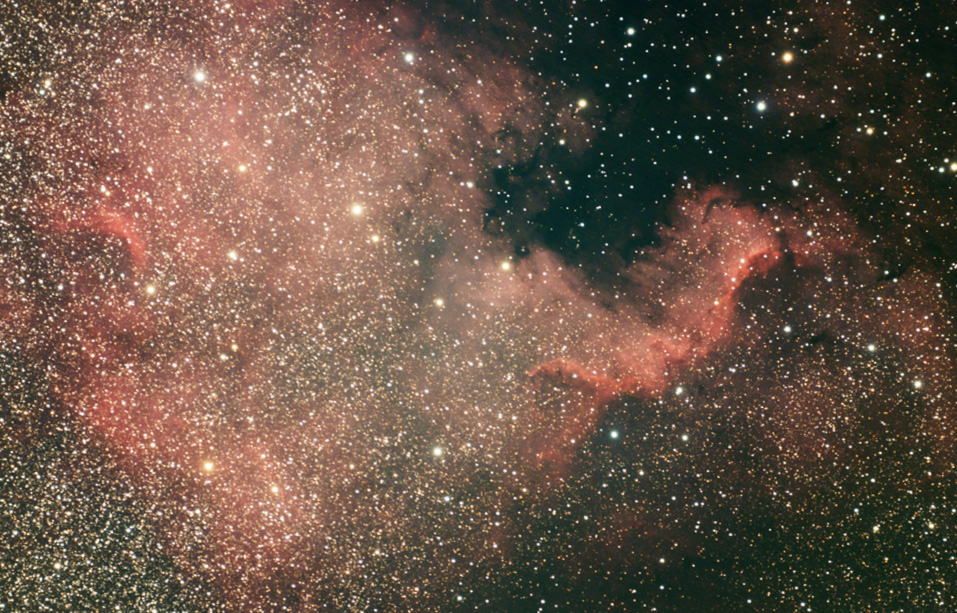
Better view of the North American Nebula taken by Scott Anttila.
This nebula is cataloged as NGC 7000.
09/17/2012 – Ephemeris – Cygnus and the search for exo-planets
Ephemeris for Monday, September 17th. The sun will rise at 7:24. It’ll be up for 12 hours and 24 minutes, setting at 7:48. The moon, 2 days past new, will set at 8:21 this evening.
Nearly overhead at 10 p..m. is the constellation Cygnus the swan. The bright star Deneb is at the tail of this flying swan with its wings outstretched, flying south through the Milky Way. Cygnus is located at a point in the Milky Way in the direction the sun’s orbiting the center of the Milky Way. That is the approximate direction the Kepler spacecraft is staring. Launched in 2009 the Kepler spacecraft has been slowly drifting away from the earth in a trailing orbit of the sun. It is monitoring over 100,000 stars continuously looking for transits of planets across their stars. So far some 2300 suspects have been found. They have to be confirmed by ground based telescopes before being officially cataloged. So far close in planets to their stars have been discovered.
Addendum

Kepler Spacecraft. Credit NASA.
Click image to enlarge.
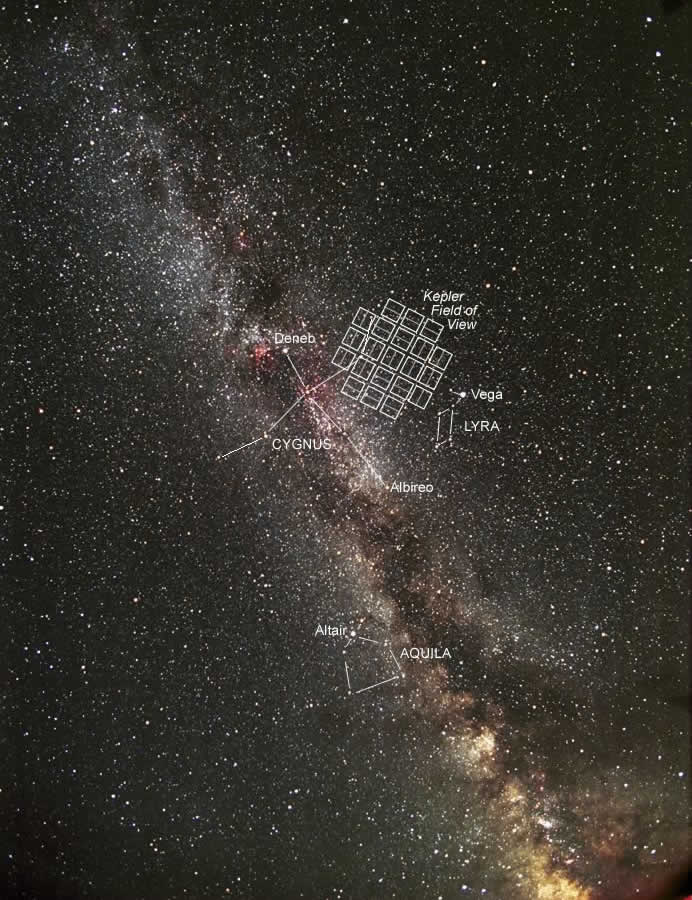
Kepler field of view. Credit C. Roberts, NASA.
Click image to enlarge.
Link to Kepler’s home page: http://kepler.nasa.gov/
07/19/2012 – Ephemeris – The constellation Cygnus the swan
Ephemeris for Thursday, July 19th. Today the sun will be up for 15 hours and 5 minutes, setting at 9:21. The moon is new today, and won’t be visible. | Tomorrow the sun will rise at 6:16.
High in the east northeast as it gets dark flies the constellation of Cygnus the swan. This constellation is also known as the Northern Cross. The cross is seen lying on its side with the bright star Deneb at the head of the cross to the left. The rest of the cross is delineated in the stars to the right. As a swan, Deneb is the tail, the stars of the crosspiece of the cross are the leading edges of wings as Cygnus flies south through the Milky Way. There are faint stars that also define the tips and trailing edges of its wings. It is a very good portrayal of a flying swan, like the mute swans we see on the wing. In Greek mythology this was the disguise of the god Zeus who seduced the young lady Leda and fathered the immortal of the Gemini twins Pollux.
Times are for the Traverse City/Interlochen area of Michigan. They may be different for your location.
Addendum
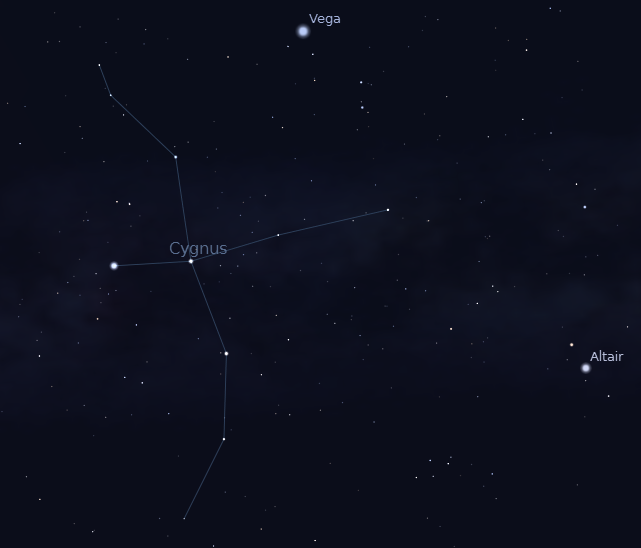
Cygnus and the stars of the Summer Triangle at 11 p.m. on July 19th. Created using Stellarium.
 Bob Moler's Ephemeris Blog