Archive

Posts Tagged ‘Jupiter’

Ephemeris: 06/10/2026 – Where are the naked-eye planets this week?

June 10, 2026 Comments off

This is Ephemeris for Wednesday, June 10th. Today the Sun will be up for 15 hours and 30 minutes, setting at 9:27, and it will rise tomorrow at 5:56. The Moon, 2 days past last quarter, will rise at 3 o’clock tomorrow morning.

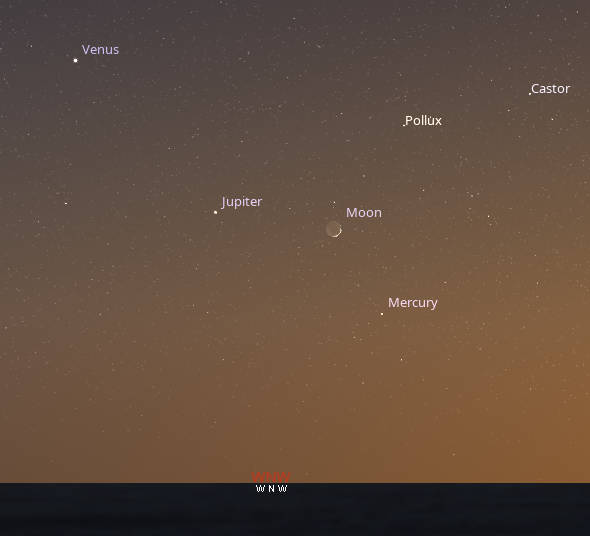
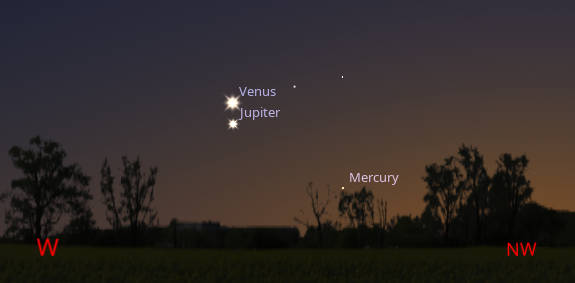
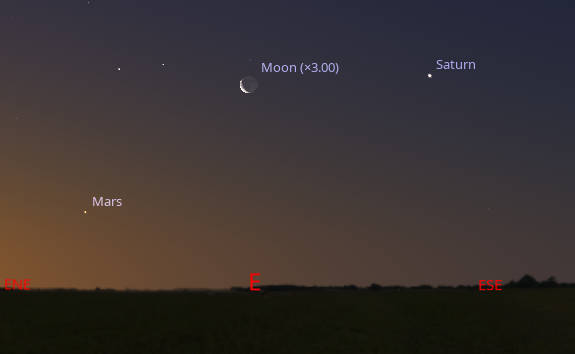
Let’s take our weekly look at the whereabouts of the naked-eye planets. By 10:15 PM tonight, nearly an hour after sunset, Venus and Jupiter may be seen in the western sky, with the brighter Venus above Jupiter. A telescope will show a very tiny disc on Venus, because it is still pretty much beyond the Sun, 111 million miles (179 million kilometers) away from us. Over the next 4 1/2 months it will be moving closer to us and becoming much larger. Mercury is marginally visible below and right of Venus and Jupiter. Jupiter now sets at 11:52 PM, with Venus setting ten minutes later. Saturn will rise into the eastern sky at 3:04 AM, followed by dimmer Mars an hour later.

The astronomical event times given in this blog are for the Traverse City/Interlochen area of Michigan (Lat 44.7° N, Long 85.7° W; EDT, UT – 4 hours) unless stated otherwise. Times will be different for other locations.

Addendum

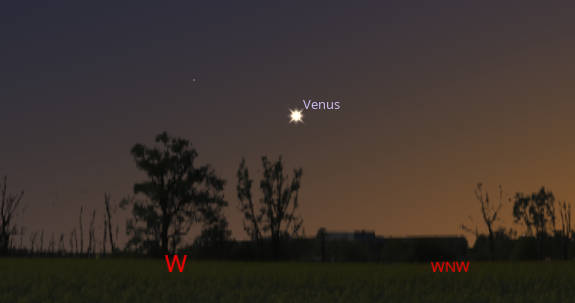
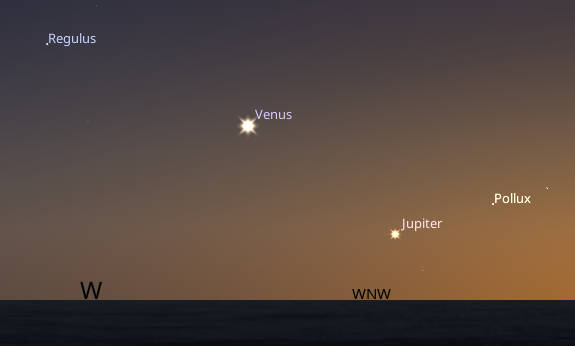
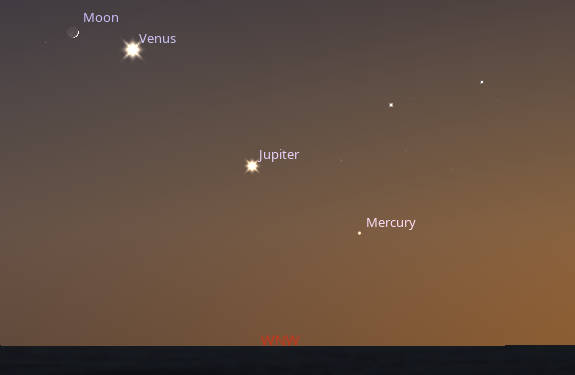
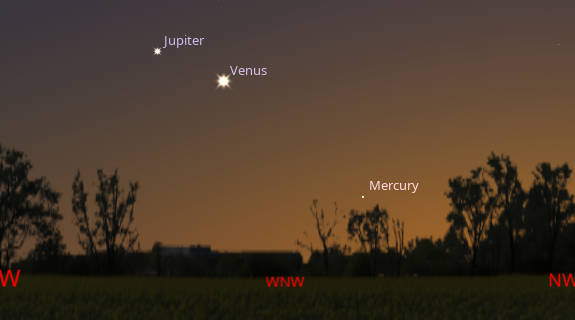
Jupiter, Venus and Mercury appearing in the wester sky's fading twilight, at 10:30 PM tonight, June 10, 2026.
Jupiter, Venus and Mercury at 10:30 PM tonight, June 10, 2026. Jupiter and Venus are now appearing to separate after yesterday’s conjunction. Mercury may be visible now, and is nearing its greatest separation from the sun, and will be at greatest elongation from the sun on the 15th. Created using Stellarium.
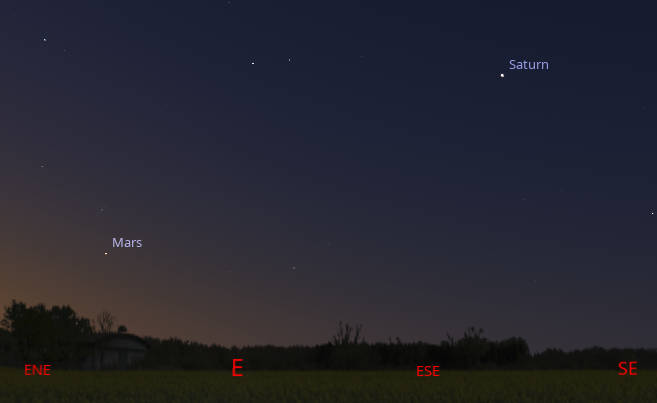
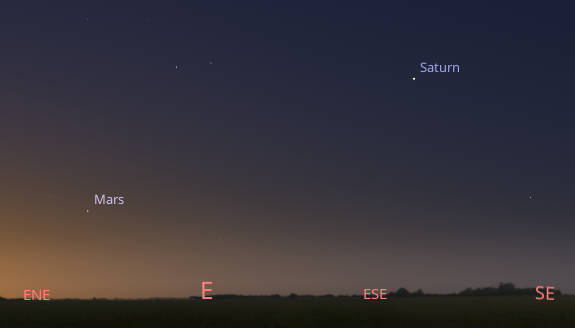
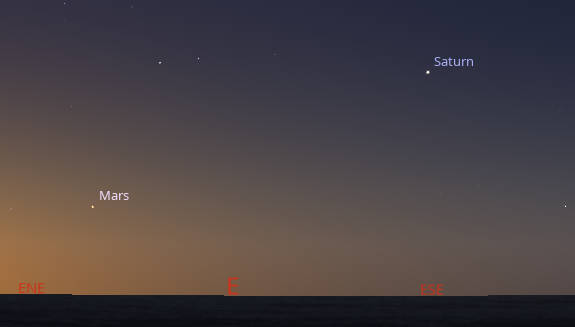
Saturn and Mars appear with the waning crescent moon between them, in the east as morning twilight grows, at 5 AM June 11, 2026.
Saturn and Mars with the waning crescent moon between them at 5 AM June 11, 2026. The moon is enlarged by a factor of 3 to better show its phase. Created using Stellarium.
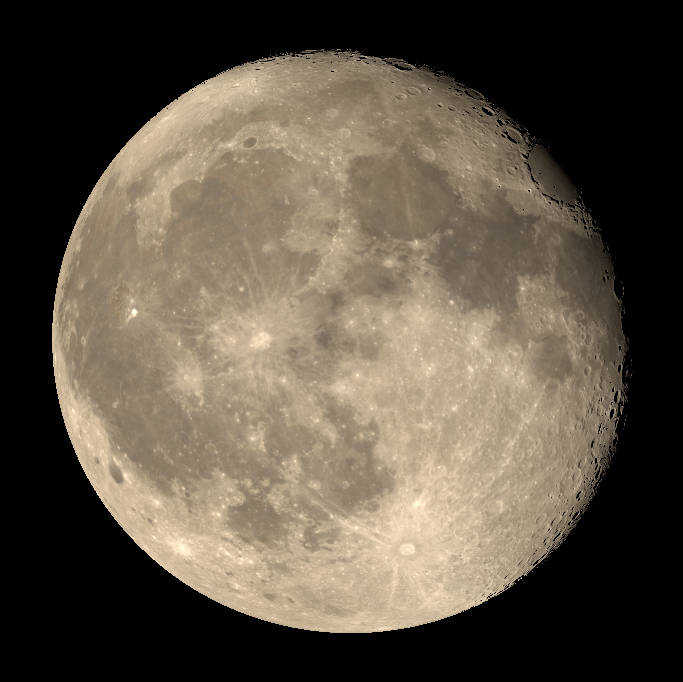
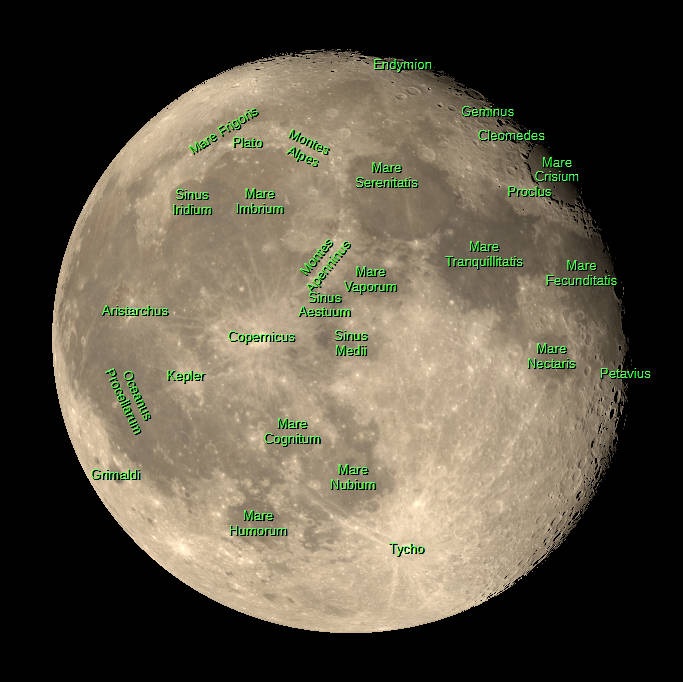
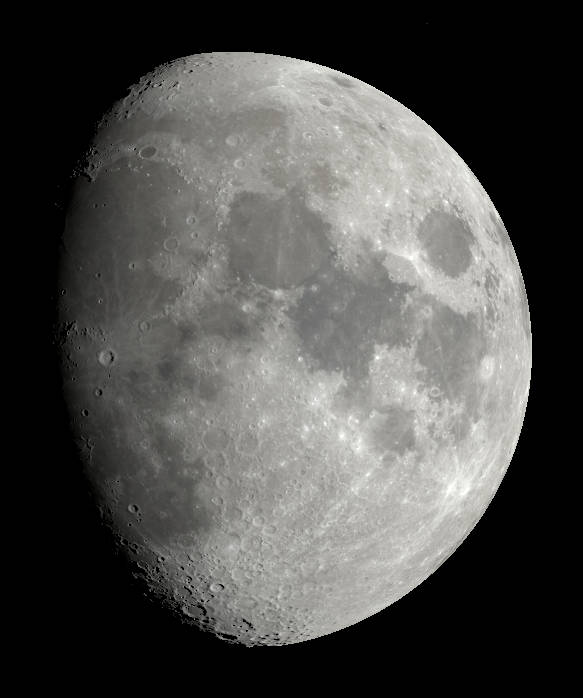
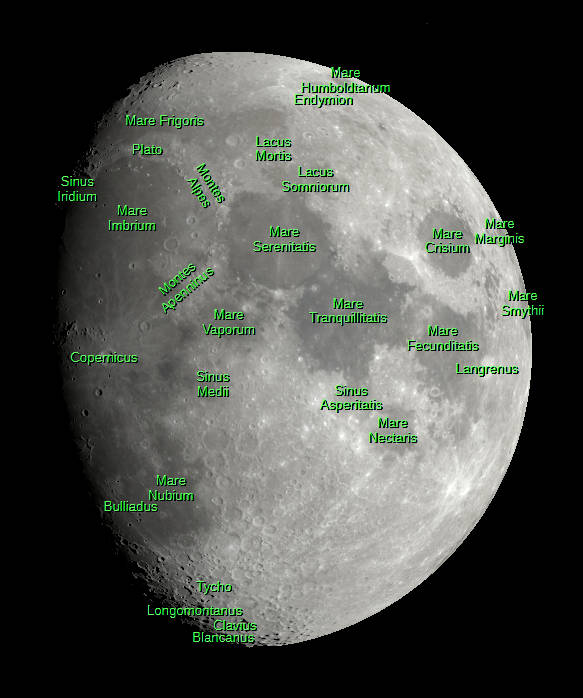
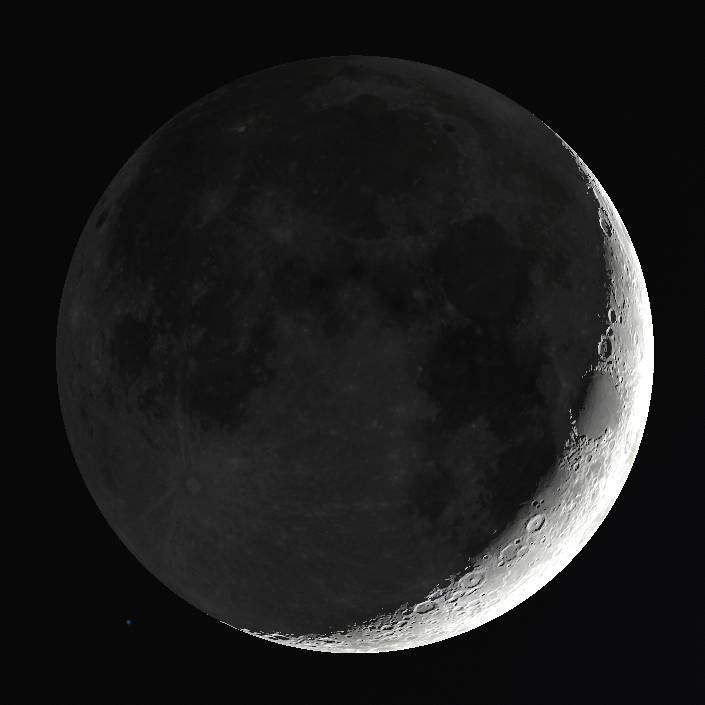
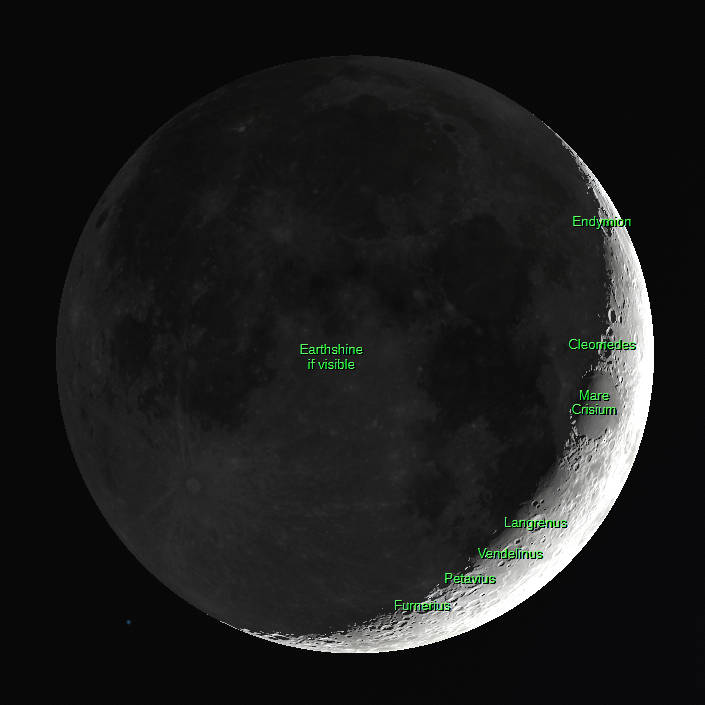
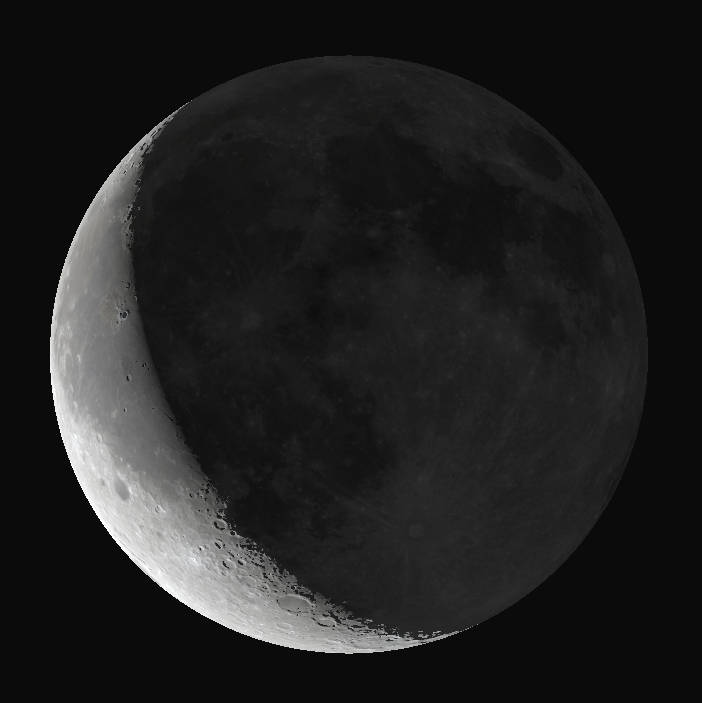
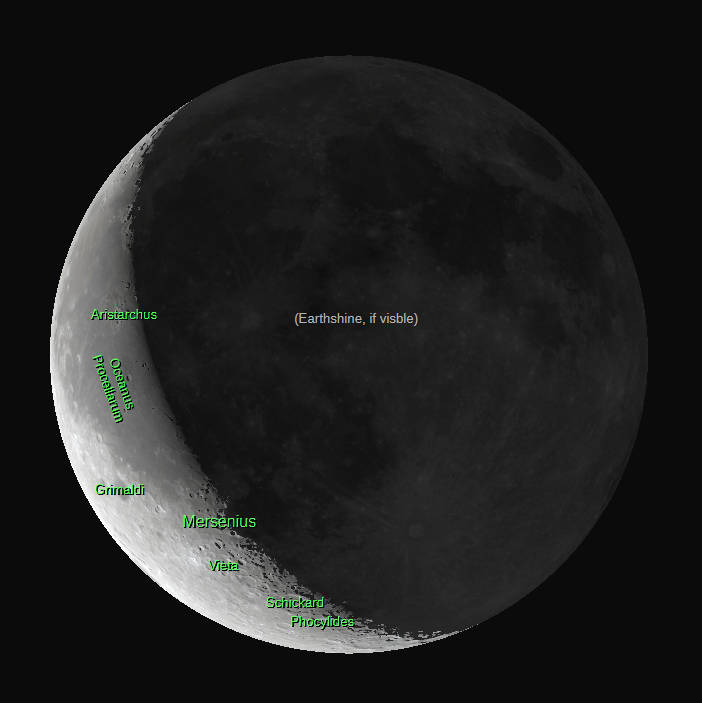
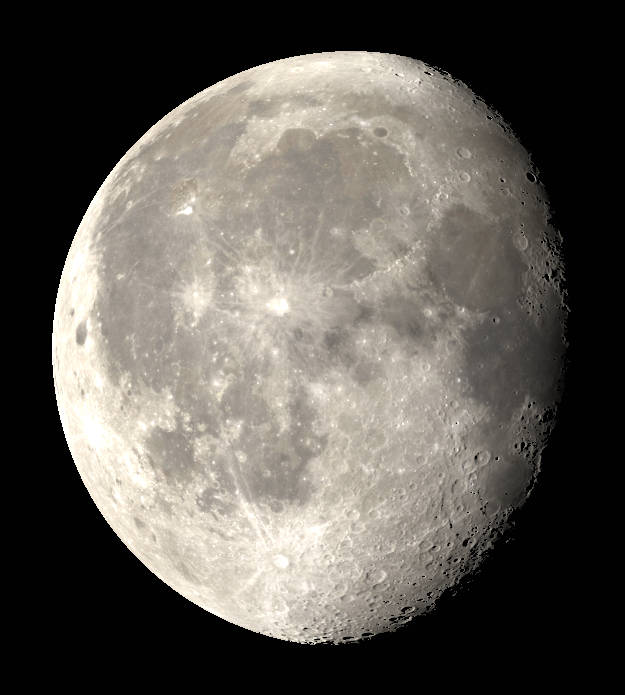
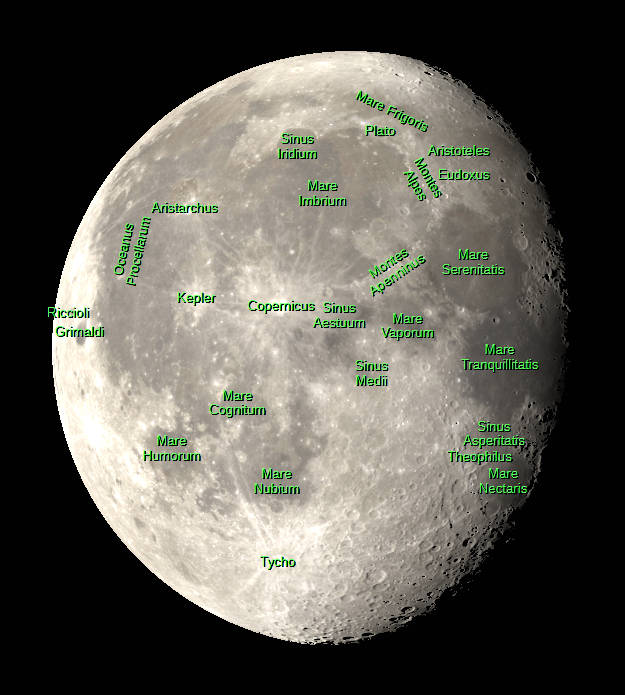
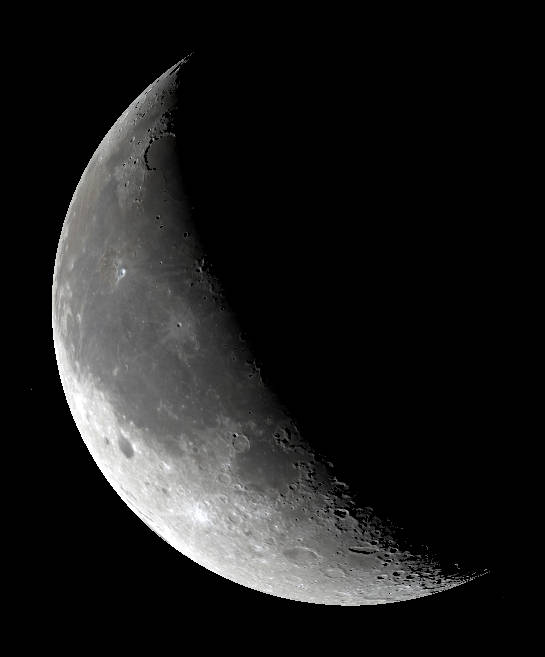
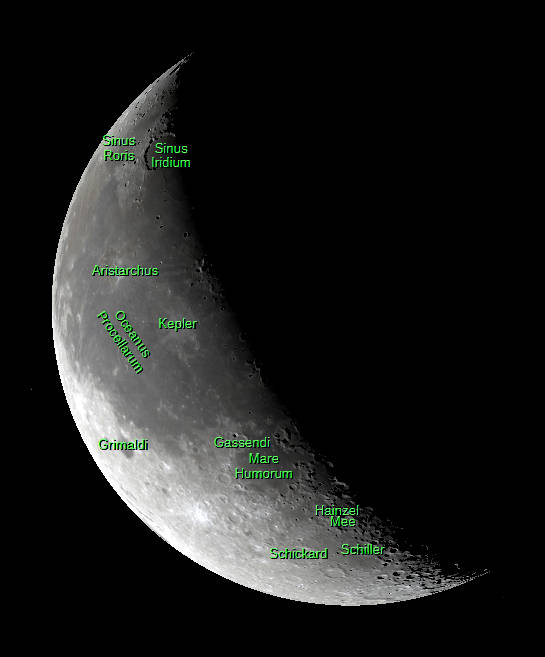
The Moon, 3 days after last quarter, as seen at 5 AM tomorrow morning, June 11, 2026. A view visible in small telescopes showing an image with and without selected features labeled. Created using Stellarium, LibreOffice Draw, and GIMP.
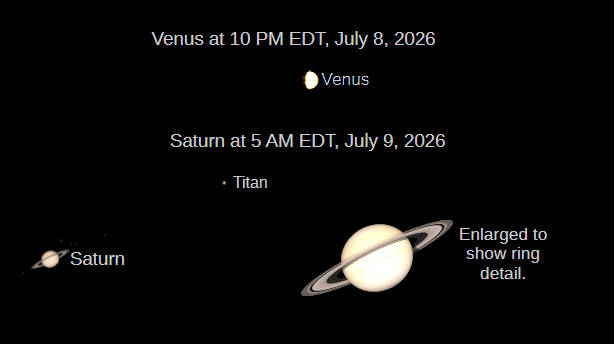
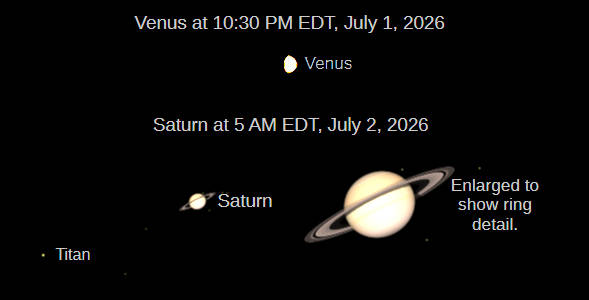
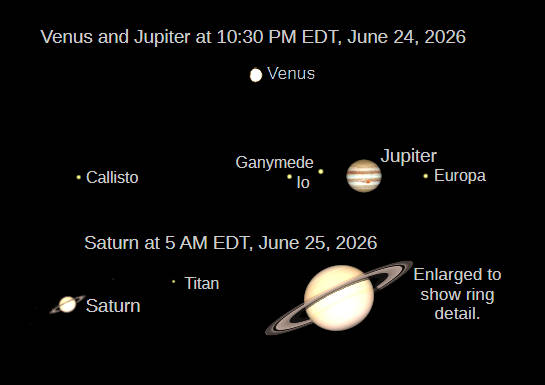
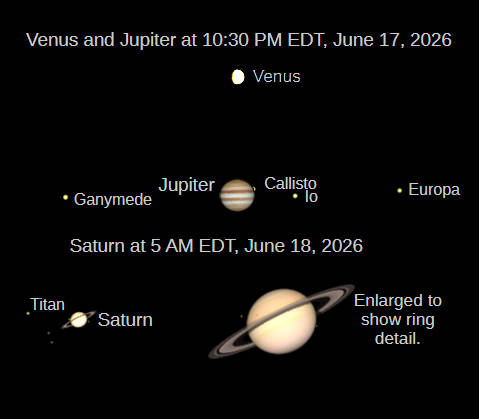
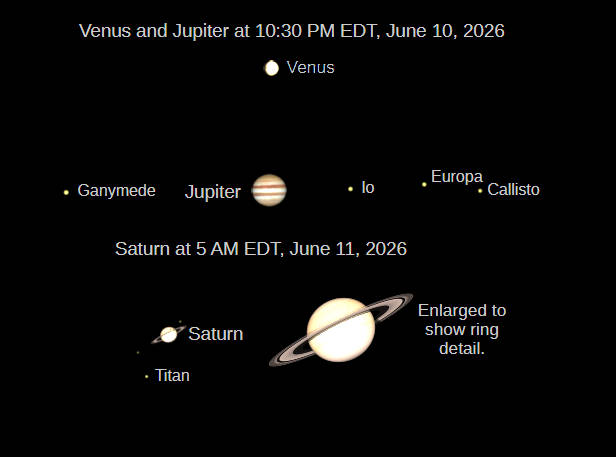
Telescopic Venus and Jupiter at 10:30 PM tonight, June 10, 2026, and Saturn at 5 AM on the 11th.
Telescopic Venus and Jupiter at 10:30 PM tonight, June 10, 2026, and Saturn at 5 AM on the 11th (north up), as they would be seen in a small telescope with the same magnification. Venus’ apparent diameter will be 14.1″, and be 76.3% illuminated. Jupiter will be 32.5″ in diameter, with its moons shown for the time listed. Saturn will be 16.9″ in diameter, and its rings extend to 39.5″ and are tilted 8.7º to our view. Mars, not shown, will appear 4.3″ in diameter. Mercury, also not shown, will appear 7.4″ in diameter and be 47.4% illuminated. The (”) symbol means seconds of arc, or 1/3600th of a degree. Created using Cartes du Ciel (Sky Charts), LibreOffice Draw and GIMP.
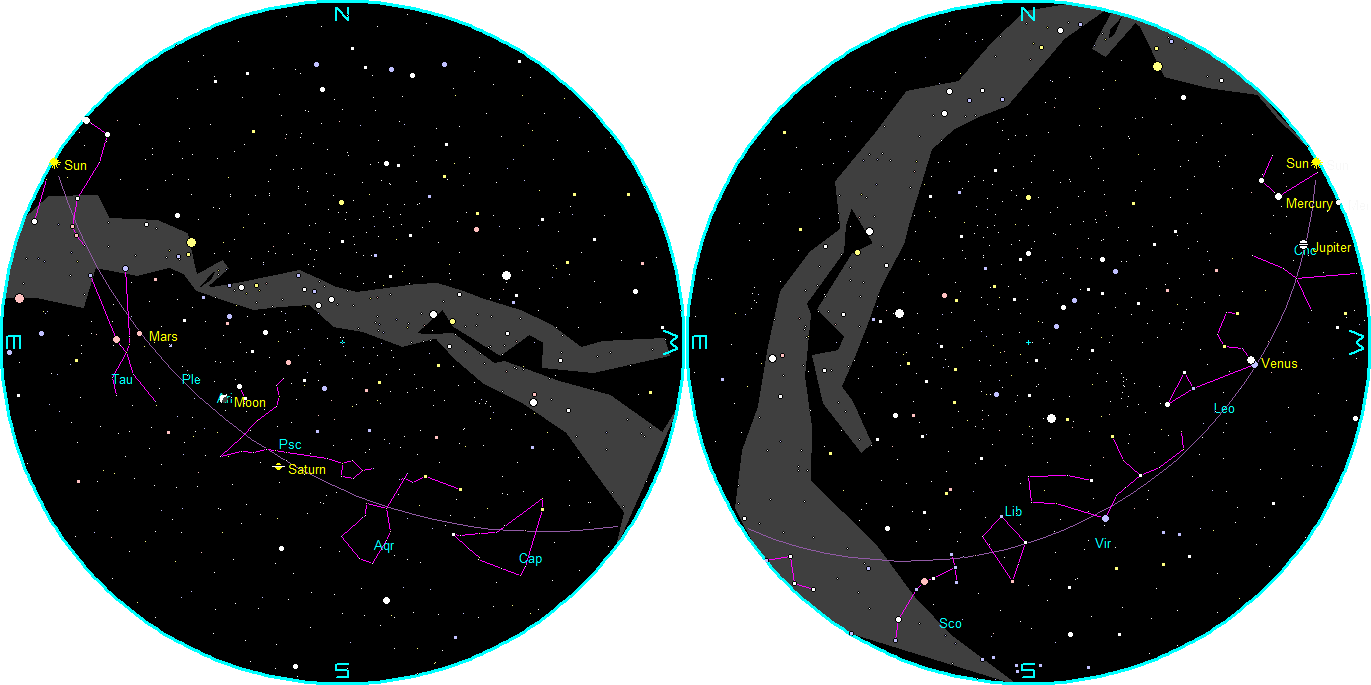
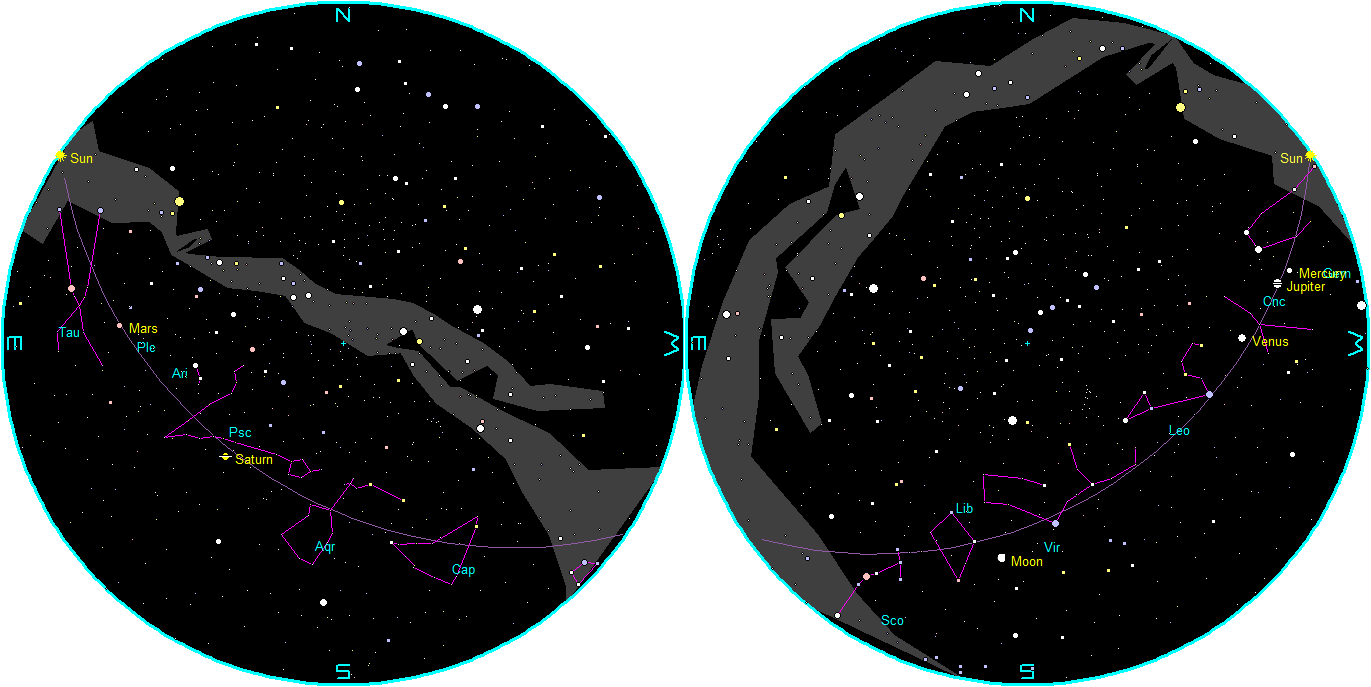
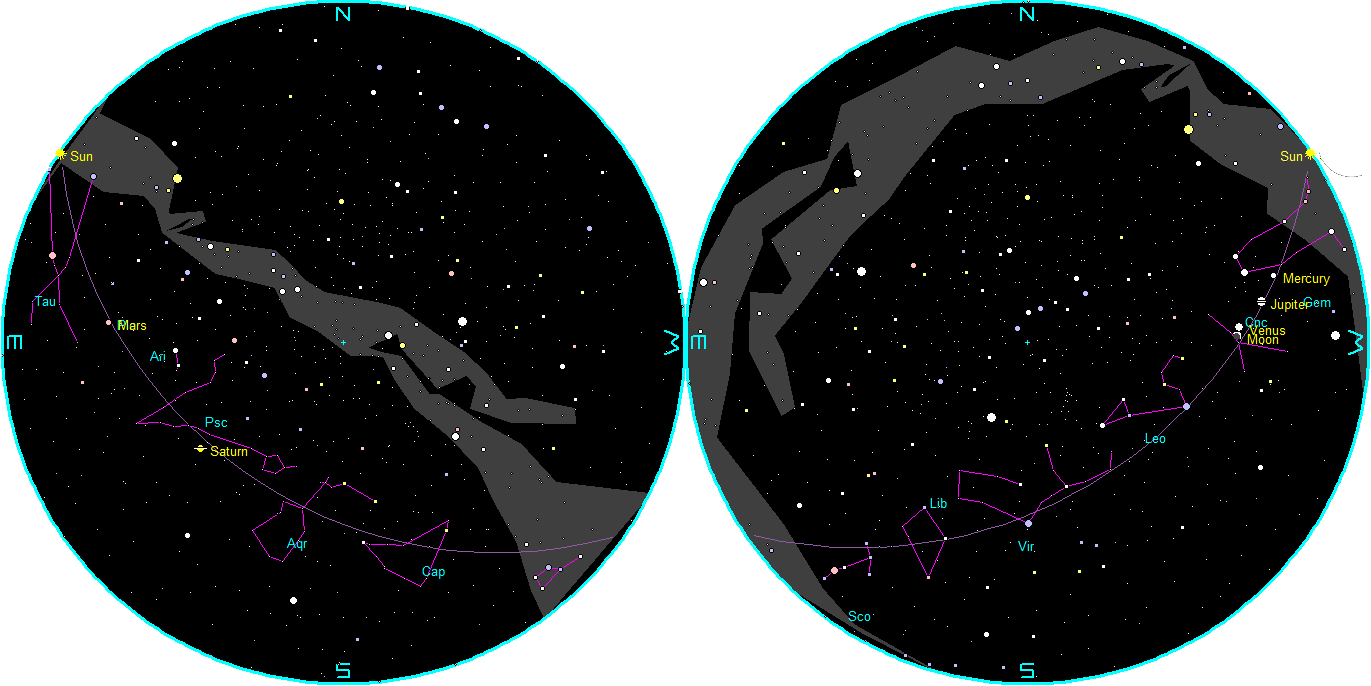
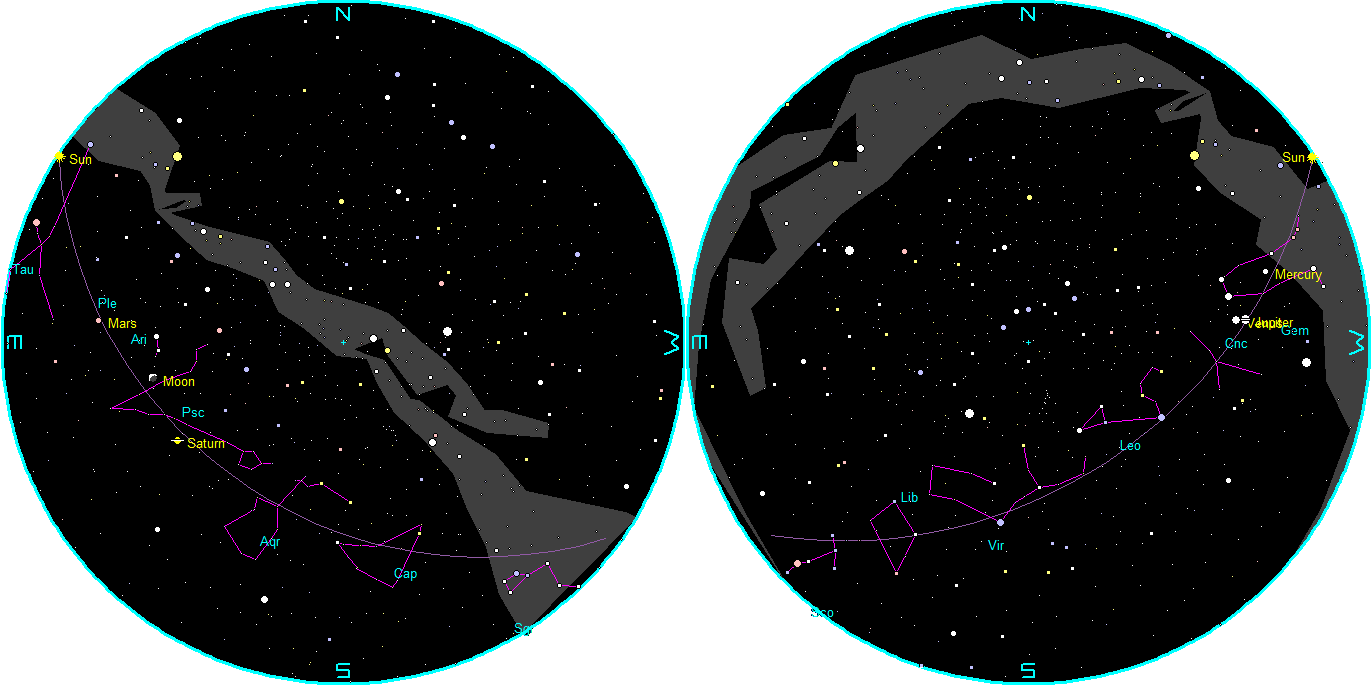
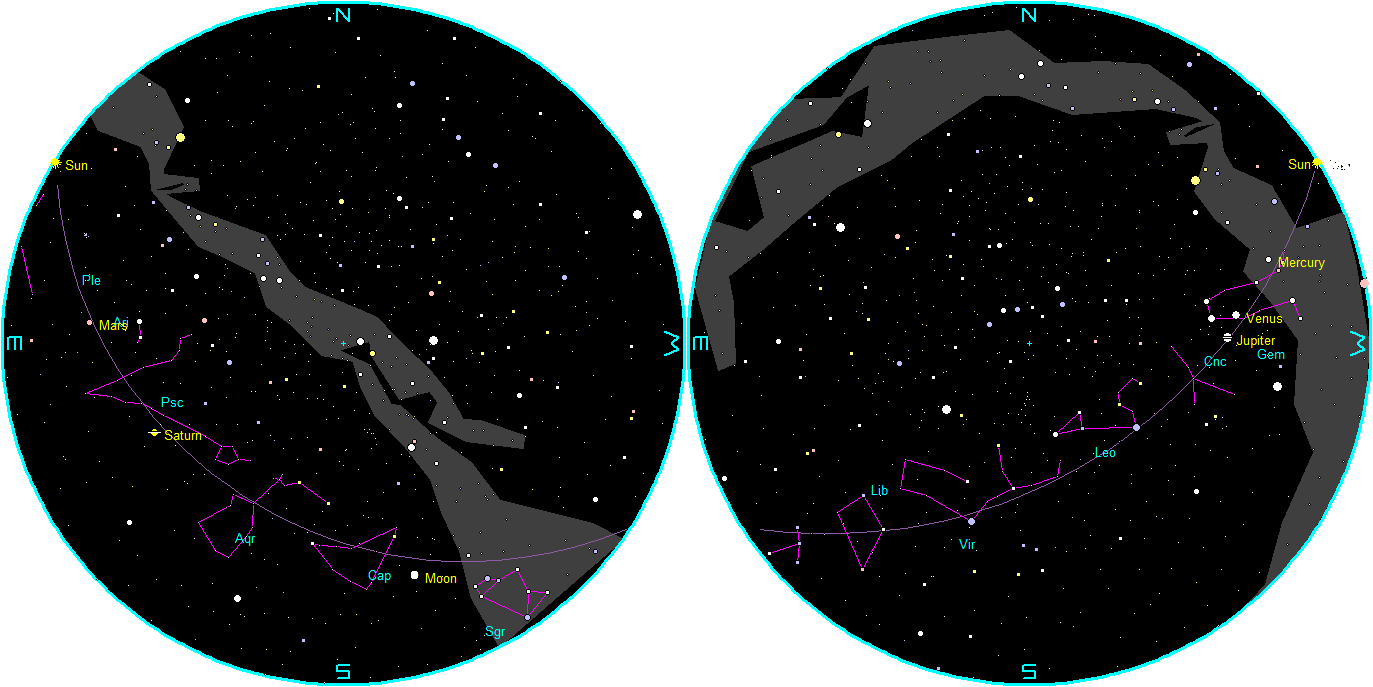
The naked-eye planets at sunset and sunrise on a single night.
The naked-eye planets at sunset and sunrise on a single night, starting with sunset on the right on June 10, 2026. The night ends on the left with sunrise on the 11th. Click or tap on the image to enlarge it. Created using my LookingUp app and GIMP.
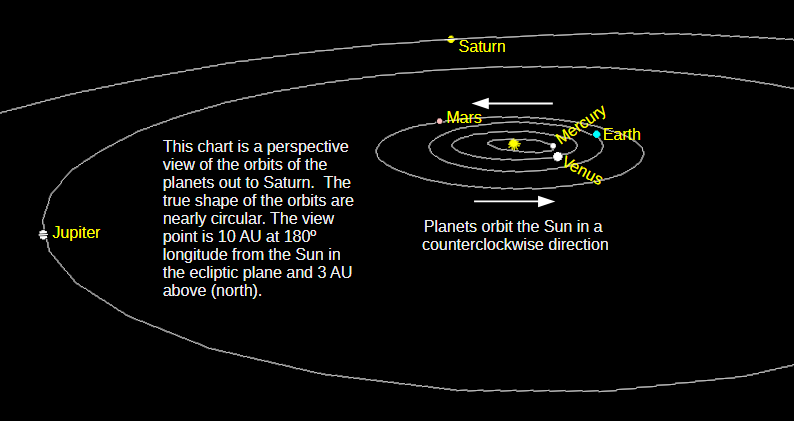
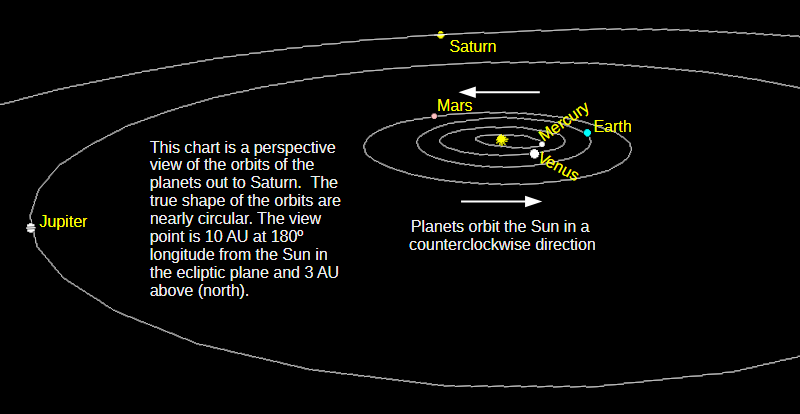
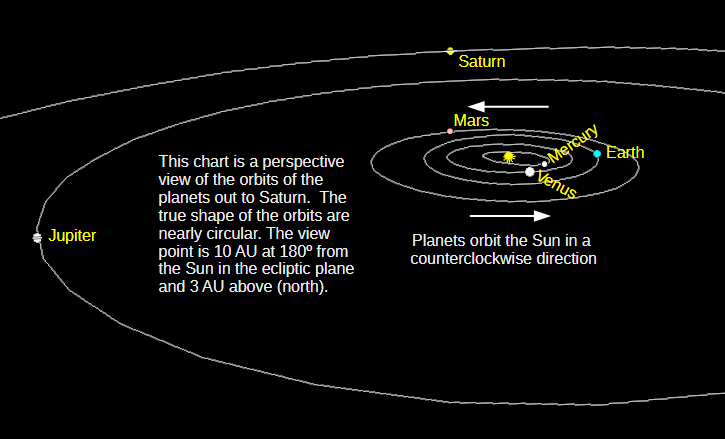
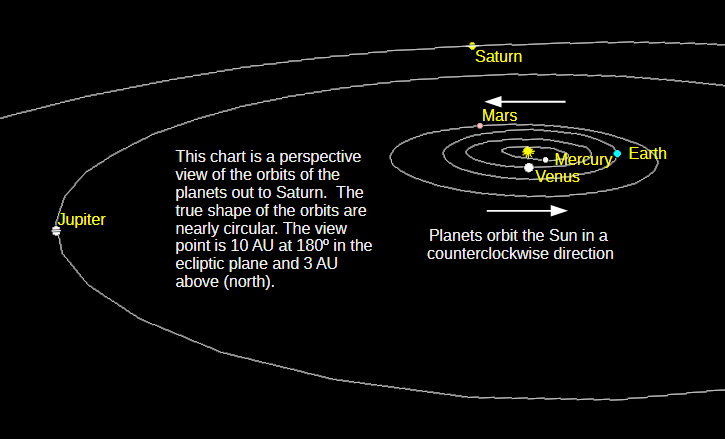
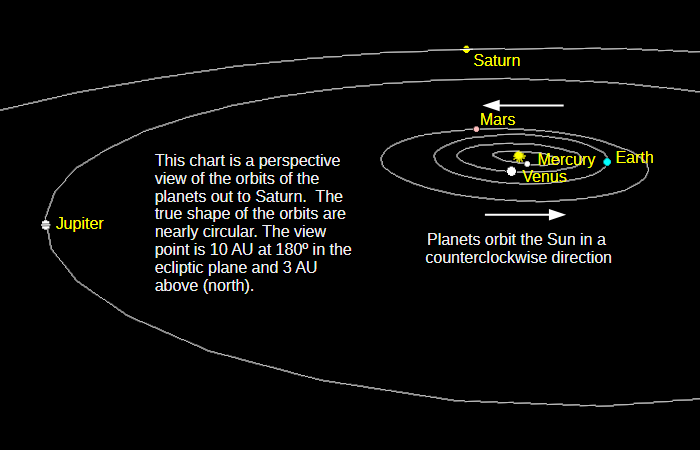
The naked-eye planets, from Mercury to Saturn in a low angle perspective view from above and a bit beyond Saturn's orbit for today, June 10, 2026.
The naked-eye planets, from Mercury to Saturn in a low angle perspective view from above and a bit beyond Saturn’s orbit for today, June 10, 2026. Created using my LookingUp app, text and arrows created using LibreOffice Draw and GIMP.

Ephemeris: 06/09/2026 – Jupiter and Venus meet again

June 9, 2026 Comments off

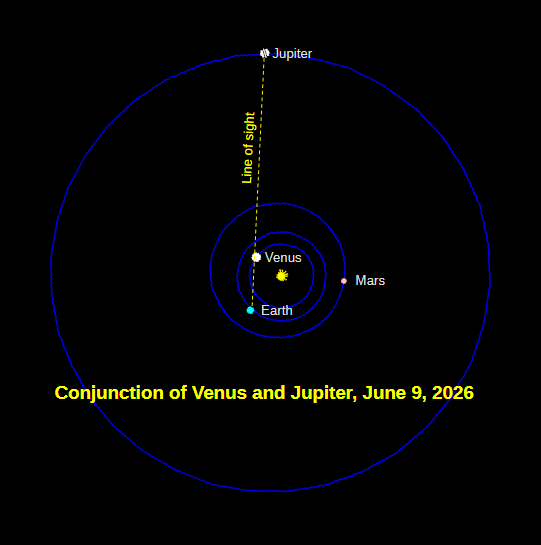
Well, not really.*

This is Ephemeris for Tuesday, June 9th. Today the Sun will be up for 15 hours and 29 minutes, setting at 9:27, and it will rise tomorrow at 5:57. The Moon, 1 day past last quarter, will rise at 2:38 tomorrow morning.

In the last month or so as Jupiter and Venus ended up in the same part of the sky we’ve been seeing that Venus has been approaching Jupiter well today they cross paths with Jupiter just below Venus tonight. Jupiter, which is brighter than any nighttime star, looks rather dim compared to Venus when they’re close together. It is about 1/6 of the brightness of Venus. Venus is much brighter than the larger Jupiter because it is much closer to us and closer to the sun which is illuminating it. Jupiter is five times the earth’s distance from the sun. The sunlight it receives is diluted to only 4% that the earth gets, which is further diminished by the reflected light travelling back to us by about the same distance.

The astronomical event times given in this blog are for the Traverse City/Interlochen area of Michigan (Lat 44.7° N, Long 85.7° W; EDT, UT – 4 hours) unless stated otherwise. Times will be different for other locations.

* See the second image in the addendum.

Addendum

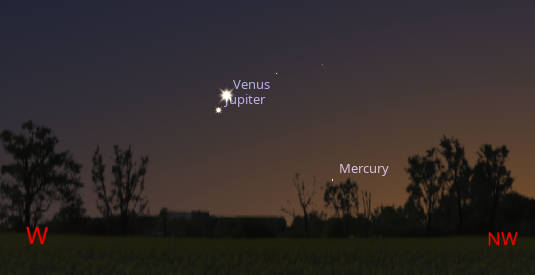
Venus and Jupiter will appear together in the western sky tonight at 10:30 PM, June 9th, 2026. Created using Stellsrium.
A space view of the Venus-Jupiter conjunction, showing a line of sight from the earth past Venus to Jupiter. This is why they appear near each other in the sky, even though Jupiter is far beyond Venus.
A space view of the Venus-Jupiter conjunction, showing a line of sight from the earth past Venus to Jupiter. This is why they appear near each other in the sky, even though Jupiter is far beyond Venus. I’ve omitted Mercury to reduce clutter. Created using my LookingUp app and LibreOffice Draw.

Starting with tomorrow’s posting I will be including a diagram something like this of the naked-eye planets and their positions relative to the Earth.

Ephemeris: 06//08/2026 – Observing Mercury in the evening

June 8, 2026 Comments off

This is Bob Moler with Ephemeris for Monday, June 8th. Today the Sun will be up for 15 hours and 29 minutes, setting at 9:26, and it will rise tomorrow at 5:57. The Moon, at last quarter today, will rise at 2:18 tomorrow morning.

We have a little more than a week to observe Mercury in the western sky after sunset. Mercury’s greatest eastern elongation or separation from the sun will occur on the 15th. It will get as far as a 24° angle from the sun. That separation is tilted a bit less than 45° to the horizon. Mercury’s greatest eastern elongations, occur about 116 days, more or less apart, because Mercury has the most elliptical orbit of any other planet. This is longer than Mercury’s orbital period of 88 days because we’re viewing it from a planet that is also orbiting the sun. Mercury is easier to observe the week before greatest eastern elongation then the week after. Part of the reason is that the phase of Mercury is waning from gibbous to a crescent and getting dimmer.

The astronomical event times given in this blog are for the Traverse City/Interlochen area of Michigan (Lat 44.7° N, Long 85.7° W; EDT, UT – 4 hours) unless stated otherwise. Times will be different for other locations.

Addendum

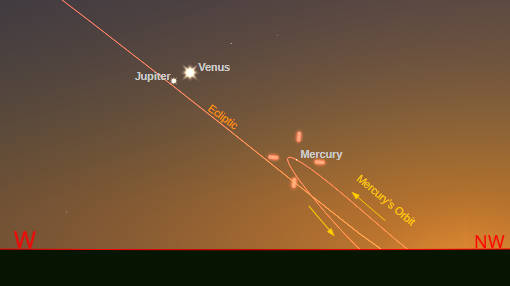
Mercury, nearing eastern elongation (separation from the Sun) June 8, 2026, at 10:15 PM: Mercury, its orbit and Venus and Jupiter nearly at minimum separation (conjunction), which will occur on the afternoon of June 9.
Mercury, nearing eastern elongation (separation from the Sun) June 8, 2026, at 10:15 PM: Mercury, its orbit and Venus and Jupiter nearly at minimum separation (conjunction), which will occur on the afternoon of June 9. Created using Stellarium, LibreOffice Draw and GIMP.

Ephemeris: 06/03/2026 – Where are the naked-eye planets this week?

June 3, 2026 Comments off

This is Ephemeris for Wednesday, June 3rd. Today the Sun will be up for 15 hours and 23 minutes, setting at 9:23, and it will rise tomorrow at 5:58. The Moon, 3 days past full, will rise at 12:29 tomorrow morning.

Let’s take our weekly look at the whereabouts of the naked-eye planets. By 10:15 PM tonight, nearly an hour after sunset, Venus and Jupiter may be seen in the western sky. A telescope will show a very tiny disc on Venus, because it is still pretty much beyond the Sun, 115 million miles (186 million kilometers) away from us. Over the next 4½ months it will be moving closer to us and becoming much larger. Jupiter is to the upper left of Venus, and the second-brightest star-like object in the sky. Venus will set at 12:05 AM, while Jupiter will hold out ten minutes longer. Venus will pass Jupiter on the afternoon of the 9th. Saturn rises into the eastern sky at 3:27 AM, followed by dimmer Mars an hour later.

The astronomical event times given in this blog are for the Traverse City/Interlochen area of Michigan (Lat 44.7° N, Long 85.7° W; EDT, UT – 4 hours) unless stated otherwise. Times will be different for other locations.

Addendum

Jupiter, Venus and Mercury seen in the west at 10:15 PM tonight, June 3, 2026. Jupiter and Venus are appearing to approach each other. They will be in conjunction on the evening of June 8th & 9th. Mercury may not be visible now, but it is increasing its distance from the sun, and will be at greatest elongation or separation from the sun on the 15
Jupiter, Venus and Mercury at 10:15 PM tonight, June 3, 2026. Jupiter and Venus are appearing to approach each other. They will be in conjunction on the evening of June 8th & 9th. Mercury may not be visible now, but it is increasing its distance from the sun, and will be at greatest elongation or separation from the sun on the 15th. Created using Stellarium.
The Moon, 3 days after full, as seen at 5 AM tomorrow morning, June 4, 2026. A view visible in small telescopes showing an image with and without selected features labeled. Created using Stellarium, LibreOffice Draw, and GIMP
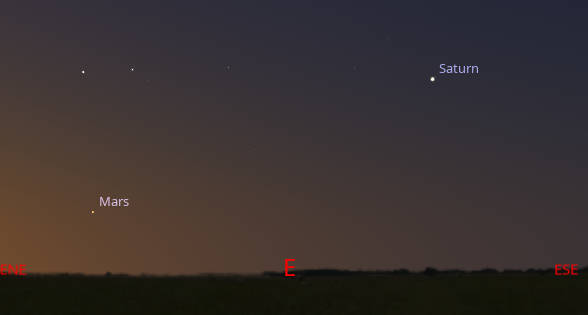
Saturn and Mars will appear low in the east at 5 AM June 4, 2026
Saturn and Mars at 5 AM June 4, 2026. Created using Stellarium.
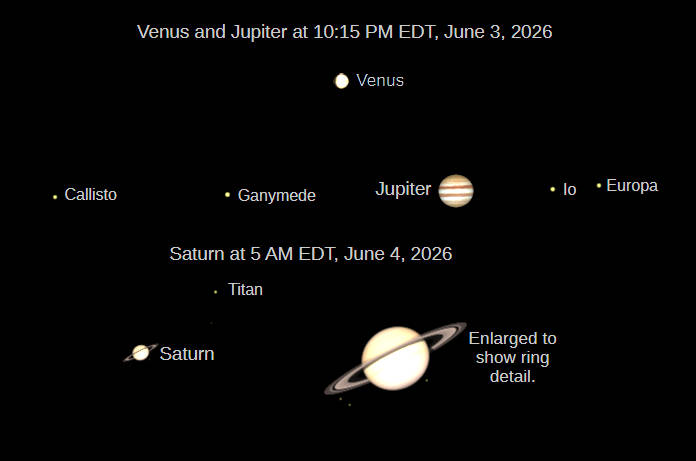
Telescopic Venus and Jupiter at 10:15 PM on the 3rd, and Saturn at 5 AM on the 4th (north up), as they would be seen in a small telescope.
Telescopic Venus and Jupiter at 10:15 PM on the 3rd, and Saturn at 5 AM on the 4th (north up), as they would be seen in a small telescope with the same magnification. Venus’ apparent diameter will be 13.5″, and be 78.6% illuminated. It’s on the far side of the Sun. Jupiter will be 32.9″ in diameter, with its moons shown for the time listed. Saturn will be 16.8″ in diameter, and its rings extend to 39.0″ and are tilted 8.5º to our view. Mars, not shown, will appear 4.3″ in diameter. Mercury, also not shown, will appear 6.2″ in diameter and be 62.2% illuminated. The (”) symbol means seconds of arc, or 1/3600th of a degree. Created using Cartes du Ciel (Sky Charts), LibreOffice Draw and GIMP.
The naked-eye planets at sunset and sunrise on a single night, starting with sunset on the right on June 3, 2026. The night ends on the left with sunrise on the 4th
The naked-eye planets at sunset and sunrise on a single night, starting with sunset on the right on June 3, 2026. The night ends on the left with sunrise on the 4th. Click or tap on the image to enlarge it. Created using my LookingUp app and GIMP.
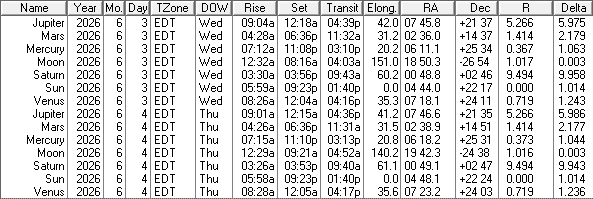
A low precision ephemeris of the Sun Moon and naked eye planet positions for today and tomorrow, June 3rd and 4th, 2026.
This is a low precision ephemeris of the Sun Moon and naked eye planet positions for today and tomorrow, June 3rd and 4th, 2026. Some of the columns are self-explanatory, others are not. The transit column is the time that the body crosses the meridian and is due south. Elong, for elongation, is the angle between the Sun and that body. RA is right ascension, which is the object’s east-west position on the celestial sphere in hours and minutes. Dec is declination which is the north-south position of the object on the celestial sphere in degrees and minutes. R is the distance of that object from the Sun in astronomical units. An astronomical unit is about 93 million miles or 150 million kilometers. And Delta is the distance of that object from the Earth, also in astronomical units. I omit the ‘m’ in am and pm for compactness. The data was generated using my LookingUp for DOS app and displayed as a table by my Ephemeris Helper app.

Ephemeris: 05/27/2026 – Taking our weekly look at the whereabouts of the naked-eye planets

May 27, 2026 Comments off

This is Bob Moler with Ephemeris for Wednesday, May 27th. Today the Sun will be up for 15 hours and 13 minutes, setting at 9:17, and it will rise tomorrow at 6:02. The Moon, halfway from first quarter to full, will set at 4:08 tomorrow morning.

Let’s take our weekly look at the whereabouts of the naked-eye planets. By 10 PM tonight, about 40 minutes after sunset, Venus may be seen in the western sky. A telescope will show a very tiny disc on Venus, because it is still pretty much beyond the Sun, 120 million miles (193 million km) away from us. Over the next 5 months it will be moving closer to us and becoming much larger. Jupiter is the second-brightest star-like object in the western sky seen before 10 PM. It is above and left of Venus tonight. Venus will set at 12:04 AM, while Jupiter will hold out until 12:41 AM. Saturn rises in the east at 3:52 AM, followed by dimmer Mars at 4:42 AM.

The astronomical event times given in this blog are for the Traverse City/Interlochen area of Michigan (Lat 44.7° N, Long 85.7° W; EDT, UT – 4 hours) unless stated otherwise. Times will be different for other locations.

Addendum

Jupiter and Venus in the western sky, at 10 PM tonight, May 27, 2026. Jupiter and Venus are appearing to approach each other. They will be in conjunction on the evening of June 8th.
Jupiter and Venus at 10 PM tonight, May 27, 2026. Jupiter and Venus are appearing to approach each other. They will be in conjunction on the evening of June 8th. Created using Stellarium.
The Moon, 4 days after first quarter, as seen at 10 PM tonight, May 27, 2026. A view visible in small telescopes showing an image with and without selected features labeled. Created using Stellarium, LibreOffice Draw, and GIMP
Saturn and Mars seen low in the east at 5 AM May 28, 2026.
Saturn and Mars at 5 AM May 28, 2026. Created using Stellarium.
Telescopic Venus and Jupiter at 10 PM on the 27th, and Saturn at 5 AM on the 28th.
Telescopic Venus and Jupiter at 10 PM on the 27th, and Saturn at 5 AM on the 28th (north up), as they would be seen in a small telescope with the same magnification. Venus’ apparent diameter will be 13.0″, and be 80.7% illuminated. It’s on the far side of the Sun. Jupiter will be 33.4″ in diameter, with its moons shown for the time listed. Saturn will be 17.0″ in diameter, and its rings extend to 38.7″ and are tilted 8.2º to our view. Mars will appear 4.3″ in diameter. The (”) symbol means seconds of arc, or 1/3600th of a degree. Created using Cartes du Ciel (Sky Charts), LibreOffice Draw and GIMP.
The naked-eye planets at sunset and sunrise on a single night, starting with sunset on the right on May 27, 2026. The night ends on the left with sunrise on the 28th.
The naked-eye planets at sunset and sunrise on a single night, starting with sunset on the right on May 27, 2026. The night ends on the left with sunrise on the 28th. Click or tap on the image to enlarge it. Created using my LookingUp app and GIMP.
A low precision ephemeris of the Sun Moon and naked eye planet positions for today and tomorrow, May 27 and 28th, 2026
This is a low precision ephemeris of the Sun Moon and naked eye planet positions for today and tomorrow, May 27 and 28th, 2026. Some of the columns are self-explanatory, others are not. The transit column is the time that the body crosses the meridian and is due south. Elong, for elongation, is the angle between the Sun and that body. RA is right ascension, which is the object’s east-west position on the celestial sphere in hours and minutes. Dec is declination which is the north-south position of the object on the celestial sphere in degrees and minutes. R is the distance of that object from the Sun in astronomical units. An astronomical unit is about 93 million miles or 150 million kilometers. And Delta is the distance of that object from the Earth, also in astronomical units. I omit the ‘m’ in am and pm for compactness. The data was generated using my LookingUp for DOS app and displayed as a table by my Ephemeris Helper app.

Ephemeris: 05/20/2026 – Taking our weekly look at the whereabouts of the naked-eye planets

May 20, 2026 Comments off

This is Ephemeris for Wednesday, May 20th. Today the Sun will be up for 15 hours exactly, setting at 9:09, and it will rise tomorrow at 6:08. The Moon, 3 days before first quarter, will set at 1:41 tomorrow morning.

Let’s take our weekly look at the whereabouts of the naked-eye planets. By 9:30 PM tonight, about 20 minutes after sunset, Venus may be seen in the western sky. A telescope will show a very tiny disc on Venus, because it is still pretty much beyond the Sun, 124 million miles (199 million kilometers) away from us. Over the next 5 months it will be moving closer to us and becoming much larger. Jupiter is the second-brightest star-like object in the western sky seen before 10 PM. It is below and right of the Moon tonight. Venus will set at 11:53 PM, while Jupiter will hold out until 1:01 AM. Saturn may be first glimpsed just after it rises in the east at 4:18 AM, before morning twilight overwhelms it later on.

The astronomical event times given in this blog are for the Traverse City/Interlochen area of Michigan (Lat 44.7° N, Long 85.7° W; EDT, UT – 4 hours) unless stated otherwise. Times will be different for other locations.

Addendum

Jupiter, Venus and the Moon itself at twice actual size at 10 PM tonight, May 20, 2026. Jupiter and Venus are appearing to approach each other. They will be in conjunction on the evening of June 8th.
Jupiter, Venus and the Moon, itself at twice actual size, at 10 PM tonight, May 20, 2026. Jupiter and Venus are appearing to approach each other. They will be in conjunction on the evening of June 8th. Created using Stellarium.
The Moon, 4 days after new, as seen at 10 PM tonight, May 20, 2026. A view visible in small telescopes showing an image with and without selected features labeled. Created using Stellarium, LibreOffice Draw, and GIMP.
Saturn and Mars low in the east at 5:15 AM May 21, 2026. Mars may not actually be visible, being too low and faint.
Saturn and Mars at 5:15 AM May 21, 2026. Mars may not actually be visible, being too low and faint. Created using Stellarium.
Telescopic Venus and Jupiter at 10 PM on the 20th, and Saturn at 5:15 AM on the 21st (north up), as they would be seen in a small telescope with the same magnification.
Telescopic Venus and Jupiter at 10 PM on the 20th, and Saturn at 5:15 AM on the 21st (north up), as they would be seen in a small telescope with the same magnification. Venus’ apparent diameter will be 13.0″, and be 82.8% illuminated. It’s on the far side of the Sun. Jupiter will be 33.9″ in diameter, with its moons shown for the time listed. Saturn will be 16.4″ in diameter, and its rings extend to 38.3″ and are tilted 8º to our view. Mars will appear 4.2″ in diameter. The (”) symbol means seconds of arc, or 1/3600th of a degree. Created using Cartes du Ciel (Sky Charts), LibreOffice Draw and GIMP.
The naked-eye planets at sunset and sunrise on a single night, starting with sunset on the right on May 20, 2026. The night ends on the left with sunrise on the 21st.
The naked-eye planets at sunset and sunrise on a single night, starting with sunset on the right on May 20, 2026. The night ends on the left with sunrise on the 21st. Click or tap on the image to enlarge it. Created using my LookingUp app and GIMP.
A low precision ephemeris of the Sun Moon and naked eye planet positions for today and tomorrow.
This is a low precision ephemeris of the Sun Moon and naked eye planet positions for today and tomorrow, May 20 and 21st, 2026. Some of the columns are self-explanatory, others are not. The transit column is the time that the body crosses the meridian and is due south. Elong, for elongation, is the angle between the Sun and that body. RA is right ascension, which is the object’s east-west position on the celestial sphere in hours and minutes. Dec is declination which is the north-south position of the object on the celestial sphere in degrees and minutes. R is the distance of that object from the Sun in astronomical units. An astronomical unit is about 93 million miles or 150 million kilometers. And Delta is the distance of that object from the Earth, also in astronomical units. I omit the ‘m’ in am and pm for compactness. The data was generated using my LookingUp for DOS app and displayed as a table by my Ephemeris Helper app.

Ephemeris: 05/13/2026 – Where are the naked-eye planets this week?

May 13, 2026 Comments off

This is Ephemeris for Wednesday, May 13th. Today the Sun will be up for 14 hours and 45 minutes, setting at 9:02, and it will rise tomorrow at 6:15. The Moon, 3 days before new, will rise at 4:37 tomorrow morning.

Let’s take our weekly look at the whereabouts of the naked-eye planets. By 9:30 PM tonight, about a half hour after sunset, Venus may be seen in the western sky. A telescope will show a very tiny disc on Venus, because it is still pretty much beyond the Sun, 128 million miles (205 million kilometers) away from us. Over the next 5 months it will be moving closer to us and becoming much larger. Jupiter is the second-brightest star-like object in the western sky seen before 10 PM. It is above and left of the brighter Venus. Venus will set at 11:38 PM, while Jupiter will hold out until 1:21 AM. Saturn may be glimpsed just after it rises in the east at 4:48 AM, before morning twilight overwhelms it sometime later.

The astronomical event times given in this blog are for the Traverse City/Interlochen area of Michigan (Lat 44.7° N, Long 85.7° W; EDT, UT – 4 hours) unless stated otherwise. Times will be different for other locations.

Addendum
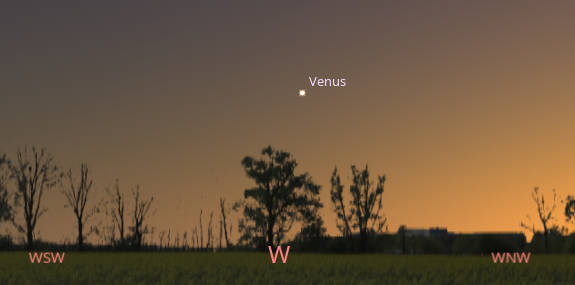
Jupiter, and Venus with a few remaining winter stars at 10 PM tonight, May 13, 2026. The planets are appearing to approach each other. They will be in conjunction on the evening of June 8th.
Jupiter, and Venus with a few remaining winter stars at 10 PM tonight, May 13, 2026. The planets are appearing to approach each other. They will be in conjunction on the evening of June 8th. Created using Stellarium.
The waning crescent Moon and Saturn at 5:15 AM May 14, 2026
The waning crescent Moon and Saturn at 5:15 AM May 14, 2026. Created using Stellarium.
A binocular or low power view of the waning creacent Moon showing the expected earthshine on its night side.
A binocular or low power view of the waning creacent Moon showing the expected earthshine on its night side. Created using Stellarium and GIMP.
Telescopic Venus, Jupiter and Saturn (north up) as they would be seen in a small telescope with the same magnification.
Telescopic Venus, Jupiter and Saturn (north up) as they would be seen in a small telescope with the same magnification, at the times indicated. Venus’ apparent diameter will be 12.2″, and be 84.7% illuminated. It’s on the far side of the Sun. Jupiter will be 34.4″ in diameter, with its moons shown for the time listed. The (”) symbol means seconds of arc, or 1/3600th of a degree. Created using Cartes du Ciel (Sky Charts), LibreOffice Draw and GIMP.
The naked-eye planets at sunset and sunrise on a single night, starting with sunset on the right on May 13, 2026. The night ends on the left with sunrise on the 14th.
The naked-eye planets at sunset and sunrise on a single night, starting with sunset on the right on May 13, 2026. The night ends on the left with sunrise on the 14th. Click or tap on the image to enlarge it. Created using my LookingUp app and GIMP.
A low precision ephemeris of the Sun Moon and naked eye planet positions for today and tomorrow, May 13 and 14th, 2026.
This is a low precision ephemeris of the Sun Moon and naked eye planet positions for today and tomorrow, May 13 and 14th, 2026. Some of the columns are self-explanatory, others are not. The transit column is the time that the body crosses the meridian and is due south. Elong, for elongation, is the angle between the Sun and that body. RA is right ascension, which is the object’s east-west position on the celestial sphere in hours and minutes. Dec is declination which is the north-south position of the object on the celestial sphere in degrees and minutes. R is the distance of that object from the Sun in astronomical units. An astronomical unit is about 93 million miles or 150 million kilometers. And Delta is the distance of that object from the Earth, also in astronomical units. I omit the ‘m’ in am and pm for compactness. The data was generated using my LookingUp for DOS app and displayed as a table by my Ephemeris Helper app.

Ephemeris: 05/06/2026 – Taking our weekly look at the whereabouts of the naked-eye planets

May 6, 2026 Comments off

This is Ephemeris for Wednesday, May 6th. Today the Sun will be up for 14 hours and 28 minutes, setting at 8:53, and it will rise tomorrow at 6:24. The Moon, 3 days before last quarter, will rise at 1:55 tomorrow morning.

Let’s take our weekly look at the whereabouts of the naked-eye planets. By 9:30 PM tonight or about 35 minutes or so after sunset, Venus may be seen very low in the West. A telescope will show a very tiny disc on Venus, because it is still pretty much beyond the Sun, 131 million miles (211 million kilometers) away from us. Over the next 5½ months it will be moving closer to us and becoming much larger. Jupiter is the brilliant star-like object in the western before 10 PM. It is above and left of the brighter Venus. Venus will set at 11:26 PM, while Jupiter will hold out until 1:40 AM. Saturn may be glimpsed starting about next Monday just after it rises in the east around 5:15 AM, and before morning twilight overwhelms it sometime later.

The astronomical event times given in this blog are for the Traverse City/Interlochen area of Michigan (Lat 44.7° N, Long 85.7° W; EDT, UT – 4 hours) unless stated otherwise. Times will be different for other locations.

Addendum
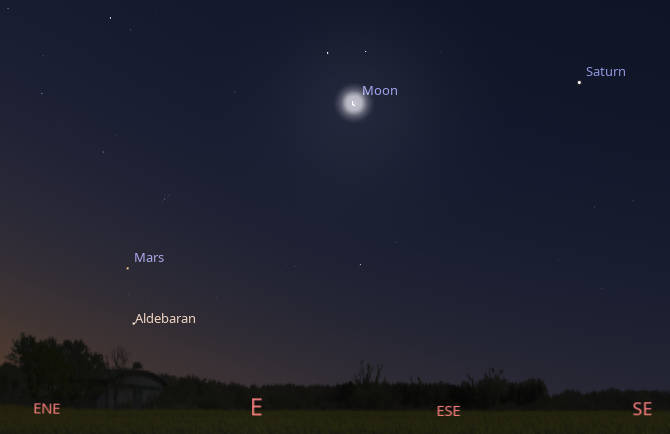
Jupiter, and Venus with fading winter stars at 10 PM tonight, May 6, 2026.
Jupiter, and Venus with fading winter stars at 10 PM tonight, May 6, 2026. Jupiter and Venus are appearing to approach each other. They will be in conjunction on the evening of June 8th. Created using Stellarium.
The Moon, 2 days before last quarter, as seen at 5 AM tomorrow morning, May 7, 2026. A view visible in small telescopes showing an image with and without selected features labeled. Created using Stellarium, LibreOffice Draw, and GIMP.
Telescopic Jupiter and Venus (north up) as they would be seen in a small telescope with the same magnification.
Telescopic Jupiter and Venus (north up) as they would be seen in a small telescope with the same magnification. Venus will be visible for a short time near the western horizon, while Jupiter will be visible until after midnight. Venus’ apparent diameter will be 11.9″, and be 86.5% illuminated. It’s on the far side of the Sun. Jupiter will be 35.0″ in diameter, with its moons shown here for 10 PM, tonight May 6, 2026. Callisto will begin to transit the face of Jupiter at 10:31 PM.. Europa will pass behind the planet (an occultation) beginning at 11:36 PM. The moons can shift noticably over an hour, especially Io and Europa. The (”) symbol means seconds of arc, or 1/3600th of a degree. Created using Cartes du Ciel (Sky Charts), LibreOffice Draw and GIMP.
The naked-eye planets at sunset and sunrise on a single night.
The naked-eye planets at sunset and sunrise on a single night, starting with sunset on the right on May 6, 2026. The night ends on the left with sunrise on the 7th. Click or tap on the image to enlarge it. Created using my LookingUp app and GIMP.
A low precision ephemeris of the Sun Moon and naked eye planet positions for today and tomorrow, May 6 and 7th, 2026.
This is a low precision ephemeris of the Sun Moon and naked eye planet positions for today and tomorrow, May 6 and 7th, 2026. Some of the columns are self-explanatory, others are not. The transit column is the time that the body crosses the meridian and is due south. Elong, for elongation, is the angle between the Sun and that body. RA is right ascension, which is the object’s east-west position on the celestial sphere in hours and minutes. Dec is declination which is the north-south position of the object on the celestial sphere in degrees and minutes. R is the distance of that object from the Sun in astronomical units. An astronomical unit is about 93 million miles or 150 million kilometers. And Delta is the distance of that object from the Earth, also in astronomical units. I omit the ‘m’ in am and pm for compactness. The data was generated using my LookingUp for DOS app and displayed as a table by my Ephemeris Helper app.

Ephemeris: 04/29/2026 – Taking our weekly look at the whereabouts of the naked-eye planets

April 29, 2026 Comments off

This is Ephemeris for Wednesday, April 29th. Today the Sun will be up for 14 hours and 9 minutes, setting at 8:45, and it will rise tomorrow at 6:34. The Moon, 2 days before full, will set at 5:42 tomorrow morning.

Let’s take our weekly look at the whereabouts of the naked-eye planets. By 9:30 PM tonight or about 45 minutes or so after sunset, Venus may be seen very low in the West. A telescope will show a very tiny disc on Venus, because it is still pretty much beyond the Sun, 136 million miles (217 million kilometers) away from us. Over the next 6 months it will be moving closer to us and becoming much larger. Jupiter is the brilliant star-like object in the western before 10 PM. It is above and left of the brighter Venus. Venus will set at 11:11 PM, while Jupiter will hold out until 2:12 AM. Meanwhile, Mercury, Mars and Saturn are breaking up just west of the Sun, but are still overwhelmed by bright morning twilight.

The astronomical event times given in this blog are for the Traverse City/Interlochen area of Michigan (Lat 44.7° N, Long 85.7° W; EDT, UT – 4 hours) unless stated otherwise. Times will be different for other locations.

Addendum
Looking west to Jupiter, and Venus with fading winter stars at 9:30 PM tonight, April 29, 2026. Jupiter and Venus are appearing to approach each other. They will be in conjunction on the evening of June 8th.
Jupiter, and Venus with fading winter stars at 9:30 PM tonight, April 29, 2026. Jupiter and Venus are appearing to approach each other. They will be in conjunction on the evening of June 8th. Created using Stellarium.
The Moon, 2 days before full, as seen at 10 PM tonight, April 29, 2026. A view visible in small telescopes showing an image with and without selected features labeled. Created using Stellarium, LibreOffice Draw, and GIMP.
Telescopic Jupiter and Venus as they would be seen in a small telescope with the same magnification.
Telescopic Jupiter and Venus (north up) as they would be seen in a small telescope with the same magnification. Venus will be visible for a short time near the western horizon, while Jupiter will be visible until after midnight. Venus’ apparent diameter will be 11.6″, and be 88.2% illuminated. It’s on the far side of the Sun. Jupiter will be 35.7″ in diameter, with its moons shown here for 10 PM, tonight April 29, 2026. The moons can shift noticably over an hour, especially Io and Europa. The (”) symbol means seconds of arc, or 1/3600th of a degree. Created using Cartes du Ciel (Sky Charts), LibreOffice Draw and GIMP.
The naked-eye planets at sunset and sunrise on a single night.
The naked-eye planets at sunset and sunrise on a single night, starting with sunset on the right on April 29, 2026. The night ends on the left with sunrise on the 30th. Click or tap on the image to enlarge it. Created using my LookingUp app and GIMP.
A low precision ephemeris of the Sun Moon and naked eye planet positions for today and tomorrow, April 29 and 30th, 2026.
This is a low precision ephemeris of the Sun Moon and naked eye planet positions for today and tomorrow, April 29 and 30th, 2026. Some of the columns are self-explanatory, others are not. The transit column is the time that the body crosses the meridian and is due south. Elong, for elongation, is the angle between the Sun and that body. RA is right ascension, which is the object’s east-west position on the celestial sphere in hours and minutes. Dec is declination which is the north-south position of the object on the celestial sphere in degrees and minutes. R is the distance of that object from the Sun in astronomical units. An astronomical unit is about 93 million miles or 150 million kilometers. And Delta is the distance of that object from the Earth, also in astronomical units. I omit the ‘m’ in am and pm for compactness. The data was generated using my LookingUp for DOS app and displayed as a table by my Ephemeris Helper app.

Ephemeris: 04/22/2026 – Taking our weekly look at the whereabouts of the naked-eye planets

April 22, 2026 Comments off

This is Ephemeris for Earth Day, Wednesday, April 22nd. Today the Sun will be up for 13 hours and 50 minutes, setting at 8:36, and it will rise tomorrow at 6:45. The Moon, 1 day before first quarter, will set at 3:07 tomorrow morning.

Let’s take our weekly look at the whereabouts of the naked-eye planets. By 9 PM tonight or about 30 minutes or so after sunset, Venus may be seen very low in the West. A telescope will show a very tiny disc on Venus, because it is still pretty much beyond the Sun, 138 million miles (222 million kilometers) away from us. Over the next 6 months it will be moving closer to us and becoming much larger. Jupiter is the brilliant star-like object high in the west-southwestern sky before 10 PM. It will appear just below the crescent Moon tonight. Venus will set at 10:54, while Jupiter will hold out until 2:30 AM. Meanwhile, Mercury, Mars and Saturn are still bunched up just west of the Sun, but are overwhelmed by bright morning twilight.

The astronomical event times given in this blog are for the Traverse City/Interlochen area of Michigan (Lat 44.7° N, Long 85.7° W; EDT, UT – 4 hours) unless stated otherwise. Times will be different for other locations.

Addendum
Jupiter, and Venus with the Moon and Sirius at 9 PM tonight.
Jupiter, and Venus with the Moon and Sirius at 9 PM tonight, April 22, 2026. Created using Stellarium.
A closer look at Jupiter and the Moon at 9 PM tonight.
A closer look at Jupiter and the Moon at 9 PM tonight, April 22, 2026. Created using Stellarium.
The Moon, a day before first quarter, as seen at 9:30 PM tonight, April 22, 2026. A view visible in small telescopes showing an image with and without selected features labeled. Created using Stellarium, LibreOffice Draw, and GIMP.
Telescopic Jupiter and Venus (north up) as they would be seen in a small telescope with the same magnification.
Telescopic Jupiter and Venus (north up) as they would be seen in a small telescope with the same magnification. Venus will be visible for a short time near the western horizon, while Jupiter is visible most of the night. Venus’ apparent diameter will be 11.3″, and be 89.7% illuminated. It’s on the far side of the Sun, 1.5 times the Sun’s distance from us. Jupiter will be 36.4″ in diameter, with its moons shown here for 9:30 PM, tonight April 22, 2026. The moons can shift noticably over an hour, especially Io and Europa. The (”) symbol means seconds of arc, or 1/3600th of a degree. Created using Cartes du Ciel (Sky Charts), LibreOffice Draw and GIMP.
The naked-eye planets at sunset and sunrise on a single night, starting with sunset on the right on April 22, 2026. The night ends on the left with sunrise on the 22nd.
The naked-eye planets at sunset and sunrise on a single night, starting with sunset on the right on April 22, 2026. The night ends on the left with sunrise on the 22nd. Click or tap on the image to enlarge it. Created using my LookingUp app and GIMP.
A low precision ephemeris of the Sun Moon and naked eye planet positions for today and tomorrow.
This is a low precision ephemeris of the Sun Moon and naked eye planet positions for today and tomorrow, April 22 and 23rd, 2026. Some of the columns are self-explanatory, others are not. The transit column is the time that the body crosses the meridian and is due south. Elong, for elongation, is the angle between the Sun and that body. RA is right ascension, which is the object’s east-west position on the celestial sphere in hours and minutes. Dec is declination which is the north-south position of the object on the celestial sphere in degrees and minutes. R is the distance of that object from the Sun in astronomical units. An astronomical unit is about 93 million miles or 150 million kilometers. And Delta is the distance of that object from the Earth, also in astronomical units. I omit the ‘m’ in am and pm for compactness. The data was generated using my LookingUp for DOS app and displayed as a table by my Ephemeris Helper app.