Archive
01/31/2014 – Ephemeris – Previewing February skies
Ephemeris for Friday, January 31st. The sun will rise at 8:02. It’ll be up for 9 hours and 47 minutes, setting at 5:50. The moon, 1 day past new, will set at 7:18 this evening.
Lets look ahead at the short month of February. It’s so short that this year it has no new moons. To make up for it both January and March have two. We’re in the depths of winter but the sun is continuing its return to northern climes. This is reflected in the increase in daylight hours, from 9 hours 50 minutes tomorrow to 11 hours 7 minutes on the 28th. These times are for the Interlochen/Traverse City area. Durations are slightly shorter in the northern part of our listening area and slightly longer to the south.. As the month goes on the weather should generally warm up, though this year who knows what will happen. Mercury is seen early for the next week or so and Jupiter are seen in the evening along with all the wonderful constellations of winter.
Times are for the Traverse City/Interlochen area of Michigan. They may be different for your location.
Addendum
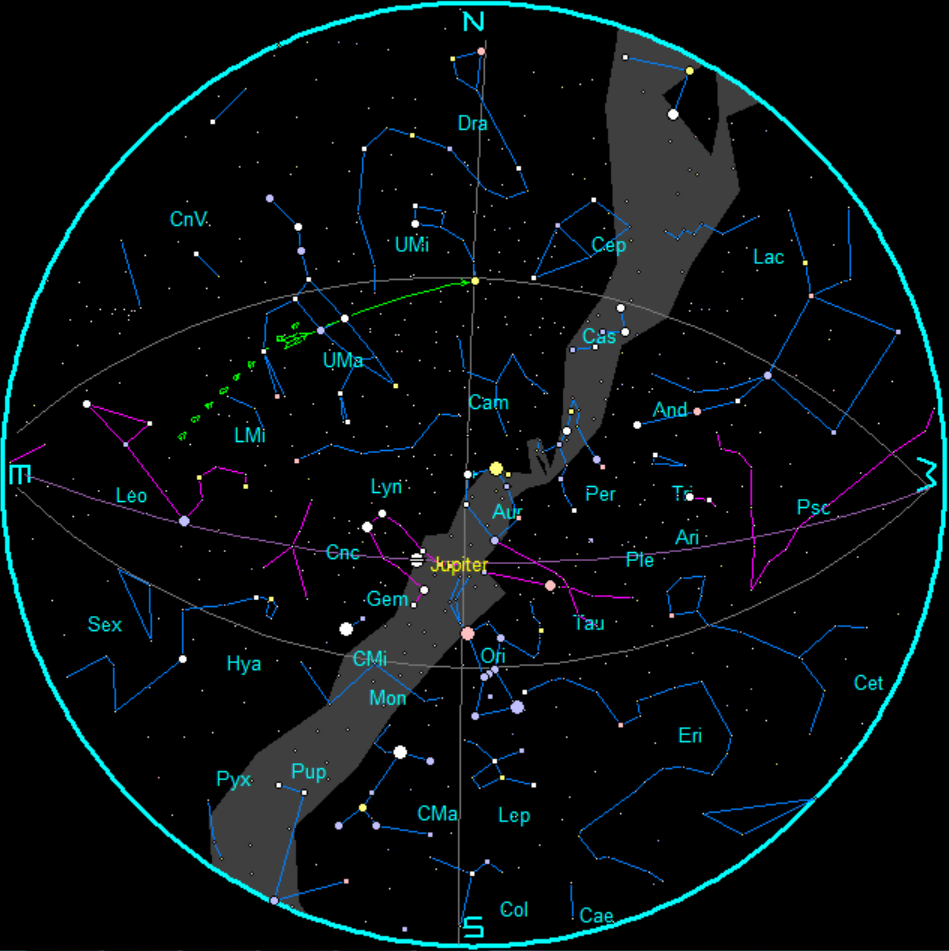
A star chart for February 15th at 9 p.m. Add a half hour to every week before the 15th and subtract and hour for every week after the 15th. Created using my LookingUp program.
For a list of constellation names to go with the abbreviations click here
01/29/2014 – Ephemeris – We could spot all the 5 naked eye planets this week
Ephemeris for Wednesday, January 29th. The sun will rise at 8:04. It’ll be up for 9 hours and 42 minutes, setting at 5:47. The moon, 1 day before new, will rise at 7:27 tomorrow morning.
Let’s take our weekly look at the planets. Tiny Mercury is 3 days from its greatest eastern elongation low in the west-southwest between sunset and 7:22, when it sets. After that Jupiter takes over the evening sky. It will be in the eastern sky as darkness falls tonight. It’s cruising against the stars of Gemini now. It will move southeast and pass due south at 10:59 p.m., and will set at 6:41 a.m. in the west-northwest. Mars will rise at 11:55 p.m. in the east-southeast. Reddish Mars is in Virgo now and above the bright star Spica. Saturn will rise at 2:32 a.m. in the east-southeast. It’s seen against Libra the scales this year. Venus will rise at 6:02 tomorrow morning, so it may become visible around 6:30 or so very low in the east-southeast.
Times are for the Traverse City/Interlochen area of Michigan. They may be different for your location.
Addendum
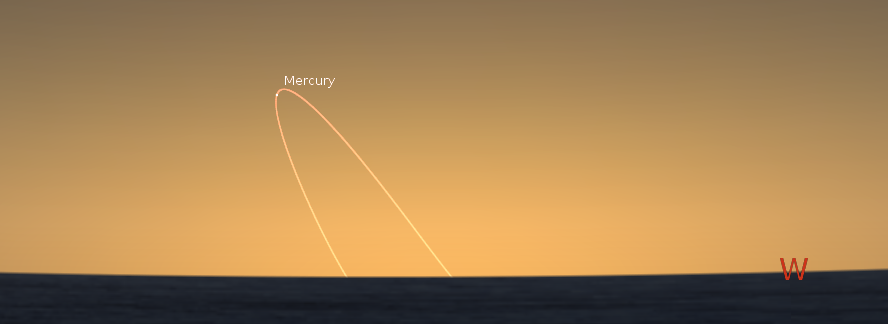
Mercury in the west southwest at 6:15 p.m. on January 29, 2014. Also displayed is Mercury’s orbit. It will reach the peak, its greatest eastern elongation from the Sun on Friday. Created using Stellarium.
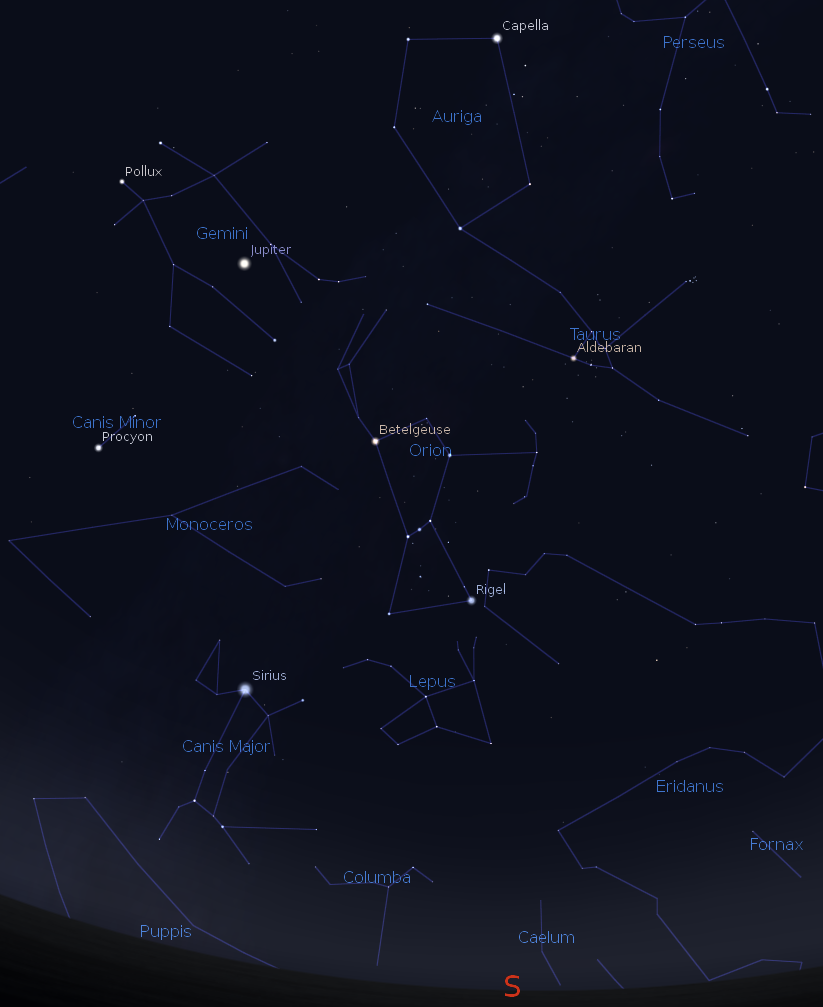
Jupiter with the winter constellations at 9 p.m. on January 29, 2014. Created using Stellarium.
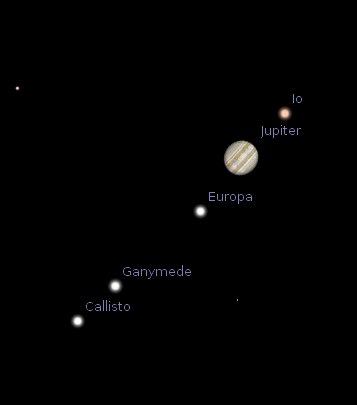
The telescopic Jupiter at 9 p.m. and January 29, 2014. Created using Stellarium.
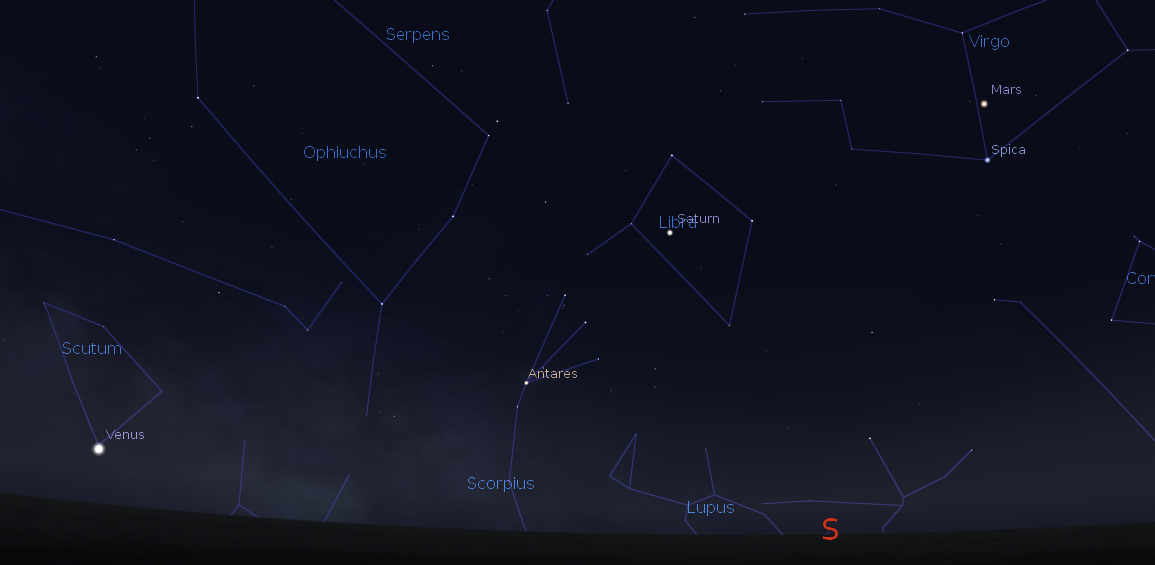
Mars, Saturn and Venus with the spring constellations at 6:30 a.m. on January 29, 2014. Created using Stellarium.
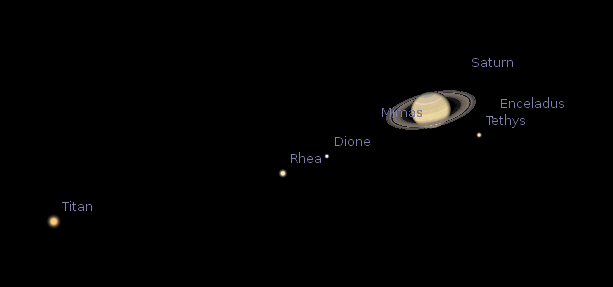
Saturn and its moons at 6:30, January 30, 2014. Of the moons, Titan will be the only one visible in small telescopes. Created using Stellarium.
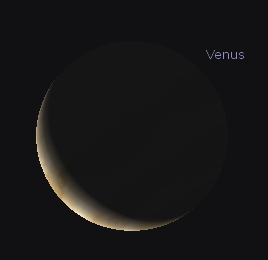
Venus as seen in a telescope at 7 a.m. on January 30, 2014. Created using Stellarium.
01/22/2014 – Ephemeris – Where are the bright planets this week?
Ephemeris for Wednesday, January 22nd. The sun will rise at 8:11. It’ll be up for 9 hours and 26 minutes, setting at 5:37. The moon, 2 days before last quarter, will rise at 12:27 tomorrow morning.
Let’s take our weekly look at the planets. Tiny Mercury is starting its week and a half appearance low in the west-southwest between sunset and 6:53, when it sets. After that Jupiter takes over the evening sky. It will be in the eastern sky as darkness falls tonight. It’s cruising against the stars of Gemini now. It will rise and pass due south at 11:30 p.m., and will set at 7:11 a.m. in the west-northwest. Mars will rise at 12:11 a.m. in the east-southeast. Reddish Mars is in Virgo now and above the bright star Spica and the Moon tomorrow morning. Saturn will rise at 2:57 a.m. in the east-southeast. It’s seen against Libra the scales this year. Venus will rise at 6:35 tomorrow morning, so it may become visible around 7 or so very low in the east-southeast.
Times are for the Traverse City/Interlochen area of Michigan. They may be different for your location.
Addendum
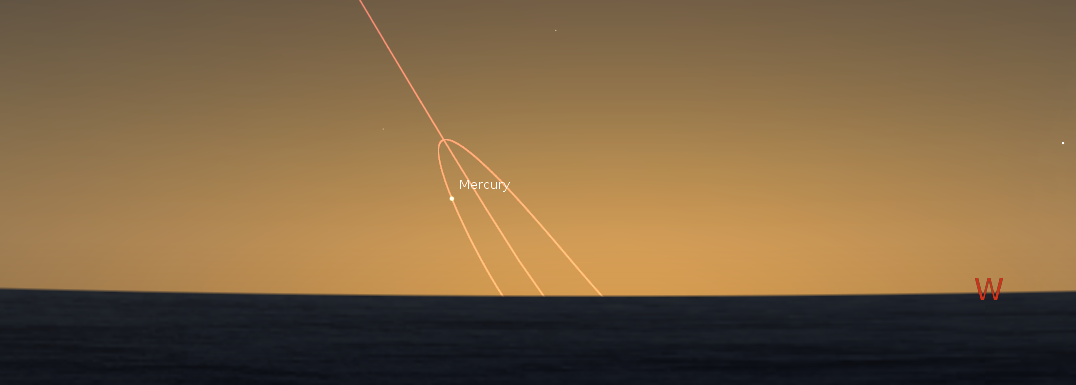
Mercury in the west-southwest at 6:15 p.m. on January 22, 2014. Also displayed is Mercury’s orbit, the loop, and the ecliptic, the plane of the Earth’s orbit. Created using Stellarium.
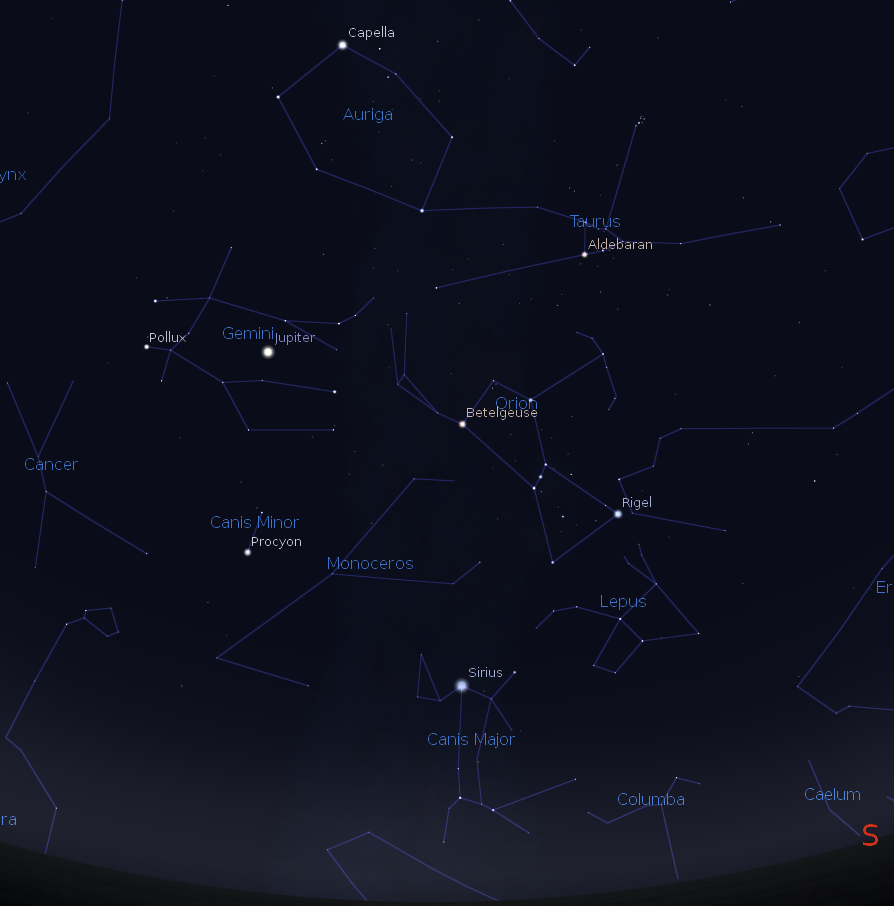
Jupiter with the winter constellations at 9 p.m. on January 22, 2014. Created using Stellarium.
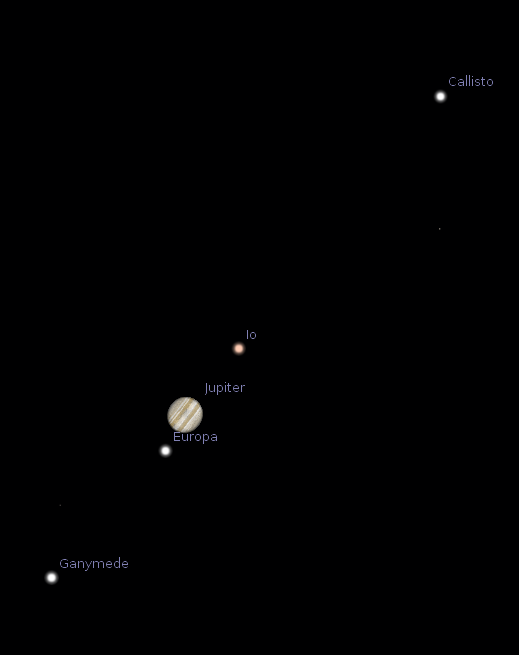
The telescopic Jupiter at 9 p.m. and January 22, 2014. Created using Stellarium.
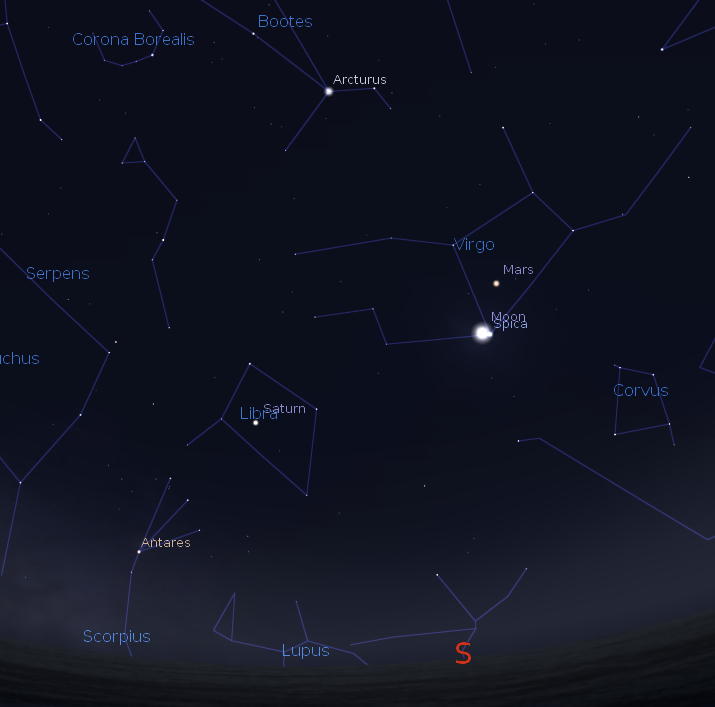
Mars, Saturn and the Moon with the spring constellations at 6:30 a.m. on January 23, 2014. Created using Stellarium.
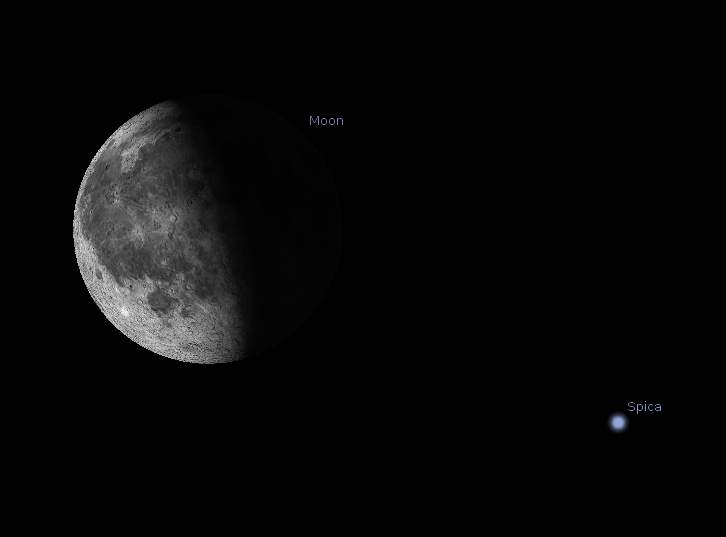
The Moon and the star Spica at 6:30 a.m. on January 23, 2014. Created using Stellarium.
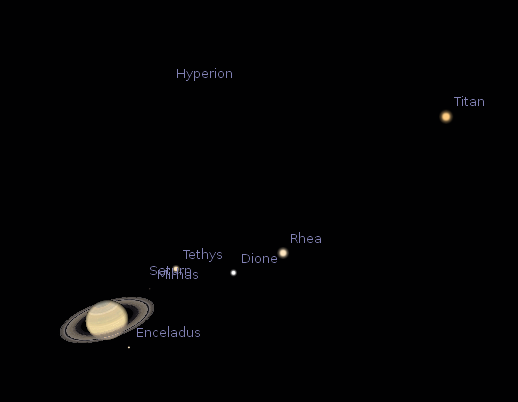
Saturn and its moons at 6:30, January 23, 2014. Of the moons, Titan will be the only one visible in small telescopes. Created using Stellarium.
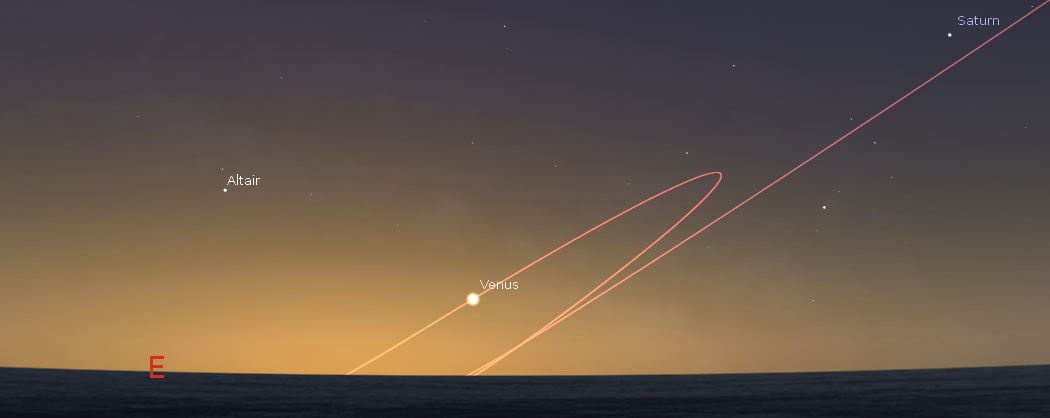
Venus in the east-southeast at 7:45 a.m. on January 23, 2014. Also displayed is Venus’ orbit, the loop, and the ecliptic, the plane of Earth. Created using Stellarium.
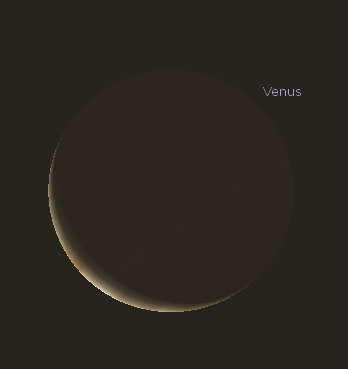
Venus as seen in a telescope at 7:45 a.m. on January 23, 2014. Created using Stellarium.
01/15/14 – Ephemeris – Where are the bright planets this week?
Ephemeris for Wednesday, January 15th. The sun will rise at 8:15. It’ll be up for 9 hours and 12 minutes, setting at 5:28. The moon, at full today, will rise at 5:28 this evening.
Let’s take our weekly look at the planets. The giant planet Jupiter is now alone in the evening sky. It will be in the eastern sky as darkness falls tonight. It’s cruising against the stars of Gemini now. It will pass due south at 12:05 a.m., and will set at 7:42 a.m. in the west northwest. Mars will rise at 12:28 a.m. in the east. Reddish Mars is in Virgo now and to the upper right of the bright star Spica by the three-quarters of the width of your fist held at arm’s length. Saturn will rise at 3:26 a.m. in the east southeast. It’s seen against Libra the scales this year. Venus will rise at 7:18 tomorrow morning, so it may become visible around 7:45 or so very low in the east southeast. It’s sudden appearance has caused come airport tower controllers to give it permission to land.
Times are for the Traverse City/Interlochen area of Michigan. They may be different for your location.
Addendum
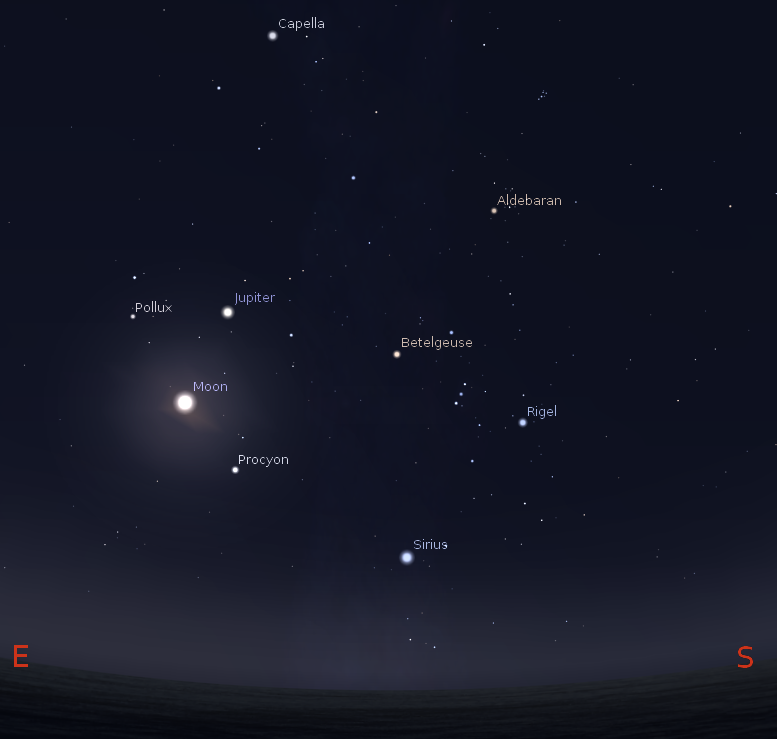
Jupiter, the Moon with the winter stars at 9 p.m. on January 15, 2014. Created using Stellarium.
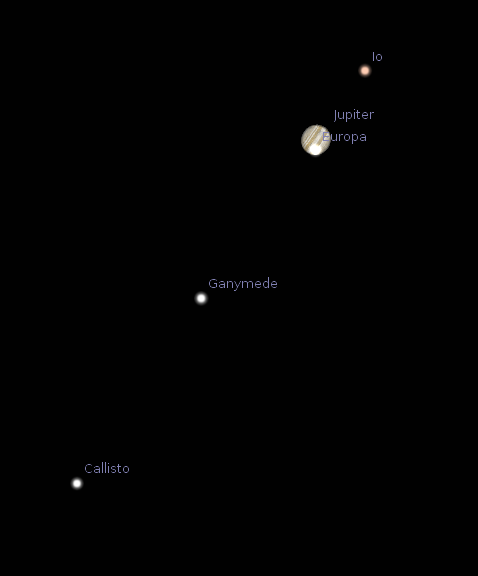
The telescopic Jupiter at 9 p.m. and January 15, 2014. The moon Europa is in front or transiting Jupiter. Created using Stellarium.
Europa, the smallest of the four Galilean satellites of Jupiter will transit the face of Jupiter tonight. It’s shadow will also cross that planet. The transit starts at 9:02 p.m. Stellarium is slightly off in that regard. Cartes du Ceil is better in that regard. Europa’s shadow starts to cross Jupiter at 9:33 p.m. Europa’s transit ends at 11:43 p.m., while it’s shadow leaves the face of Jupiter at 12:16 a.m. The source for these times is Project Pluto’s Jupiter Satellite Events page.
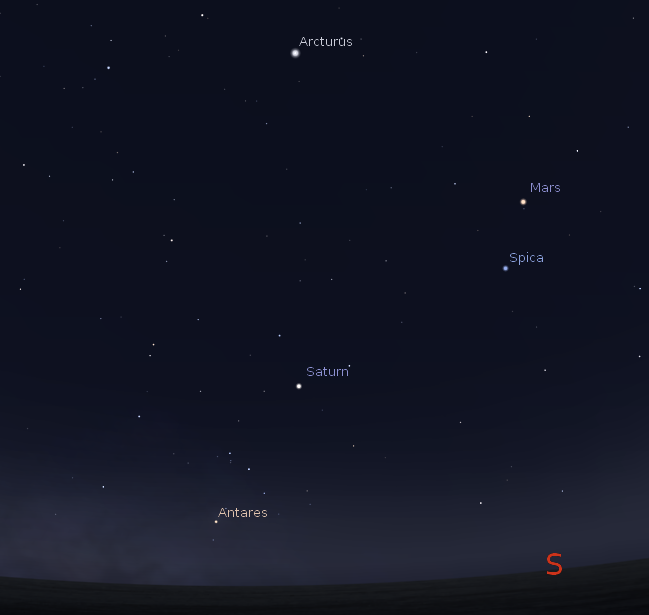
Mars and Saturn with the spring stars at 6:30 a.m. on January 16, 2014. Created using Stellarium.
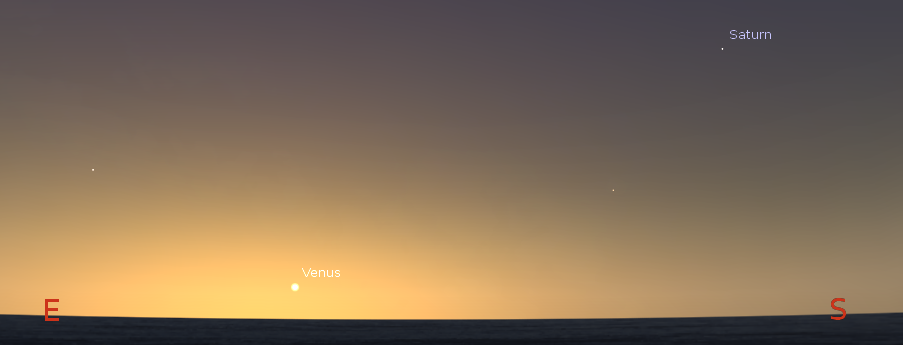
For the adventurous, Venus at 7:45 a.m. tomorrow morning January 16, 2014. Created using Stellarium.
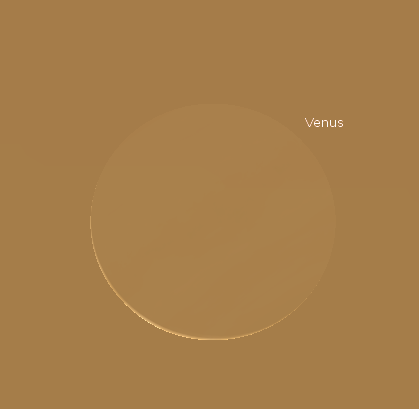
Venus as it might appear in a telescope at 7:45 a.m. tomorrow morning January 16, 2014. You will not see its night side, just the crescent. Created using Stellarium.
Want to see Venus closer to inferior conjunction? Check out Universe Today’s Virtual Star Party for January 12, 2014.
01/14/2014 – Ephemeris – The moon will appear to pass Jupiter tonight
Ephemeris for Tuesday, January 14th. The sun will rise at 8:16. It’ll be up for 9 hours and 10 minutes, setting at 5:27. The moon, 1 day before full, will set at 7:29 tomorrow morning.
The planet Jupiter will appear close to the nearly full moon this evening. The moon will pass about 10 of its diameters south of Jupiter around 1 a.m. tomorrow morning. Until then, Jupiter will appear to the left of the moon. This is a good time to view Jupiter with a small telescope. Even binoculars will detect a tiny disk and several of Jupiter’s satellites. Jupiter is a gas giant planet made primarily of hydrogen. The clouds contain methane and ammonia whipped into parallel bands by Jupiter’s rapid rotation of nearly 10 hours. The planet has a noticeable equatorial bulge, which is accentuated visually by its horizontal cloud bands. Jupiter’s equatorial diameter is 89,000 miles [143,000 km], 11 times that of the earth. [Jupiter’s volume could hold about 1,300 Earths, but its mass is only about 318 Earths. Jupiter is less dense than the Earth by a factor of four.]
Times are for the Traverse City/Interlochen area of Michigan. They may be different for your location.
Addendum
[Content in brackets was not included in the broadcast program due to time constraints.]
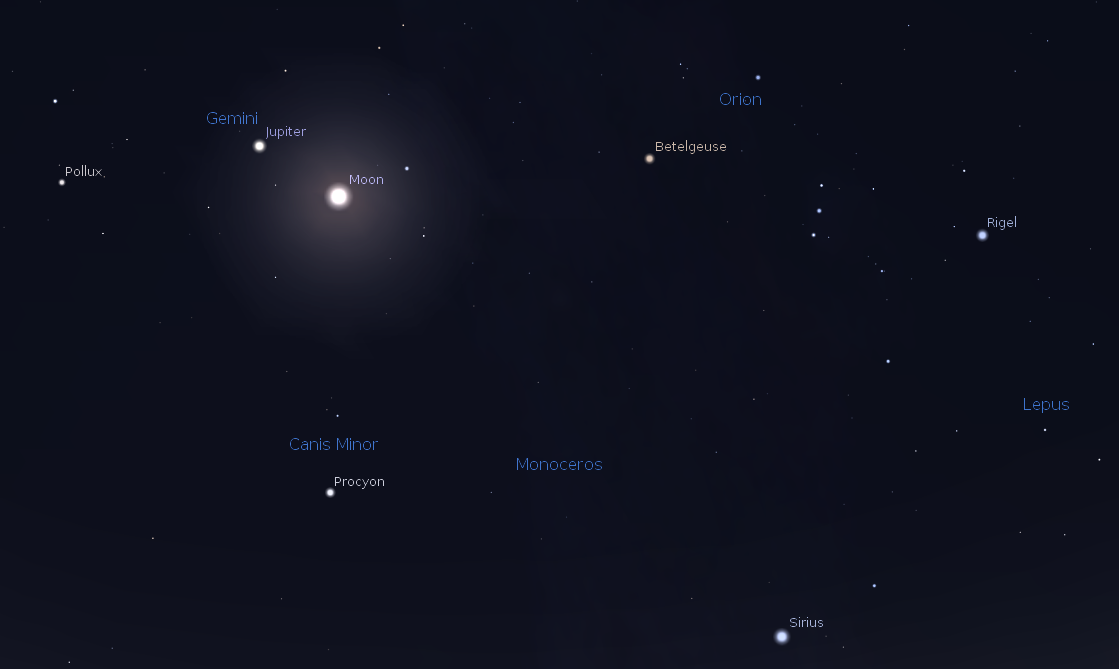
Jupiter, the Moon and the bright stars of winter at 9 p.m. on January 14, 2014. By 1 a.m. the Moon will have slipped to be directly below Jupiter. The Moon moves about its own diameter against the stars each hour. Created using Stellarium.
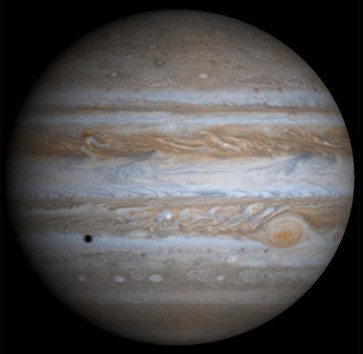
Jupiter as seen by the Cassini spacecraft as it passed by Jupiter gaining velocity on its way to Saturn. The black dot is the shadow of Europa. Credit: NASA/JPL – Caltech.
01/13/2014 – Ephemeris – Jupiter’s Great Red Spot
Ephemeris for Monday, January 13th. The sun will rise at 8:16. It’ll be up for 9 hours and 9 minutes, setting at 5:25. The moon, 2 days before full, will set at 6:49 tomorrow morning.
Jupiter is my youngest granddaughter’s favorite planet. She has books and pictures of Jupiter sporting its famous Great Red Spot. When I was a teenager in the 1950s, a bit older than she is now the Great Red Spot on Jupiter was indeed bright red. You couldn’t miss it in even the smallest telescopes. Since the early 1970s the spot has faded. At best it’s a pastel pink. The Great Red Spot appears to be a permanent feature of the Jovian atmosphere, an anti-cyclone that distorts the dark belts and bright zones of the planet. The dark belts are thought to be where air is sinking and the white zones are upwelling clouds. The Great Red Spot wanders east and west at about the same latitude within the atmosphere. I hope it gets really red soon.
Times are for the Traverse City/Interlochen area of Michigan. They may be different for your location.
Addendum
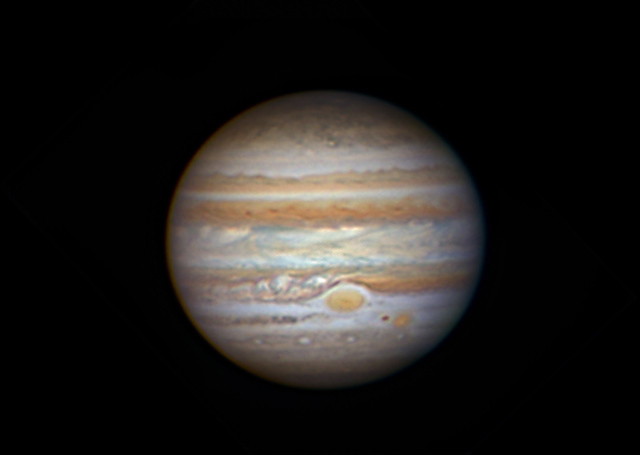
Jupiter with its Great Red Spot November 18, 2012 by Scott Anttila.
01/09/2014 – Ephemeris – More on Jupiter’s Galilean moons.
Ephemeris for Thursday, January 9th. The sun will rise at 8:18. It’ll be up for 9 hours and 3 minutes, setting at 5:21. The moon, 2 days past first quarter, will set at 3:20 tomorrow morning.
The planet Jupiter has, as of the latest count, 67 satellites or moons. However only four can be seen in small to medium-sized telescopes. Astronomers use the term moon and satellite interchangeably, though only moons orbit planets. A satellite is a more generic term and is a smaller body that orbits another larger body. Though we don’t usually call an artificial satellite orbiting the Earth a moon. Anyway, the four bright moons of Jupiter are called the Galilean moons, because Galileo discovered then in early 1610. Their names from Jupiter on out are Io, Europa, Ganymede and Callisto. They orbit over Jupiter’s equator. Since the planet has a very small axial tilt the moons seem to move back and forth from one side to the other of Jupiter in a nearly straight line.
Times are for the Traverse City/Interlochen area of Michigan. They may be different for your location.
Addendum
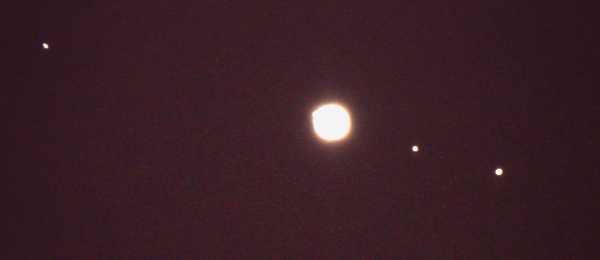
Jupiter and its four Galilean moons. The planet has to be over exposed to pick up the moons. But the eye can handle the brightness difference with no problem. This is one of my old pictures I do believe.
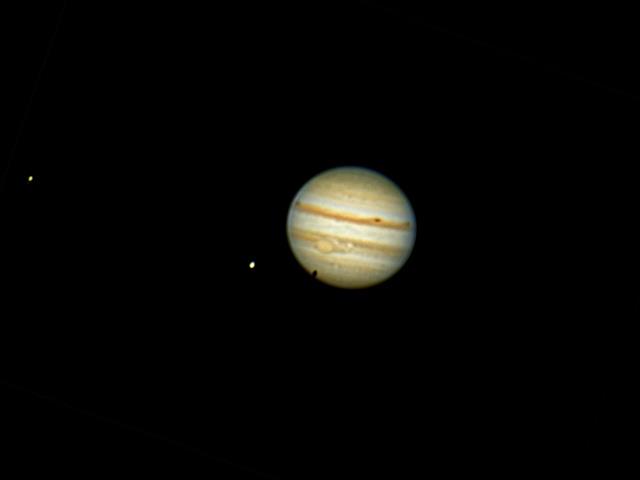
Jupiter with a solar eclipse in progress as Ganymede, lower left, casts its shadow on Jupiter on November 14, 2011 at about 10:15 p.m.. Credit: Scott Anttila.
The moon Io is off to the far left. This eclipse can be simulated with Cartes du Ciel.
01/08/2014 – Ephemeris – Where are the bright planets this week?
Ephemeris for Wednesday, January 8th. The sun will rise at 8:18. It’ll be up for 9 hours and 2 minutes, setting at 5:20. The moon, 1 day past first quarter, will set at 2:18 tomorrow morning.
This is our weekly look at the planets. Venus is only three days from passing between the Earth and the Sun in what astronomers call inferior conjunction. Sharp eyed observers may be able to spot it in the bright twilight glow before it sets at 5:57 p.m. tonight. It will then pass into the morning sky. The giant planet Jupiter will be in the eastern sky as darkness falls tonight. It’s cruising against the stars of Gemini now. It will pass due south at 12:32 a.m., and will set at 8:13 a.m. Mars will rise at 12:39 a.m. in the east. Reddish Mars is in Virgo now and to the upper right of the bright star Spica by the width of your fist held at arm’s length. Saturn will rise at 3:47 a.m. in the east southeast. It’s seen against Libra the scales this year.
Times are for the Traverse City/Interlochen area of Michigan. They may be different for your location.
Addendum
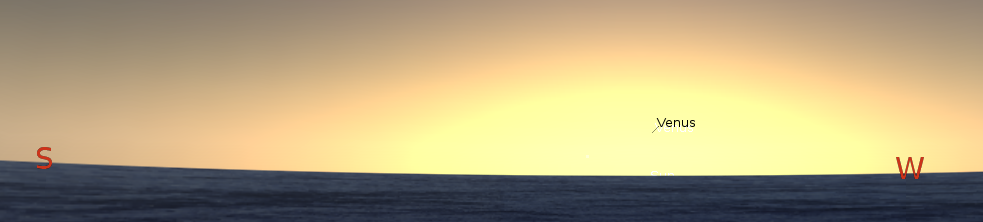
For diehards, Venus 15 minutes before it will set tonight January 8, 2014.
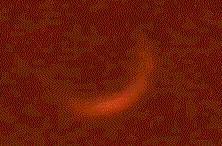
Venus at 3 days before inferior conjunction back in the late 1960’s. My photograph.
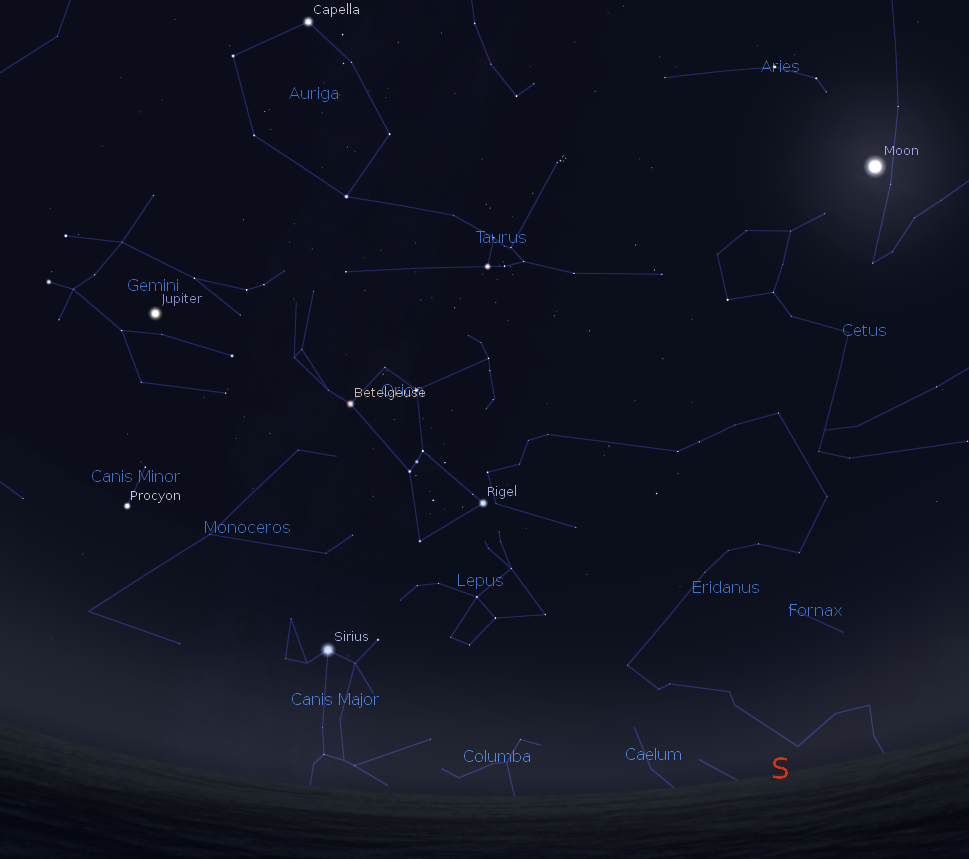
Jupiter, the Moon with the winter constellations at 9 p.m. on January 8, 2014. Created using Stellarium.
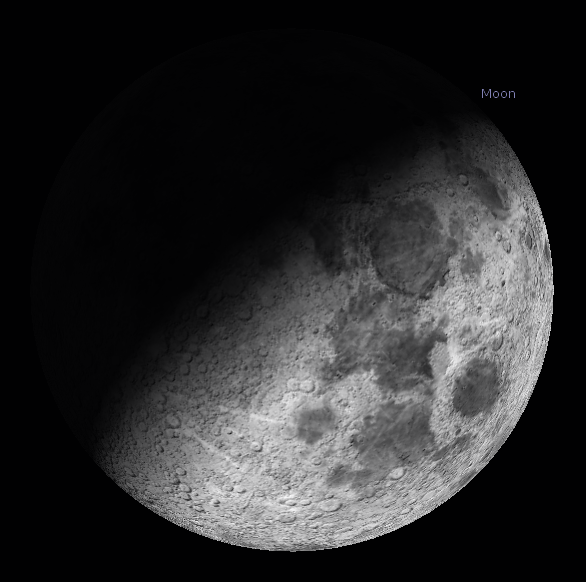
The telescopic moon at 9 p.m. January 8, 2014. Created using Stellarium.
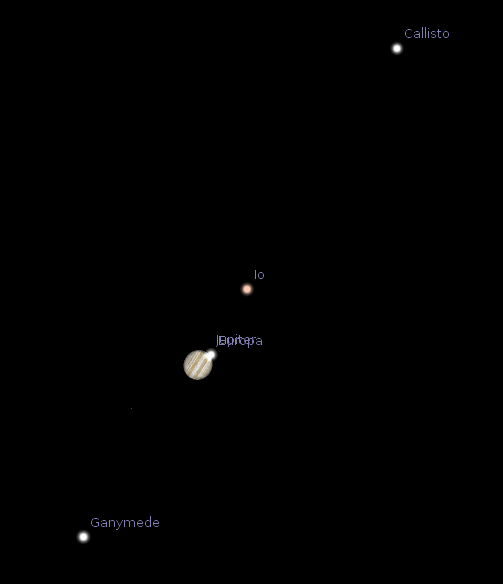
The telescopic Jupiter at 9 p.m. and January 8, 2014. The label for the moon Europa overlaps that of Jupiter. Created using Stellarium.
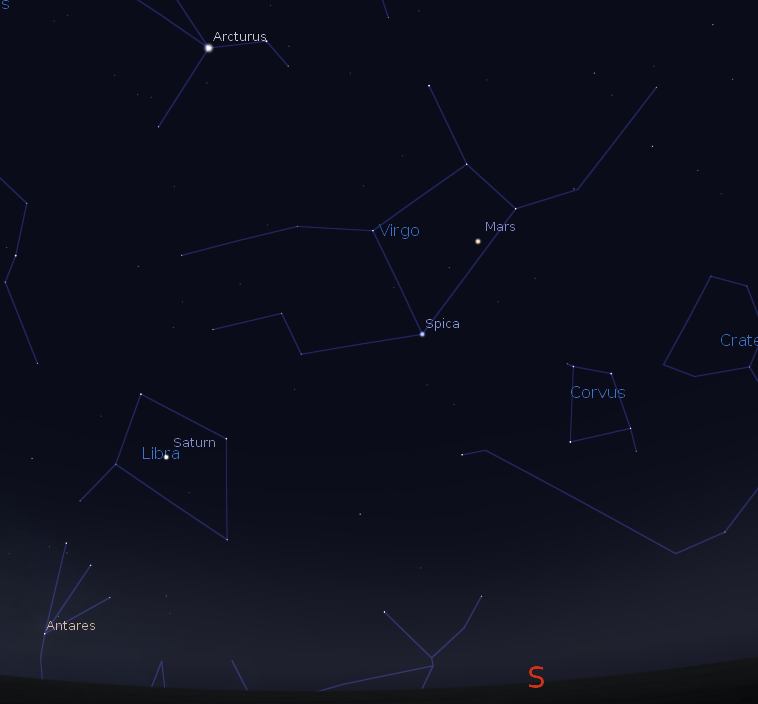
Mars and Saturn with the spring constellations at 6:30 a.m. on January 9, 2014. Created using Stellarium.
01/07/2014 – Ephemeris – Jupiter just after opposition
Ephemeris for Tuesday, January 7th. The sun will rise at 8:18. It’ll be up for 9 hours and 1 minute, setting at 5:19. The moon, at first quarter today, will set at 1:14 tomorrow morning.
The giant planet Jupiter was in opposition from the Sun two days ago, meaning that the Sun, Earth and Jupiter were pretty much in a line. It was a time the Jupiter was closest to us. The situation hasn’t changed much, However you will notice that tomorrow I will not give the time that Jupiter rises because it will rise before sunset, but I will give its setting time. Now Jupiter is about 391 million miles (630 million km) away and slowly dropping behind the faster moving Earth. Jupiter is so large that there is never bad time to view it with a small telescope, but Jupiter appears largest right now. Visible in telescopes are its four moons that change position from night to night. The face of the planet shows atmospheric cloud bands that bear closer scrutiny with larger telescopes.
Times are for the Traverse City/Interlochen area of Michigan. They may be different for your location.
Addendum
Jupiter and its four Galilean moons. The planet has to be over exposed to pick up the moons. The bump on the upper left of Jupiter’s image is another moon. But the eye can handle the brightness difference with no problem. This is one of my old pictures I do believe.
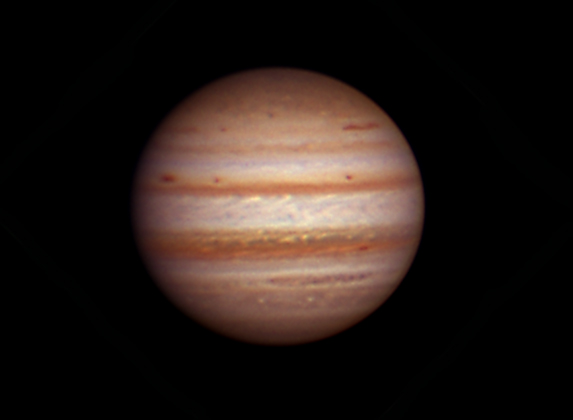
Jupiter by Scott Anttila. Taken February 6, 2012
12/30/2013 – Ephemeris – The tale of Gemini the twins
Ephemeris for Monday, December 30th. The sun will rise at 8:19. It’ll be up for 8 hours and 52 minutes, setting at 5:11. The moon, 2 days before new, will rise at 7:09 tomorrow morning.
The constellation Gemini, the Twins is visible in the east at 9 p.m. with the bright planet Jupiter interloping against its stars. The namesake stars of the two lads, will be on the left end of the constellation, nearly vertically aligned. Castor is on top, while Pollux, a slightly brighter star is on the bottom. Lines of stars from Castor and Pollux to the right delineate the lads. In Greek mythology Castor and Pollux were twins, and half brothers, Castor was fathered by a mere mortal, while Pollux was fathered by Zeus in the famous Leda and the swan affair. The brothers, however were inseparable, and when Castor was killed during the quest for the Golden Fleece, Pollux pleaded with Zeus to let him die also. Zeus placed them together in the sky forever.
Times are for the Traverse City/Interlochen area of Michigan. They may be different for your location.
Addendum
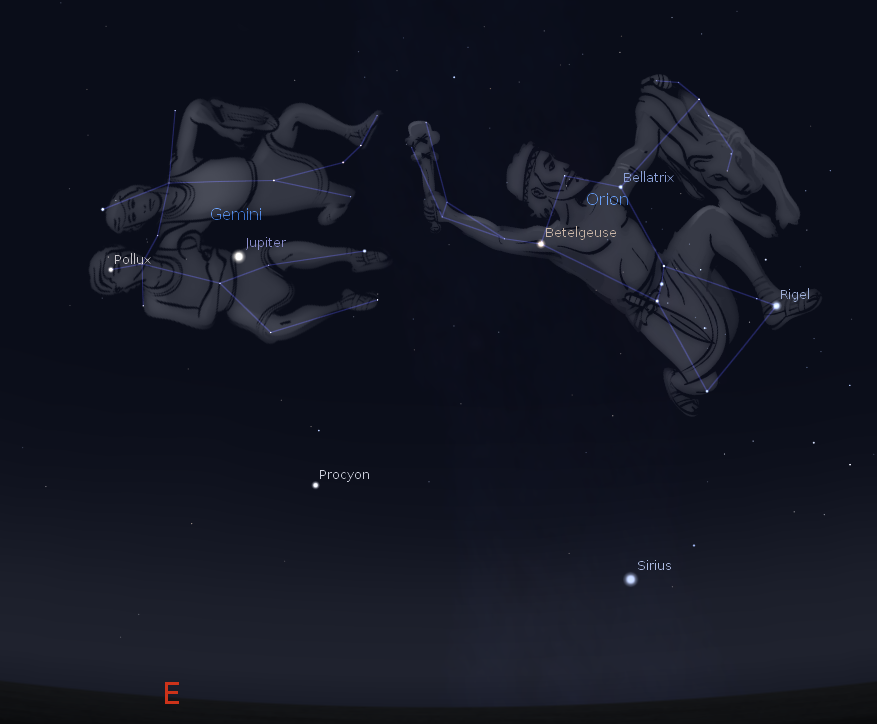
Gemini with Jupiter and Orion near by at 9 p.m. on December 30, 2013. Created using Stellarium.
 Bob Moler's Ephemeris Blog