Archive
07/31/2013 – Ephemeris – All 5 bright planets are visible now
Ephemeris for Wednesday, July 24th. The sun rises at 6:20. It’ll be up for 14 hours and 56 minutes, setting at 9:16. The moon, 2 days past full, will rise at 10:12 this evening.
Lets check out the planets visible now. Venus is now low in the west northwestern sky in evening twilight, Venus will set at 10:44 p.m. Holding forth in the southwest will be Saturn this evening, the brightest star-like object in the constellation Virgo appearing yellowish to the left of the extremely blue-white star Spica. Saturn is a wonderful sight in a telescope of 20 power or more. In telescopes Saturn’s large moon Titan can be easily seen. Saturn will set at 1:04 tomorrow morning. Jupiter and Mars will rise close together at 4:14 and 4:17 a.m. Respectively in the east northeast in morning twilight. The much dimmer Mars will appear to the lower left of the brighter Jupiter, and may take binoculars to locate.
Times are for the Traverse City/Interlochen area of Michigan. They may be different for your location.
Addendum
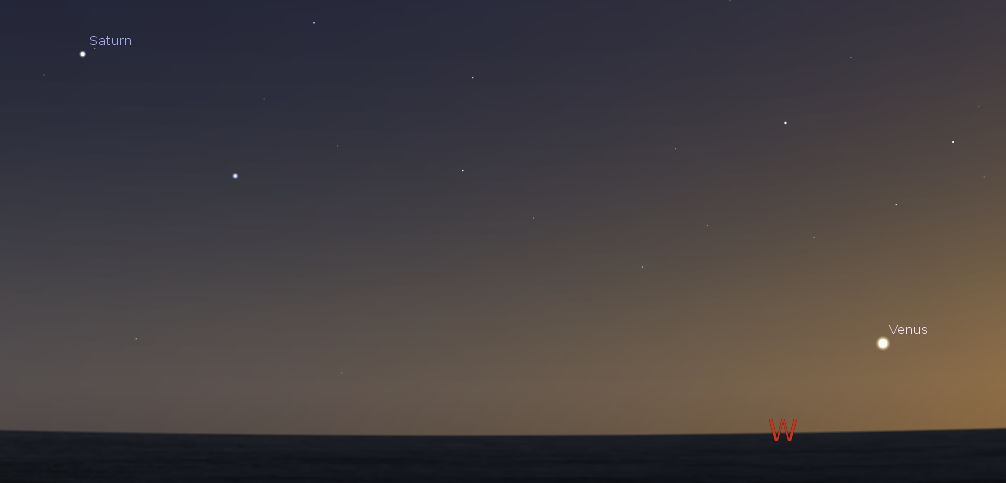
Venus and Saturn at 10 p.m. on July 31, 2013. Created using Stellarium
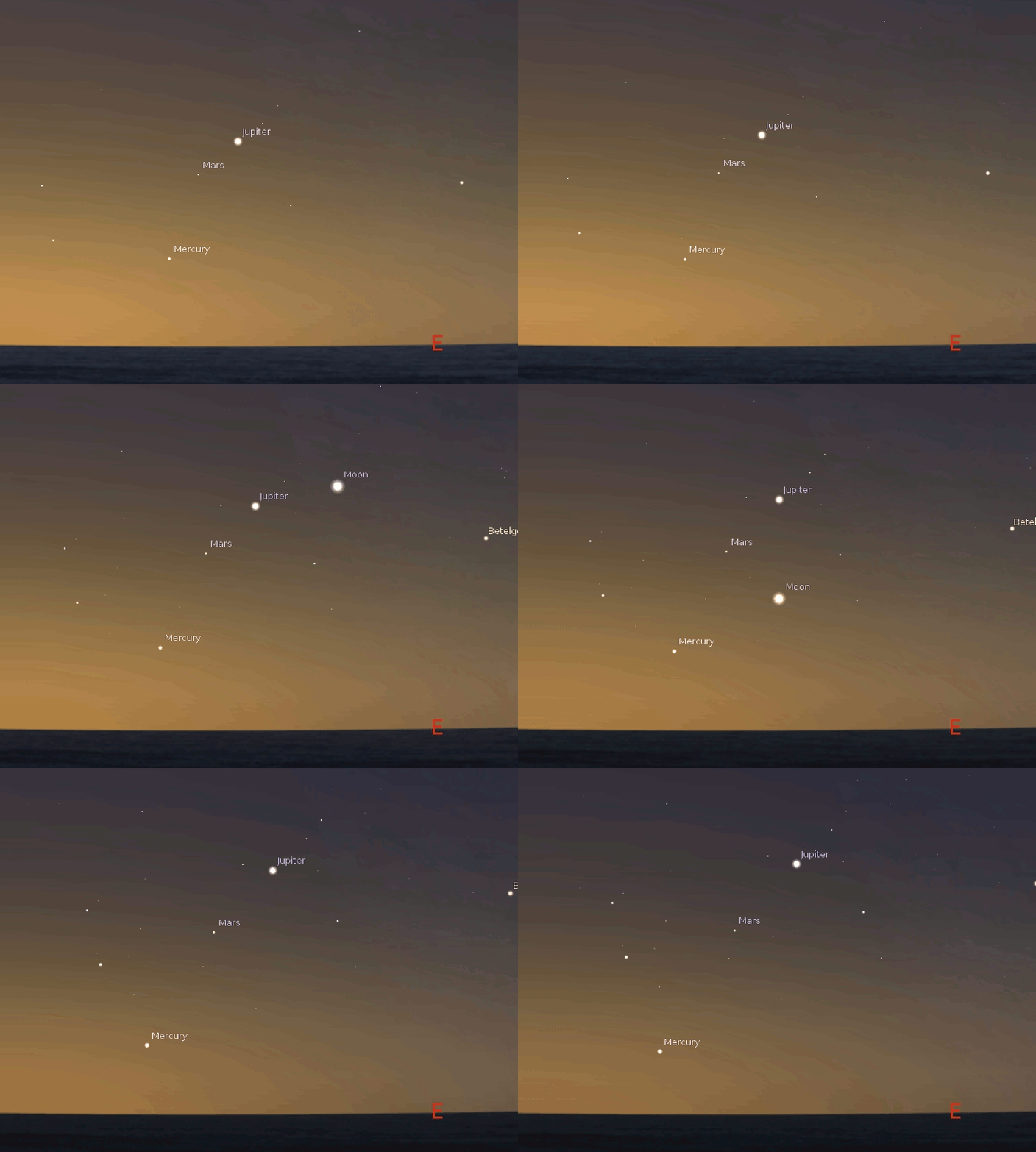
Animation of Mercury, Mars and Jupiter at one day intervals from July 31 to August 7, 2013 at 5:45 a.m. Created using Stellarium and the GIMP.
07/24/2013 – Ephemeris – Where are the bright planets in the sky this week?
Ephemeris for Wednesday, July 24th. The sun rises at 6:20. It’ll be up for 14 hours and 56 minutes, setting at 9:16. The moon, 2 days past full, will rise at 10:12 this evening.
Lets check out the planets visible now. Venus is now low in the west northwestern sky in evening twilight, Venus will set at 10:44 p.m. Holding forth in the southwest will be Saturn this evening, the brightest star-like object in the constellation Virgo appearing yellowish to the left of the extremely blue-white star Spica. Saturn is a wonderful sight in a telescope of 20 power or more. In telescopes Saturn’s large moon Titan can be easily seen. Saturn will set at 1:04 tomorrow morning. Jupiter and Mars will rise close together at 4:14 and 4:17 a.m. Respectively in the east northeast in morning twilight. The much dimmer Mars will appear to the lower left of the brighter Jupiter, and may take binoculars to locate.
Times are for the Traverse City/Interlochen area of Michigan. They may be different for your location.
Addendum
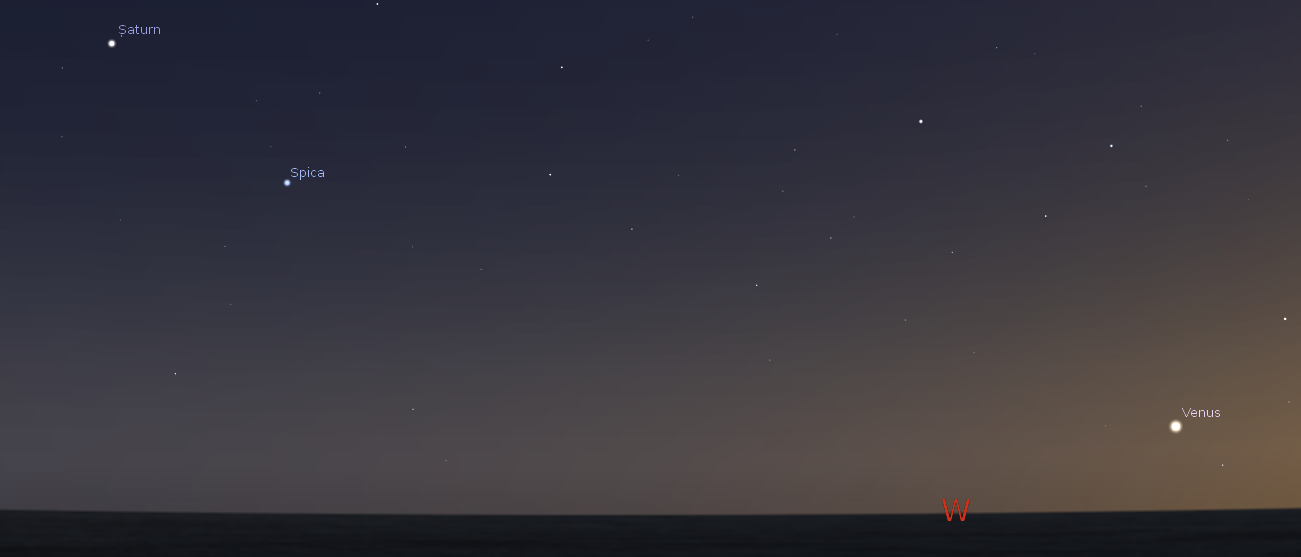
Venus and Saturn at 10:15 p.m. on July 24, 2013. Created using Stellarium. Click on Image to enlarge.
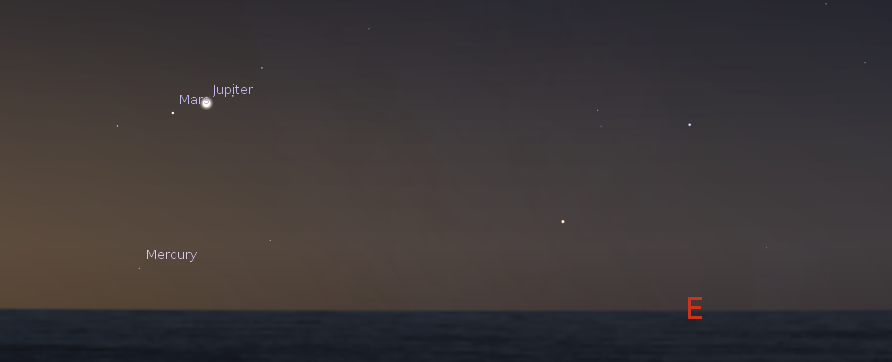
Jupiter, Mars and Mercury in morning twilight at 5:20 a.m. on July 25, 2013. I didn’t mention Mercury on the program because it’s very difficult to spot. Created using Stellarium.
06/19/2013 – Ephemeris – Mercury and Venus one last time
Ephemeris for Wednesday, June 19th. Today the sun will be up for 15 hours and 33 minutes, setting at 9:30. The moon, 3 days past first quarter, will set at 3:28 tomorrow morning. Tomorrow the sun will rise at 5:57.
The early evening will still be taken up with Venus and faint Mercury low in the west northwest at about 10:15 p.m. Mercury is below and left of Venus by 2 degrees, about 4 times the width of the moon. Mercury has dropped greatly in brightness as its phase is now a crescent, moving between the sun and the earth. Mercury will set at 10:56, and Venus will set at 11:03 p.m. Holding forth in the south will be Saturn this evening, the brightest star-like object in the constellation Virgo appearing yellowish to the left of the extremely blue-white star Spica. Saturn is a wonderful sight in a telescope of 20 power or more. Saturn will pass due south at 10:04 p.m., and will set at 3:23 tomorrow morning.
Times are for the Traverse City/Interlochen area of Michigan. They may be different for your location.
Addendum
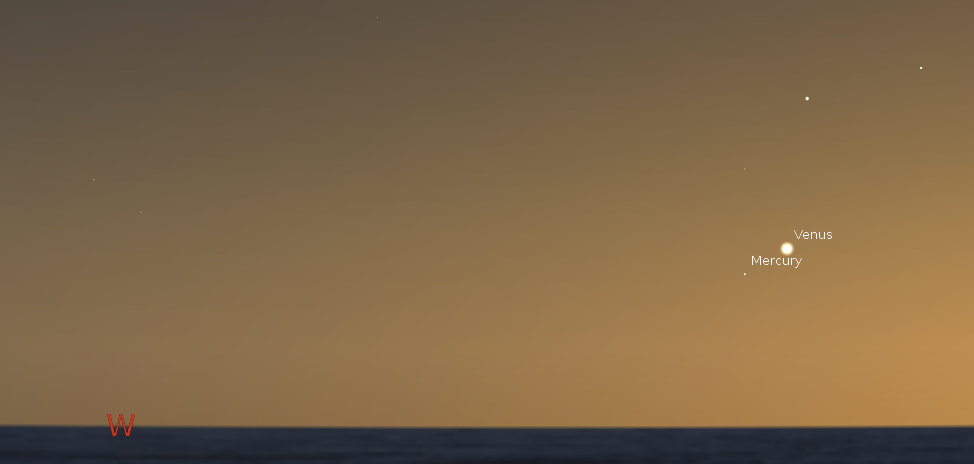
Venus and Mercury conjunction seen at 10:15 p.m. June 19 2013. Created using Stellarium.
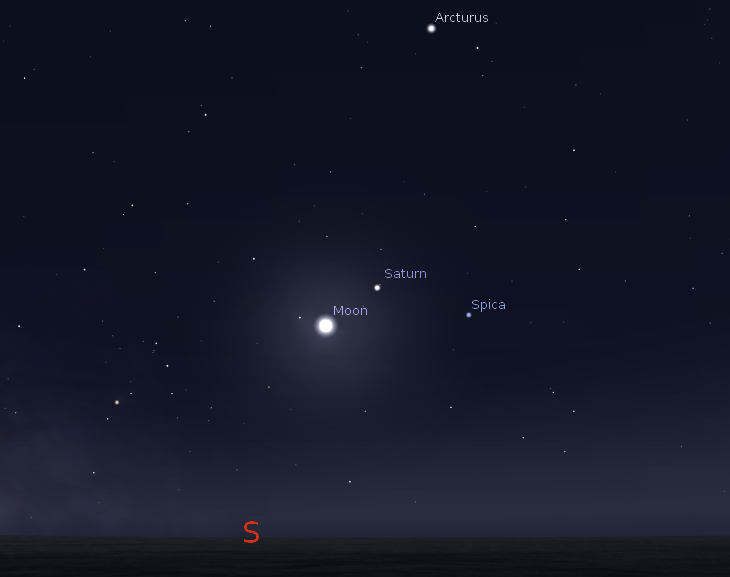
Saturn, the moon and bright stars at 11 p.m. June 19, 2013. Created using Stellarium.
06/12/2012 – Ephemeris – Three planets still in the evening sky
Ephemeris for Wednesday, June 12th. Today the sun will be up for 15 hours and 31 minutes, setting at 9:28. The moon, half way from new to first quarter, will set at 11:55 this evening. Tomorrow the sun will rise at 5:56.
The early evening will be taken up with Venus and faint Mercury low in the west northwest at about 10:15 p.m. The crescent moon is nearby to the left. Mercury is above and left of Venus by about 5 degrees, about half the width of your fist at arm’s length. Mercury is at its greatest separation or elongation from the sun today of 24 degrees angle. Venus will set at 10:59, and Mercury will set at 11:14 p.m. Holding forth in the south will be Saturn this evening, the brightest star-like object in the constellation Virgo appearing yellowish to the left of the extremely blue-white star Spica. Saturn is a wonderful sight in a telescope of 20 power or more. Saturn will pass due south at 10:33 p.m., and will set at 3:51 tomorrow morning.
Times are for the Traverse City/Interlochen area of Michigan. They may be different for your location.
Addendum
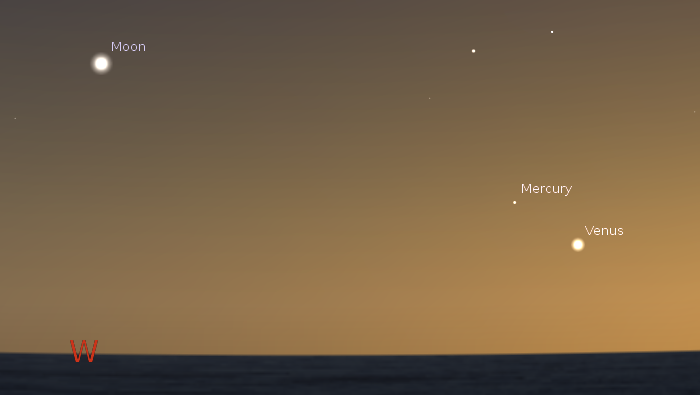
Mercury, Venus and the moon at 10:15 p.m. on June 12, 2013. Created using Stellarium. Note that the moon at this phase (thin crescent) doesn’t show at this scale, so the moon’s position is shown as full.
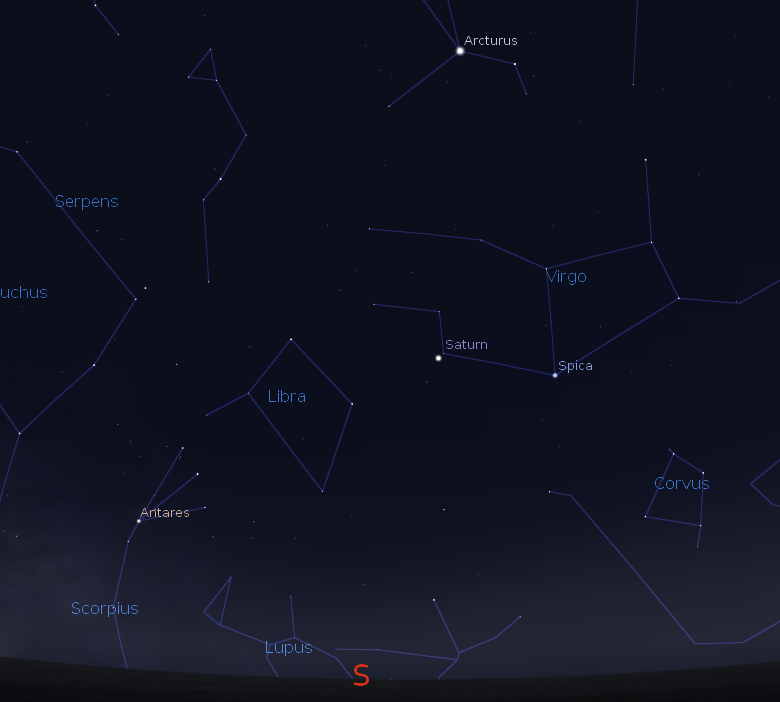
Saturn and constellations at 11 p.m. on June 12, 2013. Note Scorpius rising to the left. Created using Stellarium.
06/10/2013 – Ephemeris – Mercury and Venus in the west
Ephemeris for Monday, June 10th. Today the sun will be up for 15 hours and 29 minutes, setting at 9:27. The moon, 2 days past new, will set at 10:49 this evening. Tomorrow the sun will rise at 5:56.
Tonight the moon will join Mercury and Venus low in the west northwest at around 10:15. Venus will be the easiest to spot. Mercury will be above Venus and to the left. Binoculars may help you spot it. The crescent moon will be to the left and a bit below Venus. If you’ve been watching these planets for the past two weeks you’ve probably noticed that Mercury is getting fainter. That’s because its phase is becoming less full as moves around the sun toward us. It’s phase is now a bit more than half illuminated. Wednesday it will be half illuminated as it reaches its greatest elongation from the sun, a whopping 24 degree angle from the sun. That’s pretty good for us observing from the northern hemisphere.
Times are for the Traverse City/Interlochen area of Michigan. They may be different for your location.
Addendum
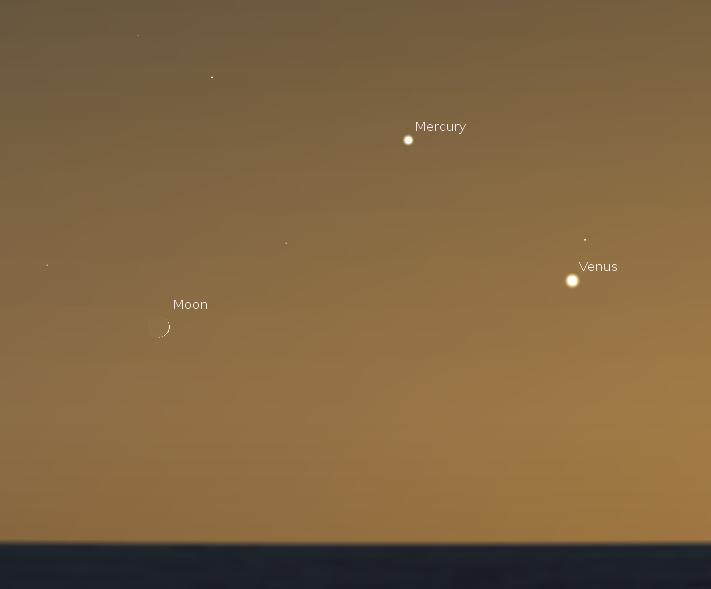
Mercury, Venus and the crescent moon in the west northwest at 10:15 p.m. on June 19, 2013. Created using Stellarium.
06/05/2013 – Ephemeris – Then there were two… planets that is, in the west
Ephemeris for Wednesday, June 5th. Today the sun will be up for 15 hours and 25 minutes, setting at 9:23. The moon, 3 days before new, will rise at 4:43 tomorrow morning. Tomorrow the sun will rise at 5:58.
The early evening will be taken up with Venus and Mercury low in the west northwest at about 10:15 p.m. Mercury is above and left of Venus by about 5 degrees, about half the width of your fist at arms length. Jupiter is out of it now, setting at 10:07. We’ll see it next in late July in the morning sky. Venus will set at 10:49, and Mercury will set at 11:16 p.m. Holding forth in the south will be Saturn this evening, the brightest star-like object in the constellation Virgo appearing yellowish to the left of the extremely blue-white star Spica. Saturn will pass due south at 11:01 p.m., and will set at 4:19 tomorrow morning. I’ll talk about star and planet colors on tomorrow’s program.
Times are for the Traverse City/Interlochen area of Michigan. They may be different for your location.
Addendum
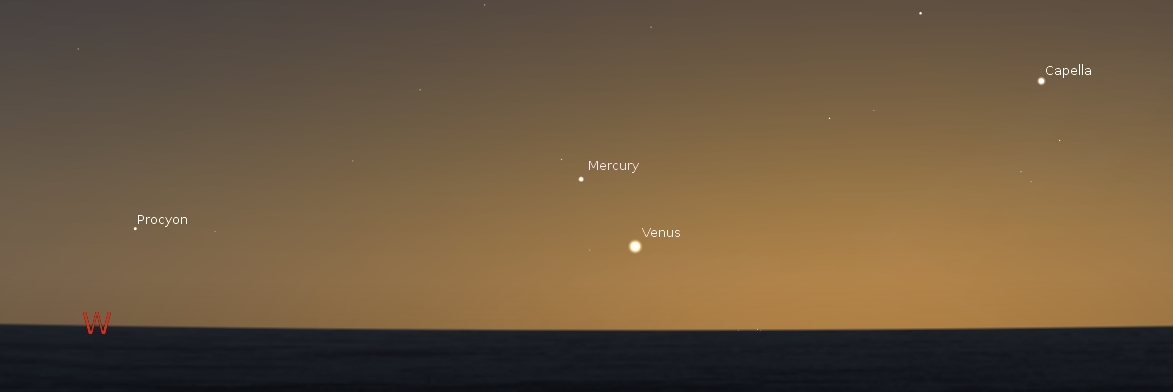
Mercury and Venus seen in the west northwest after sunset. Here it’s 10:15 p.m. on June 5, 2013. Created using Stellarium.
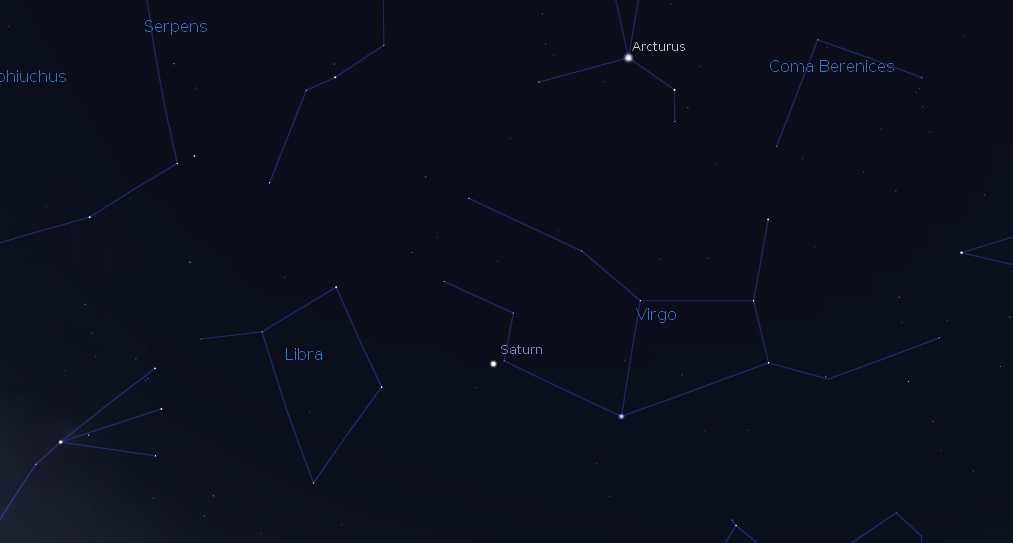
Looking south at Saturn and surrounding constellations at 11 p.m. on June 5, 2013. Created using Stellarium.
05/29/2013 – Ephemeris – Planetary breakup in the west while Saturn looks on
Ephemeris for Wednesday, May 29th. Today the sun will be up for 15 hours and 16 minutes, setting at 9:18. The moon, 2 days before last quarter, will rise at 1:10 tomorrow morning. Tomorrow the sun will rise at 6:01.
The early evening will be taken up with the slow breakup of the grouping of Jupiter, Venus and Mercury low in the west northwest at about 10 p.m. Mercury now is on top with Venus below with Jupiter below Venus. Jupiter will set at 10:48 with Venus following 9 minutes later. Mercury will set at 11 p.m. Hanging backing from this planetary grouping in the east southeast will be Saturn this evening, the brightest star-like object in the constellation Virgo appearing yellowish to the left of the extremely blue-white star Spica. Saturn will pass due south at 11:30 p.m., and will set at 4:48 tomorrow morning.
Times are for the Traverse City/Interlochen area of Michigan. They may be different for your location.
Addendum
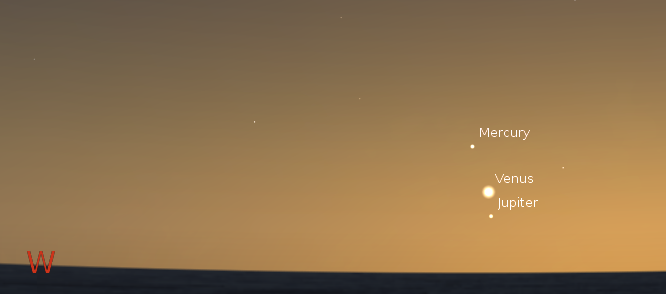
Mercury, Venus and Jupiter low in the west northwest at 10 p.m. on May 29, 2013. Created using Stellarium.
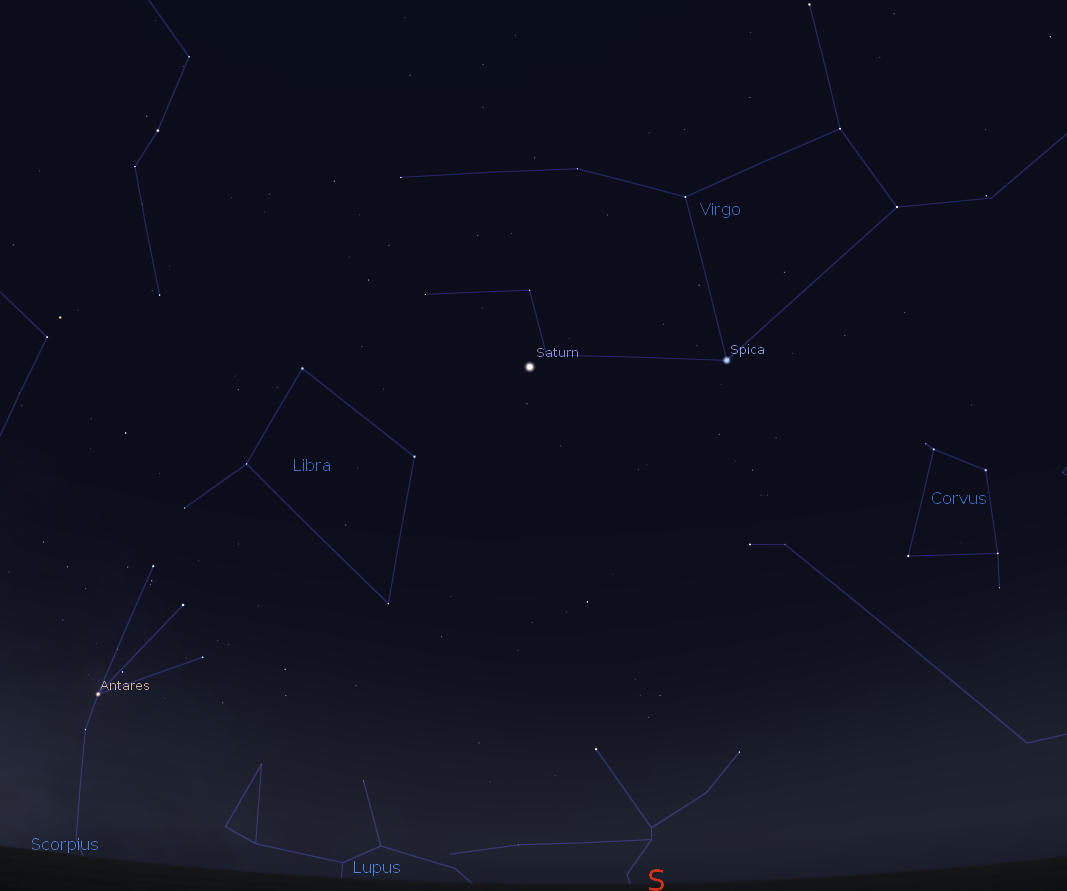
Saturn and the constellations of the south at 11 p.m. on May 29, 2013. Created using Stellarium.
05/27/2013 – Ephemeris – They’re breaking up that old planet gang of mine
Ephemeris for Memorial Day, Monday, May 27th. Today the sun will be up for 15 hours and 12 minutes, setting at 9:16. The moon, 2 days past full, will rise at 11:51 this evening. Tomorrow the sun will rise at 6:02. | Tonight the planets Jupiter and Venus will appear close together in the west northwest after 10 p.m. With Mercury above them and to the left. Find a spot with a low western horizon to check them out. The grouping will break up from there. But in the days to come keep checking out Venus and Mercury. A week ago I was doing some telescope work at the Leelanau School’s Lanphier Observatory on the shore of Sleeping Bear bay. It was a gorgeously clear night. Twilight was fading. The fat crescent moon was high in the southwest, with Jupiter in the west. Venus was visible just above the horizon. A great many stars were visible too. The sight took this old astronomer’s breath away.
Times are for the Traverse City/Interlochen area of Michigan. They may be different for your location.
Update: I spotted the three last night in that tight triangle in a binocular field. Venus was easiest to spot, then Jupiter and Mercury. It was a gorgeous sight.
Addendum
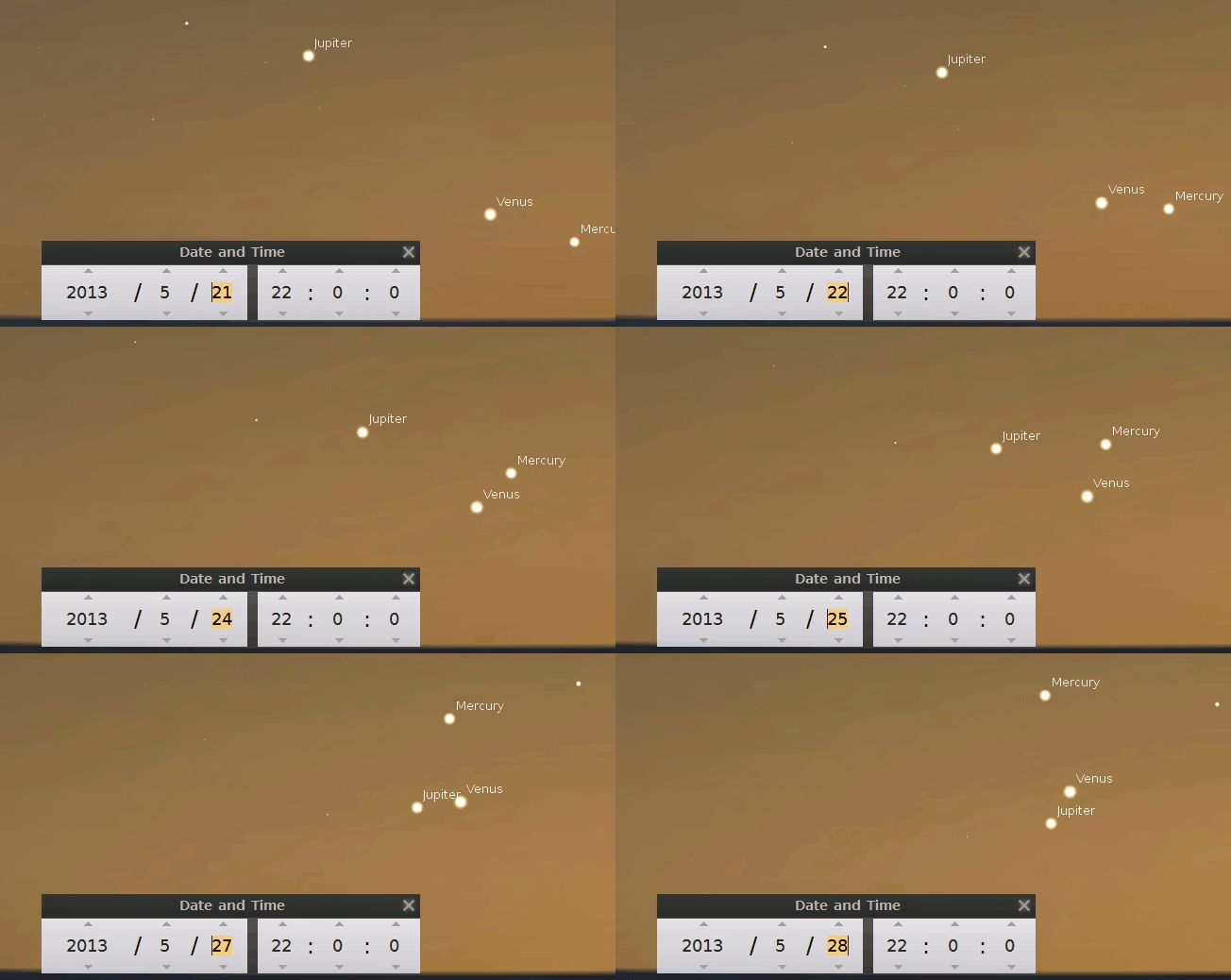
Dance of the planets Jupiter, Venus and Mercury, May 21 thru May 28, 2013. Created using Stellarium. Click on the image to start animation.
05/24/2013 – Ephemeris – The grouping of planets will reach its climax Sunday
Ephemeris for Friday, May 24th. Today the sun will be up for 15 hours and 7 minutes, setting at 9:13. The moon, 1 day before full, will set at 6:31 tomorrow morning. Tomorrow the sun will rise at 6:04.
This holiday weekend the planet grouping of Jupiter, Venus and Mercury reach their most compact. The group is collapsing rapidly, and the planets will be at their most compact Sunday night the 26th. For a preview of the planet’s motion go to my blog at bobmoler.wordpress.com. As far as any astronomical significance to this alignment of the planets, there isn’t any. Astrologers make a big deal of such groupings, called conjunctions but astronomers have long since discarded astrology as not having any scientific value. Conjunctions like this are reasonably rare and rather remarkable in appearance. It is for this reason that we track and observe them. The heavens are filled with beauty,
Times are for the Traverse City/Interlochen area of Michigan. They may be different for your location.
Addendum
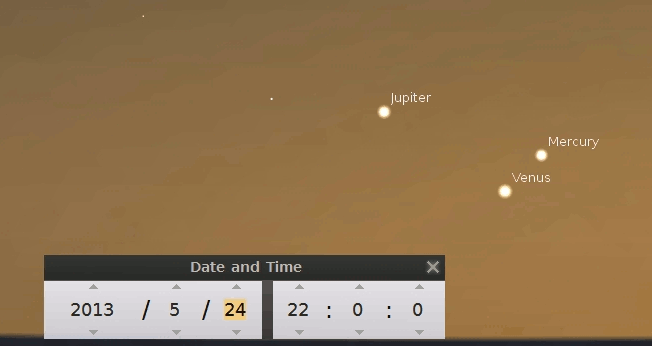
Jupiter, Venus and Mercury at 10 p.m. on May 24, 2013. Created using Stellarium.
Dance of the planets Jupiter, Venus and Mercury, May 21 thru May 28, 2013. Created using Stellarium. Click on the image to start animation if it has stopped.
05/23/2013 – Ephemeris – The planetary group tightens
Ephemeris for Thursday, May 23rd. Today the sun will be up for 15 hours and 5 minutes, setting at 9:12. The moon, 2 days before full, will set at 5:39 tomorrow morning. Tomorrow the sun will rise at 6:05.
Lets take a look at the planet jam in the west after sunset. There’s a rather short period and a very low western horizon that will let you see them. Jupiter will be on top, with Venus just below and to its right. Mercury will be to Venus’ right and just a bit higher. The separation from Jupiter to Mercury is just under 6 degrees, a bit more than half the width of a fist held at arm’s length. It is generally true that the width of one fist held at arm’s length describes a ten degree angle in the sky, Kind of a rule of thumb, or in this case fist to help one gauge the sky with out a sextant or quadrant. Tomorrow the grouping will be getting even more compact. Reaching their most compact Sunday evening.
Times are for the Traverse City/Interlochen area of Michigan. They may be different for your location.
Addendum
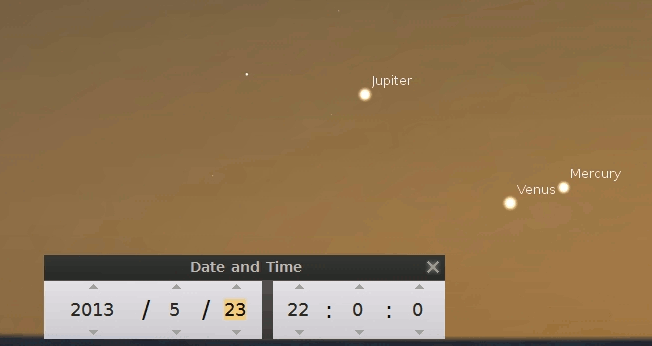
Jupiter, Venus and Mercury at 10 p.m. on May 23, 2013. Created using Stellarium.
Dance of the planets Jupiter, Venus and Mercury, May 21 thru May 28, 2013. Created using Stellarium. Click on the image to start animation.

