Archive
09/07/2016 – Ephemeris – Then there was one in the west and two in the southwest
Ephemeris for Wednesday, September 7th. The Sun will rise at 7:12. It’ll be up for 12 hours and 54 minutes, setting at 8:07. The Moon, 2 days before first quarter, will set at 11:29 this evening.
Tonight we still have all the bright classical planets in the evening sky, barely. Venus, Mercury, Jupiter are very low in the west, but only Venus is briefly visible after sunset. It will set at 9:03 p.m. Later this month Mercury and Jupiter will pass the Sun to become visible in the morning sky. Venus alone will remain in the evening sky, slowly pulling away from the Sun. Mars, Saturn and the star Antares start the evening in the southwestern sky in a triangle, with Saturn on top, Mars below and to the left, and Antares below and right of Mars. Saturn, spectacular in telescopes with its rings, will set at 11:45 p.m. And Mars, moving rapidly to the east against the stars will set at 11:50 p.m.
Times are for the Traverse City/Interlochen area of Michigan. They may be different for your location.
Addendum
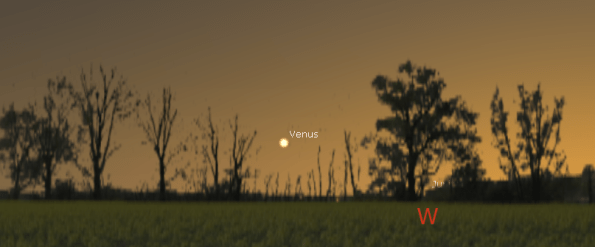
Looking very low in the west at 8:30 p.m., 20 minutes after sunset, September 7, 2016. Created using Stellarium.
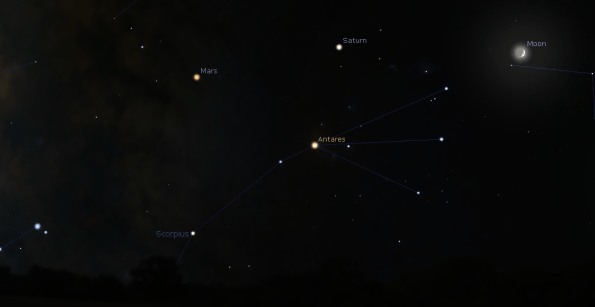
The Moon and the Mars-Saturn-Antares triangle at 9:30 p.m., September 7, 2016. Created using Stellarium.
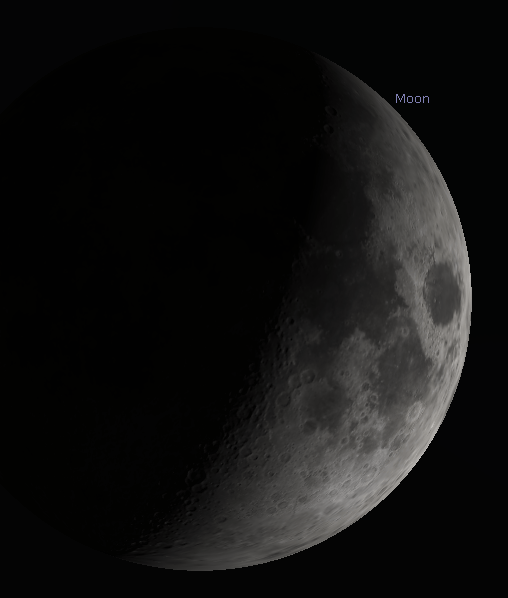
The Moon tonight as it might be seen in binoculars at 9:30 p.m. September 7, 2016. Created using Stellarium.
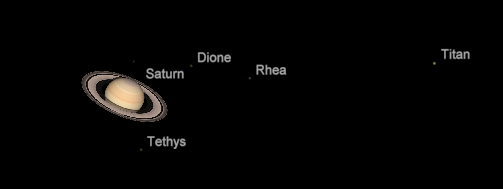
Saturn and some of its moons at 9:30 p.m. September 7, 2016. Created using Cartes du Ciel (Sky Charts).
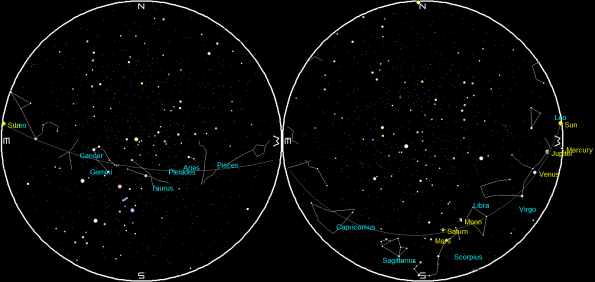
Planets and Moon at sunset and sunrise of a single night starting with sunset on the right on September 7, 2016. The night ends on the left with sunrise on September 8. Actually all the naked eye planets are in the evening sky. If you are using Firefox right-click on the image and select View Image to enlarge the image. That goes for all the large images. Created using my LookingUp program.
08/05/2016 – Ephemeris – Star party at NMC’s Rogers Observatory tonight
Ephemeris for Friday, August 5th. The Sun rises at 6:34. It’ll be up for 14 hours and 28 minutes, setting at 9:02. The Moon, 3 days past new, will set at 10:31 this evening.
There will be a star party this evening at Northwestern Michigan College’s Rogers Observatory hosted by the Grand Traverse Astronomical Society and the NMC Astronomy Club starting at 9 p.m. On tap, if it’s clear, will be Jupiter and the Moon early, then Mars and Saturn. Mars will appear quite small. As it gets darker the stars will appear. Some will show companion stars, while between the stars, what we call deep sky objects will be seen. Clusters of stars, and nebulae which can be either the birthplaces of stars or markers of dying stars. While other galaxies can be spotted our eyes are dazzled by our galaxy, the Milky Way spanning the sky from northeast to the south, in which these other objects dwell. The months of August and September are the months when the heart of the Milky Way is best seen.
Times are for the Traverse City/Interlochen area of Michigan. They may be different for your location.
Addendum
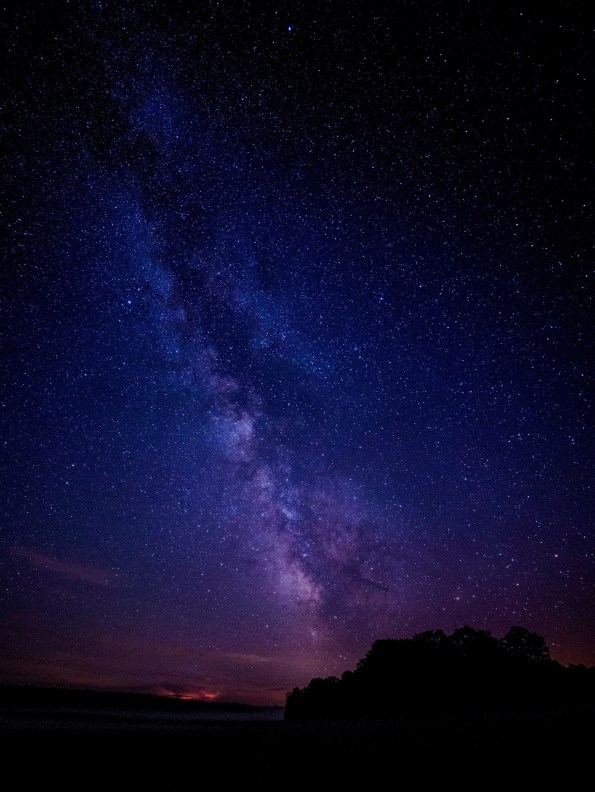
The Milky Way from the Sleeping Bear Dunes last August by Mark Stewart.
This year Saturn and Mars will be in the picture. In this picture Saturn is low and to the right.
08/03/2016 – Ephemeris – Jupiter is slipping toward the setting Sun
Ephemeris for Wednesday, August 3rd. The Sun rises at 6:31. It’ll be up for 14 hours and 33 minutes, setting at 9:05. The Moon, 1 day past new, will set at 9:29 this evening.
Venus and Mercury are in the evening sky but too close to the Sun to be easily seen. Check below for more information on the apparent interactions between the two. Jupiter will join the fray later this month. Jupiter is in the west in the evening. It will set at 10:44 p.m. Mars starts the evening in the south-southwestern sky, moving to the southwest. It’s right of its dimmer look-a-like star Antares, whose name means Rival of Mars. The Red Planet is back in Scorpius. The planet will set at 1:07 a.m. Mars is resuming its rapid eastward motion against the stars. The ringed planet Saturn is low in the south. It’s to the left of Mars. Saturn will pass due south at 9:25 p.m. and will set at 2:02 a.m.
Times are for the Traverse City/Interlochen area of Michigan. They may be different for your location.
Addendum
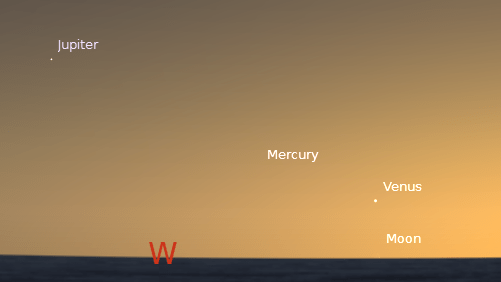
Venus, Mercury the day old Moon (not really visible) and Jupiter at 9:25 p.m. (20 minutes after sunset), August 3, 2016. Created using Stellarium.
Spotting the Moon and these planets requires a Lake Michigan horizon and may be futile. The farther one is to the south the greater the angle that the line of planets make with the horizon. This is not a good apparition of Mercury for us, but a good one for folks in the southern hemisphere.
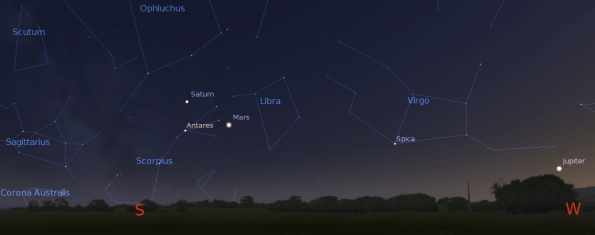
The planets and constellations at 10 p.m., August 3, 2016. Created using Stellarium.
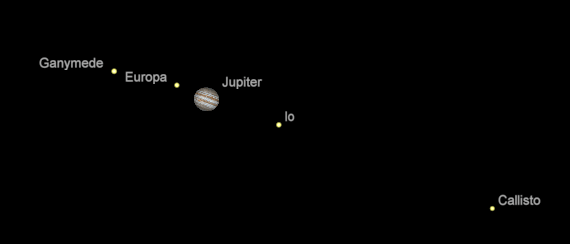
Jupiter and its satellites at 10 p.m., August 3, 2016. It will be close to the horizon and fuzzy in telescopes. Created using Cartes du Ciel (Sky Charts).
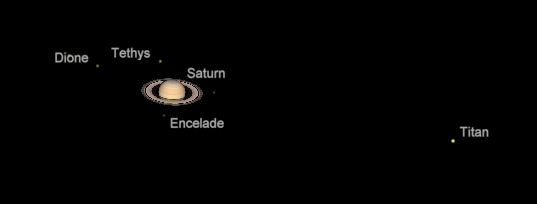
Saturn and its moons at 10 p.m. August 3, 2016. Created using Cartes du Ciel (Sky Charts).
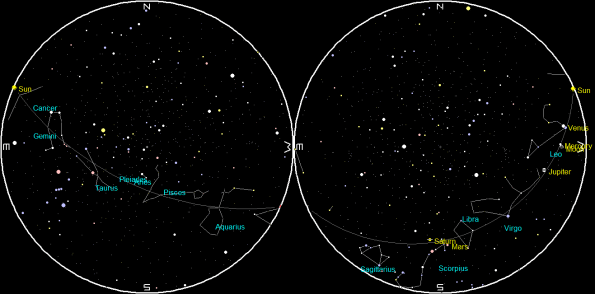
Planets at sunset and sunrise of a single night starting with sunset on the right on August 3, 2016. The night ends on the left with sunrise on August 4. Actually all the naked eye planets are in the evening sky. If you are using Firefox right-click on the image and select View Image to enlarge the image. That goes for all the large images. Created using my LookingUp program.
07/19/2016 – Ephemeris – The bright Moon is seen low in the summer
Ephemeris for Tuesday, July 19th. Today the Sun will be up for 15 hours and 6 minutes, setting at 9:22, and it will rise tomorrow at 6:16. The Moon, at full today, will rise at 9:00 this evening.
In the summer time the moon appears to be seen low in the south. If you can remember back six month to winter and where the bright moon was then. It was very high in the sky then. The reason for the difference in altitude of the bright moon is that the Moon follows closely the Sun’s yearly track against the stars. That track is the ecliptic, along which the constellations of the Zodiac lie. The Moon’s own orbit of the Earth departs from that by five degrees. Tonight the Moon will be about 3 degrees, or 6 Moon diameters above of north of that line. The full Moon happens to be in the same place, plus or minus up to five degrees north or south of where the Sun was 6 months ago or will be 6 months hence.
Times are for the Traverse City/Interlochen area of Michigan. They may be different for your location.
Addendum
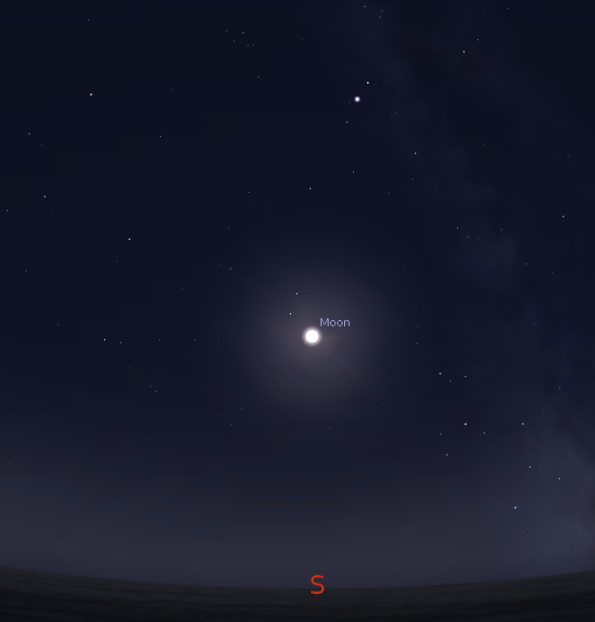
The Moon is low in the south on July 20, 2016. Created using Stellarium.
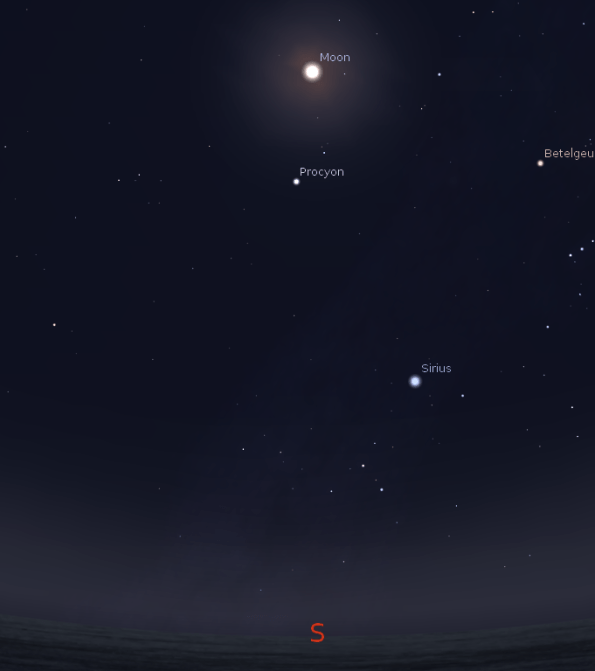
The Moon is high in the south on January 23, 2016. Created using Stellarium.
These images are the same scale.
06/15/2016 – Ephemeris – Three bright planets still reign in the evening sky
Ephemeris for Wednesday, June 15th. Today the Sun will be up for 15 hours and 33 minutes, setting at 9:30, and it will rise tomorrow at 5:56. The Moon, 3 days past first quarter, will set at 3:51 tomorrow morning.
Let’s see what the bright naked eye planets are up to. Jupiter is in the southwest in the early evening, moving to the west-southwest. It will set at 1:41 a.m. It’s below the stars of Leo this year. Binoculars can make out some of Jupiter’s moons, but a telescope is required to see all four bright moons and Jupiter’s cloud features. Mars starts the evening in the southeast. It’s above and right of its look-a-like star Antares, whose name means Rival of Mars. Mars will move due south at 11:29 p.m. and will set at 4:02 a.m. Saturn is low in the east-southeast. It’s below and to the left of Mars. Saturn will pass due south at 12:47 a.m. and will set at 5:23 a.m. It’s a wonderful telescopic sight.
Times are for the Traverse City/Interlochen area of Michigan. They may be different for your location.
Addendum
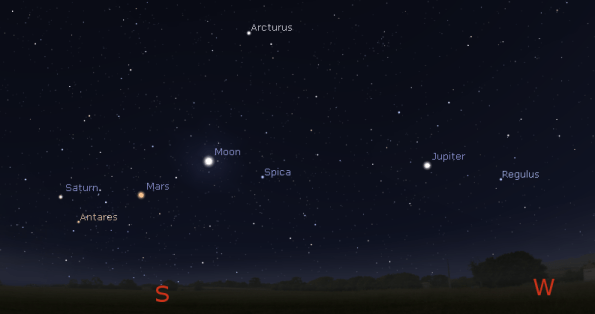
The Moon and the evening planets at 11 p.m., June 15, 2016. The Moon is too small to show the crescent, but see below. Created using Stellarium.
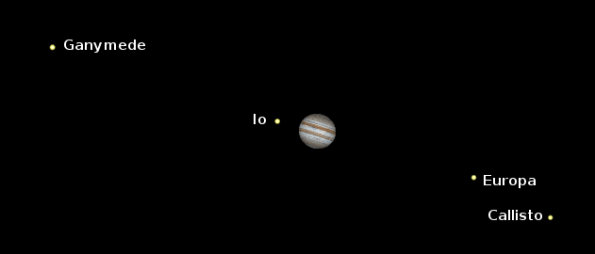
Jupiter and its Galilean moons at 11 p.m. June 15, 2016. Jupiter’s apparent diameter will be 35.7″. Created using Cartes du Ciel (Sky Charts).
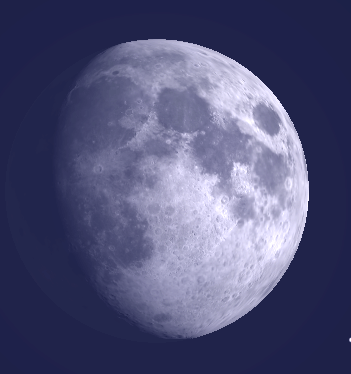
The Moon as it might appear in binoculars tonight, June 15, 2016 at 11 p.m. Created using Stellarium.
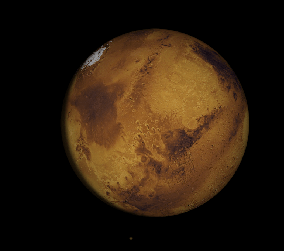
Mars as it might be seen in a large telescope with high power at 11 p.m. June 15, 2016. Mars apparent diameter is 17.9″. The central meridian will be 0.45 degrees. Created using Cartes du Ciel (Sky Charts).
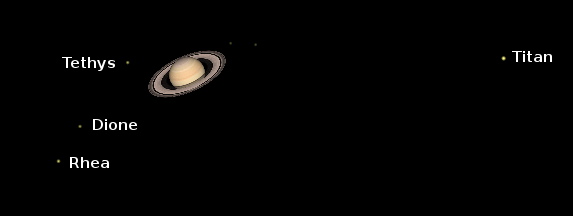
Saturn and its moons at 11 p.m. June 15, 2016. The apparent diameter of the planet will be 18.4″. The rings span 42.8″, larger than the apparent diameter of Jupiter. Created using Cartes du Ciel (Sky Charts).
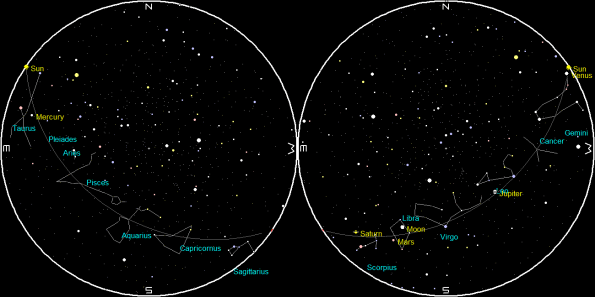
Planets at sunset and sunrise of a single night starting with sunset on the right on June 15, 2016. The night ends on the left with sunrise on June 16. If you are using Firefox right-click on the image and select View Image to enlarge the image. That goes for all the large images.
06/08/2016 – Ephemeris – Jupiter, Mars and Saturn rule the evening sky
Ephemeris for Wednesday, June 8th. Today the Sun will be up for 15 hours and 29 minutes, setting at 9:26, and it will rise tomorrow at 5:57. The Moon, half way from new to first quarter, will set at 12:23 tomorrow morning.
Let’s see what the bright naked eye planets are up to. Jupiter is in the south-southwest in the early evening, moving to the west-southwest. It will set at 2:07 a.m. It’s below the stars of Leo this year. Binoculars can make out some of Jupiter’s moons, but a telescope is required to see all four bright moons and Jupiter’s cloud features. Mars starts the evening in the southeast. It’s above and right of its look-a-like star Antares, whose name means Rival of Mars. Mars will move due south at 11:58 p.m. and will set at 4:35 a.m. Saturn is low in the east-southeast. It’s below and to the left of Mars.
Times are for the Traverse City/Interlochen area of Michigan. They may be different for your location.
Addendum
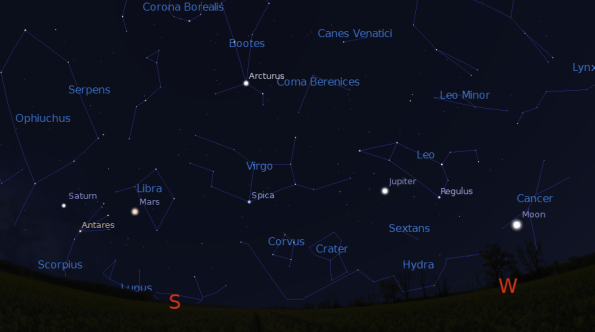
The Moon and the evening planets with the stars and constellations at 11 p.m., June 8, 2016. The Moon is too small to show the crescent, but see below. Created using Stellarium.
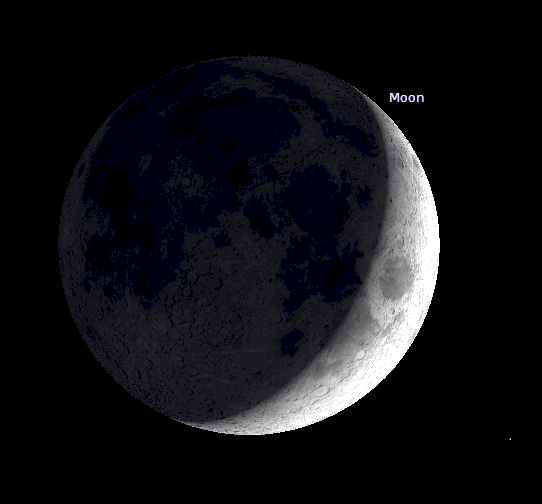
The Moon as it might appear in binoculars tonight, June 8, 2016 at 11 p.m. Created using Stellarium.
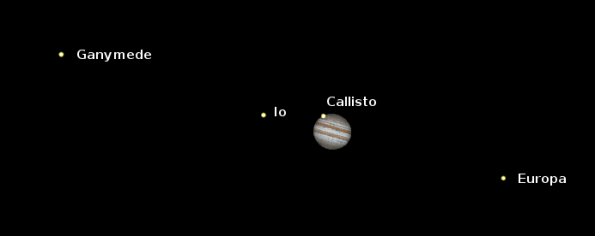
Jupiter and its Galilean moons at 11 p.m. June 8, 2016. Jupiter’s apparent diameter will be 36.3″. Note that Callisto began a transit across the face of Jupiter at 10:59 p.m. (02:59 UT) It will be hard to spot since the satellites appear here much brighter in relation to the planet than they actually are. The transit will end at 2:14 a.m. (06:14 UT) just after it sets here. Created using Cartes du Ciel (Sky Charts).
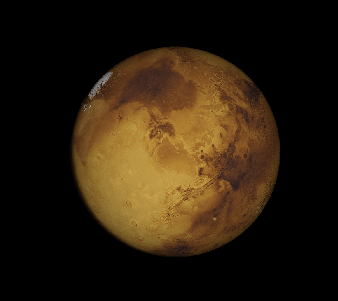
Mars as it might be seen in a large telescope with high power at 11 p.m. June 8, 2016. Mars apparent diameter is 18.3″. The central meridian will be 62.82 degrees. Created using Cartes du Ciel (Sky Charts).
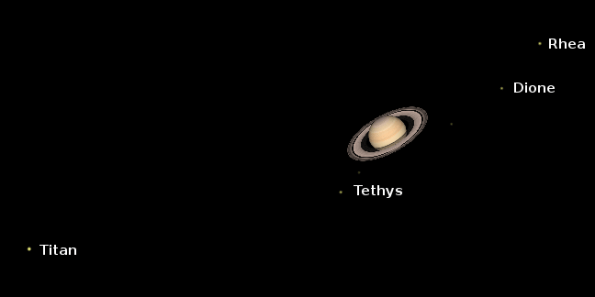
Saturn and its moons at 11 p.m. June 8, 2016. The apparent diameter of the planet will be 18.4″. The rings span 42.9″, larger than the apparent diameter of Jupiter. Created using Cartes du Ciel (Sky Charts).
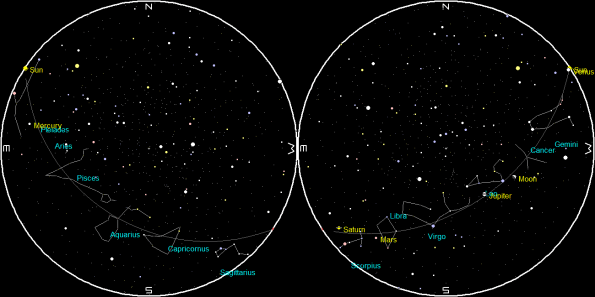
Planets at sunset and sunrise of a single night starting with sunset on the right on June 8, 2016. The night ends on the left with sunrise on June 9. If you are using Firefox right-click on the image and select View Image to enlarge the image. That goes for all the large images.
05/17/2016 – Ephemeris – Three heliocentrists memorialized on the Moon tonight
Ephemeris for Tuesday, May 17th. Today the Sun will be up for 14 hours and 55 minutes, setting at 9:07. The Moon, half way from first quarter to full, will set at 4:50 tomorrow morning. Tomorrow the Sun will rise at 6:10.
Tonight the gibbous Moon boasts the uncovering of three craters from lunar night whose namesakes were pioneers in putting forth the heliocentric theory. That is that the Earth and the other planets revolved about the Sun. Out the longest, and making the biggest splash is the crater Copernicus, named for the Polish cleric whose book On the Revolution of the Heavenly Spheres gave a new meaning to the word revolution, that is upheaval. The crater Kepler is about two-thirds the way from Copernicus and the terminator, named after the astronomer who discovered that the plants orbit the Sun in elliptical paths. Finally just catching sunlight is Aristarchus who in the 4th century BC first proposed a heliocentric solar system.
Times are for the Traverse City/Interlochen area of Michigan. They may be different for your location.
Addendum
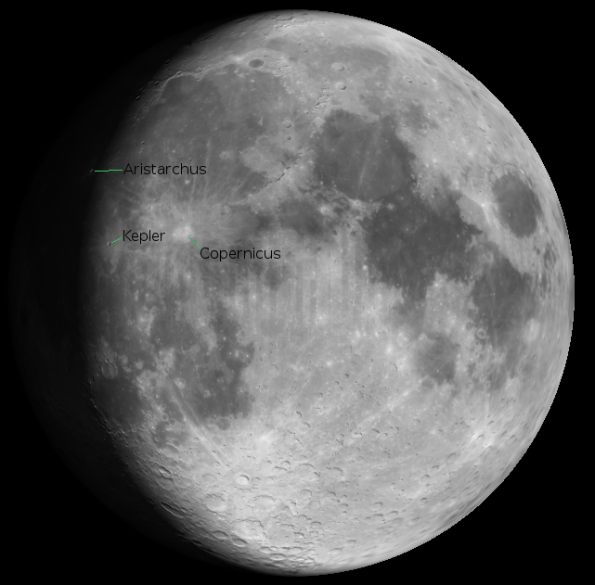
Three heliocentrists on the Moon at 10 p.m., May 17, 2016. Created using Virtual Moon Atlas.
05/16/2016 – Ephemeris – The Sun rises on the Bay of Rainbows
Ephemeris for Monday, May 16th. Today the Sun will be up for 14 hours and 53 minutes, setting at 9:06. The Moon, 3 days past first quarter, will set at 4:23 tomorrow morning. Tomorrow the Sun will rise at 6:11.
One of my favorite lunar formations is creeping into sunlight on the Moon this evening. Look to the upper left edge of the moon tonight. The large sea or dark area of the Moon, the Man in the Moon’s right eye as he’s looking at us is Mare Imbrium, the Sea of Showers. At the top left edge of that sea is a large notch. And keeping with of seas these of the first telescopic astronomers its name is Sinus Iridium, or Bay of Rainbows, a colorful name for something as colorless as the rest of the Moon. The terminator which is the sunrise line will be cutting across that bay, illuminating the semicircular mountain ring that surrounds it before all of the floor is illuminated. It can be seen in binoculars or a small telescope.
Times are for the Traverse City/Interlochen area of Michigan. They may be different for your location.
Addendum
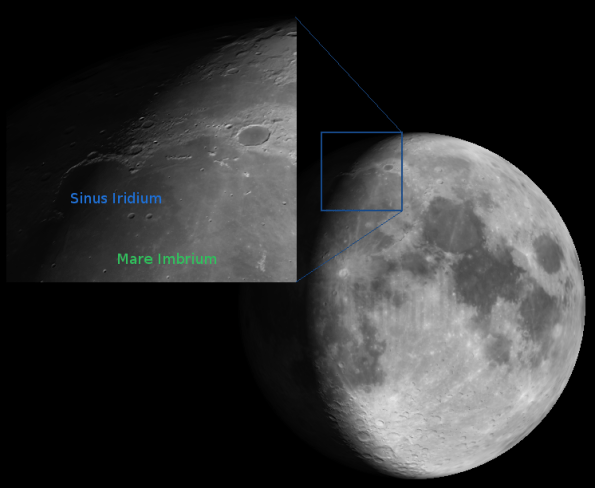
Image showing the Moon tonight at 10 p.m., May 16, 2016 (2 hr, May 17, 2016 UT) with Sinus Iridium (Bay of Rainbows) just coming into sunlight. Created using the Virtual Moon Atlas.
05/11/2016 – Ephemeris – Three of the bright planets are seen before midnight
Ephemeris for Wednesday, May 11th. Today the Sun will be up for 14 hours and 41 minutes, setting at 9:00. The Moon, 2 days before first quarter, will set at 1:48 tomorrow morning. Tomorrow the Sun will rise at 6:17.
Let’s see what the bright naked eye planets are up to. Mercury is now officially in the morning sky but too close to the Sun to be seen. Jupiter is in the south in the early evening, and will pass due south at 9:22 p.m., and will set at 3:55a.m. It’s below the stars of Leo this year. Binoculars can make out some of Jupiter’s moons, but a telescope is required to see all four bright moons and Jupiter’s cloud features. Mars will rise at 10:33 p.m. in the east-southeast. It’s still above its look-a-like star Antares, whose name means Rival of Mars. Mars is getting closer to the Earth now, only 50 million miles away It will be closest on the 30th. Saturn will rise at 10:41 p.m. in the east-southeast. It’s just left of Mars.
Times are for the Traverse City/Interlochen area of Michigan. They may be different for your location.
Addendum
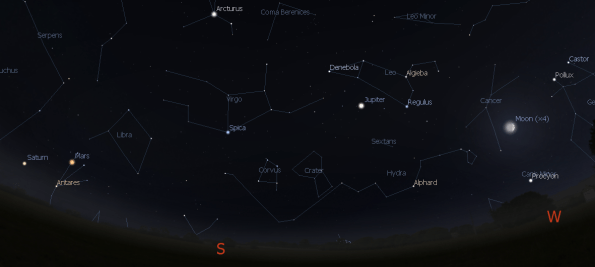
The evening sky tonight at 11:30 p.m. Created using Stellarium.
04/20/2016 – Ephemeris – Two bright planets in the evening, and two in the morning
Ephemeris for Wednesday, April 20th. The Sun rises at 6:49. It’ll be up for 13 hours and 45 minutes, setting at 8:34. The Moon, 2 days before full, will set at 6:47 tomorrow morning.
Let’s see what the bright naked eye planets are up to. Mercury is in the west-northwest, very low to the horizon, setting at 10:26 p.m. Mercury is fading now. Jupiter is in the southeast in the evening, and will pass due south at 10:46 p.m., and will set at 5:19 a.m. It’s below the stars of Leo this year. Binoculars can make out some of Jupiter’s moons, but a telescope is required to see all four bright moons and Jupiter’s cloud features. Mars will rise at 11:40 p.m. in the east-southeast. It’s above Scorpius but is actually in western Ophiuchus now. Saturn will rise at 12:09 a.m. in the east-southeast. It’s just left of Mars. Its rings are a telescopic treat. Venus will rise at 6:28 a.m. and not visible in the bright twilight.
Times are for the Traverse City/Interlochen area of Michigan. They may be different for your location.
Addendum
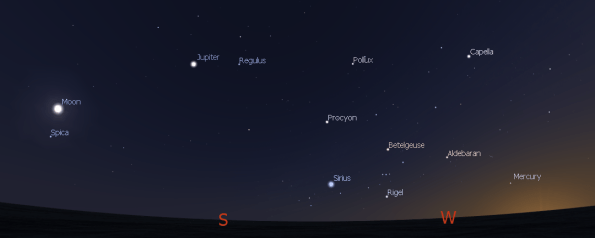
Mercury, Jupiter, the Moon and bright stars visible at 9:30 p.m. April 20, 2016.. Created using Stellarium.
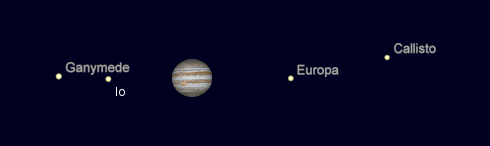
Jupiter and its moons as they might be seen through a telescope at 9:30 p.m. April 20, 2016. It’s 42.0″ in diameter. Created using Cartes du Ciel (Sky Charts).
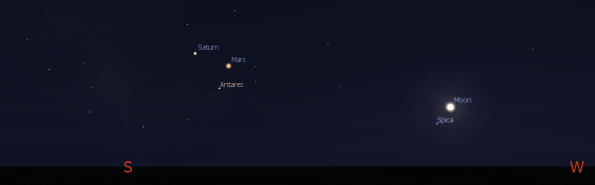
The Moon, Mars and Saturn and the bright stars at 5:30 a.m. April 21, 2016. Created using Stellarium.
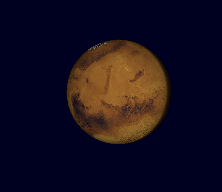
Mars as it might be seen in a large telescope with high power at 5:30 a.m., April 21 2016. Mars apparent diameter is 14.6″. The central meridian will be 233.11 degrees. Syrtis Major is at the extreme left of the planet. Created using Cartes du Ciel (Sky Charts).
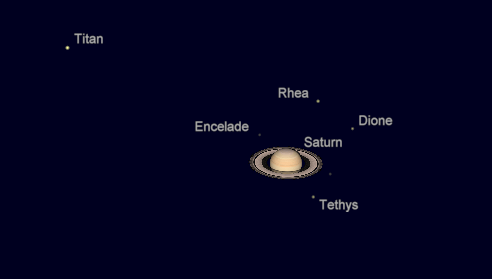
Saturn and its moons at 5:30 a.m., April 21, 2016. The apparent diameter of the planet is 17.9″. The rings span 41.7″, almost the apparent diameter of Jupiter. Created using Cartes du Ciel (Sky Charts).
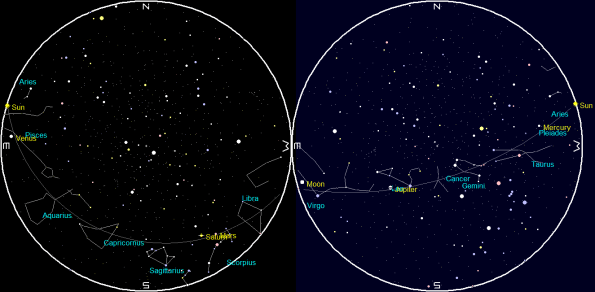
Planets at Sunrise and Sunset on April 20, 2016. If you are using Firefox right-click on the image and select View Image to enlarge the image.
 Bob Moler's Ephemeris Blog