Archive
01/05/2016 – Ephemeris – The crescent moon is passing the morning planets
Ephemeris for Tuesday, January 5th. The Sun will rise at 8:20. It’ll be up for 8 hours and 56 minutes, setting at 5:16. The Moon, 3 days past last quarter, will rise at 4:48 tomorrow morning.
This morning the crescent Moon will be in the morning sky about half way between Venus below and Mars above. Reddish Mars is to the left of the bright blue-white star Spica nearly in the south at 7 a.m. Jupiter is way high in the south-southwest by then. Venus is approaching Saturn, and they will apparently cross paths this Saturday. By tomorrow morning the Moon will be much closer to Venus, with our Morning Star about 5 degrees, or 10 Moon diameters below and left of the thin crescent Moon, which should be exhibiting earthshine by then. By Thursday the Moon will be about the same distance to the left of Venus. The line that can be drawn through planets, along the Zodiac, is lying down as the Sun is slowly heading northward.
Times are for the Traverse City/Interlochen area of Michigan. They may be different for your location.
Addendum
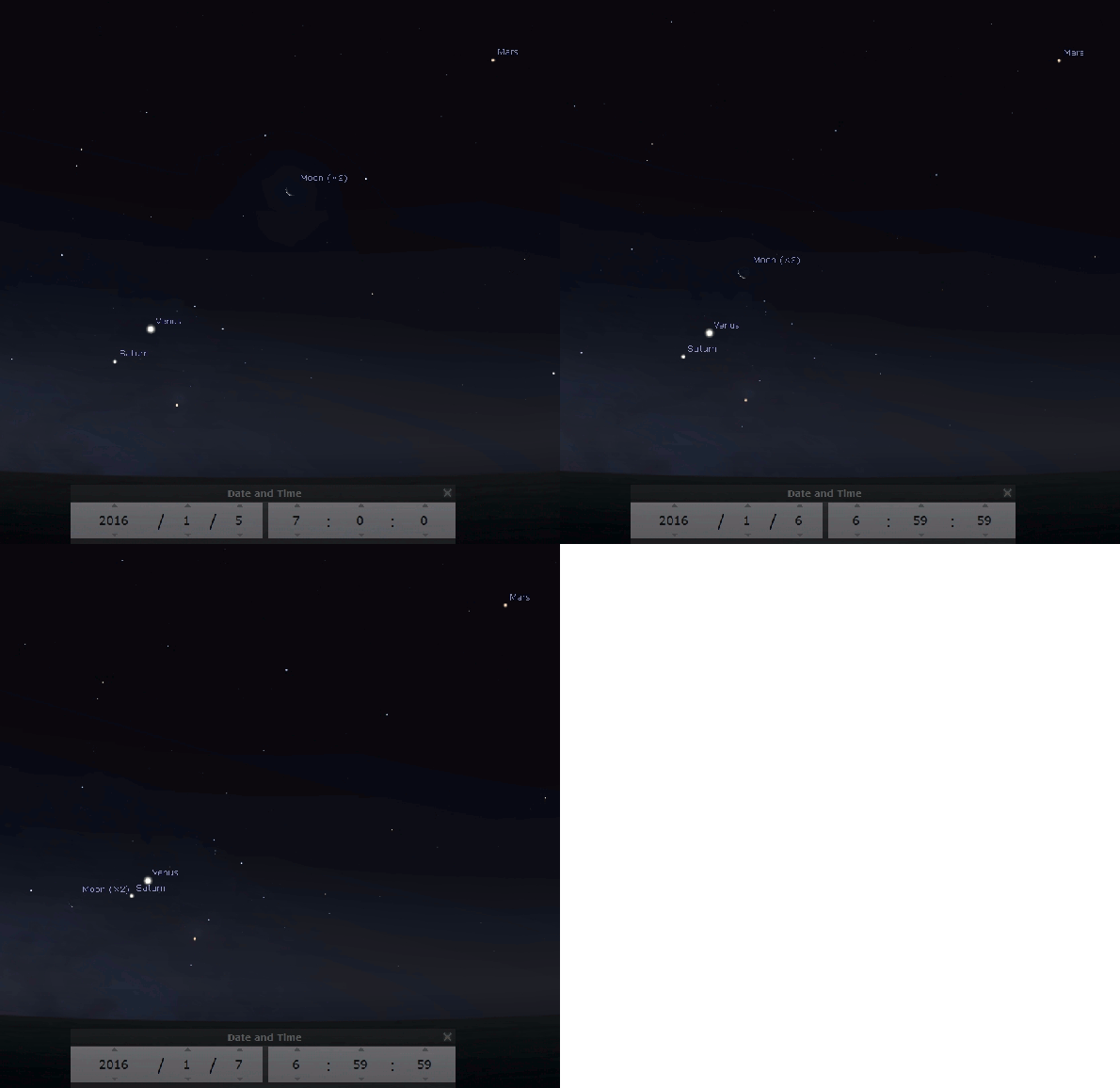
The travels of the crescent Moon by Venus and Saturn. Positions shown for 7 a.m. on consecutive mornings: January 5-7, 2016. The moon is shown twice its size for clarity. Created using Stellarium and GIMP.
12/30/2015 – Ephemeris – Last look at the bright planets for this year
Ephemeris for Wednesday, December 30th. The Sun will rise at 8:19. It’ll be up for 8 hours and 50 minutes, setting at 5:10. The Moon, 3 days before last quarter, will rise at 10:58 this evening.
Let’s check out the whereabouts of the bright naked eye planets. Mercury moved to its greatest separation from the Sun Monday night. It will be visible very low in the southwest before it sets at 6:42 p.m. in the west-southwest. In the morning sky there are four bright planets. Jupiter will be the first to rise, actually at 11:23 p.m., in the east. Tomorrow it will be just left of the Moon. Mars will rise next at 2:27 a.m. also in the east. It’s left of the bright star Spica. Venus will rise at 5:11 a.m. in the east-southeast. Saturn will rise at 6:10 a.m. in the east-southeast. Comet Catalina is a binocular object just below the bright star Arcturus, which is pointed to by the arc of the handle of the Big Dipper.
Times are for the Traverse City/Interlochen area of Michigan. They may be different for your location.
Addendum
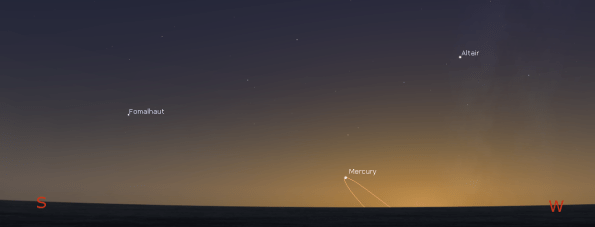
Mercury at 6 p.m., 50 minutes after sunset, December 30, 2015. It may be visible as early as 5:30. Binoculars will help. Created using Stellarium.
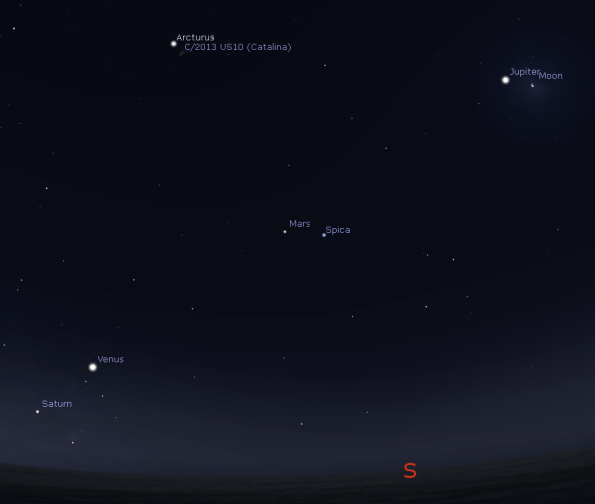
The morning planets, Jupiter, Mars, Venus and Saturn, plus Comet Catalina at 7 a.m. December 31, 2015. Created using Stellarium.
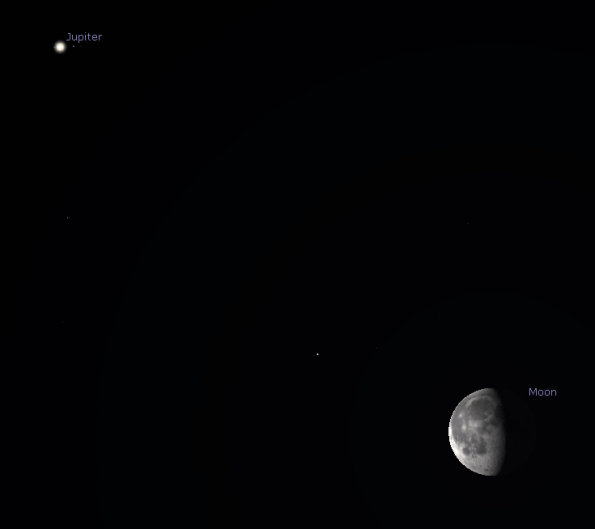
Jupiter and the Moon tomorrow morning December 31, 2015 at 7 a.m. Created using Stellarium.
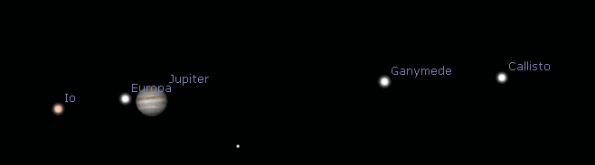
Telescopic view of Jupiter at 7 a.m. December 31, 2015. Created using Stellarium.
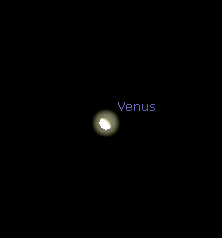
Telescopic view of Venus at 7 a.m. December 31, 2015. Created using Stellarium.
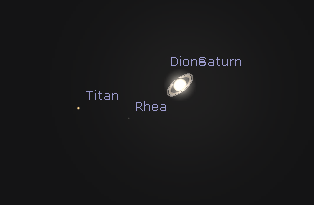
Telescopic view of Saturn at 7 a.m. December 31, 2015. The satellites would be pretty much invisible except for Titan with Saturn low in the sky in twilight. Created using Stellarium.
The three planet telescopic views are shown to the same scale, that is seen with the same magnification.
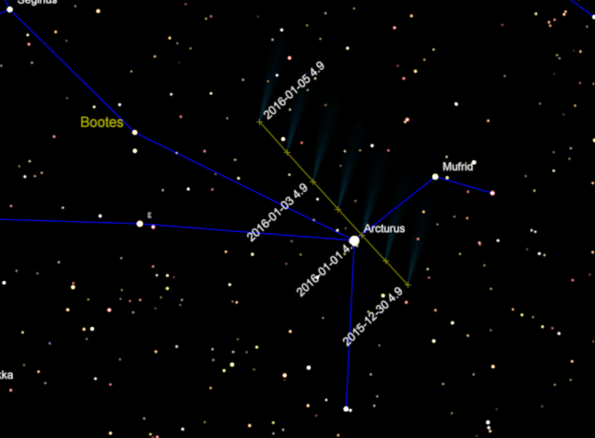
Comet Catalina’s path for the next week. Note the magnitudes for the comet are about 1 magnitude too bright. It will take binoculars or a small telescope to spot the comet which will not show a tail visually. Created using Cartes du Ciel (Sky Charts)..
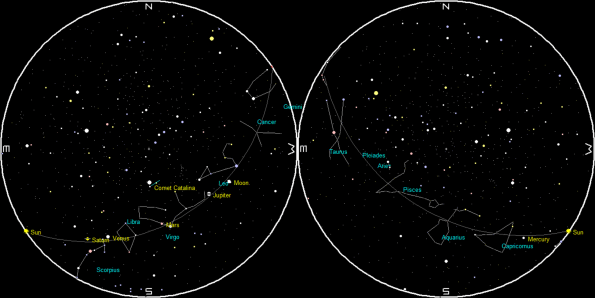
This is a chart showing the sunrise and sunset skies for December 30, 2015 showing the location of the planets, the Moon and Comet Catalina at that time. Created using my LookingUp program.
Several of the images above are shown smaller than actual size. Image expansion lately hasn’t worked. If you are using Firefox, right-click on the image, and then click on View Image.
12/16/2015 – Ephemeris – The planet action is still in the morning
Ephemeris for Wednesday, December 16th. The Sun will rise at 8:13. It’ll be up for 8 hours and 49 minutes, setting at 5:02. The Moon, 2 days before first quarter, will set at 10:57 this evening.
Let’s check out the whereabouts of the bright naked eye planets. Mercury is becoming marginally visible very low in the southwest before it sets at 6 p.m. In the morning sky there are three bright planets. Jupiter will be the first to rise, at 12:15 a.m. in the east. Mars will rise next at 2:39 a.m. also in the east, followed by Venus at 4:41 a.m. in the east-southeast. Mars lies in line between Venus below and Jupiter above, almost halfway between the two. Don’t confuse Mars with the star Spica which is brighter and right below it. Saturn will rise at 6:54 a.m. in the east-southeast. Comet Catalina is a telescopic object about one and a half the width of a fist held at arm’s length above Venus and the same amount left of Mars.
Times are for the Traverse City/Interlochen area of Michigan. They may be different for your location.
Addendum
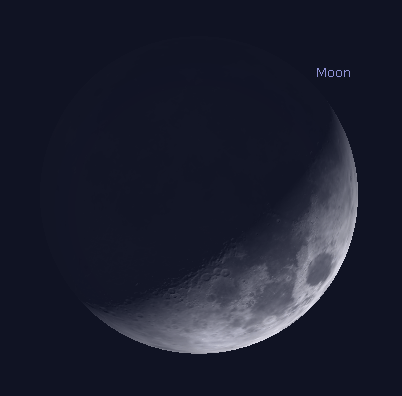
The moon as it might look in binoculars at 8 p.m., December 16, 2015. Created using Stellarium.
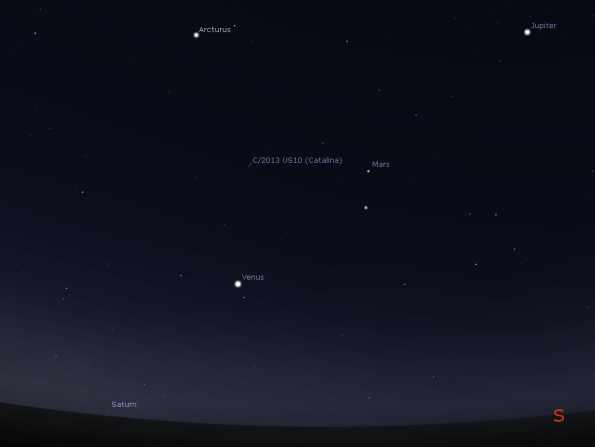
The Morning planets at 7 a.m., December 17, 2015. Created using Stellarium.
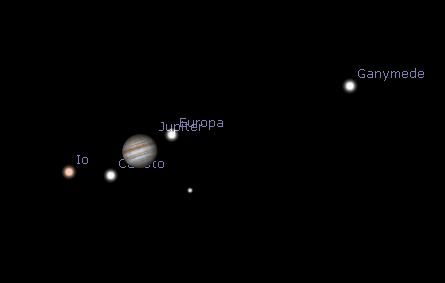
Jupiter and moons in a telescope at 7 a.m. December 17, 2015. Created using Stellarium.
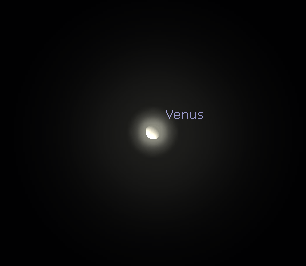
Venus as seen in a telescope as seen at the same magnification as Jupiter above, at 7 a,m. December 17, 2015. Created using Stellarium.
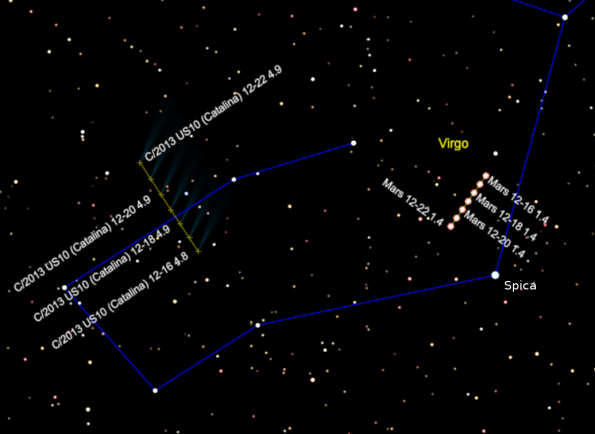
Comet Catalina and Mars for the next week. Note the magnitudes for the comet are about 1 magnitude too bright. It will take binoculars or a small telescope to spot the comet which will not show a tail visually. Created using Cartes du Ciel (Sky Charts).
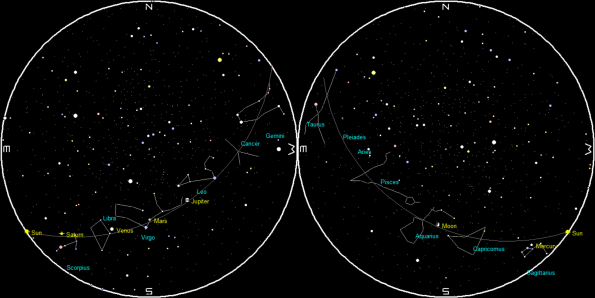
This is a chart showing the sunrise and sunset skies for December 16, 2015 showing the location of the planets and the Moon at that time. Created using my LookingUp program. Click on the image to enlarge.
12/07/2015 – Ephemeris – Today the Moon will pass in front of the planet Venus
Ephemeris for Monday, December 7th. The Sun will rise at 8:06. It’ll be up for 8 hours and 56 minutes, setting at 5:02. The Moon, half way from last quarter to new, will rise at 5:04 tomorrow morning.
The Moon will pass in front of Venus between about 12:20 p.m. and 1:27 p.m. for the Interlochen, Traverse City Area. Times will vary as much as 5 minutes over the IPR listening area. Some sort of telescopic aid is needed to see Venus and the crescent Moon in daylight. The crescent Moon is quite faint, though Venus should be easier to spot because it’s brighter. I have a special post on my blog dated Saturday December 5th.. It’s titled Venus Occultation December 7, 2015 from Northern Michigan with all the details. My blog is bobmoler.wordpress.com, or do an Internet search for Bob Moler, That’s Moler spelled M-O-L-E-R, no extra letters. And hope for clear skies.
Times are for the Traverse City/Interlochen area of Michigan. They may be different for your location.
Addendum
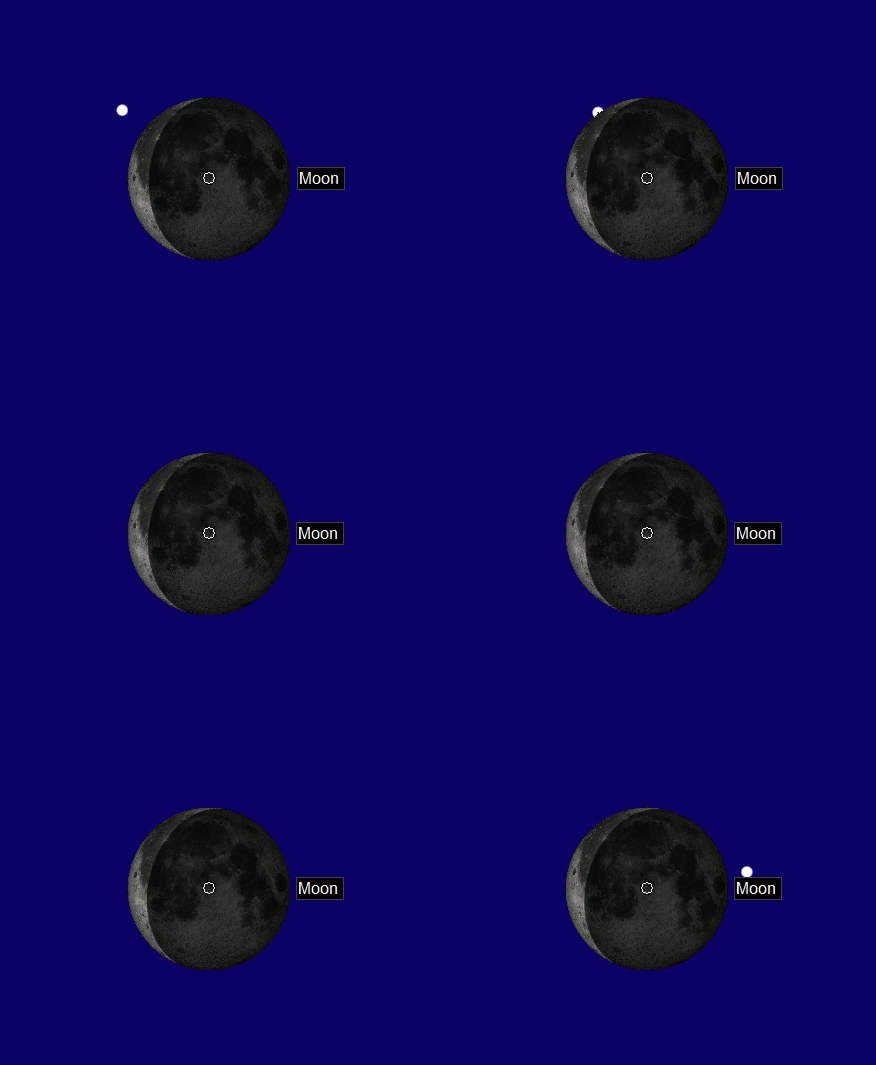
Animation of the occultation. Created using Cartes du Ciel (Sky Charts) and GIMP.
Venus Occultation December 7, 2015 from Northern Michigan
What is an occultation? An occultation is when one nearer celestial body covers or hides another, more distant body. The word occultation comes from occult which simply means hidden. No black magic is involved.
The occultation of Venus will occur on December 7, from 12:21 p.m. to 1:27 p.m. for the Grand Traverse Area, give or take a few minutes either way. The exact time depends on your location. This event would be a great sight if it occurred in the early morning skies before sunrise. Unfortunately it’s centered on 1 p.m. Venus and the Moon are visible in the daytime with a telescope and even binoculars, but are difficult to find. The Moon and Venus do make a beautiful sight in the morning in the 5 to 7 a.m. hours.
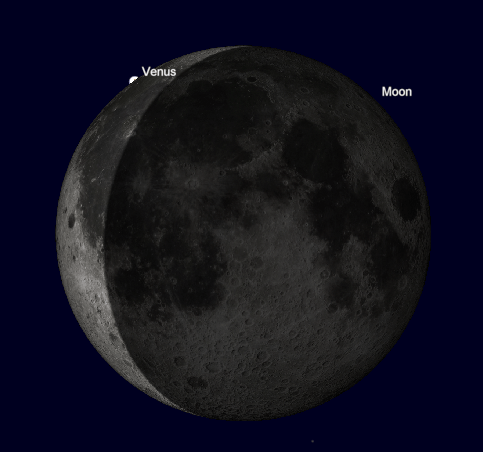
Disappearance of Venus at 12:20 p.m. Created using Cartes du Ciel (Sky Charts).
The trick to viewing this event is even finding the Moon or Venus. One could set up a telescope with tracking ability to track Venus throughout the morning. Unless you have a telescope Go To mount and can track the Moon, track Venus instead. The Moon moves about its own diameter with respect to the stars in an hour, so it will have to be constantly adjusted to keep pointed at the Moon. Actually Venus has a higher surface brightness than the Moon, so it should be easier to track, especially if the sky is hazy and the Moon isn’t visible.
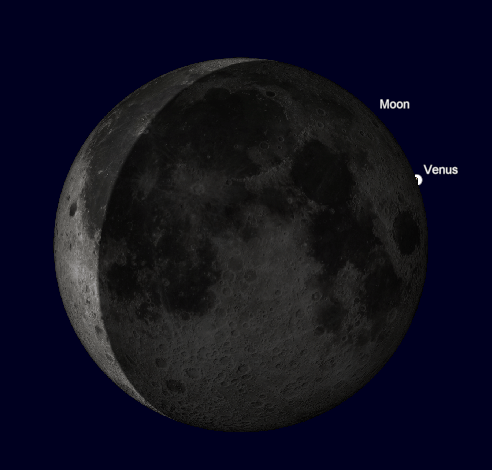
Disappearance of Venus at 1:27 p.m. Created using Cartes du Ciel (Sky Charts).
Unlike a stellar occultation Venus will disappear over several seconds. A telescope capable to seeing Venus’ gibbous phase will see the bright edge of the Moon actually pass in front it. Venus will emerge from the Moon’s dark side which will be invisible. So Venus will slowly reappear next to the crescent Moon. Hoping for clear skies, and good luck.
If you are not located near Traverse City, you can use my technique to estimate the occultation times. I used Cartes du Ciel the free software found on the Internet at http://www.ap-i.net/skychart/en/start. Make sure that the program is set for topocentric positions under Setup/Solar System. And you have entered your position under Setup/Observatory. You can find your location in Google Earth.
You can also use Stellarium (http://stellarium.org). Just make sure the Moon is normal sized.
In both programs you can lock the Moon or Aldebaran in the center of the screen Pick a time in advance of the occultation and using the set time window walk the star towards the Moon, mark the time. Then walk the star out from the Moon and record the reappearance time. That’s it.
This should work with other planetarium programs too.
Animation of the occultation. Created using Cartes du Ciel (Sky Charts) and GIMP.
For better accuracy go to the International Occultation Timing Association (IOTA) website. Download and install their Occult4 program for Windows computers. Follow the instructions. When I ran the program for my location, the location I use for Interlochen/Traverse City (Since I live approximately half-way between the two). I got results within a half-minute of the IOTA Occult4 program results. So the approximation method using planetarium programs is valid.
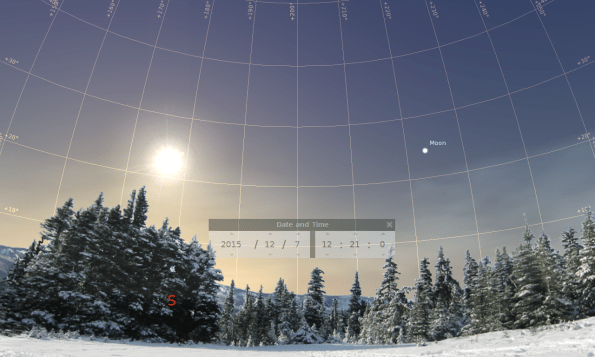
Sun and Moon’s positions at the start of the occultation from northern Michigan. Note the Moon and Venus will be invisible to the naked eye. Created using Stellarium.
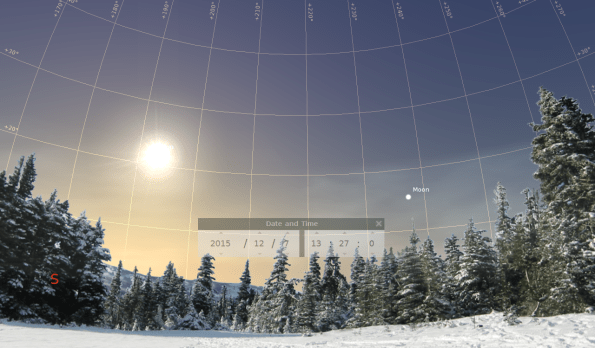
Sun and Moon’s positions at the end of the occultation from northern Michigan. Note the Moon and Venus will be invisible to the naked eye. Created using Stellarium.
When I made up the above images I really thought there would be snow on the ground by now. But what little we had has come and gone.
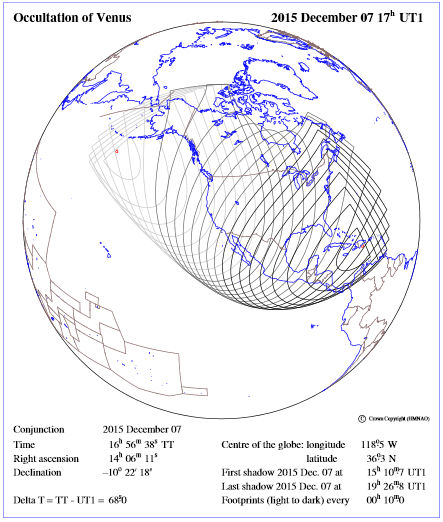
Occultation of Venus Visibility Map for North America. Credit: Astronomical Almanac Online -U.S. Nautical Almanac Office, United States Naval Observatory (USNO), in the United States and Her Majesty’s Nautical Almanac Office (HMNAO), United Kingdom Hydrographic Office (UKHO), in the United Kingdom.
12/03/2015 – Ephemeris – The Moon will pass by the morning planets in the next few days
Ephemeris for Thursday, December 3rd. The Sun will rise at 8:01. It’ll be up for 9 hours and 1 minute, setting at 5:03. The Moon, at last quarter today, will rise at 1:11 tomorrow morning.
The Moon will be making a grand procession by the morning planets in the next few days, culminating with passing in front of Venus just after noon on Monday. This morning the Moon is approaching Jupiter to its lower left. By tomorrow morning Jupiter will be just above the Moon. Saturday morning the Moon will be approaching Mars, 12 of its diameters to its lower left. Sunday morning finds the crescent Moon between Mars and Venus with Mars 8 diameters above and right of the Moon. Monday Morning at 6 a.m. the Moon will be closing on Venus, with the brilliant planet just 4 moon diameters below left of the thin crescent Moon. Sharp eyed binocular and telescopic observers will be able see the Moon occult Venus after noon.
Times are for the Traverse City/Interlochen area of Michigan. They may be different for your location.
Addendum
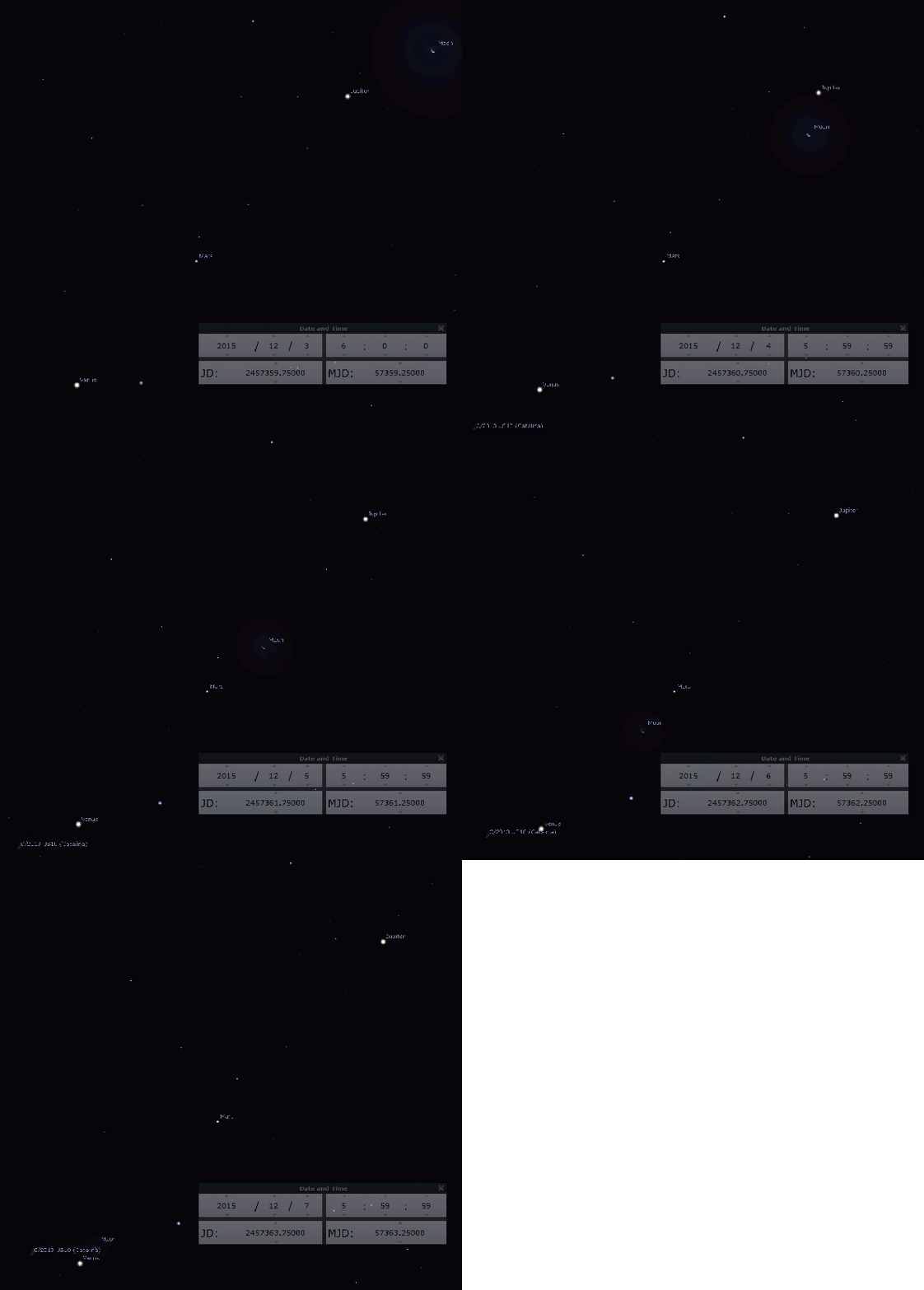
Animation of the Moon’s passage by the morning planets and Comet Catalina from December 2nd through the 7th, 2015. Created using Stellarium and GIMP.
12/02/2015 – Ephemeris – All the bright planet action is in the morning
Ephemeris for Wednesday, December 2nd. The Sun will rise at 8:00. It’ll be up for 9 hours and 2 minutes, setting at 5:03. The Moon, 1 day before last quarter, will rise at 12:12 tomorrow morning.
Let’s check out the whereabouts of the bright naked eye planets. Saturn and Mercury are too close to the direction of the Sun to be seen now. In the morning sky there are three bright planets. Jupiter will be the first to rise, at 1:03 a.m. in the east. Mars will rise next at 2:52 a.m. in the east, followed by Venus at 4:13 a.m. also in the east. Mars lies in line between Venus below and Jupiter above, almost halfway between Venus and Jupiter. The Moon will pass each of these planets in the next few days culminating by passing in front of Venus Monday. Comet Catalina will be about the width of a fist held at arm’s length below and left of Venus and will slowly be moving to the upper left and be level with Venus on the 6th.
Times are for the Traverse City/Interlochen area of Michigan. They may be different for your location.
Addendum
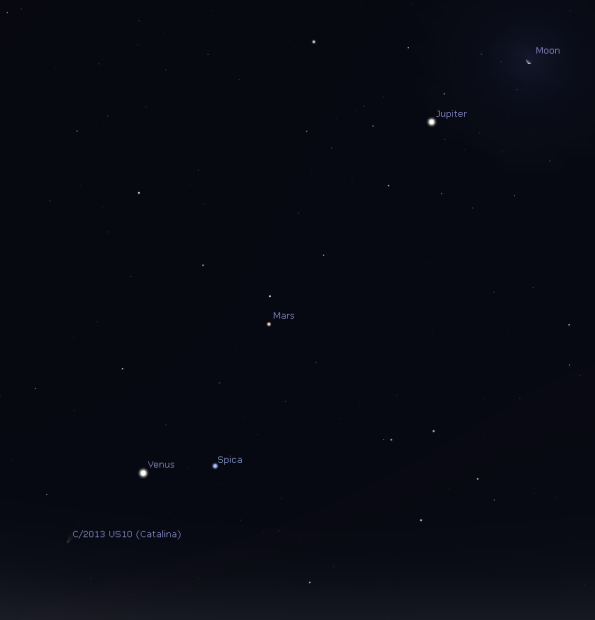
The Moon, Jupiter, Mars and Venus appear in the southeast at 6 a.m., December 3, 2015. Note that Comet Catalina is near Venus. Created using Stellarium.
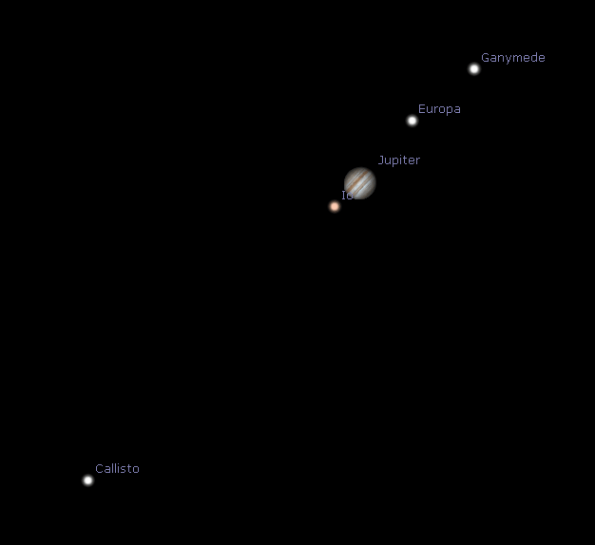
Jupiter and moons in a telescope at 6 a.m. December 3, 2015. Created using Stellarium.
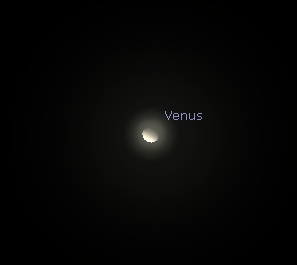
Venus as seen in a telescope as seen at the same magnification as Jupiter above, at 6 a,m. December 3, 2015. Created using Stellarium.
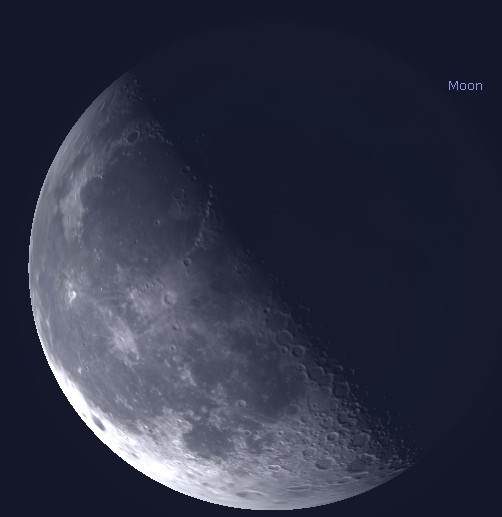
The Moon as seen in a binoculars or small telescope at 6 a,m. December 3, 2015. Created using Stellarium.
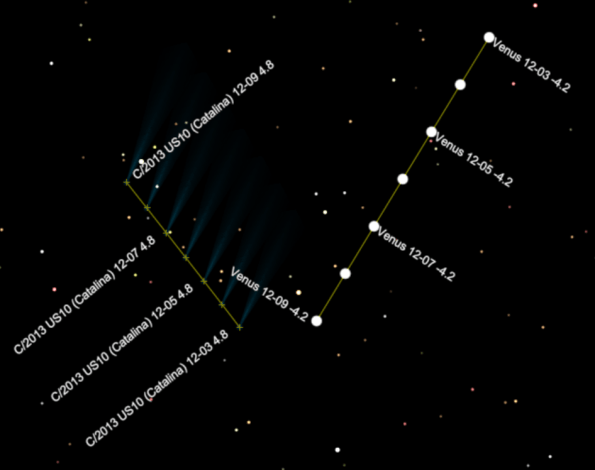
Comet Catalina and Venus for the next week. Note the magnitudes for the comet are about 2 magnitude too bright. It will take binoculars or a small telescope to spot the comet.
11/25/2015 – Ephemeris – The occultation of Aldebaran is tomorrow morning!
Ephemeris for Wednesday, November 25th. The Sun will rise at 7:52. It’ll be up for 9 hours and 14 minutes, setting at 5:06. The Moon, at full today, will rise at 5:26 this evening.
Tomorrow morning between about 5:38 and 6:29 a.m. the Moon will pass in front of the bright star Aldebaran. The event is called an occultation. Aldebaran is the bright reddish star in the V-shaped face of the constellation Taurus the bull, which is seen in the sky charging Orion the hunter in the evening sky now. By the time of this event, they will have moved into the west. Aldebaran, though bright, doesn’t hold a candle to the nearly full Moon. I know that a holiday is a good day to sleep in, unless you are getting an early start on preparing the Thanksgiving feast. In any case the earlier you get out to spot Aldebaran the easier it will be to find in the Moon’s glare. Check out my posts on bobmoler.wordpress.com for more information.
Times are for the Traverse City/Interlochen area of Michigan. They may be different for your location.
Addendum
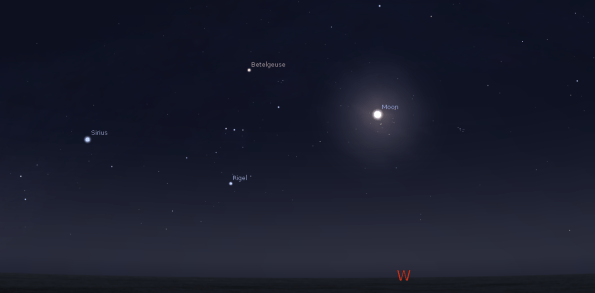
Here’s the Moon hiding Aldebaran in its glare at 5:30 a.m. tomorrow morning November 26, 2015. Created using Stellarium.
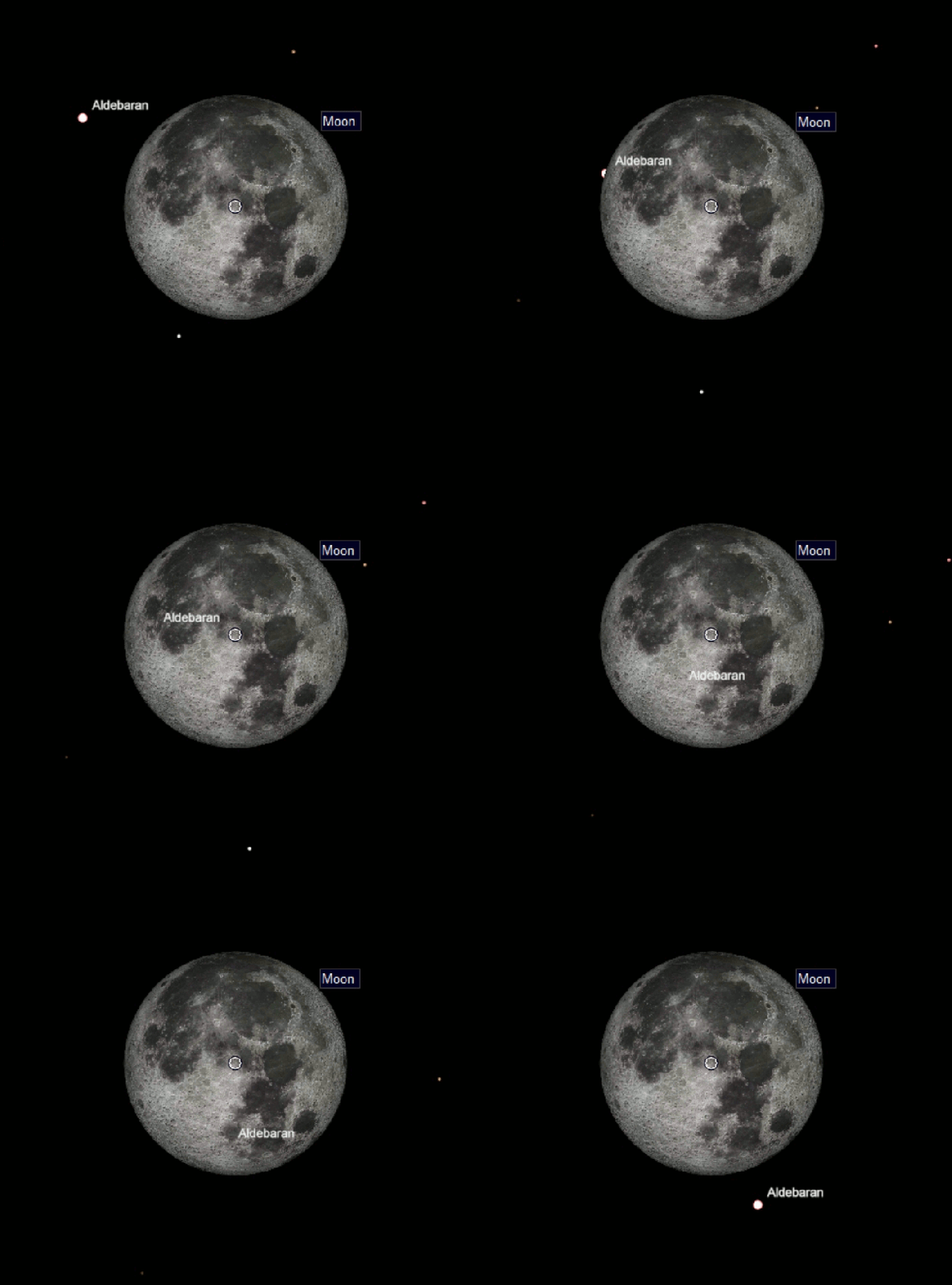
An occultation animation starting at 5:19 a.m. EST showing 10 minute intervals. Computer generated graphics cannot produce a point star. Aldebaran will wink out and back in an instant. Created using Cartes du Ciel (Sky Charts) and GIMP.
11/23/2015 – Ephemeris – An occultation of Aldebaran by the Moon will be visible to much of the northern US Thursday morning
Ephemeris for Monday, November 23rd. The Sun will rise at 7:49. It’ll be up for 9 hours and 18 minutes, setting at 5:08. The Moon, 2 days before full, will set at 5:58 tomorrow morning.
Thursday morning, Thanksgiving Day here in the US, the Moon will occult or pass in front of the bright star Aldebaran for the northern half of the United States, and Canada. I have a special post on my blog dated yesterday, November 22nd. It’s titled Aldebaran Occultation November 26, 2015 from Northern Michigan (click here) with all the details. My blog is bobmoler.wordpress.com, or do an Internet search for Bob Moler, That’s Moler spelled M-O-L-E-R, no extra letters. Aldebaran is the bright orange star in the face of the constellation Taurus the bull. You will need at least a pair of binoculars to pick out Aldebaran next to the Moon. Aldebaran will disappear at about 5:38 a.m. and reappear about 6:29 a.m. for Interlochen and Traverse City.
Times are for the Traverse City/Interlochen area of Michigan. They may be different for your location. The November 22 post has instructions on how to calculate the occultation times for your location, and has a map to see if you can view the occultation at all.
Addendum
An occultation animation starting at 5:19 a.m. EST showing 10 minute intervals. Not that the computer generated graphics cannot produce a point star. Aldebaran will wink out and back in an instant. Created using Cartes du Ciel (Sky Charts) and GIMP.
Aldebaran Occultation November 26, 2015 from Northern Michigan
On the early morning of November 26th, that’s Thanksgiving morning here in the US, The Moon will pass in front of, or occult, the bright star Aldebaran in Taurus the bull. The event is called an occultation.
Three first magnitude stars can be occulted by the Moon, Aldebaran, Regulus in Leo the lion, Antares in Scorpius the Scorpion, and Spica in Virgo the virgin, since these stars lie within 5 1/2 degrees of the ecliptic, the plane of the Earth’s orbit. The Moon’s orbit is inclined to it by 5º 14′. Also because the Moon’s orbit precesses over a period 18.6 years they occur over the Earth in monthly series every 18.6 years. There are 43 monthly occultations that will occur in this series, which actually started in January. This is the best of them so far. We’ll have another on the evening of January 19th next year. Below is a chart of the event from the Astronomical Almanac Online which can be accessed here: http://asa.usno.navy.mil/.
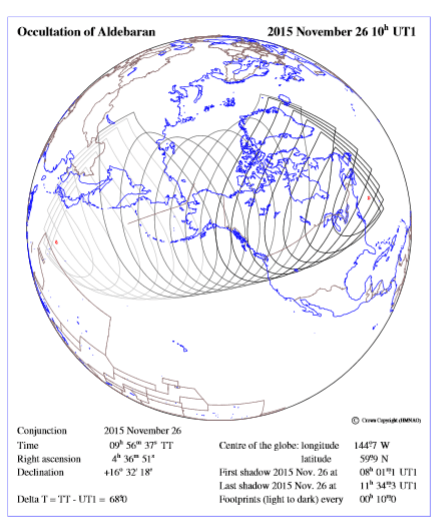
Map of the area where the occultation of Aldebaran is visible. Credit: Astronomical Almanac Online – U.S. Nautical Almanac Office, United States Naval Observatory (USNO), in the United States and Her Majesty’s Nautical Almanac Office (HMNAO), United Kingdom Hydrographic Office (UKHO), in the United Kingdom.
The occultation will be visible for locations within the nested grid of curved lines.
The two important events of the occultation is the star’s disappearance and reappearance. The times of these two events depend on your location, and are scientifically useful in determining the precise position of the Moon.
I’ve worked out the timings for my location about half way between Traverse City and Interlochen, so they should be within a couple of minutes of your observed time if you’re within 30 or so miles. Go out early, the earlier the better. The Moon will be especially bright, being only 12 hours after the instant the Moon will be full. Binoculars or a small telescope will be necessary to spot Aldebaran. The farther away Aldebaran is away from the Moon the easier it can be picked up. Note as a rule of thumb, the Moon moves its own diameter against the stars in about an hour.
For the Traverse City/Interlochen area I calculate the disappearance of Aldebaran at 5:38 a.m.
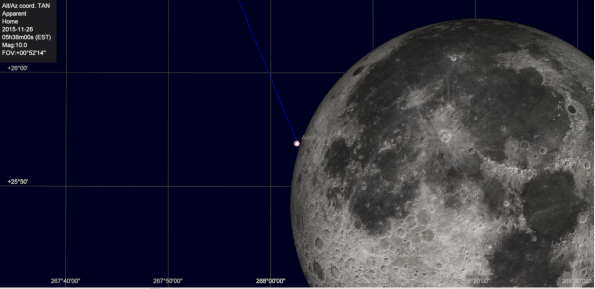
Aldebaran just prior to it’s disappearance behind the Moon from Interlochen/Traverse City. Created using Cartes du Ciel (Sky Charts).
For the Traverse City/Interlochen area I calculate the reappearance of Aldebaran at 6:29 a.m.
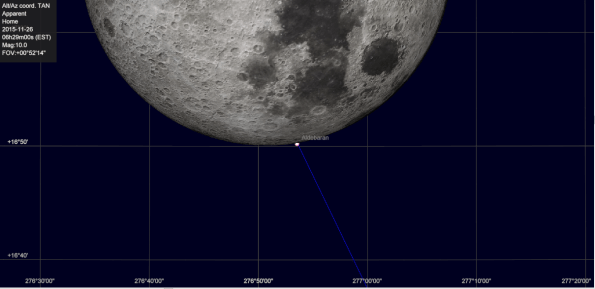
Aldebaran just after it’s reappearance from behind the Moon from Interlochen/Traverse City. Created using Cartes du Ciel (Sky Charts).
The Moon will be low in the western sky.
Timings for 3 locations in Michigan
This can be used to approximate the occultation time for other locations in Michigan.
City(s)                    Disappears  Reappears Location
Ironwood          5:33 a.m.   6:25 a.m. Northwestern corner of the
                                        Upper Peninsula (UP) of
                                        Michigan
Interlochen/      5:38 a.m.   6:29 a.m. Northwestern lower Michigan
   Traverse City
Monroe            5:45 a.m.   6:29 a.m. Southeastern corner of Michigan
Estimating timings for your location
I used Cartes du Ciel the free software that I have a link to on the right. Make sure that the program is set for topocentric positions under Setup/Solar System. And you have entered your position under Setup/Observatory. You can find your location in Google Earth.
You can also use Stellarium. Just make sure the Moon is normal sized.
In both programs you can lock the Moon or Aldebaran in the center of the screen Pick a time in advance of the occultation and using the set time window walk the star towards the Moon, mark the time. Then walk the star out from the Moon and record the reappearance time. That’s it.
This should work with other planetarium programs too.
 Bob Moler's Ephemeris Blog