Archive
08/13/2013 – Ephemeris – Highs and lows on the moon
Ephemeris for Tuesday, August 13th. The sun rises at 6:43. It’ll be up for 14 hours and 7 minutes, setting at 8:50. The moon, 1 day before first quarter, will set at 12:04 tomorrow morning.
The moon passed Saturn a couple of hours ago while they were below the horizon. By this evening the moon will be to the left of Saturn. In each 24 hour period the moon moves about 24 times its diameter against the stars, or its own width in an hour. Looking at the moon tonight with binoculars or a telescope, the Sea of Serenity or Mare Serenitatis dominates the moon’s upper right quadrant. To me its shaped like a scallop shell. On the bottom part of the moon are the lunar highlands, bright and saturated with craters large and small. The highlands are really high, while the sea’s like Serenity are low. Should the moon have an atmosphere and water, the seas would be real, not just lava filled plains.
Times are for the Traverse City/Interlochen area of Michigan. They may be different for your location.
Addendum
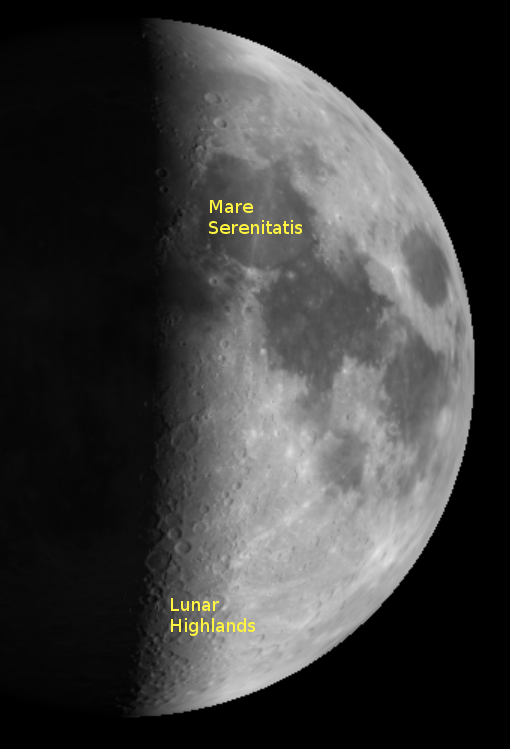
The Moon 1 day before first quarter. Created usinf Virtual Moon Atlas.
07/15/2013 – Ephemeris – The moon will appear near Spica tonight
Ephemeris for Monday, July 15th. Today the sun will be up for 15 hours and 12 minutes, setting at 9:24. The moon, at first quarter today, will set at 12:48 tomorrow morning. Tomorrow the sun will rise at 6:12.
The moon this evening is very close to the bright star Spica. It might take a pair of binoculars to spot it in the glare of the moon. Spica will be just above left of the moon tonight. For other spots on the earth the moon will actually pass in front of the star. The event is called an occultation, from the word occult meaning hidden. Simply put the moon will pass in front of or hide the star for up to an hour. The chief beneficiary of this occultation is the state of Hawai’i. Occultations are one of the best ways to measure the position, diameter and shape of distant asteroids and Kuiper belt objects that are too small to measure otherwise. Satellites of these objects have also been discovered this way.
Times are for the Traverse City/Interlochen area of Michigan. They may be different for your location.
Addendum
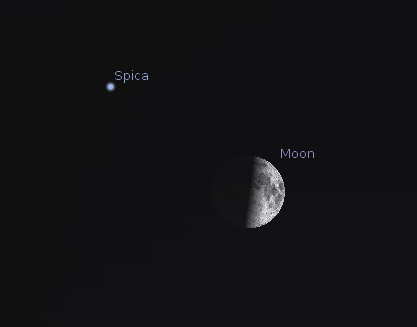
Spica and the Moon at 10 p.m. on July 15, 2013. Created using Stellarium.
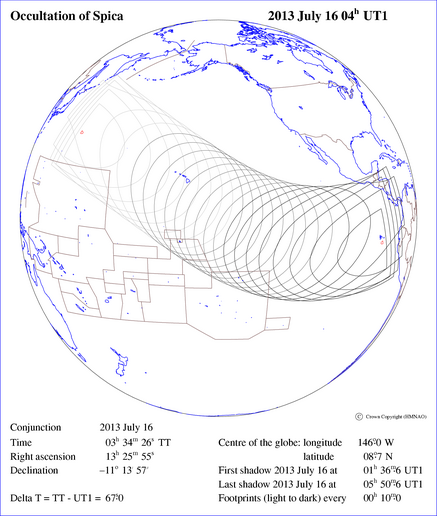
Path on the Earth where the occultation of Spica will be visible. Credit Astronomical Almanac Online.
The Astronomical Almanac Online ( http://asa.usno.navy.mil/) “is a joint publication of the U. S. Nautical Almanac Office, United States Naval Observatory (USNO), in the United States and Her Majesty’s Nautical Almanac Office (HMNAO), United Kingdom Hydrographic Office (UKHO), in the United Kingdom.”
06/19/2013 – Ephemeris – Mercury and Venus one last time
Ephemeris for Wednesday, June 19th. Today the sun will be up for 15 hours and 33 minutes, setting at 9:30. The moon, 3 days past first quarter, will set at 3:28 tomorrow morning. Tomorrow the sun will rise at 5:57.
The early evening will still be taken up with Venus and faint Mercury low in the west northwest at about 10:15 p.m. Mercury is below and left of Venus by 2 degrees, about 4 times the width of the moon. Mercury has dropped greatly in brightness as its phase is now a crescent, moving between the sun and the earth. Mercury will set at 10:56, and Venus will set at 11:03 p.m. Holding forth in the south will be Saturn this evening, the brightest star-like object in the constellation Virgo appearing yellowish to the left of the extremely blue-white star Spica. Saturn is a wonderful sight in a telescope of 20 power or more. Saturn will pass due south at 10:04 p.m., and will set at 3:23 tomorrow morning.
Times are for the Traverse City/Interlochen area of Michigan. They may be different for your location.
Addendum
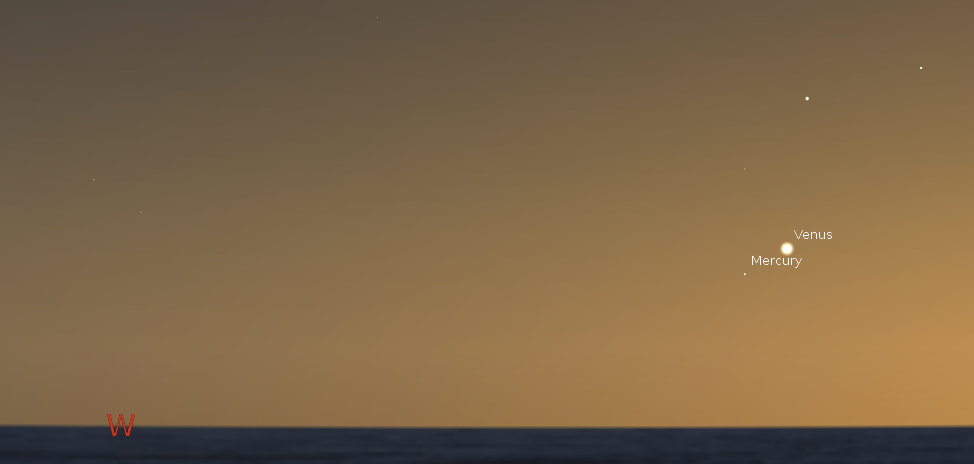
Venus and Mercury conjunction seen at 10:15 p.m. June 19 2013. Created using Stellarium.
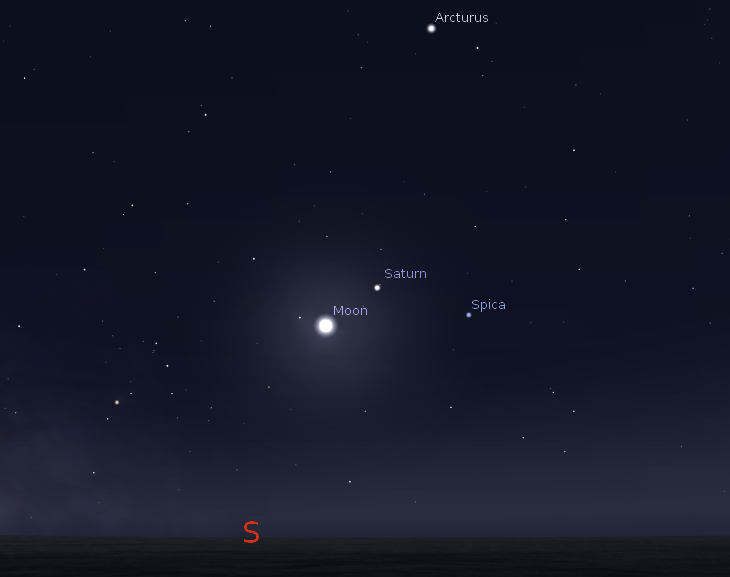
Saturn, the moon and bright stars at 11 p.m. June 19, 2013. Created using Stellarium.
06/13/2013 – Ephemeris – The moon tonight and the crater Theophilus
Ephemeris for Thursday, June 13th. Today the sun will be up for 15 hours and 31 minutes, setting at 9:28. The moon, 3 days before first quarter, will set at 12:23 tomorrow morning. Tomorrow the sun will rise at 5:56.
The 5 day old crescent moon reveals to a small telescope, a trio of large craters on the edge of the moon’s terminator or sunrise line. The best of these is on top Theophilus, a perfectly circular 61 mile diameter crater with a prominent central peak. It’s a little late for it tonight but sometimes when the terminator is crossing the crater, the floor is dark and the central peak catches the morning sunlight. The other two craters won’t be completely in sunlight tonight. Theophilus is a couple of hundred miles south of the Apollo 11 landing site in the Sea of Tranquility, That sea will be completely in sunlight tomorrow night. The moon is a great celestial object to view with any telescope.
Times are for the Traverse City/Interlochen area of Michigan. They may be different for your location.
Addendum
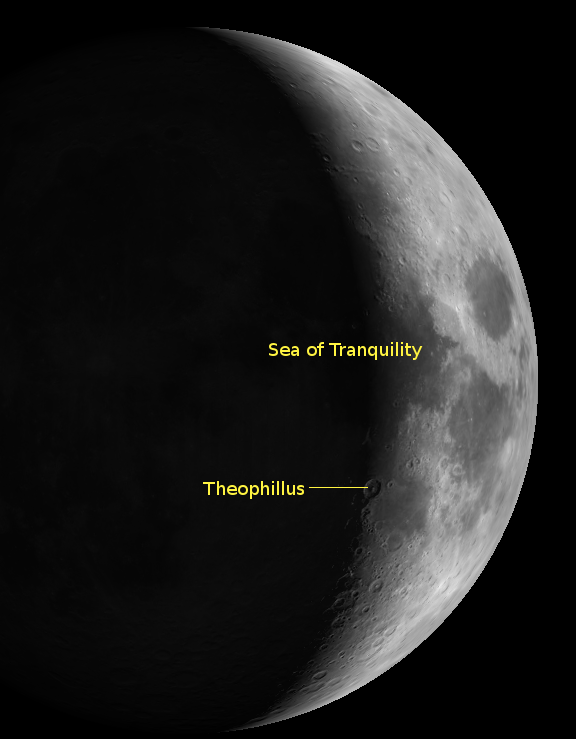
The moon at 10 p.m. on June 13, 2013. In our skies the moon will be rotated some 30-40 degrees clockwise. Created using Virtual Moon Atlas.
Note: Due to some familial concerns yesterday, this post is a bit late.
06/12/2012 – Ephemeris – Three planets still in the evening sky
Ephemeris for Wednesday, June 12th. Today the sun will be up for 15 hours and 31 minutes, setting at 9:28. The moon, half way from new to first quarter, will set at 11:55 this evening. Tomorrow the sun will rise at 5:56.
The early evening will be taken up with Venus and faint Mercury low in the west northwest at about 10:15 p.m. The crescent moon is nearby to the left. Mercury is above and left of Venus by about 5 degrees, about half the width of your fist at arm’s length. Mercury is at its greatest separation or elongation from the sun today of 24 degrees angle. Venus will set at 10:59, and Mercury will set at 11:14 p.m. Holding forth in the south will be Saturn this evening, the brightest star-like object in the constellation Virgo appearing yellowish to the left of the extremely blue-white star Spica. Saturn is a wonderful sight in a telescope of 20 power or more. Saturn will pass due south at 10:33 p.m., and will set at 3:51 tomorrow morning.
Times are for the Traverse City/Interlochen area of Michigan. They may be different for your location.
Addendum
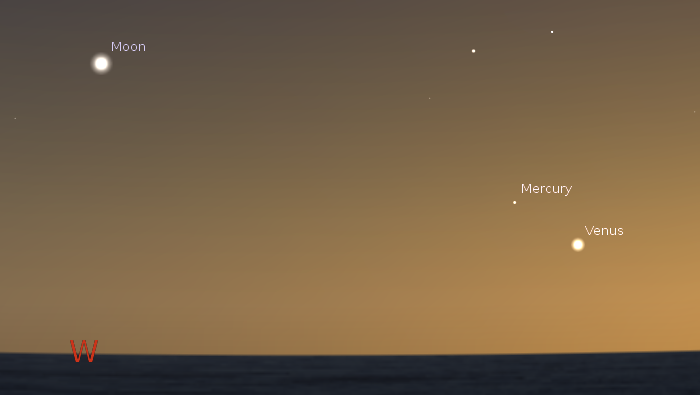
Mercury, Venus and the moon at 10:15 p.m. on June 12, 2013. Created using Stellarium. Note that the moon at this phase (thin crescent) doesn’t show at this scale, so the moon’s position is shown as full.
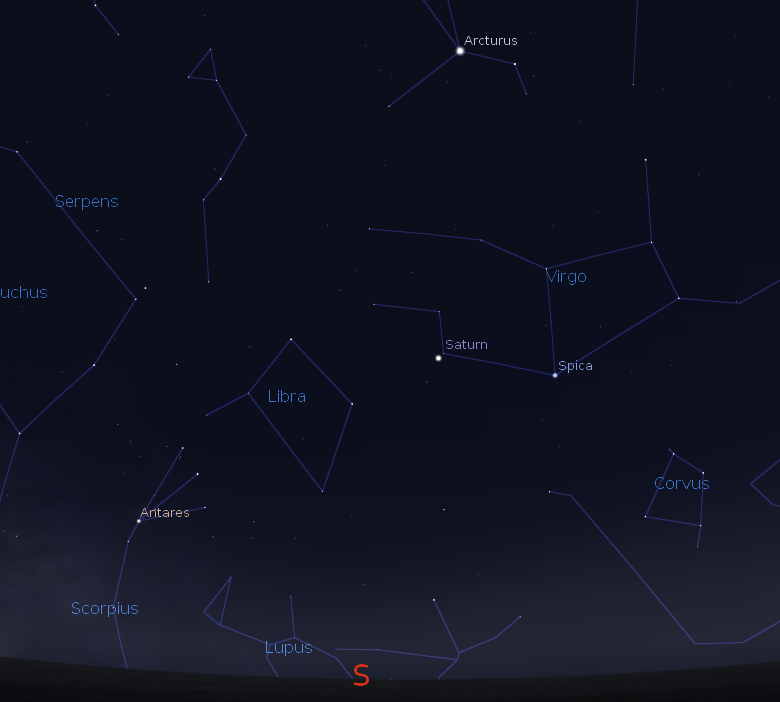
Saturn and constellations at 11 p.m. on June 12, 2013. Note Scorpius rising to the left. Created using Stellarium.
06/10/2013 – Ephemeris – Mercury and Venus in the west
Ephemeris for Monday, June 10th. Today the sun will be up for 15 hours and 29 minutes, setting at 9:27. The moon, 2 days past new, will set at 10:49 this evening. Tomorrow the sun will rise at 5:56.
Tonight the moon will join Mercury and Venus low in the west northwest at around 10:15. Venus will be the easiest to spot. Mercury will be above Venus and to the left. Binoculars may help you spot it. The crescent moon will be to the left and a bit below Venus. If you’ve been watching these planets for the past two weeks you’ve probably noticed that Mercury is getting fainter. That’s because its phase is becoming less full as moves around the sun toward us. It’s phase is now a bit more than half illuminated. Wednesday it will be half illuminated as it reaches its greatest elongation from the sun, a whopping 24 degree angle from the sun. That’s pretty good for us observing from the northern hemisphere.
Times are for the Traverse City/Interlochen area of Michigan. They may be different for your location.
Addendum
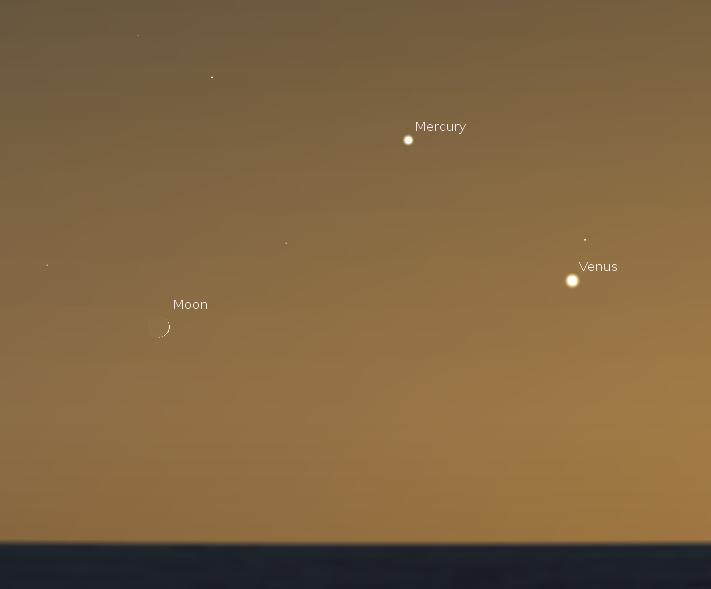
Mercury, Venus and the crescent moon in the west northwest at 10:15 p.m. on June 19, 2013. Created using Stellarium.
04/18/2013 – Ephemeris – The moon at first quarter
Ephemeris for Thursday, April 18th. The sun rises at 6:52. It’ll be up for 13 hours and 38 minutes, setting at 8:31. The moon, at first quarter today, will set at 3:21 tomorrow morning.
Lets take a look at the moon tonight. It’ll be about 6 hours after first quarter and we’ll see features at the terminator, the sunrise line that cuts the moon in half. In small telescopes, at the north or top end of the moon, the wide flat crater Plato is just entering sunlight. Long shadows from its crater walls will retreat across its flat floor over the evening. If you look closely you’ll notice that the floor of Plato is slightly convex to conform with the curvature of the moon itself. Nearby is the straight gash in the Alps Mountains, called the Alpine Valley. Supposedly the crater Plato formed shortly after Mare Imbrium formed throwing up the Alps and the Apennine mountains to the south. The Straight wall, can be seen on the south end of the moon.
Times are for the Traverse City/Interlochen area of Michigan. They may be different for your location.
Addendum
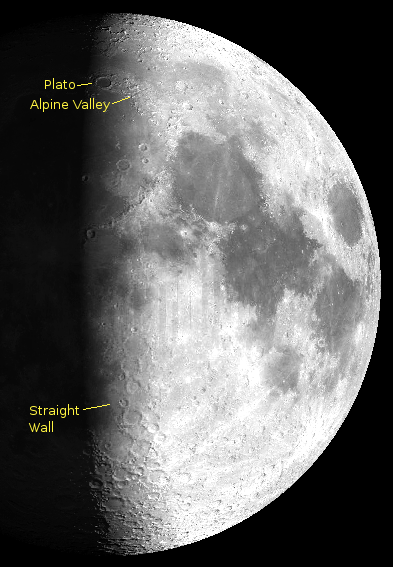
First quarter moon April 18, 2013 Created using Virtual Moon Atlas
04/16/2013 – Ephemeris – The moon’s strange orbit
Ephemeris for Tuesday, April 16th. The sun rises at 6:56. It’ll be up for 13 hours and 32 minutes, setting at 8:28. The moon, 2 days before first quarter, will set at 2:13 tomorrow morning.
The fat crescent moon appears high in the sky. It appears in a part of the sky where the sun will be in early July. The moon follows a path nearly in the plane of the earth’s orbit , but a bit tilted from it by an angle of 5 degrees. This is unusual. Most planet’s major satellites orbit their primary in it’s equatorial plane, like our geostationary communication satellites, though none them orbit in one of their planet’s days. The moon orbits the earth, but due to its great distance of 60 earth radii, or 240 thousand miles also is very much gravitationally affected by the sun. Apparently one of its effects was to pull the moon close to the the earth’s orbital plane. If you like eclipses this is a good thing. It makes eclipses much more frequent than if the moon orbited over the earth’s equator.
Times are for the Traverse City/Interlochen area of Michigan. They may be different for your location.
Addendum
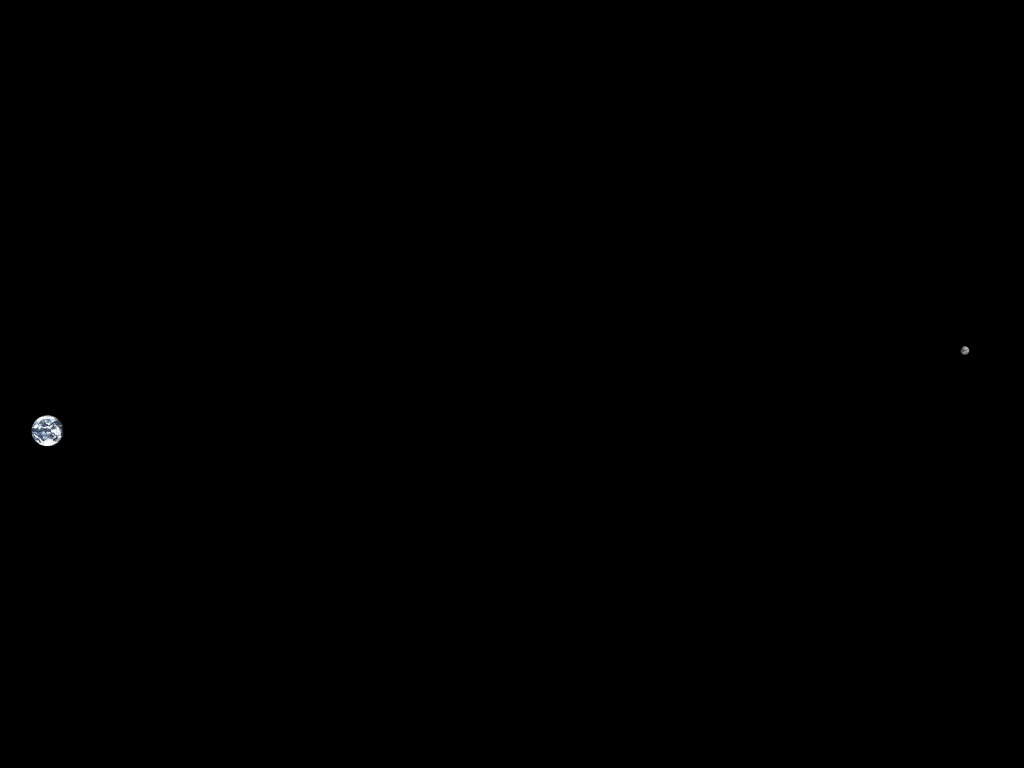
The true scale of the earth-moon system. From Traipse.com
03/27/2013 – Ephemeris – Where’s Comet PanSTARRS and the bright planets this week?
Ephemeris for Wednesday, March 27th. The sun will rise at 7:32. It’ll be up for 12 hours and 31 minutes, setting at 8:04. The moon, at full today, will rise at 8:49 this evening.
It’s time to check out a comet and the two remaining bright planets for this week. Comet PanSTARRS is in the northwest, moving away from the sun, and getting a little higher in the sky as it moves northward rather than eastward. The comet will set at 10:26. The comet is now down to near 4th magnitude, as bright as a relatively faint naked eye star. Jupiter is located in the constellation of Taurus and is in the high southwest during the evening. It will set at 1:35 a.m. Jupiter is a wonderful sight in telescopes with its cloud bands and its moons which change positions each night. The other bright planet Saturn will rise at 10:43 p.m. in the east southeast. It’s located in eastern Virgo. It will pass due south at 3:55 a.m. Saturn is the most beautiful of planets in a telescope.
Times are for the Traverse City/Interlochen area of Michigan. They may be different for your location.
Addendum
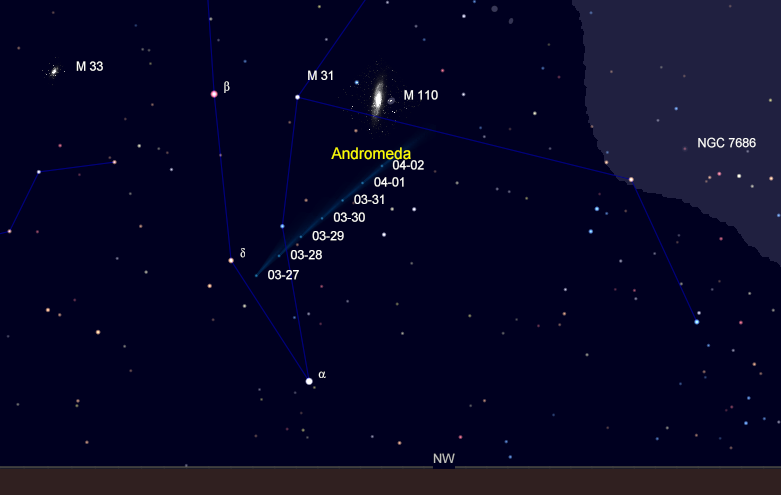
Comet PanSTARRS at about 9:15 p.m. from March 27 to April 2, 2013. Note that the comet will pass the Great Andromeda Galaxy in early April. Created using Cartes du Ciel.
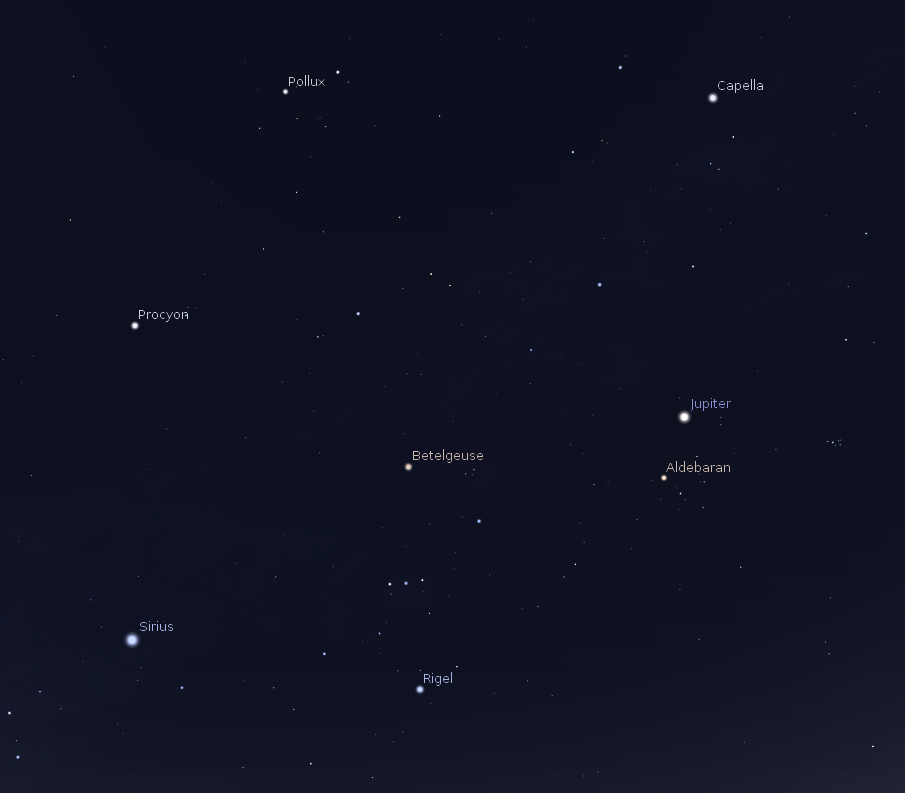
Jupiter with the stars of winter in a moon brightened sky at 9:30 p.m. March 27, 2013. Created using Stellarium.
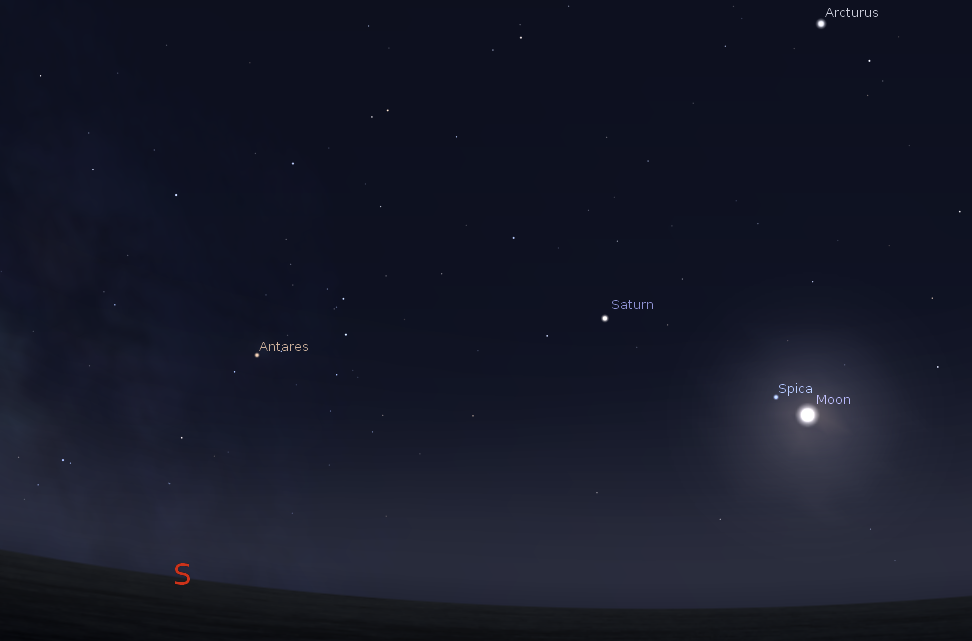
Saturn near Spica and the moon at 6 a.m. on March 28th. The moon will be passing Saturn on Friday afternoon, below the horizon. Created using Stellarium.
08/12/2013 – Ephemeris – Comet PanSTARRS will appear near the moon tonight
Ephemeris for Tuesday, March 12th. The sun will rise at 7:59. It’ll be up for 11 hours and 45 minutes, setting at 7:45. The moon, 1 day past new, will set at 9:05 this evening.
Tonight 40 to 45 minutes after sunset, that’s about 8:30 p.m., if it’s very clear down to the western horizon Comet PanSTARRS might be glimpsed low on the western horizon. The day old sliver of the moon will point to the comet. The comet will appear just to the left of the moon by about 8 moon widths. The comet will appear due west, so a compass will help locate it. It’s tail is expected to be nearly vertical and canted to the left. If the comet is bright enough the tail will appear to be split in two. The gas component is ionized and is pushed back rapidly by the solar wind. Cometary dust is pushed by the pressure of sunlight. Near perihelion, its closest to the sun as comet is moving crosswise to its tail. The tail will swing to the right in the coming days.
Times are for the Traverse City/Interlochen area of Michigan. They may be different for your location.
Addendum
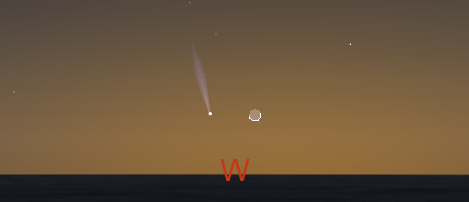
Comet PanSTARRS with the moon at 8:30 p.m. or 45 minutes after sunset) on March 12, 2013. Created using Stellarium, Cartes du Ciel and my Looking Up.
As noted in yesterday the sky is from, Stellarium and the comet from Cartes du Ciel. Both free programs that can be downloaded from links on this page. The moon is from my own, much simpler LookingUp program. The moon does appear slightly larger and brighter than how it will appear in the sky, as does the comet. The comet will set shortly after 9 p.m. and the tail may be visible for a while after that.
Reports show that the comet is reaching 1st magnitude, but not for long. Check the link for spaceweather.com for some cool pictures of the comet in the evening twilight.
 Bob Moler's Ephemeris Blog