Archive
01/27/2022 – Ephemeris – Looking at the constellation of Gemini the twins
This is Ephemeris for Thursday, January 27th. Today the Sun will be up for 9 hours and 37 minutes, setting at 5:44, and it will rise tomorrow at 8:06. The Moon, 2 days past last quarter, will rise at 4:56 tomorrow morning.
Another famous winter constellation is Gemini. The constellation of Gemini the Twins is visible high in the southeast, above and left of Orion the hunter, at 9 p.m. The namesake stars of the two lads, are the two bright stars at the left end of Gemini, and are high and nearly in the east. Castor is on top, while Pollux is below. From them come two lines of stars that outline the two, extending horizontally toward Orion. In Greek mythology the lads were half brothers, Castor was fathered by a mere mortal, while Pollux was fathered by Zeus, but were born together as twins. When Castor was killed during the quest for the Golden Fleece, Pollux pleaded with Zeus to let him die also, so Zeus placed them together in the sky.
The astronomical event times given are for the Traverse City/Interlochen area of Michigan (EST, UT – 5 hours). They may be different for your location.
Addendum
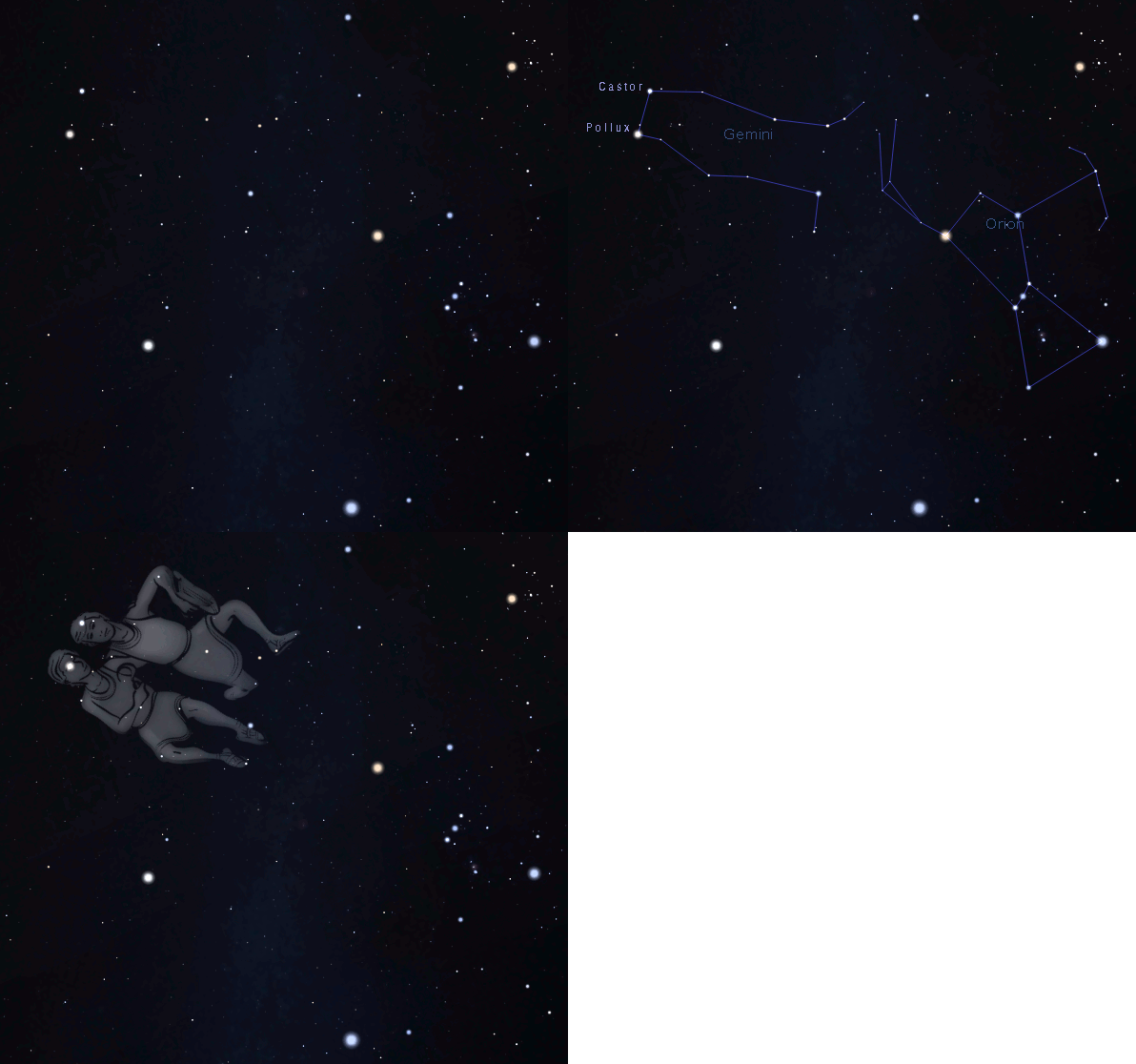
Gemini finder animation for 9 pm January 27th, showing just stars, constellation lines and star names, and figures of the lads. Click on the image to enlarge it. Created using Stellarium and GIMP.
02/08/2021 – Ephemeris – A look at Gemini the twins
This is Ephemeris for Monday, February 8th. Today the Sun will be up for 10 hours and 9 minutes, setting at 6:01, and it will rise tomorrow at 7:51. The Moon, 3 days before new, will rise at 6:49 tomorrow morning.
Let’s look at another of the winter constellations, and a member of the Zodiac. The constellation of Gemini the Twins is visible high in the southeast, above and left of Orion the hunter at 9 p.m. The namesake stars of the two lads, will be at the left end of Gemini, are nearly overhead and vertically aligned. Castor is on top, while the slightly brighter Pollux is below. From them come two lines of stars that outline the two extending toward Orion. In Greek mythology the lads were half brothers, Castor was fathered by a mere mortal, while Pollux was fathered by Zeus, but were born together as twins. When Castor was killed during the quest for the Golden Fleece, Pollux pleaded with Zeus to let him die also, so Zeus placed them together in the sky, so they could be together forever.
The event times given are for the Traverse City/Interlochen area of Michigan. They may be different for your location.
Addendum
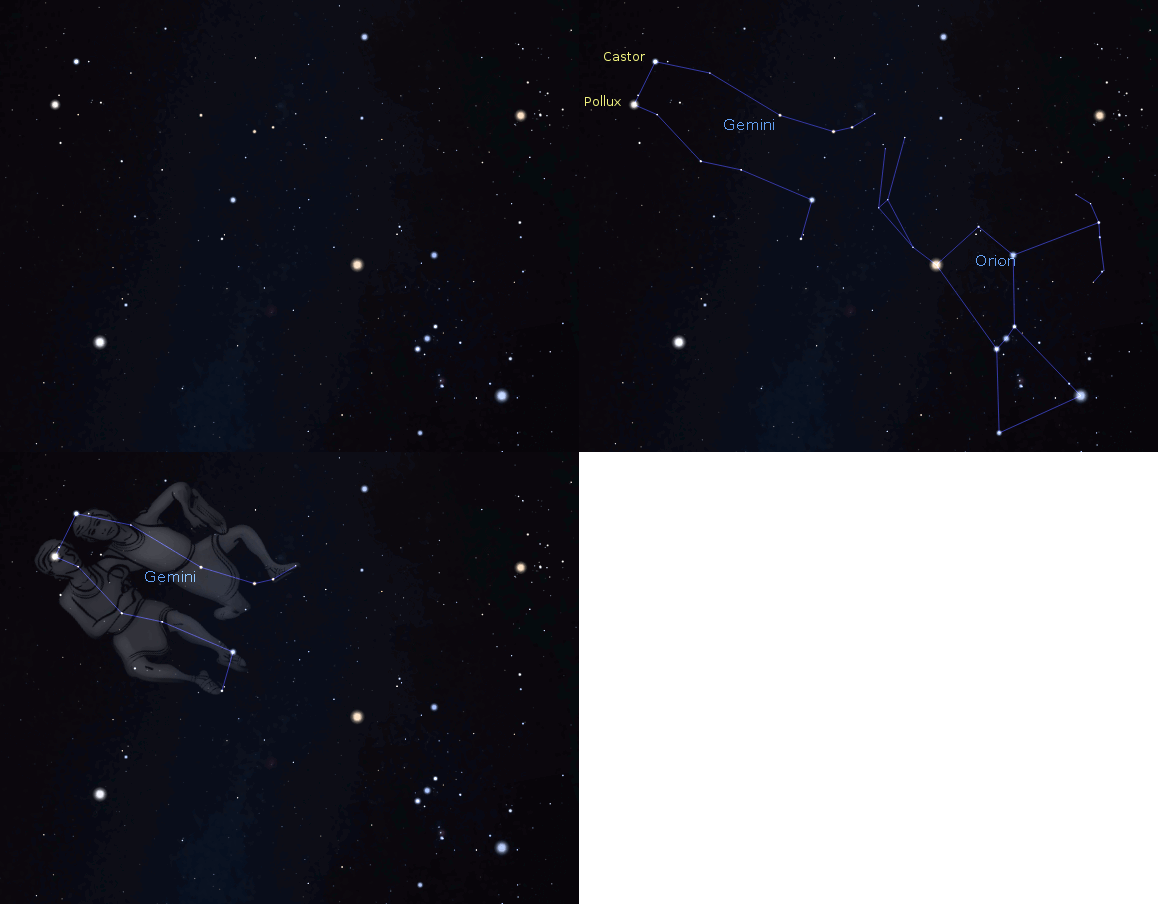
Gemini finder animation for early February at 9 pm (about 3 hours after sunset). Created using Stellarium and GIMP.
03/12/2020 – Ephemeris – The mythology behind the constellation of Gemini
Ephemeris for Thursday, March 12th. Today the Sun will be up for 11 hours and 46 minutes, setting at 7:45, and it will rise tomorrow at 7:57. The Moon, 3 days past full, will rise at 11:45 this evening.
Lets look at the next to last of the winter constellations, and member of the Zodiac. The constellation Gemini, the Twins is visible high in the southeast, above and left of Orion the hunter at 9 p.m. The namesake stars of the two lads, will be at the left end of Gemini, nearly vertically aligned. Castor is above, Pollux below. From them can be traced two lines of stars extending toward Orion that outline the two. In Greek mythology the lads were half brothers, Castor was fathered by a mere mortal, while Pollux was fathered by Zeus in the famous Leda and the swan affair and immortal, but were born together as twins. When Castor was killed during the quest for the Golden Fleece, Pollux pleaded with Zeus to let him die also, so he placed them together in the sky so they could be together forever.
The event times given are for the Traverse City/Interlochen area of Michigan. They may be different for your location.
Addendum
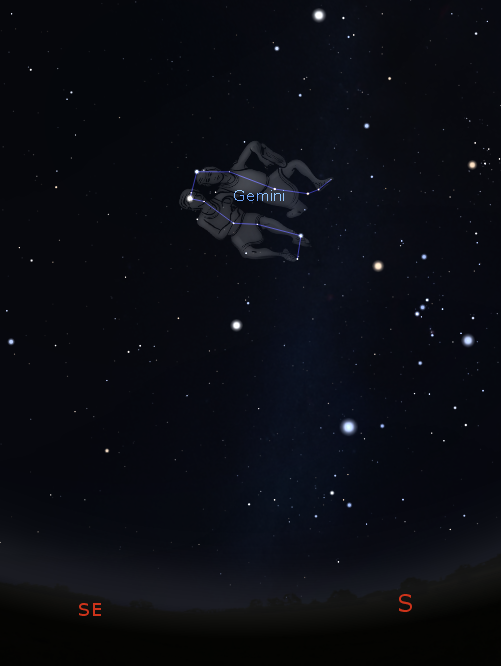
Gemini finder looking south-southeast around 9 p.m. March 10th, 2020. Created using Stellarium.
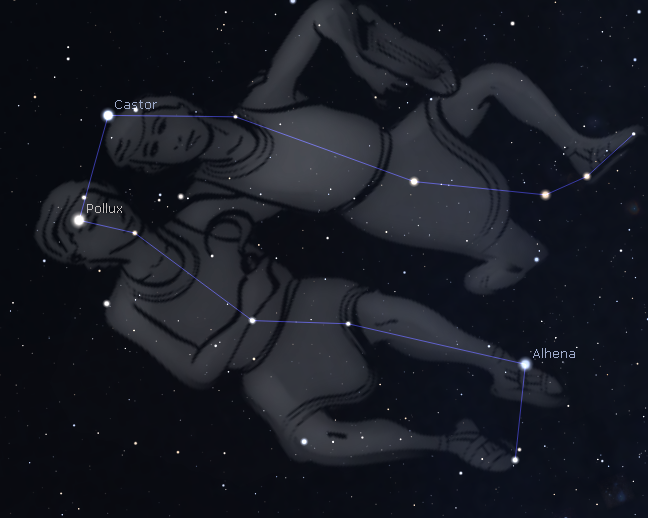
Castor and Pollux namesakes of the twins of Gemini in its position around 9 p.m. EDT March 12th. Created using Stellarium.
03/10/2020 – Ephemeris – A Closeup look at Gemini’s namesake stars
Ephemeris for Tuesday, March 10th. Today the Sun will be up for 11 hours and 39 minutes, setting at 7:43, and it will rise tomorrow at 8:01. The Moon, 1 day past full, will rise at 9:07 this evening.
At 9 p.m. the constellation of Gemini the twins will be seen high in the south-southeast. The namesake stars of the two lads are the two bright stars at the upper left of the constellation. Pollux the pugilist, or boxer, is the lower of the two, while Castor, the horseman, is the other star, or rather a six star system. In telescopes two close stars may be seen each is a spectroscopic binary, meaning the two stars can be detected by the rainbow colors of light from the star. A faint nearby spectroscopic binary also belongs. Pollux, though a single star, does have at least one planet, over twice the mass of Jupiter orbiting it at a distance somewhat greater than Mars is from the Sun. Pollux is 34 light years away while Castor is 50 light years away.
The event times given are for the Traverse City/Interlochen area of Michigan. They may be different for your location.
Addendum
Gemini finder looking south-southeast at 9 p.m. March 10th, 2020. Created using Stellarium.
Castor and Pollux namesakes of the twins of Gemini in its position at 9 p.m. EDT March 10th. Created using Stellarium.
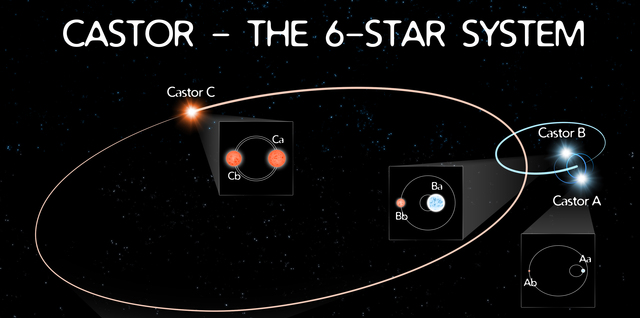
The Castor star system exploded in this JPL/NASA infographic.
02/25/2019 – Ephemeris – Cancer the crab
Ephemeris for Monday, February 25th. Today the Sun will be up for 10 hours and 57 minutes, setting at 6:24, and it will rise tomorrow at 7:25. The Moon, 1 day before last quarter, will rise at 1:46 tomorrow morning.
Between the stars Castor and Pollux in Gemini high in the southeast and the star Regulus in Leo the Lion in the east-southeast lies the dimmest constellation of the zodiac, Cancer the crab. To me its 5 brightest stars make an upside down Y. There’s the stars in the center of the constellation Asellus Borealis and Asellus Australis, the north and south donkeys. There’s a fuzzy spot between and just west of them called Praesepe, the manger. In binoculars it resolves into a cluster of stars called the Beehive cluster. We amateur astronomers also know it as M44, the 44th object on comet hunter Charles Messier’s list of objects that might be mistaken for comets.
The times given are for the Traverse City/Interlochen area of Michigan. They may be different for your location.
Addendum
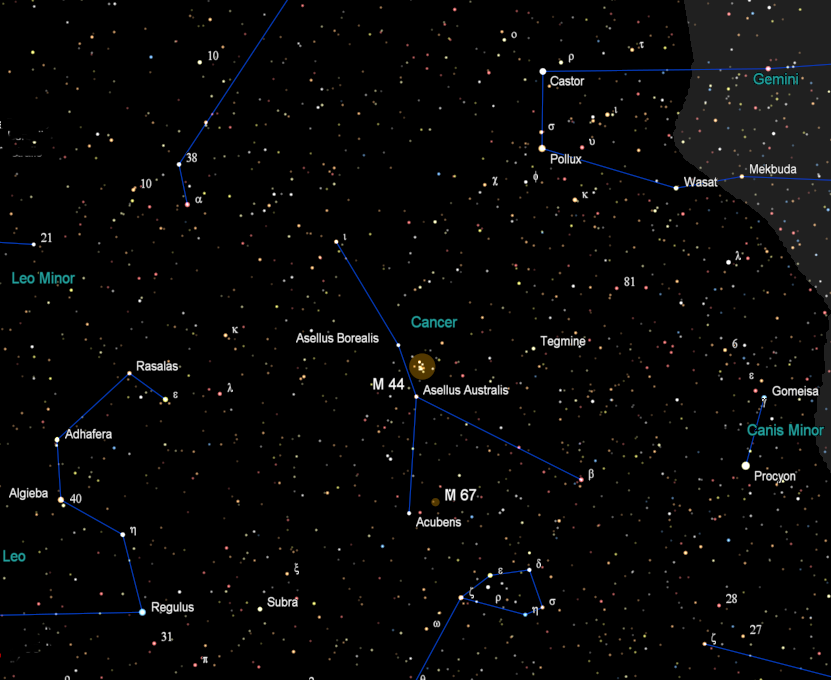
The constellation Cancer finder chart. Click on image to enlarge. Created using Cartes du Ciel (Sky Charts).
02/11/2019 – Ephemeris – The stars Castor and Pollux
Ephemeris for Monday, February 11th. Today the Sun will be up for 10 hours and 16 minutes, setting at 6:05, and it will rise tomorrow at 7:47. The Moon, 1 day before first quarter, will set at 12:57 tomorrow morning.
At 9 p.m. the constellation of Gemini the twins will be seen high in the southeast. The namesake stars of the two lads are the two bright stars at the top of the constellation. Pollux the pugilist, or boxer, is the lower of the two, while Castor, the horseman, is the other star, or rather a six star system. In telescopes two close stars may be seen each is a spectroscopic binary, meaning the lines of two stars can be seen in the spectrum. A faint nearby spectroscopic binary also belongs. Pollux, though a single star, does have at least one planet, over twice the mass of Jupiter orbiting the star at a distance somewhat greater than Mars is from the Sun. Pollux is 34 light years away while Castor is 50 light years away. Not too far away as stars go.
The times given are for the Traverse City/Interlochen area of Michigan. They may be different for your location.
Addendum
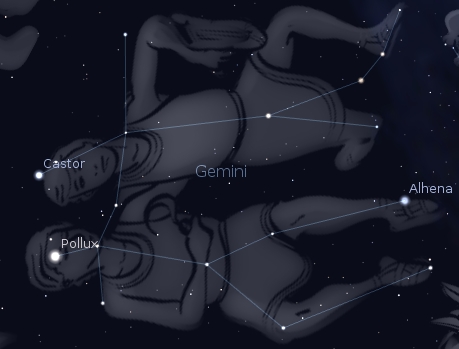
Gemini with Castor and Pollux. Created with Stellarium.
The Castor star system exploded in this JPL/NASA infographic.
5/15/2018 – Ephemeris – Two thirds thru spring
Ephemeris for Tuesday, May 15th. Today the Sun will be up for 14 hours and 49 minutes, setting at 9:04, and it will rise tomorrow at 6:13. The Moon is new today, and won’t be visible.
Here we are at the middle of May, nearly two-thirds through spring and in the west only a few winter stars remain. Castor and Pollux of Gemini are horizontal in the west, Procyon the Little Dog Star is below and left of them, Capella in Auriga is in the northwest, but for most of the IPR listening area it will never quite set. At 10:30 Betelgeuse in Orion the hunter will be setting, chased from the skies by Scorpius the scorpion, which is rising in the southeast. In one story it is the sting of this scorpion that killed him. Already at that time two-thirds of the stars of the summer Triangle are up. Bright Vega in Lyra the harp, and Deneb in Cygnus the swan. The Big Dipper reigns overhead as spring is in full bloom.
The times given are for the Traverse City/Interlochen area of Michigan. They may be different for your location.
Addendum
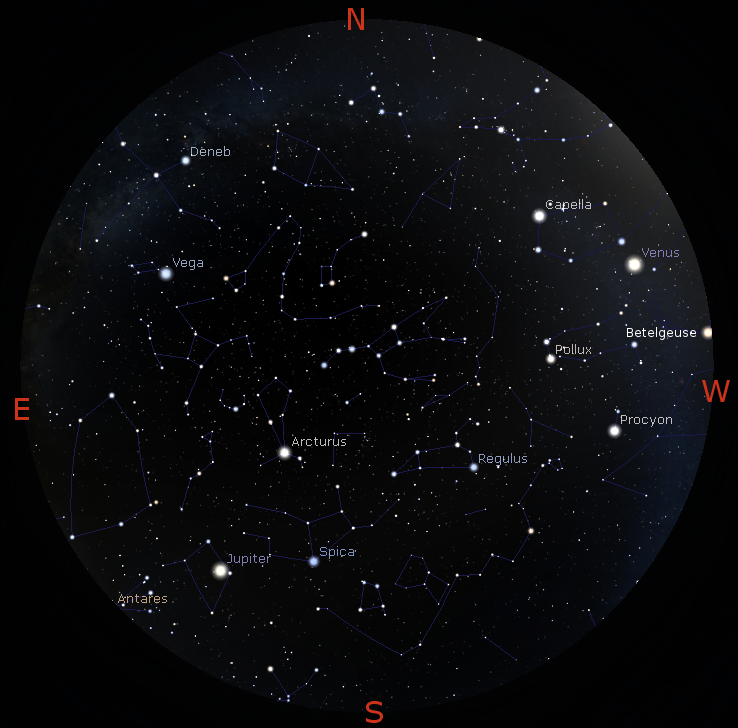
The sky dome for 10:30 p.m. May 15, 2018 showing the stars and constellations. It may not work for any latitude or time, but it works for our location, near 45 degrees north. Created using Stellarium.
03/09/2018 – Ephemeris – The good ship Argo
Ephemeris for Friday, March 9th. The Sun will rise at 7:06. It’ll be up for 11 hours and 35 minutes, setting at 6:41. The Moon, at last quarter today, will rise at 2:50 tomorrow morning.
Located south and east of Canis Major, the great hunting dog of Orion and it brilliant star Sirius in the south is a dim constellation of Puppis, the poop deck of the old constellation Argo Navis, the constellation that depicts the ship Jason and the Argonauts used in their search for the Golden Fleece. This huge constellation has been subdivided. Only Puppis and Pyxis the ship’s compass are visible from Michigan. The other parts of the ship are Carina the keel, and Vela the sails require traveling south at least to the southern most of the United States. Three other constellations also related to this expedition are Gemini with Castor, who died on the expedition and Pollux. Hercules was also aboard as was the physician of the constellation Ophiuchus.
The times given are for the Traverse City/Interlochen area of Michigan. They may be different for your location.
Addendum
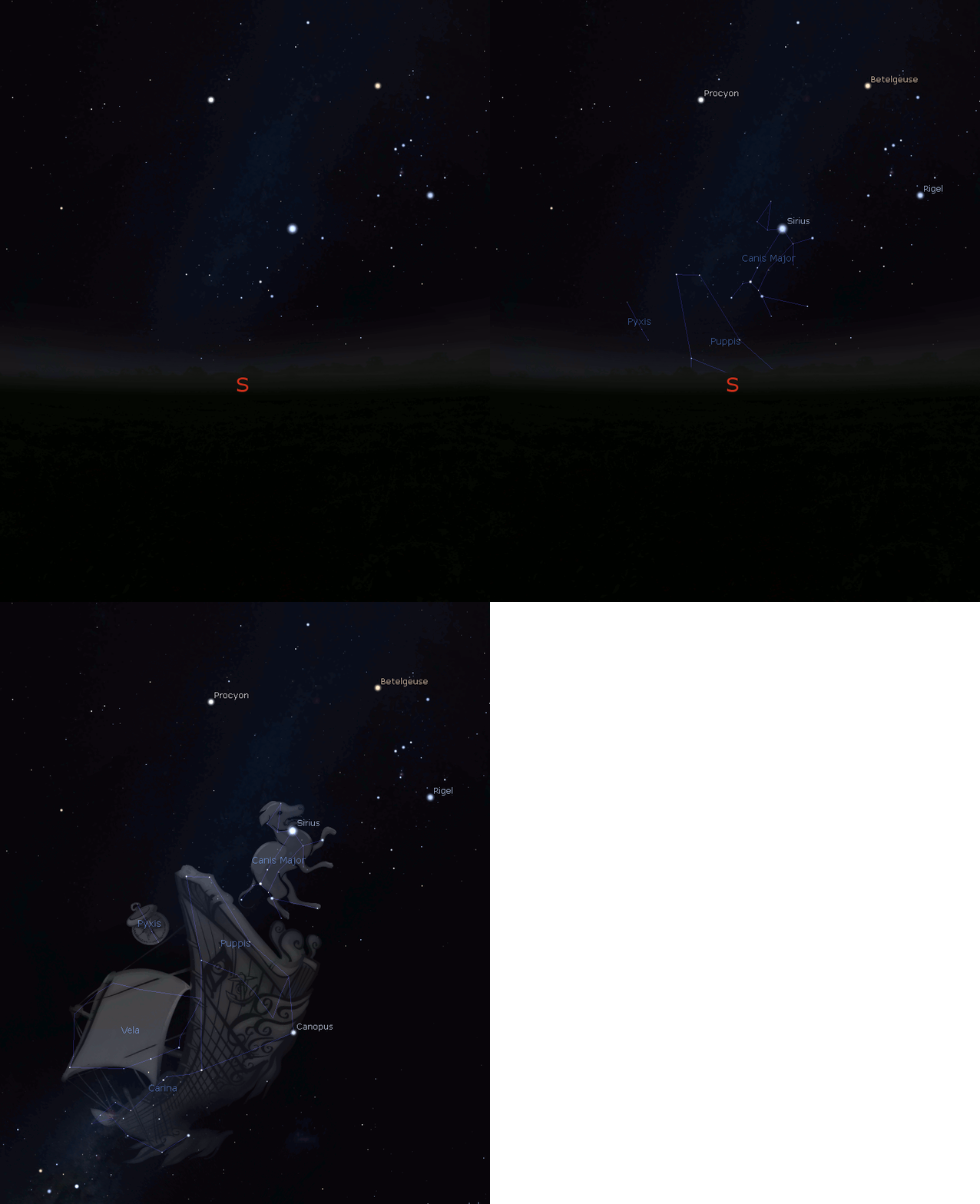
Puppis ans Pyxis; what we can see from Michigan, plus the rest of Argo Navis at 9 p.m., March 9, 2018. The Stellarium artist has the ship reversed. Puppis is the rear end, not the bow. Note that the Crux, the Southern Cross is below the ship. Click on the image to enlarge. Created using Stellarium and GIMP.
02/23/2018 – Ephemeris – Meet the stars Castor and Pollux
Ephemeris for Friday, February 23rd. The Sun will rise at 7:30. It’ll be up for 10 hours and 52 minutes, setting at 6:22. The Moon, at first quarter today, will set at 2:54 tomorrow morning.
The star Pollux is at the head of the same named brother of Gemini the twins. Castor is the slightly dimmer star right above it. Pollux is about 34 light years away. It’s twice as massive as the Sun, and has run out of hydrogen in its core and is in the process of evolving into a red giant star. One planet, recently given the name Thestias, has been detected around it. Castor is at 51 light years away. There are 6 stars in its system. The brightest three are visible in telescopes. Each is a spectroscopic binary, meaning that the companion stars are detected by the Doppler shifts of the lines in their spectra as the stars orbit each other. The Doppler shift is just one of the many pieces of information revealed by the spectroscope.
The times given are for the Traverse City/Interlochen area of Michigan. They may be different for your location.
Addendum
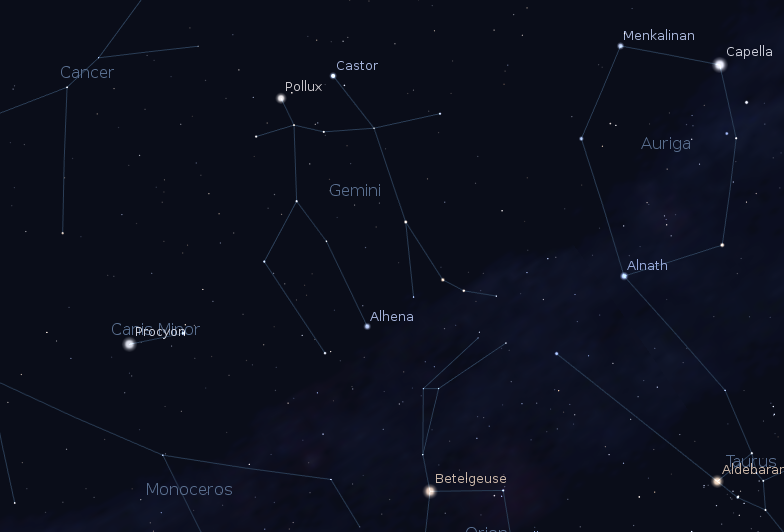
Gemini with the stars Castor and Pollux. Created using Stellarium.
The Castor star system exploded in this JPL/NASA infographic.
02/12/2018 – Ephemeris – The Winter Circle
Ephemeris for Monday, February 12th. The Sun will rise at 7:47. It’ll be up for 10 hours and 19 minutes, setting at 6:07. The Moon, 3 days before new, will rise at 6:29 tomorrow morning.
The winter skies are blessed with more first magnitude stars than any other season. Six of these stars lie in a large circle centered on the seventh, It’s called the Winter Circle. This circle is up at 9 p.m. Starting high overhead is yellow Capella in Auriga the charioteer. Moving down clockwise is orange Aldebaran in the face of Taurus the Bull. Then down to Orion’s knee we find blue-white Rigel. Down and left is the brightest star of all the brilliant white Sirius the Dog Star in Canis Major, lowest of these stars in the south-southeast. Moving up and left is white Procyon in Canis Minor, Above Procyon is Pollux in Gemini the twins. All these are centered, well not quite, on Betelgeuse the bright red star in Orion’s shoulder.
The times given are for the Traverse City/Interlochen area of Michigan. They may be different for your location.
Addendum
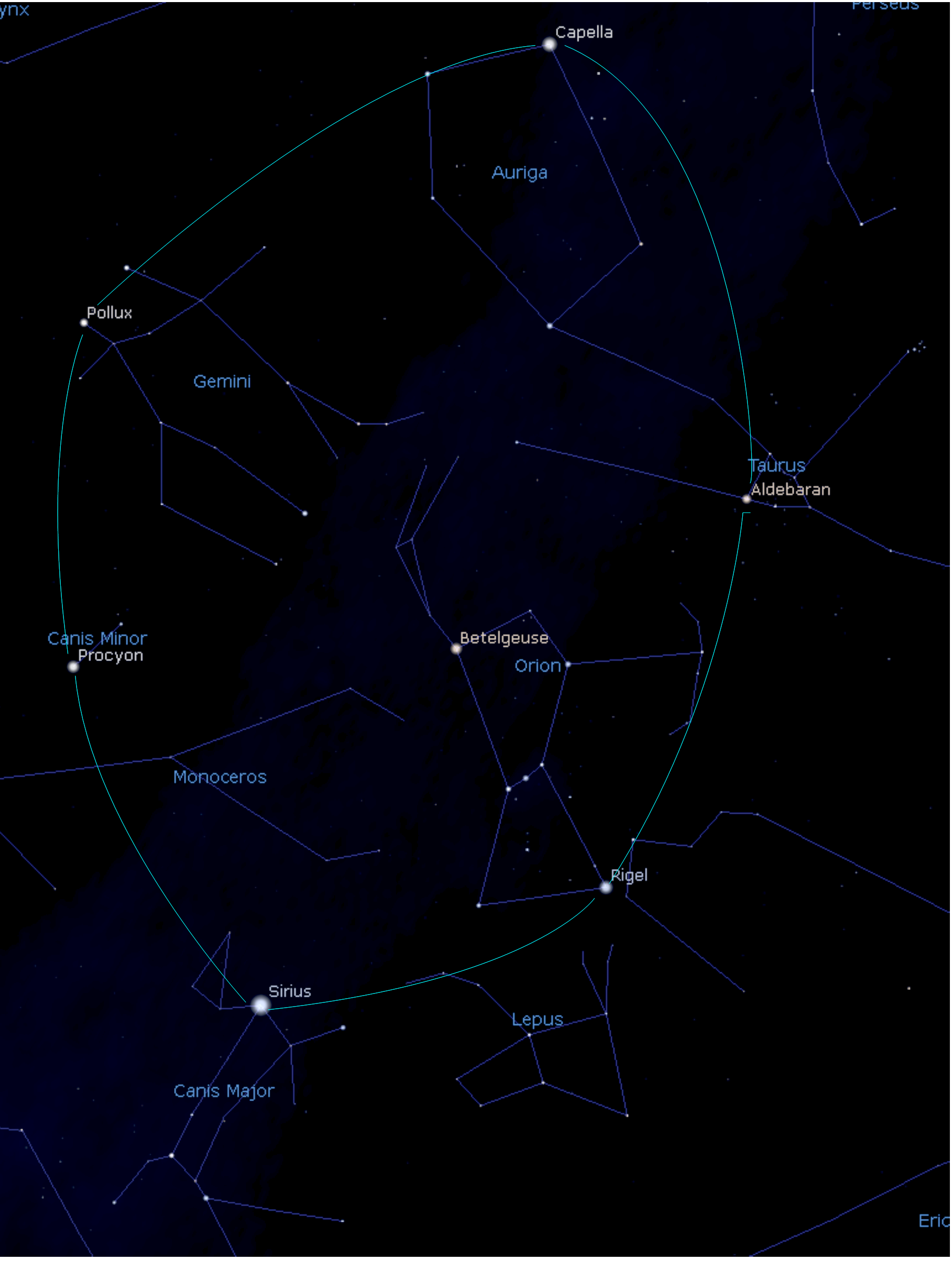
The bright stars of winter arrayed in a circle (well almost). Created using Stellarium.
 Bob Moler's Ephemeris Blog