Archive
Ephemeris: 02/20/2026 – The star that’s called “Before the Dog”
This is Ephemeris for Friday, February 20th. Today the Sun will be up for 10 hours and 43 minutes, setting at 6:18, and it will rise tomorrow at 7:33. The Moon, 3 days past new, will set at 10:21 this evening.
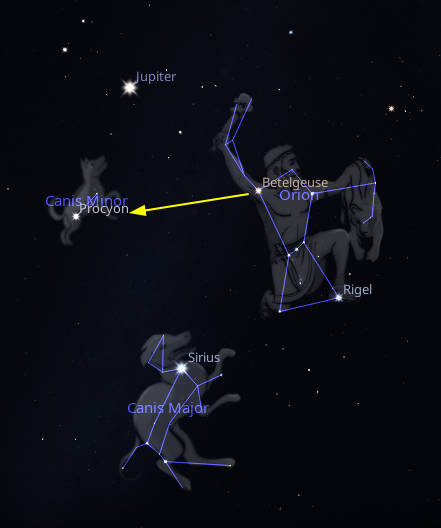
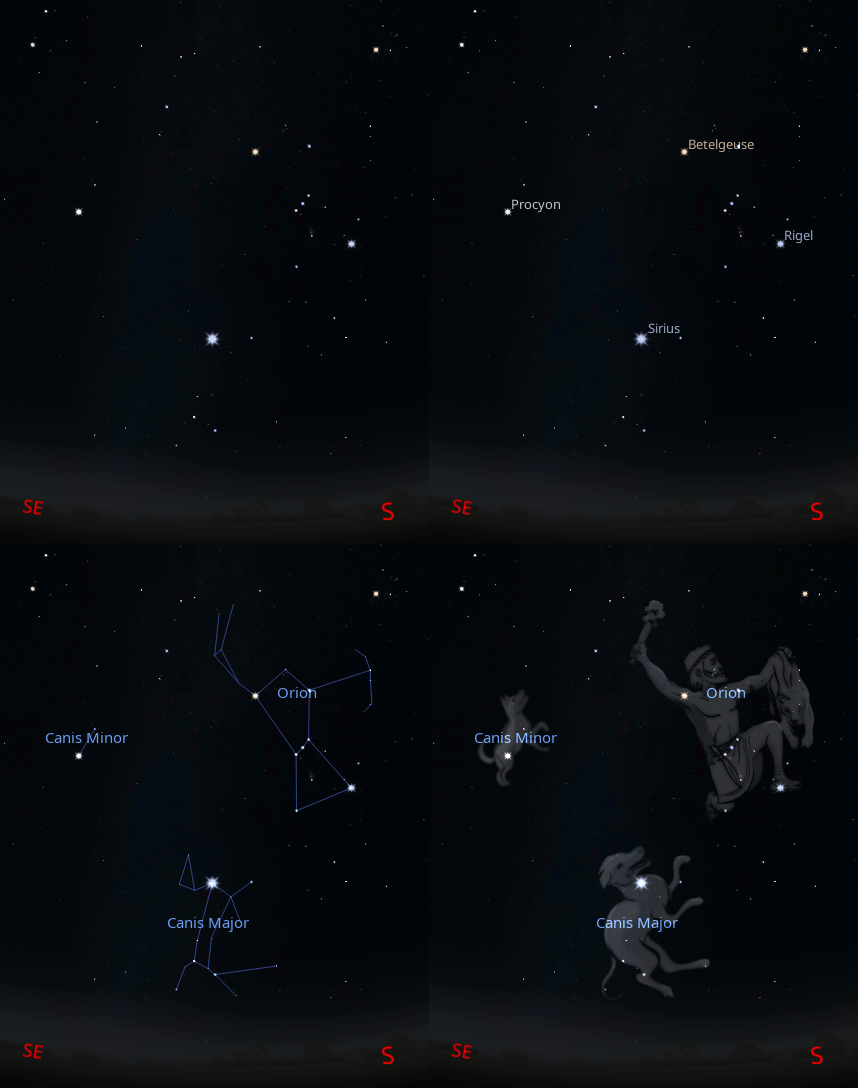
The star Procyon is in Orion’s little hunting dog, Canis Minor, which contains only one other star. It can be found by using the shoulder stars of Orion, Bellatrix and Betelgeuse, pointing to the left and down a bit to Procyon at 9 PM. With Jupiter above, Betelgeuse to the right and Sirius below, it makes an imposing diamond of stars. The word Procyon means “Before the Dog” meaning that rises before the Dog Star, Sirius, even though it is east of it. Procyon is also north of Sirius, which for observers above 30° north latitude, it does indeed rise before the Dog Star. It is a star like Sirius, though it’s not as bright, or white. Procyon is 11.5 light years away while Sirius is 8.6. Both have tiny white dwarf companion stars.
The astronomical event times given in this blog are for the Traverse City/Interlochen area of Michigan (Lat 44.7° N, Long 85.7° W; EST, UT – 5 hours) unless stated otherwise. Times will be different for other locations.
Addendum
Ephemeris: 01/20/2025 – The planets augment the Winter Hexagon
This is Ephemeris for Martin Luther King Jr. Day, Monday, January 20th. Today the Sun will be up for 9 hours and 22 minutes, setting at 5:35, and it will rise tomorrow at 8:12. The Moon, 1 day before last quarter, will rise at 12:56 tomorrow morning.
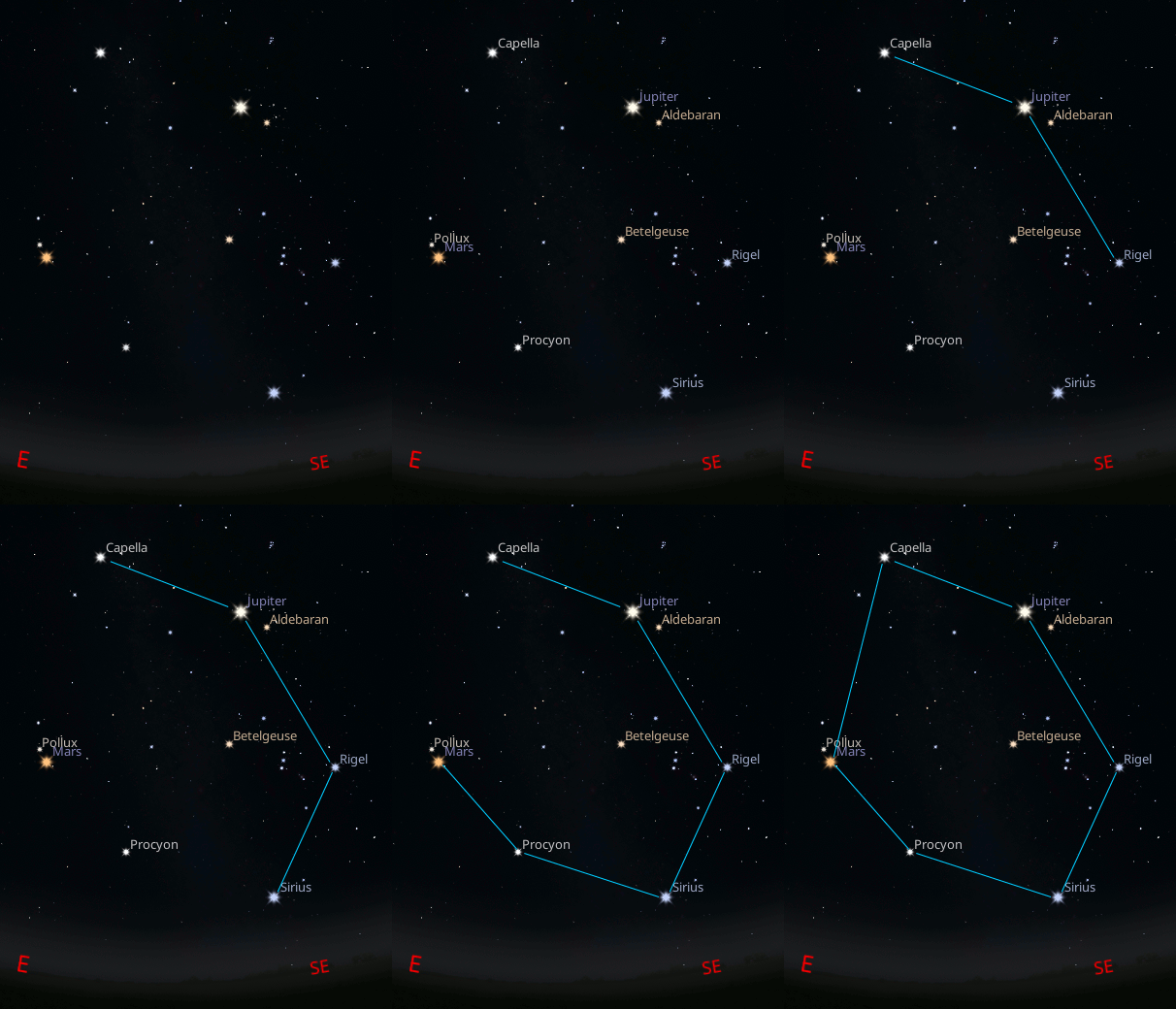
The winter circle or more properly hexagon, seen in the winter sky this evening, has the addition of two planets, and they’re in the proper location so that they don’t spoil the hexagon. We start at the top with the star Capella high in the east. We move clockwise downward to Jupiter and below it the star Aldebaran. We drop lower to Orion’s knee and the star Rigel, then down to Sirius, low in the southeast, the brightest nighttime star, but doesn’t hold a candle to Jupiter. Then we go above left to Procyon and upwards and left to Mars, which is near Pollux, and finally back up to Capella. That’s that is our winter hexagon right now, so take it in while you can, before Jupiter and Mars move off and mess it up.
The astronomical event times given are for the Traverse City/Interlochen area of Michigan (EST, UT – 5 hours). Times will be different for other locations.
Addendum
As for events happening on Earth: Resist!
Ephemeris: 04/25/2024 – Finding Hydra, the longest constellation
This is Ephemeris for Thursday, April 25th. Today the Sun will be up for 14 hours exactly, setting at 8:41, and it will rise tomorrow at 6:39. The Moon, 2 days past full, will rise at 11:00 this evening.
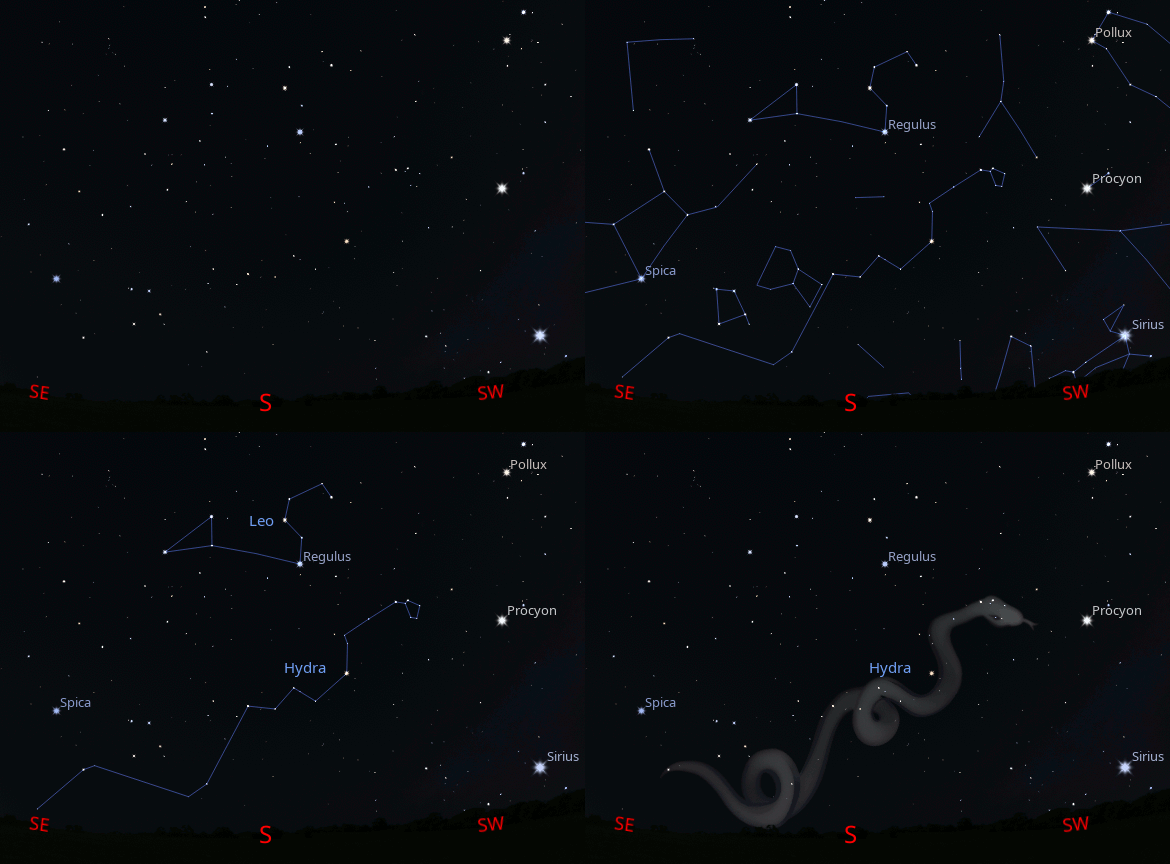
Stretching from midway up the sky in the southwest to low in the southeast at 10 p.m. can be found the constellation of Hydra the water snake, the longest constellation of all. Unlike the monster of the same name that Hercules slew, this Hydra has but one head, which is its most distinctive part. The head of Hydra is located between the bright stars Procyon in the southwest. Which is above the brighter star Sirius low in the sky, and Regulus in Leo the lion, higher in the south. Hydra’s head is a small but distinctive group of 6 stars that make a drooping loop to the right. The rest of Hydra wends its way in a reasonably straight line down to the southeastern horizon.
The astronomical event times given are for the Traverse City/Interlochen area of Michigan (EDT, UT–4 hours). They may be different for your location.
Addendum
Ephemeris: 03/07/2024 – There’s a unicorn in there somewhere
This is Bob Moler with Ephemeris for Thursday, March 7th. Today the Sun will be up for 11 hours and 30 minutes, setting at 6:39, and it will rise tomorrow at 7:06. The Moon, 3 days before new, will rise at 6:35 tomorrow morning.
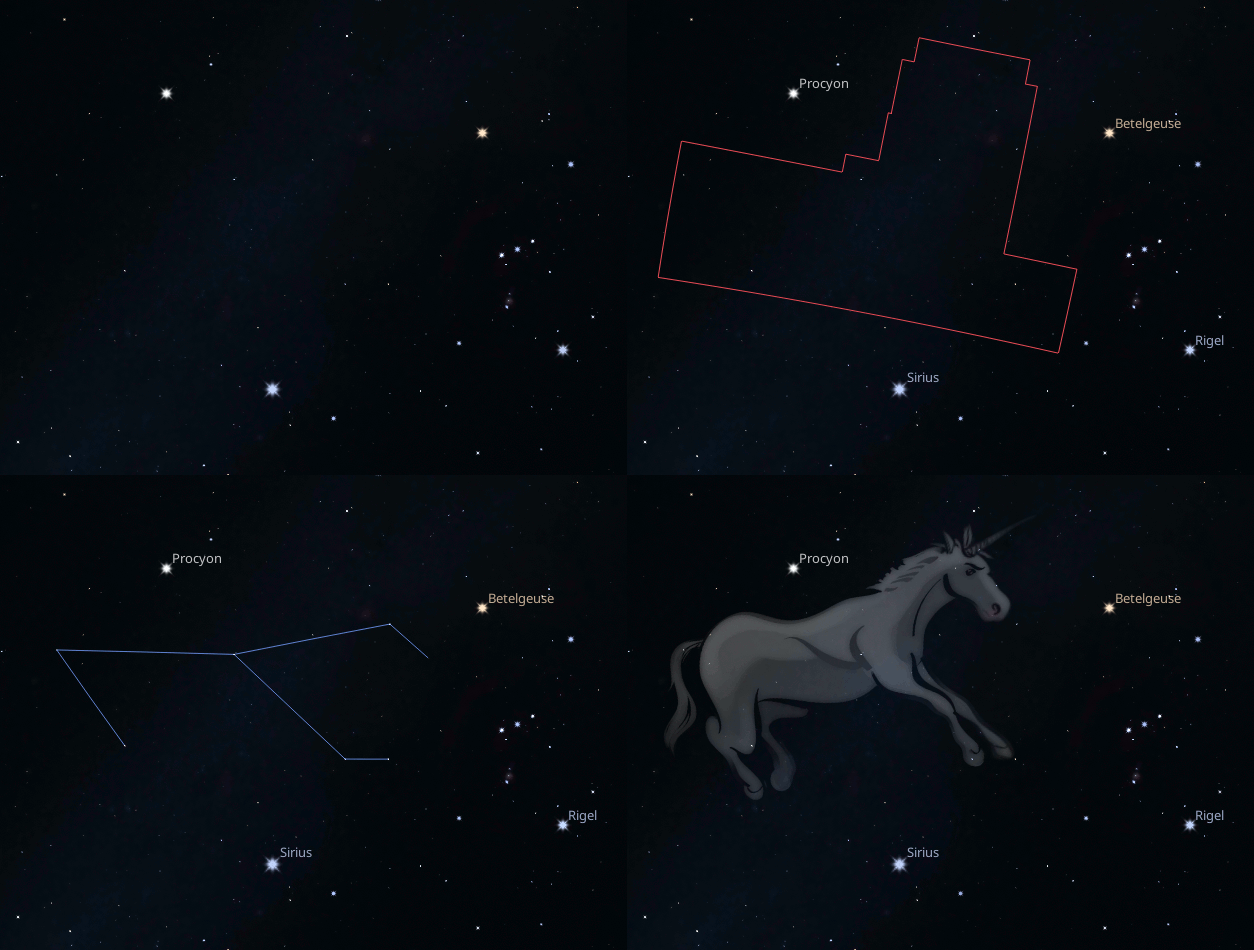
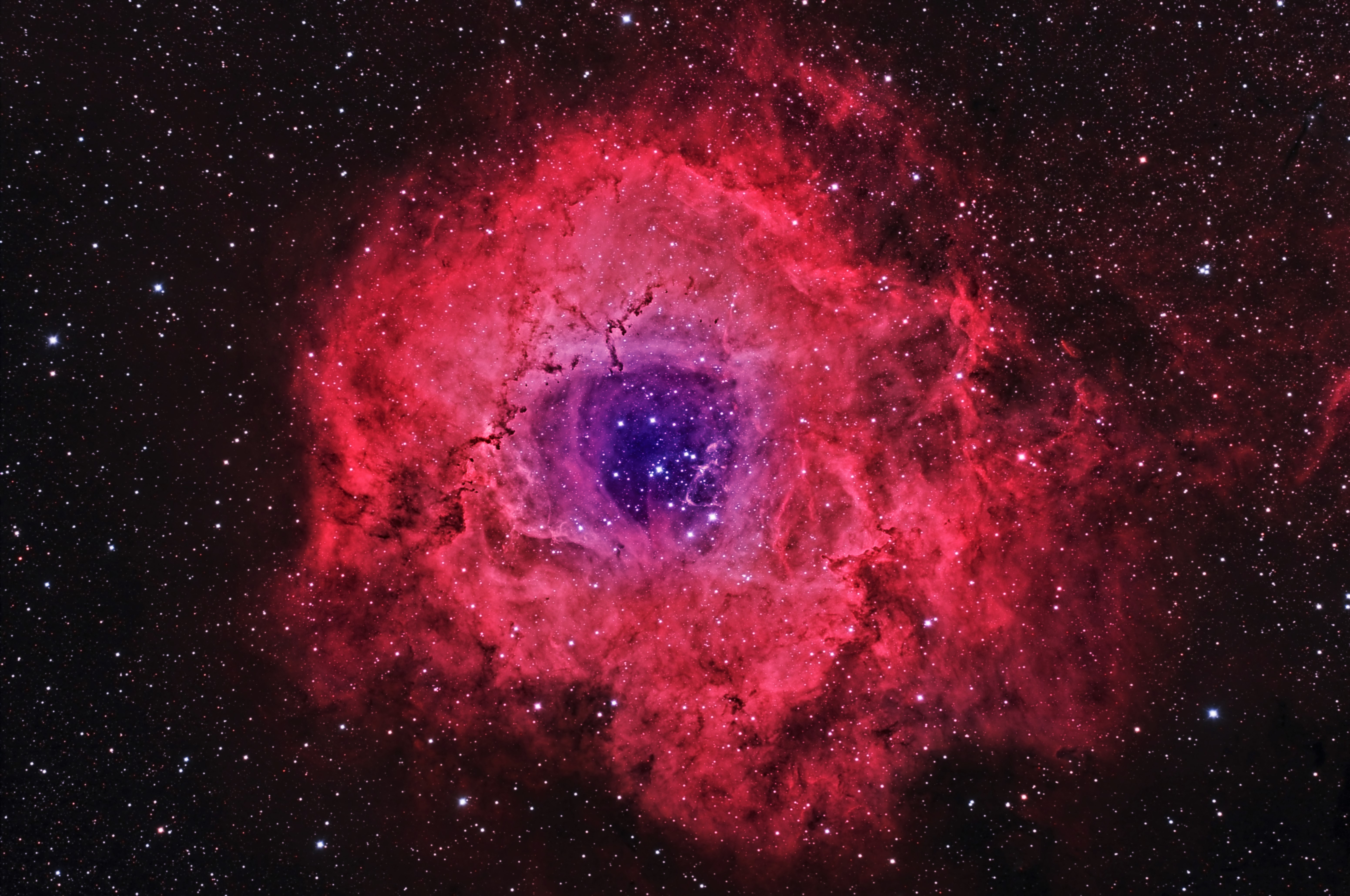
The constellation of Monoceros the unicorn is located in an area of sky to the left of Orion so it’s in the south at 8 pm, inside the Winter Triangle of stars, Betelgeuse in Orion; Sirius in the Great Dog, Canis Major; and Procyon in Canis Minor. If you don’t see anything there, it’s OK. Nobody sees real unicorns any more anyway. Are there any real unicorns? Anyway, there’s a great number of nebulae here in the Milky Way that runs through it, which unfortunately are too faint to be seen with amateur telescopes. However, it is a gold mine for amateur astronomers who are also astrophotographers using time exposures to record the faint nebulae here, including the famous Rosette Nebula!
The astronomical event times given are for the Traverse City/Interlochen area of Michigan (EST, UT –5 hours). They may be different for your location.
Addendum
Ephemeris: 02/05/2024 – Looking at the star Procyon
This is Ephemeris for Monday, February 5th. Today the Sun will be up for 9 hours and 59 minutes, setting at 5:56, and it will rise tomorrow at 7:56. The Moon, 3 days past last quarter, will rise at 5:44 tomorrow morning.
The star Procyon is in Orion’s little hunting dog Canis Minor, which contains only one other star. It can be found by using the shoulder stars of Orion, Bellatrix and Betelgeuse, pointing to the left and down a bit to Procyon in the evening. The word Procyon appears to mean “Before the Dog” meaning that rises before the Dog Star, Sirius, even though it is east of it. Procyon is also north of Sirius, which for observers above 30° north latitude does indeed rise before the Dog Star. It is a star like Sirius, though it’s not as bright, or white. Procyon is 11.5 light years away while Sirius is 8.4 light years away. Both have tiny white dwarf companion stars.
The astronomical event times given are for the Traverse City/Interlochen area of Michigan (EST, UT –5 hours). They may be different for your location.
Addendum
02/22/2022 – Ephemeris – The Winter Triangle
This is Ephemeris for Tuesday, February 22nd. Today the Sun will be up for 10 hours and 49 minutes, setting at 6:21, and it will rise tomorrow at 7:30. The Moon, 1 day before last quarter, will rise at 1:26 tomorrow morning.
I’ve talked about the Winter Circle of bright stars already this winter, but some other astronomers talk about the Winter Triangle. The stars involved are Betelgeuse in the hunter Orion, Sirius in Canis Major, Orion’s large hunting dog, and Procyon in Canis Minor, his other small hunting dog. These three stars enclose a rather blank piece of sky with the faint Milky Way running through it and the almost invisible constellation of Monoceros the unicorn. The Summer Triangle has three bright stars with no other close competition. The Winter Triangle has four other bright stars near it. Any three of these would make a nice triangle. One of these constellations, Canis Minor, is tiny with Procyon and one other star. It makes me think of a dachshund, or maybe, if I’m hungry, a hot dog.
The astronomical event times given are for the Traverse City/Interlochen area of Michigan (EST, UT -5 hours). They may be different for your location.
Addendum
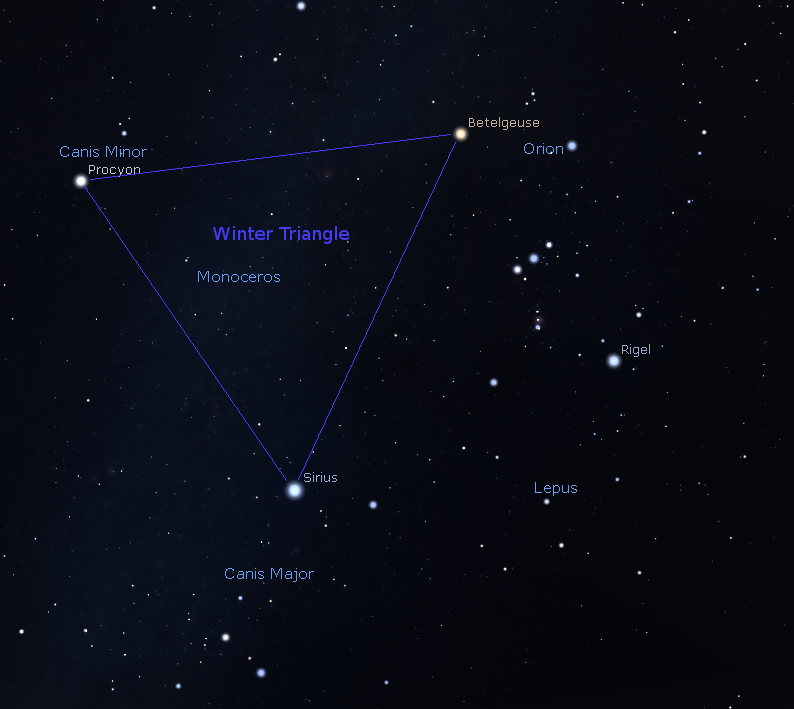
The Winter Triangle. It encloses a pretty blank space where Monoceros the unicorn lies. Created using Stellarium with my annotations for the Winter Triangle.
01/31/2022 – Ephemeris – The winter circle of bright stars
This is Ephemeris for Monday, January 31st. Today the Sun will be up for 9 hours and 47 minutes, setting at 5:50, and it will rise tomorrow at 8:01. The Moon, 1 day before new, will rise at 8:48 tomorrow morning.
The winter skies are blessed with more first magnitude stars than any other season. Six of these stars lie in a large circle centered on the seventh, It’s called the Winter Circle. This circle is up in the evening. Starting high overhead is yellow Capella in Auriga the charioteer. Moving down clockwise is orange Aldebaran in the face of Taurus the Bull. Then down to Orion’s knee, we find blue-white Rigel. Down and left is the brightest star of all the brilliant white Sirius the Dog Star in Canis Major, lowest of these stars in the south-southeast. Moving up and left is white Procyon in Canis Minor, Above Procyon is Pollux in Gemini, the twins. All these are not quite centered on Betelgeuse, the bright red star in Orion’s shoulder.
The astronomical event times given are for the Traverse City/Interlochen area of Michigan (EST, UT – 5 hours). They may be different for your location.
Addendum
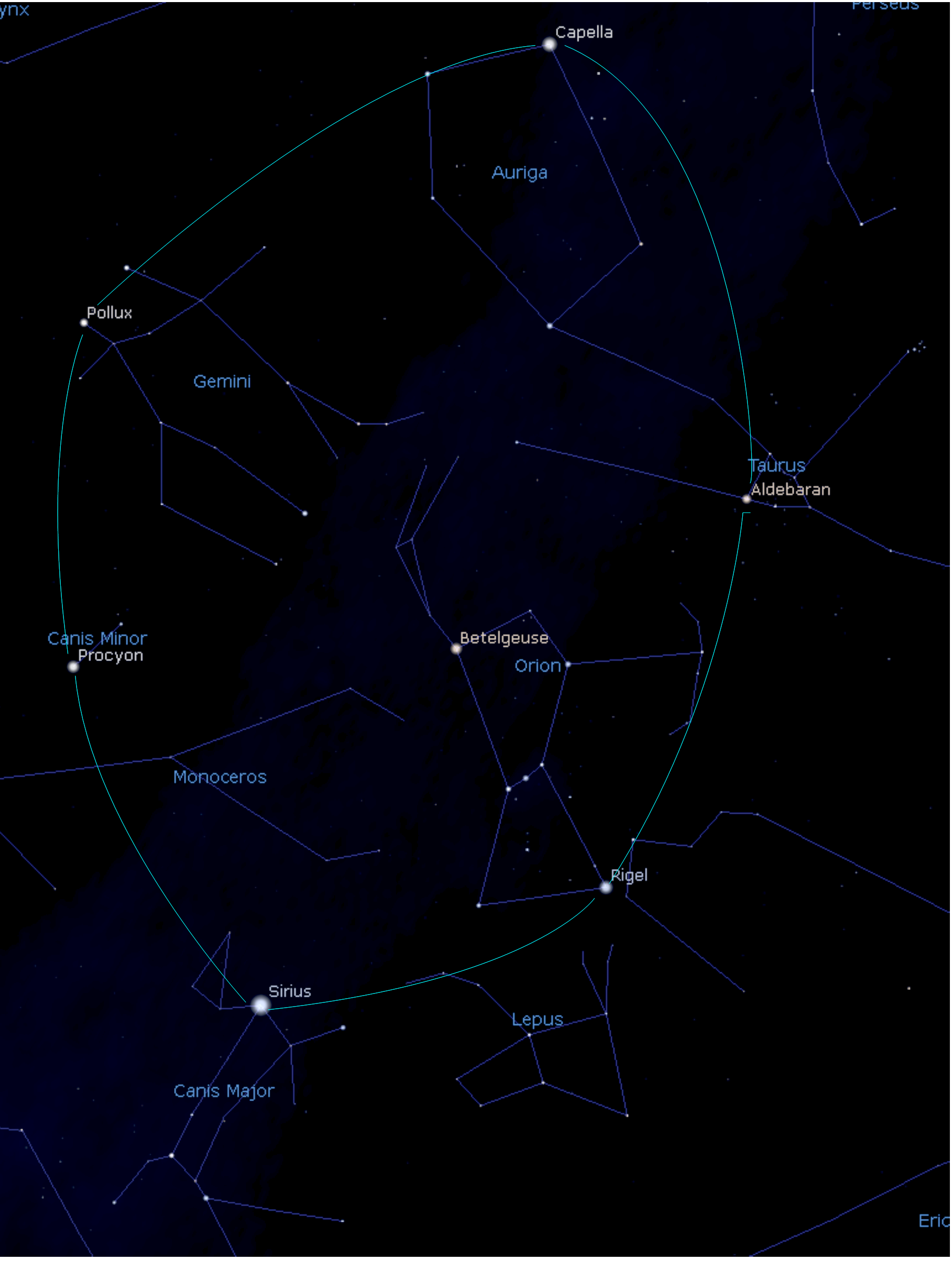
The bright stars of winter arrayed in a not so accurate circle. Some call it the Winter Hexagon. These stars are what make the winter sky so brilliant on the rare clear night in winter. Created using Stellarium.
03/09/2021 – Ephemeris – A celestial warning to keep off thin ice
This is Ephemeris for Tuesday, March 9th. Today the Sun will be up for 11 hours and 35 minutes, setting at 6:41, and it will rise tomorrow at 7:03. The Moon, halfway from last quarter to new, will rise at 6:12 tomorrow morning.
The native Anishinaabe peoples of the Great Lakes Region, which includes the tribes of our area, have one constellation of winter I know of. It is The Wintermaker which uses many of Orion’s stars and whose arms stretch from Aldebaran in Taurus the bull to Procyon the Little Dog Star, embracing the whole of the winter sky. Now that spring is nearly here he is sinking into the west, losing to the heat of the Sun. The first constellation of spring is Curly Tail, or the Great Underwater Panther. It uses the stars of Leo the lion’s backward question mark as its curly tail and the small knot of stars that are the head of Hydra the water snake below Cancer the crab as its head. His warning: Keep off the thinning ice or break through and be snatched by the great panther that lives below.
The astronomical event times given are for the Traverse City/Interlochen area of Michigan. They may be different for your location.
Addendum
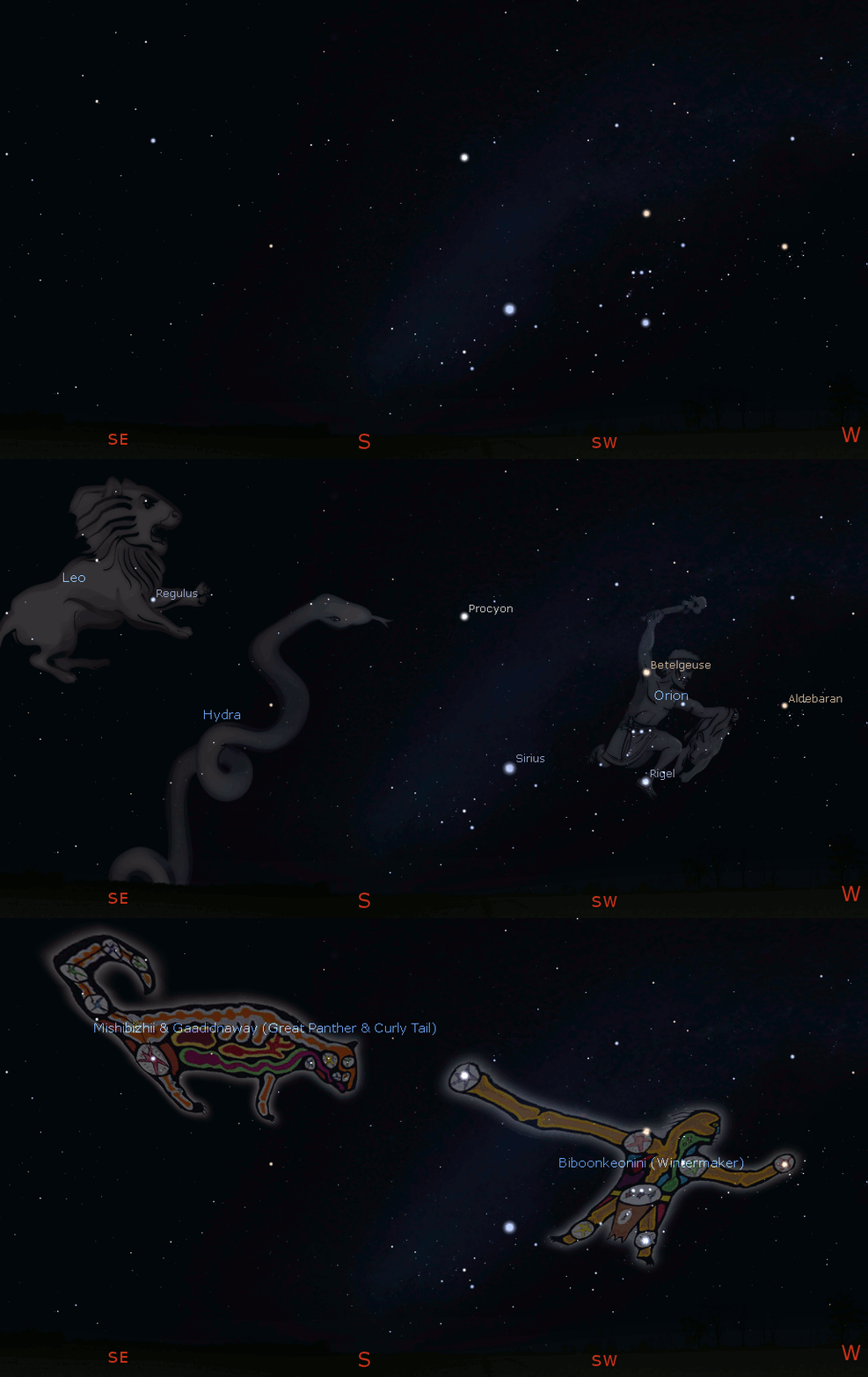
The Great Underwater Panther finder animation. Three frame animation of Unannotated sky, International Astronomical Union constellations, and Anishinaabe (Ojibwe) constellations of Curly Tail and Wintermaker. Click on the image to enlarge. Created using Stellarium and GIMP. Additional credits below.
The time is set for the above image is 10 pm on March 9th.
The constellation art is part of the latest versions of Stellarium. Ojibwe (Anishinaabe) constellation art by Annette S Lee and William Wilson from Ojibwe Sky Star Map Constellation Guide, ISBN 978-0-615-98678-4. There is also an Ojibwe Sky Star Map poster suitable for framing.
02/11/2021 – Ephemeris – The Winter Triangle
This is Ephemeris for Thursday, February 11th. Today the Sun will be up for 10 hours and 17 minutes, setting at 6:06, and it will rise tomorrow at 7:47. The Moon is new today, and won’t be visible.
I usually talk about the Winter Circle of bright stars, but some other astronomers talk about the Winter Triangle. The stars involved are Betelgeuse in the hunter Orion, Sirius in Canis Major, Orion’s large hunting dog, and Procyon in Canis Minor, his other small hunting dog. These three stars enclose a rather blank piece of sky with the faint Milky Way running through it and the almost invisible constellation of Monoceros the unicorn. The Summer Triangle has three bright stars with no other close competition. The Winter Triangle has four other bright stars near it. Any three of these would make a nice triangle. One of these constellations Canis Minor is tiny, with Procyon and one other star. It makes me think of a dachshund, or maybe, if I’m hungry, a hot dog.
The event times given are for the Traverse City/Interlochen area of Michigan. They may be different for your location.
Addendum
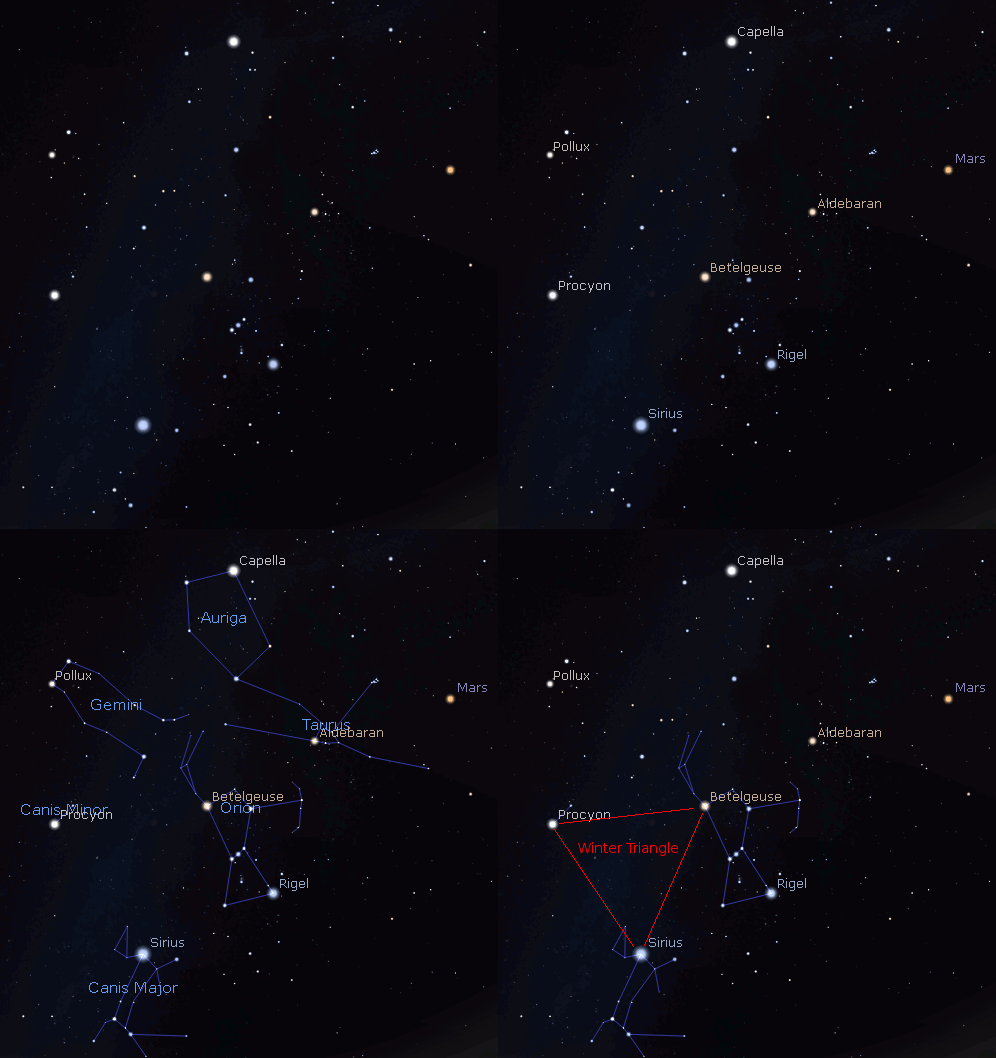
Winter Triangle finder animation. It shows the star field, named first magnitude stars, then their constellations, then the Winter Triangle and constellations of the three stars. Click on the image to enlarge. Created using Stellarium and GIMP.
01/11/2021 – Ephemeris – Procyon, the before the Dog Star
This is Bob Moler with Ephemeris for Monday, January 11th. Today the Sun will be up for 9 hours and 5 minutes, setting at 5:23 pm, and it will rise tomorrow at 8:17 am. The Moon, 2 days before new, will rise at 8:05 tomorrow morning.
Visible low in the east at 8 p.m. appears the star Procyon. To its right and below is Sirius the brightest night-time star. Procyon is the bright star in the constellation Canis Minor, or lesser dog. I can find only one other star in Canis Minor. Perhaps it’s a hot dog. If Sirius, in Canis major is the Dog Star then Procyon should be the Little Dog Star. However, Procyon is an interesting name. It means “Before the dog”, which is an allusion to the fact that Procyon, though east of Sirius actually rises before it. This is due to Procyon’s more northerly position. This effect doesn’t work south of the equator, however. Sirius will rise at about 7:30 tonight. Procyon is a star much like Sirius but is 32% farther away. It’s 11.4 to Sirius’ 8.6 light years away.
The event times given are for the Traverse City/Interlochen area of Michigan. They may be different for your location.
Addendum
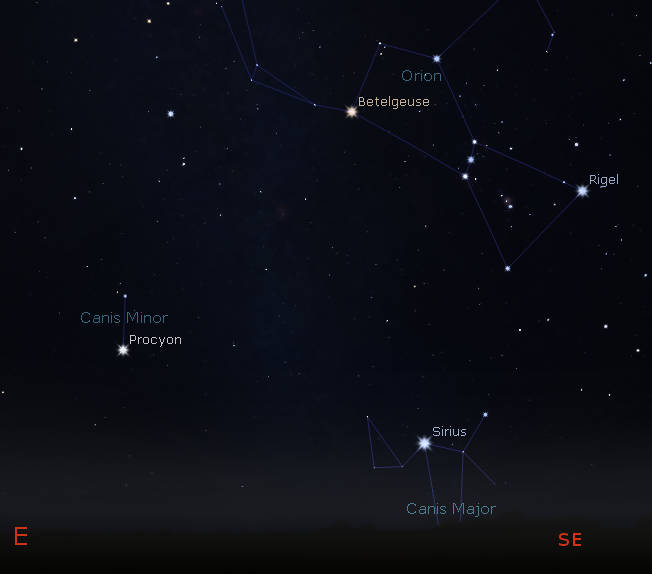
Orion and his hunting dogs in early winter (8 pm, January 11, 2021) showing that Procyon does rise before Sirius.
 Bob Moler's Ephemeris Blog