Archive
Ephemeris: 01/16/2026 – Comparing Orion’s two brightest stars
This is Ephemeris for Friday, January 16th. Today the Sun will be up for 9 hours and 13 minutes, setting at 5:29, and it will rise tomorrow at 8:15. The Moon, 2 days before new, will rise at 7:54 tomorrow morning.
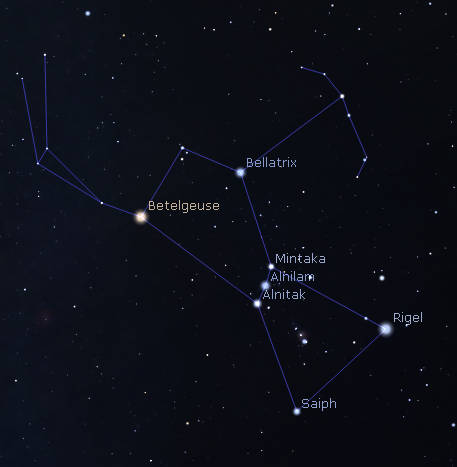
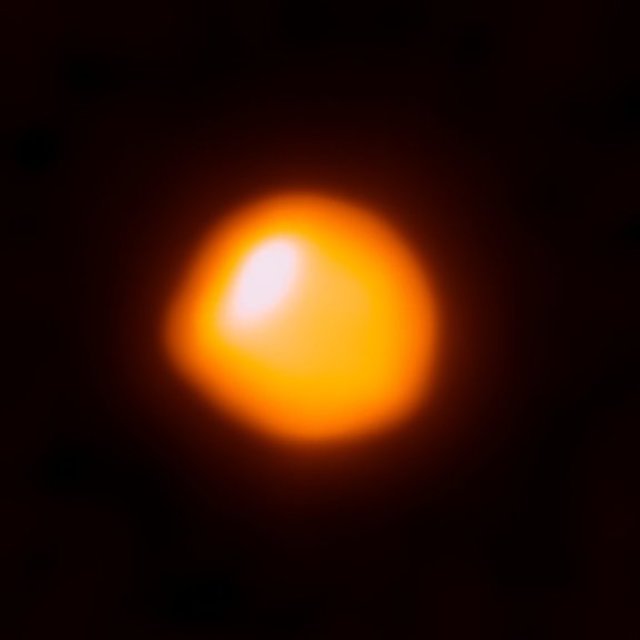
Orion’s two brightest stars are kind of the same but different. Let me explain. Betelgeuse is a red giant star, extremely massive, maybe 14 to 19 times the sun’s mass. It is somewhere between 8 and 14 million years old, which compared to the sun is just a baby, except it is so massive that it is in the last million or so years of its life. Rigel is a bluish white and a bit more massive, about 21 times the mass of the sun, and maybe 8 million years old. It has used most of the hydrogen in its core, and is beginning to transition into its final years which is a few more millions of years. So it’s not as far along in its evolution as Betelgeuse and has not bloated out and turned red. Betelgeuse is 500 light years away, while Rigel is almost 900.
The astronomical event times given in this blog are for the Traverse City/Interlochen area of Michigan (Lat 44.7° N, Long 85.7° W; EST, UT – 5 hours) unless stated otherwise. Times will be different for other locations.
Addendum
Ephemeris: 01/06/2026 – A river in the sky
This is Ephemeris for Tuesday, January 6th. Today the Sun will be up for 8 hours and 58 minutes, setting at 5:18, and it will rise tomorrow at 8:19. The Moon, 3 days past full, will rise at 9:25 this evening.
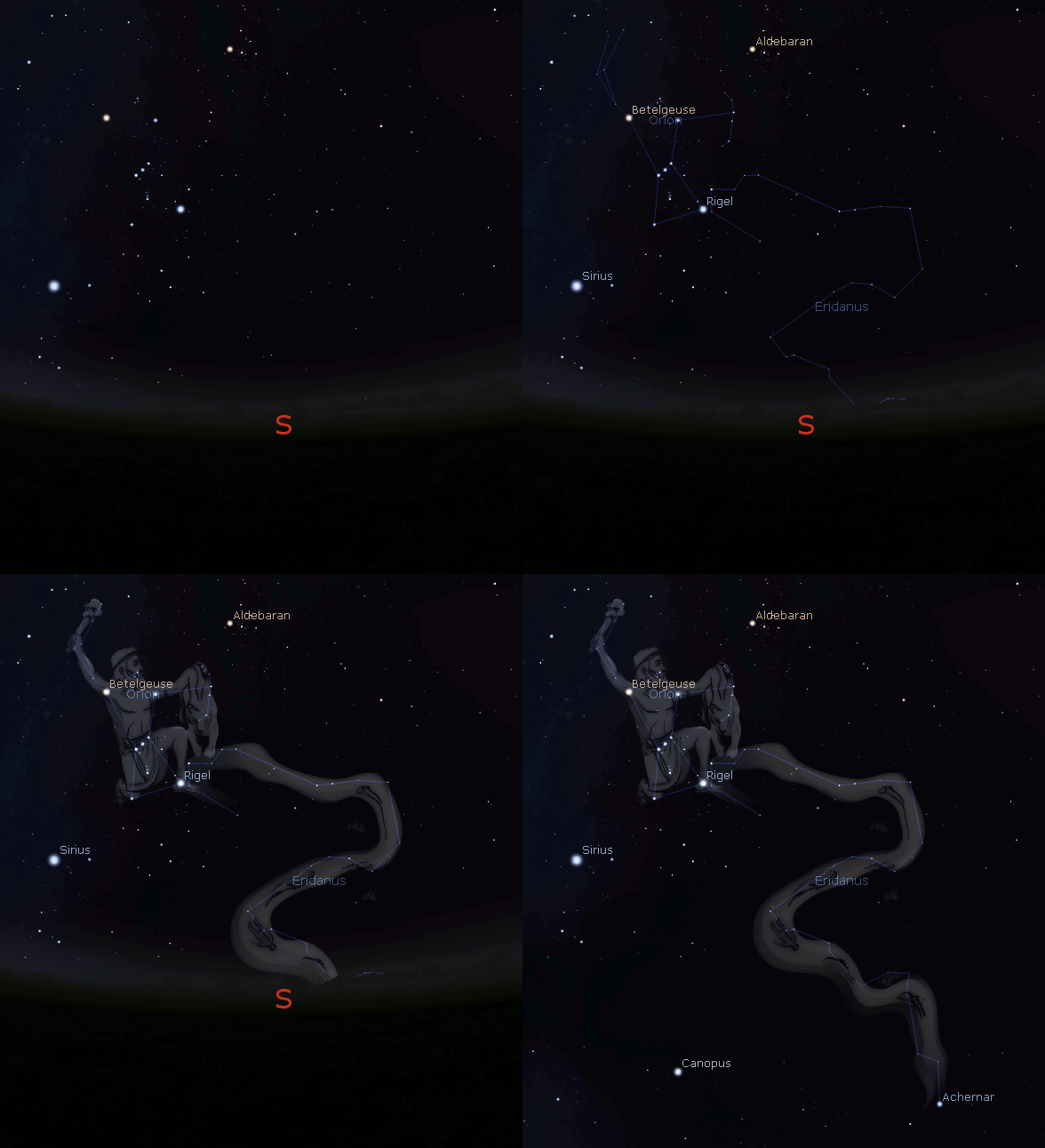
One of the more obscure constellations around is Eridanus, which depicts a river. At 8 PM the river, marked by dim stars, starts near the lower right corner of Orion, near the bright star Rigel and flows to the right then down a little way, then to the lower left, and again to the right, to the southern horizon. One has to travel to the far south to see the southern terminus of the river, the bright star Achernar. Writers over the ages have seen here the Nile, the Rhine and the Earth circling river Ocean of the flat earth days. To most Greeks, including Ptolemy it was simply the River. The earlier Greek astronomer Hipparchus called it the River of Orion, alluding to Orion’s star Rigel as its source. The southern part of the river was added when astronomers made it far enough south.
The astronomical event times given in this blog are for the Traverse City/Interlochen area of Michigan (Lat 44.7° N, Long 85.7° W; EST, UT – 5 hours) unless stated otherwise. Times will be different for other locations.
Addendum
Ephemeris: 01/20/2025 – The planets augment the Winter Hexagon
This is Ephemeris for Martin Luther King Jr. Day, Monday, January 20th. Today the Sun will be up for 9 hours and 22 minutes, setting at 5:35, and it will rise tomorrow at 8:12. The Moon, 1 day before last quarter, will rise at 12:56 tomorrow morning.
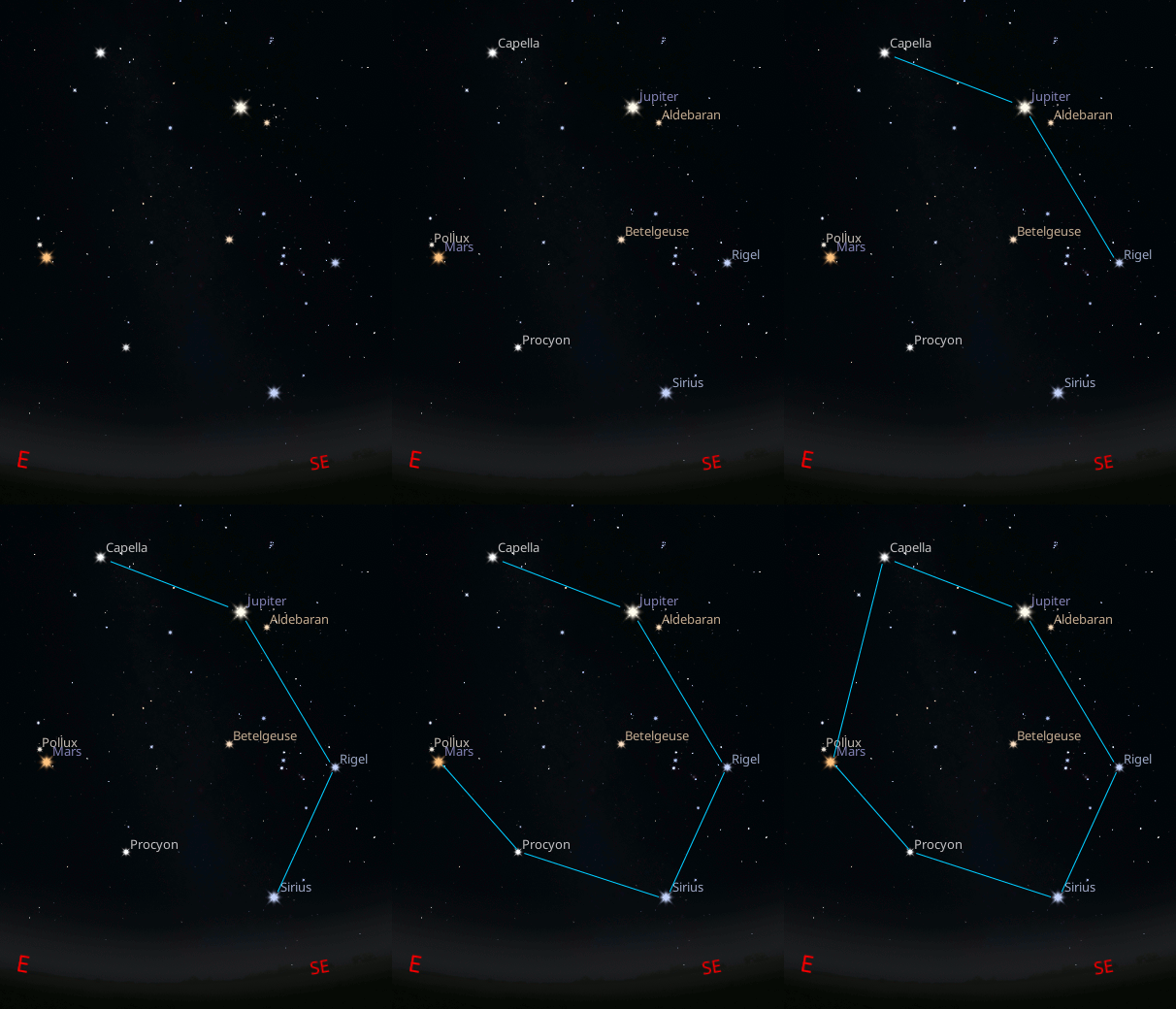
The winter circle or more properly hexagon, seen in the winter sky this evening, has the addition of two planets, and they’re in the proper location so that they don’t spoil the hexagon. We start at the top with the star Capella high in the east. We move clockwise downward to Jupiter and below it the star Aldebaran. We drop lower to Orion’s knee and the star Rigel, then down to Sirius, low in the southeast, the brightest nighttime star, but doesn’t hold a candle to Jupiter. Then we go above left to Procyon and upwards and left to Mars, which is near Pollux, and finally back up to Capella. That’s that is our winter hexagon right now, so take it in while you can, before Jupiter and Mars move off and mess it up.
The astronomical event times given are for the Traverse City/Interlochen area of Michigan (EST, UT – 5 hours). Times will be different for other locations.
Addendum
As for events happening on Earth: Resist!
Ephemeris: 02/08/2024 – Up the river
This is Ephemeris for Thursday, February 8th. Today the Sun will be up for 10 hours and 7 minutes, setting at 6:00, and it will rise tomorrow at 7:52. The Moon, 1 day before new, will rise at 8:09 tomorrow morning.
One of the more obscure constellations around is Eridanus, which depicts a river. The river starts near the lower right corner of Orion, near the bright star Rigel and flows to the right then down near the southwestern horizon, then it meanders along the horizon to the south before turning below the horizon. One has to travel to the far south to see the southern terminus of the river, the bright star Achernar. Writers over the ages have seen here the Nile and the Earth circling river Ocean of the flat earth days. Achernar is actually two stars, the brightest was discovered to be the flattest star known, due to its rapid spin. The dimensions of Achernar A has been determined to be twice as wide across its equator than from pole to pole. It’s 139 light years away.
The astronomical event times given are for the Traverse City/Interlochen area of Michigan (EST, UT –5 hours). They may be different for your location.
Addendum
Ephemeris: 01/11/2024 – Rigel, the star in Orion’s knee or is it his foot?
This is Bob Moler with Ephemeris for Thursday, January 11th. Today the Sun will be up for 9 hours and 4 minutes, setting at 5:23, and it will rise tomorrow at 8:18. The Moon is new today, and won’t be visible.
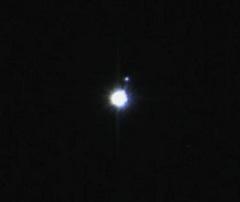
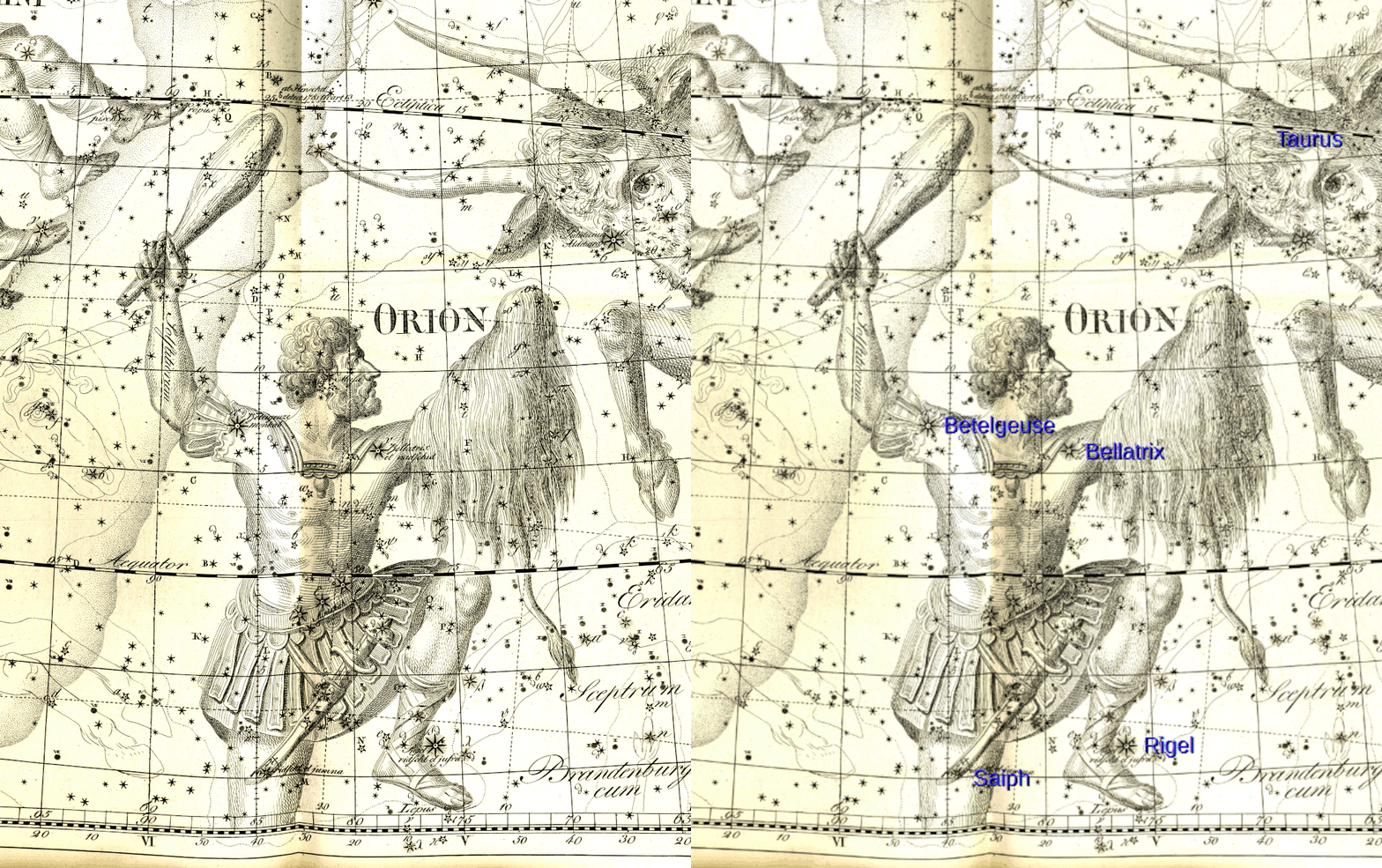
Orion’s second first magnitude star is Rigel in the lower right corner of the constellation this is a blue-white star in contrast to Betelgeuse which is a reddish star. The name Rigel is part of a phrase that means Left foot of Jauzah. Jauzah being the old name of the constellation Orion. It’s where we place Orion’s left knee now. In older drawings of the constellation, Orion has his left foot raised as if charging towards Taurus who’s charging at him. Rigel is about the same mass as Betelgeuse, though it’s nearly twice as far away at nearly 900 light years. Rigel is a quadruple star system. The bright Rigel A itself has what looks like a companion in small telescopes. That companion is actually three stars orbiting each other.
The astronomical event times given are for the Traverse City/Interlochen area of Michigan (EST, UT –5 hours). They may be different for your location.
Addendum
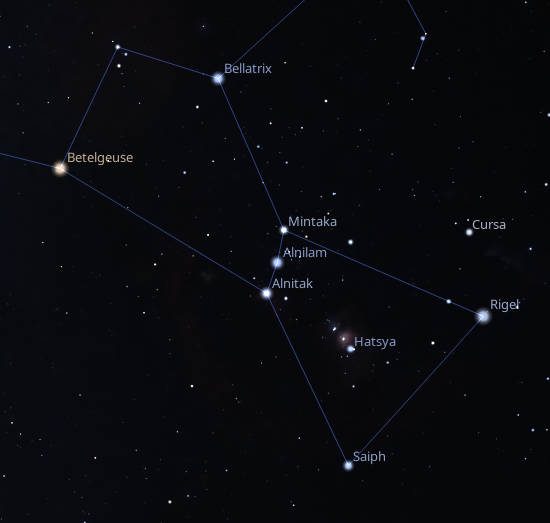
right-most bright star Is Rigel, a bluish white star, in contrast to Betelgeuse which has a ruddy glow. Here it looks like Betelgeuse and Bellatrix are in Orion’s shoulders and Saiph and Rigel are in his knees, with the belt star halfway in between. The word Rigel, however, means foot, and Saiph means sword. Check out the star chart below. Created using Stellarium.
01/10/2023 – Ephemeris – The constellation of Orion the hunter, unlucky in love
This is Bob Moler with Ephemeris for Tuesday, January 10th. Today the Sun will be up for 9 hours and 3 minutes, setting at 5:22, and it will rise tomorrow at 8:18. The Moon, halfway from full to last quarter, will rise at 9:01 this evening.
Before the Moon rises tonight, we will have two hours of darkness. Winter’s central constellation, Orion the hunter, doesn’t need the Moon to be absent to see its principal stars. He’s in the southeast before the Moon rises with red Betelgeuse in one shoulder and dimmer Bellatrix on the other, Saiph at one knee and bright blue-white Rigel at the other. Between his shoulders and knees runs his belt of three stars in a line. Above Betelgeuse, he is holding a club aloft and from Bellatrix he holds a lion skin shield to defend himself from the charge of Taurus the bull, above and right of him. I consider him a hard luck hero, with three different stories on how he died. Unlucky in love, he’s consigned to chase the Seven Sisters of the Pleiades throughout eternity.
The astronomical event times given are for the Traverse City/Interlochen area of Michigan (EST, UT –5 hours). They may be different for your location.
Addendum
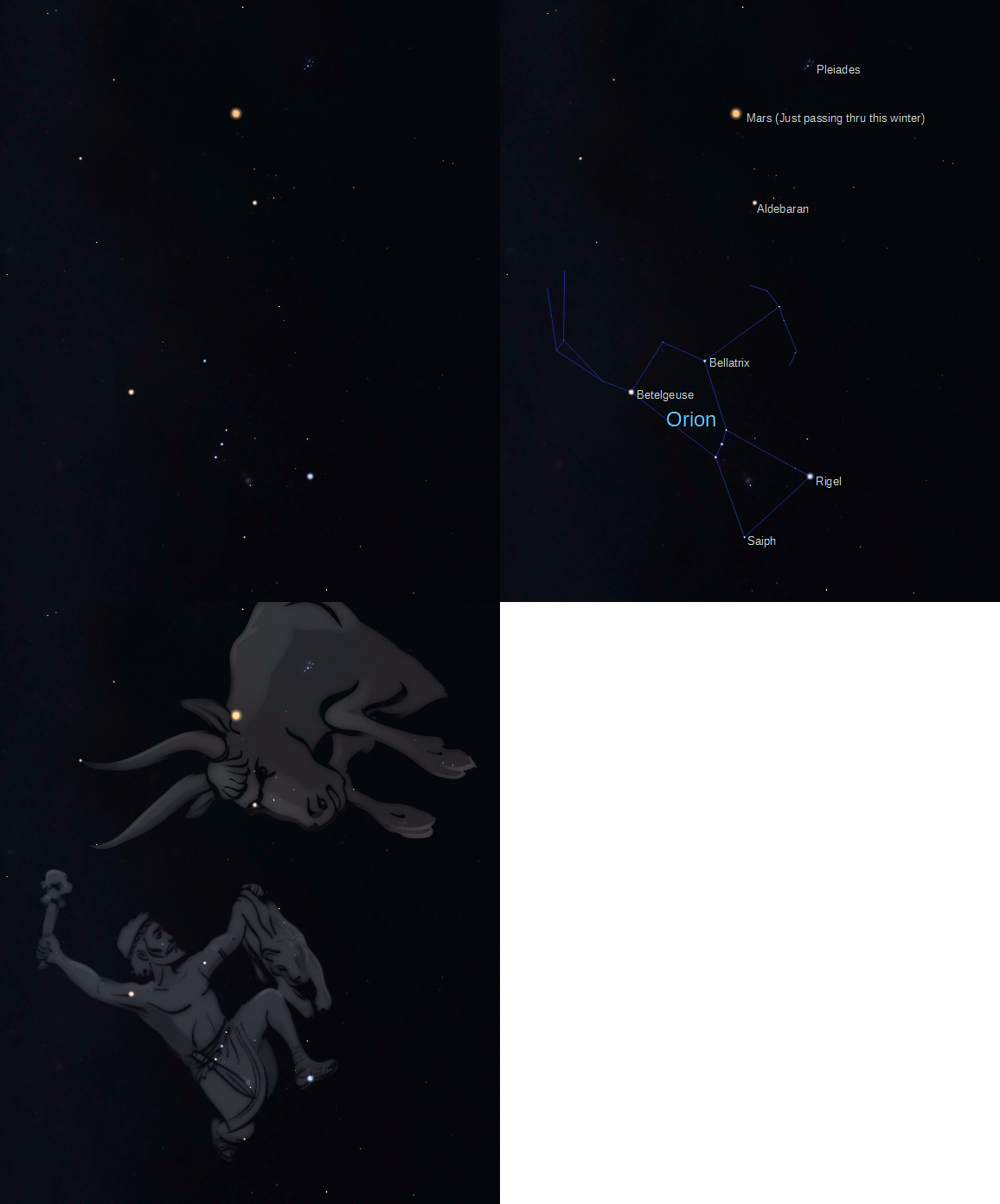
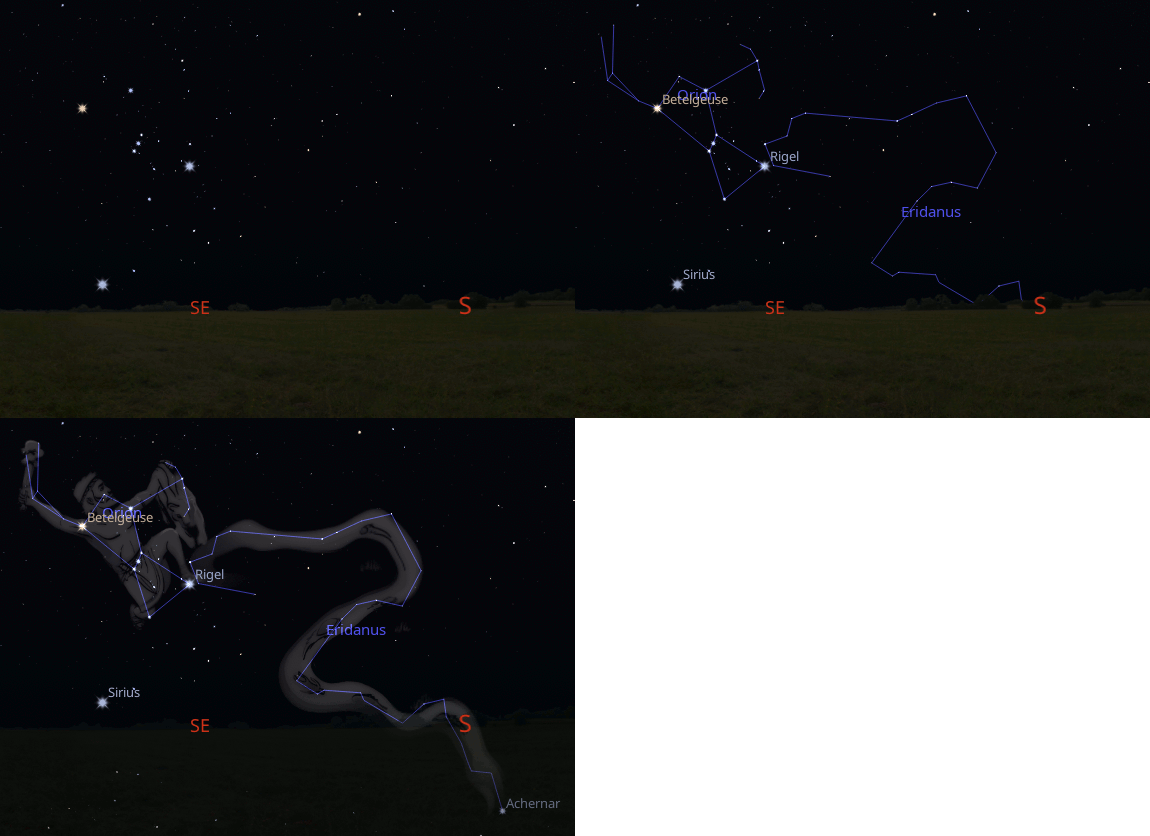
Orion finder animation with Mars. First, showing the unannotated sky looking southeast at Orion. Second, Orion with lines and labels of the stars at the corners of his body, and other bright stars in the view, plus the Pleiades and bright planet Mars, that’s just happening to be passing through this year. Third, the constellation art for Orion and Taurus the bull. Created using Stellarium, LibreOffice Draw and GIMP.
Here are the three stories of how Orion died: One: Orion raped the goddess Artemis, and so she killed him. Two: Orion was betrothed to Artemis, but her twin brother Apollo was jealous and caused her to kill him in a hunting “accident”. Three: Orion was killed by the sting of a scorpion, which is the reason Orion and Scorpius are never in the sky at the same time.
01/31/2022 – Ephemeris – The winter circle of bright stars
This is Ephemeris for Monday, January 31st. Today the Sun will be up for 9 hours and 47 minutes, setting at 5:50, and it will rise tomorrow at 8:01. The Moon, 1 day before new, will rise at 8:48 tomorrow morning.
The winter skies are blessed with more first magnitude stars than any other season. Six of these stars lie in a large circle centered on the seventh, It’s called the Winter Circle. This circle is up in the evening. Starting high overhead is yellow Capella in Auriga the charioteer. Moving down clockwise is orange Aldebaran in the face of Taurus the Bull. Then down to Orion’s knee, we find blue-white Rigel. Down and left is the brightest star of all the brilliant white Sirius the Dog Star in Canis Major, lowest of these stars in the south-southeast. Moving up and left is white Procyon in Canis Minor, Above Procyon is Pollux in Gemini, the twins. All these are not quite centered on Betelgeuse, the bright red star in Orion’s shoulder.
The astronomical event times given are for the Traverse City/Interlochen area of Michigan (EST, UT – 5 hours). They may be different for your location.
Addendum
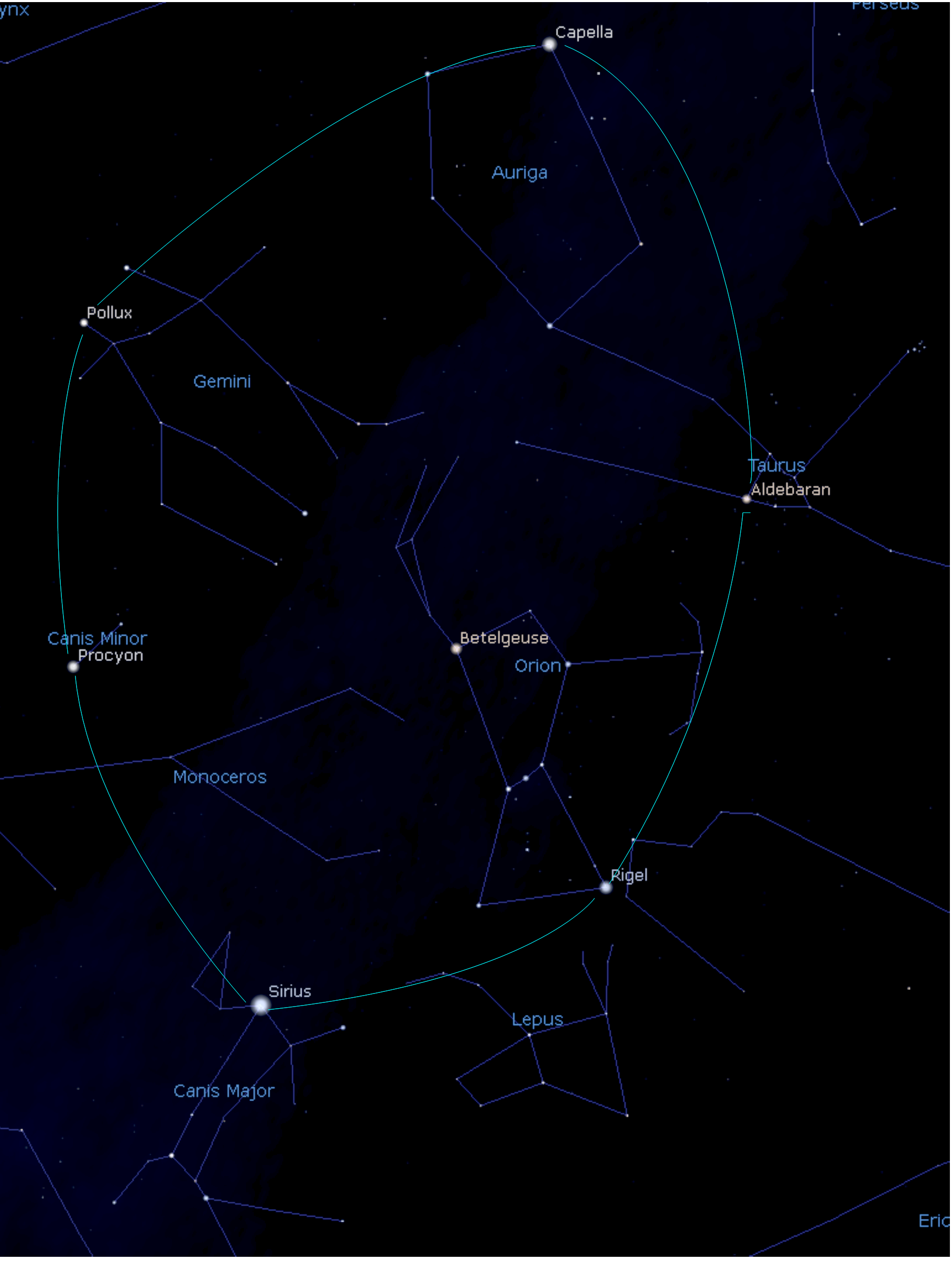
The bright stars of winter arrayed in a not so accurate circle. Some call it the Winter Hexagon. These stars are what make the winter sky so brilliant on the rare clear night in winter. Created using Stellarium.
01/06/2022 – Ephemeris – The named stars of Orion
This is Ephemeris for Thursday, January 6th. Today the Sun will be up for 8 hours and 58 minutes, setting at 5:18, and it will rise tomorrow at 8:19. The Moon, 3 days before first quarter, will set at 10:07 this evening.
Orion is still on an angle, leaning to the left, at 8 to 9 pm in the southeastern sky. It’s seven brightest stars have names from antiquity, and some of them are familiar. Starting from the top left, the bright reddish star is famous Betelgeuse. The top right star is Bellatrix, a name familiar to Harry Potter fans. The three stars of his belt, from bottom to top, are Alnilam, Alnitak, and Mintaka. The final bottom two stars from left to right are Saiph, pronounced “safe”. And blue-white Rigel, usually the brightest star of the constellation. These are the stars of Orion’s shoulders, belt and knees. He has other stars that delineate an arm with an upraised club and an arm holding a lion skin shield and a sword hanging from his belt.
The astronomical event times given are for the Traverse City/Interlochen area of Michigan (EST, UT – 5 hours). They may be different for your location.
Addendum
Orion’s named stars. Betelgeuse means “Armpit”. Bellatrix means “Female warrior”. The names of Orion’s belt stars refer to belt or girdle, Rigel refers to Orion’s foot. Saiph means sword, however Orion’s sword is the line of three stars below the belt stars. In binoculars, there’s more than three stars here. Around the second “star” of the sword is the Great Orion Nebula, barely visible here. Created using Stellarium.
01/12/2021 – Ephemeris – The celestial river Eridanus
This is Bob Moler with Ephemeris for Tuesday, January 12th. Today the Sun will be up for 9 hours and 7 minutes, setting at 5:25, and it will rise tomorrow at 8:17. The Moon, 1 day before new, will rise at 8:58 tomorrow morning.
One of the more obscure constellations around is Eridanus, which depicts a river. The river starts near the lower right corner of Orion, near the bright star Rigel and flows to the right then down near the southwestern horizon, then it meanders along the horizon to the south before turning below the horizon. One has to travel to the far south to see the southern terminus of the river, the bright star Achernar. Writers over the ages have seen here the Nile and the Earth circling river Ocean of the flat earth days. Achernar is actually two stars, the brightest was discovered to be the flattest star known, due to its rapid spin. The dimensions of Achernar A has been determined to be twice as wide across its equator than from pole to pole. It’s 139 light years away.
The event times given are for the Traverse City/Interlochen area of Michigan. They may be different for your location.
Addendum
An animation of the constellation Eridanus which is a river that flows from Rigel in Orion to the star Achernar below our southern horizon at latitude 45 degrees north. Create using Stellarium and GIMP.
12/07/2020 – Ephemeris – Looking forward to the best of winter: Orion
This is Ephemeris for Monday, December 7th. Today the Sun will be up for 8 hours and 55 minutes, setting at 5:02, and it will rise tomorrow at 8:07. The Moon, at last quarter today, will rise at 12:25 tomorrow morning.
Orion, the central constellation of the winter evening sky will be completely risen by 9 this evening. Then it can be seen low in the east-southeast it’s upright rectangle of stars tilted to the left. The topmost star to the left in this rectangle is the famous red giant star Betelgeuse, which is reportedly dimming again. It’s in Orion’s shoulder. In his other shoulder is Bellatrix, a name known to Harry Potter fans. In his knees are Rigel, a blue-white giant star and Saiph. In the center of the rectangle are three stars in a straight line, now almost vertically arranged, Orion’s belt. And below his belt what seem to be three more stars, his sword. In the center of the sword stars can be found, with binoculars or telescope, Orion’s most famous feature, the Great Orion Nebula.
The event times given are for the Traverse City/Interlochen area of Michigan. They may be different for your location.
Addendum
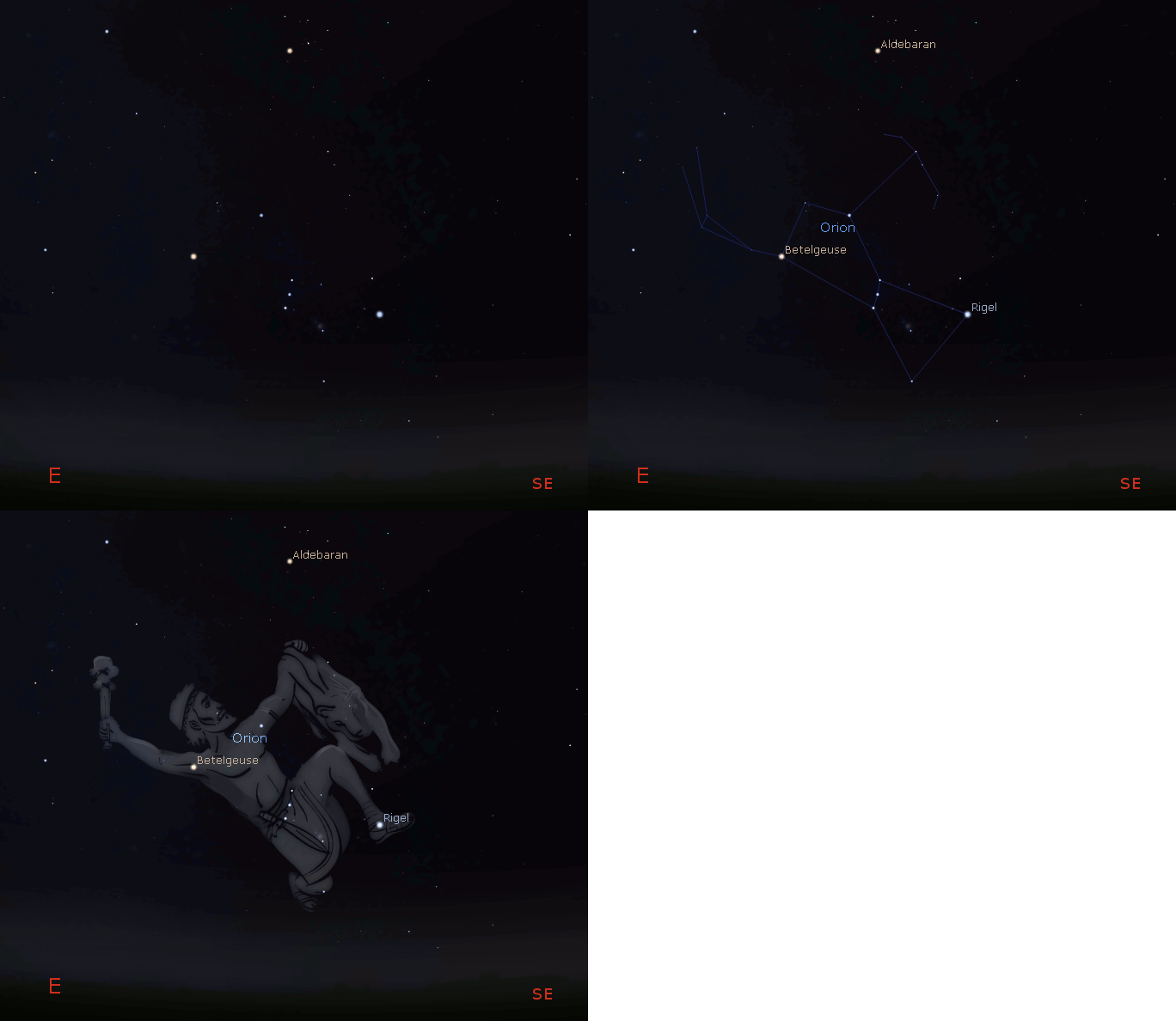
Orion early December finder animation for 9 pm December 7th. Created using Stellarium and GIMP.
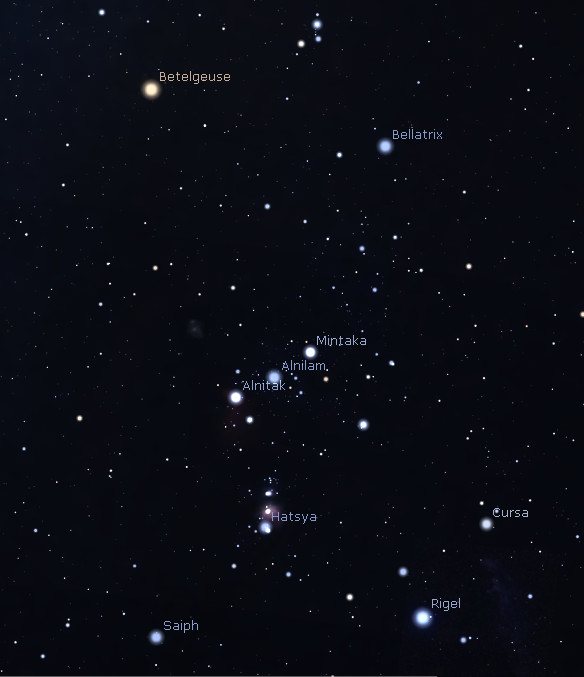
Orion’s named stars including the belt stars. Cursa, though named belongs to the neighboring constellation Eridanus the river. Created using Stellarium.
 Bob Moler's Ephemeris Blog