Archive
12/31/2014 – Ephemeris – A New Year’s look at the bright planets and a comet
Ephemeris for New Years Eve, Wednesday, December 31st. The sun will rise at 8:19. It’ll be up for 8 hours and 52 minutes, setting at 5:11. The moon, 3 days past first quarter, will set at 4:42 tomorrow morning.
Lets take a last look at the bright planets for 2014. Mercury joins Venus low in the southwest. It will be below and right of Venus and will set at 6:07 p.m. Venus is low in the southwest shortly after sunset. It now sets at 6:26 p.m., an hour and 15 minutes after the sun. It will be seen low in the southwestern twilight by 5:55 p.m. Mars is low in the southwest at 7 p.m. and is in the constellation of Capricornus. The Red Planet will set tonight at 8:36 p.m. Jupiter will rise in the east at 8:33 p.m. It’s near the sickle-shaped head of Leo. Jupiter is now moving slowly westward. This is an effect that happens because the Earth is passing Jupiter, a motion shared by all the planets that baffled the ancients who thought the Earth to be motionless. Early risers will be able to spot Saturn which will rise in the east-southeast at 5:10 a.m.
Times are for the Traverse City/Interlochen area of Michigan. They may be different for your location.
Addendum
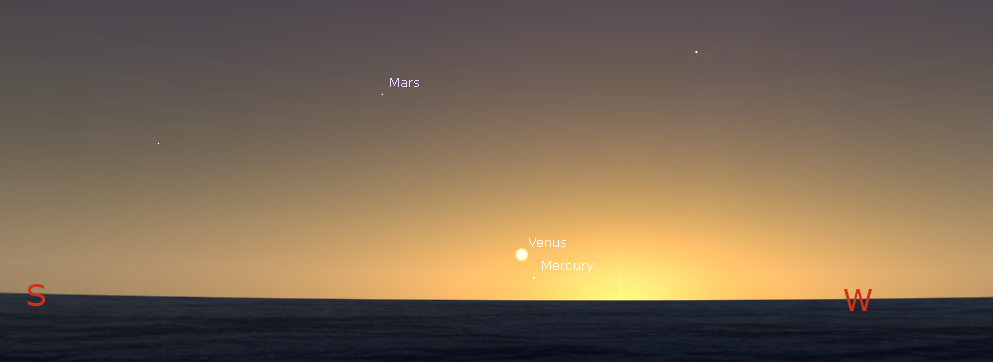
Mercury, Venus and Mars are seen in the southwestern sky shortly after sunset. In this case 5:45 p.m. December 31, 2014, only 34 minutes after sunset. Created using Stellarium.
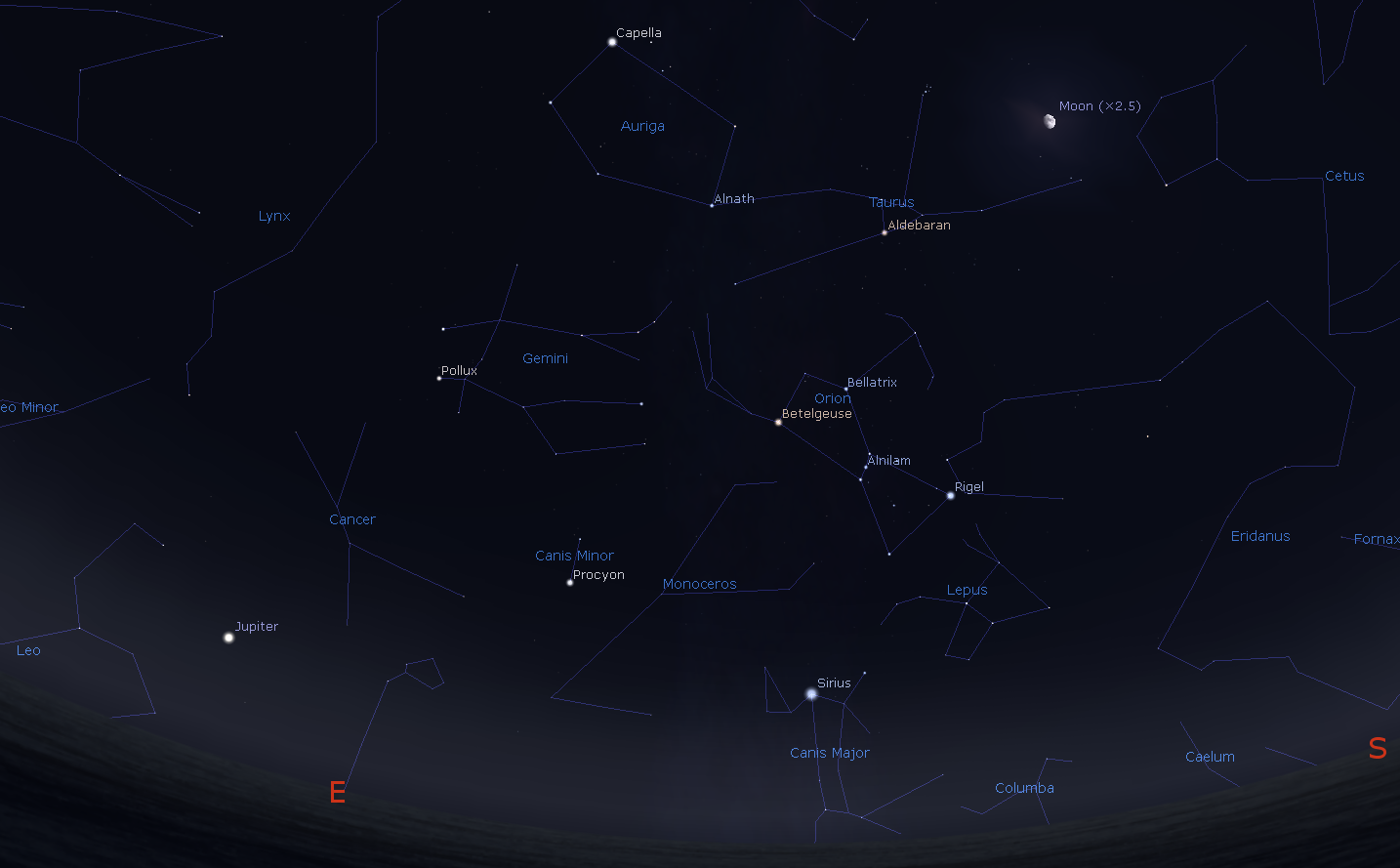
Jupiter, the Moon and the winter constellations at 9:30 p.m. December 31, 2014. Created using Stellarium.
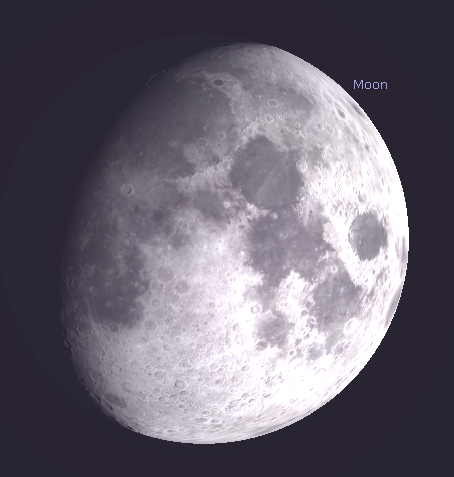
The Moon as it will appear in binoculars at 9:30 p.m. December 31, 2014. Created using Stellarium.
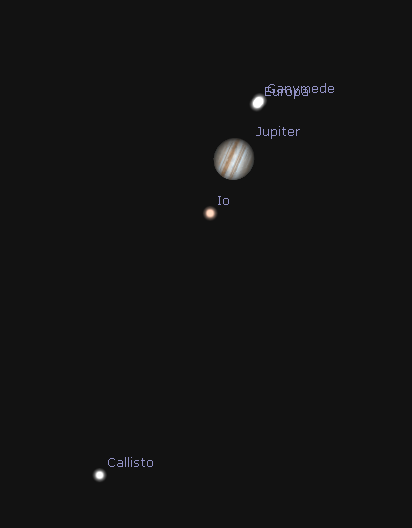
Jupiter seen through a telescope at 9:30 p.m. December 31, 2014. Note that Ganymede and Europa will appear very close to each other. Created using Stellarium.
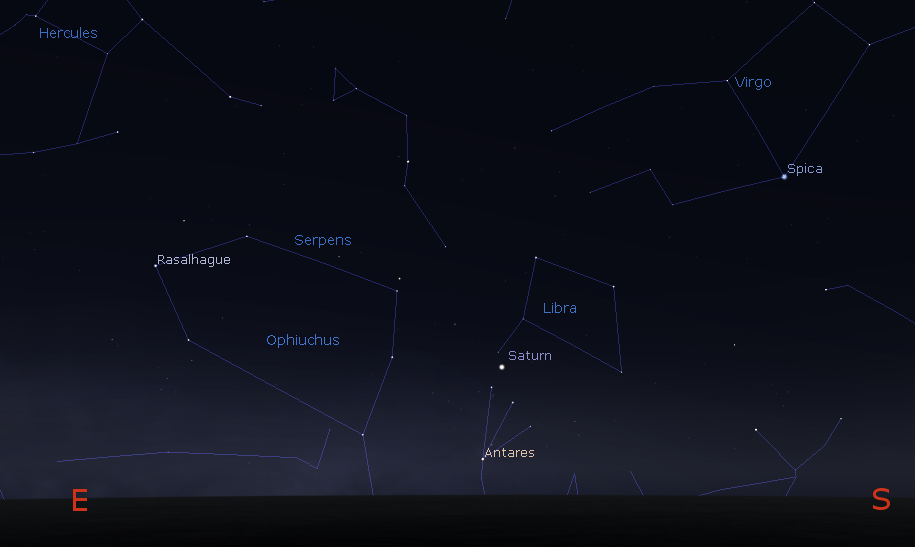
Saturn and the late spring and early summer constellations at 7 a.m. New Year’s Day 2015. Created using Stellarium.
Comet Lovejoy
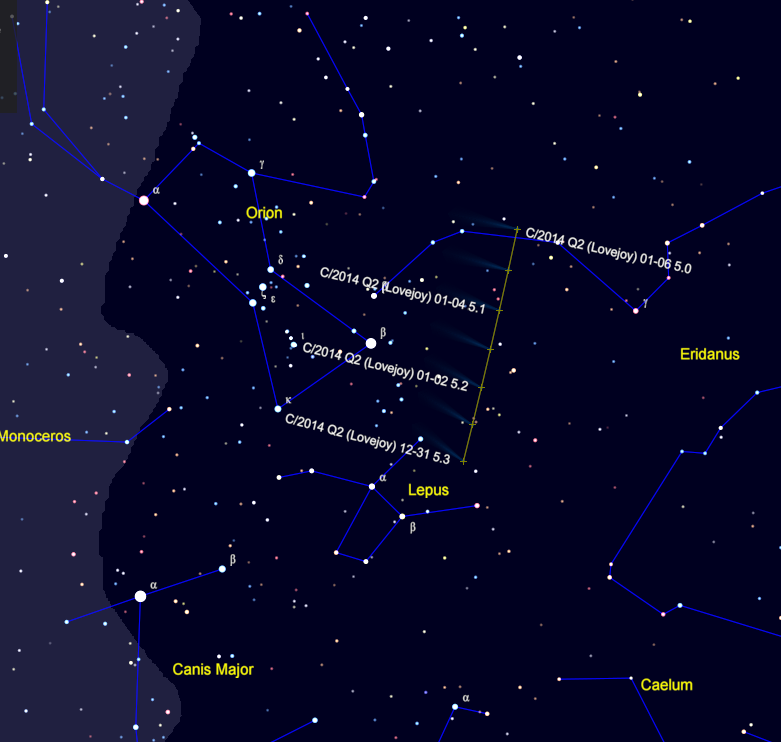
Comet Lovejoy (C/2014 Q2) plotted for 9 p.m. from 12/31/2014 to 1/06/2015. Created using Cartes du Ceil (Sky Charts).
12/24/2014 – Ephemeris – Twas the night before Christmas and only the planets and a comet were stirring
Ephemeris for Christmas Eve, Wednesday, December 24th. The sun will rise at 8:17. It’ll be up for 8 hours and 49 minutes, setting at 5:06. The moon, 3 days past new, will set at 8:37 this evening.
Twas the night before Christmas and only the planets were stirring. Venus is low in the southwest shortly after sunset. It now sets at 6:09 p.m., 63 minutes after the sun. It will be tough to spot at all. New Year’s Eve might be a good time to start to see it. Mars, low in the southwest at 7 p.m. has the Moon just to the right of it tonight. Mars will set tonight at 8:34 p.m. Jupiter, which will be our Christmas Star this year will rise in the east at 8:59 p.m. It’s near the sickle shaped head of Leo. Jupiter is now moving slowly westward. This is an effect that happens because the Earth is passing Jupiter, a motion shared by all the planets that baffled the ancients who thought the Earth to be motionless. Saturn will rise in the east-southeast at 5:34 a.m.
Times are for the Traverse City/Interlochen area of Michigan. They may be different for your location.
Addenda
The Planets tonight
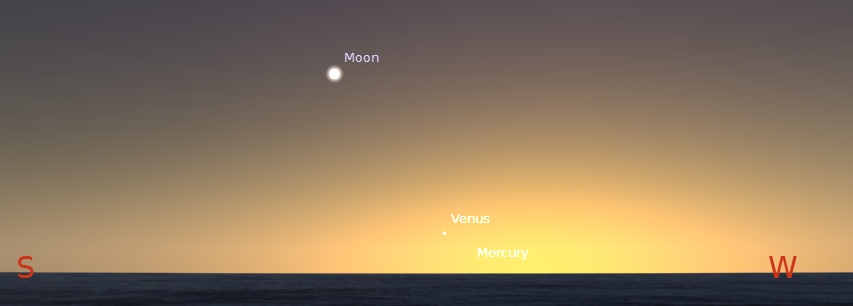
Venus low on the horizon, and the Moon, at 5 30 p.m. on December 24, 2014. Created using Stellarium.
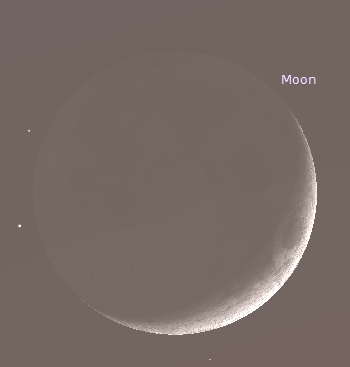
The crescent Moon through binoculars, at 5 30 p.m. on December 24, 2014. Created using Stellarium.
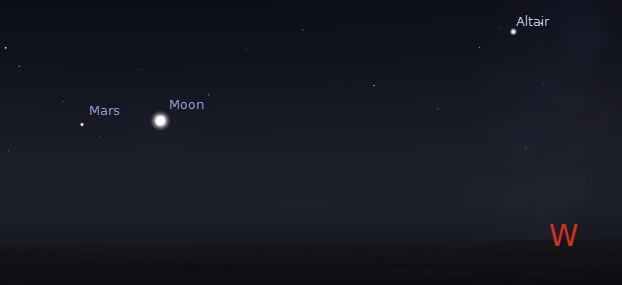
Mars and the Moon at 7:30 p.m. on December 24, 2014. Created using Stellarium.
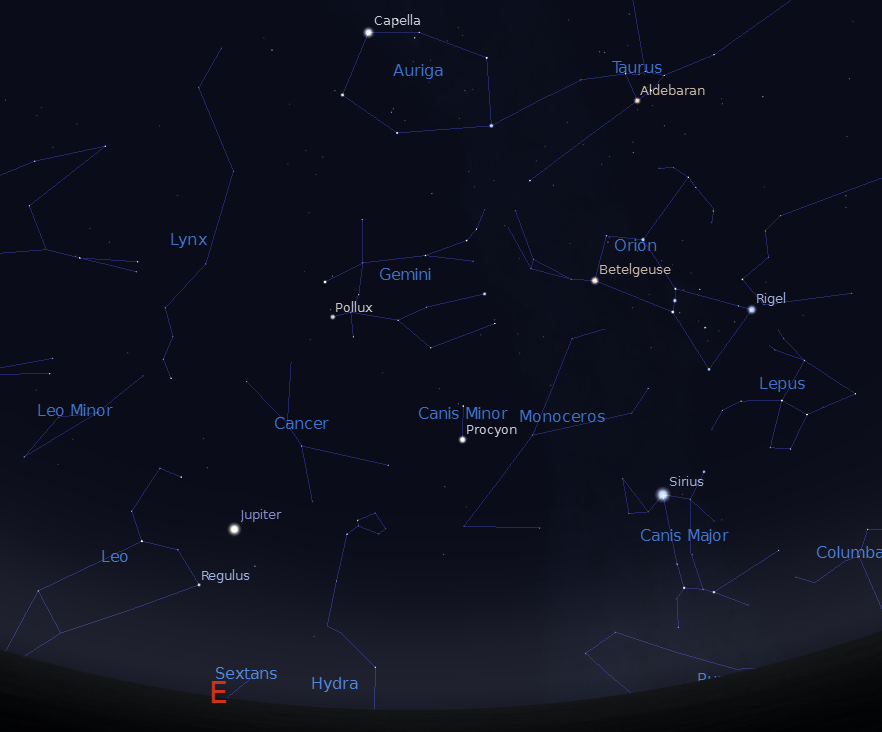
Jupiter and the winter constellations at 11 p.m. on December 24, 2014. Created using Stellarium.
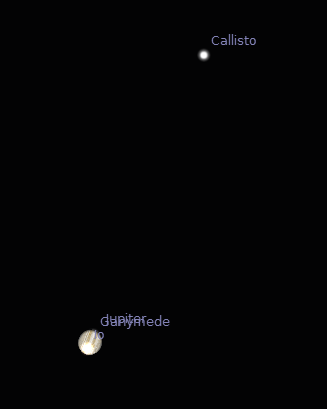
Jupiter with three hidden satellites, with only Callisto showing at 11 p.m. on December 24, 2014. See blow by blow of the satellite disappearances below. Created using Stellarium.
Jovian satellite events of the night of December 24-25, 2014
Ganymede starts eclipse (enters Jupiter’s shadow) 6:20 p.m.
Europa starts eclipse 8:27p.m.
Io’s shadow starts crossing Jupiter 9:32 p.m.
Ganymede leaves Jupiter’s shadow 10:00 p.m.
Ganymede starts being occulted by Jupiter 10:11 p.m.
Io’s transit across the face of Jupiter starts 10:29 p.m.
Io’s shadow leaves the face of Jupiter 11:50 p.m.
Io’s transit of Jupiter ends 12:46 a.m.
Europa’s occultation by Jupiter ends 1:10 a.m.
Ganymede’s occultation by Jupiter ends 1:50 a.m.
Note that Europa’s occultation by Jupiter starts before its eclipse ends, so unlike the more distant Ganymede there isn’t an interval of visibility between the two.
Jovian satellite event timings provided by Project Pluto www.projectpluto.com
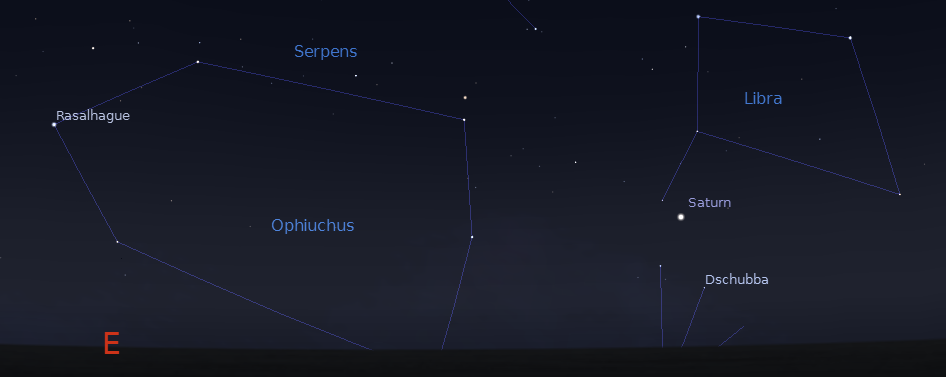
Saturn low in the east-southeast among the constellations of late spring and early summer at 6:30 a.m. on Christmas morning 2014 . Created using Stellarium.
Comet C/2014 Q2 (Lovejoy)
Normally my Ephemeris program deals with celestial objects that are visible to the naked eye. While Comet Lovejoy will, for a few weeks become brighter than 6th magnitude the normal limit for the unaided human eye, a comet is a diffuse object and always looks dimmer than a star of the same magnitude. This comet was discovered August 17, 2014 by Australian amateur astronomer Terry Lovejoy. He has discovered 5 comets. His most famous find was C/2011 W3 (Lovejoy) that buzzed the Sun and survived becoming a magnificent comet for southern hemisphere observers.
Recently Comet Lovejoy became brighter than expected. The data for the charts below are from Minor Planet Center and do not include new brightness estimates that include the outburst. They have the comet reaching magnitude 4.9. The aerith.net website gives the maximum brightness next month of 4. (Magnitudes are like golf scores the lower the magnitude the brighter the object). Each magnitude step is a brightness difference of about 2 and a half times. To check on the comet go to http://www.aerith.net/comet/weekly/current.html. Currently Comet Lovejoy is the brightest comet now visible and is the first comet on the list. Clicking on the comet ‘s name will give you the comet’s page. The last chart on the page is a chart tracking the comet’s brightness from reports vs. prediction. That chart predicts a magnitude of 4 just after the first of the year.
Photographs of the comet show a gaseous coma (head) and a very faint ion tail, which may not be visible visually in binoculars and telescopes. Right now the comet is highest around midnight.
The finder charts below designate the comet by month-day and the predicted magnitude
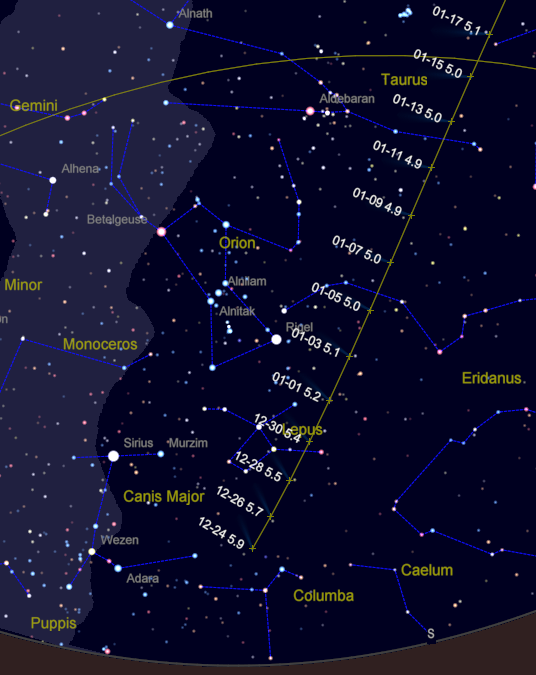
Comet C/2014 Q2 (Lovejoy) at 11 p.m. at 2 day intervals from tonight 12/24/2014 to 1/17/2015. Created using Cartes du Ceil (Sky Charts).
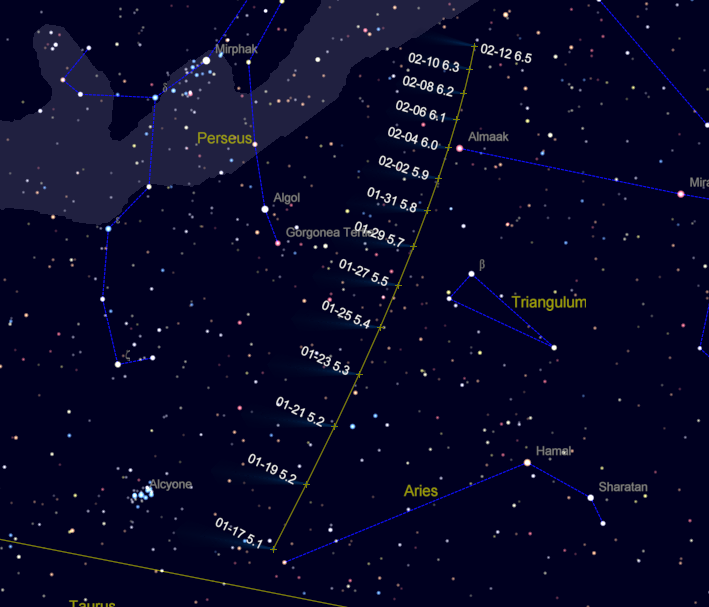
Comet C/2014 Q2 (Lovejoy) at 8 p.m. at 2 day intervals from tonight 1/17/2015 to 2/12/2015. Created using Cartes du Ceil (Sky Charts).
On December 28th Comet Lovejoy will appear to pass the globular cluster M79.
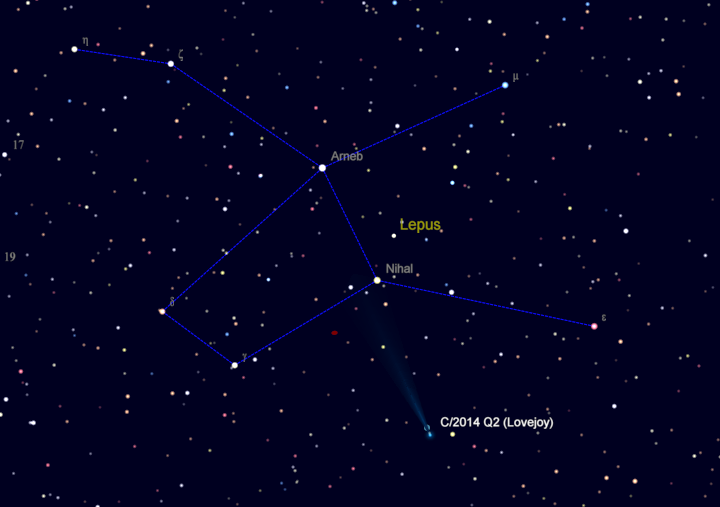
Comet Lovejoy and M79 a distant globular star cluster, in the constellation of Lepus the hare, will appear together at 11 p.m. December 28th, 2014. Note the that M79 is the unlabeled blue dot in the tail of the comet, next to the head. Created using Cartes du Ceil (Sky Charts).
12/17/2014 – Ephemeris – Your weekly look at the bright planets
Ephemeris for Wednesday, December 17th. The sun will rise at 8:13. It’ll be up for 8 hours and 49 minutes, setting at 5:03. The moon, 3 days past last quarter, will rise at 4:19 tomorrow morning.
Venus is slowly moving from around the sun into the evening sky. It now sets at 5:55 p.m., 52 minutes after the sun. It will be tough to spot at all New Year’s Eve might be a good time to start to see it. Mars is still low in the southwest at 7 p.m. It’s now moving through the constellation of Capricornus and will set tonight at 8:32 p.m. Jupiter, which will be our Christmas Star this year will rise in the east at 9:32 p.m. It’s near the sickle-shaped head of Leo. Jupiter has just started to turn from eastward or direct motion to retrograde, or westward motion among the stars. This is an effect that happens because the Earth is passing Jupiter, a motion shared by all the planets that baffled the ancients who thought the Earth to be motionless. Saturn will rise in the east-southeast at 5:58 a.m.
Times are for the Traverse City/Interlochen area of Michigan. They may be different for your location.
Addendum
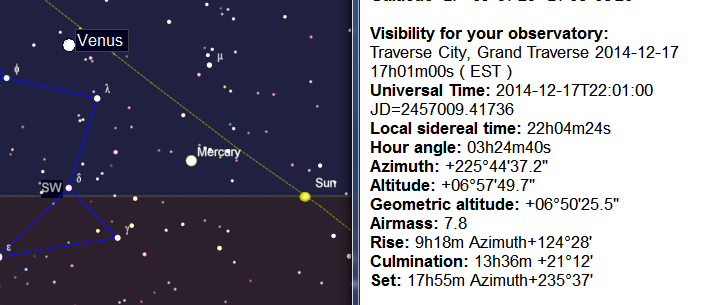
Venus at Sunset. Only 7 degrees above the horizon. Created using Cartes du Ceil (Sky Charts).
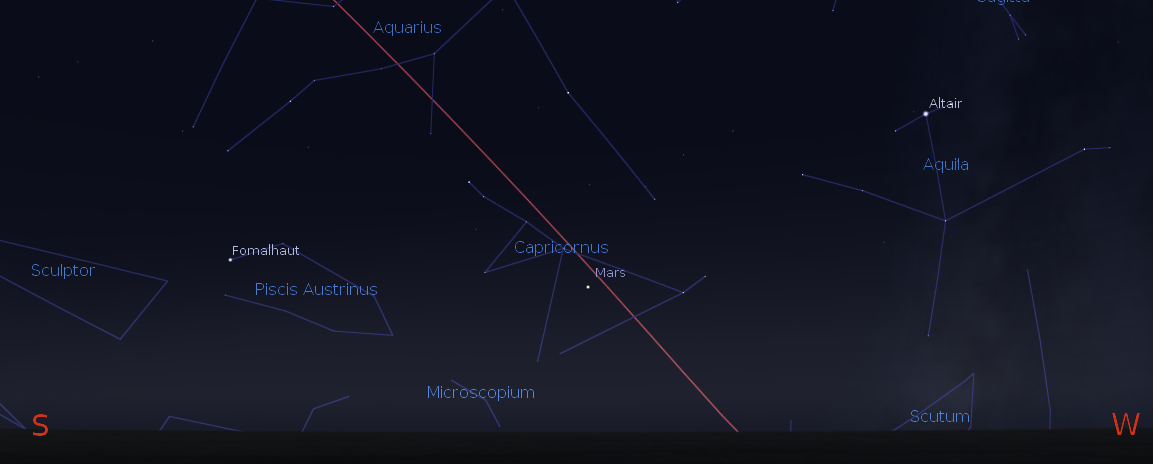
Mars and the constellations plus the ecliptic (red line) at 7 p.m. on December 17, 2014. Created using Stellarium.
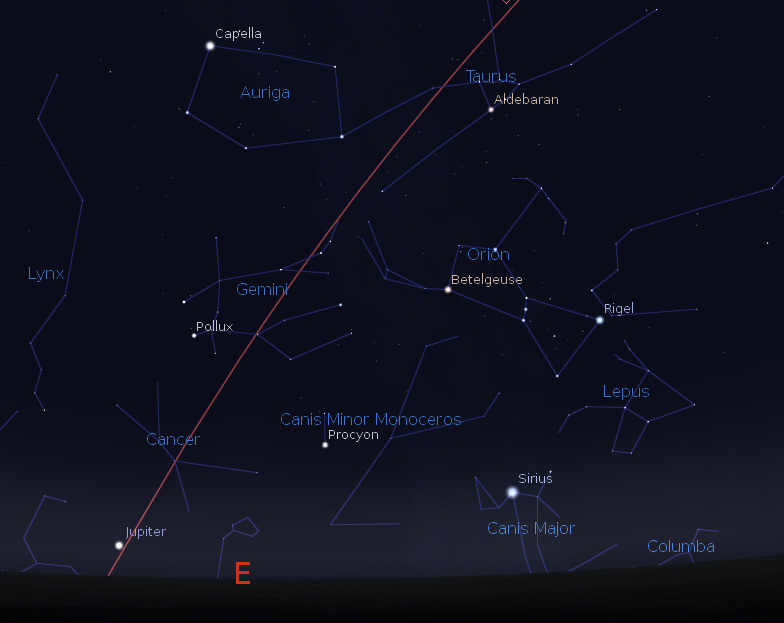
Jupiter and the winter constellations at 11 p.m. on December 17, 2014. Created using Stellarium.
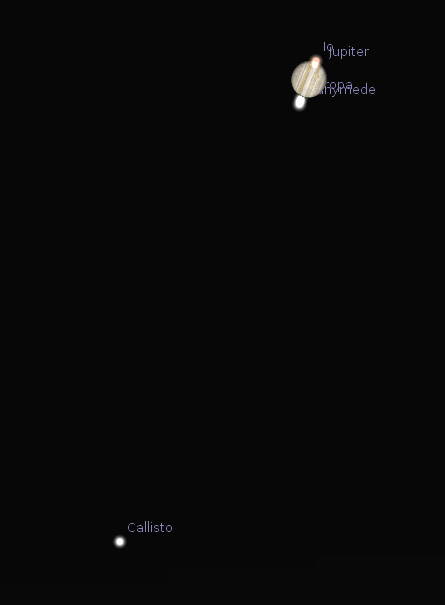
Jupiter and moons in a telescope. The moons Io, Europa and Ganymede all will be moving away from Jupiter over the evening and morning. Image as of 11 p.m. December 17, 2014. Created using Stellarium.
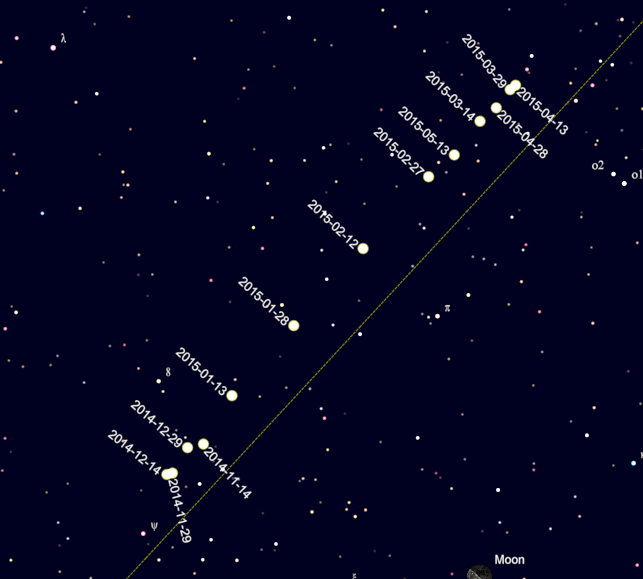
Jupiter’s Retrograde motion. Created using Cartes du Ceil (Sky Charts).
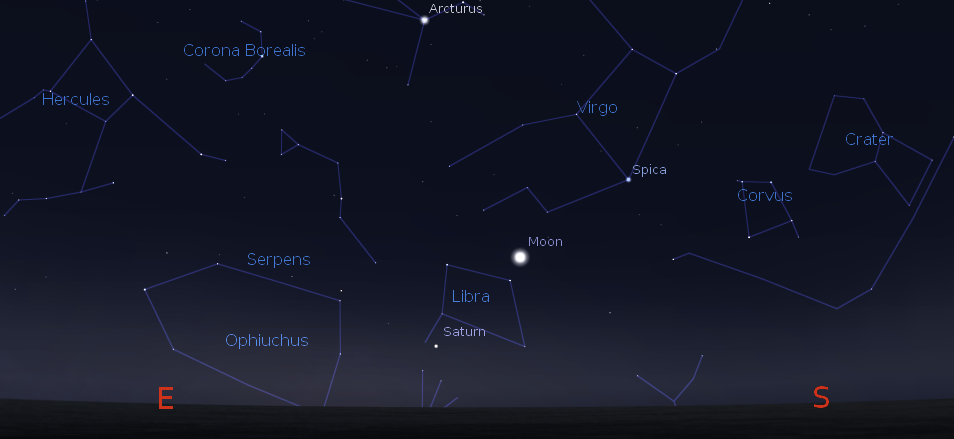
Saturn and the Moon at 7 a.m. on December 18, 2014. Created using Stellarium.
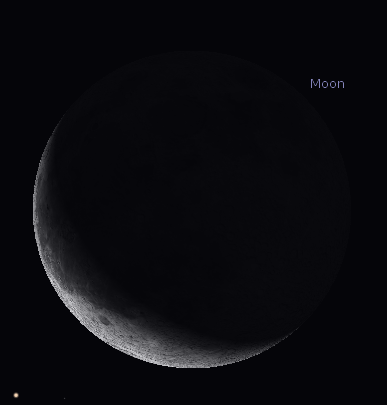
The Moon as it would appear in binoculars on December 18, 2014. Created using Stellarium.
12/03/2014 – Ephemeris – Bright planets: One early and one late
Ephemeris for Wednesday, December 3rd. The sun will rise at 8:01. It’ll be up for 9 hours and 1 minute, setting at 5:03. The moon, 3 days before full, will set at 5:48 tomorrow morning.
In reviewing which planets are visible tonight, it looks like we’re still down to two. Venus, Saturn and Mercury are hanging around near the direction of the Sun. It will be a little while before we see them again. However we can see Mars, which will be low in the southwest at 7 p.m. It will set at 8:29 p.m. Mars’ setting time will slowly advance only 6 minutes between now and the end of the year. Jupiter will rise at 10:28 p.m. in the east-northeast. The best telescopic views will have to wait a couple of hours after that. So if you’re more of an early bird rather than a night owl it might be better to view Jupiter with a telescope in the morning. Jupiter has those four bright moons that change position daily, and sometimes while you watch.
Times are for the Traverse City/Interlochen area of Michigan. They may be different for your location.
Addendum
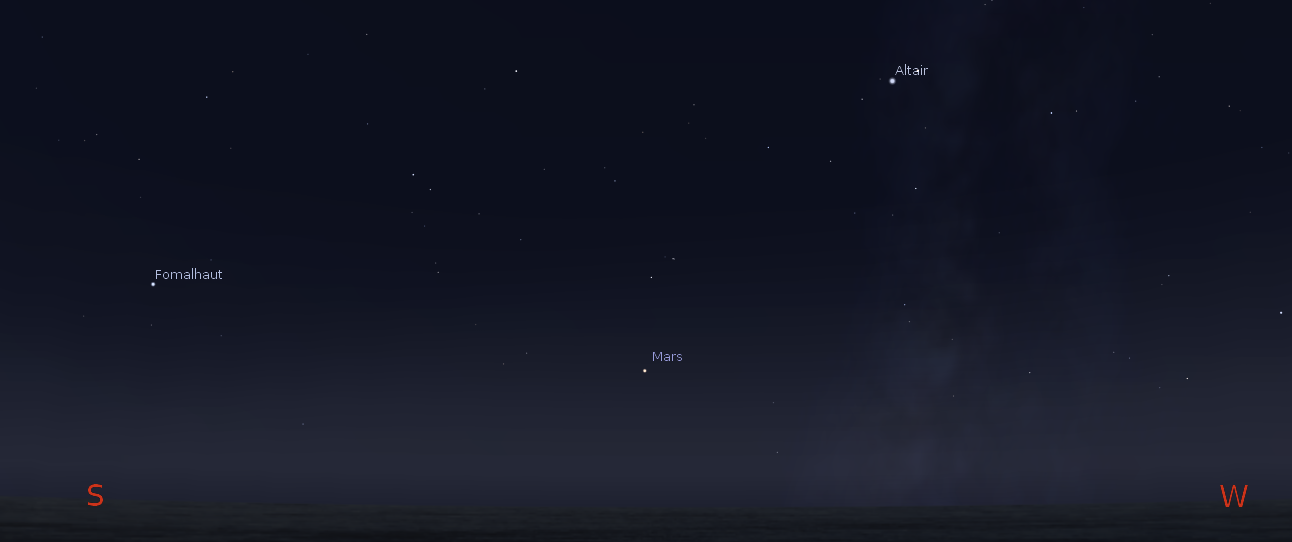
Mars in the southwest at 7 p.m. December 3, 2014. Created using Stellarium.
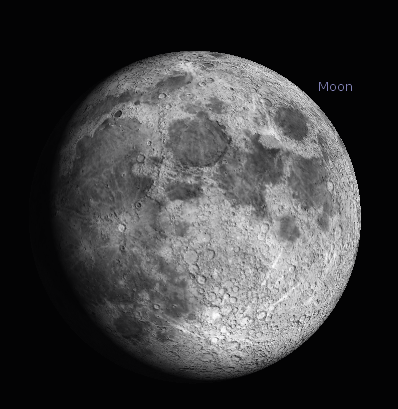
A binocular view of what the moon will look like at 7 p.m. December 3, 2014. Created using Stellarium.
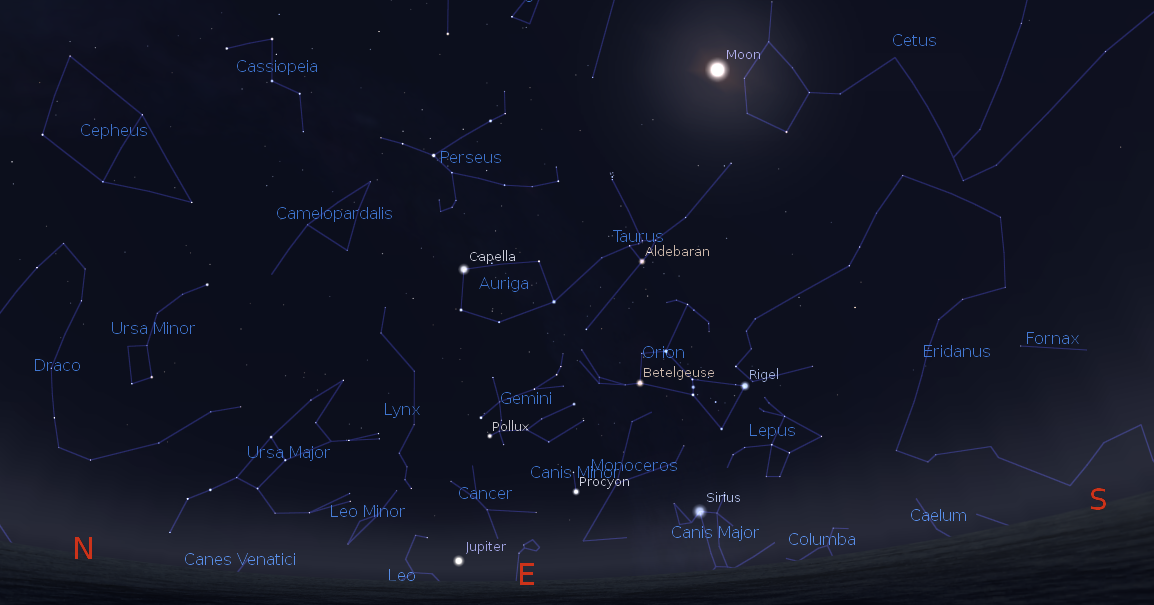
Jupiter rising with the winter constellations at 11 p.m., December 3, 2014. We’re actually looking at the eastern half of the sky. Created using Stellarium.
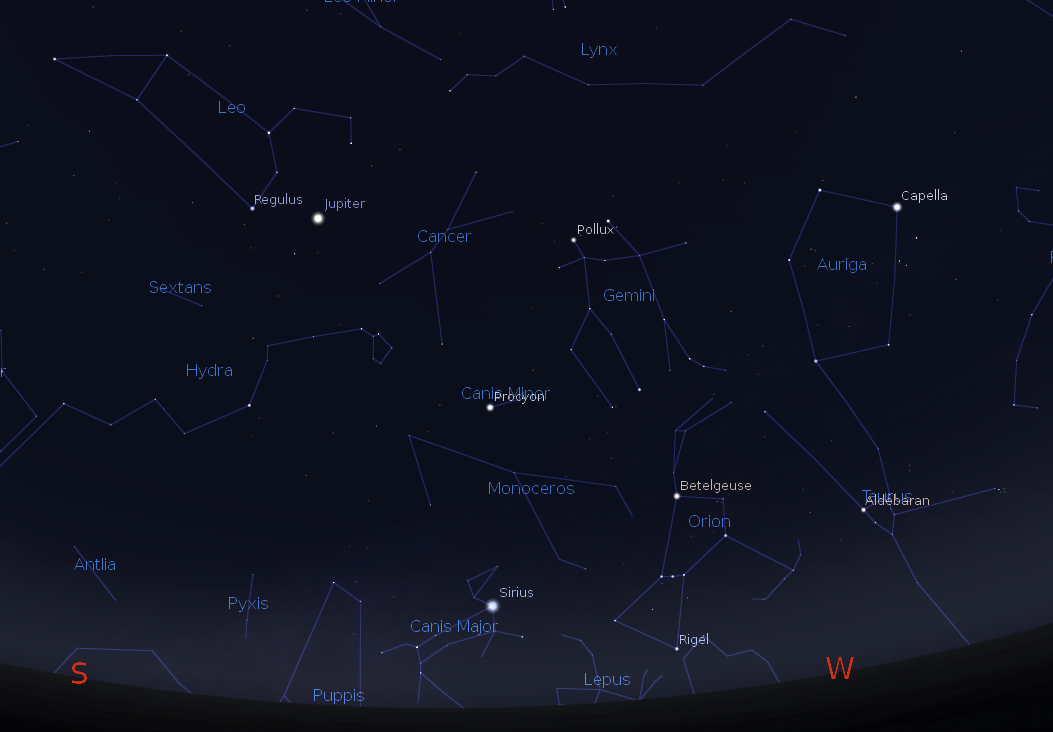
At 6 a.m. December 4, 2014 Jupiter and the winter constellations will swing into the southwest while out of the view the spring and early summer stars take over the eastern sky. Created using Stellarium.
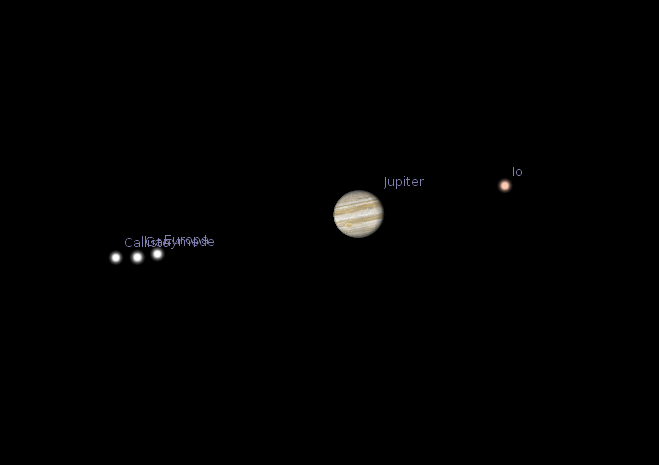
Telescopic view of Jupiter at 6 a.m. December 4, 2014. The moons on the left in order from left to right are Callisto, Ganymede and Europa. In the next hour the moons will appear to get even closer together, especially Ganymede and Callisto. Created using Stellarium.
11/26/2014 – Ephemeris – Where did all the planets go?
Ephemeris for Wednesday, November 26th. The sun will rise at 7:53. It’ll be up for 9 hours and 12 minutes, setting at 5:06. The moon, 3 days before first quarter, will set at 9:41 this evening.
In reviewing which planets are visible tonight, it looks like we’re down to two. Venus, Saturn and Mercury are hanging around near the direction of the Sun. It will be a while before we see them again. However we can see Mars, which will be low in the southwest at 7 p.m. It will set at 8:29 p.m. Mars’ setting time will slowly advance only 6 minutes between now and the end of the year. Jupiter will rise at 10:54 p.m. in the east-northeast. The best telescopic views will have to wait a couple of hours after that. So if you’re more of an early bird rather than a night owl it might be better to view Jupiter with a telescope in the morning. Jupiter has those four bright moons that change position daily, and sometimes while you watch.
Times are for the Traverse City/Interlochen area of Michigan. They may be different for your location.
Addendum
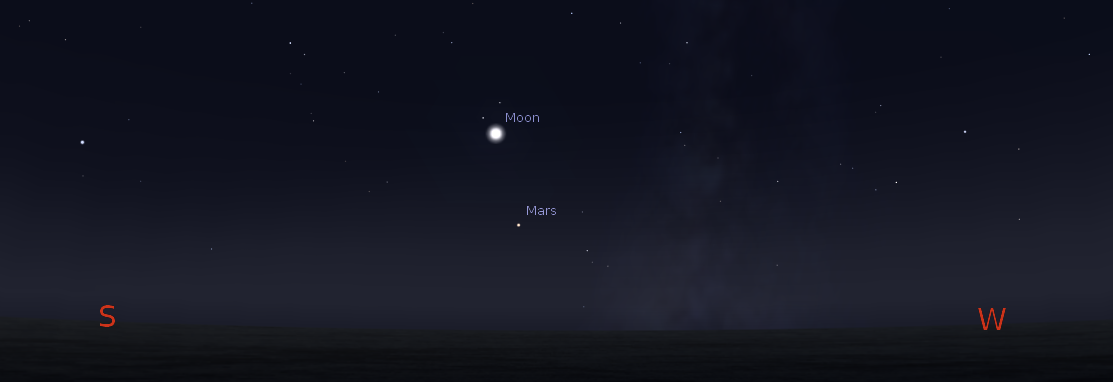
Mars with the crescent Moon at 7 p.m. on November 26, 2014. Created using Stellarium.
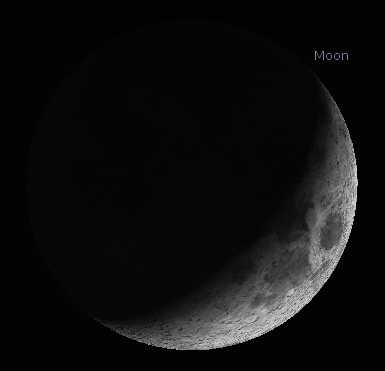
The crescent moon as it would appear in binoculars at 7 p.m. on November 26, 2014. Created using Stellarium.
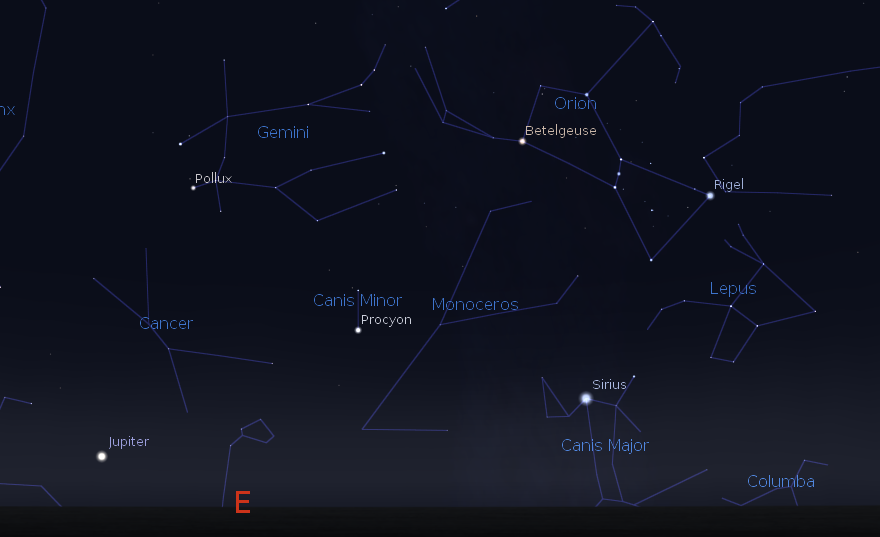
Jupiter rising with the winter constellations at 11:30 p.m. on November 26, 2014. Created using Stellarium.
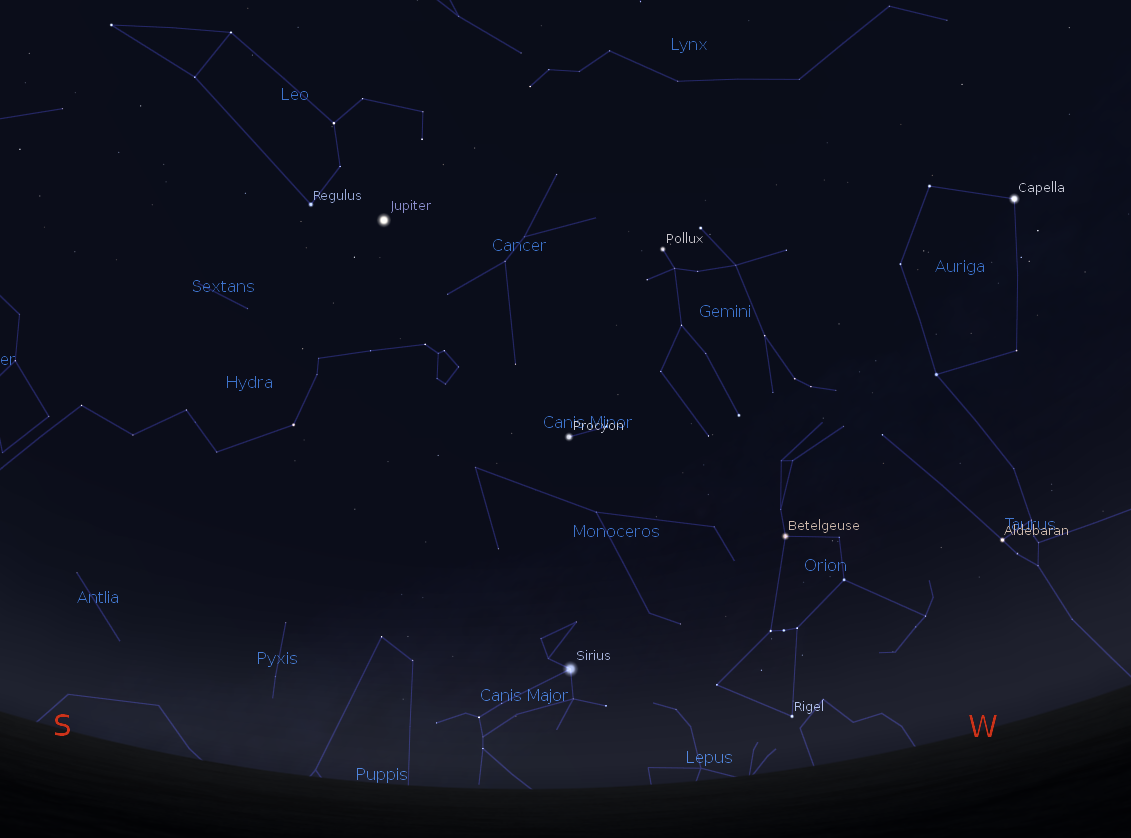
Jupiter with the winter constellations at 6:30 a.m. on November 27, 2014. Created using Stellarium.
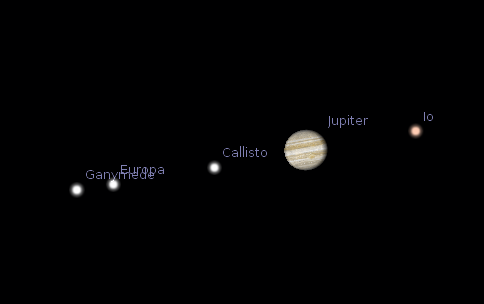
Jupiter as seen in a telescope at 6:30 a.m. on November 27, 2014. Created using Stellarium.
11/19/2014 – Ephemeris – Where did all the bright planets go?
Ephemeris for Wednesday, November 19th. The sun will rise at 7:44. It’ll be up for 9 hours and 26 minutes, setting at 5:10. The moon, 3 days before new, will rise at 5:34 tomorrow morning.
In reviewing which planets are visible tonight, it looks like we’re down to two. Venus, Saturn and Mercury are hanging around near the direction of the Sun. It will be a while before we see them again. However we can see Mars, which will be low in the southwest at 7 p.m. It will set at 8:29 p.m. Jupiter will rise at 11:20 p.m. in the east-northeast. The best telescopic views will have to wait a couple of hours after that. So if you’re more of an early bird rather than a night owl it might be better to view Jupiter with a telescope in the morning. Jupiter has those four bright moons that change position daily, and sometimes while you watch if they appear close enough to each other. On the planet are cloud bands and the elusive Great Red Spot.
Times are for the Traverse City/Interlochen area of Michigan. They may be different for your location.
Addendum
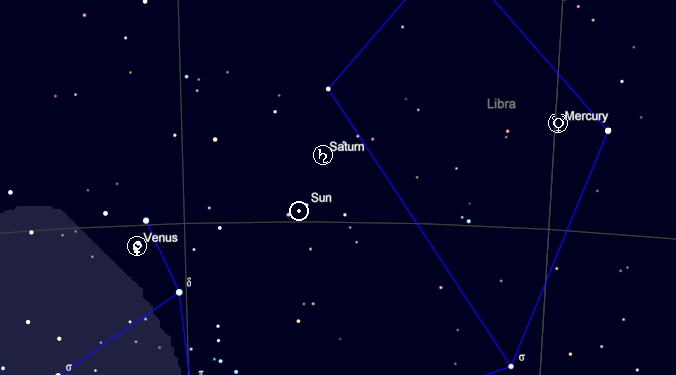
Mercury, Saturn and Venus appear near the Sun near sunset at 5 p.m. on November 19, 2014. Displayed planets as their symbols. Created using Cartes du Ciel (Sky Charts).
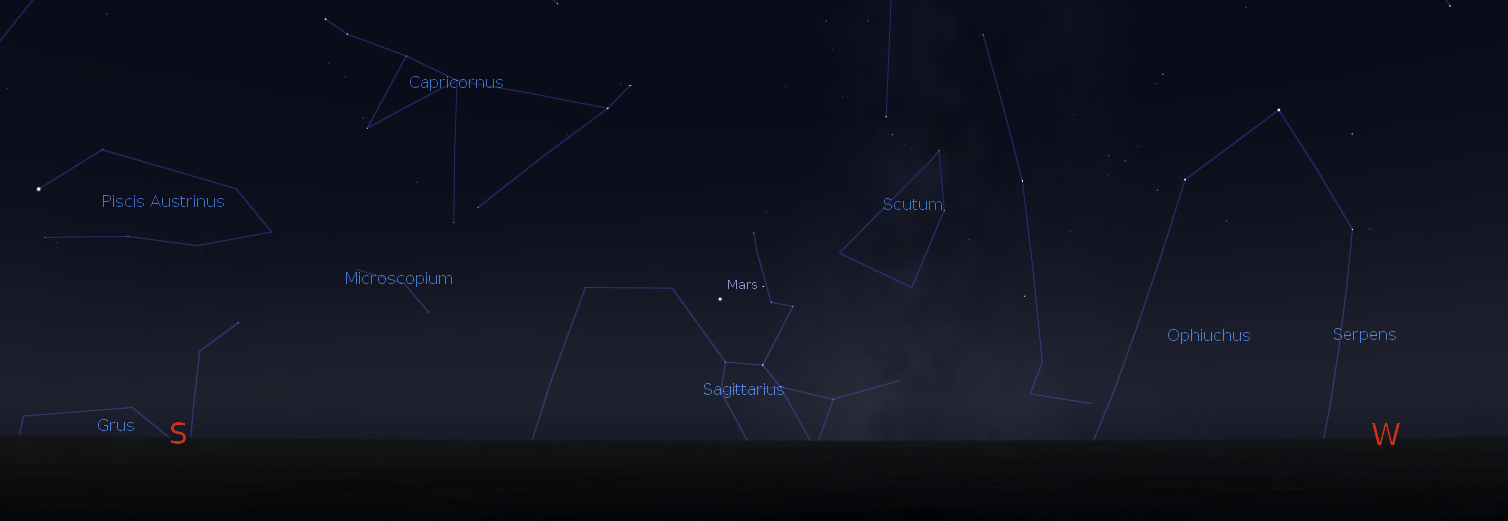
Mars and the setting summer constellations at 7 p.m. on November 19, 2014. Created using Stellarium.
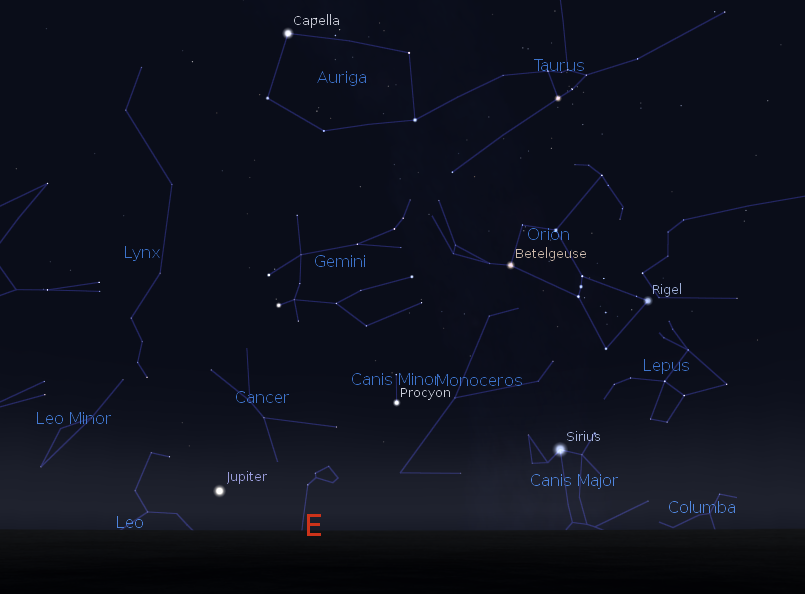
Jupiter and the rising winter constellations at midnight November 20, 2014. Created using Stellarium.
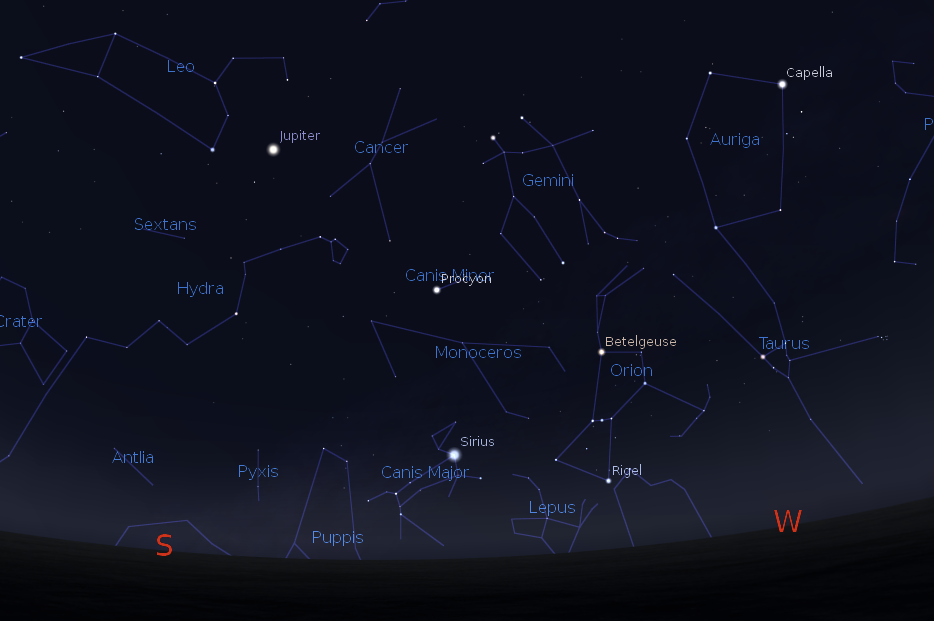
Jupiter with winter and spring constellations at 6:30 a.m. on November 20, 2014. Created using Stellarium.
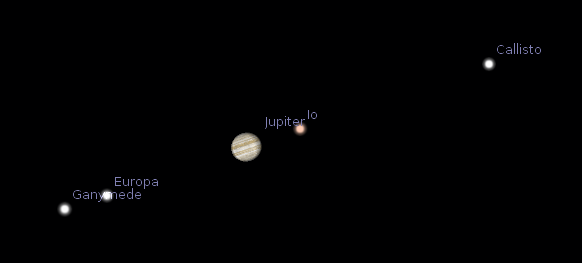
Jupiter and moons through a telescope at 6:30 a.m. on November 20, 2014. Created using Stellarium.
10/22/2014 – Ephemeris – The bright planets this week plus a preview of Thursday’s partial solar eclipse
Ephemeris for Wednesday, October 22nd. The sun will rise at 8:06. It’ll be up for 10 hours and 39 minutes, setting at 6:46. The moon, 1 day before new, will rise at 7:46 tomorrow morning.
Tonight Saturn will be low in the west-southwest before it sets at 7:56 p.m. Mars will be low in the southwest at 9 p.m. and will set at 9:40 p.m. The sky will stay devoid of bright planets until Jupiter rises at 1:56 a.m. tomorrow morning. Jupiter is visible this morning in twilight in the south-southeast along with the brighter stars of winter visible, a preview of colder evenings to come. Tomorrow evening, weather permitting, we will get to see part of a partial solar eclipse. The exact times depend on your location, though shouldn’t deviate from these by a few minutes for the Interlochen Public Radio listening area (northwestern lower Michigan). The eclipse will start around 5:32 p.m. and will continue till sunset around 6:44 p.m. Use proper eye protection or use pinhole projection.
Times are for the Traverse City/Interlochen area of Michigan. They may be different for your location.
Addendum
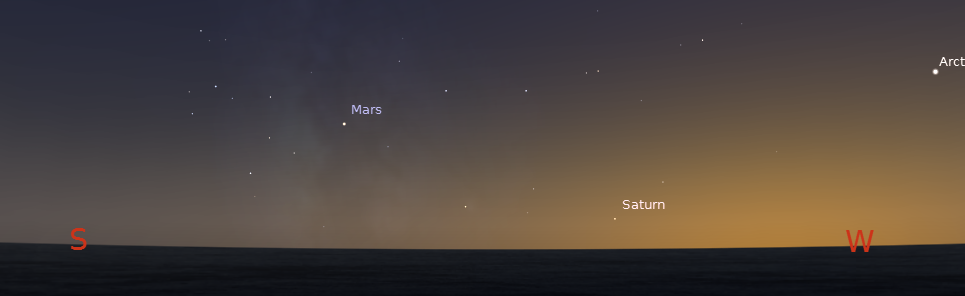
Saturn and Mars at 7:30 p.m. on October 22, 2014. Created using Stellarium.
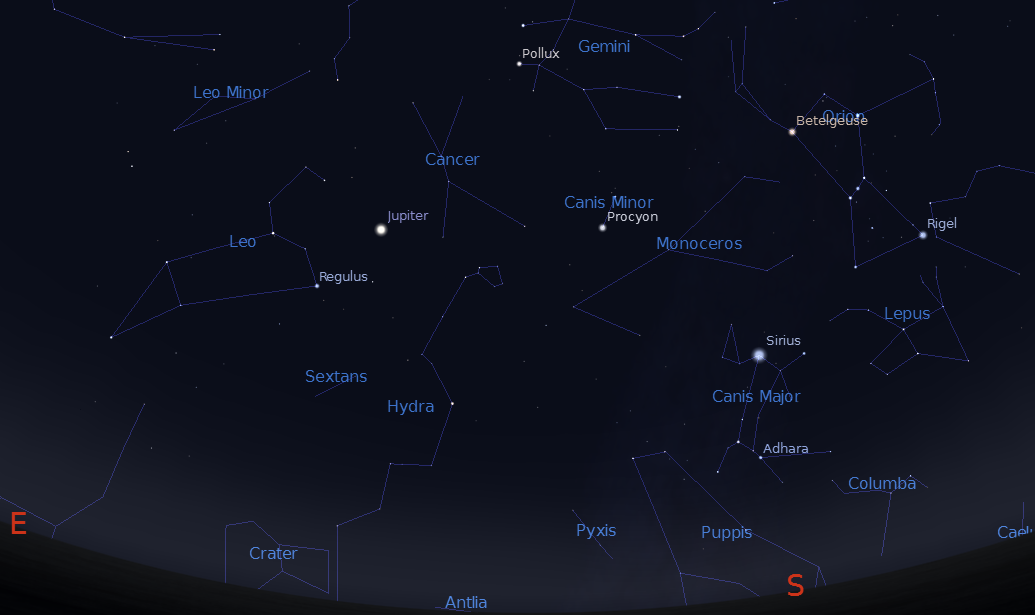
Jupiter and the morning constellations at 6:30 a.m., October 23, 2014. Created using Stellarium.
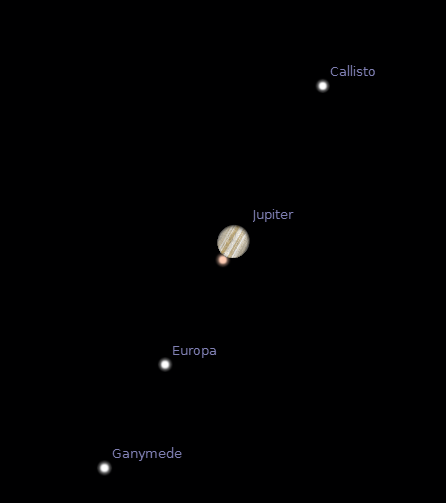
Jupiter through a telescope at 6:30 a.m. October 23, 2014. The unnamed moon is Io. Created using Stellarium.
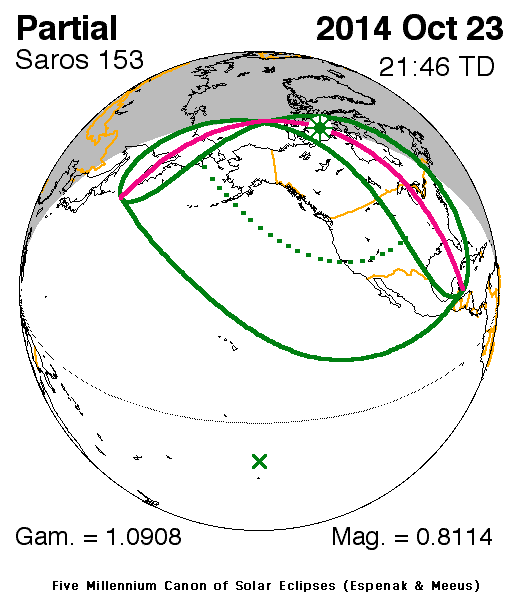
Coverage of the partial solar eclipse of October 23, 2014. Credit: NASA. Click image for more information.

The setting partially eclipsed sun from Traverse City. Created using Stellarium.
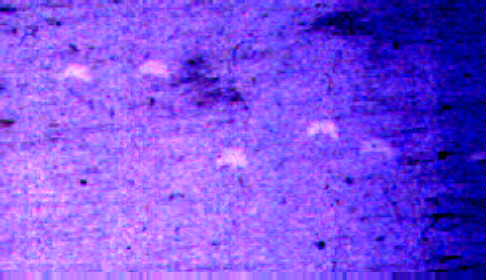
Partially eclipsed sun using a series of pinholes projected on a reasonably white surface.
10/15/2014 – Ephemeris – Looking for the bright planets this week
Ephemeris for Wednesday, October 15th. The sun will rise at 7:57. It’ll be up for exactly 11 hours, setting at 6:57. The moon, at last quarter today, will rise at 12:53 tomorrow morning.
Let’s check out the bright planets for this week. Saturn is very low in the west-southwestern sky at 8 p.m. and difficult to spot. It will set at 8:22 p.m. Mars is right of the spout of the Teapot of Sagittarius low in the southwest. Mars is in the constellation of Ophiuchus as astronomers draw constellation boundaries, it will set at 9:46. Comet Siding Spring will pass close to Mars this coming Sunday the 19th. More on that tomorrow. In the morning sky brilliant Jupiter will rise in the east-northeast at 2:18 a.m. It’s moving from Cancer to Leo now. Venus is too close to the sun to be seen. On the 25th of this month Venus will be in superior conjunction with the sun, that is it will move behind the sun, and will enter the evening sky.
Times are for the Traverse City/Interlochen area of Michigan. They may be different for your location.
Addendum
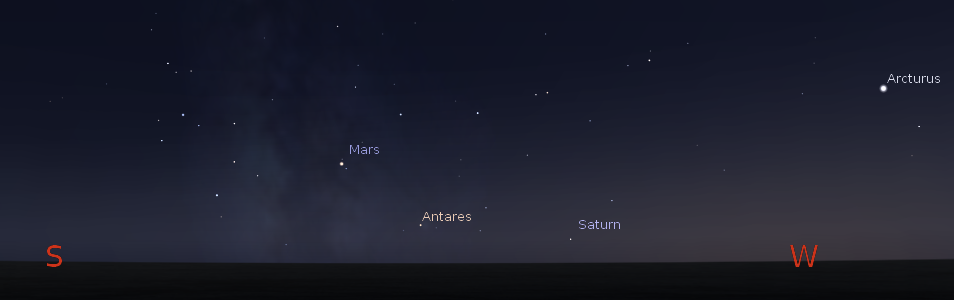
Saturn and Mars low near the setting southern summer stars at 8 p.m. October 15, 2014. Created using Stellarium.
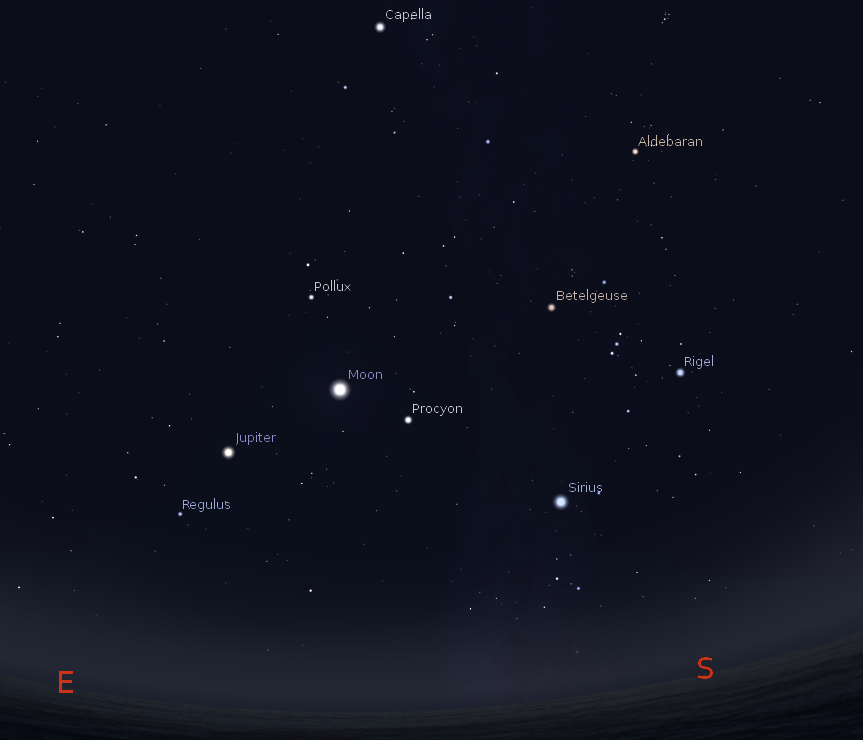
Jupiter and the Moon among the stars of winter at 6 a.m. October 16, 2014. Created using Stellarium.
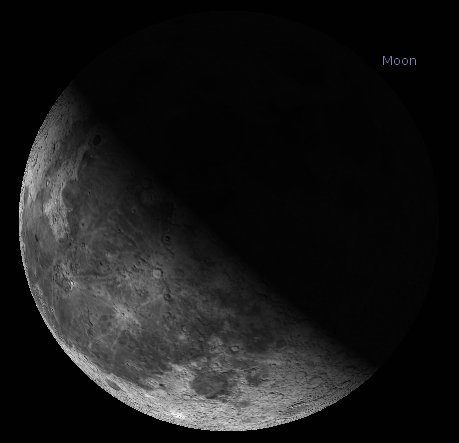
The Moon slightly after last quarter as seen in binoculars at 6 a.m. October 16, 2014. Created using Stellarium.
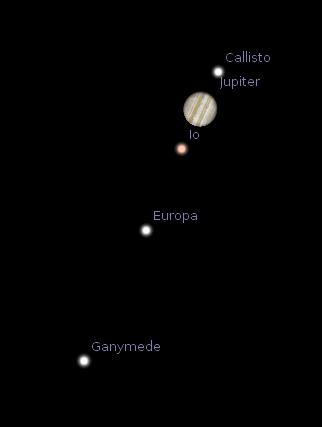
A telescopic view of Jupiter and its moons as they would be seen at 6 a.m. October 16, 2014. Created using Stellarium.
10/08/2014 – Ephemeris – The ongoing lunar eclipse and a peek at the planets
Note: This program is scheduled to be aired at two points during the total lunar eclipse. The first airing occurs at6:19 a.m., six minutes before totality starts. The second airing will occur at 7:59 a.m. during totality.
Ephemeris for Wednesday, October 8th. The sun will rise at 7:48. It’ll be up for 11 hours and 21 minutes, setting at 7:10. The moon, at full today, will rise at 7:23 this evening.
There is a lunar eclipse occurring right now. Totality is either about to start or the moon is in totality with an orange or reddish hue, depending on when you hear this. You can see it right now in the west, if it’s reasonably clear. Totality will end at 7:24. The ending partial phase will be interrupted by moon setting near 8 a.m. Tonight Saturn will be low in the west-southwest before it sets at 8:47 p.m. Mars will be low in the southwest at 9 p.m. and will set at 9:54 p.m. The sky will stay devoid of bright planets until Jupiter rises, which it will do at 2:40 a.m. tomorrow morning. Jupiter is visible this morning in twilight in the south-southeast along with the brighter stars of winter visible, a preview of colder evenings to come.
Times are for the Traverse City/Interlochen area of Michigan. They may be different for your location.
Addendum
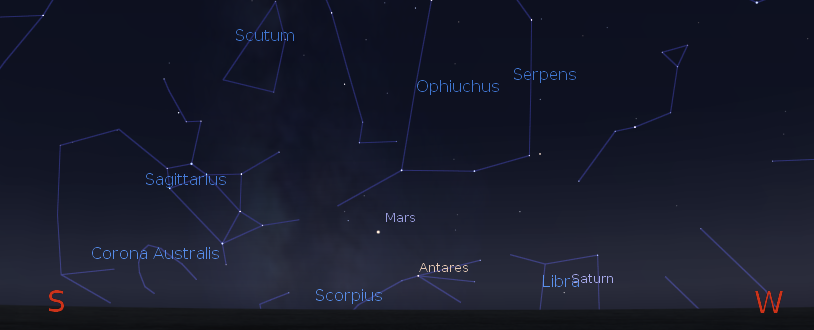
Saturn, Mars and the setting stars of summer at 8:30 p.m. on October 8, 2014.
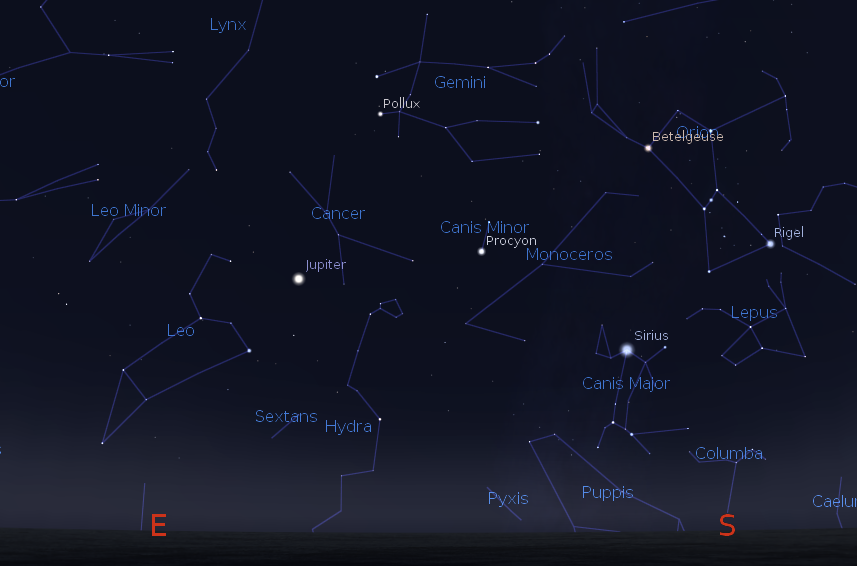
Jupiter and a preview of the stars of winter at 6:30 a.m. on October 9, 2014.
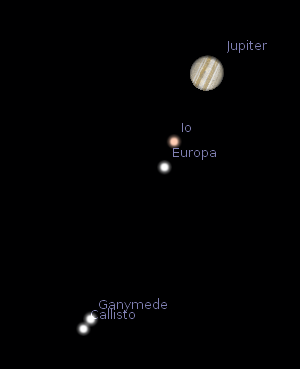
Jupiter and its moons as seen through a telescope at 6:30 a.m. October 9, 2014.
10/01/2014 – Ephemeris – Let’s start off the month with a look at the bright planets
Ephemeris for Wednesday, October 1st. The sun will rise at 7:40. It’ll be up for 11 hours and 42 minutes, setting at 7:23. The moon, at first quarter today, will set at 12:43 tomorrow morning.
Let’s check out the bright planets for this week. Mars and Saturn are in the southwestern sky at 8:30 p.m. with Mars above the equally bright and red star Antares with Saturn a ways right of them and as high in the sky as Antares. Saturn will set at 9:16 p.m. Mars is in the constellation of Ophiuchus as astronomers draw constellation boundaries, though it looks to be in Scorpius. Mars will set at 10:04. In the morning sky brilliant Jupiter will rise in the east-northeast at 3:02 a.m. Venus will rise about a half hour before the sun, so it will not be visible. On the 25th of this month Venus will be in superior conjunction with the sun, that is it will move behind the sun, and will then enter the evening sky.
Times are for the Traverse City/Interlochen area of Michigan. They may be different for your location.
Addendum
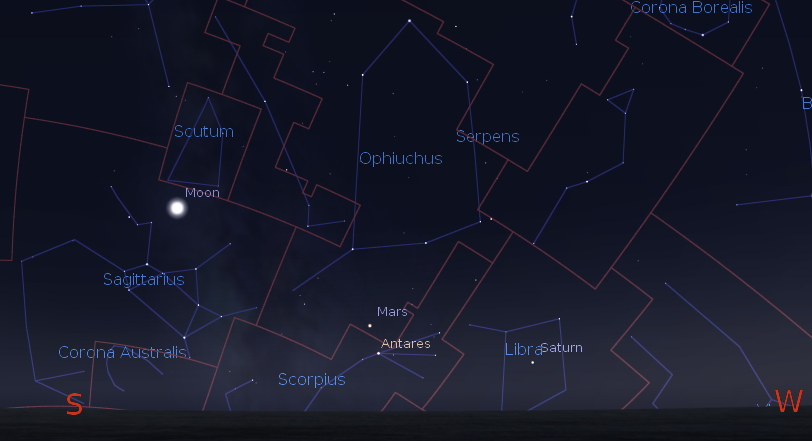
Saturn and Mars with the evening constellations, showing constellation boundaries in red at 8:30 p.m. on October 1, 2014. Created using Stellarium.
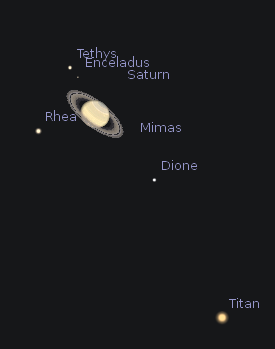
Saturn through a telescope. Of the satellites only Titan should be visible with Saturn so low in the sky at 8:30 p.m. Created using Stellarium.
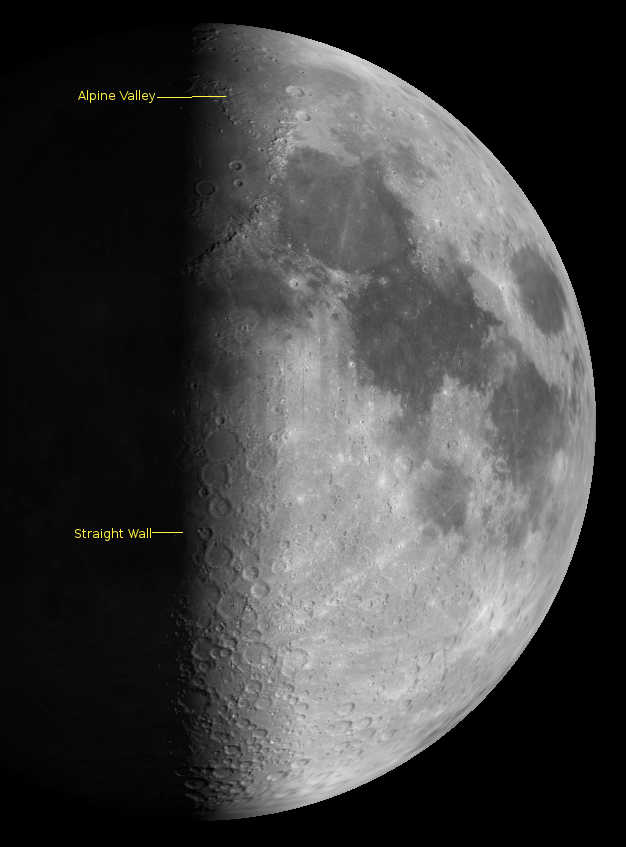
The first quarter Moon tonight at 8:30 p.m. with some interesting locations. Created using Virtual Moon Atlas.
Points of interest on the moon tonight:
- Alpine Valley – This is a fault valley some 79 miles (130 km) long and 7 miles (11 km) wide through the lunar Alps.
- Straight Wall – This is a fault that runs north-south on the moon and is only seen either one day after first quarter or one day after last quarter. It is 67 miles (110 km) long and 900 feet (300 meters) high. But instead of being a wall, it has only a 7 degree slope, which explains its brief appearance. Tonight it will cast a shadow. One day after last quarter the sun will shine directly on the slope, which is covered by lighter material and will show as a bright line.
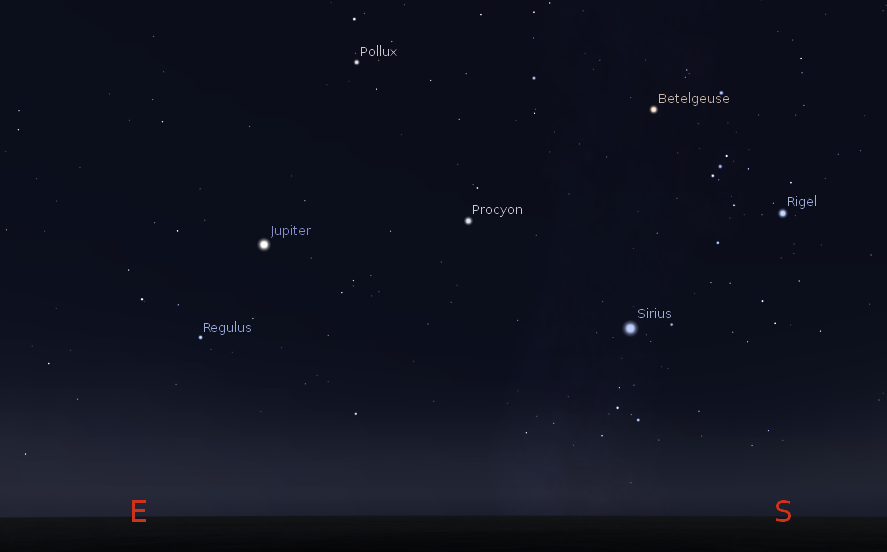
Jupiter and the winter stars at 6:30 a.m. on October 2, 2014. Created using Stellarium.
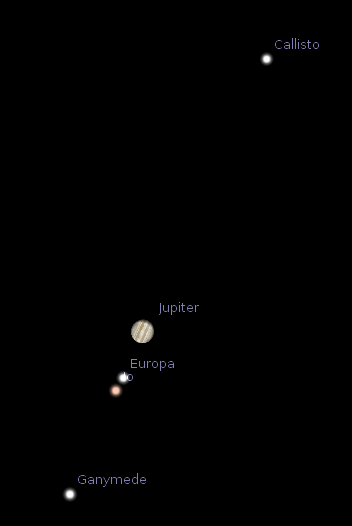
Jupiter and its satellites as seen through a telescope at 6:30 a.m. October 2, 2014. Created using Stellarium.

