Archive
06/09/2016 – Ephemeris – Waiting for the first stars to appear
Ephemeris for Thursday, June 9th. Today the Sun will be up for 15 hours and 30 minutes, setting at 9:27, and it will rise tomorrow at 5:56. The Moon, 3 days before first quarter, will set at 12:59 tomorrow morning.
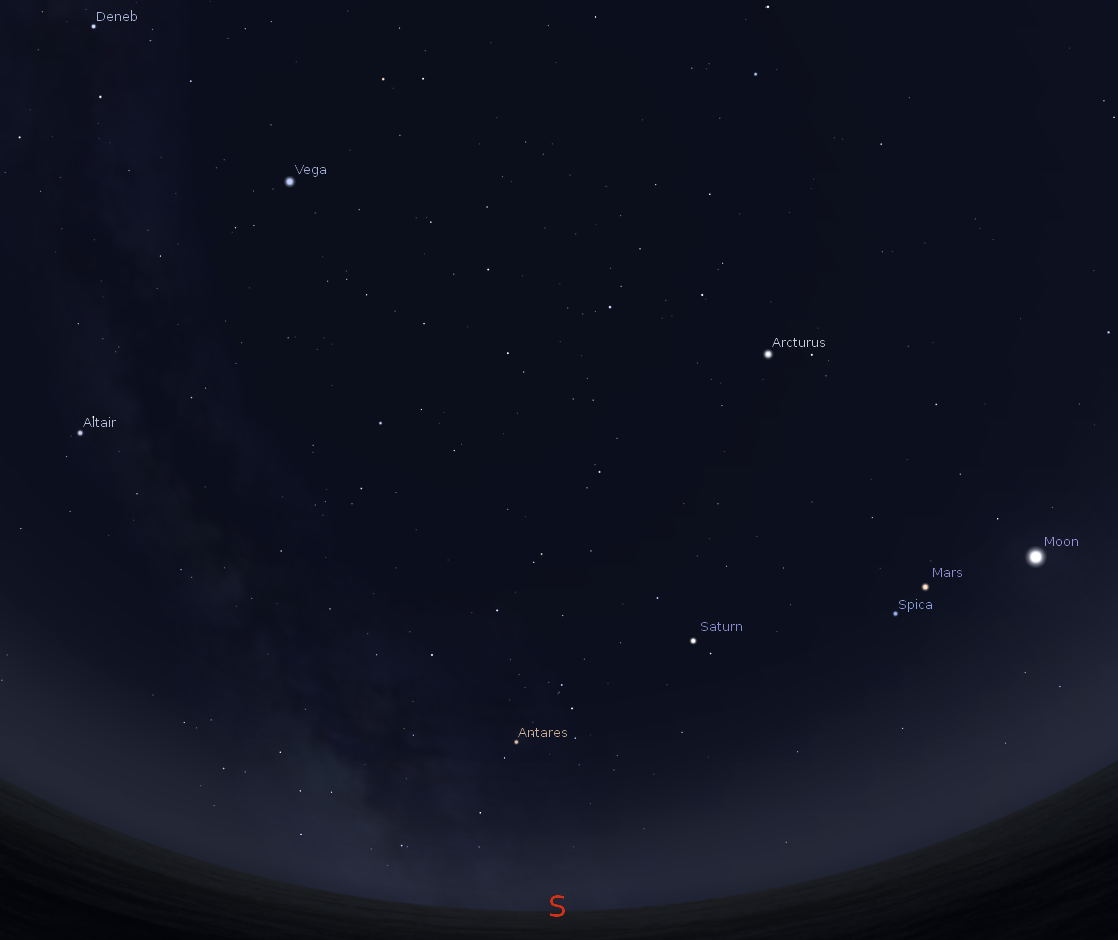
Lets look at the first stars and planets to appear tonight as it gets dark. The first object to appear will be the fat crescent Moon in the southwest. The planet Jupiter will be the next to appear after sunset left and above the Moon. Mars, low in the southeast will appear reddish, shortly thereafter. Looking very high in the southeast, the fourth brightest nighttime star will appear. This will be Arcturus with an orange hue. Saturn should appear to the left and below Mars. Soon other stars will appear including the Big Dipper overhead. Other bright stars will appear, the summer star Vega low in the northeast. Regulus between Jupiter and the Moon and Spica between Jupiter and Mars.
Times are for the Traverse City/Interlochen area of Michigan. They may be different for your location.
Addendum
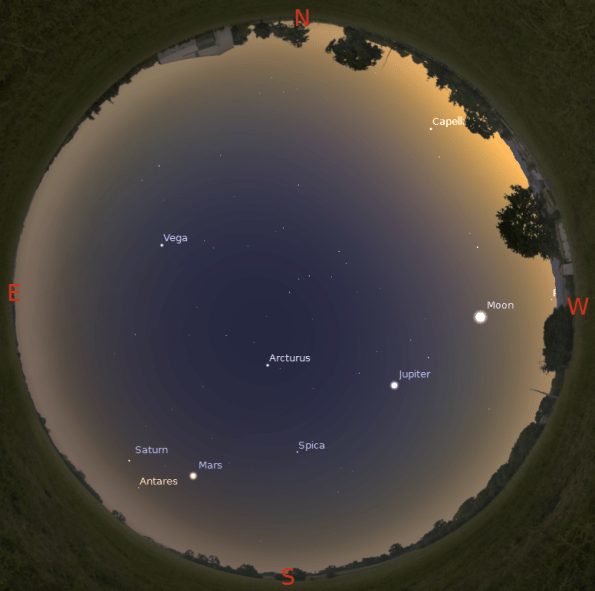
The sky at about 10 p.m. or a little later, watching the first stars and planets appear. Created using Stellarium. If viewing using Firefox right-click on the image and select View Image to enlarge.
05/24/2016 – Ephemeris – Follow the spike to Spica
Ephemeris for Tuesday, May 24th. Today the Sun will be up for 15 hours and 9 minutes, setting at 9:14, and will rise tomorrow at 6:04. The Moon, 3 days past full, will rise at 11:35 this evening.
Just about due south at 11 p.m. is the bright star Spica which can be found from all the way back overhead to the Big Dipper. Follow the arc of the handle of the Big Dipper to the bright star Arcturus high in the south, southeast. Then straighten the curve of the arc to a straight spike which points to Spica. Arcturus is much brighter than Spica and has an orange tint to Spica’s bluish hue. In fact Spica is the bluest of the 21 first magnitude stars. That means that it is hot. Actually Spica is really two blue stars orbiting each other in 4 days. Spica is 250 light years away, which is reasonably close. Spica was an important star to the ancients. One temple was built, and aligned to its setting point.
Times are for the Traverse City/Interlochen area of Michigan. They may be different for your location.
Addendum
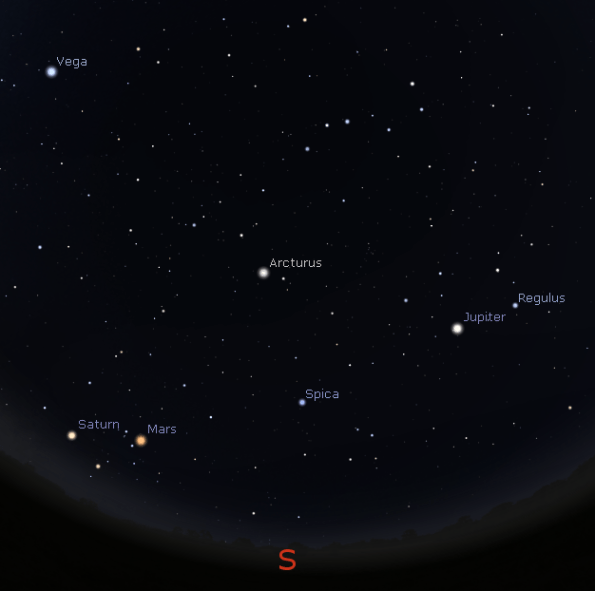
The evening sky to the south. All the finder stars are there, so follow the arc of the Big Dipper’s handle to Arcturus. Straighten it to a spike that points to Spica. Created using Stellarium.
07/09/2015 – Ephemeris – The first stars to appear at night
Ephemeris for Thursday, July 9th. Today the Sun will be up for 15 hours and 23 minutes, setting at 9:29. The Moon, 1 day past last quarter, will rise at 2:05 tomorrow morning, and tomorrow the Sun will rise at 6:07.
Let’s check out all the bright stars in the evening sky, as it gets dark tonight. Low in the west are the planets Venus and Jupiter. High in the west is the bright yellow-orange star Arcturus. In the northwest is the Big Dipper, whose curved handle points to Arcturus. Straightening that curve to a spike will point to Spica a blue-white star low in the southwest. The planet Saturn is located in the south. Below and left of it is the red star Antares which usually twinkles merrily. High in the east is the bright white star Vega. To its lower right is Altair, and to its lower left the star Deneb. Vega, Altair and Deneb make the Summer Triangle, whose rising in the east signals the coming of summer.
Times are for the Traverse City/Interlochen area of Michigan. They may be different for your location.
Addendum
I talked about seeing the first stars a month ago. It seems that in holding star parties this time of year we spend a lot of time watching the first stars appear. I wanted to discuss the Summer Triangle, but it wandered off to what you see above. I’ll get there next week, I promise.
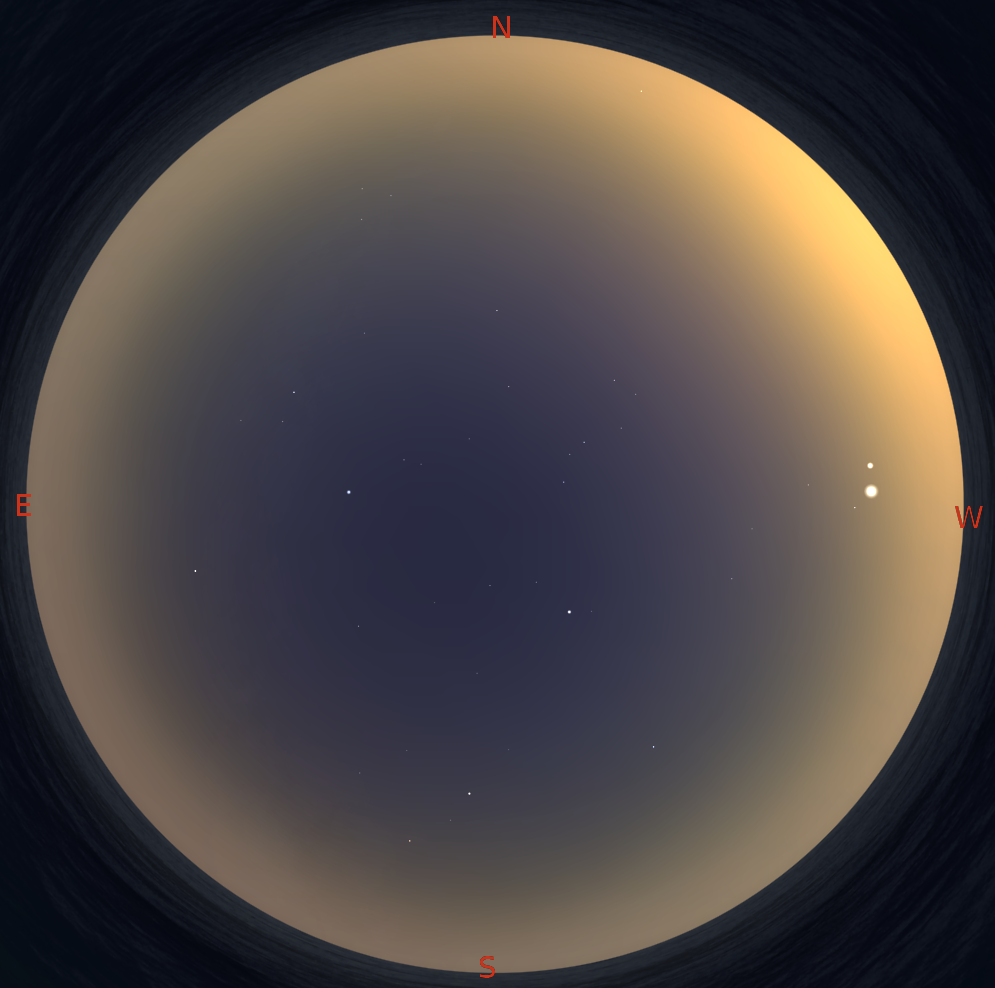
The first stars and planets to appear. See if you can located them from the text. Created using Stellarium for about 10 p.m., July 9, 2015.
05/11/2015 – Ephemeris – How to find the constellation Virgo
Ephemeris for Monday, May 11th. Today the Sun will be up for 14 hours and 39 minutes, setting at 8:59. The Moon, at last quarter today, will rise at 3:08 tomorrow morning. Tomorrow the Sun will rise at 6:18.
Friday I talked about that in spring we are looking out the thin side of our Milky Way galaxy’s disk. One of the large constellations we see in the south at 11 p.m. can be found using the Big Dipper overhead, follow the arc of the handle to the bright star Arcturus, the straighten the arc to a spike to reach Spica, a bright blue-white star in the south. Spica is the brightest star in the constellation Virgo the virgin. She represents the goddess of the harvest, Virgo is holding a sheaf of wheat in depictions of her, and Spica is placed at the head of the sheaf. In the space between Spica and Leo the lion to her right is, a great cluster just below naked eye visibility. The Virgo cluster of galaxies.
Times are for the Traverse City/Interlochen area of Michigan. They may be different for your location.
Addendum
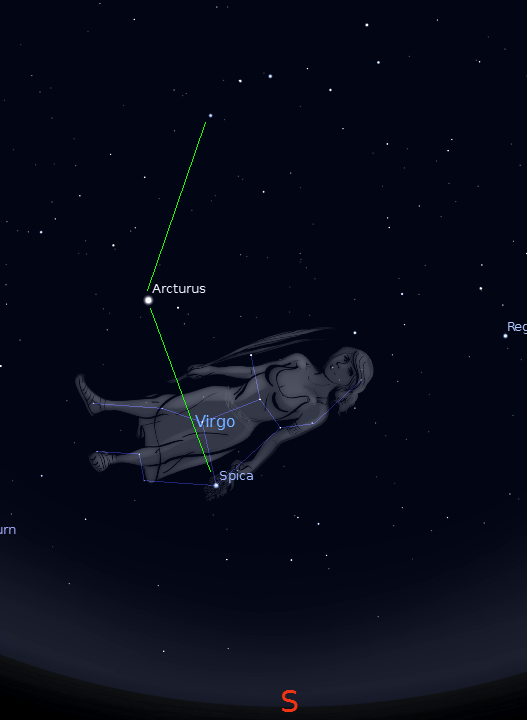
Star hop from the Big Dipper through Arcturus to Spica and Virgo. Orientation for 11 p.m. on May 11, 2015. Created using Stellarium.
07/04/2014 – Ephemeris – Find patriotic red, white and blue stars
Ephemeris for Independence Day, Friday, July 4th. Today the sun will be up for 15 hours and 27 minutes, setting at 9:30. The moon, 1 day before first quarter, will set at 1:03 tomorrow morning. Tomorrow the sun will rise at 6:03.
On this patriotic day let’s look for some red, white, and blue stars. Red is easy, the red star Antares is seen in the south at 11 p.m. Mars, the red planet, in the southwest, can be added even though it’s not technically a star. White is easy too, the official white calibration star Vega high in the east at 11 p.m. The blue star is really blue-white. The brightest of these out at 11 p.m. is Spica, low in the southwest. The color is best seen in binoculars. Star colors are quite subtle, and are an indicator of the temperature of their outer gaseous layers. The temperature of a stars outer layers, in order of their increasing temperatures, red, white and blue, is not related to the temperature in their cores. Of these three the coolest on the outside, Antares is really the hottest inside, using helium as fuel.
Times are for the Traverse City/Interlochen area of Michigan. They may be different for your location.
Addendum
Red white and blue stars for Independence Day at 11 p.m. on July 4, 2014. Created using Stellarium.
06/02/2014 – Ephemeris – The Big Dipper points to other stars and constellations
Ephemeris for Monday, June 2nd. Today the sun will be up for 15 hours and 21 minutes, setting at 9:21. The moon, 3 days before first quarter, will set at 12:41 tomorrow morning. Tomorrow the sun will rise at 5:59.
The Big Dipper points to other stars and constellations. Right now the Big Dipper is nearly overhead. The front bowl stars point to Polaris, the North Star which never seems to move in the sky. The handle can be used to find two stars. First follow the arc of the handle away from the bowl to find the fourth brightest night time star Arcturus in the base of the kite shaped constellation of Boötes. Straighten the arc to a spike and continue to the south and you will come to the bright blue-white star Spica in Virgo the virgin. Don’t confuse it with reddish Mars to the right of it now. You can remember these stars with the phrase “Follow the arc of the handle to Arcturus and then spike to Spica”
Times are for the Traverse City/Interlochen area of Michigan. They may be different for your location.
Addendum
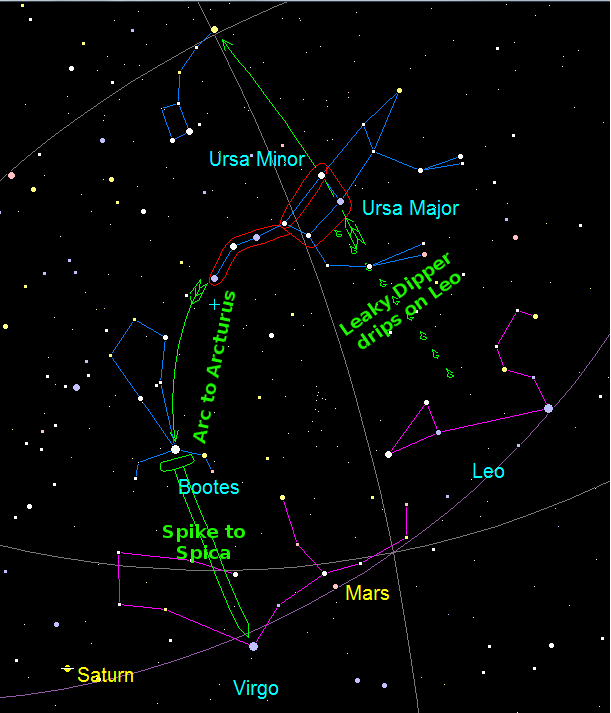
The Big Dipper can be used to point to other stars and constellations in the spring sky. Credit: My LookingUp program.
04/14/2014 – Ephemeris – The total lunar eclipse is tonight after midnight.
Updated 4 p.m. EDT: See bottom of the post.
Ephemeris for Monday, April 14th. The sun will rise at 7:00. It’ll be up for 13 hours and 26 minutes, setting at 8:26. The Moon, 1 day before full, will set at 7:05 tomorrow morning.
We’re hoping for clear skies for tonight’s total lunar eclipse. Actually it’s in the wee hours of tomorrow morning. So if you’re a night owl, stay up tonight or otherwise catch all or part of it by setting your alarm clock. Here’s the timings: The partial phase begins as the Moon enters the earth’s inner shadow at 1:58 a.m. Totality starts at 3:06 a.m. Totality will last until 4:24,when the upper left edge of the moon again peeks into sunlight. The ending partial phase will end at 5:33 a.m. If it’s clear or at least partly cloudy there are two locations in the Grand Traverse area to view the eclipse, other than your own back yard, which is perfectly acceptable. The first is the NMC Rogers Observatory, and the other is the Dune Climb parking lot at Sleeping Bear Dunes.
Times are for the Traverse City/Interlochen area of Michigan. They may be different for your location.
Addendum
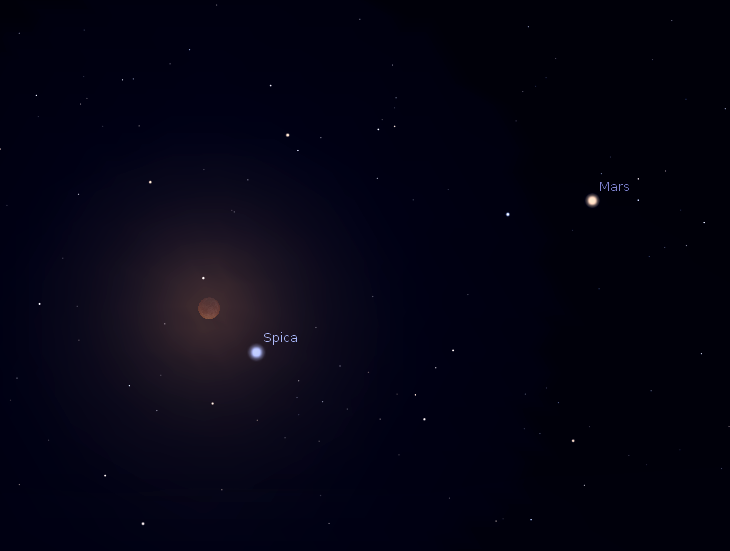
The April 15, 2014 lunar eclipse simulated by Stellarium. Note that Mars and the star Spica will be nearby.
As of 24 hours before the eclipse the weather prospects don’t look good for northwestern lower Michigan or all the east coast for that matter. We’re on the edge of the clouds. The western shore Lake Michigan and parts of the U.P. may be clear. But things could change.
There will be a live webcast from University of Georgia at http://www.ccssc.org/webcast.html, who may be stuck with the same overcast we may have. Hat Tip to Spaceweather.com
There is also another live stream of the eclipse from Griffith Observatory in Los Angeles. Or go to http://www.griffithobservatory.org and click on the Griffith TV button. Coverage starts at 9:45 PDT or 12:45 a.m. EDT which is a bit more than an hour before the partial phase of the eclipse starts. Hat Tip to Carla Johns of the NASA Museum Alliance for the links.
Here’s a link to the official NASA eclipse website for this eclipse.
Here’s a link to my in-depth discussion of the April 15, 2014 eclipse.
Update
Here’s another link to a live feed of the eclipse: Virtual Telescope Project.
Universe Today has more links.
The Sleeping Bear eclipse viewing has been canceled.
07/15/2013 – Ephemeris – The moon will appear near Spica tonight
Ephemeris for Monday, July 15th. Today the sun will be up for 15 hours and 12 minutes, setting at 9:24. The moon, at first quarter today, will set at 12:48 tomorrow morning. Tomorrow the sun will rise at 6:12.
The moon this evening is very close to the bright star Spica. It might take a pair of binoculars to spot it in the glare of the moon. Spica will be just above left of the moon tonight. For other spots on the earth the moon will actually pass in front of the star. The event is called an occultation, from the word occult meaning hidden. Simply put the moon will pass in front of or hide the star for up to an hour. The chief beneficiary of this occultation is the state of Hawai’i. Occultations are one of the best ways to measure the position, diameter and shape of distant asteroids and Kuiper belt objects that are too small to measure otherwise. Satellites of these objects have also been discovered this way.
Times are for the Traverse City/Interlochen area of Michigan. They may be different for your location.
Addendum
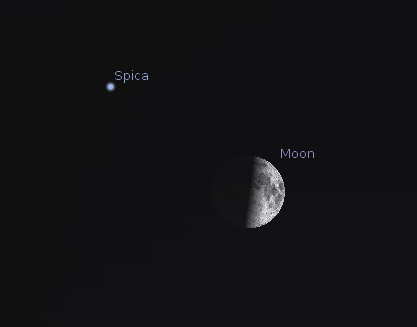
Spica and the Moon at 10 p.m. on July 15, 2013. Created using Stellarium.
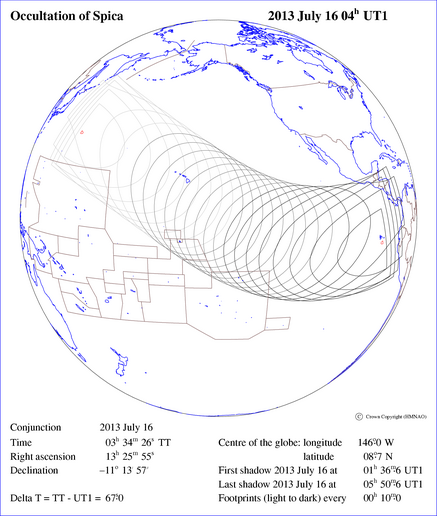
Path on the Earth where the occultation of Spica will be visible. Credit Astronomical Almanac Online.
The Astronomical Almanac Online ( http://asa.usno.navy.mil/) “is a joint publication of the U. S. Nautical Almanac Office, United States Naval Observatory (USNO), in the United States and Her Majesty’s Nautical Almanac Office (HMNAO), United Kingdom Hydrographic Office (UKHO), in the United Kingdom.”
07/04/2013 – Ephemeris – Patriotic Stars: Red, White and Blue
Ephemeris for Independence Day in the United States, Thursday, July 4th. Today the sun will be up for 15 hours and 27 minutes, setting at 9:30. The moon, half way from last quarter to new, will rise at 4:05 tomorrow morning. Tomorrow the sun will rise at 6:03.
Today is Independence Day so let’s look for some red, white, and blue stars. Red is easy, the red star Antares is seen in the south at 11 p.m. White is easy too, the official white calibration star Vega high in the east at 11 p.m. The blue star is really blue-white. The brightest of these out at 11 p.m. is Spica, low in the southwest to the right of the brighter Saturn. The color is best seen in binoculars. Star colors are quite subtle, and are an indicator of the temperature of their outer gaseous layers. The temperature of a stars outer layers, in order of their increasing temperatures are red, white and blue. Of these three the coolest on the outside, Antares is really the hottest inside, using helium as fuel.
Times are for the Traverse City/Interlochen area of Michigan. They may be different for your location.
Addendum
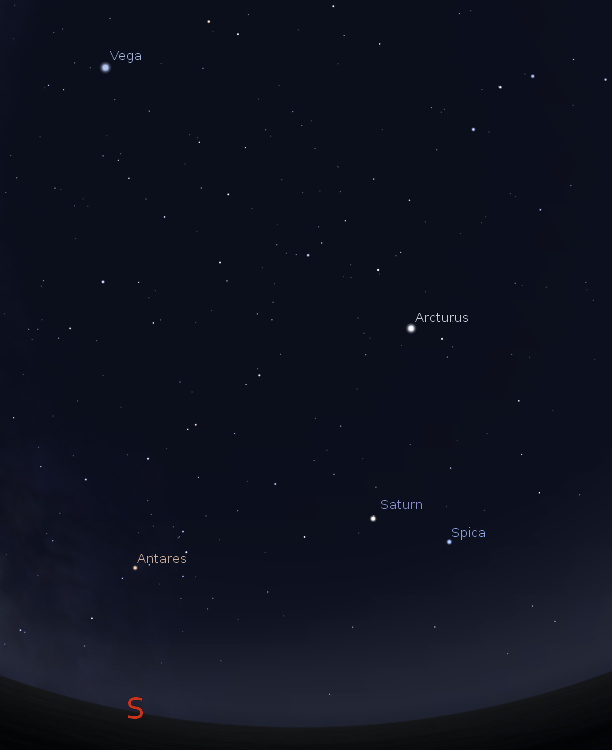
Red Antares, white Vega and blue Spica. Patriotic Stars this evening. Created using Stellarium.
06/06/2013 – Ephemeris – Star colors
Ephemeris for Thursday, June 6th. Today the sun will be up for 15 hours and 26 minutes, setting at 9:24. The moon, 2 days before new, will rise at 5:22 tomorrow morning. Tomorrow the sun will rise at 5:57.
Star and planets colors are quite subtle. This is partly due to the fact that we are color blind at very low light levels. Only the brightest stars show color at all. Telescopes however aid our color perception because it makes the stars brighter. The planet Saturn, now in the south at night has a distinct yellowish hue, caused by the color of its atmosphere. The star Spica to its right is the bluest of the bright first magnitude stars, and shows as a bright arc light. Arcturus, above both Saturn and Spica has a yellow to orange hue. Antares low in the southeast has a definite reddish hue. In a telescope it also looks like a sparkler due to our turbulent atmosphere. Red stars are the coolest stars (temperature wise) while blue-white stars are the hottest.
Times are for the Traverse City/Interlochen area of Michigan. They may be different for your location.
Addendum
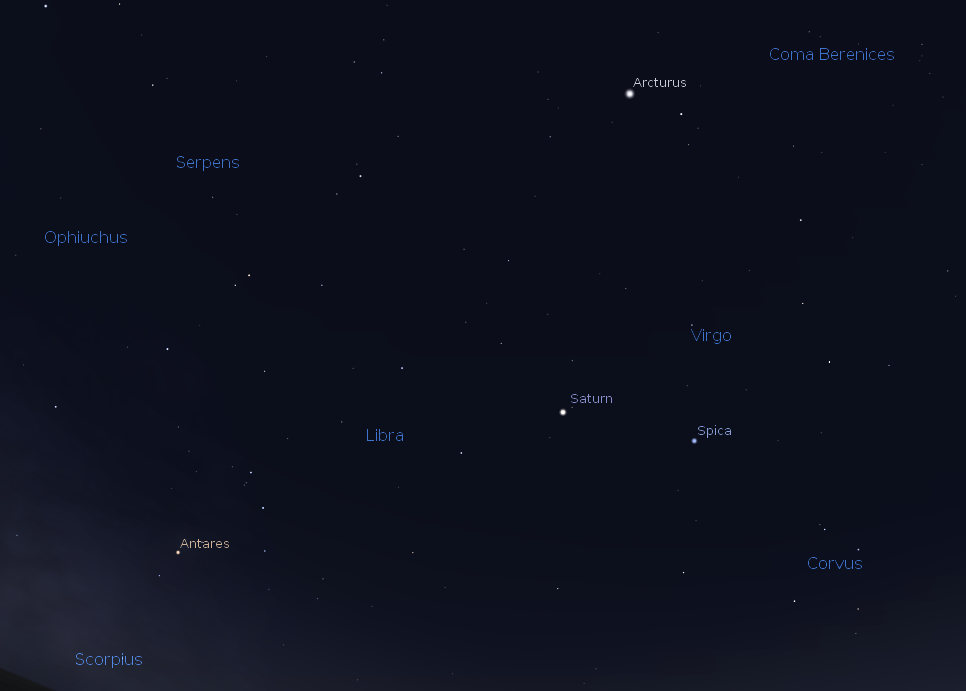
Stellarium does a pretty good job of showing the subtle colors of stars, which is also reflected in the color of the star labels. Click on the image to enlarge.
 Bob Moler's Ephemeris Blog