Archive
08/29/2012 – Ephemeris – Where are the bright planets this week?
Ephemeris for Wednesday, August 29th. The sun will rise at 7:02. It’ll be up for 13 hours and 21 minutes, setting at 8:23. The moon, 2 days before full, will set at 6:04 tomorrow morning.
Let’s see what’s happening with the bright planets for this week. Mars Saturn and the star Spica make a bright but elongating triangle in the west southwest after sunset. Mars is on the upper left with Saturn on the upper right and Spica below. They are located in the constellation Virgo the virgin. Saturn will be setting in the west at 10:20 p.m, and Mars will set 3 minutes later. The morning sky features the two brightest planets: Jupiter, which will rise at 12:23 a.m. in the east northeast and Venus, which will rise at 3:16 also in the east northeast. Jupiter is near the head of Taurus the bull, while Venus is moving between Gemini and Cancer. Early morning is a good time to get a preview of winter stars.
Times are for the Traverse City/Interlochen area of Michigan. They may be different for your location.
Addendum
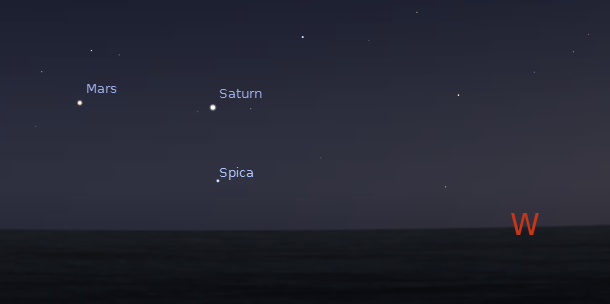
Mars, Saturn and Spica at 9:30 p.m. on August 29, 2012. Created using Stellarium.
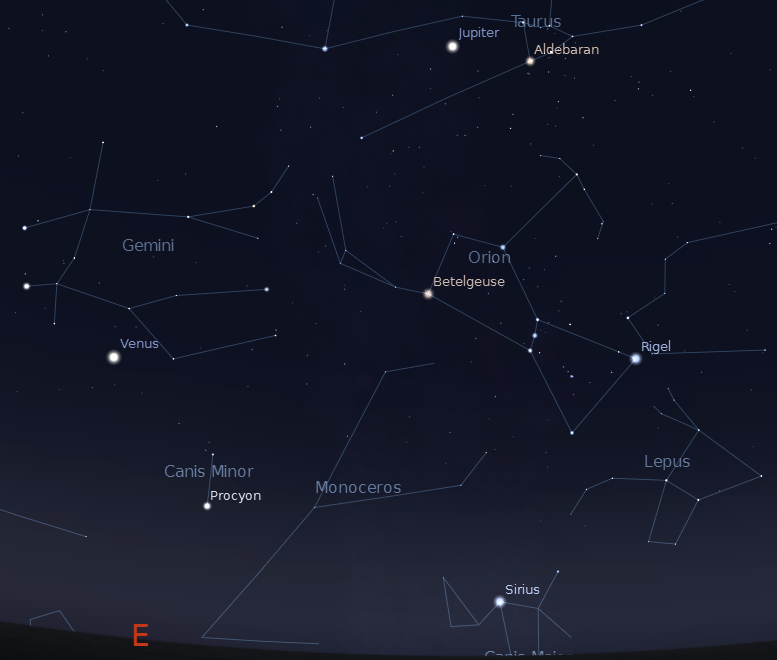
Jupiter, Venus and the stars of winter rising at 5:30 a.m. on August 30, 2012. Created using Stellarium.
08/21/2012 – Ephemeris – The moon, the planets Mars, Saturn and the star Spica get together tonight
Ephemeris for Tuesday, August 21st. The sun rises at 6:52. It’ll be up for 13 hours and 44 minutes, setting at 8:37. The moon, 3 days before first quarter, will set at 10:21 this evening.
Tonight the moon will join the triangle of the planets Saturn, Mars and the star Spica. Mars is the dimmest of the three star-like objects and is nearly directly above the moon. Saturn is yellowish and to the upper right, while the star Spica is the bluest of the 21 brightest first magnitude stars. Mars gets its color from rust, good old iron oxide. Saturn has a yellowish tinge due partly to the color of its cloud tops. The color of the rings is much more white of ice. But since Saturn reflects the sun, some of that yellowness come from the sun itself. While the daylight sun appears white to us, our night vision shifts to the blue, so sunlike stars appear yellowish. This shift to the blue also enhances the color of a blue star like Spica.
Times are for the Traverse City/Interlochen area of Michigan. They may be different for your location.
Addendum
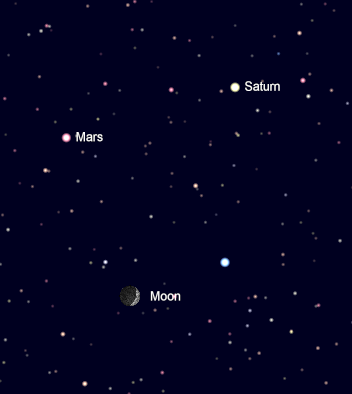
The moon and the planets Mars and Saturn plus the bright star Spica before 10 p.m. Created using Stellarium.
Spica is the unnamed star to the right of the moon.
08/13/2012 – Ephemeris – Saturn, Mars and Spica line up
Ephemeris for Monday, August 13th. The sun rises at 6:43. It’ll be up for 14 hours and 7 minutes, setting at 8:50. The moon, half way from last quarter to new, will rise at 3:38 tomorrow morning.
This evening the triangle of the planets Mars and Saturn plus the star Spica has momentarily disappeared. They are, this evening only, practically in a straight line. Mars has moved to be between Saturn and Spica. The reason Mars moves so fast and Saturn has been hanging around Spica all year is that Mars is closer to the sun, so it moves faster. It takes a bit less than two or our years to orbit the sun. Saturn takes nearly 30 years to do the same. Saturn averages 9.5 times the earth’s distance from the sun. While Mars averages one and a half times the earth’s distance. Mars will hang on in the western sky for a few more months, getting dimmer as it moves around behind the sun. Saturn and Spica will soon be lost in twilight.
Times are for the Traverse City/Interlochen area of Michigan. They may be different for your location.
Addendum
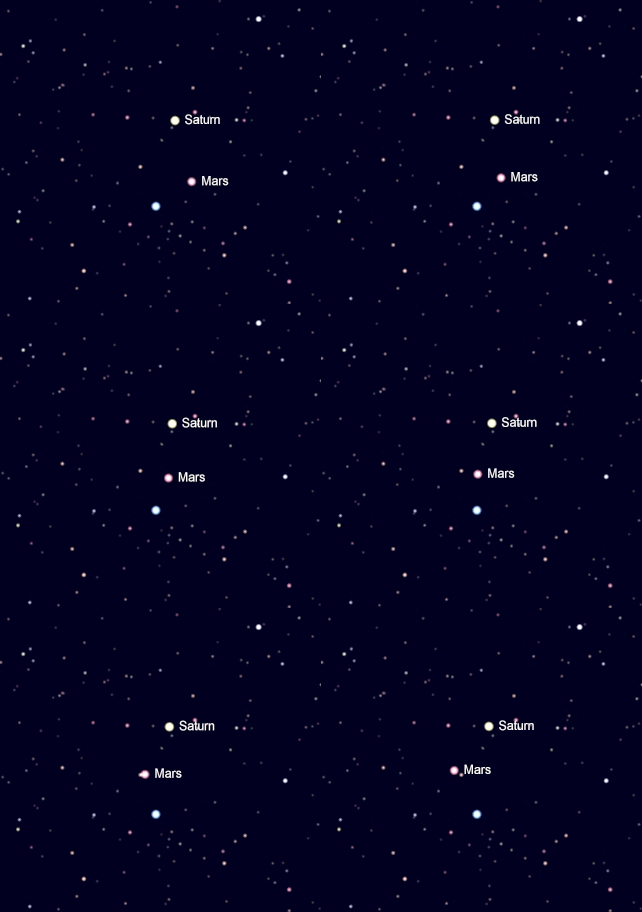
The trio of Mars, Saturn and the star Spica from August 11th through the 18th. Created using Cartes du Ciel (Sky Charts)
06/14/2012 – Ephemeris – Flag Day: Red, White and Blue Stars
Ephemeris for Flag Day, Thursday, June 14th. Today the sun will be up for 15 hours and 32 minutes, setting at 9:29. The moon, 3 days past last quarter, will rise at 3:16 tomorrow morning. Tomorrow the sun will rise at 5:56.
Since it’s Flag Day, lets look for some red white and blue stars. Red is easy, I talked about it Tuesday, It is Antares now low in the southeast in the evening in the heart of the constellation of Scorpius the scorpion. For the white star there is no purer white star than Vega, spectral type A0 (A zero), the astronomers definition of white. It is located midway up the sky in the east. It is the 5th brightest night time star, and is seen off a small parallelogram of stars that make up the body of Lyra the harp. For the blue star, the best is Spica, below Saturn this year and in the south in the evening. It is the bluest of the 21 brightest first magnitude stars. Color in stars is often subtle, so try to see these colors.
Times are for the Traverse City/Interlochen area of Michigan. They may be different for your location.
Addendum
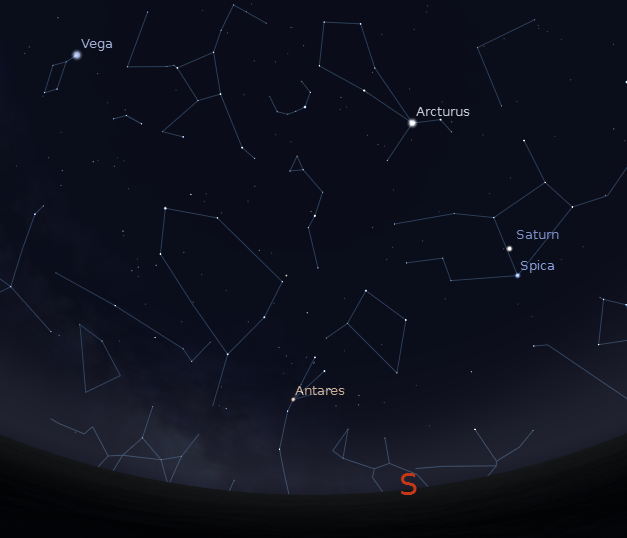
Red (Antares), White (Vega) and Blue (Spica) stars of spring. Created using Stellarium.
05/11/2012 – Ephemeris – The bright star Spica
Ephemeris for Friday, May 11th. Today the sun will be up for 14 hours and 40 minutes, setting at 8:59. The moon, 1 day before last quarter, will rise at 2:09 tomorrow morning. Tomorrow the sun will rise at 6:17.
The bright blue star Spica can be found in the southeast as it gets dark now. It’s one of the fainter of the 21 first magnitude stars. It lies in the constellation of Virgo the virgin, and lies very close to the path of the sun, moon and planets in the sky. Saturn is just to the left of it this year. Spica is a binary star, whose brighter component is drawn into an ellipsoid by the tidal effect of the companion. They orbit each other in only 4 days. Spica is 260 light years away and over 3,000 times brighter than the sun. An Egyptian temple at Thebes was oriented to the setting point of Spica. The change in the setting point over time allowed the Greek astronomer Hipparchus to discover the precession of the equinoxes.
Times are for the Traverse City/Interlochen area of Michigan. They may be different for your location.
Addendum
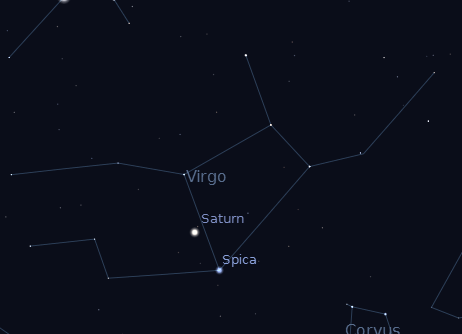
Saturn and Spica on May 11, 2012. Created using Stellarium.
03/09/2012 – Ephemeris – The moon will pass Spica and Saturn tomorrow
Ephemeris for Friday, March 9th. The sun will rise at 7:04. It’ll be up for 11 hours and 36 minutes, setting at 6:41. The moon, 1 day past full, will rise at 8:47 this evening.
The moon will be passing by the bright star Spica and the planet Saturn tomorrow evening. They will make a neat triangle with the moon at the point below. I should remind everyone that the moon will only pass these object from our point of view. We are lining up the nearby moon, only a quarter million miles away with Saturn, nearly a billion miles away, and Spica trillion and trillions of miles away. Though the heavens appear as a sphere overhead, it is unimaginably deep. The ancients called the heavens the firmament, meaning that it was literally solid. It was, according to Genesis, placed there to divide the waters above from that below. We find now that time is as deep into the past as space is deep, some 13.7 billion years.
Not mentioned in the program: Daylight Time will start at 2 a.m. Sunday March 11th at 2 a.m.
* Times are for the Traverse City/Interlochen area of Michigan. They may be different for your location.
Addendum
Below is The moon below Spica and Saturn at 11 p.m. on Saturday, march 10, 2012.
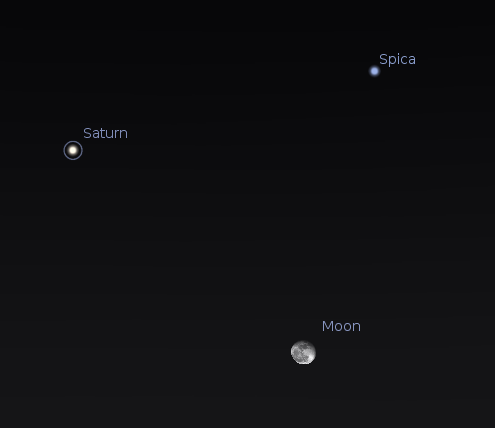
The Moon, Spica and Saturn at 11 p.m March 10, 2012. Chart created using Stellarium.
01/16/2012 – Ephemeris – The moon will appear below Saturn and Spica this morning
Ephemeris for Martin Luther King Day, Monday, January 16th. The sun will rise at 8:15. It’ll be up for 9 hours and 13 minutes, setting at 5:29. The moon, at last quarter today, will rise at 2:31 tomorrow morning. | This morning the crescent moon will appear below Saturn and the bright blue-white star Spica in the southeast before twilight brightens too much. When seen together Saturn and Spica really show the difference in their colors. Saturn reflects the light of our yellow sun, and that’s accentuated by it’s cream colored clouds. Only Saturn’s rings reflect the sun’s light pretty much unaltered because they’re made mostly of ice. Spica has the hottest surface temperature of any first magnitude star and shines with a blue tinge. This came home to me a long time ago, when I photographed a lunar eclipse with color film when the moon was next to Spica. Spica came out looking very blue indeed.
* Times, as always are for the Traverse City/Interlochen area of Michigan.
Addendum
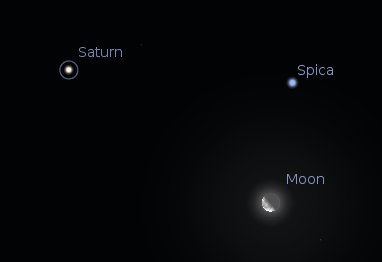
Saturn, Spica and the Moon on the morning of January 16, 2012. Created using Stellarium.
07/19/11 – Ephemeris – The brightest stars visible now in the evening
Tuesday, July 19th. Today the sun will be up for 15 hours and 6 minutes, setting at 9:21. The moon, half way from full to last quarter, will rise at 11:11 this evening. Tomorrow the sun will rise at 6:15.
Let’s check out all the bright stars in the evening sky, as it gets dark tonight. High in the west is the bright yellow-orange star Arcturus. In the northwest is the Big Dipper, whose curved handle points to Arcturus. Straightening that curve to a spike will point to Spica a blue-white star low in the southwest. The bright star to its right isn’t. It’s the planet Saturn. In the south is the red star Antares which usually twinkles merrily. High in the east is the bright white star Vega. To its lower right is Altair, and to its lower left the star Deneb. Vega, Altair and Deneb make the Summer Triangle, whose rising in the east signals the coming of summer. Always present for us in northern Michigan is Capella very low in the north.
* Times are for the Traverse City/Interlochen area of Michigan. They may be different for your location.
Addendum
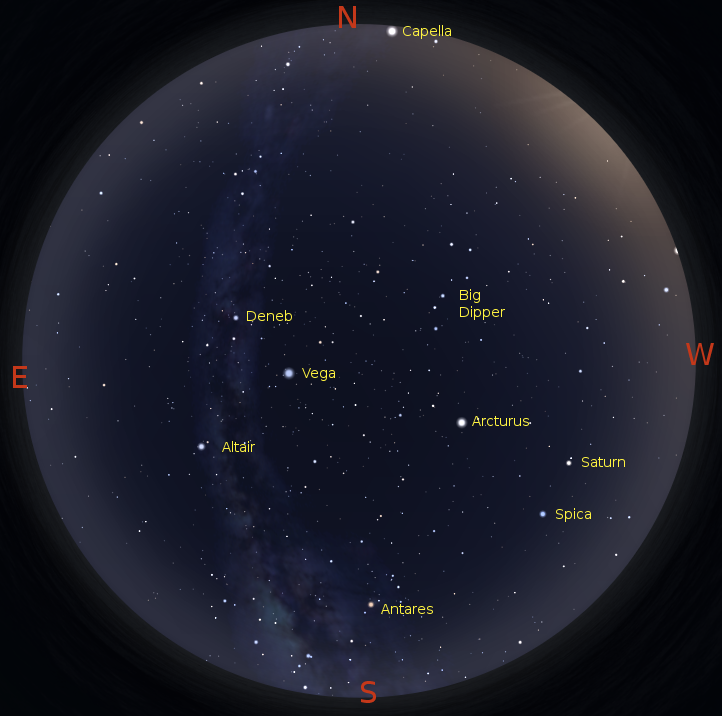
Bright Summer Stars. Created using Stellarium.
Click on the image to enlarge. This is a whole sky chart. The round edge is the horizon. BTW the star Capella, very low in the north, is a winter star, but it’s visible all year round for folks north of 44 degrees north latitude.
07/04/11 – Ephemeris – Red, white and blue stars
Independence Day, Monday, July 4th. Today the sun will be up for 15 hours and 27 minutes, setting at 9:30. The moon, 3 days past new, will set at 11:22 this evening. Tomorrow the sun will rise at 6:03.
Today’s Independence Day so let’s look for some red, white, and blue stars. Red is easy, the red star Antares is seen in the south at 11 p.m. White is easy too, the official white calibration star Vega high in the east at 11 p.m. The blue star is really blue-white. The brightest of these out at 11 p.m. is Spica, low in the southwest. The color is best seen in binoculars. Star colors are quite subtle, and are an indicator of the temperature of their outer gaseous layers. The temperature of a stars outer layers, in order of their increasing temperatures, red, white and blue, is not related to the temperature in their cores. Of these three the coolest on the outside, Antares is really the hottest inside, using helium as fuel.
* Times are for the Traverse City/Interlochen area of Michigan. They may be different for your location.
05/27/11 – Ephemeris – Spica, some thoughts about its future
Friday, May 27th. Today the sun will be up for 15 hours and 12 minutes, setting at 9:15. The moon, 3 days past last quarter, will rise at 3:27 tomorrow morning. Tomorrow the sun will rise at 6:03.
Yesterday I talked about Spica the bright star to the lower left of Saturn in the evening now. Spica is actually two very massive and hot stars orbiting each other in 4 days. One is 10 times the sun’s mass while the other is 7 times the sun’s mass. The more massive one will run out of hydrogen in its core first and begin to bloat in size. As it does so it will begin to transfer mass to the other star and speed up its evolution. The resulting show should be spectacular when seen at a safe distance. I’m not sure the stars 260 light year distance is safe enough. But we have many millions of years to wait before things get interesting, and that’s fine with me. What seems to be a silent, seemingly changeless sky can hide dramatic happenings.
* Times are for the Traverse City/Interlochen area of Michigan. They may be different for your location.
Addendum
Being only an amateur astronomer the above is rank speculation with no proof that the proposed events will happen. But it’s fun to think about.
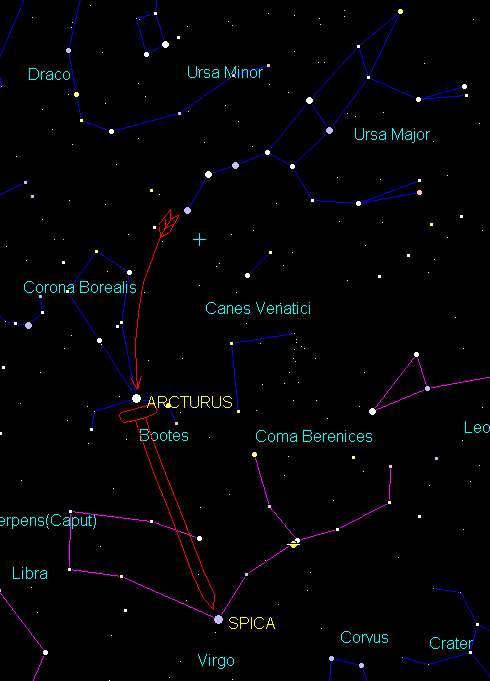
Follow the Spike to Spica, 5/26/2011
 Bob Moler's Ephemeris Blog