Archive
06/29/2020 – Vega, brightest star of the Summer Triangle
This is Ephemeris for Monday, June 29th. Today the Sun will be up for 15 hours and 31 minutes, setting at 9:32, and it will rise tomorrow at 6:00. The Moon, 1 day past first quarter, will set at 2:46 tomorrow morning.
Vega is the highest star In the east and brightest star of the Summer Triangle also rising in that direction. It is an important and much studied star, first as a standard for brightness for thr star brightness magnitude scale at magnitude of almost exactly zero. It also has two fields of debris orbiting it. In 1983 the Infrared Astronomy Satellite discovered an excess of infrared radiation coming from the star. It seems now that there are two orbiting rings, one warm, and the other cold orbiting the star. This is somewhat like the two disks the Sun has: The asteroid belt between Mars and Jupiter and the Kuiper belt, beyond Neptune. No planets have been discovered around Vega, but I wouldn’t bet against it.
The event times given are for the Traverse City/Interlochen area of Michigan. They may be different for your location.
Addendum
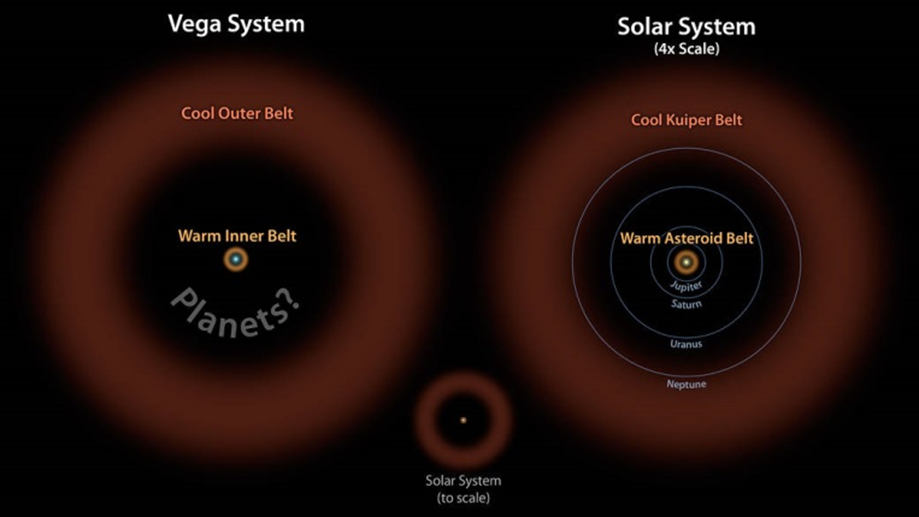
Vega possesses two debris fields, similar to our own solar system’s asteroid and Kuiper belts. Astronomers continue to hunt for planets orbiting Vega, but as of May 2020 none have been confirmed. More info: bit.ly/VegaSystem Credit: NASA/JPL-Caltech.
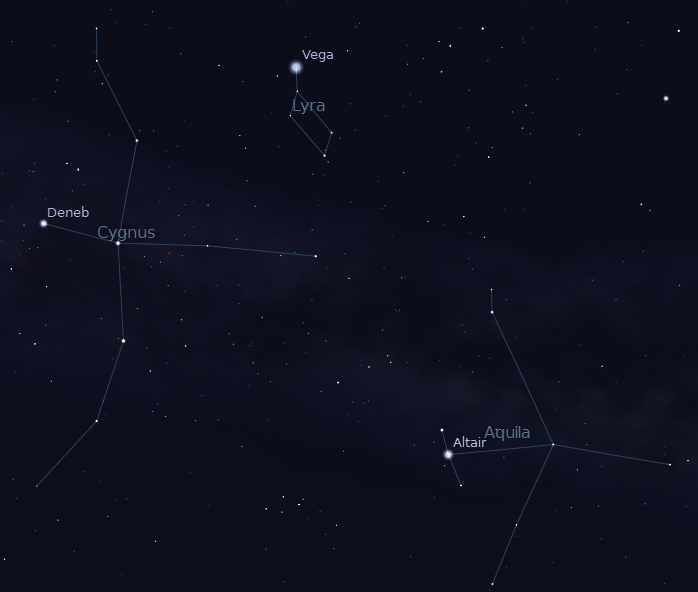
Summer Triangle. Created using Stellarium.
06/12/2020 – Ephemeris – The Summer Triangle proclaims that summer is almost here
This is Bob Moler with Ephemeris for Friday, June 12th. Today the Sun will be up for 15 hours and 32 minutes, setting at 9:29, and it will rise tomorrow at 5:56. The Moon, 1 day before last quarter, will rise at 2:27 tomorrow morning.
Summer skies are coming. It’s only 8 days until summer officially arrives. It is a calendar day early this year because of the extra day added in February for the leap year. Looking to the eastern sky at 11 pm are three bright stars in a large triangle. The top star Vega is about half way up the sky to the zenith, and the brightest of the three. It’s in the small constellation of Lyra the harp. Lowest of the stars and just about due east is Altair in Aquila the eagle. Completing the triangle is Deneb in the northeast in the tail of Cygnus the swan or the head of the horizontal Northern Cross. These three stars make up the Summer Triangle. Be that as it may, the Summer Triangle will be in our evening sky moving slowly westward until December.
The event times given are for the Traverse City/Interlochen area of Michigan. They may be different for your location.
Addendum
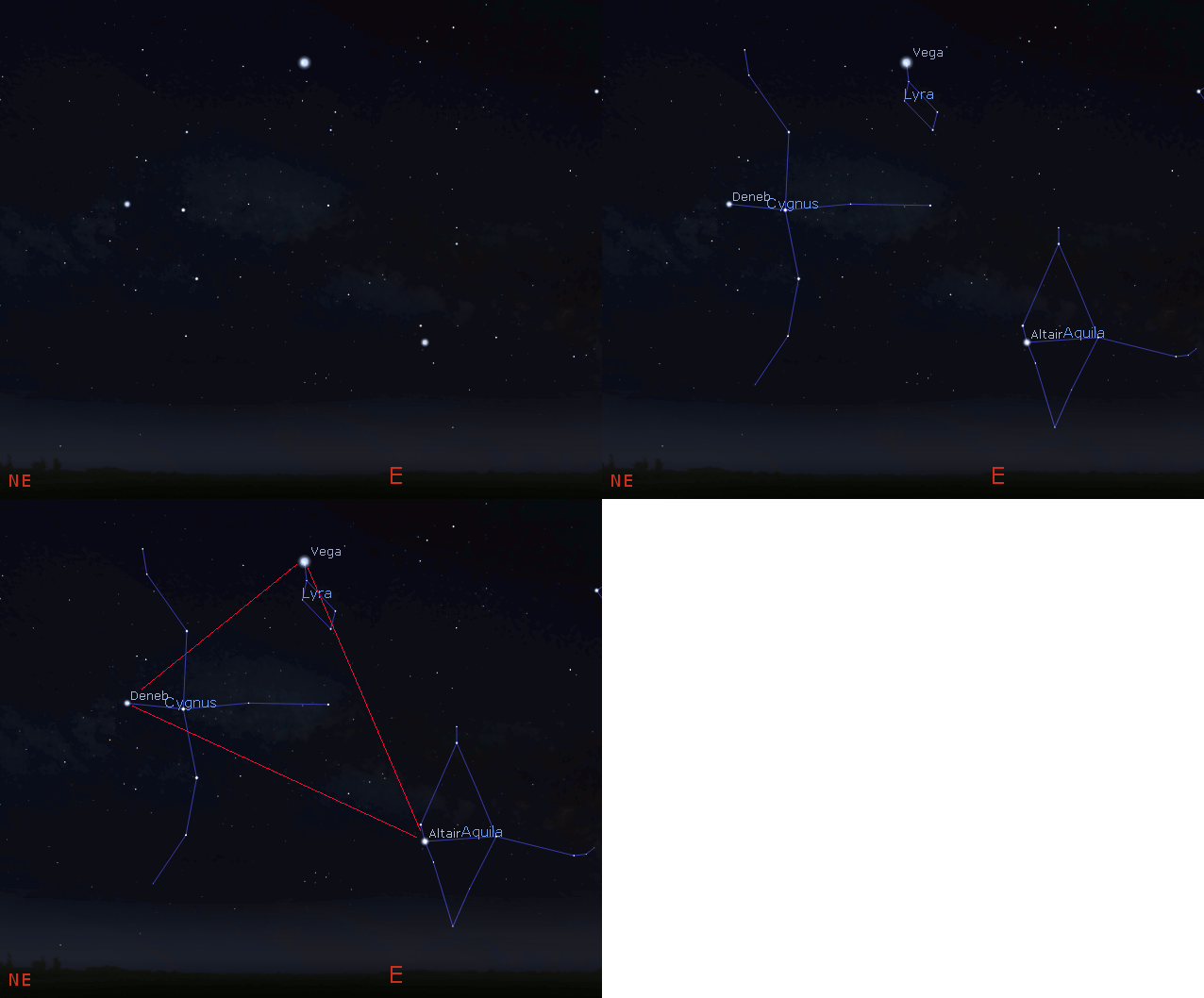
Finder animation for the Summer Triangle, seen in red for 11 pm, June 12th. Created using Stellarium and GIMP.
08/23/2019 – Ephemeris – Two small constellations around the Summer Triangle
Ephemeris for Friday, August 23rd. Today the Sun will be up for 13 hours and 41 minutes, setting at 8:35, and it will rise tomorrow at 6:55. The Moon, at last quarter today, will rise at 12:43 tomorrow morning.
Located below the eastern edge of the Summer Triangle of three of the brightest stars in the sky, which is overhead in our sky at 10 p.m., is the tiny constellation of Delphinus the dolphin. Delphinus’ 6 stars in a small parallelogram with a tail, really does look like a dolphin leaping out of the water. The parallelogram itself has the name Job’s Coffin. The origin of this asterism or informal constellation is unknown. Of the dolphin itself: the ancient Greeks appreciated this aquatic mammal as we do, and told stories of dolphins rescuing shipwrecked sailors. There’s another tiny constellation to the right of Delphinus, Sagitta the arrow a small thin group of 5 stars, which represents Cupid’s dart. Above-right of Sagitta binoculars will find a little star group called the Coat hanger.
The times given are for the Traverse City/Interlochen area of Michigan. They may be different for your location.
Addendum

Delphinus and Sagitta finder animation. Created using Stellarium and GIMP.
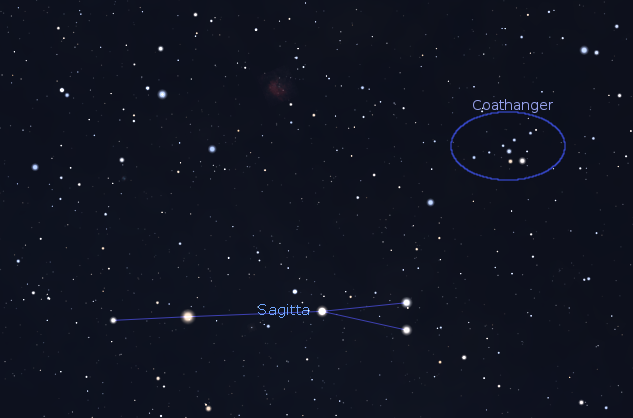
Closeup of Sagitta and the binocular asterism the Coathanger. Created using Stellarium.
08/19/2019 – Ephemeris – The dimmest looking star of the Summer Triangle is by far the brightest
Ephemeris for Monday, August 19th. Today the Sun will be up for 13 hours and 52 minutes, setting at 8:42, and it will rise tomorrow at 6:50. The Moon, half way from full to last quarter, will rise at 10:53 this evening.
This evening when it gets dark the bright star Deneb in Cygnus the swan will be very high in the east. Deneb is the dimmest star of the summer triangle. Of the other stars of the triangle, Vega is higher nearly overhead, while Altair is lower in the southeast. While Deneb’s apparent magnitude, or brightness as seen from Earth, makes it the dimmest of the three bright stars, Deneb’s vast distance of possibly 2,600 light years* makes it over 90 times the distance of Vega. If brought as close as Vega, Deneb would be as bright at least as the quarter moon. It is possibly as bright as 196 thousand suns; and a huge star, possibly as large in diameter as the orbit of the Earth. For all this it is only 20 to 25 times the mass of the Sun.
The times given are for the Traverse City/Interlochen area of Michigan. They may be different for your location.
Addendum
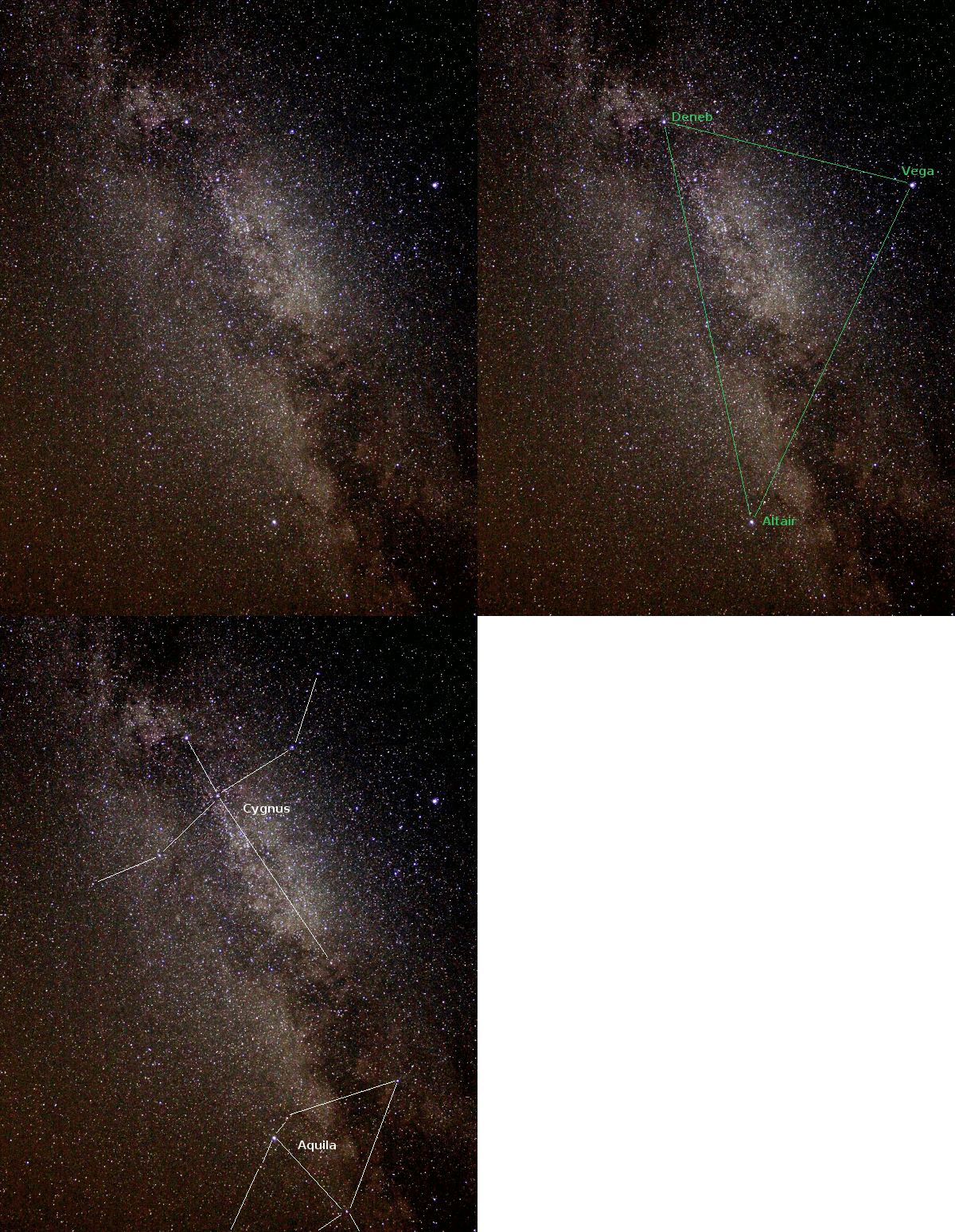
The Great Rift finder animation as seen in the Summer Triangle, also showing the constellations of Cygnus the swan and the the northern part of Aquila the Eagle. This image a stack of 5 30 second exposures taken the morning of the Perseid meteor shower last year in a vain attempt to capture some meteors.
06/04/2019 – Ephemeris – The night sky previews summer
Ephemeris for Tuesday, June 4th. Today the Sun will be up for 15 hours and 24 minutes, setting at 9:23, and it will rise tomorrow at 5:58. The Moon, 1 day past new, will set at 10:51 this evening.
The Moon will be visible early this evening. By early I mean by 10 p.m. since the Sun sets so late now. By the time you see it it will be a day and a half old and a thin sliver. Closer inspection will reveal the the whole Moon will be visible due to Earth shine. That’s due to the nearly full Earth shining on the night side of the Moon.
Even though Summer is 17 days away the three bright stars of the Summer Triangle are visible in the eastern sky at 11 p.m. The three stars are Vega highest in the east. Deneb is lower in the northeast. Altair is lower close to the horizon in east. They will rise higher throughout the summer season. Looking close to the horizon in the southeast that bright star at that hour is the planet Jupiter.
The times given are for the Traverse City/Interlochen area of Michigan. They may be different for your location.
Addendum
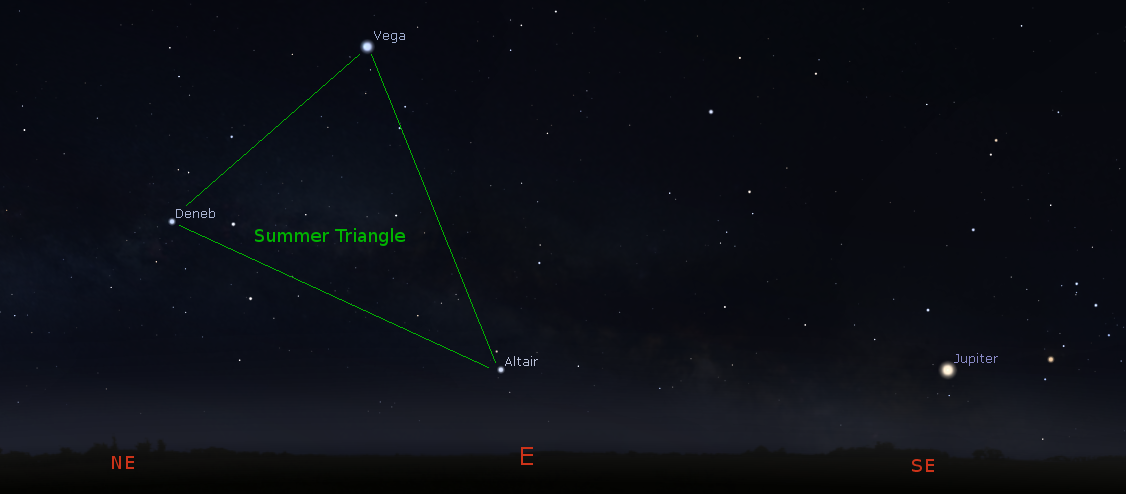
The eastern skies at 11 p.m. June 4, 2019. Click on the image to enlarge. Created using Stellarium and GIMP.
11/13/2018 – Ephemeris – The Summer Triangle in autumn
Ephemeris for Tuesday, November 13th. The Sun will rise at 7:37. It’ll be up for 9 hours and 39 minutes, setting at 5:16. The Moon, 2 days before first quarter, will set at 10:20 this evening.
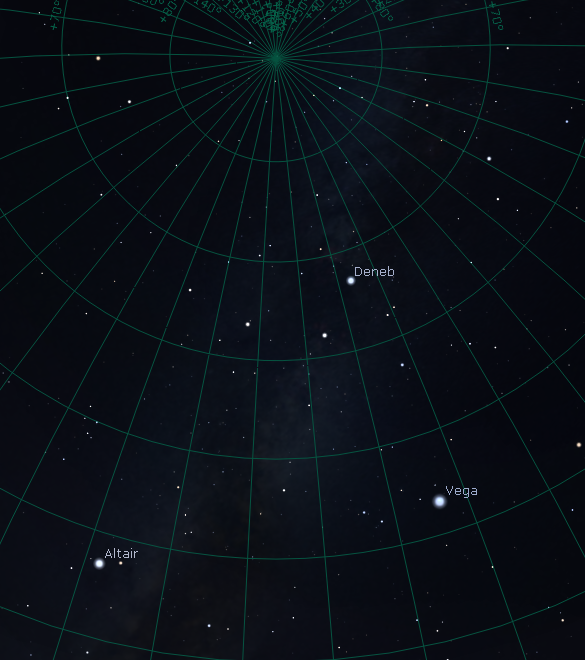
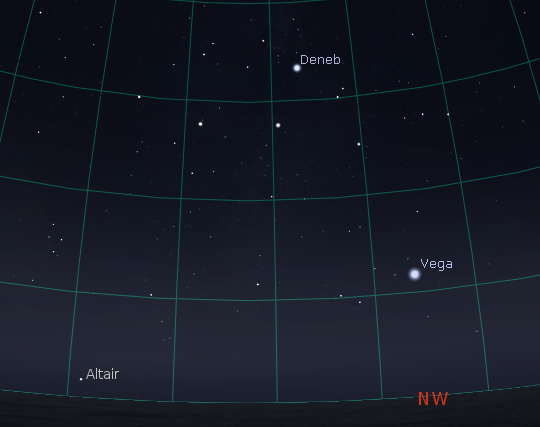
The Summer Triangle is still in the sky at 9 p.m., even though it’s November. These three bright stars that straddle the Milky Way are high in the east for most of the summer, move overhead and begin to slide to the west in autumn. We will lose Altair, the southernmost of the three stars at 9 p.m. on the winter solstice, December 21st. We’ll lose the brightest, Vega in January. For the northern half of the IPR listening area the northernmost of the triangle stars, Deneb won’t quite set below a north Lake Michigan horizon. Next spring we’ll be waiting and watching for these three stars to rise, reclaim the skies, and bring again the warm summer skies. The winter skies do however have more bright stars than the summer sky.
The times given are for the Traverse City/Interlochen area of Michigan. They may be different for your location.
Addendum
09/10/2018 -Ephemeris – The Coathanger in the sky
Ephemeris for Monday, September 10th. The Sun will rise at 7:15. It’ll be up for 12 hours and 47 minutes, setting at 8:02. The Moon, 1 day past new, will set at 8:57 this evening.
Just about every amateur astronomer knows a little asterism or informal constellation called the Coathanger. It’s stars are mostly below naked eye visibility, but it is a great sight in binoculars. It’s located along a line from Altair in Aquila the eagle to Vega in Lyra the harp. These are two star of the Summer Triangle. It is also just west of, or right of, the constellation Sagitta the arrow. It consists of six stars in just about a perfectly straight line with four stars in a tight group south of them making the hook. In telescope finders which invert the image the Coathanger appears right-side-up. Arab astronomer Al Sufi discovered it and described it in 964 AD. It has the catalog designation of Collinder 399. It is also known as Brocchi’s Cluster.
The times given are for the Traverse City/Interlochen area of Michigan. They may be different for your location.
Addendum
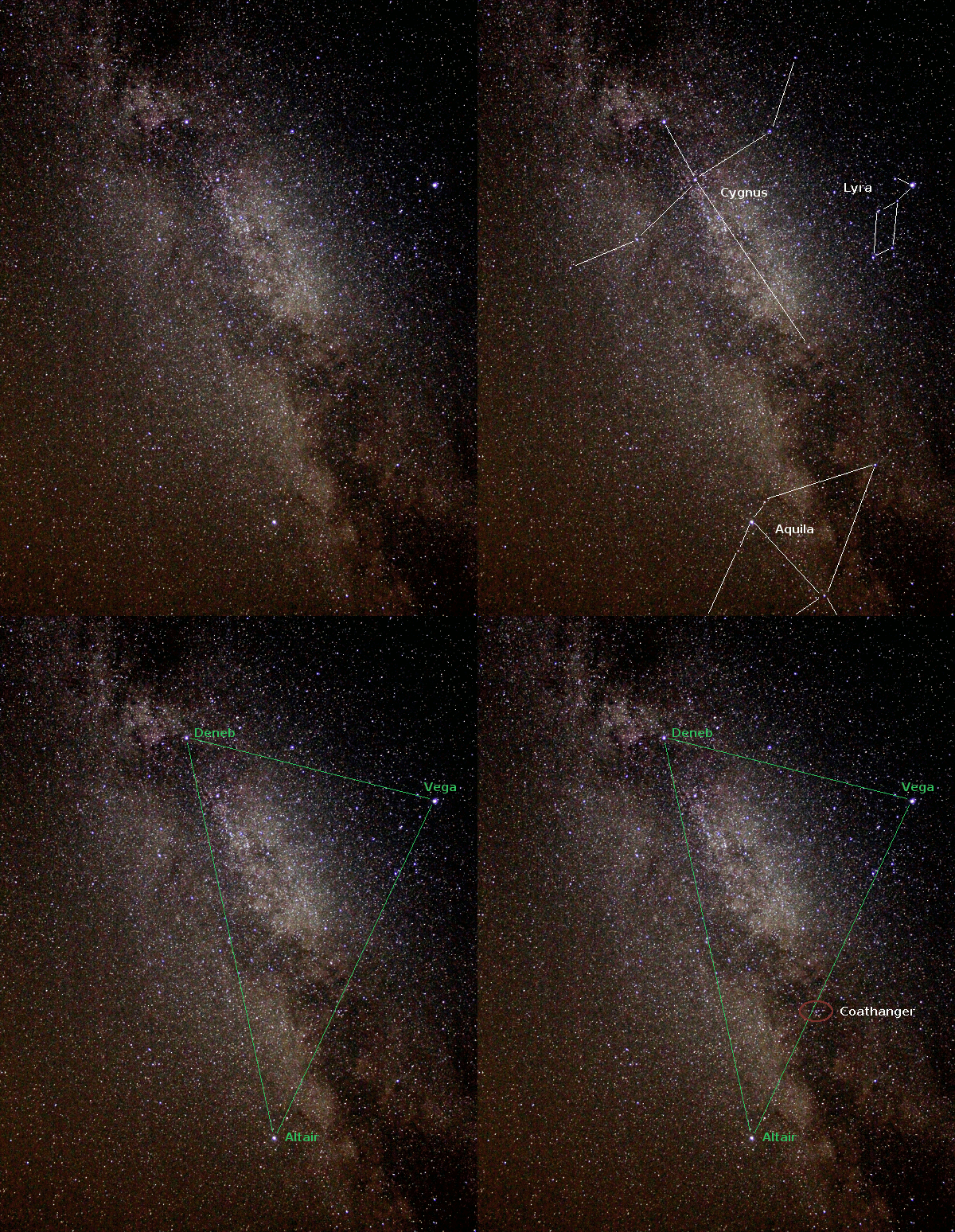
How to find the Coathanger. Look for the Summer Triangle. On the line from Altair to Vega the Coathanger can be found. Star imaged by Bob Moler.

Binocular view of the Coathanger. From the original resolution of the above photograph.
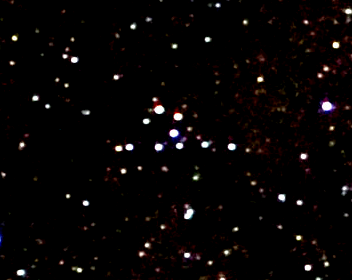
Telescope finder view of the Coathanger. Telescope finders usually invert the image, so it looks like a proper coat hanger.
09/06/2018 – Ephemeris – The constellations of Delphinus and Sagitta
Ephemeris for Thursday, September 6th. The Sun will rise at 7:11. It’ll be up for 12 hours and 59 minutes, setting at 8:10. The Moon, 3 days before new, will rise at 4:19 tomorrow morning.
Located below the eastern edge of the Summer Triangle of three of the brightest stars in the sky, which is nearly overhead in our sky at 10 p.m., is the tiny constellation of Delphinus the dolphin. Delphinus’ 6 stars in a small parallelogram with a tail, really does look like a dolphin leaping out of the water. The parallelogram itself has the name Job’s Coffin. The origin of this asterism or informal constellation is unknown. Of the dolphin itself: the ancient Greeks appreciated this aquatic mammal as we do, and told stories of dolphins rescuing shipwrecked sailors. There’s another tiny constellation to the right of Delphinus, Sagitta the arrow a small thin group of 5 stars, which represents Cupid’s dart.
The times given are for the Traverse City/Interlochen area of Michigan. They may be different for your location.
Addendum
Delphinus and Sagitta finder animation. Click on image to enlarge. Created using Stellarium and GIMP.
07/02/2018 – Ephemeris – The starry triangle of summer
Ephemeris for Monday, July 2nd. Today the Sun will be up for 15 hours and 30 minutes, setting at 9:31, and it will rise tomorrow at 6:02. The Moon, half way from full to last quarter, will rise at 12:19 tomorrow morning.
Now that it’s summer it’s time to look for the Summer Triangle in the sky. It’s seen rising in the east as it gets dark. Highest of the three bright stars is Vega in the constellation Lyra the harp, whose body is seen in a narrow parallelogram nearby. The second star of the triangle is Deneb lower and left of Vega, It appears dimmer than Vega because it is by far the most distant of the three. The third star of the Summer Triangle is seen farther below and a right of Vega. It is Altair in Aquila the eagle, and the closest. Altair is 16.5 light years away, Vega is 27 light years while Deneb actually one of the brighter stars known, is 1500 or more light years away. It’s distance is not well known.
The times given are for the Traverse City/Interlochen area of Michigan. They may be different for your location.
Addendum
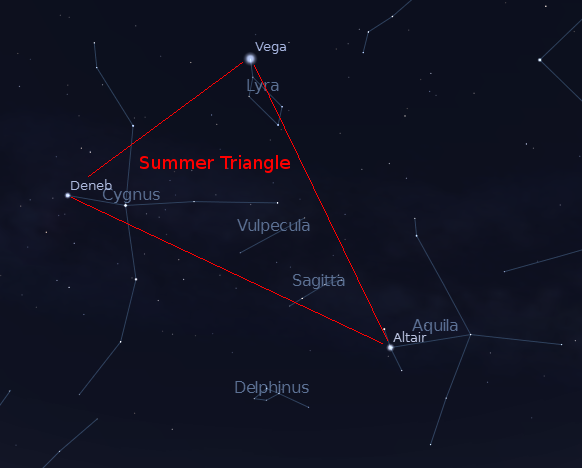
The Summer Triangle. Created using Stellarium.
5/15/2018 – Ephemeris – Two thirds thru spring
Ephemeris for Tuesday, May 15th. Today the Sun will be up for 14 hours and 49 minutes, setting at 9:04, and it will rise tomorrow at 6:13. The Moon is new today, and won’t be visible.
Here we are at the middle of May, nearly two-thirds through spring and in the west only a few winter stars remain. Castor and Pollux of Gemini are horizontal in the west, Procyon the Little Dog Star is below and left of them, Capella in Auriga is in the northwest, but for most of the IPR listening area it will never quite set. At 10:30 Betelgeuse in Orion the hunter will be setting, chased from the skies by Scorpius the scorpion, which is rising in the southeast. In one story it is the sting of this scorpion that killed him. Already at that time two-thirds of the stars of the summer Triangle are up. Bright Vega in Lyra the harp, and Deneb in Cygnus the swan. The Big Dipper reigns overhead as spring is in full bloom.
The times given are for the Traverse City/Interlochen area of Michigan. They may be different for your location.
Addendum
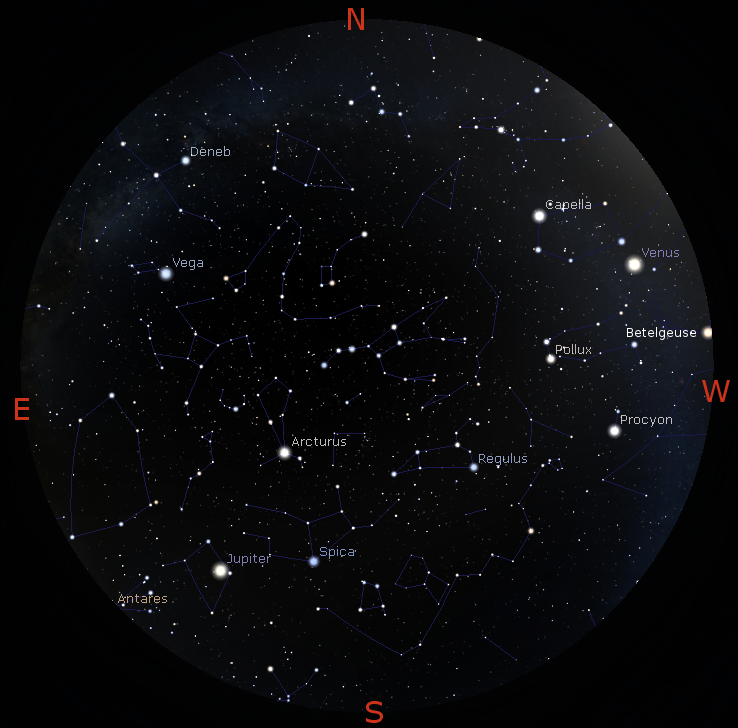
The sky dome for 10:30 p.m. May 15, 2018 showing the stars and constellations. It may not work for any latitude or time, but it works for our location, near 45 degrees north. Created using Stellarium.
 Bob Moler's Ephemeris Blog