Archive
07/29/11 – Ephemeris – Viewing night at Sleeping Bear Dunes National Lakeshore
Friday, July 29th. The sun rises at 6:25. It’ll be up for 14 hours and 46 minutes, setting at 9:11. The moon, 1 day before new, will rise at 6:20 tomorrow morning.
The Grand Traverse Astronomical Society will hold a viewing night in cooperation with the rangers of the Sleeping Bear Dunes National Lakeshore tomorrow night starting at 9 p.m. It will be held at stop 3, the Dunes Overlook on Pierce Stocking Drive. It’s best to park at Picnic Mountain and walk over. The short cul-de-sac running to he observation platform will be closed to preserve the darkness of the spot. The viewing will take place only if we’re not completely clouded up. On tap early will be the planet Saturn, which we’ll probably pick up around 9:45. We’ll then go for some of the brighter sky objects like binary stars, then fainter star clusters and nebulae in the summer Milky Way. Sleeping Bear is one of the top 10 darkest national parks.
* Times are for the Traverse City/Interlochen area of Michigan. They may be different for your location.
07/28/11 – Ephemeris – GTAS Night at the Lanphier Observatory
Thursday, July 28th. The sun rises at 6:24. It’ll be up for 14 hours and 48 minutes, setting at 9:12. The moon, 2 days before new, will rise at 5:08 tomorrow morning.
The Lanphier Observatory in Glen Arbor is open Wednesday and Thursday nights through August but only on clear evenings from 10 to midnight. The observatory is located close to the beach at the Leelanau School, just east of Glen Arbor on M22. I was asked by Norm Wheeler, who is the director of the observatory to help him out tonight, so I’m also inviting the crew over from the Grand Traverse Astronomical Society to help out with me. The Delta Aquarid meteor shower is reaching peak around now. These will seem to come from the southeast in the morning. Also beginning to show themselves in the Perseid meteor shower. The full moon will dim their maximum on August 12th, but early meteors can be seen from now until then when the moon isn’t up.
* Times are for the Traverse City/Interlochen area of Michigan. They may be different for your location.
07/27/11 – Ephemeris – The bright planets this week
Wednesday, July 27th. The sun rises at 6:23. It’ll be up for 14 hours and 50 minutes, setting at 9:14. The moon, 3 days before new, will rise at 4:00 tomorrow morning.
It’s Wednesday and time again to take a look at the whereabouts of the bright planets. The ringed planet Saturn will be visible in the west southwest as it gets dark. It’s near the bright star Spica to its left. Spica has a blue tinge, while Saturn is yellowish. It will set at 11:58 p.m. Saturn is a wonderful sight is a telescope with its rings. We are now slowly seeing Saturn slip into evening twilight. We have a few more weeks of good viewing of Saturn before its image deteriorates by being too low in the sky. Jupiter will rise at 12:50 a.m. in the east northeast and is seen against the stars of the constellation Aries now. Mars will rise at 3:15 also in the east northeast and is located near the lower tip of the horn of Taurus the bull.
* Times are for the Traverse City/Interlochen area of Michigan. They may be different for your location.
Wednesday, July 27th. The sun rises at 6:23. It’ll be up for 14 hours and 50 minutes, setting at 9:14. The moon, 3 days before new, will rise at 4:00 tomorrow morning. | It’s Wednesday and time again to take a look at the whereabouts of the bright planets. The ringed planet Saturn will be visible in the west southwest as it gets dark. It’s near the bright star Spica to its left. Spica has a blue tinge, while Saturn is yellowish. It will set at 11:58 p.m. Saturn is a wonderful sight is a telescope with its rings. We are now slowly seeing Saturn slip into evening twilight. We have a few more weeks of good viewing of Saturn before its image deteriorates by being too low in the sky. Jupiter will rise at 12:50 a.m. in the east northeast and is seen against the stars of the constellation Aries now. Mars will rise at 3:15 also in the east northeast and is located near the lower tip of the horn of Taurus the bull.
* Times are for the Traverse City/Interlochen area of Michigan. They may be different for your location.
Raise the debt ceiling already!
Here is the email I sent my US representative Dave Camp:
Dear Mr. Camp,
I am writing to you to urge you to vote to raise the debt ceiling. Preferably with no strings attached. The amount of hate coming from the extreme right towards Mr. Obama must be more that just his politics. Heck he’s farther right than I am, and I consider myself a moderate.
We cannot continue to be a great country by starving the government, the poor and elderly. I know “investing” is a bad word to you Republicans, but America must invest in jobs, our infrastructure, and our future or our drop from a first world to a third world country will be rapid. To do this we must spend and if necessary raise taxes.
Get on with it, Sir.
Respectfully,
Bob Moler
I live in the politically red side of the State of Michigan, where the joke is, on the shores of Grand Traverse Bay, “A view of the bay is worth half your pay.”
It’s no joke.
07/26/11 – Ephemeris – The Milky Way
Tuesday, July 26th. The sun rises at 6:22. It’ll be up for 14 hours and 53 minutes, setting at 9:15. The moon, 3 days past last quarter, will rise at 3:01 tomorrow morning.
The Milky Way, which is rising to pass overhead later in the evening is what we see of a huge structure of stars of which we are a part. We call it the Milky Way galaxy. It’s a spiral galaxy with a straight bar of stars through the center, a barred spiral galaxy about a hundred thousand light years across. It’s part of a small cluster of galaxies called the Local Group. Besides these three dozen galaxies, the Milky Way has small satellite galaxies orbiting it. The largest of these are the two Magellanic clouds seen from the southern hemisphere of earth. Even now a tiny galaxy is colliding with our galaxy. We can penetrate to the center of our own galaxy in infrared light, but not visible light from our location 26,000 light years away.
* Times are for the Traverse City/Interlochen area of Michigan. They may be different for your location.
Addendum

The Milky Way 360 degrees - Wikipedia
This is a mosaic of photographs showing the Milky Way as seen from the earth. The summer Milky Way we see is from just right of center to the left edge.
07/25/11 – Ephemeris – The constellation Aquila the eagle
Note: Due to a bad cable modem, this program was not uploaded in time for broadcast. It will be repeated at a later date.
Monday, July 25th. The sun rises at 6:21. It’ll be up for 14 hours and 55 minutes, setting at 9:16. The moon, 2 days past last quarter, will rise at 2:10 tomorrow morning.
The southernmost star in the Summer Triangle of three bright stars is Altair, high in the south southeast in the evening. It’s in the head of the constellation Aquila the Eagle. Altair is flanked by two stars, the eagle’s shoulders, and farther out are the wing tips. Other stars to the lower right are in its body and a last three in its tail. Near the tail binoculars will show a fuzzy spot that telescopes show as a compact star cluster, sometimes called the Wild Duck Cluster for its nearly triangular shape. Aquila is flying northeastward through the Milky Way, where it is split in two by a cloud of gas and dust. According to mythology the Trojan boy Ganymede was taken to heaven at the behest of the god Zeus by this eagle.
* Times are for the Traverse City/Interlochen area of Michigan. They may be different for your location.
07/22/11 – Ephemeris – 8 days and nights of astronomy outreach
Friday, July 22nd. Today the sun will be up for 15 hours and 1 minute, setting at 9:19. The moon, 1 day before last quarter, will rise at 12:22 tomorrow morning. Tomorrow the sun will rise at 6:18.
Tonight is the first of three appearances of the Grand Traverse Astronomical Society at Friday Night Live on Front Street in Traverse City. We’re usually stationed a few doors west of the State Theater. If it’s clear we’ll have telescopes looking at the sun. Solar activity is picking up with more sunspots visible than last year. The society will also be there next Friday along with three other events next week. On Wednesday the 27th we’ll be at Black Star Farms in Suttons Bay for a dinner, dessert, a twilight talk and viewing of the stars. On Thursday its the GTAS at the Lanphier Observatory in Glen Arbor. Saturday we’ll be at stop 3 on Pierce Stocking Drive at the Sleeping Bear Dunes National Lakeshore.
* Times are for the Traverse City/Interlochen area of Michigan. They may be different for your location.
07/21/11 – Ephemeris – The constellation of Cygnus the swan
Thursday, July 21st. Today the sun will be up for 15 hours and 3 minutes, setting at 9:20. The moon, 2 days before last quarter, will rise at 11:56 this evening. Tomorrow the sun will rise at 6:17.
High in the east northeast as it gets dark flies the constellation of Cygnus the swan. This constellation is also known as the Northern Cross. The cross is seen lying on its side with the bright star Deneb at the head of the cross to the left. The rest of the cross is delineated in the stars to the right. As a swan, Deneb is the tail, the stars of the crosspiece of the cross are the leading edges of wings as Cygnus flies south through the Milky Way. There are faint stars that also define the tips and trailing edges of its wings. It is a very good portrayal of a flying swan, like the mute swans we see on the wing. In Cygnus we are looking in the direction that the sun and the earth are traveling as we orbit the center of the Milky Way.
* Times are for the Traverse City/Interlochen area of Michigan. They may be different for your location.
Addendum
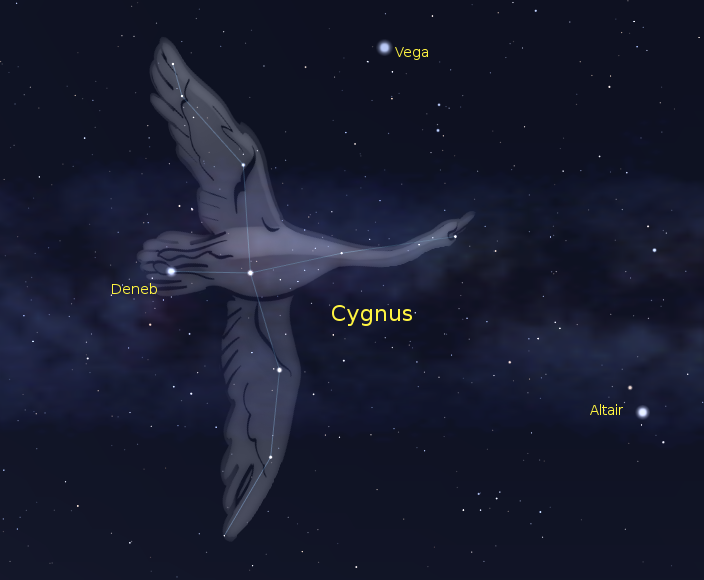
Cygnus The Swan Created using Stellarium.
Click to enlarge.
07/20/11 – Ephemeris – The bright planets visible this week
Wednesday, July 20th. Today the sun will be up for 15 hours and 5 minutes, setting at 9:21. The moon, 3 days before last quarter, will rise at 11:33 this evening. Tomorrow the sun will rise at 6:16.
It’s Wednesday and time again to take a look at the whereabouts of the bright planets. The ringed planet Saturn will be visible in the west southwest as it gets dark. It’s near the bright star Spica to its left. Spica has a blue tinge, while Saturn is yellowish. It will set at 12:29 a.m. Saturn is a wonderful sight is a telescope with its rings. We are now slowly seeing Saturn slip into evening twilight. We have about another month of good viewing of Saturn before its image deteriorates by being too low in the sky. Jupiter will rise at 1:15 a.m. in the east and is seen against the stars of Aries now. Mars will rise at 3:24 in the east northeast and is located against the horns of Taurus the bull.
* Times are for the Traverse City/Interlochen area of Michigan. They may be different for your location.
07/19/11 – Ephemeris – The brightest stars visible now in the evening
Tuesday, July 19th. Today the sun will be up for 15 hours and 6 minutes, setting at 9:21. The moon, half way from full to last quarter, will rise at 11:11 this evening. Tomorrow the sun will rise at 6:15.
Let’s check out all the bright stars in the evening sky, as it gets dark tonight. High in the west is the bright yellow-orange star Arcturus. In the northwest is the Big Dipper, whose curved handle points to Arcturus. Straightening that curve to a spike will point to Spica a blue-white star low in the southwest. The bright star to its right isn’t. It’s the planet Saturn. In the south is the red star Antares which usually twinkles merrily. High in the east is the bright white star Vega. To its lower right is Altair, and to its lower left the star Deneb. Vega, Altair and Deneb make the Summer Triangle, whose rising in the east signals the coming of summer. Always present for us in northern Michigan is Capella very low in the north.
* Times are for the Traverse City/Interlochen area of Michigan. They may be different for your location.
Addendum
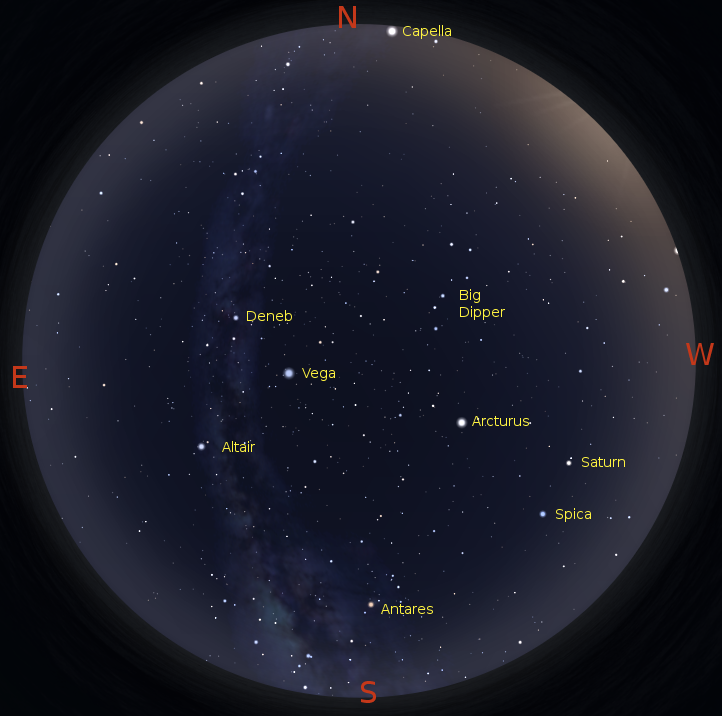
Bright Summer Stars. Created using Stellarium.
Click on the image to enlarge. This is a whole sky chart. The round edge is the horizon. BTW the star Capella, very low in the north, is a winter star, but it’s visible all year round for folks north of 44 degrees north latitude.
 Bob Moler's Ephemeris Blog