Archive
09/30/11 – Ephemeris – Previewing October skies
Friday, September 30th. The sun will rise at 7:38. It’ll be up for 11 hours and 46 minutes, setting at 7:25. The moon, half way from new to first quarter, will set at 9:14 this evening.
Let’s look at the skies for the month of October which starts tomorrow. The sun will still be moving south rapidly. Daylight hours in the Interlochen/Traverse City area will drop from 11 hours and 43 minutes tomorrow to 10 hours 14 minutes on the 31st. The altitude of the sun above the southern horizon at local noon will be 42 degrees tomorrow, and will descend to 31degrees on Halloween, also in the Interlochen area. The Straits area will have the sun a degree lower. Local noon, when the sun is due south will be about 1:30 p.m. in Interlochen. The planet Jupiter will move higher in the southeast in the evening next month. I’m hoping with the sun’s activity increasing we’ll get a shot at seeing some northern lights next month.
* Times are for the Traverse City/Interlochen area of Michigan. They may be different for your location.
09/29/11 – Ephemeris – Deneb at the zenith
Thursday, September 29th. The sun will rise at 7:37. It’ll be up for 11 hours and 49 minutes, setting at 7:27. The moon, 2 days past new, will set at 8:28 this evening.
At 10 p.m. tonight the first magnitude star Deneb will be overhead, that is very near the zenith. Deneb is the northern most and dimmest of the three stars of the Summer Triangle. It is at the head of the Northern Cross, which extends to the south. This is an asterism, which is what astronomers call a informal constellation. The Big and Little Dippers are also examples of asterisms. You won’t find them in the list of the 88 official constellations. The actual constellation that Deneb belongs to is Cygnus the swan. In the swan Deneb is the tail. That’s actually what Deneb means. The swan is flying southwestward along the Milky Way with its wings outstretched. Stars can be followed around the wings to make out a very realistic flying swan.
* Times are for the Traverse City/Interlochen area of Michigan. They may be different for your location.
Addendum
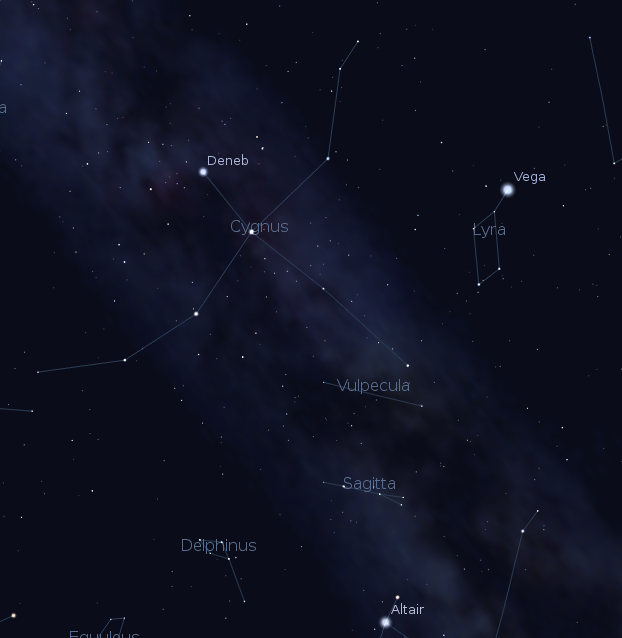
Deneb at the Zenith. Looking overhead while facing south. Created using Stellarium.
The Summer Triangle of bright stars Deneb, Vega and Altair are in this view.
09/28/11 – Ephemeris – Where are the bright planets this week?
Wednesday, September 28th. The sun will rise at 7:36. It’ll be up for 11 hours and 52 minutes, setting at 7:29. The moon, 1 day past new, will set at 7:50 this evening.
It’s Wednesday and time again to take a look at the whereabouts of the bright planets. The planet Venus is rather close to the sun in the evening setting 29 minutes after the sun and not really visible. The ringed planet Saturn also hidden in the bright twilight is setting 38 minutes after the sun. Jupiter is now the prominent planet of the evening sky after it rises at 8:44 p.m. in the east northeast and is seen against the stars of the constellation Aries now. In a telescope it will be accompanied by its 4 brightest moons, and as the planet rises higher Jupiter’s image becomes sharper, and its cloud bands will become visible. Mars will rise at 2:20 a.m also in the east northeast and is now entering the constellation of Cancer.
* Times are for the Traverse City/Interlochen area of Michigan. They may be different for your location.
09/27/11 – Ephemeris – The constellation of Capricornus
Tuesday, September 27th. The sun will rise at 7:35. It’ll be up for 11 hours and 55 minutes, setting at 7:30. The moon is new today, and won’t be visible.
As the Teapot of the constellation Sagittarius tilts and pours celestial tea on the southwestern horizon, it is followed in the south by the faint constellation of Capricornus the sea goat. I’m not sure you’ll see a half goat with a fish’s tail here unless you’ve started Oktoberfest a bit early. To me, it looks like a big sagging triangle with the point down. Capricornus is a constellation of the zodiac, and its claim to fame is a latitude line on the globe at 23 and a half degrees south, called the Tropic of Capricorn. Back a couple of thousand years ago the sun entered Capricornus on the first day of winter, the winter solstice. Thus the latitude where the sun is overhead at that instant was called the Tropic of Capricorn. Due to the wobble of the earth’s axis, the line should be called the Tropic of Sagittarius.
* Times are for the Traverse City/Interlochen area of Michigan. They may be different for your location.
Addendum
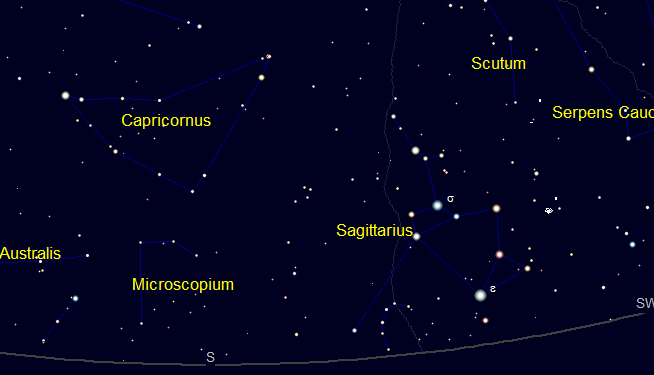
Capricornus as represented in Cartes du Ciel
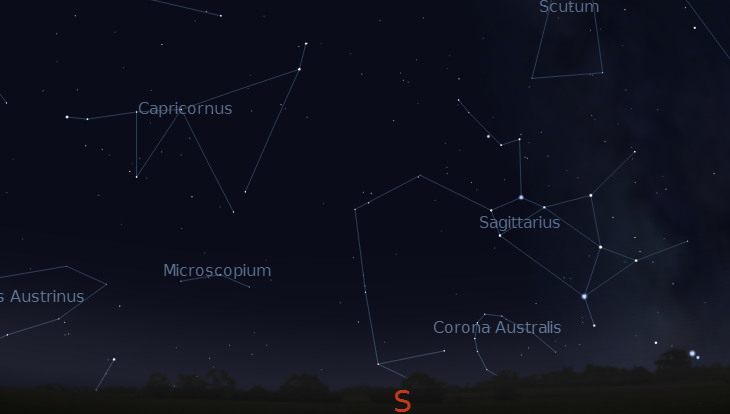
Capricornus as represented in Stellarium
09/26/11 – Ephemeris – The sun is getting very active again
Monday, September 26th. The sun will rise at 7:34. It’ll be up for 11 hours and 58 minutes, setting at 7:32. The moon, 1 day before new, will rise at 7:53 tomorrow morning.
There is a large sunspot group rotating onto the earth facing side of the sun. It has already produced two large solar flares. Flares are explosions caused by the snapping of the magnetic field lines that cause the sunspots in the first place. The most energetic of these throw off a huge cloud of charged particles, protons, electrons, and alpha particles called a coronal mass ejection or CME at a couple of million miles an hour. It takes 36 to 48 hours for the cloud to reach the earth. Then it tangles with the earth’s magnetic field causing a geomagnetic storm. This is not good news for satellite operators and power and phone companies in the north. However for the rest of us, we get a chance to see the northern lights or Aurora Borealis. Saturday’s two flares from that sunspot group sent out a CME that we may catch the tail of later today.
* Times are for the Traverse City/Interlochen area of Michigan. They may be different for your location.
09/23/11 – Ephemeris – Autumn is already here
Friday, September 23rd. The sun will rise at 7:30. It’ll be up for 12 hours and 8 minutes, setting at 7:38. The moon, 3 days past last quarter, will rise at 4:00 tomorrow morning.
Autumn has arrived. It snuck in at 5:05 a.m. At that instant the sun passed over the celestial equator, earth’s equator projected on the sky, heading southward. By Monday the sun will be up less than 12 hours a day, heading to less than 9 hours at the start of winter, three month’s away. It is the tilt of the earth’s axis, which is fixed as the earth orbits the sun that causes the sun to appear to change its height in the sky at noon and the length of daylight that warms the earth. Its is not the small change in the distance of the earth from the sun. And besides the earth is currently moving closer to the sun and will arrive at its closest, called perihelion in early January.
* Times are for the Traverse City/Interlochen area of Michigan. They may be different for your location.
09/22/11 – Ephemeris – The Constellations Delphinus and Sagitta
Thursday, September 22nd. The sun will rise at 7:29. It’ll be up for 12 hours and 11 minutes, setting at 7:40. The moon, 2 days past last quarter, will rise at 2:47 tomorrow morning.
Located below the eastern edge of the Summer Triangle of three of the brightest stars in the sky, which is overhead in our sky at 10 p.m., is the tiny constellation of Delphinus the dolphin. Delphinus’ 6 stars in a small parallelogram with a tail, really does look like a dolphin leaping out of the water. The parallelogram itself has the name Job’s Coffin. The origin of this asterism or informal constellation is unknown. Of the dolphin itself: the ancient Greeks appreciated this aquatic mammal as we do, and told stories of dolphins rescuing shipwrecked sailors. There’s another tiny constellation to the right of Delphinus, Sagitta the arrow a small thin group of 5 stars, which represents Cupid’s dart. Behind Sagitta binoculars will find a little star group called the Coat hanger.
* Times are for the Traverse City/Interlochen area of Michigan. They may be different for your location.
Addendum
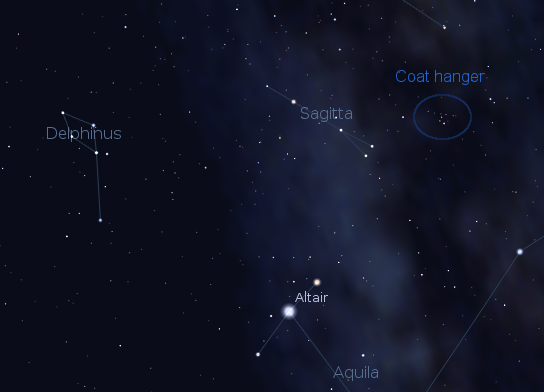
Delphinus, Sagitta and the Coat hanger. Diagram created using Stellarium.
09/21/11 – Ephemeris – The bright planets this week
Wednesday, September 21st. The sun will rise at 7:28. It’ll be up for 12 hours and 14 minutes, setting at 7:42. The moon, 1 day past last quarter, will rise at 1:37 tomorrow morning.
It’s Wednesday and time again to take a look at the whereabouts of the bright planets. The planet Venus is rather close to the sun in the evening setting 26 minutes after the sun and not really visible. The ringed planet Saturn also hidden in the bright twilight is setting 51 minutes after the sun. Jupiter is now the prominent planet of the evening sky after it rises at 9:13 p.m. in the east northeast and is seen against the stars of the constellation Aries now. In a telescope it will be accompanied by its 4 brightest moons, and as the planet rises higher Jupiter’s image becomes sharper, and its cloud bands will become visible. Mars will rise at 2:25 a.m also in the east northeast and is now between the constellations of Gemini and Cancer.
* Times are for the Traverse City/Interlochen area of Michigan. They may be different for your location.
09/20/11 – Ephemeris – The constellation Andromeda
Tuesday, September 20th. The sun will rise at 7:26. It’ll be up for 12 hours and 17 minutes, setting at 7:44. The moon, at last quarter today, will rise at 12:33 tomorrow morning.
In the east southeast at 9 this evening can be found a large square of stars, the Great Square of Pegasus the flying horse. The square is standing on one corner. What look like its hind legs stretching to the left from the left corner star is another constellation, Andromeda the chained maiden. She is seen in the sky as two diverging curved strings of stars that curve upward. She was rescued by the hero Perseus, a nearby constellation, riding his steed Pegasus. Andromeda’s claim to astronomical fame is the large galaxy seen with the unaided eye just above the upper line of stars. The Great Andromeda Galaxy is two and a half million light years away. To the unaided eye the galaxy appears a a small smudge of light. In binoculars the galaxy is a delicate spindle of light.
* Times are for the Traverse City/Interlochen area of Michigan. They may be different for your location.
Addendum
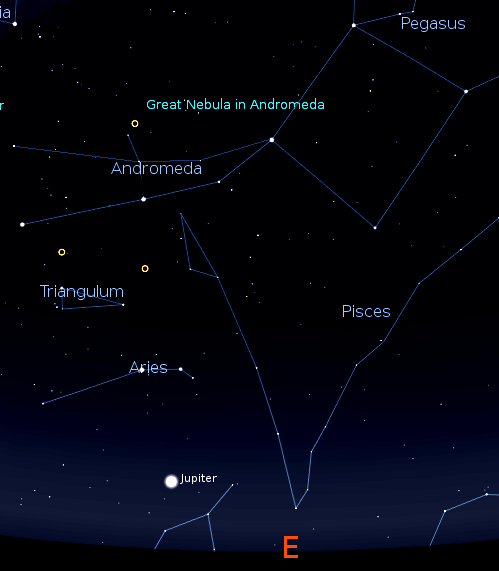
The Constellation Andromeda. Created using Stellarium.
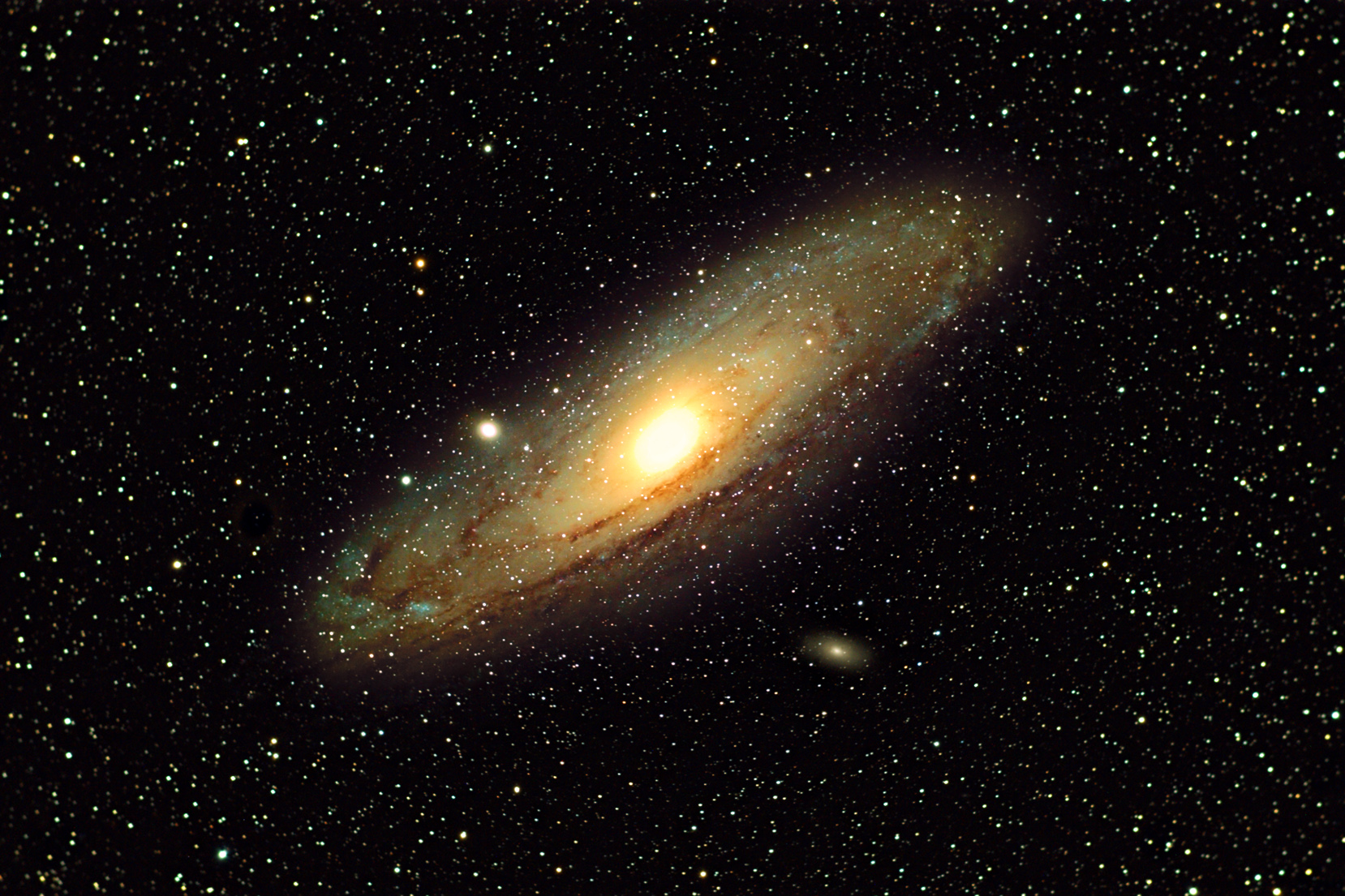
The Great Andromeda Galaxy (M31). Image taken by Scott Anttila.
Click on image for full size version.
Stellarium has it by its old name the Great Andromeda Nebula, before it was reclassified as an island universe (obsolete) or galaxy.
09/19/11 – Ephemeris – Talk Like a Pirate Day and the constellation Pegasus
Arrrh! This is Cap’n Bob with Ephemeris for Talk like a Pirate Day, Monday, September 19th. I can’t keep this up. The sun will rise at 7:25. It’ll be up for 12 hours and 20 minutes, setting at 7:46. The moon, 1 day before last quarter, will rise at 11:35 this evening.
A reminder of the end of summer is located in the east around 9 p.m. It’s one of the great autumn constellations: Pegasus the flying horse of Greek myth. Its most visible feature is a large square of four stars, now standing on one corner. This feature, called the Great Square of Pegasus, represents the front part of the horse’s body. The horse is quite aerobatic, because it is seen flying upside down. Remembering that fact, the neck and head is a bent line of stars emanating from the right corner star of the square. Its front legs can be seen in a gallop extending to the upper right from the top star of the square. In Mythology Pegasus was born of the blood of Medusa, decapitated by the hero Perseus.
* Times are for the Traverse City/Interlochen area of Michigan. They may be different for your location.
Addendum
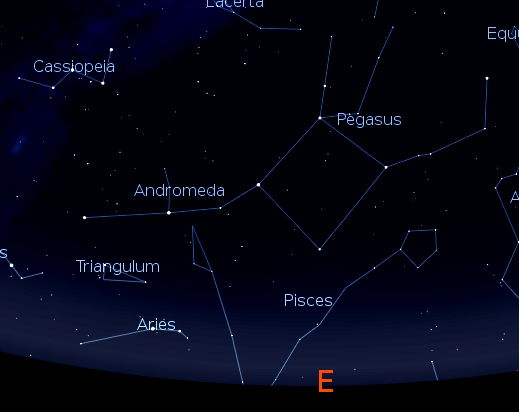
Pegasus at 9 p.m. Chart created using Stellarium.
 Bob Moler's Ephemeris Blog