Archive
02/29/2012 – Ephemeris – Where are the bright planets this week?
Ephemeris for Wednesday, February 29th, the leap day or intercalary day. The sun will rise at 7:20. It’ll be up for 11 hours and 8 minutes, setting at 6:29. The moon, at first quarter today, will set at 2:28 tomorrow morning.
Let’s see what’s happening with the bright planets for this week. Venus is brilliant in the western sky after sunset and will set at 10:23 in the west. Jupiter the second brightest planet after Venus is located high in the west as it gets dark and is seen against the stars of the constellation Aries. Venus is now approaching it. Jupiter will set at 11:21 p.m.. Mars is the up and coming planet. It will rise near sunset in the east and is in the constellation Leo the lion. It is 62.8 million miles away . It’s now as bright as most first magnitude stars. Mars will pass due south at 1:14 a.m. Saturn will rise at 10:29 p.m. just to the left of the bright star Spica in the east southeast.
* Times are for the Traverse City/Interlochen area of Michigan. They may be different for your location.
Addendum
Mars in approach. These photos of Mars from earlier posts by Scott Anttila shows Mars approaching, or rather being approached by the earth over the last two months.
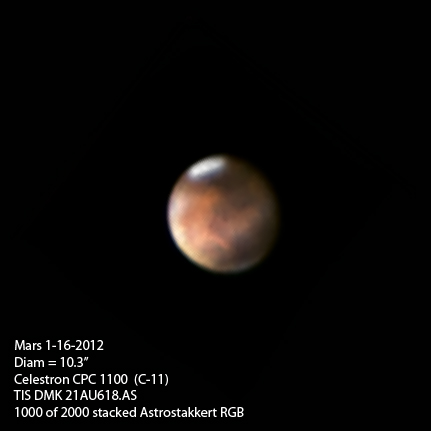
Mars 9 days ago. Photograph by Scott Anttila
Besides getting larger in approach, Mars is becoming more full. Also notice that the north polar cap is shrinking as northern summer proceeds.

Mars on February 6, 2012. Photograph by Scott Anttila

Mars on February 20, 2012 at 5:57 UT (12:57 a.m.). Photograph by Scott Anttila.
Mars will reach opposition from the sun on March 3rd, and will be closest to the earth on the 5th, at just a teensy bit closer than today at 62.6 million miles.
For more on the martian seasons check out this blog post with video by the Planetary Society’s Emily Lakdawalla.
02/28/2012 – Ephemeris – The moon will pass south of the Pleiades tonight
Ephemeris for Tuesday, February 28th. The sun will rise at 7:22. It’ll be up for 11 hours and 5 minutes, setting at 6:28. The moon, 1 day before first quarter, will set at 1:34 tomorrow morning.
The fat crescent moon will appear below the Pleiades star cluster tonight. The Pleiades is also known as the Seven Sisters. With the moon as bright as it is the stars of the Pleiades may not be easily spotted, so a pair of binoculars might be needed. The Pleiades will appear nearly 8 moon diameters above the moon, so they might escape the moon’s glare somewhat. The moon will pass the Pleiades every 28 and a fraction days. Sometimes it passes south of the cluster, and sometimes north of it, and occasionally it passes in front of the stars of the cluster. The moon’s orbit of the earth wobbles or precesses once every 18.6 years. It’s why eclipses occur at different times of the year, and generally earlier one year to the next.
* Times are for the Traverse City/Interlochen area of Michigan. They may be different for your location.
Addendum
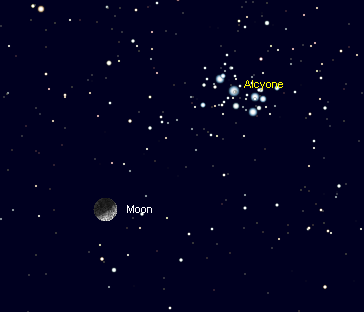
The moon south of the Pleiades at 10:19 p.m. February 28, 2012 from Michigan . Chart created using Cartes du Ciel (Sky Charts)
02/27/2012 – Ephemeris – The Leap or Intercalary Day
Ephemeris for Monday, February 27th. The sun will rise at 7:24. It’ll be up for 11 hours and 2 minutes, setting at 6:26. The moon, 2 days before first quarter, will set at 12:37 tomorrow morning.
Wednesday we’re going to have one of those special days that only occur once every 4 years making this a leap year. It’s the intercalary day that compensates for that fact that the earth takes 365 and nearly a quarter day to orbit the sun. That orbit is a year, and those quarter days are accumulated and added as the last day of February on years divisible by 4. The Gregorian reform makes a slight adjustment on most century years, making century years not divisible by 400 ordinary years to keep the calendar in sync with the seasons. The Romans, from who we’ve gotten our calendar considered the month of February as unlucky, and so they shortened it. Enjoy your extra day Wednesday. * Times are for the Traverse City/Interlochen area of Michigan. They may be different for your location.
02/24/2012 – Ephemeris – The moon will pass Venus and Jupiter this weekend
Friday, February 24th. The sun will rise at 7:29. It’ll be up for 10 hours and 53 minutes, setting at 6:22. The moon, 3 days past new, will set at 9:36 this evening.
This weekend we will be able to spot appearances of the moon passing two planets. Tomorrow night Venus will appear below the moon. It should be a spectacular sight with Jupiter nearby to the upper left. Then Sunday night the moon will have moved near Jupiter. This time Jupiter will appear to the left of the moon, their closest apparent approach being after they set Monday morning. Even though the moon will leave these planets, keep watching them. As Venus slowly approaches Jupiter. They will be their closest, called a conjunction on the Ides of March. That’s March 15th using our calendar. These two planet will still be with us for the next few months, with Mars and Saturn appearing later in the evening now.
* Times are for the Traverse City/Interlochen area of Michigan. They may be different for your location.
Addendum
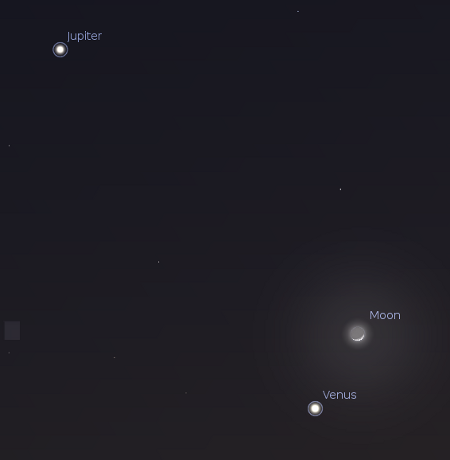
The moon will pass above Venus at 7 p.m. Saturday February 25, 2012. Created using Stellarium.
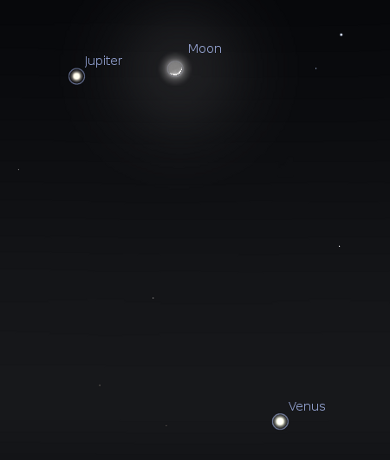
The moon will pass Jupiter, seen at 10 p.m. February 26, 2012. Created using Stellarium.
02/23/2012 – Ephemeris – The star Castor in Gemini
Ephemeris for Thursday, February 23rd. The sun will rise at 7:30. It’ll be up for 10 hours and 50 minutes, setting at 6:21. The moon, 2 days past new, will set at 8:34 this evening.
High in the south southeast at 9 p.m. is the constellation of Gemini the twins. The heads of the two lads contain bright stars with their names. Brighter Pollux is below and Castor is above. Stars that delineate their bodies lie to the lower right of them stretching out in the direction of Orion. Castor is an interesting star because it is actually six stars. Two are easily seen. The two brightest component stars can be resolved in a small telescope. Each has a red dwarf companion detectable only by indirect means. The fifth and sixth stars makes a faint eclipsing binary of red dwarf stars some distance away and very faint. The Castor system resides some 50 light years away.
* Times are for the Traverse City/Interlochen area of Michigan. They may be different for your location.
Addendum
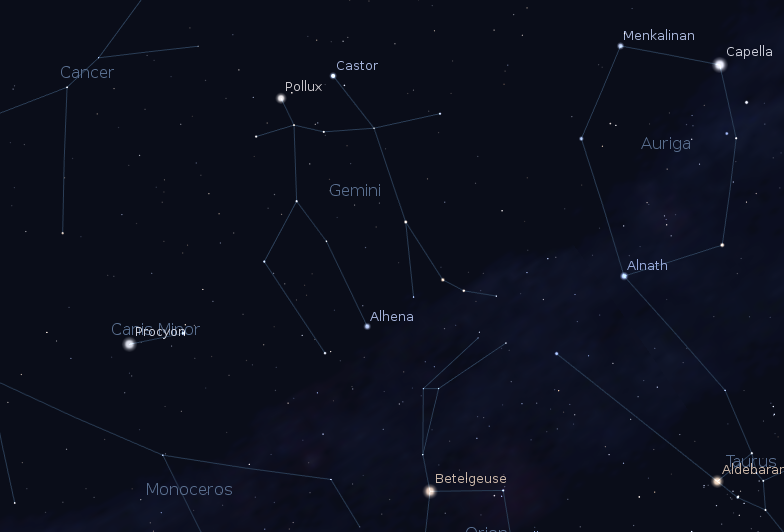
Gemini with the stars Castor and Pollux. Created using Stellarium.
02/22/2012 – Ephemeris – Where are the bright planets this week?
Ephemeris for Ash Wednesday, Wednesday, February 22nd. The sun will rise at 7:32. It’ll be up for 10 hours and 47 minutes, setting at 6:20. The moon, 1 day past new, will set at 7:31 this evening.
Let’s see what’s happening with the bright planets for this week. Venus is brilliant in the western sky after sunset and will set at 10:08 in the west. Jupiter the second brightest planet after Venus is located high in the west as it gets dark and is seen against the stars of the constellation Aries. Venus is approaching it now. Jupiter will set at 11:39 p.m.. Mars is the up and coming planet. It will rise near sunset in the east and is below the hind end of the constellation Leo the lion. It is 64.0 million miles away and closing and is getting brighter. It’s now as bright as most first magnitude stars. Mars will pass due south at 1:52 a.m. Saturn will rise at 10:58 p.m. just to the left of the bright star Spica in the east southeast.
* Times are for the Traverse City/Interlochen area of Michigan. They may be different for your location.
Addendum
Mars on February 20, 2012 at 5:57 UT (12:57 a.m.). Photograph by Scott Anttila.
We are nor a couple of weeks from the opposition of Mars with the sun on March 3rd. (March is named for Mars, by the way.) It will be closest on March 5th at 62.6 million miles.
02/21/2012 – Ephemeris – The winter Milky Way
Ephemeris for Fat Tuesday, Tuesday, February 21st. The sun will rise at 7:34. It’ll be up for 10 hours and 44 minutes, setting at 6:18. The moon is new today, and won’t be visible.
The winter Milky Way doesn’t seem as bright as the summer part. That’s mainly because we are looking away from the center of the Milky Way Galaxy. The galaxy appears to us as a band encircling the sky because we are within it, and our galaxy is a flat spiral galaxy. Our galaxy has the mass of maybe 200 billion suns and has a diameter of about 100 thousand light years. We are approximately 25 thousand light years from the center, which lies in the summer constellation of Sagittarius. There is a star forming region in the constellation of Orion, and part of it shows up as the Great Orion Nebula. There are more of these regions south of Orion, which we can’t see from Michigan. It’s said that the southern Milky Way is brighter than the one we see.
* Times are for the Traverse City/Interlochen area of Michigan. They may be different for your location.
Addendum
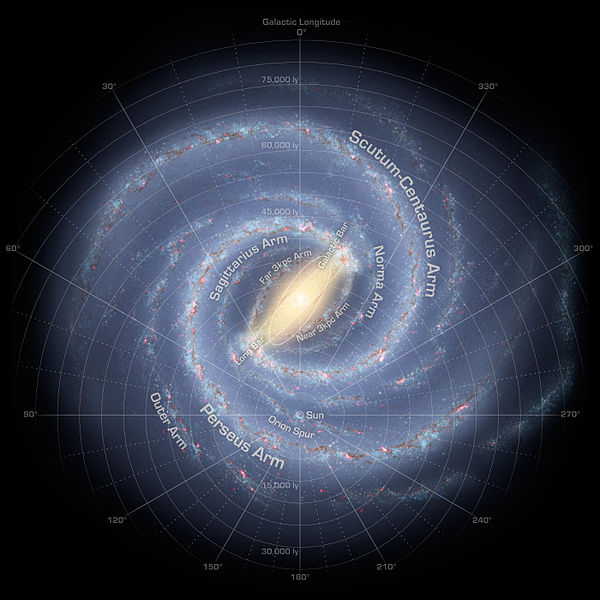
Artist's conception of the Milky Way. From NASA/JPL/Spitzer/Cal Tech
02/20/2012 – Ephemeris – The Winter Circle
Ephemeris for President’s Day, Monday, February 20th. The sun will rise at 7:35. It’ll be up for 10 hours and 41 minutes, setting at 6:17. The moon, 1 day before new, will rise at 7:01 tomorrow morning. | The winter skies are blessed with more first magnitude stars than any other season. Six of these stars lie in a large circle centered on the seventh. This circle is up at 9 p.m. Starting high overhead is Capella in Auriga the charioteer. Moving down clockwise is Aldebaran in the face of Taurus the Bull. Then down to Orion’s knee we find Rigel. Down and left is the brightest star of all Sirius the Dog Star in Canis Major, lowest of these stars in the south southeast. Moving up and left is Procyon in Canis Minor, Above Procyon is Pollux in Gemini the twins. All these are centered on Betelgeuse the bright red star in Orion’s shoulder.
* Times are for the Traverse City/Interlochen area of Michigan. They may be different for your location.
Addendum
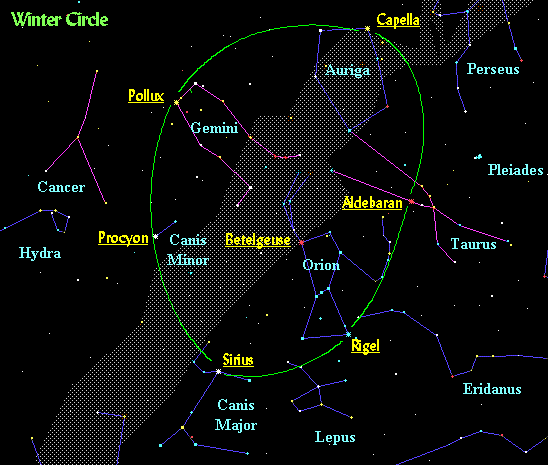
The Winter Circle of 1st magnitude stars
02/17/2012 – Ephemeris – The constellation of the Unicorn
Ephemeris for Friday, February 17th. The sun will rise at 7:40. It’ll be up for 10 hours and 32 minutes, setting at 6:13. The moon, 3 days past last quarter, will rise at 5:24 tomorrow morning.
Among all the constellations in the sky of animals real and mythical, there is also a unicorn. It’s called Monoceros, and inhabits the southeastern sky at 9 p.m. bounded by Orion on the right, Canis Major, the great dog below and Canis Minor, the little dog to the left. Unfortunately for observers without optical aid Monoceros, though large, is devoid of any but the faintest stars. Maybe that’s why no one sees unicorns anymore. It has many faint stars because the Milky Way runs through it. To the telescope it is a feast of faint nebulae or clouds of gas and dust, the birth place of stars, including the red rose of the Rosette Nebula, and the strange and tiny Hubble’s Variable Nebula. It contains no bright stars, but a wealth of wonders below the surface so to speak.
* Times are for the Traverse City/Interlochen area of Michigan. They may be different for your location.
Addendum
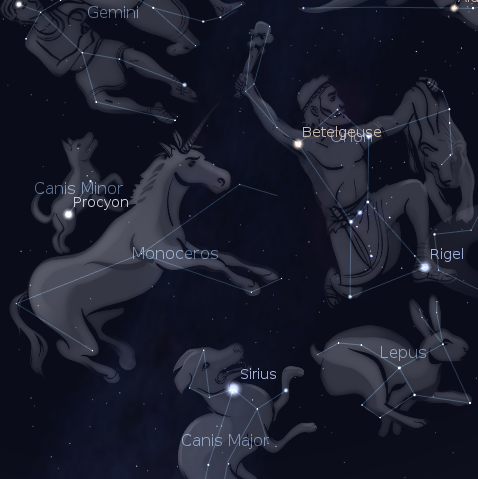
Monoceros the unicorn. Created using Stellarium.
02/16/2012 – Ephemeris – The constellation of Lepus the hare
Ephemeris for Thursday, February 16th. The sun will rise at 7:41. It’ll be up for 10 hours and 29 minutes, setting at 6:11. The moon, 2 days past last quarter, will rise at 4:39 tomorrow morning.
Orion, the central winter constellation is seen in the south at 9 p.m. He is a hunter, but is preoccupied in defending himself from the charge of Taurus the bull to the upper right. At Orion’s feet, and unnoticed by him is the small constellation of Lepus the hare. It’s very hard to see a whole rabbit in its eight dim stars: however, I do see a rabbit’s head, ears and shoulders. A misshapen box is the head and face of this critter facing to the left. His ears extend upwards from the upper right star of the box, and the bend forward a bit. Two stars to the right of the box and a bit farther apart show the front part of the body. The free computer program Stellarium shows a different orientation to the hare. You might check it out at Stellarium.org.
* Times are for the Traverse City/Interlochen area of Michigan. They may be different for your location.
Addendum
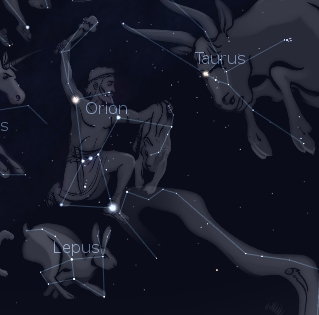
Lepus and a preoccupied Orion. Image from Stellarium.
 Bob Moler's Ephemeris Blog