Archive
06/29/2012 – Ephemeris – Preview July skies
Ephemeris for Friday, June 29th. Today the sun will be up for 15 hours and 31 minutes, setting at 9:31. The moon, 3 days past first quarter, will set at 2:58 tomorrow morning. Tomorrow the sun will rise at 6:00.
Lets preview July’s skies. The sun, having reached its northern solstice, is beginning to slide southward again, at first imperceptibly, then with greater speed. The daylight hours will decrease from 15 hours and 29 minutes Sunday to 14 hours 40 minutes at month’s end. The daylight hours will be slightly shorter south of Interlochen, and slightly longer to the north. The altitude of the sun at local noon, when the sun is due south will decrease from 68 degrees today to 63 degrees at month’s end. The sun will be a degree lower in the Straits area. Despite the warmth, the earth will reach its greatest distance from the sun on Wednesday the 4th. It’s a time to slow down and appreciate the wonderful stars of summer.
Times are for the Traverse City/Interlochen area of Michigan. They may be different for your location.
06/28/2012 – Ephemeris – Mercury near greatest elongation from the sun
Ephemeris for Thursday, June 28th. Today the sun will be up for 15 hours and 31 minutes, setting at 9:31. The moon, 2 days past first quarter, will set at 2:16 tomorrow morning. Tomorrow the sun will rise at 6:00.
Saturday will be the greatest eastern elongation of Mercury from the sun. It’s a whopping 26 degrees angle east from the sun. Mercury has a markedly elliptical orbit. And when we have a spring eastern elongation, its around 18 degrees from the sun. The best western elongations for us are in the autumn when again the elongation angle is 18 degrees. I won’t go into the why of all this here. But we’re getting an extra good view of this tiny planet. The best time to look for Mercury starts about 10:15 p.m. and ends about 10:45 when Mercury is too close to the horizon. The stars Pollux and Castor of Gemini will appear just to the right of Mercury, and will provide a check that you really have found it.
Times are for the Traverse City/Interlochen area of Michigan. They may be different for your location.
Addendum
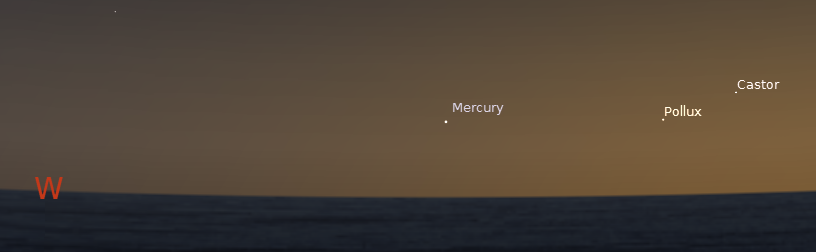
Mercury with the bright stars Pollux and Castor at 10:30 p.m. June 28, 2012. Created using Stellarium.
06/27/12012 – Ephemeris – Where are the bright planets this week?
Wednesday, June 27th. Today the sun will be up for 15 hours and 32 minutes, setting at 9:31. The moon, 1 day past first quarter, will set at 1:40 tomorrow morning. Tomorrow the sun will rise at 5:59.
Let’s see what’s happening with the bright planets for this week. Mercury is in the evening sky but very low in the west northwest about 45 minutes after sunset. It will set at 11:04 p.m. Mars, with its unmistakable bright reddish color, is in the west southwest in the evening entering the constellation of Virgo the virgin. Mars will be setting in the west at 1:15 a.m. Saturn will be in the south southwest above the bright star Spica now. It will set at 2:21 a.m. Jupiter, now a morning planet will rise at 3:53 a.m. in the east northeast. Venus, is now seen below Jupiter after it rises at 4:23 a.m. [They are striking in telescopes with Venus as a large thin crescent, and Jupiter with its cloud bands and satellites.]
Times are for the Traverse City/Interlochen area of Michigan. They may be different for your location. Bracketed text was omitted from the audio program due to time constraints.
Addendum
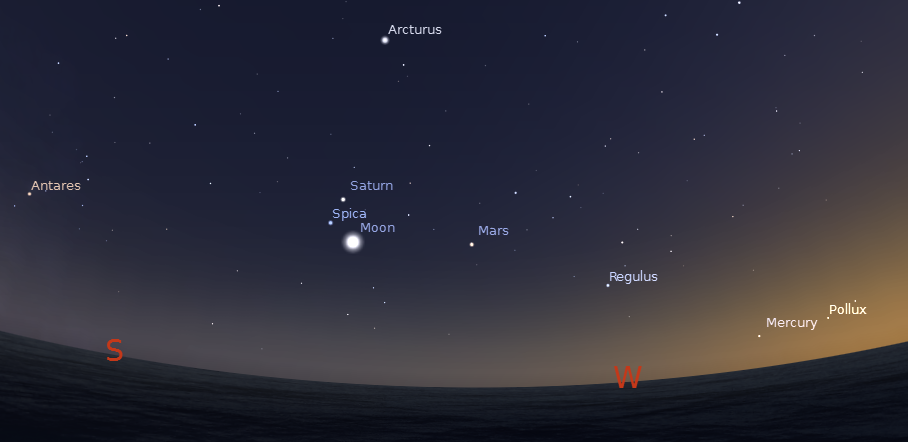
Mercury, Mars and Saturn at 10:30 p.m. on June 27, 2012. Created using Stellarium.
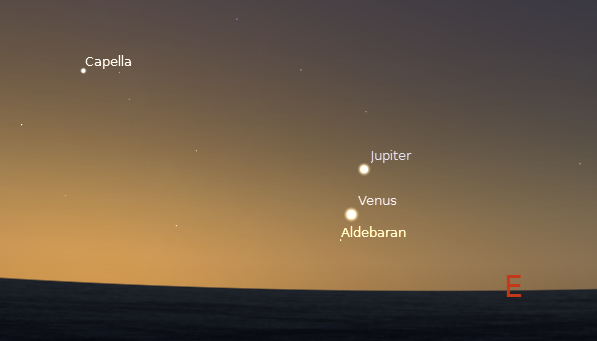
The eastern sky with Jupiter and Venus. at 5:15 a.m. June 28, 2012. Created using Stellarium.
06/26/2012 – Ephemeris – Saturn’s moon Titan
Ephemeris for Tuesday, June 26th. Today the sun will be up for 15 hours and 32 minutes, setting at 9:31. The moon, at first quarter today, will set at 1:09 tomorrow morning. Tomorrow the sun will rise at 5:59.
The planet Saturn appears above the bright blue-white stars Spica now. The moon to the right of then tonight will pass below them Thursday morning. Saturn is a wonderful sight in a small telescope and it’s largest satellite Titan will appear as a star nearby. The latest news about Titan concerns a lake of liquid methane located in the equatorial regions of that moon. The equatorial region seems too warm to support such a lake. At the poles, yes as we have seen, but not at the equator. The guess now is the that lake is fed from an underground aquifer. With its atmosphere, clouds, lakes, rains, rivers and hilly terrain Titan is a spooky analog of the earth that’s 300 degrees colder.
Times are for the Traverse City/Interlochen area of Michigan. They may be different for your location.
Addendum
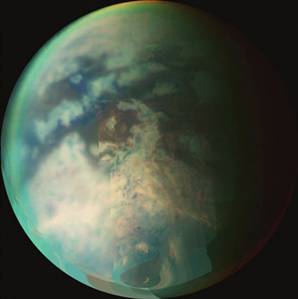
Seeing through the clouds at Titan’s surface. Credit: NASA – Cassini
06/25/2012 – Venus and Jupiter in the morning and Mercury in th evening
Ephemeris for Monday, June 25th. Today the sun will be up for 15 hours and 33 minutes, setting at 9:31. The moon, 1 day before first quarter, will set at 12:41 tomorrow morning. Tomorrow the sun will rise at 5:59.
You’ve got to be an early riser for this, say about quarter after 5. Venus and Jupiter will appear close together low in the east northeast in the growing twilight. It’s reminiscent of their evening show. However their paths will not cross. The brighter Venus appears below and to the left of the dimmer Jupiter. They will be their closest around July 3rd. Then Jupiter will outpace Venus. In the evening sky the dim planet Mercury is making an appearance. Start looking to the west northwest about 10:15 for this elusive planet. Here binoculars will help. The bright stars Pollux and Castor are to its right and nearly in a horizontal line to it. Mercury, though is brighter than they are so you should spot Mercury first.
Times are for the Traverse City/Interlochen area of Michigan. They may be different for your location.
Addendum
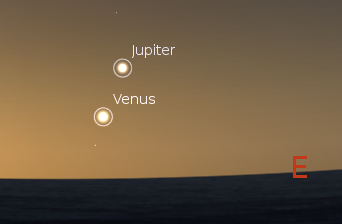
Jupiter and Venus in the Morning June 25th 2012. Created using Stellarium.
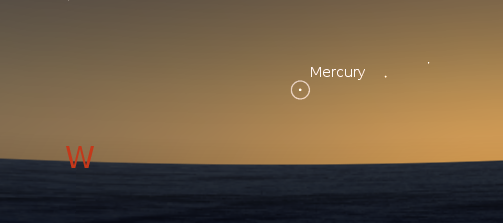
Mercury with the stars Pollux and Castor to its right at 10:15 p.m. June 25th, 2012 Created using Stellarium.
06/22/2012 – Ephemeris – A double header of astronomy events tomorrow
Ephemeris for Friday, June 22nd. Today the sun will be up for 15 hours and 33 minutes, setting at 9:31. The moon, 3 days past new, will set at 11:19 this evening. Tomorrow the sun will rise at 5:57.
Tomorrow the Grand Traverse Astronomical Society will be part of two events. The first is Boardman River Nature Center’s Nature Fest. The society will have telescopes, including the new hydrogen alpha solar telescope, to view the sun and the public will be able to examine meteorites there from 10 a.m to 3 p.m. Then starting 9 p.m. Society members will be at Northwestern Michigan College’s Rogers Observatory for it’s second star party of the month featuring the planet Saturn and the moon plus some of the brighter wonders of the night sky as it gets darker. Star parties in June and early July start before sunset so there’s always some hands on kids activities that are lead by the NMC Astronomy Club.
Times are for the Traverse City/Interlochen area of Michigan. They may be different for your location.
06/21/2012 – Ephemeris – Where are the bright planets this week?
Ephemeris for Thursday, June 21st. Today the sun will be up for 15 hours and 33 minutes, setting at 9:31. The moon, 2 days past new, will set at 10:48 this evening. Tomorrow the sun will rise at 5:57.
Let’s see what’s happening with the bright planets for this week, one day late. Mercury is in the evening sky but very low in the west northwest about 45 minutes after sunset. It will set at 11:09 p.m. Mars is in the west southwest in the evening between the constellations Leo the lion and Virgo with its unmistakable bright reddish color. Mars will be setting in the west at 1:33 a.m. Saturn will be in the south southwest above the bright star Spica now. It will set at 2:45 a.m. Jupiter, now a morning planet will rise at 4:10 a.m. in the east northeast. Venus, is now in the morning sky will rise at 4:45 a.m. In the east northeast. It’s making its debut as the morning star.
Times are for the Traverse City/Interlochen area of Michigan. They may be different for your location.
Addendum
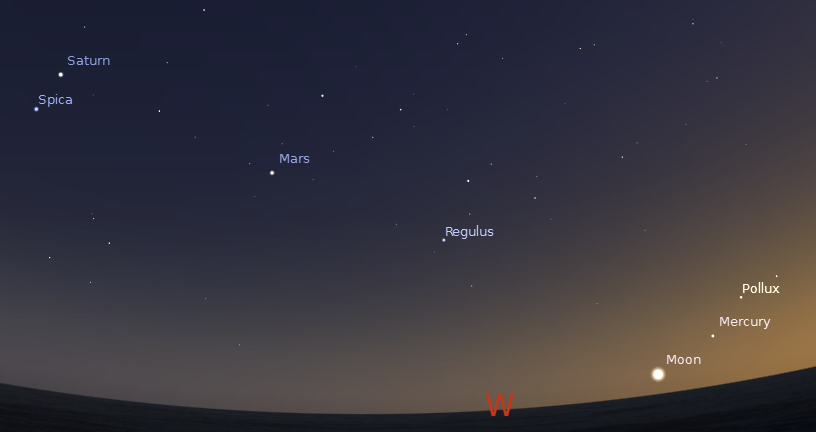
Looking at the fading twilit sky at 10:30 p.m. on June 21, 2012. Created using Stellarium.
This is just an hour after sunset. The moon is really a very thin crescent, and is much dimmer than is shown here. Click to expand. When expanded the images above and below will appear at the same scale.
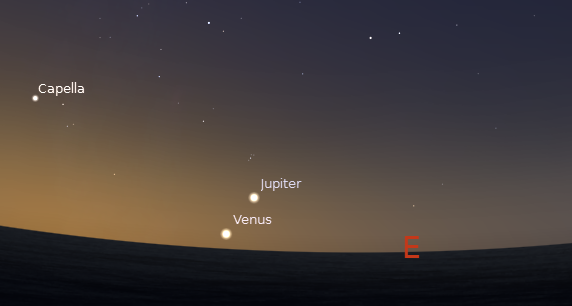
The eastern sky at 05:00 a.m. on June 22, 2012. Created using Stellarium.
This shows the sky an hour before sunrise tomorrow. In actuality Venus is much brighter than Jupiter.
06/20/2012 – Ephemeris – Summer begins tonight!
Ephemeris for Wednesday, June 20th. Today the sun will be up for 15 hours and 33 minutes, setting at 9:31. The moon, 1 day past new, will set at 10:12 this evening. Tomorrow the sun will rise at 5:57.
We interrupt our weekly planet report to bring you this important news. At 7: 07 (EDT) this evening summer will begin. That instant of time is called the summer solstice. Solstice means “sun standstill”. That makes today the longest day in terms of daylight hours, though you will notice very little change for the next week or so. We have come to the point in earth’s orbit when the north pole of the earth is tipped its maximum toward the sun so the northern hemisphere will receive the most heat from the sun. The southern hemisphere will experience at that same instant their winter solstice. The earth now is not at its closest to the sun. In fact we’ll be at our farthest from the sun in two weeks.
Times are for the Traverse City/Interlochen area of Michigan. They may be different for your location.
06/19/2012 – Ephemeris – Astronomy at the Traverse Area District Library
Ephemeris for Tuesday, June 19th. Today the sun will be up for 15 hours and 33 minutes, setting at 9:30. The moon is new today, and won’t be visible. | Tomorrow the sun will rise at 5:57.
The Grand Traverse Astronomical Society will host an event at the Traverse Area District Library, on Woodmere Street in Traverse City, starting at 11 am this morning. They will be showing the sun through safely filtered telescopes and have other hands on activities. The sun is really getting fascinating to view with a great number of sunspots that are appearing now. The sunspots come and go. Right now a big group is rotating off the edge of the sun that caused northern lights over North America last weekend. There may be some active regions that will rotate on to the sun’s disc soon. Usually sunspots last a couple of weeks. They are the result of intense magnetic fields within the sun that cool the gasses and cause the dark spots.
Times are for the Traverse City/Interlochen area of Michigan. They may be different for your location.
06/18/2012 – Ephemeris – The Little Dipper
Ephemeris for Monday, June 18th. Today the sun will be up for 15 hours and 33 minutes, setting at 9:30. The moon, 1 day before new, will rise at 6:03 tomorrow morning. Tomorrow the sun will rise at 5:57.
11 p.m. is the best time now to spot the Little Dipper. It is difficult to spot, being mush smaller and dimmer than the Big Dipper. However it is the Big Dipper that points to it, by the two stars at the front of the bowl of the Big Dipper to point to the North Star Polaris, the star that doesn’t appear to move. That is the tip of the handle of the Little Dipper. The handle is seen in a curve of the stars upwards and a bit to the left to a small box of stars that is its bowl. The two stars at the front of the bowl are called the Guard Stars because they guard the pole. The Little Dipper is not an official constellation, but is Ursa Minor the lesser bear. To the Anishinabek native peoples of this area it represents a loon.
Times are for the Traverse City/Interlochen area of Michigan. They may be different for your location.
Addendum
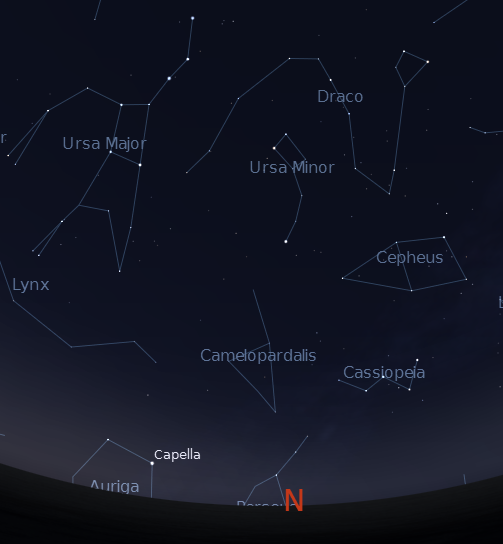
Little Dipper (Ursa Minor) and the Big Dipper (Ursa Major). Created using Stellarium.
 Bob Moler's Ephemeris Blog