Archive
11/28/2014 – Ephemeris – Not quite a star cluster, but pretty cool nonetheless
Ephemeris for Friday, November 28th. The sun will rise at 7:55. It’ll be up for 9 hours and 9 minutes, setting at 5:04. The moon, 1 day before first quarter, will set at 12:01 tomorrow morning.
When is a star cluster not a star cluster? When it’s an association. That is when it has begun to dissipate because the gravitational force of the group cannot hold it together. The central stars of the Big Dipper belong to The Ursa Major Association. Below the W shaped constellation of Cassiopeia in the northeast at 9 or 10 p.m. Is the constellation of Perseus (Per-seus or Pers-e-us) as it is usually pronounced. Its brightest star is Mirfak with a designation of Alpha Persei. There are some stars there to the naked eye, but with binoculars there are a great many stars just below naked eye visibility. This is called the Alpha Persei association. It is perfect to spot with binoculars, but way too wide-spread for a telescope.
Times are for the Traverse City/Interlochen area of Michigan. They may be different for your location.
Addendum
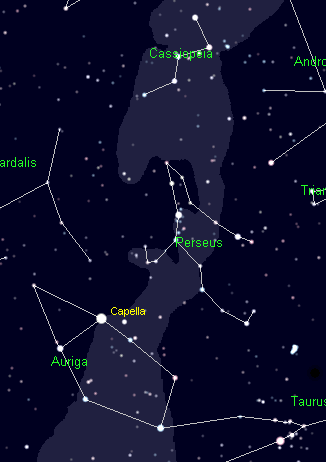
The Constellations Cassiopeia, Perseus and Auriga. Cartes du Ciel
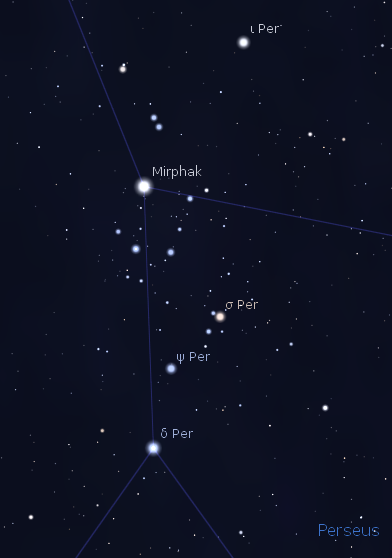
Alpha Persei Association. Created using Stellarium.
11/27/2014 – Ephemeris – The voyage of the Mayflower
Ephemeris for Thanksgiving Day, Thursday, November 27th. The sun will rise at 7:54. It’ll be up for 9 hours and 10 minutes, setting at 5:05. The moon, 2 days before first quarter, will set at 10:51 this evening.
We are regaled with stories of the first Thanksgiving dinner between the Native Americans and the Pilgrims. The Mayflower was headed for the Virginia Colony but were diverted by a storm. Their first landfall in the New World was Newfoundland, where they picked up supplies. Fulling intending to head south to Virginia, the passage became too hazardous, so they put into Cape Cod and there they stayed. Back in those days the ship’s position was determined rather crudely. Latitude was measured by the height of the north star and the sun at noon. Distance and speed were measured with a log thrown overboard with a rope with knots in it. The knots counted over a period of time gave the ship’s speed.
Times are for the Traverse City/Interlochen area of Michigan. They may be different for your location.
Addendum
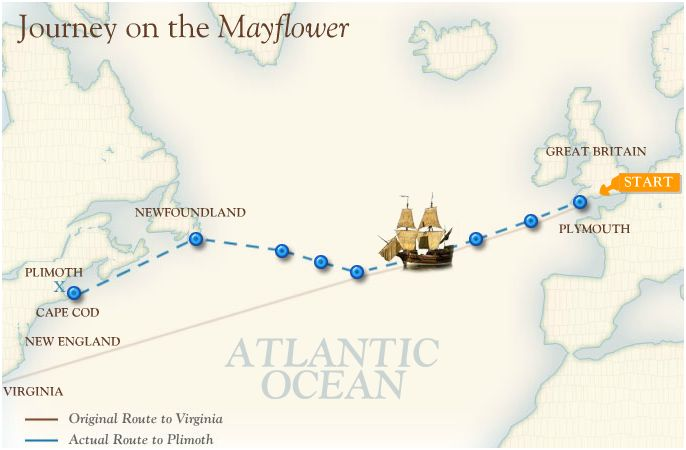
Credit: Scholastic
11/26/2014 – Ephemeris – Where did all the planets go?
Ephemeris for Wednesday, November 26th. The sun will rise at 7:53. It’ll be up for 9 hours and 12 minutes, setting at 5:06. The moon, 3 days before first quarter, will set at 9:41 this evening.
In reviewing which planets are visible tonight, it looks like we’re down to two. Venus, Saturn and Mercury are hanging around near the direction of the Sun. It will be a while before we see them again. However we can see Mars, which will be low in the southwest at 7 p.m. It will set at 8:29 p.m. Mars’ setting time will slowly advance only 6 minutes between now and the end of the year. Jupiter will rise at 10:54 p.m. in the east-northeast. The best telescopic views will have to wait a couple of hours after that. So if you’re more of an early bird rather than a night owl it might be better to view Jupiter with a telescope in the morning. Jupiter has those four bright moons that change position daily, and sometimes while you watch.
Times are for the Traverse City/Interlochen area of Michigan. They may be different for your location.
Addendum
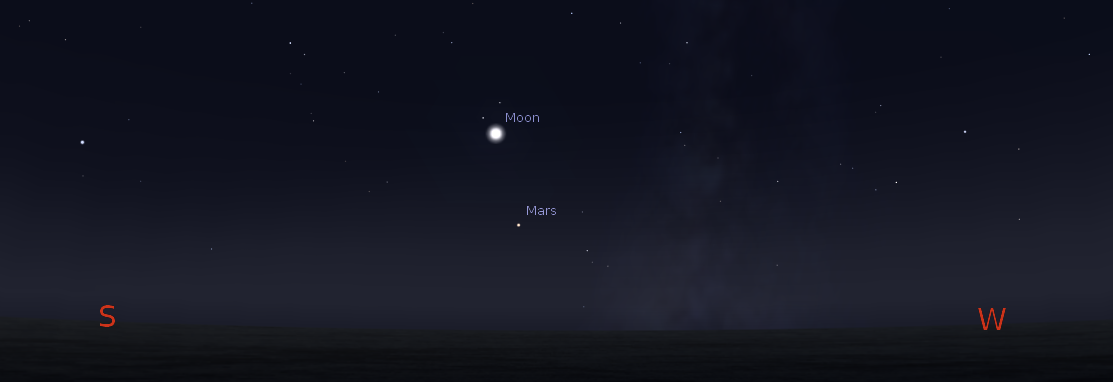
Mars with the crescent Moon at 7 p.m. on November 26, 2014. Created using Stellarium.
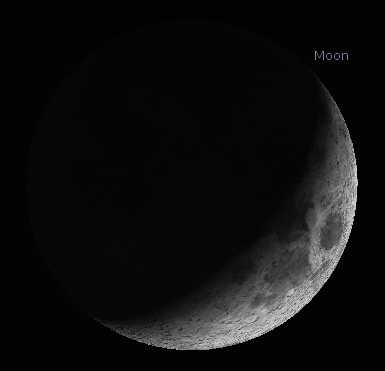
The crescent moon as it would appear in binoculars at 7 p.m. on November 26, 2014. Created using Stellarium.
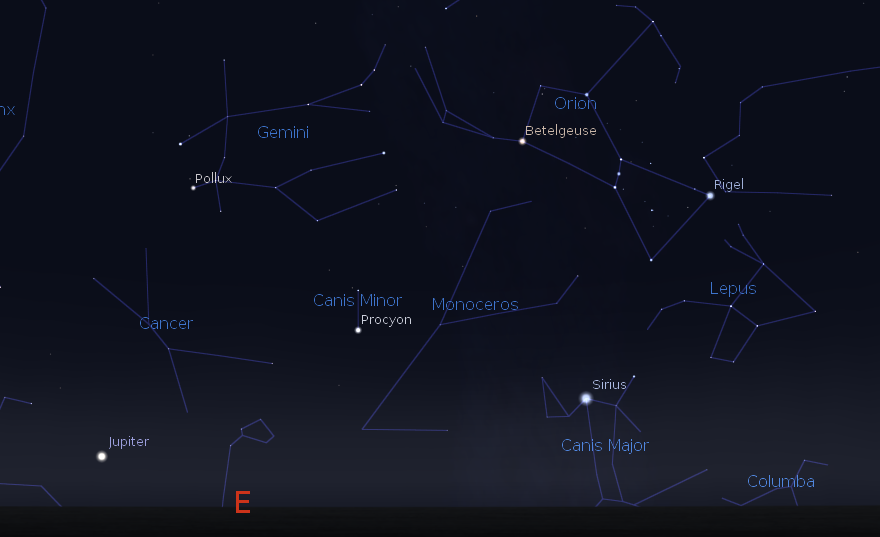
Jupiter rising with the winter constellations at 11:30 p.m. on November 26, 2014. Created using Stellarium.
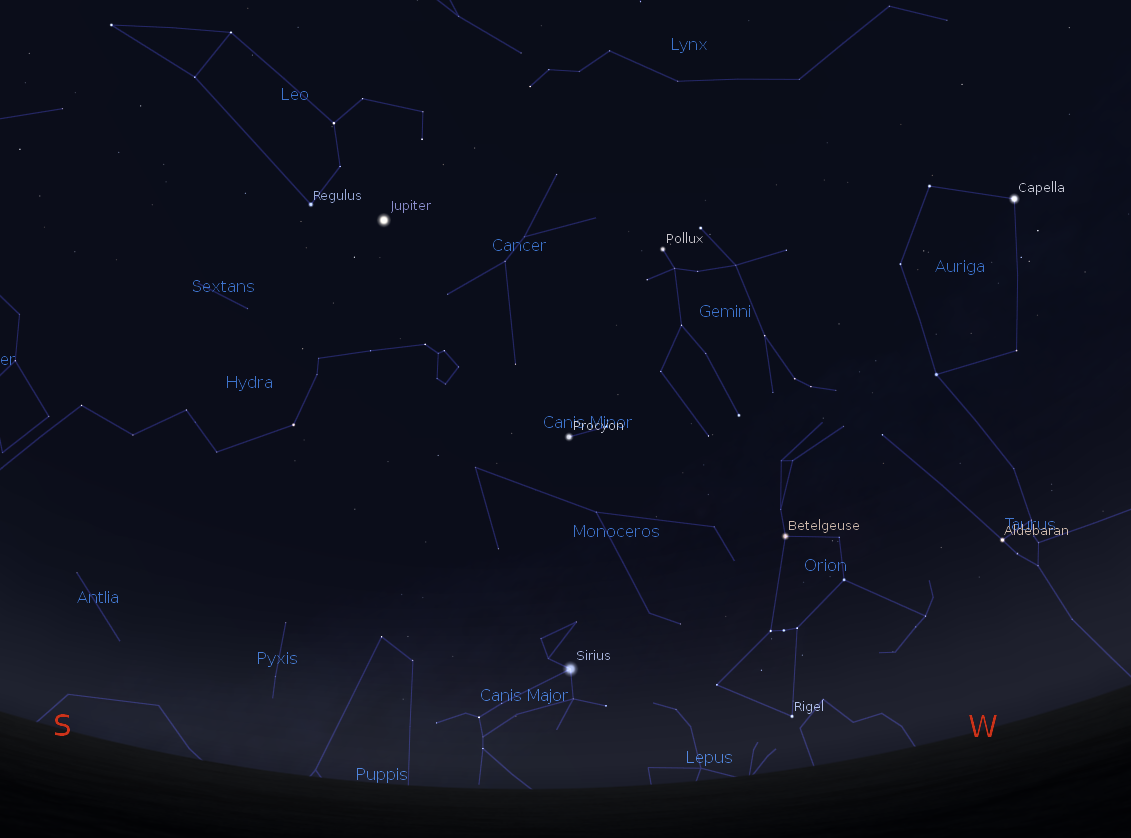
Jupiter with the winter constellations at 6:30 a.m. on November 27, 2014. Created using Stellarium.
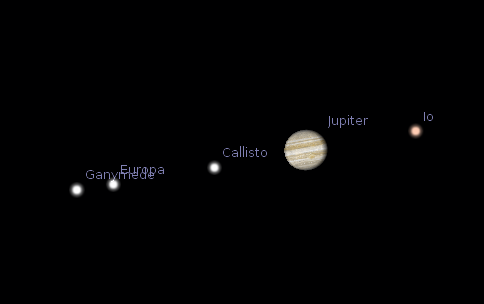
Jupiter as seen in a telescope at 6:30 a.m. on November 27, 2014. Created using Stellarium.
11/25/2014 – Ephemeris – Cassiopeia the constellation
Ephemeris for Tuesday, November 25th. The sun will rise at 7:52. It’ll be up for 9 hours and 14 minutes, setting at 5:06. The moon, 3 days past new, will set at 8:33 this evening.
Nearing the zenith at 8 p.m. is the W shaped constellation of Cassiopeia the queen. It’s actually just north of the zenith and since we’re half way from the equator and the north pole at near 45 degrees north, Cassiopeia will not set. Cassiopeia we say is circumpolar. Cassiopeia will rise is set if you’re in Florida. In Antarctica Cassiopeia is a just rumor, just as the Southern Cross is to us in Michigan since it never rises. Cassiopeia lies against the Milky Way, so there are a lot of star clusters in it. Unfortunately they can be seen only in telescopes. In 1572 the last of the pre-telescopic astronomers Tycho Brahe discovered a bright star that suddenly appeared. His discovery broke open the Aristotelian belief that the heavens were changeless.
Times and views are for the Traverse City/Interlochen area of Michigan. They may be different for your location.
Addendum
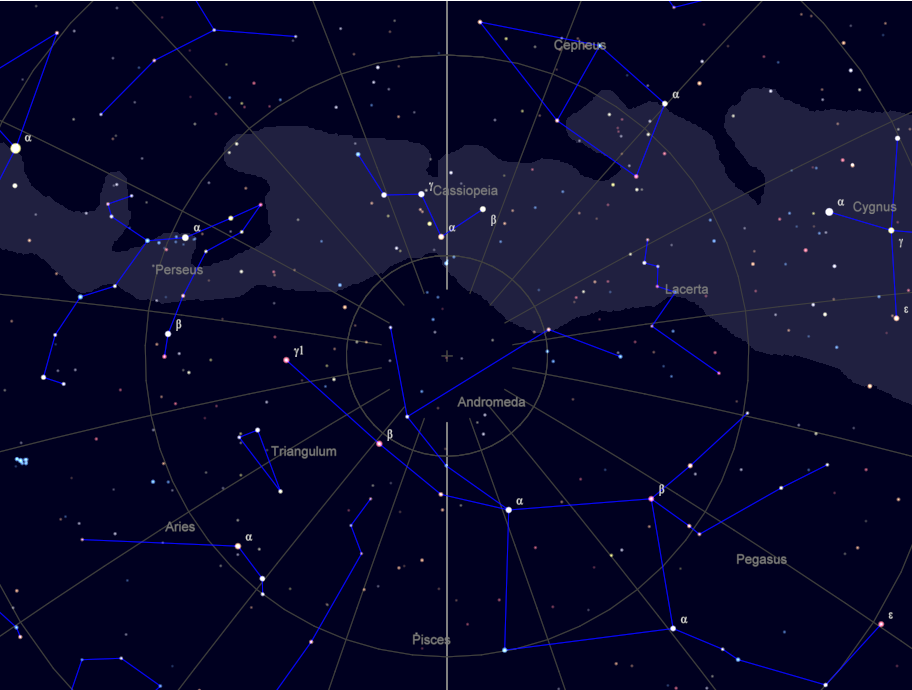
Looking straight up at the zenith, facing the south, Cassiopeia is just north of the zenith. The lines are radiating from the zenith. where the + sign is. Created using Cartes du Ciel.
My neck hurts just making this chart.
11/24/2014 – Ephemeris – The Summer Triangle is still with us
Ephemeris for Monday, November 24th. The sun will rise at 7:50. It’ll be up for 9 hours and 16 minutes, setting at 5:07. The moon, 2 days past new, will set at 7:29 this evening.
Well it’s almost Thanksgiving and about time that the Summer Triangle of bright summer stars finally set. Except it won’t go just yet. The stars Vega, Altair and Deneb are still hanging around in the west. The bright summer part of the Milky Way is gone. The constellations the three stars are in are Altair in Aquila the Eagle, now flying vertically up, Deneb in Cygnus the swan flying vertically down, and Vega in Lyre the harp, lying on its side. Altair the southernmost of these three will set first, later Vega will also set. What happens to Deneb depends on your location in the Interlochen Public Radio area. It you are north of Traverse City, Deneb will not actually set over Lake Michigan’s northern horizon.
Times are for the Traverse City/Interlochen area of Michigan. They may be different for your location.
Addendum
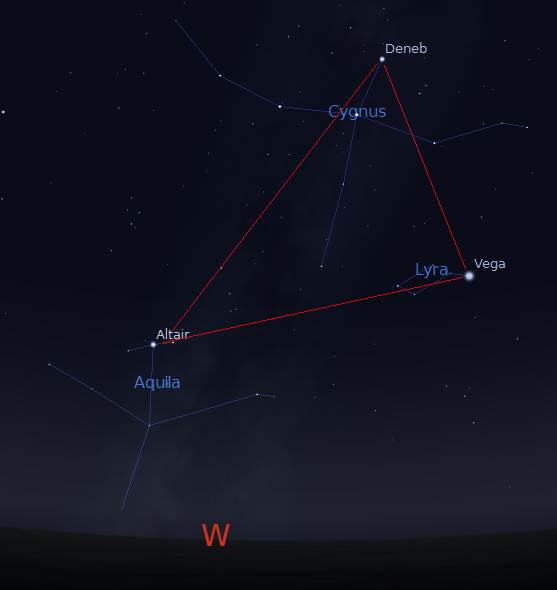
The Summer Triangle at 9 p.m. on November 24, 2014. Created using Stellarium.
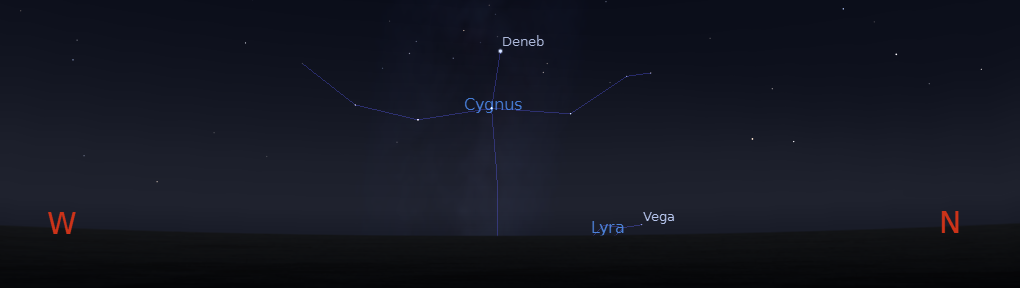
Vega near its setting point at 11:07 p.m. p.m. on November 24, 2014. Created using Stellarium.
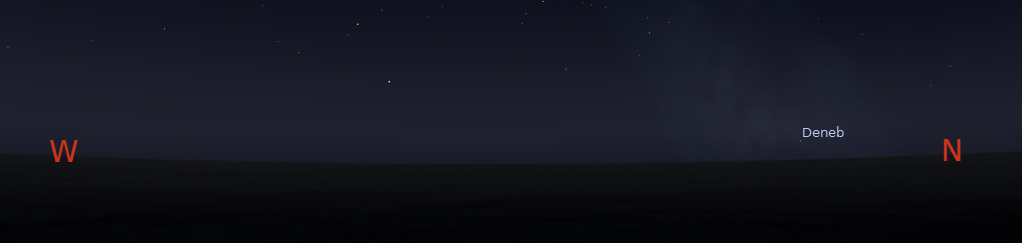
Deneb near its setting point at 5:05 a.m. p.m. on November 25, 2014. Created using Stellarium.
But will Deneb really set for Traverse City. Geometrically it will. However with a flat northern horizon looking northward over the bays to a clean Lake Michigan horizon, atmospheric refraction will bend the light from Deneb making it appear higher in the sky than it really is, so it won’t actually set. On the other side atmospheric extinction, the dimming of stars close to the horizon due to the filtering effect of looking through so much atmosphere would make Deneb impossible to see without a telescope. It might be an interesting challenge to spot.
11/21/2014 – Ephemeris – The Hyades a very important star cluster
Ephemeris for Friday, November 21st. The sun will rise at 7:47. It’ll be up for 9 hours and 22 minutes, setting at 5:09. The moon, 1 day before new, will rise at 7:42 tomorrow morning.
The face of the constellation Taurus the bull looks like the letter V sideways above the rising Orion the Hunter in the east at 9 p.m. The bright star at the tip of a letter V of stars is Aldebaran. Look with binoculars at the letter V shape and you will see the stars of the Hyades star cluster The Hyades is the closest star cluster to us, at about 151 light years. And is important for that reason. Before satellites like Hipparcos. The Hyades were the only star cluster to be directly measured by a technique called parallax, using the radius of the earth’s orbit as one side of a surveyors enormous triangle. Its many stars at the same distance were used to determine distances of star clusters even farther away. Additional techniques based on the distance of the Hyades allow us to measure distances to the galaxies.
Times are for the Traverse City/Interlochen area of Michigan. They may be different for your location.
Addendum
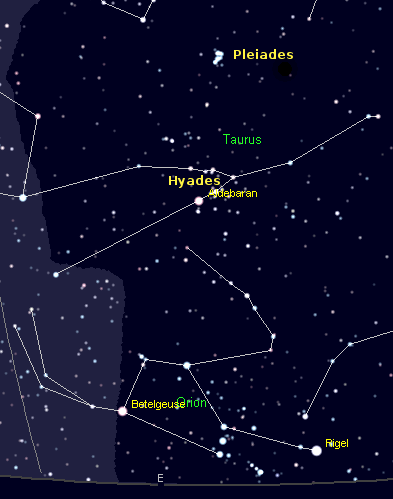
Orion and the Hyades.
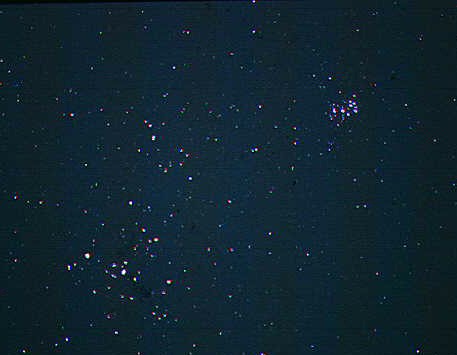
The Hyades (lower left) and the Pleiades (upper right). My photograph from many years ago.
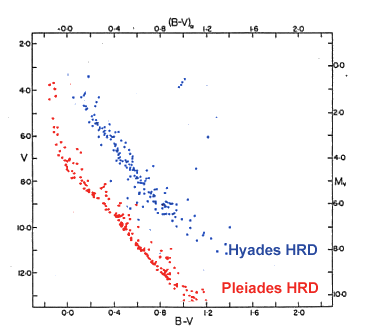
H-R diagram showing the Hyades and Pleiades. Credit: European Southern Observatory.
The Hertzsprung-Russell diagram or H-R diagram plots stars by brightness on the vertical axis versus surface temperature on the horizontal axis, hot to the left to cool on the right. The plot of stars for open or galactic star clusters, where the stars are burning hydrogen in their cores lie on a diagonal line called the main sequence. When matching the plots of two star clusters based on apparent magnitude the main sequence plot for the more distant star cluster will be dimmer by a certain magnitude difference. Since the brightness of and light source diminishes by the inverse square of the distance. The difference in brightness equates to a difference in distance.
For more information on the H-R diagram check out the Wikipedia article. It’s more than about distance.
11/20/2014 – Ephemeris – Constellation rotation from rise to set
Ephemeris for Thursday, November 20th. The sun will rise at 7:45. It’ll be up for 9 hours and 24 minutes, setting at 5:10. The moon, 2 days before new, will rise at 6:38 tomorrow morning.
At 9 p.m., if it’s clear tonight look to the east to see the bright winter constellation Orion the hunter mostly risen over the eastern horizon as Robert Frost told in his poem Star-Splitter. Orion’s throwing a leg up over the horizon, climbing into the sky. The three stars of Orion’s belt are nearly vertical as the mighty hunter rises. When in the spring he sets those stars will be horizontal. The same is true on the two namesake stars of the twins of Gemini Castor and Pollux to Orion’s left rising in then east-northeast. They rise vertically aligned and set horizontally. It’s due to our latitude and the fact that these stars are near the equator of the sky. At the poles the stars don’t change attitude, and don’t rise or set. Here they flip about 90 degrees, and at the equator they do a 180. Interesting.
Times are for the Traverse City/Interlochen area of Michigan. They may be different for your location.
Addendum
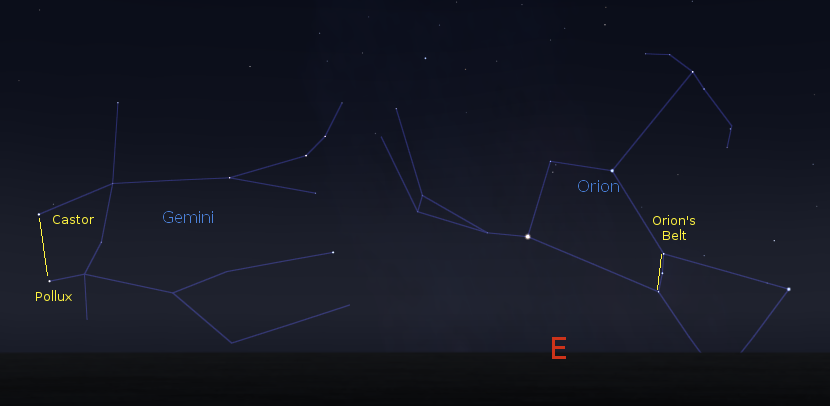
Orion rising at 9 p.m. on November 20, 2014. Note that Orion’s Belt stars and Gemini’s namesake stars are nearly vertically aligned. Created using Stellarium.
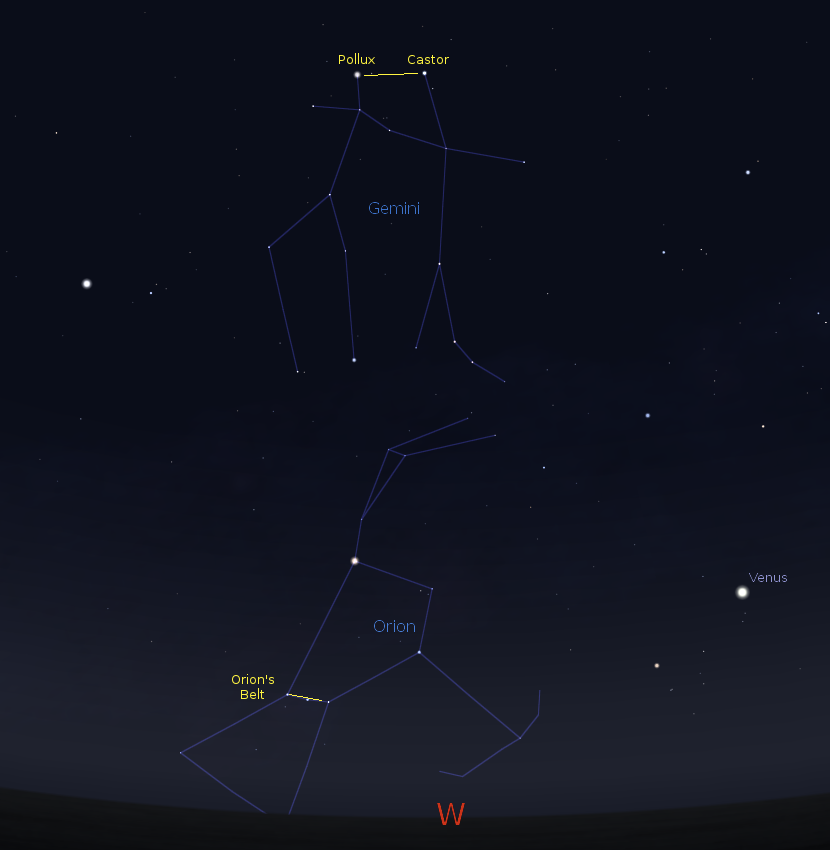
Orion setting near the end of twilight in April 2015. Note that Orion’s Belt stars and Gemini’s namesake stars are now nearly horizontally aligned. Created using Stellarium.
11/19/2014 – Ephemeris – Where did all the bright planets go?
Ephemeris for Wednesday, November 19th. The sun will rise at 7:44. It’ll be up for 9 hours and 26 minutes, setting at 5:10. The moon, 3 days before new, will rise at 5:34 tomorrow morning.
In reviewing which planets are visible tonight, it looks like we’re down to two. Venus, Saturn and Mercury are hanging around near the direction of the Sun. It will be a while before we see them again. However we can see Mars, which will be low in the southwest at 7 p.m. It will set at 8:29 p.m. Jupiter will rise at 11:20 p.m. in the east-northeast. The best telescopic views will have to wait a couple of hours after that. So if you’re more of an early bird rather than a night owl it might be better to view Jupiter with a telescope in the morning. Jupiter has those four bright moons that change position daily, and sometimes while you watch if they appear close enough to each other. On the planet are cloud bands and the elusive Great Red Spot.
Times are for the Traverse City/Interlochen area of Michigan. They may be different for your location.
Addendum
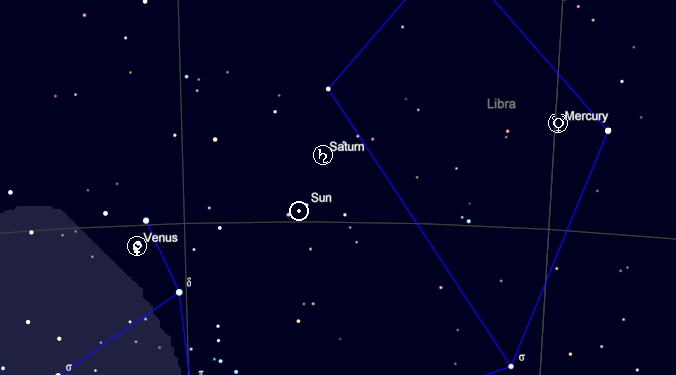
Mercury, Saturn and Venus appear near the Sun near sunset at 5 p.m. on November 19, 2014. Displayed planets as their symbols. Created using Cartes du Ciel (Sky Charts).
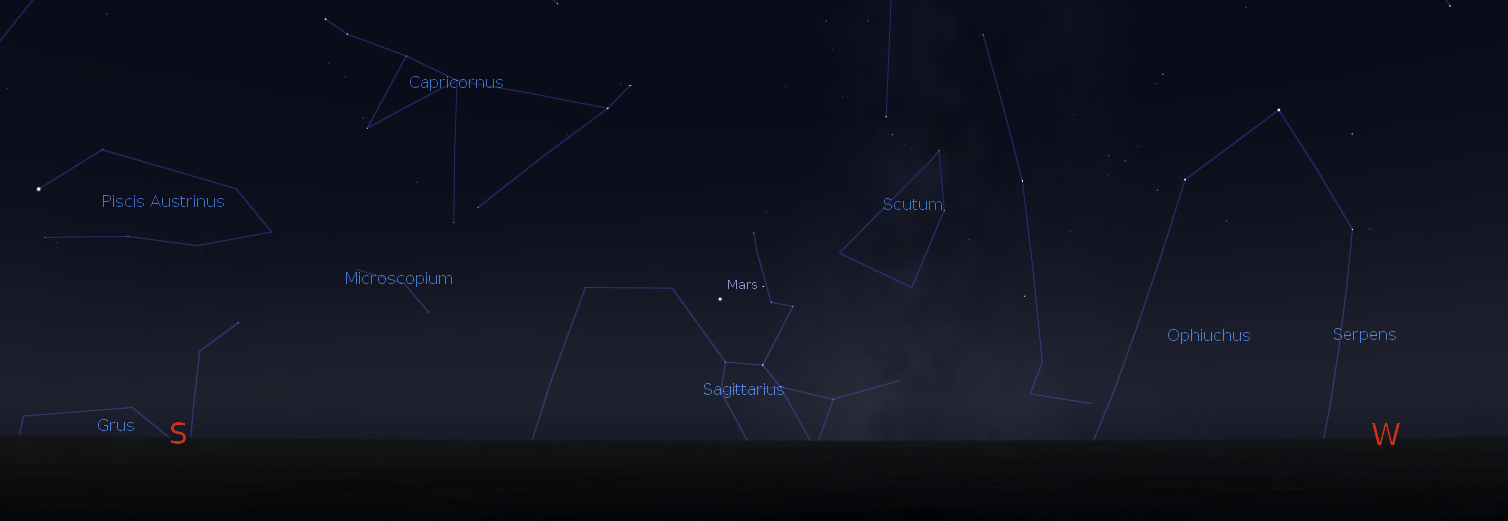
Mars and the setting summer constellations at 7 p.m. on November 19, 2014. Created using Stellarium.
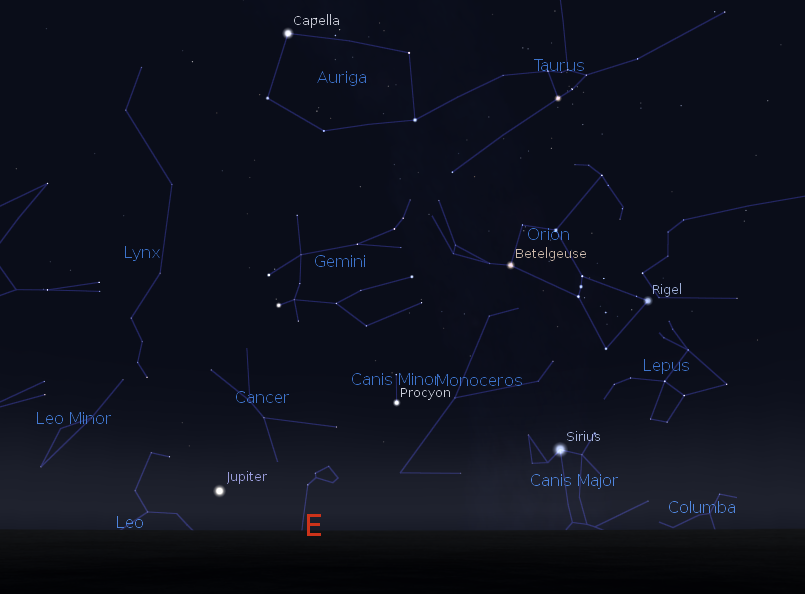
Jupiter and the rising winter constellations at midnight November 20, 2014. Created using Stellarium.
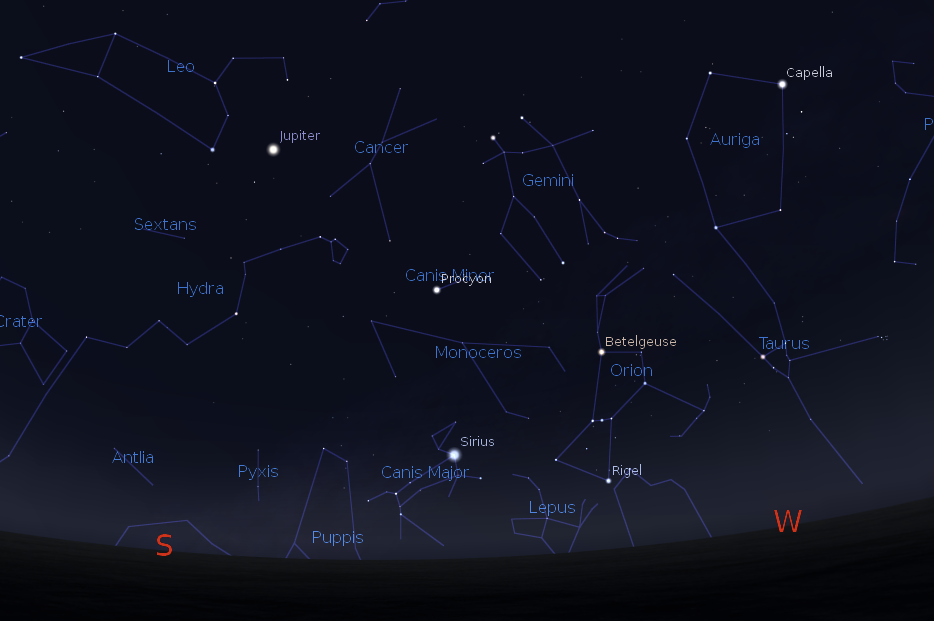
Jupiter with winter and spring constellations at 6:30 a.m. on November 20, 2014. Created using Stellarium.
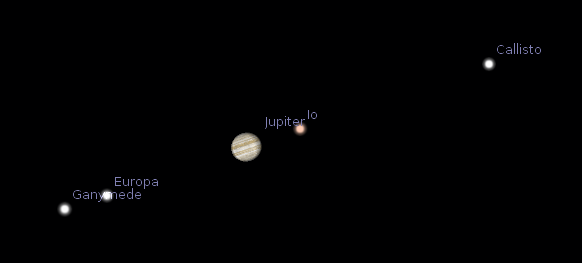
Jupiter and moons through a telescope at 6:30 a.m. on November 20, 2014. Created using Stellarium.
11/18/2014 – Ephemeris – Rosetta, Philae with Comet 67P and Maven’s discovery of the effects of it’s comet encounter
Ephemeris for Tuesday, November 18th. The sun will rise at 7:43. It’ll be up for 9 hours and 28 minutes, setting at 5:11. The moon, half way from last quarter to new, will rise at 4:31 tomorrow morning.
Last week the Philae lander bounced down on Comet 67P/Churyumov-Gerasimenko, its harpoons not able to fire to hold the lander down. “Where is Captain Ahab when you need him?” I Twittered at the time. We were lucky it didn’t bounce off the comet entirely. It ended against a cliff and in a shadow, so it couldn’t recharge its batteries from sunlight. The ESA controllers had it perform all its possible experiments quickly before its batteries died. Philae was still an amazing success. News from last month’s encounter Mars encounter with Comet Siding Spring. The Maven satellite detected the aftermath of a great martian meteor shower when it peaked around the planet from where it was hiding.
Times are for the Traverse City/Interlochen area of Michigan. They may be different for your location.
Addendum
Philae
If I’m understanding the spacecraft controllers at the European Space Agency (ESA) correctly Philae was launched toward the comet with a velocity of something like .7 meters per second (m/s). It would have accelerated to 1 m/s by the time it hit the comet. So it was pushed into the comet at more than the comet’s escape velocity. One meter per second is only 2.2 miles per hour. So to bounce and not escape the comet either the lander, the surface of the comet or both would have to have a lot of give to it. On this comet one could jump faster than escape velocity and go floating off into space.
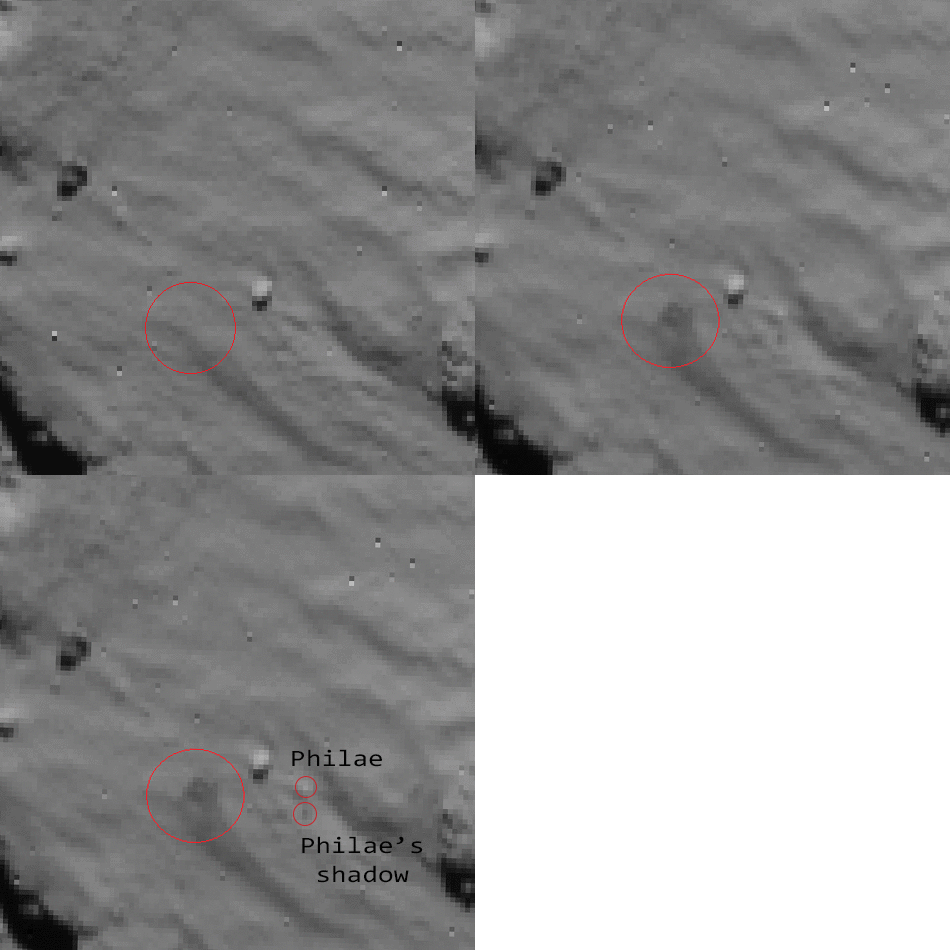
The Rosetta spacecraft spotted Philae and its shadow shortly after the lander touched down on Comet 67P/Churyumov–Gerasimenko and bounced up again. The first image is taken on Nov. 12, 2014 at 10:30 a.m. EDT (3:30 p.m. UTC) and the second five minutes later. Credit: ESA/Rosetta/NAVCAM; pre-processed by Mikel Catania. Hat tip to and credit for the caption to Universe Today.
Maven
Maven detected the aftermath of a meteor storm in the upper martian atmosphere with the signatures of eight metals. It looks like it was prudent to hide all the satellites when Mars came closest to the comet’s path. Here’s a link to Bob King’s post about it in Universe Today blog from 11 days ago.
11/17/2014 – Ephemeris – The Leonid meteor shower peaks this week
Ephemeris for Monday, November 17th. The sun will rise at 7:41. It’ll be up for 9 hours and 30 minutes, setting at 5:12. The moon, 3 days past last quarter, will rise at 3:30 tomorrow morning.
This week the Leonid meteor shower will again be seen. This is an unremarkable shower most years, but about every 33 years can be spectacular. This year we could see two peaks to the shower. Problem is that the peak activity for the Leonids last only an hour of so. The first is in the afternoon our time today. The radiant rises at midnight and one may be able to spot a few meteors after that. There is another peak calculated to be centered on 4:17 a.m. on Friday the 21st. It is supposed to be debris left by the comet responsible for the Leonids, Tempel-Tuttle back in 1567. Every once in a while the Leonids surprise us. Meteors are the streaks we see when grain sized particles shed by comets zip through the atmosphere at interplanetary speeds.
Times are for the Traverse City/Interlochen area of Michigan. They may be different for your location.
Addendum
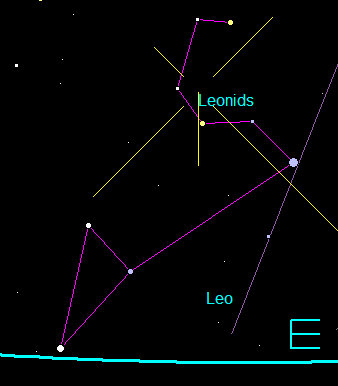
Leo rising at around 2 a.m. on the morning of November 20. Note the radiant in the sickle asterism of Leo. Created using Looking Up, my own program.
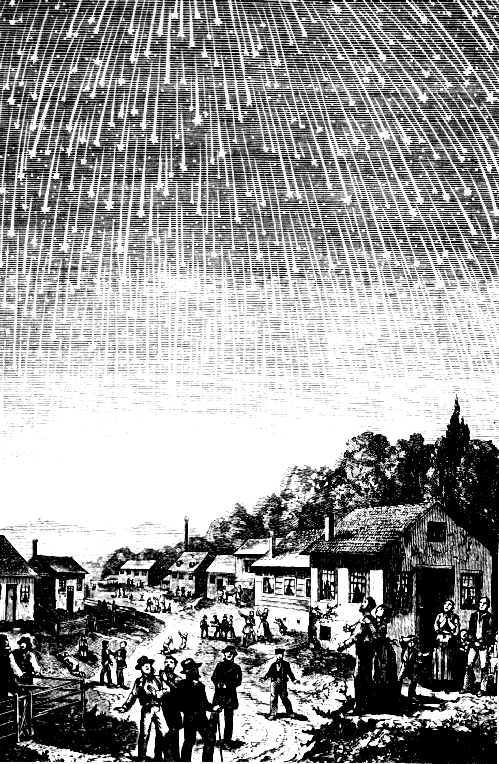
A famous woodcut of the 1833 Leonid meteor storm.
 Bob Moler's Ephemeris Blog