Archive
Here’s your chance to find Neptune – tonight only
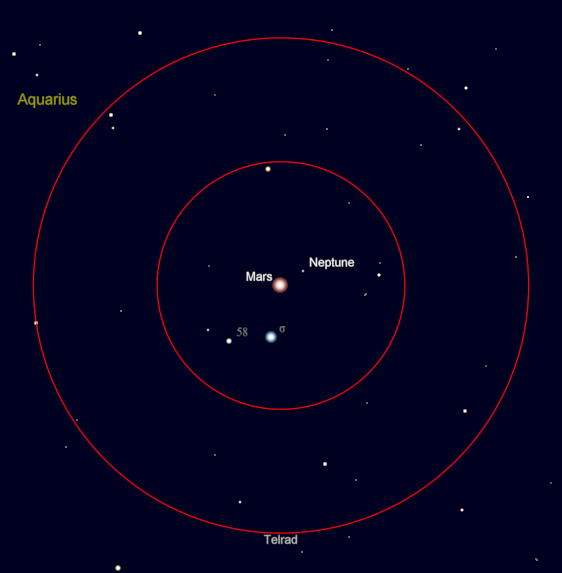
Mars and Neptune tonight only. Here is where Cartes du Ceil (Sky Charts) puts them at 7 p.m. January 19, 2015. They will be low in the southwest. Mars is second magnitude, Neptune is 8th.
The outer red circle matches that of the popular Telrad telescope finder and is a bit smaller (4º) than 7 or 10 power binoculars. The smaller circle is a 2° circle. It will take binoculars at least and a clear sky to spot this outermost planet.
Galileo actually recorded Neptune with his primitive telescope when Jupiter passed it. But to Galileo it was simply a background star.
Note: The 7 p.m. time in the caption is local to western lower Michigan. My location is 43 minutes behind Eastern Standard Time. If you are near your time meridian the time is more likely 6:15 p.m. This normally isn’t a big deal, but These planets are close to setting.
01/19/2015 – Ephemeris – Sirius, the brightest star in the night
Ephemeris for Martin Luther King Day, Monday, January 19th. The sun will rise at 8:14. It’ll be up for 9 hours and 19 minutes, setting at 5:33. The moon, 1 day before new, will rise at 7:53 tomorrow morning. | The star Sirius is the brightest night-time star in the heavens. It’s up on frosty winter evenings, and currently low in the southeastern sky in the early evening. It can be found in line and left of the three stars of Orion’s belt. It’s known as the Dog Star because it’s in the heart of the constellation Canis Major the greater dog. Sirius, however means dazzling one or sparkling one due to its brightness and the long time it spends low to the horizon where our turbulent atmosphere breaks up its light as a sparkler of color in telescopes and binoculars. Sirius owes its brightness mostly to its close proximity of 8.6 light years. It is 25 times brighter than the sun. It also has a white dwarf companion star nicknamed the Pup.
Times are for the Traverse City/Interlochen area of Michigan. They may be different for your location.
Addendum

Sirius A and B (near the diffraction spike to the lower left), A Hubble Space Telescope photograph. Credit NASA, ESA.
01/16/2015 – Ephemeris – Orion’s greater hunting dog: Canis Major
Ephemeris for Friday, January 16th. The sun will rise at 8:16. It’ll be up for 9 hours and 13 minutes, setting at 5:29. The moon, 3 days past last quarter, will rise at 5:09 tomorrow morning.
The great winter constellation or star group Orion the Hunter, is located in the south-southeastern sky at 9 p.m. His elongated rectangle of a torso is almost vertical. In the center of the rectangle are three stars in a line that make his belt. As a hunter, especially one of old, he has two hunting dogs. The larger, Canis Major can be found by following the three belt stars of Orion down and to the left. There lies the brilliant star called Sirius, also known as the Dog Star. It’s in the heart of a stick figure dog low in the southeast facing Orion that appears to be begging. I’ll have more to say about Sirius on Monday, but there’s a fine star cluster, caller M41, at the 5 o’clock position from Sirius easily visible in binoculars or a small telescope.
Times are for the Traverse City/Interlochen area of Michigan. They may be different for your location.
Addendum
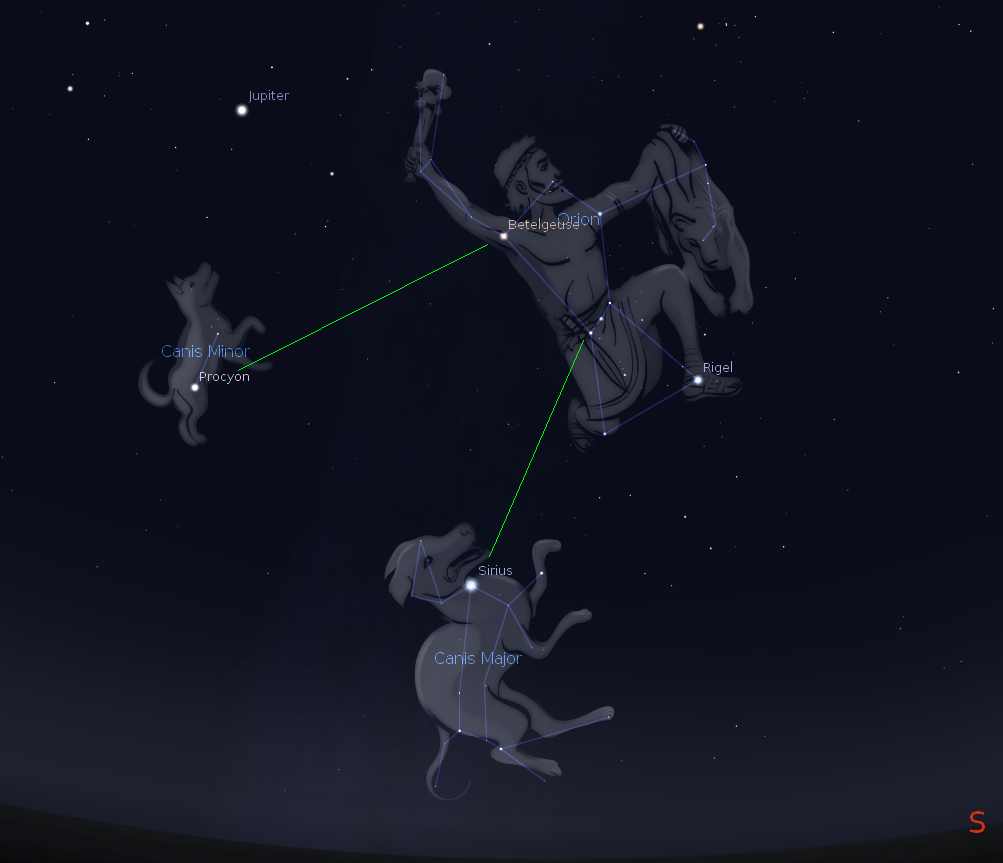
Orion and his hunting dogs with pointers as seen at 9 p.m. in the second half of January. Created using Stellarium.
01/15/2015 – Ephemeris – Family STEM Night at Greenspire School
Ephemeris for Thursday, January 15th. The sun will rise at 8:16. It’ll be up for 9 hours and 11 minutes, setting at 5:28. The moon, 2 days past last quarter, will rise at 4:07 tomorrow morning.
Tonight the Greenspire School is sponsoring its annual Family STEM Night from 5:30 to 8 p.m. at the school on Red Drive at the Grand Traverse Commons. Red Drive is a block west of Silver Drive that connects to Silver Lake Road at Franke Road. STEM is an acronym for Science, Technology, Engineering and Math. One of the demonstrations will be a 3D printer. The Grand Traverse Astronomical Society will be there also making dry ice comets, showing the sky and Comet Lovejoy through telescopes if it’s clear, and giving away two Galileoscope telescope kits and a some Race to the Planets trivia games courtesy of Professor Jerry Dobek and Project Astro. There are lots of hands on activities for the whole family.
Times are for the Traverse City/Interlochen area of Michigan. They may be different for your location.
Addendum

01/14/2015 – Ephemeris – Five bright planets and Comet Lovejoy are visible now
Ephemeris for Wednesday, January 14th. The sun will rise at 8:17. It’ll be up for 9 hours and 9 minutes, setting at 5:26. The moon, 1 day past last quarter, will rise at 3:05 tomorrow morning.
Lets take a look at the bright planets and a pretty bright comet for this week. Venus and Mercury are side by side low in the southwest by 6 p.m. Mercury is about 2 and a half moon widths to the right of the much brighter Venus. Mercury will set at 7:02, while Venus will set at 7:03 p.m. Mars is low in the southwest at 7 p.m. and is in the constellation of Aquarius. The Red Planet will set tonight at 8:39 p.m. Jupiter will rise in the east at 7:31 p.m. It’s near the sickle shaped head of Leo the lion. Early risers will be able to spot Saturn which will rise in the east-southeast at 4:21 a.m. Comet Lovejoy, visible in binoculars, makes an equilateral triangle with the V shaped head of Taurus and the Pleiades, to the right of both.
Times are for the Traverse City/Interlochen area of Michigan. They may be different for your location.
Addendum
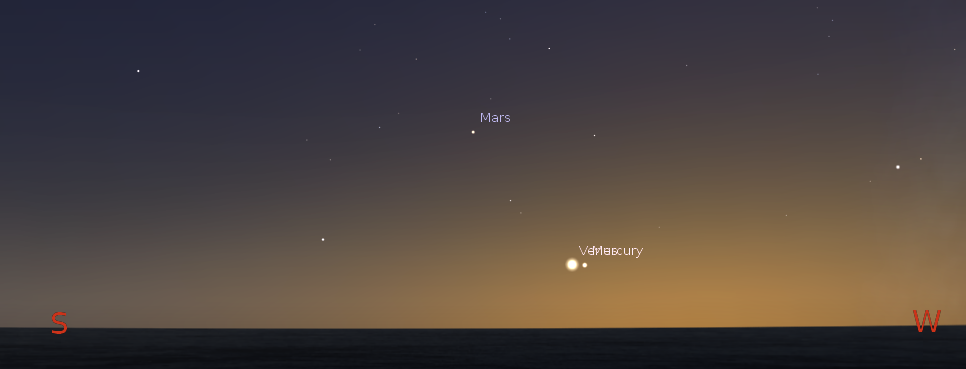
Venus, Mercury and Mars at 6:15 p.m. on January 14, 2015. Note that Mercury is getting dimmer, and Venus is overtaking Mars which is a bit more than a month away. Created using Stellarium.
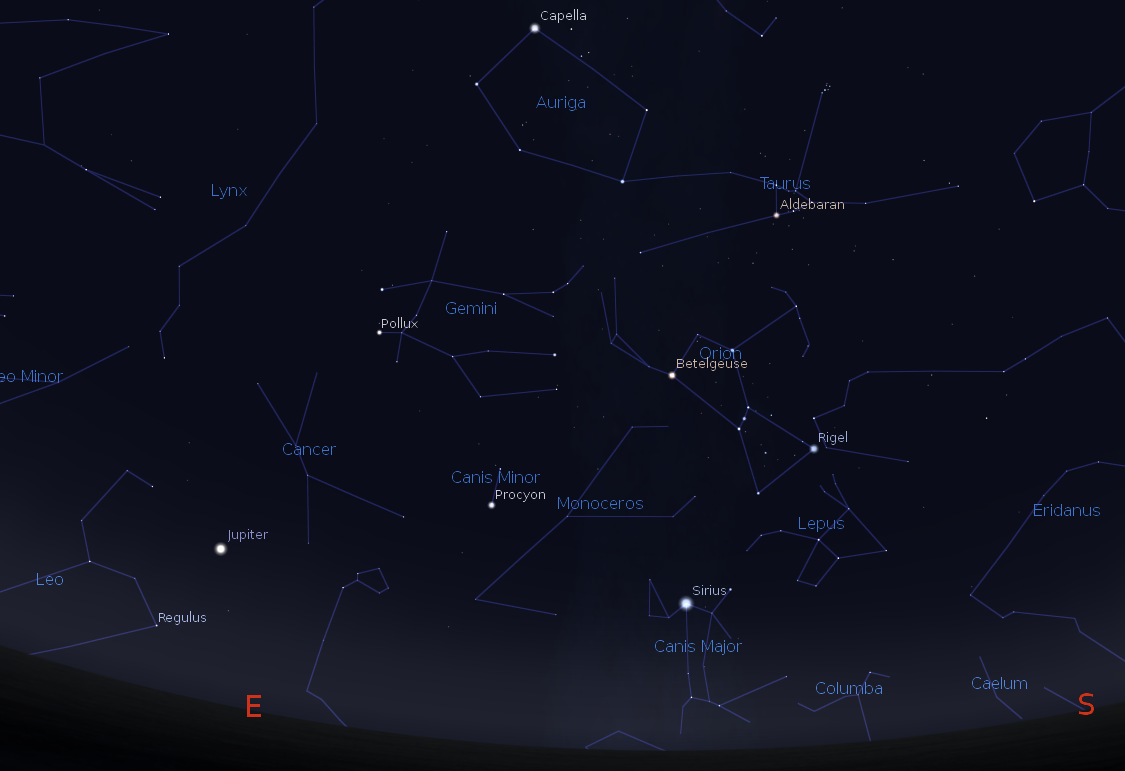
Jupiter and the winter constellations at 9 p.m. on January 14, 2015. Comet Lovejoy is not shown. Created using Stellarium.
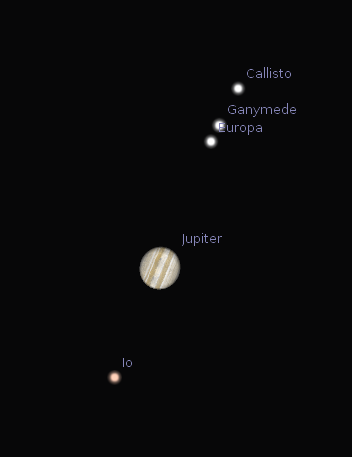
Jupiter and it’s Galilean satellites as seen in a telescope at 9 p.m. on January 14, 2015. Created using Stellarium.
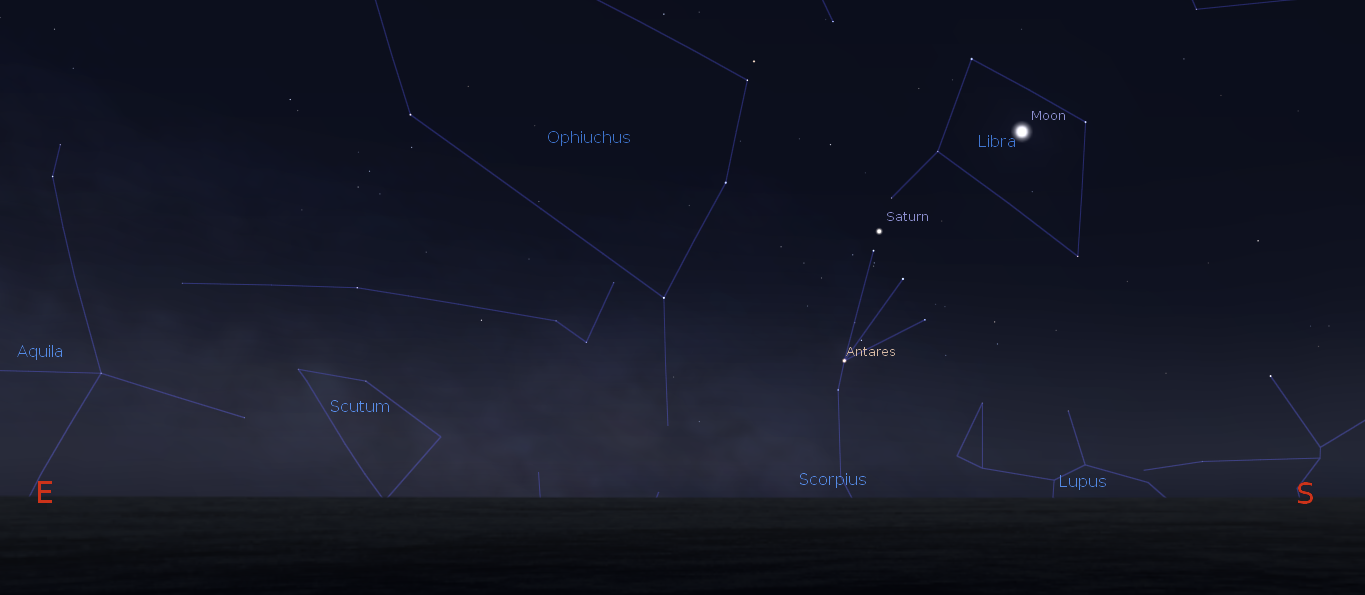
Saturn and the Moon at 7 a.m., January 15, 2015. Created using Stellarium.
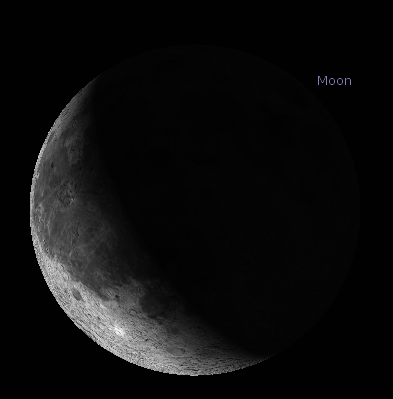
The Moon as it would be seen in binoculars at 7 a.m., January 15, 2015. Created using Stellarium.
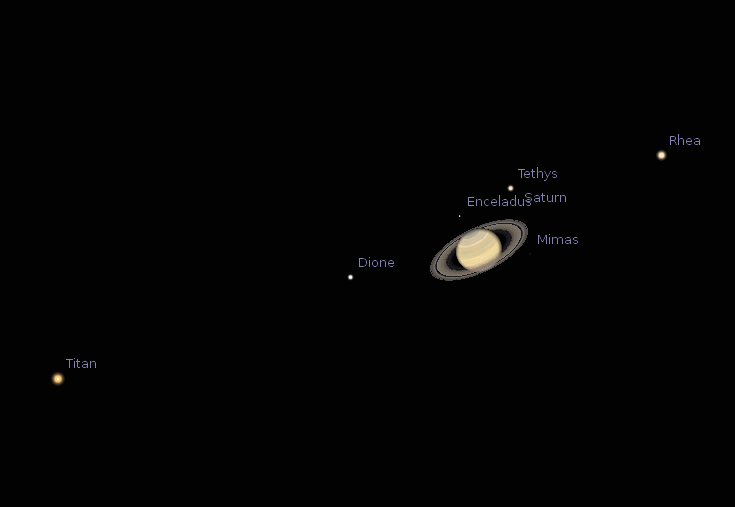
Saturn as seen with a telescope at 7 a.m., January 15, 2015. Titan is visible in most small telescopes. Created using Stellarium.
Comet Lovejoy
We finally had a clear night. Comet Lovejoy was not visible to me to the naked eye last night. But I thing an observer far from city lights and perfectly dark adapted might be able to spot it. It was a great sight in 10X50 binoculars. it was a bright featureless round blob of light. I couldn’t spot a tail, which I expected. My friend Scott Anttila, an excellent astrophotographer unfortunately has moved down to the Detroit area and is hindered by the lights down there. However he was able to get this image of the comet sans tail. But the green color of the come shows wonderfully. Unfortunately our eyes don’t register color at low light levels.
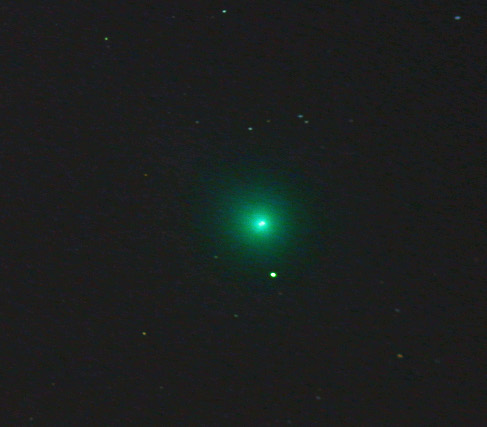
Scott Anttila’s photo of Comet Lovejoy from the light polluted skies of the Detroit area.
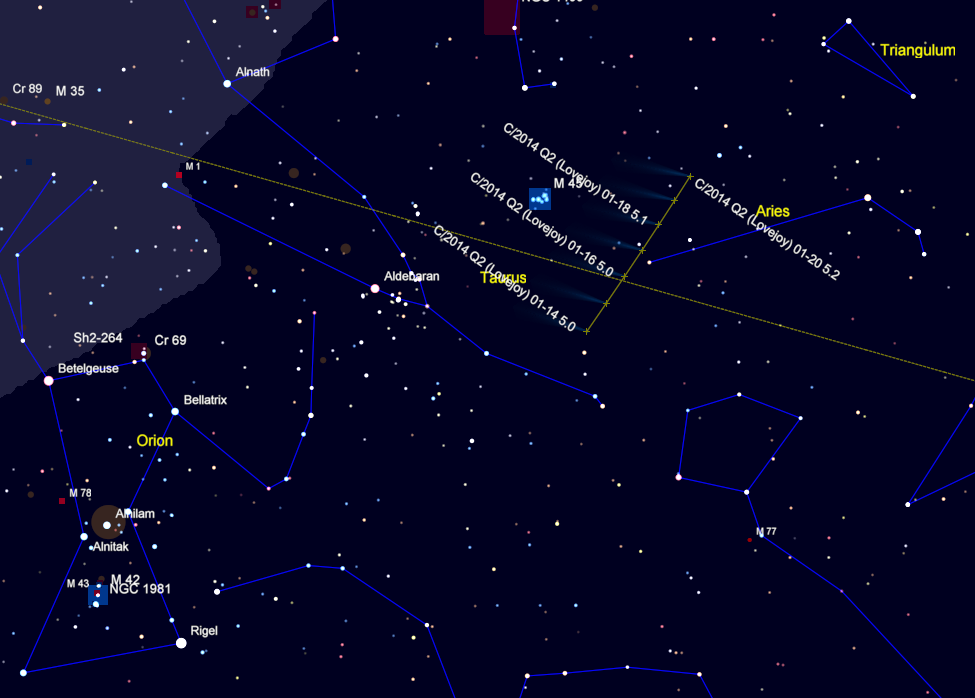
The track of Comet Lovejoy for the next week (from 1/14/2015 to 1/20/2015 at 9 p.m.) Created using Cartes du Ceil (Sky Charts).
01/13/2015 – Ephemeris – How to find Comet Lovejoy
Ephemeris for Tuesday, January 13th. The sun will rise at 8:17. It’ll be up for 9 hours and 7 minutes, setting at 5:25. The moon, at last quarter today, will rise at 2:03 tomorrow morning.
A new comet has entered the evening sky for northern hemisphere observers. It is best seen in binoculars as a fuzzy blob. Photographs reveals a green comet with a faint wispy tail. It was discovered by Australian amateur astronomer Terry Lovejoy. It’s his 5th comet. Tonight the comet is located in line with the bottom side of the letter V of stars, the head of Taurus the bull, The V is lying on its side and to the right by the width of a fist held at arm’s length will be the fuzzy ball of the head of the comet. Charts for finding the comet can be found on my blog at bobmoler.wordpress.com today and also every Wednesday for the next month or so. Photographs of this beautiful comet can be found on space.com and spaceweather.com among other websites.
Times are for the Traverse City/Interlochen area of Michigan. They may be different for your location.
Addendum
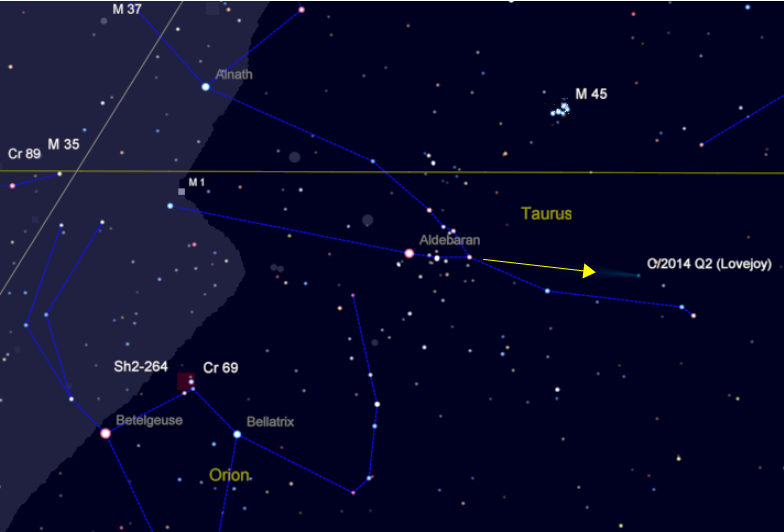
Finding Comet Lovejoy at 9 p.m., January 13, 2015. created using Cartes du Ceil (Sky Charts). Click on image to enlarge.
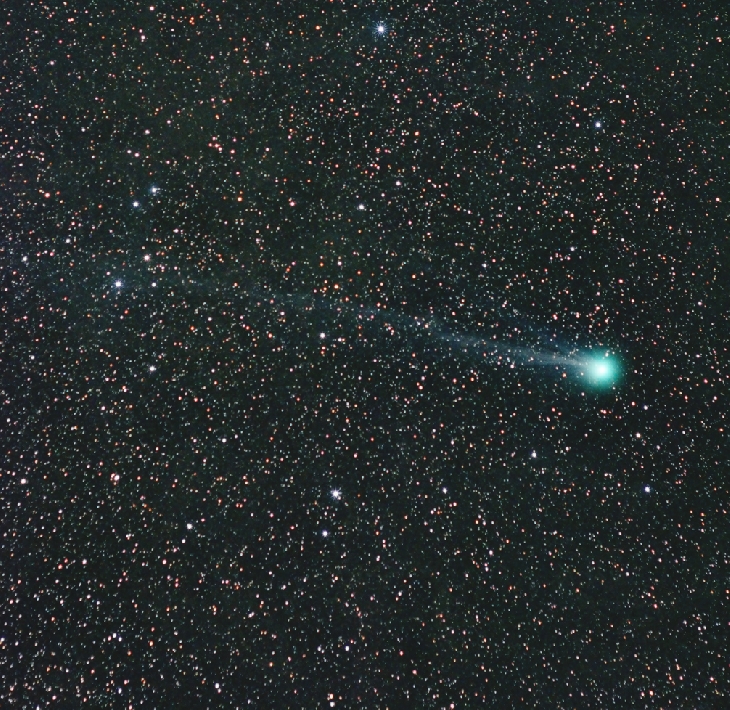
Comet Lovejoy taken by Jan Curtis on January 11, 2015 @ Near Santa Fe, New Mexico. Found on http://www.spaceweather.com. Great photo Jan. Click on image to enlarge.
More questions about the length of daylight hours
This is the result of a question I got about why the daylight hours change the way they do during the year. My answer is posted here as “How come hours of daylight changes very slowly around the solstice, but very rapidly around the equinoxes?”
My correspondent has a few more questions. I’ll boil them down.
I pretty much understand why daylight changes rapidly at the equinoxes and slowly at the solstices based upon your map showing the ecliptic and how the steepest part is at the equinoxes. Also, the figure eight drawing makes sense. But why does the curve of the ecliptic seem to linger for a time at the solstices before plunging? Does it have to do with the speed of the Earth in its orbit?
The analemma, as seen below, is the result of two phenomena. First, the tilt of the Earth’s axis which would on itself make a figure 8 with equally sized lobes, with crossing point at the equinoxes. Second, the Earth’s orbit of the Sun is a slight ellipse, meaning for our purposes here that the Earth moves its fastest near perihelion when the Earth is nearest the Sun, around January 4th. and slowest at aphelion, when the Earth is farthest from the Sun, around July 4th. That makes the bottom lobe larger because the Sun is by reflection moving faster eastward in the sky. The apparent slowness that the questioner perceives is an illusion because the Sun appears to be moving in a more directly eastward, and changed the actual time of local solar noon. Wikipedia has a detailed discussion of the analemma.
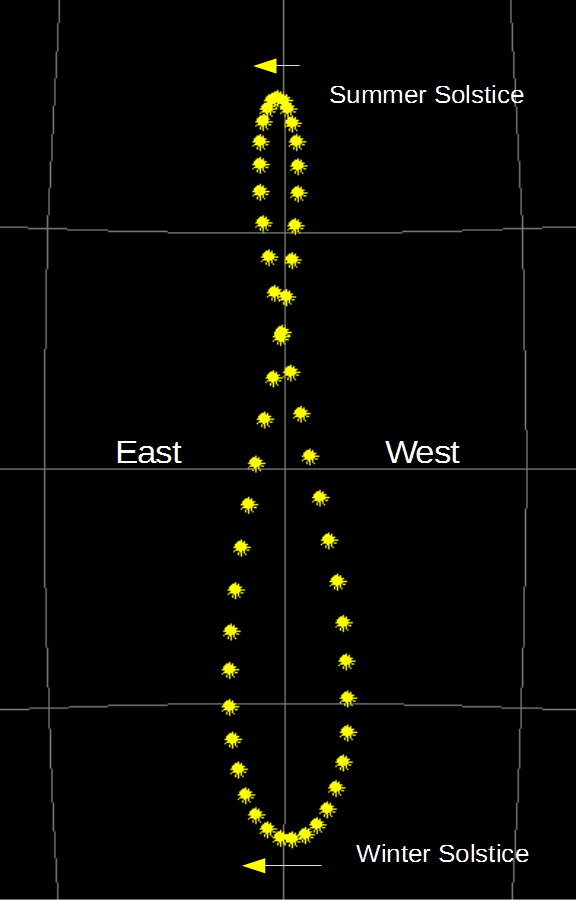
This figure 8 is called an analemma. One can find it on old globes in the Pacific Ocean. Explanation below. Created using my LookingUp program.
I had stated in the prior post that daylight hours would be 12 hours at the equinoxes and also all the time at the equator. So here’s the other question.
At the equator, day length does change over the course of the year, doesn’t it? At the equinoxes it would be 12 hours long, but at the summer solstice up north it would sink towards the south by 23 degrees and at the summer solstice in the south it would sink towards the north by the same amount.
Other than getting cooperation from someone who either lives on or has visited the equator, I generated a calendar of sunrise and sunset times for the equator, specifically for 0º longitude and 0º latitude. A link to it is here. Also read the explanation on that calendar page.
The answer is No, the daylight hours at the equator doesn’t change over the year. The one minute variance has to do with the Analemma.
01/12/2015 – Ephemeris – The world’s faorite constellation: Orion
Ephemeris for Monday, January 12th. The sun will rise at 8:18. It’ll be up for 9 hours and 6 minutes, setting at 5:24. The moon, 1 day before last quarter, will rise at 1:02 tomorrow morning.
For people the world over who look up and recognize the brighter constellations Orion is perhaps the odd on favorite. The Big Dipper, a favorite in the northern hemisphere, cannot be easily seen south of the equator. The Southern Cross cannot be easily be seen north of the equator. Orion, or parts of him can be seen from pole to pole because he straddles the equator of the sky. It has 7 bright stars like the Big Dipper, but those seven are brighter than those in the big Dipper. In the early evening Orion is seen is the southeast. The three stars of his belt now tipped diagonally from upper right to lower left. They are in the center of a left leaning rectangle of stars with bright red Betelgeuse to the upper left and bright blue-white Rigel to the lower right.
Times are for the Traverse City/Interlochen area of Michigan. They may be different for your location.
Addendum
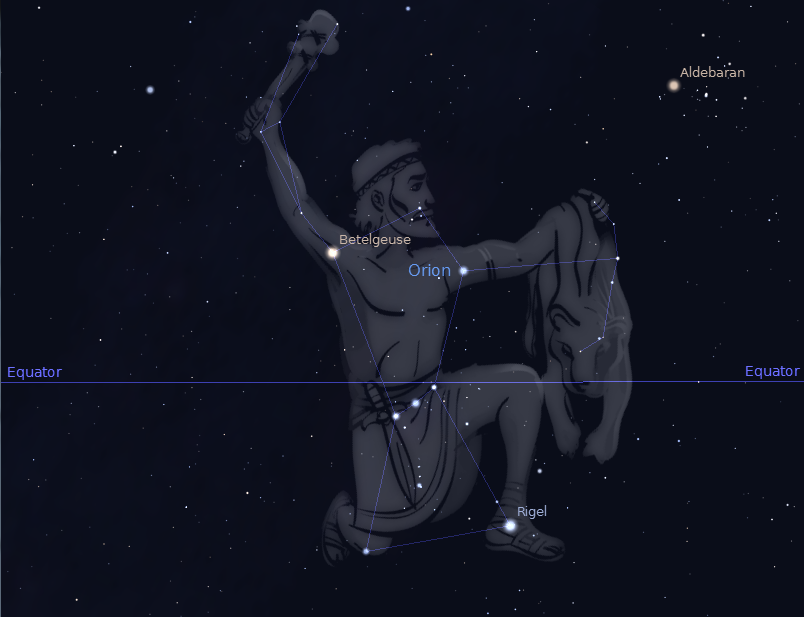
Orion from mid latitudes north of the equator. Orion would be upside down if viewed south of the equator. Created using Stellarium.
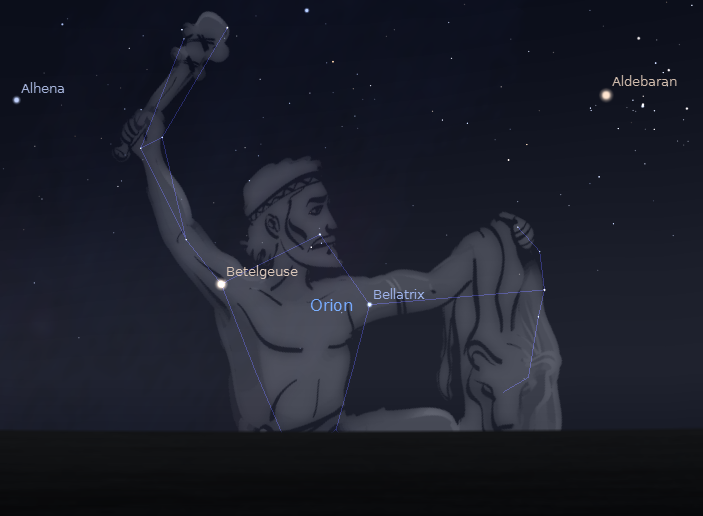
Orion from near the north pole. Created using Stellarium.
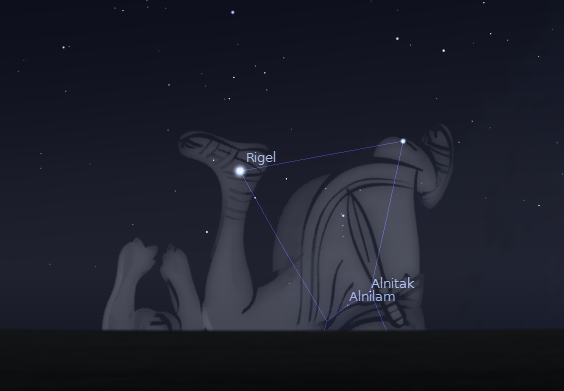
Orion from near the south pole. Created using Stellarium.
How come hours of daylight changes very slowly around the solstice, but very rapidly around the equinoxes?
This question came in as a an off topic comment to my post yesterday 01/09/2015. It deserves a good answer. So here goes.
Day to day change in daylight hours occur when the Sun appears to move south or north. For us in the northern hemisphere the daylight hours get shorter when the Sun appears to move south, and longer when the Sun appears to move north. If we spread out the sky in a Mercator projection, like they do the earth or one of those satellite tracking maps, it would look like the image below.
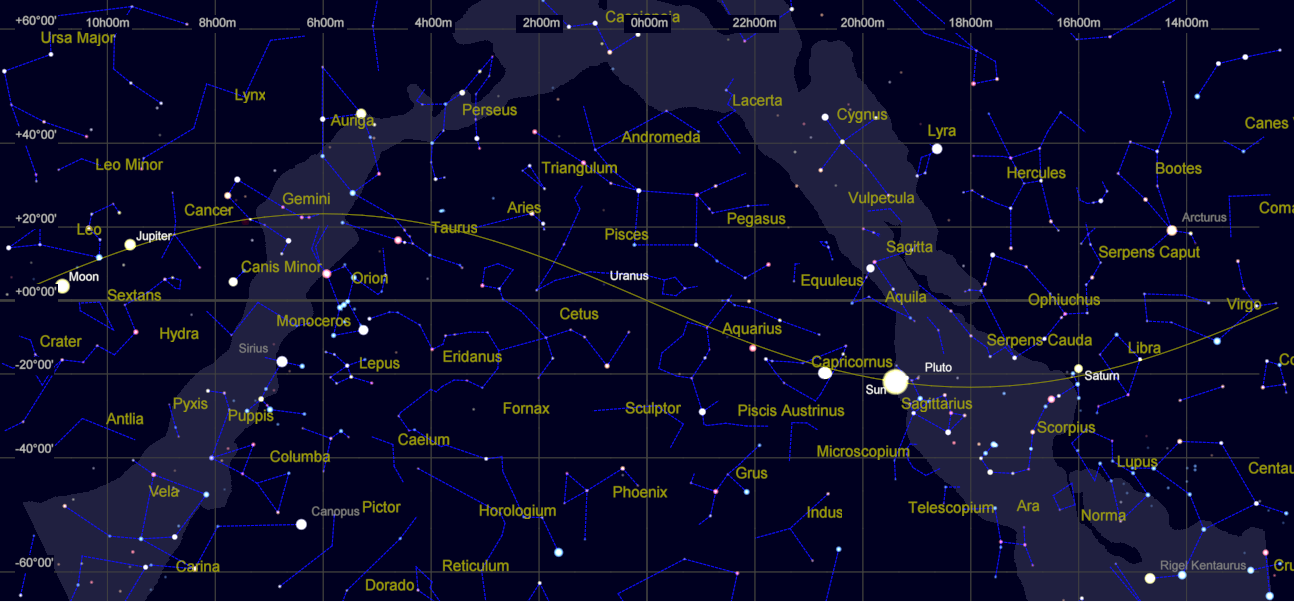
Mercator projection of the heavens from declinations +60 to -60 degrees declination, centered on the vernal equinox. The center horizontal white line is the celestial equator, and the yellow sinusoidal line is the ecliptic, the apparent path of the sun. Note the planets and Moon also stick close to that line. The date of the image is January 9, 2015. Venus and Mercury are on top of each other and unlabeled under the ‘a’ in Capricornus. Created using Cartes du Ceil (Sky Charts). Click image to enlarge.
Note that the steepest part of the ecliptic occurs at the equinoxes, the vernal or March equinox in the center and the autumnal or September equinox at the left and right edges. That’s where the sun’s motion north or south is the greatest, so the daily change in daylight hours is the greatest. Near the solstices at 6 and 18 hours* the Sun isn’t changing its north-south motion very much, so the daylight hours aren’t changing much from day to day. If you were watching the sky at local solar noon, you’d think that at the solstice the sun would stop its motion and stand still before heading back. That’s what the word solstice means: sun-standstill. The variation is daylight hours also depends on your location. At the equator, it doesn’t change at all. Of course at the other extreme, at the poles, there’s 6 months of daylight and 6 months of night.
* The east-west direction in the heavens is like longitude on the Earth but it’s called right ascension and is measured in hours where 15 degrees equals one hours. Astronomers use clocks to keep track of it. Declination is the same as latitude on the Earth. In astronomy longitude and latitude were already in use for ecliptic based coordinates.
So what causes the wavy path in the sky? Lets check out the earth from the sun’s point of view, so to speak.
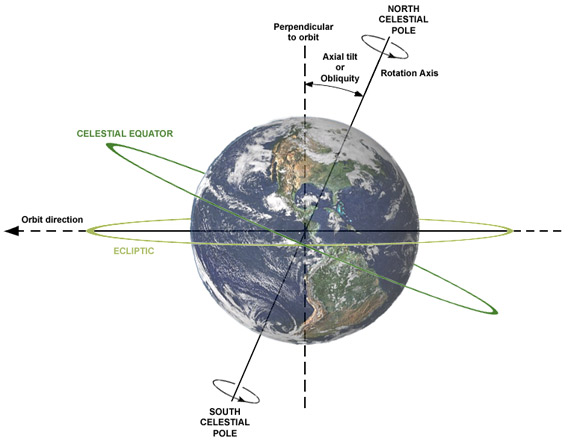
Earth’s axial tilt. The horizontal line is the plane of the Earth’s orbit and what we see projected on the sky as the ecliptic. The tilt of the Earth’s axis to the plane of its orbit by 23 1/2 degrees, gives us the seasons and why the celestial equator and ecliptic cross at a 23 1/2 degree angle. Credit Dennis Nilsson.
Both the celestial equator and the ecliptic are great circles in the sky. They intersect at an angle of 23 1/2 degrees at the equinox points.
Lets take a look at the difference in daylight hours at three times in the year, the equinox and the two solstices for Traverse City, MI whose latitude is just shy of 45° north. The following three images were generated in stereographic projection, which exaggerates the distance of things near the horizon and diminishes the distance of things in the center, the zenith. So actually the speed of the sun is unchanging across the sky.
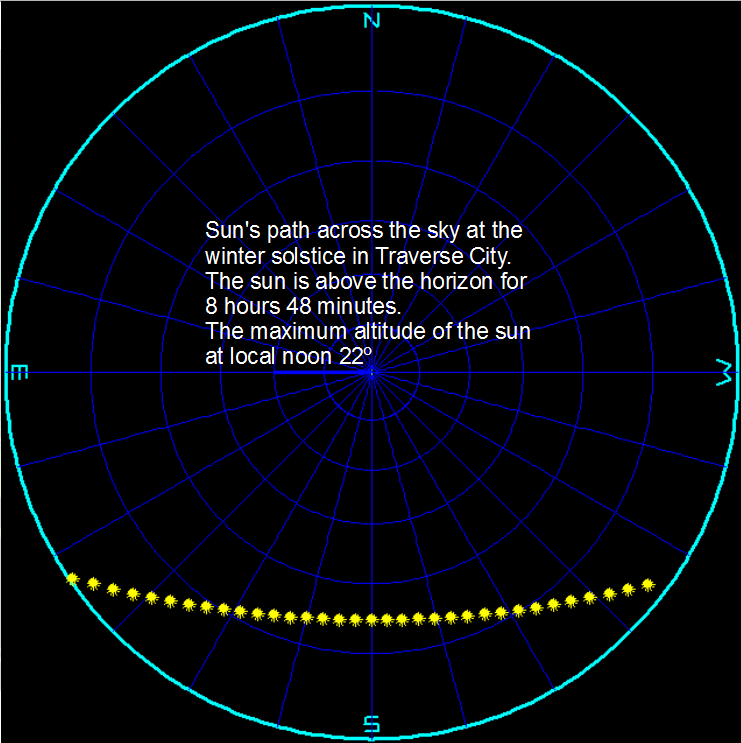
The sun’s daily path through the sky from horizon to horizon on the first day of winter, the winter solstice. Credit My LookingUp program.
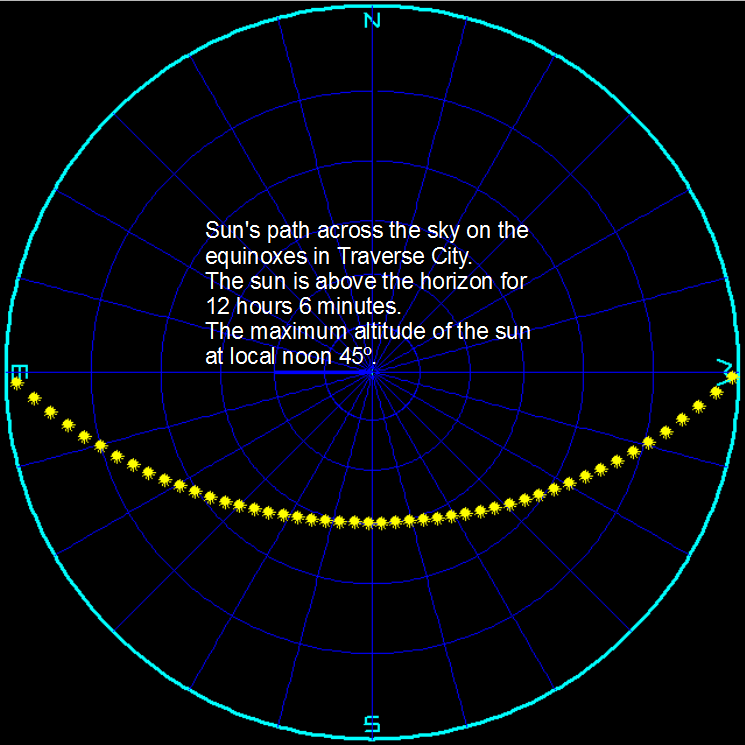
The sun’s daily path through the sky from horizon to horizon on an equinox the first day of spring or autumn. Credit My LookingUp program.
Note that at the equinox the sun rises due east and sets due west.
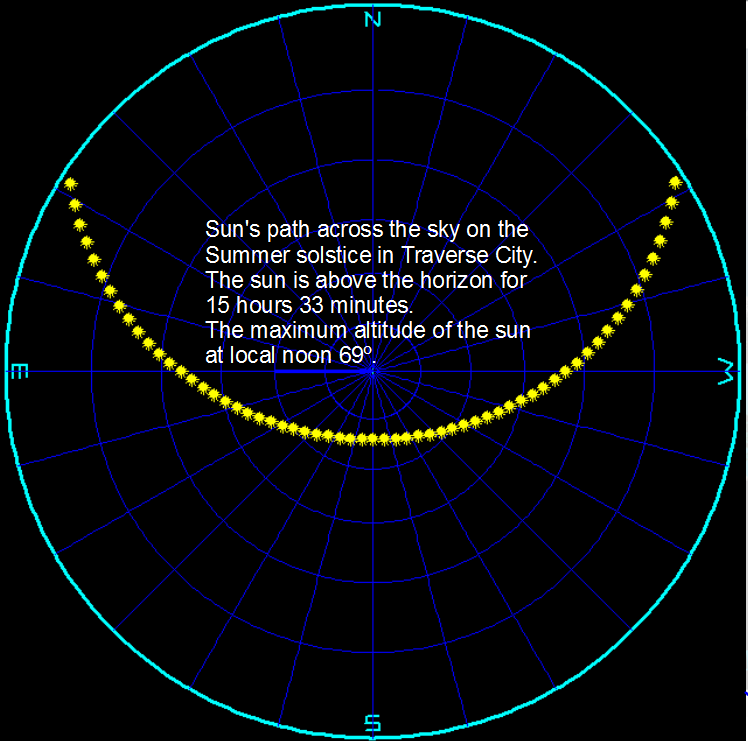
The sun’s daily path through the sky from horizon to horizon on the first day of summer, the summer solstice. Credit My LookingUp program.
One more diagram to illustrate the change in the sun’s north-south position in the sky.
This figure 8 is called an analemma. One can find it on old globes in the Pacific Ocean. Created using my LookingUp program.
This is the Sun plotted for mean solar noon over one year at 7 day intervals. One can see the rapid motion in the north-south position of the sun around the equinoxes versus the solstices. The more rapid the north-south motion of the Sun the greater the change in day-to-day daylight hours. The line with “East West” on it is the celestial equator. Check out my December 2, 2014 post on why it’s a figure 8.
01/09/2015 – Ephemeris – Tomorrow Mercury almost makes a conjunction with Venus but falls back
Ephemeris for Friday, January 9th. The sun will rise at 8:19. It’ll be up for 9 hours and 1 minute, setting at 5:20. The Moon, 4 days before last quarter, will rise at 10:06 this evening.
Low in the southwest just after sunset, say around 6 to 6:15 in the evening Venus and Mercury can be seen seeming to flirt with one another. Venus has been moving away from the Sun in the evening sky for a couple of month’s not, but hasn’t been all that visible. Mercury, named after the messenger of the gods is fleet of orbit and is almost about to catch up with Venus. Except it can’t, not this time. Tomorrow evening Mercury will appear closest to Venus about 0.6 angular degrees away, a bit more than the width of the Moon. So for another day the two planets will appear close. But after tomorrow night they will separate with Mercury not able to keep up. Next Tuesday it will reach its greatest elongation or separation from the sun and fall back.
Times are for the Traverse City/Interlochen area of Michigan. They may be different for your location.
Addendum
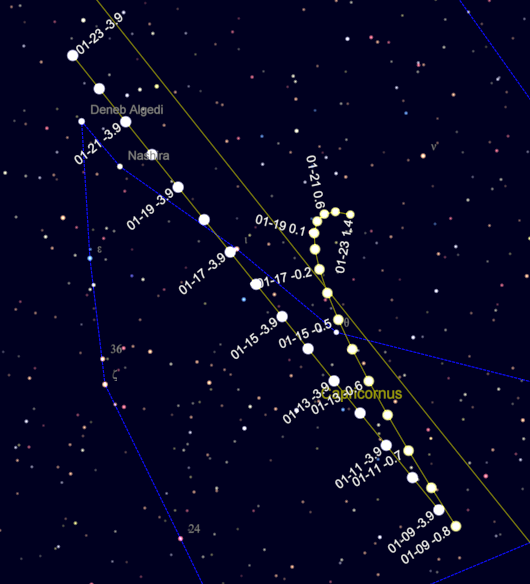
Venus, the straight track, and Mercury are shown for every evening from yesterday 1/08/15 to 01/23/15. The planets are marked for every night at 6 p.m. and tagged every other day. with month-day and magnitude. The higher the magnitude value the dimmer it is. Created using Cartes du Ceil (Sky Charts).
 Bob Moler's Ephemeris Blog