Archive
05/15/2015 – Ephemeris – The Grand Traverse Astronomical Society will be at the NMC Barbecue Sunday
Ephemeris for Friday, May 15th. Today the Sun will be up for 14 hours and 49 minutes, setting at 9:04. The Moon, 3 days before new, will rise at 5:27 tomorrow morning. Tomorrow the Sun will rise at 6:13.
The Grand Traverse Astronomical Society will participate in the Northwestern Michigan College Barbecue. The society will be in front of and inside the Health and Science Building, viewing the Sun outside and inside with displays and a program about meteorites. In the evening sky, Venus is getting to be an interesting sight in telescopes. It is still way too bright, so the earlier it can be spotted the better. Magnification helps with the brightness, but as Venus sinks in the sky its image will deteriorate, undulate with the upper air currents and develop color fringes due to the prismatic effects of the thick atmosphere down low. Venus will continue to grow larger, and its phase gets thinner until it’s too close to the Sun to spot.
Times are for the Traverse City/Interlochen area of Michigan. They may be different for your location.
Addendum

Observing the sun through GTAS members telescopes at the NMC Barbecue in 2012. Credit; Eileen Carlisle.
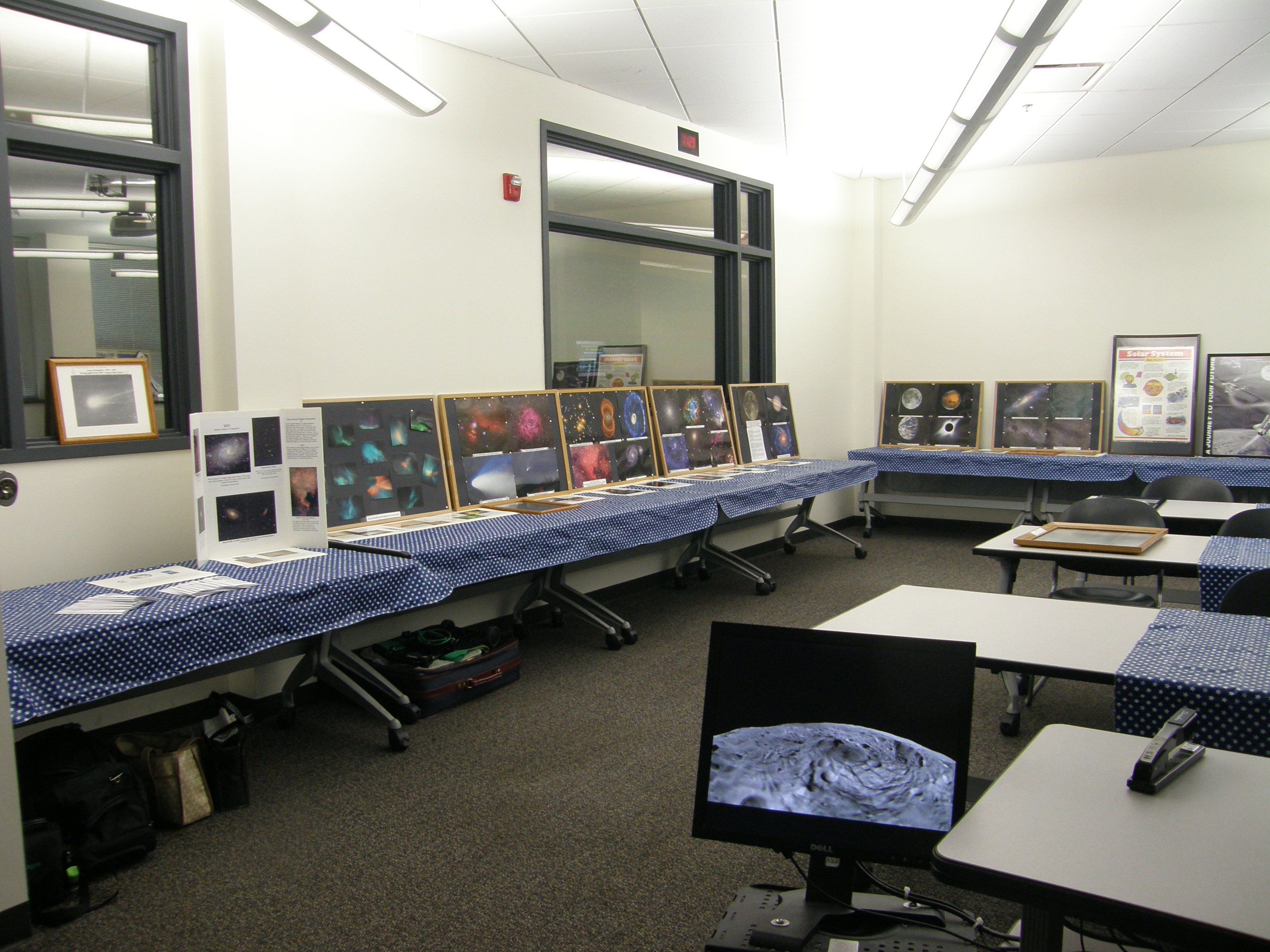
Astronomical photographs line the walls and tables of a classroom plus a series of astronomy videos are displayed at the NMC Barbecue. Credit: Eileen Carlisle.
05/14/2015 – Ephemeris – The constellation Virgo in mythology
Ephemeris for Thursday, May 14th. Today the Sun will be up for 14 hours and 46 minutes, setting at 9:02. The Moon, 3 days past last quarter, will rise at 4:51 tomorrow morning. Tomorrow the Sun will rise at 6:14.
Tonight in the sky: to the left of the constellation of Leo the lion, which lies in the west-southwest at 11 p.m. is the next constellation of the zodiac: Virgo the virgin, is seen in the south. Virgo is a large constellation of a reclining woman holding a stalk of wheat. The bright star in the center of the constellation, Spica, is the head of that spike of wheat; and as such ruled over the harvest in two of Virgo’s guises as the goddesses Persephone and Ceres. Virgo is also identified as Astraea the goddess of justice. The constellation of Libra, the scales, is found just east of her. Early Christians saw Virgo as the Virgin Mary. Virgo is the home of the Virgo Cluster of thousands of galaxies.
Times are for the Traverse City/Interlochen area of Michigan. They may be different for your location.
Addendum
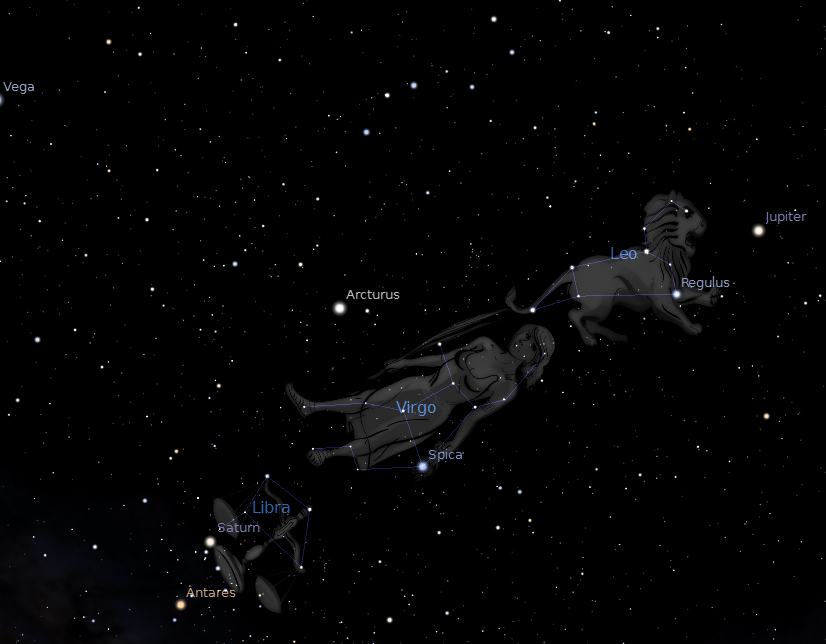
Virgo with the also mentioned constellations of Leo and Libra for 11 p.m., May 14, 2015. Created using Stellarium.
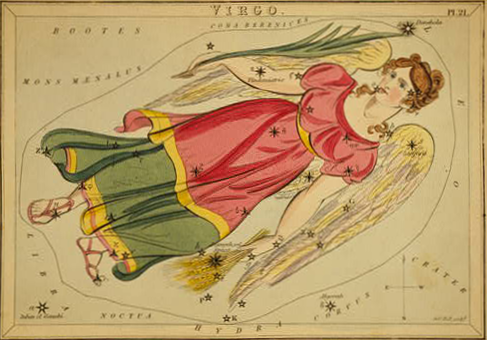
Virgo as depicted in Urania’s Mirror, a set of constellation cards published in London c.1825. From the Library of Congress. H/T Wikipedia.
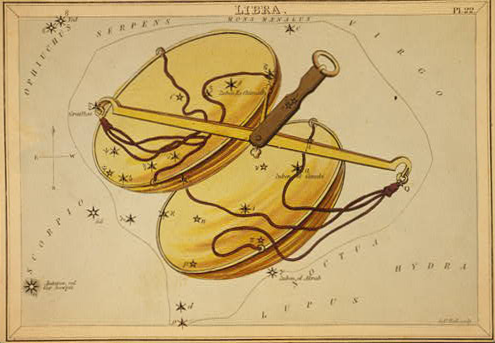
Libra as depicted in Urania’s Mirror, a set of constellation cards published in London c.1825. From the Library of Congress. H/T Wikipedia.
05/13/2015 – Ephemeris – The bright planets including a last look at Mercury for a while
Ephemeris for Wednesday, May 13th. Today the Sun will be up for 14 hours and 44 minutes, setting at 9:01. The Moon, 2 days past last quarter, will rise at 4:17 tomorrow morning. Tomorrow the Sun will rise at 6:16.
Lets take a look at the bright planets for this week. Mercury is low in the west-northwestern sky after sunset. It’s at a 19 degrees angle from the sun and will set at 10:47. Mercury is getting dimmer as its phase becomes a decreasingly thin crescent. Our brilliant evening star Venus is in the west by 9:30 p.m. It will set at 12:44 a.m. Jupiter will appear high in the west-southwestern sky before 10 p.m. It will set at 2:43 a.m. It’s near the sickle-shaped head of Leo the lion, and it’s the second brightest star-like object in the sky after Venus. Saturn will rise in the east-southeast at 9:33 p.m. It will be low in the southwest as morning twilight brightens. It’s rings and the moon Titan can be seen in small telescopes.
Times are for the Traverse City/Interlochen area of Michigan. They may be different for your location.
Addendum
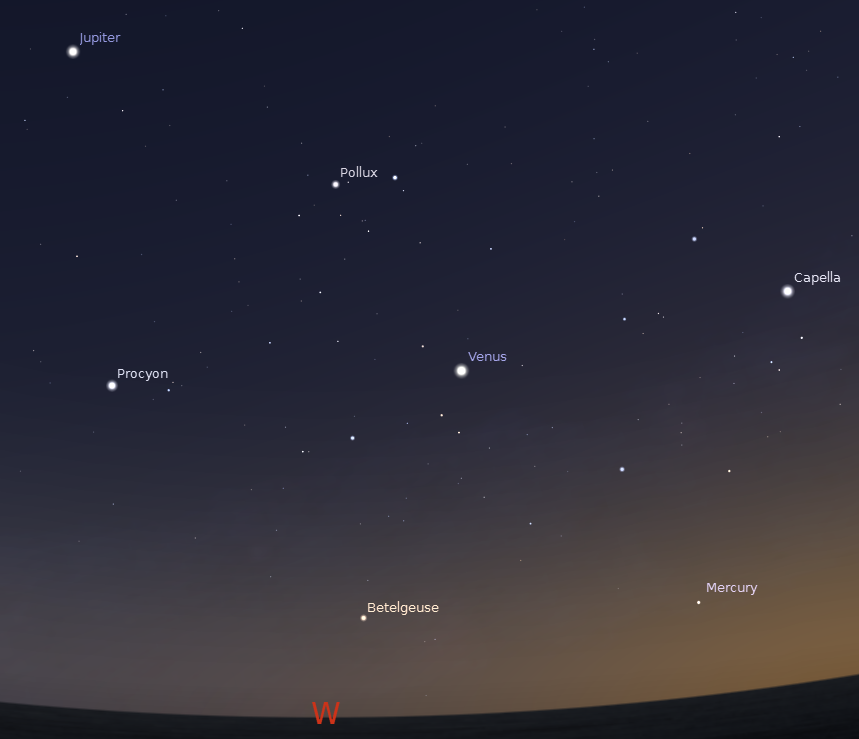
Mercury, Venus, Jupiter and the setting stars of winter at 10 p.m., May 13, 2015. Created using Stellarium.

Venus through a telescope, over exposed to match the brilliant orb of Venus, on May 13, 2015. Created using Carted du Ceil (Sky Charts).
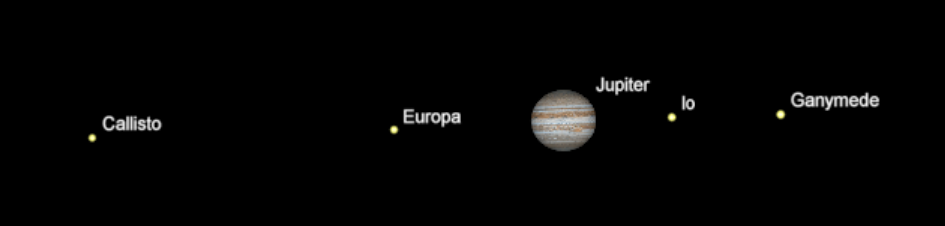
Jupiter and its moons at 10 p.m. May 13, 2015. Created using Cartes du Ciel (Sky Charts).
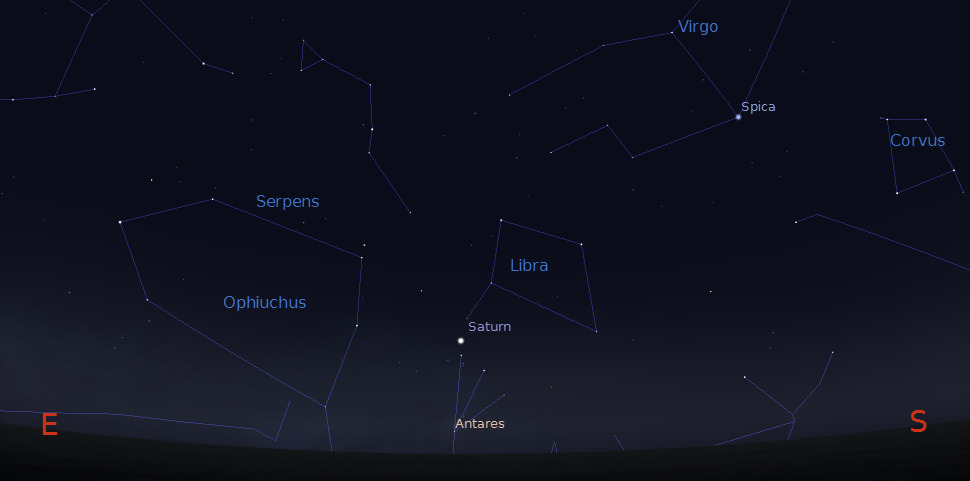
Saturn above the southeastern horizon with the stars of late spring at 11 p.m. May 13, 2015. Created using Stellarium.
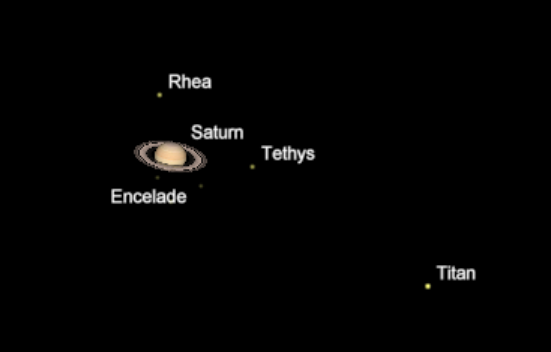
What Saturn and its moons might appear like in a telescope the night of May 6-7, 2015. Small telescopes will show only the moon Titan. Same scale/magnification as Jupiter and Venus. Created using Cartes du Ceil (Sky Charts).
05/12/2015 – Ephemeris – Arcturus, a look at the Sun’s future
Ephemeris for Tuesday, May 12th. Today the Sun will be up for 14 hours and 42 minutes, setting at 9:00. The Moon, 1 day past last quarter, will rise at 3:43 tomorrow morning. Tomorrow the Sun will rise at 6:17.
Arcturus, a red giant star is about midway up the sky in the southeast at 10 p.m. It’s visible earlier, being the 4th brightest night-time star and the third brightest star-like object out at that time after Venus and Mars. A pointer to it is the handle of the Big Dipper, following the arc of the handle to Arcturus. Though only 37 light years away, it’s not from around here. It’s passing through the galactic disk from north to south. Arcturus is about 7 billion years old, and is about 8% more massive than our Sun. It appears to be starting its red giant phase, after running out of hydrogen to fuse to helium in its core and is beginning to fuse helium. It’s a preview of coming attractions for our Sun when it gets that old.
Times are for the Traverse City/Interlochen area of Michigan. They may be different for your location.
Addendum
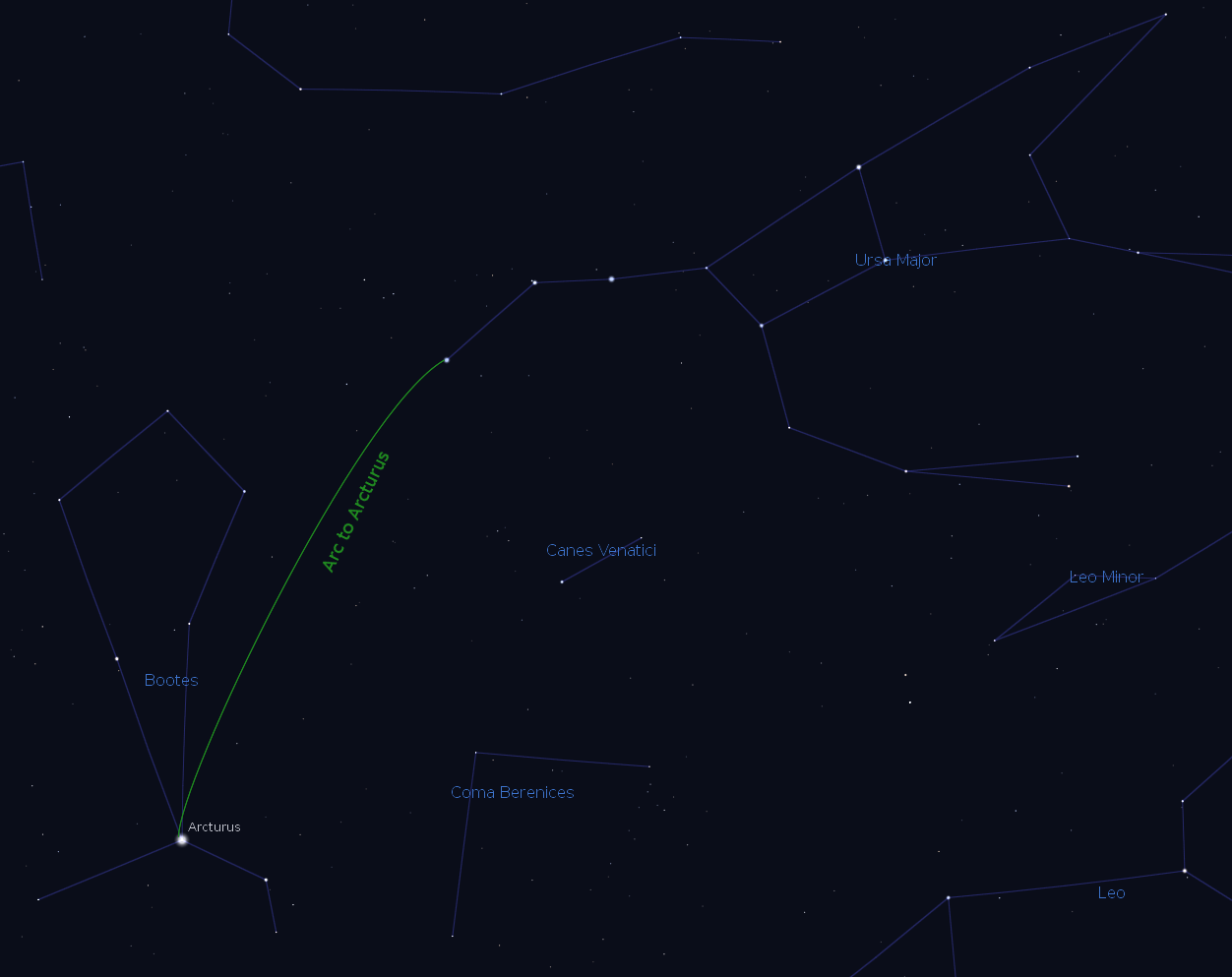
Finding Arcturus. Orientation for 11 p.m. on May 12, 2015. Created using Stellarium.

Evolution of a sun-like star. Note the sizes of the star at the various stages are compressed, also the time line. In the red giant stage the star is possibly a hundred times larger than at the main sequence stage. The white dwarf stage is a hundred times smaller than the main sequence stage. Click to enlarge. Credit: From a NASA/Chandra poster.
05/11/2015 – Ephemeris – How to find the constellation Virgo
Ephemeris for Monday, May 11th. Today the Sun will be up for 14 hours and 39 minutes, setting at 8:59. The Moon, at last quarter today, will rise at 3:08 tomorrow morning. Tomorrow the Sun will rise at 6:18.
Friday I talked about that in spring we are looking out the thin side of our Milky Way galaxy’s disk. One of the large constellations we see in the south at 11 p.m. can be found using the Big Dipper overhead, follow the arc of the handle to the bright star Arcturus, the straighten the arc to a spike to reach Spica, a bright blue-white star in the south. Spica is the brightest star in the constellation Virgo the virgin. She represents the goddess of the harvest, Virgo is holding a sheaf of wheat in depictions of her, and Spica is placed at the head of the sheaf. In the space between Spica and Leo the lion to her right is, a great cluster just below naked eye visibility. The Virgo cluster of galaxies.
Times are for the Traverse City/Interlochen area of Michigan. They may be different for your location.
Addendum
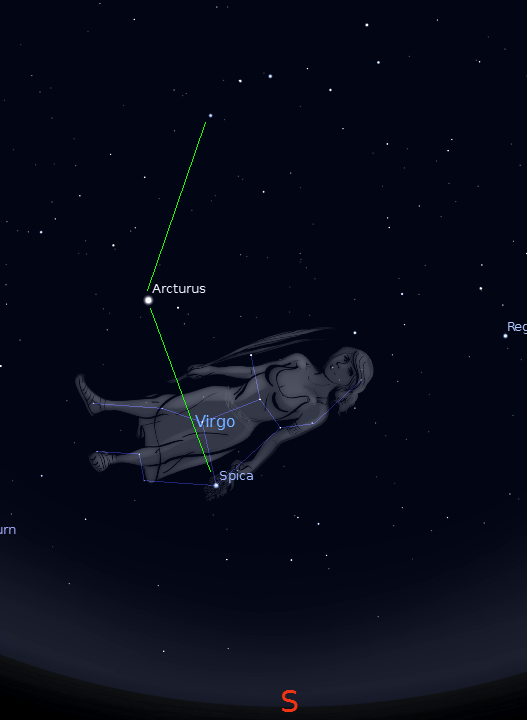
Star hop from the Big Dipper through Arcturus to Spica and Virgo. Orientation for 11 p.m. on May 11, 2015. Created using Stellarium.
05/08/2015 – Ephemeris – May’s missing Milky Way
Ephemeris for Friday, May 8th. Today the Sun will be up for 14 hours and 32 minutes, setting at 8:55. The Moon, 3 days before last quarter, will rise at 1:08 tomorrow morning. Tomorrow the Sun will rise at 6:22.
In May we look up to the sky and notice that the Milky Way is missing. Will not really it’s as if the sky has pattern baldness with the Milky Way as a fringe on the horizon around the north half of the sky. Overhead, where none should be is a galactic star cluster, a star cluster that should normally be in the Milky band. That cluster is the constellation of Coma Berenices. Its is a sparse star cluster of about 50 stars only 288 light years away. If we were a thousand light years from it, it would appear in the Milky band. One notes too that the stars of spring are also fewer, not the riot of stars we see in the winter or late summer. The Milky Way galaxy is a thin disk, and in spring we are looking out the thin side.
Times are for the Traverse City/Interlochen area of Michigan. They may be different for your location.
Addendum
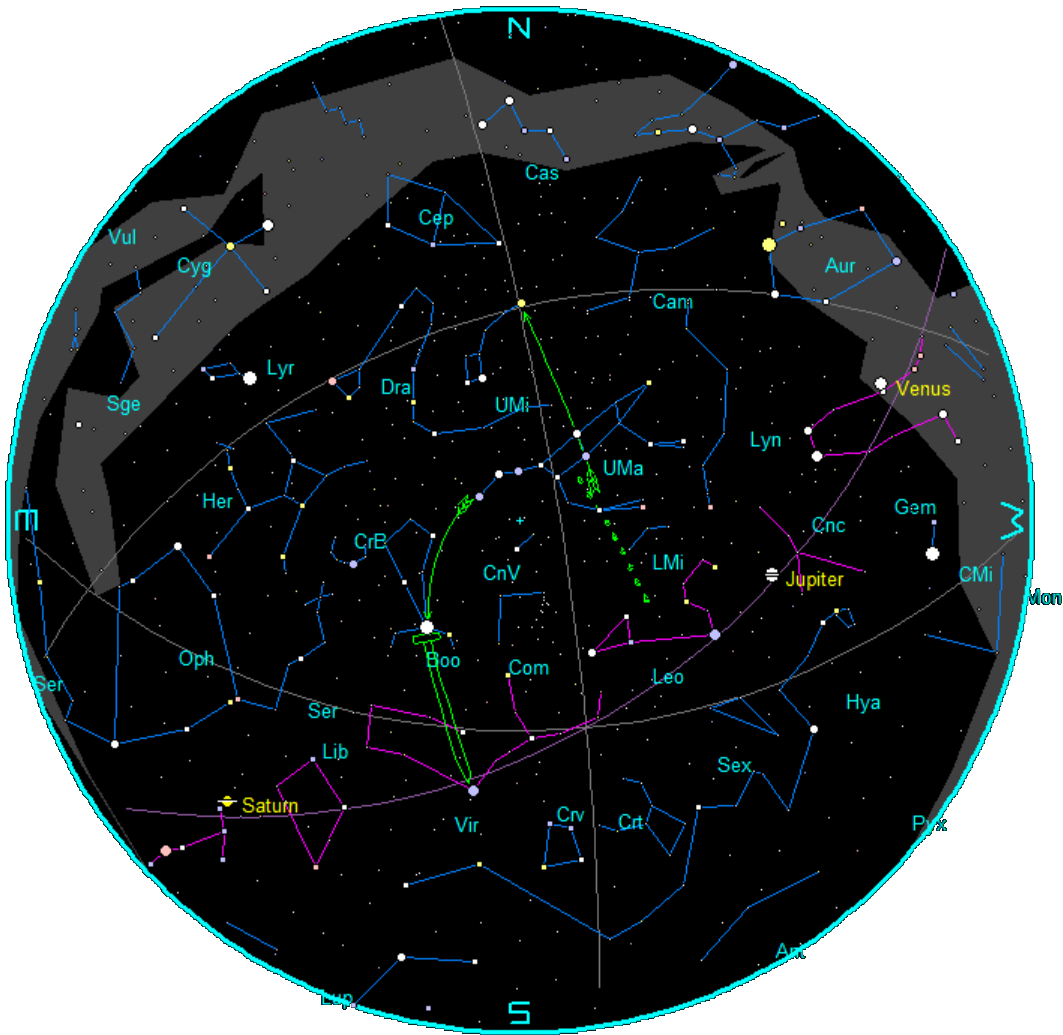
Star Chart for May 2015. Note the Milky way in the north. The Coma Berenices cluster is located between the labels CnV and Com. Created using my LookingUp program.
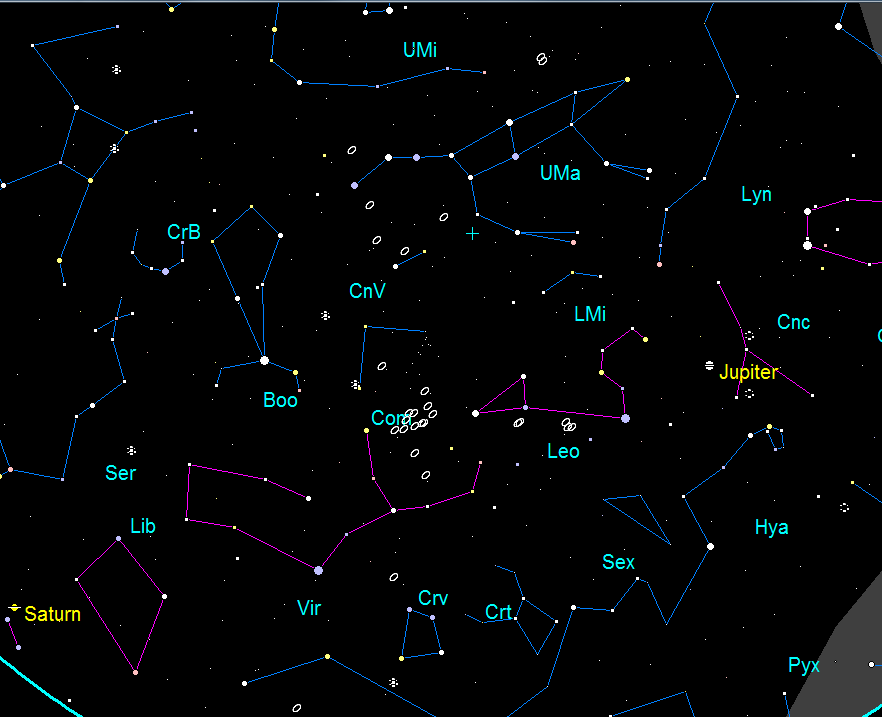
Messier objects, mostly galaxies (ovals) in the spring sky. Created using my LookingUp program.
Most of the galaxies in the above chart belong to the Virgo Cluster a cluster of several thousand galaxies about 53 million light years away. Charles Messier was a comet hunter active in the period around the time of the American Revolution at the Paris Observatory. He made a catalog of fuzzy objects he ran into that didn’t move and thus were not comets. The Messier catalog, which ran to 110 galaxies, star clusters and nebulae, some added posthumously, became a must-see list of some of the best sights for the telescope.
05/07/2015 – Ephemeris – Mercury is at greatest eastern elongation today
Ephemeris for Thursday, May 7th. Today the Sun will be up for 14 hours and 30 minutes, setting at 8:54. The Moon, half way from full to last quarter, will rise at 12:20 tomorrow morning. Tomorrow the Sun will rise at 6:23.
The tiny planet Mercury has been in the news lately because the MESSENGER spacecraft plunged onto its surface a week ago, after having mapped and studied chemical composition of this planet for four years. Today, for Mercury watchers from the Earth, it reached its greatest angular separation from the sun in its orbit, of 21 degrees just before 1 a.m. Mercury has always been a tough planet to study, low to the horizon in twilight. It’s also a tough planet to get to with a spacecraft, being far down the Sun’s gravity well. MESSENGER took 7 years to get there, bleeding off energy by passing Earth, Venus and Mercury itself to fall into orbit of this little world that was full of surprises.
Times are for the Traverse City/Interlochen area of Michigan. They may be different for your location.
Addendum
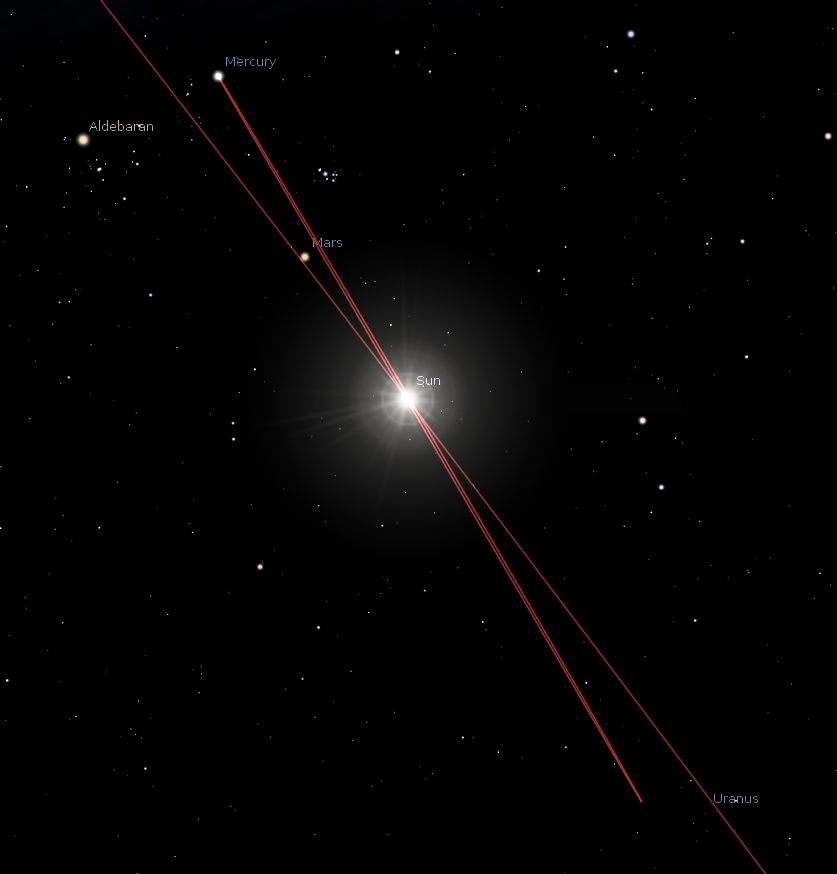
Mercury’s orbit as seen from about 45 degrees north latitude Earth at the greatest eastern elongation at sunset on May 7, 2015. Created using Stellarium.
°
The other red line is the plane of the Earth’s orbit. In the spring at sunset it is much closer to vertical than in autumn. The angle of the ecliptic to the horizon at sunset on the vernal equinox is 90° – (your latitude) + 23.5°. Here near 45° north latitude it’s 68.5°. For the sunset at the autumnal equinox the formula is 90° – (your latitude) – 23.5° or 21.5°. The ecliptic will really lay down making planets close to the direction of the Sun hard to spot. In the morning sky the ecliptic will be steep at the autumnal equinox and lay down at the vernal equinox. Thus the best time to spot Mercury, which never strays far from the sun is on late winter and spring evenings and late summer and autumn mornings. Also note that Mercury’s 7 degree inclination to the ecliptic helps it now.
Also note that we are seeing Mercury’s orbit nearly edge on. It will be edge-on in a couple of days. It so happens that a year from now, the morning of May 9th, 2016, for us in the United States, Mercury will transit, or cross in front of, the Sun. Three years ago this June we witnessed the extremely rare transit of Venus. The transit of Mercury isn’t as spectacular or rare, but it’s rare enough.
05/06/2015 – Ephemeris – Wednesday is planet day or night on Ephemeris
Ephemeris for Wednesday, May 6th. Today the Sun will be up for 14 hours and 27 minutes, setting at 8:53. The Moon, 3 days past full, will rise at 11:26 this evening. Tomorrow the Sun will rise at 6:24.
Lets take a look at the bright planets for this week. Mercury is low in the west-northwestern sky after sunset. It’s at a 21 degrees angle from the sun and will set at 10:52. Our brilliant evening star Venus is high in the west by 9:30 p.m. It will set at 12:37 a.m. Jupiter will appear high in the west-southwestern sky before 10 p.m. It will set at 3:05 a.m. It’s near the sickle-shaped head of Leo the lion, and it’s the second brightest star-like object in the sky after Venus. In telescopes, Jupiter’s moon Europa will pass in front of Jupiter starting at 1:43 a.m. Saturn will rise in the east-southeast at 10:33 p.m. It will be low in the south as morning twilight brightens. It’s rings and the moon Titan can be seen in small telescopes.
Times are for the Traverse City/Interlochen area of Michigan. They may be different for your location.
Addendum
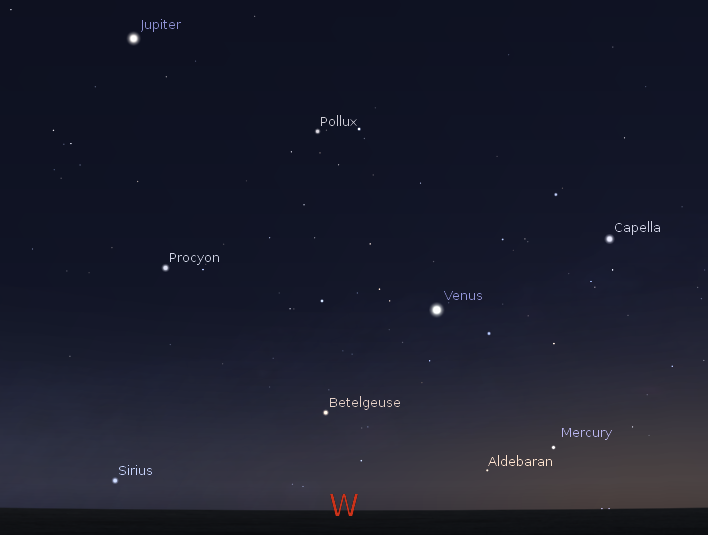
Mercury, Venus, Jupiter and the setting stars of winter at 10 p.m., May 6, 2015. Created using Stellarium.
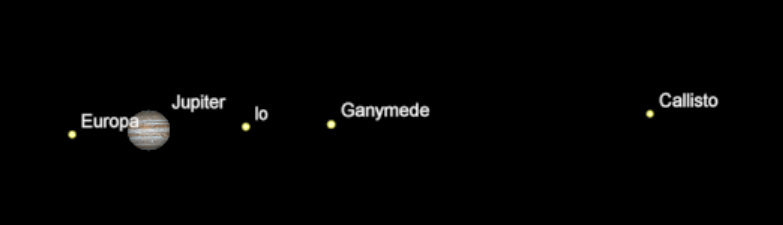
Jupiter and its moons at 10 p.m. May 6, 2015. Created using Cartes du Ciel (Sky Charts).
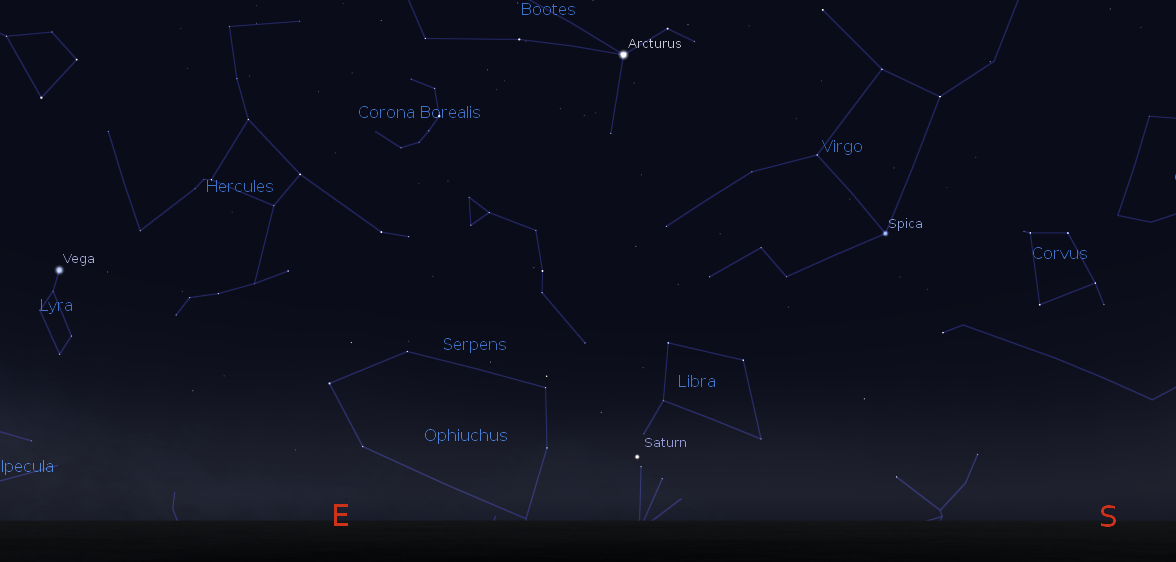
Saturn above the southeastern horizon with the stars of late spring at 11 p.m. May 6, 2015. Created using Stellarium.
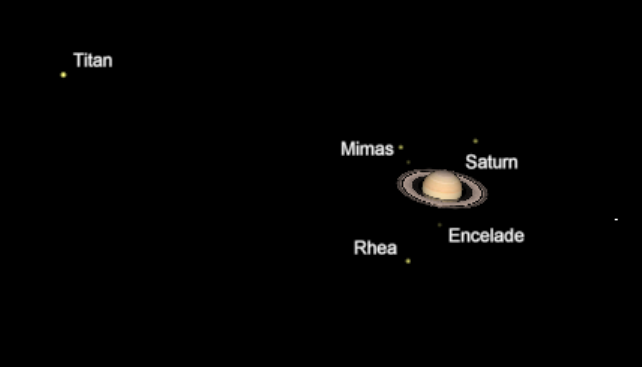
What Saturn and its moons might appear like in a telescope the night of May 6-7, 2015. Small telescopes will show only the moon Titan. Created using Cartes du Ceil (Sky Charts).
05/05/2015 – Ephemeris – Eta Aquariids, an early visit of Halley’s Comet
Ephemeris for Tuesday, May 5th. Today the Sun will be up for 14 hours and 24 minutes, setting at 8:52. The Moon, 2 days past full, will rise at 10:29 this evening. Tomorrow the Sun will rise at 6:26.
The Eta Aquariid meteor shower will reach peak tomorrow morning. But the Moon will be bright, so only the brightest of them will be seen. However if you’re waiting to see the return of Halley’s Comet, you needn’t wait until the main body of the comet returns in 2061. Halley’s Comet has made many passes of the inner solar system in recorded history, and many more before that, returning to the inner solar system every 76 years or so, before returning to its frigid home beyond Neptune. It’s closest to the Sun, called perihelion is inside Venus’ orbit. On the way in and out it passes close to the Earth’s orbit. It has left a trail of debris, which we pass through in May and again in October.
Times are for the Traverse City/Interlochen area of Michigan. They may be different for your location.
Addendum
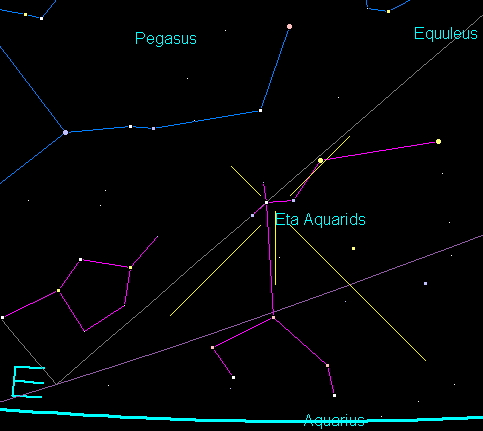
The Eta Aquariid radiant at 5 a.m. The radiant moves slowly to the east with time. Credit: My LookingUp program.
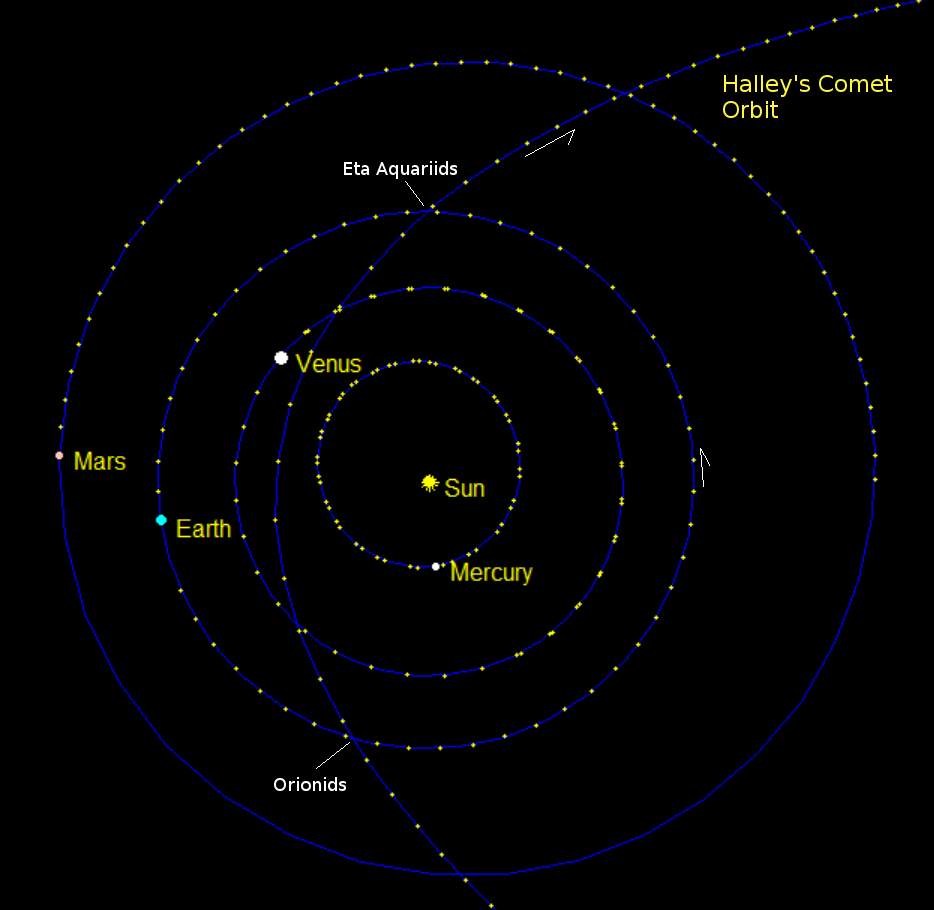
We get two meteor showers from Halley’s Comet. The Orionids, when Halley is approaching the inner solar system, and the Eta Aquariids when it’s leaving. Credit: My LookingUp program.
05/04/2015 – Ephemeris – Last good evening appearance of Mercury for the year*
Note: This program was recorded before the MESSENGER spacecraft crashed into Mercury.
Ephemeris for Monday, May 4th. Today the Sun will be up for 14 hours and 22 minutes, setting at 8:51. The Moon, 1 day past full, will rise at 9:29 this evening. Tomorrow the Sun will rise at 6:27.
The tiny and elusive planet Mercury will be making its final easily observable evening appearance of the year. For the next week or so. Not that Mercury is ever easy to spot. The MESSENGER spacecraft, which has been orbiting Mercury for the past four years is out of fuel and is descending to an impact any day now. It may already have. Mercury is the smallest planet only 50% larger than the diameter of our Moon. There are two planetary satellites larger than it: Jupiter’s Ganymede and Saturn’s Titan. It is a whole lot larger than Pluto, which was demoted to dwarf planet 9 years ago. Mercury is the second densest planet after the Earth. And even Venus with its greenhouse effect is hotter.
Times are for the Traverse City/Interlochen area of Michigan. They may be different for your location.
*For northern hemisphere viewers.
Addendum
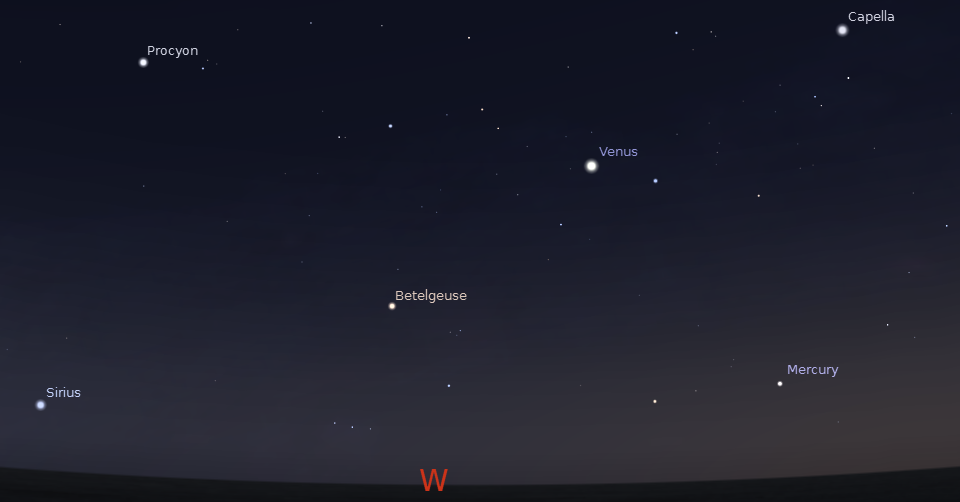
Mercury, Venus and the setting stars of winter at 10 p.m., May 4, 2015. Created using Stellarium.
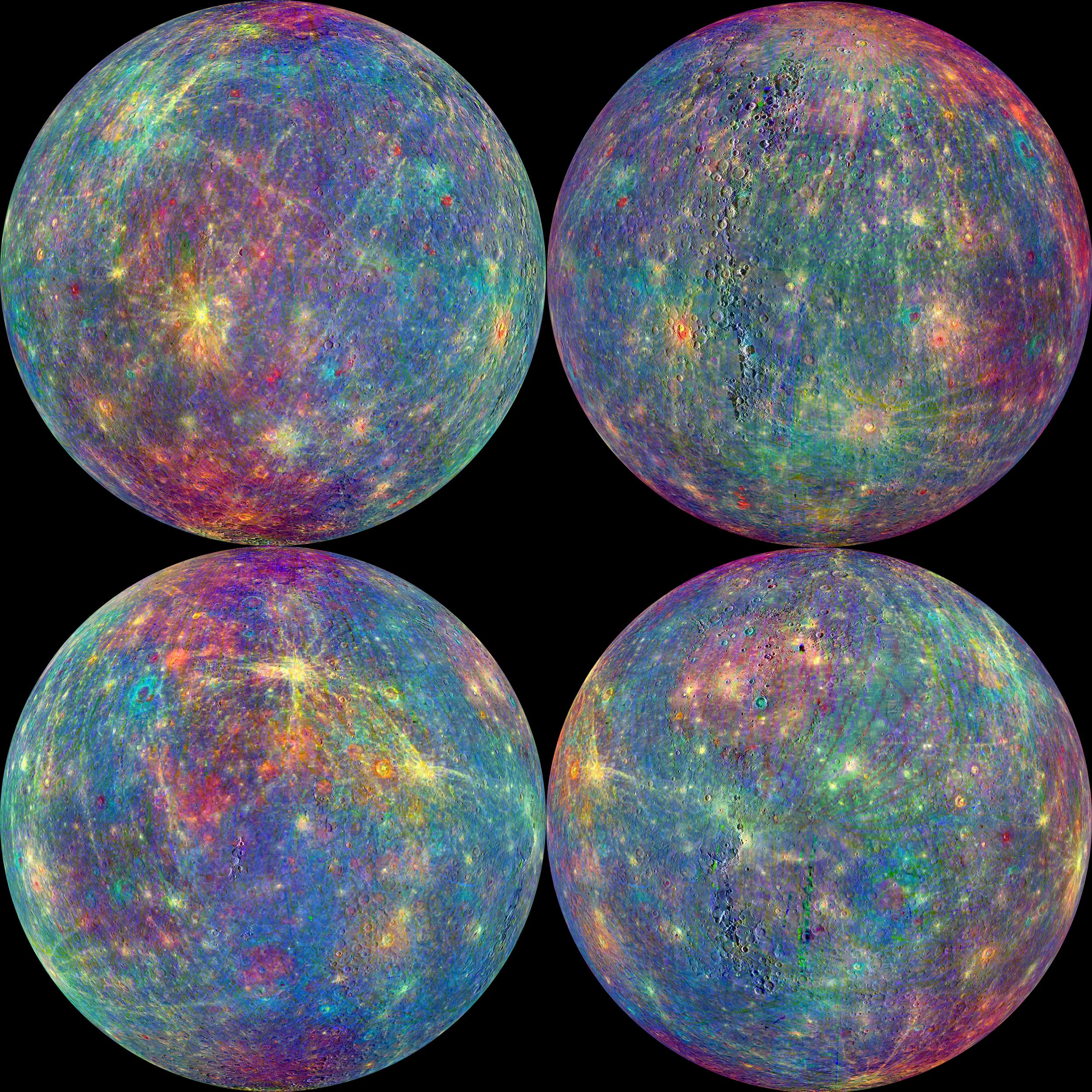
Four views of Mercury with colors based on the mineralogy seen. Credit: NASA/Johns Hopkins University Applied Physics Laboratory/Carnegie Institution of Washington. Click on image to enlarge.
 Bob Moler's Ephemeris Blog