Archive
07/17/2015 – Ephemeris – The constellation of the harp now and Venus and the Moon tomorrow night.
Ephemeris for Friday, July 17th. Today the Sun will be up for 15 hours and 11 minutes, setting at 9:24. The Moon, 2 days past new, will set at 10:07 this evening, and tomorrow the Sun will rise at 6:14.
High in the east at 11 p.m. can be found a bright star just above a small, narrow, but very distinctive parallelogram of stars. They are the stars of the constellation Lyra the harp. The bright star is Vega, one of the twenty one brightest stars, called first magnitude stars. Vega is actually the 5th brightest night time star. The harp, according to Greek mythology, was invented by the god Hermes. The form of the harp in the sky, is as he had invented it: by stretching strings across a tortoise-shell. Hermes gave it to his half-brother Apollo, who in turn gave it to the great musician Orpheus.
Looking westward tomorrow night the planet Venus will appear about 2 moon widths above the crescent Moon.
Times are for the Traverse City/Interlochen area of Michigan. They may be different for your location.
Addendum
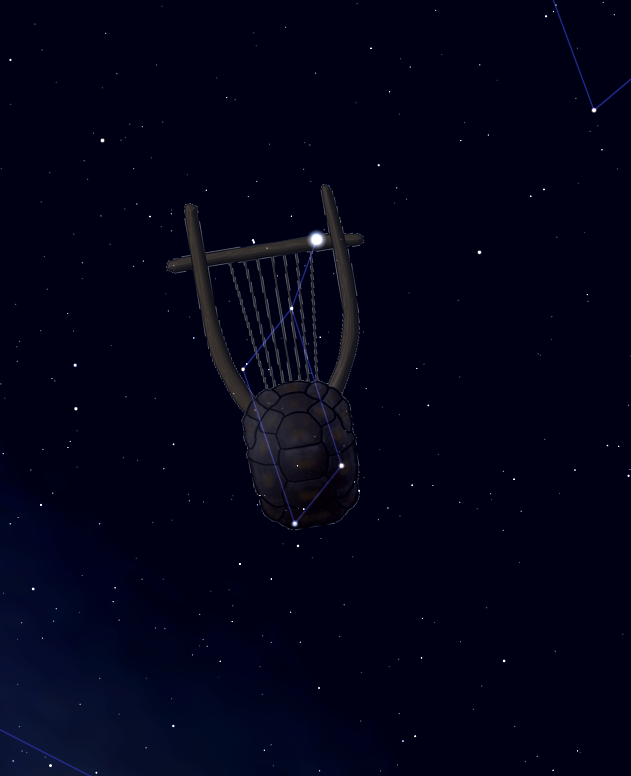
Lyra as a tortoise-shell harp. Created using Stellarium and free clip art.
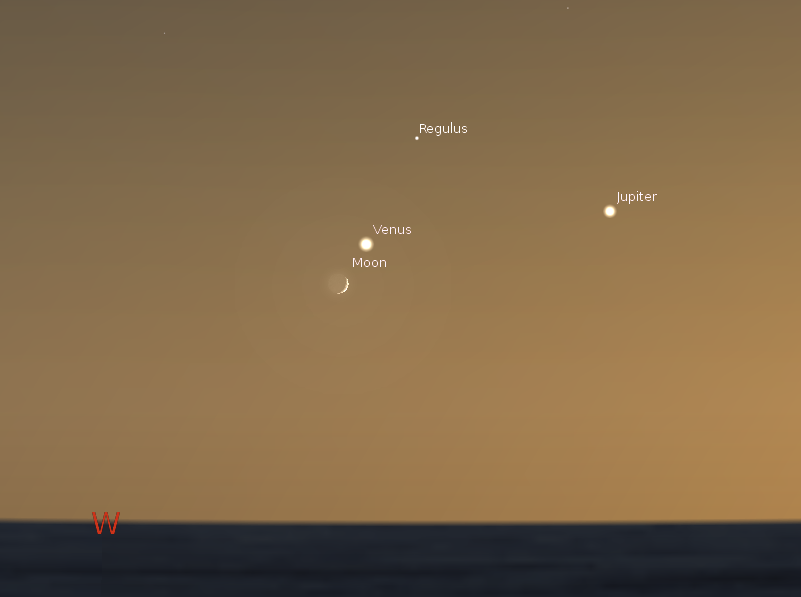
Venus appears above the thin crescent moon with Jupiter to the right at 10 p.m. Saturday July 18, 2015. Created using Stellarium.
07/16/2015 – Ephemeris – The Summer Triangle is the sign of the season
Ephemeris for Thursday, July 16th. Today the Sun will be up for 15 hours and 12 minutes, setting at 9:25. The Moon, 1 day past new, will set at 9:32 this evening, and tomorrow the Sun will rise at 6:13.
We’re almost a month into summer, and the asterism or informal constellation called the Summer Triangle can be seen midway up the sky in the east as it gets dark. Highest of the three bright stars is Vega in the constellation Lyra the harp, whose body is seen in a narrow parallelogram nearby. The second star of the triangle is Deneb lower and left of Vega, It appears dimmer than Vega because it is by far the most distant of the three. The third star of the Summer Triangle is seen farther below and a right of Vega. It is Altair in Aquila the eagle, and the closest. Altair is 16.5 light years away, Vega is 27 light years while Deneb is so far away that it’s distance is in some doubt and may be 2,600 light years away.
Times are for the Traverse City/Interlochen area of Michigan. They may be different for your location.
Addendum
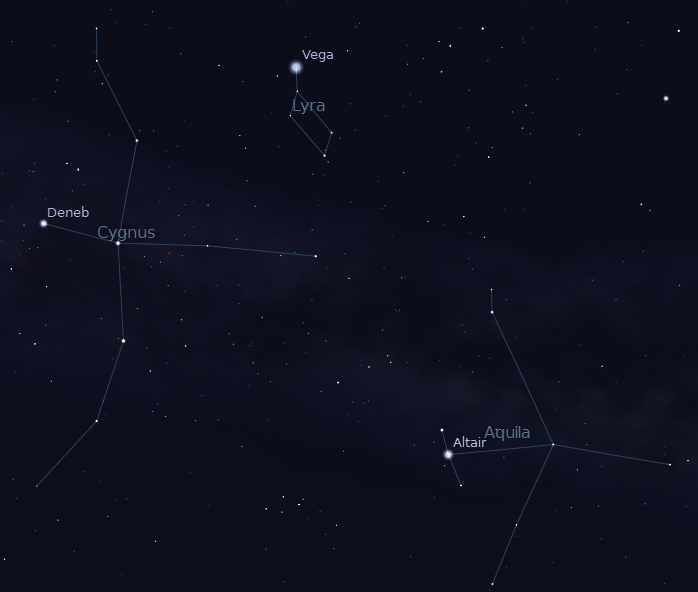
Summer Triangle. Created using Stellarium.
07/15/2015 – Ephemeris – Venus and Jupiter are dipping lower in the west
Ephemeris for Wednesday, July 15th. Today the Sun will be up for 15 hours and 14 minutes, setting at 9:25. The Moon is new today, and won’t be visible. Tomorrow the Sun will rise at 6:12.
Lets take a look at the bright planets for this week. Our evening stars Venus and Jupiter are still side by side in the west by 9:45 p.m. They both will set near 10:55 p.m.. Venus’ will slide down to the Sun faster and faster in the coming weeks leaving Jupiter behind for a while. Venus will take 1 month to slide past the Sun. Jupiter though will take 6 weeks, so Venus will pass it again around August 4th when both are too close to the horizon and Sun to spot. There’s a third conjunction of these two in October in the morning sky with Mars nearby. Saturn is in the south in the evening twilight. It will pass due south at 9:55 p.m. and will set at 2:44 a.m. Even small telescopes can see Saturn’s rings.
Times are for the Traverse City/Interlochen area of Michigan. They may be different for your location.
Addendum
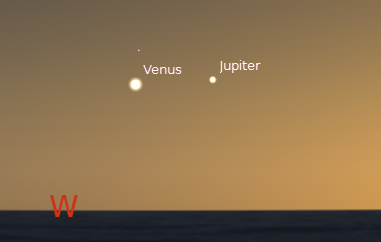
Venus and Jupiter will be about 9 degrees above the western horizon at 10 p.m. (45 minutes after sunset if you’re not from around here) on July 15, 2015. Created using Stellarium.
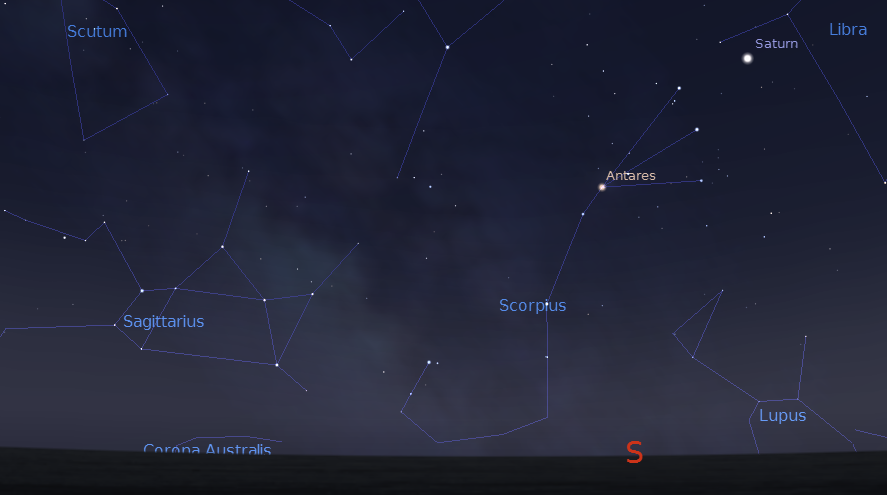
Saturn with Scorpius and the Teapot of Sagittarius at 10:30 p.m., July 15, 2015. Created using Stellarium.
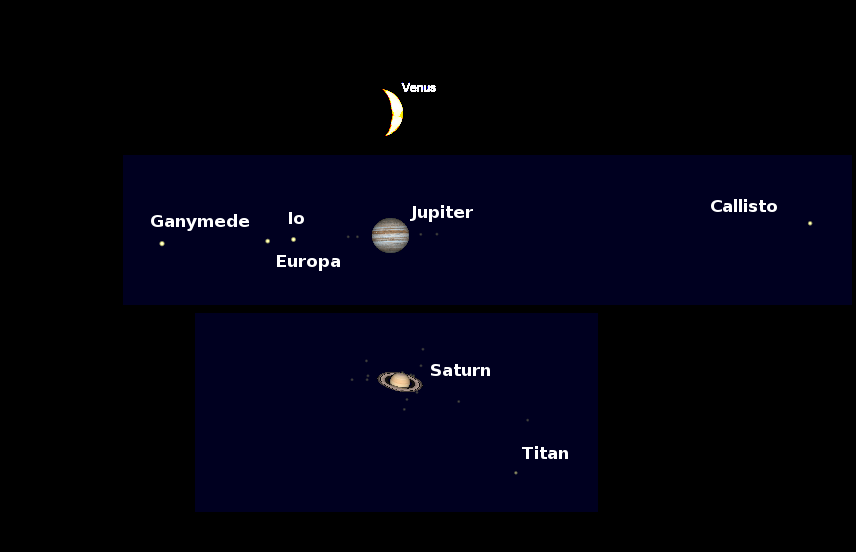
Comparative apparent sizes of the evening planets as seen through a telescope of the same magnification. Created using Cartes du Ciel (Sky Charts).
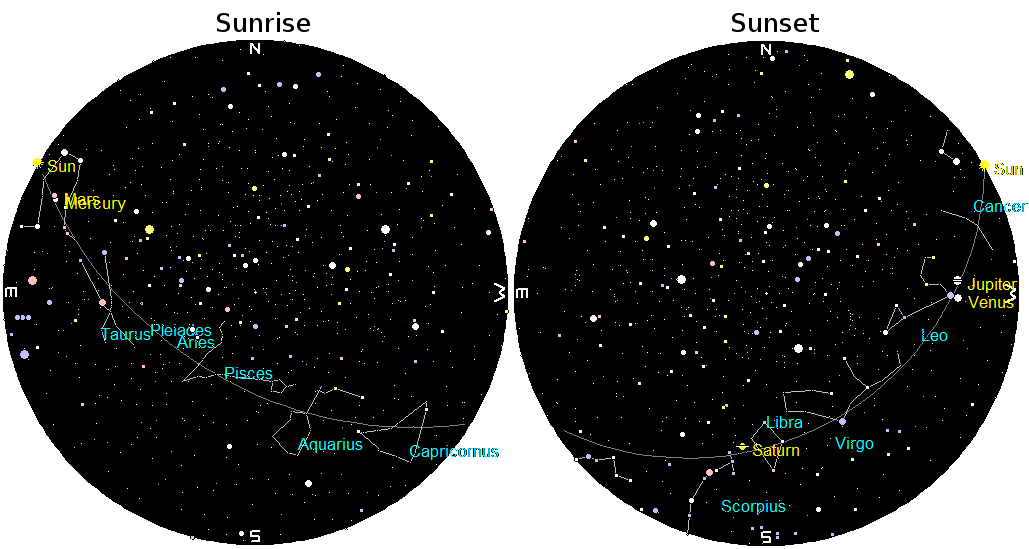
This is a chart adapted from the one I publish monthly as my role as the editor of the Grand Traverse Astronomical Society newsletter the Stellar Sentinel. It’s for sunrise and sunset for July 15, 2015 showing the location of the planets at that time. I’m bringing it to Wednesday Planet Day on this blog. Created using my LookingUp program. Click on the image to enlarge.
07/14/2015 – Ephemeris – New Horizons is beginning its encounter with Pluto right now
Ephemeris for Tuesday, July 14th. Today the Sun will be up for 15 hours and 16 minutes, setting at 9:26. The Moon, 1 day before new, will rise at 6:01 tomorrow morning, and tomorrow the Sun will rise at 6:11.
Right now as I speak the New Horizons spacecraft is beginning its pass through the Pluto system of the dwarf planet itself, its huge moon Charon and four smaller moons. It’s nail-biting time, because the spacecraft will be too busy to send anything back immediately. Everything will be stored for playback over the next 16 months. We will expect to hear from it at 9:02 tonight when a brief phone home signal will be sent to confirm the probe’s survival. Already this morning 7 of NASA’s deep space network antennas will have blasted a radio signal to Pluto* in time for the spacecraft to receive the signal as it passes behind first Pluto and Charon to probe their atmospheres. Tomorrow we will expect to receive the first closeup images.
Times are for the Traverse City/Interlochen area of Michigan. They may be different for your location.
*I’ve since found out that the signal will be broadcast from those antennas from 4:30 to 6:30 a.m. EDT, Check with DSN Now: http://eyes.nasa.gov/dsn/dsn.html. DSN Now shows all the antennas of all the DSN sites. Those antennas transmitting or receive data from New Horizons will have the label NHPC.
Addendum
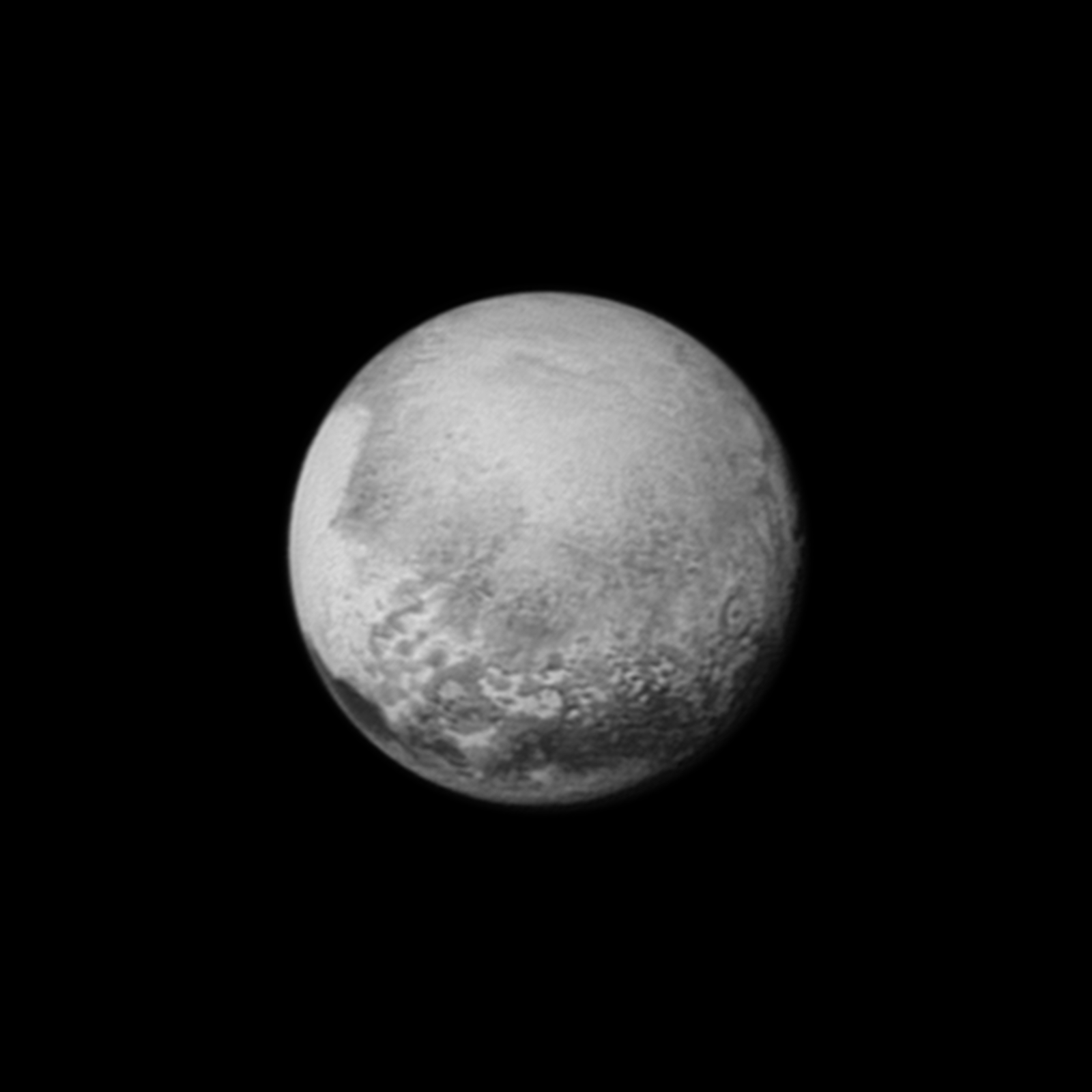
Last image of Pluto posted before the encounter. Note that the “Heart” is rotating into view on the left. Credit: NASA/Johns Hopkins University Applied Physics Laboratory/Southwest Research Institute. Click on image to enlarge.
07/13/2015 – Ephemeris – New Horizons’ encounter with Pluto just 1 day to go!
Ephemeris for Monday, July 13th. Today the Sun will be up for 15 hours and 17 minutes, setting at 9:27. The Moon, 2 days before new, will rise at 5:05 tomorrow morning, and tomorrow the Sun will rise at 6:10.
The New Horizons spacecraft is hopefully Go for its encounter with Pluto and its moons tomorrow morning (July 14, 2015), and tomorrow New Horizons will be working in radio silence because it will be too busy to turn and relay anything to the Earth. Tomorrow evening we should get a signal from the spacecraft with engineering data on its survival of the encounter. Any photographs will be sent starting Wednesday. Pretty pictures are not the only data to be sent back. It will take 16 months to get all the data sent back. A series of highly compressed images will be sent for the next 6 days. Then other data will be taking priority until September 14th when photographs will again be sent. We’ll be feasting on the information for quite some time.
Times are for the Traverse City/Interlochen area of Michigan. They may be different for your location.
Addendum
The following images are shown in chronological order as New Horizons approaches Pluto and Charon. Click on any of these images to enlarge.
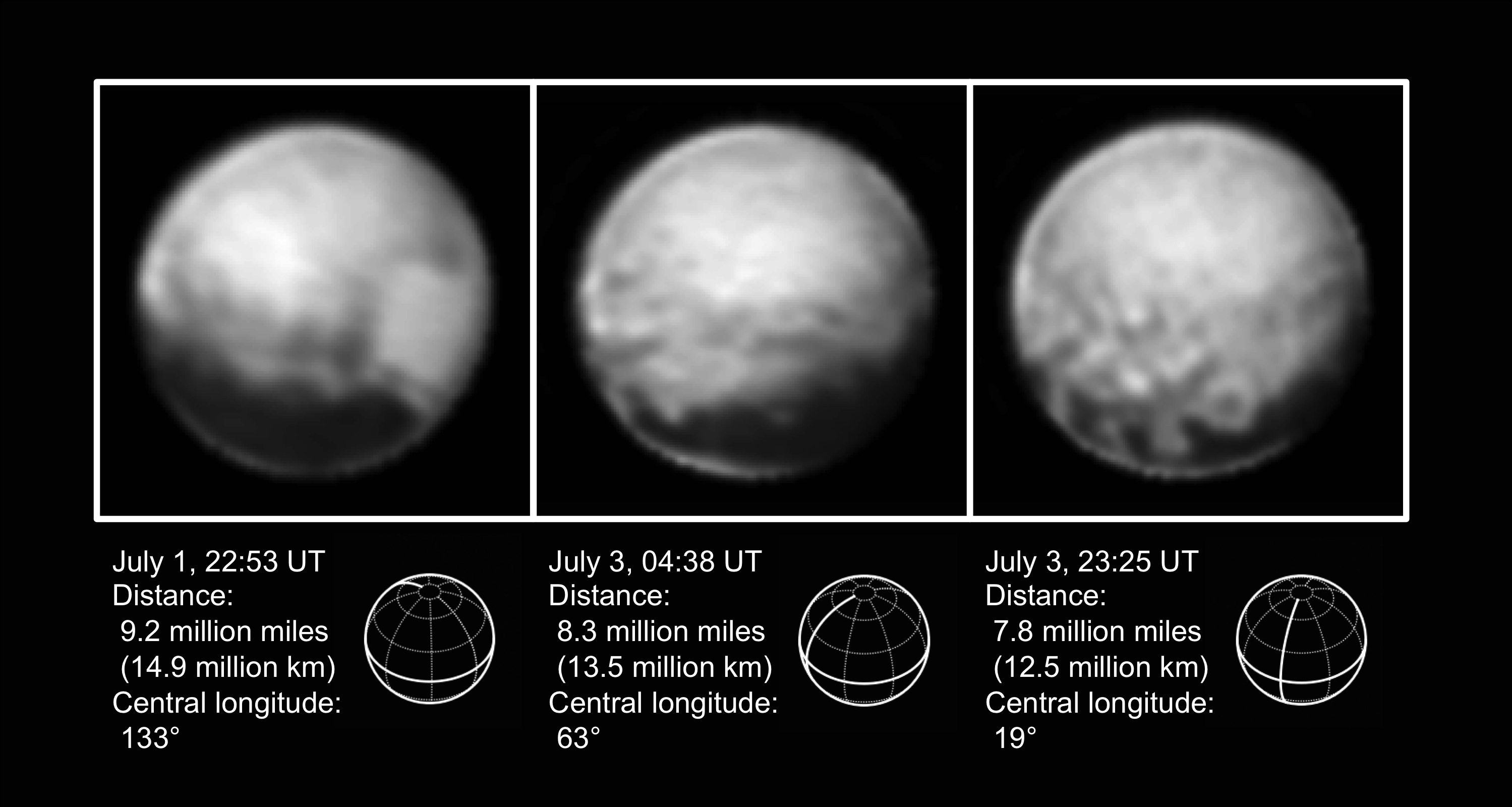
Pluto on three consecutive days: July 2-3 as the Pluto rotates not quite half a rotation. It’s rotation period is 6.4 Earth-days. Credit: NASA/Johns Hopkins University Applied Physics Laboratory/Southwest Research Institute.
On July 4, the spacecraft went into safe mode. Imaging resumed on July 8th.
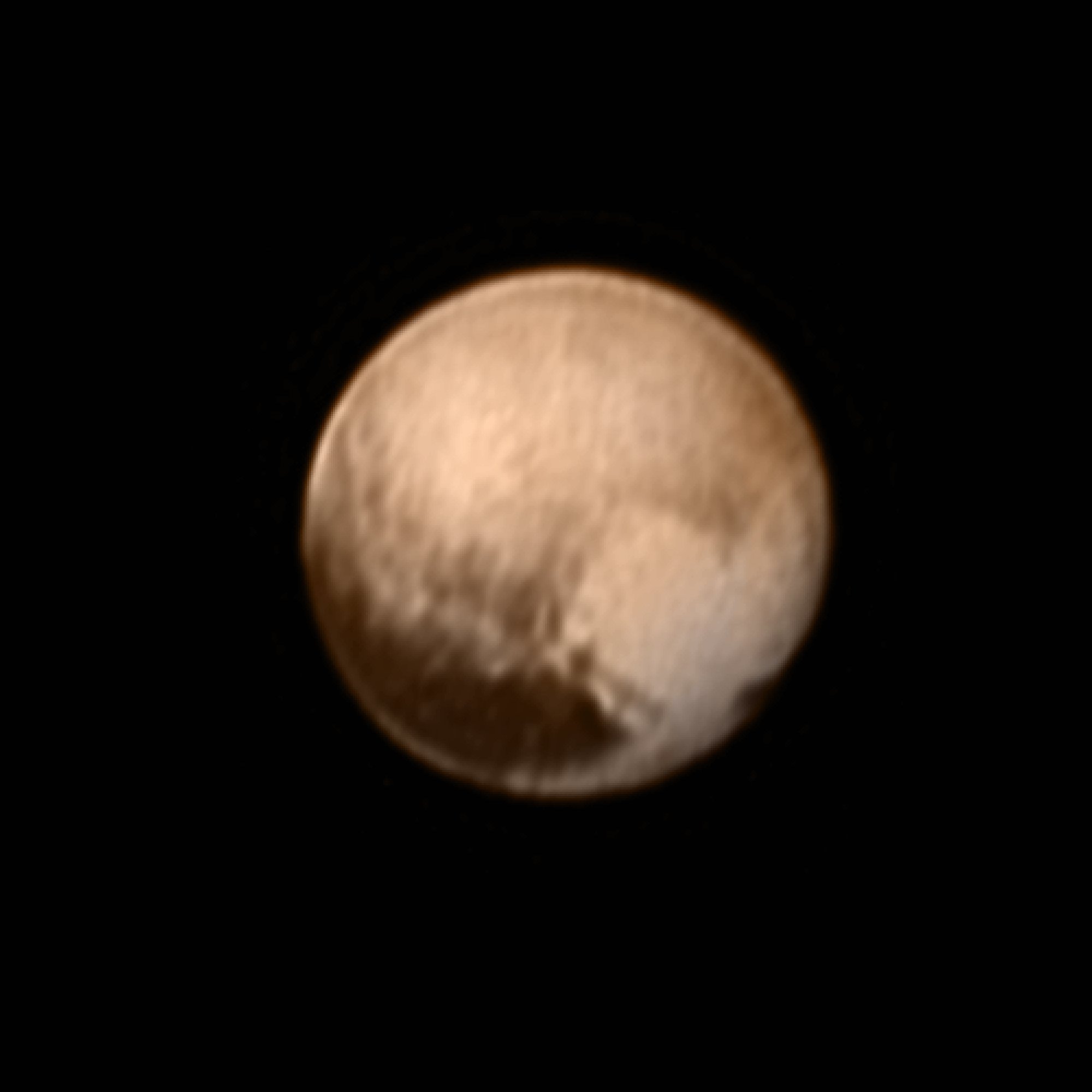
Pluto on July 8th showing its love for us, or it’s just a heart-shaped feature on Pluto’s lower right edge. This is a back & white image colorized by information captured by “Ralph”, a visible and infrared imager. The detail in all these pictures is provided by LORRI the long-range imager. Credit: NASA/Johns Hopkins University Applied Physics Laboratory/Southwest Research Institute.
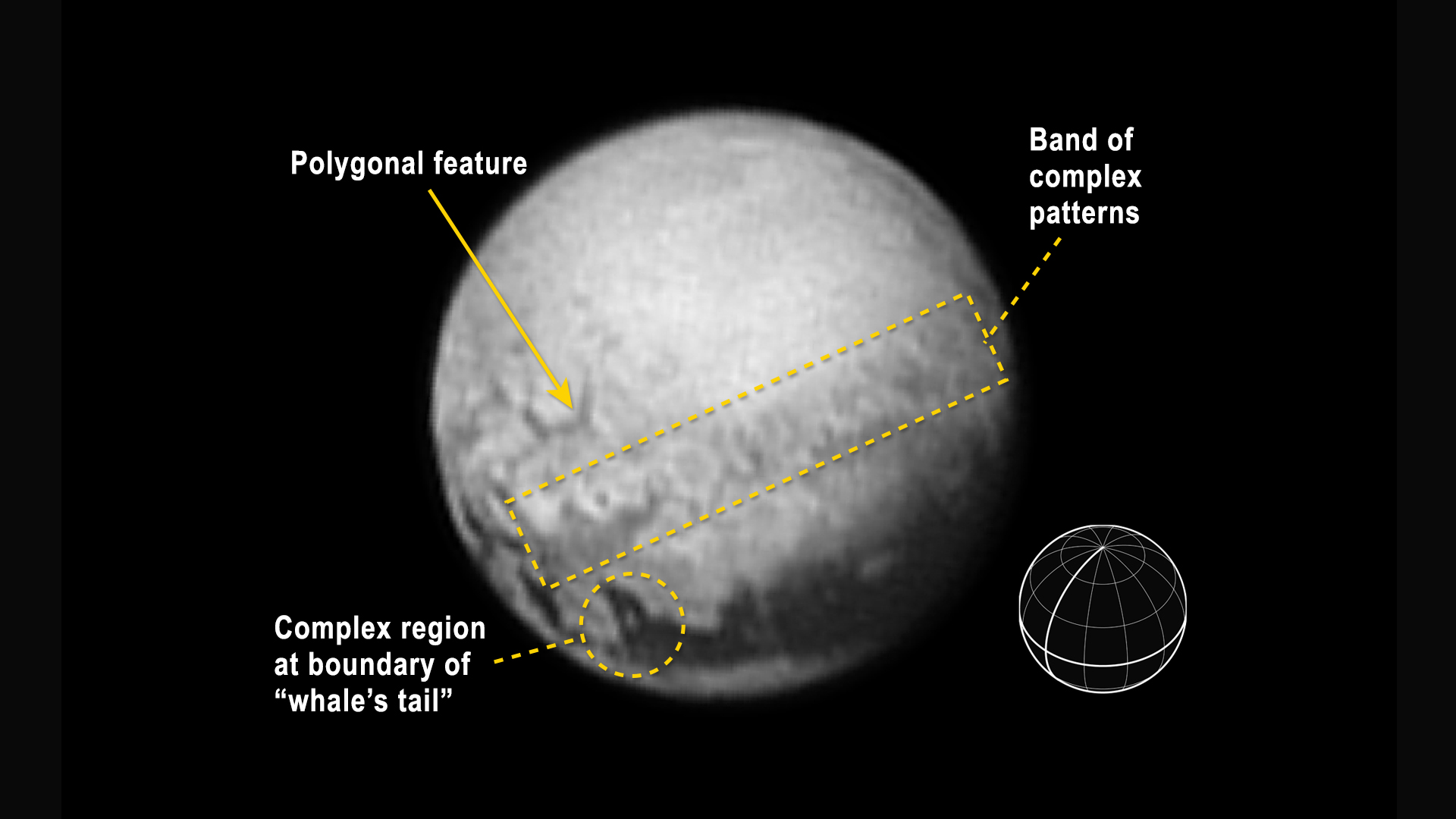
An annotated image from July 10. The rest of the “whale” can be seen impinging on the “heart” in the July 8 image. Credit: NASA/Johns Hopkins University Applied Physics Laboratory/Southwest Research Institute.
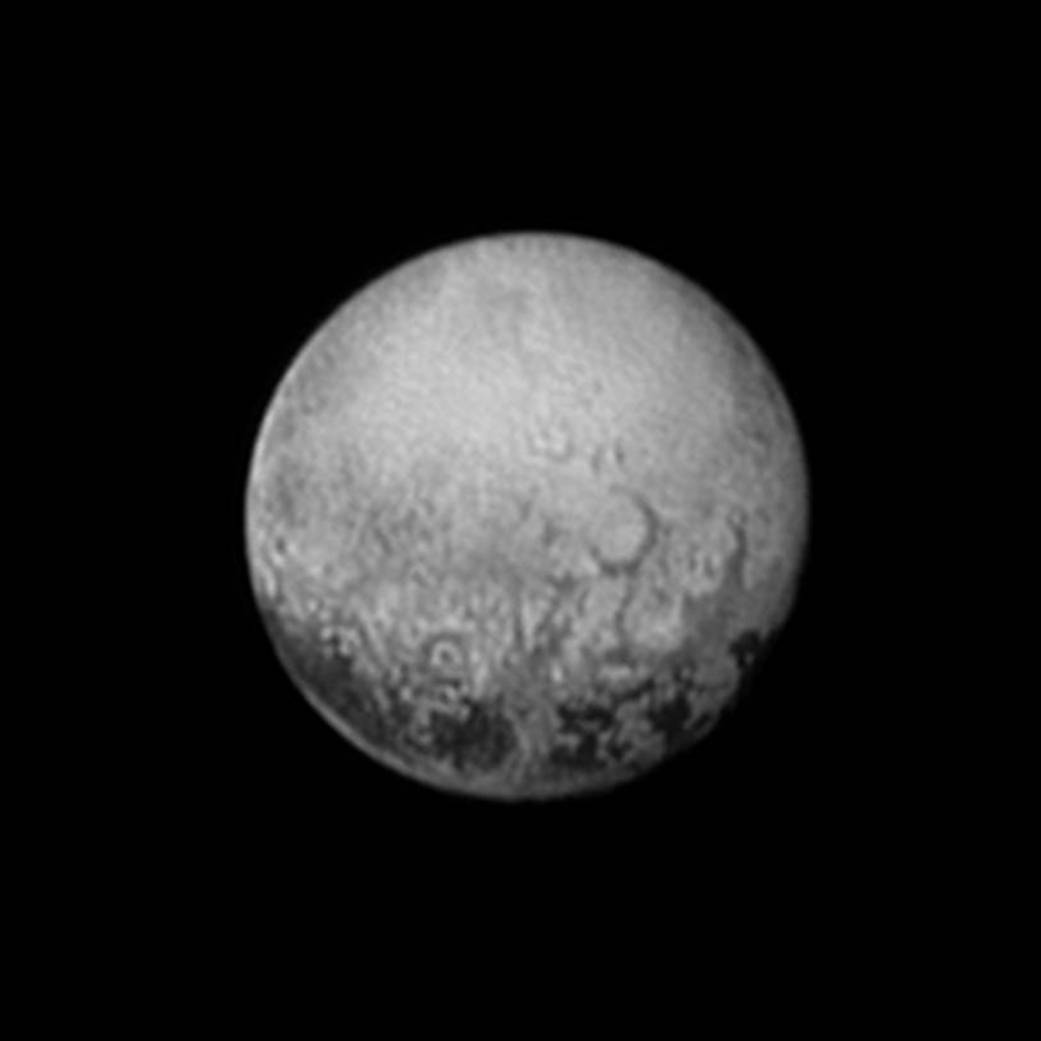
Pluto on July 11. Note the four mysterious dark spots along the bottom right of the disk. Credit: NASA/Johns Hopkins University Applied Physics Laboratory/Southwest Research Institute.
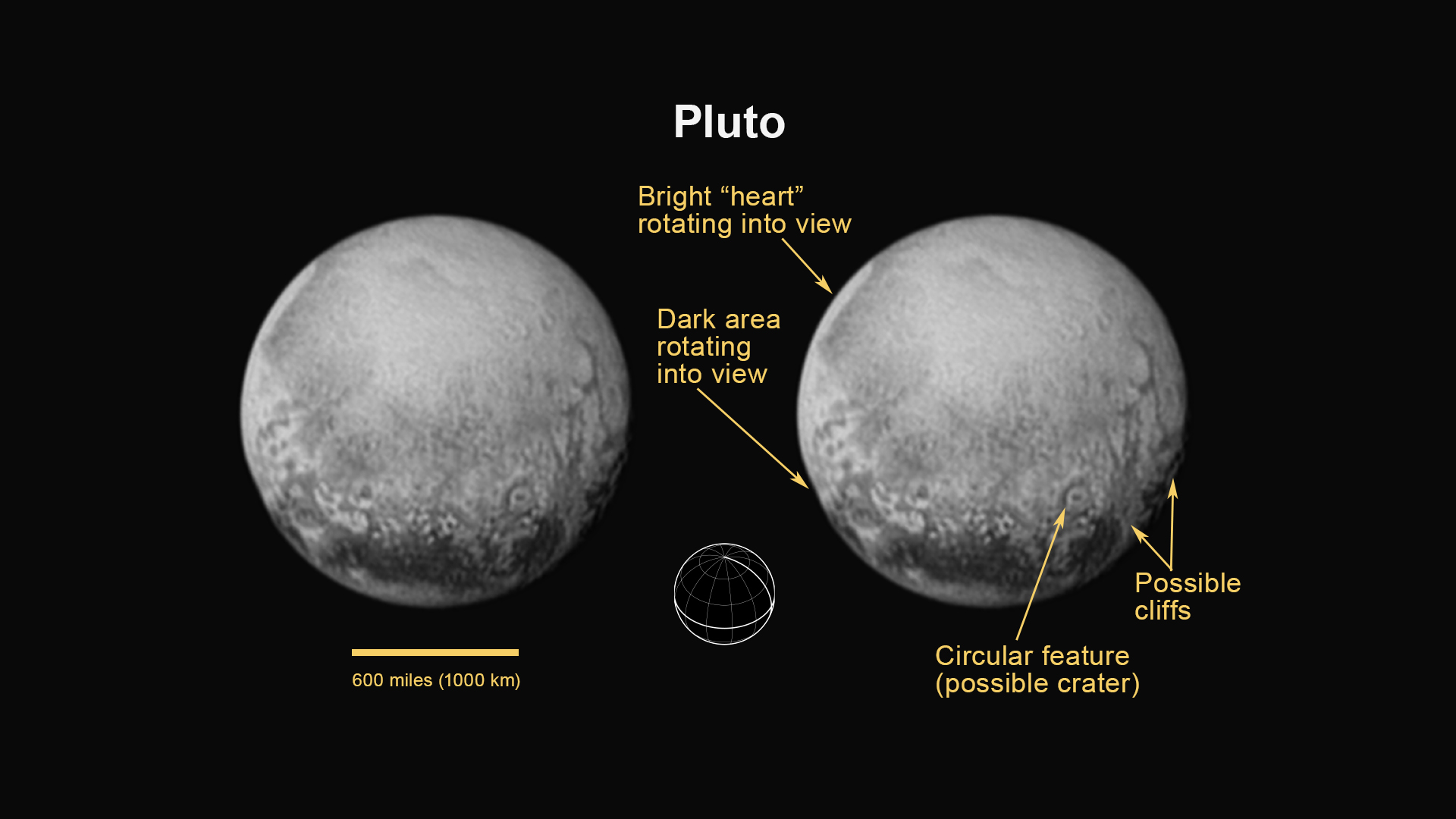
Pluto image annotated for July 12 (2 days before encounter). The features on the right are intriguing, but we’ll have to wait for the next mission to resolve. New Horizons can’t stop. Credit: NASA/Johns Hopkins University Applied Physics Laboratory/Southwest Research Institute.
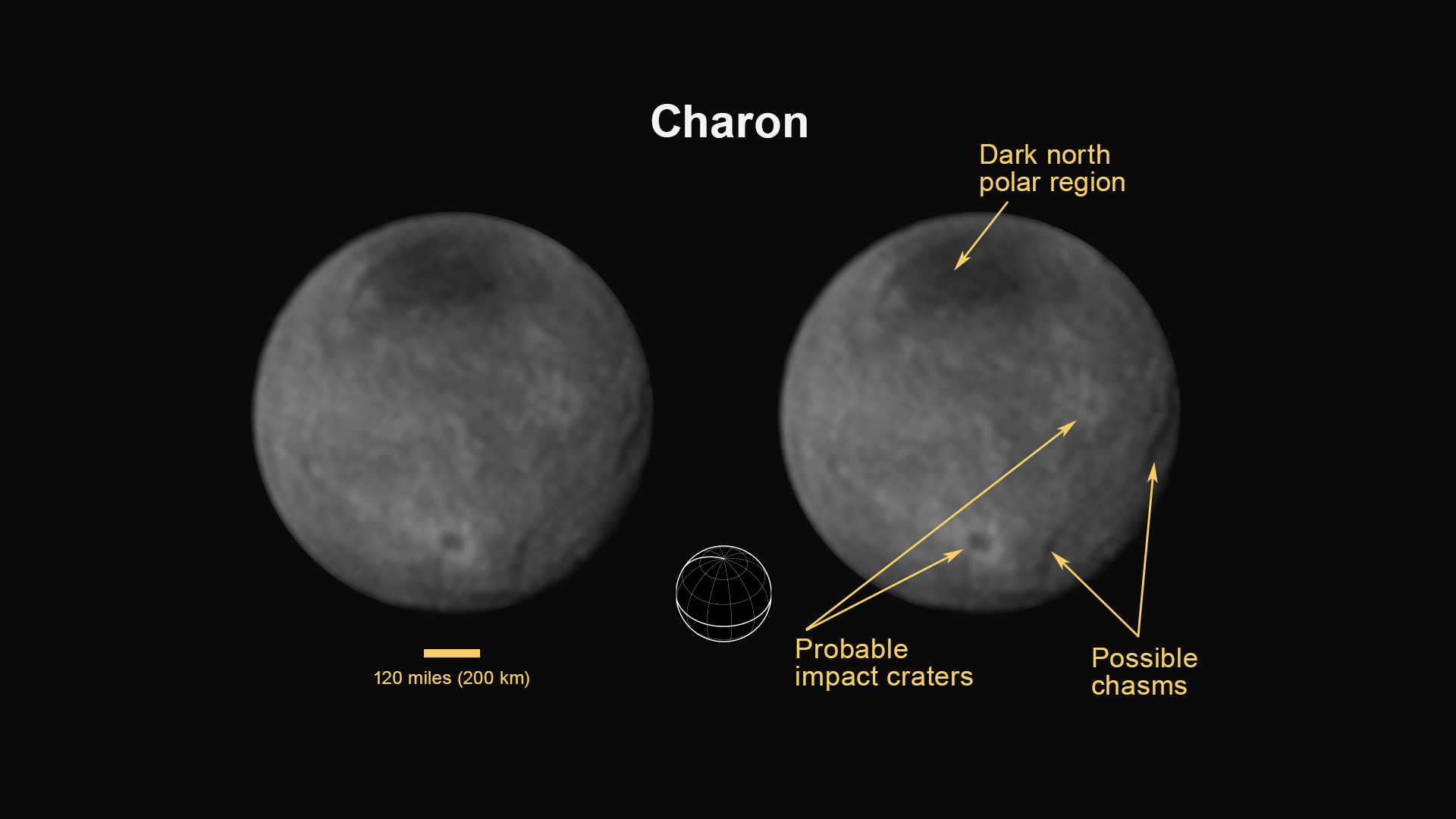
The moon Charon on July 12 with some of its features noted. Credit: NASA/Johns Hopkins University Applied Physics Laboratory/Southwest Research Institute.
07/10/2015 – Ephemeris – The celestial scorpion crawls over the horizon
Ephemeris for Friday, July 10th. Today the Sun will be up for 15 hours and 21 minutes, setting at 9:28. The Moon, 2 days past last quarter, will rise at 2:44 tomorrow morning, and tomorrow the Sun will rise at 6:07.
The planet Saturn, this year, is on the right edge of the constellation of Scorpius the scorpion which is in the south at 11 p.m. Its brightest star is Antares in its heart, a red giant star. From Antares to the right is a star then a vertical arc of three stars that is its head. The Scorpion’s tail is a line of stars running down to the left of Antares swooping to the horizon before coming back up and ending in a pair of stars that portray his poisonous stinger. Scorpius looks huge lying on the southern horizon. But if you go south Scorpius will be higher in the sky, and will look smaller. Being close to the horizon from Michigan, Scorpius shares with the rising and setting sun and moon the illusion of increased size.
Times are for the Traverse City/Interlochen area of Michigan. They may be different for your location.
Addendum
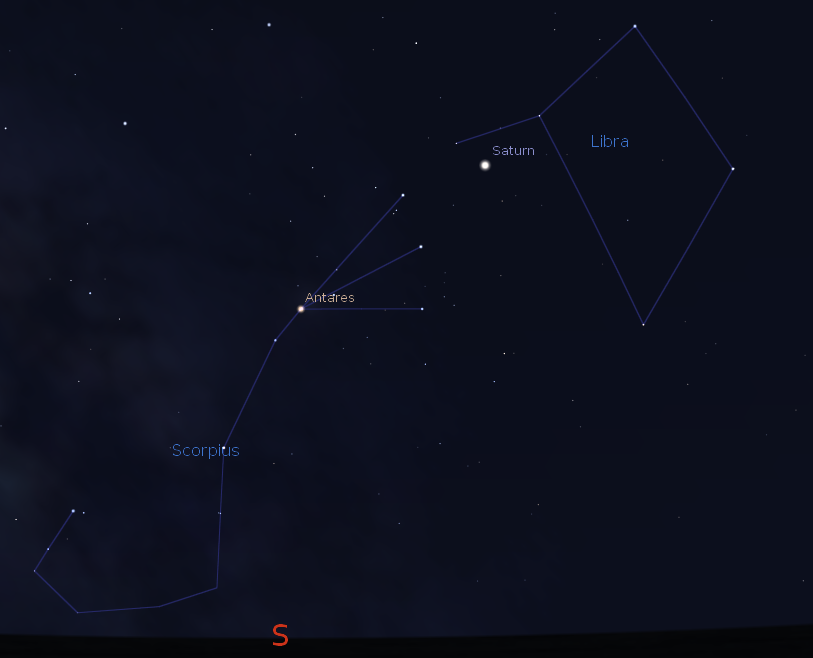
Scorpius from Traverse City/Interlochen at 11 p.m. on July 10, 2015. Created using Stellarium.
07/09/2015 – Ephemeris – The first stars to appear at night
Ephemeris for Thursday, July 9th. Today the Sun will be up for 15 hours and 23 minutes, setting at 9:29. The Moon, 1 day past last quarter, will rise at 2:05 tomorrow morning, and tomorrow the Sun will rise at 6:07.
Let’s check out all the bright stars in the evening sky, as it gets dark tonight. Low in the west are the planets Venus and Jupiter. High in the west is the bright yellow-orange star Arcturus. In the northwest is the Big Dipper, whose curved handle points to Arcturus. Straightening that curve to a spike will point to Spica a blue-white star low in the southwest. The planet Saturn is located in the south. Below and left of it is the red star Antares which usually twinkles merrily. High in the east is the bright white star Vega. To its lower right is Altair, and to its lower left the star Deneb. Vega, Altair and Deneb make the Summer Triangle, whose rising in the east signals the coming of summer.
Times are for the Traverse City/Interlochen area of Michigan. They may be different for your location.
Addendum
I talked about seeing the first stars a month ago. It seems that in holding star parties this time of year we spend a lot of time watching the first stars appear. I wanted to discuss the Summer Triangle, but it wandered off to what you see above. I’ll get there next week, I promise.
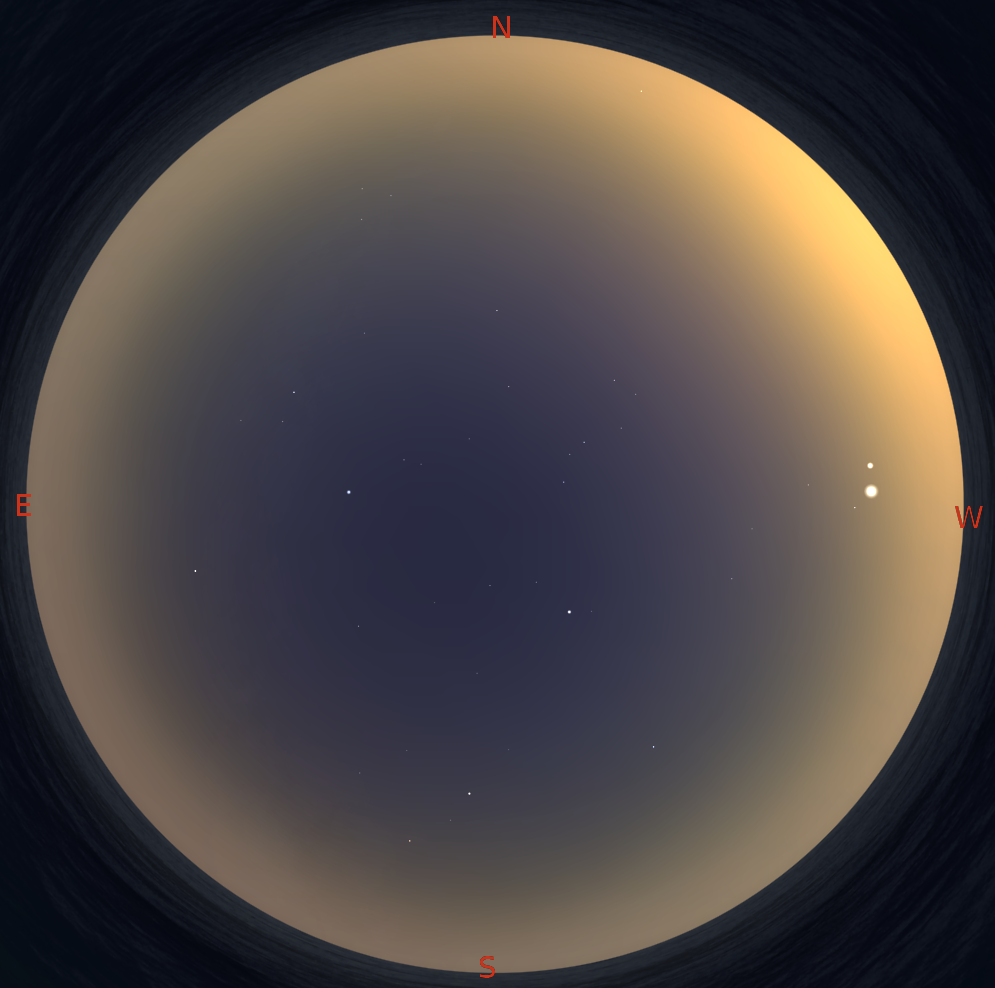
The first stars and planets to appear. See if you can located them from the text. Created using Stellarium for about 10 p.m., July 9, 2015.
07/08/2015 – Ephemeris – The bright planets are hanging around in the evening.
Ephemeris for Wednesday, July 8th. Today the Sun will be up for 15 hours and 24 minutes, setting at 9:29. The Moon, at last quarter today, will rise at 1:30 tomorrow morning, and tomorrow the Sun will rise at 6:06.
Lets take a look at the bright planets for this week. Our evening stars Venus and Jupiter are side by side in the west by 9:45 p.m. They both will set at 11:21 p.m.. Venus’ will slide down to the Sun faster and faster in the coming weeks leaving Jupiter behind for a while. Venus will take 5 weeks to slide past the Sun. Jupiter though will take 7 weeks, so Venus will pass it again around August 4th when both are too close to the horizon and Sun to spot. There’s a third conjunction of these two in October in the morning sky with Mars nearby. Saturn is in the south in the evening twilight. It will pass due south at 10:24 p.m. and will set at 3:16 a.m. Even small telescopes can see Saturn’s rings.
Times are for the Traverse City/Interlochen area of Michigan. They may be different for your location.
Addendum
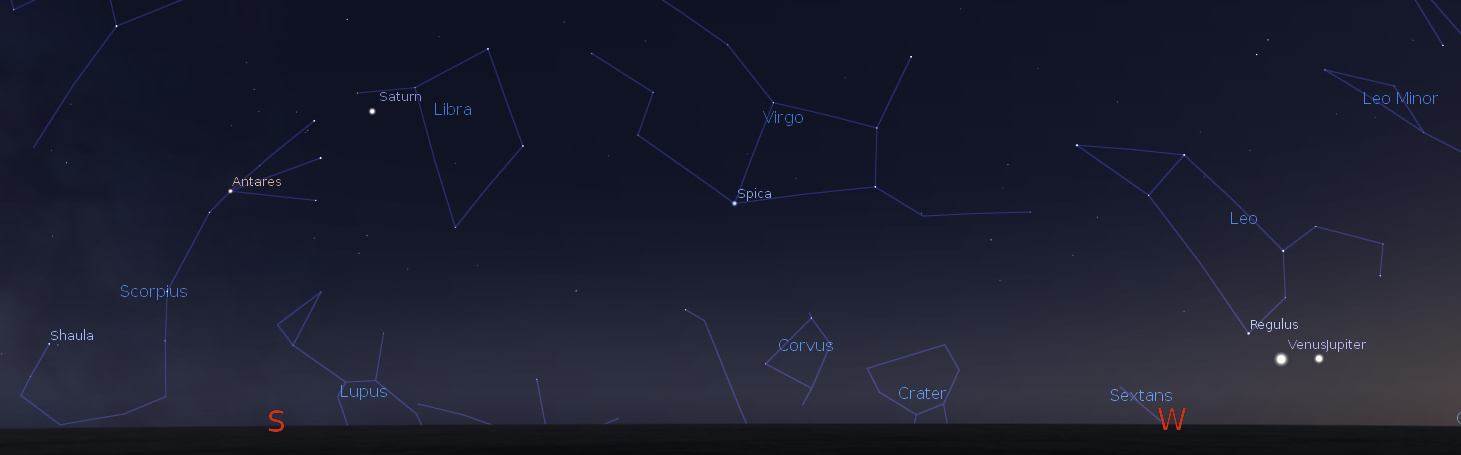
The evening planets at 10:30 p.m. July 8, 2015. Created using Stellarium.
Venus’ greatest brilliancy will be on Sunday the 12th. This is the point where Venus’ increasing size is countered by its decreasing phase. The brightness of Venus doesn’t change much over its orbit, and will be stay brilliant. However it will surrender to the brightening twilight as it sets closer and closer to sunset.
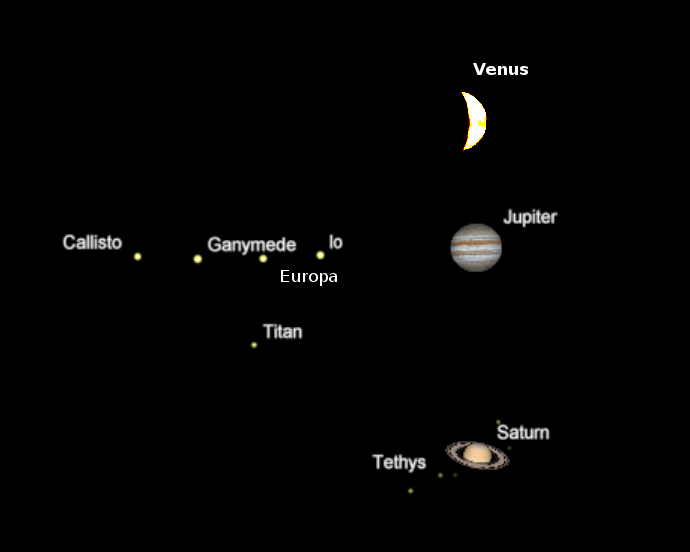
The evening planets as seen with the same magnification. Note that Venus is noticeably larger appearing than Jupiter. This is probably the time Venus’ crescent is visible in binoculars. Created using Cartes du Ciel (Sky Charts).
07/07/2015 – Ephemeris – New Horizons will resume science gathering after glitch July 4th.
Ephemeris for Tuesday, July 7th. Today the Sun will be up for 15 hours and 25 minutes, setting at 9:30. The Moon, 1 day before last quarter, will rise at 12:56 tomorrow morning. Tomorrow the Sun will rise at 6:05.
On July 4th, the New Horizons spacecraft, now one week from is flyby of Pluto, suffered a glitch and went into safe mode. It, however switched to its backup computer, and is now in contact with the Earth. Sunday night it was determined that the problem was a timing flaw in a command sequence preparing for Pluto encounter. Normal spacecraft operations will resume today. Two way communication time is now nearly 9 hours, almost half a day. Earth day that is. New Horizons is approaching Pluto at 31,000 miles an hour. The spacecraft will have only a few hours to observe Pluto and its moons at their closest next Tuesday. It’s getting down to crunch time for the little spacecraft.
Times are for the Traverse City/Interlochen area of Michigan. They may be different for your location.
Addendum
I wrote Tuesday’s program Sunday night before the announcement that the problem with New Horizons was found and the spacecraft would back to normal on Tuesday. I found that out just before recording the programs, and had to do a quick fix. With New Horizons problems found, I could write the July 13th program I had planned. I write and record 5 programs at a time – Tuesday through Monday.
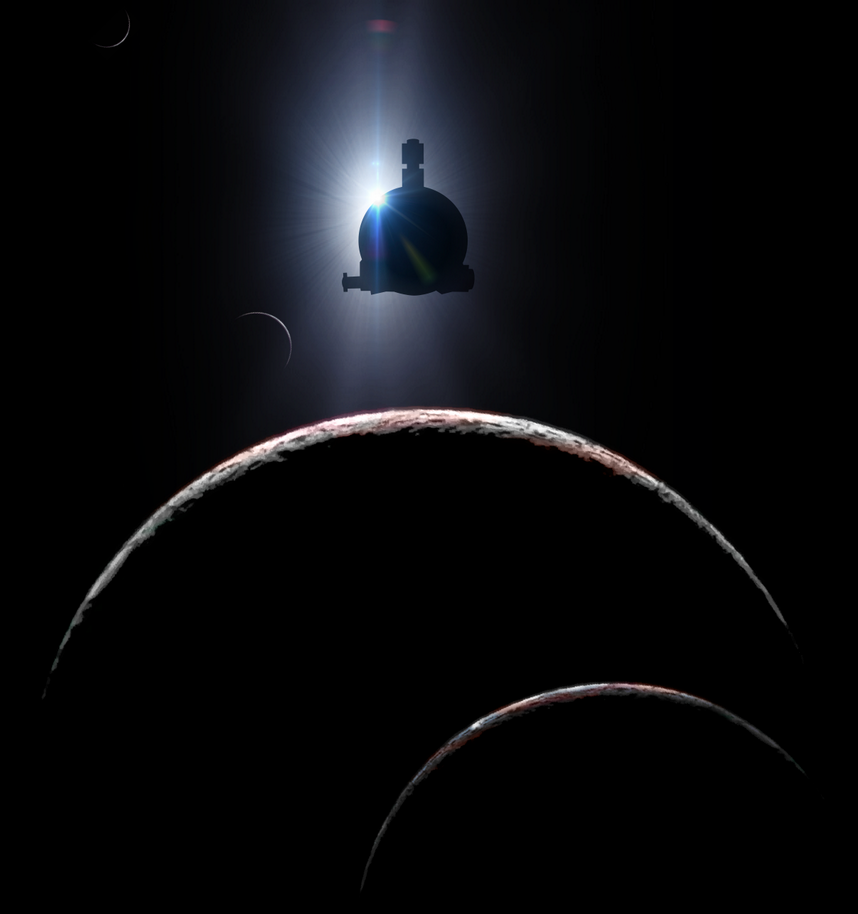
Artist’s rendition credit NASA.
07/06/2015- Ephemeris – Today we are at our greatest distance from the sun.
Ephemeris for Monday, July 6th. Today the Sun will be up for 15 hours and 26 minutes, setting at 9:30. The Moon, 2 days before last quarter, will rise at 12:23 tomorrow morning and tomorrow the Sun will rise at 6:04.
This is the day the we are the farthest we can get from the Sun for the year. The point in the Earth’s orbit that it occurs is called aphelion. Earth is closest to the Sun in January at perihelion. The actual distance difference between perihelion and aphelion is 3 million miles out of roughly 93 million miles. So now we’re roughly 94 and a half million miles from the Sun or 152 million kilometers., and will swoop down to 91 and a half million miles(91.4) or 147 kilometers from the Sun in early January. Because Earth’s northern and southern hemispheres have different ratios and placement of land versus ocean I’m not sure you could correlate seasonal differences of the hemispheres with the Earth’s distance from the Sun. Anyway the approximate time we reach aphelion will be 3 p.m. EDT (19 hr UT).
Times are for the Traverse City/Interlochen area of Michigan. They may be different for your location.
Addendum
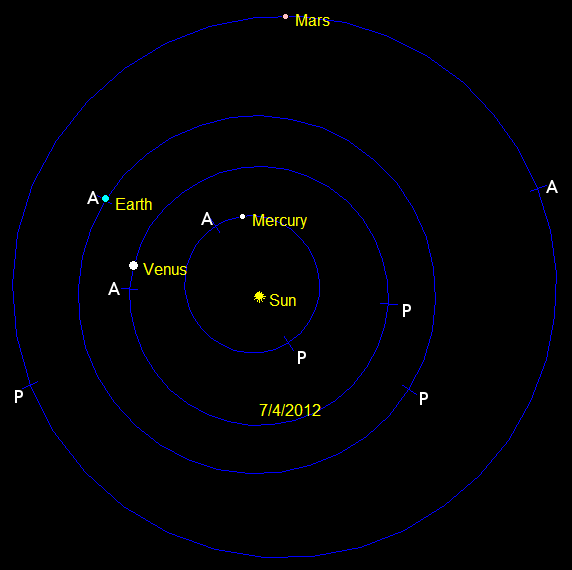
The orbits of the inner planets. (P)erihelion – (A)phelion
The above is a diagram from three years ago, so the planets other than the Earth will be in different positions today. The date of aphelion and perihelion move around over a greater range of dates than the equinoxes and solstices. I’m not sure why without researching it, but I suspect that the Moon has something to do with it.
 Bob Moler's Ephemeris Blog