Archive
03/17/16 – Ephemeris – Why are there no green stars?
Ephemeris for St. Patrick’s Day, Thursday, March 17th. The Sun will rise at 7:50. It’ll be up for 12 hours and 1 minute, setting at 7:52. The Moon, 2 days past first quarter, will set at 5:10 tomorrow morning.
Today we celebrate the patron saint of the Emerald Isle. And green is the color of the day. When we look to the skies we don’t see a lot of green. Well, maybe in the Hubble Space Telescope’s false color photographs like the original Pillars of Creation, where green represents hydrogen, and in the northern lights. The colors we see in stars are red or orange if they are cooler than the Sun, yellow if they are the same temperature as the Sun, and white or bluish if hotter than the Sun. In the spectrum of light we can see, green is in the middle, between yellow and blue. As a matter of fact the Sun radiates its energy most heavily in the green. So if you got rid of those other colors the Sun itself would be green.
Times are for the Traverse City/Interlochen area of Michigan. They may be different for your location.
Addendum

Star cluster showing star colors, probably enhanced. Source uncredited image from planetsforkids.org.
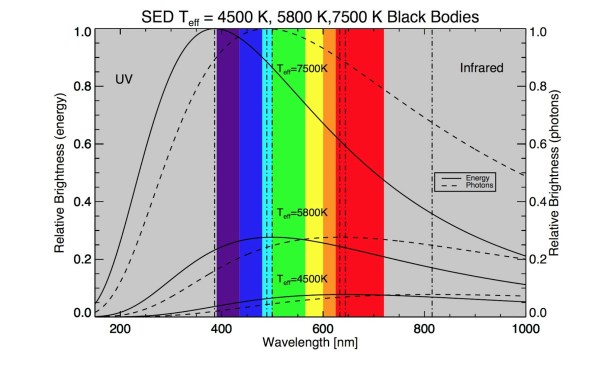
“Black body” Radiation Curves by temperatures. The Sun’s surface temperature is around 5800 Kelvin. Note the peak radiation besides increasing in amplitude slides from red to blue with increasing temperature.

Aurora looking north at 10/24/2011 at 10:52 p.m. The first color visible in an aurora or northern lights is green. More active aurorae give off other colors. Credit: Bob Moler.
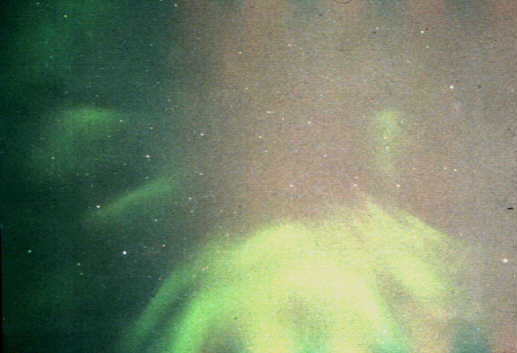
Looking overhead in an active aurora, and the variety of colors, even green. Credit: Bob Moler.
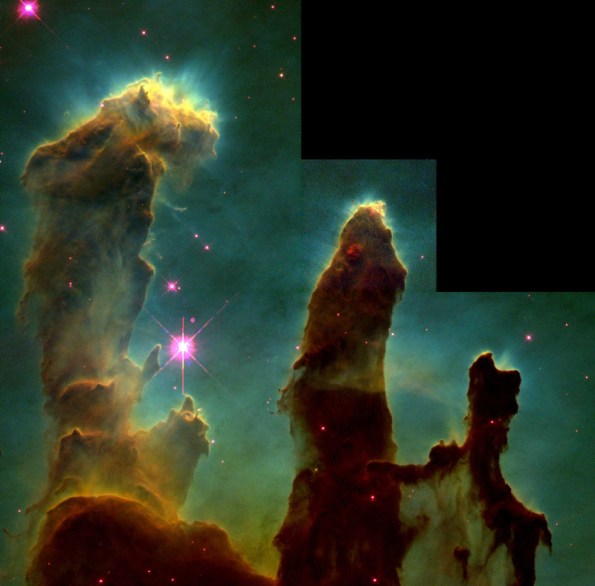
Pillars of Creation in false color by the Hubble Telescope. Sometimes the colors are given to specific elemental emissions, of shifted because the colors represent radiation that is invisible to the human eye. Credit: NASA/ESA/HST.
03/16/2016 – Ephemeris – Jupiter is in the evening, the other bright planets are in the morning
Ephemeris for Wednesday, March 16th. The Sun will rise at 7:52. It’ll be up for 11 hours and 58 minutes, setting at 7:50. The Moon, 1 day past first quarter, will set at 4:26 tomorrow morning.
Let’s check out the whereabouts of the bright naked eye planets. Jupiter is up at sunset, and will pass due south, astronomers call it a transit, at 1:13 a.m., and will set at 7:44 a.m. It’s below the stars of Leo now. Binoculars can make out some of Jupiter’s moons, but a telescope is required to see Jupiter’s cloud formations. Mars will rise next at 1:29 a.m. in the east-southeast. It’s seen in western Scorpius now. Saturn will rise at 2:29 a.m. in the east-southeast. It’s above the stars of Scorpius, actually in Ophiuchus. Its rings are a telescopic treat. Venus will rise at 7:13 a.m. again in the east-southeast. Mercury is lost in the bright morning twilight and will pass behind the Sun in superior conjunction a week from now.
Times are for the Traverse City/Interlochen area of Michigan. They may be different for your location.
Addendum
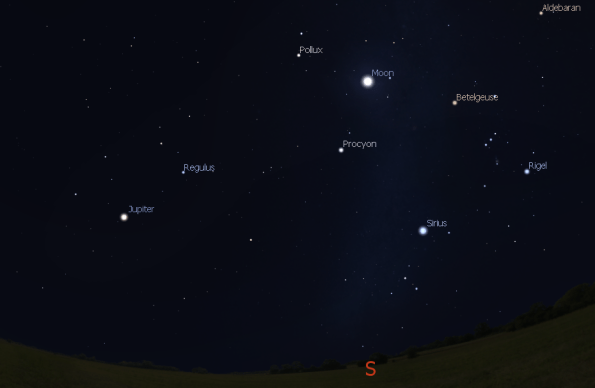
Jupiter and the Moon with the bright stars at 10 p.m. on March 16, 2016. Created using Stellarium.
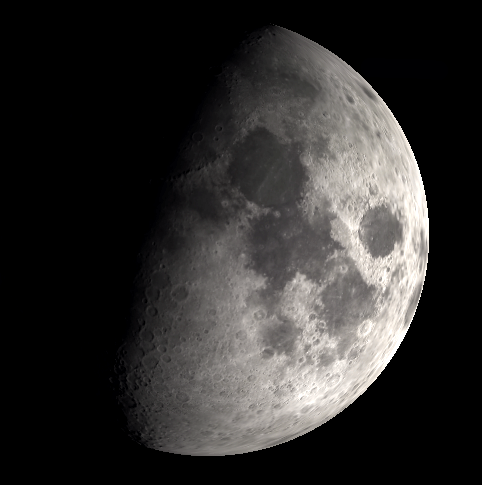
The Moon as it might appear in binoculars at 10 p.m. on March 16, 2016. Created using Stellarium.
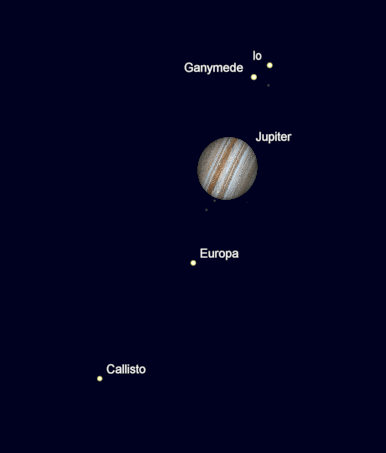
Jupiter and its moons as they would be seen in a telescope, at 10 p.m. March 16, 2016. Jupiter has an apparent diameter of 44.3″ Created using Stellarium.
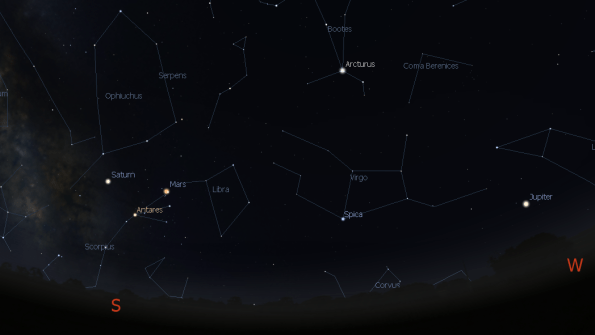
The morning planets Mars, Saturn and Jupiter at 6:30 a.m. March 17, 2016. Created using Stellarium.
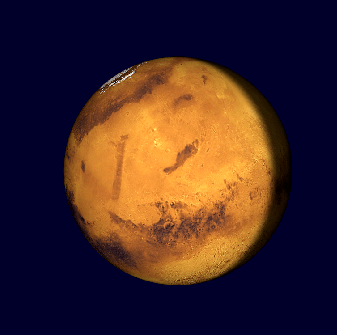
Mars as seen in a large telescope at high power. It’s only 10.0″ in diameter, about a quarter of Jupiter’s diameter. The long dark area near the bottom or south is Mare Cimmerium. The bright area above center is Elysium. Created using Cartes du Ciel (Sky Charts).
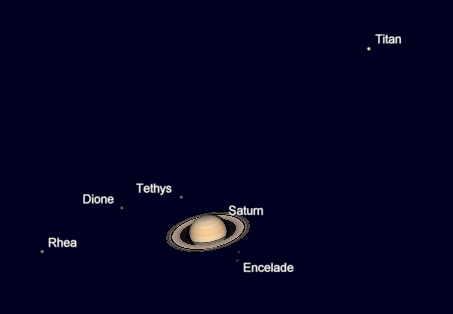
Saturn and its large satellite Titan and other moons as they should appear in a telescope in the morning of March 17, 2016. The planet is 17.0″ in diameter while the rings span 39.6″. Created using Stellarium.
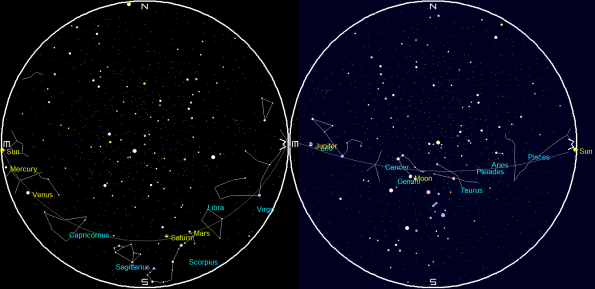
This is a chart showing the sunrise and sunset skies for March 16, 2016 showing the location of the planets and the Moon at that time. Created using my LookingUp program.
Some of these images above are shown smaller than actual size. Image expansion lately hasn’t worked. If you are using Firefox, right-click on the image, and then click on View Image.
03/15/2016 – Ephemeris – Spotting the celestial Horse and Rider
Ephemeris for, the Ides of March, Tuesday, March 15th. The Sun will rise at 7:54. It’ll be up for 11 hours and 55 minutes, setting at 7:49. The Moon, at first quarter today, will set at 3:36 tomorrow morning.
In the handle of te Big Dipper rising high in the east northeast is an easily seen double star. It’s the star second from the end of the handle where it makes a bend. The bright star is Mizar. It has a dim companion star that folks with good eyesight can easily spot, named Alcor. The Arabs of old, before optometrists used the pair as an eye test. I would have failed. Even with my glasses on I can’t spot Alcor. I must resort to binoculars. The pair is known as the Horse and Rider, while the indigenous peoples of North America, see the stars of the handle of the Big Dipper not as the great Bear’s tail, but hunters following the bear. In this case Alcor is either a hunting dog, or a cooking pot to cook the bear in.
Times are for the Traverse City/Interlochen area of Michigan. They may be different for your location.
Addendum
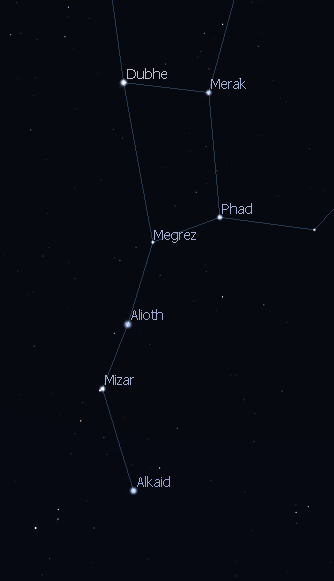
The Big Dipper, part of Ursa Major the Great Bear, is poised on its handle in the northeast. Can you spot Alcor? Created using Stellarium.
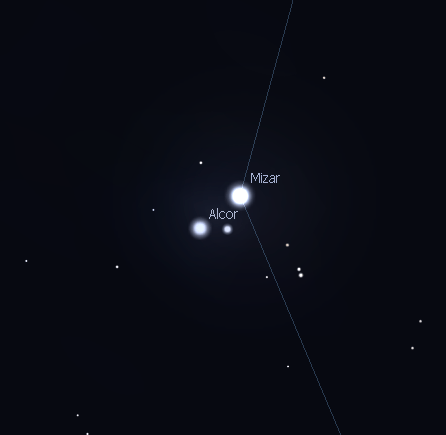
A closeup view of Mizar and Alcor and a dimmer star that lies in the background. Created using Stellarium.
A telescope with low power will also split Mizar intro a bright and dim companion named Mizar A and Mizar B. By observing Mizar A, B and Alcor have determined that all three are binary. There’s six stars there.
3.1416 – 03/14/2016 – Ephemeris – When Jupiter hits your eye like a big pizza Pi
Ephemeris for Pi Day 3/14, Monday, March 14th. The Sun will rise at 7:56. It’ll be up for 11 hours and 52 minutes, setting at 7:48. The Moon, 1 day before first quarter, will set at 2:39 tomorrow morning.
We turn again to the giant planet Jupiter which is shining brightly in the southeastern part of the sky in the early evening. The first thing one notices in a small telescope are it’s four moons, generally in a straight line, which move back and forth each night. Notice their plane. It’s the same direction as the cloud bands are aligned. Jupiter has a very small axial tilt, and its large satellites orbit pretty much over Jupiter’s equator. Our Moon doesn’t behave that way, but that’s another story. Jupiter rotates on its axis in a bit less than 10 hours, which whips its clouds into alternating bands of reddish-brown and cream color. Also the rotation rate of these clouds lessens with increasing latitude.
Times are for the Traverse City/Interlochen area of Michigan. They may be different for your location.
Addenda
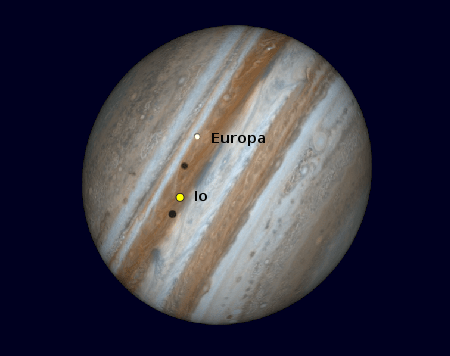
Transits of Europa and Io across the face of Jupiter at 11 p.m. EDT March 14, 2016. The shadows of the moons are hard to see, but the satellites are even harder. Jupiter’s current cloud bands may not be as shown. Image created using Cartes du Ciel (Sky Charts).
| Event | EDT | Universal Time | ||
| Date | Time | Date | Time | |
| Europa Transit Start | March 14 | 09:26 PM | March 15 | 01:26 AM |
| Europa Shadow Start | March 14 | 09:45 PM | March 15 | 01:45 AM |
| Io Shadow Start | March 14 | 10:12 PM | March 15 | 02:12 AM |
| Io Shadow Start | March 14 | 10:21 PM | March 15 | 02:21 AM |
| Europa Transit End | March 15 | 12:12 AM | March 15 | 04:12 AM |
| Io Transit End | March 15 | 12:26 AM | March 15 | 04:26 AM |
| Europa Shadow End | March 15 | 12:33 AM | March 15 | 04:33 AM |
| Io Shadow End | March 15 | 12:36 AM | March 15 | 04:36 AM |
Jovian satellite data from Project Pluto.
Pi Day
Check this out: Pi Day the NASA Way.
Answer to Friday’s Moon phase poser
Of the two representations of the Moon’s terminator last Friday, the Virtual Moon Atlas was the correct representation.
03/11/2016 – Ephemeris – The lunar Sea of Crises
Ephemeris for Friday, March 11th. The Sun will rise at 7:01. It’ll be up for 11 hours and 42 minutes, setting at 6:44. The Moon, 3 days past new, will set at 10:14 this evening.
Tonight the Moon shows one remarkable sea: Mare Crisium or the Sea of Crises. It is a large gray basin. The largest feature visible in binoculars. Because it’s near the Moon’s limb or edge it is foreshortened into an ellipse, with the long axis running north and south. In actuality it is elliptical with the long axis east and west. It looks funny on a geologic map of the whole moon or a Moon globe. Its dimensions are 345 by 375 miles (570 by 620km). It’s really a crater as are all seas whose impact asteroid reached down to the Moon’s magma and caused lava to well up to produce the flat floor. When the sunlight is low as it is now wrinkle ridges will appear showing where successive lava flows have stopped and solidified.
Times are for the Traverse City/Interlochen area of Michigan. They may be different for your location.
Addendum
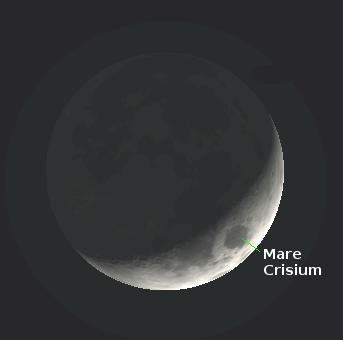
The Moon on its orientation in the southwest at 8 p.m.March 11, 2016. Created using Stellarium.
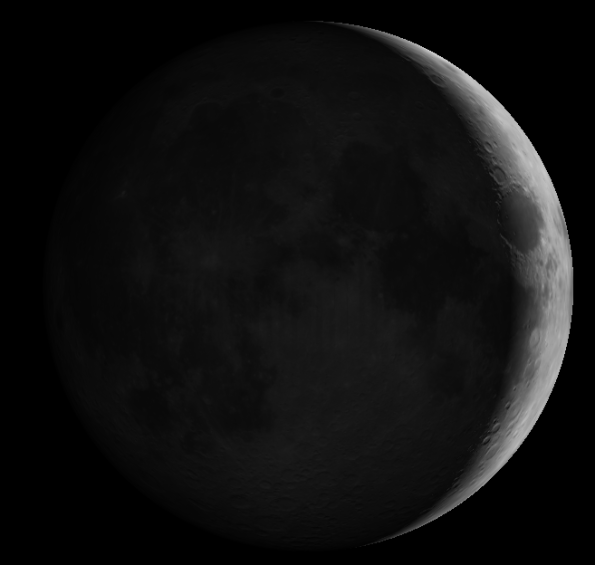
The Moon at 8 p.m. March 11, 2016 via Virtual Moon Atlas. Note that despite the difference in rotation, that the phase is s bit different. We’ll have to see which one is correct.
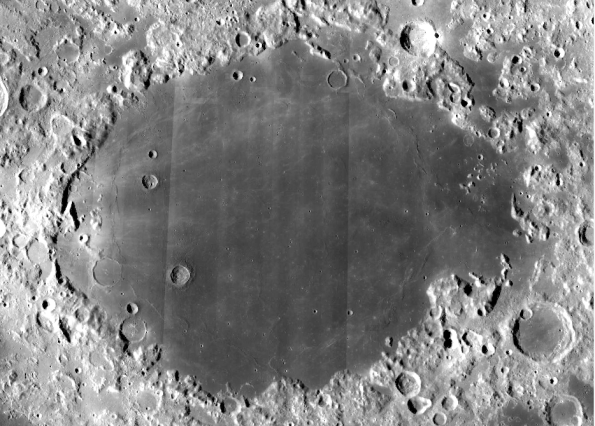
Mare Crisium from overhead with Lunar Reconnaissance Orbiter. The vertical lines are due to the north-south scans by the polar orbiting satellite. Credit: NASA/LRO/Virtual Moon Atlas.
03/10/2016 – Ephemeris – The many faces of the Big Dipper and Ursa Major
Ephemeris for Thursday, March 10th. The Sun will rise at 7:03. It’ll be up for 11 hours and 39 minutes, setting at 6:43. The Moon, 2 days past new, will set at 8:59 this evening.
The Big Dipper has many names to many peoples and countries around the world, from the plough, Charles’ Wain, and many others. Officially to the International Astronomical Union, it’s part of Ursa Major, the Great Bear, also recognized by Native Americans, Europeans, it’s even in the Bible. In the Book of Job the star Arcturus is a miss-translation. Arcturus means Guardian of the Bear. It should be Bear itself, and most modern translations catch that mistake. Anyway, the Anishinaabe people around the Great Lakes say the stars of the bear are that of another creature, that of Fisher Star one small weasel-like mammal that brought summer to the Earth, and now heralds the seasons of spring and autumn by his position in the sky.
Times are for the Traverse City/Interlochen area of Michigan. They may be different for your location.
Addendum
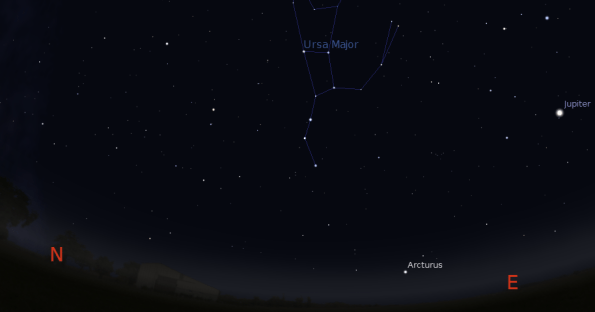
Ursa Major in the northeastern sky at 9 p.m., March 10, 2016. Created using Stellarium.
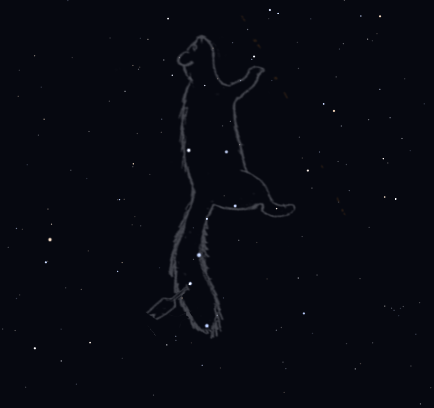
Fisher Star. Star field created by Stellarium.
03/09/2016 – Ephemeris – With Venus and Mercury lost in twilight, Mars and Saturn are the only official morning planets easily seen now
Ephemeris for Wednesday, March 9th. The Sun will rise at 7:05. It’ll be up for 11 hours and 36 minutes, setting at 6:41. The Moon, 1 day past new, will set at 7:43 this evening.
Let’s check out the whereabouts of the bright naked eye planets. Jupiter is up at sunset, and will pass due south, astronomers call it a transit, at 12:47 a.m., and will set at 7:14 a.m. It’s below the stars of Leo now. Binoculars can make out some of Jupiter’s moons, but a telescope is required to see Jupiter’s cloud formations. Mars will rise next at 12:45 a.m. in the east-southeast. It’s seen in eastern Libra almost entering the territory of Scorpius. Saturn will rise at 1:56 a.m. in the east-southeast. It’s above the stars of Scorpius, actually in Ophiuchus. Its rings are a telescopic treat. Venus will rise at 6:20 a.m. again in the east-southeast. Mercury is lost in the bright morning twilight and will pass behind the Sun in superior conjunction on the 23rd.
Times are for the Traverse City/Interlochen area of Michigan. They may be different for your location.
Addendum
Sorry for the late post, but preparation for my visit to Mill Creek Elementary school in Williamsburg, MI took some extra preparation. Of course too I was watching the solar eclipse from Micronesia, both channels.
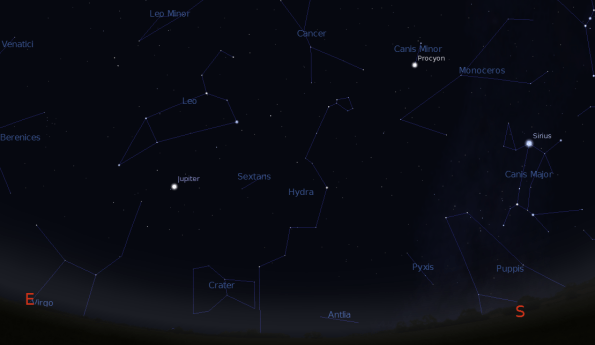
Jupiter appears with the coming spring stars and constellations at 9 p.m., March 9, 2016. Created using Stellarium.
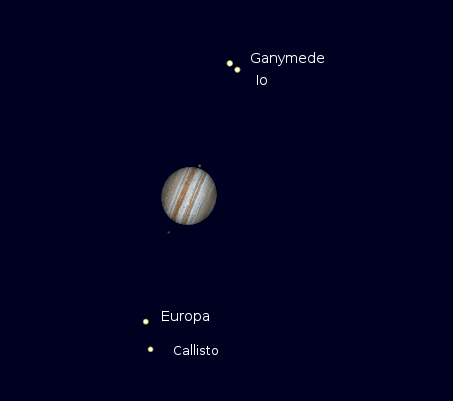
Jupiter and its moons in a telescope at 9 p.m. March 9, 2016. It’s apparent diameter is 44.4″. Created using Cartes du Ciel (Sky Charts).
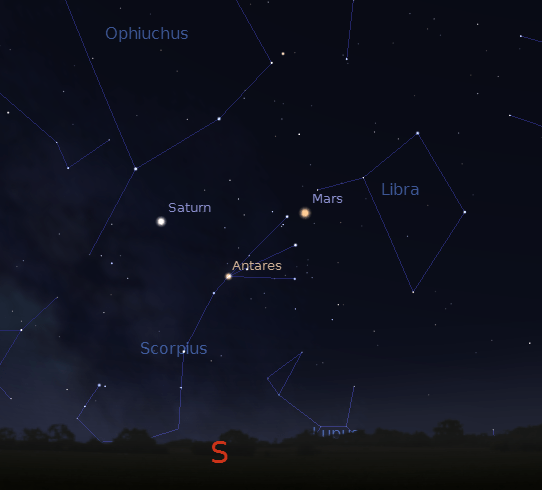
The morning planets Mars and Saturn are near each other in the south morning sky at 6 a.m. March 10, 2016. Created using Stellarium.
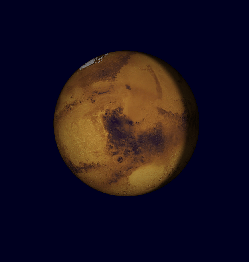
Mars as seen in a large telescope at high power. It’s only 9.5″ in diameter, about a quarter of Jupiter’s diameter. The large dark area in the center is Syrtis Major which sounds cooler than its English translation “Great Swamp”. South of it is the bright elliptical Hellas Basin. Created using Cartes du Ciel (Sky Charts).
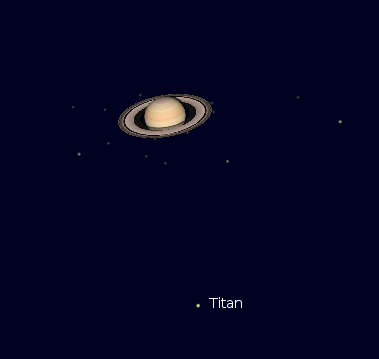
Saturn and its moon Titan as they might be seen through a telescope at 6 a.m. March 10, 2016. The planet diameter is 16.8″ while the rings span 38.1″. Created using Created using Cartes du Ciel (Sky Charts).
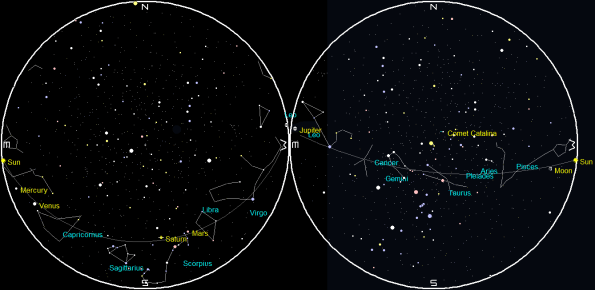
This is a chart showing the sunrise and sunset skies for March 9, 2016 showing the location of the planets and the Moon at that time. Created using my LookingUp program.
03/08/2016 – Ephemeris – View tonight’s total solar eclipse on the Internet
Ephemeris for Tuesday, March 8th. The Sun will rise at 7:07. It’ll be up for 11 hours and 33 minutes, setting at 6:40. The Moon is new today, and won’t be visible.
Today’s new moon has a bonus, it will produce a total solar eclipse. Not for us, but for Indonesia, some islands of Micronesia, and across the Pacific Ocean. We do have a shot at seeing it, however. NASA and the The Exploratorium has sent an expedition to the Woleai Atoll near the point of the greatest eclipse, allowing over 4 minutes of totality. So if it’s clear there NASA and the Exploratorium will have Web and TV feeds. There will be two feeds, An educational feed running from 8 to 9 p.m. covering the heart of the eclipse and a telescope only feed covering the entire eclipse running from 7 to 10:15 p.m. For NASA TV go to NASA.gov and click on NASA TV. The other place to go is exploratorium.edu and you can’t miss it.
Times are for the Traverse City/Interlochen area of Michigan. They may be different for your location.
Addendum
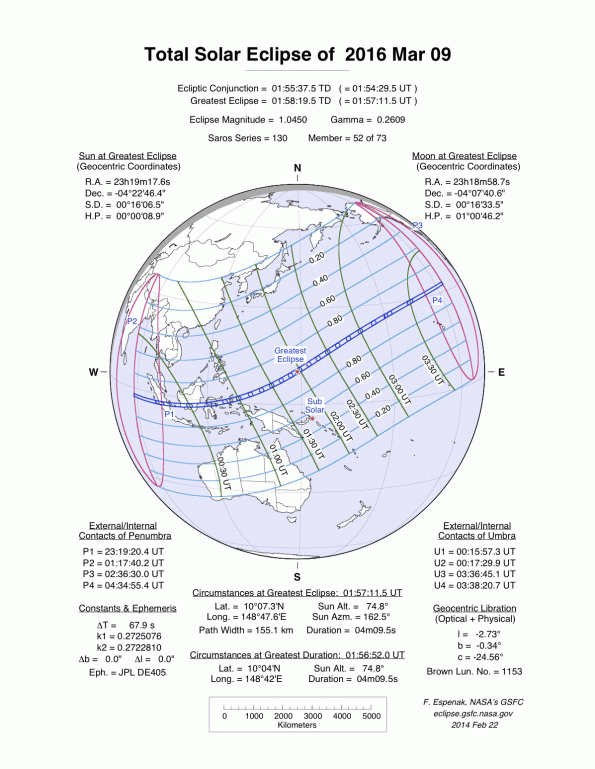
Eclipse chart for the March 9, 2016 total solar eclipse. Credit NASA/GSFC/Fred Espenak.
These are my photographs from prior eclipses that will give one feel as to what an eclipse looks like. The corona will be visible the whole time of totality. The diamond ring and Baily’s Beads will be visible for only a few seconds at the end of totality. They are generally not seen as totality starts because filters will stay on the equipment until totality actually starts.
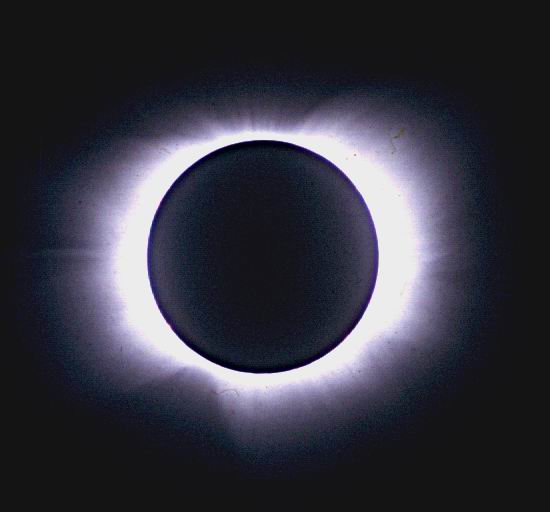
The solar corona displayed during the July 10, 1072 total solar eclipse from Prince Edward Island. Credit Bob Moler.
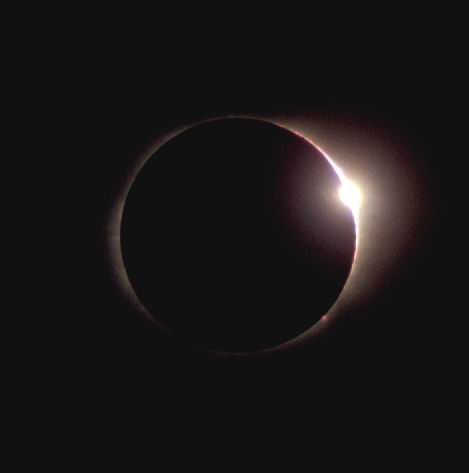
Diamond ring at the end of totality of the total solar eclipse July 10, 1972. Credit Bob Moler.
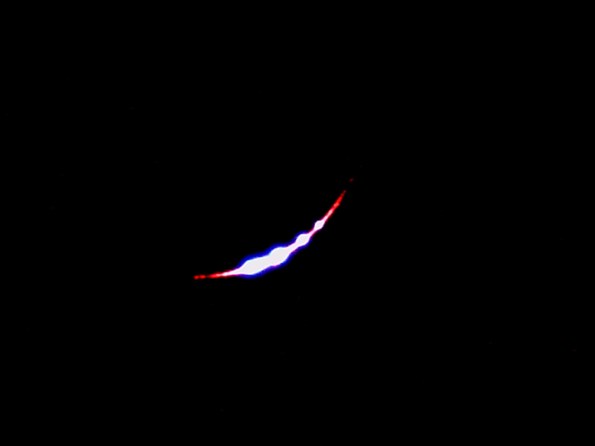
Baily’s Beads at the end of totality of the March 7, 1970 total solar eclipse from Bladenboro, NC. Credit: Bob Moler.
03/07/2016 – Ephemeris – Jupiter officially becomes an evening planet tomorrow, celebrating with a double transit of its moons.
Ephemeris for Monday, March 7th. The Sun will rise at 7:08. It’ll be up for 11 hours and 30 minutes, setting at 6:39. The Moon, 1 day before new, will rise at 6:49 tomorrow morning.
Tomorrow is a busy day astronomically speaking, Tomorrow night our time there will be a solar eclipse on the other side of the Earth that will be covered by NASA-TV. I’ll talk more about it tomorrow. However in the early morning hours Jupiter will reach opposition from the Sun tomorrow at 4:58 a.m. At opposition the Earth is placed almost directly between the Sun and Jupiter. It is the time the planet is closest to the Earth in its orbit. For Jupiter that distance will be 412 million miles (664 million km) away. It’s apparent diameter will be 44.5 seconds of arc. One second of arc is one 3,600th of a degree. The Moon and Sun are about a half a degree or 1800 seconds in diameter. Even so Jupiter appears as a tiny disk in binoculars, but a very tiny disc. A few of its 4 large Galilean moons can also be spotted in binoculars. Jupiter is over 11 times the Earth’s diameter and is twice as massive as all the other planets, asteroids and satellites combined.
Times are for the Traverse City/Interlochen area of Michigan. They may be different for your location.
Addendum
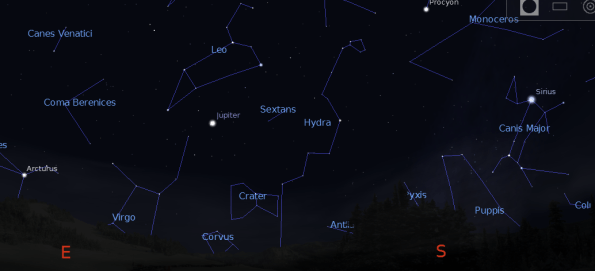
Jupiter at 10 p.m. March 8, 2016 with some of the spring constellations and Canis Major. Created using Stellarium.
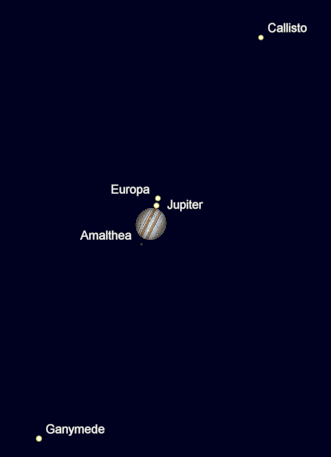
Jupiter and its moons at 10 p.m. March 7, 2016. Created using Cartes du Ciel (Sky Charts).
Io and Europa and their shadows transit the face of Jupiter
This evening there will be two satellites transiting across the face of Jupiter at the same time: Europa and Io. The start of Europa’s transit won’t be seen locally, since Jupiter will rise at 6:30 p.m. Locally, because of Jupiter being low in the sky I wouldn’t expect to spot the transiting satellites or their shadows. However observers in Europe, whose Jupiter rising has a 5 hour head start on us, will be in perfect position. In any case this takes a very good telescope to see. The appearance of Europa and Io in and out of transit can easily be seen in any telescope. In the table below I give the timing of these events for both the Eastern time zone (us) and Universal Time for others. Note the transits start on the 7th of March and end on the 8th for Universal Time.
The shadows of the moons themselves will appear very close to the moons, and may be obscured by them because we are just hours from opposition, and looking at Jupiter from nearly in line with the Sun. That should be a challenge. Watch for pictures from astrophotographer’s Twitter, Instagram and Facebook sites.
Times for this table are from Project Pluto: http://www.projectpluto.com/jevent.htm.
| Event | Eastern Time Zone | Universal Time | ||
| Date | Time | Date | Time | |
| Europa Shadow Start* | 7 | 6:08 p.m. | 7 | 23:08 |
| Europa Transit Start* | 7 | 6:11 p.m. | 7 | 23:11 |
| Io Shadow Start | 7 | 7:27 p.m. | 8 | 00:27 |
| Io Transit Start | 7 | 7:28 p.m. | 8 | 00:28 |
| Europa Transit End | 7 | 8:56 p.m. | 8 | 01:56 |
| Europa Shadow End | 7 | 8:56 p.m. | 8 | 01:56 |
| Io Transit End | 7 | 9:42 p.m. | 8 | 02:42 |
| Io Transit End | 7 | 9:42 p.m. | 8 | 02:42 |
| * The Europa Shadow and Transit Start Events cannot be seen in Michigan because they will occur before Jupiter will rise. |
||||
02/04/2016 – Ephemeris – The Great Underwater Panther & Fun star contest tonight
Ephemeris for Friday, March 4th. The Sun will rise at 7:14. It’ll be up for 11 hours and 21 minutes, setting at 6:35. The Moon, 3 days past last quarter, will rise at 4:47 tomorrow morning.
The Anishnabek people of the Great Lakes Region, which includes the Odawa and Chippewa Indians have two constellations of winter that I know of. The first is The Winter Maker which uses many of Orion’s stars plus Procyon the Little Dog Star. It rises in the eastern skies in the evening as winter is beginning. The second is the Great Underwater Panther. Which uses the stars of Leo the lion’s backward question mark as its tail and the small knot of stars that are the head of hydra the water snake below Cancer as its head. I imagine this constellation was a warning to youngsters to keep off the thinning ice of spring, lest they fall in and be snatched by the great underwater panther that lives down there.
Times are for the Traverse City/Interlochen area of Michigan. They may be different for your location.
Addendum
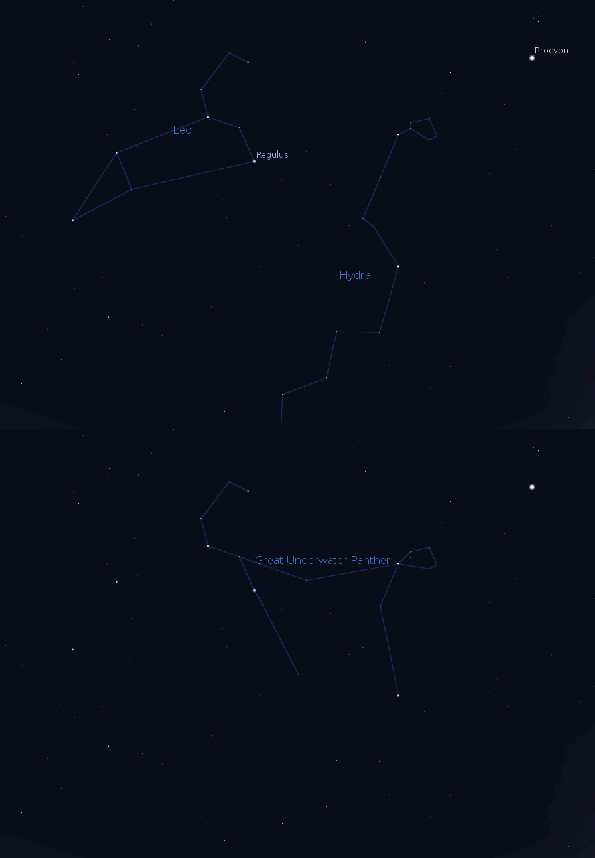
Alternately showing Leo and Hydra of our “Western” constellation and the Anishinabek constellation of the Great Underwater Panther. Created using Stellarium. The constellation drawing of the panther is mine after Michael Wassegijig Price.
Starpardy Tonight!
An astronomical quiz between the astronomy students and members of the Northwestern Michigan College Astronomy Club vs. the Grand Traverse Astronomical Society will be held tonight at 8 p.m. at the NMC Observatory. Folks attending can watch and learn or join one of the teams. The format is that of the popular Jeopardy show. These quizzes used to be called Star Bowls, after the old College Bowl TV shows. It’s been morphed into the Jeopardy format over the years, so this year I’m calling it Starpardy. And I can… I play Alex Trebek for this one, my second outing. Professor Jerry Dobek will be scorekeeper and arbiter of the Final Starpardy response, which will be open-ended this time. So come, enjoy the fun.
After the quiz there will be, weather permitting, a star party, and clear or not Becky Shaw will be by to continue her series on female astronomers of history and present day.
 Bob Moler's Ephemeris Blog