Archive
01/31/2017 – Ephemeris – Looking ahead at February 2017
Ephemeris for Tuesday, January 31st. The Sun will rise at 8:02. It’ll be up for 9 hours and 48 minutes, setting at 5:50. The Moon, 3 days before first quarter, will set at 10:06 this evening.
February is the shortest month, even so the daylight hours throughout the month will be getting longer. Daylight hours will increase from 9 hours and 50 minutes tomorrow to 11 hours and 7 minutes on the 28th. The sunrise time will decrease from 8:01 tomorrow to 7:21 at months end. The sunset times will increase from 5:51 tomorrow to 6:29 on the 28th. Along with that the altitude of the sun at noon will increase from 28.4 degrees today to 38.6 degrees at month’s end. It will be a degree lower for folks in the Straits area because they are a degree of latitude farther north. Local noon, by the way for Interlochen and Traverse City is about 12:55 p.m. On the evening of the 10th the Moon will enter the Earth’s outer shadow with an penumbral lunar eclipse. I’ll have more information on that then. Moon will be near the planets Mars and Venus in the southwestern sky early tonight.
Times are for the Traverse City/Interlochen area of Michigan. They may be different for your location.
Addenda
February Star Charts
Evening
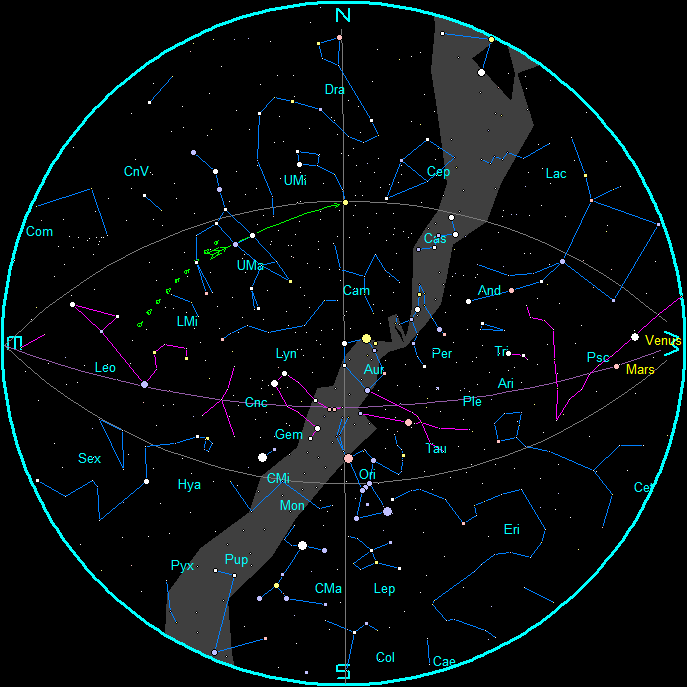
Star Chart for February 2017. Created using my LookingUp program. Click on image to enlarge.
Morning
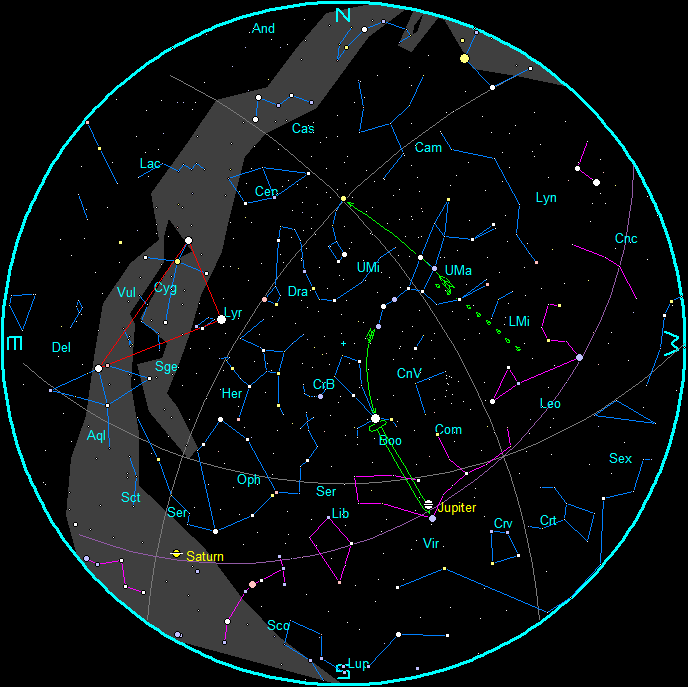
Star Chart for February 2017 mornings. Created using my LookingUp program. Click on image to enlarge.
The planets and stars are plotted for the 15th at 9 p.m. EST, and again at 6 a.m. Those are chart times. Note, Traverse City is located approximately 45 minutes behind our time meridian. (An hour 45 minutes behind our daylight saving time meridian. during EDT and 45 minutes behind our daylight standard time meridian. during EST). To duplicate the star positions on a planisphere you may have to set it to 1:45 or 0:45 earlier than the current time if you were near your time meridian.
Add a half hour to the chart time every week before the 15th and subtract a half hour for every week after the 15th.
For a list of constellation names to go with the abbreviations click here.
- Pointer stars at the front of the bowl of the Big Dipper point to Polaris the North Star
- Follow the arc of the handle of the Big Dipper to the star Arcturus, and
- Straighten to a spike to Spica
- The Summer Triangle is shown in red
Evening nautical twilight ends at 6:56 p.m. EST on the 1st, increasing to 7:31 p.m. EST on the 28th.
Evening astronomical twilight ends at 7:30 p.m. EST on the 1st, increasing to 8:05 p.m. EST on the 28th.
Morning astronomical twilight starts at 6:22 a.m. EST on the 1st, and increasing to 5:45 a.m. EST on the 28th.
Morning nautical twilight starts at 6:56 a.m. EST on the 1st, and Increasing to 6:19 a.m. EST on the 28th.
NASA Calendar of Planetary Events
Credit: Sky Events Calendar by Fred Espenak and Sumit Dutta (NASA’s GSFC)
To generate your own calendar go to http://eclipse.gsfc.nasa.gov/SKYCAL/SKYCAL.html
Times are Eastern Time and follow the time change dates.
Date        Time    Event
Feb 01  We          Venus: 45.5° E
    02  Th  5:11 am Venus-Mars: 5.4° N
    03  Fr 11:19 pm First Quarter
    05  Su  4:14 pm Moon-Aldebaran: 0.2° S
    06  Mo  8:59 am Moon Perigee: 368800 km
    07  Tu  1:34 pm Moon North Dec.: 18.9° N
    10  Fr  7:33 pm Full Moon
    10  Fr  7:45 pm Penumbral Lunar Eclipse
    11  Sa  9:04 am Moon-Regulus: 0.8° N
    11  Sa  2:49 pm Moon Ascending Node
    15  We  9:55 am Moon-Jupiter: 2.9° S
    18  Sa  2:33 pm Last Quarter
    18  Sa  4:14 pm Moon Apogee: 404400 km
    20  Mo  6:44 pm Moon-Saturn: 3.9° S
    21  Tu  3:50 pm Moon South Dec.: 18.8° S
    26  Su  1:28 pm Moon Descending Node
    26  Su  9:54 am Annular Solar Eclipse - South Atlantic
    26  Su  9:58 am New Moon
Mar 01  We          Venus: 32.5° E
February 2017 Calendar
LU             Ephemeris of Sky Events for Interlochen/TC
February, 2017    Local time zone: EST
+-----------------------------------------------------------------------+
| DATE |  SUN     SUN  DAYLIGHT|   TWILIGHT*    |MOON  RISE OR    ILLUM |
|      |  RISE    SET    HOURS |  END    START  |PHASE SET** TIME FRACTN|
+=======================================================================+
|Wed  1| 08:01a  05:51p  09:50 | 06:57p  06:55a |      Set  11:15p   26%|
|Thu  2| 08:00a  05:53p  09:52 | 06:59p  06:54a |      Set  12:25a   37%|
|Fri  3| 07:59a  05:54p  09:55 | 07:00p  06:53a |F Qtr Set  01:35a   48%|
|Sat  4| 07:57a  05:56p  09:58 | 07:01p  06:52a |      Set  02:45a   59%|
+------+-----------------------+----------------+-----------------------+
|Sun  5| 07:56a  05:57p  10:00 | 07:03p  06:51a |      Set  03:53a   70%|
|Mon  6| 07:55a  05:58p  10:03 | 07:04p  06:50a |      Set  04:56a   80%|
|Tue  7| 07:54a  06:00p  10:06 | 07:05p  06:48a |      Set  05:54a   89%|
|Wed  8| 07:52a  06:01p  10:09 | 07:06p  06:47a |      Set  06:45a   95%|
|Thu  9| 07:51a  06:03p  10:11 | 07:08p  06:46a |      Set  07:28a   99%|
|Fri 10| 07:50a  06:04p  10:14 | 07:09p  06:45a |Full  Rise 05:59p  100%|
|Sat 11| 07:48a  06:06p  10:17 | 07:10p  06:43a |      Rise 07:06p   99%|
+------+-----------------------+----------------+-----------------------+
|Sun 12| 07:47a  06:07p  10:20 | 07:12p  06:42a |      Rise 08:12p   96%|
|Mon 13| 07:45a  06:08p  10:23 | 07:13p  06:41a |      Rise 09:16p   90%|
|Tue 14| 07:44a  06:10p  10:26 | 07:14p  06:39a |      Rise 10:18p   84%|
|Wed 15| 07:42a  06:11p  10:28 | 07:15p  06:38a |      Rise 11:18p   76%|
|Thu 16| 07:41a  06:13p  10:31 | 07:17p  06:37a |      Rise 12:18a   67%|
|Fri 17| 07:39a  06:14p  10:34 | 07:18p  06:35a |      Rise 01:16a   58%|
|Sat 18| 07:38a  06:15p  10:37 | 07:19p  06:34a |L Qtr Rise 02:12a   48%|
+------+-----------------------+----------------+-----------------------+
|Sun 19| 07:36a  06:17p  10:40 | 07:21p  06:32a |      Rise 03:07a   39%|
|Mon 20| 07:34a  06:18p  10:43 | 07:22p  06:31a |      Rise 03:59a   30%|
|Tue 21| 07:33a  06:20p  10:46 | 07:23p  06:29a |      Rise 04:49a   21%|
|Wed 22| 07:31a  06:21p  10:49 | 07:25p  06:28a |      Rise 05:34a   14%|
|Thu 23| 07:30a  06:22p  10:52 | 07:26p  06:26a |      Rise 06:16a    8%|
|Fri 24| 07:28a  06:24p  10:55 | 07:27p  06:25a |      Rise 06:54a    3%|
|Sat 25| 07:26a  06:25p  10:58 | 07:28p  06:23a |      Rise 07:29a    0%|
+------+-----------------------+----------------+-----------------------+
|Sun 26| 07:25a  06:26p  11:01 | 07:30p  06:21a |New   Set  06:43p    0%|
|Mon 27| 07:23a  06:28p  11:04 | 07:31p  06:20a |      Set  07:53p    2%|
|Tue 28| 07:21a  06:29p  11:07 | 07:32p  06:18a |      Set  09:03p    7%|
+-----------------------------------------------------------------------+
* Nautical Twilight
** Moonrise or moonset, whichever occurs between sunset and sunrise
Penumbral Lunar Eclipse February 10/11, 2016
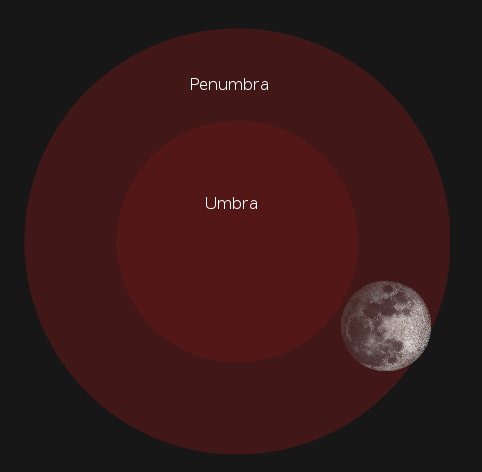
The moment of mid-eclipse at 7:45 p.m. February 10, 2016 EST (0:45 UT February 11). The Moon is traveling from upper right to lower left. Orientation is alt-az for northern Michigan. Created using Cartes du Ciel (Sky Charts).
In the early evening hours of February 10th the Moon will pass through the Earth’s outer or penumbral shadow. It will not get particularly dark since the Moon will still be somewhat illuminated by the Sun.
Anything shows two types of shadows in the sunlight. Your shadow appears fuzzy. That fuzziness is your penumbra, where the sunlight is only partially blocked. The dark inner part of your shadow is your umbra.
The eclipse starts at 5:34 p.m. (22:34 UT) at which time you will see nothing out of thee ordinary. Since the Moon is entering the shadow at a shallow angle it will take 2 hours and 11 minutes to reach the maximum eclipse. I’m guessing here, but one will probably not notice anything before 7 p.m. (0:00 UT) To help see the effect better, put on sunglasses. They will reduce the Moon’s glare to help see the darkening effect. Officially the eclipse will end at 9:53 p.m. (2:53 UT the 11th)
Binocular Comet 45P/Honda-Mrkos-Pajdusakova
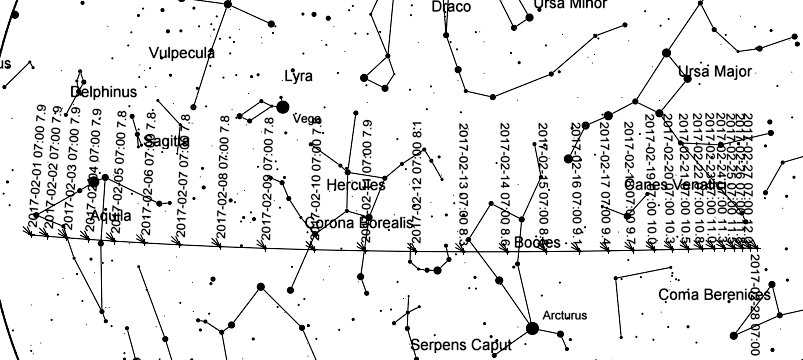
Comet 45P’s track for February. The comet is expected to be about a magnitude brighter than displayed (7th magnitude). Created using Cartes du Ciel (Sky Charts).
In the chart above the comet’s position is marked by a comet symbol. The comet’s tail, if visible at all, will actually point to the right along its track. The data for this chart is taken from Seiichi Yoshida’s Weekly Information about Bright Comets: http://www.aerith.net/comet/weekly/current.html
01/30/2017 – Ephemeris – Can you really see a unicorn?
Ephemeris for Monday, January 30th. The Sun will rise at 8:03. It’ll be up for 9 hours and 45 minutes, setting at 5:49. The Moon, 3 days past new, will set at 8:58 this evening.
Among all the constellations in the sky of animals real and mythical, there is also a unicorn. It’s called Monoceros, and inhabits the southern sky at 9 p.m. bounded by Orion on the right, Canis Major, the great dog below and Canis Minor, the little dog to the left. Unfortunately for observers without optical aid Monoceros, though large, is devoid of any but the faintest stars. Maybe that’s why no one sees unicorns anymore. It has many faint stars because the Milky Way runs through it. To the telescope it is a feast of faint nebulae or clouds of gas and dust, the birth place of stars, including the red rose of the Rosette Nebula, and the strange and tiny Hubble’s Variable Nebula. It contains no bright stars, but a wealth of wonders below naked eye visibility.
Times are for the Traverse City/Interlochen area of Michigan. They may be different for your location.
Addendum
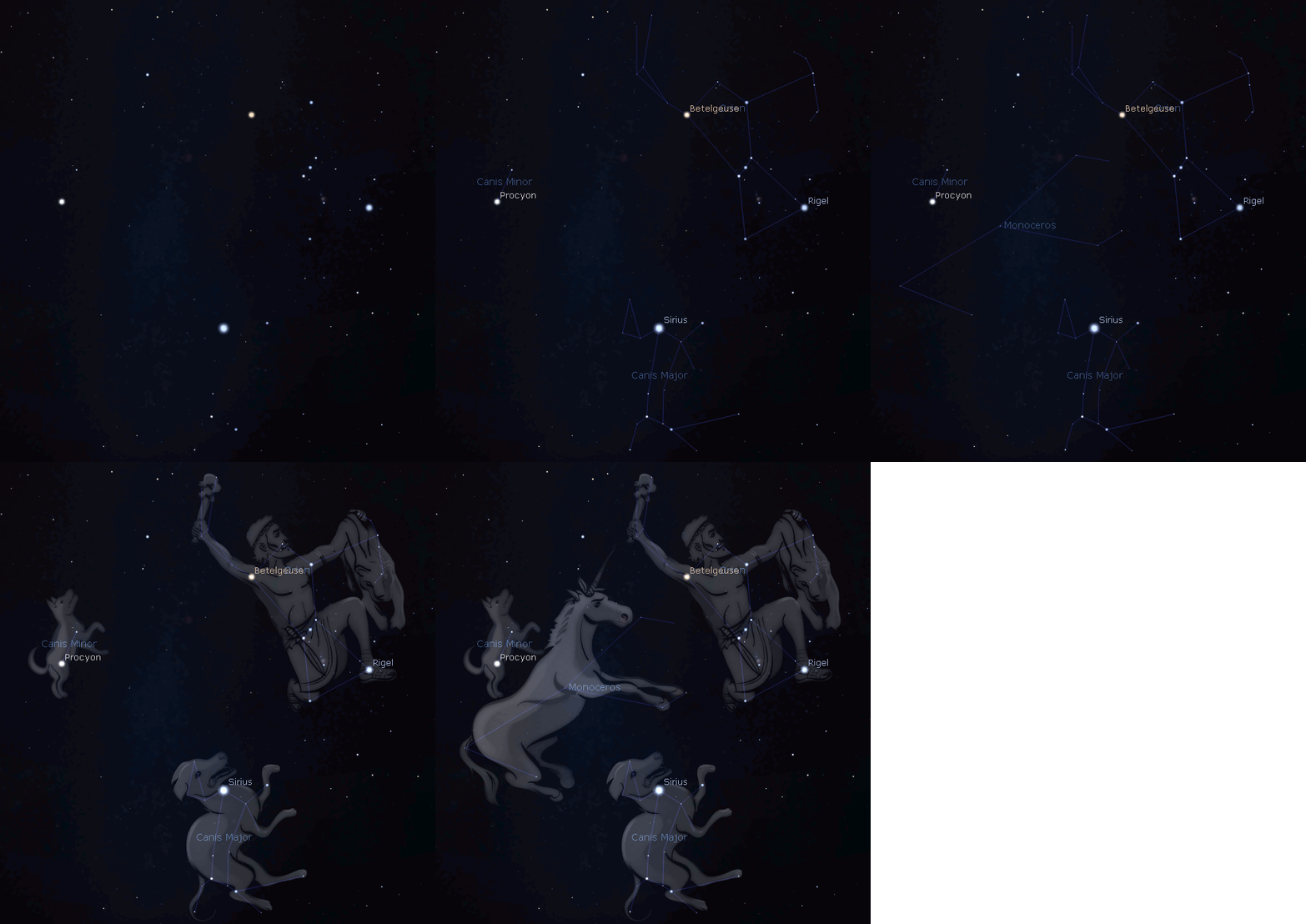
Monoceros finder chart animation. Created using Stellarium and GIMP.
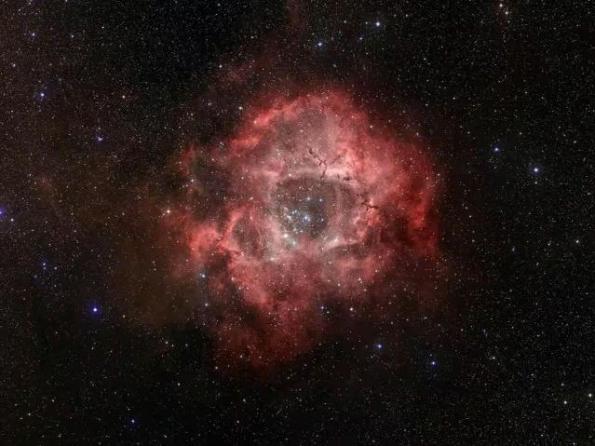
Rosette Nebula in the infrared from the Spitzer Space Telescope. Credit: NASA/JPL/Caltech.
I’ve never seen it visually through a telescope. However the inner star cluster, NGC 2244 is visible. The nebula is NGC 2239.
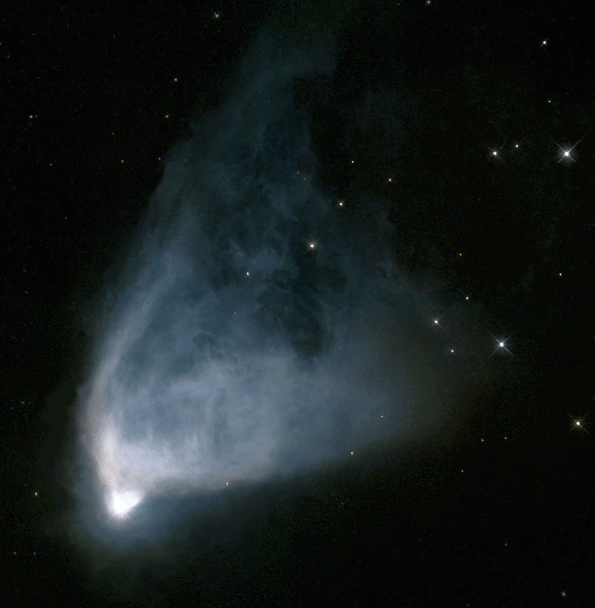
Hubble’s Variable Nebula NGC 2261 photographed appropriately enough by the Hubble Space Telescope. Credit: NASA/ESA and The Hubble Heritage Team (AURA/STScI).

Another nebula: The Cone Nebula, NGC 2264, as seen with the Hubble Space Telescope. Kind of looks like eggs in an eagle’s nest Credit ESA/Hubble.
The mentioned NGC objects can be found with a good star atlas or the free program Cartes du Ciel via the link on the right.
01/27/2017 – Ephemeris – The celestial twins
Ephemeris for Friday, January 27th. The Sun will rise at 8:06. It’ll be up for 9 hours and 38 minutes, setting at 5:44. The Moon is new today, and won’t be visible.
The constellation Gemini, the Twins is visible high in the southeast at 9 p.m. The namesake stars of the two lads, will be high on the upper left edge of the constellation, nearly vertically aligned. Castor is above, while Pollux, a slightly brighter star is below it. Lines of stars from Castor and Pollux to the lower right delineate the lads. In Greek mythology Castor and Pollux were twins, and half brothers, Castor was fathered by a mere mortal, while Pollux was fathered by Zeus in the famous Leda and the swan affair. The brothers, however were inseparable, and when Castor was killed during the quest for the Golden Fleece, Pollux pleaded with Zeus to let him die also. Zeus granted his wish, so both appear in the sky together forever.
Times are for the Traverse City/Interlochen area of Michigan. They may be different for your location.
Addendum
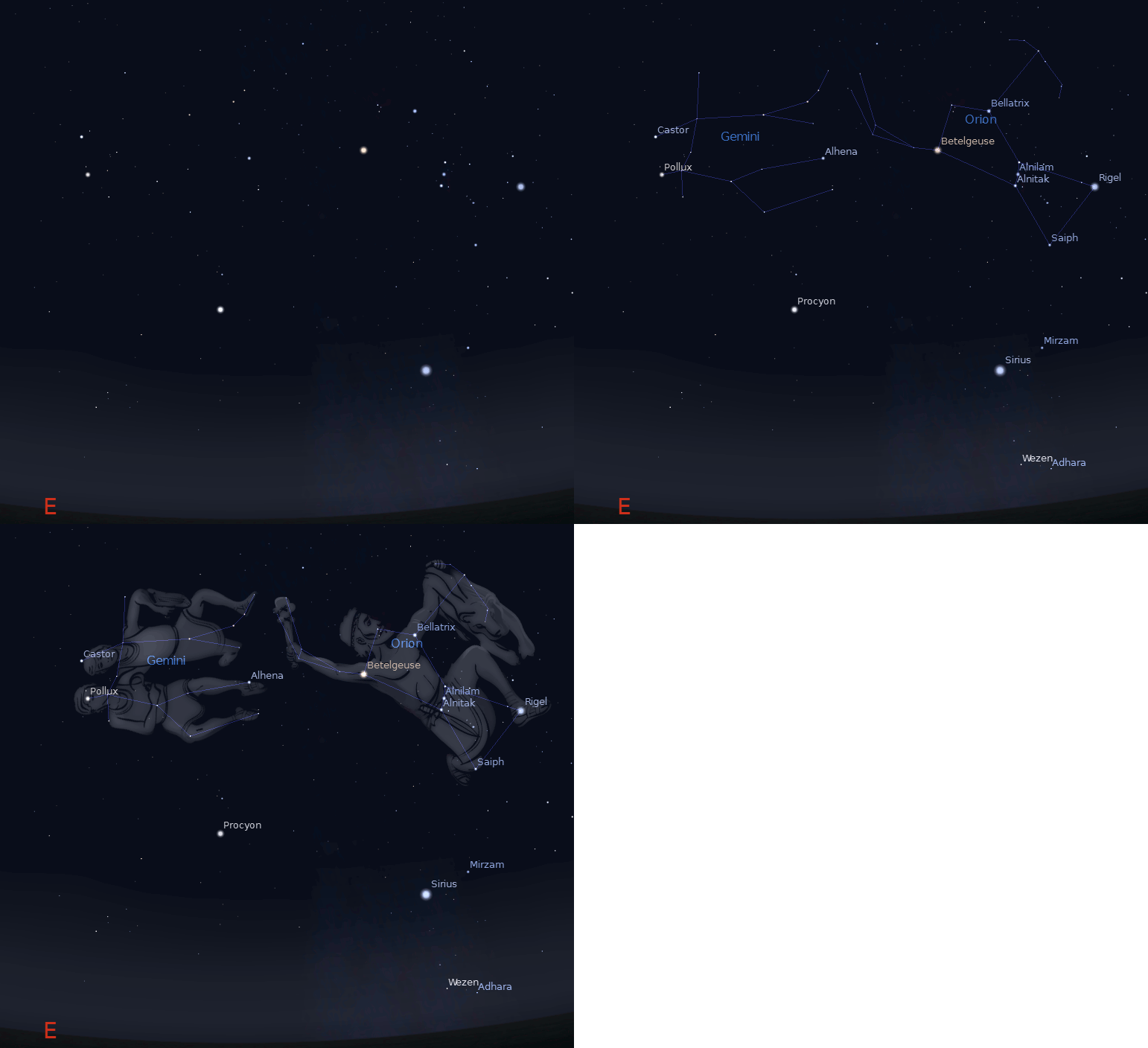
Gemini revealed by animation. Created using Stellarium and GIMP.
01/26/2017 – Ephemeris – Is it a dachshund or a hot dog?
Ephemeris for Thursday, January 26th. The Sun will rise at 8:07. It’ll be up for 9 hours and 36 minutes, setting at 5:43. The Moon, 1 day before new, will rise at 7:40 tomorrow morning.
The constellation Orion has two hunting dogs. We’ve seen Canis Major the greater dog at Orion’s feet with Sirius in its heart. The lesser dog, Canis Minor is level with Betelgeuse in Orion’s shoulder and off to the left. Just two stars mark it. Is it a dachshund or is it a hot dog? You decide. It’s brighter star’s name is Procyon which means “Before the dog”, an odd title. It means that though east of Sirius, it rises before Sirius, due to its more northerly position in the sky. In many ways Procyon is nearly a twin of Sirius. It shines with the same white color, although a bit cooler, and has a white dwarf companion like Sirius. It’s a bit farther away than Sirius’ 8 light years. Procyon is 11 and a half light years away. Procyon, Betelgeuse and Sirius make the winter triangle.
Times are for the Traverse City/Interlochen area of Michigan. They may be different for your location.
Addendum
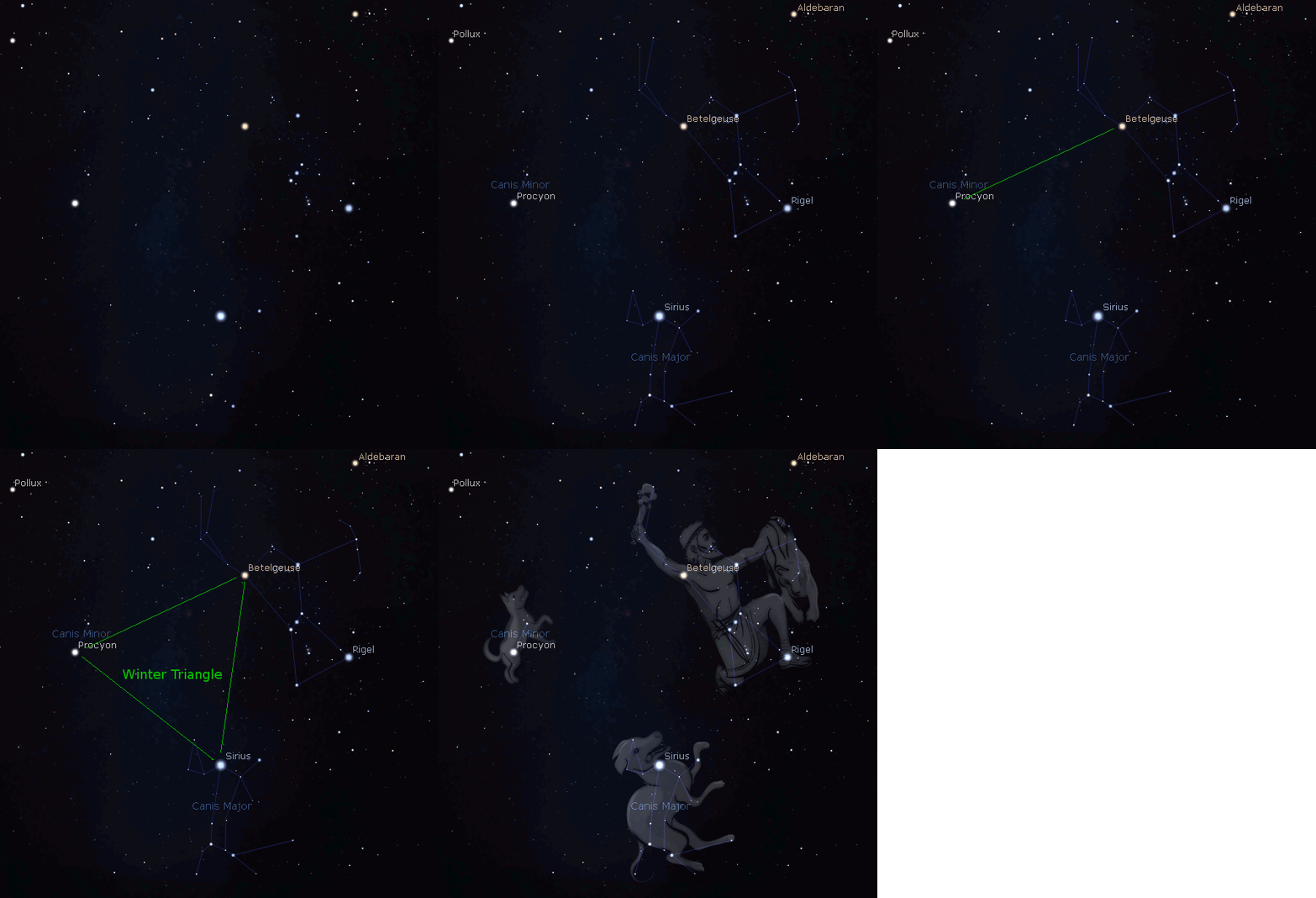
Procyon and Orion’s hunting dogs animation also showing the Winter Triangle asterism*. Created using Stellarium and GIMP.
* Asterism – an informal constellation like the Big Dipper, the Northern Cross, or the Summer Triangle. Not one of the 88 official constellations.
01/25/2017 – Ephemeris – Two planets on the morning and two in the evening
Ephemeris for Wednesday, January 25th. The Sun will rise at 8:08. It’ll be up for 9 hours and 33 minutes, setting at 5:42. The Moon, 2 days before new, will rise at 6:56 tomorrow morning.
Let’s check out the bright planets for this week. Saturn can be glimpsed this morning at 7 a.m. It will rise tomorrow at 5:25 in the east-southeast. Jupiter can be seen in the south-southwest this morning above the star Spica in Virgo. Jupiter will rise tomorrow at 12:14 a.m. Venus and Mars are in the evening sky. At 6:30 p.m. these planets will be seen in the southwestern sky. Venus is unmistakable as the brilliant evening star, Mars will be above and left of it and much dimmer and will set at 10:14. Venus itself will set at 9:47 p.m. Venus exhibits a dazzling fat crescent in small telescopes now, but a month from now as it gets closer to Earth the thinning crescent will be big enough to be seen in binoculars.
Times are for the Traverse City/Interlochen area of Michigan. They may be different for your location.
Addendum
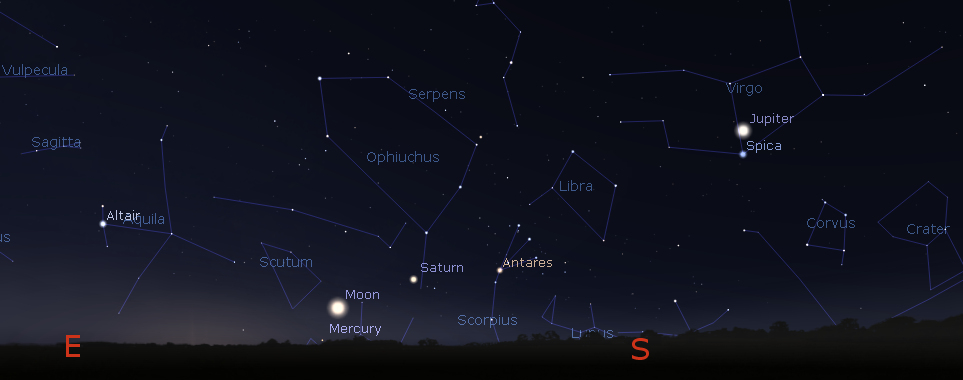
Jupiter in the south above the star Spica with Saturn and Mercury peeking over the horizon in the southeast at 7 a.m. this morning, January 25, 2017. The Moon shows as a big blob when it’s really a very thin crescent. Click on image to enlarge. Created using Stellarium.
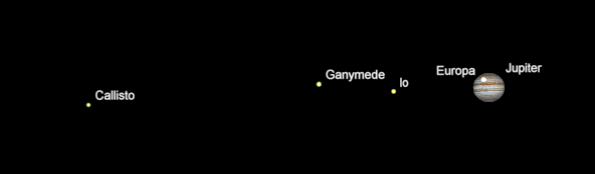
Jupiter and its moons as they might be seen in a telescope at 7 a.m. this morning January 25, 2016. Though Europa is transiting the face of Jupiter it will not really be visible against the face of Jupiter. Created using Cartes du Ciel (Sky Charts).
Jupiter satellite events for 2017 can be fund here: http://www.projectpluto.com/jevent.htm.
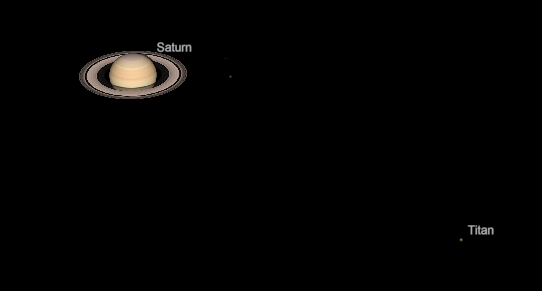
Saturn and its moon Titan as they might be seen in a telescope at 7 a.m. this morning, January 25, 2016. Created using Cartes du Ciel (Sky Charts).
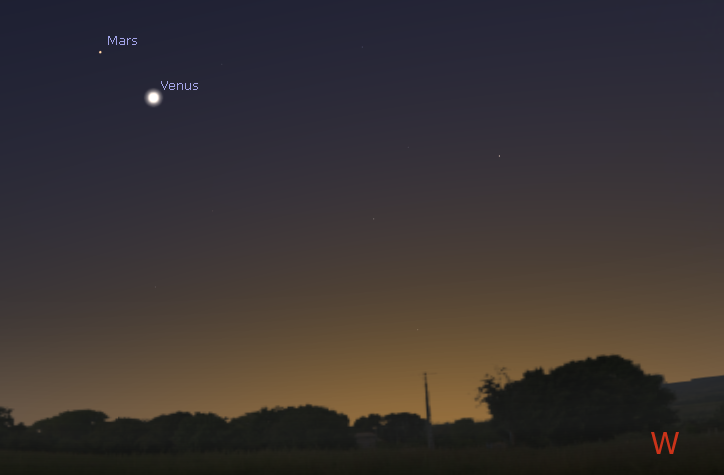
Venus, and Mars in the evening twilight of about 50 minutes after sunset. 6:30 p.m. January 25, 2017. Click on image to enlarge. Created using Stellarium.
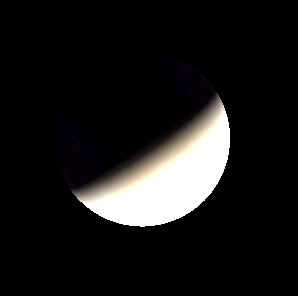
Venus as it might appear in a telescope tonight January 25, 2016. I processed the image to overexpose it as it would appear in a telescope. Created using Stellarium.
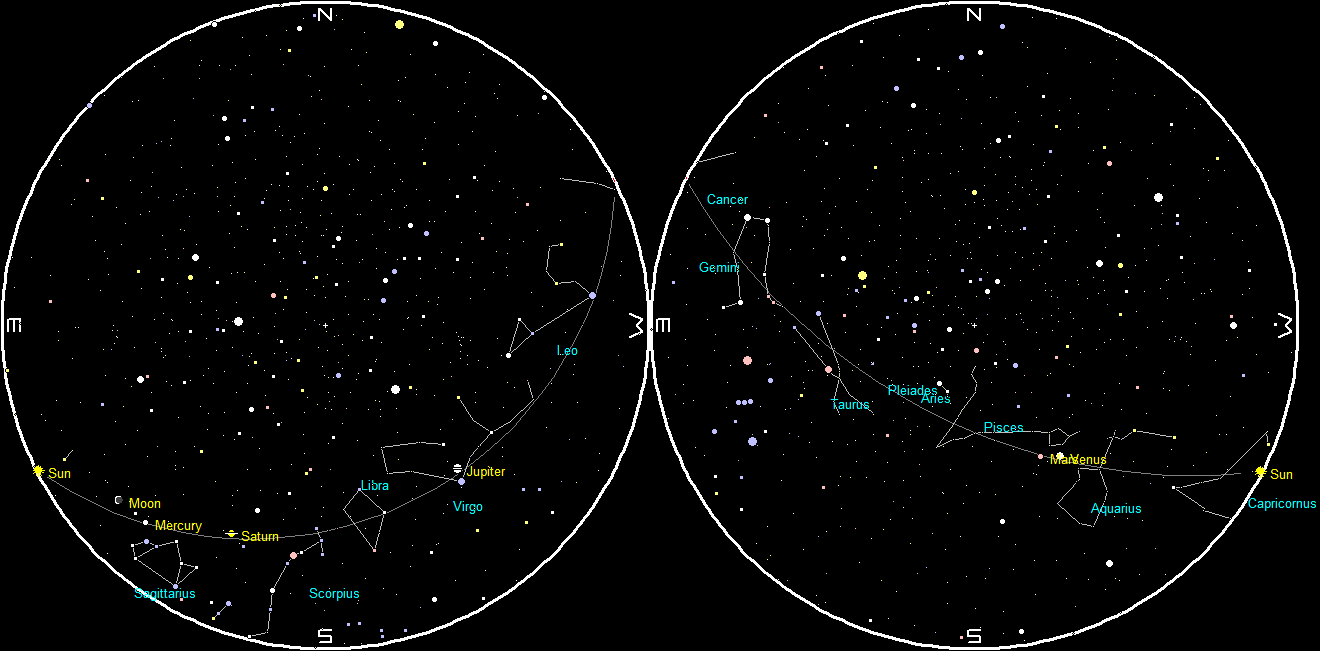
Planets and Moon at sunset and sunrise of a single night starting with sunset on the right on January 25, 2017. The night ends on the left with sunrise on January 26. Click on image to enlarge. Created using my LookingUp program.
01/24/2017 – Ephemeris – The Moon is near Saturn this morning
Ephemeris for Tuesday, January 24th. The Sun will rise at 8:09. It’ll be up for 9 hours and 31 minutes, setting at 5:40. The Moon, 3 days before new, will rise at 6:08 tomorrow morning.
This morning look low in the southeast to see the thin crescent Moon with the planet Saturn below and to the right. The Moon passed Saturn a little after they rose. Saturn is quite far south in our skies, almost as far south as the Sun was on the winter solstice on December 21st. It will take a while to rise high enough in deep twilight or darkness for good views with a telescope. When Saturn or any planet is low on the horizon we are looking at it through a lot of our atmosphere. Beside draining about half its brightness that atmospheric motions make the planet fuzzy in telescopes. Yes, you can still see the rings, but the gaps on each end between the rings and the planet may not be distinct, and its large moon Titan may not be visible at all.
Times are for the Traverse City/Interlochen area of Michigan. They may be different for your location.
Addendum
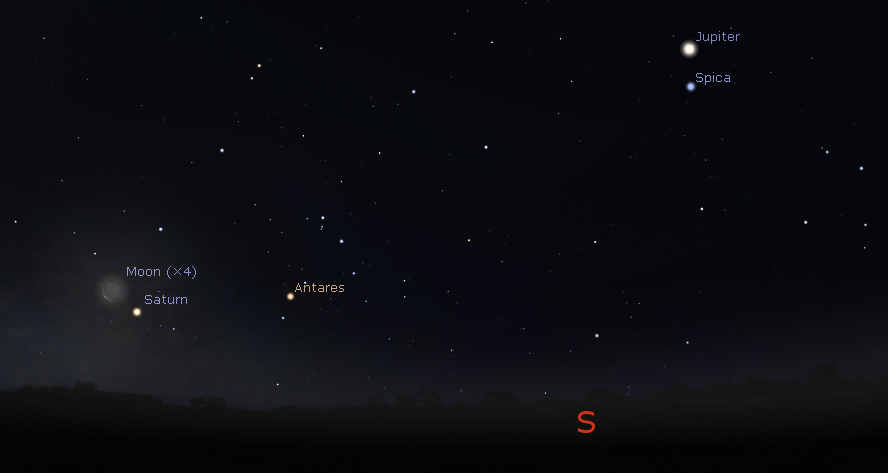
The morning planets and the Moon at 7 a.m. this morning, January 24th. Because planetarium programs don’t show a thin crescent very well, I’ve enlarged the Moon by a factor of 4 times to make the Moon show up at all. Click on the image to enlarge. Created using Stellarium.
01/23/2017 – Ephemeris – The rabbit that got away
Ephemeris for Monday, January 23rd. The Sun will rise at 8:10. It’ll be up for 9 hours and 29 minutes, setting at 5:39. The Moon, half way from last quarter to new, will rise at 5:17 tomorrow morning.
Orion, the central winter constellation is seen in the south-southeast at 9 p.m. He is a hunter, but is preoccupied in defending himself from the charge of Taurus the bull to the upper right. At Orion’s feet, and unnoticed by him is the small constellation of Lepus the hare. It’s very hard to see a whole rabbit in its eight dim stars: however, I do see a rabbit’s head, ears and shoulders. A misshapen box is the head and face of this critter facing to the left. His ears extend upwards from the upper right star of the box, and the bend forward a bit. Two stars to the right of the box and a bit farther apart show the front part of the body. The free computer program at Stellarium.org shows a whole rabbit facing the opposite direction.
Times are for the Traverse City/Interlochen area of Michigan. They may be different for your location.
Addendum

An animation showing the stars, constellations and artwork of Lepus, Orion and Taurus. Created using Stellarium and GIMP.
01/20/2017 – Ephemeris – Orion’s greater hunting dog
Ephemeris for Friday, January 20th. The Sun will rise at 8:12. It’ll be up for 9 hours and 22 minutes, setting at 5:35. The Moon, 1 day past last quarter, will rise at 2:29 tomorrow morning.
The great winter constellation or star group Orion the Hunter, is located in the south-southeastern sky at 9 p.m. His elongated rectangle of a torso is almost vertical. In the center of the rectangle are three stars in a line that make his belt. As a hunter, especially one of old, he has two hunting dogs. The larger, Canis Major can be found by following the three belt stars of Orion down and to the left. There lies the brilliant star called Sirius, also known as the Dog Star. It’s in the heart of a stick figure dog low in the southeast facing Orion that appears to be begging. I’ll have more to say about Sirius in the future, but there’s a fine star cluster, called M41, at the 5 o’clock position from Sirius easily visible in binoculars or a small telescope.
Times are for the Traverse City/Interlochen area of Michigan. They may be different for your location.
Addendum
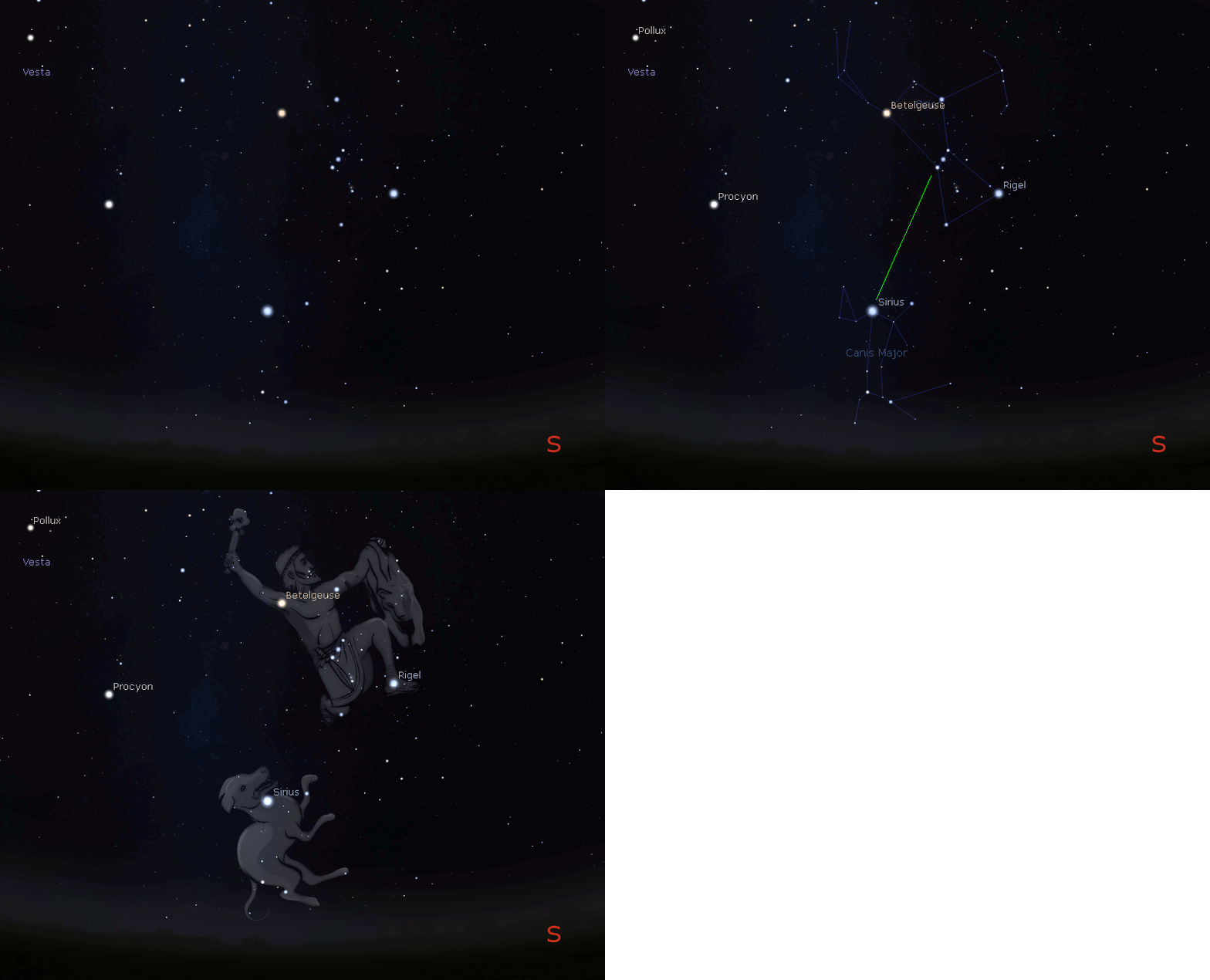
Orion and Canis Major Animation for 9 p.m. January 20, 2017. Click on image to enlarge. Created using Stellarium and GIMP.
01/19/2017 – Ephemeris – Tonight bring the kids, it’s Greenspire School’s STEM Night.
Ephemeris for Thursday, January 19th. The Sun will rise at 8:13. It’ll be up for 9 hours and 20 minutes, setting at 5:33. The Moon, at last quarter today, will rise at 1:31 tomorrow morning.
Tonight the Greenspire School is sponsoring its annual STEM Night from 5:30 to 7:30 p.m. at the school on Red Drive at the Grand Traverse Commons. Red Drive is a block west of Silver Drive that connects to Silver Lake Road at Franke Road. STEM is an acronym for Science, Technology, Engineering and Math. The Grand Traverse Astronomical Society will be there for the fourth year with yours truly finding out what comets are made of by helping the kids create dry ice comets. We’ll have other exhibits too. If it happens to be clear there will be viewing of the planet Venus and other wonders of the sky. Plus there will be fun things to give away. There’s also cookies and hot chocolate.
Times are for the Traverse City/Interlochen area of Michigan. They may be different for your location.
Addendum

01/18/2017 – Ephemeris – Where are the bright planets this week?
Ephemeris for Wednesday, January 18th. The Sun will rise at 8:13. It’ll be up for 9 hours and 18 minutes, setting at 5:32. The Moon, 1 day before last quarter, will rise at 12:32 tomorrow morning.
Let’s check out the bright planets for this week. Saturn can be glimpsed this morning at 7 a.m. It will rise tomorrow at 5:49 in the east-southeast. Jupiter can be seen in the south-southwest this morning above the star Spica in Virgo. Jupiter will rise tomorrow at 12:40 a.m. Tomorrow the last quarter Moon will appear near Jupiter. Venus and Mars are in the evening sky. At 6:30 p.m. these planets will be seen in the southwestern sky. Venus is unmistakable as the brilliant evening star, Mars will be above and left of it and much dimmer and will set at 10:14. Venus itself will set at 9:39 p.m. Venus exhibits a fat crescent in small telescopes now, but next month as it gets closer the thinning crescent will be big enough to be seen in binoculars.
Times are for the Traverse City/Interlochen area of Michigan. They may be different for your location.
Addendum
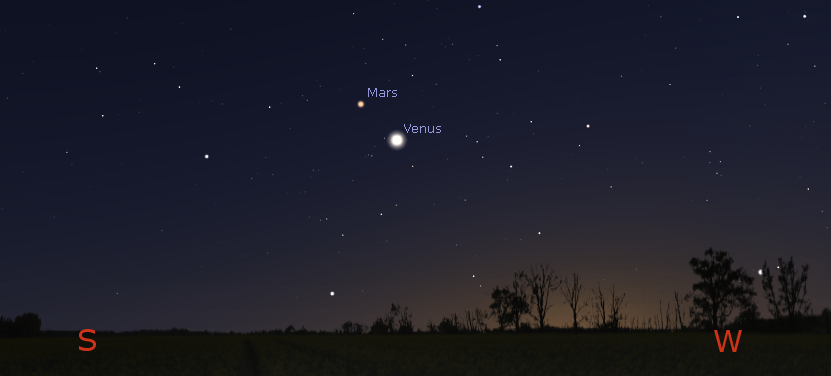
Venus, and Mars in the evening twilight of about an hour after sunset. 6:30 p.m. January 18, 2017. Created using Stellarium. Click image to enlarge.
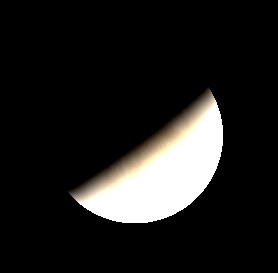
Venus as it might appear in a telescope tonight January 18, 2016. I processed the image to overexpose it as it would appear in a telescope. Created using Stellarium.
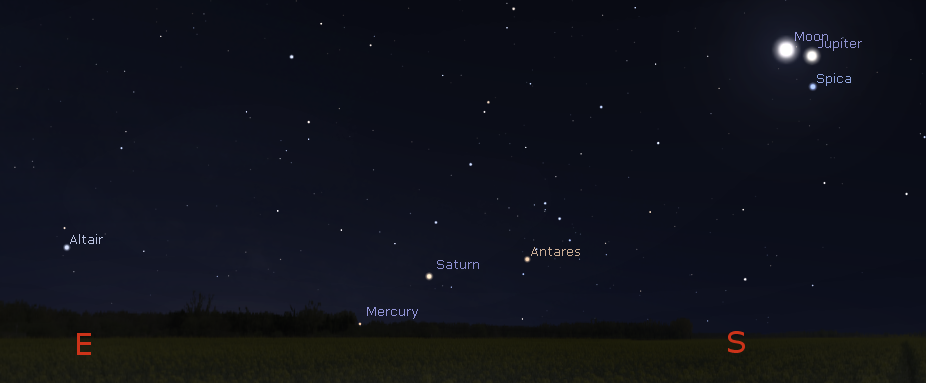
The Moon and Jupiter in the south above the star Spica with Saturn and Mercury peeking over the horizon in the southeast at 7 a.m. tomorrow morning, January 19, 2017. Created using Stellarium. Click image to enlarge.
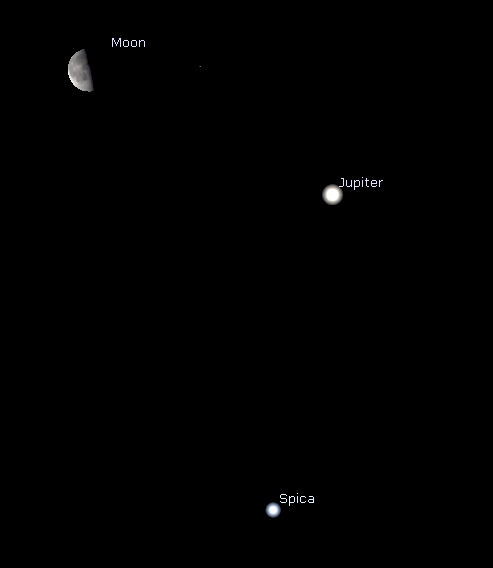
The Moon, Jupiter, and the star Spica tomorrow at 7 a.m., January 19, 2017. Created using Stellarium.
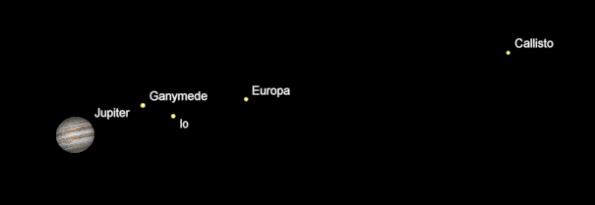
Jupiter and its moons tomorrow morning at 7 a.m., January 19, 2017. Created using Stellarium.
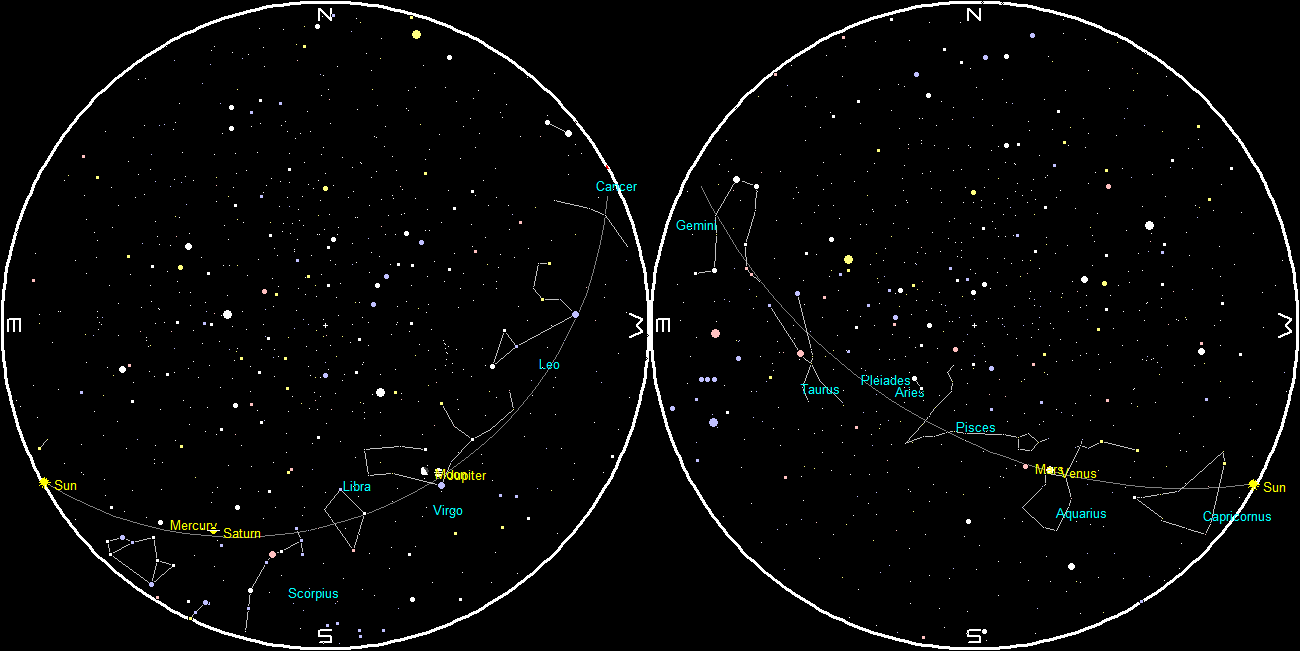
Planets and Moon at sunset and sunrise of a single night starting with sunset on the right on January 18, 2017. The night ends on the left with sunrise on January 19. Click on image to enlarge. Created using my LookingUp program.
In Memorium
Yesterday we lost the 11th man to set foot on the Moon and the last one to leave it. Eugene Cernan, the commander of Apollo 17 hated the title of “The last man to walk on the Moon”, and hoped before he died that another would walk on the Moon, lifting that title from his shoulders. Of the 12 men who walked on the Moon, half are now gone. The way things are going the next person to walk on the Moon will probably be Chinese. Godspeed Eugene Cernan.
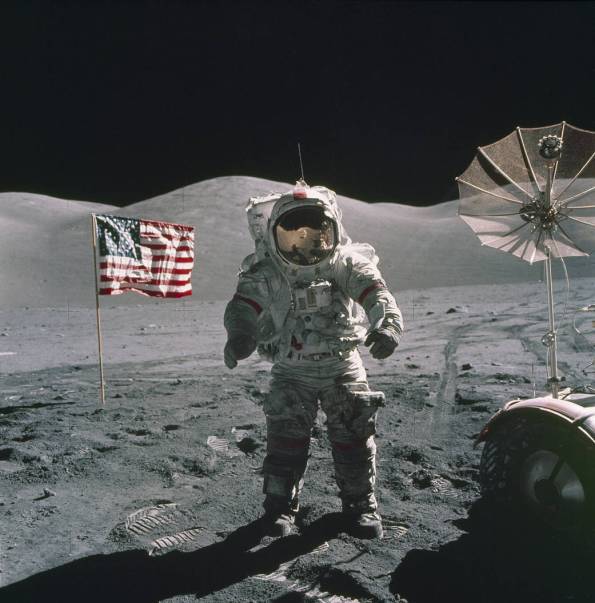
Eugene Cernan with the American Flag and the lunar rover. Credit: NASA/Harrison Schmitt

The first and last men on the Moon. Neil Armstrong, left and Eugene Cernan. File photo.
 Bob Moler's Ephemeris Blog